
Finding Comfort at Home: Your 2026 Guide to Palliative Care in Monterey
Living with a serious illness often brings a desire for comfort and a sense of control. For the 75% of adults over 50 who want to age in their own homes, finding medical support that honors these wishes is key. If you're asking, "Where can I find palliative care in Monterey that supports aging at home?", you are taking a vital step.
This type of care focuses on relief from the symptoms and stress of a serious illness. It can be provided right alongside treatments meant to cure you.
This guide is your direct resource for palliative care options across the Central Coast. Many families don't know this support is available at home, often covered by insurance. This guide will help you find the right fit for your family.
Why Palliative Care at Home Matters Now
There has been a big shift in how people want to receive care. Most older adults prefer to stay in their homes. At the same time, nearly 95% of people over 60 live with at least one chronic condition.
This means more families in Monterey County need palliative care that comes to them. For families facing a serious diagnosis like cancer, heart failure, or COPD, the search for support often begins with a desire to avoid repeat hospital visits. They want symptom relief and emotional support at home.
Many people mistakenly think palliative care is only for hospitals or that it means stopping treatment. This is not true. Delaying this type of support can lead to unmanaged pain and stress for both patients and their families.
The Solution: A Team That Comes to You
Central Coast VNA & Hospice is a nonprofit healthcare provider with over 74 years of local service. We offer in-home palliative care throughout Monterey County, San Benito County, Santa Cruz County, and South Santa Clara County.
Our team works with your doctor to manage symptoms and plan care right in your home. This team includes Registered Nurses, therapists, medical social workers, and chaplains. Getting this support early improves comfort and helps families feel more confident.

1. Central Coast VNA & Hospice
For families searching for palliative care in Monterey, Central Coast VNA & Hospice (CCVNA) is a cornerstone of community-based support. With a legacy of over 74 years, this nonprofit organization delivers a full continuum of care directly to a patient's home. Their mission-driven approach puts patient needs first.
Unlike hospital programs, CCVNA brings a dedicated team to you. This team includes Registered Nurses, therapists, and medical social workers who work with your own doctor. They help manage difficult symptoms from illnesses like COPD or cancer, so you can live better while continuing treatment.
Why It Stands Out: A Mission-Driven Continuum of Care
CCVNA’s strength is its nonprofit status and "Care at Every Stage" philosophy. All revenue is reinvested into patient services and community programs. This means care is guided by what's best for the patient, not a financial goal.
This approach creates a smooth path for patients as their needs change. It can go from home health for recovery, to palliative care for symptom relief, and finally to hospice if needed. Families build trust with one familiar team.
Practical Use and Access
Getting started is simple. A phone call to their local admissions team can clarify services and insurance coverage.
- Palliative Care Inquiries: Call 831-372-6668 to speak with the home health team.
- Cost and Coverage: Palliative care is often covered by Medicare and other insurance plans. The admissions team helps you understand your specific coverage.
- Service Area: CCVNA serves Monterey, San Benito, Santa Cruz, and South Santa Clara counties.
The website also has helpful resources. For families trying to understand different care types, CCVNA clearly explains the difference between palliative and hospice care.
Strengths and Limitations
Pros:
- Mission-Driven Focus: As a nonprofit, its priority is patient well-being, not profit.
- Comprehensive Care Model: The "Care at Every Stage" continuum offers stability as health needs change.
- Deep Local Roots: With 74+ years of service, CCVNA has deep community trust and strong local relationships.
- Specialized Teams: Offers dedicated teams for cardiac, diabetic, and orthopedic conditions.
Cons:
- Geographic Limits: Service is focused on the Central Coast, so it is not available outside this area.
- Potential for Wait Times: As a high-demand provider, some programs may have a waiting list.
- Variable Coverage: While Medicare covers many services, some may require private payment.
Website: https://ccvna.com
2. Hospice of the Central Coast (Montage Health)
For families whose doctors are with Montage Health, Hospice of the Central Coast offers good continuity of care. As a hospital-based program, its team is connected with Community Hospital of the Monterey Peninsula (CHOMP). This is helpful for patients going from the hospital to home.
This option is best for those who meet hospice criteria. This usually means a doctor expects they have six months or less to live and they have chosen to stop treatments meant to cure their illness. The program provides a team, including nurses and other professionals, to the patient's home.
Key Details & Considerations
- Best For: Patients with a life expectancy of six months or less who are already in the Montage Health system.
- Access Requirements: A doctor must certify that the patient is eligible for hospice.
- Pros: Excellent coordination with CHOMP doctors and strong after-hours support.
- Cons: Services are only for patients who qualify for and choose the hospice benefit. It is not for those still seeking curative treatment.
Website: https://www.montagehealth.org/
3. Salinas Valley Health — Palliative Medicine
For people with a serious illness who are still getting curative treatments, the outpatient clinic at Salinas Valley Health is a great start. Their program offers talks with specialists who manage symptoms and help with care planning. This service connects clinic support with the home-based services needed to age in place.

The team at Salinas Valley Health is skilled at coordinating care. They can make referrals to home health agencies for in-home support. This is a key benefit for families looking for palliative care but who are not ready for hospice, because palliative care is not just for the end of life.
Key Details & Considerations
- Best For: Patients in the earlier stages of a serious illness who need symptom management while continuing treatment.
- Access Requirements: A referral from a doctor is usually needed to schedule a visit.
- Pros: Great for early-stage palliative support and helps connect clinic and home services.
- Cons: Direct care at home may be done by partner agencies, not the clinic team.
Website: https://www.salinasvalleyhealth.com/services/palliative-care/
4. Bridge Home Health & Hospice — Salinas
For Monterey County families who want one provider for a range of care, Bridge Home Health & Hospice is a good option. Their Salinas office provides both home health and hospice services. This is ideal for patients who may first need therapy at home and later need comfort-focused hospice care.
A key feature is their "Bridge Program," which helps ease the move from home health to hospice. This coordinated approach means the team provides consistent support. Bridge offers a practical solution by bringing these services to a person's home.
Key Details & Considerations
- Best For: Patients who may need both home health and hospice, and value the continuity of one agency.
- Access Requirements: A doctor's order is needed for both services. Hospice requires a doctor to certify a terminal illness.
- Pros: Offers both home health and hospice for a smooth transition.
- Cons: The availability of services can be limited by how many patients they are currently serving.
Website: https://www.bridgehh.com/salinas-home-health/
5. Heartland Hospice (formerly ProMedica / part of Gentiva) — Monterey
As part of a large national network, Heartland Hospice brings broad resources to Monterey County. This provider delivers in-home hospice care for those who are eligible. Their services cover Monterey, Santa Cruz, and San Benito Counties from a local office.

This option is for patients with a terminal diagnosis who have chosen to stop curative treatments. Heartland’s large size may allow for a faster start of care. Their team provides nursing, spiritual support, social work, and medical equipment to enhance comfort at home.
Key Details & Considerations
- Best For: Families who need to start hospice quickly and value the structure of a large national provider.
- Access Requirements: A doctor must certify a life expectancy of six months or less.
- Pros: Broad service area and potential for rapid admission.
- Cons: As a large company, the experience may feel less personal than a local agency.
Website: https://www.promedicahospice.org
6. Universal Health Net Monterey — Hospice
For families who want a smaller, more personal agency, Universal Health Net Monterey is a locally owned option. This nurse-owned hospice provides home-based care across Monterey, Santa Cruz, and San Benito Counties. Their approach focuses on comfort wherever the patient calls home.

This provider is ideal for those who meet hospice criteria. Universal Health Net focuses on supporting the whole family with education and grief support. With 24/7 on-call nursing, families have peace of mind that urgent needs will be met.
Key Details & Considerations
- Best For: Patients who qualify for hospice and prefer the direct communication of a smaller, local agency.
- Access Requirements: A doctor must certify the patient meets hospice criteria.
- Pros: Personalized service from a smaller local team and good for Spanish-speaking families.
- Cons: As a smaller provider, specialized programs may be limited.
Website: https://www.uhnhospicemonterey.com/
7. Hospice of Santa Cruz County — Now serving Northern Monterey County
For residents in northern Monterey County, this nonprofit provider is a key local option. Hospice of Santa Cruz County has expanded its service area, bringing its programs to communities like Prunedale and Castroville. The organization provides both hospice and a separate Transitional & Palliative Care Service.

Their Transitional Care program is for adults who are not yet ready for hospice but need extra support. This palliative approach helps manage symptoms while you continue medical treatments. They also offer strong grief programs and specialized pediatric support.
Key Details & Considerations
- Best For: Patients in northern Monterey County who need palliative support but are not yet hospice-eligible.
- Access Requirements: Hospice requires a doctor's certification. Eligibility for the Transitional and Palliative Care program is decided case-by-case.
- Pros: Offers a dedicated palliative program for those still seeking curative treatment.
- Cons: Service is focused on northern Monterey County, so you must confirm your address is in their area.
Website: https://www.hospicesantacruz.org/
8. Coastal Kids Home Care — Pediatric Home‑Based Palliative Care
Serious illness affects families at every age. Coastal Kids Home Care is a nonprofit agency just for children. It provides nursing, therapy, and home-based pediatric palliative care across Monterey and nearby counties.

Coastal Kids Home Care delivers a family-centered model. This includes nursing and therapy as well as mental health counseling for the whole family. For families looking for palliative care in Monterey built for a child, this organization is a compassionate resource.
Key Details & Considerations
- Best For: Families with a child or teen living with a serious illness who need specialized, in-home support.
- Access Requirements: A referral from the child’s doctor is usually required.
- Pros: Deep pediatric expertise and a family-centered support model.
- Cons: Services are only for children and do not serve adults.
Website: https://www.coastalkidshomecare.org/
9. Sutter Care at Home — Salinas (AIM/Palliative and Home Health)
As part of a large healthcare network, Sutter Care at Home provides a bridge between different levels of care. Their Salinas office coordinates nursing, therapy, and social work in a patient's home. This is helpful for patients already in the Sutter Health system.

Sutter’s model includes an Advanced Illness Management (AIM) program, which is their palliative care service. This program focuses on symptom management, but you must confirm its availability in Monterey. This approach supports the need for expert aging-in-place services near you in Monterey.
Key Details & Considerations
- Best For: Patients who value the resources of a large healthcare system and may need to move between different types of home care.
- Access Requirements: A doctor referral is typically required. Availability of the AIM program must be verified.
- Pros: Backed by a major health network with clear clinical pathways.
- Cons: The AIM palliative program’s availability can vary by location.
Website: https://www.sutterhealth.org
10. Natividad — Palliative Care Program (County Hospital)
For patients at Monterey County's safety-net hospital, Natividad's Palliative Care Program is a vital bridge from hospital to home. This team helps manage symptoms and plan for a safe discharge. It connects patients with home health services and other community resources.

The team is skilled at providing culturally sensitive care, with strong Spanish language access. While the service is based in the hospital, its strength is its discharge coordination. Knowing the early signs it's time to consider palliative care can help families ask for this service during a hospital stay.
Key Details & Considerations
- Best For: Hospitalized patients at Natividad who need help managing symptoms and a clear plan to return home.
- Access Requirements: Patients must be admitted to Natividad. A consultation is usually requested by the doctor.
- Pros: Strong coordination with community agencies for post-discharge support.
- Cons: This is a hospital-based service, not a provider of routine home visits.
Website: https://www.natividad.com/services-main/support-services/palliative-care/
11. Right at Home — Monterey (Supportive Non‑Medical Palliative Assistance)
While clinical teams handle medical needs, Right at Home addresses the practical, non-medical side of comfort care. Their services help with daily tasks like personal hygiene, meals, and medication reminders. This support helps make aging at home with a serious illness possible.

This option is great for families who have a medical team but need extra hands-on help. It also gives family members a much-needed break. The Monterey office can provide trained professionals for a few hours a week or 24/7.
Key Details & Considerations
- Best For: Families needing non-medical, hands-on support to supplement clinical palliative or hospice services.
- Access Requirements: Services are usually paid for privately, though some long-term care insurance may cover them.
- Pros: Fills gaps in non-medical daily care and offers relief for family members.
- Cons: This is not a medical service and cannot replace skilled nursing care.
Website: https://www.rightathome.net/monterey/services/specialty-care/palliative-care
12. Choice Home Health and Personal Care — Monterey
For families who want one agency for both medical and non-medical needs, Choice Home Health offers a blended solution. This provider bridges the gap between clinical home health and the daily support needed for aging at home. They work with a patient’s doctors to deliver services that match palliative goals.

This combined model is helpful for those who need medical care but are not ready for hospice. By combining support, Choice can help patients stay stable at home. This reduces the chance of hospital readmissions.
Key Details & Considerations
- Best For: Patients needing both skilled home health services and non-medical personal care from a single agency.
- Access Requirements: Requires a doctor’s order for skilled home health services.
- Pros: A single point of contact for medical and personal care needs.
- Cons: This is not a hospice or dedicated palliative care provider.
Website: https://choicehomehealth.com/
Taking the Next Step Toward Comfort at Home
Finding the right support during a serious illness can feel hard, but you are not alone. This guide shows that many options are available for palliative care in Monterey that supports aging at home. High-quality, compassionate care can be brought right to your door.
Your Path Forward: Making an Informed Choice
As you move forward, the most important step is to match a provider's services with your specific needs. Think about what matters most to you and your family.
Consider these key factors:
- Your Primary Goal: Do you need help managing symptoms for a chronic condition, or more complete support for the whole family?
- Insurance and Eligibility: Before you decide, talk about coverage. Ask what Medicare or your private insurance will pay for.
- The Care Team: Who will visit your home? A team with nurses, therapists, and social workers offers more complete support.
- Continuum of Care: Can the provider offer a smooth transition if your needs change? An agency that offers home health, palliative care, and hospice provides stability.
Palliative care is not about giving up. It is about gaining control over your daily life. It is a choice to manage symptoms, reduce hospital visits, and live better while you continue treatment.
Frequently Asked Questions (FAQs)
1. What is the main difference between palliative care and hospice care?
Palliative care can be given at any stage of a serious illness, alongside treatments meant to cure you. Hospice care is for the last phase of life, when curative treatments have stopped.
2. Who pays for palliative care at home?
Palliative care is often covered by Medicare Part B, Medi-Cal, and most private insurance plans. Our admissions team at Central Coast VNA & Hospice can help you understand your specific benefits.
3. How do I know if my family member is ready for palliative care?
If your loved one is living with a serious illness and has symptoms like pain, fatigue, or anxiety that affect their quality of life, it may be time. Palliative care helps manage these symptoms and provides an extra layer of support.
4. Can I keep my own doctor if I start palliative care?
Yes. A palliative care team works with your current doctor. They act as partners and specialists in symptom management, but your primary doctor remains in charge of your overall care.
5. How do I start palliative care with Central Coast VNA & Hospice?
You can start by calling our local admissions team at 831-372-6668. We will have a conversation to understand your needs, explain our services, and coordinate with your doctor to get started.
Ready to learn more about how a dedicated, nonprofit palliative care team can support you in Monterey County? Contact Central Coast VNA & Hospice to start a no-obligation conversation. Visit us at ccvna.com to see how our 74+ years of local, compassionate care make a difference.
What Does Registered Nursing Care at Home in Monterey, CA Include?
When families in Monterey, CA, face a new medical challenge, the question is often the same. Can my loved one receive skilled medical care at home instead of going to a facility? The answer is a resounding yes.
Registered nursing care at home provides medical support from licensed professionals right in the comfort of home. This includes clinical assessments, wound care, and medication management. It is very different from non-medical assistance.
Your Guide to Skilled Nursing Care at Home in Monterey
When a loved one is recovering from surgery or managing a chronic illness, families often look into home care. However, many people mistakenly assume that all "home care" is the same. It's vital to understand the difference between non-medical assistance and skilled nursing care.
Non-medical assistance includes help with meals or housekeeping. These tasks are helpful but not clinical. Skilled nursing, on the other hand, is medical care ordered by a doctor and delivered by a licensed professional, like a Registered Nurse (RN).
This level of care is crucial when a medical condition requires expert oversight. It ensures safety and promotes healing, helping prevent hospital readmissions.
What Does Skilled Nursing Involve?
Skilled nursing focuses on the specific medical tasks that help a patient recover. It also helps them manage their condition and stay out of the hospital. It’s hands-on, clinical care tailored to your loved one’s needs.
Ask your physician if skilled home health services are appropriate for your situation.
Registered nursing care at home often includes:
- Clinical Assessments and Monitoring: Our nurses act as the doctor's eyes and ears in the home. They evaluate your loved one's health and report changes to their physician.
- Chronic Disease Management: We provide education and support for managing conditions like heart failure, COPD, or diabetes. According to some reports, nearly 95% of adults over 60 live with at least one chronic condition, making skilled oversight essential.
- Post-Hospital Follow-Up: A nurse's oversight is key to a safe transition from the hospital to home. This reduces the risk of complications and readmission.
- Wound and Ostomy Management: Our team provides specialized care to promote healing and prevent infection. We also teach you and your family how to manage care.
- Medication Education and Administration: We help patients and families understand and manage complex medication schedules. This ensures doses are taken correctly and safely.
- Coordination with Therapists: We work closely with physical, occupational, and speech therapists when rehabilitation is part of the care plan.
Finding a Trusted Partner in Monterey County
Choosing a provider that offers a continuum of care ensures smooth transitions if health needs change. Central Coast VNA & Hospice is a nonprofit home healthcare provider. We offer registered nursing care throughout Monterey County and the surrounding communities.
Our interdisciplinary team includes Registered Nurses (RNs), Nurse Practitioners (NPs), and other healthcare professionals. We are all focused on delivering skilled, patient-centered care in the comfort of home. For over 74 years, we have served as a trusted partner for our local community.
This ensures your loved one has the expert care they need to heal. They can manage their health in the place they want to be most—their home. You can learn more about how we deliver skilled nursing care at home on our website.
What Does a Registered Nurse Do in Home Health?
When your loved one needs help managing a serious illness, you may wonder who will provide the medical care. Think of a Registered Nurse (RN) in home health as the clinical expert. They bring hospital-level skill and coordination to your living room.
An RN is a licensed medical professional who manages the care plan your doctor prescribes. Their role is to ensure your loved one receives safe, effective treatment at home. This helps them heal and avoid returning to the hospital.
What Clinical Services Do RNs Provide?
A home health RN does much more than take vital signs. They provide skilled, hands-on medical care that is crucial for recovery. These are tasks that require clinical expertise and can only be performed by a licensed nurse.

As the infographic shows, professional home nursing delivers expert medical support. It happens in the one place patients feel most comfortable—their own home.
Key services our RNs provide include:
- Advanced Wound Care: Properly caring for surgical incisions, pressure sores, and other complex wounds to promote healing and prevent serious infections.
- IV Therapy Management: Safely administering intravenous medications, injections, or hydration fluids as ordered by a physician.
- Post-Surgical Monitoring: Closely watching a patient's recovery after surgery. They identify potential complications early and keep the doctor updated.
- Chronic Disease Management: Helping patients with conditions like COPD, heart failure, or diabetes manage their symptoms and improve their daily quality of life.
The table below shows how an RN's role differs from that of a non-medical home care aide.
| Service Provided | Registered Nursing Care (Skilled) | Non-Medical Home Care (Unskilled) |
|---|---|---|
| Medication | Administers IVs, injections, sets up complex medication plans | Provides reminders to take pre-sorted pills |
| Wound Care | Changes sterile dressings, manages wound vacs, assesses healing | Cannot perform wound care |
| Medical Assessment | Monitors vital signs, assesses symptoms, evaluates patient's condition | Observes and reports changes but cannot make medical assessments |
| Patient Education | Teaches patient and family about disease management, medications | Offers companionship and emotional support |
| Overall Goal | Medical treatment, recovery, and clinical management | Assistance with daily living, safety, and companionship |
This distinction is important. While non-medical aides provide invaluable support, only a skilled nurse can deliver the clinical care needed to manage medical conditions at home.
The RN as Care Coordinator and Educator
An RN doesn’t just work alone. A huge part of their job is acting as the central hub for your loved one's entire care team. They communicate with doctors, physical therapists, and social workers to ensure everyone is on the same page.
More importantly, our nurses empower you. A large part of every visit is spent teaching patients and families. Whether it's understanding a new medication or learning to use medical equipment, this education gives you confidence. For more on this, our guide on medication management for elderly is a great resource.
At Central Coast VNA & Hospice, our Registered Nurses bring over 74 years of mission-driven experience into homes across Monterey County. They are compassionate guides dedicated to helping your family navigate the path to recovery.
Who Is Eligible for In-Home Nursing Care
Figuring out who qualifies for in-home nursing can feel complicated. The rules are there to make sure medical support gets to the people who truly need it. This helps them recover safely at home or manage a chronic illness.
The most important step is a physician's order. A doctor must determine that skilled nursing care is medically necessary. This order officially starts the process and is what insurance providers, including Medicare, require.
The Homebound Requirement
One point of confusion for families is the "homebound" rule. To be considered homebound, it must be a considerable and taxing effort for the patient to leave home. This doesn't mean they are bed-bound, but trips out are infrequent and usually for medical appointments.
For example, a patient recovering from knee surgery who finds it very difficult to walk would be considered homebound. The same is true for someone with severe COPD whose breathing becomes strained with little effort.
This requirement ensures that home health services are directed to individuals for whom travel would be a significant physical hardship.
Needing Intermittent Skilled Care
Insurance, especially Medicare, also requires that the patient needs intermittent skilled nursing care or therapy. This means the patient needs a licensed professional to provide care on a part-time basis, not 24/7. The key word here is "skilled."
This isn't just basic help; it's medical care that includes tasks like:
- Wound care for a surgical incision or pressure ulcer.
- Administering IV medications.
- Giving injections that can't be self-administered.
- Teaching a patient and their family how to manage a new diagnosis like diabetes.
- Monitoring an unstable health condition.
Understanding these rules can be overwhelming. Working with an experienced team makes a difference. For more details, our guide on qualifying for home health care is a fantastic resource.
At Central Coast VNA & Hospice, our admissions specialists are experts in this process. They help families across Monterey County understand eligibility and insurance coverage. A simple phone call can get you the answers you need.
Why Home-Based Nursing Is Essential for Monterey County
For many families across the Monterey Peninsula, it starts with a growing concern. An aging parent or loved one finds it harder to manage their health at home. This is a shared experience reflecting a larger shift on the Central Coast.

As our population ages, the need for professional registered nursing care in Monterey has never been more pressing. More older adults are choosing to live in the familiar comfort of their own homes. The demand for home-based clinical services is rising as families seek alternatives to nursing facilities.
The Growing Need in Our Community
In Monterey County, the senior population aged 65 and older makes up a significant part of all residents. This highlights a clear preference for aging in place. Many of these seniors manage complex chronic conditions in their homes across Monterey, Salinas, and surrounding areas.
You can read also about why home health care is growing on the Monterey County coast to learn more about this trend.
This reality creates a rising need for skilled medical oversight at home. Without it, families risk preventable health crises and stressful hospital readmissions. This is especially true in the more spread-out communities of the Central Coast.
A Trusted Local Solution for Generations
This is where a nonprofit home health provider like Central Coast VNA & Hospice steps in. For over 74 years, our team has delivered compassionate, expert registered nursing care designed for our community. We provide a personal, effective alternative to institutional care.
Home health from CCVNA offers focused, one-on-one attention from a Registered Nurse. This helps reduce readmissions by focusing on patient-centered plans guided by our nonprofit mission.
Our services ensure that seniors get the vital sign monitoring, therapy, and health education they need. This fosters dignity and independence. As Monterey's population evolves, our 74-year legacy provides trusted home nursing that helps patients stay safely at home.
How Central Coast VNA & Hospice Provides Coordinated Care
When you need care at home, it’s about more than just a single nurse. True healing happens when a dedicated team works together. At Central Coast VNA & Hospice, we build our care around this idea.
Our coordinated, interdisciplinary approach brings a team of experts together to support you. It’s a philosophy woven into our nonprofit mission. We see the person, not just the diagnosis.

This structure means you’re not just getting a service; you’re getting a circle of support. It ensures every part of your health is covered. This leads to better outcomes and gives your family peace of mind.
Your Interdisciplinary Care Team
Choosing Central Coast VNA & Hospice means you’re not alone. You gain a team of specialists who collaborate with you, your family, and your doctor. They build a care plan that fits your life.
Your dedicated team may include:
- Registered Nurses (RNs) who lead your medical care, from wound treatments to medication education.
- Physical Therapists to help you rebuild strength, improve balance, and regain mobility.
- Occupational Therapists who help you perform daily activities like bathing and dressing with confidence.
- Speech Therapists to assist with communication or swallowing difficulties.
- Medical Social Workers who connect you to community resources and provide emotional support.
- Hospice Aides who offer gentle and respectful assistance with personal care.
A Seamless Continuum of Care
One of the biggest advantages of this team approach is our seamless continuum of care. A person’s health needs rarely stay the same. Our "Care at Every Stage" model is designed to adapt with you.
This is fundamental to helping seniors live safely at home in Monterey.
This integrated structure allows for smooth transitions from home health to palliative care for symptom management. It also supports transitions to hospice care if comfort becomes the primary focus. With Central Coast VNA & Hospice, you have a long-term partner in your health journey.
As a local nonprofit provider with over 74 years of history, our focus is on the people of Monterey, San Benito, Santa Cruz, and South Santa Clara Counties. This allows us to deliver genuinely coordinated, patient-first care that puts your family at the center of everything we do.
Taking the Next Step for Your Loved One
Now that you understand what registered nursing care at home looks like, you can take the next step. It's time to get help for your loved one. We know it can feel overwhelming when a loved one has a new medical need.
You’re not on your own.
The path to getting professional medical support at home often begins with a simple conversation. Speak with your loved one’s physician about a referral for home health. This can open the door to a new level of care in the comfort of home.
How to Start the Conversation
When you talk to the doctor, being prepared can make all the difference. It helps them see the day-to-day challenges your loved one faces. It also helps them understand why in-home support is necessary.
You can get the ball rolling with questions like:
- "My mother is having a hard time with her new medications. Could a Registered Nurse visit her at home to help us get organized?"
- "We’re worried about my father’s fall risk. Would in-home physical therapy help him regain strength and balance?"
- "His symptoms seem to get worse between appointments. Would having a skilled nurse monitor his condition at home be possible?"
Taking this step is a sign of taking control. You're building a circle of support to keep your loved one safe and promote healing.
One Call to a Compassionate Local Team
Families in Monterey, Salinas, Hollister, Santa Cruz, and nearby Central Coast communities can find help with one phone call. Central Coast VNA & Hospice is a local, nonprofit organization with a 74-year legacy of compassionate care.
Call 831-372-6668 to speak directly with one of our local admissions specialists. A brief conversation can help determine eligibility and insurance coverage. We will help you see if in-home skilled nursing is the right next step for your loved one.
Frequently Asked Questions About Home Nursing Care
Thinking about professional medical care at home for a loved one brings up many questions. Getting clear answers is the first step toward feeling confident. Here are some of the most common questions we answer for families in Monterey and surrounding counties.
1. How often will a Registered Nurse visit?
The frequency of nursing visits is based on your doctor's orders and your unique medical needs. For someone recovering from surgery with complex wound care, visits might be daily. For a person managing a chronic condition, a nurse might visit a few times a week. We review this plan with you and your doctor regularly and adjust it as your health improves.
2. Is registered nursing care at home covered by Medicare?
Yes, for eligible individuals, Medicare Part A and/or Part B typically cover 100% of skilled home health services. To qualify, you must be under a doctor's care, need intermittent skilled nursing or therapy, and be certified as "homebound" by a physician. Our admissions team can help you verify your specific coverage.
3. What is the difference between a Registered Nurse and a non-medical aide?
This is an important distinction. A Registered Nurse (RN) is a licensed medical professional who provides skilled clinical services like wound care, IV therapy, and health assessments. A non-medical aide helps with activities of daily living like bathing, meals, and companionship. Central Coast VNA & Hospice focuses on providing skilled medical care from licensed clinicians.
4. Can I choose my own home health agency?
Absolutely. Federal law gives you the right to choose which Medicare-certified agency provides your care. We encourage families to select a provider with deep local roots and a trusted reputation, like Central Coast VNA & Hospice. Our nonprofit has served Monterey, San Benito, Santa Cruz, and South Santa Clara Counties for over 74 years.
5. What if my health needs change during care?
This is where choosing a provider with a full continuum of care makes a difference. If your condition changes, your care team works with your doctor to adjust the plan immediately. This allows for a smooth transition to palliative care for symptom management or to hospice care if priorities shift to comfort, ensuring you always have the right support.
At Central Coast VNA & Hospice, we are committed to providing compassionate, expert support to families across the Central Coast. If you have more questions, contact us today to speak with a local admissions specialist. You can learn more about our services at https://ccvna.com.

Central Coast Growth Driving Registered Nursing Care in Monterey
For families across the Monterey Peninsula, it often begins with a quiet, growing concern. A loved one, once independent, is now home from the hospital. They are struggling to keep track of a new, complex medication schedule.
This is more than one family’s story. It is a reflection of a larger trend happening here on the Central Coast. As our communities grow and our population ages, the need for professional registered nursing care in Monterey has never been more critical.
Monterey’s Growing Need for Skilled Nursing at Home
Think about a family in Pacific Grove or Salinas. Their mother has just been discharged after a serious health event. Suddenly, her daily life is filled with a confusing mix of prescriptions and appointments.
Her children want to help, but they lack the medical training to manage her care. This exact scenario plays out in homes across Monterey County every day. It is part of a national trend called the “silver wave,” with millions of Americans living longer while managing chronic conditions.
Our Community's Evolving Healthcare Landscape
This "silver wave" means more seniors are living independently in Monterey, Salinas, and nearby towns. Many are managing multiple chronic conditions. As this population grows, hospitals face increased demand.
Without access to registered nursing care at home, families may face delayed follow-ups or preventable complications. This is especially true in the spread-out areas of the Central Coast. The need for skilled services, like home health wound care, is rising as more people choose to age in place.

The numbers tell a clear story. A rising population and more seniors mean local healthcare solutions that prioritize comfort at home are essential. You can see a detailed breakdown of why home health care is growing fast on the Monterey County coast.
Monterey's Shifting Demographics at a Glance
The data clearly shows the changes driving the need for more in-home nursing services.
| Metric | Monterey County | City of Monterey |
|---|---|---|
| Total Population (2024) | 436,251 | ~30,000 |
| Population Growth (2010-2022) | +4% | - |
| Senior Population (Adults 65+) | 17.2% of population | 6,291 residents |
| Seniors as % of Adult Population | - | ~25% |
Data sourced from World Population Review and local city statistics.
These figures paint a picture of a community with a growing senior population. This highlights the vital role of accessible, professional home healthcare.
A Trusted Local Solution for Generations
As a nonprofit home healthcare provider, Central Coast VNA & Hospice is ready to answer this call. For over 74 years, we have provided compassionate, expert registered nursing care. We are a local provider with deep community roots.
We have seen our community evolve, and we are dedicated to evolving with it. We ensure everyone has the support they need to live safely and with dignity at home. Our mission is to serve our neighbors in Monterey County, San Benito County, Santa Cruz County, and South Santa Clara County.
The Local Impact of the National 'Silver Wave'
You have likely heard the term "silver wave." It describes a major shift where the number of older Americans is rising. Think of it less like a sudden wave and more like a predictable tide.
Here on the Central Coast, we see this trend in our own communities. As more of our neighbors reach their retirement years, they choose to stay in their homes. While aging in place is a wonderful goal, it often brings new health challenges.
From Population Growth to Complex Health Needs
The link between an aging population and healthcare demand is clear. As we get older, we are more likely to manage one or more chronic conditions. These illnesses require consistent medical attention to maintain a good quality of life.
This is a major reason for the growing need for registered nursing care in Monterey. When someone lives with a condition like heart failure, their health can be fragile. A small problem can quickly become a serious complication, leading to a stressful emergency room visit.
Chronic illnesses do not stick to a 9-to-5 schedule. They demand skilled, ongoing monitoring. This is precisely where professional nursing care at home becomes so vital.
This shift affects local families. Adult children find themselves trying to coordinate complex medical care for their parents. This is why access to skilled nursing outside a hospital is an essential piece of our community's healthcare.
The Real-World Impact on Local Families
Let's imagine what this looks like for a family in Monterey. An elderly father living with COPD has a flare-up. In the past, this might have meant a trip to the emergency room.
With skilled nursing care at home, a Registered Nurse can visit and assess his symptoms. The nurse can speak with his doctor and adjust his treatment plan in his living room. This proactive care offers several crucial benefits.
- Symptom Management: The nurse can get his breathing difficulties under control before they become a crisis.
- Reduced Hospitalizations: This professional oversight helps prevent disruptive and costly hospital readmissions.
- Patient Education: The nurse empowers both the patient and his family to manage his condition with more confidence.
This shows how central coast growth driving registered nursing care in monterey leads to better health outcomes. You can learn more by reading about the shift driving more seniors to stay at home. By bringing medical expertise into the home, we help our seniors live safer, healthier lives.
The Hidden Risks of Gaps in Home Healthcare
When a loved one comes home from the hospital, families often feel relieved but also anxious. Home can be a place with hidden risks if medical support is missing. Without a professional nurse, families in Monterey County can face preventable complications and repeated trips to the emergency room.
This is a growing reality as our community’s senior population expands. More seniors across Monterey and Salinas are living independently with chronic conditions. This puts a strain on local hospitals, making skilled care at home more critical than ever.
The Cycle of Preventable Crises
When skilled nursing care is not available at home, families are often left to manage complex health needs. This gap in support can create a dangerous cycle of crises. These events could have been avoided with the right help.
The real risk is what happens between doctor visits. Without a Registered Nurse to monitor symptoms and catch warning signs, a manageable issue can spiral into a serious health event.
This puts immense pressure on the patient and their family. The consequences can be serious, taking a heavy emotional and financial toll. Common risks include:
- Medication Errors: A complicated medication schedule can lead to confusion. Without a nurse to provide education, missed doses or overdoses become a real risk.
- Unmanaged Pain: Chronic pain that is not properly managed can cause decreased mobility and needless suffering.
- Preventable Readmissions: After a hospital stay, a patient is at a higher risk of complications. You can check our guide on preventing hospital readmissions.
The Local Numbers Tell the Story
This is a measurable challenge for our community. The growing number of older adults in Monterey County is accelerating the need for skilled nursing. Census data shows the 65+ age group grew as part of the county's 4% population rise from 2010 to 2022.
You can learn more about these population shifts and their impact on Monterey County demographics. According to the National Hospice and Palliative Care Organization (NHPCO), over 1.72 million Medicare beneficiaries received hospice services in 2020 (NHPCO, 2021). While this statistic is about hospice, it shows the scale of in-home care needs nationally.
This trend is important for older adults with conditions like heart failure or COPD. Proactive care at home makes all the difference. This proves the value of professional home health services for families and physicians.
How Registered Nursing Care at Home Bridges the Gap
When healthcare gaps appear, registered nursing care at home acts as the bridge. This service brings professional medical expertise into a patient's living room. It is the practical solution to the risks of unmanaged health conditions.
Registered nursing care is more than just checking in. It involves skilled medical tasks that only a licensed professional can perform. A doctor prescribes this service to help someone recover safely and stay out of the hospital.

The Nurse as Your Healthcare Quarterback
Think of a Registered Nurse (RN) from Central Coast VNA & Hospice as your family’s healthcare "quarterback." This professional coordinates the entire plan of care. They are the central point of communication between the patient, family, and physician.
This leadership is vital for managing complex health situations. For example, our RN might:
- Assess a patient’s condition and report updates to their doctor.
- Teach the family how to spot warning signs.
- Coordinate with physical therapists and other specialists.
An RN at home does more than follow orders; they anticipate needs. By managing symptoms and empowering families, they build a circle of safety around the patient.
This model of care is a direct response to the Central Coast’s growth, which is driving demand for registered nursing care in Monterey. The nurse's role is more important than ever for positive health outcomes.
Practical Benefits for Monterey Families
The value of registered nursing at home is measured in real, everyday benefits. It brings peace of mind to families and empowers patients. The focus is on improving daily life and helping patients live as independently as possible.
Here are key services an RN provides and their direct benefits:
- Post-Surgery Wound Care: A nurse properly cleans and dresses wounds to prevent infection. This ensures a safer, faster recovery.
- IV Therapy at Home: A licensed nurse can administer IV treatments at home. This allows patients to stay in a comfortable environment.
- Complex Medication Management: An RN educates patients on medication schedules, reducing the risk of errors. Early nursing involvement helps manage these complex regimens.
- Chronic Disease Education: For conditions like diabetes, a nurse teaches vital self-management skills. This empowers patients to control their symptoms.
These services directly address healthcare gaps. They reduce complications and improve symptom control. You can learn more about what’s included in skilled nursing at home.
A Nonprofit Mission Focused on Community Care
In a healthcare world that can feel impersonal, choosing a provider with deep community roots makes a difference. For families across the Central Coast, finding trusted, local expertise is important. This is especially true for registered nursing care in Monterey.
Central Coast VNA & Hospice is a nonprofit home healthcare provider with over 74 years of service. Unlike for-profit agencies, our organization is guided by a patient-first mission. This means our decisions are based on what is best for the people in our care.

Reinvesting in Our Community's Health
Being a nonprofit means any revenue we generate is put back into our local communities. These funds enhance patient care and expand our services. This commitment ensures our focus stays on community well-being, not profit margins.
The shifts on the Central Coast are creating a higher demand for in-home nursing. With Monterey County's population growing, our nonprofit model lets us respond to these needs. At the heart of our work is the philosophy of patient-centered care.
Care at Every Stage of Life
A key advantage of choosing Central Coast VNA & Hospice is our care at every stage. A person’s health needs change over time. Our continuum of care offers a seamless pathway that adapts to a patient’s journey.
This integrated approach means a patient can transition smoothly between levels of care. This happens within one trusted organization. Our interdisciplinary team includes Registered Nurses, therapists, social workers, and chaplains.
Our continuum ensures that as a patient's needs evolve, their care team evolves with them. This continuity builds trust and provides families with peace of mind.
This seamless pathway includes:
- Home Health Care: For recovering at home after a hospital stay.
- Palliative Care: An extra layer of support focused on managing symptoms of a serious illness.
- Hospice Care: Compassionate end-of-life care focused on comfort and dignity.
Serving Our Neighbors Across the Central Coast
Our commitment extends across a wide service area. We ensure families throughout the region have access to high-quality care at home. We proudly serve our neighbors in:
- Monterey County
- San Benito County
- Santa Cruz County
- South Santa Clara County
This broad coverage reinforces our dedication to being a true community partner. As Central Coast growth continues driving registered nursing care in Monterey, our nonprofit mission remains our guide. You can read more about how Central Coast VNA & Hospice impacts lives across the Central Coast.
Taking the Next Step to Find the Right Support
Figuring out the healthcare system for a loved one can feel overwhelming. But you don’t have to carry this burden alone. Knowing when to ask for help is an important step.
Getting a registered nurse involved early can prevent crises and ease stress. It gives your loved one professional care at home. If your family member just came home from the hospital or is managing a new illness, it’s a good time to ask about home health.
How to Start the Conversation
A prepared conversation with a physician can make a difference. Your goal is to give them a clear picture of what is happening at home. This helps them see the need for the right kind of support.
This simple step opens the door to getting the help you need. It ensures your loved one’s doctor understands the day-to-day realities. It shows how registered nursing care in Monterey can be a perfect solution.
Taking action early is a sign of taking control. It is about building a circle of support that provides safety and peace of mind for everyone.
Key Questions to Ask the Doctor
To have a productive talk, focus on practical concerns. Here are a few questions you can adapt to start the conversation:
- "My mother is struggling to manage her new medications. Could a Registered Nurse help her at home?"
- "We’re worried about my father falling. Would in-home therapy help him regain strength safely?"
- "His symptoms seem to be getting worse between appointments. Would a skilled nurse at home help us monitor his condition?"
These questions tie your real-life concerns to a solution. This makes it easier for the doctor to write a referral for home health services.
One Call to a Neighborly Team
If you are looking for registered nursing care in Monterey, finding support is simple. Calling 831-372-6668 connects you with a local admissions team. They live and work right here in our community.
Our team will compassionately walk you through every step. This includes:
- Discussing your loved one’s needs and eligibility.
- Explaining insurance coverage, including Medicare.
- Coordinating with your doctor to get the referral.
- Outlining the next steps to begin in-home support.
Frequently Asked Questions About Home Nursing Care
When considering medical care at home, it is natural to have questions. Getting clear, honest answers helps you feel confident. Here are common questions our team hears from families.
1. Who is eligible for registered nursing care at home?
Skilled nursing care is for anyone who needs medical services but is safe to receive them outside a hospital. A doctor must determine that this care is medically necessary. Patients are often recovering from surgery or managing a chronic illness.
2. Is home nursing care covered by Medicare?
Yes, in most situations, it is. Medicare Part A and Part B can cover skilled nursing care at home if certain conditions are met. A doctor must create a plan of care, the patient must need intermittent skilled care, and they must be certified as "homebound." Our admissions team can help you understand these requirements.
3. How is home health different from palliative care?
Home health care focuses on recovery and rehabilitation after an event like surgery. Palliative care is an extra layer of support focused on relieving symptoms and stress from a serious illness. Palliative care can be received at the same time as treatments meant to cure.
4. How do we get started with home nursing care?
It starts with a conversation with your loved one’s doctor, or you can call us directly. A physician’s order is required to begin care. If you call us, our team will listen and coordinate with your family doctor to get the necessary referral.
5. What if my loved one’s health needs change?
Our care is designed to be flexible. Our Registered Nurses constantly assess a patient’s condition. If needs change, we will talk with the patient, family, and doctor to adjust the plan or discuss a transition to another level of care, like palliative or hospice.
For over 74 years, Central Coast VNA & Hospice has been the trusted nonprofit home healthcare provider for families on the Central Coast. If you have more questions, please reach out. Learn more about our services at https://ccvna.com or call us at 831-372-6668 to start the conversation.

Private Pay vs Medicare Home Health: Understanding the Cost Differences
When you need to arrange care for a loved one at home, the terms can be confusing. You might hear "Medicare home health" and "private pay home care." Making the right choice is important to avoid surprise bills and ensure your family member gets the right support.
It all comes down to one key question: what kind of care is needed?
Here is the most important difference: Medicare covers part-time, skilled medical care ordered by a doctor. In contrast, private pay is for non-medical help with daily activities. Understanding this is the first step to making a clear, confident decision.
Navigating Your Home Health Choices: Medicare vs. Private Pay

Many families use the terms "home health" and "home care" for the same thing. But they are very different services with separate ways of paying for them. As a nonprofit home healthcare provider with over 74 years of experience, we help families sort through these options every day.
Central Coast VNA & Hospice (CCVNA) serves Monterey County, San Benito County, Santa Cruz County, and South Santa Clara County. We are a local, mission-driven organization dedicated to our community.
The goal of home-based support is often to help a loved one stay in their own home. It is helpful to understand what aging in place means and what it truly involves for seniors and their families.
Key Differences at a Glance
The main difference between Medicare and private pay is the type of care. Medicare’s home health benefit is strictly medical. Private pay home care is mainly non-medical, also called "custodial care."
This table breaks down the main differences in a simple way.
| Feature | Medicare Home Health | Private Pay Home Care |
|---|---|---|
| Primary Goal | To provide skilled medical care to help someone recover from an illness, injury, or surgery. | To help with daily living activities, offer companionship, and manage personal tasks. |
| Services Offered | Skilled nursing, physical therapy, occupational therapy, and speech therapy. | Personal care (like bathing or dressing), meal preparation, errands, and light housekeeping. |
| Billing Method | Billed in 30-day "episodes of care," not by the hour. | Billed by the hour. Rates can vary a lot based on the agency and your location. |
| Cost to Patient | Usually $0 out-of-pocket for eligible patients with Medicare Part A or B. | Paid directly by the individual or their family. This can become quite costly. |
Medicare home health, which agencies like CCVNA provide, is all about treating an illness or injury. For example, a Registered Nurse might visit to help manage medications. A Physical Therapist might work with a patient to regain strength after a fall. You can learn more about these home health care services and how they support recovery.
Private pay home care handles tasks that do not need a licensed medical professional. This could be helping an older adult with grocery shopping. It could also mean providing companionship during the day. This type of care is flexible but comes with an hourly cost.
What Medicare Home Health Actually Covers and Who Qualifies
Understanding home health costs can feel overwhelming. It's especially true when comparing private pay to what Medicare covers. A good place to start is to know what Medicare’s home health benefit is for.
Think of it as a short-term medical benefit, not a long-term care solution. Its purpose is to help you recover at home after an illness, injury, or surgery. If you meet the strict rules, these services can be provided at $0 out-of-pocket.
A doctor must be involved for Medicare to pay. The services must be part of a formal care plan that the doctor creates and reviews. This ensures the care is medically needed and focused on recovery.
Meeting Medicare's Eligibility Criteria
The rules for Medicare home health are very specific. They ensure the benefit is used for its intended purpose: skilled medical care in the home.
To qualify, a patient must need at least one of these skilled services:
- Skilled Nursing Care: This is care from a Registered Nurse (RN). It includes wound care, IV therapy, or teaching about a condition like diabetes.
- Physical Therapy (PT): This helps a person restore movement and strength, often after surgery.
- Occupational Therapy (OT): This focuses on helping patients get back to daily activities like dressing and cooking.
- Speech-Language Pathology Services: This helps patients with swallowing or communication problems, often after a stroke.
If a patient qualifies for a skilled service, Medicare may also cover a Home Health Aide for personal care. It might also cover a Medical Social Worker for extra support.
Key Takeaway: The need for a skilled service is what starts Medicare coverage. If a patient only needs help with personal care, like bathing, Medicare will not cover it under the home health benefit.
The Homebound Requirement Explained
One of the most misunderstood rules is "homebound" status. For Medicare to cover home health, a doctor must certify that the patient is homebound. This does not mean they are trapped inside.
A person is considered homebound if:
- It takes a lot of effort to leave home due to illness or injury. They may need help from another person or a device like a walker.
- Leaving home is not frequent, is for short periods, or is for medical appointments. Attending religious services or a family event is also allowed.
We know this can be a lot for families to sort through. At Central Coast VNA & Hospice, our team is here to help. You can read our detailed guide on Medicare home care eligibility to see if you or a loved one might qualify.
What Medicare Does Not Cover
It is also important to know what Medicare’s home health benefit won’t pay for. This helps families in Monterey County and our other service areas plan for any extra support.
Medicare home health does not cover:
- 24-hour care at home: The benefit is for part-time visits only.
- Meal delivery: Medicare doesn’t pay for meal delivery services.
- Homemaker or custodial services: Things like housekeeping and shopping are not covered if they are the only services a person needs.
- Personal care: Help with bathing or dressing is only covered if a patient is also getting skilled nursing or therapy.
This is where private pay home care becomes an option. When a family needs support that Medicare doesn't cover, private services can fill the gaps.
The Financial Reality of Private Pay Home Care
When Medicare doesn't cover the daily support your loved one needs, private pay home care is often the next step. This is a self-funded option focused on non-medical services. These include companionship, personal hygiene help, or making meals.
Unlike Medicare, which is billed in 30-day episodes, private pay is simple. You pay by the hour. This lets you create a schedule that fits your family’s exact needs, but it comes at a direct cost.
Breaking Down the Hourly Costs
The main factor in private pay cost is the home health care hourly cost in California. Rates can change based on the agency and the level of care. Since the family pays directly, budgeting is very important.
Looking at the numbers makes the cost clear. This infographic shows the typical costs families can expect for non-medical support.

As you can see, even a few hours of help each day can become a major monthly expense. More intensive or live-in care is a significant financial commitment. This is very different from Medicare-covered services, which often have no direct cost to the patient.
The True Cost Difference: Private Pay vs. Medicare Home Health
The financial gap between these two options is huge. Private pay can easily cost thousands of dollars per month. Eligible seniors might get the services they need from Medicare for free.
Here’s a direct comparison: the national median for non-medical in-home care is about $33 per hour. For a 40-hour week, that can be over $5,000 per month. Live-in care often costs more than $10,000 a month.
Now, compare that to Medicare. According to a MedPAC report to Congress, the average Medicare payment per in-person visit in 2021 was around $220. Many patients paid nothing for their skilled nursing, therapy, or aide services.
This is the main point: Medicare is a medical insurance benefit for recovery. Private pay is a personal expense for ongoing daily support.
A Note on Budgeting: Planning for private pay requires a clear look at your family's finances. It’s a great way to help a loved one stay at home, but it depends on realistic financial planning.
Understanding these costs helps you build a care plan that works. If you’re figuring out your financial options, our guide on how families afford long-term in-home care can be a great resource.
At Central Coast VNA & Hospice, our team helps families on the Central Coast make these complex decisions. We can help you understand your options and find a path that works for your family.
A Side-by-Side Comparison of Services and Costs

When you're trying to figure out the best care for a loved one at home, the options can be confusing. It often comes down to one question: is the need for short-term medical recovery or long-term daily support?
Seeing the differences between Medicare home health and private pay home care laid out clearly can make the path forward much easier. Let's break down what each option offers.
Medicare Home Health vs. Private Pay Home Care at a Glance
This table provides a simple, direct comparison. It helps you see the core differences between these two types of care.
| Feature | Medicare Home Health | Private Pay Home Care |
|---|---|---|
| Cost Structure | Typically $0 out-of-pocket if all rules are met. Billed in 30-day episodes of care, not hourly. | Paid directly by the family and billed by the hour. Costs vary based on care level and location. |
| Services Covered | Skilled medical services only: skilled nursing, physical therapy, occupational therapy, and speech therapy. | Non-medical services: personal care, companionship, meal preparation, transportation, and light housekeeping. |
| Eligibility | Must be under a doctor’s care, certified as homebound, and need intermittent skilled services. | No medical eligibility is required. Services are available to anyone who needs non-medical help and pays for it. |
| Care Duration | Intermittent and for a limited time. The goal is recovery from an illness or injury, not long-term care. | Flexible and can be long-term. The schedule is based on the family’s needs and budget, from a few hours a week to 24/7 care. |
| Typical Use Case | A patient recovering at home after a hospital stay for surgery, a stroke, or a serious illness. | An older adult who is medically stable but needs help with daily tasks to live safely at home. |
This table shows that while both services happen "at home," they have very different purposes. One is for clinical recovery, and the other is for daily living support.
Nuanced Cost Differences and Value
The financial difference between the two is stark. With private pay, the costs are hourly and paid directly by you. The median hourly rate for a home care aide could reach $33 soon. For a family needing consistent support, that can add up to over $80,000 a year.
Medicare-covered home health is much more affordable for eligible patients. For those who meet the criteria, there is often no out-of-pocket cost for the care they receive.
Key Insight: The core of the private pay vs. Medicare home health cost difference is simple. Medicare is an insurance benefit for medical needs, while private pay is a self-funded service for personal support.
The Blended Approach: A Practical Solution
For many families in Monterey and San Benito Counties, the best solution is combining both options. This is a practical way to get complete, well-rounded support for a loved one.
Imagine someone qualifies for Medicare-covered nursing visits but still needs help with cooking and personal care. In this case, a blended approach works perfectly.
- Medicare Home Health: A Registered Nurse from Central Coast VNA & Hospice can visit for wound care and to manage medications.
- Private Pay Home Care: A private aide can be hired for several hours each day to help with meals and provide companionship.
This strategy ensures both medical and non-medical needs are met. It allows a patient to get key clinical care while also getting the daily help needed to stay safe and comfortable. You can learn more by exploring our guide to understanding Medicare skilled nursing coverage.
Ultimately, the right choice depends on your specific situation. Our compassionate team is here to help you understand your options and create a care plan that makes sense for your family.
Real-World Scenarios: When to Use Each Option

The best way to understand the private pay vs. Medicare home health cost differences is to see how they apply in real life. Walking through a few common situations can give you a clearer picture of which path might be best for your family on the Central Coast.
Scenario 1: Post-Surgery Recovery
An 80-year-old resident of Monterey County is home after a hip replacement. Her doctor has ordered skilled care to help her recover safely.
This is a classic case where Medicare home health is the perfect solution. A Registered Nurse from Central Coast VNA & Hospice will visit to check her incision. A Physical Therapist will also come to help her regain strength. Because the services are ordered by a doctor and she is homebound, Medicare covers the cost 100%.
Scenario 2: Support for Early-Stage Dementia
A 75-year-old in San Benito County has early-stage dementia. He is medically stable but is becoming forgetful and struggles with daily routines.
His family is worried about him being alone. This situation is a perfect fit for private pay home care. The family can hire an aide for several hours each day to provide companionship, make sure he eats well, and give medication reminders. The hourly cost gives the family flexibility to create a safe and comfortable schedule.
Key Takeaway: The decision really comes down to this: is the main need for medical treatment or for personal support? Medicare is for medical needs, while private pay is for personal care and companionship.
Scenario 3: Blending Services for Complex Needs
A patient in Santa Cruz County with advanced COPD is in our Medicare home health program. A nurse visits weekly to monitor her breathing. But her condition makes it hard to handle personal care on her own.
This is a perfect example of a blended approach. While Medicare covers the nursing visits, her family also hires a private aide for a few hours each morning. The aide helps with bathing, dressing, and light housekeeping. These tasks are essential for her quality of life but are outside of Medicare's scope.
Studies show why using traditional Medicare for these core needs is important. One comprehensive study found that patients in Medicare Advantage plans got fewer home health visits and had worse outcomes than those with traditional Medicare. By using traditional Medicare, families in our community can get the robust services they are entitled to without frustrating delays.
How We Guide You Through Every Stage of Care
Making healthcare decisions for a loved one can feel overwhelming. You do not have to figure it all out on your own. For over 74 years, Central Coast VNA & Hospice has been a constant, trusted partner in our community.
Unlike agencies that focus on just one service, we offer a full continuum of care. This means your loved one can move smoothly from home health care to palliative care, and then to hospice care if needed. This happens without the stress of changing providers.
Your Local, Mission-Driven Partner
As a nonprofit serving Monterey County, San Benito County, Santa Cruz County, and South Santa Clara County, our only focus is your well-being. Our recommendations are always based on what is best for you and your family. Our team of Registered Nurses, therapists, and other specialists helps you understand the differences between Medicare and private pay.
At Central Coast VNA & Hospice, our goal is to empower you with clarity and confidence. We make sure your loved one gets the right care at the right time.
From Recovery to Long-Term Support
Think of our services as a supportive bridge that connects different stages of care. Here is what that journey can look like:
- Home Health Services: It might start with Medicare-certified home health to help your loved one recover at home after a hospital stay.
- Palliative Care: If a serious illness becomes more challenging, we can introduce palliative care to focus on managing symptoms and improving quality of life.
- Hospice Care: Should the need arise, we ensure a gentle transition to compassionate hospice care, where the focus is on dignity and comfort.
This seamless support means you always have a familiar, expert team by your side. You are never left wondering what comes next.
Choosing between Medicare and private pay is a big decision, but you have our expertise to guide you. Contact us today to start the conversation. Talk with our team to understand your coverage and options.
Common Questions About Home Health Costs
Making decisions about care at home brings up many questions, especially about cost. We've answered some of the most common ones our team hears from families across the Central Coast.
What happens when Medicare home health coverage ends?
When a patient no longer meets Medicare’s rules, coverage will stop. For example, they may no longer be homebound or no longer need a skilled medical service.
If your loved one still needs help with daily activities, families often switch to private pay home care. This marks a shift from medical care to non-medical support. Our team helps you plan for this transition.
How do families pay for private pay home care?
Since Medicare does not cover this type of care, families fund it directly. Common ways to pay include:
- Private savings or income: Many families use personal funds.
- Long-term care insurance: Policies can be a primary source of funding.
- Reverse mortgages or home equity lines of credit: Some use their home's value to pay for care.
- Veterans benefits: Certain VA programs can help cover costs for eligible veterans.
For more ideas, you might find our guide on how to get help at home when insurance doesn't cover everything useful.
Can I use long-term care insurance for these services?
Yes. Long-term care insurance is designed to pay for non-medical, custodial care. This is exactly what private pay services provide. Most policies cover help with activities of daily living like bathing and dressing.
It is important to review your specific policy. Coverage details and benefit amounts can vary. Our team can provide the documentation you need to file a claim.
Can we use both Medicare and private pay at the same time?
Yes, and many families find this "blended" approach is the perfect solution. A person can receive Medicare-certified home health nursing while also hiring a private aide for non-medical support.
For example, a Central Coast VNA & Hospice Registered Nurse might visit to manage medications (covered by Medicare). At the same time, a privately paid aide helps with meals and companionship. This ensures all needs are fully met.
How do I start the process with Central Coast VNA & Hospice?
Getting started is simple. For Medicare-covered home health, a referral from a doctor is required. We can coordinate with your physician’s office to handle the details.
For any questions about our services—from home health to palliative care—our team is here to help. We’ll talk through your loved one’s needs, review eligibility, and explain your options with clarity and compassion.
At Central Coast VNA & Hospice, we are committed to guiding you with expertise and compassion. Our nonprofit mission is to ensure you have the support you need, every step of the way. Talk with our team to understand your coverage and options.
Step-by-Step: How to Get Approved for Medicare Home Health Care
When you or a loved one is recovering from an illness, the last thing you want is to get tangled in confusing rules. Trying to figure out Medicare's requirements for home health care can feel overwhelming, but it doesn't have to be. This guide will walk you through the process step-by-step.
The approval process follows a clear path. It starts with your doctor, requires that you are ‘homebound’ and need ‘skilled care,’ and finishes with a Medicare-certified agency creating a plan of care for you.
Your Path to Medicare Home Health Care
This guide is a simple roadmap. It takes you from your doctor's office all the way to receiving professional care in the comfort of your home. We'll explain what it means to be 'homebound' and what kinds of 'skilled care' Medicare covers.
Understanding the Core Requirements
Medicare's approval process has a few key rules. You must be under a doctor's care. That doctor must certify that you need skilled nursing or therapy services from time to time. You also must be certified as homebound, which means leaving home is very difficult.
A strong, positive relationship with your medical team is a huge part of this journey. Open communication makes the entire process smoother for everyone involved.
The simple graphic below breaks down the three main parts of Medicare home health approval.

As you can see, your journey starts with a doctor's order. It also depends on meeting both the homebound and skilled care requirements.
Partnering with a Mission-Driven Provider
Choosing the right home health agency makes all the difference. Central Coast VNA & Hospice is a local nonprofit that has cared for families in Monterey County, San Benito County, Santa Cruz County, and South Santa Clara County for over 74 years. Our focus is on providing compassionate care at every stage, from short-term recovery to managing a chronic illness.
Because we are a nonprofit, our decisions are guided by patient needs, not profit margins. We reinvest back into care and services for our Central Coast community. When you finish this guide, you’ll have a clear understanding of what to do. Our team is here to walk with you when you're ready.
Step 1: Get a Physician Evaluation and Referral

Your journey to getting Medicare-covered home health care always starts with your doctor. Your doctor must provide a medical order, called a physician's certification. This order confirms you need skilled services at home.
Think of it as the green light for care. Without it, Medicare will not approve or pay for your services.
The process requires a face-to-face meeting with your doctor or another approved practitioner. This can be an in-person visit or a telehealth appointment. This meeting must happen either in the 90 days before you start home health or within the first 30 days after your care begins.
What Your Doctor Needs to Document
During your appointment, your doctor will evaluate your condition. They will officially document why home health care is medically necessary. Their signed certification has to state that you are homebound and require intermittent skilled care (like services from a Registered Nurse or Physical Therapist).
This is where you can help yourself. Be open with your doctor about your daily struggles. Explain why leaving home is hard and what medical support you need.
Expert Tip: Don't just say "it's hard to get around." Give specific examples. "I get exhausted just walking to the mailbox," or "I'm afraid I'll fall if I try to shower alone." These details help your doctor and Medicare understand your needs.
Your Medicare Home Health Eligibility Checklist
Not sure if you meet the criteria? This checklist breaks down the key requirements. Use it to prepare for the conversation with your doctor.
| Requirement | What It Means for You | How to Meet This Requirement |
|---|---|---|
| Homebound Status | Leaving home requires a major effort and you need help from another person or a device (like a walker or wheelchair). | Explain to your doctor why it's difficult to leave home. Document any falls, fatigue, or pain that limits your mobility. |
| Need for Skilled Care | You need care that can only be provided by a skilled professional, like a nurse or therapist, on an intermittent basis. | Your doctor will determine this based on your diagnosis, like needing wound care, physical therapy after a fall, or IV medication. |
| Physician's Plan of Care | A doctor must establish and regularly review a plan of care for you. | This happens as part of the certification. Your doctor will create the plan, which the home health agency will then follow. |
| Face-to-Face Encounter | You must have a documented visit with your doctor related to the need for home care. | Schedule an in-person or telehealth appointment within 90 days before or 30 days after starting care. |
Meeting these requirements is the foundation for your Medicare approval. Having everything in order before the referral can prevent delays.
Step 2: Referral to a Medicare-Certified Agency
Once your doctor certifies your need for care, their office sends a referral to a Medicare-certified home health agency. If you are leaving the hospital, a discharge planner will coordinate this. This is the official start of the process.
At Central Coast VNA & Hospice, our admissions team has great working relationships with physicians and discharge planners throughout Monterey, San Benito, Santa Cruz, and South Santa Clara counties. We help make sure the referral process is handled correctly so your care can begin right away. You have the right to choose your provider, and we are honored to have served our community for over 74 years.
Step 3: The First In-Home Assessment

Once the referral is received, a Registered Nurse from the home health agency will call you. They will schedule the first assessment visit. This important meeting usually takes place in your home within 48 hours.
The nurse’s goal is to fully understand your situation. This includes your health, home environment, and personal recovery goals.
During this visit, the nurse performs a complete evaluation using a tool required by Medicare called OASIS. This is a detailed assessment that looks at your mobility, pain levels, and ability to manage medications.
This first assessment is a conversation. It’s your chance to share what matters most to you, whether it’s walking to your garden again or feeling safe in the shower.
The nurse will also review your medications, check your vital signs, and assess your home for safety risks. This information is key to creating a care plan that is right for you. You can read more about the specifics of qualifying for home health care.
A patient-focused, nonprofit agency like ours uses this assessment to build a plan that meets Medicare’s rules and respects your wishes. We offer a full continuum of care, from home health to palliative care and hospice, ensuring you always have the support you need.
Step 4: Creating and Approving Your Plan of Care
After the in-home assessment, the next step is creating your official Plan of Care. This is the detailed roadmap for your recovery. It's made with you, your family, and our Registered Nurse.
This plan outlines every part of the care you will receive. It lists the types of skilled services you need, like physical therapy or wound care from a nurse. It also sets the schedule for visits.
What Is Included in the Plan
The Plan of Care is a formal document that your doctor must review and sign. This is a critical step for approval. Without your doctor's signature, Medicare will not cover the services.
A solid plan always includes:
- The types of services you'll get (like skilled nursing or physical therapy).
- How often each team member will visit.
- Specific medical treatments and procedures.
- Your treatment goals, which must be measurable.
- Any medical equipment or supplies needed.
A Long-Term Approach to Your Health
As a nonprofit, our team at Central Coast VNA & Hospice creates a Plan of Care that supports your long-term health. We give you the tools to manage your condition and stay out of the hospital. You can learn more about our home health care services and how we support patients in Monterey and San Benito Counties.
Your Plan of Care is a living document. It should be reviewed and updated regularly by your home health team and doctor to reflect your progress.
We work closely with physicians and discharge planners to make sure this step is handled perfectly. Our goal is a plan that satisfies Medicare's rules and gives you peace of mind.
Step 5: The 60-Day Certification Period
Once your doctor signs the plan of care, your Medicare home health services can begin. Medicare authorizes care in 60-day blocks, called certification periods. This system ensures your care is reviewed regularly as your health needs change.
At the end of each 60-day period, your doctor and our team at Central Coast VNA & Hospice will review your progress. We will check if you still meet the criteria for skilled care at home.
The Recertification Process
If you still need skilled services and are homebound, your doctor can recertify your care for another 60 days. This process can be repeated as many times as needed. There is no lifetime limit on certification periods as long as your medical condition requires in-home skilled care.
According to the National Hospice and Palliative Care Organization (NHPCO), over 1.72 million Medicare beneficiaries received hospice services in 2020 (NHPCO, 2021). This shows how many families rely on Medicare-certified care, whether it's for recovery or comfort. A responsive, mission-driven agency is key to accessing these benefits without delay.
When Your Needs Change
What happens when you get better? If your health improves and you no longer need skilled care, your home health services will end. This is our goal—it means you met your recovery goals!
Sometimes, a person's condition changes. If a chronic illness gets worse, the focus might shift to managing symptoms. In that case, a transition to palliative care may be the next step.
As a nonprofit provider offering care at every stage, Central Coast VNA & Hospice ensures this transition is seamless. You stay with a team you know and trust.
This continuum of care is at the heart of our mission. Whether your needs change from home health and hospice programs or to palliative care, our team is here to support you. Our guide on Medicare skilled nursing coverage offers more detail. For families in Monterey County, San Benito County, Santa Cruz County, and South Santa Clara County, this provides stability and peace of mind.
Frequently Asked Questions (FAQs)
What does being "homebound" mean for Medicare?
For Medicare, being “homebound” means it is a major effort for you to leave your home. It does not mean you are stuck in bed. You can still leave for medical appointments or religious services, but it must be difficult to do so.
Can I choose my own Medicare home health agency?
Yes, you absolutely have the right to choose your provider. While a hospital or doctor might give you a list of options, the final decision is yours. It's wise to choose a trusted, local agency like Central Coast VNA & Hospice, a nonprofit with over 74 years of service.
What should I do if my home health request is denied?
First, don't panic. A denial is not always the final word. Often, it's due to incomplete paperwork. Your doctor and home health agency can help you appeal the decision by providing the necessary information.
How quickly can home health care start?
A responsive agency will act quickly. At Central Coast VNA & Hospice, our goal is to have a Registered Nurse in your home for the first visit within 48 hours of a referral. This prompt start is especially important after a hospital discharge.
Does Medicare cover 24-hour care at home?
No, Medicare does not cover 24-hour care at home. Medicare home health provides "intermittent" or part-time skilled care ordered by a doctor, like visits from a nurse or therapist. It does not cover full-time custodial care like help with bathing or meals if that is the only help you need.
Navigating the Medicare home health process can feel complex, but you don't have to do it alone. The compassionate admissions team at Central Coast VNA & Hospice is here to support you at every stage, from answering questions to coordinating with your doctor. Contact our admissions team to begin the referral process.
Does Medicare Ever Stop Paying for Home Health?
Receiving a notice that Medicare might stop paying for a loved one's home health care can be upsetting. The short answer is yes, Medicare coverage for home health services can end. This usually happens when a patient’s condition improves and they no longer meet specific criteria.
Understanding When Medicare Stops Paying for Home Health

It is normal to feel worried when essential services might be ending. But these decisions are not random. They are based on a clear set of rules.
Think of Medicare’s home health benefit as a bridge, not a permanent road. It helps patients who need skilled care and have trouble leaving home. When a patient's needs change, Medicare may decide the services are no longer medically necessary.
The Core Requirements for Coverage
For Medicare to keep covering home health, a few key conditions must be met. A doctor reviews and re-certifies a plan of care every 60 days. This plan confirms the patient's ongoing needs.
To maintain coverage, the patient must:
- Be under a doctor's care with a plan the doctor reviews regularly.
- Need intermittent skilled care, like services from a Registered Nurse or physical therapist. This is different from "custodial" care, which is help with daily tasks like bathing or dressing.
- Be certified by a doctor as "homebound." This term can be confusing, but it doesn't mean you are trapped in your house.
The term "homebound" means that leaving home takes a lot of effort. You can still go to medical appointments, religious services, or even the salon and qualify as homebound.
Common Reasons Medicare May Stop Home Health Coverage
If your home health agency says Medicare coverage is ending, it is usually because a core requirement is no longer met. This table explains what that means.
| Reason for Coverage Ending | What This Means for the Patient | Next Steps to Consider |
|---|---|---|
| Goals of Care Met | The patient has recovered and no longer needs skilled care to be safe at home. | Celebrate the progress! Discuss any ongoing needs with the doctor and agency. |
| No Longer Homebound | The patient can now leave home without major effort. | The patient may be able to go to outpatient therapy or other community services. |
| Care Becomes "Custodial" | The main need is for help with daily living, not skilled medical care. | Explore private-pay home care, community programs, or long-term care insurance. |
| Refusal of Care | The patient consistently refuses visits from the home health team. | The family and care team should discuss the reasons and explore other options. |
| Patient is Hospitalized | Home health services stop during a hospital stay but can resume after discharge if criteria are still met. | Work with the hospital discharge planner to set up new home health services. |
When a patient's condition improves, Medicare sees this as a success. The need for their specific benefit has ended. You can find more details in our guide on Medicare home care eligibility requirements.
At Central Coast VNA & Hospice, we know navigating these rules is stressful. As a nonprofit home healthcare provider with over 74 years of experience in Monterey County, San Benito County, Santa Cruz County, and South Santa Clara County, our mission is to offer clear, compassionate guidance. We are here to help families understand their options.
Common Reasons for a Medicare Home Health Denial
It’s a big worry for families: what if Medicare stops paying for home health? Understanding why this happens can reduce fear and confusion. It usually comes down to a few key reasons.
Sometimes, coverage issues are due to administrative problems. This can include things like prior authorization in healthcare. Let’s review the most common reasons so you know what to expect.
You Are No Longer Considered Homebound
Think back to when care started. Maybe leaving home felt like a huge task. But with help from your physical therapist, you have made great progress.
This is wonderful news! From Medicare’s view, however, this progress means you may no longer be "homebound." Once your home health agency notes this improvement, Medicare might stop covering in-home services.
You No Longer Need Skilled Care
Skilled care is the foundation of the Medicare home health benefit. This is care that only a licensed professional can provide safely. A Registered Nurse (RN) or physical therapist are examples.
It helps to see the difference between skilled and custodial care:
- Skilled Care: This includes an RN managing a complex wound or a physical therapist guiding you through exercises.
- Custodial Care: This is non-medical help with daily life, like bathing, dressing, or making meals.
Medicare will not cover custodial care on its own. If you no longer need a skilled professional, Medicare will stop paying for home health. This is true even if you still need help with daily tasks.
The Goals of Your Care Plan Are Met
When you started home health, your doctor and agency created a plan of care with specific goals. A goal might be "walk 50 feet without a walker."
Reaching these goals is a major milestone. It signals to Medicare that the original purpose of the skilled care has been met. This is a positive outcome, but it can feel sudden if you do not feel ready to be on your own.
A Crucial Fact: Care Doesn't Have to Lead to Improvement
A harmful myth is that Medicare only pays for home health if you are "getting better." This is not true. A court case, Jimmo v. Sebelius, confirmed that Medicare must cover skilled services needed to maintain a patient's condition or slow their decline.
Sadly, some agencies may still incorrectly stop services when a patient's condition is stable. If skilled care is needed to keep you from getting worse, it should be covered by Medicare. It is important to know your rights.
What to Do After Receiving a Notice of Medicare Non-Coverage
Getting a notice that Medicare will no longer pay for home health is stressful. But that notice, called a Notice of Medicare Non-Coverage (NOMNC), is not the final word. You have the right to challenge the decision.
When services are set to end, your home health agency must give you the NOMNC. This paper explains why coverage is ending and the exact date it will stop. The most important thing is to act fast once you get this notice.
Understanding the Fast Appeal Process
The NOMNC notice is your key to starting an appeal. It has the contact information for an independent reviewer called the Beneficiary and Family Centered Care-Quality Improvement Organization, or BFCC-QIO. They are a neutral party that handles Medicare disputes.
You can ask for a "fast appeal." This means the BFCC-QIO must decide quickly, usually within 72 hours. A fast appeal allows your services to continue at no cost to you while the review happens, as long as you request it before the coverage end date. If you get a notice that home health is ending, it is vital to learn how to appeal a health insurance denial.
How to File a Fast Appeal for Home Health Care
Because the timelines are so short, you need to act right away. Here is a simple checklist to guide you.
| Step | Action to Take | Important Note |
|---|---|---|
| 1. Find the Deadline | Look at the NOMNC for the date your coverage ends. You must call the BFCC-QIO before noon on the day before that date. | Missing this deadline means you lose the right to a fast appeal. You can still file a standard appeal later. |
| 2. Call the BFCC-QIO | Use the phone number on your notice to call the BFCC-QIO. Tell them you want to file a fast appeal. | Keep your Medicare card handy. They will need your Medicare number. |
| 3. Explain Your Situation | Be ready to explain why you feel you still need skilled care. For example, "I still need a nurse for my wound care." | The BFCC-QIO will then get your medical records from the home health agency. |
| 4. Wait for the Decision | The BFCC-QIO will call you with their decision, typically within 72 hours. You will also get a written decision in the mail. | If you win, your Medicare coverage continues. If not, the notice explains your next steps. |
Taking these steps ensures your voice is heard and an expert reviews your case.
Your Right to Appeal is a Powerful Tool
The appeals process protects you. It ensures an unbiased review of your case. Do not hesitate to use it if you believe the care is still medically necessary.
Navigating this process can feel overwhelming. As a nonprofit home health provider, Central Coast VNA & Hospice is committed to providing care through our Continuum of Care. If you live in Monterey County, San Benito County, Santa Cruz County, or South Santa Clara County, our team is here to help.
We can help you understand the notice and figure out what to do next. You can also read our guide on what to do if insurance doesn’t cover everything. If you received a coverage notice, call our team to review next steps.
How Medicare Advantage Plans Affect Your Coverage
People often think of “Medicare” as one program. In reality, there are two main ways to get coverage: Original Medicare and Medicare Advantage. The home health rules for each are very different.
Medicare Advantage (MA) plans are sold by private insurance companies. They work like health insurance you might have had through a job. MA plans have their own rules and provider networks.
The Role of Provider Networks
One of the biggest differences with Medicare Advantage is the focus on provider networks. Every MA plan has a list of specific doctors, hospitals, and home health agencies it works with. You usually have to use providers from that list to keep costs down.
This is where a family can be surprised. Your coverage can end even if you still medically qualify for care. If your MA plan drops your home health agency from its network, your coverage with that agency is terminated.

The first step is always to review the notice. Then, call to start an appeal to protect your right to care.
When Your Plan and Provider Part Ways
It feels like hiring a trusted contractor for a project at your home. Then, the group that helps pay for it decides it won't work with that contractor anymore. You are left stressed and trying to find a new person.
This is what it feels like when an MA plan ends its contract with a home health agency. When this happens, studies show that about 10% of affected patients get frustrated and switch back to Original Medicare for more stability (KFF, 2023). This shows how much a private insurance plan's business decisions can disrupt a family's care.
Stability in a Shifting System
As a nonprofit healthcare provider, Central Coast VNA & Hospice offers stability and a commitment to our Continuum of Care. Our mission is to serve patients in Monterey County, San Benito County, and our surrounding areas. We focus on patient care, not shareholder demands.
Understanding your plan's details is essential. You might also find our guide on Medicare skilled nursing coverage at home helpful. If you have received a notice that your coverage is ending, contact our team today to review your next steps.
Planning Your Next Steps When More Care Is Needed

Learning that Medicare will stop paying for home health can feel like a door has closed. It is normal to wonder, “What do we do now?”
This moment is not an ending. Think of it as a transition to a different type of support.
The good news is you do not have to figure this out alone. For families in Monterey County, San Benito County, Santa Cruz County, and South Santa Clara County, there are clear paths forward. As a nonprofit provider offering a Continuum of Care, Central Coast VNA & Hospice makes this transition smooth.
When Symptoms Require More Than Home Health
Sometimes, a serious illness gets worse. The goal may shift from recovery to comfort. Symptoms like constant pain or shortness of breath can become hard to manage with just home health visits.
This is where palliative care can help. Palliative care is special medical care focused on relief from symptoms and stress. It can be provided with other treatments and helps improve your quality of life.
Continuum of Care: A Seamless Transition
A great benefit of partnering with Central Coast VNA & Hospice is our integrated approach. A patient can move from our home health services to our palliative care program without the stress of finding a new provider. Our teams work together to ensure uninterrupted support.
Considering Hospice for End-of-Life Comfort
If a doctor believes a patient has six months or less to live, the focus may shift to comfort and dignity. This is the heart of hospice care. It is a compassionate approach that supports the patient and their family.
Hospice manages pain and symptoms while providing emotional and spiritual support. This care can be delivered wherever the patient calls home.
Sadly, Medicare's home health services are often cut short. A report showed that from 2019 to 2022, home health agencies served 15% fewer traditional Medicare patients. During that time, in-person visits dropped by over 30%, a trend that hurts those with chronic conditions. You can read more in the report on declining Medicare-covered home health care.
Private Pay and Other Support Options
What if you no longer qualify for skilled care but still need help with daily activities? This is where private pay services become a vital support. You can hire aides to provide non-medical help, allowing you to live safely at home.
Navigating these changes requires a partner who is both knowledgeable and kind. For over 74 years, Central Coast VNA & Hospice has been that trusted partner for our community. We can help you explore every option.
Our guide on getting skilled nursing at home offers more insight. If you received a coverage notice, call our team to talk through the next steps.
Frequently Asked Questions About Medicare Home Health
Trying to understand Medicare can be hard. Below are answers to common questions we hear from families across the Central Coast.
How long does Medicare pay for home health care?
There is no set time limit for Medicare home health benefits. Coverage is not cut off after a specific number of weeks or months.
Medicare covers care in 60-day periods. As long as you meet the rules, like being homebound and needing skilled care, your doctor can recertify you for another 60 days. This can continue for as long as the care is medically needed.
Can I appeal if Medicare stops paying for my home health?
Yes, you have the right to appeal. The system is designed to let you do so quickly. Your home health agency must give you a written notice called a "Notice of Medicare Non-Coverage" (NOMNC).
This notice is the official start of your appeal. It explains why coverage is ending and gives you contact information for an independent review group. You must act fast because there are strict deadlines.
What happens if I lose my appeal but still need care?
Losing an appeal is not the end of the road. A trusted care partner can help you find the next steps.
Depending on your needs, you might:
- Transition to Palliative Care: Our palliative care team can manage symptoms and improve your quality of life.
- Arrange Private Pay Services: You can hire aides for daily help like bathing or meals.
- Consider Hospice Care: If your illness is terminal, our hospice care team provides compassionate support at home.
As a nonprofit organization offering a Continuum of Care, Central Coast VNA & Hospice helps patients in Monterey, San Benito, Santa Cruz, and South Santa Clara counties move smoothly between services.
Does my condition have to improve for Medicare to keep paying?
No. This is a common and incorrect belief. Medicare must cover skilled services needed to maintain a person’s current condition or slow their decline.
The myth that you must be "getting better" for coverage is false. If skilled care from a Registered Nurse or therapist is keeping you stable, that care should be covered by Medicare.
Why did my Medicare Advantage plan stop paying for home health?
Medicare Advantage plans have their own rules and networks. Your coverage could end if your plan stops working with your home health agency. This can happen even if you still medically need the care. If this occurs, you have the right to appeal the decision.
How can Central Coast VNA & Hospice help if my coverage ends?
Getting a coverage denial notice is stressful. Our team at Central Coast VNA & Hospice has helped many families through this situation. We offer clear, compassionate guidance.
As a local nonprofit with over 74 years of service on the Central Coast, our mission is to ensure you get the right care at the right time. We can help you understand the denial and talk through your next steps.
If you received a notice that your Medicare coverage is ending, you do not have to figure this out on your own. Call the team at Central Coast VNA & Hospice today at ccvna.com to review your options and get the support you need.
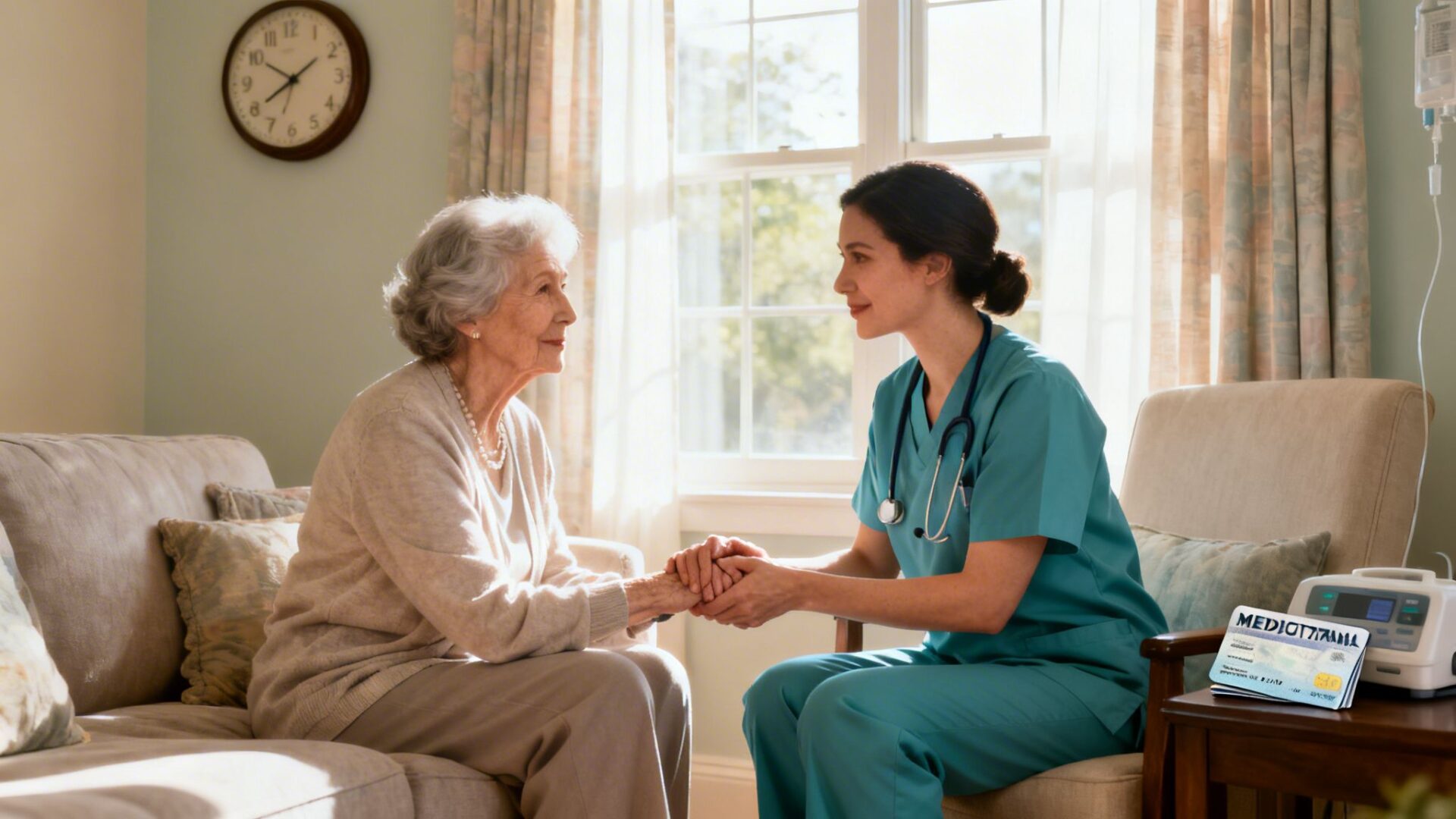
Does Medicaid Cover 24-Hour Home Health Care?
When a loved one needs constant care, keeping them at home is often the main goal. But this goal comes with a big question: how will we pay for it? This leads families to ask one of the most common questions we hear: Does Medicaid cover 24-hour home health care?
The short answer is that standard Medicaid very rarely covers 24-hour skilled home health care.
Setting Realistic Expectations for Home Care

For families here in Monterey County, San Benito County, and nearby areas, it is vital to know what Medicaid pays for. Understanding this from the start helps you avoid frustration. It also makes sure your loved one gets the right support quickly.
The first step is to learn about the two main types of in-home support. They are used for very different reasons.
Skilled Home Health Care vs. Personal Care
Think of these as two different tools for two different jobs.
- Skilled Home Health Care: This is medical care that a doctor orders. It is given by licensed professionals like a Registered Nurse or a physical therapist. It is usually short-term and helps a patient recover from surgery, an injury, or a serious illness. This care includes tasks like wound care, IV therapy, or physical therapy.
- Personal Care (or Custodial Care): This is non-medical help with daily life. Aides help with Activities of Daily Living (ADLs), such as bathing, dressing, making meals, or light cleaning. The goal is to provide safety and support, not to treat a medical issue.
This chart shows what standard Medicaid usually covers.
Home Care Covered by Medicaid At a Glance
| Type of Care | What Medicaid Usually Covers | Primary Goal of Care |
|---|---|---|
| Skilled Home Health Care | Part-time, periodic visits from a licensed medical professional (like a nurse or therapist). | To treat an illness or injury and help the patient recover. |
| Personal Care (Custodial) | Varies by state; often paid for through special waiver programs, not the standard benefit. | To assist with daily living activities (bathing, dressing, meals) and ensure safety. |
| 24-Hour (Continuous) Care | Not covered by standard Medicaid; requires a specific waiver or special program approval. | To provide constant monitoring and support for complex medical needs. |
As you can see, the key word for standard Medicaid (known as Medi-Cal in California) is intermittent. This means visits are scheduled and part-time. They are not continuous or around-the-clock. We explain more in our article about why home health isn't 24-hour care and what to do instead.
The purpose of Medicaid's standard home health benefit is to provide targeted medical help during recovery, not constant supervision.
As a nonprofit home health provider serving the Central Coast for over 74 years, our team at Central Coast VNA & Hospice can help you understand these details. We believe in providing clear, honest guidance. While getting 24-hour skilled nursing at home is rare, there are often other state programs that can help.
Understanding Medicaid's Home and Community-Based Services
If standard Medi-Cal only covers brief, skilled visits, how do some people get more care at home? The answer is through special state programs called Home and Community-Based Services (HCBS) waivers. These programs are the main way for families to get long-term support at home.
Think of an HCBS waiver as a special exception. It allows a state like California to "waive" certain federal Medicaid rules. This frees up money for more services for specific groups of people. The goal is to provide the support someone needs to live safely at home instead of in a nursing facility.
How HCBS Waivers Work
HCBS waivers are for people who qualify for a nursing-home level of care but want to stay in their own homes. This idea fits with our mission at Central Coast VNA & Hospice. We focus on helping people stay independent for as long as possible.
These programs can pay for a wider range of services than traditional Medicaid.
- Personal Care Services: Help with daily life, like bathing, dressing, making meals, and moving around safely.
- Adult Day Health Care: Supervised care in a group setting during the day.
- Respite Care: Short-term relief for family members who provide most of the care.
- Home Modifications: Money for changes that make a home safer, like adding ramps or grab bars.
- Case Management: A professional who helps coordinate all the services a person receives.
There has been a big shift toward this type of care. Medicaid is now a major funder of home care. It served about 5.1 million people through HCBS programs in 2023. That’s up from 4.5 million in 2021. This shows that families prefer to receive care at home when they can.
Why Waivers Differ From State to State
Here is where things can get tricky. HCBS waivers are not an entitlement. Regular Medicaid benefits must be given to anyone who qualifies. But states can limit the number of people in a waiver program. This often leads to long waiting lists.
Also, every state designs its own waiver programs. This means the services, rules, and care hours can be very different from one state to another. They can even be different between programs right here in California.
A waiver program is a state-specific solution. It unlocks Medicaid funding for non-medical, long-term support at home. Its goal is to prevent or delay the need for a nursing home.
The people who provide this hands-on support, like our dedicated Hospice Aides, are the heart of this system. You can learn more about their important work by reading about Working in Home Health Care as a CNA.
Understanding how these waivers work is the first step in creating a lasting care plan. They may not offer one person for 24 hours a day. But they provide the funds needed to build a strong support system. To get started, read our guide on qualifying for home health care.
When Medicaid Might Cover Around-the-Clock Care
While 24-hour coverage is rare, Medicaid can cover it in very specific situations. It is for people with extremely high medical needs. In these cases, constant skilled care is the only thing that keeps them out of the hospital.
This level of support is not for managing chronic conditions or providing basic supervision. It is for patients with complex medical needs that often depend on technology. Getting approval is very difficult and requires a lot of medical paperwork.
What Constitutes a High Medical Need
For Medicaid to consider around-the-clock care, the patient must need continuous help from a Registered Nurse (RN) or Licensed Practical Nurse (LPN). This is very different from what a personal care aide or a family member can safely provide.
If a loved one's condition is so fragile that a licensed nurse must be nearby to prevent a medical crisis, they might qualify.
These situations often involve conditions like:
- Ventilator Dependence: For someone who cannot breathe on their own.
- Tracheostomy Care: For individuals who need frequent, complex care for a breathing tube.
- Intravenous (IV) Nutrition or Medication: For patients who need continuous IV drips that a nurse must manage.
- Complex Wound Care: For those with severe wounds that need constant monitoring to prevent infection.
Even then, "24-hour care" does not mean one nurse works a full day. It is a schedule of nursing shifts to make sure a skilled professional is always there. Navigating the approval process is a challenge. That is why working with an expert team like Central Coast VNA & Hospice can provide valuable guidance.
Understanding the Pathway to Continuous Care
This high level of care is almost always approved through a state’s Home and Community-Based Services (HCBS) waiver programs. It is not part of standard Medicaid benefits. These waivers are for people who qualify for nursing home placement but can be cared for at home.
This chart helps show the different ways to get Medicaid-funded home care.

As the chart shows, the key question is whether a person's needs are complex enough to qualify for a nursing home. If they are, a waiver might unlock more services.
While an estimated 70% of adults over 65 will eventually need long-term services, very few ever get 24-hour skilled nursing at home. The system is built for intermittent care, making continuous support a rare exception.
For families here on the Central Coast, from Monterey to South Santa Clara County, understanding these facts is the first step. It helps set realistic goals and focuses your energy on the best solutions. Our experts can help you assess the level of medical need and explore options for skilled nursing at home.
How Medi-Cal and IHSS Work in California

For families on the Central Coast, California's specific programs are key to getting help. Our state’s version of Medicaid is called Medi-Cal. It offers a vital program for long-term, non-medical support at home called In-Home Supportive Services (IHSS).
It is important to know that IHSS is not the same as skilled nursing or therapy from a home health agency like Central Coast VNA & Hospice. IHSS is all about personal care. It helps with daily tasks so someone can stay safely in their own home.
The Role of IHSS in California
Think of IHSS as a way to pay for the help your loved one needs to live on their own. It provides money so a person can hire a provider for daily activities. This includes bathing, dressing, cooking, and light housekeeping.
The number of hours a person gets is decided by a county social worker. They visit the home to see what tasks your loved one can and cannot do. They then calculate the time needed for each activity, up to a state limit.
For a non-severely impaired person, the maximum is 195 hours per month. A severely impaired individual might get up to 283 hours per month. Even at the highest level, this is not 24/7 coverage.
One of the best things about the IHSS program is that your loved one can choose their own provider. This could be a professional aide, a friend, or often, a family member.
When you are dealing with complex health issues, it is helpful to see the line between IHSS personal care and medical services. Understanding all your options for in-home support to avoid a nursing home can show you how these programs can work together. This is a key step for families in Monterey, San Benito, Santa Cruz, and South Santa Clara counties.
How IHSS Hours Are Determined
When the county social worker visits for the IHSS assessment, they look at very specific needs. They use a standard form to figure out how much help is needed for different tasks.
The assessment focuses on:
- Activities of Daily Living (ADLs): These are basic self-care tasks, like bathing, dressing, grooming, and moving around the house.
- Instrumental Activities of Daily Living (IADLs): These are tasks needed to live independently, such as making meals, shopping, and doing laundry.
- Protective Supervision: If your loved one has a condition like dementia and could get hurt if left alone, extra hours may be approved for safety.
Based on this evaluation, the social worker assigns a certain number of hours for each task. These are added up to get the total number of approved hours per month.
As a nonprofit with over 74 years of local experience, we at Central Coast VNA & Hospice see how these systems fit together. We often see families combine our intermittent skilled nursing visits with daily personal care from an IHSS provider. This "blended" model is often the most realistic way to provide complete care at home.
Creating a Complete Care Plan with Blended Services

For most families, a single program like IHSS is not enough to cover every need. So, while you may start by asking, "Does Medicaid cover 24-hour home health care?" you will often find a better solution. Blending different types of support can create a true safety net.
This approach knows that care is not one-size-fits-all. By layering services, you can fill gaps and reduce stress on your family. This is where having an experienced guide makes all the difference.
Layering Support for Around-the-Clock Care
Think of a blended plan like a quilt. Each piece is a different source of support. Together, they provide complete comfort and security. For families on the Central Coast, this often means combining paid services with help from family and friends.
A typical blended plan might look like this:
- Skilled Home Health Visits: A Registered Nurse from Central Coast VNA & Hospice visits a few times a week to handle medical needs. This includes managing medications, providing wound care, or checking your loved one's condition.
- IHSS Personal Care Hours: An IHSS provider comes daily to help with personal tasks like bathing, making meals, and light housekeeping.
- Family & Community Support: Family members or trusted neighbors fill in the other hours. They often cover evenings, overnights, and weekends.
This model lets each person and service focus on what they do best. It requires excellent care coordination to make sure everyone is working toward the same goals.
The Critical Role of Family Caregivers
Family members are the heroes of the home care system. Many juggle their own jobs while providing hours of unpaid care each week. Medicaid programs like HCBS waivers are designed to support this network, not replace it.
The strain on family caregivers is real. According to AARP, about 9% of U.S. caregivers rely on Medicaid for their own health insurance while providing unpaid care. A significant 38% of these caregivers provide over 40 hours of care each week, which is like a full-time job.
Blending services is about more than just planning. It's about creating a support system that prevents caregiver burnout and ensures your loved one gets consistent, high-quality attention.
As a nonprofit home health provider with deep roots in Monterey and San Benito counties, Central Coast VNA & Hospice understands this well. We work with families and IHSS providers to make sure our skilled medical care fits with the personal support you already have.
This coordinated approach is at the heart of what we do, from home health to palliative and hospice care. You can learn more about our integrated home health and hospice services and see how we help families build these support networks every day.
How We Can Help You Navigate Your Options
We know how overwhelming the world of Medicaid and home care can feel. You do not have to go on this journey alone.
For over 74 years, Central Coast VNA & Hospice has been a trusted, local nonprofit partner for families. We serve Monterey, San Benito, Santa Cruz, and South Santa Clara counties. Our compassionate team is here to walk with you and help you find the clearest path forward.
Figuring out which programs your loved one might qualify for can be confusing. Our clinical experts can provide a professional, in-home assessment. This will give you an honest picture of your loved one’s medical needs and help clarify if skilled care or another service is the right fit.
Guiding You Through Every Stage
As a provider of the full continuum of care, from home health to palliative and hospice, we help families manage these important transitions.
We see how our skilled nursing visits can be blended with IHSS hours to create a complete care plan. Our deep roots in the community give us a unique understanding of how to coordinate these services so nothing is missed.
Our commitment is to your family’s well-being. As a nonprofit home healthcare provider, our only goal is to ensure your loved one receives the right care, at the right time, in the place they call home.
Let’s review your loved one’s needs and coverage options. We can help you understand the difference between the skilled medical care a Registered Nurse provides and the personal support an IHSS provider offers.
Contact Central Coast VNA & Hospice today to learn more about our home health, palliative care, and hospice services.
FAQs: Common Questions About Medicaid and Home Care
Navigating Medicaid and home care can feel confusing. The rules are complex, and it’s easy to feel lost. Here are some simple answers to questions we hear all the time.
What is the difference between home health care and personal care?
Home health care is medical care you receive at home. It is prescribed by a doctor and provided by licensed professionals, like a Registered Nurse or physical therapist. It is meant to be short-term to help you recover from an illness or injury.
Personal care is non-medical help with daily activities. This includes tasks like bathing, dressing, making meals, and light housekeeping. It is often provided long-term through programs like California's In-Home Supportive Services (IHSS).
Does Medicaid pay for 24-hour home care?
Standard Medicaid does not typically pay for 24-hour home care. It covers intermittent, or part-time, skilled care. However, in rare cases, specific state waiver programs may approve around-the-clock care for individuals with very high-level medical needs, such as ventilator dependence.
Are there waiting lists for Medicaid long-term care at home?
Yes, many states have waiting lists for their Home and Community-Based Services (HCBS) waiver programs. These programs fund long-term care at home. Because states can cap enrollment, it is smart to apply as soon as you think you might need the services.
Can I pay a family member to provide care through Medi-Cal in California?
Yes, in many cases. California's IHSS program lets your loved one choose and hire their own provider. This can often be a trusted family member. This flexibility allows care to be provided by someone your loved one already knows and trusts.
What should I do if my request for more home care hours is denied?
A denial is not the end of the road. You have the right to appeal the decision. This is also a good time to consider a blended care plan. A blended plan combines different sources of support, such as skilled home health visits from an agency like ours and personal care hours from IHSS.
Feeling overwhelmed is understandable, but you don't have to figure it out alone. As a local, nonprofit provider with over 74 years of experience here on the Central Coast, Central Coast VNA & Hospice is here to be your guide. Let’s talk through your loved one’s needs and what coverage options make sense. Contact us today to learn more about our hospice care in Monterey County and other supportive services.
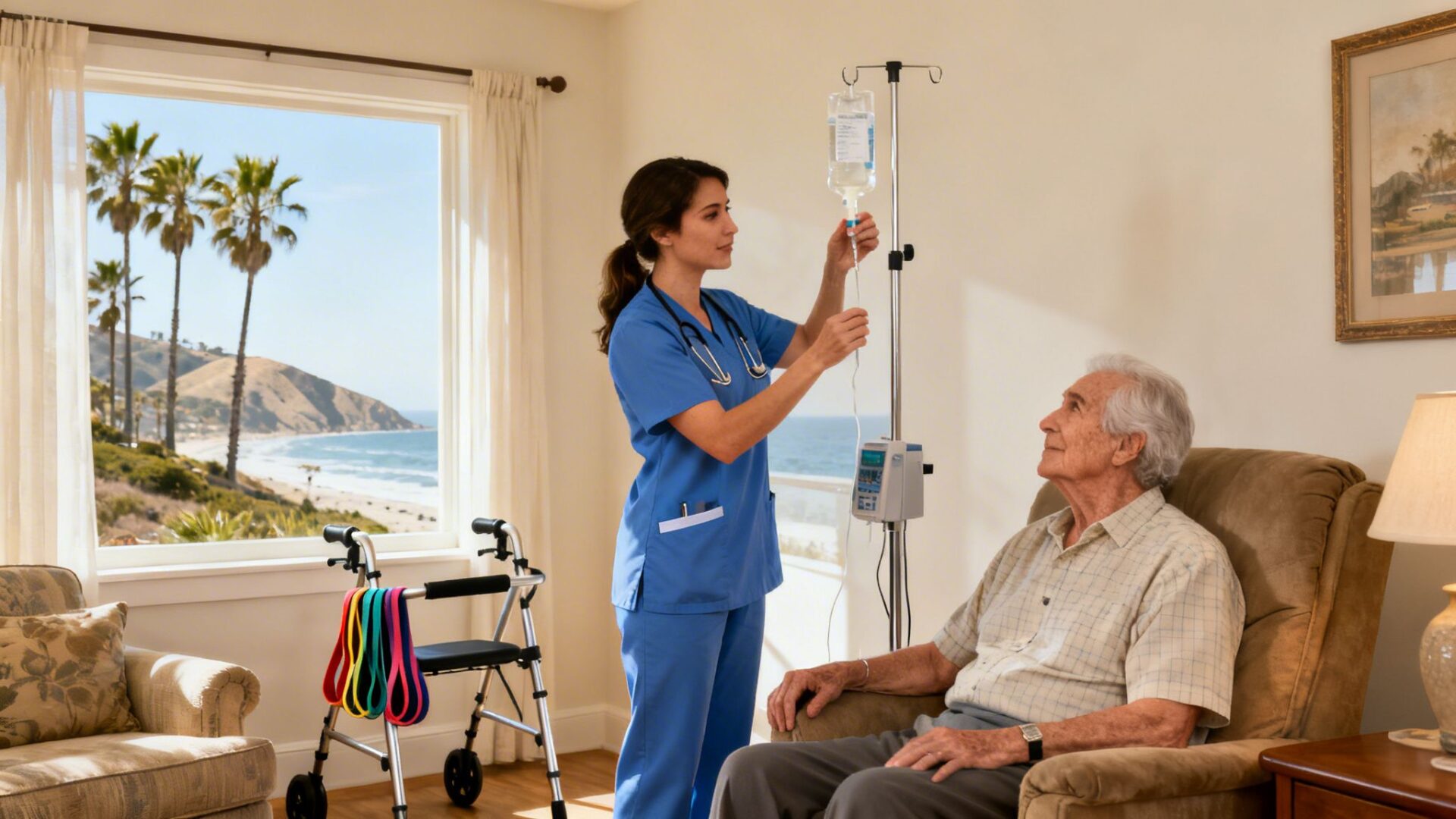
California Home Health Care: What It Covers & Who Qualifies
When you or a loved one are recovering from surgery, an injury, or a new illness, a long hospital stay can feel overwhelming. Many people don't realize there's another path to healing. California home health care brings a dedicated medical team right to your front door. This lets you recover in the comfort of home.
This isn't 24/7 personal help. It's a specific type of care ordered by a doctor that focuses on skilled, intermittent visits. These visits from a Registered Nurse or therapist help you get back on your feet.
What Is California Home Health Care?
Think of it as bringing the hospital's recovery team into your living room. That is the heart of California home health care. It is a medical service prescribed by your doctor to help you heal safely at home. It can often prevent a hospital stay or let you come home sooner.
This care is for patients who need professional medical support but not around-the-clock. Instead, you get targeted visits from licensed experts focused on your recovery goals. It's important to know this is different from general home care services for seniors, which usually helps with daily tasks. Home health care delivers clinical expertise directly to you.
Home Health Care Services at a Glance
To give you a clearer picture, here is a snapshot of the skilled services in a home health plan. This team works together to provide support based on your medical needs.
| Service Type | What It Means for You |
|---|---|
| Skilled Nursing | A Registered Nurse (RN) manages your care, from wound dressing and IVs to medication education and monitoring your health. |
| Physical Therapy | A Physical Therapist (PT) helps you regain strength, balance, and mobility with targeted exercises and training. |
| Occupational Therapy | An Occupational Therapist (OT) helps you safely return to daily activities like dressing, bathing, and cooking. |
| Speech Therapy | A Speech-Language Pathologist (SLP) assists with communication or swallowing problems after a stroke or illness. |
| Medical Social Work | A Medical Social Worker (MSW) connects you with community resources and provides counseling to help you and your family cope. |
| Home Health Aide | A certified Home Health Aide (HHA) assists with personal care, like bathing, under the supervision of a nurse or therapist. |
These services are coordinated by your doctor and the home health agency. This ensures your care plan helps you meet your personal recovery goals.
The Purpose of Skilled Care at Home
The main goal of home health care is to help you recover and regain independence. While every patient's journey is unique, the focus is always on improving your health at home.
The goals of these services often include:
- Recovering after a hospital stay for surgery, a heart attack, or a serious infection.
- Managing a new medical diagnosis, such as diabetes or chronic obstructive pulmonary disease (COPD).
- Receiving therapy to rebuild strength or communication skills after an injury or stroke.
- Learning to manage medications safely to prevent future health problems.
For over 75 years, Central Coast VNA & Hospice has been a trusted nonprofit provider. We serve communities across Monterey County, Santa Cruz County, San Benito County, and South Santa Clara County. Our mission is to deliver expert, compassionate care that keeps our neighbors healthy and safe at home.
As a mission-driven nonprofit, our focus is on patient well-being, not profits. We provide a full continuum of support, from recovery with our home health care services to managing illness with palliative care and providing comfort with hospice. Our dedicated teams of Registered Nurses, therapists, and medical social workers are committed to your recovery, with 24/7 on-call clinical support always available.
Who Qualifies for Home Health Care in California
Figuring out who qualifies for California home health care can feel confusing. But the rules are more straightforward than they seem. Eligibility comes down to two main requirements.
First, you need a physician's order. A doctor must certify that you need "intermittent" skilled nursing or therapy. This is an official referral that confirms home-based medical care is essential for your recovery.
The Homebound Requirement Explained
The second major requirement is that you must be homebound. This is the most misunderstood part of qualifying. It does not mean you are stuck in bed or can never leave the house.
So, what does it mean? Medicare says:
- Leaving your home takes a considerable and taxing effort because of your illness or injury.
- You might need help from another person or a device like a walker to get out.
- When you do leave, it’s usually for short, infrequent trips like medical appointments.
Think of someone recovering from knee surgery. They can get to their doctor's appointment, but a trip to the grocery store would be exhausting. That is a perfect example of being homebound. The focus is on the effort involved.
This decision path helps show how it all comes together.

It all starts with a medical need and a doctor's order. Those are the first steps before home health care can be approved.
Meeting the Criteria for Skilled Care
Besides being homebound and having a doctor’s order, there is one more piece. The care must be both skilled and intermittent. "Skilled" means it requires the knowledge of a professional, like a Registered Nurse or Physical Therapist.
At Central Coast VNA & Hospice, our clinical teams specialize in assessing patient needs. With a legacy of serving Monterey, Santa Cruz, San Benito, and South Santa Clara counties, we help families navigate these requirements with compassion.
For instance, a nurse teaching a patient about new diabetes medications is a skilled service. So is a therapist guiding someone through exercises after a fall. A Home Health Aide can also be covered if their services support an existing plan of skilled care.
You can find more details in our guide about qualifying for home health care.
What Services Home Health Care Actually Covers
Once a doctor gives the green light for California home health care, the next question is, "What does that mean for us?" Home health is not just one service. It is a team of clinical experts who come right to your door.
Each team member has a specific role in your recovery. They all follow a personal care plan that your doctor approves.

The goal is to bring the medical care you need into your home. At a nonprofit provider like Central Coast VNA & Hospice, this team approach is everything. It ensures we are looking at the whole picture with compassion.
So, let's break down the key services you can expect.
Skilled Nursing Care
At the heart of your home health plan is skilled nursing care. A Registered Nurse (RN) or Licensed Vocational Nurse (LVN) becomes the manager of your care at home. They are your main point of contact and oversee your progress.
These nurses handle complex medical needs right in your living room. These are things you might have thought could only happen in a hospital.
- Wound Care: They change dressings after surgery and care for complex wounds to prevent infection.
- IV Therapy and Injections: Nurses can manage intravenous medications, fluids, or nutrition. This service often lets patients come home from the hospital sooner.
- Medication Management: They teach you and your family about new medications—what they are for, when to take them, and what side effects to watch for.
- Disease Management Education: If you are managing a condition like diabetes, the nurse is your coach. They teach you how to spot symptoms and take control of your health.
This high level of care is why a doctor's order is needed. You can learn more about our approach to skilled nursing at home.
Rehabilitation Therapies
Helping you regain independence is a key part of home health. This is where the rehabilitation team comes in. These specialized therapists work with you to restore function and quality of life.
Physical Therapy (PT)
A Physical Therapist helps you get moving again. They work on building strength, improving balance, and increasing mobility. A PT will design an exercise plan to get you walking safely after a fall, stroke, or joint replacement.
Occupational Therapy (OT)
An Occupational Therapist helps you get back to the "occupations" of daily life. This is about essential activities like bathing, dressing, or making a meal safely on your own.
Speech-Language Pathology (SLP)
A Speech-Language Pathologist helps with communication and swallowing problems. After a stroke, they work with patients to improve speech and learn to swallow food and liquids safely.
At Central Coast VNA & Hospice, our interdisciplinary team works hand-in-hand. The therapists and nurses share updates and time their visits to make sure your care plan is working as a whole.
Medical Social Work and Home Health Aide Services
Recovery is not just physical. It has emotional and practical challenges, too. That is where medical social workers and home health aides complete the circle of care.
Medical Social Work
A Medical Social Worker is a great source of support for you and your family. They can help you cope with stress, connect you to community resources like Meals on Wheels, and assist with long-term planning.
Home Health Aide Services
Working under the supervision of your nurse or therapist, a Home Health Aide can help with personal care. This might include help with bathing and dressing. These services are only covered when part of a skilled care plan.
This team-based model ensures patients in Monterey, Salinas, Hollister, Santa Cruz, and South Santa Clara County receive complete care. We empower people in our community to heal where they feel most comfortable.
Understanding Your Medicare and Medi-Cal Coverage
Worries about paying for medical care should not get in the way of recovery. When your doctor orders California home health care, you might wonder how to pay for it. The good news is that for most eligible people, these services are covered by Medicare or Medi-Cal, often at no cost.
Understanding this financial support provides peace of mind. It is also central to our mission as a nonprofit home healthcare provider. At Central Coast VNA & Hospice, our focus is on delivering great care to our communities in Monterey and Santa Cruz County, not on profits.
How Medicare Covers Home Health Care
If you are 65 or older or have certain disabilities, Medicare is likely your primary coverage. When you have Original Medicare (Part A and/or Part B) and meet the requirements, your home health services are typically covered at 100%. This means you must be certified as homebound and need physician-ordered skilled care.
That means you will have $0 out-of-pocket costs for all approved services, including:
- Skilled nursing visits from a Registered Nurse
- Physical, occupational, and speech therapy
- Medical social work consultations
- Home health aide services to support your skilled care plan
You don’t have to worry about a deductible or copay for these visits. The only potential cost is a 20% coinsurance for any durable medical equipment (DME), like a walker or hospital bed.
You can find more details in our guide on Medicare home care eligibility.
Medi-Cal as a Vital Safety Net
Medi-Cal, California's Medicaid program, is a healthcare safety net for low-income individuals. Like Medicare, Medi-Cal covers all medically necessary home health services ordered by a doctor. If you are eligible for Medi-Cal, you can receive skilled care without a copay.
This coverage ensures that all Californians, regardless of income, have access to the support they need to recover at home. This aligns with our 75-year history of serving everyone in our community.
According to the Centers for Medicare & Medicaid Services (CMS), nearly 3.2 million beneficiaries received home health services in 2021 (CMS, 2023). This shows how vital these programs are in helping people recover safely at home.
Private Insurance and Other Options
What if you have private insurance or a Medicare Advantage Plan (Part C)? Your coverage will depend on your policy. Most plans cover home health services but may have different rules about copayments or which agencies are in their network. The team at Central Coast VNA & Hospice can help you verify your benefits.
Our goal is to make sure you can focus on your health. With strong coverage from programs like Medicare and Medi-Cal, you can feel confident that expert care is available right at home.
How Home Health Fits in Your Long-Term Care Journey
A person’s healthcare needs can change over time. A sudden illness or a new diagnosis can shift the kind of support your family needs. Understanding how different levels of care connect is key to feeling confident about the future.
California home health care is often the first step people take. It is a temporary, goal-oriented service to help someone recover. But what happens when the goal is no longer recovery but managing a serious illness long-term?
From Recovery to Long-Term Support
It helps to think of the healthcare journey as a path with different stages. Each one has a specific purpose.
A common path might look like this:
- Home Health Care: This is the recovery phase. A team of nurses and therapists comes to your home to help you regain strength and independence.
- Palliative Care: If an illness becomes a long-term condition, the focus may shift to comfort and symptom management. Palliative care adds an extra layer of support while you continue treatment.
- Hospice Care: When curative treatments are no longer working, the focus moves to comfort and dignity. Hospice provides compassionate support for the patient and family.
During recovery, many families also invest in modern wellness equipment to make the home safer.
The Power of an Integrated Care Partner
Moving between these stages can be stressful. Finding a new provider and learning a new system adds an emotional burden. This is why a single, trusted partner that can provide care at every stage is so powerful.
As a nonprofit provider serving the Central Coast for over 75 years, Central Coast VNA & Hospice offers this seamless continuum. Our families in Monterey, Santa Cruz, San Benito, and South Santa Clara counties never have to search for a new agency as their needs evolve.
This integrated approach provides consistency and peace of mind. The same organization that helped with home health care can smoothly transition to our palliative care team. And if the time comes for hospice care, you will be surrounded by a familiar, trusted team.
This continuum of care means you always have a compassionate partner by your side. It ensures you get the right care at the right time.
How to Start Receiving Home Health Care Services
Taking the first step to get professional medical support at home is easier than you think. We will walk you through how to start California home health care for yourself or a loved one.
It all starts with a talk with your doctor. A physician’s order is a mandatory first step to begin services covered by Medicare, Medi-Cal, or private insurance.

The Power of a Physician Referral
A referral from your doctor or a hospital discharge planner officially kicks things off. This order certifies that you have a medical need for skilled care. You have the right to speak up for yourself or your family member.
Especially after a hospital stay, you can and should ask for a home health evaluation. This talk is a key part of good discharge planning from the hospital. It helps make the transition home safe and supported.
At Central Coast VNA & Hospice, our teams are always here to answer questions. With 75 years of nonprofit service to Monterey, Salinas, Hollister, and Santa Cruz, we've made the referral process simple.
Once your doctor sends the referral, things move quickly. A team member from the agency will call you to schedule an assessment at home.
What to Expect From the First Visit
During this first visit, a Registered Nurse (RN) will come to your home for an assessment. Think of it as a friendly meeting. The goal is to understand your needs and review your medical history.
The nurse will then work with you, your family, and your doctor to create a personal plan of care. This plan is your roadmap. It outlines what services you will get and how often the team will visit.
With an organization like Central Coast VNA & Hospice, help is always a phone call away. Our 24/7 on-call clinical support means a Registered Nurse is available to answer urgent questions day or night. This gives you and your family incredible peace of mind.
Speak with our clinical team to see if home health care is right for your family.
Frequently Asked Questions About California Home Health Care
Even after learning the basics, you may still have questions about California home health care. Let’s walk through some common questions we hear from families. This can help you feel clear about your next steps.
Is home health care the same as a private aide?
No, and this is an important difference. Home health care is skilled medical care from a licensed nurse or therapist. It is prescribed by a doctor to help you recover from an illness, injury, or surgery. A private aide helps with non-medical daily activities like meal prep or errands and is usually paid for out-of-pocket.
How fast can home health services begin?
Services can begin very quickly, often within 24 to 48 hours after the agency receives a referral from your doctor. Once the referral is made, a Registered Nurse will contact you to schedule the first visit. This visit includes a full assessment to create your personalized plan of care so visits can start right away.
Can I choose my home health care provider?
Yes, absolutely. Federal law guarantees Medicare beneficiaries the right to choose any certified agency in their area. A hospital may give you a list of local providers, but the final decision is always yours. We encourage families to look for a trusted, local agency with deep community roots, like Central Coast VNA & Hospice.
Do I need a hospital stay to qualify?
Not necessarily. While many people start home health care after a hospital stay, it is not a strict requirement. You can also qualify if your doctor sees that a new or worsening chronic condition needs skilled management at home. In these cases, home health care can help you avoid a hospital stay.
What if I need help on a weekend or at night?
Your health needs don't keep business hours. While your regular visits are scheduled during the day, you should never feel alone. Reputable agencies like Central Coast VNA & Hospice provide 24/7 on-call clinical support. This means a Registered Nurse is always a phone call away to answer urgent questions.
For over 75 years, Central Coast VNA & Hospice has been a trusted nonprofit home healthcare provider serving Monterey County, San Benito County, Santa Cruz County, and South Santa Clara County. We are guided by our mission to deliver care at every stage of life. Speak with our clinical team to see if home health care is right for your family.
What’s the Real Difference Between Hospice and Palliative Care?
When you or a loved one has a serious illness, it's important to know your care options. Palliative care can start at any stage of an illness. On the other hand, hospice care is for the final months of life.
Palliative care adds a layer of comfort and support during medical treatment. Hospice focuses completely on comfort and quality of life when a cure is no longer the goal.
A Compassionate Guide to Your Care Options

Dealing with a serious illness can feel overwhelming for patients and families. You will likely hear two terms: palliative care and hospice care. Both aim to provide comfort, but they serve different needs at different times.
Understanding the real difference between hospice and palliative care helps you make good decisions. It ensures you get the right support at the right time. For over 74 years, Central Coast VNA & Hospice has helped families in Monterey, San Benito, Santa Cruz, and South Santa Clara counties understand these choices.
Both palliative care and hospice are about helping people live as well as they can, for as long as they can. They focus on improving your quality of life, allowing you to spend that time in the way you want to spend it.
To clear up any confusion, let's look at their main features. This comparison is a great starting point for talks with your family and doctors. For another helpful overview, see this resource on Hospice vs Palliative Care Understanding the Difference.
Hospice vs. Palliative Care at a Glance
This table gives a quick summary of the differences between these two types of compassionate care.
| Feature | Palliative Care | Hospice Care |
|---|---|---|
| Timing of Care | Can begin at diagnosis and be provided at any stage of a serious illness. | Typically begins when an illness is terminal, with a life expectancy of six months or less. |
| Treatment Goals | Provided alongside curative treatments (like chemotherapy) to manage symptoms and stress. | Focuses on comfort and quality of life when curative treatments are no longer being pursued. |
| Care Team | Includes a specialized team, often a Registered Nurse and Social Worker, who work with your current doctors. | Involves a full interdisciplinary team, including a Medical Director, Registered Nurse, Hospice Aide, and Chaplain. |
| Location of Care | Often provided at home, in an outpatient clinic, or during a hospital stay. | Primarily delivered wherever the patient calls home, including private residences, nursing homes, or assisted living. |
Both services provide comfort and dignity. The key difference is the timing and approach. Palliative care works with active treatment, while hospice becomes the main focus when comfort is the priority.
Exploring Palliative Care for Comfort and Quality of Life

When you are living with a serious illness, the focus is often on treatment. But what about comfort, stress, and your overall quality of life? This is where palliative care helps.
Palliative care is a specialized type of support that eases the symptoms and stress of a serious illness. It's an extra layer of support that can begin at any age or stage of an illness. Its main goal is to improve life for both the patient and their family.
This care is very helpful for people with conditions like cancer, heart failure, or dementia. It works alongside your current doctors and treatments. For residents in Monterey County and Santa Cruz County, palliative care at home can lead to fewer hospital visits.
Who Is on the Palliative Care Team?
A palliative care team adds to the care you get from your other doctors. At Central Coast VNA & Hospice, our team provides complete, coordinated support. These professionals work together to meet your needs.
A typical palliative care team includes:
- Registered Nurse: A skilled Registered Nurse manages your symptoms and coordinates care. They are your main contact for managing pain and other difficult symptoms.
- Social Worker: A medical Social Worker gives emotional support and helps you navigate your healthcare journey. They can connect you with community resources and help with advance care planning.
The core principle of palliative care is that it can be provided at the same time as curative treatments. You do not have to choose between getting better and feeling better.
This approach ensures you are fully supported while you continue treatment. Our team works with your doctors to make sure your care plan matches your goals.
What Does Palliative Care Actually Do?
Palliative care focuses on relief from symptoms, pain, and stress of a serious illness. The real difference is its focus on your comfort and well-being.
Here’s how palliative care can help you or your loved one:
- Symptom and Pain Management: Provides expert treatment for pain, shortness of breath, fatigue, and other symptoms.
- Emotional and Spiritual Support: Helps patients and families cope with the emotional toll of an illness.
- Improved Communication: Helps you, your family, and your doctors stay on the same page.
- Coordination of Care: Helps you navigate the healthcare system and makes sure your providers work together.
Despite its benefits, many people don't know about palliative care. A poll from the National Hospice and Palliative Care Organization (NHPCO) found many Americans are unfamiliar with it. This knowledge gap means people miss out on care that could improve their life.
Central Coast VNA & Hospice is dedicated to educating our community. By bringing this care into homes across the Central Coast, we help patients live more comfortably. If you're wondering how this support fits in, you might enjoy our article on why palliative care isn't just for the end.
Understanding Hospice Care for Dignity at End of Life
While palliative care offers support at any stage, hospice is for when an illness enters its final phase. It’s not about giving up. It’s a shift in focus from curing the disease to maximizing quality of life.
This compassionate approach is for people with a life-limiting illness and a life expectancy of six months or less. When curative treatments are no longer working or wanted, hospice provides support that centers on the whole person.
The Shift to Comfort and Quality of Life
Starting hospice is a personal decision that marks a change in healthcare goals. Instead of aggressive treatments, the focus turns entirely to comfort. This means managing pain and symptoms so a person can live their remaining time as alert as possible.
Central Coast VNA & Hospice has provided this care for over 74 years. We have helped thousands of families across Monterey County, San Benito County, Santa Cruz County, and South Santa Clara County. As a nonprofit, mission-driven organization, our decisions are guided by patient needs.
Hospice care is a philosophy that embraces life and focuses on making every day count. It helps patients and families find peace by providing expert medical care, pain management, and emotional and spiritual support tailored to their specific needs and wishes.
The goal is to empower patients to live their final months on their own terms. For most, this means receiving care where they call home. To learn more, read our guide on what exactly happens when someone starts hospice care.
The Interdisciplinary Hospice Team
Hospice care is delivered by a dedicated, interdisciplinary team. They work together to support both the patient and their family. This team approach addresses physical, emotional, and spiritual well-being.
The Central Coast VNA & Hospice team includes:
- Medical Director: A physician who offers medical guidance and works with the patient's own doctor.
- Registered Nurse: Manages pain and symptoms, making regular home visits to provide skilled care.
- Hospice Aide: Helps with personal care like bathing and dressing to keep the patient comfortable.
- Chaplain: Provides spiritual support that respects the patient's and family's beliefs.
- Social Worker: Offers emotional support and connects the family with community resources.
This team creates a circle of support for the entire family. We’re available 24/7 for urgent needs, which often prevents trips to the emergency room.
Where Is Hospice Care Provided?
A common myth is that hospice is a place you go to. In reality, hospice is a type of care provided wherever a person calls home. Most of our patients receive hospice care in their own residence.
This commitment to home-based care is a key part of our service. Our teams travel throughout the Central Coast to support patients in settings like:
- Private homes
- Assisted living communities
- Skilled nursing facilities
By bringing expert care to the patient, hospice helps families spend quality time together. It’s all about honoring a person's final wishes with dignity and respect.
Making the Right Choice for Your Family's Needs
Understanding the definitions of hospice and palliative care is one thing. Figuring out how they apply to your family is another step. Looking at a few real-life examples can make the path forward clearer.
These choices are not about giving up hope. They are about regaining control and ensuring your loved one gets the right support at the right time. By walking through some examples, you can have better talks with your doctor.
A Palliative Care Scenario for Heart Failure
Let's imagine a 72-year-old man in San Benito County with congestive heart failure (CHF). He is tired and short of breath, and frequent hospital trips are draining. He still sees his cardiologist, but his symptoms are getting in the way of daily life.
This is a perfect time to bring in palliative care. Here’s why:
- He is still seeking curative treatment: He is still working with his cardiologist. Palliative care adds support, it doesn't replace his doctor's plan.
- His biggest need is symptom management: The palliative team can focus on managing his shortness of breath and fatigue at home.
- The goal is to improve his quality of life: By controlling his symptoms, the team helps him avoid stressful ER visits and feel better.
In this situation, palliative care from Central Coast VNA & Hospice acts as an extra layer of support. Our team works with his doctors to manage symptoms and reduce anxiety.
A Hospice Scenario for Heart Failure
Now, let's fast-forward five years. The same man's heart failure has gotten worse. The treatments are no longer as effective, and he wants to avoid the hospital. His priority has shifted to comfort and quality time with his family at home in Monterey County.
This is when a transition to hospice care becomes the most supportive choice.
The real difference often comes down to this pivotal moment: the decision to shift the focus from trying to cure the illness to maximizing comfort and quality of life for the time that remains.
The infographic below helps show the key question for starting hospice care.

As this shows, when a doctor certifies a life expectancy of six months or less, hospice becomes the recommended path for comfort-focused care.
In this hospice scenario, the entire focus changes:
- Comfort is the top priority: The hospice team—including a Registered Nurse and Hospice Aide—manages his pain and symptoms at home.
- Holistic support is provided: The team supports the patient, his wife, and children with emotional and spiritual guidance.
- Care is brought directly to him: All care, medications, and medical equipment for his hospice diagnosis are delivered to his home.
These scenarios show how Central Coast VNA & Hospice provides a continuum of care. It is common for a patient to start in our palliative care program and later move to hospice. This ensures they have a familiar, trusted team.
If you’re wondering about the timing, a great next step is to check out our guide on how to know when hospice is needed.
Correcting Common Myths About Hospice and Palliative Care
Fear and confusion about hospice and palliative care are common. These myths can stop families from getting the support they need. Let's look at the truth.
At Central Coast VNA & Hospice, we want to give our community clear answers. Let's tackle some of the biggest myths so you can feel confident in your choices.
Myth 1: Palliative Care Means I'm Dying
This is a big and harmful myth. Palliative care is not end-of-life care. It is care focused on relief from the symptoms and stress of a serious illness.
You can get palliative care at any age or stage of an illness. The goal is to improve your quality of life while you continue curative treatments. Think of it as an extra layer of support.
Myth 2: Hospice Means Giving Up Hope
Many people feel that choosing hospice is giving up. In reality, it’s about shifting hope from a cure to comfort, peace, and meaningful time with loved ones. Hospice care is about making every day count.
When a cure is not possible, hospice provides expert pain management. This allows patients to live more comfortably. Families often tell us they wish they had started hospice sooner.
A common fear is that hospice shortens life, but research often shows the opposite. By focusing on aggressive symptom management and holistic support, hospice can actually improve both the quality and length of life.
Some studies have even found that hospice patients may live longer than similar patients who don't receive it. For instance, one study found that hospice patients lived an average of 29 days longer than those who were not in hospice.
Myth 3: You Can Only Get Hospice for a Few Days
Another myth is that hospice is only for the last few days of life. Patients are eligible when a doctor certifies they have a life expectancy of six months or less.
Many people receive hospice care for weeks or months. This gives them the full benefit of our team's support. To learn more, check our article on the top misconceptions about hospice.
By clearing up these myths, we can help more families in Monterey, San Benito, Santa Cruz, and South Santa Clara counties get the care they deserve.
How to Access Palliative and Hospice Services
Living with a serious illness is a challenge, but you don't have to do it alone. The first step is to understand your options. The second is knowing how to get support.
The process often starts with a conversation. Your doctor is the best person to talk to first. They can give you a referral and help you figure out which service is the right fit.
Starting the Conversation with Your Doctor
Bringing up palliative or hospice care can feel difficult, but it's an important step. Talk openly with your doctor about your symptoms and your hopes.
Here are a few questions you can ask:
- Could palliative care help me manage my symptoms while I continue my treatments?
- What would need to change for hospice to be a supportive option for me?
- Can you give me a referral to Central Coast VNA & Hospice so my family and I can learn more?
This talk allows your doctor to recommend services. A referral is often all it takes to begin.
Starting the conversation is not about giving up; it’s about adding a layer of expert, compassionate support to your existing care. It's about ensuring your journey is guided by your wishes and your comfort.
Once you have a referral, you can reach out to a trusted provider. An informational visit can answer your questions with no obligation. You can also look into local health care resources for seriously ill family members for more information.
A Seamless Continuum of Care
Choosing a local, nonprofit provider like Central Coast VNA & Hospice has many benefits. One is the ability to move smoothly between different types of care as your needs change. For over 74 years, we have been a trusted partner for families across Monterey, San Benito, Santa Cruz, and South Santa Clara counties.
A patient might start with our home health services after a hospital stay. They can then transition to our palliative care program for symptom management. If their goals later shift to comfort, they can move into our hospice program with the same familiar team.
This continuity ensures you get the right care at the right time. Our only goal is your well-being. We are here to help you with dignity and compassion.
If you or a loved one is facing a serious illness, please do not wait to get support. Contact us today to learn how our services can help.
Frequently Asked Questions
When you're trying to understand hospice and palliative care, many questions come up. Here are clear answers to common concerns from families.
How Are Hospice and Palliative Care Paid For?
This is a very important question. For the most part, hospice is a fully covered benefit under Medicare Part A. This means there is typically no out-of-pocket cost for the patient or family. This benefit covers the care team, medications for the terminal illness, and medical equipment.
Palliative care is different. It’s usually covered by Medicare Part B and private insurance, like a visit to a specialist. You might have a co-pay depending on your plan. The team at Central Coast VNA & Hospice can help you understand your coverage.
Can I Receive Palliative Care at Home?
Yes, absolutely. Our palliative care program at Central Coast VNA & Hospice is designed to bring this support right into your home. This helps you manage symptoms in a comfortable, familiar setting. In-home support also cuts down on tiring trips to the doctor's office.
Do I Have to Give Up My Doctor for Hospice?
No, you don't. This is a common myth. When you start hospice care, your personal doctor remains an important part of your care team.
Our hospice team works in close collaboration with your doctor. We see ourselves as partners in your care, making sure your doctor’s insights are combined with our specialized comfort care expertise to give you the best support possible.
The hospice Medical Director and your Registered Nurse will work with your primary doctor. You are not losing a doctor; you are gaining a whole team.
What Happens If My Condition Improves on Hospice?
It is not unusual for someone's condition to stabilize or improve on hospice. The focused symptom management and support can lead to a better outlook. If a patient's health improves, they can be "discharged" from hospice. They can always re-enroll if their condition declines again later.
How Do I Start the Conversation About Care with My Family?
Bringing up this topic can feel hard, but focusing on goals can make it easier. Try asking your loved one questions like, "What is most important to you right now?" or "How can we make your days more comfortable?" This opens the door to a talk about improving their quality of life. You can then introduce palliative or hospice care as tools to help.
If you have more questions, the team at Central Coast VNA & Hospice is here to help. With over 74 years of service to Monterey, San Benito, Santa Cruz, and South Santa Clara counties, we are a nonprofit provider offering care at every stage. Contact us today to learn how we can support you and your family.
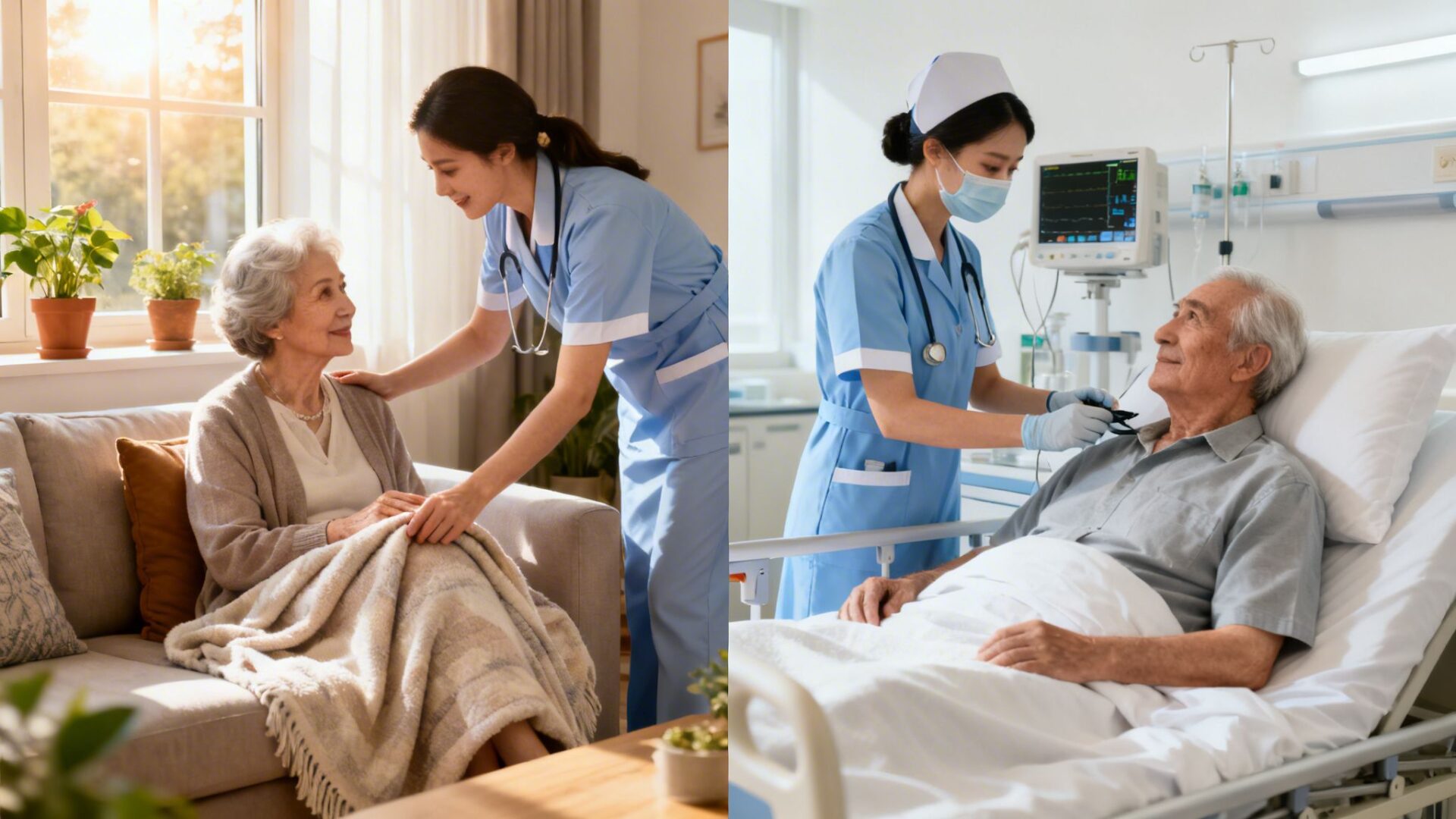
Top Guide: Is Home Nursing Care Better Than a Nursing Facility?
When families ask, "is home nursing care better than a nursing facility?" the answer depends on your loved one. Many find that skilled medical care at home offers a safer and more personal choice. It helps them keep their independence with true one-on-one attention.
Deciding Between Home Nursing Care and a Facility
Choosing the right care for a loved one is a major decision. You want high-level medical support but also want them to feel comfortable. The good news is that you have options and don't have to trade quality for comfort.
Many people believe skilled nursing only happens in a facility. This is a common misstep. In reality, Registered Nurses and therapists can provide these exact services at home.
These services are often covered by Medicare after a hospital stay or during a chronic illness. This makes professional care accessible right where your loved one feels most secure.
Core Differences at a Glance
Home nursing care supports a loved one's wish for Aging In Place Staying Independent. This approach honors their personal routines. It also keeps them connected to their community.
Central Coast VNA & Hospice has served the Central Coast for over 74 years. As a local nonprofit, we help families in Monterey County, San Benito County, Santa Cruz County, and South Santa Clara County navigate these choices every day.
This table shows the key differences between skilled care at home versus in a nursing facility. It helps you see the primary trade-offs at a glance.
At a Glance Comparison: Home Nursing vs. Nursing Facility
| Factor | Home Nursing Care | Nursing Facility |
|---|---|---|
| Environment | The patient's own comfortable and familiar home. | A clinical, institutional setting with multiple residents. |
| Personalization | One-on-one care from a dedicated team of clinicians. | Staff care for multiple residents simultaneously. |
| Independence | Promotes autonomy and allows for personal routines. | Structured schedules for meals, activities, and care. |
| Family Involvement | Easy and frequent access for family visits and participation. | Restricted visiting hours and less direct involvement. |
| Social Interaction | Maintained connections with neighbors and community. | Primarily with other residents and facility staff. |
The choice often comes down to what matters most. Is it the personalized, independent environment of home care? Or is it the structured setting of a facility?
This chart helps show the benefits of each setting. It highlights how home care focuses on comfort and safety. A facility focuses more on clinical structure.

The image shows that home care provides a personal touch. Facilities offer a structured environment with 24/7 on-site staff. You can learn more about how we provide in-home support to avoid a nursing home on the Central Coast.
A Nuanced Look at Clinical Outcomes and Patient Safety
When comparing home nursing to a facility, safety is a top concern. While facilities offer constant supervision, home nursing provides dedicated, one-on-one attention. This personalized focus often leads to better health outcomes.
When a skilled Registered Nurse from Central Coast VNA & Hospice works with a patient, the care plan is very responsive. Any change in health is noticed and addressed quickly. This can stop a small problem from becoming a crisis.

Reducing Risks in a Familiar Environment
A clear advantage of home care is the lower risk of infection. Infections can spread quickly in hospitals and nursing facilities. Receiving care at home reduces this exposure, which is vital for patients with a weakened immune system.
Falls and poor communication are also common concerns in facilities. Skilled care at home offers a safer, more personalized alternative.
Medication management is another area where home nursing shines. A home health Registered Nurse oversees medications, reducing the risk of errors. The nurse also teaches the patient and family about the regimen.
The Healing Power of Comfort
The benefits of being home are mental as well as physical. Familiar surroundings provide a deep sense of comfort, especially for those with dementia. This stability can reduce stress and confusion.
This emotional well-being is tied to better physical health. When a patient feels safe, they tend to rest and eat better. You can read our guide that asks, is it safer to age at home instead of a nursing home?
Data backs this up. A study of Medicare beneficiaries showed a clear survival advantage for those who received skilled care at home.
After one year, 77.7% of home health patients were still alive, compared to just 76.2% of nursing home patients. Even more telling, for patients eligible for both Medicare and Medicaid, long-term care costs were $4,582 higher for nursing home residents.
You can read more in the full study on long-term care outcomes. This research shows that home nursing is a powerful and effective model for managing health. It blends clinical expertise with the comfort of being home.
Breaking Down the Costs of Care
Cost is a major concern when deciding on care. Many families assume a facility is the only option for serious medical needs. However, skilled nursing at home can be more affordable and effective.
The biggest factor is overhead. Nursing facilities have high costs for their buildings, utilities, and round-the-clock staff. These expenses are bundled into their daily rate.
Home nursing care is different. You pay only for the specific, skilled services your loved one needs from a Registered Nurse or therapist. This model cuts out the high overhead costs of a facility.
How Medicare Supports Care at Home
Many families do not realize how home nursing gets paid for. For those recovering from a hospital stay, Medicare often covers the full cost of skilled home health services.
To qualify for Medicare-covered home health, a patient needs to meet a few criteria:
- Be under a doctor's care. A physician must create and review a plan of care.
- Need skilled services. This includes skilled nursing, physical therapy, or speech therapy.
- Be certified as homebound. This means leaving the house requires a lot of effort.
When these conditions are met, Medicare can cover care from an agency like Central Coast VNA & Hospice. You can learn more in our guide on how families afford in-home care long-term.
Comparing the Numbers
Home care's financial edge is clear when looking at national averages. The data shows that receiving care at home is much less expensive than a nursing facility.
Cost comparisons show full-time home care has a national median of $6,292 per month. In contrast, a semi-private room in a nursing home averages $9,277 per month, representing potential savings of up to 32%.
These numbers show how home care helps you avoid paying for a facility's bundled costs.
For families in Monterey County and surrounding areas, this means you can get professional support without the financial strain. Learning about long-term care insurance costs is another key step.
As a nonprofit, Central Coast VNA & Hospice is mission-driven. Our focus is on delivering the highest quality of care. This gives families on the Central Coast peace of mind.
Evaluating Quality of Life and Emotional Well-Being
The care environment has a huge impact on a person’s emotional health. This human element is often the tiebreaker when families decide between home and a facility. The comfort of a familiar home can be very powerful.
Receiving care at home means being surrounded by personal memories and even the family pet. This reinforces a person’s dignity. It is about honoring a life well-lived, not just medical treatment.

Fostering Independence and Connection
Good home nursing care is designed to support independence. Patients keep their own routines and sleep in their own beds. This control helps maintain a sense of purpose.
Staying at home also makes it easier to stay connected with friends and neighbors. Social isolation is a major risk for older adults. Home-based care allows for natural social interactions that support mental health.
Home care prioritizes personal dignity by allowing individuals to receive expert medical care without sacrificing the familiarity and warmth of their own home. It shifts the focus from simply managing a condition to supporting a whole person.
This model helps the whole family. Loved ones can visit freely and take part in care decisions. Read our guide on how to get real support as a family caregiver on the Central Coast.
The Link Between Comfort and Thriving
A person’s environment affects their ability to heal. A calm setting can reduce stress, which has a real effect on physical health. It can lead to better sleep and appetite.
This is especially true for people with cognitive conditions like dementia. A familiar environment can decrease confusion and agitation. The comfort of home provides a stable anchor.
At Central Coast VNA & Hospice, our teams in Monterey County, San Benito County, Santa Cruz County, and South Santa Clara County see this daily. Our Registered Nurses and therapists know that healing is more than medicine. It's about creating an environment where patients feel safe and respected.
How to Choose the Right Care for Your Loved One
Deciding between home nursing and a facility is a personal choice. There is no one-size-fits-all answer, but there is a right answer for your family. This guide gives you a framework to feel confident in your choice.
The best first step is to look at your loved one’s needs. This includes their medical, social, and emotional needs. The right path often becomes clear when you consider the whole person.

Considering Different Health Scenarios
A health condition often points to the best care environment. Here are a few common examples.
- Post-Surgery Recovery: After a surgery like a hip replacement, home nursing is often ideal. A skilled Registered Nurse or Physical Therapist can provide one-on-one care at home to manage pain and guide recovery.
- Chronic Illness Management: For conditions like COPD or diabetes, home health offers consistent medical oversight. A Registered Nurse can help manage medications, monitor symptoms, and teach the patient how to stay healthy.
- Advanced Cognitive Decline: In this case, a facility might be safer. If a loved one with advanced dementia needs 24/7 supervision, a specialized memory care unit is often the best option.
These are general guidelines. The best choice depends on the individual’s needs and support system.
Essential Questions to Ask Yourself
Take a moment to think about your loved one’s needs and what your family can provide. Answering these questions can bring clarity.
- Medical Needs: What specific medical tasks are required, like wound care or IV therapy? How often are they needed?
- Safety and Mobility: Is the home safe and accessible? Can your loved one move around without risk of falling?
- Social and Emotional Needs: How important is their social network? Do they thrive on the comfort of home, or would they enjoy the activities a facility offers?
- Family Support: What level of support can the family truly provide? Be honest about who will be the main point of contact and their limitations.
A growing national trend shows a strong preference for aging in place. Data from 2009 to 2020 reveal that home care workforces expanded while nursing home staffs contracted. This reflects both patient preference and the effectiveness of care at home. You can learn more about this shift toward home care.
How We Can Help on the Central Coast
Navigating these decisions is tough, but you don’t have to do it alone. At Central Coast VNA & Hospice, we help families in Monterey, San Benito, Santa Cruz, and South Santa Clara counties find the right care. Our experienced clinicians can come to the home for an assessment.
We help determine the most appropriate care along our continuum. This may be home health, palliative care, or hospice care. We work with you and your doctor to create a plan that honors your loved one’s wishes. Contact us today to start the conversation.
Your Partner in Home-Based Care on the Central Coast
Figuring out the right care for a loved one is a personal journey. For over 74 years, Central Coast VNA & Hospice has been a nonprofit partner for families like yours. Our mission is to provide expert care right where you want to be—at home.
We understand. Choosing home nursing is about holding onto comfort, dignity, and independence. Our teams of Registered Nurses, therapists, and Hospice Aides are committed to that vision.
Care at Every Stage of Life
A local, community-focused provider can offer continuous support as needs change. Central Coast VNA & Hospice provides a seamless experience for patients and families.
Our continuum of care includes:
- Home Health: Skilled nursing and therapy to help you recover after surgery or manage an illness.
- Palliative Care: Support that focuses on relieving symptoms and stress of a serious illness.
- Hospice Care: Compassionate end-of-life care that puts comfort, dignity, and quality of life first.
This integrated approach means your loved one gets the right support at the right time. They get it all from a single team they know and trust.
Because we’re a nonprofit, mission-driven organization, every decision is guided by what’s best for our patients, not the bottom line. We reinvest our resources into providing exceptional care for our neighbors across Monterey, San Benito, Santa Cruz, and South Santa Clara counties.
If you're in Monterey County or South Santa Clara County and need help, we are here. Our team can come to you for an in-home assessment and answer your questions. Learning why Central Coast VNA is the best choice for home health care can give you peace of mind.
Contact us today to learn how we can support your family with compassionate, professional care at home.
Frequently Asked Questions (FAQs)
Can my loved one get the same level of medical care at home?
Yes. Home health agencies like Central Coast VNA & Hospice bring skilled nursing and therapy right to your door. Our licensed clinicians, including Registered Nurses and therapists, are experts at managing complex needs like wound care and IV therapy under a doctor’s supervision.
Does Medicare cover home nursing care?
Yes, it often does. Medicare will cover skilled home health care if a doctor certifies it is medically necessary and the patient is "homebound." To be homebound means leaving the house requires a major effort.
What happens if their health needs become too complex for home care?
Our team at Central Coast VNA & Hospice continuously assesses a patient’s condition. If needs change, we talk with the family and doctor to decide on the next steps. We help make any transition smooth, whether that means adding palliative services or coordinating with a facility.
Is home care a good option for someone with dementia?
For many, it is an excellent choice in the early-to-moderate stages. The familiar sights of home can reduce confusion and anxiety. For advanced stages that require 24/7 supervision, a specialized memory care facility might be a safer alternative.
What should I do to get started with home nursing care?
The first step is to ask about Medicare-covered in-home nursing. Talk to your doctor, especially after a hospital discharge or during chronic illness, as their order is required. You can also contact Central Coast VNA & Hospice directly if you live in Monterey County, San Benito County, Santa Cruz County, or South Santa Clara County.