
When a serious, life-limiting illness enters the picture, families often find themselves at a crossroads. The search begins for a path that honors their loved one’s wishes for peace, dignity, and comfort. This is where hospice care comes in.
It’s a compassionate philosophy focused on maximizing the quality of life when curative treatments are no longer the goal. Think of it as a shift in focus—from treating the disease to caring for the whole person.
What Hospice Care Truly Means for Families

Many people hear the word "hospice" and immediately think it means "giving up." In reality, choosing hospice is an active decision to embrace comfort, preserve dignity, and live the final months as fully as possible. It puts patients and their families back in control by placing their physical, emotional, and spiritual well-being at the heart of every decision.
The core idea is simple: manage pain and other difficult symptoms so that a person can focus on what really matters to them. That might be spending precious time with family, finding spiritual peace, or just feeling comfortable in their own home. It’s a deeply personal approach that ensures care aligns with individual values and goals.
A Focus on Comfort and Quality of Life
The journey into hospice care begins when a patient, their family, and their doctor all agree that the focus should move away from aggressive, curative treatments. Instead of constant hospital visits and invasive procedures, the goal becomes managing symptoms to ensure the best possible quality of life.
This shift brings profound benefits that ripple out to the entire family:
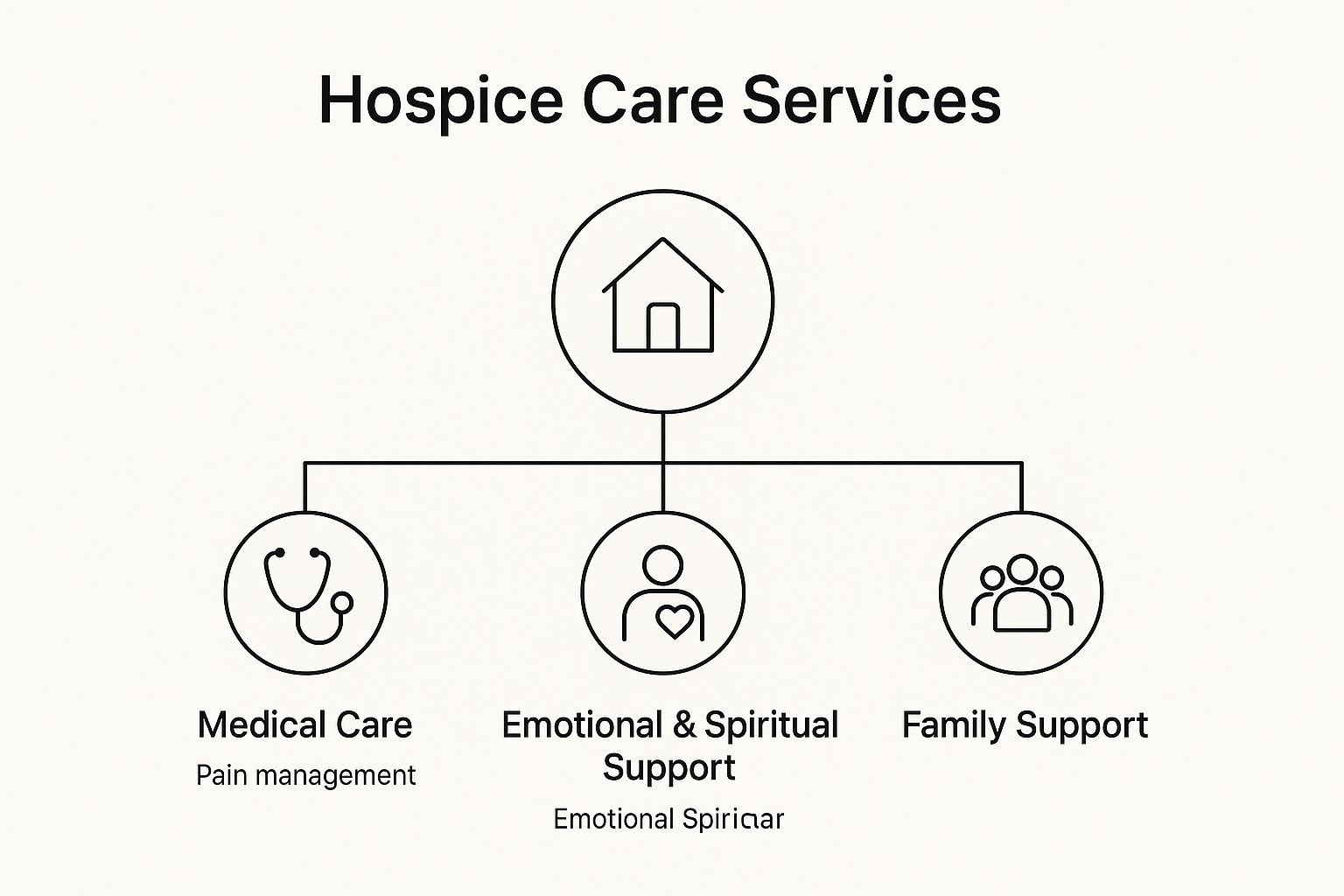
- Expert Pain and Symptom Management: A dedicated team works tirelessly to control pain, nausea, shortness of breath, and other symptoms.
- Emotional and Spiritual Support: Chaplains and Medical Social Workers are there to provide counseling and help patients and families navigate the complex emotions that arise.
- Reduced Family Stress: The hospice team offers education and hands-on assistance, lifting a significant burden from family members.
A Mission-Driven Approach to Care
As a nonprofit organization with over 74 years of service, Central Coast VNA & Hospice is deeply woven into the fabric of the communities we serve. Our mission is to provide this compassionate support to everyone who needs it in Monterey County, San Benito County, Santa Cruz County, and South Santa Clara County.
Hospice care is not about the end of a life, but rather about making the most of the life that remains. It’s a testament to the belief that every person deserves to live with dignity, comfort, and peace until their final moments.
The value of this approach is becoming more widely recognized. According to the National Hospice and Palliative Care Organization (NHPCO), over 1.72 million Medicare beneficiaries received hospice services in 2020 (NHPCO, 2021). This reflects a broader understanding of how crucial this specialized care is for our communities.
We know that figuring out all the details of hospice can feel overwhelming. If you're starting to explore options, our guide on hospice care for a loved one offers more information. It’s also good to be aware of evolving factors, and there are always additional things to know about hospice care that can help inform your decisions.
Meet Your Dedicated Hospice Care Team
Hospice care isn’t the work of just one person. It’s a philosophy brought to life by a team of compassionate professionals, all working together to support you and your family. This collaborative approach means that every part of a person's well-being—physical, emotional, and spiritual—gets the attention it deserves.
At Central Coast VNA & Hospice, this team is the core of our continuum of care, which includes home health, palliative care, and hospice. They work in close partnership with each other, the patient, their family, and the primary doctor to create a care plan that feels right for everyone.
The Core Members of Your Hospice Team
The real strength of hospice comes from this teamwork. Each member brings a unique skill, but they all share the same goal. Let's meet the key people who will be part of your journey.
Medical Director and Physicians The hospice Medical Director, alongside other team physicians, oversees all medical care. They don’t replace your primary doctor—they partner with them. Their job is to review the plan of care, manage any complex symptoms, and make sure every medical decision respects your wishes.
Registered Nurse (RN) Your Registered Nurse (RN) is usually the main point of contact for you and your family. These skilled nurses are experts in managing pain and other symptoms. They make regular visits to your home to check on you, administer medications, and provide direct, hands-on care.
Just as importantly, they teach family members how to provide support, giving them the skills and confidence they need.
Hospice Aide Hospice Aides provide the kind of personal, hands-on support that makes a world of difference in daily life. They help with activities like bathing, dressing, and other personal care, allowing patients to maintain their dignity and feel more comfortable. Their gentle assistance and compassionate presence are a true gift to both patients and their families.
Comprehensive Emotional and Spiritual Support
True comfort care goes far beyond physical symptoms. It’s about recognizing that emotional and spiritual peace are just as crucial for a person’s well-being.
Hospice is not about waiting for an end, but about creating a supportive environment where life, no matter how long it may be, can be lived with purpose and comfort. It's a promise to be there for every challenge and every quiet moment.
Medical Social Worker A serious illness brings a host of practical and emotional hurdles. The Medical Social Worker is your guide through these challenges. They can help your family find community resources, make sense of insurance paperwork, and plan for what’s ahead. They also offer counseling and support to help everyone cope.
Chaplain Spiritual questions often come to the surface during this time. A Chaplain provides non-denominational spiritual support that honors your individual beliefs and values. They offer a comforting presence, help explore questions about meaning and hope, and can connect you with your own faith community if you'd like.
Specially Trained Volunteers Volunteers are truly the heart of hospice, offering the simple yet profound gift of their time and companionship. They are carefully vetted and trained to provide a friendly visit, read a book aloud, or listen to life stories. Their presence gives family members a much-needed break and offers the patient a meaningful connection.
Each of these roles is vital, but their real power is in how they work together. If you're exploring this option for a family member, you might find our article on 5 reasons to consider hospice for a loved one helpful for gaining more clarity.
Exploring the Comprehensive Hospice Benefit

Many families are surprised to discover just how extensive hospice support really is. The hospice benefit is a complete package of care designed to address every aspect of a patient's well-being while also relieving burdens on their family. This all-inclusive approach is a core part of the philosophy behind hospice care.
Instead of juggling multiple bills for equipment, medications, and professional visits, the hospice benefit bundles everything into one coordinated service. This allows everyone to focus on what truly matters: spending quality time together.
What Is Covered Under the Hospice Benefit?
The main goal is to relieve physical, emotional, and financial stress. The hospice benefit, largely covered by Medicare, is quite comprehensive. It's also helpful to understand how different Medicare Supplement Plan options might fit with your primary coverage.
Our team at Central Coast VNA & Hospice helps families across Monterey County and nearby areas understand exactly what’s included. Here’s a quick look at what the hospice benefit typically covers:
- All Care from Your Hospice Team: This includes scheduled visits from your Registered Nurse, Hospice Aide, Medical Social Worker, and Chaplain.
- Medical Equipment: Anything needed for safety and comfort, like a hospital bed, wheelchair, or oxygen, is delivered right to your home.
- Medical Supplies: We provide necessary supplies such as wound care dressings, catheters, and incontinence products.
- Medications: All medications related to managing the symptoms of the terminal illness are fully covered.
- 24/7 On-Call Support: A Registered Nurse is available by phone 24 hours a day, 7 days a week, to answer questions or respond to urgent needs.
The hospice benefit is designed to remove barriers to comfort. By covering the costs of necessary equipment, supplies, and medications, it allows families to focus on care and companionship, not on navigating a complex healthcare system.
Hospice Care Services At a Glance
| Service Category | Description of Services Included |
|---|---|
| Expert Symptom Control | Your care team works to manage pain, nausea, anxiety, and other symptoms to keep the patient as comfortable as possible. |
| Personal Care Assistance | Our Hospice Aides help with daily activities like bathing and dressing, preserving dignity and providing hands-on comfort. |
| Counseling and Support | Medical Social Workers and Chaplains offer emotional and spiritual guidance for both the patient and their family members. |
| Bereavement Care | Our support for the family doesn’t end. CCVNA provides grief counseling and support groups for up to 13 months after a loved one’s passing. |
This complete network of support ensures that no one has to walk this journey alone. It provides practical help, emotional comfort, and the reassurance that a dedicated team is always there for you.
Receiving Hospice Care in the Comfort of Home
For most of us, there’s simply no place like home. This is why modern hospice care is built around the idea of bringing expert medical support directly to you, wherever you call home. This approach allows people to spend their final months surrounded by the people, pets, and possessions they love most.
At Central Coast VNA & Hospice, our teams work tirelessly across Monterey County, San Benito County, Santa Cruz County, and South Santa Clara County to make this a reality for families. This is the heart of what home care services are all about—shaping care around the lives of those who need it most.
Routine Home Care: The Standard of Hospice
The most common level of hospice is what we call Routine Home Care (RHC). This is the day-to-day care most patients receive, where our interdisciplinary team makes regular, scheduled visits to the patient's residence. This can be a private house, an assisted living community, or a nursing home.
This model isn't just common; it's what families overwhelmingly prefer. Under Routine Home Care, the CCVNA team provides a full range of support, including:
- Skilled Nursing Visits: A Registered Nurse regularly visits to assess the patient, manage medications, and provide expert symptom control.
- Hospice Aide Visits: Our Hospice Aides assist with personal care like bathing and dressing, focusing on comfort and preserving dignity.
- Psychosocial and Spiritual Support: A Medical Social Worker and Chaplain are available to provide emotional counseling and spiritual guidance.
Flexible Levels of Care for Changing Needs
While Routine Home Care is the foundation, we know that a person’s needs aren't static. The hospice benefit is designed to be flexible, offering different levels of care to respond to specific situations. This ensures every patient gets the right intensity of support at exactly the right time.
The ability to adapt care levels is a critical part of the hospice promise. It means that whether a patient needs steady, routine support or intensive crisis management, the team is equipped to respond with compassion and expertise.
Central Coast VNA & Hospice is always prepared to provide these elevated levels of care when needed.
Advanced Levels of Hospice Support
Beyond routine visits, there are three other levels of care designed for more acute situations:
- Continuous Home Care (CHC): If a patient experiences a medical crisis, like uncontrolled pain, this level can be initiated. It brings a Registered Nurse or Hospice Aide into the home for extended periods (8 to 24 hours a day) to provide intensive management until the crisis is resolved.
- General Inpatient Care (GIP): For symptoms that cannot be managed at home, a patient might be temporarily moved to a hospital or skilled nursing facility that partners with us. The goal is to stabilize the patient so they can return home as soon as possible.
- Inpatient Respite Care: We know that being a family member providing care is demanding. Respite care allows a patient to be temporarily admitted to a facility for up to five days, giving their family a much-needed break to rest and recharge.
This flexible structure is a core part of how our hospice services on the Central Coast are designed to meet the real-world needs of each patient and their family.
How to Qualify and Pay for Hospice Care

Talking about the logistics of healthcare, especially during an emotional time, can feel overwhelming. Our goal is to demystify the rules around eligibility and payment for hospice care. The truth is, the process is often more straightforward than people think.
At its heart, hospice is for people nearing the end of their life’s journey. The path to receiving this care is based on clear medical guidance to ensure it’s provided at the right time.
Understanding Hospice Eligibility
The main factor for hospice eligibility comes down to a medical prognosis. To qualify, a person needs a diagnosis for a life-limiting illness and a life expectancy of six months or less, assuming the illness runs its natural course.
This isn’t a decision made by just one person. It requires two separate physicians to agree and certify the prognosis:
- The patient's own primary care physician or a specialist.
- The hospice provider’s medical director.
This dual-certification process ensures a thoughtful evaluation of the person's condition. For a deeper dive, you can learn more about how doctors determine hospice eligibility in our dedicated guide.
How Hospice Care Is Paid For
For many families, one of the biggest sources of relief is discovering that hospice is a fully covered benefit. This lifts a significant financial weight off their shoulders. The entire system is built to make this crucial support accessible.
Financial stress should never be a barrier to receiving compassionate end-of-life care. The hospice benefit is structured to cover nearly all aspects of care, allowing families to focus on love and support, not on medical bills.
Here’s a look at the most common ways hospice services are paid for:
- Medicare Part A: For most older adults, hospice is a 100% covered benefit under Medicare Part A. This includes virtually everything related to the terminal diagnosis with no deductibles or copayments for the hospice care itself.
- Medi-Cal and Medicaid: Hospice is also a covered benefit under Medi-Cal (California's Medicaid program), which ensures that low-income individuals and families have access to the same high-quality care.
- Private Insurance: The vast majority of private health insurance plans offer a comprehensive hospice benefit. Our team at Central Coast VNA & Hospice can work with you to verify your specific plan’s coverage.
Our Commitment as a Nonprofit Provider
As a local nonprofit, Central Coast VNA & Hospice has a mission that’s deeply rooted in serving our communities. We are committed to providing care to every eligible person, regardless of their ability to pay.
Thanks to the incredible generosity of community donors, we make sure no one is ever turned away due to their financial situation. This promise has been at the core of our work for over 74 years.
Frequently Asked Questions About Hospice Care
When families start to explore hospice care, it’s natural to have a lot of questions. To bring some clarity to the process, our team at Central Coast VNA & Hospice has answered the questions we hear most often.
1. Does choosing hospice mean we are giving up hope?
Absolutely not. Hospice isn't about giving up—it's about redefining hope. Instead of focusing on the hope for a cure, the goal shifts to hope for comfort, peace, and the best quality of life possible. You can learn more by reading about common misperceptions about hospice care.
2. Can a patient leave hospice care once they start?
Yes, they can. A person has the right to stop hospice care at any time, for any reason. If someone’s condition unexpectedly improves, or if they decide to try a curative treatment, they simply sign a form to end services. They are always free to re-enroll in hospice later if their situation changes.
3. Who makes the decision to start hospice care?
The decision to begin hospice is a deeply personal one, usually made by the patient after talking with their family and doctor. While a physician makes the official referral, anyone can start the conversation. We encourage families to contact a provider like Central Coast VNA & Hospice directly to ask questions and learn about their options.
4. How does hospice care support the family?
Hospice care is built to support the entire family, not just the person who is ill. Our team gives family members the education and hands-on training they need to feel confident at home. Medical Social Workers and Chaplains also provide emotional and spiritual counseling, and we offer bereavement services for up to 13 months after a loved one passes.
5. Where is hospice care provided?
Hospice care is provided wherever the patient calls home. For most people, this is a private residence, but it can also be an assisted living facility or nursing home. Our teams at Central Coast VNA & Hospice serve patients throughout Monterey County, San Benito County, Santa Cruz County, and South Santa Clara County.
At Central Coast VNA & Hospice, we are committed to providing compassionate, expert care that honors the wishes of every patient and family we serve. With over 74 years of nonprofit service to the Central Coast, our team is here to guide you with dignity and respect. If you have more questions about hospice care in Monterey County, please contact us today to learn how we can help.
{ “@context”: “https://schema.org”, “@type”: “FAQPage”, “mainEntity”: [ { “@type”: “Question”, “name”: “Does choosing hospice mean we are giving up hope?”, “acceptedAnswer”: { “@type”: “Answer”, “text”: “No. Hospice is not about giving up hope u2014 it is about redefining it. Instead of focusing on a cure, the goal shifts to hope for comfort, peace, and the best possible quality of life. Many families find that hospice allows their loved one to live more fully in the time they have.” } }, { “@type”: “Question”, “name”: “Can a patient leave hospice care once they start?”, “acceptedAnswer”: { “@type”: “Answer”, “text”: “Yes. A person has the right to stop hospice care at any time, for any reason. If a patient’s condition unexpectedly improves or they decide to pursue curative treatment, they simply sign a form to revoke the hospice benefit and can re-enroll later if needed.” } }, { “@type”: “Question”, “name”: “Who makes the decision to start hospice care?”, “acceptedAnswer”: { “@type”: “Answer”, “text”: “The decision to begin hospice is a deeply personal one, usually made by the patient in conversation with their family and physician. While a doctor makes the official referral, anyone u2014 the patient, a family member, or a friend u2014 can start the conversation with Central Coast VNA & Hospice.” } }, { “@type”: “Question”, “name”: “How does hospice care support the family?”, “acceptedAnswer”: { “@type”: “Answer”, “text”: “Hospice care at Central Coast VNA & Hospice supports the entire family, not just the patient. Our team provides education, hands-on training, emotional support through Medical Social Workers, spiritual care through chaplains, and bereavement support for up to 13 months after a loved one’s passing.” } }, { “@type”: “Question”, “name”: “Where is hospice care provided?”, “acceptedAnswer”: { “@type”: “Answer”, “text”: “Hospice care is provided wherever the patient calls home u2014 a private residence, assisted living facility, or nursing home. Central Coast VNA & Hospice serves families throughout Monterey, Santa Cruz, San Benito, and South Santa Clara Counties.” } } ] }