
For most families, the preference is crystal clear: they want compassionate, effective in-home support to avoid nursing home placement altogether. This allows loved ones to age with dignity in the place they know and cherish. They can be surrounded by a lifetime of memories and the simple comfort of their own community.
The Growing Desire to Age with Dignity at Home
Deciding to age in place is not just about logistics; it’s a deeply emotional choice. The sense of independence and normalcy that comes from being at home is something you cannot replicate in an institutional setting.
The data backs this up. AARP has found that a vast majority of seniors want to stay in their own homes as they age. Often, the financial side also makes sense, since in-home care can be more affordable than a residential facility.
For over 74 years, Central Coast VNA & Hospice has been dedicated to making this happen for families across Monterey County, San Benito County, Santa Cruz County, and South Santa Clara County. As a local, mission-driven nonprofit, our commitment is to one thing: helping people live well, right where they belong.
Why Home Is Where the Health Is
Staying at home means staying connected. It's about keeping vital links to neighbors, friends, and the familiar routines that are so important for mental and emotional well-being. This continuity helps sidestep the stress and confusion that often come with moving to a new environment.
And let's not forget independence. The simple things—making a meal in your own kitchen, sleeping in your own bed—give a person a sense of self-worth and control over their own life.
When you bring professional support into the home, you create an environment that honors a person's desire for independence while making sure their health and safety are covered. It becomes a true partnership between the clinical team, the patient, and their family.
To give you a clearer picture, let's look at how professional home support stacks up against a nursing home facility.
Comparing In-Home Support and Nursing Home Care
This table offers a clear, at-a-glance comparison between professional support at home and traditional nursing home care. It focuses on key differences in environment, cost, and personalization.
| Feature | In-Home Support | Nursing Home Facility |
|---|---|---|
| Environment | Familiar, comfortable, and private setting. | Institutional environment with set schedules. |
| Personalization | Highly personalized, one-on-one care tailored to individual needs and routines. | Standardized care for multiple residents. |
| Independence | Promotes autonomy and preserves daily routines. | Limited independence due to structured living. |
| Cost | Often more affordable, with flexible service hours. | Can be very expensive, with all-inclusive daily rates. |
| Family Involvement | Family can be closely involved in daily care. | Visiting hours and facility rules may limit involvement. |
Ultimately, the choice depends on individual needs. For many, the benefits of staying home are undeniable.
A Continuum of Care Tailored to Your Needs
Healthcare needs change, and we understand that. Central Coast VNA & Hospice provides a seamless range of services that adapt as a patient's condition evolves, ensuring there are no gaps in care.
Our services include:
- Home Health: Skilled nursing and therapy to help you or your loved one recover from surgery, illness, or an injury.
- Palliative Care: Specialized support focused on managing symptoms and improving quality of life for those with serious illnesses.
- Hospice Care: Compassionate end-of-life care that provides comfort, dignity, and support for patients and their families.
Sometimes, small things make a huge difference in preserving that feeling of independence. Simple assistive devices, like adjustable over-bed tables, can make daily activities much easier and safer.
Choosing in-home support is a powerful decision that puts comfort, dignity, and personal choice first. By understanding the options and finding a trusted partner, you can confidently create a plan that truly honors your loved one’s wishes. You can explore our expert guidance on aging in place care services to see exactly how we can help.
Decoding Your In-Home Care Options

When you're trying to find the right in-home support to avoid nursing home placement, the terminology can be confusing. "Home health," "palliative," and "hospice" are often used interchangeably. However, they represent very different types of care designed for specific points in a person's health journey.
Understanding the distinctions is the key to getting the right help at the right time.
At Central Coast VNA & Hospice, we provide this full spectrum of services. Families in Monterey County and the surrounding areas never have to search for a new provider as needs change. Our nonprofit mission is to create a seamless experience, offering stability and trust when you need it most.
Home Health Care: Focused on Recovery
Think of home health care as short-term, skilled medical support prescribed by a doctor. It is designed to help someone recover from an illness, injury, or surgery. It’s for individuals who are considered homebound and need clinical expertise to get back on their feet safely.
For example, imagine a Santa Cruz County resident just home after a hip replacement. A CCVNA Registered Nurse might visit to manage medications and check the surgical wound. A Physical Therapist would guide them through exercises to regain mobility in their own living room.
Home health is all about active, goal-oriented rehabilitation. It provides the specific clinical support a patient needs to restore their independence and get back to their life.
Palliative Care: For Comfort and Quality of Life
Palliative care is specialized support for people living with a serious illness. Unlike home health, it is not limited by time and can begin at any stage of a diagnosis. It can even be provided while pursuing curative treatments.
The entire focus is on improving quality of life by managing symptoms, pain, and stress.
Let’s say a family in South Santa Clara County is caring for a loved one with a progressive lung condition. A CCVNA palliative care team—which could include a Nurse Practitioner, Medical Social Worker, and Chaplain—works alongside the patient's other doctors. They might help manage breathing issues, address anxiety, and offer emotional support to the entire family. To see how our teams can help, you can learn more about skilled nursing at home and our other specialized services.
Hospice Care: A Shift to Compassionate Comfort
Hospice is a special kind of care for individuals with a life-limiting illness, where the focus shifts from cure to comfort. It's typically for those with a prognosis of six months or less if the disease takes its natural course. Hospice provides expert pain and symptom management, as well as emotional and spiritual support for both the patient and their family.
In San Benito County, a CCVNA Hospice Aide could help a patient with personal care. A Registered Nurse would ensure their pain is completely under control. A Chaplain or Medical Social Worker might also be there to provide counseling, helping the family navigate this difficult time with peace and dignity.
As a nonprofit with over 74 years of local history, our promise is to deliver this comfort wherever a patient calls home. The U.S. home care industry statistics show a compelling financial reason for staying home as well.
How to Accurately Assess Your Loved One’s Needs
The first real step toward arranging in-home support to avoid nursing home care is getting a clear, honest picture of what your loved one actually needs. This isn't just a quick check-in. It's a gentle but thorough look at their daily life, the challenges they face, and where they could use a helping hand.
The goal is to move past vague worries like, "Dad seems to be struggling," and get to specific, actionable insights. For instance, "Dad has forgotten his blood pressure medication three times this week and I've noticed he has a hard time getting up from his favorite chair." This level of detail is what turns a concerned conversation into a productive plan.
This infographic lays out the key steps families can take to get organized. It helps coordinate the right kind of in-home support.
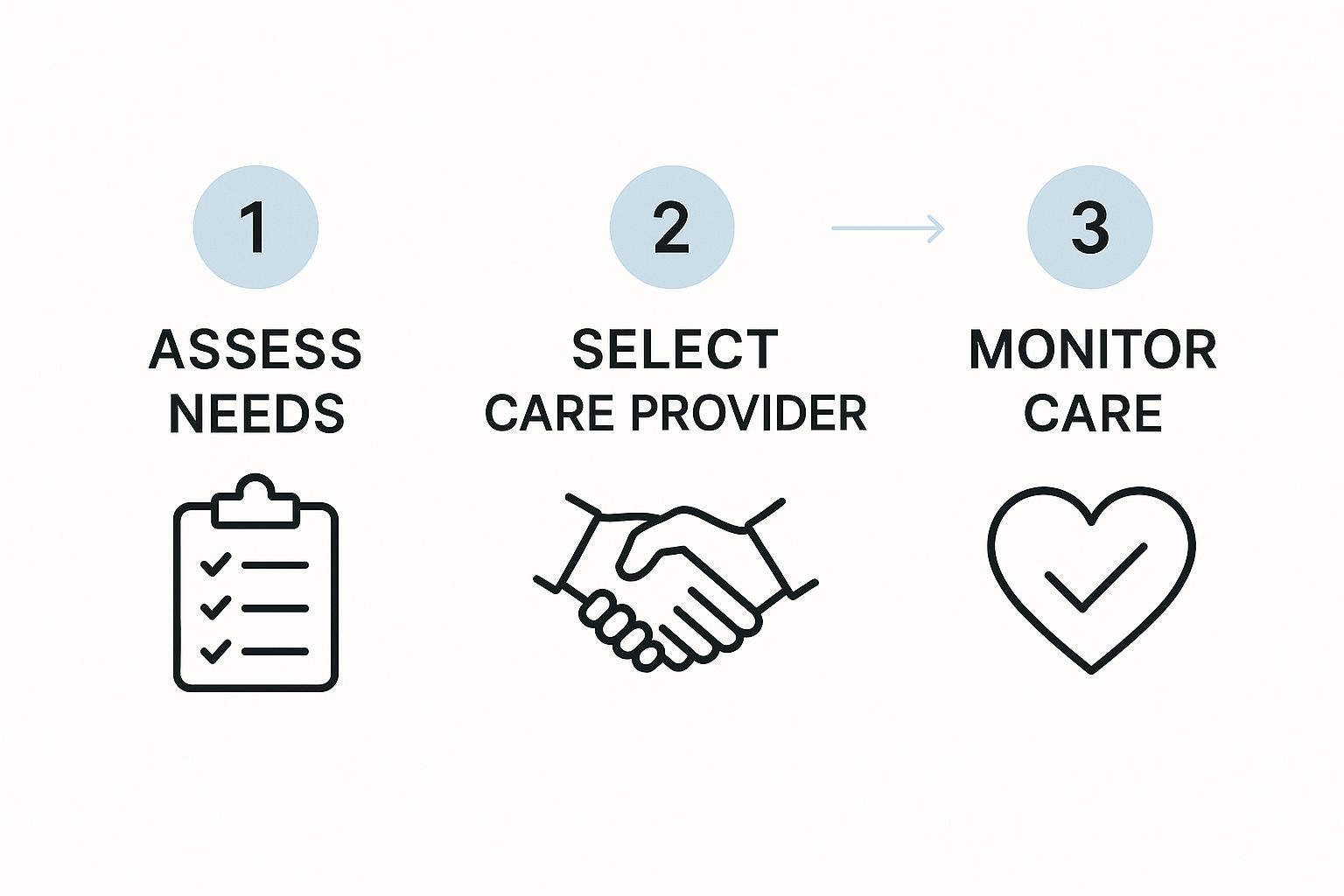
As you can see, it highlights a simple, logical flow—from the initial assessment to ongoing management. Having a structured approach makes all the difference.
Key Areas for Assessment
A good assessment goes far beyond a medical diagnosis. You need to look at the whole person. This includes their physical abilities, specific medical needs, the safety of their home, and their emotional well-being.
Breaking it down into categories makes this feel much less overwhelming. Think of these areas as a guide for your observations and conversations.
Medical and Clinical Requirements
This is where you focus on the specific health tasks that might require a skilled professional.
- Medication Management: Is Mom or Dad taking the correct doses at the right times? Who is managing the refills?
- Wound Care: Are there any post-surgery incisions, pressure sores, or other wounds that need professional attention?
- Symptom Control: Are they dealing with unmanaged pain, shortness of breath, nausea, or other persistent symptoms from a chronic illness?
- Medical Equipment: Is your loved one using oxygen, a catheter, an IV line, or other specialized medical devices that require monitoring?
Activities of Daily Living (ADLs)
ADLs are the absolute basics of self-care. When these become a struggle, it’s often one of the first signs that help is needed.
- Personal Hygiene: Is bathing, grooming, or getting dressed becoming difficult or unsafe?
- Mobility: Can they get around the house safely? What about standing up from a bed or chair?
- Toileting: Is using the bathroom independently becoming a challenge?
- Eating: Can they feed themselves once a meal is prepared?
Instrumental Activities of Daily Living (IADLs)
These are the more complex activities necessary for living independently in the community.
- Meal Preparation: Are they able to plan and cook nutritious meals, or are they relying on snacks and toast?
- Housekeeping: Can they keep their living space reasonably clean and safe from clutter and fall hazards?
- Managing Finances: Are bills getting paid on time? Is mail piling up unopened?
- Transportation: Can they still drive safely, or can they arrange rides to the doctor or grocery store?
Social and Emotional Well-Being
A person’s mental and emotional state is every bit as important as their physical health. Do not overlook it.
- Companionship: Do they seem lonely or isolated? Are they withdrawing from hobbies or friends?
- Safety: Are you worried about them being alone? Have there been falls, or even near-misses?
- Cognitive Function: Have you noticed any troubling memory loss, confusion, or changes in their judgment or personality?
A Note on Starting the Conversation: These topics can be really sensitive. It's best to frame questions from a place of love and concern. Instead of saying something that sounds critical, try, "I was wondering if having someone help with meals a few times a week might make your days a little easier?"
The Importance of a Professional Assessment
While your family’s observations are invaluable, a professional assessment is the next critical step. A Registered Nurse from Central Coast VNA & Hospice can come to the home and conduct a thorough evaluation. This creates a formal, personalized plan of care that meets clinical standards.
This professional assessment is often essential for qualifying for home health care and ensuring that services are covered by Medicare or other insurance.
Our clinicians are trained to see the full picture. They can identify needs you might have missed and connect them to the right services. This step is what transforms your loving concern into a concrete action plan, allowing your loved one to age safely and comfortably at home.
Navigating the Financials of Home-Based Support

Let's be honest: for most families, figuring out how to pay for care is the biggest hurdle. The financial side of things can feel overwhelming, but it doesn't have to be. There are well-established ways to cover the costs of professional medical support right at home.
With a 74-year history of serving the Central Coast, we at Central Coast VNA & Hospice have guided countless families through this process. As a Medicare-certified nonprofit, our mission is to ensure every eligible person in Monterey, San Benito, Santa Cruz, and South Santa Clara Counties can get the care they need. Our nonprofit status and community support make this possible.
Medicare Coverage for Home Health and Hospice
Medicare is often the first stop and the primary payer for many clinical services you'd receive at home. The key is understanding what it covers and under what circumstances.
- Both Medicare Part A and Part B will cover intermittent skilled nursing, physical therapy, occupational therapy, and speech therapy services delivered in your home.
- To qualify, a patient must be under a doctor's care, have a physician-established plan of care, and be certified as homebound.
- The Medicare Hospice Benefit is a comprehensive package that covers nearly every aspect of hospice care, from nursing services and medical equipment to medications.
This coverage is what makes skilled home health care services a real, financially sound option for so many seniors. It's important to remember that Medicare generally doesn't cover 24-hour care at home or personal care if that's the only type of support you need.
Other Key Funding Sources
Beyond Medicare, several other resources can help families manage the costs of staying at home. You just need to know where to look.
Medi-Cal
California's Medicaid program, Medi-Cal, is an essential resource. It often picks up where Medicare leaves off, covering services like long-term personal care. Eligibility is tied to income and medical need, and our team can help you determine if you or a family member might qualify.
Private Insurance Plans
Many private health insurance plans, including Medicare Advantage (Part C) plans, offer their own benefits for home health care. The details, like co-pays and deductibles, can vary from one plan to the next. The best approach is always to call the insurance provider directly, or let our care coordinators handle it.
Veterans Affairs (VA) Benefits
Veterans may be eligible for a range of home-based care benefits through the VA. This can include skilled home health care, homemaker services, and specialized hospice care. Our team has deep experience working with the VA to coordinate care for local veterans.
Navigating these different payment systems requires real expertise. As a trusted local nonprofit, we help families understand their benefits and coordinate directly with payers to ensure a smooth, stress-free process.
Your Nonprofit Partner in Care
Because Central Coast VNA & Hospice is a nonprofit organization, our one and only focus is on patient care. We focus on the well-being of our community, not on generating profits for shareholders. This is a fundamental difference.
The generous donations from our community allow us to provide care to all eligible patients. We help bridge financial gaps whenever they appear.
We truly believe that financial worries should never stand in the way of receiving high-quality, compassionate care at home. Contact us today to speak with one of our knowledgeable team members. We can help clarify your coverage options and guide you toward the best solution for your family.
Creating a Safe and Supportive Home Environment
Effective in-home support to avoid nursing home placement is about more than just scheduled medical visits. It’s about looking at the entire home environment. The goal is to transform it into a space that truly supports independence and minimizes risk.
The first step is always a practical look at the living space. Here at Central Coast VNA & Hospice, our teams conduct professional home safety assessments. We walk through homes across Monterey, San Benito, Santa Cruz, and South Santa Clara Counties to spot potential hazards and suggest simple modifications.
Practical Steps for a Safer Home
Making a home safer doesn't have to be a massive, expensive project. Some of the most effective changes are surprisingly simple. The number one priority is fall prevention, because a single fall can easily lead to a hospital stay.
Start with these key strategies to boost home safety:
- Clear the Decks: Walk through every room and clear pathways of any clutter. Small throw rugs are notorious trip hazards, so either secure them with double-sided tape or remove them.
- Light It Up: Good lighting is non-negotiable. Make sure hallways, stairways, and bathrooms are brightly lit. A few well-placed nightlights can create a safe, illuminated path for middle-of-the-night trips.
- Install Grab Bars: These are essential. Place sturdy grab bars next to the toilet and both inside and outside the shower or bathtub.
- Keep Communication Easy: A phone should always be within arm's reach. Program important contacts into the phone and make sure the numbers are easy to read. A medical alert system provides peace of mind.
A safe home environment is the foundation of successful aging in place. It builds confidence, reduces family anxiety, and allows clinical care to be delivered more effectively, ultimately preventing the need for facility-based care.
Don't Forget Emotional Well-Being
Physical safety is just one side of the coin. A person's emotional and social health is just as critical for maintaining a high quality of life at home. Loneliness can quickly lead to depression and a decline in physical health.
Keeping someone socially engaged can be as straightforward as arranging regular visits from friends. Setting up video chats with family or finding a local community group can also help. It’s all about keeping the mind active and the spirit lifted.
The COVID-19 pandemic gave us all a stark reminder of the benefits of being at home. Research from the time reinforced what many of us already knew—home is often the safest place to be. You can learn more by reviewing the research on nursing home statistics to understand the full scope.
Our teams are dedicated to working with families to build a supportive atmosphere. We look after both physical safety and emotional needs, ensuring home truly is the best place to be.
Frequently Asked Questions About In-Home Support
1. How do we know when it's the right time for help?
The best time to ask for help is when you start wondering if you need it, not during a crisis. If you notice an increase in falls, difficulty with daily tasks like managing medication, or a recent hospitalization has taken a toll, it's a good time to explore options. An early assessment provides a clear path forward.
2. What is the difference between home health, palliative, and hospice care?
Think of them as a continuum. Home Health Care is short-term, skilled medical care prescribed by a doctor for recovery. Palliative Care focuses on improving quality of life for those with serious illness, at any stage. Hospice Care is for those with a life-limiting illness, shifting the focus to comfort and dignity.
3. Will Medicare pay for in-home support?
Yes, Medicare Part A and Part B cover eligible home health services, such as skilled nursing and physical therapy, if a patient is certified homebound by a doctor. The Medicare Hospice Benefit is also comprehensive. However, Medicare generally does not cover 24-hour care or personal care services alone.
4. What makes Central Coast VNA & Hospice different from other agencies?
As a local, independent nonprofit with over 74 years of service, our sole mission is patient care, not profit. We reinvest all resources back into our community and staff. Our dedicated team of employees ensures a higher standard of care and accountability to families in Monterey County, San Benito County, Santa Cruz County, and South Santa Clara County.
5. How do we start the process with CCVNA?
Getting started is simple. You, a family member, or your doctor can call us to begin the conversation. To officially start services, we need a physician's referral. Our team will then help verify insurance and schedule an in-home assessment with a Registered Nurse to create a personalized care plan.
Taking that first step to secure quality care at home can bring an enormous sense of relief. The experienced, compassionate team at Central Coast VNA & Hospice is here to guide you through every question. We can help ensure your loved one can stay safely and comfortably right where they want to be.
Contact us today or visit us online at ccvna.com to learn more about how we can support your family.