
Choosing a hospice for someone you love is one of the most profound decisions a family can make. This decision often comes at a time when you're already feeling overwhelmed.
While your heart and gut instincts are important, grounding your choice in objective measures is key. Trust, transparency, and real patient stories will ensure your loved one receives high-quality care. This guide will walk you through how to use these three pillars to find the right care partner.
Making an Informed and Compassionate Hospice Choice
Finding the right hospice means looking past glossy brochures to find measurable proof of excellence. It’s about learning to evaluate a provider’s history in the community and understanding public data. Authentic testimonials reflect the true character of their team and empower you to be the best advocate for your loved one.
New regulations are raising the bar on care standards. Families are paying closer attention to things like satisfaction scores, CAHPS survey results, and provider ratings. With over 70% of people reading reviews before choosing a healthcare provider, testimonials and ratings have become essential trust signals.
The Three Pillars of a Good Decision
To make a confident choice, it helps to focus on three core factors. Think of these as the legs of a sturdy stool—each is essential for stable, reliable support. These pillars help you see the complete picture of a hospice agency.
- Trust: This is built on a provider's proven track record and deep local roots. A long history of service, like Central Coast VNA & Hospice’s 74+ years on the Central Coast, is a powerful indicator of reliability.
- Transparency: A transparent provider openly shares their quality scores and patient satisfaction results. They make it easy for families to find data from objective sources like the CAHPS Hospice Survey.
- Testimonials: These are the human stories behind the statistics. Authentic reviews give priceless insights into the compassion of the care team, from the Registered Nurse managing symptoms to the Hospice Aide providing comfort.
Choosing a hospice isn't just about finding medical support; it's about partnering with a team that honors your loved one's dignity and brings peace of mind to the entire family.
To help you organize your thoughts, here’s a quick look at how these three pillars work together.
Key Pillars for Choosing a Hospice
A quick look at the three core factors—Trust, Transparency, and Testimonials—and what they mean for your family's decision.
| Pillar | What to Look For | Why It Matters for Your Family |
|---|---|---|
| Trust | A long history in the community, non-profit status, and a clear, patient-focused mission. | A long-standing provider has proven its reliability and commitment, ensuring stable, dependable care when you need it most. |
| Transparency | Publicly available quality scores (like CAHPS ratings) and clear communication about services and staffing. | This shows the agency is confident in its quality of care and has nothing to hide, giving you confidence in your choice. |
| Testimonials | Specific, heartfelt stories from other local families that mention staff members and the quality of care provided. | Real stories go beyond data, revealing the true compassion, responsiveness, and humanity of the care team. |
By focusing on these three areas, you can cut through the noise and find a partner you can truly rely on.
Educating yourself on what quality hospice looks like helps you ask the right questions. Many don’t realize there are differences between providers. Taking the time to learn how to find the best hospice care near me can make an incredible difference.
Beyond immediate needs, families often face practical challenges. A compassionate guide for cleaning out a house after death can provide direction for managing difficult tasks.
Central Coast VNA & Hospice is available to explain what quality care looks like—at no cost or commitment. If your family is in Monterey County, San Benito County, Santa Cruz County, or South Santa Clara County, please contact our team.
Building a Foundation of Trust in Hospice Care
When it comes to end-of-life care, trust isn't just a feeling—it's everything. It’s built on a provider’s proven history of reliability and deep roots in the community. This foundation assures you that your family can count on a consistent, professional, and caring team.
A trustworthy reputation is earned over years, not overnight. For families here in Monterey County or San Benito County, that means looking for an organization with decades of local service. A long history signals stability and a real understanding of our community's needs.
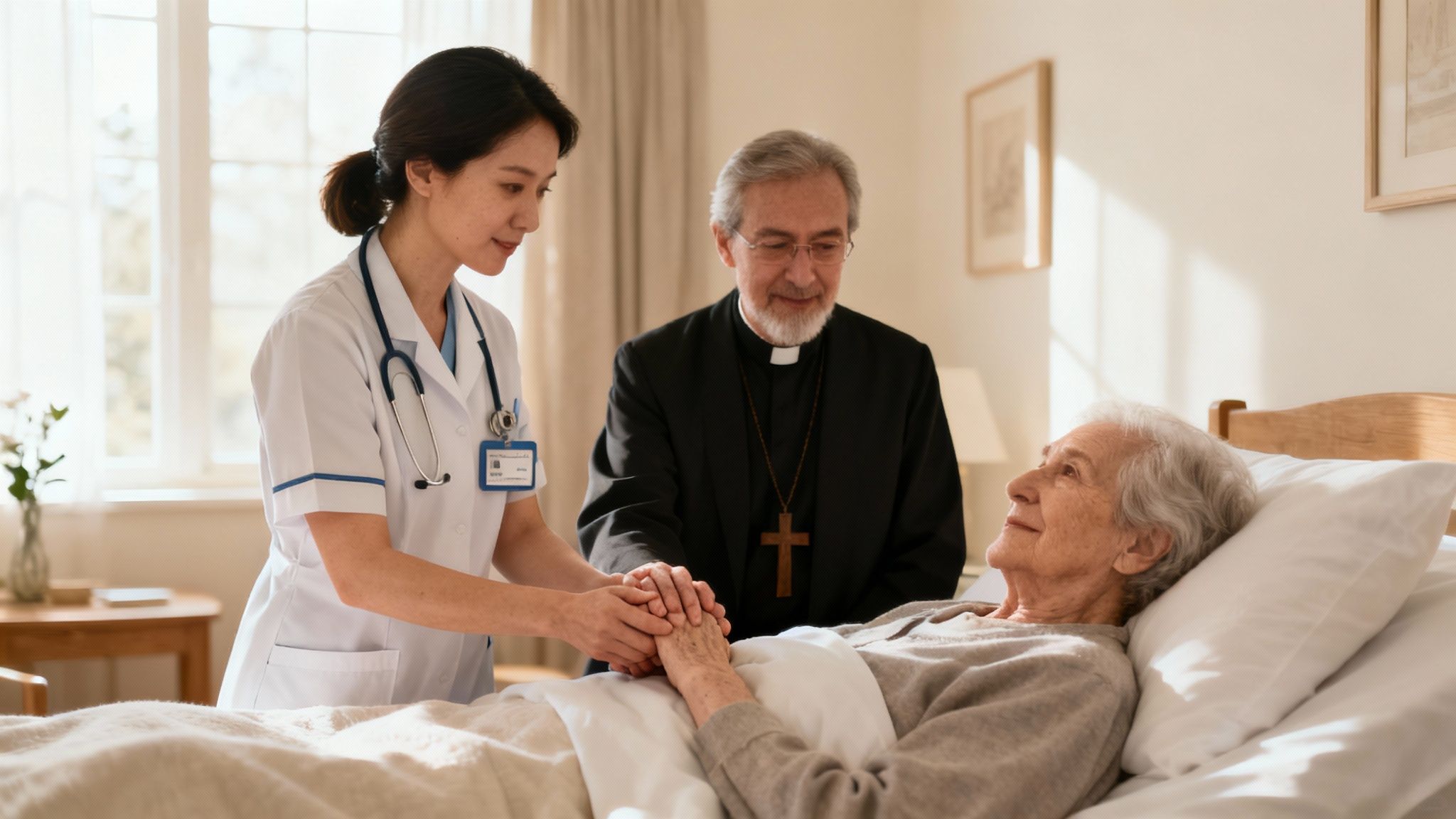
Nonprofit Mission vs. For-Profit Models
A huge piece of the trust puzzle comes down to a hospice’s core mission. Nonprofit providers, like Central Coast VNA & Hospice, are mission-driven. Our primary focus is on patient care and community well-being, not generating profits.
Any excess revenue is put right back into enhancing patient services, community programs, and staff training. In contrast, for-profit agencies answer to their investors, which can sometimes influence care decisions. A nonprofit's sole commitment is to the patients and families it serves.
The Power of an Interdisciplinary Team
A truly trustworthy hospice provider doesn't just send one person to help. They bring a full, coordinated team of professionals who work together. This structure is a hallmark of high-quality, reliable care.
This interdisciplinary team creates a seamless support system. It ensures every physical, emotional, and spiritual need is met with expertise and heart.
At Central Coast VNA & Hospice, our team approach means you are never alone. A dedicated group of professionals collaborates to create a circle of support around your family, ensuring consistent and holistic care.
So, who is on this team? Here’s a look at the professionals who work together for your family:
- Registered Nurse: Manages pain and other symptoms and coordinates the overall medical care plan.
- Hospice Aide: Provides gentle, hands-on personal care, like assistance with bathing and dressing.
- Medical Social Worker: Offers emotional support and helps families connect to community resources.
- Chaplain: Provides spiritual support that respects your family’s unique beliefs and values.
This collaborative model ensures no detail is overlooked and that your family feels fully supported. Understanding the importance of online reputation management also reflects a provider's credibility.
With over 74+ years of service on the Central Coast, organizations with deep local roots have a proven legacy. You can see how Central Coast VNA & Hospice impacts lives by reading these stories of compassionate care.
Using Transparency to Measure Quality of Care
When you're choosing a hospice, how can you be sure you’re getting the best possible care? True quality comes down to transparency. A transparent provider is open and honest about their performance, sharing public data that works like a report card.
This data lets you look past the sales pitch and see objective proof of how an agency supports families. This openness is a cornerstone of trust between a healthcare provider and families in communities like Salinas and Santa Cruz.

Finding a Hospice Report Card
So, where do you find this "report card"? The most powerful tool you have is the CAHPS Hospice Survey. This is a national survey that gathers feedback directly from families who have received hospice care.
Since 2015, the Centers for Medicare & Medicaid Services (CMS) has required hospices to participate. The results are posted on Medicare.gov, allowing families to compare agencies. It’s a real snapshot of quality care that empowers you to make an informed choice.
These surveys aren't just about statistics; they capture the heart of the hospice experience. They reveal how well a team managed a patient’s symptoms and supported a family’s emotional needs.
By looking at this public data, you can see a provider’s track record for delivering compassionate, consistent care. It helps you move from hoping for good care to expecting it based on proven results.
What to Look For in the Data
When you review the survey results on Medicare’s Care Compare website, you’ll see how different providers score. This is your window into what day-to-day support will actually look and feel like.
To get a clear picture, focus on these key areas:
- Communication with Family: This score shows how well the team kept everyone informed about the patient’s condition.
- Getting Timely Help: This tells you how quickly the hospice responded when the family needed help.
- Treating Patient with Respect: This is a direct measure of the compassion and humanity of the care provided.
- Emotional and Spiritual Support: This reflects how well the hospice addressed the needs of both the patient and the family.
These scores give you a way to compare providers in Monterey County and neighboring areas side-by-side. Understanding how hospices are funded also adds important context, especially for nonprofit organizations like Central Coast VNA & Hospice.
By using these transparent, public tools, you become an empowered advocate for your family. You can make a decision based on what a provider’s past performance proves.
The Human Story Behind Testimonials and Reviews
Data and quality scores give you the black-and-white numbers. Testimonials and patient stories provide the heart of the hospice experience. These personal accounts reveal the compassion that statistics alone can never capture.
When you know how to read between the lines, these stories give you real, authentic insights.
These stories matter. With over 70% of people reading online reviews when choosing healthcare providers, genuine feedback is an essential trust signal. Hearing from others who have walked a similar path can be incredibly reassuring.
Looking for Consistent Themes in Feedback
One of the most powerful ways to use testimonials is to look for consistent themes. A single glowing review is nice, but a pattern of praise across multiple reviews tells a much bigger story. It signals that a positive experience is part of the provider's culture.
As you read, ask yourself if the same comments keep popping up. These patterns are clues to a provider’s true strengths.
- Compassionate Staff: Do different reviews mention a specific Hospice Aide who was exceptionally gentle? Consistent praise points to a strong, caring staff culture.
- Excellent Communication: Look for comments that highlight how well the team kept the family informed. Phrases like "they always answered our calls" are signs of a supportive provider.
- Effective Symptom Management: Do families mention how comfortable their loved one was? Comments about pain control are direct indicators of high-quality clinical care.
Finding these recurring themes helps build confidence in the team you’re choosing.
How to Spot an Authentic and Helpful Review
Not all reviews are created equal. To get the most value, you need to know how to spot genuine, detailed stories. Authentic testimonials are full of specific details that paint a clear picture.
A truly helpful review will often include:
- Specific Examples: Instead of saying "the care was good," a detailed review might share, "The Hospice Aide knew exactly how to reposition my father to make him comfortable."
- Names or Roles: When a family mentions a professional by their role (e.g., "our Medical Social Worker"), it suggests that person made a significant impact.
- The Full Journey: The most insightful stories touch on the entire experience, from the first call to bereavement support.
Testimonials and family satisfaction scores are more than just marketing tools; they are critical benchmarks for evaluating quality. Positive feedback often correlates with better patient outcomes and a more peaceful end-of-life experience for the entire family.
Research backs this up. According to one study, patients receiving hospice care report a 44.8% increase in satisfaction ratings and experience significantly fewer hospitalizations. You can explore research on hospice patient outcomes to learn more.
Reading about the experiences of other local families can be incredibly powerful. You can read our VNA & Hospice stories to see firsthand how our team has supported families across Monterey and Santa Cruz Counties.
Critical Questions to Ask Any Hospice Provider
When you're meeting with potential hospice providers, walking in prepared can make all the difference. Knowing what to ask helps you become the best advocate for your loved one. It allows you to clearly compare your options and find a team that fits your family’s values.
Think of it as an interview for one of life’s most significant journeys. Below is a checklist of practical questions to guide these crucial conversations. We'll also get into why each question is so important.
Care Team and Support
A hospice is only as good as its people. The quality of care your loved one receives comes down to the expertise and compassion of the team. These questions will help you understand how their team actually operates.
A great provider won't hesitate to give you specific, concrete answers.
- What is your staff-to-patient ratio? A lower ratio often translates to more direct, hands-on care from the Registered Nurse and Hospice Aide.
- How often will a Registered Nurse and Hospice Aide visit? You're looking for a provider who offers consistent, planned visits, not one that only shows up in a crisis.
- Is your entire team—including Chaplains and Medical Social Workers—employed directly by your agency? Direct employees usually mean better communication and more coordinated care.
- What does your after-hours support look like? A top-tier hospice will have a Registered Nurse available 24/7 to take your call and make an emergency visit if needed.
Getting a feel for these details is essential. You can explore our guide on the 7 signs you’ve found the right hospice for your parent.
Quality and Communication
Trust is built on transparency. These questions are designed to get to the heart of a provider's quality. They also reveal their commitment to keeping families informed.
A hospice that is proud of the care it delivers will be open and ready to talk about its quality scores and family satisfaction ratings. If you sense hesitation when you ask for this information, that’s a red flag.
The decision tree below can help you visualize how to sort through testimonials and reviews.
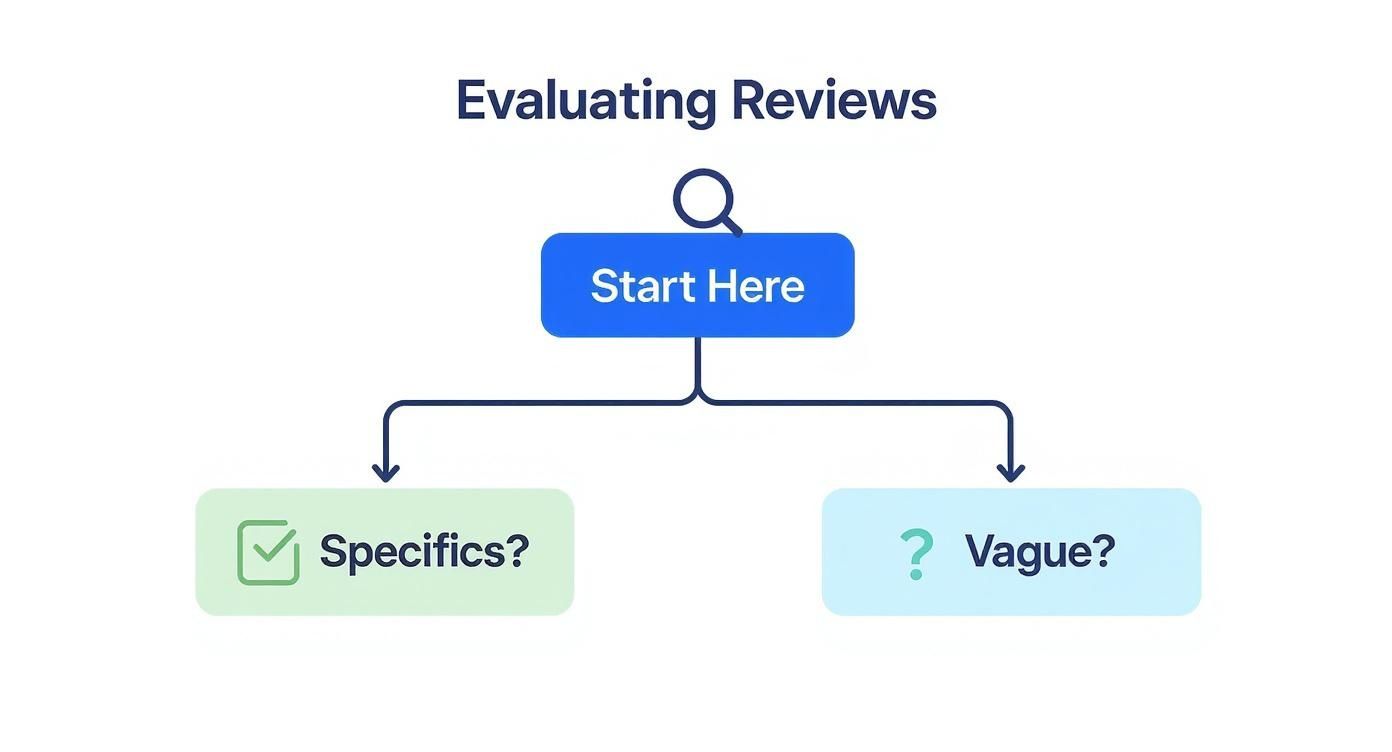
As you can see, specific stories from other families will give you a much clearer picture.
Here are a few more questions to get to the core of their quality:
- Can you share your most recent CAHPS Hospice Survey scores? A willingness to point you to this public data shows they are accountable.
- How do you create and update a patient's care plan? A strong answer will describe a collaborative process involving the patient, family, and the hospice team.
- What is your process for managing pain and other difficult symptoms? Listen for a proactive, comprehensive approach that includes regular assessments and timely adjustments.
- How does your team support the family? Ask specifically about bereavement programs, training, and emotional support offered by their Medical Social Workers and Chaplains.
We've compiled the key questions into a simple checklist you can use.
Essential Questions Checklist for Hospice Interviews
This simple checklist can guide your conversations with potential hospice providers, ensuring you cover every critical aspect of care.
| Category | Question to Ask | What a Good Answer Includes |
|---|---|---|
| Care Team | What is your staff-to-patient ratio? | A specific number and an explanation of how it allows for personalized care. |
| Care Team | How often will nurses and aides visit? | A clear, typical schedule for routine visits, not just crisis response. |
| Care Team | Is your interdisciplinary team employed by you? | Confirmation of direct employment, which promotes coordinated care. |
| Care Team | What is your after-hours support system? | 24/7 access to a Registered Nurse by phone and for visits, with a quick response time. |
| Quality | Can I see your CAHPS Hospice Survey scores? | An enthusiastic "yes," with directions to their scores on Medicare.gov. |
| Quality | How is the care plan developed and updated? | A description of a collaborative process involving the patient, family, and team. |
| Quality | How do you manage pain and symptoms? | Details on a proactive approach, including regular assessments and medication management. |
| Quality | How do you support the family? | Specific examples of bereavement support, respite care, and emotional counseling. |
Armed with these questions, you’re ready to have meaningful conversations with providers across the Central Coast.
A Legacy of Trusted Care on the Central Coast
Choosing a hospice is a journey of the heart. It’s a decision guided by a deep need for trust, honesty, and comfort. For families across the Central Coast, these are the bedrock of the care we've provided at Central Coast VNA & Hospice for over 74+ years.
As a local, nonprofit, mission-driven organization, our entire focus has always been on the people we serve. Our legacy is built on decades of showing up for our neighbors in Monterey County, San Benito County, Santa Cruz County, and South Santa Clara County. Our commitment is to our community’s well-being.

Our Commitment to Transparency
We believe families deserve to make decisions with total confidence. That’s why we are completely transparent about our quality of care. We invite you to review our patient satisfaction scores and quality metrics.
Our team—made up of dedicated Registered Nurses, Hospice Aides, Chaplains, and Medical Social Workers—is here to deliver consistent support. We are incredibly proud of the work they do and the peace of mind they bring to families.
At Central Coast VNA & Hospice, we see ourselves as more than a provider—we are a local community partner. We are here to help you navigate this journey with clarity, compassion, and peace of mind, every step of the way.
Support Along the Entire Continuum of Care
The need for support often begins long before hospice care is on the table. That’s why we offer a full Continuum of Care. Our services are designed to work together seamlessly as your loved one’s needs change.
This integrated approach includes:
- Home Health Care: We provide skilled nursing and therapy to help patients recover from surgery or manage chronic conditions at home.
- Palliative Care: Our teams offer specialized support to manage symptoms and improve quality of life for those with serious illnesses.
- Hospice Care: We deliver compassionate end-of-life care that honors your loved one’s dignity and supports the entire family.
By offering this complete spectrum, we can build a lasting, trusting relationship with your family. This ensures a smooth and gentle transition between levels of care.
Let's Talk About Your Needs
We understand how difficult and overwhelming this time can be, and we are here to help. We invite you to contact us for a no-cost, no-commitment conversation. Let us show you what our legacy of trusted, transparent, and compassionate care looks like.
You can learn more about our hospice care services or call our team today. We are here to listen and provide the guidance you need.
Frequently Asked Questions About Choosing Hospice
Exploring hospice care brings up many questions. The path ahead can feel uncertain, but clear answers help. Here are five of the most common questions we hear from families.
What’s the difference between nonprofit and for-profit hospice?
A nonprofit hospice, like Central Coast VNA & Hospice, is mission-driven. Our purpose is built around patient care and serving our community—not generating profits. Any revenue goes right back into our programs to enhance patient care and support families.
A for-profit agency has a responsibility to its investors, which can shape its approach. With a nonprofit, the commitment is always to the people we serve.
Where can I find honest quality ratings for local hospices?
The best place to start is Medicare's official "Care Compare" tool on Medicare.gov. You can look up hospice providers in Monterey County or Santa Cruz County. The tool shows family satisfaction scores from the national CAHPS Hospice Survey, giving you unbiased feedback.
How can I spot a genuine patient testimonial?
Look for specific details, not just vague praise. A trustworthy review will often mention how a specific Hospice Aide brought comfort or how a Registered Nurse managed a tough symptom. Look for patterns across multiple reviews that highlight the same strengths, like excellent communication or genuine compassion.
Can my loved one receive hospice care at home?
Yes, absolutely. A core goal of hospice is to bring comfort and care to wherever a person calls home. This could be their own house, an assisted living community, or a skilled nursing facility. The Central Coast VNA & Hospice team comes directly to the patient, allowing them to stay in a familiar environment.
When is the right time to start looking into hospice?
It’s never too early to start learning. Gathering information before you're in a crisis can lift a huge weight off your shoulders. It allows you to make calm, clear-headed decisions when the time comes. If your loved one is managing a serious illness, please call us for a no-cost consultation to learn about all the support available.
At Central Coast VNA & Hospice, our commitment is to guide you through this journey with trust, transparency, and genuine care. To learn more about our services or just to talk with someone from our team, please visit us at https://ccvna.com.