
When you're facing the question of how to pay for hospice, it can feel overwhelming. But understanding your options is the first step toward finding peace of mind.
The short answer is this: hospice is typically paid for through a mix of the Medicare Hospice Benefit, state Medicaid programs, private insurance, and community donations. This layered system is designed to make sure compassionate end-of-life care is available to everyone who needs it.
A Clear Overview of Hospice Funding
When a family is considering hospice, financial worries shouldn't be what holds them back from getting compassionate support. The way hospice is funded in the United States is meant to be supportive, with several different paths to cover the costs. This approach ensures that people can get the care they need, regardless of their financial situation.
At Central Coast VNA & Hospice, our 74+ year mission has been to serve the communities of Monterey County, San Benito County, and the surrounding areas with dignity. We truly believe that having clear information empowers families to make the best possible decisions during a difficult time.
This breakdown shows the primary sources of hospice funding and how they all fit together to create a solid support system for patients and their families.
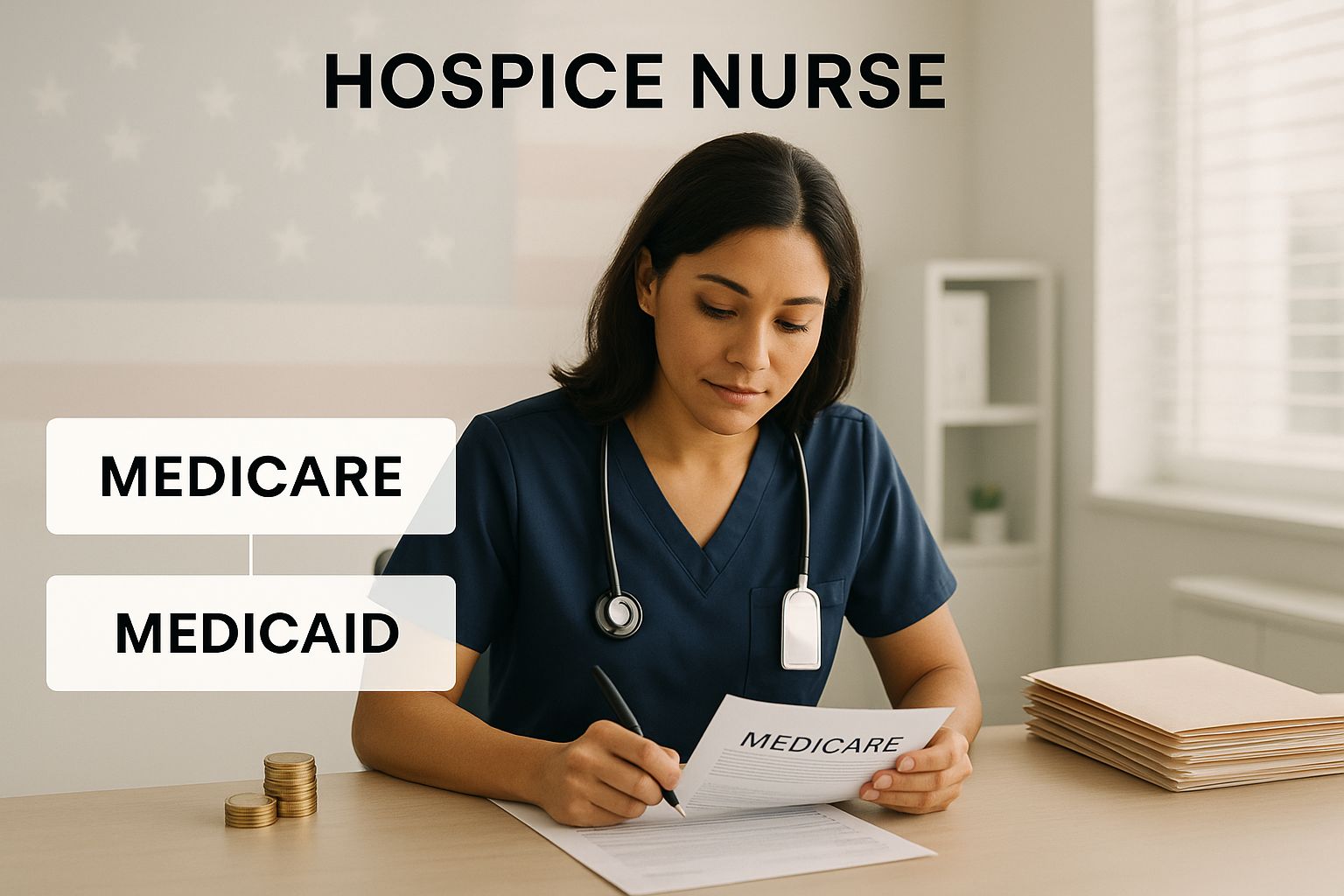
As you can see, federal programs like Medicare and Medicaid provide the foundation. Private insurance adds another layer of coverage, and then vital community support from donations and grants fills in the gaps.
The Main Financial Pathways
Getting a handle on each funding stream is key. While the details might seem complex at first glance, the system really boils down to a few main categories that work together to cover the full spectrum of hospice services.
- Government Programs: Medicare and Medicaid are the biggest players in hospice funding. They offer a comprehensive, all-in-one benefit that's built to cover the entire interdisciplinary team, medical supplies, and medications related to the terminal illness.
- Private Health Insurance: Many health plans, whether from an employer or bought privately, also include a hospice benefit. The specifics can vary from plan to plan, but they often mirror the kinds of services that Medicare covers.
- Nonprofit and Community Support: For a mission-driven provider like Central Coast VNA & Hospice, charitable giving is absolutely essential. Donations and grants help us bridge the gap, funding care for people who are uninsured or underinsured and supporting programs that go beyond what standard reimbursement covers.
These different streams are what allow our team—from Registered Nurses to Chaplains and Hospice Aides—to put all their focus on patient comfort and family support. To get a better feel for the philosophy behind this care, you can learn more about what hospice care is in our detailed guide. This financial structure is the backbone that makes our compassionate care model possible across the Central Coast.
Primary Hospice Funding Sources at a Glance
To make things a bit simpler, the table below gives you a quick-reference summary of these primary funding sources. It outlines who is generally eligible and what services are typically included, helping you see the main pathways at a glance.
| Funding Source | Who Is Typically Eligible | What It Generally Covers |
|---|---|---|
| Medicare Hospice Benefit | Individuals 65+ with Medicare Part A, certified with a terminal illness (≤6 months prognosis) | Full interdisciplinary team, medical equipment, supplies, and medications for symptom management. |
| State Medicaid | Individuals with low income and limited assets who meet eligibility criteria | Comprehensive hospice services, often mirroring the coverage provided by Medicare. |
| Private Insurance | Individuals covered by employer-sponsored or private health plans with a hospice benefit | Varies by plan, but generally includes skilled nursing, medical social services, and support. |
| Community Support | Uninsured or underinsured patients served by nonprofit hospices like CCVNA | Bridges financial gaps, funds specialized programs, and ensures no one is denied care due to inability to pay. |
Ultimately, this blended model of funding ensures that when a family needs hospice, the focus can remain where it belongs: on providing comfort, dignity, and quality of life.
Understanding the Medicare Hospice Benefit

For most American families, the answer to the big question—"how are hospices funded?"—comes down to one essential program: the Medicare Hospice Benefit. This federal program isn't just a line item in a budget; it’s the bedrock of end-of-life care funding across the United States. It was intentionally designed to be comprehensive, providing reassurance to patients and their loved ones when they need it most.
Think of it as an all-inclusive care package. Its purpose is to lift the heavy burden of coordinating different services and juggling payments. This allows everyone to focus on what truly matters: comfort, peace, and preserving quality of life during an incredibly personal journey.
Who Is Eligible for This Benefit?
Navigating healthcare benefits can feel like a maze, but the requirements for the Medicare Hospice Benefit are refreshingly straightforward. To qualify, a person just has to meet a few specific criteria.
These conditions are in place to make sure the benefit goes to those who have made the thoughtful choice to prioritize comfort and symptom management over treatments aimed at a cure.
To be eligible, a person must:
- Be enrolled in Medicare Part A (often called hospital insurance).
- Have a physician certify that they have a life-limiting illness with a life expectancy of six months or less, assuming the illness runs its natural course.
- Formally elect to receive comfort-focused care (hospice) instead of curative treatments.
Here at Central Coast VNA & Hospice, our admissions team walks families in Monterey and San Benito Counties through these requirements every day. We work directly with physicians to make sure the certification process is handled with compassion and clarity.
What the Medicare Hospice Benefit Covers
Once a person is enrolled, the Medicare Hospice Benefit covers an incredibly wide range of services tied to their terminal diagnosis. This comprehensive coverage is one of its greatest strengths, structured to care for the whole person—physically, emotionally, and spiritually.
The benefit pays for the entire hospice team. This includes visits from a Registered Nurse for clinical care, a Hospice Aide for personal assistance, a Medical Social Worker to help with resources, and a Chaplain for spiritual support. It's this layered, team-based approach that our team at CCVNA is dedicated to providing across the Central Coast.
On top of that, the benefit also covers:
- Medications for pain relief and symptom management.
- Medical equipment like a hospital bed, oxygen, or a walker.
- Medical supplies such as bandages and catheters.
- Grief and loss counseling for both the patient and their family.
This all-in-one approach means families are not getting surprise bills from multiple providers. Instead, all care is coordinated and covered through a single organization like Central Coast VNA & Hospice.
How Medicare Pays for Hospice Care
The way Medicare pays for this care is a key reason the benefit works so well. Instead of billing for every single service, Medicare pays the hospice provider a set daily rate, known as a per diem payment. This flat rate is designed to cover all the services detailed in the patient’s plan of care.
For families, this means there are generally no direct costs or copayments for the hospice care covered by the benefit. It's a huge relief. This financial peace of mind allows the focus to stay squarely on the patient's comfort and dignity.
For a nonprofit provider like CCVNA, the per diem model empowers us to deliver the right care at the right time, without financial hurdles getting in the way. In a recent fiscal year, total Medicare hospice payments hit roughly $27.5 billion, which shows just how much the nation relies on this benefit to fund essential end-of-life care.
Grasping how this primary funding source works is the critical first step for any family exploring their options. To dive deeper, you can continue exploring our complete guide on how hospice care is funded. This is the structure that allows our team to proudly uphold our 74+ year mission of providing compassionate care.
Using Medicaid and Private Insurance for Hospice

While the Medicare Hospice Benefit is the most well-known path, it’s certainly not the only way to fund this essential care. Other vital streams, like state Medicaid programs and private health insurance, create a broad financial safety net. This ensures that almost everyone who needs compassionate end-of-life support can get it.
For many families, trying to figure out these options can feel like another heavy weight during an already stressful time. At Central Coast VNA & Hospice, our team is here to help families across Santa Cruz County, South Santa Clara County, and our entire service area understand their benefits and coordinate coverage.
The Role of Medicaid in Hospice Funding
Medicaid is a critical resource for people with limited financial means, guaranteeing access to high-quality healthcare. When it comes to end-of-life care, most state Medicaid programs offer a comprehensive hospice benefit.
This benefit is often set up to mirror the coverage provided by Medicare. That means it typically covers the full range of services from the interdisciplinary care team—including the Registered Nurse, Hospice Aide, Medical Social Worker, and Chaplain. It also pays for medications, medical equipment, and supplies related to the terminal diagnosis.
For a mission-driven, nonprofit provider like Central Coast VNA & Hospice, Medicaid is an essential partner. It allows us to fulfill our promise of providing dignified care to every member of our community, regardless of their income or financial circumstances.
This alignment between Medicare and Medicaid creates a consistent standard of care. It ensures a patient’s financial situation doesn’t dictate the quality of their end-of-life experience. You can learn more about the criteria for receiving this care by reviewing our guide on hospice care eligibility.
Navigating Private Health Insurance Plans
For people covered by an employer-sponsored or private health plan, hospice care is almost always an included benefit. The big difference? Unlike the standardized government programs, the specifics of private insurance policies can vary quite a bit.
Understanding your specific plan is the first, most important step. Our team always advises families to connect with their insurance provider directly, or let us step in to help coordinate benefits.
Here are the key details to clarify with your insurance provider:
- Covered Services: Confirm which services are included, like home visits, continuous care, or inpatient respite care.
- Pre-Authorization: Some plans might require pre-authorization before hospice services can begin.
- Co-payments or Deductibles: Ask about any out-of-pocket costs you might be responsible for.
- In-Network Providers: Make sure your chosen hospice, like Central Coast VNA & Hospice, is considered an in-network provider to get the most out of your benefits.
Our dedicated admissions team brings 74+ years of experience working with a wide range of insurance plans. We can help you understand the fine print, coordinate with your provider, and lift that administrative burden right off your shoulders. This support allows your family to focus completely on what truly matters—your loved one’s comfort and well-being.
The Mission of a Nonprofit Hospice
What does it really mean to choose a nonprofit hospice? It means you're picking an organization driven by a mission of compassionate care, not by the pressure of delivering shareholder profits. That single, fundamental difference shapes every part of the experience for patients and their families.
Unlike for-profit agencies that answer to investors, a nonprofit hospice is accountable to the communities and families we serve across the Central Coast of California. That commitment has been our north star at Central Coast VNA & Hospice for more than 74 years.
Investing Every Dollar Back into Care
The clearest distinction of a nonprofit hospice is what happens to its resources. Every dollar we receive—whether it's from a Medicare payment or a private donation—is funneled directly back into patient care and community wellness programs. This constant cycle of giving and serving is the lifeblood of our organization.
This structure allows us to do far more than just meet the basic requirements of care. It gives us the freedom to go above and beyond what standard insurance reimbursement covers. This is a critical point, and it’s key to understanding how hospice funding truly works.
At Central Coast VNA & Hospice, our nonprofit status isn't just a line on a tax form; it's a promise. It’s our pledge to put people before profits, ensuring our care decisions are always based on the needs of patients in Monterey County, San Benito County, Santa Cruz County, and South Santa Clara County.
The Role of Charitable Gifts and Grants
While insurance reimbursements cover the core medical services, it’s the charitable gifts, grants, and community fundraisers that allow a nonprofit to truly fulfill its mission. These funds are what let us provide a holistic, robust continuum of care that addresses needs far beyond the purely clinical.
Think of insurance as the foundation of a house. It’s strong and absolutely essential, but it doesn't make the house feel like a home. Donations and grants are what furnish that home with warmth, comfort, and the specialized support that transforms a medical service into a human experience.
This support funds many vital services, including:
- Comprehensive Grief Support: Offering bereavement counseling and support groups for families for up to a year after a loved one’s passing.
- Specialized Programs: Creating and sustaining programs that enhance quality of life, like music therapy, pet therapy, or dedicated support for unique populations. We are especially proud of our work with veterans, which you can read more about in our guide to hospice care for veterans.
- Care for All: Most importantly, these funds allow us to provide care for uninsured or underinsured patients, ensuring no one is ever turned away due to an inability to pay.
Community Support in a Growing Market
The need for this community-supported model is only getting more critical as the demand for hospice grows. According to the National Hospice and Palliative Care Organization (NHPCO), over 1.72 million Medicare beneficiaries received hospice services in 2020 (NHPCO, 2021).
This rapid expansion points to a clear trend: as our population ages, more families will rely on end-of-life care. While government programs are a major funding source, this growth also underscores the increasing need for diverse funding models—especially charitable contributions—to meet the demand for comprehensive services. You can explore more about this trend and read the full research about the hospice services market.
When you choose or support a nonprofit hospice, you are making a direct investment in the health and compassion of your own community. You are helping to build a safety net of care that catches everyone, strengthening the social fabric for all residents of the Central Coast.
Covering Care When Insurance Is Not Enough
It’s one of the most common and deeply felt worries we hear from families: "What if we can't afford care?" This question adds a heavy layer of stress during an already emotional time. But as a nonprofit provider, our mission at Central Coast VNA & Hospice ensures this fear never becomes a barrier to receiving dignified, compassionate support.
Our promise is simple yet powerful: no one is ever denied care because of an inability to pay. This isn't just a slogan; it's the principle that has guided our work every single day for over 74 years. We are committed to making sure every person in our community gets the comfort and quality of life they deserve.
The Financial Safety Net of a Nonprofit
For individuals who may not qualify for Medicare, Medicaid, or a private insurance plan, there are still paths forward. One option is a private pay arrangement, where services are paid for directly. Our team can always walk you through this transparently to see if it’s a sustainable choice for your family.
But more importantly, the heart of our mission is funded by something that goes far beyond insurance reimbursements. The funds from community donations, memorial gifts, and grants are what allow us to build a true financial safety net for our neighbors.
Think of community support as the final, crucial layer of how hospice is funded. It's the lifeblood that allows a mission-driven organization to bridge the gap between what insurance covers and what a family can afford, ensuring compassionate care is a reality for everyone.
These generous contributions make dignified end-of-life care available to all residents in our service area, from Monterey to San Benito County and across the Central Coast.
How Community Donations Are Put into Action
When you support a nonprofit hospice, your contribution is a direct investment in patient care. These funds aren’t used for shareholder profits; they are poured right back into the community in tangible, meaningful ways.
This support allows us to:
- Provide subsidized or free care for patients who are uninsured or underinsured, removing financial barriers completely.
- Fund specialized programs that go beyond standard medical care, like music therapy or the dedicated support from our specially trained Hospice Aides.
- Offer extensive bereavement services to families for up to 13 months after a loved one has passed—a service often not fully covered by insurance.
- Maintain a 24/7 on-call team of Registered Nurses and other clinical staff, ensuring help is always just a phone call away.
Understanding the different ways to cover costs is an important part of the planning process. For a broader overview, you can explore our detailed guide on how to fund home health care costs.
A Confidential Conversation About Your Needs
Navigating financial questions can feel intimidating, but you don’t have to do it alone. Our commitment at Central Coast VNA & Hospice extends beyond clinical excellence to providing clear, compassionate guidance on costs and coverage. We are here to help you understand every option available.
We strongly encourage families to contact our admissions team for a confidential conversation about their unique situation. Our experts can review potential benefits, explain how our charitable care funds work, and create a plan that brings you peace of mind. Our 74+ year legacy is built on serving everyone in our community, and we are here to support you.
Frequently Asked Questions About Hospice Funding
Figuring out the financial side of hospice care often brings up a lot of practical questions. Our goal is to give you clear, straightforward answers so you can feel confident in the decisions you make for your loved one.
After 74+ years of service, our team at Central Coast VNA & Hospice knows that peace of mind comes from clarity. We're an open book when it comes to how hospice is funded, making sure every family on the Central Coast has the support they need to focus on what truly matters.
1. Is hospice care completely free with Medicare?
For eligible patients, the answer is pretty close to yes. The Medicare Hospice Benefit is designed to cover nearly everything related to the terminal illness, lifting the financial weight off families during an already difficult time.
This coverage is comprehensive. It includes the entire interdisciplinary team—from your Registered Nurse and Hospice Aide to the Medical Social Worker and Chaplain. For most families, this means no out-of-pocket costs for these core services.
2. What if my loved one does not have Medicare?
If Medicare isn't in the picture, there are still excellent options available to ensure your loved one gets the highest quality of care. Many families find that other benefits provide the same level of comprehensive support.
- Private Insurance: Most private or employer-sponsored health plans offer a hospice benefit that looks very similar to Medicare’s coverage.
- Medicaid: State Medicaid programs also provide a robust hospice benefit, creating a critical safety net for those with limited financial resources.
- Nonprofit Support: As a nonprofit provider, Central Coast VNA & Hospice is committed to caring for everyone in Monterey County and San Benito County, regardless of their ability to pay.
3. Does hospice funding cover care in a nursing home?
Yes, absolutely. Hospice care follows the patient, wherever they call home—and that includes a skilled nursing or assisted living facility. The Medicare Hospice Benefit (or a similar private insurance plan) will cover the costs of our hospice team and all the related services we provide in that setting.
It's important to know that the payment for room and board at the facility is handled separately. Our team has deep experience coordinating with facilities across Santa Cruz County and South Santa Clara County to make sure everything is seamless.
4. How can I support nonprofit hospice in my community?
Supporting a nonprofit like Central Coast VNA & Hospice ensures that compassionate, expert care is always available for your friends and neighbors. Your generosity directly funds care for underinsured patients and allows us to offer specialized programs that insurance doesn’t cover. You can make a real difference through donations, volunteering, or participating in community fundraising events.
5. How do I start the conversation about hospice costs?
The easiest first step is just to call us. We offer a no-obligation consultation where our admissions team can talk with you and your family, explain our services, and answer all your financial questions in a confidential and compassionate way. We’re here to guide you.
Navigating hospice funding can feel complicated, but you don’t have to do it alone. The compassionate team at Central Coast VNA & Hospice is here to answer your questions and give you the support you need. Contact us today to learn more about our services and how we can help your family.