
When Your Medicare Plan Limits Which Home Health Agency You Can Use
Your mom is being discharged tomorrow. The hospital case manager hands you a list and says she needs a nurse at the house within a day or two. Then someone asks which Medicare plan she has, and you realize you have no idea.
This happens constantly in Monterey County. Families call about home health hours after a discharge, and the very first question they ask is whether Medicare covers this. That question has two different answers depending on which kind of Medicare your parent signed up for.
With Original Medicare, you can pick any Medicare-certified agency that serves your address. With Medicare Advantage, the plan itself may decide for you. Here is how that works, what it means at the moment of discharge, and the one question worth asking long before you need an answer.
Two kinds of Medicare, two very different sets of options
Original Medicare is the federal program. Home health is covered under Part A and Part B, and a patient can choose any Medicare-certified agency serving their ZIP code, whether that is Pacific Grove, Salinas, or King City.
Medicare Advantage is different. It is a private plan that replaces Original Medicare, and it comes with a network. That network is the part families never think about until a discharge planner asks for a preference.
Under a Medicare Advantage plan, you may run into:
- A short in-network list of approved home health agencies in your county
- Prior authorization before a Registered Nurse or Physical Therapist can make the first visit
- Fewer approved visits than Original Medicare would allow for the same diagnosis
- More frequent care plan reviews, with changes requested mid-recovery
- Reauthorization if therapy needs to continue past the first approved block
Research from the Center for Medicare Advocacy found that Medicare Advantage plans commonly deny or limit services through prior authorization, approve fewer visits, and require more care plan changes than Original Medicare. For a family waiting on a nurse to check a surgical wound, that is not paperwork. That is days.
Original Medicare vs Medicare Advantage for home health
A side by side look at how the two plan types treat home health differently. Your specific plan documents always control the details.
| What matters | Original Medicare | Medicare Advantage |
|---|---|---|
| Choice of agency | Any Medicare-certified agency serving your ZIP code | Usually limited to in-network agencies on the plan's list |
| Prior authorization | Generally not required to start | Often required before the first visit |
| Number of visits | Based on physician orders and clinical need | May be capped or approved in shorter blocks |
| Care plan changes | Driven by the clinical team and physician | Plan may request changes or additional review |
| Speed to first visit | Often within 24 to 48 hours of the order | Can be delayed while authorization is processed |
Why these restrictions hurt most at the moment of discharge
Network limits are manageable when you have time. They are brutal when you have none.
Most families reach out within hours or days of a hospital discharge. They are stressed, unfamiliar with how home health works, and trying to figure out whether someone will come today or next week. Comparison shopping is the last thing on their minds.
Geography makes it tighter here. A family in Hollister or King City may be an hour or more from the discharging hospital, and there are fewer agencies covering those ZIP codes to begin with. If the plan's in-network list has two names on it and neither one covers South Monterey County, you have a real problem at nine o'clock at night.
Delays also carry risk. Home health exists in large part to catch the problems that send people back to the emergency room, things like a wound that is not healing, a blood pressure reading that is off, or a medication list that does not match what is actually in the cabinet.
If you want a clearer picture of how the first days should go, the first 72 hours after a hospital stay covers what a properly running start looks like.
The referral step families do not see coming
A large share of first-time callers are surprised to learn that home health cannot simply be scheduled. It takes a physician order first. Several families each month say some version of "I didn't know we needed a doctor's order."
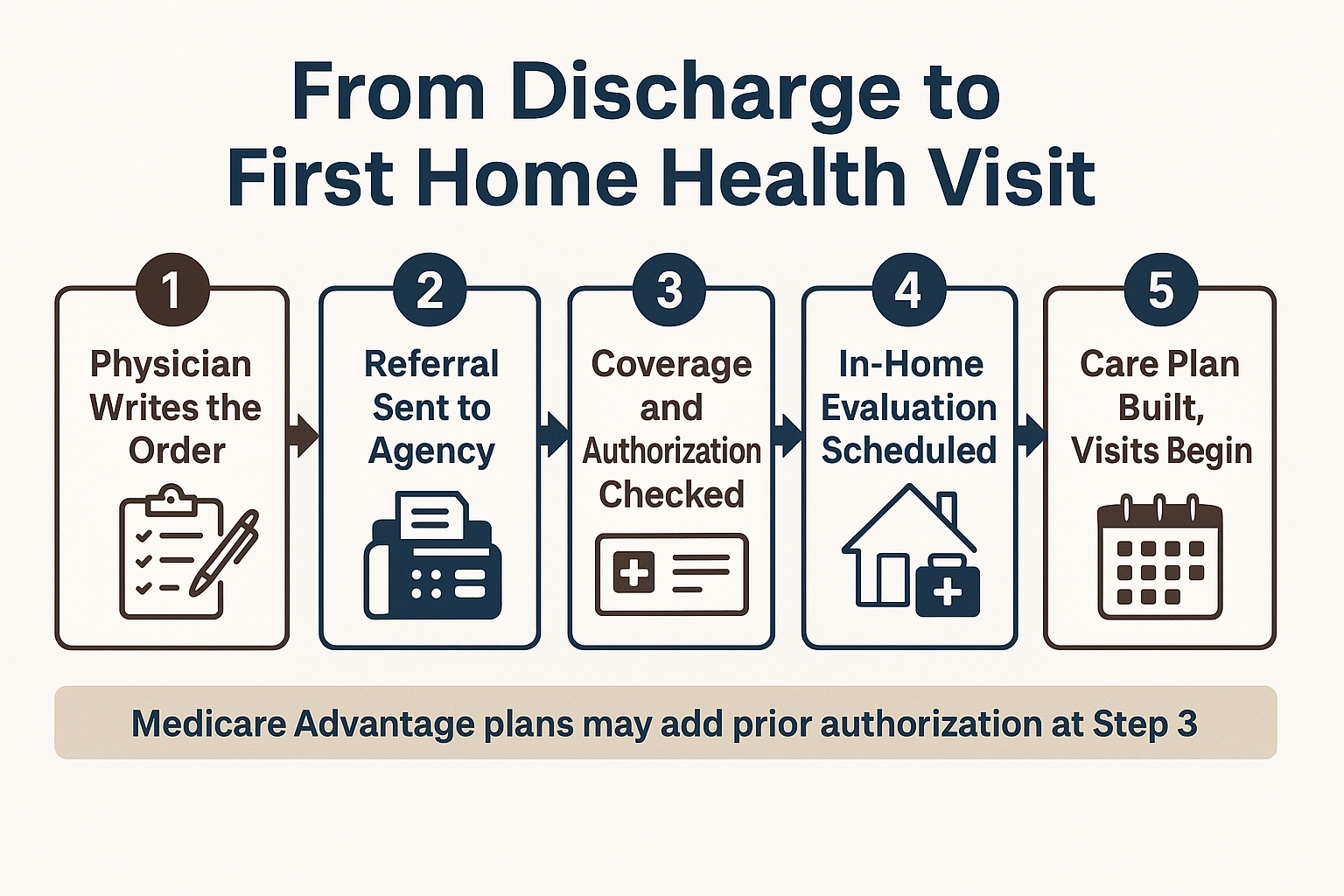
The basic pathway looks like this:
- A physician writes the order for home health
- The agency receives the referral, usually by fax from the hospital or clinic
- Insurance and eligibility are checked, including any plan authorization
- A clinician schedules an initial in-home evaluation
- A care plan is built and visits begin
Every one of those steps can stall. The order gets faxed to the wrong number. The plan asks for more documentation. A weekend lands in the middle of it.
Some agencies, including community nonprofits serving Monterey County, will chase the physician order on the family's behalf rather than leaving you to call the doctor's office three times. That single act often removes two or three days of waiting. Here is how the referral requirement actually works if you want the detail before you are in the middle of it.
The path from hospital bed to first home visit
Five steps stand between a discharge order and a nurse at the door. Knowing them helps you spot where things are stuck.
The one question to ask before you need the answer
Most people ask an agency, "Do you accept Medicare?" That is the wrong question if your parent has a Medicare Advantage plan.
Ask instead: "Are you in-network with this specific plan?" Then give the plan name and the plan type exactly as it appears on the insurance card. Accepting Medicare generally and being contracted with one particular Advantage plan are two separate things.
The ideal time to ask is when nothing is wrong. Before a scheduled knee replacement. During a stable stretch with a chronic condition. While you are still sitting in the surgeon's office talking about recovery.
A few things worth pinning down in that call:
- Whether the agency is contracted with the exact plan on the card
- Whether the agency serves your specific ZIP code, not just the county
- Whether prior authorization is typically required and how long it takes
- How quickly a first visit usually happens once the order arrives
- What happens if approved visits run out before recovery is finished
If you are still sorting out what type of care fits, this comparison of home health and hospice clears up the terms families most often mix up on that first phone call.
Why not every agency answers these questions the same way
Home health agencies are under real financial pressure. The 2026 Medicare home health payment rule finalized a 1.3% cut to aggregate Medicare payments, softened from a proposed 6.4% cut, amounting to roughly $220 million less in reimbursement nationally.
When margins tighten, some agencies respond by narrowing which payer types they accept or which geographies they cover. Rural and outlying areas usually feel that first.
A nonprofit community agency answers to the community rather than to shareholders, which can lead to different decisions about who gets accepted and how far the team will drive. Central Coast VNA & Hospice has been serving Monterey County since 1951, along with San Benito County, South Santa Clara County, and parts of Santa Cruz County, and accepts Medicare, Medi-Cal, and Veterans benefits.
One more thing worth knowing. Home health covers skilled, intermittent visits, not daily hands-on help. Many callers need both. A public reviewer described paying somewhere around $8,000 a month out of pocket for private-duty help alongside clinical care, which is a useful reminder that costs vary widely and are worth asking about early. If daily personal care is the gap, most agencies can point you toward private-duty providers who fill it.
Frequently Asked Questions About Medicare Advantage Home Health Restrictions
How do I find out which type of Medicare my parent has?
Look at the insurance card. Original Medicare cards are red, white, and blue and say Medicare Health Insurance. A Medicare Advantage card carries a private insurer's name and logo, and usually lists copays and a member services number on the back. If you only have one card and it has a company name on it, that is almost certainly an Advantage plan.
Can I switch plans if my preferred agency is out of network?
Plan changes are generally limited to the annual enrollment window each fall or a qualifying special enrollment period, so switching mid-recovery is rarely an option. Call your plan's member services line to ask about your specific situation.
Does prior authorization mean my parent will be denied?
No. It means the plan reviews the request before care starts. Most requests go through, but the review adds time, and that is exactly the delay families cannot afford right after a discharge. Asking about typical turnaround up front helps you plan around it.
What if the approved visits run out before recovery is done?
The clinical team can request additional visits with supporting documentation from the physician. Approval is not automatic under an Advantage plan. If more help is still needed after home health ends, a Medical Social Worker can help you look at community resources and other options.
Do Veterans have different options for home-based care?
Often yes. VA programs can cover home-based services in ways that differ from both Original Medicare and Advantage plans, and many families never think to ask. It is worth raising with the discharge planner and with any agency you call.
Sorting out your options before the discharge date
If you are trying to understand which home health options are open to your family under a particular Medicare plan, a care coordinator can walk you through the questions without any pressure to sign up for anything. VNA has been caring for families across Monterey County, Salinas, King City, Hollister, and the surrounding Central Coast for 75 years, with teams of nurses, therapists, social workers, chaplains, volunteers, and other clinicians. You can reach someone at 831-372-6668 or read more at ccvna.com.

Managing COPD and Diabetes at Home: What Skilled Nursing Actually Involves
Your dad spent three days at Salinas Valley Health after a COPD flare. He is home now, breathing better, and the discharge folder is sitting unopened on the counter. Nobody explained what happens next.
Or your mother's blood sugar has been swinging for months. She lives alone in King City, checks it when she remembers, and her last A1C worried her doctor enough that he mentioned home health.
Families across Monterey County call with a version of the same question: does a nurse coming to the house actually do anything for a condition that is not going away? This article walks through what those visits look like for COPD and diabetes, and how coverage usually works.
Chronic Illness Is One of the Most Common Reasons Home Health Starts
Most people picture home health as something that follows a hip replacement or a heart surgery. That is a real use of it, but it is not the whole picture.
Across Monterey County and the Salinas Valley, chronic disease management is one of the most frequent reasons a physician orders home health at all. It is also the least understood.
A patient does not need stitches to qualify. What matters is whether there is a skilled clinical need that requires a licensed professional. That can include:
- A COPD exacerbation that landed someone in the emergency department at Community Hospital of the Monterey Peninsula
- Blood sugar readings that have become unstable enough to be dangerous
- A new insulin regimen the patient has never managed before
- A diabetic foot wound that needs assessment and dressing changes
- Repeated falls or a clear drop in strength tied to a chronic condition
The purpose is teaching and monitoring, not permanent hands-on help. Home health is intermittent care, usually one to three visits a week for a few weeks, with the goal of handing the knowledge back to the patient and family. If you want the day-to-day picture, this piece on what a skilled nurse actually does on a home visit covers it.
What a Nurse Does for a COPD Patient at Home
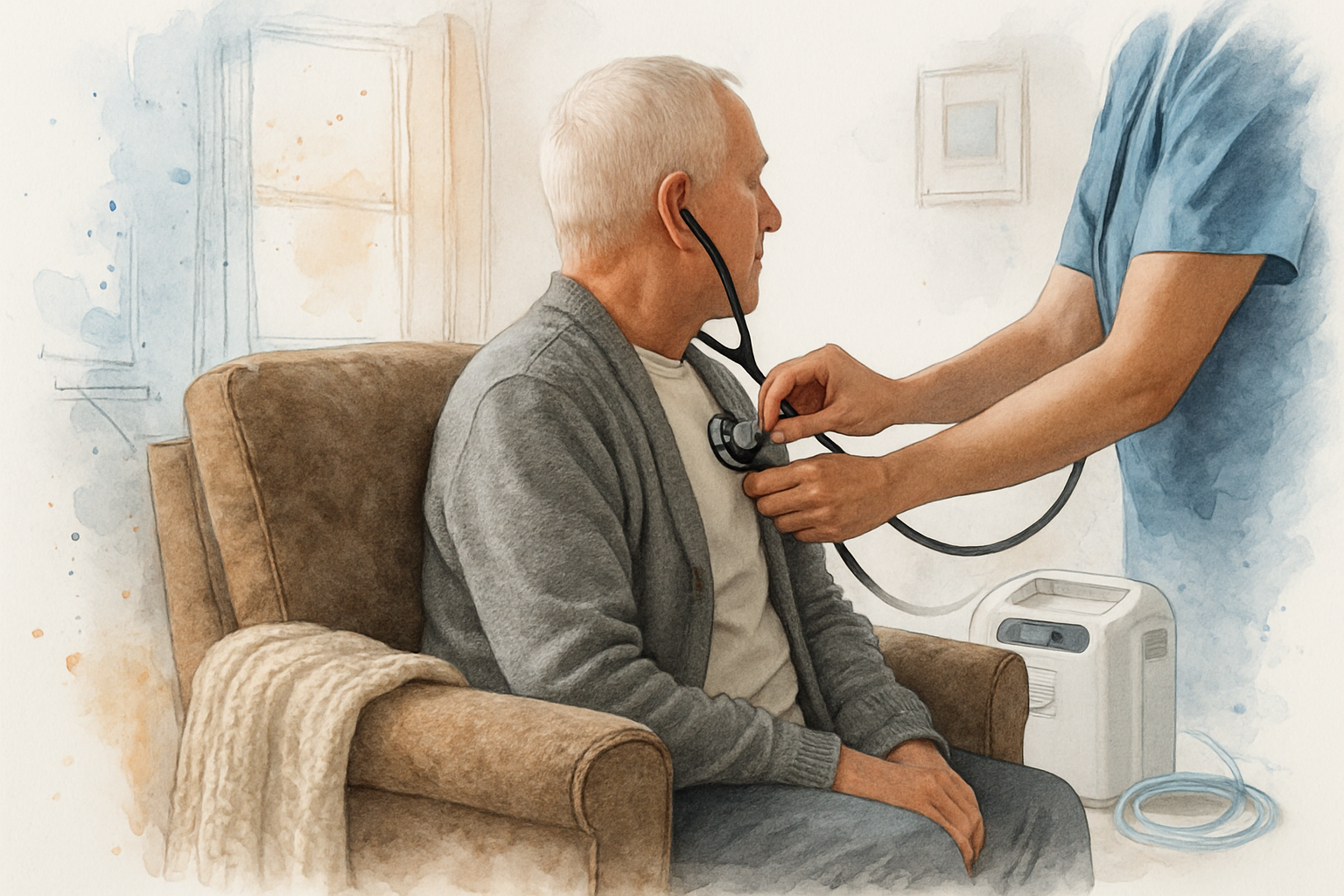
A COPD visit is far more than a quick check-in. The nurse is building a picture of whether this patient is stable, sliding, or heading back toward the hospital.
At each visit, a Registered Nurse or Licensed Vocational Nurse typically:
- Listens to breath sounds and records oxygen saturation
- Watches the patient use their inhaler and corrects technique, which is wrong far more often than people expect
- Reviews every medication, including the ones prescribed by a different specialist
- Teaches the early warning signs of an exacerbation: more sputum, a change in its color, needing the rescue inhaler more than usual, sleeping upright
- Checks oxygen equipment and tubing for safe setup
- Calls the physician when something has shifted, so the plan can change before a crisis
That last item is where a lot of the value sits. A nurse who notices a subtle change on a Tuesday can get an order adjusted before Saturday night in the ER.
Location matters here too. In Salinas, King City, and the farming communities in between, agricultural dust and summer air quality can push respiratory patients backward quickly. Wildfire smoke drifting into the valley has the same effect. There is more on that in this guide to summer heat and smoke for home patients on the Central Coast.
What a Nurse Does for a Diabetes Patient at Home
Diabetes management at home involves a lot more than reading a number off a meter.
A nurse visiting a patient with Type 1 or Type 2 diabetes is assessing the whole system around that number:
- Whether the patient truly understands their medication and insulin schedule, not just whether they say they do
- Foot health, checked at nearly every visit, looking for early neuropathy, redness, cracking, or a small wound the patient cannot feel
- Glucometer technique, including whether the strips are expired and the meter is coded correctly
- What the person is actually eating, based on what is in their kitchen, not a printed diet sheet
- When a reading means call 911, when it means call the doctor, and when it means eat something and recheck
That last distinction is the one families ask about most. Knowing the difference between a number that is worrying and a number that is an emergency changes how the whole household sleeps at night.
For an elderly patient living alone in rural San Benito County or south Monterey County, where the nearest clinic might be a long drive, that weekly visit may be the only consistent clinical set of eyes they get. Medication confusion is often the real trigger, and that overlaps heavily with medication management when memory becomes a safety issue.
COPD and Diabetes Visits Side by Side
Both conditions get skilled nursing, but the focus of each visit is different. Here is a general comparison of what tends to get attention.
| Visit Element | COPD Focus | Diabetes Focus |
|---|---|---|
| Primary assessment | Breath sounds, oxygen saturation, work of breathing | Blood sugar patterns, foot and skin condition |
| Equipment reviewed | Inhalers, spacers, oxygen concentrator, tubing | Glucometer, test strips, insulin pens or syringes |
| Main teaching goal | Recognize an exacerbation early | Know when a reading needs action versus a phone call |
| Environmental factor | Dust, smoke, and summer air quality inland | Meal routines, food access, and activity at home |
| Common added service | Physical Therapy for breathing tolerance and stamina | Wound care for a diabetic foot ulcer |
| Typical trigger for referral | Recent flare or hospital visit | Unstable readings, new insulin, or a non-healing wound |
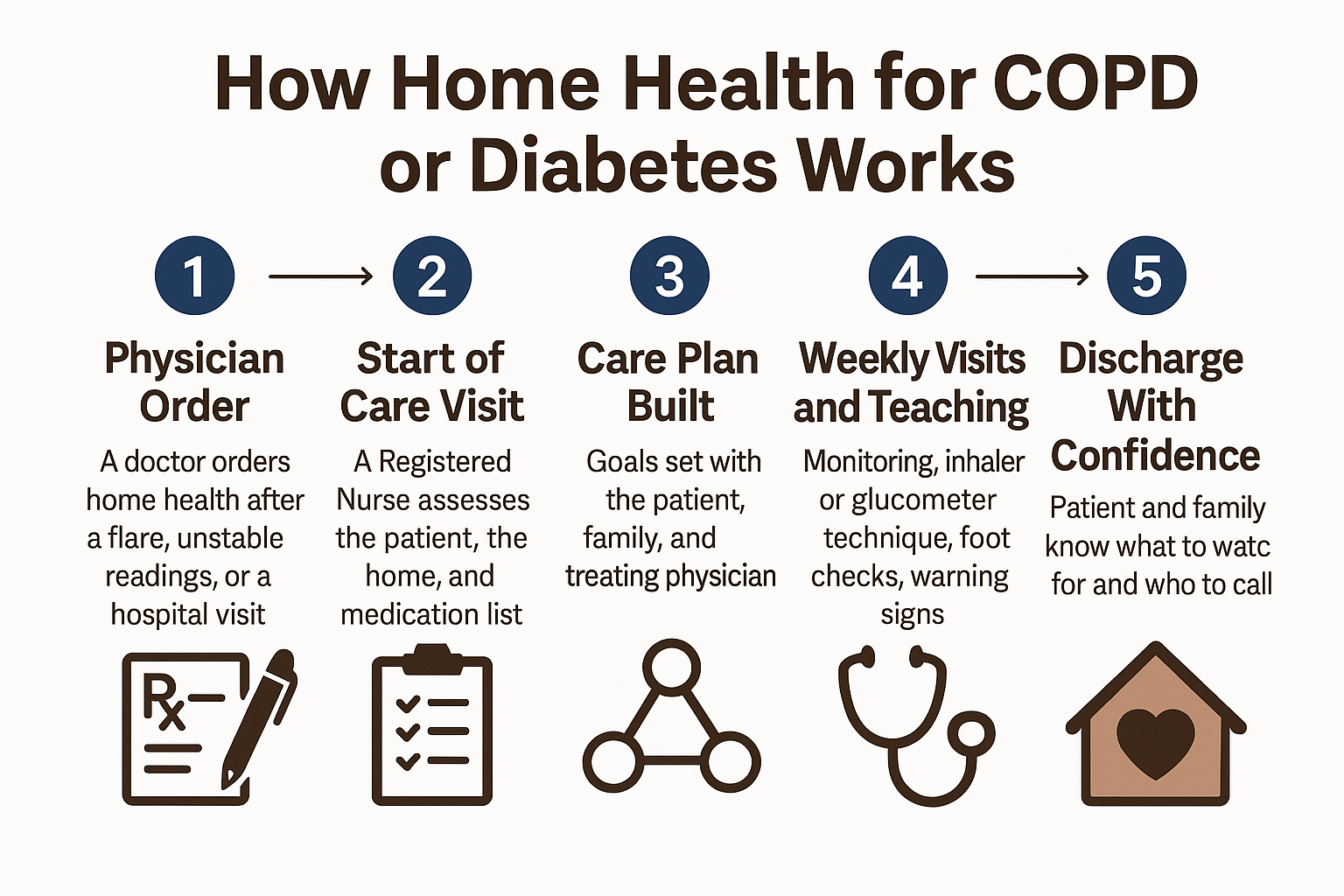
How a Chronic Disease Home Health Episode Unfolds
Families often want to know what the sequence looks like from the first phone call to the last visit. This breaks it into five steps.
The Medicare Rule Families Miss
One of the most common questions on the phone is some version of: does Medicare cover this, and do we need the doctor first?
The answer to the second part is yes. A physician order is required before any visit can be scheduled, and that surprises a lot of families who assume they can arrange it themselves. The physician referral process is worth understanding before you make calls.
Here is the part that gets missed. Many families, and honestly some physicians, assume home health only follows a hospital discharge or surgery. It does not.
An acute flare of a chronic condition counts as a qualifying event. A doctor who just treated a COPD exacerbation in clinic, or who is looking at a diabetic foot wound that is not healing, can order home health right from that appointment. No inpatient stay required.
Under Medicare, the patient generally needs to be considered homebound, meaning leaving home takes considerable effort, and needs intermittent skilled care. When those conditions are met, Medicare's home health benefit typically covers the visits with no cost to the patient for the covered services. Coverage details vary by plan and situation, so confirm specifics with the provider and your physician. Medi-Cal and Veterans benefits are also accepted by many home health agencies in the region.
Knowing to ask at the clinic visit, rather than waiting for the next hospitalization, can close the gap by days or weeks.
What This Is Actually Trying to Achieve
The point of skilled chronic disease management is not to cure anything. COPD and diabetes are lifelong conditions.
The point is to stretch out the time someone can safely stay in their own home, cut down on emergency room trips, and give the family the ability to catch decline early instead of late. Research on structured home-based education and monitoring for COPD, diabetes, and heart failure consistently points toward fewer hospitalizations.
It is rarely a nurse working alone. Depending on the plan of care, the team can include Registered Nurses, Licensed Vocational Nurses, Physical Therapists, Occupational Therapists, Speech Therapists, Medical Social Workers, Hospice Aides, Chaplains, Volunteers, and other clinicians.
One Monterey Peninsula family described exactly that after their 91-year-old mother moved in: a nurse who came weekly and checked vitals, a Physical Therapist who built an exercise plan, and a Medical Social Worker who tracked down community resources. That mix is common when a chronic condition touches mobility, safety, and daily life at once.
If you are still weighing whether the timing is right, when it is time to think about getting help at home walks through the signals worth paying attention to.
Frequently Asked Questions About Home Health for COPD and Diabetes
How often does a nurse come for chronic disease management?
It depends on how unstable things are. A common pattern is one to three visits per week at the start, tapering as the patient and family get more confident. The physician sets the frequency and adjusts it as status changes.
We need someone there every day. Is this what we want?
Probably not on its own. Home health is intermittent skilled care, not daily hands-on help with bathing, meals, and errands. Many Monterey County families pair home health with a private-duty agency for the daily hours, using the nursing visits as the clinical anchor. A good intake team will tell you this honestly and point you to local options.
Does my parent have to have been in the hospital first?
No. A hospital stay is one path, but a physician can order home health straight from a clinic visit after a COPD flare, a wound, or blood sugars that have gotten out of control. This is the single most common thing families do not know to ask about.
What does it cost?
For patients who meet Medicare's homebound and skilled-need criteria, covered home health visits generally come at no out-of-pocket cost. Medi-Cal and Veterans benefits also cover home health for eligible patients. Coverage varies by plan, so the reliable move is to confirm with the agency and your doctor before care starts.
How fast can visits start after the doctor sends the order?
Often within a day or two of the order arriving, sometimes the same day for a post-discharge patient. If someone came home from the hospital this week, say so when you call, because that changes how the referral gets prioritized.
Still Not Sure If Home Health Fits Your Situation?
If you are looking at a parent's COPD flare or unstable blood sugars and trying to figure out the next step, a conversation with a care coordinator can sort out whether a physician order makes sense and what coverage would look like. Central Coast VNA & Hospice has been visiting homes in Monterey County, the Salinas Valley, San Benito County, and South Santa Clara County since 1951. You can reach the team at 831-372-6668 or read more at ccvna.com whenever you are ready.

The First 72 Hours of Home Health After a Hospital Stay
The call usually comes with almost no warning. A hospital case manager says your mother is being discharged this afternoon, and suddenly you have hours, not days, to figure out what care at home is going to look like.
Families across Monterey County describe this same moment over and over. Discharges from Community Hospital of the Monterey Peninsula, Salinas Valley Health, and Natividad often move faster than anyone expects, and the drive home to Pacific Grove, Salinas, or King City is spent wondering who is going to walk through the door and when.
This is a plain look at what the first 72 hours of home health actually involve, so that part of the day stops being a mystery.
Why the Window Between Discharge and Home Feels So Short
Hospitals decide a patient is ready to go home based on clinical criteria, not on how prepared the family feels. Once that decision is made, the discharge itself can happen in a matter of hours.
The piece that surprises most families is the paperwork. Home health cannot start on a family's request alone. A physician's order is required before any agency can schedule a visit, which is why hospital case managers and discharge planners are usually the ones who set the referral in motion. If you want the detail on that step, a physician referral is required for home health and it works differently than most people assume.
A few things worth confirming before your loved one leaves the building:
- Which home health agency the referral was sent to, and whether they cover your town
- Whether the order includes therapy, nursing, or both
- The discharge medication list, printed, and who to call with questions about it
- Any equipment ordered, such as a walker, bedside commode, or hospital bed
Geographic coverage matters more here than people expect. A family in Carmel Valley, Hollister, and Watsonville may all get very different answers about who can reach them, so it is worth asking directly rather than assuming.
The First Visit Is an Evaluation, and Care Starts Anyway
The first home visit after a hospital stay is technically an evaluation visit. That word makes it sound like paperwork, but clinical care begins the moment the nurse walks in.
A Registered Nurse typically arrives within a day or so of the patient getting home, sometimes the same day for higher-risk discharges. In that first hour, the nurse is doing several jobs at once:
- Reviewing the full medication list, hospital orders and home bottles both
- Checking surgical sites or wounds and how they are healing
- Taking vital signs and comparing them to what the hospital recorded
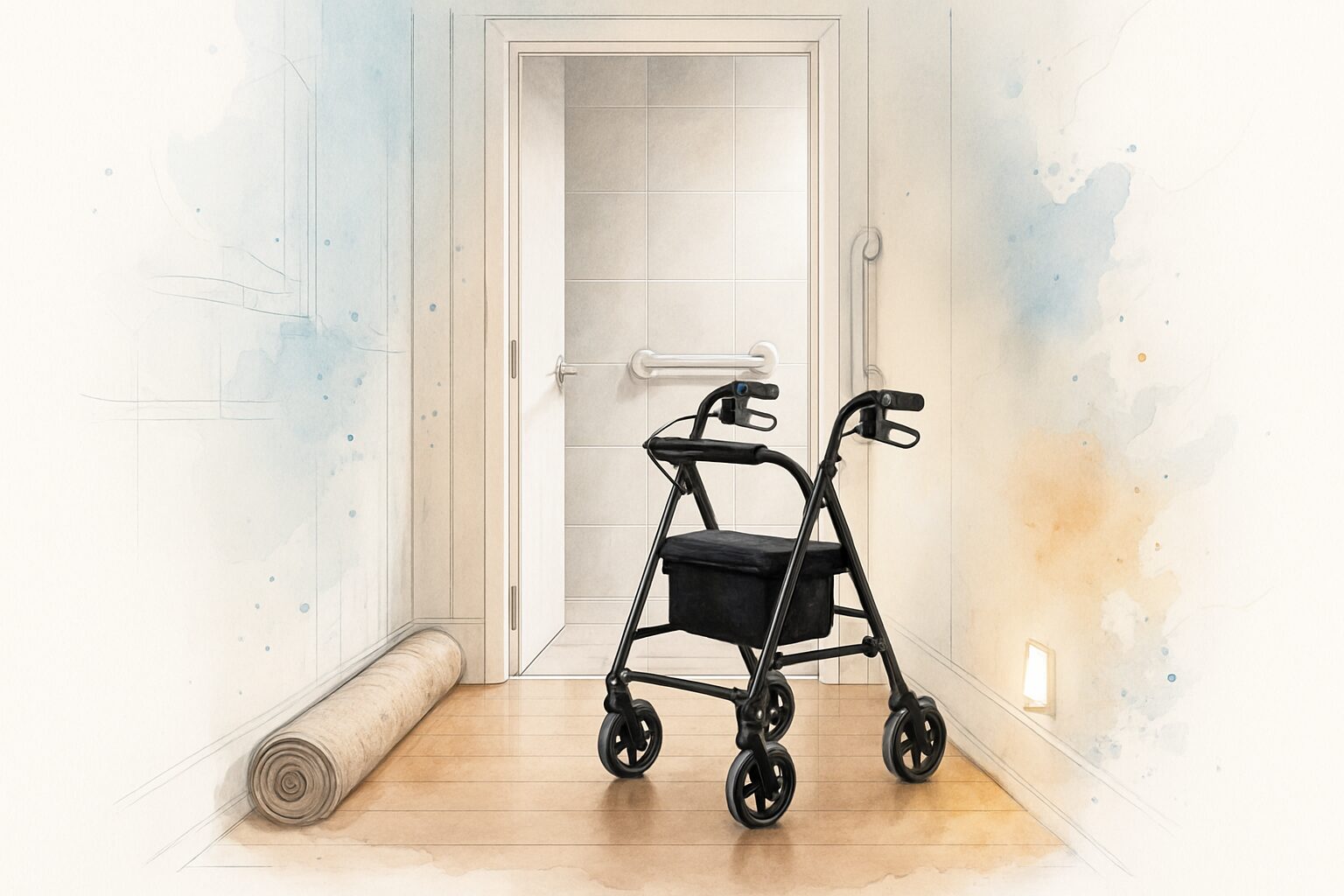
- Looking at the home itself for fall risks, poor lighting, loose rugs, stairs, bathroom setup
- Asking how the patient slept, ate, and moved since getting home
That visit also builds the care plan that governs everything after it. It determines whether a Physical Therapist, Occupational Therapist, Speech Therapist, or Medical Social Worker gets added, and how often each one comes.
One Monterey Peninsula family described exactly this order of events in a public review: a nurse came first to evaluate, then a weekly nurse, then a Physical Therapist who built an exercise plan and kept adjusting it. That sequence is normal. Families are often surprised how much gets settled in the first hour. What a skilled nurse actually does on a home visit goes deeper on the clinical side.
Medication Reconciliation: The Highest-Stakes Task of the First Three Days
If there is one thing that goes wrong in the first days home, it is medication. Hospital discharge paperwork frequently does not match what is already sitting in the medicine cabinet at home.
The usual gaps look small on paper and are not:
- A dose was changed in the hospital, but the old bottle is still on the counter
- A new drug interacts with something the patient has taken for years
- A blood thinner or blood pressure medication was stopped, and nobody at home knows it
- Two bottles with different names contain the same active ingredient
A nurse comparing both lists side by side is the safety net that keeps a paperwork mismatch from turning into an emergency room trip. This is also why the nurse asks you to gather every bottle in the house, including supplements, eye drops, and anything from a previous hospitalization.
One family in Monterey County wrote in describing a parent in their 80s whose five-plus medications had simply become too confusing for a spouse to track. That is a common situation, not a failure. It gets harder when memory is involved, and dementia can turn medication management into a real safety issue very quickly.
Keep a single written list going forward, and update it after every appointment.
Who May Come Through the Door in the First Week
Not every patient sees every role. The care plan built during the evaluation visit decides who is added, based on the diagnosis and what the physician ordered.
| Role | What they focus on | Typical early pattern |
|---|---|---|
| Registered Nurse | Medications, wounds, vital signs, teaching the family what to watch for | First visit, then often 1-3 times a week |
| Physical Therapist | Strength, balance, walking safely, fall prevention | Starts within the first week if ordered |
| Occupational Therapist | Bathing, dressing, kitchen and bathroom safety, daily routines | Added when independence at home is the concern |
| Speech Therapist | Swallowing, speech, and thinking skills after stroke or illness | Added by order, less common overall |
| Medical Social Worker | Benefits, community resources, family stress, planning ahead | Often one or two visits early on |
| Home health aide | Personal care support under the care plan | Varies by plan and eligibility |
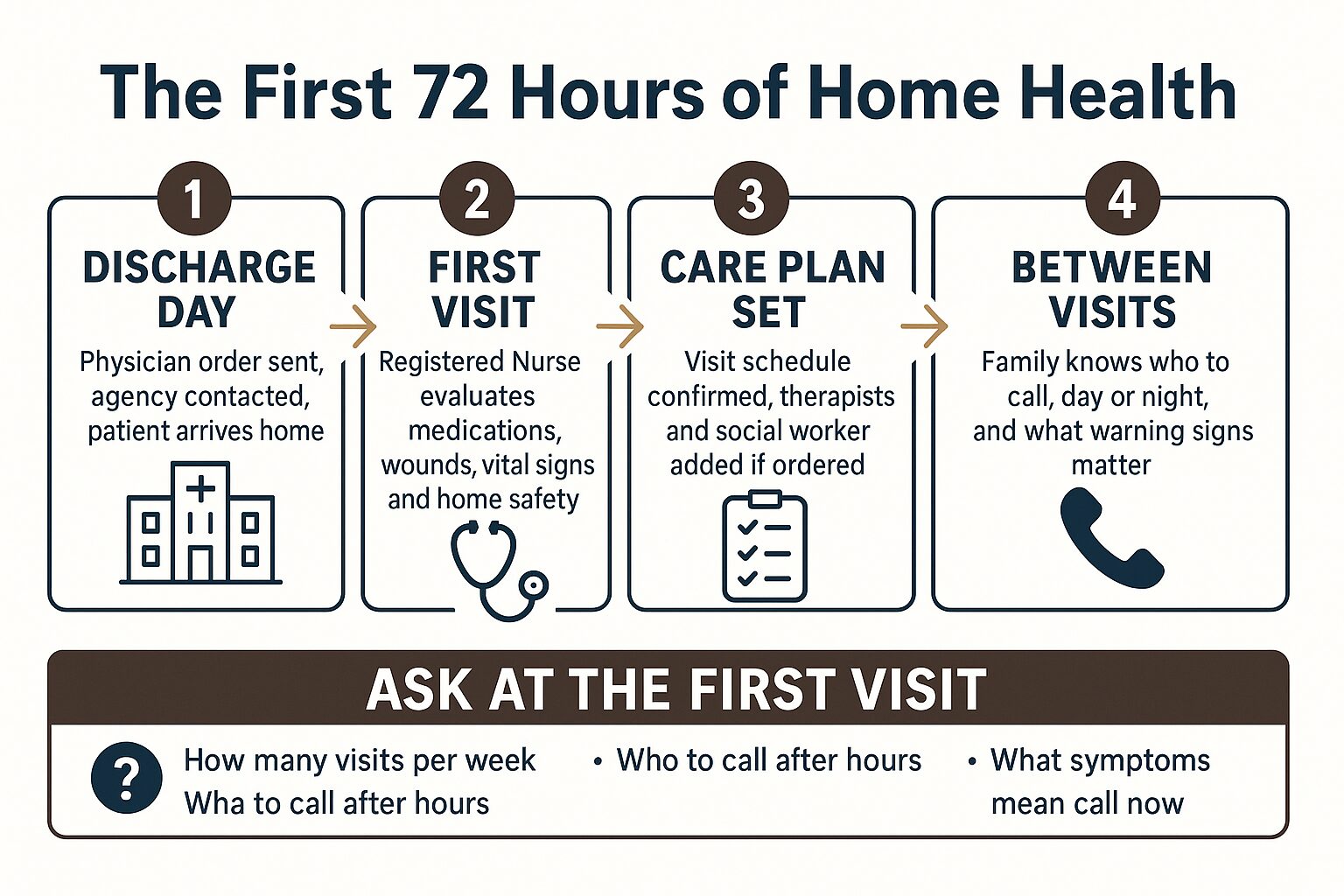
The First 72 Hours at a Glance
A simple map of how the first three days usually unfold once a patient gets home.
Home Health Is Intermittent, Not Around-the-Clock Care
This is the single biggest misunderstanding families run into, and it is better to hear it now than on day two. Home health is intermittent skilled care, which means visits a few times a week, not a nurse in the house all day.
A typical early schedule might be two or three nursing visits a week, plus therapy visits on separate days. Medicare's own description of the home health benefit spells out that it covers part-time or intermittent skilled care, not continuous supervision.
The gaps between visits are when families feel most anxious, especially in week one. Two questions asked at the first visit make those gaps far easier:
- How many visits a week should we expect, and on which days
- Who do we call at 9pm on a Saturday, and what number is that
If your loved one genuinely needs someone present most of the day, that is a separate kind of help. Private-duty hourly care is paid out of pocket in most cases, and in Monterey County round-the-clock coverage can run into the thousands of dollars a month depending on hours and agency. Costs vary widely, so get real numbers before assuming anything. Many families combine a clinical home health team with private hourly help, and a Medical Social Worker can point you toward local options.
What families in Monterey wish they had known sooner about home care covers more of this territory.
What the Team Is Quietly Watching For
The riskiest stretch after a hospital stay is the first 30 days. That is when avoidable returns to the hospital happen most often, and usually not because of one dramatic event.
Most of the time, something small was missed. A wound that looks slightly worse each day. A new medication causing dizziness that gets written off as tiredness. A patient who seems more confused than they should be for this point in recovery.
A family member without clinical training has no reason to catch those patterns. A nurse or therapist who saw the patient on Monday and sees them again on Thursday does, because they have a baseline to compare against. Part of the job in those first days is straightforward detective work.
What you can do between visits:
- Write down anything that changes, even if it seems minor
- Note appetite, sleep, and how far they walked each day
- Take a phone photo of a wound if you were told to watch it
- Call the after-hours line rather than waiting for the next scheduled visit
That last one matters. Families are rarely wrong when they feel that something is off, and the team would much rather get the call.
If recovery is more about relearning daily tasks than healing a wound, occupational therapy at home after a hospital stay explains what that side of the plan involves.
Frequently Asked Questions About the First Days of Home Health
How soon after discharge will someone actually come to the house?
It depends on when the order arrives and how urgent the situation is, but the first visit commonly happens within 24 to 48 hours of the patient getting home. Some post-surgical cases start sooner. Ask the discharge planner to confirm the timing before you leave the hospital, and call the agency directly if you have not heard anything the next morning.
Does Medicare cover home health, and do we need a doctor's referral first?
Yes to both, in most cases. Medicare covers eligible home health services, and a physician's order is required before any visit can be scheduled. Medi-Cal and Veterans benefits also cover home-based care for eligible patients. Coverage depends on meeting the criteria, so a quick conversation about the specific situation is worth more than a general answer.
What if my parent needs help every single day, not just a few visits a week?
That is a real and common gap. Home health provides skilled clinical visits, while daily hands-on help with meals, bathing, and companionship comes from private-duty agencies, family, or community programs. Many Monterey County families run both at once, using the clinical team as the medical anchor and hourly help for the rest of the day.
Is this the same thing as hospice?
No. Home health is focused on recovery, rehab, and managing a condition so someone can get back to independence. Hospice begins when the goal shifts from curing to comfort. They are different programs with different eligibility, and mixing them up is one of the most frequent points of confusion on first calls.
How do I know the person at my door really works for the agency?
Ask for a photo ID badge, and call the agency's main number to confirm. A legitimate agency will never ask for personal or financial information before an in-person assessment has been arranged. If anything feels off, stop and verify. Nobody will take offense.
Questions about care at home on the Central Coast?
If a hospital stay just ended and you are trying to sort out what happens next, a care coordinator can walk you through how home health works and whether it fits your family's situation. Central Coast VNA & Hospice has been serving families in Monterey County and the surrounding Central Coast since 1951, and you can reach someone at 831-372-6668 or at ccvna.com. There is no cost to ask a question.
Veterans and Home-Based Care: Benefits Most Families Do Not Know to Ask About
Your father spent decades in uniform. He knows how to fill out a form, how to sit on hold, how to work a system that does not want to be worked. And yet when the hospital says he needs care at home, nobody in the family knows which benefit actually pays for it.
That gap shows up constantly on the Central Coast. Families in Monterey, Salinas, Seaside, and Hollister take whatever plan the discharge planner hands them, never asking whether their veteran had a second or third benefit pathway available the whole time.
This article walks through the pathways veterans and their families most often miss, how VA and Medicare hospice benefits can interact, and why living an hour from a VA facility does not cut you off from care at home.
Why Veteran Benefits and Home Care Feel Like Two Separate Mazes
Veterans are usually the ones helping other people figure out paperwork. That is what makes this so disorienting when it happens to them.
Central Coast VNA & Hospice's 2025 annual report includes a firsthand account from a local veterans affairs director who spent 24 days in UCSF's Cardiac Critical Care Unit and then had to find home care to be discharged to. His description of that stretch is the clearest version of this problem anyone has written down: "Healthcare is its own complicated country, and we were trying to move through it while simultaneously hurting, healing, and feeling quite lost."
He had spent a career helping veterans find the right door. He still could not find his own.
His family is not unusual. The people staffing a hospital discharge desk know Medicare home health cold. They do not always know how a veteran's VA enrollment, service-connected disability rating, or priority group changes what is available.
So the family gets one option, takes it, and never learns there were others. That is not anyone acting in bad faith. It is just two systems that were built separately and never sat down together.

How Veterans Can Access Home Health and Hospice Benefits: Three Doors, Not One
Most families assume there is one payer and one plan. In practice a veteran may have coverage through more than one channel, and the rules about how they coordinate are complicated enough that it is worth asking directly.
The pathways worth asking about:
- VA healthcare benefits. Depending on enrollment status, priority group, and service connection, the VA may arrange or pay for home-based skilled care and hospice services through community providers.
- Medicare Part A. This is the standard route for home health and the Medicare hospice benefit. Most veterans over 65 have it alongside their VA coverage.
- Medi-Cal. For veterans who meet income and asset requirements, Medi-Cal can cover services or fill gaps the other two do not.
These are not always mutually exclusive. But the coordination rules are dense, and no family should be expected to sort them out from a hospital hallway.
One more thing that trips families up regardless of which door they use: a physician's order is required before home health can be scheduled. Roughly one in ten calls to local home health agencies involves a family surprised by that step, which is why understanding why a physician referral is required for home health ahead of time saves days.
A Medical Social Worker is the person who maps all of this. Ask for one by name during the referral conversation, not after.
Three Benefit Pathways at a Glance
Coverage details depend on the individual veteran's enrollment, service connection, and income. This table is general orientation, not a determination of what any one person qualifies for.
| Pathway | Generally Used For | Who Can Help You Confirm It |
|---|---|---|
| VA healthcare benefits | Home-based skilled care and hospice arranged through community providers; may cover items other benefits do not | VA social worker, county Veterans Service Office, or a Medical Social Worker at the home health agency |
| Medicare Part A | Intermittent skilled nursing, physical, occupational and speech therapy, and the hospice benefit | Discharge planner, physician's office, or the home health agency's intake team |
| Medi-Cal | Coverage for veterans meeting income and asset limits; can fill gaps left by other coverage | County social services, a Medical Social Worker, or the agency handling the referral |
VA Hospice and Medicare Hospice Are Not Always an Either/Or
This is the single most common thing families do not know to ask about.
When a veteran is nearing the end of life, families often assume they must pick one benefit. The VA offers hospice benefits that in some circumstances can work alongside the standard Medicare hospice benefit rather than instead of it.
In certain cases the VA benefit covers things the Medicare hospice benefit does not, including some medications and some care settings. Nobody volunteers this information. You have to ask about VA hospice coordination specifically when care is being set up.
The VA's geriatrics and extended care program is the starting point for understanding what a veteran's enrollment makes available. A county Veterans Service Office can help sort out the rest.
Worth saying plainly: asking about hospice benefits is not the same as choosing hospice. Plenty of families ask early, learn what exists, and use none of it for another year. If eligibility is the part that worries you, the hospice eligibility question most families are afraid to ask covers it directly.
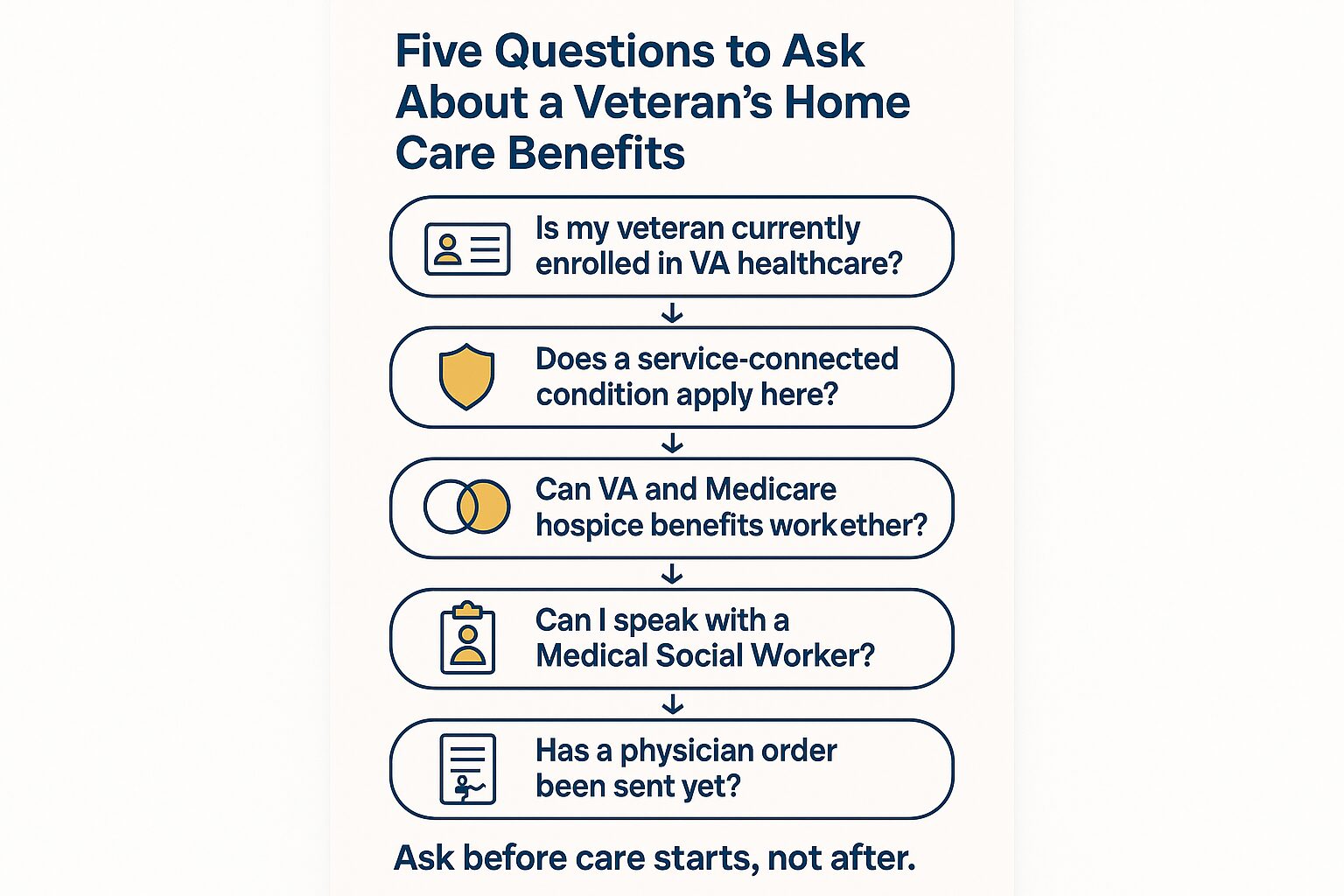
Five Questions to Ask Before Care Starts
These are the questions that open doors families did not know were there. Ask them during the referral conversation, not after care has already begun.
Hollister, King City, and the Salinas Valley: Distance From a VA Facility Is Not the Whole Story
Geography does real damage to veteran benefit access on the Central Coast, but not always in the way families assume.
A veteran in King City or out past Greenfield may be a long drive from any VA facility. Families in San Benito County sometimes decide that puts them outside the range of meaningful veteran support entirely, and they stop asking.
That conclusion is usually wrong. VA-coordinated home health and hospice services can be delivered by community providers with agreements in place, which means the care comes to the house in Hollister rather than the veteran driving to the care.
Home-based nonprofits have covered this ground for a long time. An office opened in Hollister back in 1974 to bring skilled nursing and therapy to San Benito County, and the four-county service footprint across Monterey, San Benito, Santa Cruz and South Santa Clara counties has held since.
What this means practically: the question is not "how far are we from the VA?" It is "which providers in our area coordinate with the VA?" Those are very different questions with very different answers.
Agent Orange, Burn Pits, and the Conversation Veterans Tend to Avoid
Veterans who served in eras with known toxic exposure, including Agent Orange in Vietnam and burn pits in Iraq and Afghanistan, may have chronic conditions that qualify them for specific VA healthcare programs.
As those conditions progress, home health or palliative care can become medically necessary. The clinical need is real. The paperwork usually is not the problem.
The problem is that many veterans will not describe their health in the terms that trigger eligibility. Saying "I am short of breath most days and I stopped walking to the mailbox" feels like complaining. So they say "I'm fine" instead, and the benefit conversation never starts.
A Medical Social Worker who has worked with veteran benefits knows how to translate that. So does an adult child who understands that describing symptoms accurately is not the same as asking for a handout.
One related note on cost, since families always ask. Home health and hospice benefits cover intermittent skilled visits, not round-the-clock help in the house. Families in Monterey County who need daily hands-on assistance often end up paying privately for that piece, and those costs can run well into the thousands per month depending on hours. It is worth asking early which portion a benefit covers and which portion it does not, which is a big part of what families miss when planning a hospital discharge to home.
Frequently Asked Questions About Veteran Home Health and Hospice Benefits
Does my veteran have to give up VA care to use Medicare home health?
Not necessarily. Many veterans carry both VA benefits and Medicare Part A, and the two can often be coordinated rather than traded. The rules depend on enrollment, service connection, and the specific service, so ask a Medical Social Worker or your county Veterans Service Office to confirm your veteran's situation before you assume you have to pick.
We live in Hollister. Are we too far out for VA-coordinated home care?
Usually not. VA-coordinated home health and hospice can be delivered by community providers in San Benito County, so the visits happen at the house rather than requiring a drive to a VA facility. Distance from a VA campus and access to VA-coordinated care are two different things.
How fast can care start after a hospital discharge?
Once a physician's order is in hand, home health agencies on the Central Coast typically move quickly, sometimes within a day or two of the veteran getting home. The delay is almost never the agency. It is the order. If a discharge is coming up, ask the hospital to send that order before the patient leaves the building.
What is the difference between home health and hospice for a veteran?
Home health is skilled care aimed at recovery and stability, like wound care, therapy after surgery, or managing heart disease and COPD at home. Hospice begins when the goal shifts from curing to comfort. Many veterans use home health for years before hospice ever comes up. The piece on home health vs. hospice breaks down how families tell which one fits.
Who actually shows up at the house?
Depending on the plan of care, that can include Registered Nurses, Licensed Vocational Nurses, Physical Therapists, Occupational Therapists, Speech Therapists, Medical Social Workers, Hospice Aides, Chaplains, and trained Volunteers. Ask during intake which team members are part of the plan so nobody is surprised by a knock at the door.
Questions About a Veteran's Options for Care at Home?
If you are sorting through benefits for a veteran in Monterey County, Salinas, Hollister, or anywhere along the Central Coast, a conversation with a care coordinator can help you understand what pathways exist before any decisions get made. Central Coast VNA & Hospice accepts Medicare, Medi-Cal, and Veterans benefits, and has been caring for families in this region since 1951. You can reach a care coordinator at 831-372-6668 or find more information at ccvna.com.
Occupational Therapy at Home: What Really Happens After a Hospital Stay
Your mother is discharged from Community Hospital of the Monterey Peninsula after a knee replacement. The paperwork includes a referral for home health, and you assume that means a nurse will come check the incision.
Then someone calls to schedule an Occupational Therapist. Most families have no idea what that visit is for, and almost nobody expects how practical it turns out to be.
This is a look at what occupational therapy at home actually does after surgery, what the therapist is watching for in your parent's house, and how Medicare coverage works for these visits in Monterey County.
What an Occupational Therapist Is Actually Evaluating
An Occupational Therapist who comes to the house is answering one question: can this person safely do the ordinary activities of daily life in their real environment?
That sounds simple until you break down what a single morning requires. Getting out of bed, standing at the sink, stepping over a tub wall, reaching a shelf, buttoning a shirt, carrying a plate from the stove to the table. Surgery disrupts the strength, balance, and sometimes the mental focus that all of those tasks quietly depend on.
So the therapist watches the patient do them. Not describe them. Actually do them.
Common areas an Occupational Therapist works on after a hospital stay:
- Bathing and toileting, including how someone gets in and out of a shower or tub
- Dressing, especially lower-body dressing after hip or knee surgery when bending is restricted
- Meal preparation, from standing tolerance at the counter to safely handling hot pans
- Moving between rooms, including the path from bed to bathroom at 2 a.m.
- Energy management, so a patient does not spend all their strength before lunch
The plan that comes out of this is built around that specific house. The layout, the furniture, the height of the bed, the habits of the person living there. A clinic gym cannot tell you whether the hallway in a Pacific Grove cottage is wide enough for a walker. The home visit can.
The Home Safety Assessment Catches What a Hospital Room Never Will
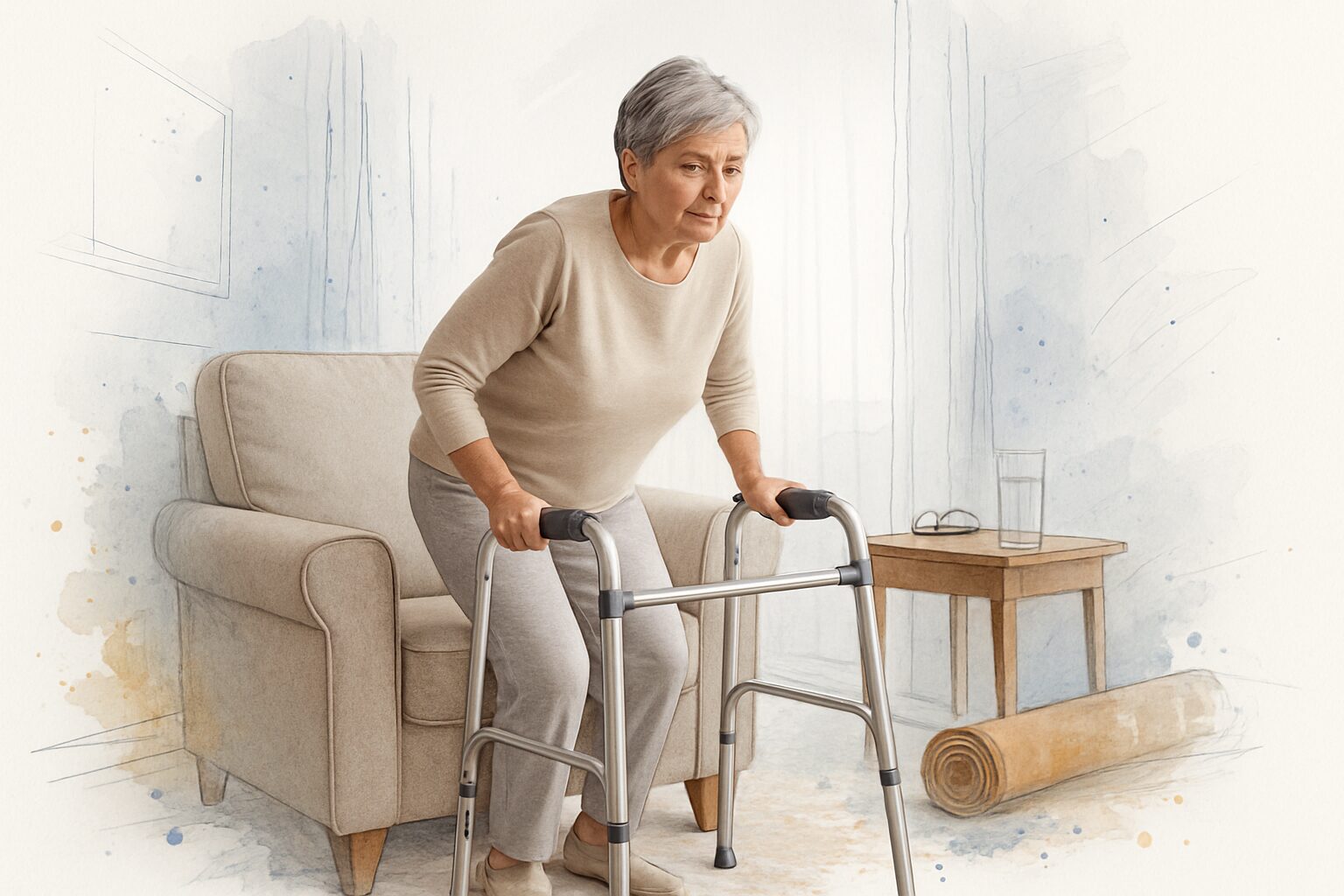
A hospital room is flat, wide, and built for medical equipment. Almost no home on the Central Coast looks like that.
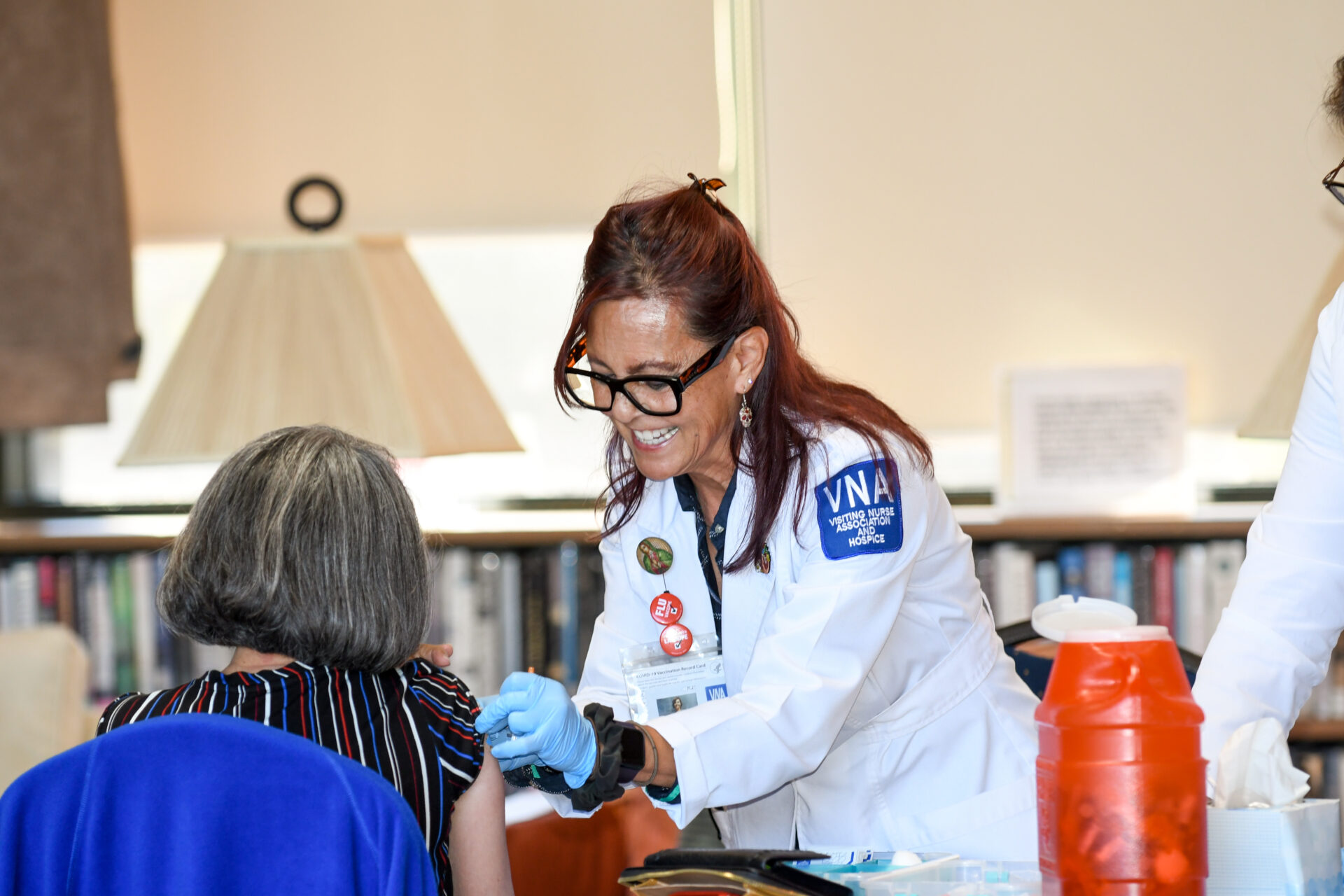
Under the Orthopedic Program at Central Coast VNA & Hospice, a home safety assessment can happen before surgery when a physician orders it, and care can begin within 24 hours of a patient returning home. Either way, the therapist is looking for the same things.
What gets flagged during a home safety review:
- Fall risks like throw rugs, extension cords, low lighting, and pets underfoot
- Bathroom access, which is where a large share of household falls happen
- Stair navigation, including the short entry steps common in older Monterey and Seaside homes
- The bed to bathroom path, walked at night, in the dark, half asleep
- Whether a walker or wheelchair actually fits through the doorways it needs to clear
These are not hypothetical hazards. Older homes in Carmel, Pacific Grove, and the older Salinas neighborhoods often have narrow hallways, raised thresholds, tubs with high walls, and stairs with a handrail on only one side.
If you want the wider picture of what a discharge plan should include, it is worth reading what families often miss when planning a hospital discharge to home.
Occupational Therapy vs. Physical Therapy at Home
Families often assume these are the same service with different labels. They overlap, but the focus is different. Many patients receive both.
| Focus Area | Physical Therapist | Occupational Therapist |
|---|---|---|
| Main question | Can this person move, walk, and build strength safely? | Can this person carry out daily tasks in this home? |
| Typical work | Gait training, balance, strengthening exercises, endurance | Bathing, dressing, meal prep, transfers, energy pacing |
| Equipment role | Walkers, canes, assistive devices for mobility | Grab bars, shower chairs, dressing aids, reachers |
| Environment focus | Movement patterns and physical capacity | Room layout, furniture height, bathroom setup, daily routine |
| Common after | Joint replacement, stroke, fall, general deconditioning | Joint replacement, stroke, hand surgery, cognitive changes |
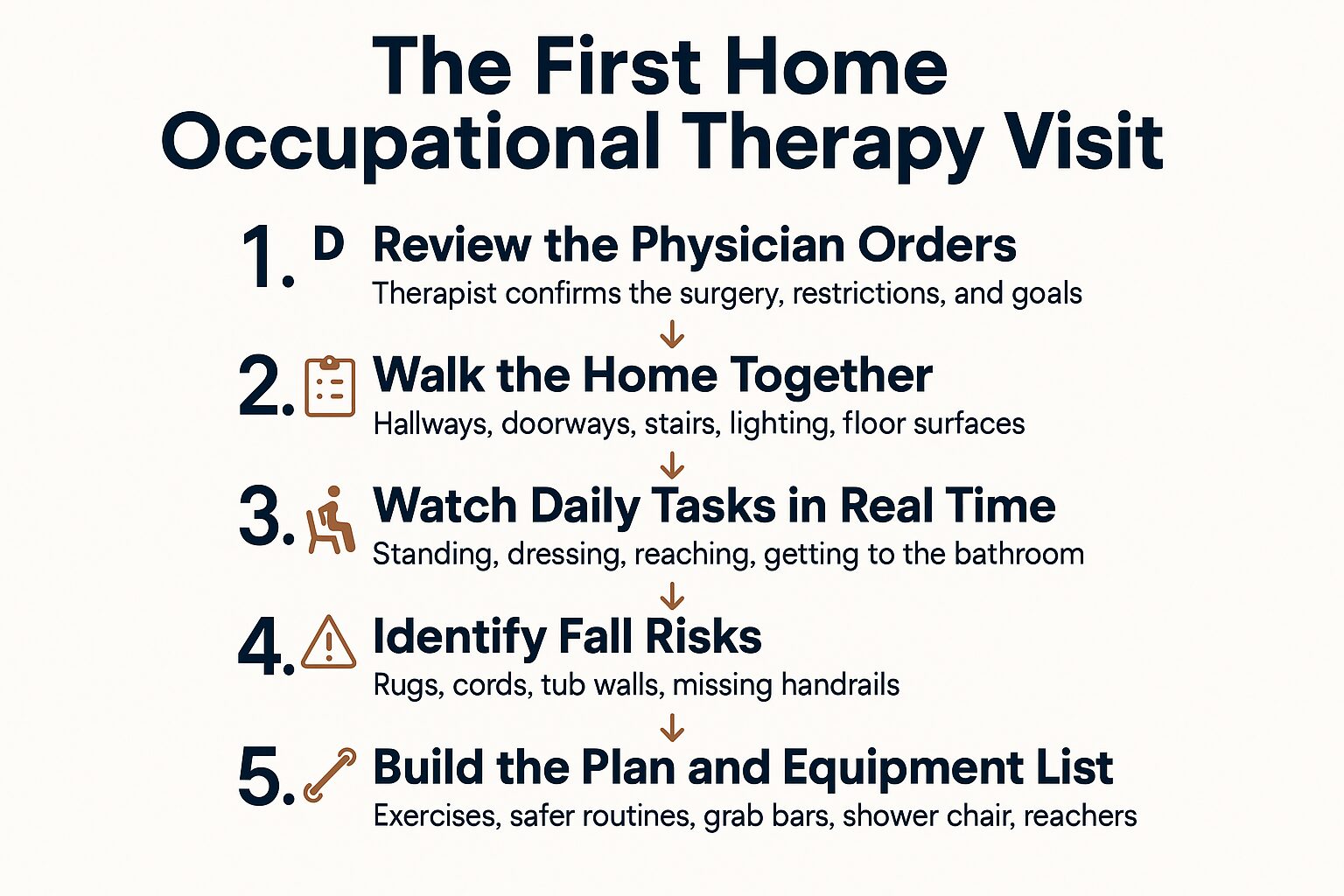
What Happens During the First Home OT Visit
Most first visits follow a similar shape. Here is what families can expect in the hour or so after the therapist arrives.
How Medicare Coverage Works for Home Occupational Therapy
Medicare covers Occupational Therapy visits at home when a physician orders them as part of a home health plan of care and the patient meets the homebound standard. Homebound does not mean bedbound. It generally means leaving the house takes real effort or help.
The part that surprises families most is the referral. A doctor's order has to come first before visits can be scheduled. Callers ask about this constantly, usually some version of does Medicare cover this, and do we need a referral from the doctor first. The answer to both is yes.
You can read the specifics on covered home health services directly from Medicare's own coverage page, and we cover the order process in more detail in why a physician referral is required for home health.
Families in Pacific Grove, Carmel, and Seaside helping a parent recover from a hip or knee replacement often do not learn this coverage exists until a nurse or a Medical Social Worker mentions it during an intake call. Ask about it at the time of discharge, not after the first fall.
Coverage for therapy at home also comes up constantly with physical therapy, and the rules are similar. That is walked through in does Medicare cover physical therapy at home.
The Equipment Conversation Is Worth Having Early
An Occupational Therapist will usually recommend adaptive equipment, and this is where a lot of the practical value shows up. Grab bars, shower chairs, raised toilet seats, long-handled shoe horns, sock aids, reachers.
These are modest changes that often decide whether someone can manage at home without full-time help. Costs vary quite a bit by item and supplier, but many of the smaller aids fall in the low double digits, while durable items like hospital beds and wheelchairs are more commonly rented than bought. The therapist can tell you what typically falls under Medicare's durable medical equipment provisions and what usually does not, so families know what to ask for and what to budget.
One local patient wrote in a review that the nurse who assessed her home before surgery "left me with useful information" for staying safe during recovery, and that the therapy team "encouraged me to do more than I could imagine possible so soon after surgery." That combination, a safer house plus steady pushing, is the whole point.
For the longer view on making a home work over years rather than weeks, see what actually makes staying home as you age possible.
Frequently Asked Questions About Occupational Therapy at Home After Surgery
How many occupational therapy visits will my parent get at home?
It depends on the surgery, the recovery, and what the physician orders. Home health is intermittent care, so visits are typically a few times per week for a stretch of weeks, not daily. The therapist reassesses progress and the plan changes as the patient improves.
Is this the same as having someone come help with bathing and meals every day?
No, and this trips up a lot of families. Home health occupational therapy is skilled, physician-ordered clinical care on a visit schedule. If your family needs daily hands-on help with personal care, that is private-duty home care, and it is usually paid for out of pocket. Many families use both, with the home health team as the clinical anchor.
My mom refuses to use a walker or a shower chair. Can the therapist help with that?
Often, yes. Refusal usually comes from pride or from equipment that was never fitted properly. An Occupational Therapist can adjust the height, show why a particular setup helps, and sometimes find a less obtrusive option that a patient will actually accept.
Does insurance other than Medicare cover home occupational therapy?
Medi-Cal, Veterans benefits, and most private insurance plans cover home health services, though the requirements and visit limits differ. Coverage details are worth confirming during the intake call rather than assuming.
Do you serve areas outside the Monterey Peninsula?
Home health service across the Central Coast covers Monterey County, including Salinas and King City, along with San Benito County including Hollister, parts of Santa Cruz County, and South Santa Clara County. Coverage by exact address is worth confirming by phone before a discharge date is set.
Questions About Therapy at Home After a Hospital Stay?
If a parent is coming home to Monterey, Salinas, Pacific Grove, or anywhere else in Monterey County after surgery and you are not sure what the home health referral covers, it is a fair question to ask out loud. A care coordinator can walk through what the physician ordered, what Medicare or Medi-Cal typically covers, and what an Occupational Therapist would look at in that specific house. Central Coast VNA & Hospice has been visiting homes in this region since 1951, and the phone number is 831-372-6668.
When a Parent's Dementia Makes Medication Management a Safety Issue
A Monterey County family put it plainly in a message to a local nonprofit home health team. An 86-year-old father had just been diagnosed with dementia. He was taking more than five prescriptions, and his wife, in her 80s and recovering from her own serious illness, was the one keeping track of all of it.
Their question was direct. Could a Registered Nurse look over his medications and help put together a daily schedule?
That same question arrives again and again from families on the Monterey Peninsula, across the Salinas Valley, and out toward King City. This article covers what actually goes wrong with dementia and medication management at home, what a skilled nursing visit looks like, and how coverage works.
Why a Pill Routine That Worked Six Months Ago Can Be Dangerous Now
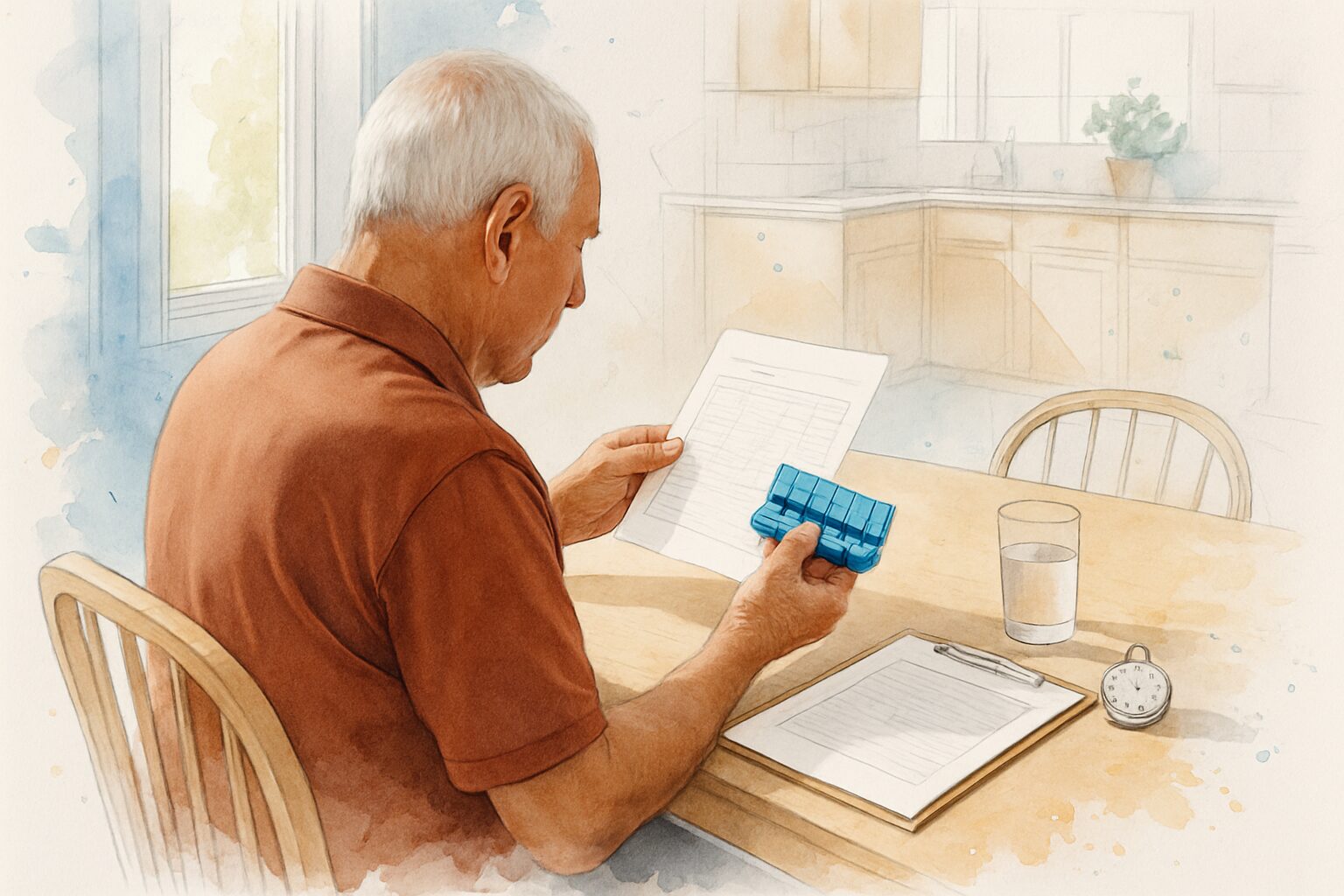
Dementia changes three things at once: how a person processes instructions, how they recognize pills, and whether they remember taking a dose. Any one of those alone is manageable. Together, they break a routine that used to run fine.
Most families worry about missed doses. The bigger danger is usually double-dosing, because a person who does not remember the morning pills may take them again at noon.
That matters most with a few common categories:
- Blood thinners, where an extra dose raises bleeding risk
- Diabetes medications and insulin, where a repeat dose can drop blood sugar fast
- Cardiac drugs for blood pressure and heart rhythm
- Pain medications and sedatives, which compound confusion and fall risk
An extra dose of a blood pressure medication can end with a fall in the hallway and an ambulance ride to an emergency department in Monterey or Salinas. That is often the moment a family realizes the system had been failing for weeks.
One more detail families miss: pills get moved. A person with dementia may relocate bottles, hide them, or set them down somewhere odd, which makes it impossible to tell from the bottle whether a dose was taken.

What a Registered Nurse Actually Does During a Medication Visit
Families often picture a nurse counting pills and filling a plastic organizer. That is a small piece of it. The visit is a clinical review of the whole picture, in the home, with the actual bottles on the table.
A visit focused on medication management generally includes:
- A full review of every prescription, over-the-counter drug, and supplement, including duplicates from different prescribers
- A check for interactions and doses that no longer fit the patient's kidney function, weight, or blood pressure
- An honest assessment of whether the patient can still self-administer safely
- Communication with the prescribing physician about simplifying the regimen, such as consolidating dose times or dropping a drug that no longer helps
- Hands-on teaching for the family member running the day-to-day system
- A written schedule that matches how the household actually works, not an idealized version of it
That teaching piece is the part families underestimate. For a spouse in her 80s managing an ailing partner, sitting down with a nurse for an hour can turn daily dread into something she feels able to handle.
The visit is also where problems surface that nobody reported over the phone. A skilled nurse on a home visit sees the stairs, the lighting, the two bottles that look nearly identical, and the sticky notes on the refrigerator that stopped making sense a month ago.
How Medication Needs Shift as Dementia Progresses
Dementia-related medication problems tend to compound. What works with reminders in the early stages often does not work at all 12 to 18 months later.
| Stage | What families usually notice | Support that tends to fit |
|---|---|---|
| Early | Occasional missed doses. A weekly organizer and reminders still mostly work. | Family reminders, one clinical review of the full list, a simplified schedule |
| Middle | Doses repeated or skipped. Bottles moved or hidden. Confusion between similar looking tablets. | Skilled nursing visits, pre-set organizers, physician review to reduce the number of drugs |
| Later | No reliable ability to self-administer. Refusing pills or spitting them out. | Another person administering every dose, with clinical oversight and ongoing family teaching |
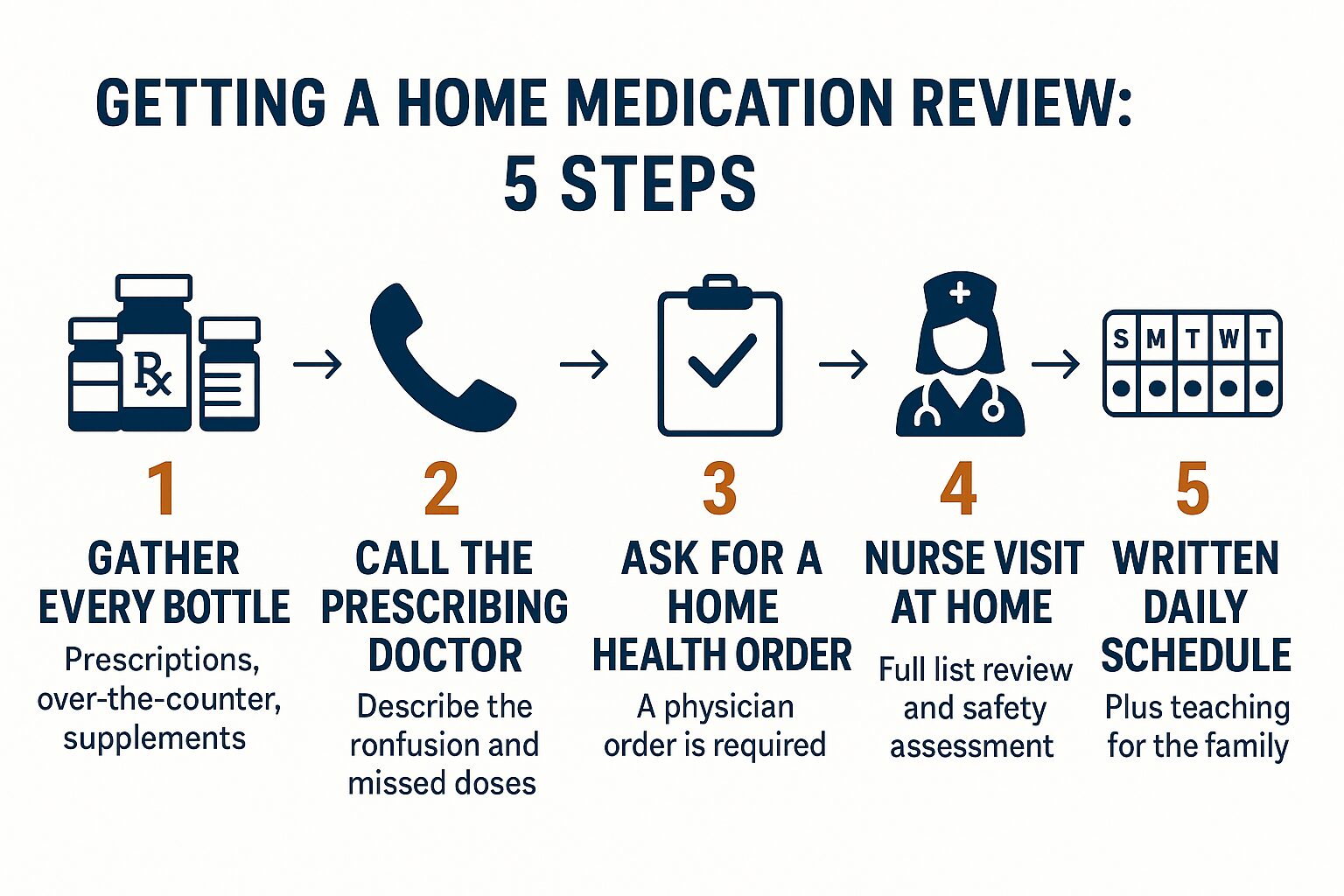
How Families Get a Medication Review Started
The path is shorter than most families expect, but it does start with the physician rather than the home health agency.
Medicare Covers This, and Many Families Are Never Told
Home health visits for medication management are a covered benefit under Medicare when two conditions are met. There has to be a physician order, and the patient has to meet the homebound criteria, meaning leaving home takes considerable effort or help.
Medicare publishes the rules for home health services coverage directly, and skilled nursing on an intermittent basis is part of it. Nonprofit agencies in the region, including Central Coast VNA & Hospice, accept Medicare, Medi-Cal, and Veterans benefits along with most private insurance.
Here is where families get stuck. Callers regularly reach local agencies not knowing that a doctor's order comes first, which delays everything by days or weeks. And the physician who wrote the prescriptions does not always connect a new dementia diagnosis to eligibility for skilled nursing at home.
So the family sometimes has to make that connection and ask for it. Plenty of households in Hollister, King City, and the Salinas Valley have gone a year without support that was available the whole time. If you want the mechanics, this piece on why a physician referral is required walks through the process.
One honest limit: home health is intermittent skilled care, usually a few visits per week, not someone in the house every day. Families who need daily hands-on help typically add private-duty help, and that market runs into the thousands of dollars per month depending on hours. Costs vary widely, so ask any provider for specifics on your situation.
Asking Early Is Easier Than Recovering From a Crisis
Families who wait for the fall, the hypoglycemic episode, or the hospitalization end up making decisions under pressure with fewer options. Families who ask while the situation is still messy but manageable get to build something on their own terms.
The point of early involvement is not to take over. It is to set up a system the household can actually keep running, then adjust it as the disease changes what is needed.
That usually means the whole team gets involved over time: nurses, therapists, medical social workers, chaplains, volunteers, and other clinicians. A Medical Social Worker may be the one who finds the community resources nobody knew about, which is exactly what one Monterey Peninsula family described in a public review after their 91-year-old mother came onto service.
If you are already past the medication question and wondering about the bigger picture, when caring for an aging parent becomes more than you can do alone covers the next set of decisions.
Frequently Asked Questions About Dementia and Medications at Home
Can a nurse just come out and look over my parent's medications?
Yes, that is a normal reason for a home health visit, but it needs a physician order first. Call your parent's doctor, describe what you are seeing with missed or repeated doses, and ask for a home health referral for medication management.
Does Medicare pay for medication management at home?
Skilled nursing at home is covered under the Medicare home health benefit when there is a physician order and the patient meets homebound criteria. Medi-Cal and Veterans benefits also cover home health for eligible patients. Coverage details depend on the individual plan, so confirm with the agency before services start.
What if we need someone in the house every day?
Home health visits are intermittent, often two or three times a week, so daily hands-on help usually comes from a private-duty agency. Many Monterey County families use both, with the home health team as the clinical anchor and private help filling the daily hours.
Will the nurse take over giving the pills?
Not usually. The goal is a workable system the family can sustain between visits, which often means the nurse pre-sets organizers, writes out the schedule, and teaches the spouse or adult child what to watch for.
My dad insists he can handle his own medications. What then?
That is common, and it is one reason an outside clinician helps. A nurse can assess self-administration objectively and frame the changes as doctor's orders rather than a family member questioning his judgment, which lowers the resistance considerably.
Want to Understand What Support Is Available Near You?
If you are sorting through pill bottles at a kitchen table somewhere in Monterey County and not sure what comes next, a conversation with a care coordinator can clarify what is covered and what a home visit would involve. Central Coast VNA & Hospice has been working with families across Monterey County, San Benito County, and the surrounding Central Coast since 1951, and information is available at 831-372-6668 or ccvna.com whenever you are ready to ask.
Speech Therapy at Home: What It Covers and Who Qualifies
Most families picture the same thing when they hear speech therapy: someone practicing words that came out wrong. That picture is only a small slice of what a Speech Therapist actually does in the home.
After a stroke, a head or neck surgery, or a long hospital stay, the harder problems are often invisible from across the room. Trouble swallowing safely. Forgetting the steps of a task. Losing the thread of a conversation halfway through.
Families across Monterey County call about this after a discharge from Community Hospital of the Monterey Peninsula, Salinas Valley Health, or Natividad, usually with two questions: does Medicare cover it, and do we need a doctor's order first. This guide answers both, and explains what speech therapy at home actually covers after a stroke or surgery.
What speech therapy at home actually covers after a stroke or surgery
A Speech Therapist, also called a speech-language pathologist, works on three broad areas in the home. Speech is only one of them.
- Swallowing safety (dysphagia). Coughing during meals, a wet or gurgly voice after drinking, food that seems to stick, or unexplained weight loss.
- Communication. Slurred words, trouble finding the right word, difficulty understanding what others say, or a voice that has gone weak and quiet.
- Thinking and memory (cognition). Losing track of medications, repeating questions, trouble sequencing daily tasks, poor safety awareness after a fall or a head surgery.
That third one surprises people. A patient in Pacific Grove who can hold a normal conversation may still be unable to reliably remember whether they took their morning pills.
That is a speech therapy problem, and it is also a safety problem. It is one reason therapy visits are usually coordinated with a Registered Nurse who is already managing medications in the home.
Speech therapy in the home is part of a physician-directed plan, the same way skilled nursing care at home works. Visits are intermittent, goal-based, and reassessed as the patient improves.
The swallowing problem families almost never see coming
Of everything a Speech Therapist handles at home, swallowing difficulty carries the highest stakes. When food or liquid goes down the wrong way, it can settle in the lungs and cause aspiration pneumonia, which sends patients right back to the hospital.
It often shows up quietly. A parent starts eating less. Meals take twice as long. They stop drinking water because it makes them cough. According to the National Institute on Deafness and Other Communication Disorders, swallowing problems commonly follow stroke and other nervous system conditions, and they can lead to poor nutrition and dehydration.
What a Speech Therapist does about it in the home:
- Evaluates how the patient handles different food textures and liquid thicknesses
- Teaches positioning and swallowing techniques that reduce risk
- Recommends diet changes, cup types, and pacing that the family can actually follow
- Trains family members on what warning signs mean a call to the nurse
Families frequently do not realize this is a skilled clinical concern at all. They treat it as picky eating, and then the pneumonia arrives three weeks later.
What Families Notice vs. What a Speech Therapist Is Looking At
The same everyday observation can point to a very different clinical issue. Here is how common household signs line up.
| What the family notices | What it may actually be | What therapy addresses |
|---|---|---|
| Coughing or throat clearing during meals | Unsafe swallow, aspiration risk | Swallow techniques, texture and liquid changes, positioning |
| "He just doesn't talk much anymore" | Weak voice or word-finding difficulty after stroke | Voice strength, language exercises, communication strategies |
| Missed or doubled medications | Memory and sequencing changes | Cognitive strategies, written routines, safety cues |
| Repeating the same question | Short-term memory loss after surgery or illness | Memory supports the family can maintain between visits |
| Eating less, losing weight | Fear of choking, fatigue while chewing | Meal pacing, calorie-dense soft foods, endurance work |
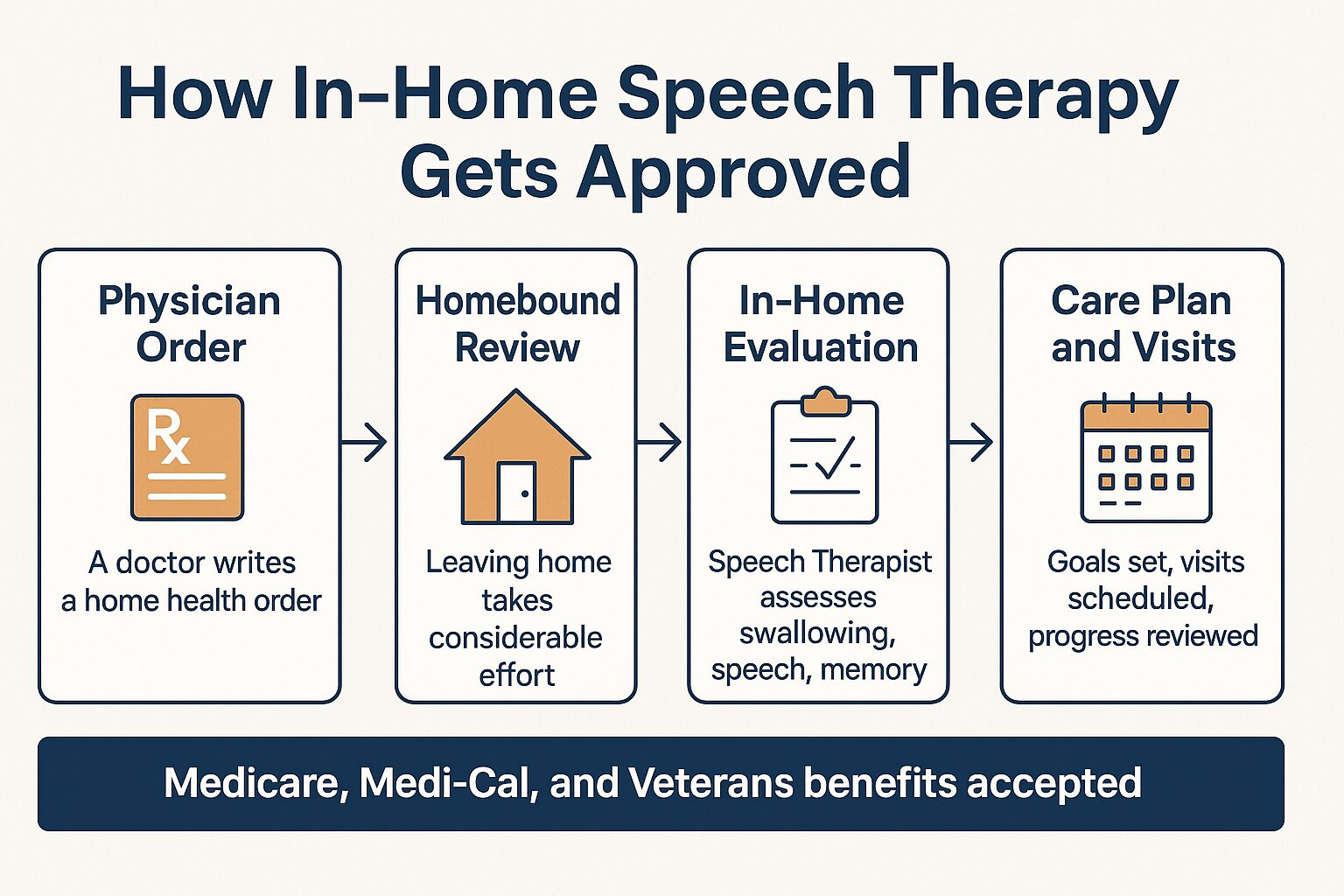
The Qualifying Path in Four Steps
Most families get stuck on the referral step. This is the order things actually happen in.
Who qualifies, and what "homebound" really means
To get speech therapy at home under Medicare, a patient generally needs two things: a physician order and to meet the homebound requirement. Those are the same conditions that apply to skilled nursing and physical therapy.
The homebound standard is where families count themselves out too early. It does not mean the patient can never leave the house. It means leaving takes a considerable and taxing effort, or that they need help or a device to do it.
Someone in Salinas who can get to a Sunday church service with a walker and a family member's arm may still qualify. Someone recovering from head and neck surgery who tires after twenty minutes upright may qualify too.
A few practical notes:
- Medicare, Medi-Cal, and Veterans benefits are all accepted for home health services here
- The order can come from the hospital physician at discharge or from the primary care doctor later
- Home health does not cover ages 0 to 21, maternity diagnoses, or primary behavioral health conditions
If the rules feel murky, a Registered Nurse or care coordinator can walk through the specific situation. The guidelines are more flexible than most families assume, which is also true of Medicare coverage for physical therapy at home. And if you are unsure how the order gets written, this explanation of the physician referral process covers it step by step.
Why the kitchen beats the clinic room
A clinic can simulate a meal. A home does not have to.
When a Speech Therapist sits down in a patient's own King City or Hollister kitchen, they are working with the actual cups in that cupboard, the actual chair height, the food that family actually cooks. Swallowing strategies get practiced with dinner, not with a demonstration.
The same holds for memory work. Cues get placed on the real pill organizer, on the real calendar, in the room where the patient will use them at 7 a.m. tomorrow.
One family on the Peninsula described the team that came to their home as nurses, physical therapists, and a Medical Social Worker who each evaluated a different piece of the picture, then built one plan. That coordination between nurses, therapists, social workers, chaplains, volunteers, and other clinicians is the point of home-based care.
Progress made in the room where the patient lives tends to stick. There is no gap between the exercise and real life.
Asking for an evaluation is not a commitment
Plenty of families wait because they are not sure the problem is "serious enough" to bother anyone about. That hesitation costs weeks.
A formal evaluation gives you information, not an obligation. A Speech Therapist can tell you what is present, what is not, which goals are realistic, and roughly how many weeks a course of therapy might run.
Sometimes the answer is that no therapy is needed and the family can stop worrying. Sometimes the answer changes the meal plan that night. Either outcome is better than guessing.
If a discharge is coming up soon, it is worth reading what families often miss when planning a hospital discharge to home, because the speech therapy question is one of the most commonly skipped items on the list.
Frequently Asked Questions About In-Home Speech Therapy
Does Medicare cover speech therapy at home, and what will we pay?
Medicare covers speech-language pathology as part of the home health benefit when the patient meets the homebound requirement and has a physician order. For eligible patients, the covered home health visits themselves typically come with no coinsurance, though durable medical equipment is usually billed separately at a percentage. Coverage details depend on the plan, so ask a care coordinator to review the specific situation before assuming anything.
Do we need a doctor's order first, or can we just call and schedule?
A physician order is required before a visit can be scheduled. This is the single most common point of confusion on incoming calls. The hospital physician can write it at discharge, or the primary care doctor can write it afterward.
My mother's speech is fine. Is speech therapy still relevant?
Often yes. Swallowing difficulty and memory or sequencing problems fall under speech therapy even when the patient speaks clearly. If she is coughing at meals, losing weight, or mixing up medications, an evaluation is worth requesting.
How many visits does in-home speech therapy usually involve?
It varies with the diagnosis and goals. Home health is intermittent, meaning scheduled visits rather than daily coverage, and the plan is reassessed as the patient progresses. A Speech Therapist can give a realistic estimate after the initial evaluation.
We need someone in the house every day. Is that what this is?
No, and this comes up often. Home health provides skilled clinical visits, not around-the-clock personal care. Many families pair home health with a private-duty agency for daily hands-on help, and a care coordinator can point you toward local options for that piece.
Still Unsure Whether a Speech Therapy Evaluation Makes Sense?
If someone you love is coughing at meals, forgetting medications, or struggling to be understood after a stroke or surgery, a conversation costs nothing but a few minutes. Central Coast VNA & Hospice has provided home-based care across Monterey County and the surrounding Central Coast since 1951, and a care coordinator can talk through whether an in-home evaluation fits your situation. You can reach the team at 831-372-6668 or read more at ccvna.com.
How Families in Monterey County Can Vet a Hospice Provider
The moment usually arrives on a hard day. A physician sits down with your family and explains that treatment is no longer working, and someone hands you a name and a phone number for hospice.
Most families accept that first name. It feels like the only option, and nobody has the energy to shop around. But a referral from a discharge planner or a physician is a starting point, not a vetted recommendation.
This guide walks through the questions families in Monterey County can ask in a single phone call. Six steps, each with a concrete answer you can actually judge.
Step 1: Treat the referral as one option, not the decision
Hospital discharge planners at hospitals across the Monterey Peninsula and Salinas Valley are doing their job, and they are usually doing it fast. They pass along providers who are in-network and accepting patients.
That list is not a quality ranking. You are allowed to ask for more than one name, and you are allowed to call a provider your family found on its own.
Here is what to do before you say yes to anyone:
- Ask the discharge planner for two or three hospice names, not one
- Ask whether the hospital has any financial relationship with the provider
- Write down the questions in this guide and ask each provider the same ones
- Give yourself 24 to 48 hours if the clinical situation allows it
One more practical note for families in King City, Greenfield, or out toward Big Sur: ask directly whether the provider actually staffs your area. Several callers each month learn mid-conversation that a provider's map stops well short of their driveway. Coverage on paper and a nurse who can reach you in 40 minutes are two different things.
Step 2: Ask if they are Medicare-certified, and whether they are nonprofit
Start with Medicare certification. Every legitimate hospice serving Monterey County is certified, so this is a floor requirement rather than something that sets a provider apart. If a provider hesitates on this question, end the call.
You can verify certification and see patient survey results yourself through Medicare's Care Compare tool, which lists hospices by ZIP code.
The more revealing question is the funding model. Nonprofit hospice organizations return their resources to patients and the community. For-profit hospices answer to investors.
That difference shows up in ordinary ways: staffing ratios, how long a nurse stays in the room, whether a Chaplain drives to Carmel Valley at 10 p.m. because it is the right thing to do.
California has also seen a real problem with fraudulent hospice operations, mostly concentrated in Southern California but worth understanding anyway. If you want the background, read about California's hospice fraud crisis.
A quick safety note families here have raised: a legitimate provider will never ask for personal or financial details before an in-person assessment is scheduled. If someone shows up unannounced claiming to represent a hospice, call the agency's main number and confirm.
Step 3: Make them name every person on the team
Hospice is not one nurse who visits twice a week. A credible program should be able to name each member of the interdisciplinary team without pausing to think about it.
Ask who will actually come to the house. The full team should include:
- Registered Nurses for pain and symptom management
- Hospice Aides for bathing, grooming, and personal comfort
- Medical Social Workers for paperwork, benefits, and family conflict
- Chaplains for spiritual support, regardless of faith or lack of one
- Bereavement Specialists for the months after a death
- Volunteers who sit with patients so family members can sleep or run errands
If a provider is vague about Chaplain availability, or does not bring up bereavement follow-up on their own, treat that as a real gap. Families across Monterey County have been caught off guard by programs that sent a nurse but had no one else behind her.
Ask how often each person visits, and ask whether visit schedules are set in advance. Inconsistent, unannounced arrivals are one of the most common complaints families raise about hospice care anywhere, and a provider who cannot describe a schedule probably does not keep one.
Step 4: Ask what happens at 2 a.m.
This is the single most useful question on the list, because the answer is concrete and easy to judge.
Ask it plainly: if my mother has a pain crisis at two in the morning, what happens?
A solid answer sounds like this. You call one number, a clinician answers, and that person can either talk you through a medication adjustment or send a Registered Nurse to the house that night.
A weak answer sounds like this. An answering service takes a message, and someone calls back during business hours.
Follow up with:
- Is the after-hours line staffed by a nurse or by a message service?
- How long does a night visit typically take to arrive in my area?
- Who covers weekends and holidays?
- What medications will already be in the house for a crisis?
Nights are when families feel most alone. A provider that has thought this through will answer in fifteen seconds without checking with a supervisor.
Six Questions and What the Answers Should Sound Like
Use this as a phone script. Ask every provider the same questions and compare the answers side by side.
| Question to ask | A solid answer | A warning sign |
|---|---|---|
| Are you Medicare-certified? | Yes, with a certification number they will share | Hesitation or a vague yes |
| Nonprofit or for-profit? | A direct answer either way, with an explanation | Deflection or confusion |
| Who is on the care team? | Names every role, including Chaplain and Volunteers | Only nurses are mentioned |
| What happens at 2 a.m.? | A 24/7 clinical line that can dispatch a nurse | An answering service takes a message |
| What does bereavement look like? | Months of support, groups and one-on-one counseling | A single follow-up phone call |
| How long in this community? | A specific number of years and local references | Recently opened, no local history |
The Six-Question Vetting Call at a Glance
Print this or keep it on your phone. The whole conversation takes about fifteen minutes per provider.
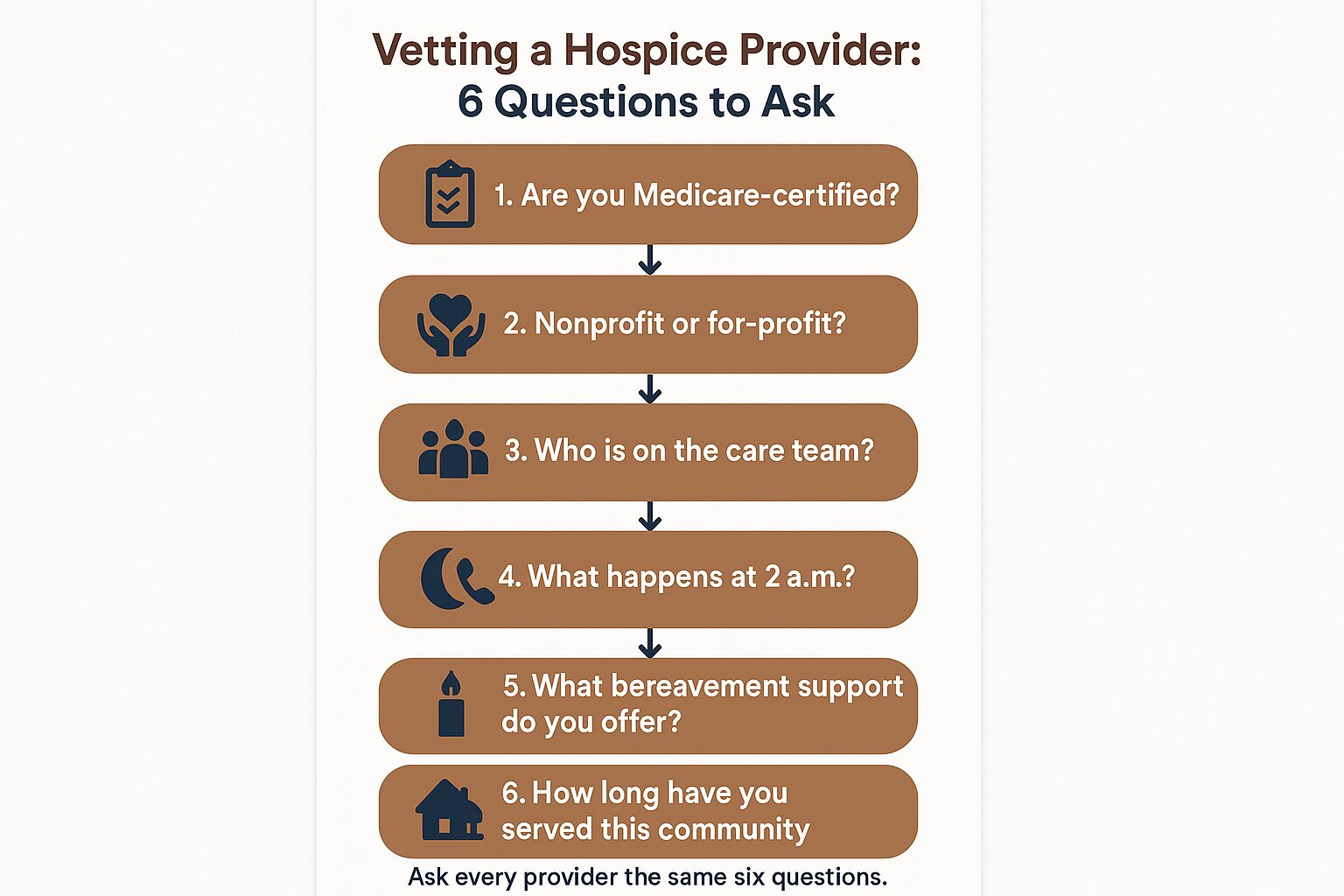
Step 5: Ask about grief support before you think you need it
Bereavement is the part families skip during the vetting call and regret skipping six months later.
Ask what happens after your loved one dies. Real grief support means ongoing counseling and support groups over a period of months, not one sympathy call and a mailed pamphlet.
A second question worth asking: does the provider offer grief support to people in the community who were never hospice patients? A steady stream of calls comes in from Monterey and Pacific Grove residents who lost a spouse through a different provider and have nowhere to turn afterward. One recent message came from a woman whose husband of more than fifty years had died the day before, asking simply for a group she could attend nearby.
Providers who keep the door open to the wider community tend to be more invested in the whole family experience. If you want a sense of what this looks like in practice, here is what grief support after hospice actually involves.
Step 6: Check local history, because reputation here is evidence
The Monterey Peninsula is small. A provider's actual record travels through churches, senior communities, and physician offices faster than any marketing campaign.
A hospice that has operated continuously in Monterey County, San Benito County, and the surrounding communities for decades leaves a trail you can follow:
- Ask your loved one's primary physician which programs they trust
- Ask neighbors and friends who have been through it recently
- Check licensing and complaint history through the California Department of Public Health
- Read reviews, including the critical ones, and see whether the provider responds
Read negative reviews carefully rather than dismissing them. A pattern of complaints about scheduling or communication tells you something. A single hard review with a thoughtful reply tells you something different.
Also be clear on what you are actually choosing. Many families call about hospice when what they need right now is home health or palliative care. If that line is still blurry, this comparison of home health and hospice sorts it out, and the eligibility question most families are afraid to ask covers timing.
Frequently Asked Questions About Choosing a Hospice Provider
Do we need a doctor's order before hospice can start?
Yes. Hospice requires a physician certification that the illness is expected to run its course within about six months if it follows its usual path. This is the step that surprises families most often and the one that delays admission. You can call a provider first and start the conversation while the order is being arranged.
Does Medicare cover hospice, and what does it actually pay for?
The Medicare hospice benefit generally covers the care team's visits, medications related to the terminal illness, medical equipment such as a hospital bed, and supplies. Small copayments can apply to some outpatient prescriptions and inpatient respite stays, and coverage details vary by situation. Medi-Cal and Veterans benefits also cover hospice. Ask any provider you call to walk you through the specifics for your loved one.
Can we switch hospice providers if it is not working?
Yes. Medicare allows you to change hospice providers once during each benefit period, and doing so does not end the benefit. If visits are inconsistent, calls go unanswered, or the team is not a fit, you are not stuck.
How quickly can hospice start after a hospital discharge?
Often within a day or two once the physician order is in place, and sometimes the same day for urgent situations. When you call, say plainly that the patient is being discharged and needs someone at the house. That changes how the intake conversation is handled.
Does hospice mean we are giving up on treatment?
No. Hospice shifts the goal from curing the disease to caring for the whole person, including pain relief, emotional support, and spiritual care. Families often describe it as the point where their loved one finally got comfortable. If curative treatment is still on the table, palliative care may be the better fit right now.
Questions About Hospice Care on the Central Coast?
If you are working through these questions for a parent or spouse in Monterey County, San Benito County, or South Santa Clara County, you are welcome to ask them of us the same way you would ask any other provider. Central Coast VNA & Hospice has served families here since 1951, and a care coordinator can talk through options, eligibility, and Medicare or Medi-Cal coverage without any pressure to decide. The number is 831-372-6668.

Summer Heat and Smoke on the Central Coast: What Home Patients Need to Know
It usually starts with a phone call. A daughter in Pacific Grove, wearing a sweatshirt in 62-degree fog, calls her father in Salinas and finds out his house has been sitting at 94 degrees since noon.
That gap between the coast and the valley is one of the most misunderstood health risks in Monterey County. And when wildfire smoke drifts in on top of the heat, a patient managing serious illness at home is dealing with a medical situation, not a weather annoyance.
This guide covers what heat and smoke actually do to a seriously ill person at home, which medications make it worse, and the handful of questions families should answer before the next advisory shows up on their phone.
Why heat hits inland patients harder than coastal ones
Monterey County is really two climates. Coastal Monterey, Pacific Grove, and Carmel often stay in the 60s through summer, while Salinas, Gonzales, Soledad, and King City can push into the 90s and past 100.
A lot of seriously ill patients live in those hotter inland communities. Their adult children often live on the Peninsula, where the fog makes the risk feel abstract.
Heat is harder on some bodies than others. Risk climbs for:
- Adults over 65, who sweat less and feel thirst less reliably
- People with heart disease or a history of heart failure
- People with COPD or other chronic lung conditions
- People with diabetes, which can affect circulation and sweating
- Anyone with limited mobility who cannot move to a cooler room on their own
- Anyone taking medications that interfere with temperature regulation
One more factor matters here: many older inland homes have no central air conditioning. A home built to shed valley heat overnight does not do much during a five-day stretch of triple digits. If your parent is already having trouble managing the house on a hot day, that is often the same moment families start asking whether it's time to get some help at home.

Heat plus wildfire smoke is a different kind of risk
Smoke season on the Central Coast rarely stays put. Fires burning in Big Sur, Los Padres National Forest, or well outside the county can push haze into the Salinas Valley and across the Peninsula for days.
In July 2026, the American Heart Association published findings that the combination of extreme heat and wildfire smoke can nearly double the risk of a fatal heart attack, with older adults facing even greater risk. You can read the American Heart Association's warning on heat and wildfire smoke directly.
The reason is fairly simple. Heat already makes the heart work harder to cool the body. Fine smoke particles inflame the airways and lower the oxygen the blood is carrying. Stack those two demands on a heart or set of lungs that is already compromised, and the margin gets thin fast.
For a patient with a cardiac diagnosis, COPD, or an advanced illness, that means a smoke event needs to be managed clinically, not just waited out. Symptoms families should watch closely during a smoke day include new or worsening shortness of breath, chest pressure, a cough that will not settle, confusion, and swelling in the legs or feet.
The medication piece most families never hear about
This is the part that surprises people. Some of the most common medications for seriously ill patients make it harder for the body to handle heat.
Monterey County's own emergency heat guidance flags people taking certain medications as higher-risk during heat events. Broad categories that can affect temperature regulation, fluid balance, or sweating include:
- Diuretics, often called water pills
- Beta blockers and some other blood pressure medications
- Certain antidepressants and antipsychotics
- Anticholinergic medications, including some bladder and allergy drugs
- Medications that cause drowsiness or reduce awareness of thirst
Nobody should stop or change a dose on their own. But a Registered Nurse visiting the home can look at the full medication list, flag the combinations that raise heat risk, and bring concerns back to the treating physician.
That kind of review is routine work on a home visit. If you have never seen one, this walkthrough of what a skilled nurse actually does during a home visit covers the ground. Medication management is also part of why a single visit often catches problems a family has been living with for months.
Warning signs during a heat or smoke event and what they usually mean
Use this as a general reference, not a diagnosis. Any patient with a serious illness should have symptom instructions from their own physician or care team.
| What you notice | What it may point to | Typical next step |
|---|---|---|
| Hot, dry skin with no sweating, plus confusion | Possible heat stroke | Call 911 right away |
| Chest pressure, pain, or a racing heartbeat | Cardiac event | Call 911 right away |
| Sudden severe shortness of breath or bluish lips | Respiratory distress | Call 911 right away |
| Dizziness, weakness, cramping, heavy sweating | Early heat exhaustion | Move to a cooler room, give fluids, call the care team |
| Worsening cough or wheeze during a smoke day | Airway irritation | Call the care team or physician the same day |
| Not urinating much, very dark urine | Dehydration | Call the care team or physician the same day |
| More confused or sleepy than usual | Heat effect or medication effect | Call the care team the same day |
Five questions to answer before the next heat advisory
Families who work through these five questions ahead of time spend far less energy scrambling once an advisory hits.
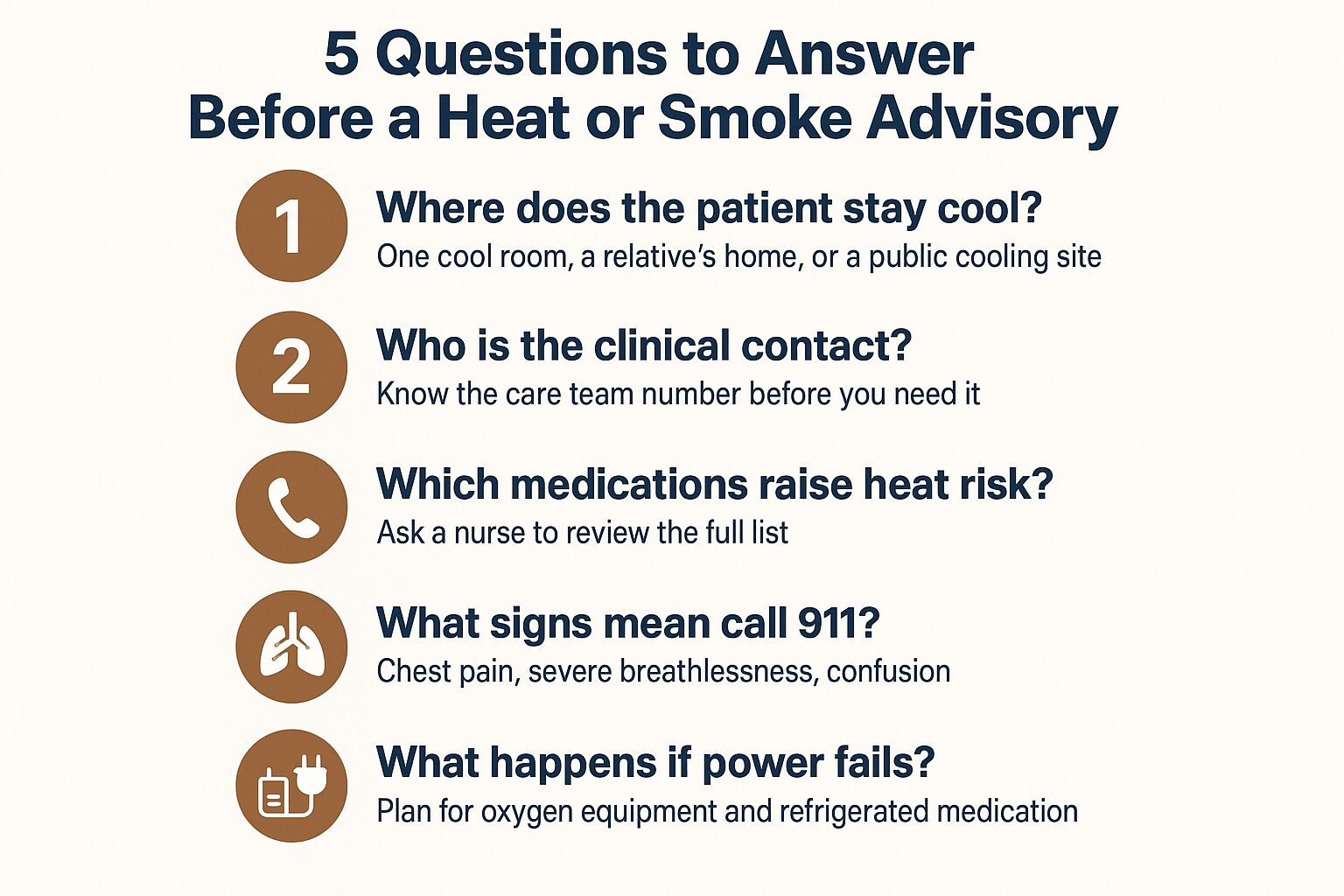
Building a plan that fits your parent's actual house
The plan does not need to be elaborate. It needs to be specific to the home and the person in it.
Start with cooling. If there is no air conditioning, pick one room to cool rather than the whole house. Costs vary, but many households in Monterey County find portable or window units land somewhere in the range of a couple hundred dollars, and a good box fan with drawn shades makes a real difference in a valley home overnight.
Then work through the practical gaps:
- A backup plan for power, especially if the patient uses an oxygen concentrator or refrigerated medication
- Someone who can physically get the patient to the cooler room, since a hallway is a long trip for a patient with limited mobility
- Windows and doors closed during smoke, with recirculating air and a clean filter if the home has a system
- A written symptom list on the refrigerator so any family member or visitor knows what to act on
- Fluid guidance from the physician, because some heart and kidney patients have fluid limits that override general advice to drink more
One caller described the feeling plainly: they just needed someone to come out and help, because they did not know where to start. That is a normal place to be. Families managing a hospital discharge in August have plenty on their plate already, and the pieces families tend to miss during a discharge home often include seasonal safety.
The team already in the home is part of the answer
Here is what families often overlook. If a patient is receiving home health, palliative care, or hospice care at home, clinicians are already walking through that house on a regular schedule.
A Physical Therapist who visits weekly already knows whether the patient can safely get down the hall to a cooler room. A nurse already has the medication list. A Medical Social Worker already knows what community resources exist in Salinas or Hollister or King City.
Across a home care team, that means nurses, therapists, social workers, chaplains, volunteers, and other clinicians all see pieces of the picture. Seasonal safety planning is a reasonable thing to raise at the next visit instead of researching alone at 11 p.m.
One family in Monterey County described a team of nurses, physical therapists, and a Medical Social Worker coming into the home and said they were "blown away by the personalized care." That kind of coordination is exactly what makes a heat plan realistic rather than theoretical. It is also part of what makes staying home as you age workable through a hard summer.
Frequently Asked Questions About Heat, Smoke, and Home Patients
Does Medicare cover home health visits during a heat wave?
Heat by itself is not a qualifying reason for home health. But Medicare covers physician-ordered home health when a patient meets the clinical criteria, and a real change in condition during a heat or smoke event is worth reporting to the physician. Home health always starts with a physician referral, which is a step many families do not realize is required.
Should we cancel a scheduled home visit when the air quality is bad?
Talk to the care team rather than deciding on your own. Clinicians work through smoke days regularly, and a visit during a bad air stretch is often more useful than a normal one because someone is laying eyes on the patient.
My mother is on hospice at home. Does smoke really matter at that point?
Yes. Hospice care is focused on comfort, and smoke can cause coughing, breathlessness, and agitation that make a patient genuinely uncomfortable. Pain and symptom management includes respiratory symptoms, so report changes just as you would report new pain.
What about air purifiers? Are they worth it?
A unit with a HEPA filter sized for one room can meaningfully cut indoor fine particles during a smoke event. Prices vary widely by room size and brand, so check what the room actually needs. Running it in the bedroom where the patient sleeps usually gives the most benefit per dollar.
Who do I call if I am not sure whether something is an emergency?
Keep the care team's clinical line where you can see it, and use 911 without hesitation for chest pain, severe shortness of breath, or new confusion. Guessing wrong toward caution is the right error to make.
Want help thinking through a heat and smoke plan?
Summers in Monterey County are not getting gentler, and families in Salinas, King City, and Hollister feel that before anyone on the coast does. If you have questions about care at home during a heat or smoke event, a care coordinator at Central Coast VNA & Hospice can talk through what applies to your loved one's situation. Call 831-372-6668 or visit ccvna.com when the timing is right for you.

California's Hospice Fraud Crisis: What Families Need to Know
In April 2026, federal agents suspended 447 hospices and 23 home health agencies in the greater Los Angeles area, alleging roughly $600 million in Medicare fraud. That number is not a typo. California's hospice fraud problem has grown into one of the largest healthcare crime waves in the country.
The fraud is not limited to Southern California, and it is not abstract. The California Hospice and Palliative Care Association has documented cases where scammers "deceptively and illegally enroll seniors in hospice and skilled home health programs they never consented to." Families across the state, including those in Monterey County, need to understand what is happening before they accept a referral or sign any paperwork.
This article focuses on two things: what the fraud actually looks like in practice, and how families can tell the difference between a trustworthy provider and one they should walk away from.
What California's Hospice Fraud Actually Looks Like
Hospice fraud does not always look like obvious crime. It often looks like a helpful person showing up at the right moment, offering relief to a family that is already exhausted and overwhelmed.
The scheme tends to follow a pattern. A recruiter, sometimes posing as a hospital worker or social services coordinator, approaches a senior or their family and steers them toward a specific hospice agency. The family signs documents they may not fully understand. The agency then bills Medicare for services it either never delivers or delivers poorly, while the patient loses access to treatments they could still benefit from.
The California Governor's office confirmed expanded DHCS oversight of hospice services taking effect in July 2026, and emergency hospice regulations took effect on June 22, 2026, giving the California Department of Public Health broader authority to deny licensure, investigate complaints, and revoke licenses from illegitimate operators. This is a meaningful shift. But regulations alone do not replace a family's own judgment.
The warning signs families should watch for include:
- Pressure to enroll before a physician has recommended it, a legitimate hospice never pushes enrollment
- Recruiters approaching you in non-medical settings, like at a senior center, a pharmacy, or through an unsolicited call
- An agency that cannot clearly explain what the Medicare hospice benefit covers or what your loved one would be giving up
- Discouraging you from asking questions or comparing providers
- No verifiable history in your community, no local address, no staff you can speak with directly, no track record you can confirm
If any of these apply to a provider you are considering, stop and ask more questions before moving forward.

Why Referrals Alone Are Not Enough
Many families assume that if a hospital or physician refers them to a hospice provider, that provider must be reputable. This is understandable, but it is not always true.
Hospital discharge planners work under real time pressure. They may default to whichever agency responds fastest or is most familiar to their team, not necessarily the one with the strongest record of care. A referral is a starting point, not a guarantee.
Families have every right to ask:
- "Who else could we consider for hospice care in this area?"
- "How long has this agency operated in Monterey County or the surrounding region?"
- "Is this provider accredited and in good standing with the California Department of Public Health?"
- "Is this a nonprofit or a for-profit agency?"
Asking those questions is not rude. It is exactly what a thoughtful family should do. A trustworthy provider will welcome them. One with something to hide will not.
For families navigating this for the first time, it also helps to understand what hospice actually involves before any agency visit or paperwork conversation. Articles like how to know when it may be time to consider hospice care and what families often miss when planning a hospital discharge to home can help you go into those conversations with the right questions already in mind.
Trustworthy Hospice Provider vs. Fraud Red Flags
Use this side-by-side comparison to quickly evaluate any hospice provider you are considering.
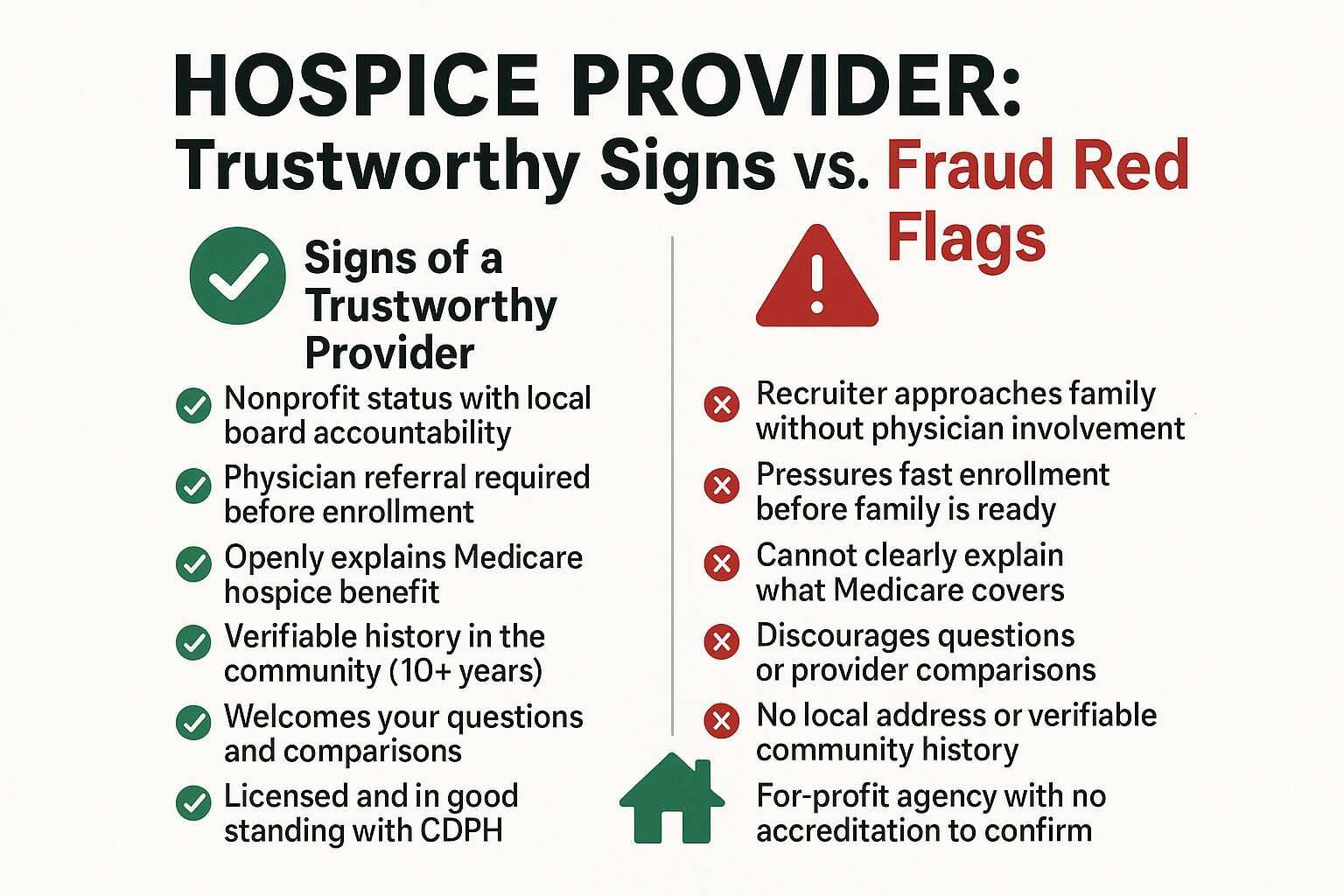
What Longevity and Nonprofit Status Actually Signal
One of the most reliable ways to evaluate a hospice provider is to ask how long they have been operating in your specific community, and whether they are a nonprofit.
Fraud operations are built to bill Medicare quickly and then disappear or rebrand before regulators catch up. They cannot fabricate decades of community presence. A nonprofit organization accountable to a local board of directors has a fundamentally different structure than a billing operation set up to exploit the Medicare hospice benefit.
This is not to say that all for-profit hospice agencies are fraudulent, or that all nonprofits are above criticism. But when a provider has been delivering care in the same communities since before most of today's families were born, that history is verifiable. Patients and families from Salinas, Pacific Grove, King City, and Hollister can speak to the care they received. Neighbors can vouch or not vouch. That kind of local accountability does not exist when a provider showed up recently with no track record you can trace.
Families evaluating their options should also consider whether a provider accepts Medicare and Medi-Cal on a transparent basis. Legitimate providers are straightforward about coverage. If an agency is vague about billing or steers you away from using Medicare, that is a reason to pause.
For a broader look at how to evaluate a provider's credibility, how to tell if a hospice provider is actually trustworthy covers the specific questions worth asking before you commit.
Questions to Ask Any Hospice Provider Before Enrolling
Before agreeing to hospice services for a loved one, work through this checklist with any provider you are considering.
| Question to Ask | What a Good Answer Looks Like | Why It Matters |
|---|---|---|
| How long has your agency operated in this county? | Specific founding year, verifiable local history | Fraud operations cannot fake a long local track record |
| Is this agency nonprofit or for-profit? | Clear, direct answer with no deflection | Nonprofit status signals community accountability over profit motive |
| Did my physician recommend hospice and refer us to you specifically? | Enrollment should follow a physician recommendation | Unsolicited recruitment is a primary fraud tactic |
| What exactly does the Medicare hospice benefit cover? | Plain explanation of covered services and what changes at enrollment | Legitimate providers explain this clearly without hesitation |
| Are you licensed and in good standing with the California Department of Public Health? | Confirmed licensure, ability to provide accreditation details | New regulations give CDPH authority to revoke fraudulent operators |
| Can I speak with a care coordinator before we decide anything? | Yes, with no pressure to sign first | Trustworthy agencies welcome questions before commitment |
What the New California Regulations Mean for Families
The emergency hospice regulations that took effect June 22, 2026 represent a real shift in how California oversees hospice licensure. The California Department of Public Health now has broader authority to deny new licenses, investigate complaints more aggressively, and revoke the licenses of providers found to be operating fraudulently.
This matters for families because it means the accountability gap that allowed hundreds of fraudulent agencies to operate in California is beginning to close. The expanded DHCS oversight taking effect July 2026 adds another layer of scrutiny at the state level.
But regulatory change moves slowly compared to how quickly a family in crisis needs to make a decision. If your parent is being discharged from Natividad Medical Center or Community Hospital of the Monterey Peninsula and a hospice referral is on the table, you may have hours, not weeks, to evaluate your options. Knowing the warning signs in advance is the practical advantage that regulations alone cannot give you.
Families who want to understand more about what hospice actually involves, separate from the fraud question, will find it useful to read hospice care is not what most families think it is before they are in a time-pressured situation.
Frequently Asked Questions About Hospice Fraud in California
Can I switch hospice providers if I realize I enrolled with the wrong one?
Yes. Under the Medicare hospice benefit, a patient has the right to change hospice providers. You can request a transfer to a different agency without losing your hospice eligibility. If you believe you were enrolled without proper consent or under false pretenses, you can also report the provider to the California Department of Public Health and to Medicare directly.
Does the hospice fraud crisis affect providers in Monterey County, or just Southern California?
The large-scale suspensions in April 2026 centered on the Los Angeles area, but the patterns that enable fraud, including loose oversight and aggressive recruiting, are not geographically limited. Families throughout California, including the Central Coast, should apply the same due diligence regardless of location.
What does a patient give up when they enroll in hospice?
Under the Medicare hospice benefit, a patient agrees to shift focus from curative treatment to comfort-focused care. This means Medicare generally stops covering treatments aimed at curing the underlying illness. This is a significant decision that should happen only when a physician has determined that curative treatment is no longer the goal, and only after a full conversation with the patient and family. Any provider that enrolls a patient without that conversation is not operating ethically. For more on this, comfort care vs. hospice: why the difference matters explains the distinction clearly.
How do I verify a hospice provider's license in California?
The California Department of Public Health maintains a public database of licensed healthcare providers. You can search by provider name or license number to confirm current status. If a provider cannot give you a license number or discourages you from checking, that is a significant warning sign.
Is a physician referral required to start hospice?
Yes. Legitimate hospice enrollment requires a physician to certify that the patient has a terminal diagnosis with a life expectancy of six months or less if the illness follows its expected course. No reputable hospice agency will enroll a patient without that physician certification in place. If someone is pushing enrollment before that step has happened, stop and ask why.
Want to Ask Questions Without Any Pressure?
Central Coast VNA & Hospice has been serving families in Monterey County, San Benito County, and surrounding Central Coast communities since 1951, and a care coordinator is available to answer your questions at whatever pace you need. You can call the team at 831-372-6668 or visit ccvna.com to learn more about hospice and palliative care services, how the enrollment process actually works, and what families in this region typically want to know before they decide.