
The main difference between hospice and palliative care is about timing and goals. Both types of care provide comfort, but they are used at different stages of an illness.
Palliative care can start when someone is first diagnosed with a serious illness. Its goal is to relieve symptoms and stress while the person continues to get treatment to cure their illness.
Hospice care is for people with a life expectancy of six months or less. At this point, the goal is no longer a cure. The focus shifts completely to comfort and quality of life.
Clarifying Your Care Options
Understanding this difference is a key step in making informed healthcare decisions. Families in Monterey County and nearby communities often ask us which path is right for their loved one.
At Central Coast VNA & Hospice, our mission is to make this choice clear. We offer compassionate guidance to help you get the right support at the right time.
Both services add an extra layer of support. But they are for different stages of a health journey.
Palliative care works with your current doctors to help manage symptoms. Hospice care becomes the main source of support after curative treatments have stopped.
Palliative Care and Hospice at a Glance
This chart shows the basic differences in timing, focus, and treatment goals.
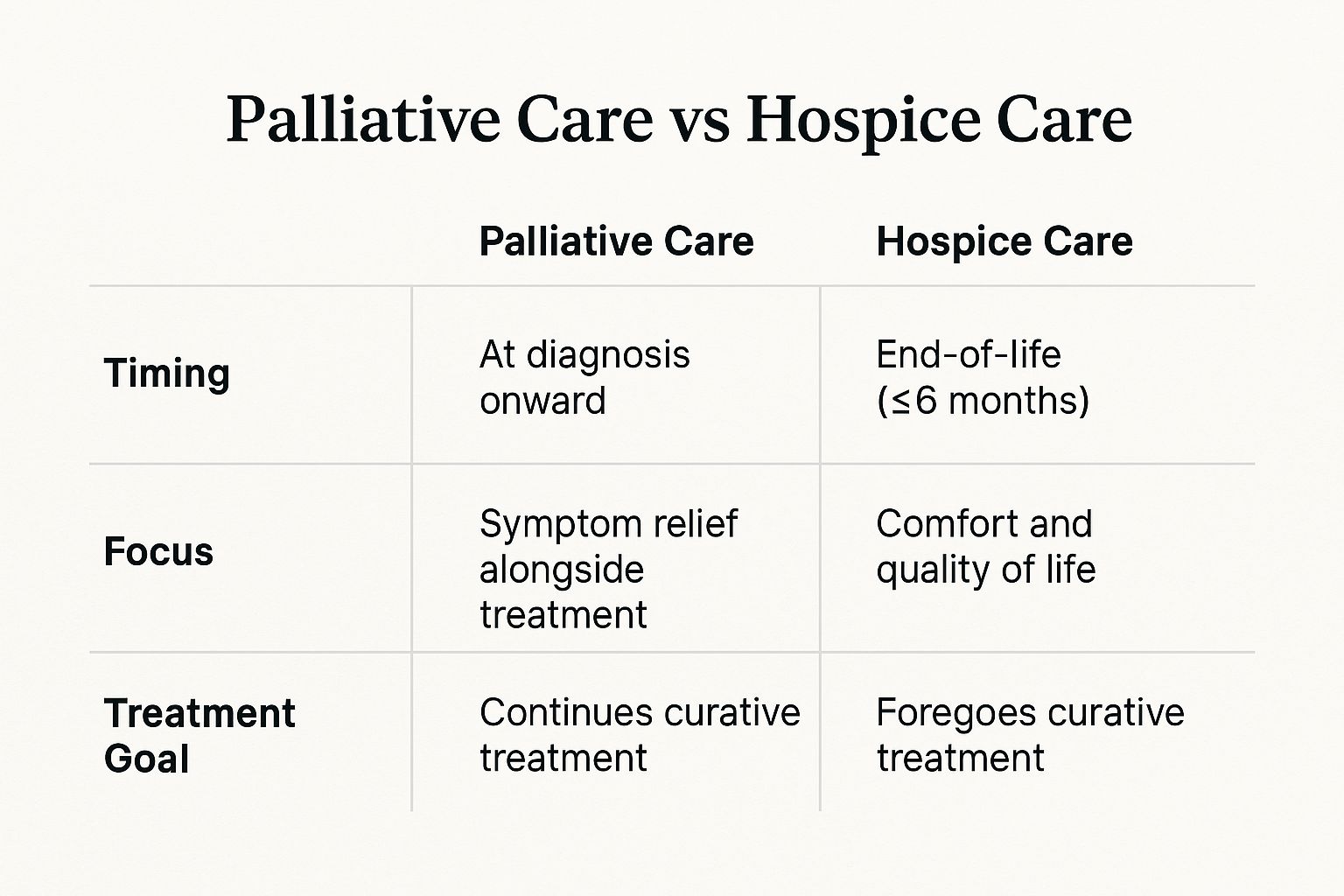
As the chart shows, palliative care is a broad support system you can use early on. Hospice is special care for the final phase of life.
The need for supportive care is very large. According to the World Health Organization, an estimated 56.8 million people need palliative care each year (WHO, 2020).
Many of these people are older adults. The key point is that palliative care can start at any time during a serious illness.
Hospice is for when a doctor believes a patient has six months or less to live. You can learn more about this in the Global Atlas of Palliative Care.
This simple table helps you see the differences side-by-side.
Hospice vs Palliative Care At a Glance
| Aspect | Palliative Care | Hospice Care |
|---|---|---|
| Timing | Can begin at diagnosis, at any stage of illness. | Begins when life expectancy is six months or less. |
| Treatment | Can be received alongside curative treatments. | Focuses on comfort care; curative treatments have stopped. |
| Goal | To relieve symptoms and improve quality of life. | To provide comfort and support for the end of life. |
| Payment | Covered by Medicare Part B, Medicaid, and private insurance. | Covered 100% by Medicare, Medicaid, and most private insurance. |
This table makes it easy to compare the two options. But every family's situation is unique.
At Central Coast VNA & Hospice, we view these services as a continuum of care. Our local clinicians in Monterey, Santa Cruz, and San Benito counties help families make informed decisions.
Many of our patients start with palliative care at home. Later, they may transition smoothly to our hospice program if their needs change. This seamless transition is a core part of our nonprofit mission.
Understanding the Role of Palliative Care
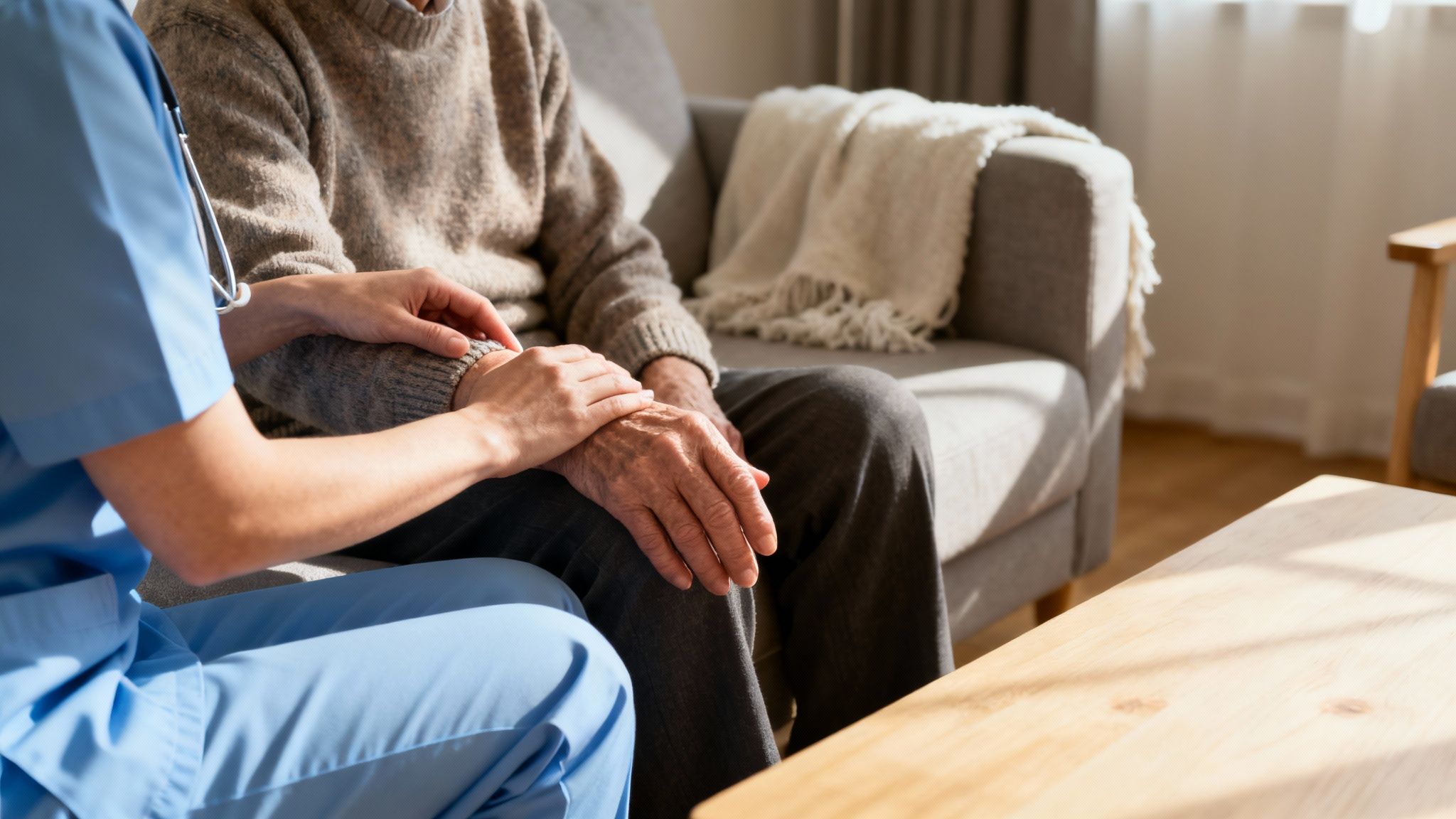
Palliative care is an extra layer of support that works with your primary treatments. It is specialized medical care for people living with serious illnesses.
This includes conditions like cancer, heart disease, or COPD. It can start at any age and at any stage of an illness, even on the day of diagnosis.
The main goal is to improve the quality of life for the patient and their family. We do this by providing relief from symptoms, pain, and stress.
Who Can Benefit From Palliative Care
Anyone with a serious illness can benefit. This is especially true when symptoms affect daily life.
It is not based on a patient's prognosis. It is often provided alongside aggressive treatments like chemotherapy.
This is a key point in the hospice vs. palliative care discussion. Palliative care helps manage symptoms while you continue to fight the illness.
A common misconception is that palliative care means you’re giving up. Our board-certified palliative experts clarify that it actually provides the strength to carry on with daily life.
Our Central Coast VNA & Hospice team helps patients in Monterey County and the surrounding areas. You can learn more about what palliative care is and how it helps patients at home.
How Palliative Care Works
A dedicated team of specialists, including Registered Nurses, works with a patient’s primary doctor. This teamwork ensures that care is coordinated and focused on the patient's needs.
The palliative care team focuses on:
- Symptom Management: Treating pain, nausea, fatigue, and other physical discomforts.
- Emotional Support: Helping patients and families cope with the emotional stress of a serious diagnosis.
- Clear Communication: Guiding conversations about treatment goals and personal care preferences.
This support is often provided right in the home. This brings skilled medical care to patients throughout our service areas in Monterey, San Benito, Santa Cruz, and South Santa Clara counties.
For many, palliative care is the first step in our continuum of care. It provides vital support long before hospice is needed.
Exploring the Purpose of Hospice Care
Hospice is not a place. It is a philosophy of care that prioritizes comfort and dignity when a cure is no longer the main goal.
It honors a person’s final chapter by focusing on their quality of life. This ensures they can live as fully and comfortably as possible.
This compassionate approach is for people with a life-limiting illness and a prognosis of six months or less. Choosing hospice is a decision to shift the focus from cure to comfort.

A Team-Based Approach to Comfort
At Central Coast VNA & Hospice, our care is built around the whole person. We address their physical, emotional, and spiritual needs.
Our teams create personalized care plans for patients across Monterey, San Benito, Santa Cruz, and South Santa Clara counties. For over 74 years, our local roots have allowed us to provide this mission-driven, compassionate care.
This interdisciplinary team is the heart of hospice care and includes:
- Registered Nurses who are experts in managing pain and other symptoms.
- Hospice Aides to help with personal care, such as bathing and dressing.
- Medical Social Workers to provide emotional support and connect families with community resources.
- Chaplains for spiritual guidance that respects all faiths and beliefs.
Hospice care is about adding life to a patient's days, not just days to their life. It means redefining hope—hope for comfort, peace, and meaningful moments with loved ones.
Making Informed and Proactive Decisions
Families often face complex medical and emotional challenges. It is also important to address legal matters to ensure a patient's wishes are honored.
Understanding how to manage end-of-life decisions is a crucial part of this journey.
The length of time a person receives hospice care can vary. According to the National Hospice and Palliative Care Organization (NHPCO), the median length of service was 17 days in 2020 (NHPCO, 2022).
Our goal is to help families feel prepared and supported. We provide clear guidance to help you understand what to expect from hospice care.
Choosing the Right Care with Real-World Scenarios
Reading definitions is helpful. But seeing how hospice and palliative care work for real families can make things clearer.
Let’s look at two scenarios based on our work on the Central Coast. These stories show how each service provides the right support at the right time.
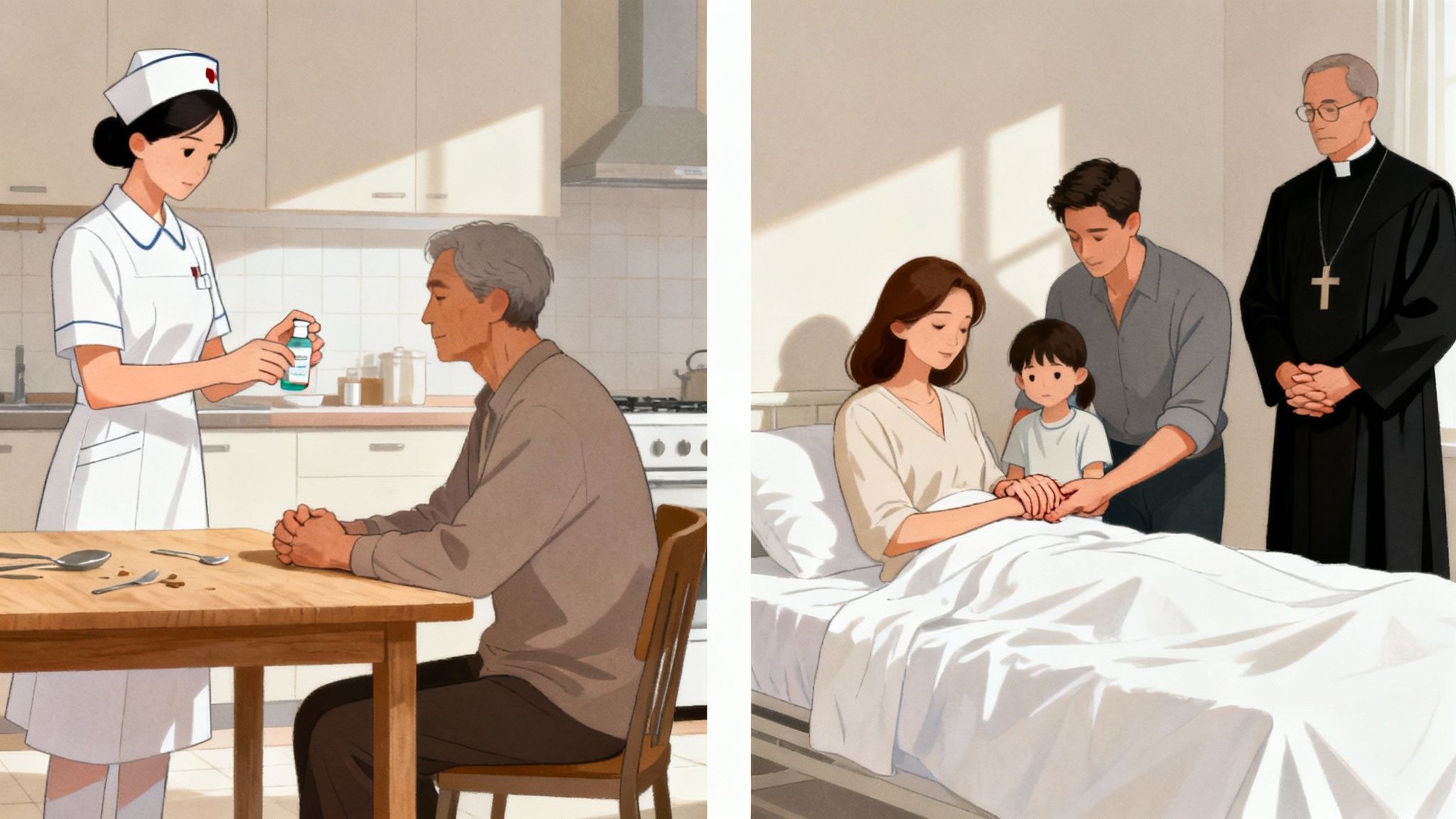
These examples help families understand how Central Coast VNA & Hospice supports loved ones at any stage of illness. This is part of our commitment as a nonprofit, mission-driven provider.
Scenario One: Palliative Care in Monterey County
Meet Maria, a 68-year-old from Monterey who has lung cancer. Her oncologist has a clear chemotherapy plan, but the side effects are severe.
Nausea and fatigue make it hard for her to continue treatment. Her doctor refers her to Central Coast VNA & Hospice for palliative care at home.
Our team’s goal is not to replace her cancer treatment. Our goal is to make it more tolerable.
Our palliative care team helps in a few key ways:
- Managing Nausea: A Registered Nurse works with Maria’s oncologist to adjust her medications, which helps her eat again.
- Reducing Fatigue: We teach her strategies to conserve energy and coordinate with her family for support.
- Emotional Support: Maria and her family have a safe space to talk about their fears and anxieties.
With this extra support, Maria’s quality of life improves. She can handle her treatments better and focus on recovery.
Scenario Two: Hospice Care in San Benito County
Now, consider David, an 82-year-old in San Benito County with advanced heart failure. After several hospitalizations, he decides to stop aggressive treatments.
His goal is to spend quality time with his family at home. His doctor certifies that his life expectancy is likely six months or less, making him eligible for hospice care.
His family calls Central Coast VNA & Hospice. Our team creates a care plan focused entirely on his comfort.
This is a key difference in the hospice vs. palliative care talk. David’s care has shifted from curative treatment to comfort-focused support.
Our hospice team provides:
- Expert Symptom Control: A Registered Nurse manages his shortness of breath so he can rest comfortably.
- Personal Care Assistance: A Hospice Aide helps with daily tasks like bathing, preserving his dignity.
- Spiritual and Emotional Support: Our Chaplain and Social Worker offer comfort to David and support his family.
By choosing hospice, David's family honors his wish for a peaceful end-of-life experience. He is surrounded by loved ones in his own home.
Correcting Common Misconceptions About Care
Misinformation often stops families from getting the right support. When learning about hospice and palliative care, you may hear myths that cause confusion.
Let's clear the air and talk about the facts. Our board-certified palliative experts want to clarify these common misconceptions.
One myth is that choosing palliative care means you are giving up. In reality, it is an extra layer of support to help you manage symptoms while you continue treatment.
Addressing Common Myths Head-On
Another common myth is that hospice is a place you move into. This is not true.
Over 90% of hospice care in the United States is provided wherever a patient calls home. This could be a private residence, an assisted living community, or a nursing home.
Here are a few other myths we often hear from families in Monterey and Santa Cruz counties:
-
Myth: You have to give up your own doctor if you choose hospice.
-
Fact: Your trusted personal physician can remain a central part of your care team and will work closely with our hospice team.
-
Myth: Hospice care is only for the last few days of life.
-
Fact: Patients can receive hospice care for six months or longer. Studies show that starting hospice earlier can improve quality of life.
By correcting these myths, we empower families to make decisions based on truth. Our goal as a nonprofit provider is to educate our community.
A Global Perspective on Care
Understanding these services is critical. Access to quality end-of-life care varies greatly worldwide.
The United States ranks 43rd out of 81 countries in end-of-life care quality. This shows a need for better education. You can discover more insights about these global disparities on NCBI.
As a nonprofit with over 74 years of service to the Central Coast, we are a reliable source of information. Continue debunking the 9 biggest myths about palliative care in our detailed guide.
How to Access Care on the Central Coast
Knowing how and when to ask for help is a critical step for families. The best place to start is with a conversation with a primary doctor or specialist.
This discussion helps get everyone on the same page about care goals. It also focuses on what is most important: quality of life.
Bringing up palliative or hospice care can feel difficult. It helps to have a few questions ready to guide the conversation.
Starting the Conversation With a Doctor
Here are a few questions you can ask to get the conversation started:
- Could palliative care help manage symptoms while we continue treatment?
- At what point should we consider hospice care, and what would that look like?
- What can we do to support our loved one’s comfort and quality of life right now?
The answers should provide a clearer path forward. If the doctor agrees that support is needed, the next step is to ask for a referral.
It is also helpful to understand your insurance options. This includes learning about coverage through Medicare Advantage plans.
At Central Coast VNA & Hospice, we work closely with physicians across our service areas. These include Monterey, San Benito, Santa Cruz, and South Santa Clara counties.
Our nonprofit, mission-driven approach means we are focused on your family’s needs. We ensure a smooth transition into our care.
Once we receive a referral, our team will schedule an informational visit. This meeting is a chance for you to ask questions and learn how our programs can help.
We also provide a number of local health care resources for seriously ill family members to guide you. Contact us today to learn more.
Frequently Asked Questions About Hospice and Palliative Care
It is easy to get confused by healthcare terms. Many families on the Central Coast ask us about the practical differences between hospice and palliative care.
Here are answers to some of the most common questions.
Can a patient receive both palliative care and curative treatment?
Yes, absolutely. This is one of the most important differences between the two types of care.
Palliative care is an extra layer of support that works alongside treatments like chemotherapy. Its goal is to manage symptoms and improve your quality of life while you continue to fight an illness.
Who pays for palliative and hospice care services?
Both services are covered by most insurance plans. This is a relief for many families.
- Palliative care is usually covered by Medicare Part B, Medi-Cal, and most private insurance.
- Hospice care is covered 100% by the Medicare Hospice Benefit, including medications and medical equipment. Most private insurance plans offer a similar benefit.
Does choosing hospice mean we are giving up hope?
No, not at all. Choosing hospice means redefining hope.
It is a shift in focus from finding a cure to hoping for comfort, peace, and meaningful time with loved ones. It is a proactive decision to make the most of the time that remains.
Where are hospice services provided?
The vast majority of hospice care happens wherever a patient calls home. This could be a private residence, an assisted living community, or a nursing home.
Central Coast VNA & Hospice brings expert care directly to patients in Monterey County, San Benito County, Santa Cruz County, and South Santa Clara County.
How does Central Coast VNA & Hospice support the family?
Our support extends to the entire family. Our team includes Social Workers and Chaplains who provide emotional support, education, and guidance.
We also offer bereavement services for up to 13 months after a loved one has passed. This ensures families are not left alone in their grief. You can learn more by exploring our other palliative care FAQs.
For over 74 years, the team at Central Coast VNA & Hospice has provided compassionate home health, palliative, and hospice care. If you have more questions or need guidance on what's right for your family, please contact us today at https://ccvna.com to learn how we can support you.