
Many people think palliative care is about giving up. But it’s really about adding support.
Think of it as an extra layer of care. It focuses on improving your quality of life, and it's for anyone with a serious illness. You can start right from the moment of diagnosis. The simple truth is that you can—and should—get palliative care while actively pursuing treatments to cure your condition.
Understanding What Palliative Care Truly Is

Here on the Central Coast of California, families often confuse palliative care with hospice. It's a common misunderstanding. But it stops people from seeking help that could make a world of difference much earlier.
Palliative care works alongside your curative medical treatments. It does not replace your primary doctor or specialists. Instead, it adds a dedicated team focused on relieving symptoms, pain, and stress from serious illnesses like cancer or heart failure.
Palliative Care Quick Facts: What It Is vs. What It Isn't
To clear up any confusion, let's break down what palliative care really means. We will look at some common myths.
| Common Misconception | The Reality of Palliative Care |
|---|---|
| It’s the same as hospice. | It’s a separate specialty focused on quality of life and can be provided alongside curative treatment. |
| You have to give up your own doctors. | You keep your entire medical team. The palliative team collaborates with them. |
| It means you’re dying. | It can be started at any stage of a serious illness, even right at diagnosis. |
| It’s only for managing physical pain. | It addresses physical, emotional, and spiritual needs for the patient and family. |
This table shows that palliative care is a flexible resource. It is designed to help you live as well as possible, for as long as possible.
An Extra Layer of Support When You Need It Most
Imagine your medical team is focused on treating your illness. That’s their main job. A palliative care team works with them, but their focus is on you as a whole person. This support improves your daily life and helps you feel strong enough to continue treatment.
This support system helps you:
- Manage difficult symptoms like pain, shortness of breath, fatigue, or nausea.
- Reduce stress and anxiety by offering emotional and spiritual support.
- Improve communication between you, your family, and your entire medical team.
- Align your care with your personal goals and what truly matters most to you.
It's so important to understand that palliative care is about living with a serious illness. It is not just about preparing for the end of life. You can take a deeper dive by exploring what is palliative care in more detail on our site.
Rooted in Community and Compassion
For over 74 years, Central Coast VNA & Hospice has been the trusted local nonprofit provider of this care. Our mission is to bring this support to patients in their homes. We serve people throughout Monterey County, San Benito County, Santa Cruz County, and South Santa Clara County.
We believe everyone deserves to live with dignity. We want you to have the best possible quality of life at every stage of illness.
How Palliative Care Works With Your Medical Team

Many families are relieved to learn palliative care doesn't mean giving up their trusted doctors. It's the opposite. It is a collaborative service, adding a team of specialists who work with your current physicians.
Your primary doctor manages the main treatment plan to fight the illness. A palliative care team works as expert consultants. They make sure everything runs as smoothly and comfortably as possible.
This team approach means you get the best of both worlds. Your specialists can focus on treating the disease. Meanwhile, your palliative team concentrates on managing tough symptoms, pain, and stress.
Your Dedicated Support Team
Here at Central Coast VNA & Hospice, our palliative care team includes professionals from different backgrounds. They are all centered on your well-being. This ensures your care addresses not just physical symptoms, but your emotional and spiritual needs, too.
Your specialized team typically includes:
- A Registered Nurse or Nurse Practitioner specializing in pain and symptom management.
- A Medical Social Worker who provides emotional support and practical assistance.
- A Chaplain who offers spiritual support that respects your personal beliefs and values.
This team model provides holistic support. It recognizes that a serious illness impacts every part of a person's life. True comfort comes from caring for the whole person—body, mind, and spirit.
This coordinated effort lifts a huge burden off patients and families. You have a team of advocates making sure your care plan aligns with what matters most to you. You can learn more about how we integrate home health and palliative care for seamless support.
Creating a Coordinated Care Plan
This partnership is built on communication. Your palliative care team stays in regular contact with your other doctors. They share insights into how you're feeling and responding to treatments. This leads to better, more personalized care.
The result is a unified approach that keeps you at the center. The team helps explain complex medical information. They empower you to make informed decisions that reflect what is most important to your quality of life.
This proactive support also helps people stay comfortable at home. It can reduce emergency room visits and hospital stays. You can read more about these palliative care findings and their impact.
The Benefits of Starting Palliative Care Sooner
Many families wait too long to talk about palliative care. This is a common mistake. It often means missing out on the greatest benefits.
The best time to add this extra layer of care is at the beginning of a serious illness. This lets you and your loved ones manage symptoms and reduce stress from day one.
This proactive approach shows why palliative care isn't just for the end of life. It’s about improving your quality of life for all the days you have. By bringing in a team focused on comfort, you can better manage a serious illness while still pursuing treatments.
Improve Your Daily Quality of Life
One of the first things people notice after starting palliative care is how much better they feel. A serious illness often comes with a heavy burden of pain, fatigue, or nausea. These symptoms drain your energy and spirit.
The palliative care team works with your doctors to fine-tune medications and other therapies. Their goal is to make you feel better. This frees you to regain strength, get back to activities you love, and hold onto your independence.
At Central Coast VNA & Hospice, our nonprofit mission drives us to bring this compassionate support to your home. We serve patients across Monterey, Salinas, Hollister, and Santa Cruz. You can learn more in our guide to the benefits of palliative care.
Reduce Stressful Hospital Visits
Nobody enjoys frequent trips to the ER or hospital stays. They are a massive source of stress. Early palliative care can cut down on these events.
By actively managing symptoms at home, the team can often get ahead of problems before they become a crisis. This means more time spent in the comfort of your own home. For families, it means less worry.
This approach can prevent avoidable hospital admissions. It allows people to age in place with dignity.
Strengthen Emotional and Family Support
A serious illness is an emotional battle for the entire family. Palliative care understands this. That’s why the team includes Medical Social Workers and Chaplains.
This support system helps everyone by:
- Facilitating difficult conversations about care goals and future wishes.
- Providing counseling to help cope with the anxiety and stress.
- Connecting families with community resources for practical help.
- Offering spiritual guidance that respects your personal beliefs.
This comprehensive support ensures no one faces the challenges alone. For those hoping to maintain independence, an aging in place checklist can be a great step. By starting palliative care sooner, you give your family the gift of support and peace of mind.
Who Is a Good Candidate for Palliative Care?
Deciding if palliative care is the right choice can feel complicated. But it boils down to something simpler: Could you or your loved one use extra support to manage a serious illness?
This is not about timelines. It is about need. Palliative care is for patients of any age at any stage of a serious illness. That is why palliative care isn’t just for the end of life—it’s for living better, right now.
Common Conditions That Benefit from Palliative Care
Many serious illnesses have a heavy burden of symptoms and stress. Palliative care is especially helpful for people managing:
- Cancer: To control pain, nausea from chemotherapy, and fatigue.
- Heart Disease: Including congestive heart failure (CHF), to ease shortness of breath.
- Lung Disease: Such as Chronic Obstructive Pulmonary Disease (COPD), to improve breathing.
- Kidney Disease: To help with symptoms like fatigue and discomfort.
- Dementia or Alzheimer’s Disease: To navigate behavioral changes and support the family.
- Neurological Conditions: Like Parkinson’s disease, ALS, or the effects of a stroke.
Getting the right support is critical. For instance, families often find value in resources like guides on caring for dementia patients, which complement help from a palliative team.
Look for the Signs, Not Just the Diagnosis
More important than the diagnosis are the real-world challenges. You do not have to wait for a doctor to bring it up. If this sounds familiar, it’s time to ask about palliative care:
- Uncontrolled Symptoms: There is persistent pain, fatigue, nausea, or shortness of breath.
- Frequent Hospital Visits: You have had multiple trips to the ER or hospital in the past year.
- Decreased Ability to Care for Oneself: Daily activities like bathing or dressing have become difficult.
- Significant Stress and Anxiety: The illness has left you or your family feeling overwhelmed.
Recent data shows that 95% of people over 60 have at least one chronic condition. Palliative care helps manage symptoms and stress, even years before hospice is needed.
If these challenges sound familiar, our Central Coast VNA & Hospice team is here to help. We can help you understand your options in Monterey County, San Benito County, and the surrounding areas.
Palliative Care vs. Hospice: Clarifying the Key Differences
To make the best decision, it’s vital to know how palliative care and hospice are different. Both focus on comfort. But they serve different needs at different times.
The biggest myth we see on the Central Coast is that they are the same. This is not true. Palliative care is an extra layer of support you can get at any stage of a serious illness, alongside curative treatments.
Hospice care is a specific type of palliative care for people near the end of life. It begins only when curative treatments have stopped. The focus shifts entirely to comfort and peace.
Palliative Care and Hospice at a Glance
For families in Monterey, Salinas, and Hollister, healthcare terms can feel overwhelming. This table makes the differences clear.
| Feature | Palliative Care | Hospice Care |
|---|---|---|
| When It Starts | At any stage of a serious illness, right from diagnosis. | When life expectancy is six months or less, and curative treatments have stopped. |
| Treatment Goals | To relieve symptoms and stress while you continue curative treatments. | To provide comfort, peace, and dignity when a cure is no longer the goal. |
| Who It's For | Patients of any age with a serious illness like cancer, heart disease, or COPD. | Patients with a terminal diagnosis who have chosen to focus on quality of life. |
| Where It's Provided | Often delivered at home, alongside your regular doctor visits. | Primarily provided at home, but also in facilities, with 24/7 on-call support. |
The core difference is that palliative care works with curative treatment. Hospice care is for when treatment has stopped. This is why palliative care isn’t just for the end of life—it’s a powerful resource for living better with a serious illness.
Making the Right Choice for Your Family
Choosing between these options isn’t about giving up. It's about getting the right support at the right time. Palliative care offers relief and strength during a long illness. Hospice provides comfort for the final chapter of life.
The following graphic shows some of the conditions that lead families to consider palliative support.
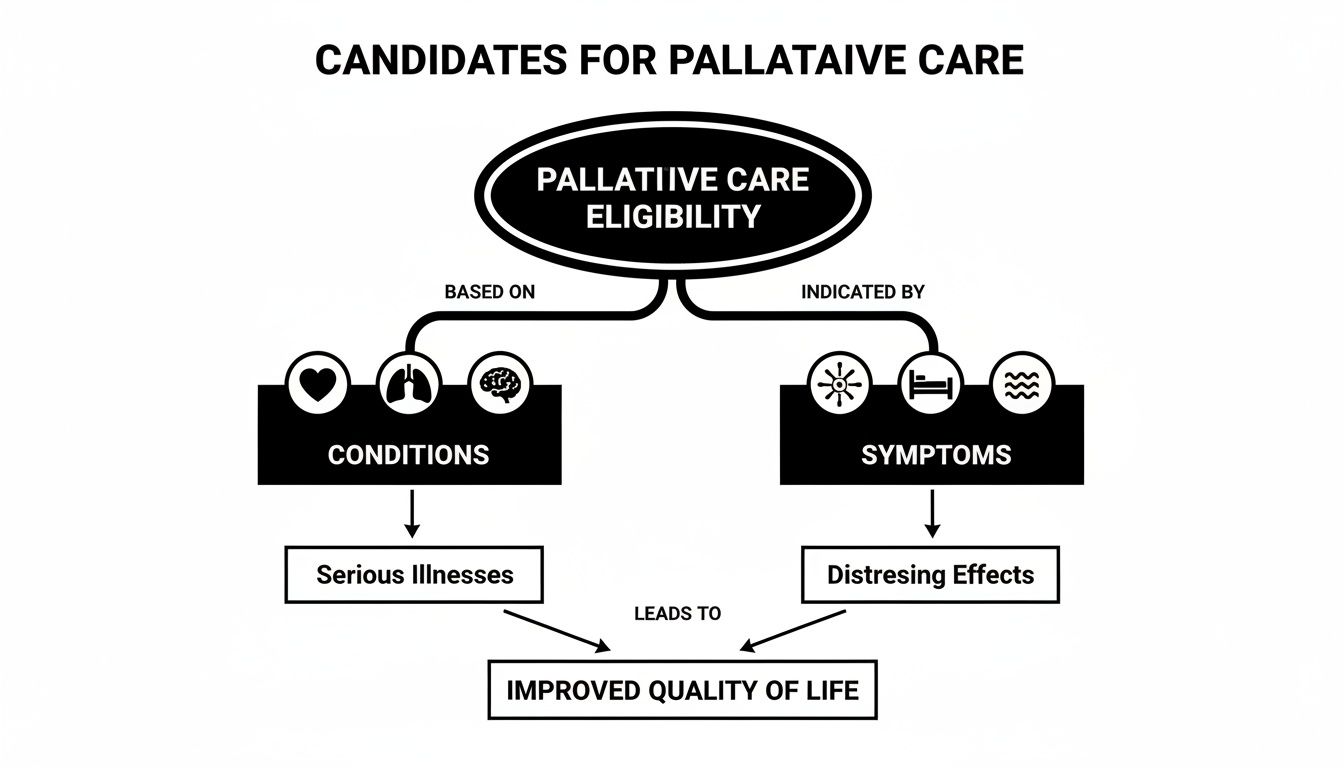
This visual shows how palliative care addresses the whole person. The goal is to improve quality of life by managing symptoms from a serious health condition.
At Central Coast VNA & Hospice, our continuum of care means we are the local nonprofit offering home health, palliative care, and hospice. This provides a seamless transition if a patient’s needs change. For a deeper look, learn more about the real differences between hospice and palliative care.
How To Get Started With Palliative Care On The Central Coast

Taking the first step is simpler than you might think. If your loved one could benefit from better symptom management, the process starts with one conversation.
Reaching out is not a final commitment. It is an exploration of the support available to you. This is a big reason why palliative care isn’t just for the end—it’s a resource you can use anytime to improve comfort.
Starting The Conversation With Your Doctor
Your first move is to talk to your physician or specialist. Palliative care almost always requires a doctor's referral. They are the natural starting point.
When you go to the appointment, be ready to talk about specific challenges. Explain which symptoms are causing the most trouble.
You can be direct and ask, "Could palliative care help us manage these symptoms?" This helps your doctor focus on your needs. Remember, asking for help is a sign of strength.
Accessing Palliative Care At Home
Once you have a referral, Central Coast VNA & Hospice makes the rest of the process easy. As a trusted local nonprofit with over 74 years of service, our mission is to bring expert care to your doorstep. We serve patients in their homes across Monterey County, San Benito County, Santa Cruz County, and South Santa Clara County.
Our palliative care team will coordinate with your doctor to build a support plan. We handle the logistics so you can focus on feeling better. You can learn more about our local services by exploring information on palliative care near me.
Understanding Your Insurance Coverage
One of the first questions families ask is about cost. The good news is that palliative care is covered by most insurance plans. This makes it an accessible option.
Here is a quick breakdown of typical coverage:
- Medicare Part B: This covers palliative care services like any other specialist visit.
- Medi-Cal: Provides coverage for palliative care consultations and follow-up visits.
- Private Insurance: Most private and employer-sponsored health plans include palliative care benefits.
Our team at Central Coast VNA & Hospice can help you verify your coverage. We believe financial worries should never stand in the way of getting compassionate care.
Ask your provider whether your loved one qualifies for palliative care—not just hospice. Look for services that provide both, so transitions can be handled smoothly later if needed.
If you're caring for someone with a serious illness in Monterey, Salinas, Hollister, or Santa Cruz, our VNA team can help you understand your options without pressure. Visit ccvna.com or call 831‑372‑6668 to speak with a nurse.
Frequently Asked Questions (FAQs)
It’s normal to have questions as you explore care options. Here are some common ones we hear from families on the Central Coast.
1. Does choosing palliative care mean I’m giving up?
Absolutely not. It is the opposite. This is a key reason why palliative care isn't just for the end of life. Palliative care works with your curative treatments, like chemotherapy. Its job is to help you manage symptoms and stress. By helping you feel stronger, it empowers you to stick with your doctor's plan.
2. Who is on a palliative care team?
You get a whole team of specialists. The goal is to address your physical, emotional, and spiritual well-being. At Central Coast VNA & Hospice, our team includes a Registered Nurse, a Medical Social Worker, and a Chaplain. This team works with your own doctors to coordinate care.
3. Is palliative care only for people with cancer?
No, not at all. It is for anyone living with a serious or chronic illness. This includes conditions like heart disease (CHF), lung disease (COPD), kidney failure, and dementia. The focus is always on improving your quality of life right now.
4. Where do you provide palliative care?
Palliative care can be offered in hospitals or clinics. But at Central Coast VNA & Hospice, we bring that support directly to you, wherever you call home. We provide care in your house or an assisted living facility. We serve communities across Monterey County, San Benito County, Santa Cruz County, and South Santa Clara County.
5. How is palliative care paid for?
Most people are surprised to learn that palliative care is treated like any other medical specialty. It is typically covered by Medicare Part B, Medi-Cal, and most private insurance plans. Our team at Central Coast VNA & Hospice can help you figure out your specific coverage.
If you're caring for someone with a serious illness in Monterey, Salinas, Hollister, or Santa Cruz, you don't have to figure this out alone. Our team at Central Coast VNA & Hospice can help you understand your options without any pressure. Visit our website or call 831‑372‑6668 to speak directly with a nurse.