
When a loved one needs advanced medical support, families often ask: is skilled nursing care at home better than a facility? Many worry about sending someone to a facility after hearing stories of neglect or poor communication. They want to know if it's possible to get that same level of care without leaving home.
While every situation is unique, the answer for most families is yes. Receiving personalized, one-on-one medical care in the comfort of home offers huge advantages. It supports recovery, safety, and emotional well-being without the institutional drawbacks many people fear.
Choosing Between In-Home Care and a Nursing Facility
This tough decision usually comes up after a hospital stay or when a chronic condition gets harder to manage alone. The idea of moving someone you love into a facility can be incredibly stressful. These worries are often fueled by real concerns about neglect, rigid schedules, and a lack of personal attention.
These concerns are valid. But they often stem from a common misunderstanding: that skilled nursing is a place instead of a service.
In reality, skilled nursing is a specific level of medical care from licensed professionals. This includes Registered Nurses (RNs) and physical therapists. This advanced support can be delivered just as effectively—and often more compassionately—right where the patient lives.
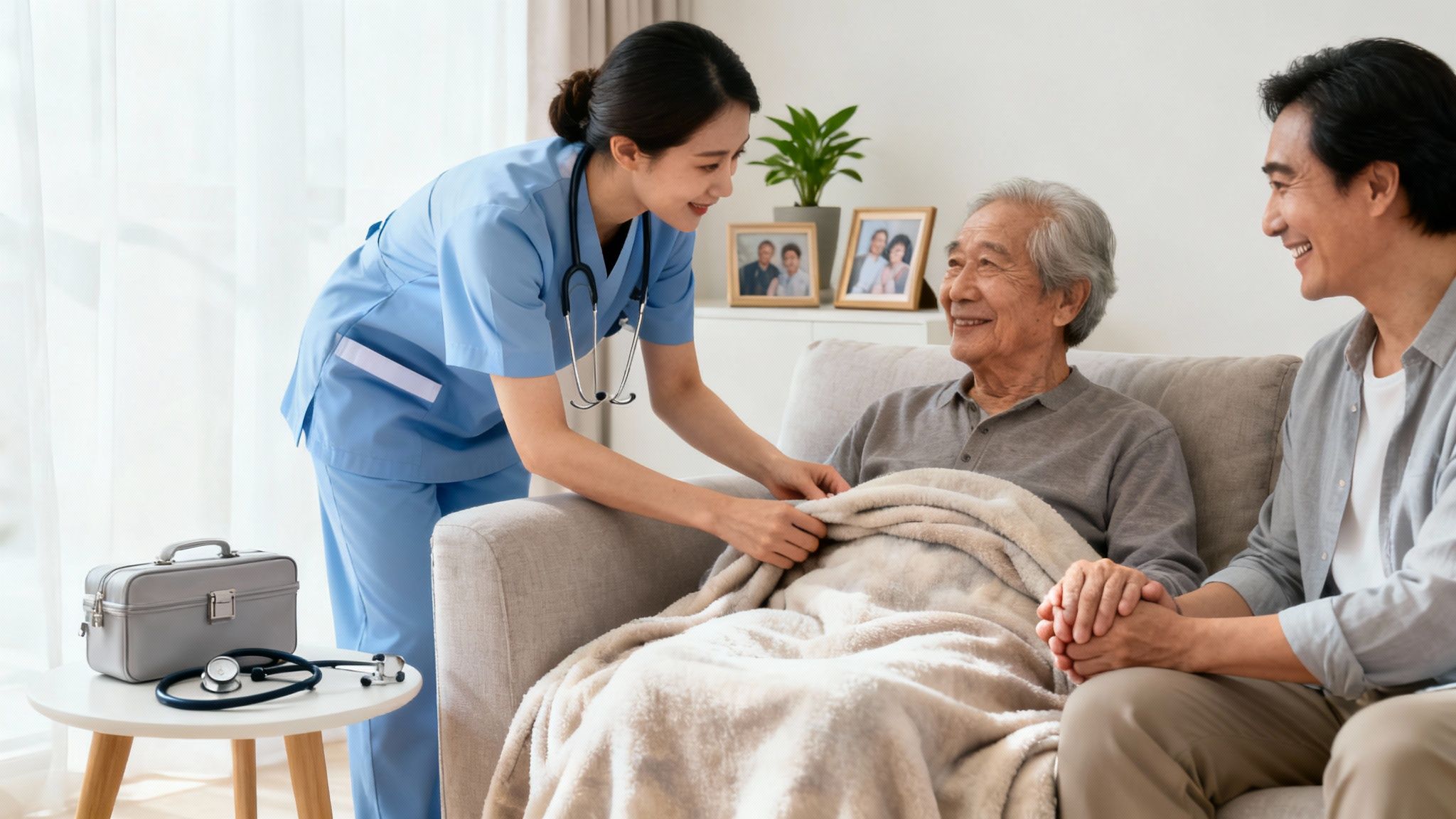
It is always a good idea to explore in-home skilled nursing options first. This lets you see what is possible before making a major life change. You can learn more about how in-home support can help avoid a nursing home in our detailed guide.
Quick Comparison At Home vs Facility Care
Deciding between home care and a facility? Here’s a quick overview of what to expect. This table highlights key differences that impact daily life and recovery.
| Factor | Skilled Nursing at Home | Skilled Nursing Facility |
|---|---|---|
| Care Ratio | One-on-one dedicated attention from a clinician during each visit. | One nurse or aide is often responsible for multiple patients at once. |
| Environment | The familiar, comfortable, and safe surroundings of the patient's own home. | An institutional setting with predetermined schedules and less privacy. |
| Family Involvement | Family is central to the care plan and actively participates in recovery. | Visiting hours may be restricted, and family involvement can be limited. |
| Independence | Care is designed to restore independence and adapt to the patient's routine. | Daily life is structured around the facility's schedule for meals and care. |
Seeing this comparison often makes the choice clearer for families. They can prioritize their loved one’s comfort and independence.
Central Coast VNA & Hospice brings this high level of personalized care to homes across Monterey County, San Benito County, Santa Cruz County, and South Santa Clara County. With over 74 years of nonprofit service, our mission is to deliver compassionate, expert care. We help people heal and thrive in the place they feel most comfortable.
Understanding What Skilled Nursing Care Includes
One of the biggest misunderstandings is that "skilled nursing" automatically means moving into a facility. This idea creates unnecessary stress. It can make families feel like their options are limited.
The truth is, skilled nursing care is not a place. It's a high level of medical care that licensed clinicians provide.
These services help people recover after surgery or manage a serious illness. The best part? This expert care can happen right in the patient's home.
This approach is becoming more common, as most older adults already live at home. The statistics might surprise you. Facility living is not the norm.
Only about 1% of people aged 65–74 live in nursing homes. Even for those 85 and older, that number is just 8%. It’s clear that in-home care is a widespread and growing choice.
What Services Are Available At Home
Choosing skilled nursing at home does not mean sacrificing quality. A dedicated team of clinicians brings advanced medical support right to your door. This allows for focused, one-on-one attention that is often hard to find in a busy facility.
Here are some of the core services available at home:
- Wound Care: Professional treatment for surgical wounds or pressure sores to prevent infection and speed up healing.
- IV Therapy: A Registered Nurse can safely manage antibiotics, hydration, or nutrition through an IV line at home.
- Medication Management and Education: We help ensure correct dosages and schedules, while teaching patients and families about their medications.
- Chronic Disease Management: This includes ongoing support for conditions like COPD, heart failure, and diabetes to help prevent hospital trips.
Rehabilitative Therapies in Your Own Home
Skilled nursing also includes therapies that are vital for restoring function. These therapies help people regain strength and confidence in a familiar setting. You can get a complete overview of what is skilled nursing care to learn more about all the services.
Therapeutic services often include:
- Physical Therapy (PT): Helps restore mobility, strength, and balance.
- Occupational Therapy (OT): Focuses on helping patients safely perform daily activities like dressing, bathing, and cooking.
- Speech Therapy (ST): Assists with communication and swallowing difficulties after a stroke or illness.
Therapies like these, especially occupational therapy, play a huge role in rebuilding independence. For a deeper look, understanding the role of occupational therapy in recovery offers great context. At Central Coast VNA & Hospice, our therapists create personalized plans to help each patient achieve their goals at home.
A Detailed Comparison of Care Environments
When you're faced with this decision, it's about more than a simple list of pros and cons. You need to understand the daily reality of receiving care at home versus in a facility. The environment itself plays a massive role in the healing process.
It really boils down to personalization versus standardization. One setting is built around the patient’s life. The other requires the patient to adapt to an institutional schedule.
Patient to Staff Ratio
One of the first things to look at is the level of direct attention your loved one will receive. In a home health setting, every visit from a Registered Nurse or therapist is 100% dedicated to that one person.
This one-on-one focus is a game-changer. It means the clinician has time to do a thorough assessment and answer every question. You never have to compete for attention, which can be a struggle in facilities where one nurse might care for a dozen patients.
In-home care provides a level of individualized attention that is simply not possible in a facility setting. This dedicated time ensures safer medication management, more effective therapy sessions, and a stronger patient-clinician relationship built on trust.
Personalization of Care Plans
When care happens at home, the plan is designed to fit the patient's existing life. Our clinicians work around the patient’s preferred schedule. This supports their sense of independence and dignity.
This flexibility allows for a truly personalized approach to recovery. A physical therapist can design exercises using the patient’s own furniture. This makes the therapy directly relevant to their real life.
The infographic below shows how some key skilled nursing services are adapted for the home.
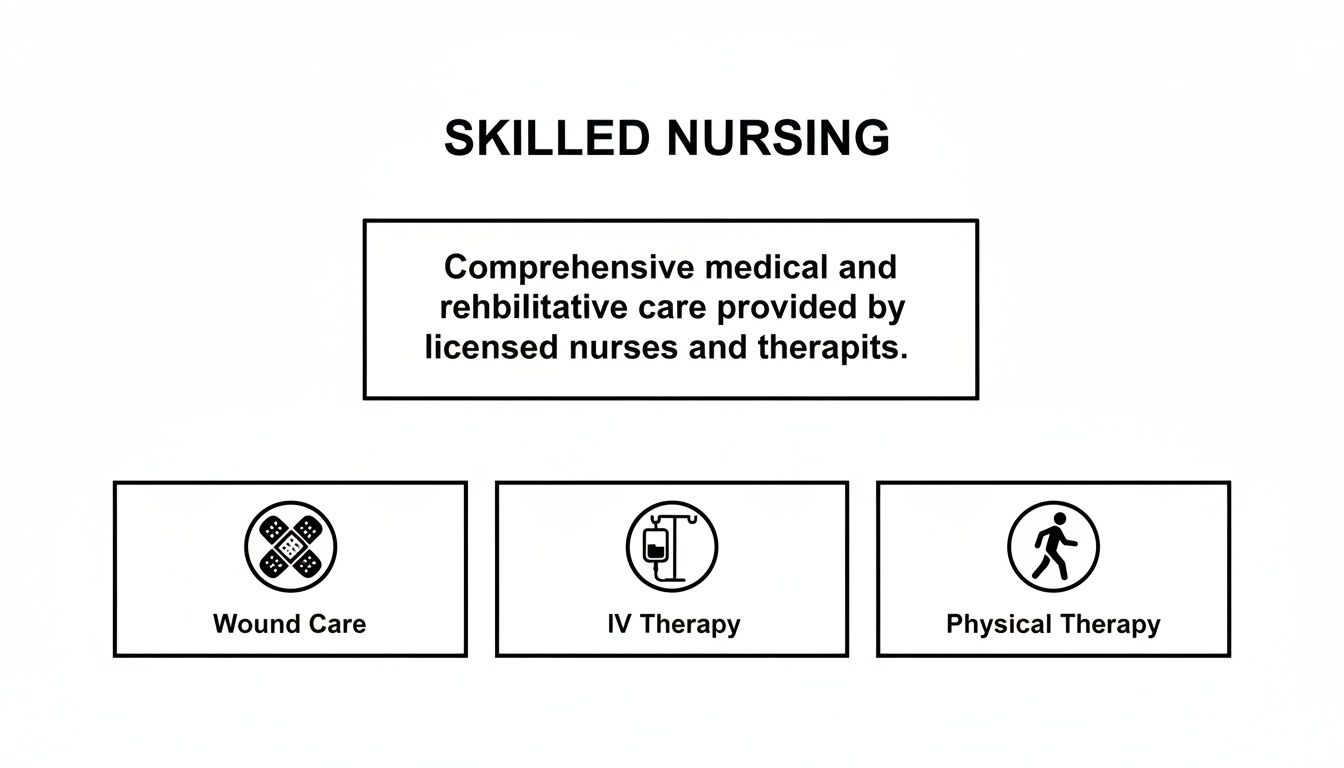
This visual highlights how core medical services are adapted to provide specialized, one-on-one treatment at home.
To help you see the differences, here’s a quick comparison of the two care environments.
Skilled Nursing Care At Home vs. Facility
| Feature | Skilled Nursing at Home | Skilled Nursing Facility |
|---|---|---|
| Attention | One-on-one care from nurses and therapists. | Shared attention; staff-to-patient ratios can be high. |
| Care Plan | Highly personalized, adapts to the patient’s daily routine and home environment. | Standardized, follows the facility’s schedule and protocols. |
| Family Involvement | Family is an integral part of the care team, receiving training and education. | Involvement is often limited to visiting hours and formal updates. |
| Environment | Comfortable, familiar, and private. | Institutional, less personal, and often a shared living space. |
| Infection Risk | Significantly lower risk of exposure to hospital-acquired infections. | Higher risk due to communal living and frequent contact with other patients. |
| Independence & Dignity | Promotes autonomy by keeping the patient in their own home and in control of their day. | Routines are structured, which can reduce a patient's sense of control. |
| Therapy Realism | Physical and occupational therapy is practiced in the patient's actual living space. | Therapy occurs in a generalized gym setting, separate from daily life. |
This table makes it clear that while both options provide skilled care, the experience is fundamentally different.
The Role of Family Involvement
In-home care actively brings the family into the healing process. Our nurses and therapists teach family members how to support their loved one.
This collaboration is invaluable. It empowers families with the knowledge to spot potential problems early. In contrast, facilities often have restricted visiting hours, leaving families feeling like spectators. For a deeper look, check out our article on the 7 reasons to choose in-home care vs a nursing home.
Environmental Comfort and Safety
You cannot overstate the emotional benefit of being in a familiar place. A person’s home is their sanctuary. Healing in this setting can reduce stress and anxiety.
On top of that, home-based care carries a lower risk of infections. Facilities are communal spaces where illnesses can spread easily. Receiving care at home minimizes exposure and creates a safer environment to get better.
For families in Monterey County, San Benito County, or Santa Cruz County, Central Coast VNA & Hospice offers this personalized care at home. Our team of clinicians is dedicated to your comfort, safety, and independence.
Comparing the Costs and Insurance Coverage
For most families, cost is a huge part of the conversation. It's easy to make assumptions. Some think a facility must be more expensive, while others worry that in-home care will lead to surprise bills.
The reality? For many on the Central Coast, in-home skilled nursing is often the more affordable path. Let's look at the real numbers and see how insurance like Medicare helps.
Breaking Down the Average Costs
When you put the numbers side-by-side, the financial benefit of home health care becomes clear. It’s not just that the monthly cost is lower. The rate at which those costs are rising is also much slower for in-home care.
A recent analysis shows this clearly. Average monthly costs for in-home care are between $6,481 and $6,677. In contrast, a skilled nursing facility costs much more, from $9,555 to $10,965 per month.
But there is a bigger story. While home health costs saw a moderate 3.7% annual increase, facility costs shot up by a staggering 10.9% each year. You can learn more about these healthcare cost trends and what is behind them. This trend means choosing in-home care is a more stable financial road for long-term needs.
Understanding Medicare and Insurance Coverage
Here’s the good news: Medicare often covers skilled nursing care at home. If a patient meets the criteria, Medicare Part A or Part B can cover 100% of the cost. This care must come from a certified agency like Central Coast VNA & Hospice.
Here’s a simple look at how coverage generally works:
- Skilled Nursing at Home: Covered by Medicare as long as a doctor prescribes it and the care is from a Medicare-certified agency. This includes nursing, physical therapy, and speech therapy.
- Skilled Nursing Facility: Medicare covers short-term stays, typically up to 100 days. This is only after a qualifying hospital stay of at least three days and is for rehabilitation, not long-term care.
Navigating these details can feel overwhelming. That is why we created a straightforward guide. We explain how Medicare skilled nursing coverage works to help you make sense of your benefits.
For many, the key takeaway is that Medicare is designed to support recovery and skilled care at home, making it an accessible option for eligible patients in Monterey, San Benito, Santa Cruz, and South Santa Clara counties.
Beyond Medicare, many private insurance plans and Medi-Cal also cover home health services. The team at Central Coast VNA & Hospice has decades of experience helping local families understand their benefits. We believe that financial stress should never stand in the way of receiving compassionate care at home.
How Availability and Access Impact Your Choice
Beyond personal factors, there is a practical challenge that often dictates the choice: availability. Many families are surprised to learn how hard it can be to find a bed in a quality skilled nursing facility.
This is a nationwide trend. The demand for skilled care is rising, but the number of facility options is shrinking. This mismatch creates long waits for families during a stressful time.
The Challenge of Finding a Facility Bed
Recent numbers tell a story of dwindling access. Since 2020, at least 774 nursing homes have closed their doors across the United States. Fewer beds mean fewer options for families.
The problem doesn't stop there. Staffing shortages are forcing facilities to limit who they can accept. Right now, 46% of facilities are limiting new admissions, and 57% have waiting lists. You can read the full report about access to nursing home care to understand the national scope.
When facility waitlists are months long, home health care isn't just a preference—it's the most practical solution. It ensures your loved one gets the skilled medical attention they need without delay.
The Flexibility and Readiness of Home Health
In sharp contrast, home and community-based care is growing. This is driven by both patient preference and the healthcare system’s recognition that healing at home is effective. Home health agencies are built to be responsive and ready to start care quickly.
This flexibility gives families a huge advantage:
- No Waiting for a Bed: A home health nurse can often start visiting within a day or two after a hospital discharge.
- Care That Adapts to You: Services can be scaled up or down as needed.
- Deep Community Roots: Providers like Central Coast VNA & Hospice serve a wide area, including Monterey County, San Benito County, Santa Cruz County, and South Santa Clara County.
This dependable access means high-quality skilled nursing care is available without the uncertainty of a waitlist. When you need immediate, reliable support, choosing a trusted home health provider offers a clear and compassionate path.
How Central Coast VNA Delivers Exceptional In-Home Care
Deciding on skilled nursing at home is a big step. The real difference comes down to the provider you choose. For families here on the Central Coast, that's where we come in.
With over 74 years of nonprofit service, our mission at Central Coast VNA & Hospice is simple. We deliver expert medical care with genuine compassion, right where patients feel most comfortable—their own home. We know you are looking for a partner you can trust, and we build our approach around earning that trust.
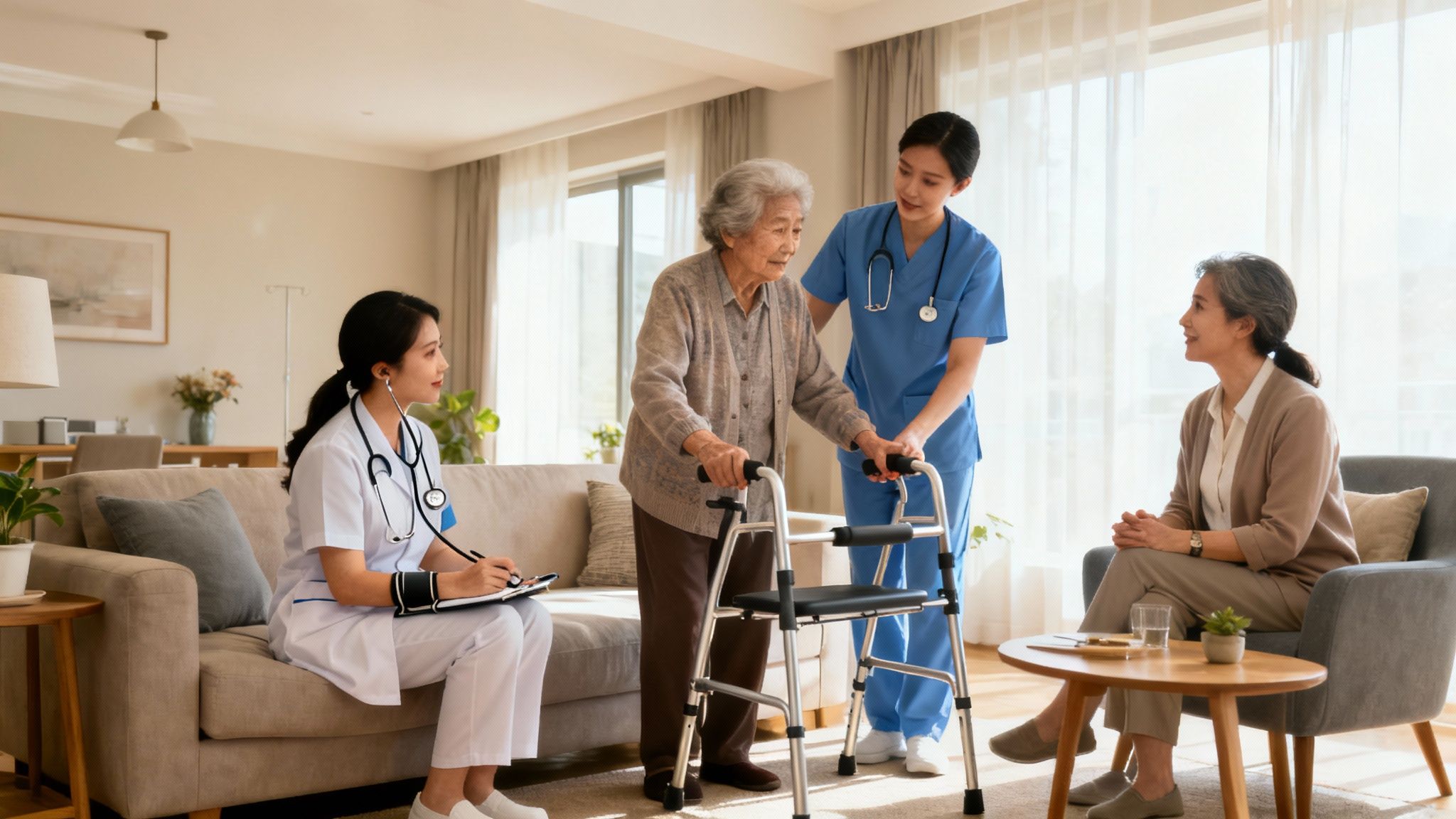
A Team-Based Approach to Healing
Great care is about a dedicated team working together. At Central Coast VNA & Hospice, every patient is backed by an interdisciplinary team. This collaborative model ensures nothing falls through the cracks.
Our teams include specialists such as:
- Registered Nurses who handle complex medical tasks like IV therapy and wound care.
- Physical, Occupational, and Speech Therapists who create personalized programs to rebuild strength and independence.
- Medical Social Workers who offer emotional support and connect families to community resources.
This is not just about treating an illness; it's about treating the whole person. Our focus is on healing, comfort, and helping people regain independence at home.
The Continuum of Care Advantage
Health needs can change. We are the only organization on the Central Coast that offers a complete continuum of care. This means we provide a smooth path for patients as their needs change.
Someone receiving home health services can easily transition to our palliative care or hospice care programs. This continuum eliminates the anxiety of finding new providers. Our team already knows the patient, their history, and their values.
You can learn more about our comprehensive skilled care options in Monterey in this detailed article.
Local Roots and Mission-Driven Service
For families in Monterey County, San Benito County, Santa Cruz County, and South Santa Clara County, choosing us means choosing a local provider. As a nonprofit, our focus is 100% on our patients and our community.
Protecting private health information is non-negotiable. We take data privacy very seriously, as detailed in guides on HIPAA-compliant healthcare faxing practices. We are committed to the highest standards of care, safety, and confidentiality.
Contact us today to learn how our dedicated team can support your family.
Frequently Asked Questions About Skilled Nursing
Making healthcare decisions for a loved one can feel overwhelming. Here, we've gathered answers to the questions we hear most often. Our goal is to give you clarity and confidence as you navigate this choice.
How do we get started with skilled nursing care at home?
The process usually begins with a referral from a doctor or hospital discharge planner. You can also contact Central Coast VNA & Hospice directly. Our team will coordinate with your physician to develop a personalized care plan and guide you through every step.
Is skilled nursing at home covered by Medicare?
Yes, it often is. For eligible patients, Medicare Part A and/or Part B typically cover medically necessary skilled nursing care at home. This includes visits from Registered Nurses and therapists. Our staff can help you verify your specific coverage.
What happens if my loved one's condition changes at home?
Our clinical team constantly monitors your loved one's condition and communicates with their doctor. If needs change, we can quickly adjust the care plan or help arrange a transition to a higher level of care. Our full continuum of services includes palliative and hospice care, ensuring a seamless transition if needed.
Can our family be involved in the care at home?
Absolutely. Family involvement is one of the greatest strengths of home care. Our clinicians educate family members on how to best support their loved one’s recovery. This makes you an empowered and essential part of the care team.
Is it really as safe to receive care at home as in a facility?
Yes, and in many ways, it can be even safer. One-on-one attention from a skilled clinician reduces the risk of medication errors. Being at home also lowers the risk of exposure to infections common in institutional settings. We always start with a thorough home safety assessment to minimize any potential risks.
If you're considering alternatives to a nursing facility in Monterey County, Hollister, Salinas, or Santa Cruz, talk to Central Coast VNA & Hospice about your in-home skilled care options. Call us today at 831-372-6668 or visit https://ccvna.com to speak with a nurse about next steps.