

Is It Too Late for Help? Understanding Hospice Timing
That nagging feeling, "is it too late for help?" can be an incredibly heavy weight to carry. The simple truth is, support is almost always available. The real question isn't if you can get help, but how to make the most of the precious time that's left.
This guide is here to walk you through exactly that.
When Is the Right Time for Hospice Care?
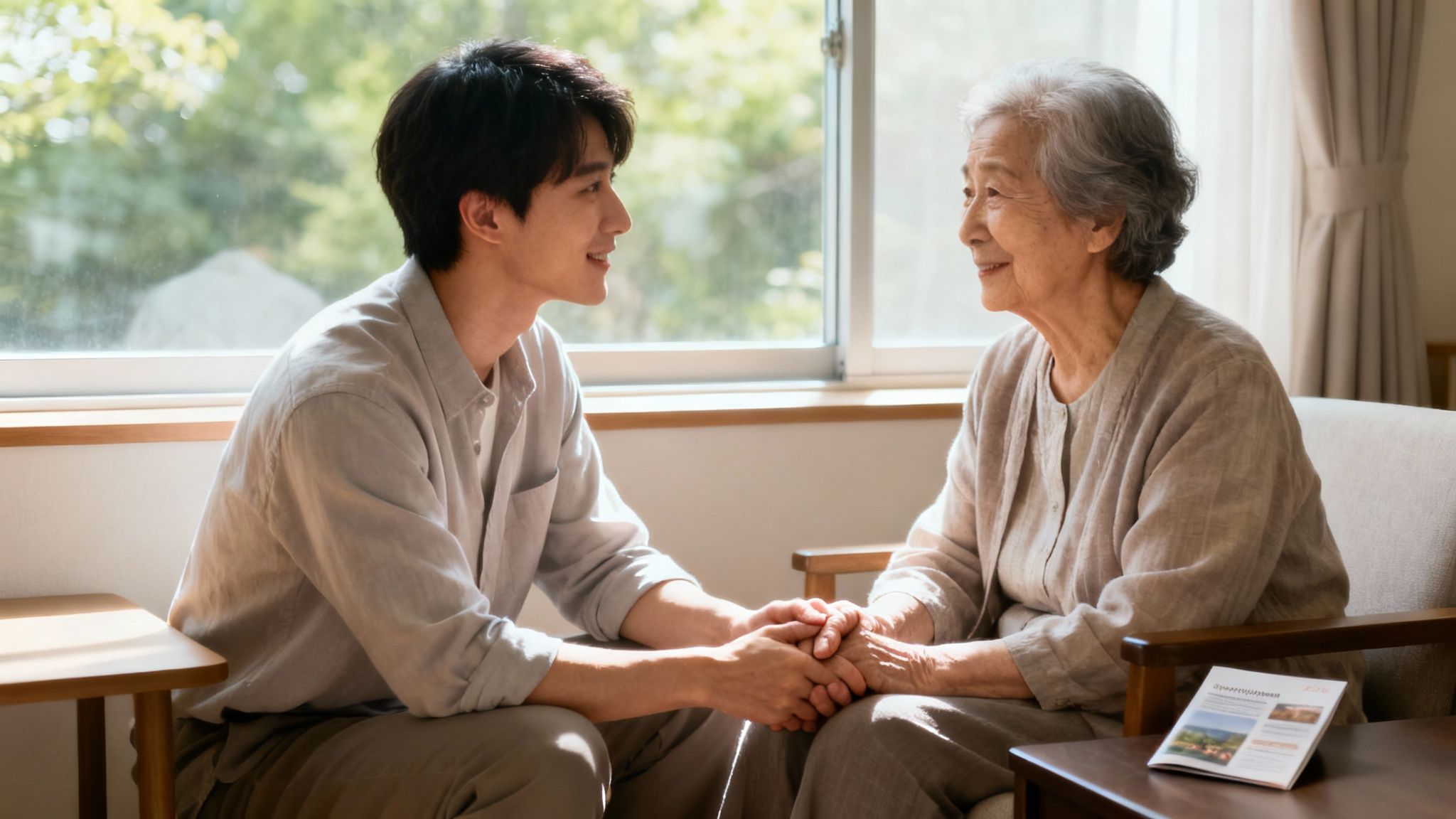
Many families believe hospice is only for the last few days of life. This is one of the biggest and most heartbreaking misunderstandings we see. It often leads to missed opportunities for meaningful support.
Hospice isn't about giving up or waiting for the end. It's a philosophy of care that shifts the focus from adding more days to life, to adding more life to the days we have left.
For over 74 years, Central Coast VNA & Hospice has served as a local, nonprofit guide for families just like yours. We're proud to serve our neighbors across Monterey County, San Benito County, Santa Cruz County, and South Santa Clara County. Our goal has always been to replace fear with facts.
The Problem of Waiting Too Long
When families put off the conversation about hospice, they often miss out on months of valuable support. The benefits aren't just for the person who is ill; they extend to the entire family. A dedicated team—including a Registered Nurse, Hospice Aide, and Chaplain—can manage symptoms, reduce stressful hospital visits, and provide crucial emotional support.
Unfortunately, many people only find this care at the last minute. In fact, many patients enter hospice with fewer than 17 days to live, even though they could have received care for months. This delay means families miss the full benefit of comfort care and symptom relief.
Waiting for a crisis forces families to make overwhelming decisions under stress. An early, gentle conversation can completely change the end-of-life experience, bringing peace instead of panic.
To see how timing impacts care, it helps to compare the two scenarios side-by-side.
Early vs. Late Hospice Support: A Quick Comparison
| Care Aspect | Benefits of an Early Conversation | Challenges of a Late Referral |
|---|---|---|
| Symptom Management | The care team has time to stabilize pain and manage complex symptoms effectively. | Symptoms may be out of control, leading to a crisis situation and emergency room visits. |
| Patient Involvement | Your loved one can actively participate in their care decisions and share their wishes. | The patient may be too ill to communicate, leaving the family to guess at what they wanted. |
| Emotional Support | Families have time to process emotions and find closure with professional guidance. | The family is often in crisis mode, with little time to prepare emotionally for the loss. |
| Family Well-being | Family members receive training, respite, and emotional support, preventing burnout. | Family members are often exhausted, having managed the illness alone for too long. |
As you can see, the difference is night and day. An early conversation opens the door to a more peaceful, dignified journey.
Benefits of an Early Conversation
Starting the discussion sooner gives everyone room to breathe. It allows your loved one to be an active participant in their own care decisions. It also gives the entire family time to prepare, both emotionally and practically.
An early start offers:
- Better Symptom Control: Our clinical teams can manage pain and other symptoms much more effectively over weeks or months.
- Emotional and Spiritual Support: Chaplains and Social Workers help patients and families navigate complex feelings.
- Reduced Family Stress: Knowing your loved one is comfortable and safe provides an incredible sense of peace of mind.
Understanding that hospice is about living fully is the first step toward finding peace. Our guide to understanding your hospice care options can provide even more clarity.
Palliative Care vs. Hospice: What Is the Difference?
To figure out if it’s ever “too late for help,” we first need to clear up some confusion. Many families use the terms palliative care and hospice to mean the same thing. But they are two distinct types of support.
Think of palliative care as an extra layer of support. It can begin the moment someone is diagnosed with a serious illness. Its main job is to improve quality of life by managing symptoms like pain or anxiety.
Palliative Care: A Focus on Comfort at Any Stage
Palliative care is not tied to a person's prognosis. It's for anyone with a serious condition, offering relief and strength. A person can receive palliative care while still getting treatments meant to cure their illness.
The key takeaway is that palliative care works alongside other medical treatments. It adds comfort without asking a patient to give up on a cure.
Hospice Care: A Shift in Goals
Hospice care is a special kind of palliative care. It begins when the focus of treatment shifts. Instead of trying to cure an illness, the goal becomes providing comfort and peace.
For a person to be eligible for hospice, a doctor usually certifies that they have a life expectancy of six months or less. This is if the illness runs its natural course.
This is the most important distinction:
- Palliative Care: Can be provided with curative treatment.
- Hospice Care: Is for patients who are no longer seeking curative treatment.
Choosing hospice isn't about giving up. It’s about prioritizing quality of life over quantity.
The Central Coast VNA & Hospice Continuum of Care
At Central Coast VNA & Hospice, we see these as a seamless continuum of care. For over 74 years, our nonprofit has guided families on the Central Coast through their healthcare journey. This approach provides stability when families need it most.
Many of our patients in Monterey County and surrounding areas start with our home health or palliative care services. Then, as their needs change, they can transition smoothly to hospice.
This transition is often handled by the same trusted clinicians. The same Registered Nurse or Hospice Aide already knows the patient’s story and preferences. This eliminates the stress of starting over with a new team.
Our integrated model ensures that care is always consistent and compassionate. It allows us to build deep, trusting relationships. To learn more, explore our guide on the differences between hospice and palliative care.
Key Signs It Might Be Time to Consider Hospice
Knowing when it's the right moment to talk about hospice can feel difficult. But several clear signs can help guide your family. These signs are about the real-world challenges that come with a serious illness.
Thinking about hospice isn't about giving up. It’s about shifting the focus to making every day the best it can be. For families across the Central Coast, a simple conversation with Central Coast VNA & Hospice can provide clarity.
This flowchart helps visualize the choice families face.
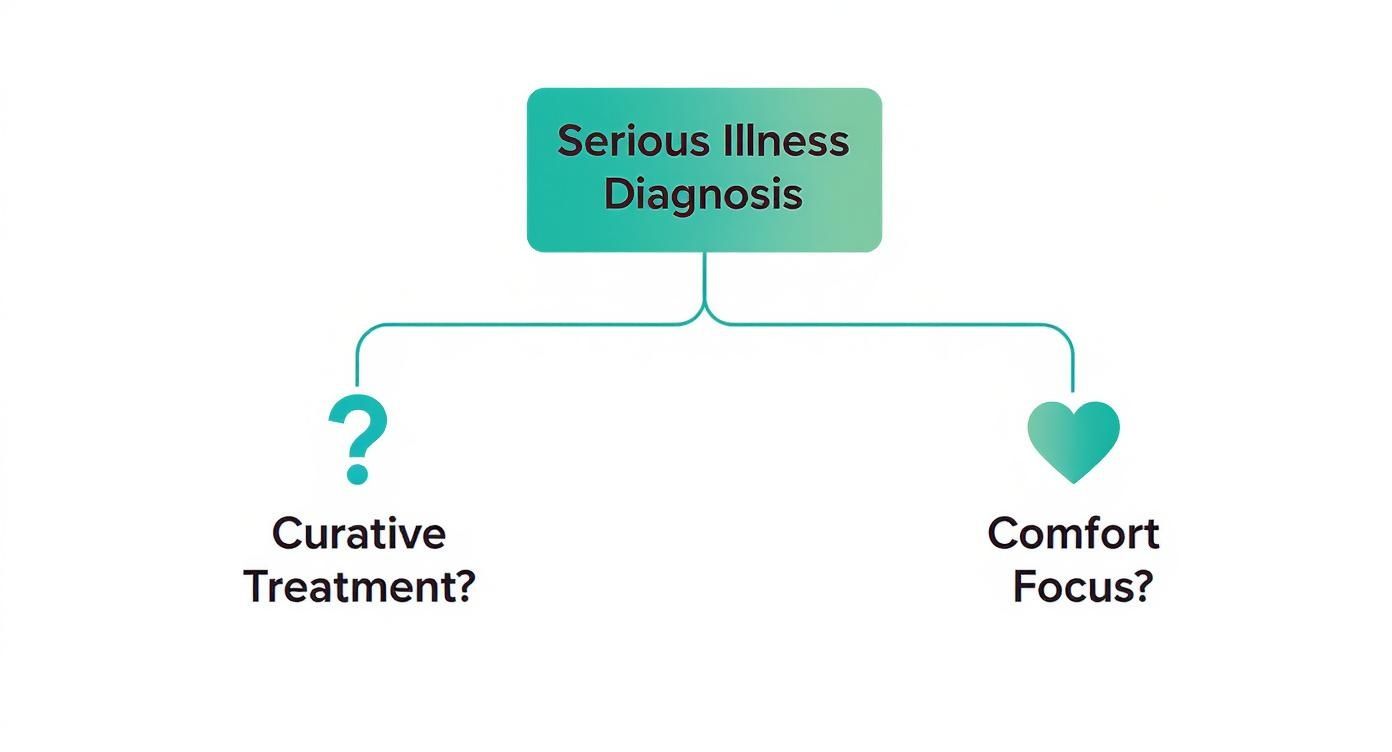
As you can see, both paths are valid options. The right choice depends entirely on a person's goals.
Physical and Clinical Indicators
Certain physical changes often signal that the body could benefit from hospice support. We’re not talking about a single bad day. We mean a pattern over time that shows an illness is progressing.
Some common clinical signs include:
- Frequent Hospital Visits: Multiple trips to the ER or hospital stays within the last six months for the same symptoms.
- Uncontrolled Symptoms: Persistent pain, shortness of breath, or nausea that has become difficult to manage.
- Significant Weight Loss: Noticeable, unintentional weight loss, often with a loss of appetite.
- Declining Function: A clear drop in the ability to handle daily activities like bathing or dressing.
These physical markers are important clues. But how a person is feeling is just as crucial.
Practical and Emotional Signs
Sometimes, the clearest signs aren't on a medical chart. You can see them in the exhaustion of a family member. You can hear them when your loved one says they’re "tired of fighting."
When someone says they no longer want to go back to the hospital, it’s a pivotal moment. Their priorities are shifting toward comfort. Listening to that is an act of love and respect.
When family members feel overwhelmed or exhausted, it's a sign that professional support is needed. Hospice isn't just for the patient; it provides essential guidance and respite for the entire family.
Other practical signs can include:
- Spending most of the day in a bed or a chair.
- Needing more and more help with basic daily tasks.
- Withdrawing from conversations or favorite social activities.
Recognizing these signs allows you to be proactive instead of reactive. For a deeper dive, you can learn more about how you know when hospice is needed in our detailed guide.
The Role of a Professional Assessment
While these signs are helpful, you don’t have to figure this out alone. The best way to get clear answers is with a hospice eligibility assessment. This is provided at no cost by a Registered Nurse from Central Coast VNA & Hospice.
This assessment can happen wherever your loved one calls home. The nurse will review your loved one’s condition and listen to your family's goals. This is a conversation designed to empower you with information.
How to Start the Hospice Conversation

Talking about hospice is one of the toughest conversations any family will have. The words themselves feel heavy. But approaching this topic with honesty and compassion is an act of love.
The goal isn't to force a decision. It's about opening a door to understand what your loved one truly wants for their quality of life. An early conversation allows for calm discussion instead of rushed choices during a crisis.
Finding the Right Time and Place
Choosing the right moment is half the battle. Look for a time when you won’t be rushed. A quiet afternoon at home often works better than a busy family gathering.
The key is to make sure everyone feels as comfortable as possible. This conversation takes emotional energy, so starting from a place of calm helps.
Framing hospice as a choice for empowerment can change the tone. It’s not about giving up; it’s about taking control of how one lives, ensuring their final chapter is filled with dignity and peace.
Starting with gentle, open-ended questions can ease into the topic. Try asking questions that focus on their feelings:
- “What’s been the most difficult part of your days lately?”
- “When you think about the coming months, what are you hoping for?”
- “What matters most to you right now?”
These questions show you’re there to listen, not to push an agenda. Their answers will give you a natural path to discussing helpful support.
Talking with the Medical Team
Your loved one’s doctor is a crucial partner in this conversation. When you meet with their physician, being prepared helps you get clear answers.
Bring a list of questions so you don’t forget anything. You might consider asking:
- What can we realistically expect as the illness progresses?
- What are the benefits of continuing with the current treatments?
- At what point would you recommend we consider comfort-focused care?
Bringing another family member to the appointment can be a huge help. One person can take notes while the other focuses on the conversation.
How Central Coast VNA & Hospice Can Help
You don’t have to navigate these difficult conversations alone. For families across the Central Coast, from Monterey to Santa Cruz, our team is here to offer guidance.
Our experienced Social Workers and Chaplains are experts at facilitating family meetings. They can help explain care options and ensure the final decision reflects your loved one's wishes. For more detailed advice, check out our guide on how to talk to your parents about hospice care.
Navigating Hospice Enrollment and What Insurance Covers
When you're facing a serious illness, the last thing you want to worry about is complicated paperwork. The good news is, the enrollment process is designed to be straightforward and supportive.
It all begins with a simple conversation. While a referral often comes from a physician, you can call Central Coast VNA & Hospice directly to ask questions. A Registered Nurse will meet with your family for an assessment, listen to your concerns, and confirm eligibility.
How Hospice Care Is Paid For
One of the biggest sources of comfort for families is learning how hospice is paid for. For most people on the Central Coast, hospice is a fully covered benefit under Medicare Part A. It’s also covered by Medi-Cal and most private insurance plans.
This benefit is designed to lift the financial burden off families. It allows you to focus on spending quality time together. As a local nonprofit, our mission is to make sure everyone in our community gets the compassionate care they deserve.
Despite a recent rise in hospice use, access remains limited. In 2022, 49.1% of Medicare beneficiaries who died received hospice care (NHPCO, 2023). This means many families are still missing out on this vital support.
What the Hospice Benefit Typically Includes
The Medicare hospice benefit covers everything related to the terminal illness. This all-inclusive approach means families aren't surprised by hidden costs.
Here’s a look at the services usually covered:
- Nursing Visits: Regular check-ins from a Registered Nurse to manage symptoms at home.
- Hospice Aide Support: Compassionate help from a Hospice Aide with personal care like bathing and dressing.
- Medical Equipment: A hospital bed, oxygen, or wheelchair delivered directly to the home.
- Medications: All medications for managing pain and other symptoms related to the terminal illness.
- Emotional and Spiritual Support: Visits from Social Workers and Chaplains for the patient and family.
- Bereavement Support: Grief counseling and support groups for the family for up to 13 months.
This complete circle of support allows families to stop worrying about medical bills. It’s designed to address physical, emotional, and spiritual needs all at once.
Understanding your options is the first step toward peace of mind. For a more detailed breakdown, learn more about how to pay for hospice care on our website. Families may also find it helpful to research resources for accessing free grant money for bills and personal use.
Why Earlier Support on the Central Coast Matters
When families ask, "Is it too late for help?", it usually means they’re in a crisis. The key to avoiding that stressful moment is understanding that timing is everything. Starting the conversation about comfort early can completely change a family’s end-of-life experience.
At Central Coast VNA & Hospice, our 74 years of serving this community have shown us one thing clearly: earlier support makes a profound difference. When families reach out before things get overwhelming, our teams have time to get to know a patient and build a trusting relationship. This helps prevent emergency room visits and gives families space to make meaningful memories.
The CCVNA Continuum of Care
As a local nonprofit serving Monterey, San Benito, Santa Cruz, and South Santa Clara counties, we offer a seamless continuum of care. Our services range from home health and palliative care to hospice. As a patient's needs change, their care team can often remain the same, providing a stable presence.
There’s incredible comfort in that consistency. Imagine your loved one receiving care from a Registered Nurse or Hospice Aide who already knows their story. This lifts a huge weight off of everyone involved.
The greatest gift of an early conversation is control. It empowers your loved one to be an active participant in their care, ensuring their final chapter is lived with dignity, comfort, and peace—on their own terms.
Take the First Step Today
Many families begin their research online. In fact, 65% of healthcare decision-makers start with Google. Educational content can bridge the knowledge gap, and Central Coast VNA & Hospice can be that trusted local source.
Don't wait until you're at a breaking point. An informational call doesn't commit you to anything, but it can provide immense relief.
Our compassionate experts are here to help you:
- Understand the real differences between palliative care and hospice.
- Recognize the signs that your loved one might need more support.
- Navigate the often-confusing world of insurance and enrollment.
If you live on the Central Coast, we encourage you to contact Central Coast VNA & Hospice for a no-obligation conversation. Learning about your options is a powerful first step toward getting the support your family deserves.
Frequently Asked Questions About Hospice Timing
1. Does choosing hospice mean we are giving up hope?
No. Choosing hospice isn’t about giving up. It’s about shifting what you hope for, from a cure to comfort, peace, and meaningful moments. It's about adding life to days, not just days to life.
2. Can a patient leave hospice care?
Absolutely. A patient can leave hospice care at any time and for any reason. If their condition improves or they decide to try a new treatment, they can stop services and re-enroll later if needed.
3. How long can someone receive hospice care?
A doctor must certify a life expectancy of six months or less. However, care is not limited to six months. A person can receive hospice support as long as they meet the medical criteria, with regular recertifications from their doctor.
4. Where is hospice care provided?
Most hospice care happens wherever a person calls home. This could be a private residence, an assisted living community, or a nursing home. Central Coast VNA & Hospice brings this support directly to you, helping avoid stressful hospital trips.
5. Do we need a doctor's referral to ask about hospice?
No. Anyone can call us directly to ask questions or get information. If you decide hospice is the right path, our team at Central Coast VNA & Hospice will coordinate with your loved one’s doctor to get the necessary referral.
It's never too late to ask for help or just get information. Early conversations bring peace of mind and a sense of control. If you're caring for a loved one on the Central Coast, please reach out to Central Coast VNA & Hospice. Learn more by visiting https://ccvna.com or calling us for a no-obligation conversation today.
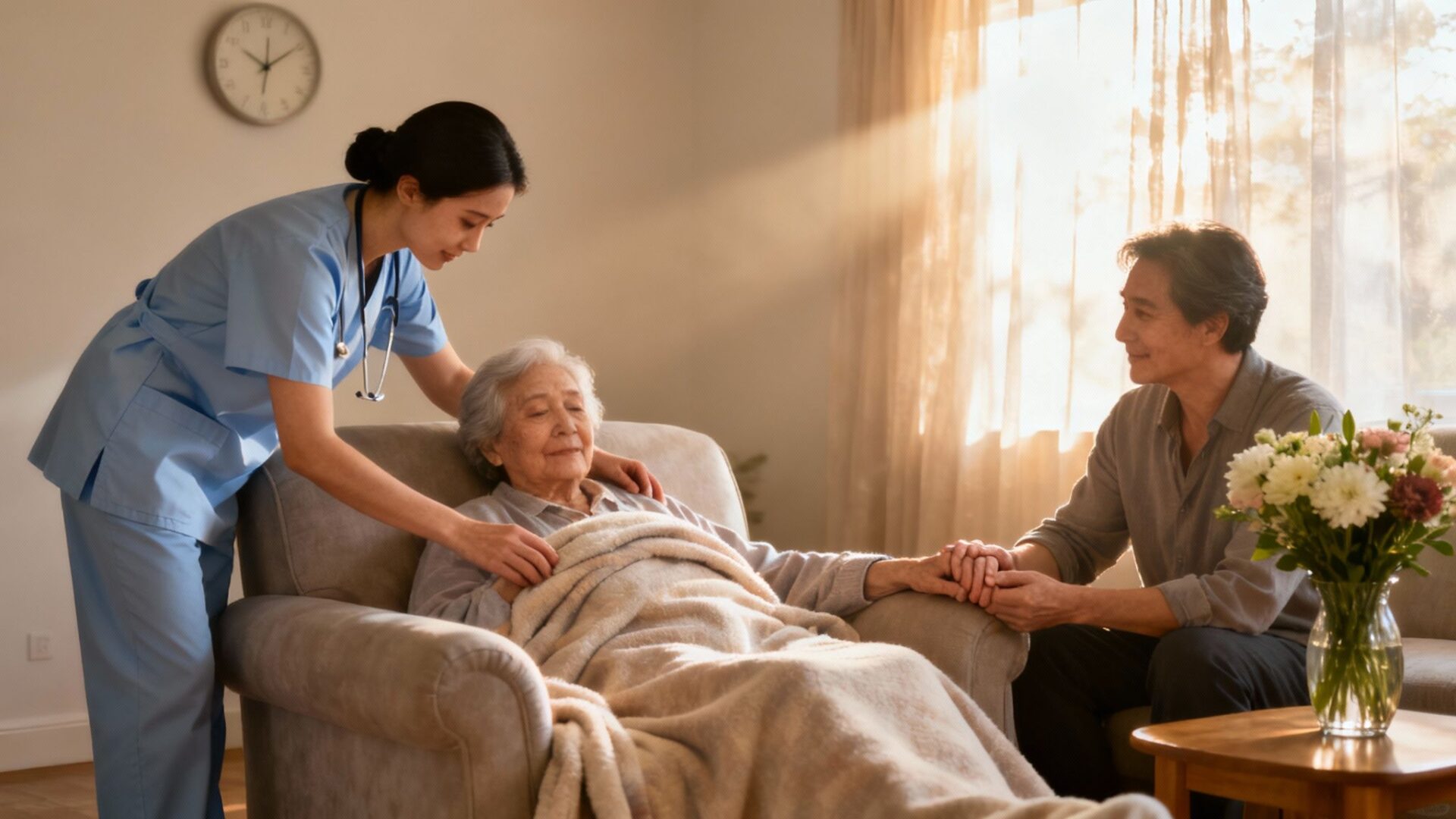
When is the right time for hospice? Sooner than you think
When is the right time to consider hospice care? The answer for many families is often months sooner than they think. Waiting until the final days means missing out on comfort and support that could have made a world of difference.
So many families wait until a crisis hits. This delay can limit access to vital resources and prevent patients from fully benefiting from the support hospice offers.
The Surprising Truth About Hospice Timing
Many people think hospice is only for the last few hours or days of life. This common misunderstanding prevents families from accessing support designed to bring comfort and peace when it’s needed most.
The truth is, hospice is about living the rest of one’s life as fully as possible. It is a philosophy of care that focuses on quality of life.
Delaying the conversation about hospice is a widespread problem. According to national data, half of all patients receive hospice care for just 17 days or fewer, even though many were eligible for months. This means families miss out on support that reduces stress and manages symptoms.
Shifting the Focus from End-of-Life to Quality of Life
Hospice care isn’t about giving up. It is about shifting the focus to maximizing comfort and making sure a person's final chapter is lived on their own terms.
Starting sooner allows the hospice team to provide guidance and dignity-focused care over a longer period. It's a proactive choice for quality of life.
Early access to hospice care gives a dedicated team time to:
- Truly understand the patient's wishes and needs.
- Put effective pain and symptom management plans in place before a crisis hits.
- Build trusting relationships with the patient and their family.
- Give family members the training, resources, and breaks they deserve.
"Hospice doesn’t mean the end is tomorrow. It means you have to enjoy the time that you have. We wanted our mom to be comfortable, surrounded by the people she loved the most."
This perspective reframes hospice as a positive choice. Central Coast VNA & Hospice offers this support to families across Monterey County, San Benito County, Santa Cruz County, and South Santa Clara County. With over 74 years of nonprofit, mission-driven service, our local teams are here to help.
For a broad overview, a compassionate guide to hospice care and what to expect can be a helpful starting point. It's also important to know if hospice is only for cancer patients to understand the full scope of support.
Recognizing The Signs It Might Be Time
Knowing when to consider hospice isn’t about a specific date. It’s about recognizing a pattern of change in your loved one’s daily life.
These signs often sneak up on you. But when you step back and look at the bigger picture, a clear pattern of decline often emerges. This can help you start an honest conversation with a doctor.
Physical And Functional Changes To Watch For
This table outlines common indicators that it might be time to discuss hospice care. Noticing these trends gives you specific information to share with a physician.
| Common Indicators It May Be Time to Consider Hospice |
|---|
| Medical Status: Frequent trips to the ER or repeat hospital stays for the same symptoms. The underlying illness seems to be progressing despite treatment. |
| Physical Decline: Unexplained and significant weight loss, often paired with a noticeable loss of appetite. |
| Functional Ability: Needing more help with daily activities like bathing, dressing, getting out of bed, or walking. |
| Energy Levels: A clear increase in time spent sleeping or resting in a bed or chair. Their world seems to be getting smaller. |
| Symptom Burden: Pain, shortness of breath, or nausea that is becoming harder to control and is impacting their quality of life. |
| Mental State: Growing confusion, restlessness, or withdrawing from activities and people they once enjoyed. |
This moves the conversation from "I'm worried" to "Here is what I'm seeing." For more detail, explore our article on how to know when hospice care is needed.
This decision flowchart can also help you visualize if it's time to explore hospice.
When a condition is clearly worsening, that's the signal to start gathering information about the supportive benefits hospice offers.
Worsening Symptoms And Declining Quality Of Life
Pay close attention to how your loved one feels. When symptoms become relentless and hard to control, their quality of life suffers.
The goal of hospice is to manage those symptoms. This helps them feel more comfortable and engaged in the time they have left.
Is your loved one experiencing any of these?
- Uncontrolled Pain: Pain that is persistent and not responding well to current treatments.
- Breathing Difficulties: A worsening shortness of breath, even while resting.
- Nausea or Vomiting: Persistent digestive issues that are draining and hard to manage.
- Growing Confusion: Increased confusion or restlessness that disrupts their peace.
When curative treatments stop providing benefits, hospice care offers expert support focused on comfort and dignity.
Unfortunately, this shift often comes much later than it should. If you see these signs, it means there is an opportunity to add comfort and specialized care to their life right now.
The team at Central Coast VNA & Hospice is here to help families in Monterey County, San Benito County, and surrounding communities understand all their options.
The True Benefits of Starting Hospice Sooner
The real purpose of hospice is to improve quality of life for months, not just days. Choosing to start hospice care sooner doesn’t mean you’re giving up.
It means you’re embracing a philosophy of care that prioritizes comfort and dignity. An earlier start gives patients and families a complete support system to ease the journey.
This proactive approach allows a dedicated team to get ahead of symptoms before they become a crisis. Families who wait often tell us they wish they had called sooner.

Superior Pain and Symptom Management
One of the greatest gifts of starting hospice early is expert symptom control. A team of Registered Nurses partners with your loved one’s doctor to create a personalized plan.
They focus on managing pain, shortness of breath, and other difficult symptoms. The goal is to keep your loved one comfortable and alert.
When symptoms are managed well, it can lead to:
- More Meaningful Interactions: Patients have more energy to spend quality time with family.
- Fewer Hospital Visits: Proactive care at home helps prevent stressful trips to the emergency room.
- A Greater Sense of Control: Patients feel more in charge when their symptoms aren't dictating every moment.
This focus on comfort leads to more good days. For a deeper look, you can read about the real benefits of starting hospice early.
Emotional and Spiritual Support for the Whole Family
A serious illness weighs heavily on the entire family. Central Coast VNA & Hospice provides a full team to walk alongside you.
Our Medical Social Workers help families navigate complex emotions. Our Chaplains offer non-denominational spiritual support that honors each person’s unique beliefs.
"Hospice doesn’t mean the end is tomorrow. It means you have to enjoy the time that you have. We wanted our mom to be comfortable, surrounded by the people she loved the most. We wanted her to get the best care. [Hospice] gave that to us.”
Practical Support and Respite for Family Members
Family members who provide care can become physically and emotionally drained. Enrolling in hospice early provides them with crucial support.
Hospice Aides assist with personal care like bathing and dressing. Trained volunteers offer companionship, giving family members a much-needed break.
This respite care is essential for preventing burnout. It gives you permission to rest and recharge, knowing your loved one is in safe hands.
Research shows that nearly 60% of eligible patients are not enrolled in hospice. Misconceptions keep people from accessing care that could ease suffering and support loved ones. At Central Coast VNA & Hospice, our team is dedicated to providing the compassionate care your family deserves.
Debunking Common Hospice Myths
Misconceptions are one of the biggest reasons families wait too long to explore hospice care. These myths create unnecessary fear.
Let's separate the facts from the fiction. This will bring clarity to what hospice truly offers.
Myth 1: Hospice Means Giving Up Hope
Many people feel that choosing hospice means "giving up." The truth is, hospice isn’t about giving up; it's about shifting what you hope for.
Hope moves away from a cure and toward making every day as good as it can be. This means a life filled with comfort, dignity, and meaning.
What does that look like? It might be:
- Enjoying a meal without feeling sick.
- Having enough energy for a conversation with a grandchild.
- Spending a quiet afternoon at home, free from pain.
This is a different kind of hope—the hope for peace and comfort.
Myth 2: Hospice Is a Place You Go To Die
Another common myth is that hospice is a building you go to for your final days. While some inpatient facilities exist, most hospice care happens wherever the patient calls home.
This could be their own house, an assisted living community, or a nursing home. Hospice is a philosophy of care, not a physical location.
Central Coast VNA & Hospice brings a dedicated team right to your doorstep. Our Registered Nurses, Hospice Aides, Medical Social Workers, and Chaplains provide support in familiar surroundings.
Myth 3: Hospice Speeds Up the End of Life
Many families worry that starting hospice will hasten their loved one’s decline. In reality, the opposite is often true.
Hospice does nothing to speed up or slow down the natural course of an illness. Our primary goal is expert pain and symptom management.
When a patient’s pain and anxiety are under control, their body is no longer fighting a constant battle. This relief can sometimes lead to renewed strength. The entire plan is designed to add life to a patient's days.
"I think we’ve reached the point when we need to consider something called hospice. It’s not about dying tomorrow. It’s about giving you comfort at the end.”
For more information on this topic, see how hospice isn't what you think, separating fact from fiction.
Myth 4: Hospice Is Unaffordable for Most Families
Worries about cost can make families hesitate. The good news is that hospice is a fully funded benefit for almost everyone who needs it.
Hospice services are typically covered by:
- Medicare: The Medicare Hospice Benefit covers 100% of the costs for all care related to the terminal illness.
- Medi-Cal: California’s Medicaid program also provides a comprehensive hospice benefit.
- Private Insurance: Most private health plans offer hospice coverage similar to Medicare’s.
This coverage includes nursing visits, medical equipment, and support for the entire family. As a nonprofit serving the Central Coast, we ensure every eligible patient gets the care they need.
How to Start the Conversation About Hospice
Talking about end-of-life care is one of the toughest conversations a family can have. But opening that door is also a profound act of love.
The secret is to approach it gently. Focus on your loved one's comfort and their goals for today, not just the illness itself.

Gentle Ways to Begin the Discussion
You don’t need a perfect script—just an open heart and a willingness to listen. Here are a few ways to gently bring up the topic:
- “I want to make sure we’re doing everything we can to keep you comfortable. What does a good day look like for you right now?”
- “It’s important to me that we’re on the same page about your wishes. What matters most to you these days?”
- “The doctor mentioned we have more options for managing your symptoms. I’d love to talk through what those are with you.”
These questions open a dialogue about their priorities. The same gentle strategies for discussing other life changes, like how to talk to parents about senior living options, can be helpful here.
Partnering With Your Doctor
Your loved one’s doctor is an important ally. Before the next appointment, jot down notes about the changes you’ve seen, such as increasing pain or weight loss.
During the visit, you can ask direct but compassionate questions like:
- "Looking ahead, what can we realistically expect as this illness progresses?"
- "At what point would you suggest we consider hospice care?"
- "Could a hospice consultation help us understand our options for managing symptoms at home?"
This empowers you to be an advocate for your loved one. For more in-depth advice, check out our guide on how to talk to your parents about hospice care.
Why a Local, Nonprofit Hospice Matters
Choosing a hospice provider is a big decision. A nonprofit like Central Coast VNA & Hospice operates from a place of mission, not profit margins.
Our entire focus is on patient and family care. Every resource goes back into the communities we serve in Monterey, San Benito, Santa Cruz, and South Santa Clara counties.
With regulators and families demanding higher standards, our nonprofit mission emphasizes accountability and community trust. For over 74 years, we have put our neighbors first.
Unlike some providers, Central Coast VNA & Hospice offers a full continuum of care. We integrate home health, palliative care, and hospice services to support patients before they reach a crisis. This makes it easier for families to transition smoothly when the time is right.
Our team is here to guide you. Families across Monterey, Salinas, Hollister, and Santa Cruz can speak with a VNA nurse or social worker to explore their options with no obligation. The earlier you reach out, the more we can help.
Contact us today to learn more about how we can support your family.
Frequently Asked Questions About Hospice Care
When is the right time to call hospice?
The right time is often sooner than you think, typically when a doctor estimates a life expectancy of six months or less if the illness runs its natural course. It's best to call when you notice a decline in health, increasing hospital visits, or uncontrolled symptoms, allowing for months of support rather than just days.
Does choosing hospice mean we're giving up?
No, hospice is not about giving up. It is a shift in focus from curative treatment to comfort care, prioritizing the patient's quality of life, dignity, and personal wishes.
Can a patient still see their regular doctor?
Yes, absolutely. The hospice team from Central Coast VNA & Hospice works closely with the patient's primary care physician, who remains an important part of the care team.
Where is hospice care provided?
Most hospice care is provided wherever the patient calls home. This can be a private residence, an assisted living facility, or a nursing home in Monterey County, San Benito County, or our other service areas.
What if the patient's health improves?
If a patient's condition improves, they can be discharged from hospice at any time and return to curative treatment. They can re-enroll in hospice later if their condition declines again.
Who pays for hospice care?
Hospice care is covered by Medicare, Medi-Cal, and most private insurance plans. As a nonprofit, Central Coast VNA & Hospice provides care to all eligible patients, regardless of their ability to pay.
Navigating these decisions is a journey, and you don't have to walk it alone. The compassionate team at Central Coast VNA & Hospice has been supporting families in Monterey, San Benito, Santa Cruz, and South Santa Clara counties for over 74 years. If you have more questions or are wondering if now is the right time, please contact us today for a no-obligation conversation.

Not Just The Final Days: Recognizing When Hospice Can Truly Help
When families face the tough question of hospice care, a common belief is that it’s only for the last few days of life. This is one of the biggest myths. The reality is that hospice is designed to improve quality of life for months, not just hours.
It’s about shifting the focus from trying to cure an illness to maximizing comfort. It helps preserve dignity and create cherished moments with loved ones.
Rethinking Hospice: More Than Just the Final Days
Deciding when to think about hospice is one of the most emotional journeys a family can take. For many, the word "hospice" feels like a last resort. It feels like something you turn to when there are no other options left.
This misunderstanding often keeps people from getting support when it could help the most. Here at Central Coast VNA & Hospice, we have served families for over 74 years. We work across Monterey, San Benito, Santa Cruz, and South Santa Clara counties.
In all that time, we've seen a different truth. Hospice isn’t about giving up; it’s about taking back control. It’s an active choice to prioritize comfort and make life as good as it can be.
Shifting Focus from a Timeline to Quality of Life
The real purpose of hospice is to provide a layer of support around a person with a life-limiting illness. This care addresses physical, emotional, and spiritual needs. Instead of counting down the days, the goal becomes making each day meaningful and comfortable.
This approach benefits the person who is ill. It also offers incredible relief and guidance to the entire family. Many families tell us they're surprised that starting hospice earlier can lead to better outcomes.
Hospice provides:
- Expert Symptom Control: A team of Registered Nurses and physicians works to manage pain, shortness of breath, and other symptoms.
- Fewer Hospital Visits: With expert support at home, many crises can be managed without stressful trips to the emergency room.
- Emotional and Spiritual Support: Our chaplains and medical social workers help patients and families navigate complex emotions and find peace.
- Feeling Empowered: When you choose hospice, you have more say in your care. Your wishes are honored in the comfort of your own home.
Hospice is a Longer-Term Support System
Many families now see that hospice offers valuable support long before the final days. According to the National Hospice and Palliative Care Organization (NHPCO), over 1.72 million Medicare beneficiaries received hospice services in 2020 (NHPCO, 2021). Many received care for several months.
This shows that hospice is becoming a trusted, longer-term option for people with advanced illnesses. If you’re exploring your options, getting the real story is important. We've laid out the facts and busted the myths in our guide, Hospice Isn't What You Think.
Recognizing The Signs That It Might Be Time For Support
Deciding when hospice might be helpful isn't about looking at a calendar. It's about paying attention to real changes in a loved one's health and daily life. Spotting these signs early allows families to explore options before a crisis hits.
Many families in Monterey and Santa Cruz counties wait until the final days because they aren't sure what to look for. But understanding key indicators can bring clarity to a confusing time. Seeing these signs is about recognizing that a different kind of care is needed to improve quality of life.
Clinical Signs To Watch For
A serious illness often leaves clues. While only a doctor can determine hospice eligibility, families can see day-to-day patterns. These signs suggest it’s time to have a conversation about hospice.
Some of the most common things to look for include:
- Frequent Hospital or ER Visits: Repeated hospital stays for the same symptoms often mean the illness is getting harder to control.
- Worsening Symptoms: Pain, shortness of breath, nausea, or fatigue that becomes a constant struggle, even with medical treatments.
- Significant Weight Loss: Unintentional weight loss can be a sign that the body is working much harder to function.
- Decline in Function: A noticeable drop in the ability to move around, get out of bed, or handle daily tasks without help.
This chart helps show how the focus can shift from treatment to comfort-focused support.
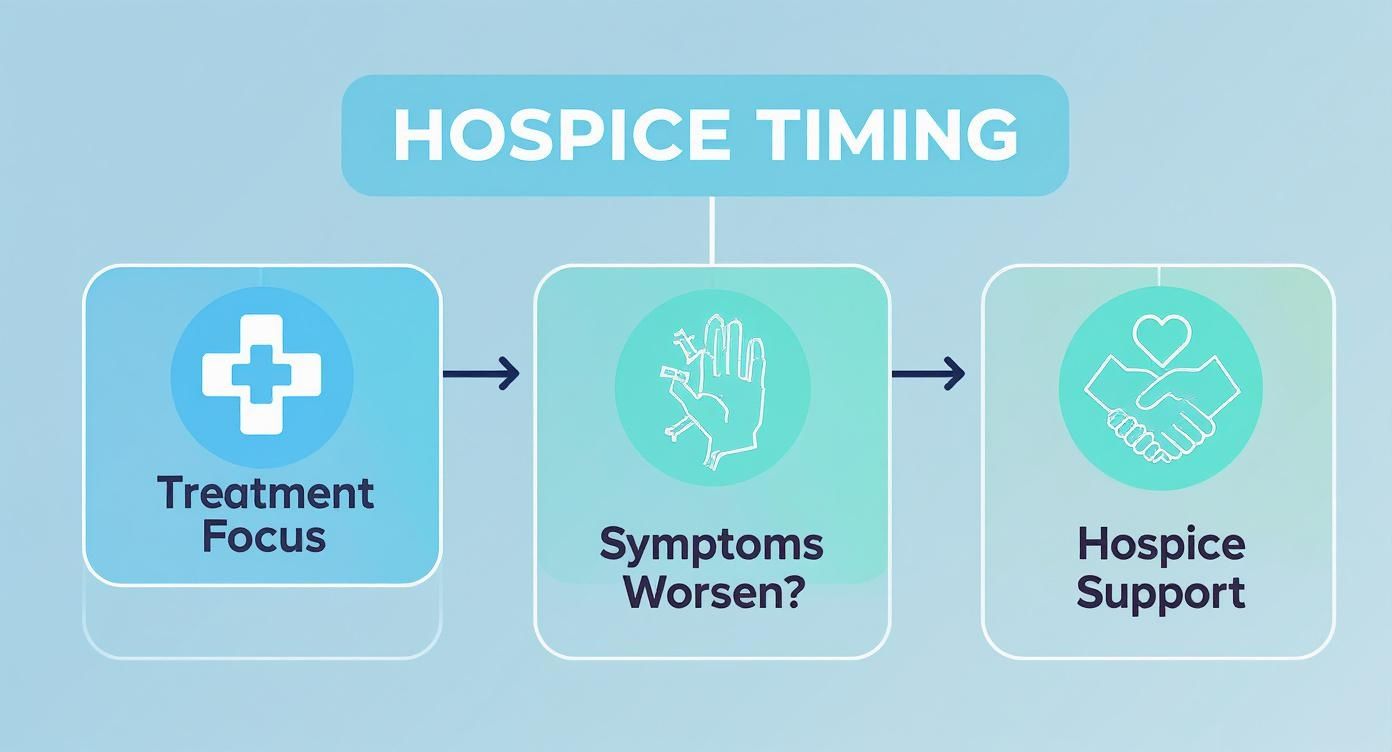
When treatments stop providing relief and symptoms worsen, hospice becomes a path toward comfort.
Personal and Emotional Indicators
Changes in a person’s spirit and daily routines offer important clues. These shifts can be subtle at first. Together, they often show a growing need for a different kind of support.
Pay close attention to these kinds of changes:
- Increasing Need for Help: A growing reliance on others for activities like bathing, dressing, or eating.
- Withdrawing from Hobbies and Social Life: Losing interest in people and passions that once brought joy.
- Spending More Time in Bed or a Chair: A major increase in time spent sleeping or resting, which points to a drop in energy.
- Growing Family Caregiver Strain: The physical and emotional toll on family becomes overwhelming.
Hospice care is designed to support not only the patient but the entire family. Recognizing caregiver stress is crucial, as it acknowledges that the burden of a serious illness is shared.
These personal shifts are just as meaningful as any clinical measurement. To better navigate the complex feelings that arise, families might find resources on understanding loss, grief, mourning, and bereavement helpful.
For a more detailed look at what to look for, you can learn more about how you know when hospice is needed in our helpful guide.
How Early Hospice Care Enhances Quality of Life
Many families feel that choosing hospice means giving up hope. It’s a powerful fear. But embracing hospice is a proactive choice to put comfort, dignity, and cherished time first.
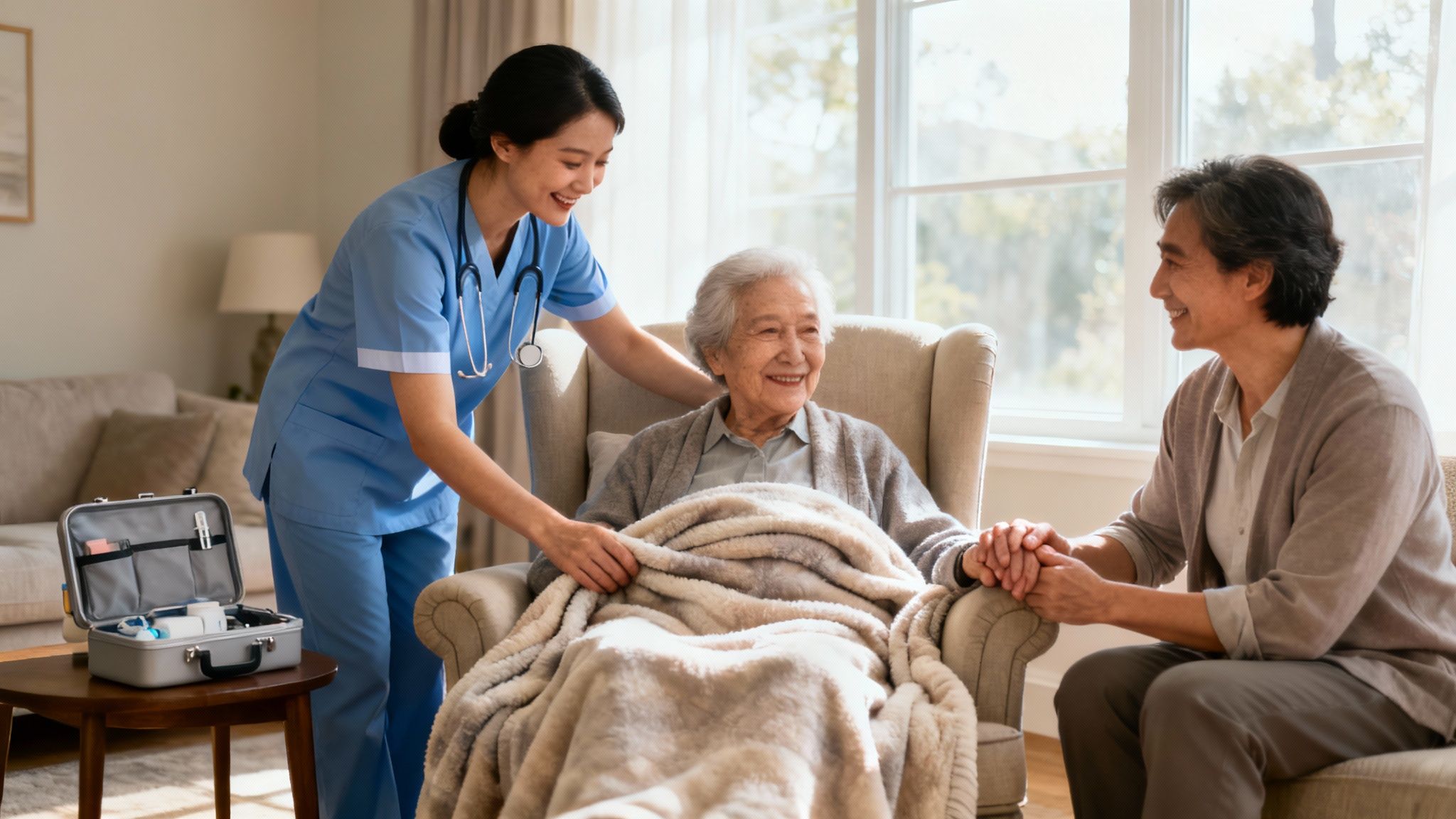
When support starts sooner, the benefits are profound for everyone. We’re not just talking about managing symptoms in the final days. We’re talking about making life better for weeks or even months.
Expert Pain and Symptom Management
One of the greatest gifts of early hospice care is expert symptom management at home. When pain, shortness of breath, or anxiety are under control, a person can engage more with family. Our team of Registered Nurses and physicians are specialists in this area.
This specialized focus can reduce the need for stressful emergency room visits. Instead of reacting to one crisis after another, the care team works to anticipate needs. This ensures stability and peace of mind.
Research shows hospice can reduce ER visits and improve pain management. It can also increase family satisfaction. When care starts earlier, those benefits are stronger.
A Holistic Safety Net for Emotional and Spiritual Needs
A serious illness takes a toll on more than just the body. It deeply impacts emotional and spiritual well-being. Hospice care, especially when started early, provides a multi-layered support system.
This is where the value of a nonprofit provider like Central Coast VNA & Hospice shines. Our interdisciplinary team includes:
- Medical Social Workers who help families navigate complex emotions and guide difficult conversations.
- Chaplains who offer spiritual support tailored to each person’s beliefs, providing a comforting presence.
- Hospice Aides who provide compassionate personal care that preserves dignity and eases the physical burden on family.
This team works together to create a circle of support. Knowing how to provide gentle care is vital, especially for individuals with dementia. Families can find essential care tips for dementia patients to help them connect.
Hospice is about adding life to days, not just days to life. By focusing on comfort and holistic support, we empower individuals to live their remaining time with meaning and purpose.
The care provided by hospice is similar to palliative care. You can learn more about the benefits of palliative care and how it can serve as a bridge to hospice.
Choosing hospice earlier means choosing more time for connection and peace at home. Whether in Salinas, Hollister, or Santa Cruz, our team ensures every patient’s final chapter is lived with dignity.
Understanding Hospice Eligibility and How to Get Started
Figuring out the path to hospice care can feel overwhelming. But it’s often more straightforward than families realize. Having the right information empowers you to make confident decisions.
The main requirement for hospice is a doctor's certification. The doctor must certify that a person has a life-limiting illness with a prognosis of six months or less, if the illness runs its natural course. This is not an expiration date—it's a medical guideline for services to begin.
What the Six-Month Guideline Really Means
It is important to see the six-month timeframe as a flexible benchmark, not a hard deadline. Many people receive hospice care for longer than six months. As long as a physician certifies that the condition remains life-limiting, they will be eligible.
Choosing hospice is never a permanent decision. A person can stop hospice services at any time. If their condition improves or they want to try a new treatment, they can disenroll and re-enroll later.
How to Start the Conversation and Get a Referral
The journey to hospice usually starts with a simple conversation. It can be started by the patient, a family member, or a doctor. The best first step is to talk with their doctor about their condition and care goals.
The process typically looks like this:
- Talk with a Doctor: Share your observations about your loved one’s health. Ask if a hospice consultation would be appropriate.
- Hospice Referral: The doctor can make a referral to a provider like Central Coast VNA & Hospice. You can also contact us directly to ask questions.
- Informational Visit: Our local team can meet with you and your family. We'll explain our services in plain language, with no pressure.
Starting the conversation early is key. An informational visit isn’t a commitment. It’s a chance to get facts and find support from a local team.
Easing Financial Worries with the Medicare Hospice Benefit
One of the biggest reliefs for families is learning that hospice care is typically covered at 100% by Medicare. This coverage is also provided by Medi-Cal and most private insurance plans. It is designed to lift the financial burden so families can focus on quality time.
The Medicare Hospice Benefit generally covers everything related to the terminal illness, including:
- Care from the hospice team (Registered Nurses, Hospice Aides, Social Workers, etc.)
- Medical equipment, like a hospital bed or oxygen
- Medical supplies, such as bandages and catheters
- Medications for pain relief and symptom management
- Emotional and spiritual support for the patient and family
At Central Coast VNA & Hospice, our nonprofit mission means we provide care to everyone who is eligible, regardless of ability to pay. To see the specific criteria, you can explore our guide on hospice eligibility requirements.
Our Legacy of Compassionate Community Care
Choosing a healthcare partner is a deeply personal decision. What sets Central Coast VNA & Hospice apart is our nonprofit mission and deep roots in the communities we serve. For over 74 years, we’ve been a trusted local resource for families across Monterey, San Benito, Santa Cruz, and South Santa Clara counties.
We are part of the fabric of this community. Our legacy is built on a promise to deliver compassionate, high-quality care that honors the whole person. This mission guides every decision we make.
A Team-Based Approach to Comfort and Support
True comfort care demands a coordinated effort from a team of dedicated professionals. At CCVNA, our interdisciplinary team works together. This creates a seamless circle of support around each patient and their family.
Our dedicated hospice care teams include:
- Registered Nurses who are experts in managing pain and other symptoms, making sure patients remain comfortable.
- Hospice Aides who provide gentle, hands-on personal care that preserves dignity.
- Medical Social Workers who offer crucial emotional support and help navigate difficult family conversations.
- Chaplains who provide non-denominational spiritual care, offering a comforting presence.
Our care planning often begins with advance care discussions—not just end-of-life referrals. As a nonprofit rooted in the Central Coast for over 74 years, our teams guide families with compassion and clarity.
More Than Just Care—It’s a Community Commitment
Our commitment doesn't end when a patient's illness does. We understand that grief is a long journey. We offer bereavement support services to loved ones for up to a year after a loss.
Being a nonprofit means our success is measured by the quality of comfort we provide. Every decision is guided by what is best for the patient.
Our long history in areas from Salinas to Hollister gives us a unique understanding of our community's needs. We are your neighbors. To see how this commitment makes a difference, you can read more about how Central Coast VNA & Hospice impacts lives.
Navigating the Conversation About Hospice
Talking about hospice can feel like one of the toughest conversations you’ll ever have. But opening up this discussion sooner can bring relief and clarity. It helps ensure your loved one’s wishes are heard and honored.
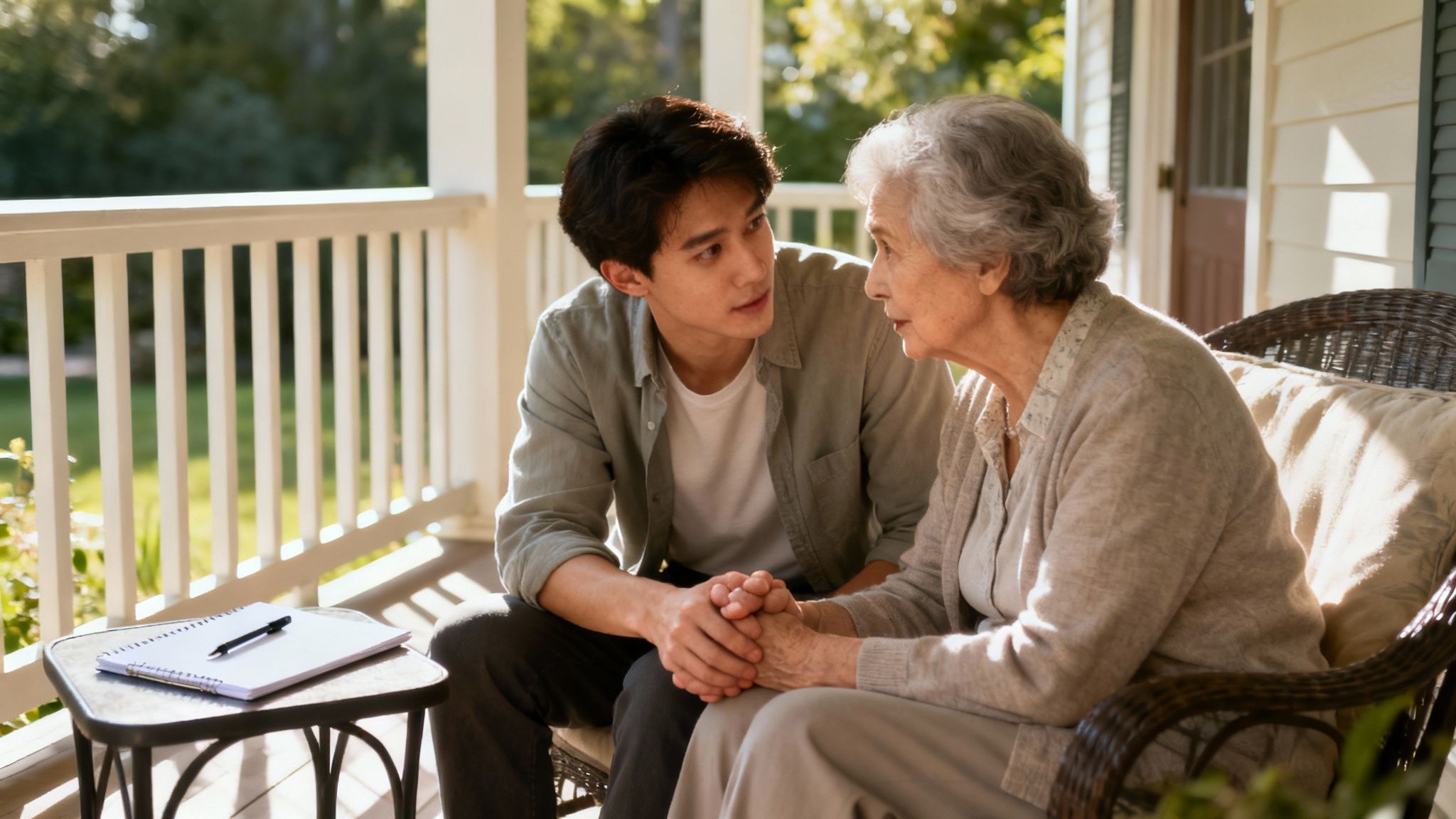
The trick is to approach it with compassion. Focus on shared goals like comfort, dignity, and quality of life. This feels less like an ending and more like planning the best path forward together.
How to Gently Begin the Conversation
Finding the right words is often the biggest hurdle. You don’t have to jump straight to the word "hospice." Instead, you can open a broader chat about their feelings and goals.
Here are a few ways you might start:
- "I've been thinking about what's most important to you. Could we talk about your hopes for the coming months?"
- "I've noticed you've been having some tough days. What would make you feel more comfortable at home?"
- "I was reading about ways to get extra support at home. Would you be open to learning about them with me?"
Tips for a Productive and Caring Discussion
Once the door is open, how you listen is just as important as what you say. The goal is to understand their perspective and validate their feelings. Don't be afraid of pauses or silence.
The most meaningful conversations are not about finding immediate answers. They are about creating a space where fears can be shared and wishes can be spoken.
To make the conversation as supportive as possible:
- Choose the Right Time and Place: Find a quiet, comfortable spot where you won’t be interrupted.
- Listen More Than You Speak: Ask open-ended questions and give them time to respond.
- Focus on Their Wishes: Reassure them that this is about honoring their choices for their own care.
If you’re in Monterey, Salinas, Hollister, or Santa Cruz and wondering if it’s time—reach out. Contact us today for a no-obligation chat. Our local team can answer your questions and help you explore your options without pressure.
Frequently Asked Questions About Hospice Care
1. Does choosing hospice mean we are giving up hope?
Not at all. Choosing hospice isn’t about giving up. It’s about redefining hope to focus on comfort, peace, and meaningful time with loved ones. It’s an active choice to ensure the best possible quality of life.
2. Can a patient still see their regular doctor?
Yes, absolutely. We work closely with your primary care physician and any specialists. Your doctor remains a vital part of the care team and collaborates with our hospice experts to honor your wishes.
3. What if my loved one lives longer than six months?
The six-month prognosis is a guideline for eligibility, not a deadline. Many people receive hospice support for much longer. As long as a physician recertifies the life-limiting illness, care continues based on the patient's needs.
4. Is hospice only for people with cancer?
No, hospice is for anyone with a life-limiting illness. Our teams care for individuals with advanced heart or lung disease, kidney failure, Alzheimer's, dementia, and other serious conditions. The focus is on comfort, whatever the diagnosis may be.
5. Who pays for hospice care?
Hospice is a fully covered benefit under Medicare, Medi-Cal, the VA, and most private insurance plans. This typically includes the hospice team, medical equipment, supplies, and medications. As a nonprofit, Central Coast VNA & Hospice provides care to all eligible individuals, regardless of their ability to pay.
If you have more questions or are wondering if hospice is the right choice for your family, the team at Central Coast VNA & Hospice is here to help. Contact us for a no-pressure conversation to learn more about our services.
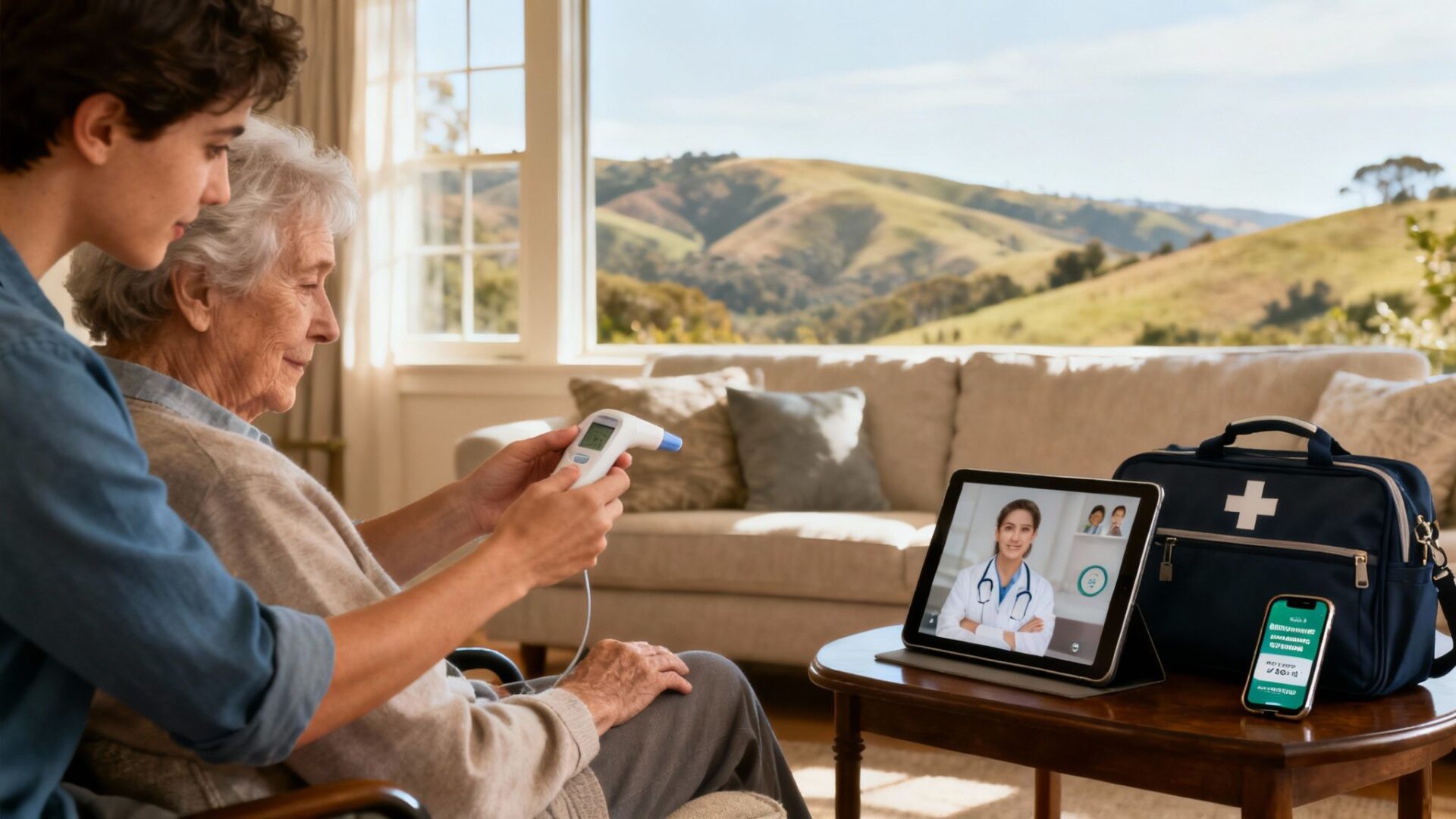
Too Sick for Home, Not Sick Enough for the ER? What Central Coast Families Can Do Instead
It’s a situation every family on the Central Coast dreads. A loved one with a chronic illness is suddenly worse, but you’re not sure if it’s bad enough for the emergency room. For families in Monterey, San Benito, Santa Cruz, and South Santa Clara Counties, this stressful gray area can feel overwhelming.
When a loved one is too sick to manage at home but not quite in need of the ER, what’s the right call? For those with serious or chronic illnesses, exploring skilled in-home health services is often the safest and most compassionate choice. This is especially true when our local hospitals are strained.
In-home support from Central Coast VNA & Hospice can be the lifeline your family needs. It provides an alternative to a stressful hospital visit.
The In-Between Illness Dilemma for Central Coast Families
This isn't a theoretical problem; it's a real scenario that plays out in homes across our community. A parent with a chronic condition takes a turn for the worse. Their symptoms don’t seem to justify a 911 call.
This "care gap" is where families often feel the most alone. Hospitals across the Central Coast are experiencing seasonal strain, leading to longer wait times and limited beds. This is especially true for non-emergency but serious conditions.
Finding a Safer Alternative to the ER
For most families on the Central Coast, the goal is simple. They want high-quality care without the anxiety and exposure of a hospital. An unnecessary trip to the emergency room can expose a vulnerable person to infections and cause a great deal of stress.
Central Coast VNA & Hospice offers a strategic, compassionate, and safe alternative. With over 74 years of nonprofit service to our community, our teams bring hospital-level support right into a patient’s home.
This model of care is quickly becoming the preferred way to manage serious illnesses. It honors the deep desire most people have to age in place, surrounded by the comfort and familiarity of their own homes. Dealing with these health concerns can put a strain on an already busy household, and finding effective strategies for balancing work and family life can create a more stable foundation.
How In-Home Care Fills the Gap
Instead of spending hours in a crowded ER, your family can have a dedicated team of clinicians. They provide personalized, one-on-one support. This approach focuses on managing symptoms before they become a crisis.
Services that provide a real alternative to the hospital include:
- Skilled Nursing: Our Registered Nurses can visit the home to manage complex symptoms, administer medications, and educate the patient and family.
- Palliative Care: This is specialized support focused on improving quality of life for anyone with a serious illness, helping manage pain and stress.
- 24/7 Clinical Access: Having a direct line to a clinician offers incredible peace of mind and can prevent many unnecessary trips to the hospital.
By bringing expert care directly into the home, Central Coast VNA & Hospice helps families and eases the burden on our local healthcare systems. This guide will give you a clear path forward, helping you explore all your options. For more specific local information, you can also review these local health care resources for seriously ill family members.
How to Assess Your Loved One’s Symptoms at Home
When a loved one isn't feeling well, your first instinct is to worry. It’s tough to stay calm and figure out what’s really going on. Making a clear-headed assessment is the most helpful thing you can do.
This is especially true for older adults or anyone managing a chronic condition. Even small changes can point to a larger problem. Instead of guessing, you can learn to spot key differences in their breathing, hydration, mental state, and mobility.
Look for Meaningful Changes in Breathing
Breathing is a vital sign you can check without any special equipment. It's helpful to understand causes of shortness of breath and when to worry. Pay close attention to the effort it takes for your loved one to breathe.
Keep an eye out for these specific signs:
- Breathing faster than usual while at rest.
- Using their neck or stomach muscles to pull in a breath.
- Struggling to speak in full sentences without stopping for air.
- Appearing pale or even bluish, especially around their lips or fingertips.
If you notice these symptoms, it’s a sign their body is working too hard to get enough oxygen. This likely warrants a call to their doctor or a trip to an urgent care center.
Check Hydration and Nutrition
Dehydration can sneak up quickly, especially on older adults. It can cause confusion, weakness, and dizziness. These symptoms can easily be mistaken for something more serious.
Look for a dry mouth and lips. Check if skin on the back of their hand doesn’t bounce back right away when you gently pinch it. A sudden loss of appetite or refusing to drink is another major warning sign.
Evaluate Mental Clarity and Awareness
A sudden change in someone's mental state is one of the biggest red flags you can spot at home. This is about an abrupt shift from their normal self.
Pay attention to sudden confusion, unusual agitation, or extreme drowsiness. If your loved one is suddenly unable to recognize familiar people or answer simple questions, seek medical advice promptly.
This infographic can help you visualize the decision-making process when you're facing this common Central Coast care dilemma.
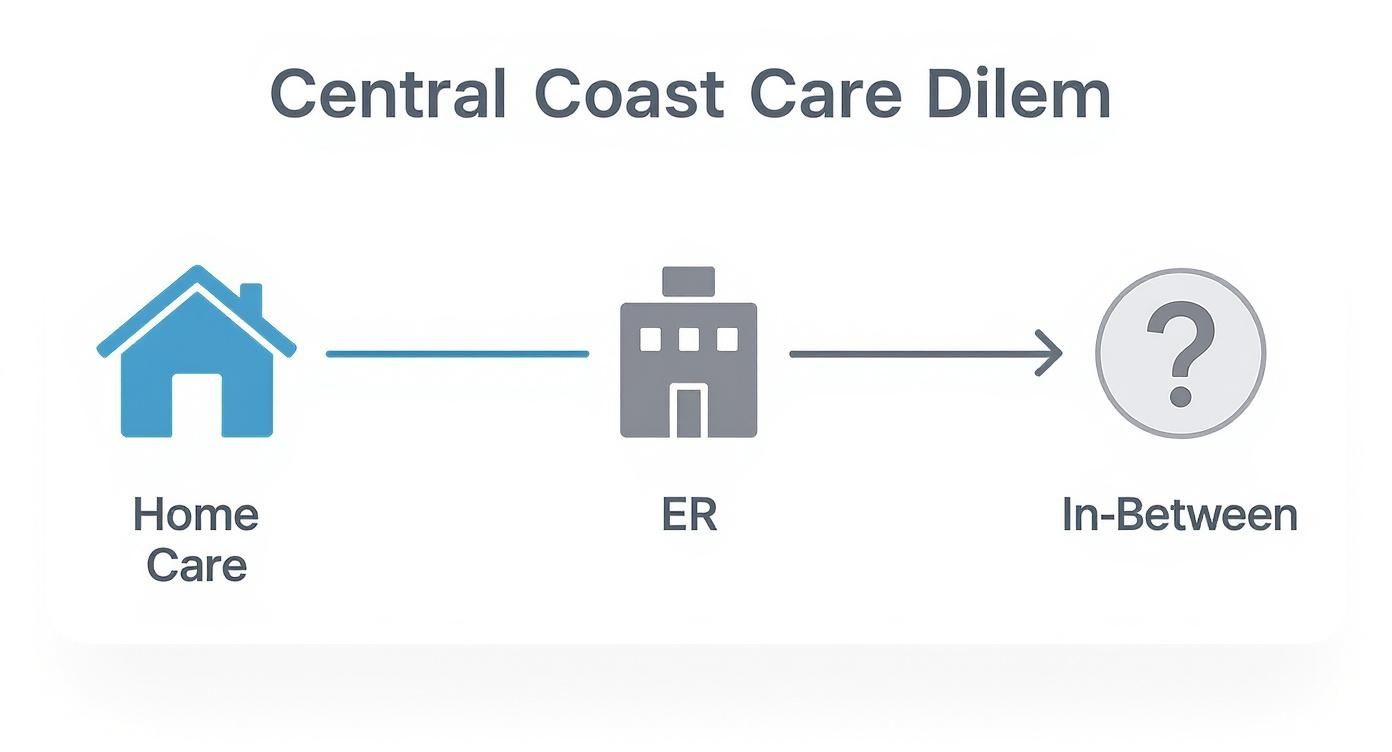
As the guide shows, while some situations clearly point to the ER or home care, many fall into that "in-between" space where professional guidance is best.
Assess Mobility and Pain Levels
How your loved one is moving can tell you a lot. A new inability to get out of a chair or walk to the bathroom is a significant change. This decline shows their current condition is making them too weak to be safe at home.
Listen carefully to how they describe any pain. Uncontrolled pain is a good reason to call their primary care doctor or look into getting in-home support.
By methodically checking these four areas, you can build a clearer picture of your loved one's condition. It gives you specific information to share when you call their doctor or a home health agency like Central Coast VNA & Hospice.
When Urgent Care Is the Right Choice on the Central Coast
Urgent care centers are valuable resources for Central Coast families. They fill the critical gap between a routine doctor's visit and a full-blown emergency. Knowing when to turn to urgent care can save you time, money, and stress.
Urgent care is the perfect choice for an illness or injury that can’t wait for an appointment but isn't life-threatening. These clinics are expertly staffed and equipped to handle many common health concerns.
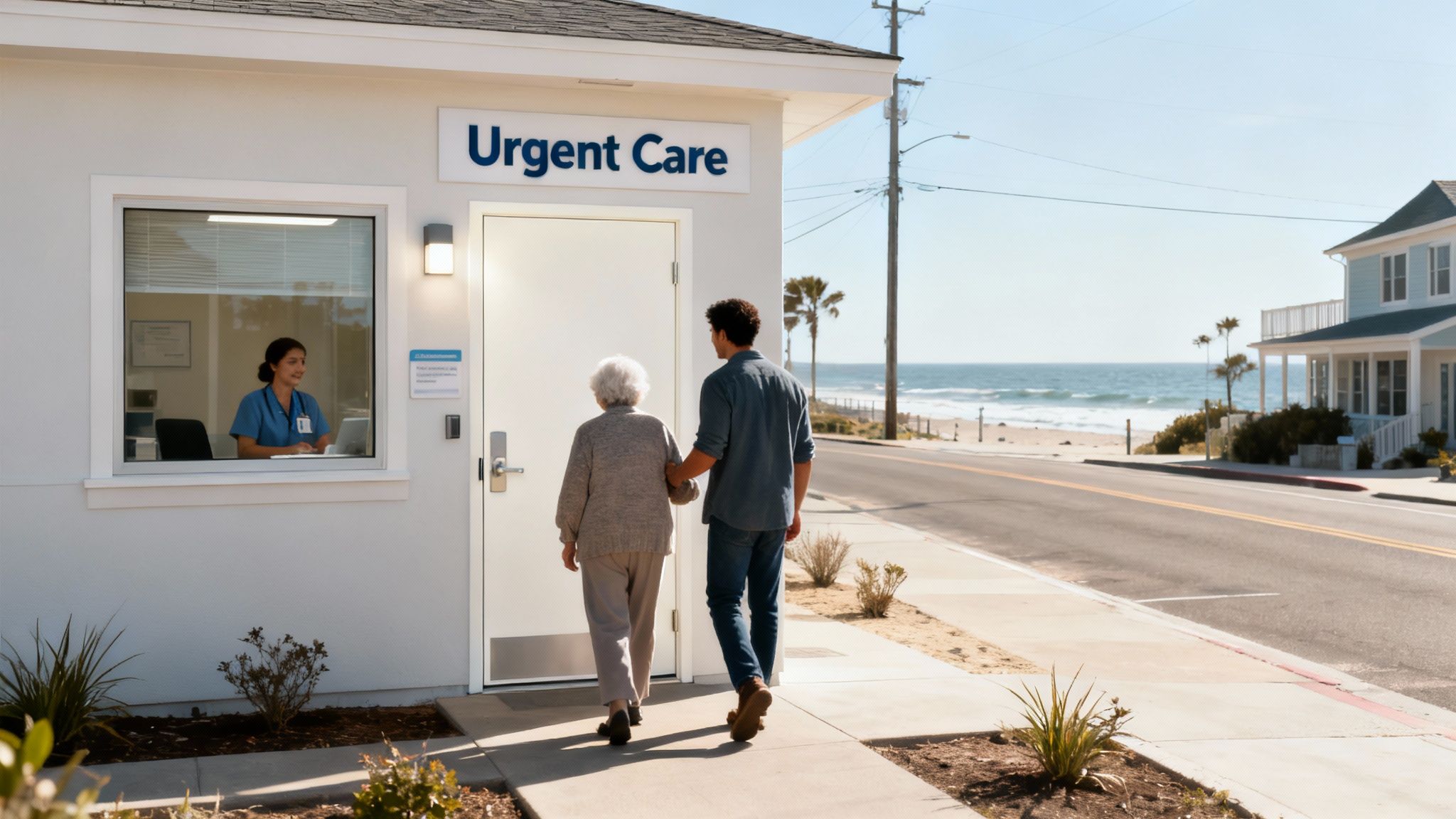
Conditions Well-Suited for Urgent Care
Many common sicknesses and minor injuries are exactly what urgent care centers are for.
It's a good idea to head to an urgent care for conditions like:
- Persistent fevers or flu-like symptoms.
- Minor cuts that might need stitches but aren't bleeding uncontrollably.
- Sprains, strains, or suspected simple fractures.
- Nagging infections, like urinary tract infections (UTIs) or ear infections.
- Vomiting or diarrhea that has you worried about dehydration.
- A bad sore throat, especially if you think it could be strep.
These centers provide a much more convenient and often faster alternative to the emergency room for these types of issues.
The Real-World Benefits for Local Families
For families in Monterey, San Benito, Santa Cruz, and South Santa Clara Counties, choosing urgent care over the ER for non-emergencies comes with real advantages. One of the biggest perks is drastically shorter wait times.
This makes a huge difference, especially with a miserable child or an uncomfortable older adult. On top of that, the cost of an urgent care visit is typically a fraction of what a trip to the ER would cost for the same condition.
The Rise of Urgent Care as an ER Alternative
The explosive growth of urgent care centers across the country proves how much families needed this middle-ground option. Increased respiratory illness, staffing shortages, and rising admissions are creating care bottlenecks in hospitals. This is leading many families to look for high-quality alternatives.
By 2022, there were more urgent care visits (206 million) than ER visits (131 million) nationwide. This cements their vital role in modern healthcare. You can explore more about this significant shift in patient care to see how it's reshaping the system.
How to Prepare for an Urgent Care Visit
A little preparation can make your visit to a Central Coast urgent care center go more smoothly. It’s smart to identify local options in your area before you need one.
When it's time to go, be sure to have these items handy:
- Your photo ID and insurance card.
- A list of your loved one’s current medications and any known allergies.
- Any key medical history details the provider should know about.
Having this information ready helps the medical team give you the best and safest care possible.
Bringing Hospital-Level Care Home with Central Coast VNA
Sometimes, a loved one needs more medical attention than you can provide, but not enough to justify a hospital stay. This is exactly where Central Coast VNA & Hospice steps in. We bridge that gap by bringing skilled, compassionate care right to your front door.
For more than 74 years, we’ve been a local, nonprofit fixture in Monterey, San Benito, Santa Cruz, and South Santa Clara Counties. Our entire mission is to deliver the expert medical support your family needs. We provide it in the one place they feel most comfortable—their own home.

Skilled Services Tailored to Your Family's Needs
Knowing a team of professionals can step in brings incredible relief. Our services are designed to manage complex medical issues and prevent unnecessary ER trips. This ultimately improves quality of life.
Our coordinated care teams offer a range of specialized support, including:
- Skilled Nursing: Our Registered Nurses are pros at managing serious symptoms at home. They can oversee complex medication schedules, provide advanced wound care, and teach you how to best support your loved one.
- Physical Therapy: Our physical therapists create personalized plans to help improve balance, build strength, and make moving around the home safer.
- Palliative Care: This is a specialized layer of support focused entirely on comfort and can be provided alongside curative treatments.
How In-Home Care Works in a Real-World Scenario
Let's say your father, who has a chronic heart condition, is getting weaker. The thought of taking him to a crowded emergency room is stressful. Instead, you call Central Coast VNA & Hospice.
A Registered Nurse comes to your home and assesses his condition. They work directly with his doctor to adjust his medications. A physical therapist starts visiting to help him build endurance. Because of this support, his symptoms stabilize, and he avoids a hospital trip.
At its core, in-home skilled care is about providing the right support at the right time. By managing symptoms proactively and offering 24/7 clinical access, we empower families to avoid the stress and uncertainty of the ER.
The Benefits of a Coordinated Team Approach
When you work with CCVNA, you have an entire team in your corner. Our nurses, therapists, and social workers communicate constantly to ensure your loved one receives seamless care.
This team approach delivers real advantages:
- Fewer Hospitalizations: Our teams are trained to spot warning signs early, which reduces the chances of an emergency.
- Truly Personalized Care: We create a care plan that reflects your loved one's personal goals and values.
- Greater Safety and Comfort: Receiving care at home minimizes exposure to infections and avoids the confusion of a hospital setting.
This shift isn't temporary—it reflects a broader trend toward aging in place and home-based care models. You can learn more about the essentials of skilled nursing care and see how it supports independence at home.
When you find yourself stuck, please know you have options. Central Coast VNA & Hospice is here to provide the expert, compassionate support your family deserves.
Why Avoiding the ER Can Be the Healthier Option
When a loved one is sick, our first instinct is often to rush to the emergency room. While the ER is the right place for a true medical crisis, an unnecessary trip can create its own problems. This is especially true for older adults or those with complex health conditions.
Understanding these risks helps you make a safer, more supportive choice. The reality is that our hospitals on the Central Coast and across the country are under incredible strain.
The Hidden Risks of a Hospital Visit
For someone with a weakened immune system, a busy ER is a hotbed for potential infections. What starts as a manageable issue can become more serious after exposure to the flu or other illnesses.
Just the physical and emotional toll of getting to the hospital and waiting for hours can drain a person's strength. This makes recovery that much harder.
The hospital environment itself can be disorienting for patients, especially older adults. The constant noise and disruption can lead to confusion and anxiety. This is why managing care at home is so often the healthier choice.
ER Overcrowding: A National Challenge
The struggle to get timely care in an emergency room isn't just a local issue. It's a well-documented challenge across the United States. This puts families in a tough spot when deciding what to do.
Americans make roughly 155.4 million emergency department visits each year. As you can discover more insights about these national health statistics, it’s clear why finding alternatives is so critical.
This national data drives home the point for families in Monterey, San Benito, Santa Cruz, and South Santa Clara Counties. When a condition is serious but not life-threatening, options like in-home health care can provide faster, safer support.
In-Home Care: A Proactive and Safer Alternative
This is where Central Coast VNA & Hospice can make all the difference. We bring expert clinical care right to your front door. This helps you manage serious health issues proactively and often prevents an ER visit altogether.
Instead of a frantic trip to the hospital, a Registered Nurse can visit to adjust medications. A physical therapist can help your loved one regain strength after an illness, reducing their risk of a fall.
This personalized care doesn't just provide peace of mind; it leads to better health outcomes. By keeping your loved one safe at home, we help them avoid hospital risks and focus on healing. This approach is also a cornerstone of preventing hospital readmissions.
Taking the Next Step: How We Can Help
When you're navigating that tough in-between illness, it’s easy to feel overwhelmed. You should now have a better feel for when urgent care is the right call. You also know when bringing professional support into your home is the safest choice.
For families across Monterey, San Benito, Santa Cruz, and South Santa Clara Counties, help is much closer than you might think.
Central Coast VNA & Hospice is your local, nonprofit partner. We’ve earned our community's trust over 74 years of dedicated service. Our team brings skilled nursing, palliative care, and hospice services directly to your home.
We’re here to empower your family to make informed decisions. These choices should honor your loved one’s comfort, dignity, and desire to heal at home. If in-home support is the right path, we encourage you to reach out. You can learn more about qualifying for home health care on our website.
Frequently Asked Questions (FAQs)
How do I know if my loved one qualifies for home health care?
A patient generally qualifies if they are considered "homebound" and a doctor certifies they need skilled medical services. This could include care from a Registered Nurse or physical therapy. Contacting their primary doctor is the first step, but our team at Central Coast VNA can help explain the requirements.
What is the difference between palliative care and hospice?
Palliative care can begin at the diagnosis of any serious illness and can be given alongside curative treatments to manage symptoms and improve quality of life. Hospice care begins when a patient with a life-limiting illness decides to stop curative treatments, focusing entirely on comfort and dignity.
Can in-home care really help avoid ER visits?
Yes, absolutely. One of the main benefits of our services is proactive symptom management at home. Our clinicians address health issues before they become a crisis, and our 24/7 clinical access provides peace of mind, significantly reducing the need for unplanned hospital trips.
Is in-home care covered by Medicare or private insurance?
In most cases, yes. Home health, palliative care, and hospice services are typically covered by Medicare, Medi-Cal, and most private insurance plans if the patient meets the eligibility criteria. Our staff will help you verify coverage and understand any potential out-of-pocket costs.
What areas does Central Coast VNA & Hospice serve?
As a local nonprofit with over 74 years of service, we are deeply rooted in the community. We proudly serve families across Monterey County, San Benito County, Santa Cruz County, and South Santa Clara County.
If you are concerned about hospital capacity or need care at home, Central Coast VNA & Hospice is ready to help. Our compassionate team can provide a consultation to discuss your loved one's needs and explain how our services can bring expert support right to your door.
Reach out to us today to learn more at https://ccvna.com.

Bridging The Gap: Helping Loved One's Access The Care They Deserve
<meta description="Learn how Central Coast VNA & Hospice bridges the gap in care with home health, palliative care, and hospice services across Monterey, San Benito, Santa Cruz, and South Santa Clara counties." />
Catching small changes in daily routines can help families act before a crisis. Whether someone is forgetting pills, skipping meals, or feeling too tired to shower, these signs point to a growing need for support. Central Coast VNA & Hospice, a nonprofit serving Monterey, San Benito, Santa Cruz, and South Santa Clara counties for over 74 years, helps bridge this gap by bringing care to your doorstep.
Signs a Loved One May Need Help
When personal care or daily tasks become hard, it’s time to learn more. Common warning flags include:
- Difficulty with bathing, dressing, or grooming
- Missed medications or medical appointments
- Unintended weight loss or mealtime changes
- Withdrawn behavior or mood shifts
- New pain or fatigue after a hospital stay
Spotting these issues early can unlock in-home support. Nearly 60% of eligible patients never get palliative or hospice care—often because families don’t know it’s an option (NHPCO, 2021). Acting now means better symptom relief and emotional support.
Types of In-Home Care Services
Families on the Central Coast can choose from three main paths:
| Service Type | Focus | Treatment Continues? |
|---|---|---|
| Home Health | Skilled nursing, therapy, recovery | Yes |
| Palliative Care | Symptom relief, emotional support | Yes |
| Hospice Care | Comfort, dignity, end-of-life support | No |
Home Health brings a Registered Nurse and therapists to help heal wounds, manage meds, and improve strength. Learn more about home health care services at CCVNA.
Palliative Care works alongside treatments to ease pain, nausea, or breathlessness. Hospice Care focuses solely on comfort and quality of life when curative options end. Both can begin well before the final days, ensuring peace of mind and relief.
Starting the Conversation
Talking about extra support can feel tough, but it shows you care. Try these steps:
- Choose a calm time—after a meal or favorite TV show.
- Use “I” statements: “I worry when you skip breakfast.”
- Ask open questions: “What do you think?”
- Offer a short trial of visits or medication review.
In Hollister, Mr. Lopez started with “I feel concerned when pills get missed.” His mom agreed to a nurse check-in. Simple steps like these build trust and open the door to care.
How to Access Care
Central Coast VNA & Hospice makes referrals easy. Anyone—family, doctor, or the patient—can call or complete an online form. A care coordinator schedules a no-cost in-home assessment within days.
Most services qualify for Medicare when a doctor confirms homebound status. Dive into details on Medicare Home Care Eligibility. CCVNA also accepts Medi-Cal, private insurance, and offers sliding-scale and charity care so finances never stand in the way.
Care costs and insurance tips:
- Medicare covers 100% of home health nursing and equipment
- Hospice visits and supplies have zero copays under Medicare
- Private plans often mirror Medicare benefits with low copays
- Ask about charity care or fee adjustments during assessment
Global medical costs are rising—WTW projects 10.4% inflation in 2025 (WTW’s site). Early referrals help families manage both care and costs.
Your Local Care Team
Central Coast VNA & Hospice brings a team of professionals to your home:
- Registered Nurse: monitors health, manages treatments
- Hospice Aide: helps with bathing, dressing, and chores
- Medical Social Worker: finds financial aid and community programs
- Chaplain: offers spiritual and emotional support
Team huddles keep everyone updated. Shared notes cut readmissions by 30%. Families report fewer ER visits and more quality time together when care is coordinated.
Overcoming Barriers
Language, culture, and myths can block access. Hispanic families on the Central Coast benefit from bilingual staff and clear explanations. Common misunderstandings include:
- “Hospice means giving up.” (Reality: it enhances comfort.)
- “You can’t keep your doctor.” (Reality: doctors stay on the team.)
- “Home health needs full independence.” (Reality: any homebound status qualifies.)
Education and open dialogue help normalize early palliative and hospice services. For tips on starting the talk, visit Learn more about talking to your parents about hospice care.
FAQs
1. How quickly can care start?
Most families see a nurse within 48 hours of referral. The initial visit is at no cost.
2. What does “homebound” mean?
Medicare defines homebound as having difficulty leaving home due to health. Learn more here.
3. Can I keep my primary doctor?
Yes. RNs coordinate with your doctor and send regular updates.
4. Is palliative care only for cancer?
No. It supports anyone with serious illness—heart failure, lung disease, dementia, and more.
5. What if we can’t afford care?
CCVNA offers sliding-scale fees, charity care, and accepts Medi-Cal and private plans.
6. How do I refer someone?
Call CCVNA or fill out the online intake. A coordinator will guide you through eligibility, insurance, and next steps.
Contact Central Coast VNA & Hospice today to bridge the gap and bring compassionate, expert care home. Visit https://ccvna.com.

Not the Same, Not Opposites: What Families Need to Know About Palliative and Hospice Care
When a loved one is living with a serious illness, it’s easy to get lost in a sea of medical terms. Families often find themselves trying to figure out the difference between palliative care and hospice care.
They aren't the same, but they aren’t opposites, either. Think of it this way: palliative care is all about providing comfort at any stage of a serious illness, while hospice care is for the final months of life.
Guiding Your Family Through Palliative and Hospice Care
Navigating a serious illness with someone you love is overwhelming. This is one of the most common—and confusing—questions families face when dealing with a serious illness.
Here on the Central Coast, one of the most common questions we hear is: what’s the real difference between palliative and hospice care? Getting this distinction right is the first step toward making confident, compassionate decisions for your family.
At Central Coast VNA & Hospice, we have been helping families walk through this for over 74 years. We know you need more than definitions. You need to understand how these services actually work to bring comfort and support into your home.

Palliative Care vs Hospice Care at a Glance
Let's start by breaking down the core differences. While both are centered on improving quality of life, their timing and goals are distinct. This simple table can help clear things up.
| Feature | Palliative Care | Hospice Care |
|---|---|---|
| When It Can Start | At any point from diagnosis onward, alongside all other medical care. | When a doctor certifies a life expectancy of six months or less if the illness runs its natural course. |
| Treatment Goals | Can be provided at the same time as curative treatments like chemotherapy or dialysis. | The focus shifts entirely from cure to comfort. Curative treatments are stopped to prioritize quality of life. |
| Primary Focus | Relieving the symptoms, pain, and stress of a serious illness to improve daily life. | Providing comfort, dignity, and peace in the final stages of life. |
| Provided By | A specialized team that works in partnership with your existing doctors and specialists. | A dedicated, interdisciplinary team that provides comprehensive medical, emotional, and spiritual support. |
This distinction is important because many people who could benefit from palliative support miss out. Globally, an estimated 56.8 million people need palliative care each year, yet the vast majority never receive it.
According to the World Health Organization, these services often don't reach people because of the misconception that they are only for the very end of life. To learn more, read about palliative care for seniors in our detailed guide.
What Palliative Care Really Means for Your Family
You often hear the term palliative care, but what does it actually involve? It’s specialized medical care that adds an extra layer of support. It focuses on relief from symptoms, pain, and stress of conditions like cancer, heart failure, or dementia.
Think of it as a team focused on the whole person, not just the disease. It works right alongside your loved one's regular treatments. The goal is to improve quality of life from the moment of diagnosis.
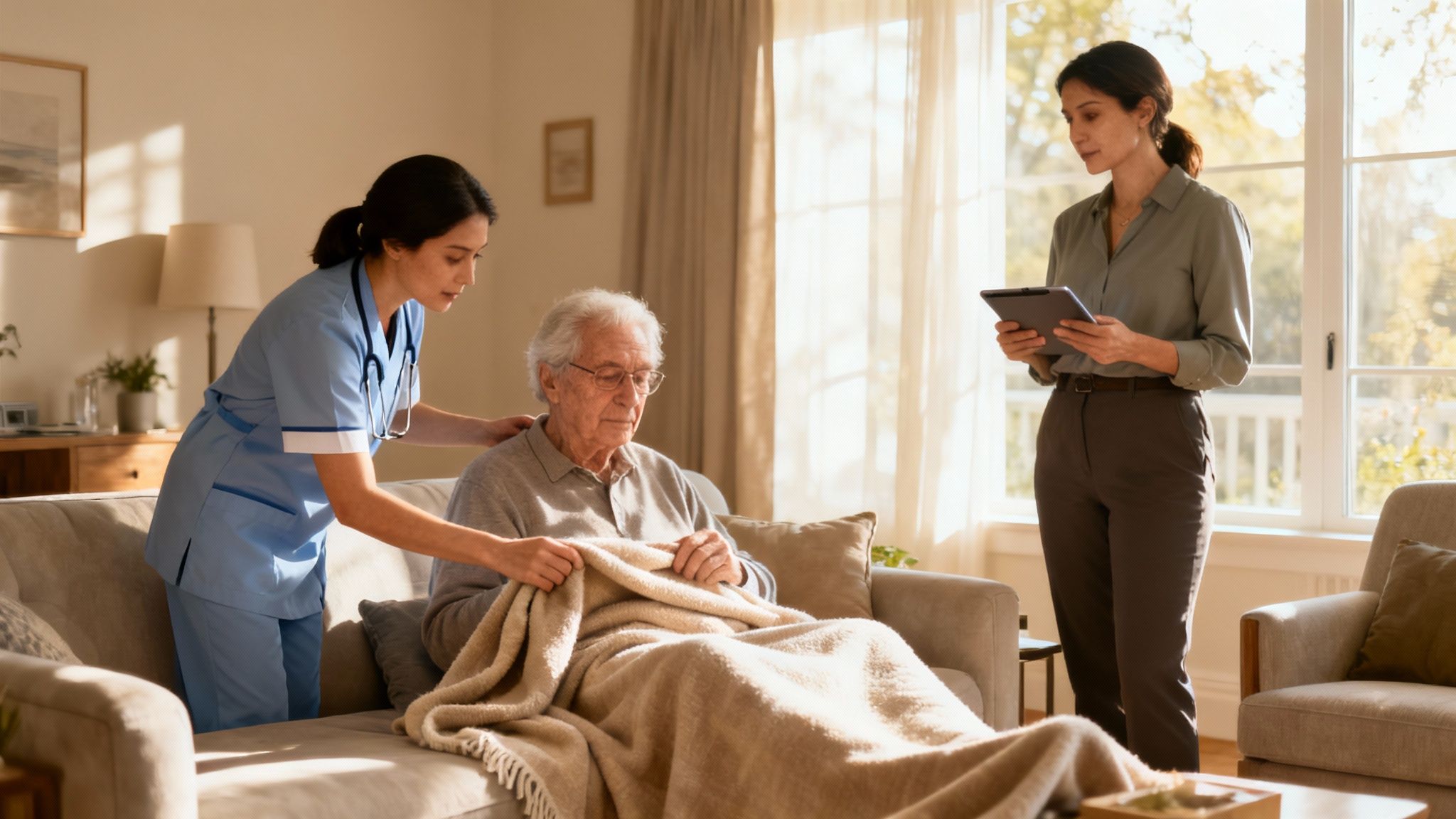
More Than Just Symptom Management
Managing physical symptoms is a huge part of palliative care. But the support goes deeper. It also addresses the emotional and spiritual challenges that come with a serious diagnosis.
At Central Coast VNA & Hospice, our palliative care team helps families navigate the healthcare system. Our skilled professionals, including Registered Nurses, act as your advocates. They ensure communication between doctors is clear and everyone is on the same page.
For families in Monterey County, Salinas, Hollister, and Santa Cruz, this means having a local expert to turn to. We help you understand complex medical information and make difficult decisions in your own home.
Key Benefits of Starting Palliative Care Early
Many families think palliative care is only for the end of life, but research shows the opposite is true. Introducing this support early often leads to better outcomes. You do not have to stop curative treatments to receive it.
Here are a few key benefits:
- Pain and Symptom Control: Expert management of discomfort to improve daily life.
- Emotional and Spiritual Support: Help for the patient and family to cope with the stress of illness.
- Improved Communication: A team that helps facilitate conversations about goals of care.
- Coordination of Care: We ensure all of your doctors and specialists are working together effectively.
Palliative care is not about giving up. It's about living as well as possible by adding an extra layer of comfort to your existing treatments.
This approach empowers your family to face challenges with more confidence and less anxiety. To dig deeper, find more insights in our article about what palliative care really means for families today.
How Hospice Care Provides Dignity and Comfort
When treatments no longer focus on a cure, the goal of care shifts to maximizing comfort. This is where hospice care offers a compassionate path forward.
Choosing hospice isn't about giving up. It's about redefining hope and focusing on living each day to the fullest, with dignity and support.
Hospice is for individuals with a life-limiting illness and a prognosis of six months or less. It provides a complete circle of support for physical, emotional, and spiritual needs.
At Central Coast VNA & Hospice, our team brings this care to wherever a patient calls home. We serve families across Monterey County, San Benito County, Santa Cruz County, and South Santa Clara County.
A Team Approach to Whole-Person Care
Hospice is delivered by an interdisciplinary team that works together. This ensures no aspect of a person's well-being is overlooked.
Our teams at Central Coast VNA & Hospice include:
- Registered Nurses who are experts in managing pain and other symptoms.
- Hospice Aides who assist with personal care like bathing and dressing to preserve dignity.
- Chaplains who offer spiritual support that honors all beliefs and philosophies.
- Medical Social Workers who provide emotional support and connect families with resources.
- Volunteers who bring companionship and give family members a much-needed break.
By managing symptoms, we allow families in communities like Salinas and Hollister to focus on their time together.
Redefining Hope and Quality of Life
The decision to begin hospice is a profound one. The focus moves away from aggressive treatments. It shifts toward ensuring the patient is comfortable and can enjoy meaningful moments.
Hospice is a philosophy of care that affirms life and regards dying as a normal process. The goal is to make the end of life as peaceful and meaningful as possible.
This patient-centered approach is gaining ground. According to the National Hospice and Palliative Care Organization (NHPCO), over 1.72 million Medicare beneficiaries received hospice services in 2020 (NHPCO, 2021). You can read more about hospice trends and insights in this detailed report.
Hospice care empowers patients to live out their final months on their own terms. For more information, you can learn about the real benefits of starting hospice early in our related article.
Deciding Between Palliative And Hospice Care
Making the right choice for a loved one isn’t about picking a “better” option. It’s about matching the care to their current goals and wishes.
It comes down to one question: Is the primary goal to cure the illness or to provide comfort? Understanding this difference brings clarity to families in Monterey County, Salinas, and Hollister.
When To Choose Palliative Care
Palliative care is the answer when your loved one is still pursuing treatment but is struggling with symptoms. Think of it as an extra layer of support that works alongside their existing care.
Here are a few real-world examples:
- A patient with lung cancer undergoing chemotherapy can use palliative care to manage nausea and pain.
- Someone with congestive heart failure might receive palliative care at home to help control shortness of breath.
- An individual with early-stage dementia can benefit from a team that helps manage behavioral changes.
In every case, the patient continues seeing their regular doctors. The palliative team, including a Registered Nurse, simply adds support to the care they're already receiving.
When To Consider Hospice Care
The conversation shifts toward hospice care when the focus moves from curing to quality of life. This usually happens when a doctor certifies a life expectancy of six months or less.
Choosing hospice isn't giving up. It's a compassionate decision to prioritize peace, dignity, and comfort.
Choosing hospice means redefining hope. The focus shifts from enduring aggressive treatments to embracing comfort and creating meaningful moments.
Hospice becomes the right path in situations like these:
- A patient with late-stage cancer decides to stop chemotherapy because the side effects outweigh the benefits.
- An individual with advanced Alzheimer's disease whose family’s priority is to ensure they are comfortable.
- Someone with end-stage kidney disease chooses to stop dialysis to spend their remaining time at home.
Knowing when to make this transition is a major step. For more guidance, our team created a resource on when to call hospice.
This infographic simplifies the core difference based on the primary treatment goal.
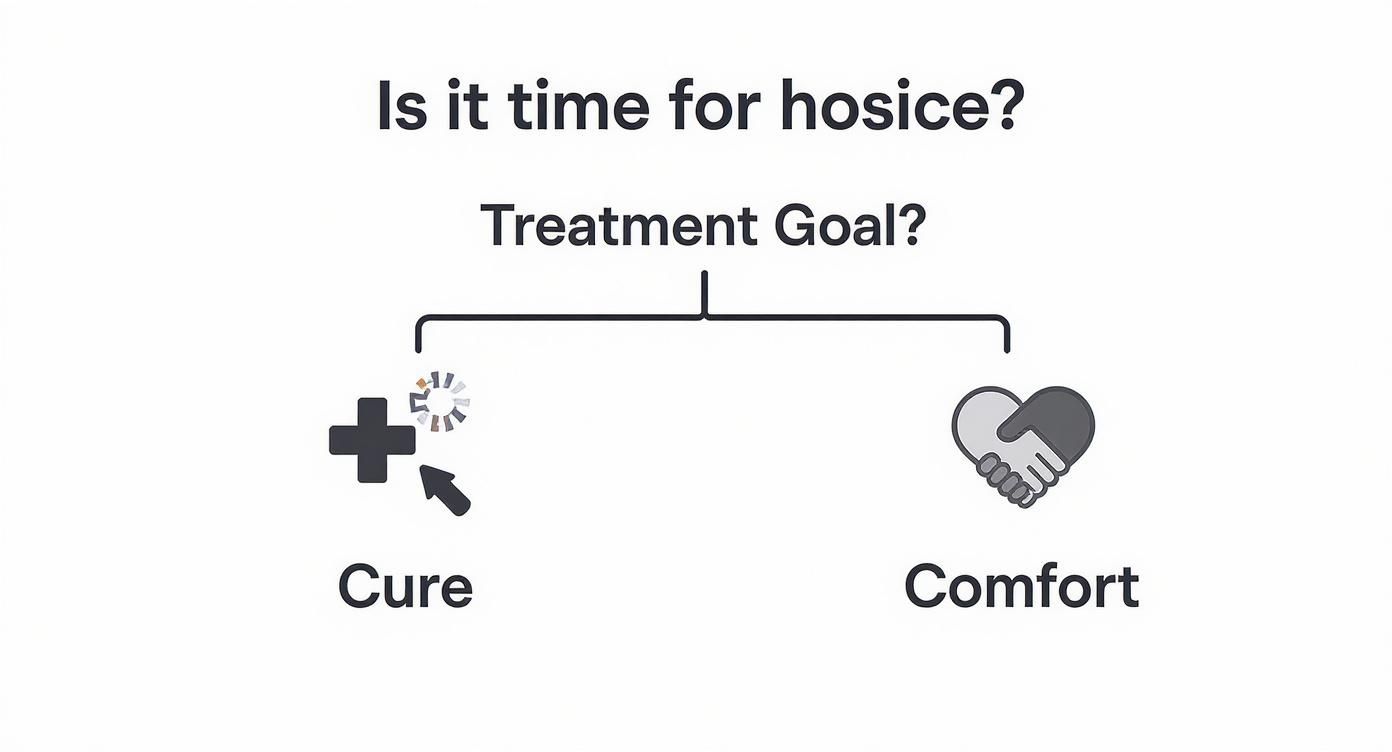
The choice hinges on whether the patient is pursuing curative treatments or has decided to shift their focus to comfort.
Detailed Comparison: Palliative Care vs Hospice Care
To help your family see the differences more clearly, let's compare the services side-by-side. The practical details of eligibility and payment are important factors in making an informed choice.
Here's a breakdown of the key distinctions.
| Aspect of Care | Palliative Care | Hospice Care |
|---|---|---|
| Timing | Can begin at any stage of a serious illness, often right from diagnosis. | Begins when curative treatments stop and a doctor certifies a prognosis of six months or less. |
| Treatment Goal | Provided alongside curative treatments like chemotherapy, surgery, or dialysis to manage symptoms. | Focuses entirely on comfort and quality of life; curative treatments are discontinued. |
| Location of Care | Often provided at home, but also available in hospitals and outpatient clinics. | Primarily provided wherever the patient calls home, including private residences and assisted living facilities. |
| Payment | Typically covered by Medicare Part B, Medi-Cal, and private insurance, similar to a specialist visit. | Covered fully by the Medicare Hospice Benefit, Medi-Cal, and most private insurance plans. |
At Central Coast VNA & Hospice, we are one of the few local providers offering both services. This means if a patient transitions from palliative to hospice care, they can often keep the same trusted team. For families, that continuity provides immense comfort.
The Benefit of a Seamless Continuum of Care
Choosing a provider for a serious illness is about finding a stable, reassuring partner for your journey. Many families must start over with a new healthcare organization when needs shift from palliative to hospice care.
At Central Coast VNA & Hospice, we provide a true continuum of care. Our services are designed to flow seamlessly from one stage to the next, from home health to palliative and hospice care. This integrated approach offers stability during a difficult time.

Why a Single Provider Matters
When needs evolve, the last thing your family should do is navigate a new healthcare system. With Central Coast VNA & Hospice, you don’t have to. The same clinicians who understand your family’s history can continue providing support.
This single-provider model offers several benefits:
- Familiarity and Trust: Your loved one builds a relationship with our Registered Nurses and Hospice Aides. Keeping that trusted team reduces stress.
- Consistent Communication: Because our teams work together under one roof, care coordination is smooth. There are no communication gaps.
- Simplified Transitions: Moving from palliative to hospice care becomes a gentle shift in focus. We guide your family through every step with compassion.
Having a single, trusted team means your family can focus on what matters most—each other. It provides peace of mind knowing that a familiar hand is there to guide you.
Rooted in Your Community
As a local nonprofit with over 74 years of service, our mission is connected to our communities. We are your neighbors in Monterey County, San Benito County, Santa Cruz County, and South Santa Clara County.
Our integrated model of home health, palliative, and hospice care is unique in the region. It ensures that no matter how your loved one’s needs change, they are supported by a team that knows them. Contact us to learn more about how our seamless care can support your family.
How to Make the Right Choice for Your Family
There’s no magic formula for deciding between palliative and hospice care. The best choice is always the one that fits your loved one’s unique needs and wishes.
At Central Coast VNA & Hospice, our approach starts with listening. We offer free, no-pressure consultations to help you understand your options.
Starting the Conversation
The first step is a simple, honest conversation. Our team can help you weigh the benefits of each path and figure out what makes sense for your family right now.
Having this talk is critical. Access to quality care isn't universal. This makes choosing a trusted local provider even more important for ensuring your family gets high-quality support.
The right choice is a personal one, based on your loved one's goals for their care. We are here to provide the information you need to make that choice with confidence.
As you make these decisions, it’s helpful to understand the legal tools available. Taking time for understanding Power of Attorney and advanced directives can empower you to honor their wishes.
You don’t have to navigate this journey alone. As a trusted nonprofit serving Monterey County, Salinas, Hollister, and Santa Cruz for over 74 years, we can help. Contact us today to learn more.
Frequently Asked Questions (FAQs)
1. Can my loved one get palliative care and curative treatment at the same time?
Yes, absolutely. This is the biggest difference between palliative care and hospice. Palliative care is designed to work alongside treatments like chemotherapy. Its purpose is to manage symptoms and stress, which often helps people tolerate their treatments better.
2. Does choosing hospice mean we're giving up hope?
No. Choosing hospice isn't about giving up; it’s about redefining hope. It becomes about hoping for comfort, dignity, and the best possible quality of life in the time that remains. Hope shifts from a cure to goals of a comfortable day and meaningful moments.
3. Who pays for palliative and hospice care?
The payment structures are different, but both are generally accessible. Palliative care is often covered by Medicare Part B, Medi-Cal, and private insurance. Hospice care is almost always 100% covered by the Medicare Hospice Benefit, Medi-Cal, and most private insurance with no out-of-pocket costs.
4. Can my loved one receive care at home?
Yes. Central Coast VNA & Hospice is built around bringing expert care to wherever you call home. That could be a private house, an assisted living community, or a nursing home. Our teams—including Registered Nurses and Hospice Aides—come to you.
5. What if my loved one gets better while on hospice?
It happens. With intensive comfort care, some people's conditions stabilize or improve. If they no longer meet the criteria, they can leave hospice care at any time and can always re-enroll later if their situation changes.
6. How do we know when it’s the right time to call?
It is never too soon to ask questions. If your loved one is dealing with a serious illness, we encourage you to call us for a free, no-obligation conversation. Our team at Central Coast VNA & Hospice can walk you through the support available.
You don't have to navigate these decisions alone. For over 74 years, Central Coast VNA & Hospice has provided a seamless continuum of care to families across Monterey County, Salinas, and Hollister. Contact us today to learn how our compassionate, local team can support your family. Learn more at https://ccvna.com.
Before The Next Health Crisis: A Central Coast Family's Guide to Advance Care Planning at Home
For families on the Central Coast, talking about future health wishes can feel like a conversation for another day. But having a plan in place before a health crisis hits is one of the most loving things you can do for your family.
This guide is a local roadmap. It is designed for families in Monterey, Salinas, Santa Cruz, and Hollister to navigate advance care planning at home. Think of it as turning a difficult topic into an act of empowerment and care.
Why Planning Before a Crisis Brings Peace of Mind

The end of the year often makes us reflect on what's next. For many, that includes concerns about aging parents, a spouse managing a serious illness, or their own long-term health. These conversations are important but are often put off until it's too late.
Waiting for a 911 call to discuss care wishes is a stressful mistake. During a crisis, emotions are high, decisions are rushed, and options become limited. This is when families in Monterey and San Benito Counties must guess what their loved one would have wanted.
Proactive planning changes that scenario completely. This is not about expecting the worst. It’s about ensuring loved ones receive care that reflects their values and goals.
The Gift of Clarity and Control
Advance care planning is the process of thinking about, talking about, and writing down your preferences for future healthcare. It ensures your family and doctors know what matters most if you cannot speak for yourself. This is an incredible gift.
When your wishes are documented, your family is relieved of making difficult decisions in the dark. Instead of guessing, they can be your confident advocate, knowing they are honoring your choices. This simple act helps prevent painful conflicts and reduces emotional strain.
Just think about the benefits:
- Your Wishes Are Honored: Your personal values drive every decision.
- Family Stress is Reduced: Loved ones have a clear roadmap, easing their burden.
- Your Advocate is Empowered: Your chosen decision-maker can speak confidently for you.
- Quality of Life Improves: Planning can lead to services like palliative care earlier, improving comfort long before a crisis.
Your Local Partner in Planning
For over 74 years, Central Coast VNA & Hospice has been a trusted, nonprofit guide for local families. We live here too and understand the unique needs of our communities. We serve Monterey County, San Benito County, Santa Cruz County, and South Santa Clara County.
Our regional population is aging, with more than one in five residents over 65 in some areas. The need for clear, compassionate planning is more urgent than ever.
Our mission-driven team is here to help you understand all your options. We cover everything from home health nursing to palliative care and hospice. You can learn more about the 7 important benefits of advance care planning in California and see how these steps bring peace of mind.
Starting these talks now protects your family from the chaos of a future medical event. It is an act of love that provides comfort and clarity when it’s needed most.
How to Start the Conversation About Care Wishes
Starting the topic of future health wishes can be the hardest part. Many families across Monterey and Santa Cruz Counties worry about upsetting their loved one or saying the wrong thing.
The secret is to treat it as a series of small, heartfelt talks, not one big meeting. You are not trying to fill out legal forms on day one. You are trying to understand what makes life meaningful for the person you love.
Framing the Conversation with Care
Finding the right moment is key. A formal meeting can feel intimidating. A quiet afternoon, a peaceful drive, or a shared cup of coffee creates a more relaxed setting.
A natural way to begin is by connecting it to a recent event. This could be a friend's health scare or a story in the news. You could also start from a place of joy, asking, "I was thinking about our last family picnic. What does a truly good day look like for you?"
A great conversation about care wishes starts with listening, not talking. It’s about creating a safe space where your loved one feels heard and understood, ensuring their values lead every future decision.
Remember, this is a dialogue. Your main job is to ask open-ended questions and listen carefully to the answers.
Gentle Questions to Get Started
Instead of asking about specific medical treatments, try questions that explore values. This helps you understand the "why" behind their future choices.
Here are a few conversation starters:
- Focus on Joy: "When you think about the future, what are you most looking forward to?"
- Define a Good Day: "If your health changed, what would a 'good day' still look like for you?"
- Address Fears: "What are your biggest worries if you were to get seriously ill?"
- Explore Trade-Offs: "Are there times you would value comfort more than living as long as possible?"
These questions shift the focus from medical jargon to what truly matters. Research shows that people who have these conversations are more likely to get the care they want. One review found these talks led to care that matched patient goals and reduced unwanted hospitalizations. You can learn more about from these findings.
When You Need a Helping Hand
Sometimes, these conversations are too hard to have alone. That’s when bringing in a neutral third party can help.
At Central Coast VNA & Hospice, our team includes Medical Social Workers and Chaplains trained to facilitate these discussions. They help families across Monterey, San Benito, Santa Cruz, and South Santa Clara counties navigate these talks with empathy.
If you’re struggling, our guide on how to talk to your parents about hospice care offers more tips. The most important thing is to just start the conversation.
Getting Your Wishes Down on Paper
Once you've started talking, the next step is to make it official. Legal documents give your loved one’s voice real power. They turn personal wishes into clear instructions for healthcare teams during a crisis.
For families on the Central Coast, understanding these key forms is the first step. They might sound similar, but each one has a different job.
The Three Core Documents for Central Coast Families
In California, there are three main documents in advance care planning. Not everyone needs all three. Knowing what each one does helps you choose the right tools.
- Advance Healthcare Directive: This is the foundation for any adult. It lets you name a healthcare agent—the person you trust to make decisions for you—and outline your general wishes for care.
- Durable Power of Attorney for Health Care (DPOAHC): This is the part of your Advance Directive that legally appoints your healthcare agent. It answers the crucial "who" question.
- Physician Orders for Life-Sustaining Treatment (POLST): This is a medical order signed by a doctor. It is for people with a serious illness or advanced frailty and gives direct instructions to EMTs.
A key part of this process is the Durable Power of Attorney (POA). You can review a Durable Power of Attorney (POA) form template to see what’s involved. Our team at Central Coast VNA & Hospice can help you get the right California-specific forms.
Key Advance Care Planning Documents at a Glance
It is easy to mix up these documents. In short, an Advance Directive states general wishes for the future. A POLST gives specific medical orders for right now.
This table breaks down the key differences.
| Document Type | What It Does | Who It's For | When It's Used |
|---|---|---|---|
| Advance Healthcare Directive | Names a healthcare agent and outlines general wishes for future medical care. | Any adult 18 or older, regardless of health status. | When you are unable to communicate your own medical decisions. |
| Durable Power of Attorney for Health Care (DPOAHC) | Legally appoints the person who will make healthcare decisions on your behalf. | Any adult who wants to choose a specific person to be their advocate. | When you are unable to speak for yourself; it activates upon incapacity. |
| Physician Orders for Life-Sustaining Treatment (POLST) | Translates your wishes into direct medical orders (e.g., DNR, feeding tubes). | Individuals with a serious, life-limiting illness or advanced frailty. | Immediately, and it is followed by all healthcare providers, including EMS. |
Thinking through what truly matters is the first step. The choices you make should reflect what makes life meaningful.
Understanding what brings joy, what causes fear, and what a "good day" looks like provides emotional clarity. For a closer look, see our helpful guide to three common advance directives for more detail.
Having these documents completed and shared is a profound act of love. It replaces uncertainty with clarity, ensuring that even in a crisis, the care provided aligns perfectly with your loved one's deeply held values and wishes.
Remember, these are not "set it and forget it" documents. They should be revisited every few years or after a major life change.
Assembling Your Home Health Emergency Kit

Advance care planning is not just about legal documents. It is also about being practically prepared. A well-organized “ready kit” at home makes a huge difference during a stressful moment.
Think of this kit as the single source of truth for your family. A visiting Registered Nurse from Central Coast VNA & Hospice or an emergency team can use it. It cuts through confusion and helps clinicians provide faster, better care.
Creating a One-Page Medical Summary
The heart of your kit is a simple, one-page medical summary. This is a snapshot of your loved one's health that anyone can understand quickly.
Keep it somewhere obvious, like on the refrigerator or in a marked folder by the front door.
Your one-page summary should include:
- Full Name and Date of Birth: Start with the basics.
- Key Medical Diagnoses: List significant conditions like heart failure or COPD.
- Known Allergies: Make this stand out in bold or red text.
- Primary Care Physician's Name and Number: Include office and after-hours contacts.
- Specialist Contact Information: List key specialists like a cardiologist.
- Emergency Contacts: Provide names and numbers for at least two family members.
This single sheet can save precious time.
Organizing Medications and Prescriptions
Medication management is a big challenge for families. Getting it organized prevents missed doses and dangerous interactions.
Your kit should have an up-to-date list of all medications. Include the name, dosage, frequency, and reason for taking it. A simple pill organizer can also help with daily routines.
Note the pharmacy's name and phone number to make refills easier. Knowing about options for home medical equipment rental can also be a crucial part of your plan.
Preparing Questions for Medical Professionals
During a health crisis, it’s normal to feel overwhelmed and forget what you wanted to ask. Preparing a list of questions in advance empowers you to be a better advocate.
In a crisis, your emergency kit is your family's anchor. It transforms chaos into clarity, ensuring that even under pressure, your loved one’s care is guided by accurate information and well-defined wishes.
This simple preparation ensures you get the information needed to make informed decisions. Keep a small notebook in your kit with questions like:
- What is the main problem we are treating?
- What are the next steps in the treatment plan?
- What side effects should we watch for?
- Who should we call if we have questions after we go home?
Assembling a hands-on kit is a powerful way to make your planning practical and effective.
How Home-Based Care Brings Your Plan to Life
An advance care plan is more than just paperwork. It is a living roadmap that guides your family and healthcare team. But how do those wishes become reality?
Home-based care is the vehicle that brings your plan to life. It ensures your loved one’s values are honored in the comfort of their home.
For families across Monterey and San Benito Counties, this is what makes planning so powerful. It ensures care aligns with discussed goals, like prioritizing comfort or avoiding hospital stays. At Central Coast VNA & Hospice, our nonprofit mission is to make this happen every day.
Aligning Care with Your Family’s Values
The beauty of a good advance care plan is how it centers on what matters most. Home-based care is designed to support those personal goals. We bring a personalized, interdisciplinary team to the patient.
This team may include a Registered Nurse, Medical Social Worker, Hospice Aide, and Chaplain. They work together to follow the instructions in an Advance Directive or POLST.
Home-based care ensures that a person's documented wishes aren't just acknowledged—they become the foundation of the daily care plan. It's about honoring values, not just treating symptoms.
For example, if a plan emphasizes avoiding hospitalization, our home health and palliative care teams provide expert symptom management at home. This proactive approach helps prevent crises before they start.
The Power of Palliative Care at Home
Many families in Salinas and Santa Cruz believe this type of care is only for the end of life. That is a myth. Palliative care improves quality of life for anyone with a serious illness, at any stage.
When provided at home, palliative care can:
- Manage Complex Symptoms: Control pain, nausea, and shortness of breath.
- Provide Emotional and Spiritual Support: Help patients and families cope.
- Coordinate Care: Improve communication between all doctors.
Bringing palliative care into the home sooner gives families support to honor their loved one's wish for comfort.
A Seamless Continuum of Care
As a nonprofit with over 74 years of service on the Central Coast, CCVNA supports families as their needs change. We offer the full spectrum of home-based services, from home health to palliative care and hospice.
This continuum ensures a smooth transition if a condition progresses. The same trusted organization can provide all levels of care. You can learn more about how VNA helps seniors live safely at home in Monterey in our dedicated article.
According to the National Hospice and Palliative Care Organization (NHPCO), over 1.72 million Medicare beneficiaries received hospice services in 2020 (NHPCO, 2021). As you consider how to bring your plan to life, exploring resources on general healthcare services and technology that support in-home care might be beneficial. By planning ahead, you give your loved one the gift of expert, compassionate care that reflects their wishes.
FAQs: Your Questions About Advance Care Planning Answered
Navigating advance care planning can bring up many questions. As a nonprofit healthcare provider with over 74 years of experience on the Central Coast, we have helped thousands of local families find clarity. Here are answers to common questions we hear in Monterey, San Benito, Santa Cruz, and South Santa Clara counties.
1. When is the right time to start advance care planning?
The best time to start is now, while you are healthy. A sudden accident or health crisis can happen to anyone at any age. Starting the conversation early removes the pressure of making these decisions during an emergency.
2. Who should I choose as my healthcare agent?
Your healthcare agent is the person you appoint to make medical decisions for you if you cannot. Choose someone who understands your values, can stay calm under pressure, and will be a strong advocate for your wishes. Have a frank conversation with them to ensure they are comfortable with this role.
3. How often should I update my advance care planning documents?
Review your documents every few years or after a major life event. This includes a new diagnosis, a change in marital status, or the death of your chosen healthcare agent. Keeping them current ensures they always reflect what is most important to you.
4. Do I need a lawyer to complete these forms in California?
No, you do not need a lawyer to complete an Advance Healthcare Directive in California. The forms can be legally binding if signed by two witnesses or notarized. However, guidance from a healthcare professional, like our Medical Social Workers at CCVNA, can be very helpful.
5. What is the difference between palliative care and hospice care?
Palliative care can be provided at any stage of a serious illness to improve quality of life and can be given alongside curative treatments. Hospice care is for individuals with a life-limiting illness when the focus shifts to comfort and quality of life, typically when life expectancy is six months or less. Central Coast VNA & Hospice offers both services at home.
At Central Coast VNA & Hospice, we believe every family deserves the peace of mind that comes with a thoughtful advance care plan. If you're ready to start the conversation, our compassionate team is here to guide you every step of the way. Contact us today to learn how we support families throughout the Central Coast.
Learn more about our services at ccvna.com
Trust, Transparency, and Testimonials: Choosing the Right Hospice for Your Loved One
Choosing a hospice for someone you love is one of the most profound decisions a family can make. This decision often comes at a time when you're already feeling overwhelmed.
While your heart and gut instincts are important, grounding your choice in objective measures is key. Trust, transparency, and real patient stories will ensure your loved one receives high-quality care. This guide will walk you through how to use these three pillars to find the right care partner.
Making an Informed and Compassionate Hospice Choice
Finding the right hospice means looking past glossy brochures to find measurable proof of excellence. It’s about learning to evaluate a provider’s history in the community and understanding public data. Authentic testimonials reflect the true character of their team and empower you to be the best advocate for your loved one.
New regulations are raising the bar on care standards. Families are paying closer attention to things like satisfaction scores, CAHPS survey results, and provider ratings. With over 70% of people reading reviews before choosing a healthcare provider, testimonials and ratings have become essential trust signals.
The Three Pillars of a Good Decision
To make a confident choice, it helps to focus on three core factors. Think of these as the legs of a sturdy stool—each is essential for stable, reliable support. These pillars help you see the complete picture of a hospice agency.
- Trust: This is built on a provider's proven track record and deep local roots. A long history of service, like Central Coast VNA & Hospice’s 74+ years on the Central Coast, is a powerful indicator of reliability.
- Transparency: A transparent provider openly shares their quality scores and patient satisfaction results. They make it easy for families to find data from objective sources like the CAHPS Hospice Survey.
- Testimonials: These are the human stories behind the statistics. Authentic reviews give priceless insights into the compassion of the care team, from the Registered Nurse managing symptoms to the Hospice Aide providing comfort.
Choosing a hospice isn't just about finding medical support; it's about partnering with a team that honors your loved one's dignity and brings peace of mind to the entire family.
To help you organize your thoughts, here’s a quick look at how these three pillars work together.
Key Pillars for Choosing a Hospice
A quick look at the three core factors—Trust, Transparency, and Testimonials—and what they mean for your family's decision.
| Pillar | What to Look For | Why It Matters for Your Family |
|---|---|---|
| Trust | A long history in the community, non-profit status, and a clear, patient-focused mission. | A long-standing provider has proven its reliability and commitment, ensuring stable, dependable care when you need it most. |
| Transparency | Publicly available quality scores (like CAHPS ratings) and clear communication about services and staffing. | This shows the agency is confident in its quality of care and has nothing to hide, giving you confidence in your choice. |
| Testimonials | Specific, heartfelt stories from other local families that mention staff members and the quality of care provided. | Real stories go beyond data, revealing the true compassion, responsiveness, and humanity of the care team. |
By focusing on these three areas, you can cut through the noise and find a partner you can truly rely on.
Educating yourself on what quality hospice looks like helps you ask the right questions. Many don’t realize there are differences between providers. Taking the time to learn how to find the best hospice care near me can make an incredible difference.
Beyond immediate needs, families often face practical challenges. A compassionate guide for cleaning out a house after death can provide direction for managing difficult tasks.
Central Coast VNA & Hospice is available to explain what quality care looks like—at no cost or commitment. If your family is in Monterey County, San Benito County, Santa Cruz County, or South Santa Clara County, please contact our team.
Building a Foundation of Trust in Hospice Care
When it comes to end-of-life care, trust isn't just a feeling—it's everything. It’s built on a provider’s proven history of reliability and deep roots in the community. This foundation assures you that your family can count on a consistent, professional, and caring team.
A trustworthy reputation is earned over years, not overnight. For families here in Monterey County or San Benito County, that means looking for an organization with decades of local service. A long history signals stability and a real understanding of our community's needs.
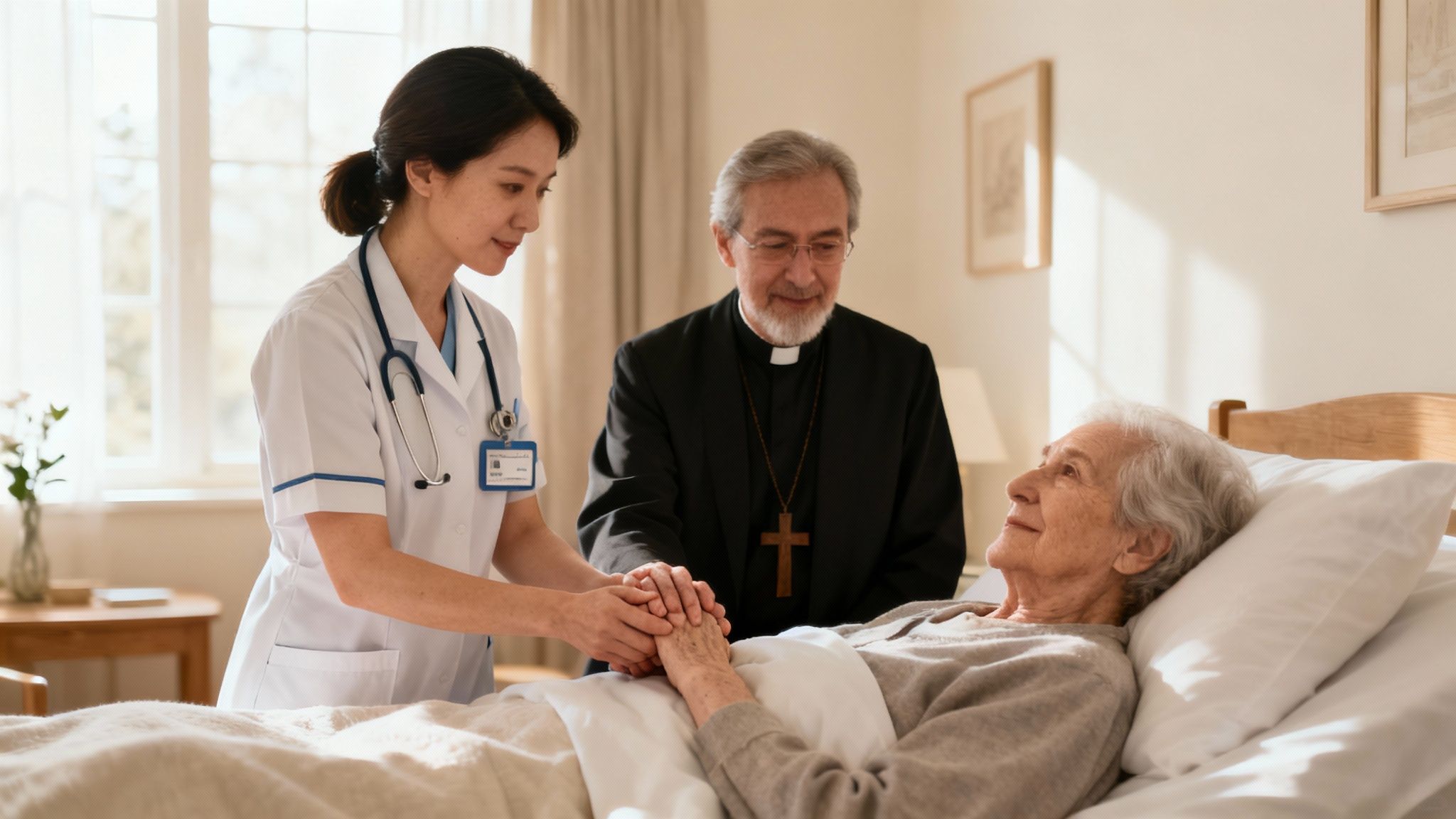
Nonprofit Mission vs. For-Profit Models
A huge piece of the trust puzzle comes down to a hospice’s core mission. Nonprofit providers, like Central Coast VNA & Hospice, are mission-driven. Our primary focus is on patient care and community well-being, not generating profits.
Any excess revenue is put right back into enhancing patient services, community programs, and staff training. In contrast, for-profit agencies answer to their investors, which can sometimes influence care decisions. A nonprofit's sole commitment is to the patients and families it serves.
The Power of an Interdisciplinary Team
A truly trustworthy hospice provider doesn't just send one person to help. They bring a full, coordinated team of professionals who work together. This structure is a hallmark of high-quality, reliable care.
This interdisciplinary team creates a seamless support system. It ensures every physical, emotional, and spiritual need is met with expertise and heart.
At Central Coast VNA & Hospice, our team approach means you are never alone. A dedicated group of professionals collaborates to create a circle of support around your family, ensuring consistent and holistic care.
So, who is on this team? Here’s a look at the professionals who work together for your family:
- Registered Nurse: Manages pain and other symptoms and coordinates the overall medical care plan.
- Hospice Aide: Provides gentle, hands-on personal care, like assistance with bathing and dressing.
- Medical Social Worker: Offers emotional support and helps families connect to community resources.
- Chaplain: Provides spiritual support that respects your family’s unique beliefs and values.
This collaborative model ensures no detail is overlooked and that your family feels fully supported. Understanding the importance of online reputation management also reflects a provider's credibility.
With over 74+ years of service on the Central Coast, organizations with deep local roots have a proven legacy. You can see how Central Coast VNA & Hospice impacts lives by reading these stories of compassionate care.
Using Transparency to Measure Quality of Care
When you're choosing a hospice, how can you be sure you’re getting the best possible care? True quality comes down to transparency. A transparent provider is open and honest about their performance, sharing public data that works like a report card.
This data lets you look past the sales pitch and see objective proof of how an agency supports families. This openness is a cornerstone of trust between a healthcare provider and families in communities like Salinas and Santa Cruz.

Finding a Hospice Report Card
So, where do you find this "report card"? The most powerful tool you have is the CAHPS Hospice Survey. This is a national survey that gathers feedback directly from families who have received hospice care.
Since 2015, the Centers for Medicare & Medicaid Services (CMS) has required hospices to participate. The results are posted on Medicare.gov, allowing families to compare agencies. It’s a real snapshot of quality care that empowers you to make an informed choice.
These surveys aren't just about statistics; they capture the heart of the hospice experience. They reveal how well a team managed a patient’s symptoms and supported a family’s emotional needs.
By looking at this public data, you can see a provider’s track record for delivering compassionate, consistent care. It helps you move from hoping for good care to expecting it based on proven results.
What to Look For in the Data
When you review the survey results on Medicare’s Care Compare website, you’ll see how different providers score. This is your window into what day-to-day support will actually look and feel like.
To get a clear picture, focus on these key areas:
- Communication with Family: This score shows how well the team kept everyone informed about the patient’s condition.
- Getting Timely Help: This tells you how quickly the hospice responded when the family needed help.
- Treating Patient with Respect: This is a direct measure of the compassion and humanity of the care provided.
- Emotional and Spiritual Support: This reflects how well the hospice addressed the needs of both the patient and the family.
These scores give you a way to compare providers in Monterey County and neighboring areas side-by-side. Understanding how hospices are funded also adds important context, especially for nonprofit organizations like Central Coast VNA & Hospice.
By using these transparent, public tools, you become an empowered advocate for your family. You can make a decision based on what a provider’s past performance proves.
The Human Story Behind Testimonials and Reviews
Data and quality scores give you the black-and-white numbers. Testimonials and patient stories provide the heart of the hospice experience. These personal accounts reveal the compassion that statistics alone can never capture.
When you know how to read between the lines, these stories give you real, authentic insights.
These stories matter. With over 70% of people reading online reviews when choosing healthcare providers, genuine feedback is an essential trust signal. Hearing from others who have walked a similar path can be incredibly reassuring.
Looking for Consistent Themes in Feedback
One of the most powerful ways to use testimonials is to look for consistent themes. A single glowing review is nice, but a pattern of praise across multiple reviews tells a much bigger story. It signals that a positive experience is part of the provider's culture.
As you read, ask yourself if the same comments keep popping up. These patterns are clues to a provider’s true strengths.
- Compassionate Staff: Do different reviews mention a specific Hospice Aide who was exceptionally gentle? Consistent praise points to a strong, caring staff culture.
- Excellent Communication: Look for comments that highlight how well the team kept the family informed. Phrases like "they always answered our calls" are signs of a supportive provider.
- Effective Symptom Management: Do families mention how comfortable their loved one was? Comments about pain control are direct indicators of high-quality clinical care.
Finding these recurring themes helps build confidence in the team you’re choosing.
How to Spot an Authentic and Helpful Review
Not all reviews are created equal. To get the most value, you need to know how to spot genuine, detailed stories. Authentic testimonials are full of specific details that paint a clear picture.
A truly helpful review will often include:
- Specific Examples: Instead of saying "the care was good," a detailed review might share, "The Hospice Aide knew exactly how to reposition my father to make him comfortable."
- Names or Roles: When a family mentions a professional by their role (e.g., "our Medical Social Worker"), it suggests that person made a significant impact.
- The Full Journey: The most insightful stories touch on the entire experience, from the first call to bereavement support.
Testimonials and family satisfaction scores are more than just marketing tools; they are critical benchmarks for evaluating quality. Positive feedback often correlates with better patient outcomes and a more peaceful end-of-life experience for the entire family.
Research backs this up. According to one study, patients receiving hospice care report a 44.8% increase in satisfaction ratings and experience significantly fewer hospitalizations. You can explore research on hospice patient outcomes to learn more.
Reading about the experiences of other local families can be incredibly powerful. You can read our VNA & Hospice stories to see firsthand how our team has supported families across Monterey and Santa Cruz Counties.
Critical Questions to Ask Any Hospice Provider
When you're meeting with potential hospice providers, walking in prepared can make all the difference. Knowing what to ask helps you become the best advocate for your loved one. It allows you to clearly compare your options and find a team that fits your family’s values.
Think of it as an interview for one of life’s most significant journeys. Below is a checklist of practical questions to guide these crucial conversations. We'll also get into why each question is so important.
Care Team and Support
A hospice is only as good as its people. The quality of care your loved one receives comes down to the expertise and compassion of the team. These questions will help you understand how their team actually operates.
A great provider won't hesitate to give you specific, concrete answers.
- What is your staff-to-patient ratio? A lower ratio often translates to more direct, hands-on care from the Registered Nurse and Hospice Aide.
- How often will a Registered Nurse and Hospice Aide visit? You're looking for a provider who offers consistent, planned visits, not one that only shows up in a crisis.
- Is your entire team—including Chaplains and Medical Social Workers—employed directly by your agency? Direct employees usually mean better communication and more coordinated care.
- What does your after-hours support look like? A top-tier hospice will have a Registered Nurse available 24/7 to take your call and make an emergency visit if needed.
Getting a feel for these details is essential. You can explore our guide on the 7 signs you’ve found the right hospice for your parent.
Quality and Communication
Trust is built on transparency. These questions are designed to get to the heart of a provider's quality. They also reveal their commitment to keeping families informed.
A hospice that is proud of the care it delivers will be open and ready to talk about its quality scores and family satisfaction ratings. If you sense hesitation when you ask for this information, that’s a red flag.
The decision tree below can help you visualize how to sort through testimonials and reviews.
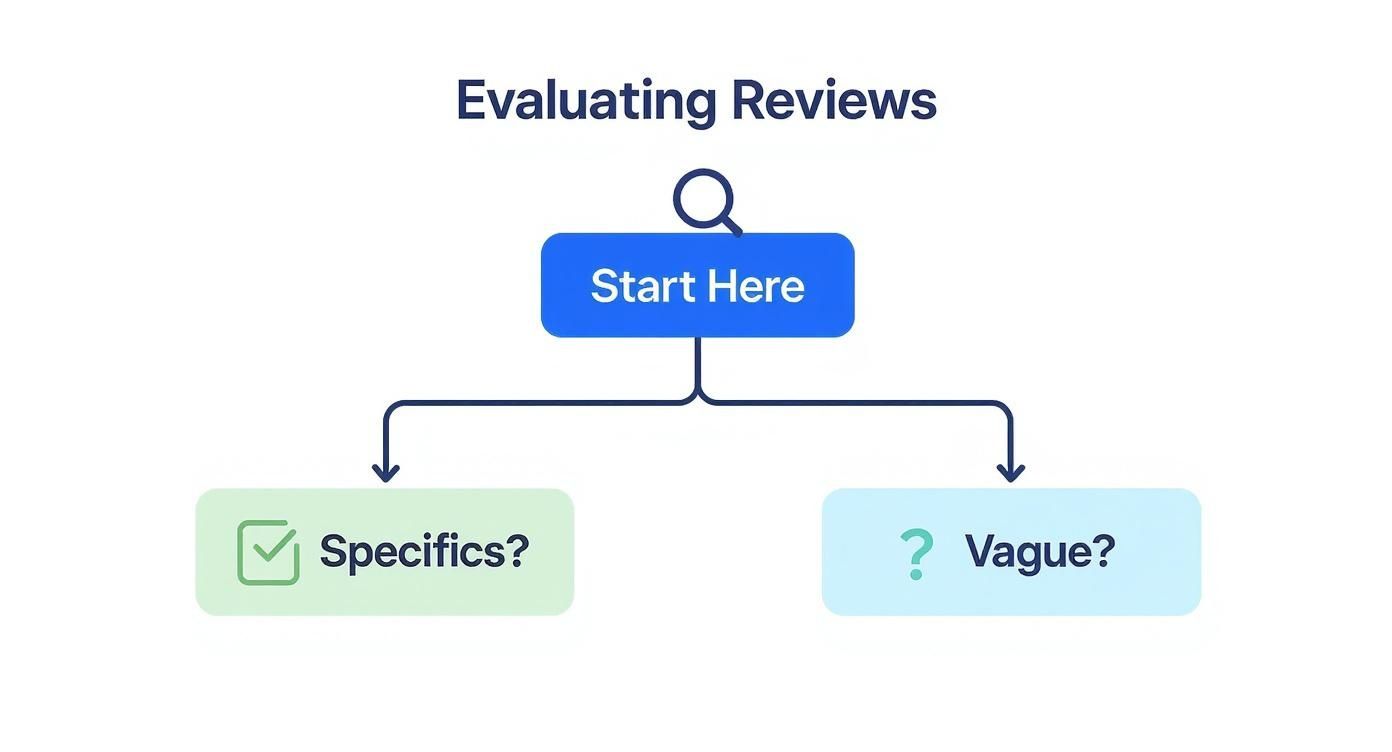
As you can see, specific stories from other families will give you a much clearer picture.
Here are a few more questions to get to the core of their quality:
- Can you share your most recent CAHPS Hospice Survey scores? A willingness to point you to this public data shows they are accountable.
- How do you create and update a patient's care plan? A strong answer will describe a collaborative process involving the patient, family, and the hospice team.
- What is your process for managing pain and other difficult symptoms? Listen for a proactive, comprehensive approach that includes regular assessments and timely adjustments.
- How does your team support the family? Ask specifically about bereavement programs, training, and emotional support offered by their Medical Social Workers and Chaplains.
We've compiled the key questions into a simple checklist you can use.
Essential Questions Checklist for Hospice Interviews
This simple checklist can guide your conversations with potential hospice providers, ensuring you cover every critical aspect of care.
| Category | Question to Ask | What a Good Answer Includes |
|---|---|---|
| Care Team | What is your staff-to-patient ratio? | A specific number and an explanation of how it allows for personalized care. |
| Care Team | How often will nurses and aides visit? | A clear, typical schedule for routine visits, not just crisis response. |
| Care Team | Is your interdisciplinary team employed by you? | Confirmation of direct employment, which promotes coordinated care. |
| Care Team | What is your after-hours support system? | 24/7 access to a Registered Nurse by phone and for visits, with a quick response time. |
| Quality | Can I see your CAHPS Hospice Survey scores? | An enthusiastic "yes," with directions to their scores on Medicare.gov. |
| Quality | How is the care plan developed and updated? | A description of a collaborative process involving the patient, family, and team. |
| Quality | How do you manage pain and symptoms? | Details on a proactive approach, including regular assessments and medication management. |
| Quality | How do you support the family? | Specific examples of bereavement support, respite care, and emotional counseling. |
Armed with these questions, you’re ready to have meaningful conversations with providers across the Central Coast.
A Legacy of Trusted Care on the Central Coast
Choosing a hospice is a journey of the heart. It’s a decision guided by a deep need for trust, honesty, and comfort. For families across the Central Coast, these are the bedrock of the care we've provided at Central Coast VNA & Hospice for over 74+ years.
As a local, nonprofit, mission-driven organization, our entire focus has always been on the people we serve. Our legacy is built on decades of showing up for our neighbors in Monterey County, San Benito County, Santa Cruz County, and South Santa Clara County. Our commitment is to our community’s well-being.

Our Commitment to Transparency
We believe families deserve to make decisions with total confidence. That’s why we are completely transparent about our quality of care. We invite you to review our patient satisfaction scores and quality metrics.
Our team—made up of dedicated Registered Nurses, Hospice Aides, Chaplains, and Medical Social Workers—is here to deliver consistent support. We are incredibly proud of the work they do and the peace of mind they bring to families.
At Central Coast VNA & Hospice, we see ourselves as more than a provider—we are a local community partner. We are here to help you navigate this journey with clarity, compassion, and peace of mind, every step of the way.
Support Along the Entire Continuum of Care
The need for support often begins long before hospice care is on the table. That’s why we offer a full Continuum of Care. Our services are designed to work together seamlessly as your loved one’s needs change.
This integrated approach includes:
- Home Health Care: We provide skilled nursing and therapy to help patients recover from surgery or manage chronic conditions at home.
- Palliative Care: Our teams offer specialized support to manage symptoms and improve quality of life for those with serious illnesses.
- Hospice Care: We deliver compassionate end-of-life care that honors your loved one’s dignity and supports the entire family.
By offering this complete spectrum, we can build a lasting, trusting relationship with your family. This ensures a smooth and gentle transition between levels of care.
Let's Talk About Your Needs
We understand how difficult and overwhelming this time can be, and we are here to help. We invite you to contact us for a no-cost, no-commitment conversation. Let us show you what our legacy of trusted, transparent, and compassionate care looks like.
You can learn more about our hospice care services or call our team today. We are here to listen and provide the guidance you need.
Frequently Asked Questions About Choosing Hospice
Exploring hospice care brings up many questions. The path ahead can feel uncertain, but clear answers help. Here are five of the most common questions we hear from families.
What’s the difference between nonprofit and for-profit hospice?
A nonprofit hospice, like Central Coast VNA & Hospice, is mission-driven. Our purpose is built around patient care and serving our community—not generating profits. Any revenue goes right back into our programs to enhance patient care and support families.
A for-profit agency has a responsibility to its investors, which can shape its approach. With a nonprofit, the commitment is always to the people we serve.
Where can I find honest quality ratings for local hospices?
The best place to start is Medicare's official "Care Compare" tool on Medicare.gov. You can look up hospice providers in Monterey County or Santa Cruz County. The tool shows family satisfaction scores from the national CAHPS Hospice Survey, giving you unbiased feedback.
How can I spot a genuine patient testimonial?
Look for specific details, not just vague praise. A trustworthy review will often mention how a specific Hospice Aide brought comfort or how a Registered Nurse managed a tough symptom. Look for patterns across multiple reviews that highlight the same strengths, like excellent communication or genuine compassion.
Can my loved one receive hospice care at home?
Yes, absolutely. A core goal of hospice is to bring comfort and care to wherever a person calls home. This could be their own house, an assisted living community, or a skilled nursing facility. The Central Coast VNA & Hospice team comes directly to the patient, allowing them to stay in a familiar environment.
When is the right time to start looking into hospice?
It’s never too early to start learning. Gathering information before you're in a crisis can lift a huge weight off your shoulders. It allows you to make calm, clear-headed decisions when the time comes. If your loved one is managing a serious illness, please call us for a no-cost consultation to learn about all the support available.
At Central Coast VNA & Hospice, our commitment is to guide you through this journey with trust, transparency, and genuine care. To learn more about our services or just to talk with someone from our team, please visit us at https://ccvna.com.
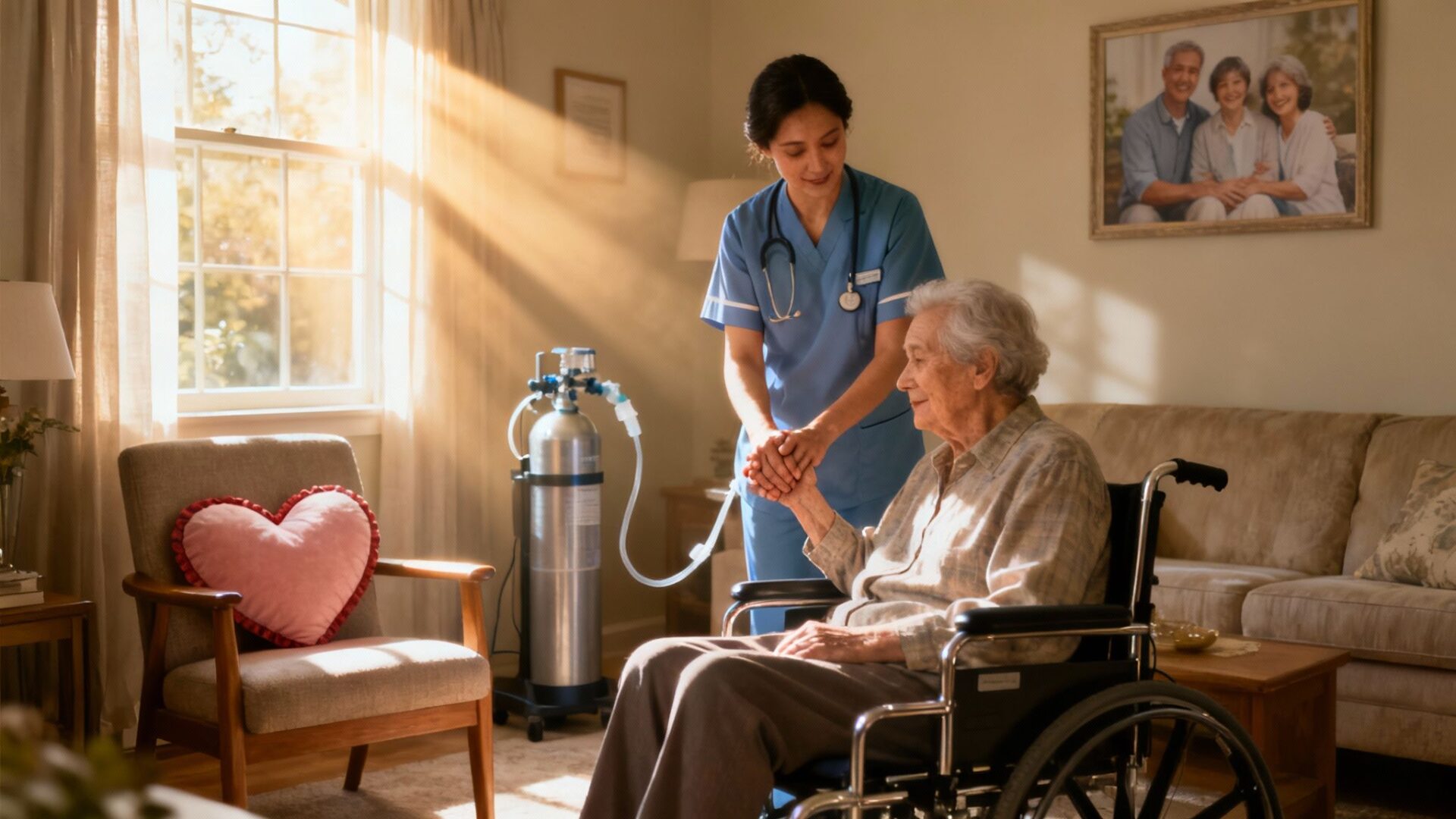
Is Hospice Only for Cancer Patients? Understanding Eligibility
No, hospice is not just for cancer patients. This is a common myth. Hospice care supports anyone with a life-limiting illness, no matter the diagnosis.
The focus is on providing comfort, dignity, and the best quality of life. This happens when curative treatments are no longer the main goal.
Challenging a Common Hospice Myth
When families in Monterey and Santa Cruz counties think of hospice, cancer often comes to mind. While we proudly support cancer patients, this myth can prevent people with other serious illnesses from getting the care they deserve.
The truth is, hospice serves a wide range of advanced conditions. For over 74 years, Central Coast VNA & Hospice has provided compassionate support to our community, regardless of the diagnosis. We see how this care helps people with heart failure, dementia, and other illnesses live their final months in peace.
Understanding this helps you make informed choices for your loved ones. We explore more myths in our article separating hospice fact from fiction.
Hospice Serves a Diverse Patient Community
While cancer is a common diagnosis, it is only one of many. Hospice care is for anyone facing the final chapter of a serious illness.
According to the National Hospice and Palliative Care Organization (NHPCO), over 1.72 million Medicare beneficiaries received hospice services in 2020 (NHPCO, 2021). Many of these patients had diagnoses other than cancer, such as heart disease, dementia, and lung disease.
Hospice is not defined by a single disease but by a philosophy of care. It embraces anyone facing the final stages of a serious illness, offering a supportive embrace that honors their life and wishes.
The goal is to provide comfort and manage symptoms. It also includes offering emotional and spiritual support to the patient and their family. This focus on the whole person makes hospice a vital resource for our neighbors in Monterey County, San Benito County, Santa Cruz County, and South Santa Clara County.
Hospice Eligibility at a Glance
This simple table gives a quick overview of common conditions that may qualify a patient for hospice. It shows that many illnesses beyond cancer are included.
| Condition Category | Examples of Diagnoses |
|---|---|
| Heart Disease | Congestive Heart Failure (CHF) |
| Lung Disease | Chronic Obstructive Pulmonary Disease (COPD) |
| Neurological Conditions | Parkinson's Disease, ALS |
| Kidney Disease | End-Stage Renal Disease |
| Liver Disease | End-Stage Liver Disease |
| Dementia | Advanced Alzheimer's Disease |
This is just a starting point. A physician must determine that a patient's life expectancy is six months or less if the disease runs its natural course. The key is focusing on the person, not just the diagnosis.
Understanding When Hospice Is an Option
Knowing when to consider hospice can feel overwhelming. The guidelines are designed to bring clarity and support during a difficult time.
The main requirement is that a doctor must certify the patient likely has six months or less to live if their illness follows its natural course. This is not a strict deadline. If a patient lives longer, hospice support can continue as long as they still meet the criteria.
Recognizing the Signs It Might Be Time
The conversation about hospice often begins when a family notices changes in a loved one's health. While every person's journey is unique, there are common signs that comfort-focused care could be beneficial.
Observing these changes helps your family start a conversation. Recognizing them early allows you to explore options with less pressure.
Key indicators that hospice may be an appropriate choice include:
- Frequent Hospitalizations: A pattern of recurring trips to the emergency room or multiple hospital stays in the last six months.
- Difficulty Managing Pain: When pain and other symptoms become persistent and are not well-controlled by current treatments.
- Noticeable Decline: You might see increasing weakness, constant fatigue, significant weight loss, or recurring infections.
- Reduced Daily Function: A clear decline in the ability to manage daily activities like bathing, dressing, eating, or moving around independently.
This simple decision tree shows that hospice eligibility is based on the seriousness of an illness, not a specific diagnosis.
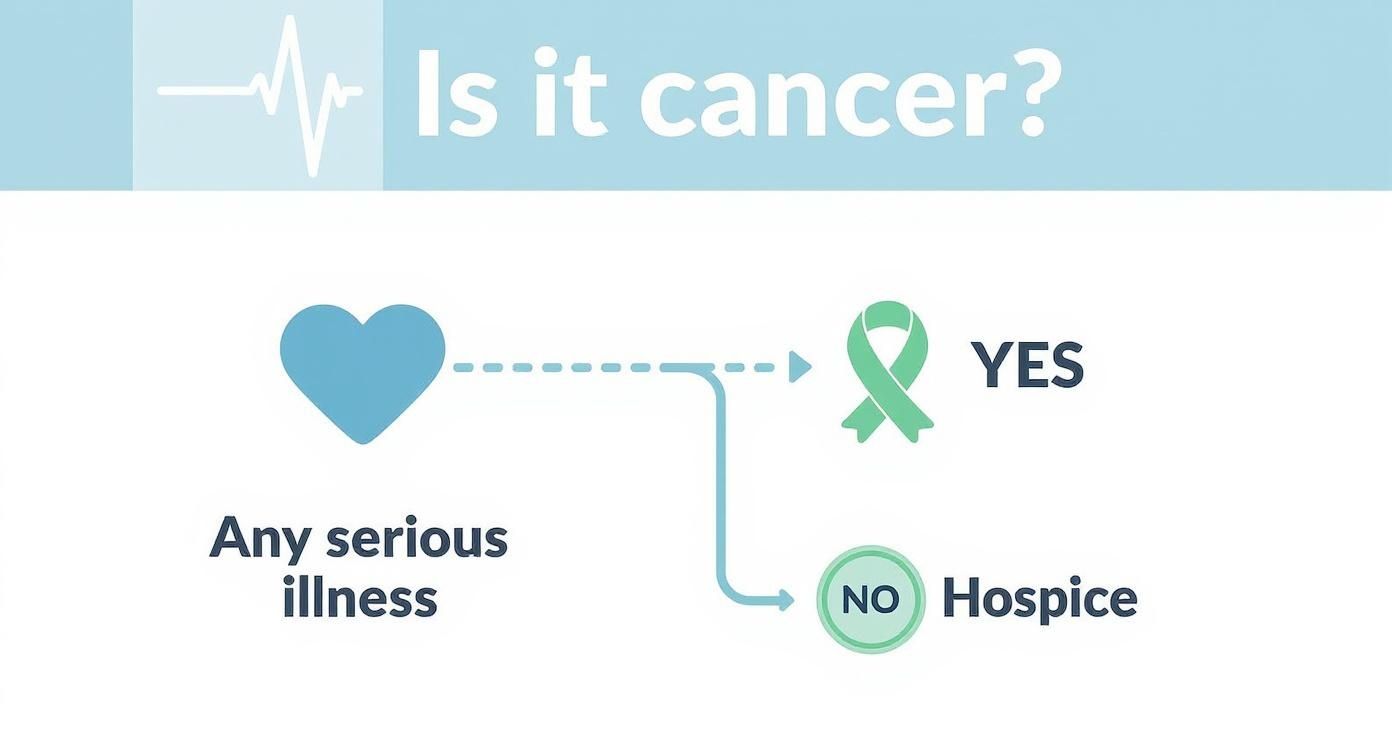
The path to hospice is determined by need, not the name of the disease. It’s all about focusing on quality of life when an illness has advanced.
Empowering Your Family with Information
Understanding these signs empowers you to advocate for your loved one. It opens the door to a different kind of care—one that prioritizes peace over aggressive treatments. This is often the most compassionate choice a family can make.
It ensures their loved one receives holistic support for their body, mind, and spirit. If you are noticing these signs and wondering about next steps, you can learn more about when to call hospice in our detailed guide.
Choosing hospice is not about giving up. It is an active decision to shift the focus from curative treatments to maximizing comfort, managing symptoms, and honoring a person's wishes for their final months.
By understanding the criteria and recognizing the signs, you can make informed decisions. Our team at Central Coast VNA & Hospice is ready to help families in Monterey County and San Benito County navigate this sensitive topic with compassion.
The Many Conditions Hospice Can Support
Most people think of cancer when they hear the word "hospice." But this care adapts to many other serious illnesses.
The teams at Central Coast VNA & Hospice support individuals with a wide range of advanced conditions. We tailor care to meet each person's unique needs right here in Monterey County and the surrounding areas.
Advanced Heart Disease
For someone with advanced heart disease, like Congestive Heart Failure (CHF), daily life can be exhausting. Simple activities might trigger fatigue, shortness of breath, or chest pain.
Our hospice Registered Nurses are experts at managing these symptoms at home. They work with the patient’s doctor to adjust medications and provide oxygen. The goal is to reduce hospital visits and improve comfort.
Chronic Lung Disease
Patients with Chronic Obstructive Pulmonary Disease (COPD) often feel anxious about their breathing. This feeling of breathlessness can be frightening and isolating.
Hospice care for COPD focuses on easing this symptom. We teach patients breathing techniques and relaxation methods. Our Hospice Aides can also help with personal care, saving the patient’s energy for time with loved ones.
Hospice care is about adding life to a patient’s days, not just days to their life. By focusing on symptom relief and emotional peace, we help individuals with any terminal illness live as fully as possible.
Dementia and Alzheimer's Disease
As dementia or Alzheimer's advances, communication becomes a challenge. The world can feel confusing.
Our teams are trained to create a peaceful and safe environment. We learn to read non-verbal cues to understand needs and manage agitation. This approach upholds the patient’s dignity and gives their family needed support.
Advanced Neurological Conditions
Conditions like Amyotrophic Lateral Sclerosis (ALS) or Parkinson’s Disease cause a progressive loss of function. This creates immense physical and emotional hurdles.
For these individuals, hospice care helps maintain comfort and preserve independence. A dedicated hospice team coordinates pain management, mobility assistance, and medical equipment. Our Social Workers and Chaplains also offer emotional and spiritual support.
What a Hospice Care Team Provides
Hospice is a dedicated team of professionals working together for you and your family. This team-based approach supports every aspect of a person's well-being.
At Central Coast VNA & Hospice, our care comes to you, wherever you call home. This could be a private residence in Monterey County or an assisted living facility in San Benito County. Our goal is to provide comfort in a familiar environment.
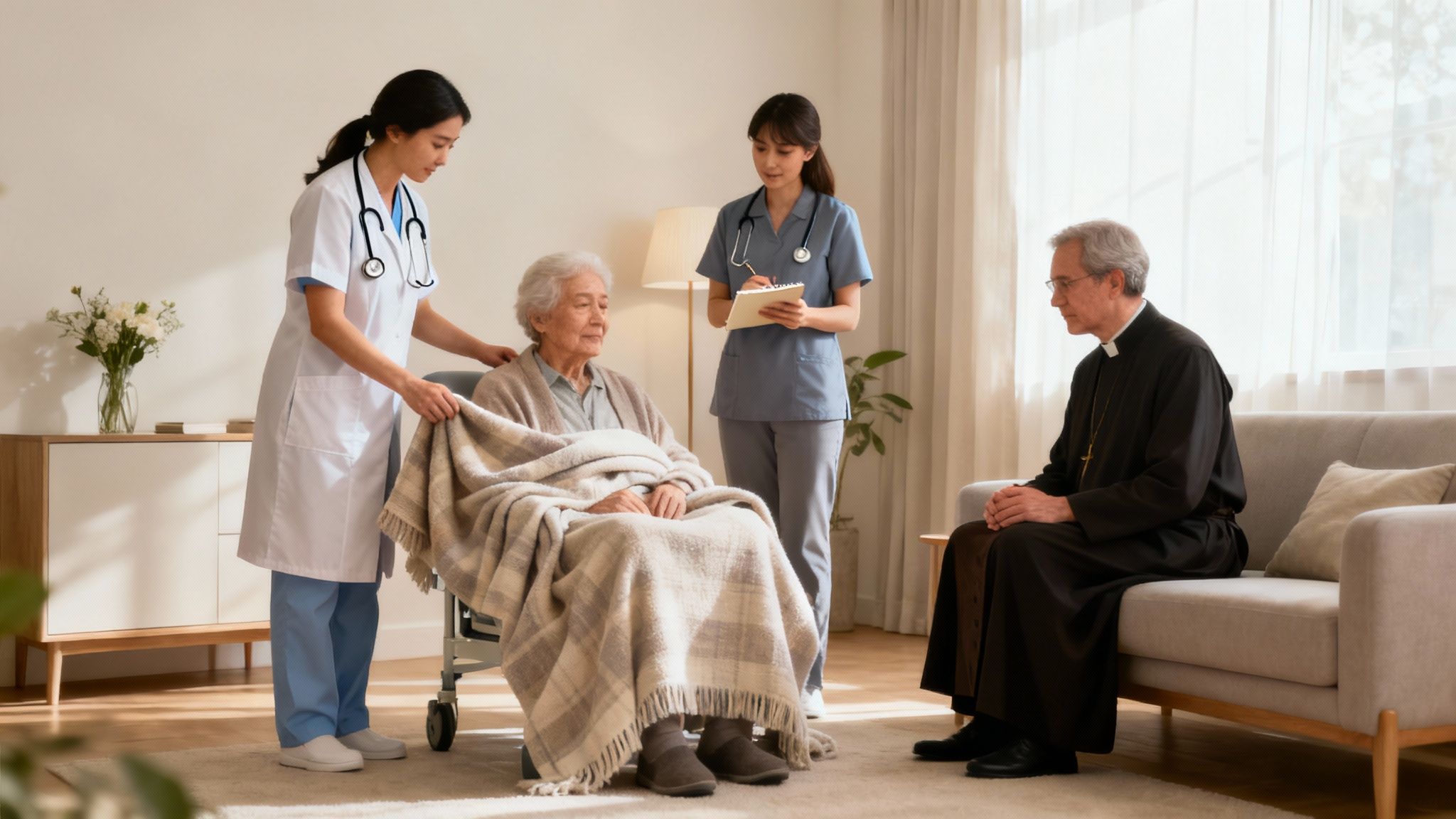
Your Interdisciplinary Care Team
A patient’s hospice journey is guided by a core team of specialists. They work together to create a personalized care plan.
Your Central Coast VNA & Hospice team includes:
- Registered Nurse: Manages pain and other symptoms and coordinates with your physician.
- Hospice Aide: Assists with personal care tasks like bathing and dressing.
- Social Worker: Offers emotional support and helps with practical matters like advance care planning.
- Chaplain: Provides non-denominational spiritual guidance that respects your family’s beliefs.
This team approach ensures the complete needs of the patient and family are met. It addresses physical, emotional, and spiritual well-being.
Easing Financial and Practical Burdens
Worrying about the cost of care can be a major source of stress. Hospice is designed to relieve this burden. This lets you focus on spending quality time together.
Under the hospice benefit, most medical supplies, equipment, and medications related to the illness are covered. This can include a hospital bed, oxygen, and pain medications. Our team coordinates the delivery and setup of everything you need.
Hospice is a comprehensive support system that wraps around the entire family. It’s about ensuring comfort, preserving dignity, and providing a steady, guiding hand during a challenging time.
By handling these logistics, we help create a more peaceful home environment. This is central to our mission as a nonprofit serving the Central Coast for over 74 years. Learn more about what to expect from hospice care in our helpful guide.
The Relationship Between Palliative and Hospice Care
Many people think "palliative care" and "hospice care" are the same. They are related, but they serve different needs at different times.
Think of palliative care as a broad type of support that can begin at any point after a serious diagnosis. A person can receive palliative care while still getting curative treatments, like chemotherapy. The goal is to relieve symptoms and improve quality of life.
All Hospice Is Palliative, But Not All Palliative Care Is Hospice
Hospice care is a specific type of palliative care. It begins when the focus shifts from curing the illness to maximizing comfort. It is for individuals with a life expectancy of six months or less.
This is the main difference. Palliative care can be given alongside curative treatments, but hospice starts after the decision to stop them.
The simplest way to think about it is that all hospice care is palliative because it’s all about comfort and symptom management. However, not all palliative care is hospice, because it can be provided long before a person reaches the end-of-life stage.
For a deeper look, you can read our guide on the real difference between hospice and palliative care.
A Seamless Continuum of Care on the Central Coast
Central Coast VNA & Hospice provides a complete continuum of care. We are the only organization in Monterey County and the surrounding areas offering home health, palliative, and hospice services under one roof.
A patient might start with our home health nursing after a hospital stay. They can then transition to our palliative care program for extra support. When the time is right, they can move smoothly into hospice care, often with the same team they already trust.
This integrated approach prevents stressful gaps in care. Our team builds a lasting relationship with your family, providing consistent support.
How to Begin the Hospice Conversation
Talking about hospice can be tough, but it is a loving conversation. It’s not about giving up. It’s about ensuring your loved one’s final chapter is lived with comfort and dignity.
You can create a safe space by starting with open-ended questions. Try asking, "Have you thought about what kind of care you’d want if you became more ill?" The goal is to listen and understand their hopes and fears.
Taking the Next Step
Once the conversation is open, the next step is gathering information. It is a myth that you need a doctor’s referral to learn about hospice. Anyone—a patient, family member, or friend—can call to ask for information.
You don’t need a physician’s referral to explore your options. A simple, no-pressure phone call can bring so much clarity and answer your questions, empowering you to make the best decision for your family.
At Central Coast VNA & Hospice, our team is right here in Santa Cruz County, ready to help. We can walk you through the services and explain eligibility.
The process for starting hospice care is straightforward. Here’s how it works:
- Contact a Hospice Provider: Call us to request an informational visit. There is no commitment.
- Schedule a Consultation: One of our Registered Nurses will meet with you to discuss needs and eligibility.
- Obtain a Physician's Order: If hospice is the right choice, we will coordinate with your loved one’s doctor to get the necessary certification.
This process is meant to relieve stress. Contact us today for a compassionate, no-obligation conversation.
Frequently Asked Questions (FAQs)
Is hospice only for the last few days of life?
No, this is a common misconception. Hospice care is most beneficial when started earlier. Patients can receive care for six months or longer, as long as they meet the eligibility criteria, allowing more time for comfort and support.
Does choosing hospice mean we are giving up?
Not at all. Choosing hospice is an active decision to focus on quality of life. It’s about ensuring your loved one’s final months are lived with peace, dignity, and as much comfort as possible.
How is hospice care paid for?
Hospice is fully covered by Medicare, Medicaid, and most private insurance plans. As a nonprofit serving the Central Coast for over 74 years, Central Coast VNA & Hospice provides care to all eligible patients, regardless of their ability to pay.
Can a patient leave hospice if they get better?
Absolutely. If a patient's condition improves or they want to try a new curative treatment, they can leave hospice care at any time. They can re-enroll later if they meet the hospice eligibility requirements.
Where is hospice care provided?
Hospice care is provided wherever a patient calls home. This could be their own house, an assisted living community, or a nursing home in Monterey County, San Benito County, or our other service areas. The goal is to bring support to them in a familiar setting.
If you have more questions or want to understand how our continuum of care can support your family, contact Central Coast VNA & Hospice today. Learn more at https://ccvna.com.

thumbnail-5
Making decisions about a loved one's health is one of the most challenging responsibilities a family can face. When a serious illness progresses, conversations about end-of-life care are often filled with emotion and misinformation. For many, the word 'hospice' brings up feelings of fear, rooted in myths that could be keeping your family from the care you deserve.
These misconceptions are significant barriers. They prevent families from accessing compassionate care that can improve a loved one’s final months. Many people delay asking about hospice because they believe it means 'giving up' or that it is only for the last few days of life. This delay, born from myths, can lead to preventable suffering and missed opportunities for meaningful connection.
At Central Coast VNA & Hospice, we have spent over 74 years helping our community navigate these difficult conversations. We believe that debunking these myths is the first step toward empowering you to make informed, compassionate choices. This article will walk you through the five most common hospice myths, replacing fear with facts and showing how hospice is truly about living as fully and comfortably as possible.
1. Myth #1: Hospice Means Giving Up and Choosing to Die
Perhaps the most damaging misconception about hospice care is the belief that it signifies surrender. Many families view a hospice referral as a sign that they are “giving up” on their loved one. This common fear is one of the biggest barriers preventing patients from receiving compassionate care when they need it most.
What Hospice Really Is: A Shift in Focus
Hospice is not about giving up; it is about shifting the goals of care. It represents a move away from aggressive curative treatments that may no longer be effective. Instead, it moves toward a philosophy centered on comfort, dignity, and quality of life.
Hospice care does not hasten death. It supports the body’s natural process by managing symptoms and providing emotional, spiritual, and physical support. The primary goal is to ensure the patient is comfortable and free from pain, allowing them to spend meaningful time with their family.
Key Insight: Hospice is not about the end of life. It is about the quality of life. The focus shifts from adding more days to life to adding more life to each day.
Comfort Care vs. Curative Treatment: A Practical Example
Understanding the difference between curative and comfort-focused care helps clarify the role of hospice. Let’s consider a patient with advanced cancer who has endured multiple rounds of chemotherapy.
- Curative Approach: The patient might continue with aggressive chemotherapy. This often causes severe side effects with a diminishing chance of shrinking the tumor.
- Hospice Approach: The patient would stop curative chemotherapy but continue receiving medications to manage symptoms like pain or nausea. A hospice team focuses on treatments that improve comfort and quality of life.
In the hospice model, every treatment is evaluated based on a single question: “Will this improve the patient’s quality of life?” This philosophy allows patients to regain control over their daily lives.
The Surprising Truth: Hospice Can Mean More Time
Contrary to the myth that hospice shortens life, studies have shown the opposite can be true. When pain and symptoms are expertly managed, the body is under less physical stress.
According to a study in the New England Journal of Medicine, lung cancer patients who received early palliative care—a philosophy similar to hospice—lived nearly three months longer than those receiving standard aggressive treatment (Temel et al., 2010). By focusing on the whole person, hospice care can provide the comfort and stability needed to extend meaningful life. You can learn more about how hospice care redefines support for patients and families and what it truly means to choose comfort.
How to Reframe the Conversation
If your family is grappling with this myth, it’s important to change the conversation from one of defeat to one of empowerment.
- Talk about goals: Ask your loved one, "What is most important to you right now?" Their answer may be to be pain-free, to be at home, or to spend time with family.
- Use different language: Instead of saying “giving up,” try framing it as “choosing comfort” or “taking control of your quality of life.”
- Consult the experts: A conversation with a Central Coast VNA & Hospice professional can help. Our teams across Monterey County, San Benito County, Santa Cruz County, and South Santa Clara County are here to provide information so you can make the decision that is right for you.
2. Myth #2: Hospice is only for cancer patients in their final days
Another common barrier to timely care is the narrow perception of who hospice is for. Many people associate hospice exclusively with a cancer diagnosis and the very last days of life. This myth can prevent patients with other life-limiting illnesses from getting crucial support.

What Hospice Really Is: A Broader Spectrum of Care
Hospice care is designed for anyone with a terminal illness who has a prognosis of six months or less if the disease follows its natural course. While hospice was founded to provide better care for cancer patients, it now supports individuals with a wide range of conditions.
Today, hospice serves patients with many different diagnoses, including:
- Congestive Heart Failure (CHF)
- Chronic Obstructive Pulmonary Disease (COPD)
- Alzheimer's disease and other forms of dementia
- Kidney or liver failure
- ALS (Lou Gehrig’s Disease)
The key eligibility criterion is the prognosis, not the specific illness. This is one of the most critical facts to understand in the list of 5 hospice myths that could be keeping your family from the care you deserve.
Key Insight: Hospice eligibility is based on prognosis, not diagnosis. It supports anyone facing the final months of any terminal illness, not just cancer.
Beyond the Final Days: A Practical Example
The belief that hospice is only for the "last 48 hours" prevents families from experiencing the full benefits of care. Let’s look at a patient with late-stage dementia.
- Without Hospice: The family might struggle with challenging behaviors and frequent infections. This often leads to repeated, stressful hospitalizations.
- Hospice Approach: The patient can enroll in hospice months before their final days. A hospice team provides specialized care at home, focusing on comfort, safety, and dignity. The patient remains in a familiar, peaceful environment.
In this model, the patient receives consistent, compassionate care over a longer period. The family receives the education and support needed to navigate a difficult disease.
The Surprising Truth: The "Six-Month" Rule is Not an Expiration Date
The six-month prognosis is a clinical guideline, not a strict deadline. It is a physician's best estimate of life expectancy if the illness runs its typical course. Many patients live longer than six months and continue to receive hospice care.
As long as a physician continues to certify that the patient’s prognosis is six months or less, they remain eligible. The hospice team simply re-evaluates the patient’s condition at regular intervals. It is possible to explore the real benefits of starting hospice early and how it can improve quality of life for months.
How to Reframe the Conversation
If you believe your loved one might be eligible for hospice but they do not have cancer, it is important to advocate for their needs.
- Ask the doctor directly: Use specific language like, "Would you be surprised if my mother lived for more than another six months?" This can open the door to a conversation about hospice.
- Focus on symptoms: Discuss uncontrolled symptoms like shortness of breath, chronic pain, or frequent infections with the doctor.
- Request a consultation: Ask for an informational meeting with a provider like Central Coast VNA & Hospice. Our team can assess your loved one’s eligibility and explain the support we can offer.
3. Myth #3: Hospice Abandons Patients and Stops All Medical Care
A common fear is that choosing hospice means a patient will be left on their own. Families worry that their loved one will no longer receive medications or clinical support. This belief suggests an abandonment of care when, in fact, the opposite is true.
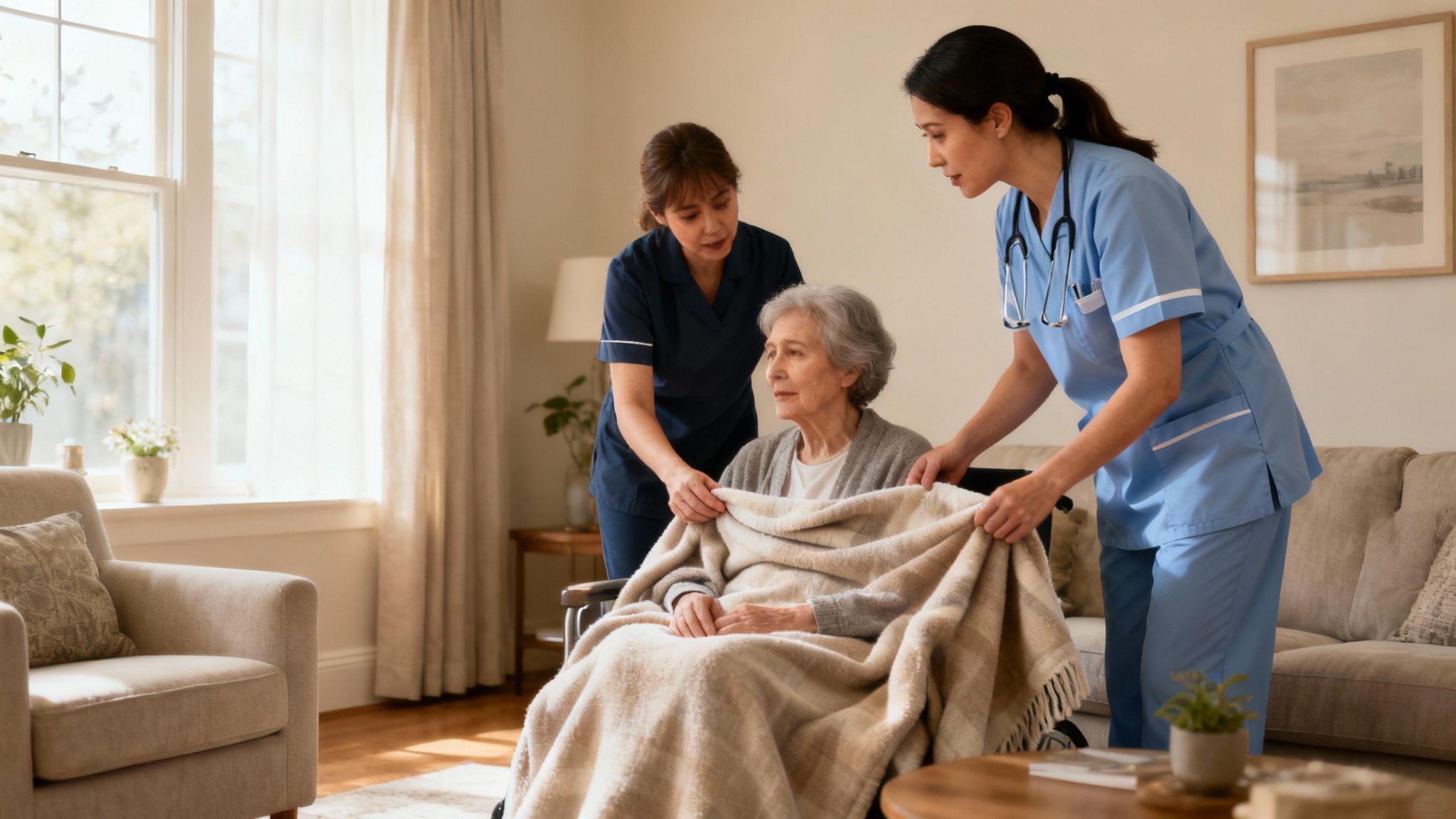
What Hospice Really Is: A Refocusing of Medical Care
Hospice does not stop medical care; it redefines its purpose. Hospice provides a highly attentive team of professionals dedicated to ensuring comfort and dignity. This team includes a hospice physician, Registered Nurses, Hospice Aides, a social worker, a Chaplain, and trained volunteers.
The hospice team carefully reviews every medication and intervention. The focus shifts from curing the disease to aggressively managing its symptoms. This is active, intensive medical care designed to enhance the patient's quality of life.
Key Insight: Hospice care is not the absence of medical care. It is a specialized type of medical care focused entirely on comfort, symptom management, and holistic well-being.
Intensive Comfort Care vs. Curative Treatment: A Practical Example
Understanding how care is redirected helps debunk this myth. Consider a patient with end-stage congestive heart failure (CHF).
- Curative Approach: The patient might experience frequent, stressful trips to the emergency room for fluid overload and other complications.
- Hospice Approach: The Registered Nurse actively manages the patient’s symptoms at home. They provide medications and oxygen to ease shortness of breath and adjust treatments to maintain comfort. They also teach the family how to recognize and respond to symptoms.
The hospice team continues to provide a wide range of medical services, all tailored to the patient's comfort. This can include:
- Pain and symptom management
- Wound care
- Catheter and ostomy care
- Providing medical equipment like a hospital bed or oxygen
The Surprising Truth: Hospice Can Mean More Attention
Many families are surprised to find that hospice provides more hands-on support and medical attention. Instead of waiting for an appointment or rushing to a hospital, they have a dedicated team on call 24/7. Regular visits from nurses and Hospice Aides ensure symptoms are managed proactively.
This constant, specialized attention is a cornerstone of the hospice philosophy. The goal is to create a stable, comfortable environment in the patient's own home. You can get a clearer picture of the support provided by exploring what to expect when beginning hospice care with a team like ours at Central Coast VNA & Hospice.
How to Reframe the Conversation
If your family is concerned about the level of medical care in hospice, shift the discussion from a fear of abandonment to specialized support.
- Ask about the team: Inquire about the roles of each team member. Who manages medications? Who is available after hours?
- Discuss specific treatments: Talk about which medications and treatments will continue.
- Focus on the location of care: Emphasize that hospice brings medical expertise directly to the patient.
- Involve the primary doctor: Remember that your loved one can often keep their primary care physician, who collaborates with the hospice team.
4. Myth #4: Entering hospice means you must leave your home
The idea of moving a seriously ill loved one out of their familiar surroundings can be a source of stress. Many people associate hospice with a specific place and fear uprooting their family member. This misconception often prevents patients from accessing care in the very place they feel most comfortable.

What Hospice Really Is: Bringing Care to You
Hospice care is not a place; it is a philosophy of care that can be delivered wherever a patient calls home. The vast majority of hospice services are provided in a patient's private residence. This allows individuals to remain in familiar, comforting environments.
The goal of hospice is to enhance comfort and dignity. Hospice care can also be provided in nursing homes and assisted living facilities, integrating with the care already being received.
Key Insight: Hospice is a service, not a location. The care team brings medical, emotional, and spiritual support directly to the patient, wherever they reside.
Care Settings vs. Philosophy: A Practical Example
Understanding how hospice adapts to different environments helps clarify this common myth. Let’s consider a patient with advanced heart failure.
- Misconception: The family believes they must transfer their loved one from their home in Monterey County to a dedicated hospice facility.
- Hospice Approach: The patient can enroll in hospice while remaining in their own home. A Central Coast VNA & Hospice team, including a Registered Nurse and Hospice Aide, will make regular visits. The team provides medical equipment, manages medications, and offers emotional support.
If symptoms become too difficult to manage at home, a patient can be moved to an inpatient facility for short-term symptom management. Once their symptoms are controlled, they can return home with continued hospice support.
The Surprising Truth: Familiarity Enhances Comfort
The primary goal of hospice is to maximize quality of life, and environment plays a huge role in that. Being at home allows patients to maintain their routines and have family and friends visit freely. This sense of normalcy and control is invaluable.
The hospice team coordinates with family members to create a safe and comfortable environment. They provide the training and support needed for families to confidently care for their loved ones at home. You can discover more about the comprehensive support available through hospice at home and how it empowers families.
How to Reframe the Conversation
If your family is concerned about leaving home, it’s important to focus the conversation on how hospice supports staying in place.
- Ask about services: Inquire about what medical equipment and supplies they provide for home-based care.
- Discuss family support: Ask about respite care options, which provide short-term relief for family members providing care.
- Use different language: Instead of "going to hospice," frame it as "bringing hospice support home."
- Clarify care settings: When speaking with Central Coast VNA & Hospice, ask which settings we serve across our service areas.
5. Myth #5: Hospice is expensive and not covered by insurance or Medicare
The thought of adding another healthcare expense during a stressful time is overwhelming. This leads to the myth that hospice is a costly service reserved for the wealthy. The fear of unaffordable bills often prevents families from exploring hospice care.
What Hospice Really Is: A Fully Funded Benefit
The reality is that hospice care is a fully funded benefit for most eligible patients. It is covered by Medicare, Medicaid, and most private insurance plans. Hospice is designed to relieve financial burdens by bundling all necessary services under one umbrella of coverage.
This comprehensive benefit includes nursing visits, physician services, medical equipment, and necessary medications. It also covers emotional and spiritual support for both the patient and their family. In fact, choosing hospice often reduces a family's overall healthcare spending.
Key Insight: Hospice is not an added expense; it is a comprehensive, covered benefit designed to reduce financial stress and provide all-inclusive care for patients and families.
Medicare and Insurance Coverage: A Practical Example
Understanding how coverage works can provide immense peace of mind. Let’s look at a patient with a Medicare plan who has end-stage heart failure.
- Without Hospice: The patient might face multiple hospital stays, each with its own deductible. They would also pay separately for prescriptions and medical equipment.
- With Hospice: Once the patient elects their Medicare Hospice Benefit, almost everything related to their heart condition is covered. This includes regular nurse visits, a hospital bed, oxygen, and all medications for pain and symptom relief. The family typically faces minimal to no out-of-pocket costs.
Understanding the distinctions between Medicare vs. private insurance is essential. Most private plans model their benefits after Medicare, offering similar coverage.
The Surprising Truth: Care is Provided Regardless of Ability to Pay
As a nonprofit organization, Central Coast VNA & Hospice is committed to serving everyone in our community, regardless of their financial situation. This is a core part of our 74-year mission in Monterey County, San Benito County, Santa Cruz County, and South Santa Clara County.
For patients who are uninsured or underinsured, our services are made possible through generous community donations. No one is ever turned away due to an inability to pay. This commitment ensures that financial worries do not stand in the way of receiving compassionate care. You can learn more about how to pay for hospice care and the financial resources available.
How to Reframe the Conversation
If your family is worried about costs, shift the focus from "Can we afford this?" to "Let's find out what's covered." Taking a proactive approach can quickly alleviate financial fears.
- Verify your benefits: Contact your insurance provider or ask the hospice admissions team to help you understand your coverage.
- Ask about financial assistance: Inquire with the hospice provider about programs for uninsured patients.
- Request a clear explanation: A reputable hospice will provide a transparent overview of what is covered. Our team at Central Coast VNA & Hospice is ready to walk you through the process.
Your Next Step: Finding Clarity and Compassionate Support on the Central Coast
Navigating a serious illness is one of life’s most profound challenges. Misconceptions should never stand in the way of receiving the best possible support. The truth about hospice care often stands in stark contrast to the persistent myths.
Debunking the 5 hospice myths that could be keeping your family from the care you deserve is about unlocking a pathway to comfort, dignity, and meaningful time together. Let’s briefly revisit the essential truths we’ve uncovered.
Key Takeaways: From Myth to Reality
- Hospice is about living fully, not giving up. It shifts the goal from aggressive treatments to comprehensive comfort care that addresses physical, emotional, and spiritual needs.
- Care is inclusive and available early. Hospice serves individuals with a wide range of life-limiting illnesses. The benefit is greatest when families engage with hospice support sooner rather than later.
- Medical support is enhanced, not abandoned. Hospice adds an entire team of experts to your care circle. Your primary physician remains involved while our team of Registered Nurses and Hospice Aides provides specialized pain and symptom management.
- Comfort is found in familiar surroundings. The vast majority of hospice care is provided right where a person lives—a private home, an assisted living facility, or a nursing home.
- Hospice is an affordable, covered benefit. For eligible individuals, Medicare covers hospice services, including medical equipment, supplies, and medications related to the terminal illness.
Your Actionable Next Steps
Making decisions during a stressful time can feel overwhelming. The key is to take small, manageable steps. Start by having an open conversation with your loved ones and your doctor.
- Start the Conversation: Talk with your family about your wishes and what quality of life means to you.
- Consult Your Doctor: Ask your physician if a hospice or palliative care consultation might be appropriate.
- Gather Information Without Pressure: Contact a local, nonprofit hospice provider like Central Coast VNA & Hospice. We can answer your specific questions and explain the services available in our service areas, all without any commitment.
By moving past the myths, you open the door to a philosophy of care centered on compassion and support. Families who embrace hospice earlier often discover it provides more peaceful days, shared memories, and the comfort of knowing you are not alone.
Frequently Asked Questions (FAQs)
1. What is the difference between palliative care and hospice care?
Palliative care can be provided at any stage of a serious illness and alongside curative treatments. Hospice care is a specific type of palliative care for individuals with a prognosis of six months or less who are no longer seeking curative treatment. Central Coast VNA & Hospice offers a continuum of care that can transition from home health to palliative and then to hospice care.
2. Can a patient keep their own doctor if they enroll in hospice?
Yes. Central Coast VNA & Hospice’s team collaborates closely with the patient's primary care physician. The patient's doctor remains a key part of the care team, working with our hospice experts to manage symptoms and ensure comfort.
3. What happens if a patient's health improves on hospice?
Patients can be discharged from hospice if their condition improves and their prognosis extends beyond six months. They can re-enroll later if their health declines. Hospice is not a one-way street; care is always adapted to the patient's needs.
4. Does hospice provide 24/7 in-home care?
Hospice provides intermittent visits from a team of professionals, including Registered Nurses and Hospice Aides, and is available 24/7 for support via phone or for urgent visits. It does not typically include continuous, round-the-clock staffing in the home. However, the hospice team provides training and support to empower families to provide care.
5. How do I know if it’s the right time to ask about hospice?
It’s time to ask about hospice when you or a loved one are experiencing frequent hospitalizations, uncontrolled symptoms like pain or shortness of breath, or a decline in the ability to perform daily activities. An informational consultation with Central Coast VNA & Hospice can help you understand your options without any pressure.
Ready to replace uncertainty with clarity and compassionate support? Learn how the dedicated team at Central Coast VNA & Hospice can help your family navigate this journey with dignity. Visit us at VNA and Hospice to explore our services or call for a no-obligation conversation today.