
When a serious illness affects your family, understanding your care options is crucial. You may hear the terms "palliative care" and "hospice care," and while both focus on providing comfort, they are not the same. They serve different needs at different stages of an illness.
The biggest distinction is in the timing and goals of care. Palliative care can begin at diagnosis and works alongside curative treatments. In contrast, hospice care starts after curative treatments stop, shifting the focus entirely to comfort and quality of life.
Understanding Your Care Options
Navigating the healthcare system during a serious illness can feel overwhelming. To make the best decisions for your loved one, it is vital to understand the difference between palliative and hospice care. Both offer specialized, compassionate support designed for very different situations.
This guide clarifies the key differences in eligibility, services, and care locations. Understanding these options empowers you to choose the right support at the right time.
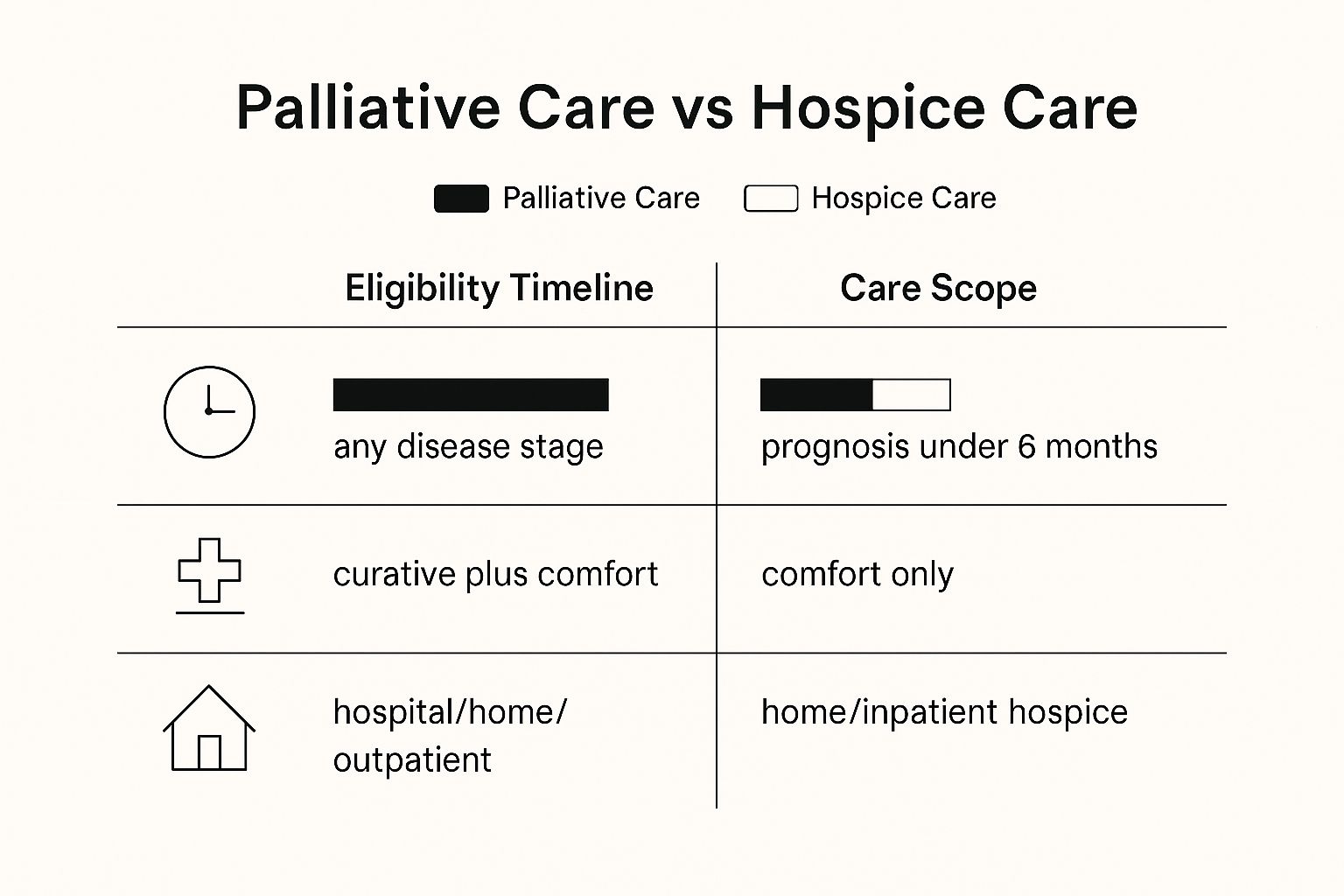
As this infographic shows, palliative care can run parallel to treatments aimed at a cure. Hospice care is a path chosen when the goal becomes comfort alone.
Palliative vs. Hospice Care at a Glance
A simple, direct comparison is often the best way to see the differences clearly. This table breaks down the core aspects of each type of care. It helps you quickly grasp which path might be right for your family’s needs.
| Care Aspect | Palliative Care | Hospice Care |
|---|---|---|
| Goal of Care | To improve quality of life and relieve symptoms at any stage of a serious illness. | To provide comfort, support, and dignity at the end of life when a cure is no longer possible. |
| Timing | Can begin at diagnosis and is provided alongside curative treatments. | Typically begins when life expectancy is six months or less, and curative treatments have stopped. |
| Location | Home, hospital, outpatient clinic, or long-term care facility. | Primarily in the comfort of home, but also available in nursing homes or dedicated hospice facilities. |
Choosing the right path forward is a deeply personal decision, and you do not have to make it alone. As a nonprofit provider with over 74+ years of service on the Central Coast, we have guided countless families through this process. To learn more, you can learn if palliative care is the right choice for a loved one in our guide.
Exploring Palliative Care: Support at Any Stage

When a serious illness enters your life, the focus often turns to tests, treatments, and prognosis. But what about your quality of life during that journey? That is where palliative care comes in.
This specialized medical care is designed to improve life for individuals and families facing a serious diagnosis. It provides an extra layer of support that can begin the moment you are diagnosed, regardless of the prognosis. A common myth is that palliative care means stopping treatment, but its purpose is to work with your primary doctors while you continue curative care.
What Does Palliative Care Involve?
The primary goal of palliative care is to provide relief from the symptoms, pain, and stress of a serious illness. At Central Coast VNA & Hospice, our interdisciplinary teams of professionals focus on the whole person, not just the disease.
This support often includes:
- Pain and Symptom Management: Our Registered Nurses are experts at managing complex symptoms like pain, nausea, and shortness of breath to improve daily comfort.
- Emotional and Spiritual Support: Our Medical Social Workers and Chaplains provide counseling and support, helping patients and families navigate the emotional weight of an illness.
- Care Coordination: We work closely with all of your doctors to ensure everyone is on the same page and that your care plan aligns with your personal goals.
Palliative care is defined by need, not prognosis. It is a proactive choice to add comfort and support to your healthcare journey, empowering you to live more fully.
This patient-first philosophy is essential as the need for this care grows. According to the World Health Organization, an estimated 56.8 million people, including 25.7 million in the last year of life, are in need of palliative care each year.
By putting your needs first, palliative care helps you regain a sense of control. For those in Monterey County, San Benito County, Santa Cruz County, and South Santa Clara County, our team is ready to provide this essential support. You can learn more about the 4 stages of palliative care.
Understanding Hospice Care: A Focus on Comfort and Dignity
While palliative care can be offered with curative treatments, hospice care represents a shift in focus. It is a compassionate philosophy of care that begins when an illness is no longer curable. The primary goal becomes maximizing comfort, peace, and quality of life.
This change usually occurs when a doctor certifies a patient has a life expectancy of six months or less if the illness runs its natural course. Choosing hospice is not about giving up; it is about redefining hope. The focus shifts toward living one's final months as fully and peacefully as possible with support for the patient and family.
How the Hospice Philosophy Works in Practice
At its heart, hospice is a holistic approach addressing a person’s physical, emotional, and spiritual needs. As a nonprofit organization serving the Central Coast for over 74 years, Central Coast VNA & Hospice brings this care directly to the patient’s home. Our mission is to ensure comfort and dignity.
Our specialized support includes:
- Expert Pain and Symptom Management: A Registered Nurse ensures the patient is as comfortable as possible.
- Personal Care Assistance: A compassionate Hospice Aide helps with daily living activities.
- Spiritual and Emotional Guidance: A Chaplain and a Medical Social Worker provide support for the patient and their family.
Choosing hospice empowers patients to live their final chapter on their own terms, focusing on quality moments. It is a decision to prioritize comfort above all else.
Our commitment extends beyond the patient’s life. We provide bereavement support to families for up to 13 months, a cornerstone of our mission-driven care. You can learn more by understanding long-term hospice care with our team.
A Situational Guide: When to Choose Each Type of Care

Knowing the definitions of palliative and hospice care is one thing, but applying them to a real-life situation is another. The decision depends on your family’s goals, the medical situation, and what you hope to achieve. This guide walks you through practical scenarios to make the distinction clear.
For families managing a serious illness like breast cancer, understanding this continuum of care is very important. As part of a health journey, you can learn more about breast cancer to see how supportive services fit into a larger treatment plan.
When Palliative Care is the Right Choice
Palliative care is the answer when you or a loved one are still pursuing treatment, but the side effects are impacting quality of life. The focus is on adding support, not replacing your current medical care.
Consider this common scenario: A resident in Santa Cruz County is undergoing chemotherapy. The treatment causes extreme nausea and fatigue, making daily life difficult. This is a perfect time for palliative care at home. A Registered Nurse from Central Coast VNA & Hospice could visit to help manage those symptoms, making it easier to continue cancer treatments.
When It’s Time to Consider Hospice
Hospice becomes the most compassionate choice when the focus shifts from curing an illness to maximizing comfort and peace. This transition often happens when the stress of aggressive treatments outweighs the potential benefits.
Consider this situation: A patient in South Santa Clara County with advanced heart failure has frequent hospital visits. More aggressive treatments are unlikely to help and are causing distress. Shifting to hospice care prioritizes quality of life. The Central Coast VNA & Hospice team would focus on pain management and emotional support, helping the patient live their remaining time comfortably at home.
Realizing it might be time for this transition is difficult, but you do not have to make this decision alone. Reading these 5 reasons to consider hospice for a loved one may offer some clarity.
Talking It Through: How to Discuss Care Options with Your Family and Doctor
Broaching the topic of palliative or hospice care with loved ones can be one of the hardest conversations. However, it is also one of the most important. A thoughtful discussion ensures everyone is on the same page, allowing you to make decisions with confidence.
These conversations are not about giving up. They are about aligning medical care with what truly matters to the patient—their personal values and goals.
Questions to Help Guide the Conversation
Walking into a discussion with your doctor or family with clear questions can make the process more manageable. This opens the door for a compassionate, productive dialogue about palliative vs. hospice care.
Try starting with questions like these:
- “What are our main goals for care right now? Are we focusing on a cure, on comfort, or both?”
- “Could we benefit from extra support from a specialized team to help manage symptoms at home?”
- “What does quality of life look like to you, and how can our family best support that vision?”
Advance care planning is a profound gift to your family. It replaces anxiety with clarity, ensuring your wishes are respected.
As you discuss care options, it is also wise to address financial planning. This may include looking into resources like long term care insurance for seniors.
The team at Central Coast VNA & Hospice is here to help facilitate these important conversations. With over 74+ years of experience supporting families across Monterey County, San Benito County, Santa Cruz County, and South Santa Clara County, we can help everyone get on the same page with compassion.
How Central Coast VNA & Hospice Delivers a Continuum of Care
Deciding between palliative and hospice care is a personal journey, but choosing the provider is just as critical. For families across Monterey County, Central Coast VNA & Hospice offers a true continuum of care. Our trusted, local nonprofit has been a leader for over 74+ years.
This integrated model means you never face a fragmented system. Patients can move smoothly from our home health services to palliative care, and eventually to hospice care when the time is right. There are no gaps in support. Our dedicated teams of Registered Nurses, Chaplains, Medical Social Workers, and Hospice Aides work together, ensuring your care is consistent and centered on your needs.
A Seamless Care Journey
Our approach removes the stress of finding a new provider as circumstances change. A patient receiving our palliative care at home in San Benito County already knows and trusts our team. If their goals later shift toward hospice, they continue their journey with the same compassionate people they rely on.
This seamless support has never been more vital. The need for these interventions is growing, yet access to coordinated care remains a challenge in many places. You can learn more about the global demand for palliative care on Medical Xpress.
As a local nonprofit, our mission is to close that gap for our neighbors in Monterey, San Benito, Santa Cruz, and South Santa Clara counties. If you would like to discuss how our continuum of care can support your family, please contact our team today.
Frequently Asked Questions About Palliative and Hospice Care

It is normal to have many questions when a serious illness affects your family. Understanding the key differences in the palliative vs. hospice discussion is the first step toward feeling confident in your decisions.
Our goal is to provide clear, straightforward answers. Here are some of the most common questions we hear from families on the Central Coast.
Can a patient receive both curative treatment and palliative care?
Yes, absolutely. This is one of the biggest distinctions between palliative and hospice care. Palliative care is an extra layer of support that works alongside curative treatments like chemotherapy or rehabilitation. The focus is on managing symptoms and improving quality of life during treatment.
Does choosing hospice care mean we are giving up?
Not at all. Choosing hospice is an act of empowerment and love. It is a decision to shift the focus from curing an illness to maximizing comfort, peace, and quality of time that remains. It redefines hope by focusing on living each day with as much dignity as possible.
Who pays for palliative and hospice care?
Hospice care is typically 100% covered by Medicare Part A, Medi-Cal, and most private insurance plans. This leaves families with few, if any, out-of-pocket costs. Palliative care is often paid for by Medicare Part B, Medi-Cal, and private insurance, similar to other specialist medical services.
Can a patient leave hospice care if their condition improves?
Yes, a patient has the right to stop hospice services at any time. If their condition stabilizes or they decide to pursue a new curative treatment, they can revoke their hospice benefit. They are always free to re-enroll in hospice later if their health changes.
Where is care from Central Coast VNA & Hospice provided?
As a provider with over 74 years of local history, we bring our services to you. We offer home health, palliative care, and hospice care in the comfort of your own home throughout our service areas of Monterey County, San Benito County, Santa Cruz County, and South Santa Clara County.
Can I transition from palliative to hospice care with the same provider?
Yes, and this is a key benefit of Central Coast VNA & Hospice's continuum of care model. Patients can transition smoothly from palliative care to hospice care with the same trusted, compassionate team they already know. This continuity ensures consistent, familiar support for the patient and their family.
The compassionate team at Central Coast VNA & Hospice is always here to help you and your family navigate these important conversations. With over 74+ years of service to our local communities, we have the experience to provide the expert guidance you need. Contact us today to learn more.