
When you are dealing with a serious illness, figuring out your care options can feel like a big challenge. Let's clear up the confusion.
Palliative care is comfort-focused care you can get at any stage of a serious illness. On the other hand, hospice is comfort-focused care for the final stage of life. Both are designed to improve quality of life, but they start at different times.
Understanding Your Comfort Care Options
Making healthcare decisions for yourself or a loved one requires clear information. As an illness gets harder to manage, two important types of care are palliative and hospice. They are often confused, but they have very different roles.

It helps to think of these services as a range of support. At Central Coast VNA & Hospice, we are a local nonprofit with over 74 years of experience. We have guided many families on this journey across Monterey County, San Benito County, Santa Cruz County, and South Santa Clara County. Our mission is to give you the right support at the right time.
What Is the Goal of Supportive Care?
The goal of both palliative and hospice care is to bring relief from the symptoms and stress of a serious illness. The focus shifts from just treating the disease to caring for the whole person. This ensures their comfort, dignity, and wishes are respected.
Some key benefits include:
- Symptom Management: Managing pain, tiredness, and other difficult symptoms to make daily life better.
- Emotional and Spiritual Support: Offering guidance from Chaplains and Medical Social Workers to help patients and families.
- Coordinated Care: Making sure all doctors and specialists work together, which creates a less stressful healthcare experience.
When you understand your choices, you can ask for the care you or your loved one deserves. For example, our palliative care at home services add an extra layer of support while you continue curative treatments.
To help you see the differences, here is a simple comparison.
Palliative Care vs. Hospice At a Glance
| Feature | Palliative Care | Hospice Care |
|---|---|---|
| Timing | Can begin at any stage of a serious illness | Typically for a life expectancy of 6 months or less |
| Treatment | Can be received with curative treatments | Focuses on comfort; curative treatments are stopped |
| Goal | Improve quality of life and manage symptoms | Ensure comfort, dignity, and peace at the end of life |
| Location | Often provided in a hospital, clinic, or at home | Most often provided at home or in a facility |
This table provides a quick reference, but every family's situation is unique.
Making an Informed Decision
Choosing the right path is a personal decision. It is a conversation that involves your family, your doctors, and your own values. Understanding the difference between palliative and hospice care is the first step.
As you explore these options, it is also smart to look into resources for things like cancer financial assistance. As a mission-driven nonprofit, Central Coast VNA & Hospice is here to provide guidance and support.
What Is Palliative Care? Support at Any Stage
Imagine having an extra layer of support while you continue to fight a serious illness. That is what palliative care is. It is special medical care that focuses on relieving symptoms, pain, and stress from conditions like cancer or heart failure.
Unlike hospice, palliative care can begin as soon as you are diagnosed. It is not about giving up hope or stopping treatment. It is like adding a dedicated team to your side, working with your primary doctor to help you feel better.
Who Can Benefit from Palliative Care?
Palliative care is for anyone, at any age, dealing with a serious illness. If you or a loved one is worn down by difficult symptoms, palliative care could be the right choice. This support is especially helpful for people managing long-term health conditions.
The need for this kind of support is growing. According to the National Hospice and Palliative Care Organization (NHPCO), the demand for palliative care is increasing as our population ages. Yet, many people who need it are not able to get it.
At Central Coast VNA & Hospice, our mission is to bring this important care into homes across Monterey County and the surrounding areas. We make expert symptom management available where it is needed most. Our nonprofit organization has proudly served our local communities for over 74 years.
What Does the Palliative Care Team Do?
Our palliative care team becomes a partner in your health journey. The team, which includes a Registered Nurse and a Medical Social Worker, works closely with your other doctors.
The team focuses on key areas to improve your daily life:
- Pain and Symptom Control: Our clinicians are experts at managing tough symptoms like pain, nausea, and tiredness.
- Communication and Coordination: We make sure all your doctors are on the same page. This reduces stress for you and your family.
- Emotional and Spiritual Support: Our team provides counseling and resources to help you and your family cope.
- Clearer Medical Guidance: We help you understand your treatment options so you can make informed decisions.
Think of palliative care as a support system that works with your existing medical treatments. It fills in the gaps, focusing on your comfort so you can better handle your primary medical plan.
Palliative Care Is Not Hospice
One of the biggest myths is that palliative care is the same as end-of-life care. This is not true. Palliative care is right for any stage of a serious illness, no matter the outlook.
For example, a patient getting chemotherapy for cancer can use palliative care to manage side effects. This extra support helps them stay strong enough to keep fighting their illness.
Central Coast VNA & Hospice is proud to offer palliative care at home in Monterey County. As a trusted local nonprofit with over 74 years of service, our mission is to provide compassionate care that improves your well-being.
What Is Hospice Care: Comfort in Life's Final Chapter
When a serious illness reaches a point where treatments are no longer focused on a cure, hospice offers a compassionate path forward. This is not about giving up. It is a shift in focus toward caring for the whole person and making the most of the time left.

This gentle approach is designed to meet a person’s complete needs—physical, emotional, and spiritual. It redefines hope, focusing on achieving peace and comfort. Choosing hospice is a decision that honors a person’s dignity and wishes.
The Core Principles of Hospice
Hospice care is based on the belief that everyone deserves to live their final months with comfort and peace. It is about improving the quality of life, not speeding up death. This care is usually provided wherever the patient calls home.
As a local nonprofit with over 74 years of service, Central Coast VNA & Hospice is dedicated to providing this support. Our mission is to ensure every patient in Monterey County, San Benito County, and our other service areas feels respected and cared for.
The Interdisciplinary Hospice Team
Hospice care is provided by a whole team of professionals. They create a circle of support around the patient and their family. Each team member brings a unique skill to make sure every need is met.
Your Central Coast VNA & Hospice team includes:
- Registered Nurse: Manages pain and other symptoms and coordinates care.
- Hospice Aide: Helps with personal care like bathing and dressing.
- Chaplain: Offers spiritual support that respects the patient's personal beliefs.
- Medical Social Worker: Provides emotional support and connects families with community resources.
- Trained Volunteers: Offer companionship and give family members a break.
This team approach ensures that no need is missed. It creates a powerful support system so families can focus on making meaningful memories together. According to the National Hospice and Palliative Care Organization (NHPCO), over 1.72 million Medicare beneficiaries received hospice services in 2020 (NHPCO, 2021).
A Focus on Comfort and Quality of Life
The main goal of hospice is to manage symptoms so the patient can live as alert and pain-free as possible. This involves expert pain management and addressing other symptoms like anxiety. To see how our approach works, you can read our guide on what hospice care is.
Families often need to navigate complex plans to meet a patient's wishes. This can sometimes include understanding financial terms like the difference between a death tax vs. estate tax. By focusing on the whole person, hospice care helps bring peace to the entire family.
Comparing Palliative Care and Hospice Services
To help your family make the right choice, it helps to see these two types of care side-by-side. The biggest difference between palliative care and hospice comes down to timing and goals. Palliative care works alongside curative treatments at any stage of a serious illness.
Hospice care is for when those treatments have stopped, and the focus shifts to comfort. This key difference shapes everything that follows. Understanding it is the first step toward choosing the right support at the right time.
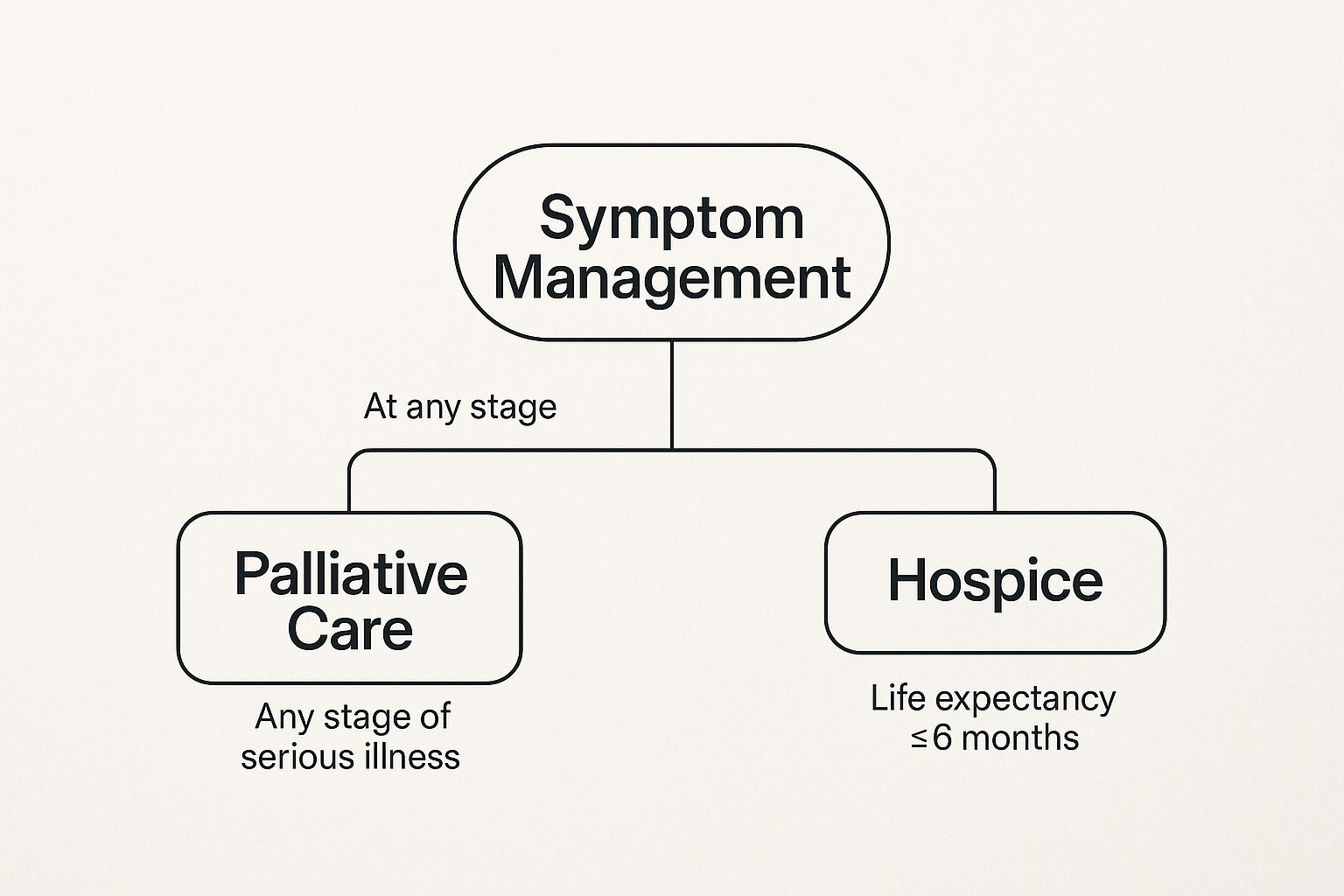
As you can see, both paths lead to comfort. But they begin at different points in a person's healthcare journey. This is key to understanding what palliative care and hospice are all about.
Timing And Treatment Goals
The most important difference is when each service can begin. Palliative care can start when someone is diagnosed and can continue for years alongside treatments like chemotherapy. Its main goal is to manage symptoms and stress to improve your quality of life.
Hospice care begins when the focus shifts away from curing the disease. It is for patients who have a life expectancy of six months or less. Here, the goal is to maximize comfort, peace, and time with loved ones.
The Composition Of Your Care Team
While both teams include different professionals, their members reflect their different goals. The experts at Central Coast VNA & Hospice build each team around the patient's specific needs.
Both palliative and hospice care use a special team to provide support. This table breaks down who you can expect on your team.
Who Is on Your Care Team
| Team Member Role | Palliative Care Team | Hospice Care Team |
|---|---|---|
| Registered Nurse (RN) | ✓ | ✓ |
| Medical Social Worker | ✓ | ✓ |
| Hospice Aide | ✓ | |
| Chaplain | ✓ | |
| Trained Volunteers | ✓ |
The palliative team works with your existing doctors, adding an extra layer of support. The hospice team becomes your primary care plan, centered on comfort.
Here is a closer look at the roles:
- Palliative Care Team: This team usually includes a Registered Nurse and a Medical Social Worker. They focus on symptom management and coordinating care. You can learn more about our palliative care services.
- Hospice Care Team: This is a more complete team that includes a Registered Nurse, Hospice Aide, Chaplain, Medical Social Worker, and trained volunteers. This group provides full medical, emotional, and spiritual support.
How Care Is Paid For
How each service is paid for also differs. Getting clear on this can provide peace of mind.
Palliative care is typically covered by Medicare Part B, Medi-Cal, and most private insurance plans. It is covered like a visit to any other medical specialist.
H hospice care has a special payment model. The Medicare Hospice Benefit covers almost everything related to the terminal illness. This includes:
- Services from the entire hospice team
- Medical equipment (like a hospital bed)
- Medical supplies
- Medications for symptom control
This benefit is designed to relieve the financial burden on families. As a nonprofit that has served this community for over 74 years, Central Coast VNA & Hospice helps families navigate these options.
How to Know When It Is the Right Time for Care
Deciding when to bring in extra support is a big step. The right time for palliative care is not the same as the right time for hospice. Understanding the difference can bring clarity and peace of mind.
For palliative care, the answer is simple: the time is right as soon as a serious illness is diagnosed. It is based on the need to manage symptoms and improve quality of life while you continue with your regular treatments.
Palliative Care: When You Need an Extra Layer of Support
If you or a loved one is dealing with difficult symptoms from a condition like cancer or heart disease, palliative care can help. It works with your primary medical treatments, never replacing them. The goal is to help you feel stronger and more comfortable.
Getting a referral is easy. It can come from your doctor, or you can ask for it yourself. At Central Coast VNA & Hospice, our team works with physicians across Monterey, San Benito, and Santa Cruz counties to make sure your care is coordinated.
Hospice Care: When Comfort Becomes the Priority
The timing for hospice care is more specific. It is designed for the final chapter of a life-limiting illness. To be eligible, a doctor must certify that a patient likely has a life expectancy of six months or less.
That six-month timeframe often confuses people. It is important to know that hospice care does not just stop after six months. Patients can continue receiving support as long as they meet the medical criteria.
Deciding to start hospice care is a choice that shifts the focus from curing an illness to maximizing comfort. It is about ensuring every day is lived as fully as possible.
The referral process is simple. Anyone—the patient, a family member, or a doctor—can make the first call. For a deeper look, you can explore our guide on when to call hospice.
Knowing the difference in timing helps you ask for the right kind of help at the right time. As a nonprofit that has served our community for over 74 years, we're committed to providing the right care when it is needed most.
Getting Started with Central Coast VNA and Hospice
Taking the first step toward getting more support is often the hardest part. We understand that. Knowing when and how to ask for help is a sign of strength.

The journey always begins with a conversation. We encourage you to speak openly with your doctor about your symptoms and challenges. This discussion is the foundation for a care plan that honors your wishes.
Your Path to Compassionate Care
Once you have talked with your doctor, the next step is connecting with us. Central Coast VNA & Hospice offers a consultation to help you understand your options. Our role is to provide information and guidance, never pressure.
Here is a simple, three-step guide to our services:
- Talk to Your Doctor: Start a conversation about the challenges you are facing. Your doctor can provide a referral for palliative care or hospice.
- Contact Our Team: You can reach out to Central Coast VNA & Hospice directly. Our caring team will coordinate with your physician.
- Schedule a Consultation: We will arrange a visit to discuss your needs and develop a personalized care plan.
As a community-based nonprofit, our mission is to provide the highest quality care. For over 74 years, we have been a trusted partner for families throughout Monterey County, San Benito County, Santa Cruz County, and South Santa Clara County.
At Central Coast VNA & Hospice, our focus is on your well-being. We are a mission-driven organization committed to serving our community with compassion.
This commitment means we work with you to navigate insurance coverage, including Medicare and Medi-Cal. Expert, compassionate help is always just a phone call away.
Ready to learn more? Contact us today to start the conversation and find the support you need.
Frequently Asked Questions About Palliative and Hospice Care
Making healthcare decisions for yourself or a loved one can feel overwhelming. Families often have a lot of questions. Here are answers to some questions we hear most often.
Can a patient receive palliative care and still try to cure their disease?
Yes, absolutely. This is the biggest difference between palliative care and hospice. Palliative care is designed to work with your regular medical treatments.
Think of it as an extra layer of support. While your main doctor focuses on treating the illness, our palliative team focuses on you. We work to manage tough side effects like pain or fatigue to improve your quality of life.
Does choosing hospice care mean we are giving up hope?
Not at all. Choosing hospice means changing what you hope for. When treatments are no longer working, hope often shifts from a cure to comfort, peace, and quality time.
Hospice helps patients live their final months with dignity, on their own terms. The focus turns to finding joy and creating meaningful memories with family.
Where are palliative and hospice services provided?
Both palliative and hospice care are brought to you, wherever you call home. We believe people are most comfortable in a familiar setting.
Across Monterey, San Benito, Santa Cruz, and South Santa Clara counties, we provide our services in:
- Your own home
- Assisted living facilities
- Skilled nursing facilities
Bringing care to the patient eliminates the stress of travel. It allows them to stay surrounded by the people and things they love.
Who pays for palliative and hospice care?
It is important for families to understand how each service is covered. The payment structures are different.
Palliative care is usually covered by Medicare Part B, Medi-Cal, and most private insurance plans. It is billed like a visit to a medical specialist.
Hospice care is most often covered 100% by the Medicare Hospice Benefit. This benefit was created to relieve families of financial stress. It covers the hospice team, medications, and medical equipment.
How long can someone receive hospice care?
Many people think hospice is just for the last few days of life, but this is a common myth. The Medicare Hospice Benefit is for patients with a life expectancy of six months or less. But care does not stop at the six-month mark.
As long as a doctor recertifies that the patient still meets the medical criteria, they can continue receiving hospice support. You can learn more about hospice care eligibility. This ensures patients and families receive care for as long as they need it.
At Central Coast VNA & Hospice, our mission is to provide clear answers and compassionate support to guide you through your healthcare journey.
Contact us today to learn more about how we can help your family.