
Navigating the first steps toward getting medical care at home can feel overwhelming, but it all boils down to a few core requirements. Knowing what they are ahead of time makes the entire process much smoother for your family.
At Central Coast VNA & Hospice, we have guided families through this for over 74 years. Serving Monterey, San Benito, Santa Cruz, and South Santa Clara counties, our nonprofit mission is to help patients get the expert support they need in the comfort of their own homes.
The Foundational Requirements for Eligibility
To start, let’s get straight to the point. Qualifying for home health care, especially when using Medicare, hinges on a few specific, non-negotiable criteria. These rules are in place to ensure services go to the people who truly need them most.
You generally need to meet these three conditions:
- A Doctor's Order: A physician must formally certify that you need medical care at home. This is not just a suggestion; it’s a requirement that kicks off a formal plan of care.
- Need for Skilled Care: The care you need must be something that requires a licensed professional, like a Registered Nurse or a Physical Therapist. This is different from needing help with daily chores; it’s about medical treatment.
- Being Homebound: This is a big one. It means that leaving your home takes a considerable and taxing effort, making outpatient care a significant challenge.
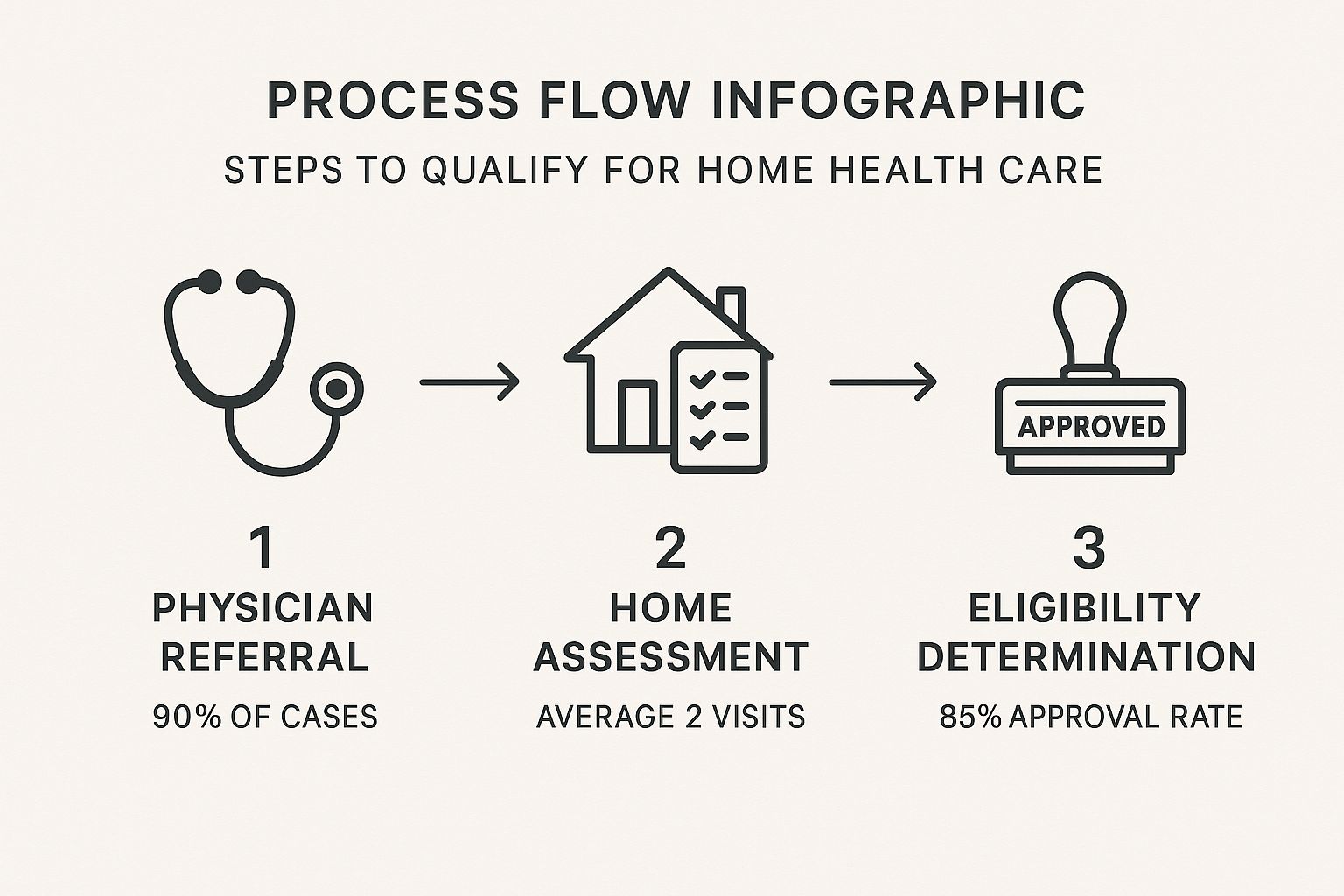
As you can see, it almost always starts with a doctor's referral. From there, a home health agency like Central Coast VNA & Hospice conducts an in-home assessment to confirm that home health is the right fit.
Core Eligibility Requirements at a Glance
To make this even clearer, here’s a simple breakdown of what these requirements mean in the real world. Our team helps families in Monterey County and surrounding areas understand these rules every day.
| Requirement | What It Means for Your Family | A Real-World Example |
|---|---|---|
| Doctor's Order | Your loved one's primary physician must create and sign a plan of care that outlines the necessary medical services. | After a hospital stay for a broken hip, a doctor orders physical therapy and skilled nursing at home to manage wound care and monitor recovery. |
| Homebound Status | Leaving home requires significant effort (e.g., using a walker, wheelchair, or needing help from others) and is infrequent. | A person with severe COPD who becomes short of breath after walking a few feet would be considered homebound, even if they can leave for doctor's visits. |
| Skilled Care Need | The patient needs intermittent services from a licensed professional, not just custodial or personal care. | A Registered Nurse is needed to administer IV antibiotics, or a speech therapist is required to help a stroke survivor regain their ability to swallow safely. |
Understanding these distinctions is key. They separate patients who qualify for these specialized medical services from those who might need other types of in-home assistance.
Medicare’s Role in Home Health Services
For millions of Americans, Medicare is the primary way to pay for home health care. In fact, in 2020, about 3.4 million Medicare beneficiaries relied on these services to recover at home. Because of this, Medicare's rules have become the gold standard that many private insurance plans follow.
At its heart, qualifying for home health care is about matching a patient's medical needs with the right professional support. It's about bringing a clinical team's expertise directly to the patient's bedside to foster safety, healing, and independence.
Central Coast VNA & Hospice is a nonprofit dedicated to providing these vital home health care services. We specialize in creating a smooth transition from the hospital back to the home, supporting patients every step of the way on their recovery journey.
Your Doctor's Role in Creating a Plan of Care

Your journey into home health care almost always begins with your physician. A doctor's official order, which comes after a thorough medical assessment, is what truly opens the door to receiving specialized services in your own home.
This order kicks off the creation of a vital document: the plan of care. You can think of it as the personalized roadmap for your recovery. It’s a collaborative game plan developed by your doctor and the clinical team from the home health agency.
What the Plan of Care Includes
The plan of care is the central hub that guides every single aspect of your treatment. It’s what keeps everyone on the same page—from your doctor to you, your family, and the entire home health team.
A truly comprehensive plan of care will spell out:
- Specific Services Needed: It clearly states which types of skilled care are medically required, whether that’s skilled nursing, physical therapy, occupational therapy, or speech-language pathology.
- Frequency and Duration of Visits: The plan details exactly how often a Registered Nurse or therapist will visit and gives an idea of how long you’ll need the services.
- Primary Diagnoses: This section identifies the specific medical conditions that make home-based care necessary.
- Health and Recovery Goals: It sets clear, measurable objectives, such as improving your ability to walk safely or managing pain.
- Medication and Treatment Orders: All medications, treatments, and any necessary medical supplies are documented right here.
To make sure your doctor’s orders and the resulting plan meet the strict eligibility requirements, it helps to understand essential medical documentation guidelines. This is the paperwork that justifies why the services in the plan are needed.
A Real-World Example in Salinas
Let’s look at how this plays out in a real-life situation. Imagine Maria, a Salinas resident in Monterey County, who is home after a hip replacement. Her surgeon knows she needs professional medical support to heal safely and properly at home.
The surgeon sends a referral to Central Coast VNA & Hospice. A CCVNA Registered Nurse then visits Maria at her home to do an initial assessment. From there, Maria’s surgeon and the CCVNA nurse work together to build her detailed plan of care.
This collaborative approach ensures that the plan of care is not just a document, but a living guide tailored to the patient's unique home environment and recovery needs. It bridges the gap between hospital-level care and safe, independent living.
For Maria, this personalized plan includes:
- Skilled nursing visits twice a week for wound care and to watch for any signs of infection.
- Physical therapy sessions three times a week to help her get her strength and mobility back.
- Medication management to keep pain under control and prevent complications like blood clots.
This plan gives Maria, her family, and her entire care team a clear path forward. It’s this physician-led, team-based approach that makes qualifying for home health care so effective, bringing expert medical support directly into homes across the Central Coast. Central Coast VNA & Hospice offers a wide variety of these home care services designed to support recovery and independence.
What 'Homebound' and 'Skilled Care' Really Mean
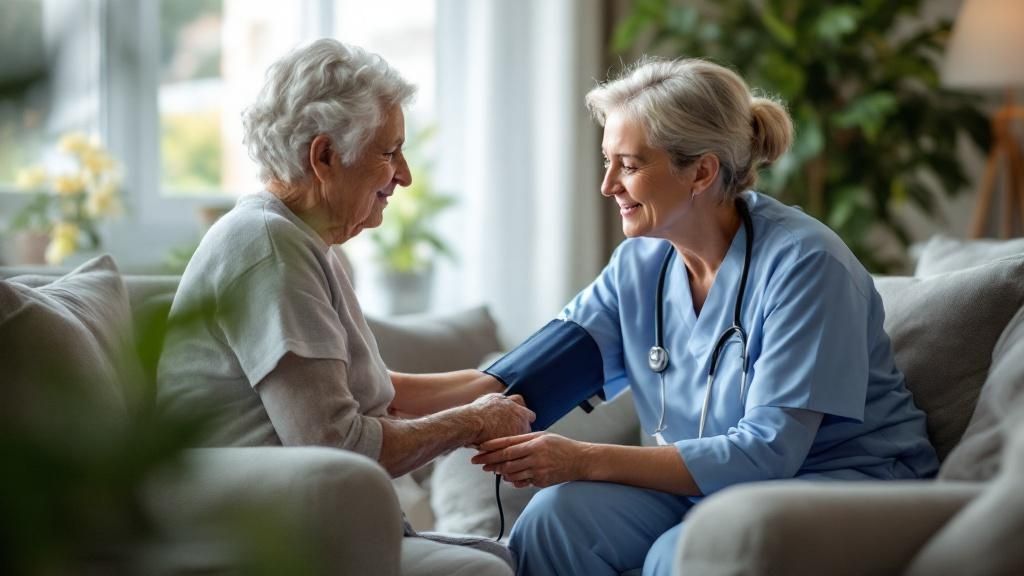
When families start looking into their options, a couple of terms almost always cause some confusion: "homebound" and "skilled care." Getting a handle on what these words actually mean in a medical context is essential, as they are the cornerstones of qualifying for home health services.
Defining 'Homebound' in the Real World
Let's tackle "homebound" first. The word itself sounds pretty restrictive, but it doesn't mean your loved one has to be confined to a bed. Instead, it’s a term used to describe a situation where leaving home takes a considerable and taxing effort.
Someone is considered homebound if they need help from another person or a device like a walker to leave home safely. Occasional, short trips for things like doctor's appointments, religious services, or even a haircut are generally fine.
Think about a patient in Santa Cruz County who's recovering from heart surgery. The thought of walking to the car and going to an appointment would leave them exhausted. This person is a perfect example of someone who is homebound.
The Meaning of 'Skilled Care'
The other key term is "skilled care." This isn't just any kind of help; it refers specifically to medical services that can only be performed correctly and safely by a licensed health professional like a Registered Nurse.
Skilled care is different from personal or custodial care, which covers assistance with activities like bathing and dressing. While a Home Health Aide can certainly provide personal care, it's typically only covered by insurance when a patient also needs skilled services. You can get a deeper understanding of these differences by reading our article on home health vs. hospice.
What does skilled care look like in practice? Here are a few examples:
- Skilled Nursing: A Registered Nurse (RN) visits to manage a complex wound, administer IV medications, or teach a patient about their condition.
- Physical Therapy: A Physical Therapist (PT) guides someone through targeted exercises to rebuild strength and balance after a fall or a stroke.
- Speech-Language Pathology: A therapist works with a patient to help them regain the ability to speak clearly or swallow safely.
- Occupational Therapy: An Occupational Therapist (OT) retrains a patient on how to safely handle daily tasks like bathing or cooking.
"During our first visit, we do more than just check vital signs. We have a compassionate conversation to understand the whole picture—how a patient feels, what challenges they face at home, and what their personal goals are. This helps us ensure the plan of care truly supports their safety and well-being." – Central Coast VNA & Hospice Clinician
This focus on skilled, professional care delivered right in the home is particularly critical for older adults. In fact, about 86% of all home health care patients in the United States are age 65 or older. For a broader look at the data, you can discover more home health insights and statistics.
Navigating Medicare and Other Insurance Coverage
Figuring out the financial side of home health care is often the biggest source of relief for families we work with. Once a doctor has certified that home-based medical care is necessary, the next logical question is always, "How are we going to pay for this?"
For most of our patients in Monterey, San Benito, Santa Cruz, and South Santa Clara counties, Medicare is the primary payer. It’s a huge weight off their shoulders to learn that when all criteria are met, Medicare Part A and Part B typically cover 100% of the cost for home health services.
What Medicare Typically Covers
When you qualify, Medicare coverage is quite specific. It's designed to pay for the intermittent, medically necessary services that help you recover from an illness, injury, or surgery.
Here's what that usually includes:
- Skilled Nursing Care: Provided on a part-time or intermittent basis by a Registered Nurse.
- Physical Therapy: To help restore mobility, balance, and strength.
- Occupational Therapy: To help you regain the ability to safely perform daily activities.
- Speech-Language Pathology Services: To address issues with communication or swallowing.
- Home Health Aide Services: For assistance with personal care, but only if you're also receiving skilled nursing or therapy.
It's just as important to know what Medicare doesn't cover. For example, it won't pay for 24-hour care at home, meal delivery, or "custodial care" if that's the only assistance you need. For anyone looking to bridge the gaps in Original Medicare, finding the best Medicare Supplement Plan is often a critical piece of the puzzle.
The goal of insurance coverage for home health is to provide the precise medical support needed for recovery, not to replace the non-medical help a family might provide. It’s about clinical care delivered in the home environment.
Private Insurance, Medi-Cal, and Other Payers
While many private insurance plans and Medi-Cal (California's Medicaid program) often follow Medicare's lead, their rules can vary. It's always best practice to contact your insurance provider directly to confirm your specific benefits.
At Central Coast VNA & Hospice, our team is here to help families make sense of their coverage options. As a local nonprofit provider with over 74 years of experience, we do everything we can to minimize financial surprises so you can focus on healing.
The Growing Shift Towards Home-Based Medical Care

Home health care isn't just about convenience anymore. It represents a real, positive change in how modern medicine works, and both patients and doctors are realizing that the best place to heal is often right at home.
This isn't just a fleeting trend. It’s a movement driven by our country's aging population and clear clinical proof that home-based treatment is highly effective. This evolution in healthcare aligns perfectly with our 74-year mission here at Central Coast VNA & Hospice.
Why Home Is Becoming the Preferred Place for Care
The desire to receive care at home goes beyond simple comfort—it's about getting better results. Thanks to incredible advances in technology, like telehealth and remote monitoring, sophisticated medical supervision is no longer confined to a hospital room.
This shift is making waves economically, too. The global home healthcare industry, which was valued at around USD 416.4 billion in 2024, is expected to keep growing as more people need ongoing medical support in their own homes.
Qualifying for home health care is more than just a procedural step. It’s an opportunity to embrace a better, more patient-centered model of care that prioritizes dignity, independence, and healing in the place you feel most secure.
This model lets people recover on their own terms, with the people and things they love close by. You can see this firsthand in stories about how people like veteran Nolan Chandler are impacting lives through home care.
Embracing a Better Model of Healing
For families living in Monterey County, San Benito County, Santa Cruz County, and South Santa Clara County, this shift means you have access to a higher standard of personalized medicine. It means less time in institutional settings and more time focusing on what really matters: getting better.
When you partner with a provider like CCVNA, you're choosing a team that is completely dedicated to this modern, compassionate philosophy. Families get incredible peace of mind knowing their loved one is receiving expert, one-on-one attention. If you're starting to explore your options, you might find our guide on the 9 ways home health care will benefit your loved one helpful.
Frequently Asked Questions About Home Health Eligibility
It is completely normal to have questions when first exploring home health care. Getting clear, straightforward answers is the best way to feel confident you are making the right choice for a loved one. With over 74 years of experience, our team at Central Coast VNA & Hospice is here to help you navigate the process.
We have gathered some of the most frequent questions we hear from families across Monterey, San Benito, Santa Cruz, and South Santa Clara counties. Let's tackle them one by one.
1. How do I start the process with Central Coast VNA & Hospice?
Getting started is simple. It all begins with a conversation with your doctor. Ask them if a referral for home health care might be a good fit for you. Your doctor can then send a referral directly to our team. You or your family members are always welcome to call us directly to ask questions and learn more.
2. Can I qualify if I live in an assisted living facility?
Yes, you absolutely can. A person's "home" can be a private house, an assisted living facility, or a group home. The key is meeting the other core eligibility criteria: you need a doctor’s order, must be considered homebound, and require intermittent skilled care.
3. How long can someone receive home health care services?
The length of care is based entirely on your specific medical needs and the goals in your physician-approved plan of care. Home health care is typically approved in 60-day periods. If you still need skilled support after 60 days, your doctor can "recertify" your care for another period.
4. What if my condition improves and I’m no longer homebound?
This is fantastic news and the goal of our services. The purpose of home health care is to help you recover to the point where you can manage safely on your own. If you are no longer homebound or no longer require skilled medical care, you would no longer meet the Medicare criteria for our services, and your care team would plan a safe discharge.
5. Are personal care services like bathing covered?
This is a very common question. Personal care from a Home Health Aide—like help with bathing or dressing—can be covered by Medicare, but with one critical rule. These services are only covered if they are part of a larger plan of care that also includes skilled services, like skilled nursing or physical therapy. For a deeper look, we've explained home health eligibility in detail in another guide.
At Central Coast VNA & Hospice, our mission as a nonprofit organization is to provide compassionate, high-quality care that helps you heal in the comfort of your own home. If you have more questions about qualifying for home health care or want to explore our continuum of care, from home health to palliative and hospice services, please reach out to us.
Learn more about how we can help by visiting https://ccvna.com or calling us today. We are here to serve the communities of Monterey County, San Benito County, Santa Cruz County, and South Santa Clara County.