
Thinking about hospice care brings up many emotions and questions. The first step toward understanding it is quite straightforward.
At its core, hospice eligibility comes down to a doctor’s professional judgment. They must determine that a patient has a terminal illness and a life expectancy of six months or less, assuming the illness takes its natural course. This marks a fundamental shift in focus—away from treatments meant to cure and toward care centered on comfort, dignity, and peace.
When Is It Time to Consider Hospice Care?

Knowing when to explore hospice is a deeply personal process. While the medical prognosis is the official starting point, the decision is really about changing the philosophy of care. It’s about choosing to prioritize quality of life when aggressive treatments may no longer be working or wanted.
This is a conversation, not a command. A patient’s own doctor and a dedicated hospice medical director work together to make the clinical determination. At Central Coast VNA & Hospice, our team is committed to supporting families through this process with warm, compassionate guidance.
We ensure everyone in Monterey County, San Benito County, Santa Cruz County, and South Santa Clara County feels heard, informed, and respected. Our local roots and 74+ years of service mean we understand our community's needs.
The Focus on Quality of Life
Hospice isn't about giving up. It’s about adding life to a patient's days, not just more days to their life. The eligibility process is designed to recognize that point when the burdens of treatment start to outweigh the potential benefits.
This opens the door to a kind of care that addresses the whole person. Of course, that includes managing physical pain, but it also means providing emotional and spiritual support for both the patient and their family. Our interdisciplinary team—which includes Registered Nurses, Chaplains, and Medical Social Workers—works together to create a plan that honors the patient’s wishes.
Understanding the Prognostic Guideline
The "six-month" timeline is a key part of the hospice eligibility requirements first established by Medicare. This has become the standard for most private insurance as well. According to the National Hospice and Palliative Care Organization (NHPCO), over 1.72 million Medicare beneficiaries received hospice services in 2020 (NHPCO, 2021).
It's critical to understand that this is a guideline, not an expiration date. It's a medical estimation of what the future may hold. Taking a moment to explore the distinctions between palliative and hospice care can help clarify how each one supports patients at different stages of a serious illness along our continuum of care.
At Central Coast VNA & Hospice, with over 74 years of nonprofit service, we believe that understanding these requirements is the first step toward accessing profound support. Our local roots and mission-driven approach ensure that every family receives the guidance they need to make the best decision for their unique situation.
If you believe a loved one might benefit from this specialized care, starting the conversation is a courageous and loving act. Contact us today to learn more about how we can help.
Understanding the Core Medical Criteria

While the official starting point for hospice is a six-month prognosis, what does that really look like day-to-day? The clinical side of hospice eligibility requirements goes much deeper than just a timeline. It’s about observing specific, tangible changes in a person’s health and well-being that tell us an illness is entering its final stage.
This is where a concept called functional decline comes into play. It’s simply a term for a noticeable and progressive loss of ability to perform daily activities. Recognizing these signs is often the first step for families in understanding that it might be time to have a meaningful conversation about comfort care.
What Is Functional Decline?
Think of functional decline not as one single event, but as a slow, steady tide going out. It reveals new challenges that weren't there before. For families, these shifts are often the most visible evidence that a loved one’s condition is advancing beyond what curative treatments can manage.
The presence of functional decline helps doctors paint a much clearer picture of a patient’s overall health. It gives them concrete evidence to support a terminal prognosis, which makes the whole eligibility determination more accurate. It's why our team at Central Coast VNA & Hospice pays such close attention to these details during an assessment.
Our expert Registered Nurses, with their deep experience in home-based care across Monterey County and the surrounding areas, are trained to see these subtle but significant changes. They work side-by-side with a patient’s primary doctor to ensure the evaluation is both thorough and compassionate.
Common Signs of Functional Decline
It can be tough to watch these changes happen, but knowing what to look for can empower you. Some of the most common indicators that may point toward hospice eligibility include:
- Progressive Weight Loss: This is unintentional weight loss, especially when someone is eating normally. It can be a sign the body is no longer able to process nutrients effectively because of the advanced illness.
- Increased Assistance with Daily Activities: A growing need for help with simple tasks like bathing, getting dressed, eating, or even just moving from a bed to a chair often shows declining strength and energy.
- Worsening Symptoms: This could be pain, shortness of breath, or nausea that becomes more frequent, more intense, or stops responding to the usual treatments.
- More Frequent Hospitalizations: If trips to the ER or hospital stays are becoming more common, it can signal that an illness is getting harder to manage outside of a supportive care setting.
- Decreased Alertness: Spending more time sleeping, being less engaged in conversations, or showing new signs of confusion can all point to a significant physical decline.
These markers aren't just a checklist; they're pieces of a larger story. Every person’s journey is unique, and our nonprofit, mission-driven approach ensures we always see the individual, not just the symptoms. For a deeper look, you can learn more about how doctors determine hospice eligibility in our related guide.
The Role of a Professional Assessment
While families are often the first to notice these changes, a formal evaluation by a professional is a necessary step. A patient’s personal physician, working with a hospice medical director, must certify that the medical criteria have been met.
At Central Coast VNA & Hospice, this process always begins with a compassionate conversation. One of our Registered Nurses will conduct an in-home assessment, respectfully observing the patient’s condition and talking with the family. This visit provides the clinical information the physician needs to make a final determination.
Our role, built on 74 years of serving the Central Coast, is to bring clarity and support. We help translate complex medical information into terms everyone can understand, making sure families in Monterey, San Benito, Santa Cruz, and South Santa Clara counties feel confident in their decisions. If you've noticed signs of decline, contacting us is a proactive step toward getting the answers and support your family needs.
Navigating Medicare and Insurance for Hospice

Worrying about how to pay for hospice care is a burden no family should have to carry. When a loved one needs comfort and dignity, cost should never be a barrier. Thankfully, the financial side of hospice is often much more straightforward than people think.
The key is the Medicare Hospice Benefit, which falls under Medicare Part A. It sets a comprehensive standard of care that most other payers—including private insurance, Medi-Cal, and VA benefits—tend to follow. It’s designed to be an all-inclusive benefit, covering nearly everything a patient needs related to their terminal diagnosis.
As a local nonprofit serving Monterey County, San Benito County, Santa Cruz County, and South Santa Clara County, our team at Central Coast VNA & Hospice has spent decades helping families make sense of their coverage. Our only goal is to make this process clear and stress-free.
What the Medicare Hospice Benefit Covers
Once a patient meets the hospice eligibility requirements and chooses to begin care, Medicare Part A steps in to cover a surprisingly wide range of services. This support is built to manage the illness, control symptoms, and lift up the entire family, all while minimizing out-of-pocket costs.
All services are organized through a single, interdisciplinary plan of care. This just means your hospice team coordinates everything to provide seamless support. After 74 years of refining this approach, we know it's the best way to ensure every aspect of a patient's well-being is addressed.
Core services covered typically include:
- Nursing Care: Regular visits from a Registered Nurse to manage symptoms, adjust medications, and provide skilled care right where the patient lives.
- Medical Equipment: Hospital beds, wheelchairs, oxygen, and any other necessary equipment delivered directly to the home.
- Medical Supplies: Items like wound care dressings, catheters, and incontinence products are fully covered.
- Medications: All prescriptions for pain relief and symptom management tied to the hospice diagnosis.
- Support Services: Visits from a Medical Social Worker, Chaplain, and Hospice Aide for personal, emotional, and spiritual support.
This comprehensive coverage frees families to focus on what truly matters: the patient’s comfort and quality of life.
Understanding the Four Levels of Hospice Care
The Medicare Hospice Benefit isn't one-size-fits-all. It defines four distinct levels of care to meet a patient’s needs as they change over time. The overwhelming majority of this care happens wherever the patient calls home.
- Routine Home Care: This is the most common level of hospice care. All the services listed above are delivered directly to the patient in their own home, an assisted living facility, or a nursing home.
- General Inpatient Care: If pain or other symptoms become too difficult to manage at home, a patient can be temporarily moved to an inpatient facility. This allows for more intensive, round-the-clock medical attention to get symptoms back under control, after which the patient can return home.
- Continuous Home Care: For brief periods of medical crisis, this level brings more intensive, "round-the-clock" nursing care into the home. It’s designed to manage severe symptoms without having to go to a hospital.
- Inpatient Respite Care: This service gives family members a much-needed break by allowing a patient to be temporarily placed in a Medicare-approved facility for up to five days.
The numbers show just how central home-based care is. In a recent fiscal year, Medicare recorded approximately 147.7 million hospice days of care. Of those, about 146 million were for routine home care. You can read more on hospice utilization in this CMS report.
At Central Coast VNA & Hospice, our mission as a community-based nonprofit is to ensure care is always accessible. We help families navigate their Medicare, Medi-Cal, VA, or private insurance benefits to ensure they receive all the support they are entitled to.
If you have questions about your coverage or how to access hospice care in Monterey County and our neighboring communities, we're here to give you clear answers. Contact us today to see how our team can help you and your family.
Eligibility Signs for Common Conditions
The "six-month prognosis" is a good starting point for hospice care eligibility, but it can feel abstract when you're dealing with a specific illness. Every condition follows its own path. Knowing what to look for can help families and doctors recognize when a shift toward comfort care makes sense.
It’s about understanding the specific clinical markers that signal a disease has entered its final, most challenging phase. For each of these, our team at Central Coast VNA & Hospice looks for clear signs that an illness has advanced to its terminal stage.
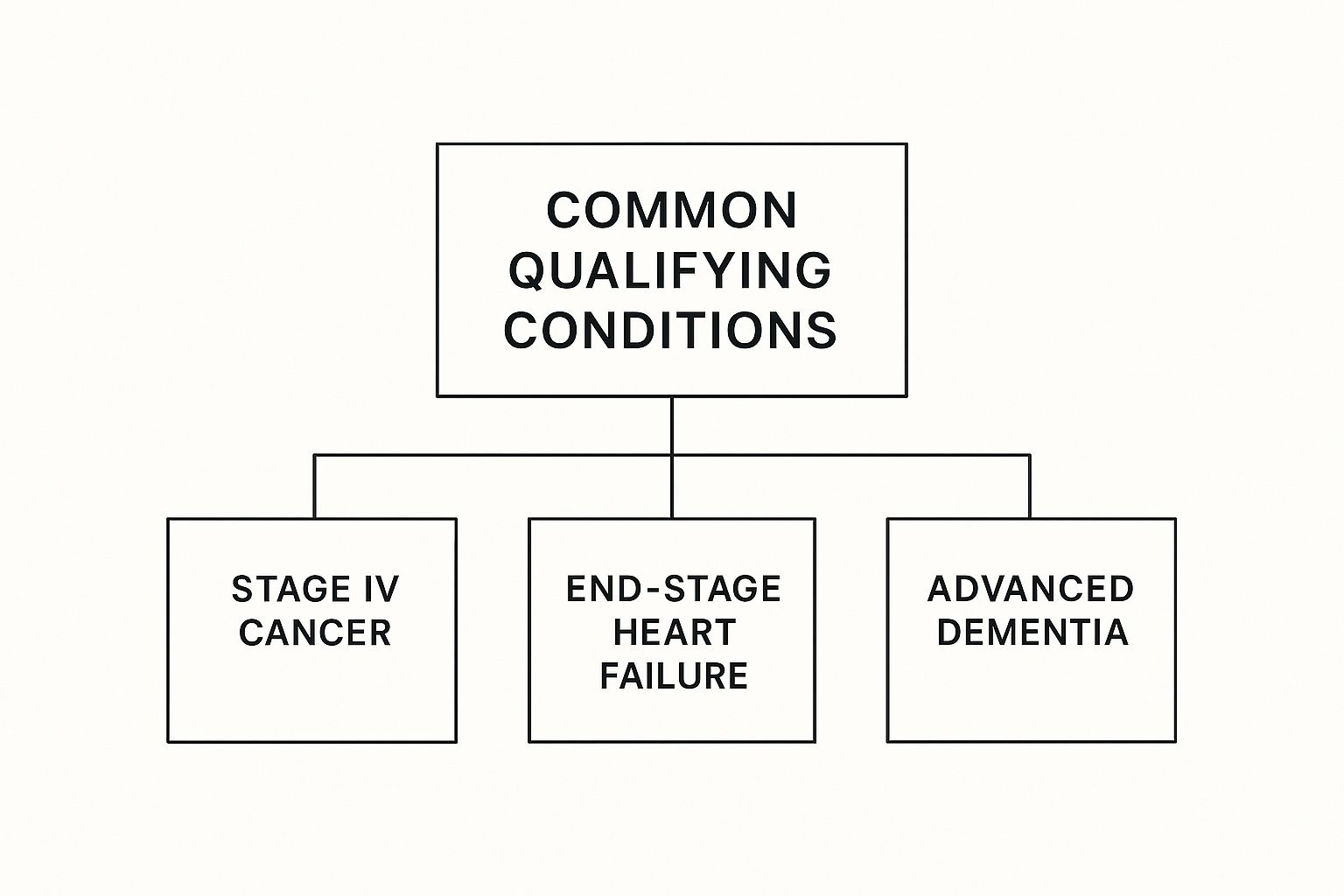
While many people still think of hospice as being primarily for cancer, you can see that conditions like end-stage heart failure and advanced dementia are major reasons people seek this specialized support. To give you a clearer picture, this table shows some of the key clinical signs that often point toward hospice eligibility for several common conditions.
Hospice Eligibility Indicators by Common Condition
This table outlines common medical conditions and associated clinical signs that may indicate a patient meets hospice eligibility requirements. This is for informational purposes and not a substitute for a physician's evaluation.
| Condition | Common Clinical Indicators for Eligibility |
|---|---|
| Dementia/Alzheimer's | Reaching Stage 7 on the FAST scale; limited speech; inability to walk or sit up without help; significant weight loss; recurrent infections (e.g., pneumonia, UTIs); difficulty swallowing (dysphagia). |
| Heart Disease | Persistent congestive heart failure symptoms (e.g., shortness of breath) at rest despite maximum medical therapy; documented ejection fraction of 20% or less; frequent hospitalizations for cardiac issues; significant functional decline. |
| Lung Disease (COPD) | Severe, disabling shortness of breath (dyspnea) at rest or with minimal activity, unresponsive to bronchodilators; need for continuous oxygen; right-sided heart failure (Cor pulmonale); unintentional weight loss of more than 10% in six months. |
| Cancer | Stage IV disease with widespread metastasis; a notable decline in functional ability (e.g., low Palliative Performance Scale score); decision to stop curative treatments like chemotherapy or radiation; worsening, uncontrolled symptoms like pain or nausea. |
Of course, these are just reference points. A full, compassionate assessment by a clinical team is the only way to formally determine if a patient qualifies for hospice. Let’s break down what these indicators look like in more detail.
Advanced Dementia and Alzheimer’s Disease
Dementia is a slow-moving disease that chips away at a person's memory, thinking, and ability to manage daily life. In the advanced stages, the need for round-the-clock support becomes undeniable, which is often when a person becomes eligible for hospice.
Doctors often use a tool called the Functional Assessment Staging Tool (FAST) to see how far the disease has progressed. Patients who reach stage 7 are generally considered eligible for hospice. At this point, they typically have very few words left, can no longer walk without help, and eventually lose the ability to sit up on their own.
Other signs we look for in dementia patients include:
- Significant, unexplained weight loss over the past six months.
- Recurring infections, like pneumonia or urinary tract infections.
- Trouble swallowing (dysphagia), which can lead to aspiration.
- The presence of other serious health issues, such as heart or lung disease.
End-Stage Heart Disease
For someone with severe heart disease, there comes a time when treatments just don't bring lasting relief anymore. The patient might feel constant, exhausting symptoms even when they're just sitting in a chair, which is a clear sign their condition has hit an advanced stage.
Our Registered Nurses and physicians—serving communities from Monterey to South Santa Clara County—look for evidence that the heart simply can't keep up. This is a critical factor in determining hospice eligibility.
Key clinical signs include:
- Constant symptoms of congestive heart failure, like chest pain or shortness of breath, that are tough to manage.
- Frequent trips to the emergency room or hospital for heart problems.
- A documented ejection fraction of 20% or less, which is a measure of how effectively the heart is pumping blood.
- A major decline in function, leaving the person mostly confined to a bed or chair.
Advanced Lung Disease (COPD)
Chronic Obstructive Pulmonary Disease (COPD) and other advanced lung conditions can turn every breath into a battle. As the disease worsens, patients often need continuous oxygen and experience severe shortness of breath (dyspnea) with even the slightest movement.
Hospice eligibility here often hinges on how severe the lung damage is and how much it impacts daily life. The Central Coast VNA & Hospice team looks at how the disease is preventing the body from getting enough oxygen and the functional decline that results.
Common markers for hospice eligibility include:
- Severe, chronic lung disease that is documented by medical tests.
- Disabling shortness of breath that doesn't get better with treatments like bronchodilators.
- An increase in respiratory infections or hospital visits for breathing issues.
- Cor pulmonale, a type of right-sided heart failure caused by high blood pressure in the lungs.
- Losing more than 10% of body weight over six months without trying.
Stage IV Cancer
When cancer reaches Stage IV, it means the disease has metastasized, or spread, to other parts of the body. While every cancer behaves differently, this advanced stage often signals that curative treatments are no longer working or are no longer what the patient wants.
Hospice eligibility for cancer patients rests on two things: the clinical proof that the disease is progressing and the patient's personal choice to shift their focus to quality of life. This is a deeply personal decision, one our team has supported with compassionate care for 74 years.
Factors that often point toward hospice readiness include:
- Widespread, metastatic disease that has been confirmed by a doctor.
- A significant drop in functional ability, measured by tools like the Palliative Performance Scale (PPS).
- A decision to stop aggressive treatments like chemotherapy or radiation.
- The presence of worsening, uncontrolled symptoms like pain, nausea, or profound fatigue.
FAQs About Hospice Eligibility
When you’re exploring hospice care, it’s natural to have a lot of questions. We've gathered some of the most common concerns we hear about hospice eligibility requirements to give you straightforward, compassionate answers. As a trusted nonprofit that has served the Central Coast for over 74 years, we believe in empowering families with information.
What happens if a patient on hospice lives longer than six months?
This is one of the first questions many families ask. If a patient lives beyond the initial six-month prognosis, they can absolutely continue receiving hospice care. The Medicare Hospice Benefit is designed with flexibility in mind.
Care is structured in "benefit periods." As long as the hospice medical director or attending physician re-certifies that the illness is still life-limiting, services continue without interruption. Our team at Central Coast VNA & Hospice regularly re-evaluates each person's condition to ensure they still qualify.
Can a patient stop hospice care if they change their mind?
Yes, absolutely. A person has the right to stop hospice care at any time for any reason. This is called "revoking" the benefit, and it ensures the patient is always in control of their healthcare choices.
Sometimes, a person's condition might unexpectedly improve, or they may decide to try a new curative treatment. If they decide to return to hospice later, our Central Coast VNA & Hospice team is ready to help restart the process quickly and smoothly.
Is a DNR order required to be eligible for hospice?
No, a patient does not need a "Do Not Resuscitate" (DNR) order to qualify for hospice care. This is a common myth that can unfortunately keep families from getting the support they need sooner.
While we encourage gentle conversations about advance directives, it is never a requirement for admission. Our Medical Social Workers and Chaplains are fantastic at helping patients and families explore these topics, but the final decision always belongs to the patient.
How do we start the conversation about hospice with our doctor?
Bringing up hospice with a physician can feel intimidating. We’ve found that a direct, honest, and caring approach works best. You could try saying, "We want to make sure we understand all our options, including hospice. Could we talk about whether it might be the right choice?"
Another option is to call Central Coast VNA & Hospice directly. Our team can speak with you first. Then, with your permission, we can coordinate with your doctor to explore eligibility together across Monterey, San Benito, Santa Cruz, and South Santa Clara counties.
Is hospice care only for the last few days of life?
This is probably the biggest myth about hospice. While some people are referred very late in their illness, the benefit is actually designed to provide meaningful support for months, not just days. To get a better feel for this, you can explore our resources on receiving hospice care for comfort and dignity.
Studies show that patients and families get the most out of hospice when it begins earlier. That extra time allows for better symptom management and lets a real, trusting relationship build with the care team. We always encourage families to ask about hospice sooner to improve a loved one's quality of life.
How is hospice eligibility different from palliative care eligibility?
Palliative care can be started at any stage of a serious illness, even at the same time as curative treatments. Hospice eligibility, on the other hand, requires a physician's certification that the patient has a life expectancy of six months or less and has chosen to stop curative treatments. Central Coast VNA & Hospice offers both services as part of our continuum of care.
How soon does hospice care start after eligibility is confirmed?
Once eligibility is confirmed and the necessary consent forms are signed, care can often begin within 24 to 48 hours. Our mission at Central Coast VNA & Hospice is to provide support as quickly as possible. The admission process is designed to be smooth and stress-free for families throughout our service areas.
The journey through a serious illness is full of questions. If you're exploring options for yourself or someone you love, the compassionate team at Central Coast VNA & Hospice is here with clear answers and unwavering support. Contact us today to learn more about our home health, palliative, and hospice services.