
When a loved one faces a serious illness, you might hear the terms palliative care and hospice care. While both focus on comfort, they serve different needs at different times. Knowing the difference helps you make the best choice.
Palliative care can begin at diagnosis. It works with your regular doctors to manage symptoms while you still seek a cure. Hospice care is for when a cure is no longer the goal, focusing entirely on peace and comfort.

Navigating Your Care Choices on the Central Coast
Making these decisions can feel overwhelming, but you are not alone. As a nonprofit with over 74 years of local service, Central Coast VNA & Hospice is here to help. We support families in Monterey County, San Benito County, Santa Cruz County, and South Santa Clara County.
Our mission is to give you clear information to honor your wishes. The biggest difference between palliative and hospice care is about timing and treatment goals.
| Feature | Palliative Care | Hospice Care |
|---|---|---|
| When It Starts | At any stage of a serious illness, even from diagnosis. | When a doctor expects life expectancy to be six months or less. |
| Treatment Goal | To relieve symptoms and stress while you receive treatments to cure your illness. | To provide comfort and quality of life when treatments to cure have stopped. |
| Team Focus | Works with your current doctors to add an extra layer of support. | A dedicated team manages all care related to the final illness. |
A common myth is that palliative care means you're giving up. That’s not true. It adds support to help you live better while you continue to fight the illness.
If you need more guidance, our resources can show you where to turn when a loved one is seriously ill.
Sadly, not everyone can get this kind of support. A study by the National Hospice and Palliative Care Organization (NHPCO) highlights the importance of local providers like CCVNA. We work to ensure our community gets the compassionate care it deserves.
Comparing Palliative Care and Hospice Care
It’s easy to confuse palliative and hospice care. Both provide comfort and support during a difficult time. However, knowing the key differences is vital for making the right choice.
Palliative care can start when a serious illness is first diagnosed. Think of it as an extra layer of support that works with treatments meant to cure you. For example, a patient getting chemotherapy can use palliative care to manage pain and nausea.
Hospice care begins when treatments to cure an illness stop. The focus shifts completely to comfort for the rest of a person's life. This is for someone a doctor believes has a life expectancy of six months or less.
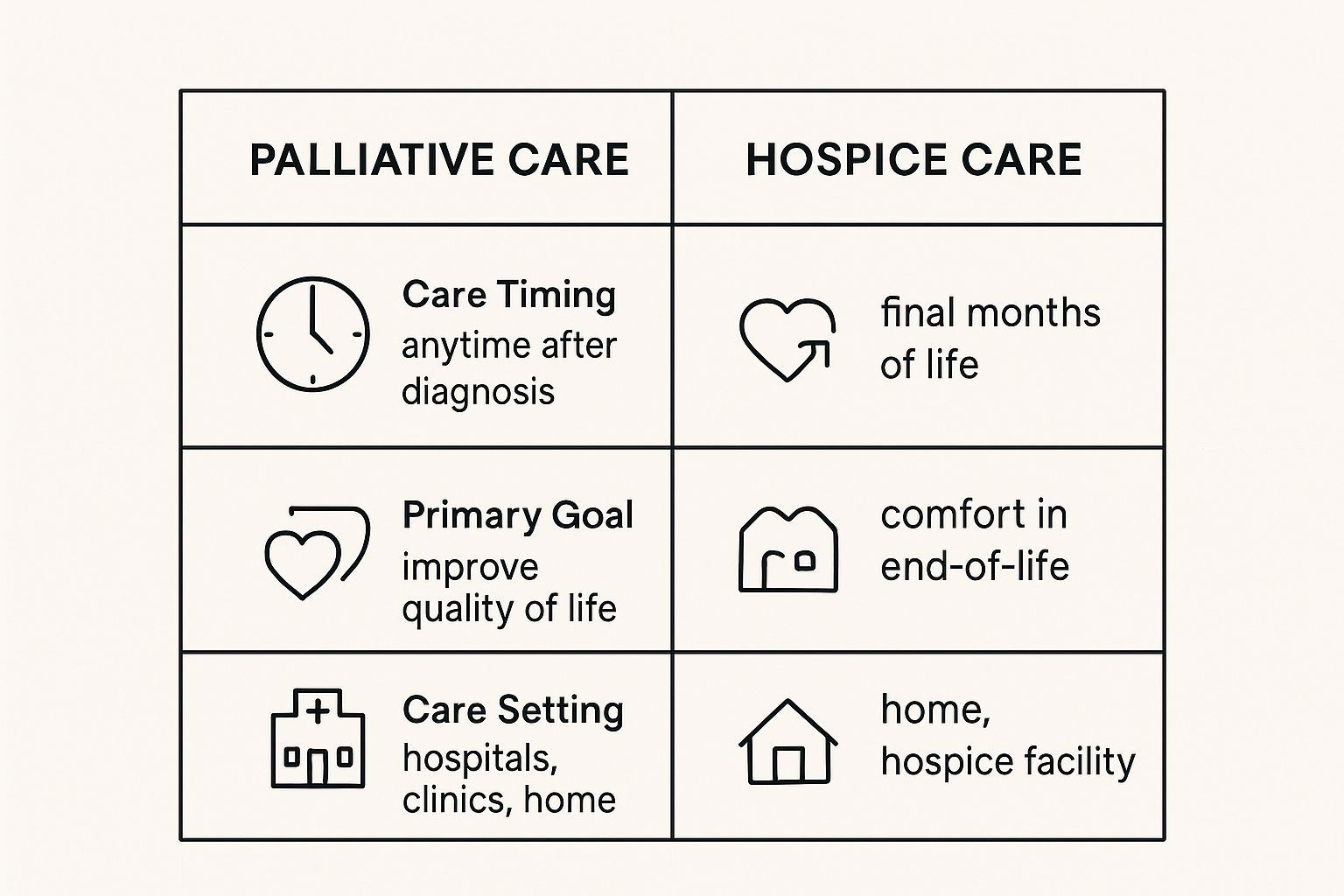
Choosing hospice is not about giving up. It's about choosing to live the time you have left with the best quality of life possible.
Key Differences At a Glance
Navigating these options can be hard. This table gives you a clear overview to help you find the right path for your family.
| Comparison Point | Palliative Care | Hospice Care |
|---|---|---|
| Timing | Can begin at diagnosis, at any stage of illness. | Begins when curative treatment stops; for a prognosis of 6 months or less. |
| Primary Goal | To relieve symptoms, improving quality of life during treatment. | To provide comfort and dignity at the end of life. |
| Curative Treatment | Provided alongside treatments intended to cure (e.g., chemotherapy, surgery). | Focuses on comfort care instead of curative treatments. |
| Duration of Care | Can be provided for years, based on the patient's needs. | As long as the patient meets criteria, even beyond 6 months. |
| Payment | Typically covered by private insurance, Medicare Part B, and Medicaid. | Fully covered by Medicare Part A, Medicaid, and most private insurance. |
| Care Location | Hospital, clinic, long-term care facility, or at home. | Primarily in the patient's home, but also in nursing homes or hospice facilities. |
The main takeaway is simple. Palliative care works with curative treatments, while hospice care is the primary support when a cure is no longer the goal.
Primary Goals and Patient Timing
The main goals are very different. Palliative care helps relieve the symptoms and stress of a serious illness. This helps a patient handle their medical treatments and feel better day to day.
Hospice care has a specific focus. It aims to make a person’s final months as comfortable and meaningful as possible. The entire team—from the Registered Nurse to the Chaplain—works to manage symptoms and provide emotional support.
The core distinction is simple: Palliative care can be provided at any stage of illness, alongside curative treatment, while hospice care is for the final phase of life when the focus is on comfort, not cure.
How Care Works with Other Treatments
It's also important to know how each service fits with other medical care. Palliative care is an add-on to your current care plan.
- Palliative Care: Works with treatments like surgery or chemotherapy. The team coordinates with the patient's other doctors.
- Hospice Care: Replaces curative treatments. The hospice team takes over, focusing only on comfort.
For families in Monterey County and Santa Cruz County, this is key. Our team at Central Coast VNA & Hospice is here to offer expert, compassionate guidance. Learn more about how our palliative care services can support your family.
Who Qualifies for Each Type of Care?
Understanding who is eligible for palliative versus hospice care can be confusing. It depends on the illness, prognosis, and patient's wishes. Getting this right helps you have better talks with your doctor.
Palliative care has broad eligibility. Anyone with a serious, long-term illness can qualify, no matter their age. This includes conditions like cancer, heart failure, or dementia.

Eligibility for Palliative Care at Home
The main requirement for palliative care is a need for symptom relief. If someone is dealing with pain, stress, or side effects, they are likely a good candidate. This care works alongside treatments meant to cure.
A patient does not need a terminal diagnosis to get palliative care. Many people receive this support for years. It helps them live more comfortably while managing their illness.
Hospice Care Eligibility Requirements
Hospice care eligibility is more specific. A patient qualifies when a doctor certifies they have six months or less to live if the illness runs its natural course. This is a crucial difference when looking at palliative care v hospice care.
A common myth is that choosing hospice means "giving up." In reality, it is a powerful choice to prioritize comfort and quality of life when a cure is no longer the primary goal.
This shift in focus allows our team from Central Coast VNA & Hospice to provide full support at home. Our team manages symptoms and offers emotional guidance to the patient and their family. You can learn more in our detailed hospice eligibility requirements.
Services Included with Palliative and Hospice
Knowing the rules for eligibility is one part of the puzzle. The other part is knowing what services each type of care provides. Though both focus on comfort, their services are different.
Palliative care is an extra layer of support. It works with your curative treatments, not instead of them. Its main goal is to manage symptoms and improve your well-being.
What Palliative Care Provides
Palliative care is flexible and tailored to your needs while you continue medical treatments. The goal is always to make your quality of life better.
Services often include:
- Expert Symptom Control: Managing pain, fatigue, nausea, and other symptoms.
- Emotional and Spiritual Support: Helping you and your family cope with stress and anxiety.
- Care Coordination: Making sure all your doctors are on the same page.
The core benefit of palliative care is that you get all this comprehensive support without having to stop treatments meant to cure your illness. This care is available wherever you call home on the Central Coast.
A Closer Look at Hospice Services
Hospice care begins when the focus shifts from cure to comfort. At Central Coast VNA & Hospice, our team provides complete support wherever a patient lives. This can be a private home in San Benito County or a facility in South Santa Clara County.
Our care team is the heart of our hospice program. It includes:
- Registered Nurse: Manages medical care with a focus on pain relief.
- Hospice Aide: Helps with personal care like bathing and dressing.
- Social Worker: Provides emotional support and helps with planning.
- Chaplain: Offers spiritual guidance for all beliefs.
This dedicated team works together to create a peaceful and dignified experience. To learn more, see what to expect with hospice care from our team.
Understanding Insurance and Payment Options
When a loved one is sick, the last thing you want is to worry about money. Financial stress should not be part of this difficult time.
Both palliative care and hospice care are covered by most insurance plans, including Medicare. But the way they are covered is different. Let's break it down.
How Palliative Care Is Covered
Think of palliative care as a specialized medical service, like seeing a heart doctor. It is an extra layer of support that works with your other treatments.
Because of this, it is billed with your existing health coverage:
- Medicare Part B: This is the most common way palliative care is covered. It is treated like a specialist visit, so deductibles apply.
- Private Insurance and Medicaid: Most private plans and Medicaid also cover these services. It's always a good idea to call your provider to check your plan.
This makes it an accessible option for anyone needing help managing symptoms of a serious illness.
The Medicare Hospice Benefit
Hospice coverage is different because it is all-inclusive. The Medicare Hospice Benefit is a plan that covers almost everything related to a patient’s final illness. This is a big difference when comparing palliative care vs. hospice care.
The Medicare Hospice Benefit is designed to be all-inclusive for the terminal diagnosis, often resulting in little to no out-of-pocket costs for the patient and their family. This includes the care team, medications, and medical equipment.
This complete coverage ensures that when the focus shifts to comfort, money worries do not get in the way. Our team at Central Coast VNA & Hospice helps families in Monterey County and nearby areas understand their benefits.
If you have questions, our team can help you get the full support you deserve. Contact us today to learn more.
Navigating Your Journey with Central Coast VNA
Knowing the difference between palliative and hospice care is one thing. Seeing how they work for your family is what truly matters. At Central Coast VNA & Hospice, our nonprofit mission is to provide care that adapts to your needs. We've been a local guide for families in Monterey, San Benito, Santa Cruz, and South Santa Clara counties for over 74 years.

A Real-World Scenario
Let's look at a common situation. Imagine someone with advanced Chronic Obstructive Pulmonary Disease (COPD). Their journey might start with our palliative care team to help manage breathing problems.
This support works alongside their regular doctor’s treatments. It helps them feel better and stay at home.
As their illness gets worse, their goals might change. They may shift from aggressive treatments toward comfort. Because they are already with our organization, the move to our hospice program is smooth.
A seamless transition from palliative to hospice care ensures that patients receive consistent, compassionate support from a team they already know and trust, right in their own community.
This connected approach is key to high-quality care. It helps families focus on what truly matters—the patient’s comfort and wishes. It is part of our Continuum of Care, from home health to palliative care to hospice.
Your Local Experts in Palliative and Hospice Care
You should not have to walk the path from diagnosis to end-of-life decisions alone. As a local nonprofit, we provide home health, palliative, and hospice services all under one roof. We are here to offer the right care at the right time.
For families starting to explore their options, learning about palliative care is a great first step. Find out why Central Coast VNA is the best choice for palliative care on the Central Coast. See how our team can support you from the beginning.
Frequently Asked Questions
Making decisions about palliative care versus hospice care brings up a lot of questions. Here are answers to some of the most common ones we hear from families we serve.
When is the right time to call for palliative or hospice care?
The best time for palliative care is at the diagnosis of a serious illness. For hospice care, the conversation usually starts when a doctor determines life expectancy is six months or less. At that point, the focus shifts to comfort.
Can someone be on hospice for more than six months?
Yes. The six-month timeframe is a guideline for eligibility, not a limit. A patient can continue receiving hospice care as long as their doctor confirms they meet the criteria. The goal is to provide support for as long as needed.
Does choosing hospice mean we're giving up hope?
Not at all. Choosing hospice is about redefining hope. It shifts from hope for a cure to hope for peace, comfort, and meaningful time with loved ones. It is a choice to live the final chapter with dignity.
Where does this care take place?
Both palliative and hospice care come to you. Our teams at Central Coast VNA & Hospice provide care wherever you call home. This includes a private house, assisted living, or a nursing home throughout Monterey, San Benito, Santa Cruz, and South Santa Clara Counties.
How is palliative care vs hospice care paid for?
Palliative care is usually covered like other medical care. This includes Medicare Part B, Medicaid, and most private insurance. Hospice care is covered by the comprehensive Medicare Hospice Benefit, which often leaves families with little to no out-of-pocket costs for the terminal illness.
Navigating these choices is hard, but you don't have to do it alone. For over 74 years, the team at Central Coast VNA & Hospice has been a trusted, nonprofit guide for local families. Contact us today to learn how we can support you.