
Finding Senior Care in Monterey County: Your Guide to Local Services
When you're juggling a career, family, and the needs of an aging parent, one question comes up often. “Can I get help at home, or do I have to put Mom in a facility?” Many families in Monterey County feel caught between these two choices.
This can lead to burnout and stress. But it's an either/or way of thinking that isn't accurate. Most seniors want to stay in their own homes. In fact, 75% of adults over 50 say this is their goal.
With the right support, aging in place is possible. This guide will show you what senior care services are available in Monterey County. It will help you find the best local options for your family.
Instead of feeling overwhelmed, you can build a support system. This system can honor your loved one's wish for independence. It will also make sure they are safe and healthy.
1. Central Coast VNA & Hospice: A Continuum of In-Home Clinical Care
For families exploring what senior care services are available in Monterey County, Central Coast VNA & Hospice (CCVNA) is a trusted nonprofit provider. With over 74 years of service, CCVNA offers a full range of clinical care in the comfort of a patient’s home. This approach supports seniors through different health stages.
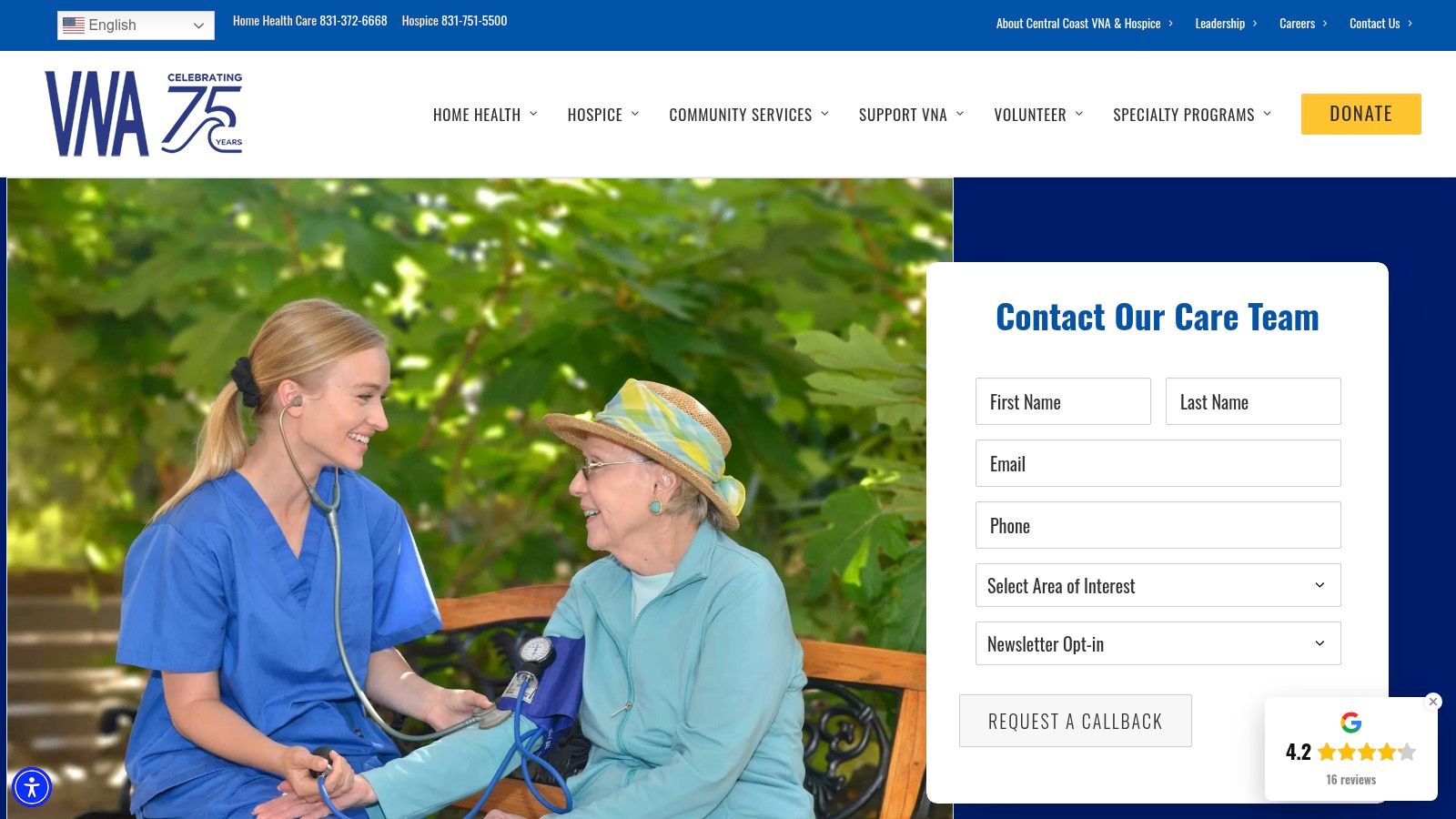
Many families think they must choose between doing it all themselves or using a facility. CCVNA bridges this gap. Their teams of nurses, therapists, and other professionals bring medical support right to the home.
This model helps seniors age in place with dignity. It is especially helpful for those managing chronic conditions or recovering from surgery. CCVNA serves Monterey County, San Benito County, Santa Cruz County, and South Santa Clara County.
Key Strengths and Differentiators
What makes Central Coast VNA & Hospice a standout choice? It provides three levels of in-home clinical care from one coordinated organization. This ensures smooth transitions for patients as their needs change.
- Integrated Continuum of Care: CCVNA offers skilled home health, palliative care, and hospice care. A patient can move from home health to palliative care to hospice with the same trusted team.
- Expert Interdisciplinary Teams: Care is delivered by a team of professionals. This includes Registered Nurses, therapists, Medical Social Workers, and Chaplains. For hospice patients, this team offers 24/7 clinical support.
- Nonprofit, Mission-Driven Focus: As a local nonprofit, CCVNA’s mission is patient well-being, not profit. This focus allows them to reinvest in compassionate care for our Central Coast communities.
Understanding the Services
CCVNA’s website, ccvna.com, clearly explains its core services. It also provides helpful resources for families.
- Skilled Home Health: This service is for patients recovering from illness, injury, or surgery. It includes skilled nursing care and physical therapy ordered by a doctor.
- Palliative Care: This care aims to improve quality of life for those with serious illnesses. It focuses on managing symptoms and pain.
- Hospice Care: For patients with a life-limiting illness, hospice provides comfort care. It focuses on dignity, peace, and support for the patient and family. To learn more, read about how hospice and palliative care support families.
Access and Eligibility
Accessing services usually starts with a doctor's referral for home health care. CCVNA works with local hospitals and doctors throughout its service areas.
The organization accepts many insurance plans. These include Medicare, Medi-Cal, Central California Alliance for Health, Blue Shield, and many private insurance plans. Families can contact CCVNA to ask about coverage.
- Home Health Referrals: (831) 372-6668
- Hospice Referrals: (831) 751-5500
2. Monterey County Aging & Adult Services (AAS)
When you first explore senior care in Monterey County, the options can seem overwhelming. The Monterey County Aging & Adult Services (AAS) website is the official starting point. It acts as a central hub for information and referrals.
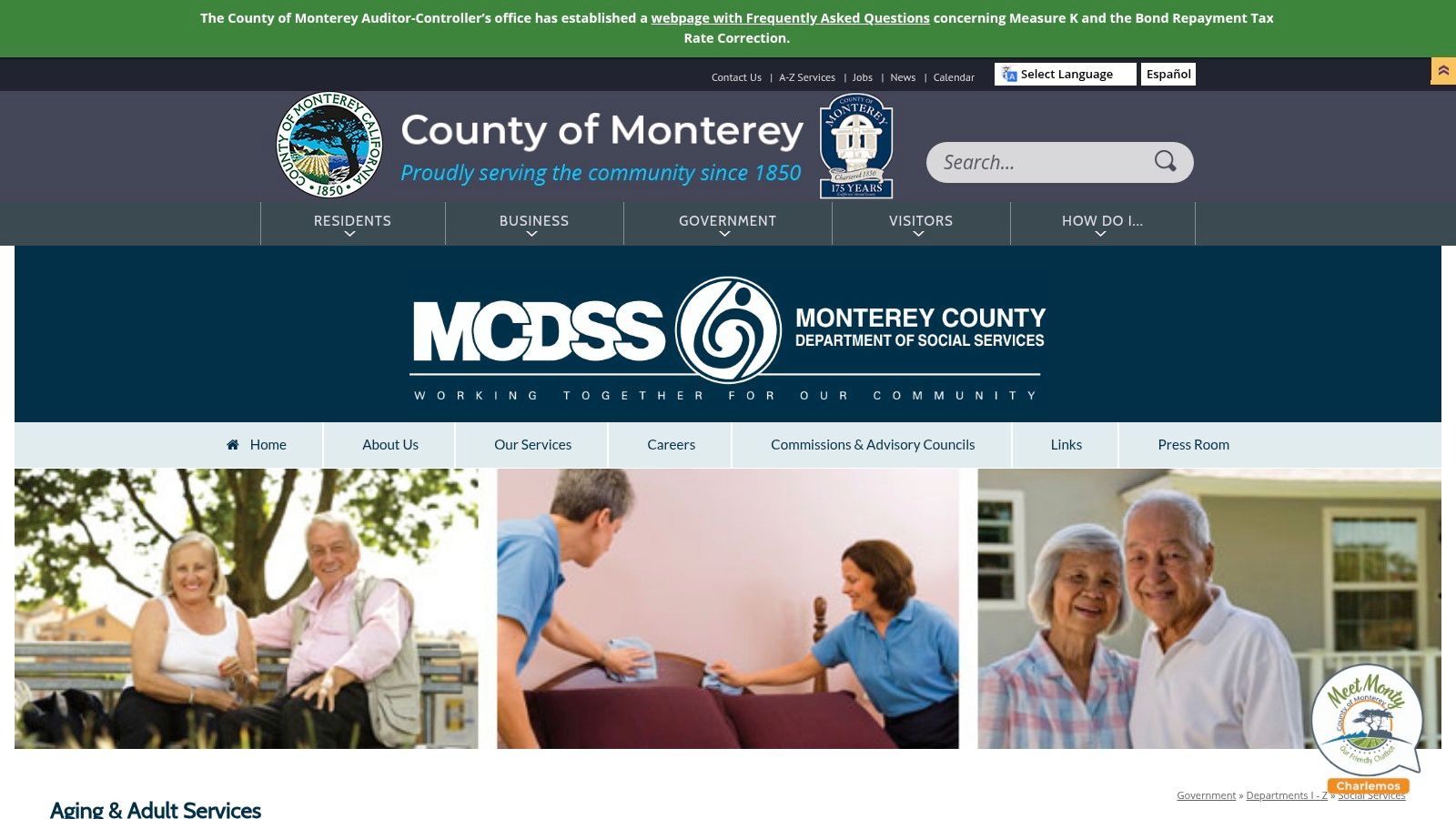
The main job of AAS is to connect you with the right services. They guide you to the right agency or program. This could be for in-home support, nutrition, or Adult Protective Services.
Key Features and How to Use Them
The most valuable tool AAS offers is its live helpline. You can speak with a staff member who can assess your situation. They can then provide referrals to trusted local agencies.
- Information, Referral & Assistance (IRA) Helpline: This is your direct line to a knowledgeable guide.
- Salinas: (831) 755-4466
- King City: (831) 385-7400
- Monterey County Aging & Disability Resource Guide: This downloadable guide is a full directory of services.
- Adult Protective Services (APS): AAS provides a direct link to APS for reporting elder abuse or neglect.
Pro Tip: Before calling the helpline, write down a list of your loved one’s needs and your questions. This will help the representative give you the most accurate referrals quickly.
Why It Stands Out
AAS is the official, county-run resource. The information is up-to-date and the referrals are to trusted local partners. While it is not a direct service provider, its role as a central navigator is key for families.
Website: https://www.countyofmonterey.gov/government/departments-i-z/social-services/adult-services
3. Monterey County Public Authority for In-Home Supportive Services (IHSS) – Registry
For families seeking hands-on in-home care, the IHSS Registry is a key resource. It is a county-run service that connects eligible seniors with individual providers. This allows seniors to hire and manage their own care provider.
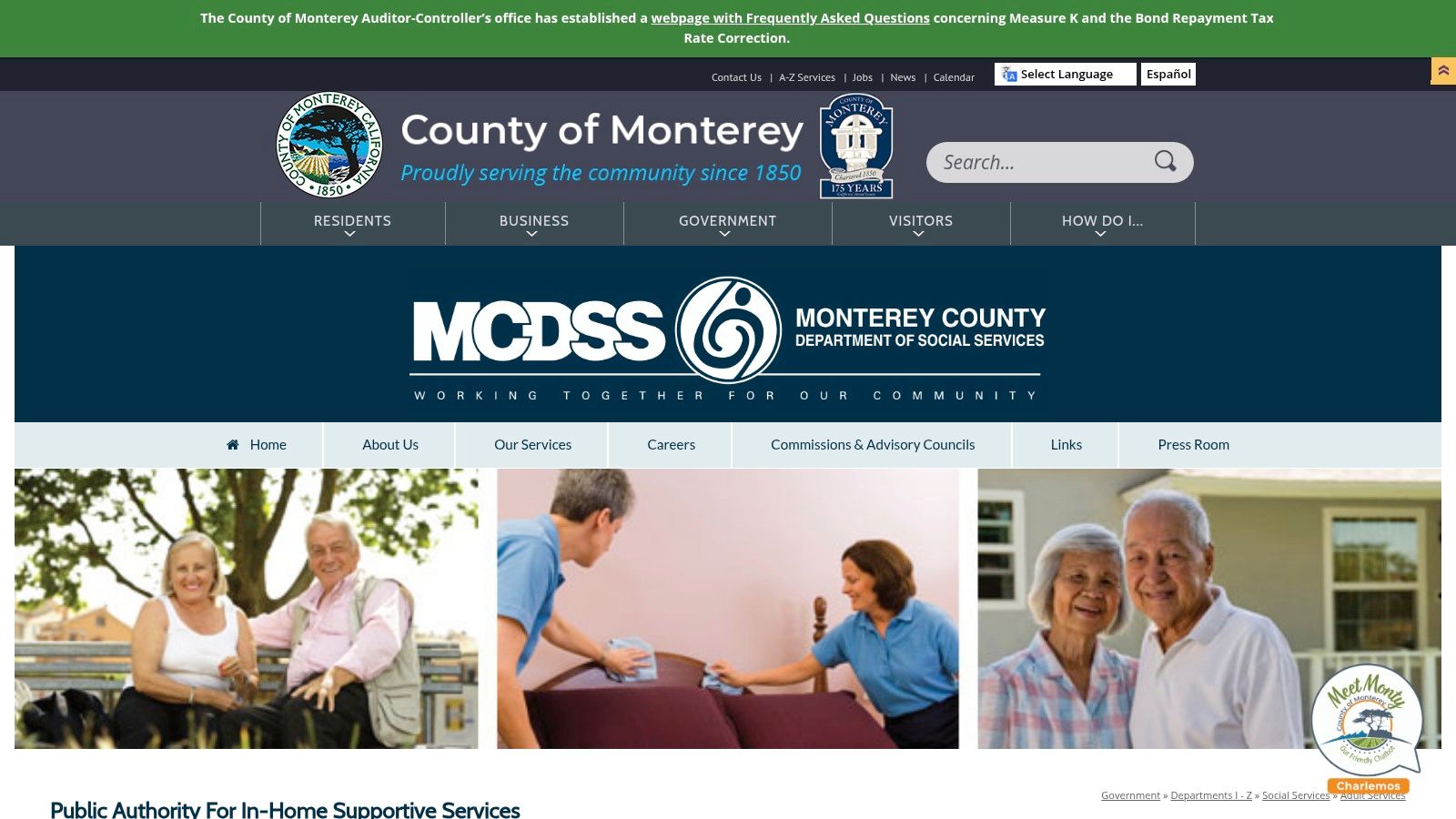
The Public Authority acts as a bridge. It supports both the senior and the provider by maintaining a list of available aides. This model is ideal for those who qualify for Medi-Cal’s IHSS program.
Key Features and How to Use Them
The Registry website guides both clients and potential providers through the process. Seniors and their families get a list of vetted providers to choose from. This personalized approach is a core part of local government programs.
- Provider Matching: The Registry matches clients with providers based on specific needs. This includes personal care tasks, schedule, and location.
- Provider Screening: Aides on the Registry have passed a background check and orientation. This provides a layer of security for families.
- Client and Provider Support: The Public Authority offers guidance on how to join the registry and conduct interviews. You can call them at (831) 755-4466 for help.
Pro Tip: When you get a list of providers, prepare interview questions. Focus on experience, reliability, and communication style. Finding a good personality fit is very important.
Why It Stands Out
The IHSS Registry is unique because it connects directly with a state benefit program (IHSS). It puts the power of choice in the hands of the consumer. The trade-off is that you must first be approved for IHSS benefits.
For those needing skilled medical care, you may need other options. You can explore in-home support to avoid a nursing home that can work alongside IHSS services.
Website: https://www.countyofmonterey.gov/government/departments-i-z/social-services/adult-services/public-authority-ihss
4. 211 Monterey County (United Way Monterey County)
When you need quick information on local support, 211 Monterey County is a powerful tool. This free and confidential service is run by United Way Monterey County. It acts as a 24/7 hotline and online database.
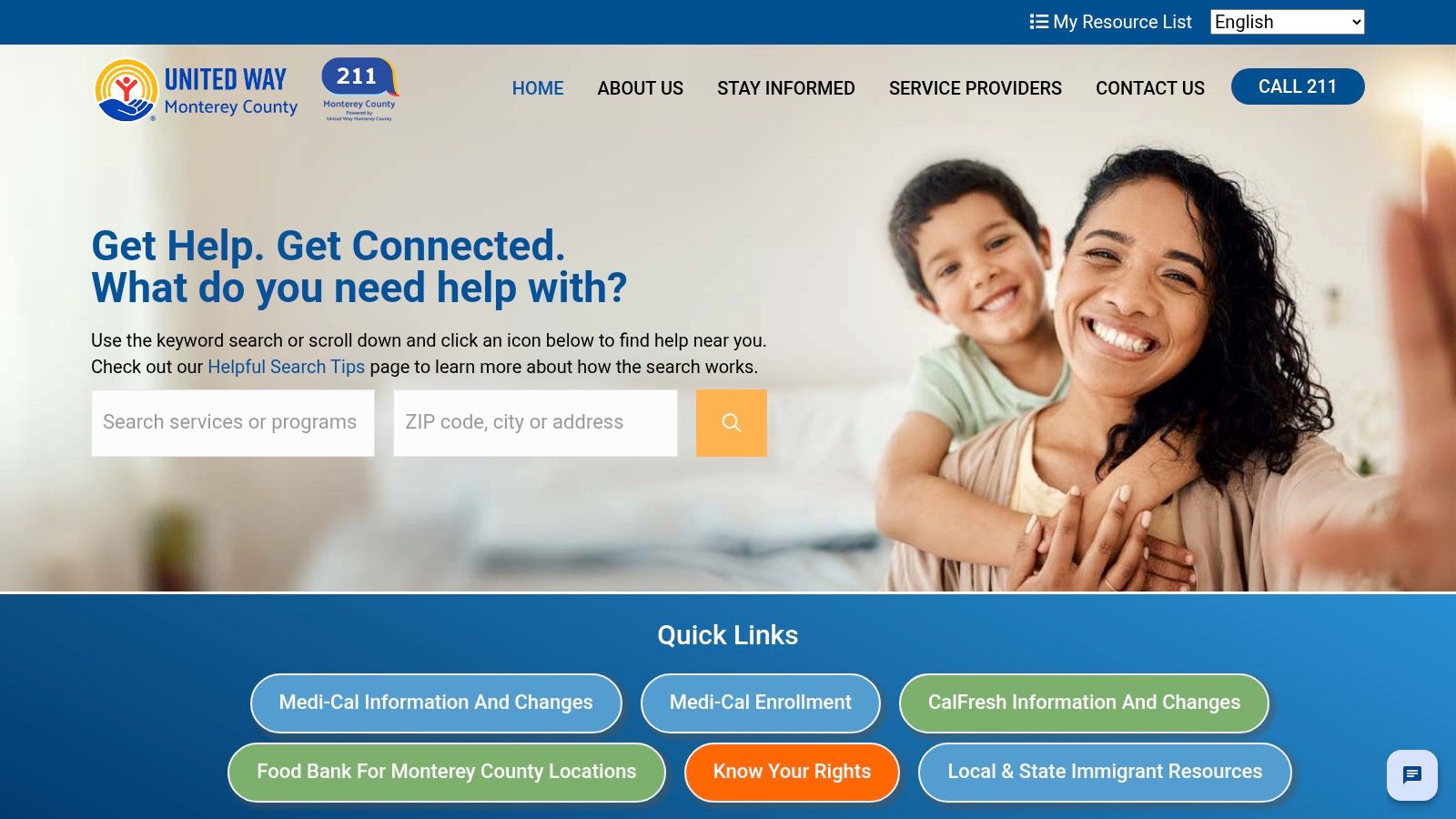
Unlike resources focused only on aging, 211 covers a wide range of needs. This includes food, housing assistance, and transportation. A single call can lead to referrals for multiple challenges.
Key Features and How to Use Them
The strength of 211 is its accessibility. Trained specialists are available around the clock. They provide live, local referrals in multiple languages.
- 24/7 Live Navigation: Simply dial 2-1-1 from any phone. You can speak with a specialist who will connect you to local resources.
- Text and Chat Options: For quick help, text your zip code to 898-211 or use the live chat on their website.
- Searchable Online Database: The website has a large directory of community resources. You can search by keyword and location.
Pro Tip: Use the online database to look for categories like "Senior Services" first. This can help you find specific programs to ask about when you call 2-1-1.
Why It Stands Out
211 Monterey County is special because of its 24/7 availability and multilingual support. It is a no-cost, one-stop shop for finding solutions to challenges that often come with aging. While 211 is a referral service, it is great at connecting you with organizations that provide direct care.
Website: https://211montereycounty.org
5. Alliance on Aging (Monterey County)
Navigating Medicare and finding support can be hard. The Alliance on Aging is a local nonprofit that has served Monterey County since 1970. It acts as a guide for older adults and their families.
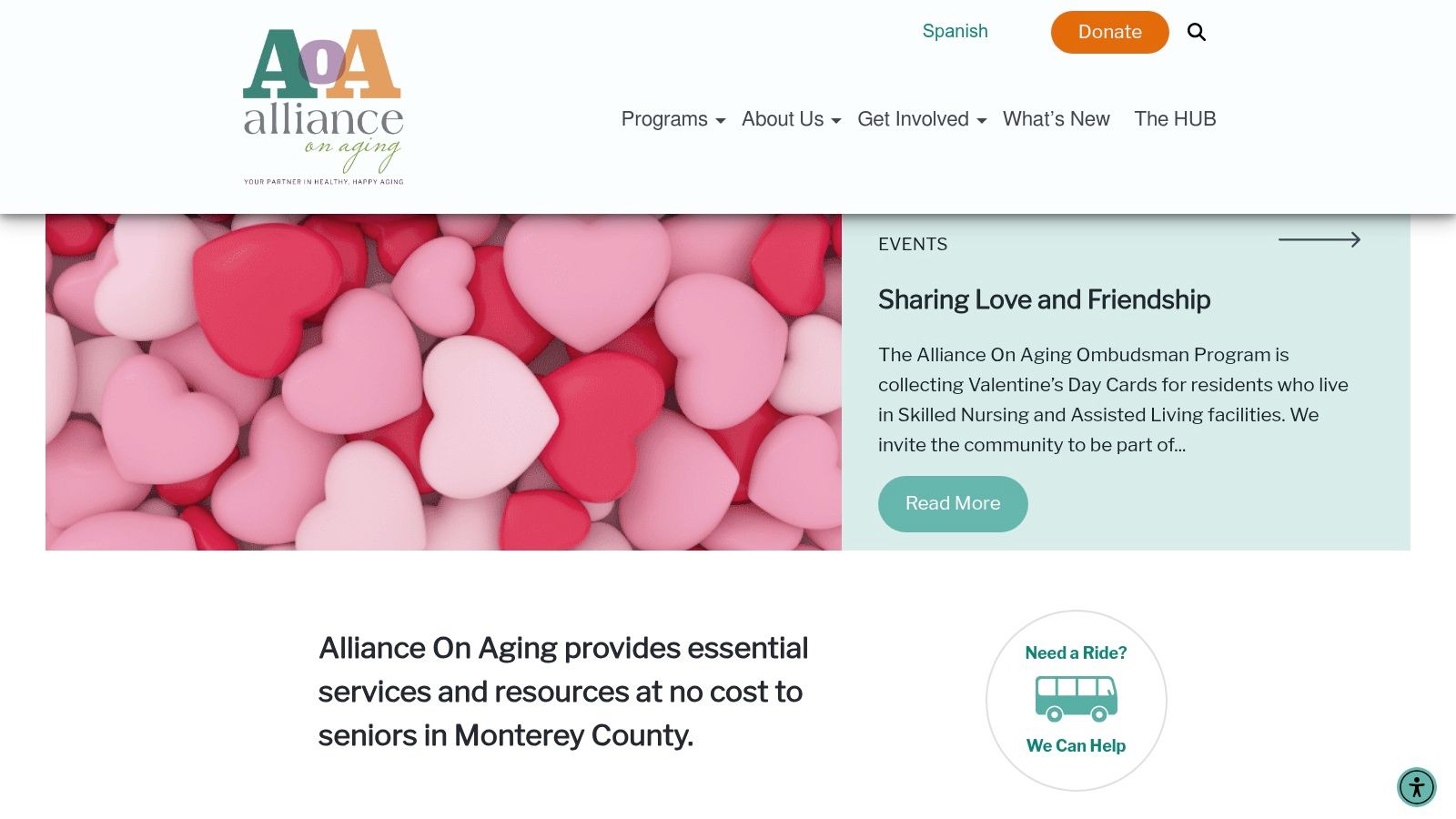
The main role of the Alliance on Aging is to empower seniors. They help people understand their benefits and access services. Their community-focused approach is a great resource for the non-medical side of aging.
Key Features and How to Use Them
The Alliance on Aging offers several free programs. Its services are available through offices in Salinas and Monterey. They also do outreach across the county.
- Medicare Counseling (HICAP): Trained counselors provide free, unbiased help. They can help you understand Medicare benefits and compare plans.
- The HUB Community Center: Located in Salinas, The HUB is a central point for resources. It hosts a Memory Café for people with cognitive decline and their care partners.
- Benefits Counseling & Peer Support: The Alliance helps seniors apply for benefits. It also offers a peer counseling program for companionship.
Pro Tip: Before Medicare's Annual Election Period (October 15 - December 7), schedule a free HICAP appointment. Counselors can help you compare plans to make sure your coverage still meets your needs.
Why It Stands Out
The Alliance on Aging is a trusted, nonprofit advocate. Its HICAP counselors provide completely unbiased advice. This organization bridges the gap between needing help and knowing where to find it.
While the Alliance is great for counseling, it is not a medical provider. For hands-on medical help at home, you will need to explore skilled in-home care. Understanding all of the senior and elderly care services available will help you create a full support plan.
Website: https://allianceonaging.org
6. Medicare Care Compare (Medicare.gov)
When your loved one is eligible for Medicare, finding certified providers is a top priority. The official Medicare Care Compare website is the government's tool to help you. You can search for and evaluate Medicare-certified home health agencies and hospice providers.
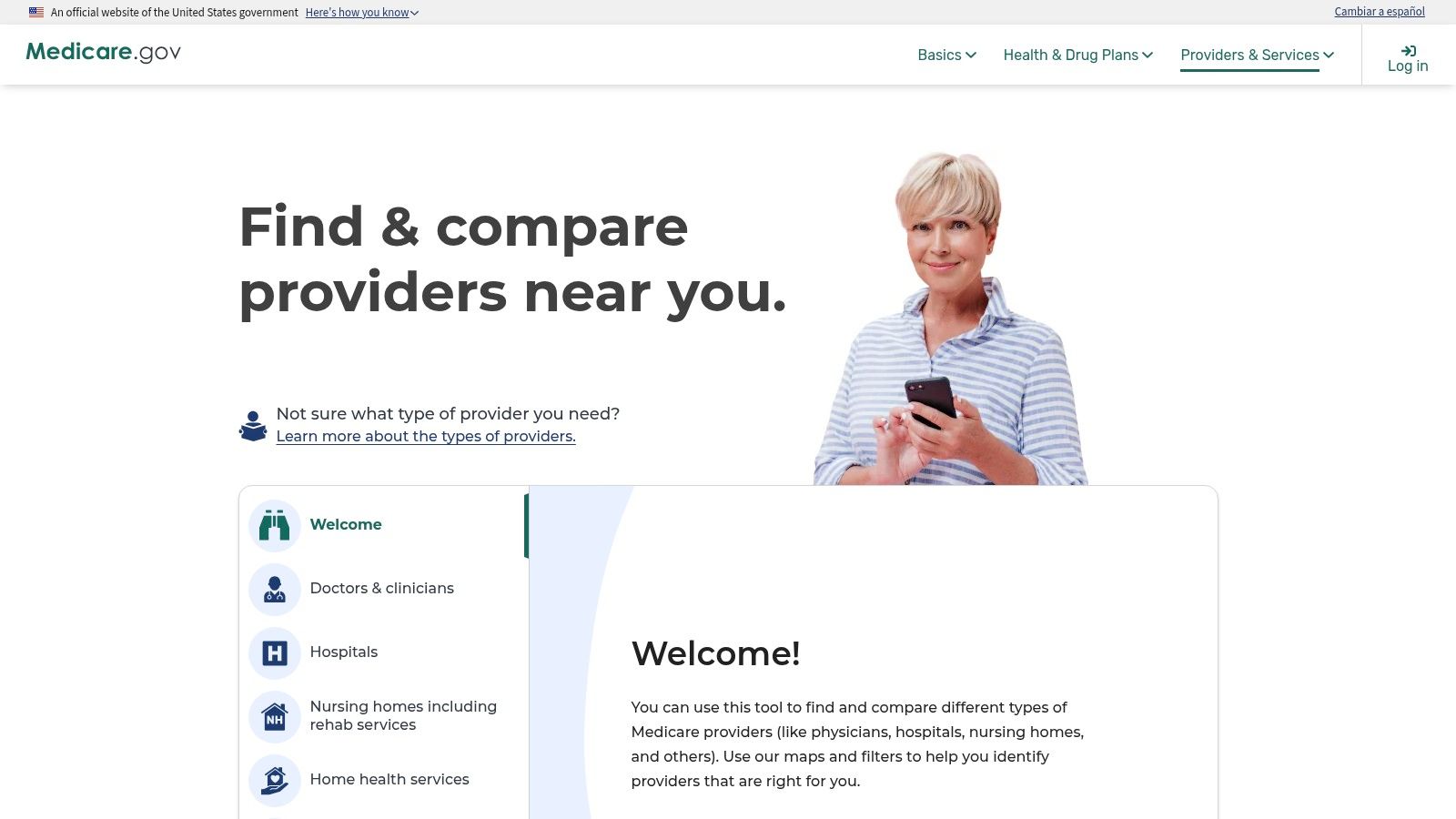
The main purpose of this platform is to provide quality ratings and patient survey results. This lets you compare local agencies side-by-side. It takes the guesswork out of choosing a provider.
Key Features and How to Use Them
The most powerful feature of Medicare Care Compare is its search tool. You can enter your zip code to find providers in Monterey County. Then you can compare them based on official star ratings.
- Side-by-Side Comparisons: Select multiple local agencies. You can view their quality ratings and patient experience scores in an easy-to-read table.
- Detailed Quality Metrics: Explore specific data, like how well an agency managed patients' pain.
- Direct Medicare Information: The site provides clear links to what Medicare covers for services. You can learn more about Medicare home care eligibility to understand the requirements.
Pro Tip: Use the "star ratings" as a starting point, but don't stop there. Click into the "Details" for each provider to read patient survey results.
Why It Stands Out
Medicare Care Compare is essential because it is credible. As the official U.S. government site, it is the most unbiased source for data on Medicare-certified providers. However, the site does not list non-Medicare or private-pay-only agencies.
Website: https://www.medicare.gov/care-compare
7. California Department of Social Services (CDSS) – Facility Search
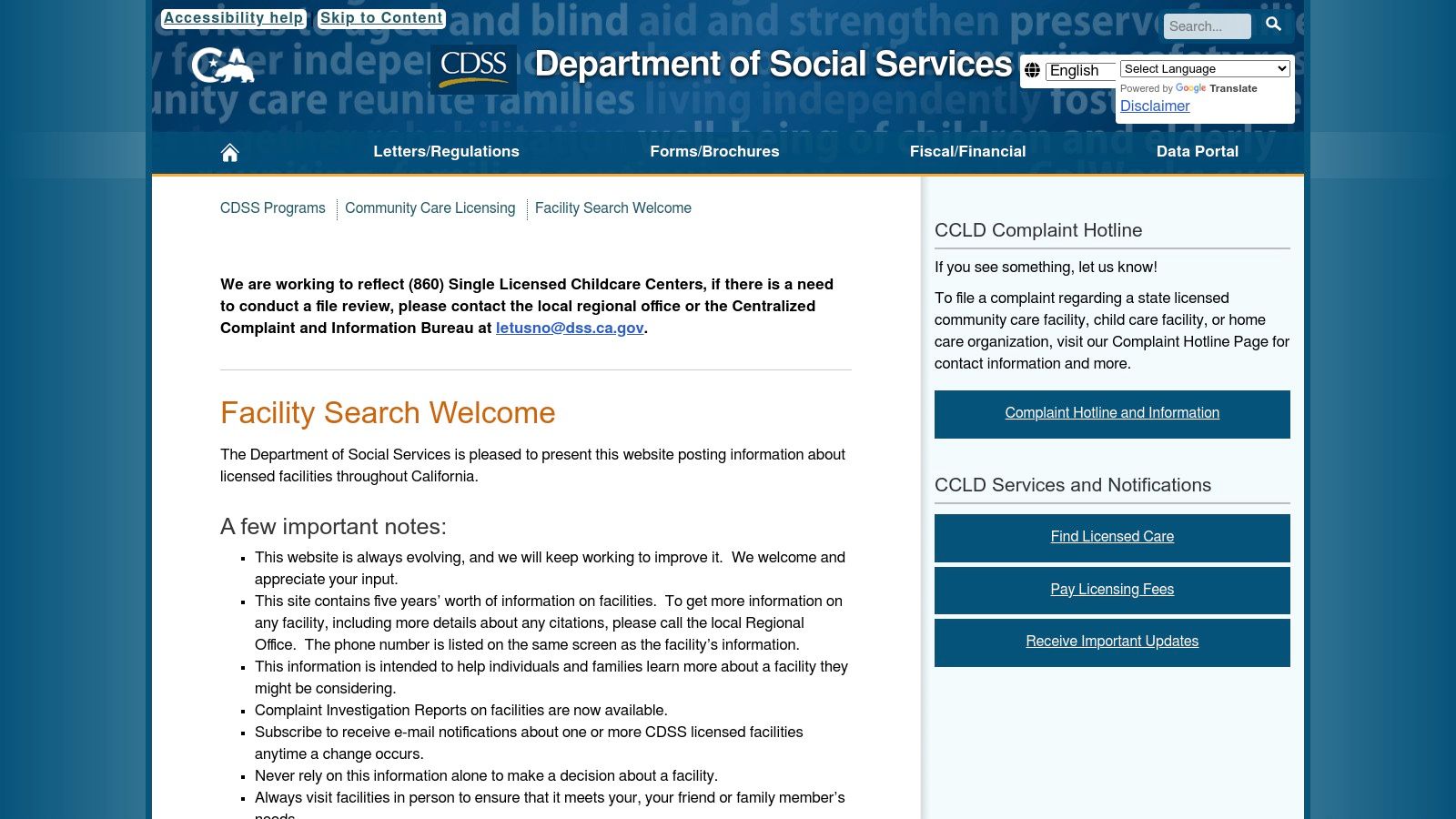
When you’re researching what senior care services are available in Monterey County, this tool is helpful. The CDSS Facility Search offers a statewide directory of licensed care facilities. It also lists Home Care Organizations.
Key Features and How to Use Them
-
Search by County or City
Enter “Monterey” to list all licensed facilities and home care agencies in your area. -
Licensing Status
View whether a facility’s license is active. This helps you know it meets state rules. -
Inspection & Complaint Reports
Access records of health and safety inspections. You can also see any complaints filed in the last five years. -
Consumer Guidance
Read tips on what to look for during tours. The site also defines different care levels. -
Email Alerts
Sign up to get automatic notices if a facility’s status changes. -
Downloadable Records
Save PDF copies of reports to review or share with family.
Pro Tip: Use the site’s filtering options to narrow results by services offered, such as memory care. Note the facility number so you can call directly for pricing and availability.
Comparison at a Glance
| Feature | CDSS Facility Search | Commercial Websites |
|---|---|---|
| Licensing Information | Up-to-date licensing status and history | Varies by provider, may lack compliance details |
| Inspection Reports | Full five-year complaint and violation history | Not always available or complete |
| Pricing & Availability | Not provided, requires direct contact | Often displays starting costs and room availability |
| User Interface | Government functional design | More intuitive filters, photos, and user reviews |
Why It Stands Out
CDSS Facility Search is the only tool backed by the state’s licensing authority. It delivers unbiased, official data you cannot find on commercial sites. This makes it ideal for checking on a facility before you visit.
However, it does not list private pricing or real-time availability. You must call each facility directly to learn costs and open spaces.
Website: https://www.cdss.ca.gov/inforesources/community-care-licensing/facility-search-welcome
Monterey County Senior Care Services — 7-Provider Comparison
| Service | Implementation Complexity 🔄 | Resource Requirements ⚡ | Expected Outcomes ⭐📊 | Ideal Use Cases 💡 | Key Advantages ⭐ |
|---|---|---|---|---|---|
| VNA and Hospice (Central Coast VNA & Hospice) | Moderate–High: interdisciplinary coordination, 24/7 clinical support | High: skilled clinicians, therapy, volunteers, equipment | High: symptom management, seamless transitions, psychosocial & spiritual support | In‑home skilled care, palliative/hospice needs, complex care coordination | Comprehensive in‑home continuum; strong local nonprofit trust; insurance‑friendly |
| Monterey County Aging & Adult Services (AAS) | Low–Moderate: referral and navigation processes | Low: helpline staff, curated county resources | Moderate: faster access to appropriate county programs and eligibility info | Older adults/disabled individuals needing referrals, APS, eligibility guidance | Official county source with up‑to‑date eligibility and live phone assistance |
| Public Authority – IHSS Registry | Moderate: eligibility verification and matching workflow | Medium: screened caregiver pool and admin support | High for eligible clients: matched caregivers to remain at home | IHSS‑eligible people who want to hire/manage paid caregivers | County‑run matching integrated with IHSS; supports client‑directed hiring |
| 211 Monterey County (United Way) | Low: simple contact methods (phone/text/chat) with specialists | Moderate: 24/7 call center, large searchable database | High: rapid multilingual referrals across many service types | Immediate non‑emergency needs (food, transport, community supports) | 24/7 multilingual navigation and broad, no‑cost community directory |
| Alliance on Aging (Monterey County) | Low: counseling, classes, peer support programs | Low–Moderate: HICAP counselors, outreach staff, community HUB | Moderate: improved Medicare decisions, caregiver support, peer connection | Medicare enrollment help, caregiver education, memory/social programs | Free unbiased Medicare counseling (HICAP); long‑standing local presence |
| Medicare Care Compare (Medicare.gov) | Low–Moderate: searchable data + technical quality metrics | Low: public online tool; internet access and data literacy needed | High for Medicare providers: transparent CMS quality and patient experience metrics | Comparing Medicare‑certified home health, hospice, skilled nursing providers | Authoritative CMS ratings and standardized quality metrics |
| CDSS Facility Search (California) | Low–Moderate: search and interpret licensing/inspection records | Low: state database access; internet required | High for regulatory checks: licensing status, inspections, complaints | Screening RCFEs/assisted living or home care organizations before visits | Official regulator‑maintained licensing, inspection and complaint histories |
Your Next Step: Partner with a Trusted Local Expert
Finding senior care in Monterey County can feel like a big task. But now you have explored many helpful tools and services. You've learned about government agencies, nonprofit resources, and online databases.
The journey often starts with one key question. “What senior care services are available in Monterey County that can help my loved one stay safely at home?” This article shows that you have more options than you think. A much better path exists than the all-or-nothing choice.
Key Takeaways for Your Family
As you move forward, keep these key points in mind:
- Aging in Place is a Realistic Goal: Most older adults want to age in their homes. With the right support, this is an achievable goal for many local families.
- A Spectrum of Care Exists: Senior care is not one-size-fits-all. It ranges from help with daily tasks (IHSS) to skilled clinical care at home (Central Coast VNA & Hospice).
- Proactive Planning Reduces Stress: Do not wait for a crisis to explore your options. Learning about these resources now will help you make calm, informed decisions later.
- Professional Guidance is Invaluable: You do not have to create a care plan alone. A local expert can provide a clear roadmap and ensure your loved one gets coordinated care.
Making Your First Actionable Step
So, where do you begin? A direct conversation with a clinical care provider is often the most effective first step. This is true if your loved one is managing chronic illnesses or recovering from surgery.
Start by looking at your loved one’s specific needs.
- Is medical care required at home? If yes, focus on Medicare-certified home health agencies. These groups provide skilled nursing and therapy that non-medical services cannot.
- Is comfort and symptom management the priority? Palliative care provides an extra layer of support for those with serious, long-term illnesses.
- Is the focus on dignity at the end of life? Hospice care provides compassionate support for individuals with a life-limiting illness.
By focusing on the type of care needed, you can narrow your search. This saves time and helps you connect with a team that can meet your family’s needs.
For families in Monterey, San Benito, Santa Cruz, and South Santa Clara counties, Central Coast VNA & Hospice is a trusted, nonprofit partner. We have served our community for over 74 years. We offer a full continuum of care, guiding patients from home health to palliative and hospice care.
Our interdisciplinary teams are compassionate experts. They are dedicated to honoring your loved one’s wishes and bringing peace of mind to your family. Choosing a local, mission-driven organization ensures the focus is always on patient well-being.
Frequently Asked Questions (FAQs)
1. What is the difference between home health, palliative care, and hospice?
Home health care provides skilled nursing and therapy to help patients recover from an illness, injury, or surgery. Palliative care focuses on symptom management for serious illnesses and can be given with other treatments. Hospice care provides comfort and support for patients with a life-limiting illness when curative treatment is no longer the goal.
2. How do I know if my parent qualifies for in-home skilled care?
A doctor must determine that your parent needs skilled medical care at home. This often happens after a hospital stay or if a health condition worsens. Agencies like Central Coast VNA & Hospice can help coordinate with your parent's doctor to assess eligibility.
3. Are these services covered by Medicare?
Yes, Medicare Part A and Part B cover eligible home health care, palliative care, and hospice care. Most services have specific eligibility requirements, so it's important to check with the provider.
4. Can I get help if my parent doesn't need medical care but struggles with daily tasks?
Yes. In-Home Supportive Services (IHSS) is a program for Medi-Cal eligible seniors who need help with tasks like bathing, dressing, and meal preparation. You can contact Monterey County Aging & Adult Services to learn more.
5. What should I look for in a home health or hospice agency?
Look for a local, nonprofit provider with a long history in the community, like Central Coast VNA & Hospice. Use Medicare Care Compare to check quality ratings. Also, ask if they provide a full continuum of care to ensure smooth transitions if needs change.
Don't navigate this journey alone. When you need a trusted partner to help you understand what senior care services are available in Monterey County, turn to the local experts at Central Coast VNA & Hospice. Visit us online to see how our nonprofit home health, palliative, and hospice programs can bring compassionate, professional care directly to your home.
When Should Someone with Dementia Go on Hospice? A Compassionate Guide
Families caring for a loved one with dementia often face a difficult question: when should we ask about hospice? Unlike illnesses with a clearer timeline, dementia’s decline is gradual. This can leave families wondering, “Are we there yet?”
Recognizing certain changes can help. If your loved one is speaking very little, needs help with all daily tasks, has lost significant weight, or sleeps most of the day, it may be time to talk about hospice.
Choosing hospice isn't about giving up. It is about adding a layer of comfort-focused care to provide the best quality of life possible.
Navigating the Gentle Path to Hospice for Dementia
Unlike cancer or heart disease, dementia progresses slowly and unpredictably. This gradual decline can leave families feeling uncertain about when to seek additional support.
Too often, families wait for a crisis to explore hospice. A fall, a serious infection, or a hospitalization can force a quick decision.
Waiting for an emergency means missing out on weeks or even months of valuable support. Hospice care is not just for the final few days of life; it can provide comfort for much longer. According to the National Hospice and Palliative Care Organization, over 51.7% of Medicare beneficiaries who died received hospice, but many enrolled too late to get the full benefit (NHPCO, 2021).
Reframing the Hospice Decision
Thinking about hospice brings up strong emotions. For many, it involves the profound challenge of letting go. It is helpful to reframe this choice as a transition to a different kind of care focused on dignity and peace.
Choosing hospice is an active decision to give your loved one comfort and expert symptom management. It supports the entire family during a difficult time.
This guide will explain the signs that it may be time for hospice and how eligibility works. At Central Coast VNA & Hospice, we have supported families in Monterey County, San Benito County, and Santa Cruz County for over 74 years.
Our local, nonprofit teams are here to guide you with compassion. Knowing when is the right time for hospice is the first step.
Recognizing the Key Signs for Hospice Consideration
Deciding when someone with dementia needs hospice can be confusing. The decline is often a series of small changes, not one single event. Knowing the specific signs of advanced dementia can help you feel more prepared.
It is rarely one single symptom. Instead, it is a collection of changes that show the body is slowing down. Recognizing these shifts can help you start a conversation about comfort-focused care.
Changes in Communication and Awareness
A significant decline in verbal communication is a key sign of advanced dementia. Your loved one may go from telling stories to struggling for words, or speaking very little at all.
This reflects deep changes happening in the brain. You might notice that they:
- Speak six or fewer intelligible words in a typical day.
- Rely on repetitive phrases or sounds instead of clear sentences.
- No longer recognize close family members or confuse them with others.
- Seem more withdrawn and less responsive to their surroundings.
This communication barrier shows the disease is affecting core brain functions. Comfort and non-verbal connection become more important than ever. Learn more in our guide on how to know when hospice is needed.
Increasing Physical Dependence
As dementia progresses, the ability to manage simple, everyday activities fades. This growing need for help is a key sign that your loved one may be ready for hospice support.
They may need total help with all activities of daily living (ADLs). This means they depend on others for basic self-care, including:
- Bathing and grooming
- Dressing and undressing
- Getting in and out of a bed or chair
- Using the toilet
When someone requires this level of hands-on care, it often signals the final stages of the disease. A skilled team, including Hospice Aides, can provide immense relief for both your loved one and the family.
Decline in Physical Health
You will likely see other significant physical changes. These signs point to a systemic decline and are crucial in determining hospice eligibility.
The checklist below can help you track these changes. Seeing several of these signs may mean it is time to speak with a doctor about a hospice consultation.
Observable Signs Your Loved One May Be Ready for Hospice
| Symptom Category | What to Look For |
|---|---|
| Weight Loss | Unintentional loss of 10% or more body weight in the last six months. |
| Swallowing Issues | Frequent coughing, choking, or holding food in the mouth while eating. |
| Increased Sleep | Spending most of the day asleep or in bed; showing little interest in activities. |
| Recurrent Infections | Repeated urinary tract infections, pneumonia, sepsis, or other infections. |
| Mobility Decline | Inability to walk without assistance; eventually confined to a bed or chair. |
| Skin Issues | Developing pressure ulcers (bedsores) despite good care. |
Seeing just one of these signs might not be a trigger. When you notice a pattern of several occurring together, it paints a clearer picture.
These physical markers show that the body is struggling to maintain its basic functions. Shifting the goals of care toward symptom management and comfort becomes the most loving path forward.
If you are seeing these signs, it may be the right time to explore what hospice can offer. The team at Central Coast VNA & Hospice can provide an expert assessment to guide your family.
Understanding How Hospice Eligibility for Dementia Works
The official requirements for hospice care can seem complex, but they are often straightforward. Doctors and hospice teams use specific tools to determine when a person with dementia is medically ready for this care.
A key benchmark for Medicare is the Functional Assessment Staging Tool (FAST). This scale measures how dementia has progressed by looking at a person’s ability to handle daily activities. Stage 7 is the most advanced phase of the disease.
What Does Stage 7 on the FAST Scale Look Like?
When someone reaches Stage 7, they need a tremendous amount of help with daily life. This goes far beyond memory loss. It is a sign that dementia has deeply affected the brain's ability to control the body.
A person in this stage will typically show a combination of these signs:
- Very Limited Speech: They might speak fewer than six words on an average day.
- Loss of Mobility: They can no longer walk without assistance.
- Need for Total Assistance: They are completely dependent on others for personal care like bathing and dressing.
This level of dependence is a strong signal that the illness has reached its final phase. The focus of care naturally shifts toward ensuring comfort. For more details, see our guide on hospice eligibility requirements.
More Than Just a Number
A FAST score is just one piece of the puzzle. Medicare also looks for other serious health issues that confirm the disease is advancing. These other conditions show how much dementia is impacting their overall health.
This visual decision tree shows how factors like communication, physical abilities, and eating all signal when hospice may be appropriate.
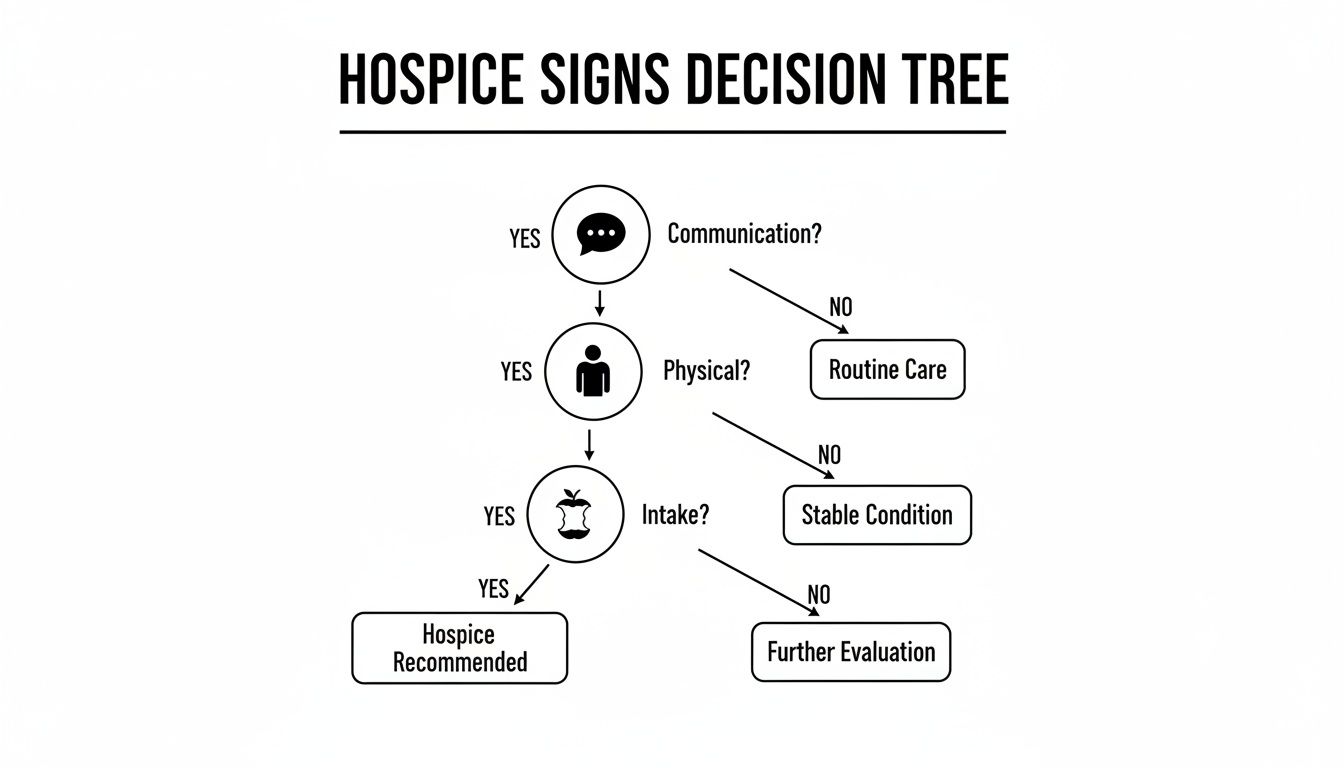
As the graphic shows, a decline across multiple areas usually opens the door to a hospice conversation.
Common Co-Occurring Conditions
A physician will look for at least one of the following health problems from the past year to complete the eligibility picture:
- Recurrent Infections: This could be pneumonia, urinary tract infections (UTIs), or sepsis.
- Significant Weight Loss: An unintentional loss of 10% or more of their body weight in the last six months.
- Difficulty Swallowing (Dysphagia): This can lead to choking and poor nutrition.
- Pressure Ulcers: The development of advanced bedsores (Stage 3-4) even with good daily care.
When one or more of these conditions appear with a FAST score of 7, it creates a clear medical basis for a hospice referral. This framework ensures your loved one gets the right care at the right time.
The Comfort and Support of Choosing Hospice Sooner

A common myth about hospice is that it is only for the last few days of life. This misunderstanding causes families to wait until a crisis, missing out on months of meaningful support.
Choosing hospice sooner is not giving up. It is a loving act that shifts the focus from cure to comfort, ensuring your loved one’s final chapter is lived with dignity.
Enhancing Comfort for Your Loved One
For a person with advanced dementia, symptoms like pain, agitation, and anxiety can be difficult to manage. An early hospice referral provides access to a team of experts trained in dementia care.
Our Registered Nurses work with your loved one’s doctor to manage symptoms, helping them stay calm and comfortable. This specialized attention can dramatically improve their daily experience.
Research shows that hospice care improves quality of life for dementia patients. A 2022 study found that 59% of dementia patients in hospice received 'excellent' care ratings from families, compared to just 28% for those not in hospice. Learn more about the benefits of hospice in dementia care from UCSF research.
A Circle of Care for the Whole Family
Hospice is a vital support system for the entire family. Caring for someone with advanced dementia is emotionally and physically exhausting. Our team at Central Coast VNA & Hospice steps in to share that load.
You gain a dedicated team offering essential support:
- Medical Social Workers provide emotional counseling and help you navigate difficult decisions.
- Chaplains offer spiritual guidance that respects your family’s beliefs.
- Hospice Aides can assist with personal care, like bathing and dressing, giving you a break.
- Specially trained volunteers offer companionship for your loved one, which gives you time to rest.
This network helps reduce stress, allowing you to focus on spending quality time together. You can explore more about the real benefits of starting hospice early in our related article.
How We Support Families on the Central Coast
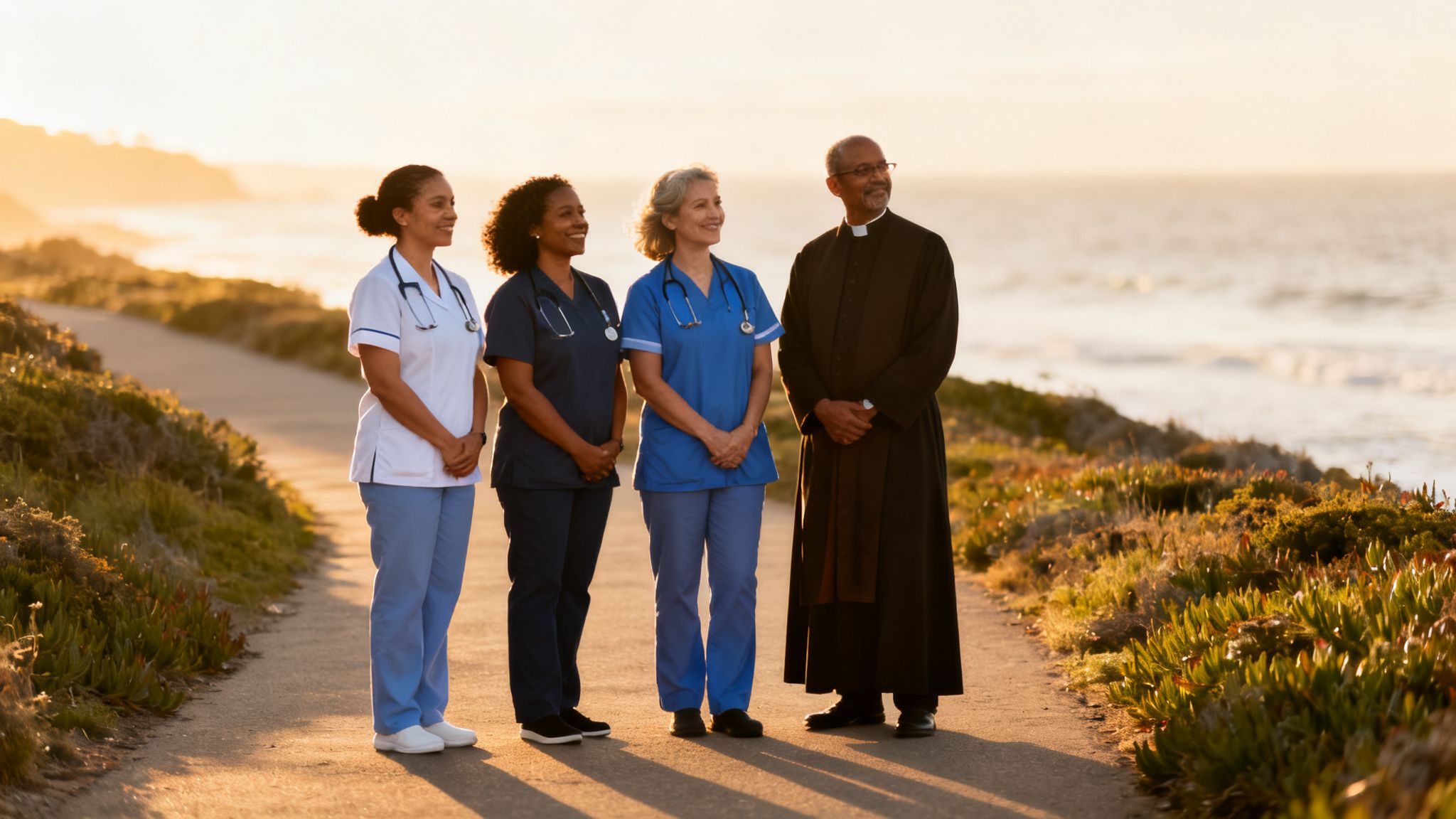
Choosing a hospice provider is a decision built on trust. At Central Coast VNA & Hospice, our mission is to deliver expert, compassionate care to our neighbors.
We are a local, nonprofit organization with roots in this community going back more than 74 years. Our focus is your family’s comfort and well-being.
We understand the unique challenges of dementia care. From Salinas to Monterey and Hollister to Santa Cruz, we’re here to support you.
Your Dedicated Dementia Care Team
When you choose us, you get an entire team trained in dementia care. They work together to create a personalized plan that honors your loved one and supports your family.
Our team includes:
- Registered Nurses who are experts at managing symptoms like pain or agitation.
- Hospice Aides who provide gentle, hands-on help with personal care.
- Medical Social Workers who offer emotional support and practical guidance.
- Chaplains who provide spiritual care tailored to your family’s beliefs.
- Trained Volunteers who offer companionship for your loved one and respite for you.
This team approach ensures that every aspect of care—physical, emotional, and spiritual—is thoughtfully addressed.
A Seamless Continuum of Care
As the only organization on the Central Coast offering a full spectrum of home-based services, from home health to palliative care to hospice, we make the journey smooth. Many families already know us through our other programs.
When needs change, transitioning to hospice is a natural next step within a system they already trust. This continuum of care means your loved one can stay with a familiar, trusted team.
If you live in Monterey County, San Benito County, Santa Cruz County, or South Santa Clara County, our local team is ready to help. We can meet with you at home or in your loved one’s care facility to talk about your needs. There is never any pressure—just guidance from a team that has served this community for decades.
Learn more about how Central Coast VNA & Hospice supports lives across the Central Coast.
Taking the Next Step with Confidence
If you feel your loved one might be ready for hospice, the best next step is to talk with their doctor. This conversation can lead to a formal evaluation and bring peace of mind.
Remember, anyone—a patient, family member, or friend—can ask about hospice care. Our team at Central Coast VNA & Hospice is here to provide information and support whenever you need it.
How to Talk to the Doctor
When you speak with the physician, be specific. Share the changes you’ve noticed in their communication, physical strength, or overall health.
Asking direct questions can help start the conversation:
- "Based on the changes we’re seeing, do you think a hospice evaluation would be appropriate?"
- "Would you be surprised if their condition worsened in the next six months?"
- "What medical signs do you look for when deciding if hospice is the right choice?"
Requesting a Hospice Evaluation
A hospice evaluation is a no-obligation consultation to gather information. The doctor can make a referral, or you can call Central Coast VNA & Hospice directly to set one up.
One of our Registered Nurses will meet with you to assess your loved one's needs and see if they meet eligibility criteria. To qualify under Medicare, a person with advanced dementia typically needs to be at FAST Stage 7 and have secondary conditions like recurring infections. You can see the specifics in the official Medicare coverage determination guidelines.
We are proud to serve communities across the Central Coast, including Salinas, Monterey, Hollister, and Santa Cruz. To schedule a consultation, call us at (831) 375-9882 or visit our hospice care page.
Frequently Asked Questions About Hospice for Dementia
Making the decision to start hospice comes with many questions. Here are answers to some common concerns we hear from families.
1. Does choosing hospice mean we are giving up?
Not at all. Choosing hospice is not about giving up. It is about shifting the focus from cure to maximizing your loved one's quality of life. It’s an active choice to prioritize comfort, dignity, and peace.
2. Can my loved one still see their regular doctor?
Yes, absolutely. Our Central Coast VNA & Hospice team works alongside your loved one’s trusted physician. Their primary doctor remains a vital part of the care team, and we keep them informed every step of the way.
3. Does my loved one have to move to a facility?
No. The goal of hospice is to bring care to wherever your loved one calls home. For most families we serve in Salinas, Santa Cruz, and surrounding areas, this means their own private residence. We also provide care in assisted living communities and skilled nursing facilities.
4. How is hospice paid for?
Hospice is a fully covered benefit under Medicare Part A, Medi-Cal, and most private insurance plans. This coverage includes our care team's visits, medical equipment, supplies, and medications related to the dementia diagnosis. Our staff will explain your specific coverage so there are no surprises.
5. What happens if their condition improves?
Sometimes a person’s condition can stabilize or improve on hospice. If that happens, they can be discharged from hospice care. The door is always open to return to hospice later if their health declines again.
If you live in Salinas, Monterey, Hollister, or Santa Cruz, our hospice team can meet with you. Call (831) 375-9882 for guidance. Contact us today to learn more about our hospice care services.

Who Manages Medical Care After Starting Hospice? A Practical Guide
When a loved one starts hospice, families often ask, "Who's in charge of their medical care now?" Many people worry that choosing comfort means losing medical oversight from a doctor.
This is a common fear, but the reality is just the opposite. Medical care doesn't stop; it changes its focus. Instead of treatments to cure an illness, your loved one gets an entire team of specialists focused on comfort and quality of life at home.
Your New Medical Team After Starting Hospice
A big myth about hospice is that you give up medical supervision. In reality, you bring in a dedicated team to lead your loved one’s care plan. This team approach often provides more responsive and personal support than traditional healthcare.
Once hospice begins, this specialized team manages everything related to the patient’s terminal illness. This is a trusted model of care. According to the National Hospice and Palliative Care Organization (NHPCO), over 1.72 million Medicare beneficiaries received hospice services in 2020 (NHPCO, 2021).

This shift in medical management can feel like a big change. Here's a simple way to see how the focus of care changes.
How Medical Management Changes With Hospice
| Care Aspect | Before Hospice (Curative Care) | After Starting Hospice (Comfort Care) |
|---|---|---|
| Primary Goal | Curing the disease and prolonging life | Managing symptoms and maximizing quality of life |
| Primary Manager | The patient's primary care physician or specialist | The hospice interdisciplinary team, led by the hospice physician |
| Focus of Care | Aggressive treatments, hospitalizations, lab tests | Pain relief, emotional support, and personal comfort |
This table shows the move from a cure-focused mindset to a comfort-focused one, with a new team leading the way.
Introducing the Core Medical Team
At Central Coast VNA & Hospice, our team is built on patient-centered care refined over 74+ years of nonprofit service. The primary medical managers for your loved one will include:
- The Hospice Physician: This doctor has special training in end-of-life medicine and is often called the Medical Director. They create the patient's plan of care and lead the entire team.
- The Registered Nurse (RN): The RN is your case manager and main point of contact. They make regular home visits, check on symptoms, give medications, and teach the family how to provide care.
- The Hospice Aide: This certified professional provides hands-on personal care. They help with things like bathing and dressing to maintain a patient's comfort and dignity.
This team structure ensures that medical, emotional, and practical needs are all met. You can learn more in our guide on what happens when someone starts hospice care.
If a patient cannot make their own medical choices, the care team works with their legal representative. It's helpful for families to understand legal matters, like the Role of Guardians in Planning End-of-Life Wishes, to honor their loved one's choices.
The Role Of The Hospice Physician And Nurse
One of the most common worries we hear is that choosing hospice means giving up the patient's doctor. This myth often causes families to wait too long to get the support they need. The truth is, hospice care enhances medical supervision with a team of licensed professionals.
When a patient joins Central Coast VNA & Hospice, their medical care shifts to our specialized team. This model is at the heart of the U.S. hospice system, which serves millions of Americans each year. You can discover more insights about hospice care statistics to see how vital this support is.

The Hospice Physician: The Symptom Relief Expert
Think of the hospice physician as the expert for your loved one's care. This doctor is a specialist in pain and symptom management. They design and oversee the entire plan of care to make sure it works effectively.
The hospice physician works closely with every team member, especially the Registered Nurse. They review the patient’s progress and adjust medications to maximize comfort. While not in the home daily, their medical oversight guides every action the team takes.
The Registered Nurse: Your Hands-On Guide
The Registered Nurse (RN) is your family's case manager and main contact. They are the physician's eyes and ears in the home. The RN makes regular visits to check on symptoms, provide treatments, and update the rest of the team.
Our nurses are also compassionate teachers. They show family members how to handle daily care with confidence, like giving medications or knowing what to do if a new symptom appears. To learn more about the role of skilled nursing care, visit our blog.
At Central Coast VNA & Hospice, our medical team provides 24/7 on-call support. A licensed clinician is always a phone call away, ready to provide guidance or make an in-home visit. Families are never on their own.
Together, the hospice physician and nurse form a powerful partnership. This teamwork ensures medical care is thoughtfully tailored to your loved one’s unique needs. Their skills bring peace of mind to families across Monterey, San Benito, Santa Cruz, and South Santa Clara counties.
How Your Family Doctor Stays Involved
A big worry for families is losing a trusted family doctor. This is an understandable concern. This physician knows your loved one’s history and has built a relationship with them. Many people wrongly believe that hospice means saying goodbye to that doctor.
The truth is, hospice doesn't replace your doctor. It adds a team of specialists to work alongside them. It's a partnership, and you have a say in how your physician stays involved in the care plan.
Your Doctor Can Be Part of the Team
When hospice begins, your family doctor can stay on as the attending physician. In this role, they become a key collaborator with the hospice team. The doctor you know and trust continues to provide guidance and stays informed about your loved one's condition.
The hospice team will manage the day-to-day symptoms related to the terminal illness. This includes things like pain, shortness of breath, or anxiety. At the same time, your attending physician can help manage other health issues not related to the hospice diagnosis.
For example, if your loved one is on hospice for heart disease but also has diabetes, the hospice team will manage heart-related symptoms. Meanwhile, your family doctor can consult on their diabetes care, working with our experts.
At Central Coast VNA & Hospice, we respect the relationships patients have with their physicians. We welcome them as partners in care across Monterey, San Benito, Santa Cruz, and South Santa Clara counties.
A Focus on Collaboration and Comfort
Think of it this way: the hospice team brings expertise in comfort, while your family doctor brings a deep understanding of your loved one’s health history. We communicate regularly with the attending physician to give updates and discuss the care plan.
This teamwork ensures that medical decisions are seamless and honor the patient’s goals. By working together, the hospice team and family doctor create a strong support system. You aren't losing a doctor—you're gaining a whole team.
Understanding Your Full Interdisciplinary Team
The hospice physician and nurse manage your loved one’s direct medical needs. But they are part of a much larger team. Hospice is designed to support the whole person—not just physical symptoms.
This complete approach is where Central Coast VNA & Hospice shines. We bring together specialists who address the emotional, spiritual, and practical needs of the patient and family. This reflects the nonprofit mission we’ve upheld on the Central Coast for over 74 years.
More Than Just Medical Experts
The full care team includes professionals with unique and essential skills. Their roles are just as vital as the medical staff in managing care.
- Medical Social Worker: Our licensed social workers are expert guides. They help families with issues like advance care planning, connect them to community resources, and offer counseling.
- Chaplain: Spiritual care is a core part of hospice for people of all faiths and beliefs. Our chaplains provide a listening ear and support that honors your family’s personal values.
- Hospice Aide: Our certified Hospice Aides provide gentle, hands-on personal care. They assist with daily activities like bathing and dressing, which helps maintain comfort and dignity.
- Volunteers: Our specially trained volunteers offer companionship and a break for families. They might sit with a patient, read a book aloud, or simply provide a quiet, comforting presence.
This diagram shows how the entire hospice team works with your loved one's own doctor.
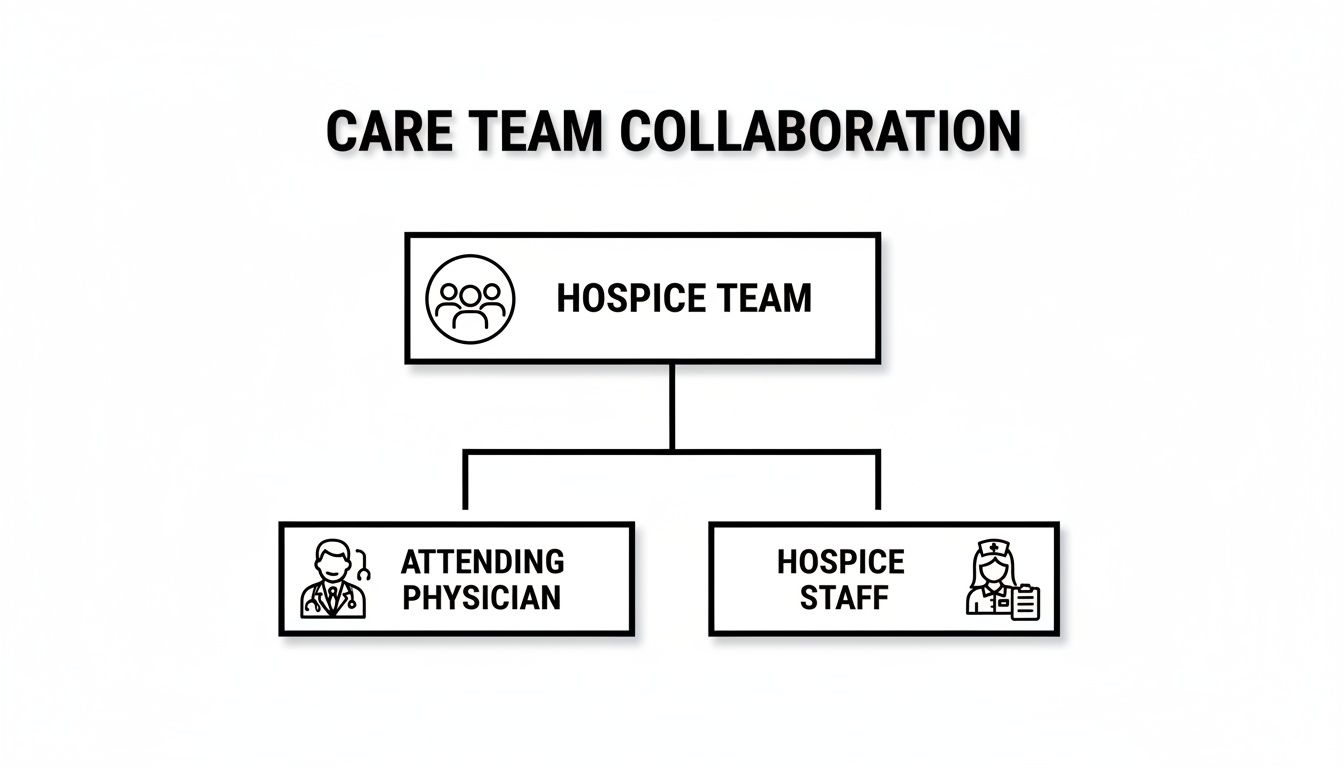
The key is partnership. The hospice team and attending physician work together closely, ensuring every aspect of care is covered.
At Central Coast VNA & Hospice, our interdisciplinary team meets regularly to discuss each patient’s needs. This ensures coordinated support for families in Monterey County, San Benito County, Santa Cruz County, and South Santa Clara County.
This team model means you are gaining a complete circle of support. For a deeper look, you can explore our family's guide to hospice care at home.
Managing Symptoms And Medications Around The Clock
A great comfort of hospice is knowing that expert medical help is always available. Families often fear being alone during a crisis in the middle of the night. With hospice, that anxiety is replaced by reassurance.
Once hospice begins, our team takes the lead on managing all medications and symptoms related to the terminal illness. Our goal is to keep the patient as comfortable as possible, 24 hours a day, seven days a week.
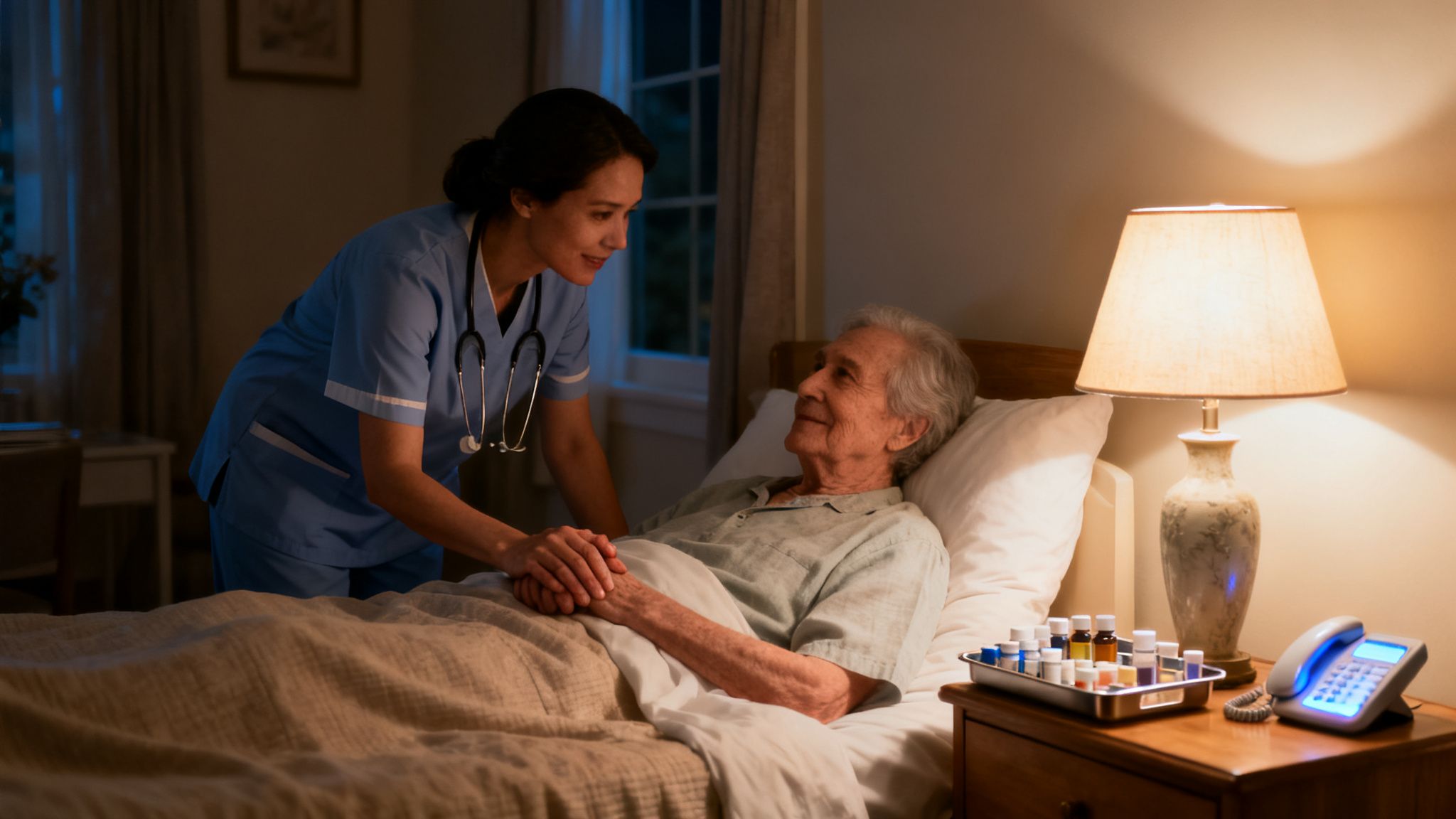
Around-The-Clock Clinical Support
This constant availability is a key part of hospice care. It allows patients to remain comfortably at home and avoid stressful trips to the emergency room.
At Central Coast VNA & Hospice, our clinical team is always on call. If a new symptom like pain appears at 2 a.m., you just call our number. A Registered Nurse will be on the line to walk you through it.
If needed, a nurse can make an in-home visit—day or night—to assess the situation and adjust treatments. This responsive care model means families in Monterey, Santa Cruz, and San Benito counties are never without expert help. You can read more about our specialized pain and symptom management services.
Expert Medication Management
Managing medications at the end of life can feel overwhelming. The hospice team simplifies this process. They work with the hospice physician to create a medication plan focused on comfort.
The team then coordinates with a pharmacy to have all prescriptions delivered to the home. They continuously monitor symptoms and adjust medications as needed. This proactive approach prevents crises and ensures peace and dignity.
This constant watchfulness is central to who manages medical care after starting hospice. It’s not just about having a plan; it’s about having a team ready to act at a moment’s notice.
How Central Coast VNA & Hospice Coordinates Your Care
A dedicated team manages medical care after starting hospice, not just one person. At Central Coast VNA & Hospice, our approach is built on 74+ years of nonprofit service to our local communities. The best care comes from a team that works together, with your family at the center.
Our interdisciplinary team meets regularly. We discuss each patient's progress and adjust the care plan to meet their changing needs. It's a truly collaborative process that puts your loved one first.
A Seamless Continuum of Care
This coordinated approach is what we are all about. As a local provider offering a full continuum of care, we provide smooth transitions from home health to palliative care and, when the time is right, to hospice care.
This means you work with a familiar, trusted organization every step of the way. You can read more about the difference this makes in our stories about how Central Coast VNA & Hospice impacts lives.
Our deep roots in Monterey County, San Benito County, Santa Cruz County, and South Santa Clara County drive us. We are your neighbors, committed to providing compassionate care to the communities we call home. You can learn more about the importance of teamwork and care coordination here.
Every family’s journey is unique, and our team is here to listen. We honor your loved one's wishes by creating a care plan that reflects their goals for comfort and dignity.
If you’re in Monterey, Hollister, Salinas, or Santa Cruz and have questions about hospice care, our local experts can help. We want families on the Central Coast to feel supported, not overwhelmed.
Contact Central Coast VNA & Hospice today at (831) 375-9882 to learn how our team can support your family. We’ll walk you through what to expect and how our medical team stays involved every step of the way.
Frequently Asked Questions About Hospice Medical Care
It is normal to have questions when considering hospice. Understanding the practical side of medical care can bring peace of mind. Here are some common questions we hear from families.
Who is in charge of medical care in hospice?
The hospice interdisciplinary team manages medical care. This team is led by a hospice physician and includes a Registered Nurse, Hospice Aide, and other professionals. They work together to manage symptoms and create a plan focused on comfort.
Can we keep our family doctor after starting hospice?
Yes, absolutely. Your family doctor can choose to stay involved as the "attending physician." In this role, they collaborate with the hospice team and remain a valued partner in your loved one’s care.
Who pays for medications after hospice starts?
The Medicare Hospice Benefit typically covers medications related to the terminal illness. The hospice team orders these medications and has them delivered to your home. Prescriptions for other conditions are usually still covered by your original insurance plan.
What happens if there is a medical emergency at night?
Instead of calling 911, you call the hospice team directly. Central Coast VNA & Hospice provides 24/7 on-call support from a Registered Nurse. A nurse can provide guidance over the phone or make an in-home visit, day or night, to manage the situation.
Does hospice mean stopping all medical treatments?
No. Hospice care shifts the focus from curing an illness to providing comfort. Medical care continues, but the goal is to manage symptoms and improve quality of life. Any treatment that makes the patient feel better is an important part of hospice care.
At Central Coast VNA & Hospice, our team is always here to provide clear answers and compassionate support. If you have more questions about hospice care in Monterey, San Benito, Santa Cruz, or South Santa Clara counties, contact us today at (831) 375-9882 or explore our services at https://ccvna.com.

Can I Get Skilled Nursing Care Without Moving My Parent?
Yes, you can. It is not only possible to get skilled nursing care without moving your parent into a facility—it is often the best choice for their health and happiness.
This means licensed medical professionals can provide vital services like wound care, medication management, and physical therapy. They deliver this care right in the comfort and safety of your parent's home.
Understanding At-Home Skilled Nursing Options
The conversation about moving a loved one into a nursing home is one of the toughest a family can face. It is filled with worries about their independence, comfort, and quality of care. Families often ask about alternatives when they feel a loved one isn't getting enough attention in a facility or want to avoid placement altogether.
But here is the good news: that move is often not necessary. The belief that "skilled care" can only happen in a facility is a common misstep. In reality, services from licensed professionals can be provided at home.
Skilled Nursing at Home vs. a Nursing Facility
To help you see the differences more clearly, let's break down what each option looks like.
| Feature | Skilled Care at Home | Nursing Home Facility |
|---|---|---|
| Environment | The patient's own comfortable and familiar home. | A clinical, institutional setting with multiple residents. |
| Care Team | A dedicated team of visiting Registered Nurses and therapists. | Rotating shifts of staff members serving many residents. |
| Independence | Promotes maximum independence and personal routine. | Structured schedules for meals, activities, and care. |
| Family Involvement | Family can be present and actively involved in daily care. | Restricted visiting hours and less direct involvement. |
| Cost | Often more cost-effective; may be covered by Medicare. | Can be very expensive, often requiring private pay. |
| Infection Risk | Lower risk of exposure to infections. | Higher risk of exposure due to a communal environment. |
As you can see, the benefits of staying home go far beyond comfort. They often lead to better health outcomes and greater peace of mind for everyone.
Rethinking Where Skilled Medical Care Happens
For many families, hearing that a parent needs advanced medical support brings an immediate, stressful thought: a nursing home. It can feel like an impossible choice between their safety and their desire to stay home.
But the reality is more flexible and hopeful than most people realize. The majority of seniors are aging at home. In fact, only 1% of seniors aged 65-74 and just 8% of those 85 and older live in nursing homes.
The term "skilled care" refers to medical services that must be performed by a licensed health professional, like a Registered Nurse or therapist. It's about who performs the care, not where it happens. Services like wound care, medication management, and rehab therapies can all be done at home.
What Skilled Nursing at Home Really Looks Like
When a doctor orders skilled nursing care at home, it involves specific, complex medical tasks. These can only be handled by a Registered Nurse (RN) or Licensed Vocational Nurse (LVN).
These trained professionals bring their clinical expertise directly to your parent. They are a part of Central Coast VNA & Hospice, a nonprofit, mission-driven provider serving the Central Coast for over 74 years.
For families here in Monterey and Hollister, this means a licensed nurse from Central Coast VNA & Hospice visits to:
- Manage IV Therapy: Administering intravenous medications or fluids is a delicate task that requires precise medical knowledge.
- Provide Complex Wound Care: Changing dressings on surgical wounds or treating pressure sores is crucial for preventing infection.
- Administer Injections: Giving necessary shots for conditions like diabetes or for pain management requires correct dosage and technique.
- Monitor Vital Signs: After a hospitalization, a Registered Nurse checks blood pressure and oxygen levels to track stability and catch issues early.
These duties are just a small sample of the professional support that defines skilled home health.
Patient and Family Education: A Core Part of the Service
Beyond hands-on medical tasks, a huge part of in-home skilled nursing is education. A visiting Registered Nurse from Central Coast VNA & Hospice does more than just treat a condition. They empower your parent and your family to manage it with confidence.
This educational role is vital for long-term health and independence. Think about real-world situations like:
- Teaching a patient how to check their blood sugar and safely administer their own insulin.
- Showing the family how to operate new medical equipment, like an oxygen concentrator.
- Explaining medication schedules, potential side effects, and why each prescription is important.
- Providing practical guidance on diet and exercise to help manage chronic conditions.
This level of professional support builds competence and reduces the anxiety that comes with managing a health condition. The goal is to create a support system that enables your parent to thrive at home.
How to Arrange Skilled Nursing Care at Home
Figuring out how to arrange skilled nursing care at home can feel like a maze, but it usually starts with a single step. The journey often begins with a conversation with a doctor.
The most important piece of the puzzle is a physician's order. Your parent's doctor must certify that the care is medically necessary.
Starting the Conversation with a Doctor
You do not have to wait for a hospital discharge planner to bring up home health care. Being proactive is one of the best things you can do.
Ask for a home health evaluation. If your loved one is homebound and recovering from surgery or managing a chronic illness, in-home skilled nursing may be covered by Medicare or health insurance. You don’t need to wait for a hospital to refer you.
A home health evaluation is a detailed assessment by a qualified clinician. A Registered Nurse will typically:
- Review Medical History: They’ll look at diagnoses, recent hospital stays, and all current medications.
- Assess Physical and Functional Needs: This involves checking mobility, strength, and ability to perform daily tasks.
- Evaluate the Home Environment: The Registered Nurse checks for safety risks and suggests helpful modifications.
- Discuss Goals: They'll talk with you and your parent about what everyone hopes to achieve with in-home care.
Gathering the Necessary Documents
To make everything go smoothly, it helps to have key information ready. When you work with an agency like Central Coast VNA & Hospice, these details speed up the intake process.
This infographic shows some of the core medical tasks that our skilled nursing staff can perform in your parent's home.
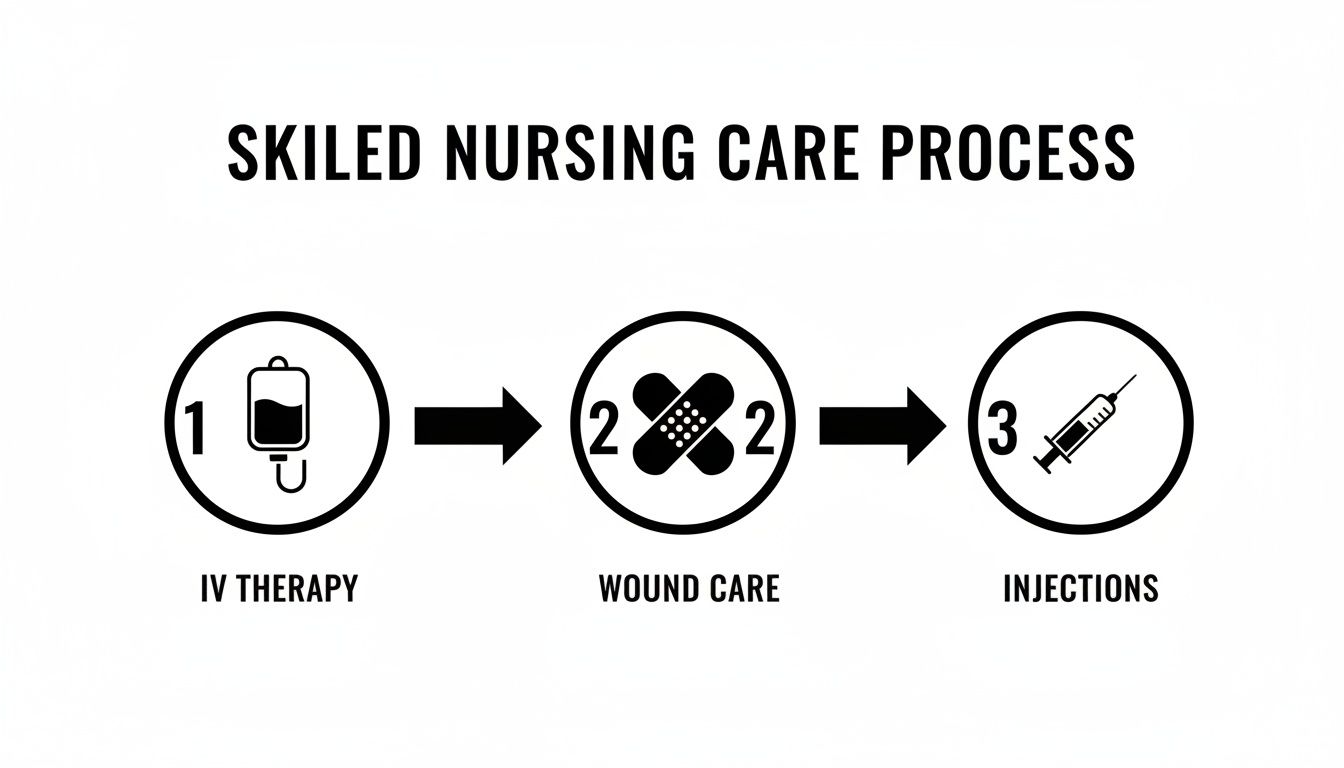
As you can see, services like IV therapy and wound care are managed safely at home by licensed professionals.
Try to have the following ready to go:
- Insurance Information: This includes Medicare, Medi-Cal, or private insurance cards.
- Physician’s Contact Information: The name and phone number of the doctor who ordered the care.
- List of Medications: A complete list of all prescriptions, over-the-counter drugs, and supplements.
- Medical History Summary: Key dates for surgeries or major health events are very useful.
Having this paperwork organized makes the first consultation more efficient. It allows the home health agency to verify benefits and start coordinating a plan of care. For more information, see our guide on qualifying for home health care in our guide.
Why Staying Home Is Often the Healthier Choice
The decision about skilled medical support goes beyond clinical care—it is about a parent's whole well-being. Many families find that bringing skilled nursing care into the home leads to better health outcomes. Data supports this, showing advantages when a loved one can recover in a familiar environment.
The comfort of being at home cannot be overstated. Surrounded by personal belongings and daily routines, a parent feels more secure and less anxious.
This sense of normalcy is a powerful part of healing. It reduces the stress that often comes with a stay in an unfamiliar facility. This familiar environment actively contributes to a more positive outlook, which can speed up recovery.
The Power of Consistent, Personal Care
This positive atmosphere translates into real clinical success. One study found home health care led to a 34% drop in hospital readmissions. This is a critical sign of effective, well-managed recovery.
One of the biggest wins for in-home skilled nursing is the consistency of the care team. Your parent can build a relationship with a dedicated group of professionals from a provider like Central Coast VNA & Hospice.
When a Registered Nurse from CCVNA visits, they know your parent’s history and what is "normal" for them. This continuity builds trust and ensures that subtle changes in health are caught right away. It's a level of personal attention that is tough to match in a facility.
Higher Satisfaction and Superior Outcomes
The numbers speak for themselves. Patients who receive skilled care at home often report higher satisfaction. They also tend to have better outcomes than those in institutional settings.
This is the model of care that Central Coast VNA & Hospice is built on. We have been serving California's Central Coast for over 74 years, delivering patient-centered care. For families in Monterey County, San Benito County, and Santa Cruz County, choosing skilled nursing at home means choosing excellent medical oversight and profound personal comfort.
You can read our detailed article about why it’s often safer to age at home instead of a nursing home.
How Central Coast VNA & Hospice Supports Your Family
Navigating the healthcare system for a parent is tough. But you do not have to go through it alone. For over 74 years, Central Coast VNA & Hospice has been a trusted, nonprofit partner for families on the Central Coast.
Our mission is to provide compassionate, top-tier medical care that honors your loved one’s wish to stay home. So when you ask, "Can I get skilled nursing care without moving my parent?" our answer is a confident yes. We are deeply rooted in the communities we serve, from Salinas to Santa Cruz.
A Collaborative Approach to In-Home Care
Effective in-home skilled nursing is a partnership. It is a collaboration between your family, your parent’s doctor, and our clinical team.
Central Coast VNA & Hospice provides skilled nursing care at home through licensed Registered Nurses (RNs), Licensed Vocational Nurses (LVNs), and therapists. Our team works with your physician to create a plan that meets medical needs while keeping your loved one comfortable and safe at home.
This teamwork is vital. It guarantees that every treatment is perfectly aligned with the doctor’s orders and your parent’s health goals.
Our Dedicated Team and Service Areas
This compassionate model is brought to life by our team of seasoned professionals. Every person on our team is committed to treating your loved one with dignity and respect.
We are proud to serve families across four counties. Our Continuum of Care progresses from home health to palliative and hospice care.
Our primary service areas include:
- Monterey County, including Salinas and the Monterey Peninsula.
- San Benito County, including Hollister.
- Santa Cruz County, including Santa Cruz and Watsonville.
- South Santa Clara County.
If your parent lives in one of these communities, our team is ready to help. Learn more about how CCVNA impacts lives across the Central Coast.
The decision to bring skilled care into the home is a powerful one. Our nonprofit mission is to make that choice a successful one for your family. Serving local families in Monterey, Hollister, Santa Cruz, and Salinas, CCVNA helps avoid facility placement when possible.
Is skilled nursing care at home the right fit for your situation? Call (831) 372-6668 to find out if it's the right fit for your situation. Contact us today to learn more about our services.
Frequently Asked Questions About In-Home Skilled Nursing Care
Here are answers to some of the most common questions we hear from families.
1. What is the difference between skilled nursing care and personal care?
Skilled nursing care is medical care that must be performed by a licensed nurse, such as a Registered Nurse (RN). It requires a doctor's order and includes services like IV therapy, injections, and complex wound care.
Personal care involves non-medical help with daily activities like bathing, dressing, and meal preparation. These tasks are typically handled by a home health aide.
2. How is in-home skilled nursing care paid for?
For patients who meet the requirements, Medicare Part A or Part B often covers 100% of the cost for intermittent skilled nursing at home. This includes visits from a Registered Nurse and physical or occupational therapy.
Other payment options include private health insurance, Medi-Cal, VA benefits, or private pay. Our team at Central Coast VNA & Hospice helps families in Monterey and Santa Cruz counties understand their coverage.
3. What does "homebound" mean for Medicare purposes?
"Homebound" is a Medicare term that causes confusion. It does not mean your parent is confined to their bed.
A person is considered homebound if leaving the house takes a considerable and taxing effort. They can still leave for medical appointments and short, infrequent non-medical trips. A doctor must certify that a patient is homebound for Medicare to cover home health services.
4. How often will a Registered Nurse visit my parent?
The frequency of visits is based on your parent’s medical needs, as outlined in the physician-ordered plan of care. A patient recovering from surgery might need daily visits at first. Someone with a chronic condition might only need a visit a few times a week.
The plan of care is flexible. Our clinical team communicates with the doctor to adjust the visit schedule as your parent's condition changes. Learn more in our guide on Medicare skilled nursing coverage.
5. Can we choose our own home health agency?
Yes, absolutely. Federal law guarantees you the right to choose which Medicare-certified agency provides your parent's care.
A hospital or doctor's office may provide a list, but the final decision is yours. Choosing an agency with deep local roots and a strong reputation, like Central Coast VNA & Hospice, helps ensure your parent receives the dedicated support they deserve.
At Central Coast VNA & Hospice, we have been the trusted choice for families on the Central Coast for over 74 years. If you believe your parent could benefit from skilled nursing care at home, contact us today to learn how we can support you. Visit us at https://ccvna.com to get started.

Guide: How Do I Get Help at Home if Insurance Doesn’t Cover Everything?
When families ask, "How do I get help at home if insurance doesn’t cover everything?" the answer can feel overwhelming. This question often comes up when a loved one needs support, but coverage is limited or ends too soon. Families are left wondering: “Who fills in the gaps?”
It’s a journey that involves understanding your loved one's needs and exploring financial aid like Medi-Cal or VA benefits. It also means connecting with local nonprofits that can help. For families on the Central Coast, Central Coast VNA & Hospice is an essential guide for this exact challenge.
The Reality of Home Care Insurance Gaps
Discovering that insurance or Medicare won't cover all the in-home support your loved one needs can be jarring. Many families are shocked to find a gap between what insurance pays for and what is needed for safe living at home.
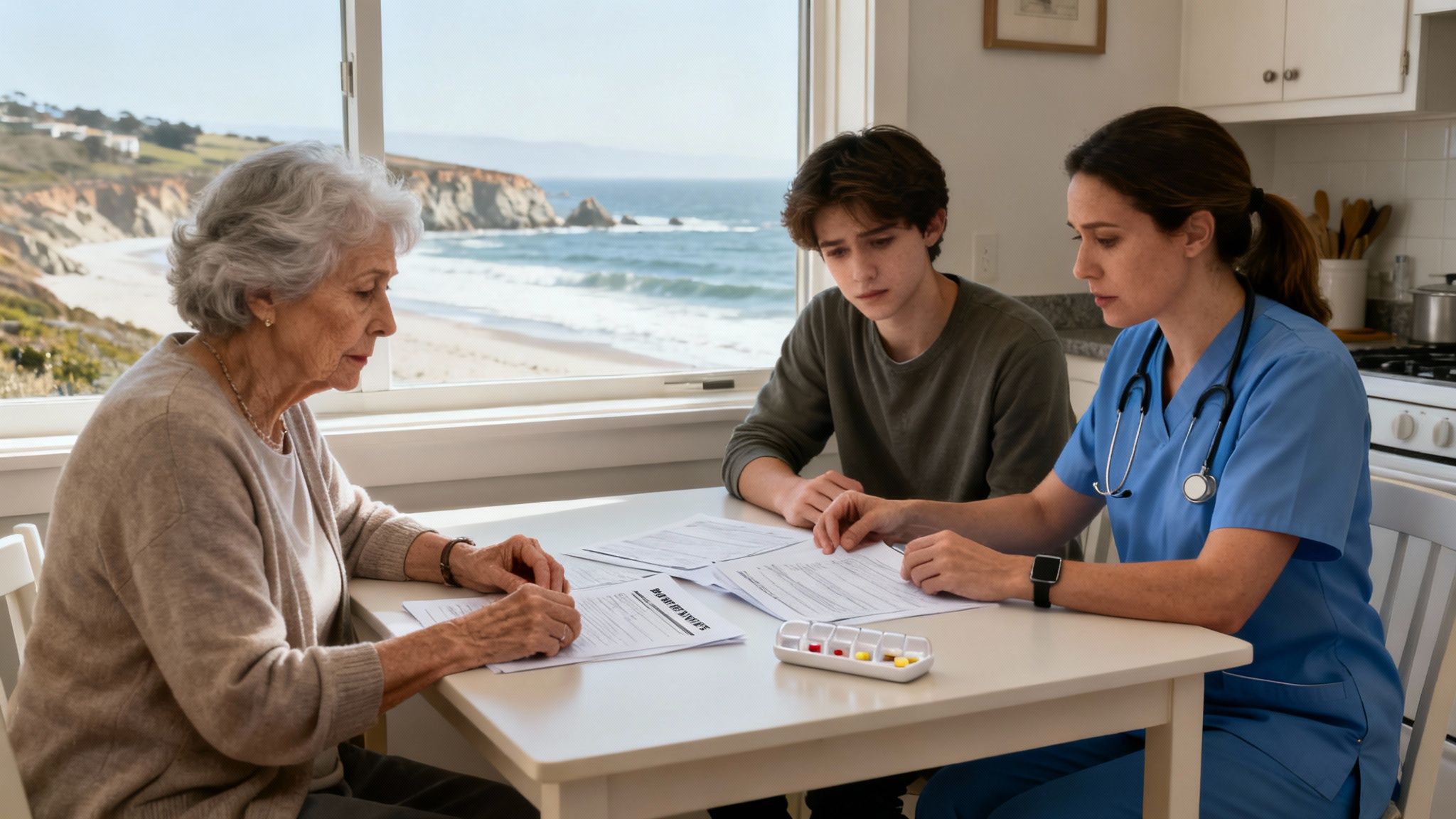
This gap exists because most plans, including Medicare, cover skilled medical care. This is care a doctor deems medically necessary, like short-term visits from a Registered Nurse. You can learn more in our guide on Medicare home care eligibility.
What Insurance Often Excludes
The problem arises when a person needs help with Activities of Daily Living (ADLs). Insurance usually calls this "custodial" care and does not cover it. Yet, these tasks make aging in place possible.
So what's left out? A lot.
- Personal Assistance: Help with bathing, dressing, and grooming.
- Companionship: Social interaction to fight loneliness.
- Household Help: Cooking, light housekeeping, and errands.
- Respite for Family: Giving a family caregiver a much-needed break.
Most older adults want to stay home as they age. In fact, 75% of adults over 50 say they want to remain in their homes. But nearly 95% have at least one chronic condition, requiring more care than insurance fully covers.
The table below shows what insurance typically handles versus what often needs other funding.
Home Health Insurance Common Coverage Gaps
| Type of Care | Typically Covered by Insurance | Often Requires Other Funding |
|---|---|---|
| Skilled Nursing | Wound care, IV therapy, medication management by an RN. | Medication reminders, transportation to appointments. |
| Therapy | Physical, occupational, or speech therapy post-injury or illness. | General exercise assistance, mobility support around the house. |
| Personal Care | Very limited, only if part of a skilled care plan. | Help with bathing, dressing, grooming, and toileting. |
| Household Support | Not covered. | Meal preparation, light housekeeping, laundry, shopping. |
| Companionship | Not covered. | Social interaction, safety supervision, accompanying to events. |
Understanding this difference is the first step toward finding a sustainable care solution.
A Common Scenario in Monterey County
Let's look at a real-world example. Imagine a family in Salinas whose father is recovering from a fall. His insurance covers a physical therapist twice a week and a nurse to check his vitals. But who helps him get to the bathroom at night or ensures he eats nutritious meals?
This is the gap where families feel the most pressure. The skilled medical needs are met, but the daily support for safety and quality of life is not. This leaves family members trying to fill in the blanks, often at great personal and financial cost.
At Central Coast VNA & Hospice, we see this all the time. Our role is to help families in Monterey, San Benito, Santa Cruz, and South Santa Clara counties build a complete circle of support. We help you understand these gaps and find solutions.
Creating a Clear and Actionable Care Plan
Before looking for funding, you need a map of the required help. A detailed care plan is that critical first step. It helps you understand your loved one's needs and communicate them to agencies.
Many people assume home health care covers everything from bathing to companionship. But medical home health is often short-term and clinical. Non-medical needs, like personal care or respite, may not be included.
This is why a thorough assessment is vital. You should plan early for how to supplement medical home health with local resources. Consider family caregiving schedules, adult day programs, and local volunteer support.
Evaluating the Full Spectrum of Needs
An effective care plan looks at the whole person. It ensures their safety, comfort, and emotional well-being are covered. Break down the needs into key categories to make it less overwhelming.
Grab a notepad and ask specific questions:
- Medical and Skilled Needs: Do they need wound care? Can they manage medications correctly? Do they need monitoring for a chronic condition?
- Personal Care Needs: Do they need help with bathing or dressing? Can they get to the bathroom safely?
- Household and Daily Living: Can they prepare nutritious meals? What about housekeeping, laundry, or grocery shopping?
- Social and Emotional Support: Are they lonely? Would companionship or community activities improve their quality of life?
This assessment is more than a checklist. It is a document that paints a clear picture of daily life. This plan helps organizations connect you with the right resources.
How a Professional Assessment Provides Clarity
Figuring this out alone can be daunting for families on the Central Coast, from Santa Cruz to Hollister. An expert assessment from a provider like Central Coast VNA & Hospice can make all the difference.
Our team of Registered Nurses and Medical Social Workers can conduct a professional evaluation in the home. This isn't just about finding problems; it's about providing a clear, actionable plan. We help you set priorities and build a solid support system.
Finding Financial Aid for In-Home Care
Once you know what care is needed, the next question is how to pay for it. The answer often lies beyond your traditional insurance policy.
Thankfully, several other funding sources are available. Many are specific to residents on California's Central Coast. Navigating these programs can feel complex, but you don't have to do it alone.
Exploring Government and State Programs
Several government programs help cover long-term care at home. For many families, these options are a lifeline.
Here are a few important programs to explore:
- Medi-Cal: California's Medicaid program offers initiatives for long-term care. The In-Home Supportive Services (IHSS) program can pay for non-medical help for eligible low-income seniors.
- VA Benefits: Veterans and their surviving spouses may qualify for benefits like Aid and Attendance. This pension supplement can be used to pay for in-home care.
- Area Agency on Aging (AAA): Your local AAA is a great resource. They often manage grants that provide support for seniors, including respite care, meal delivery, and transportation.
The first step is to break down the care plan into medical, personal, and household needs. This helps match the right need to the right funding source.
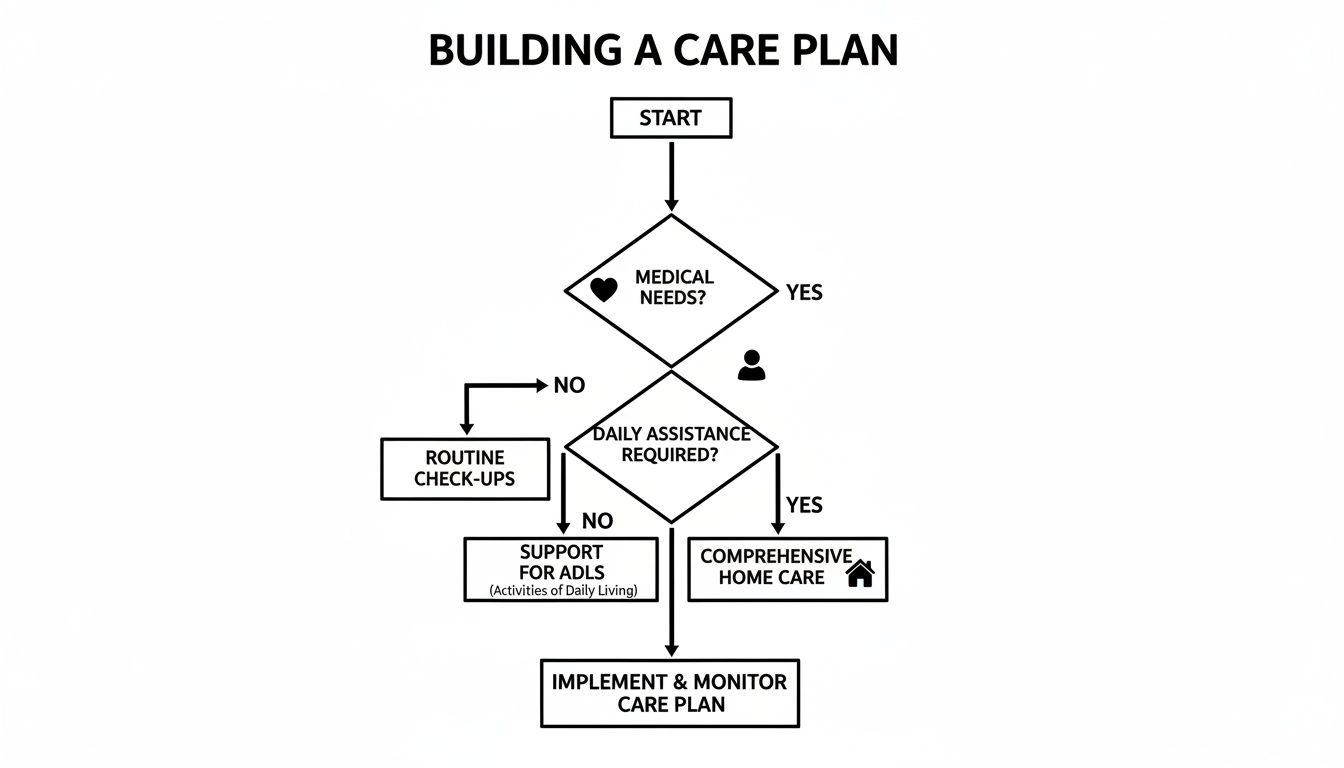
Separating these needs makes it easier to find programs designed for each type of care.
Tapping Into Disease-Specific and Nonprofit Aid
Beyond government aid, many foundations offer financial help for specific illnesses. Groups like the Alzheimer's Association or the American Cancer Society often have grants or local programs.
For those facing serious financial strain, looking into financial hardship grants can also provide relief.
This is where a mission-driven organization can be a powerful ally. Central Coast VNA & Hospice doesn’t just provide skilled nursing. Our team guides families through the entire care journey, helping you plan and coordinate services.
Because of our nonprofit status, our mission-driven support can include services like volunteer help and bereavement care. Learn more about how families can afford in-home care long-term in our guide.
Here’s a summary of some available programs.
Potential Funding Sources for Home Care
| Funding Source | Who It Typically Helps | What It May Cover |
|---|---|---|
| Medi-Cal (IHSS) | Low-income seniors and adults with disabilities in California. | Personal care (bathing, dressing), household help, meal prep. |
| VA Benefits (Aid & Attendance) | Eligible veterans and their surviving spouses. | Monthly pension supplement to pay for in-home care services. |
| Area Agency on Aging | Seniors in a specific geographic area (e.g., Monterey County). | Respite care, meal delivery, transportation, information services. |
| Disease-Specific Foundations | Individuals with specific diagnoses like Alzheimer's, ALS, or cancer. | Grants for care, equipment, or respite for caregivers. |
| Nonprofit Home Care Agencies | Community members, often regardless of ability to pay. | Skilled nursing, therapy, and support services on a sliding-fee scale. |
These programs exist to help families bridge the financial gap. Our Medical Social Workers at Central Coast VNA & Hospice are experts at this. They can help you identify which programs your family may qualify for and assist with applications.
Tapping Into Local Community and Nonprofit Support
When insurance falls short, money is only one part of the solution. The most meaningful support can come from people in your own community. Local and nonprofit resources can fill critical gaps in care.
We advise families to plan ahead. Think about blending skilled medical home health with community resources. Central Coast VNA & Hospice offers care coordination and can connect families to resources like veteran support, music therapy, or grief services.
Finding Community-Based Services
Across the Central Coast, from Santa Cruz to Hollister, a network of organizations offers support insurance rarely covers. These programs improve quality of life and help people stay safe at home.
It’s worth looking into these options:
- Local Senior Centers: Many run adult day programs with social activities, meals, and health monitoring. This combats isolation and gives family caregivers a break.
- Volunteer Services: Local nonprofits and faith-based groups often have volunteers who help with companionship, errands, or rides to appointments.
- Respite Care Grants: Some community organizations offer grants or low-cost respite services, giving family members a chance to rest. Find more advice on how to get real support as a family caregiver on the Central Coast.
These services are often funded by community donations and grants. This makes them accessible regardless of ability to pay. To learn how these organizations operate, you can explore the diverse sources of funding for nonprofits.
The Nonprofit Advantage at Central Coast VNA & Hospice
As a nonprofit serving our community for over 74 years, Central Coast VNA & Hospice is part of this local support network. Our mission-driven approach means we offer services that go beyond what’s medically billable.
Our own volunteer programs are a perfect example. We provide specialized services like pet therapy, music therapy, and bereavement support for families. These are all funded by the generosity of our community.
These programs are an essential part of our holistic care model. They address emotional and spiritual needs, providing comfort and connection. This commitment ensures families in Monterey, San Benito, and Santa Cruz counties receive comprehensive, compassionate support.
How Central Coast VNA & Hospice Bridges the Gap
Trying to arrange care when insurance falls short is like solving a puzzle with missing pieces. Central Coast VNA & Hospice can help. We are not just a medical provider; we are a partner here to guide your family.
Our team-based approach means every need—medical, emotional, or spiritual—gets attention. We bring all the support you need under one roof.
A Continuum of Compassionate Care
At Central Coast VNA & Hospice, we offer a continuum of care that adapts to your loved one's changing needs. A patient can move smoothly between our services without the stress of finding new providers.
Our services are designed to work together:
- Home Health: Our skilled nurses and therapists help patients recover from surgery or manage chronic conditions at home.
- Palliative Care: For those with a serious illness, our palliative team relieves symptoms and boosts quality of life.
- Hospice Care: When the time is right, our hospice team provides compassionate end-of-life care focused on comfort and dignity.
This integrated model ensures consistent, high-quality care every step of the way. See the difference we make by reading about how Central Coast VNA & Hospice impacts lives across the Central Coast.
Our Nonprofit Mission in Action
As a nonprofit with over 74 years of local roots, our commitment goes beyond what's billable. Thanks to community donations, we provide essential support that insurance does not cover. This can include volunteer visits, family bereavement counseling, and specialized therapies.
Our mission is to ensure every eligible person receives the care they deserve, regardless of their financial situation. We are here to help you understand your options and build a plan that works.
If you’re in Monterey, Hollister, Santa Cruz, or Salinas, our team can help. We can help you understand what your insurance covers and what your options are when it doesn’t. Call us at (831) 372‑6668 to speak with a care coordinator about in-home care planning.
Frequently Asked Questions About Funding Home Care
Navigating home care funding can be confusing. Below are answers to common questions we hear from families.
What should I do if my insurance denies a claim for home health care?
First, don't panic. Read the denial letter to understand the reason for the refusal. You have a right to appeal the decision.
Next, reach out to your provider, like Central Coast VNA & Hospice. Our team can provide medical documentation to build a stronger case. You can also contact California's HICAP (Health Insurance Counseling & Advocacy Program) for free help.
Does Medicare ever pay for long-term personal care at home?
Generally, no. Medicare does not cover long-term custodial or personal care. This includes help with daily tasks like bathing, dressing, or preparing meals.
Medicare covers short-term, skilled care prescribed by a doctor. For long-term personal care, you'll need to look at other funding routes. You can learn more in our resources on how to pay for hospice care.
Are there specific programs for veterans in Monterey County?
Yes. The Department of Veterans Affairs (VA) has programs to help veterans pay for in-home care. The most well-known are the Aid and Attendance or Housebound benefits.
These programs can provide a monthly stipend to eligible veterans and their surviving spouses. Central Coast VNA & Hospice can connect you with VA social workers and other resources to help secure these benefits.
How can a nonprofit like CCVNA help if I can’t afford care?
Our mission is to provide care to everyone in our community who needs it, regardless of ability to pay. Our focus is on the patient's well-being, not the bottom line.
Because of generous community donations, we can sometimes offer services on a sliding-fee scale. Our Medical Social Workers are experts at finding financial assistance and community resources to build a care plan that fits your family's budget.
What is the difference between medical home health and private-duty care?
Understanding this distinction is very important. They sound similar but are very different.
- Medical Home Health: This is the skilled, clinical care that Central Coast VNA & Hospice provides. It includes services like nursing and physical therapy prescribed by a doctor. This is often covered by Medicare and other insurance.
- Private-Duty Care: This refers to non-medical services like personal care, meal prep, and companionship. This type of care is typically paid for directly by the family.
The journey to find the right in-home support can be complex, but you don't have to do it alone. Central Coast VNA & Hospice is here to bring clarity and compassionate guidance to families in Monterey, San Benito, Santa Cruz, and South Santa Clara counties. Contact us today to learn more about your options at https://ccvna.com.

Why Palliative Care Isn’t Just for the End of Life
Many people think palliative care is about giving up. But it’s really about adding support.
Think of it as an extra layer of care. It focuses on improving your quality of life, and it's for anyone with a serious illness. You can start right from the moment of diagnosis. The simple truth is that you can—and should—get palliative care while actively pursuing treatments to cure your condition.
Understanding What Palliative Care Truly Is

Here on the Central Coast of California, families often confuse palliative care with hospice. It's a common misunderstanding. But it stops people from seeking help that could make a world of difference much earlier.
Palliative care works alongside your curative medical treatments. It does not replace your primary doctor or specialists. Instead, it adds a dedicated team focused on relieving symptoms, pain, and stress from serious illnesses like cancer or heart failure.
Palliative Care Quick Facts: What It Is vs. What It Isn't
To clear up any confusion, let's break down what palliative care really means. We will look at some common myths.
| Common Misconception | The Reality of Palliative Care |
|---|---|
| It’s the same as hospice. | It’s a separate specialty focused on quality of life and can be provided alongside curative treatment. |
| You have to give up your own doctors. | You keep your entire medical team. The palliative team collaborates with them. |
| It means you’re dying. | It can be started at any stage of a serious illness, even right at diagnosis. |
| It’s only for managing physical pain. | It addresses physical, emotional, and spiritual needs for the patient and family. |
This table shows that palliative care is a flexible resource. It is designed to help you live as well as possible, for as long as possible.
An Extra Layer of Support When You Need It Most
Imagine your medical team is focused on treating your illness. That’s their main job. A palliative care team works with them, but their focus is on you as a whole person. This support improves your daily life and helps you feel strong enough to continue treatment.
This support system helps you:
- Manage difficult symptoms like pain, shortness of breath, fatigue, or nausea.
- Reduce stress and anxiety by offering emotional and spiritual support.
- Improve communication between you, your family, and your entire medical team.
- Align your care with your personal goals and what truly matters most to you.
It's so important to understand that palliative care is about living with a serious illness. It is not just about preparing for the end of life. You can take a deeper dive by exploring what is palliative care in more detail on our site.
Rooted in Community and Compassion
For over 74 years, Central Coast VNA & Hospice has been the trusted local nonprofit provider of this care. Our mission is to bring this support to patients in their homes. We serve people throughout Monterey County, San Benito County, Santa Cruz County, and South Santa Clara County.
We believe everyone deserves to live with dignity. We want you to have the best possible quality of life at every stage of illness.
How Palliative Care Works With Your Medical Team

Many families are relieved to learn palliative care doesn't mean giving up their trusted doctors. It's the opposite. It is a collaborative service, adding a team of specialists who work with your current physicians.
Your primary doctor manages the main treatment plan to fight the illness. A palliative care team works as expert consultants. They make sure everything runs as smoothly and comfortably as possible.
This team approach means you get the best of both worlds. Your specialists can focus on treating the disease. Meanwhile, your palliative team concentrates on managing tough symptoms, pain, and stress.
Your Dedicated Support Team
Here at Central Coast VNA & Hospice, our palliative care team includes professionals from different backgrounds. They are all centered on your well-being. This ensures your care addresses not just physical symptoms, but your emotional and spiritual needs, too.
Your specialized team typically includes:
- A Registered Nurse or Nurse Practitioner specializing in pain and symptom management.
- A Medical Social Worker who provides emotional support and practical assistance.
- A Chaplain who offers spiritual support that respects your personal beliefs and values.
This team model provides holistic support. It recognizes that a serious illness impacts every part of a person's life. True comfort comes from caring for the whole person—body, mind, and spirit.
This coordinated effort lifts a huge burden off patients and families. You have a team of advocates making sure your care plan aligns with what matters most to you. You can learn more about how we integrate home health and palliative care for seamless support.
Creating a Coordinated Care Plan
This partnership is built on communication. Your palliative care team stays in regular contact with your other doctors. They share insights into how you're feeling and responding to treatments. This leads to better, more personalized care.
The result is a unified approach that keeps you at the center. The team helps explain complex medical information. They empower you to make informed decisions that reflect what is most important to your quality of life.
This proactive support also helps people stay comfortable at home. It can reduce emergency room visits and hospital stays. You can read more about these palliative care findings and their impact.
The Benefits of Starting Palliative Care Sooner
Many families wait too long to talk about palliative care. This is a common mistake. It often means missing out on the greatest benefits.
The best time to add this extra layer of care is at the beginning of a serious illness. This lets you and your loved ones manage symptoms and reduce stress from day one.
This proactive approach shows why palliative care isn't just for the end of life. It’s about improving your quality of life for all the days you have. By bringing in a team focused on comfort, you can better manage a serious illness while still pursuing treatments.
Improve Your Daily Quality of Life
One of the first things people notice after starting palliative care is how much better they feel. A serious illness often comes with a heavy burden of pain, fatigue, or nausea. These symptoms drain your energy and spirit.
The palliative care team works with your doctors to fine-tune medications and other therapies. Their goal is to make you feel better. This frees you to regain strength, get back to activities you love, and hold onto your independence.
At Central Coast VNA & Hospice, our nonprofit mission drives us to bring this compassionate support to your home. We serve patients across Monterey, Salinas, Hollister, and Santa Cruz. You can learn more in our guide to the benefits of palliative care.
Reduce Stressful Hospital Visits
Nobody enjoys frequent trips to the ER or hospital stays. They are a massive source of stress. Early palliative care can cut down on these events.
By actively managing symptoms at home, the team can often get ahead of problems before they become a crisis. This means more time spent in the comfort of your own home. For families, it means less worry.
This approach can prevent avoidable hospital admissions. It allows people to age in place with dignity.
Strengthen Emotional and Family Support
A serious illness is an emotional battle for the entire family. Palliative care understands this. That’s why the team includes Medical Social Workers and Chaplains.
This support system helps everyone by:
- Facilitating difficult conversations about care goals and future wishes.
- Providing counseling to help cope with the anxiety and stress.
- Connecting families with community resources for practical help.
- Offering spiritual guidance that respects your personal beliefs.
This comprehensive support ensures no one faces the challenges alone. For those hoping to maintain independence, an aging in place checklist can be a great step. By starting palliative care sooner, you give your family the gift of support and peace of mind.
Who Is a Good Candidate for Palliative Care?
Deciding if palliative care is the right choice can feel complicated. But it boils down to something simpler: Could you or your loved one use extra support to manage a serious illness?
This is not about timelines. It is about need. Palliative care is for patients of any age at any stage of a serious illness. That is why palliative care isn’t just for the end of life—it’s for living better, right now.
Common Conditions That Benefit from Palliative Care
Many serious illnesses have a heavy burden of symptoms and stress. Palliative care is especially helpful for people managing:
- Cancer: To control pain, nausea from chemotherapy, and fatigue.
- Heart Disease: Including congestive heart failure (CHF), to ease shortness of breath.
- Lung Disease: Such as Chronic Obstructive Pulmonary Disease (COPD), to improve breathing.
- Kidney Disease: To help with symptoms like fatigue and discomfort.
- Dementia or Alzheimer’s Disease: To navigate behavioral changes and support the family.
- Neurological Conditions: Like Parkinson’s disease, ALS, or the effects of a stroke.
Getting the right support is critical. For instance, families often find value in resources like guides on caring for dementia patients, which complement help from a palliative team.
Look for the Signs, Not Just the Diagnosis
More important than the diagnosis are the real-world challenges. You do not have to wait for a doctor to bring it up. If this sounds familiar, it’s time to ask about palliative care:
- Uncontrolled Symptoms: There is persistent pain, fatigue, nausea, or shortness of breath.
- Frequent Hospital Visits: You have had multiple trips to the ER or hospital in the past year.
- Decreased Ability to Care for Oneself: Daily activities like bathing or dressing have become difficult.
- Significant Stress and Anxiety: The illness has left you or your family feeling overwhelmed.
Recent data shows that 95% of people over 60 have at least one chronic condition. Palliative care helps manage symptoms and stress, even years before hospice is needed.
If these challenges sound familiar, our Central Coast VNA & Hospice team is here to help. We can help you understand your options in Monterey County, San Benito County, and the surrounding areas.
Palliative Care vs. Hospice: Clarifying the Key Differences
To make the best decision, it’s vital to know how palliative care and hospice are different. Both focus on comfort. But they serve different needs at different times.
The biggest myth we see on the Central Coast is that they are the same. This is not true. Palliative care is an extra layer of support you can get at any stage of a serious illness, alongside curative treatments.
Hospice care is a specific type of palliative care for people near the end of life. It begins only when curative treatments have stopped. The focus shifts entirely to comfort and peace.
Palliative Care and Hospice at a Glance
For families in Monterey, Salinas, and Hollister, healthcare terms can feel overwhelming. This table makes the differences clear.
| Feature | Palliative Care | Hospice Care |
|---|---|---|
| When It Starts | At any stage of a serious illness, right from diagnosis. | When life expectancy is six months or less, and curative treatments have stopped. |
| Treatment Goals | To relieve symptoms and stress while you continue curative treatments. | To provide comfort, peace, and dignity when a cure is no longer the goal. |
| Who It's For | Patients of any age with a serious illness like cancer, heart disease, or COPD. | Patients with a terminal diagnosis who have chosen to focus on quality of life. |
| Where It's Provided | Often delivered at home, alongside your regular doctor visits. | Primarily provided at home, but also in facilities, with 24/7 on-call support. |
The core difference is that palliative care works with curative treatment. Hospice care is for when treatment has stopped. This is why palliative care isn’t just for the end of life—it’s a powerful resource for living better with a serious illness.
Making the Right Choice for Your Family
Choosing between these options isn’t about giving up. It's about getting the right support at the right time. Palliative care offers relief and strength during a long illness. Hospice provides comfort for the final chapter of life.
The following graphic shows some of the conditions that lead families to consider palliative support.
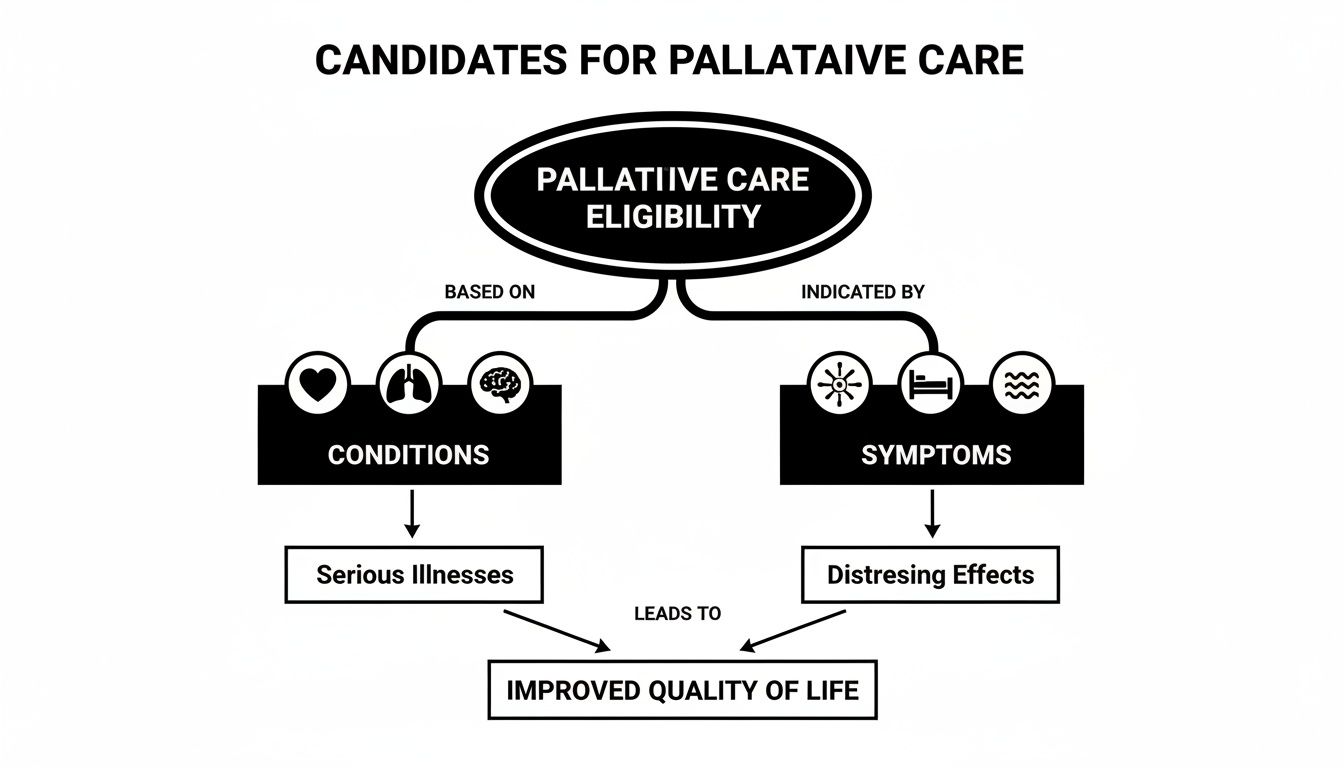
This visual shows how palliative care addresses the whole person. The goal is to improve quality of life by managing symptoms from a serious health condition.
At Central Coast VNA & Hospice, our continuum of care means we are the local nonprofit offering home health, palliative care, and hospice. This provides a seamless transition if a patient’s needs change. For a deeper look, learn more about the real differences between hospice and palliative care.
How To Get Started With Palliative Care On The Central Coast

Taking the first step is simpler than you might think. If your loved one could benefit from better symptom management, the process starts with one conversation.
Reaching out is not a final commitment. It is an exploration of the support available to you. This is a big reason why palliative care isn’t just for the end—it’s a resource you can use anytime to improve comfort.
Starting The Conversation With Your Doctor
Your first move is to talk to your physician or specialist. Palliative care almost always requires a doctor's referral. They are the natural starting point.
When you go to the appointment, be ready to talk about specific challenges. Explain which symptoms are causing the most trouble.
You can be direct and ask, "Could palliative care help us manage these symptoms?" This helps your doctor focus on your needs. Remember, asking for help is a sign of strength.
Accessing Palliative Care At Home
Once you have a referral, Central Coast VNA & Hospice makes the rest of the process easy. As a trusted local nonprofit with over 74 years of service, our mission is to bring expert care to your doorstep. We serve patients in their homes across Monterey County, San Benito County, Santa Cruz County, and South Santa Clara County.
Our palliative care team will coordinate with your doctor to build a support plan. We handle the logistics so you can focus on feeling better. You can learn more about our local services by exploring information on palliative care near me.
Understanding Your Insurance Coverage
One of the first questions families ask is about cost. The good news is that palliative care is covered by most insurance plans. This makes it an accessible option.
Here is a quick breakdown of typical coverage:
- Medicare Part B: This covers palliative care services like any other specialist visit.
- Medi-Cal: Provides coverage for palliative care consultations and follow-up visits.
- Private Insurance: Most private and employer-sponsored health plans include palliative care benefits.
Our team at Central Coast VNA & Hospice can help you verify your coverage. We believe financial worries should never stand in the way of getting compassionate care.
Ask your provider whether your loved one qualifies for palliative care—not just hospice. Look for services that provide both, so transitions can be handled smoothly later if needed.
If you're caring for someone with a serious illness in Monterey, Salinas, Hollister, or Santa Cruz, our VNA team can help you understand your options without pressure. Visit ccvna.com or call 831‑372‑6668 to speak with a nurse.
Frequently Asked Questions (FAQs)
It’s normal to have questions as you explore care options. Here are some common ones we hear from families on the Central Coast.
1. Does choosing palliative care mean I’m giving up?
Absolutely not. It is the opposite. This is a key reason why palliative care isn't just for the end of life. Palliative care works with your curative treatments, like chemotherapy. Its job is to help you manage symptoms and stress. By helping you feel stronger, it empowers you to stick with your doctor's plan.
2. Who is on a palliative care team?
You get a whole team of specialists. The goal is to address your physical, emotional, and spiritual well-being. At Central Coast VNA & Hospice, our team includes a Registered Nurse, a Medical Social Worker, and a Chaplain. This team works with your own doctors to coordinate care.
3. Is palliative care only for people with cancer?
No, not at all. It is for anyone living with a serious or chronic illness. This includes conditions like heart disease (CHF), lung disease (COPD), kidney failure, and dementia. The focus is always on improving your quality of life right now.
4. Where do you provide palliative care?
Palliative care can be offered in hospitals or clinics. But at Central Coast VNA & Hospice, we bring that support directly to you, wherever you call home. We provide care in your house or an assisted living facility. We serve communities across Monterey County, San Benito County, Santa Cruz County, and South Santa Clara County.
5. How is palliative care paid for?
Most people are surprised to learn that palliative care is treated like any other medical specialty. It is typically covered by Medicare Part B, Medi-Cal, and most private insurance plans. Our team at Central Coast VNA & Hospice can help you figure out your specific coverage.
If you're caring for someone with a serious illness in Monterey, Salinas, Hollister, or Santa Cruz, you don't have to figure this out alone. Our team at Central Coast VNA & Hospice can help you understand your options without any pressure. Visit our website or call 831‑372‑6668 to speak directly with a nurse.

The Shift Driving More Seniors to Stay at Home in 2026
A quiet but powerful shift is happening in homes across the Central Coast and the nation. More seniors are choosing to age in place, surrounded by the comfort and memories of the homes they love. This is a fundamental change in how we think about long-term care.
This movement is driven by personal choice, financial sense, and a deep desire for safety.
The Unmistakable Trend: Why More Seniors Are Choosing Home

The message from older adults is clear: they want to stay home. Instead of moving to a facility, they are opting to receive care where they feel most comfortable. This preference is reshaping healthcare for families and providers alike.
The reasons are both practical and personal. Home is a lifetime of memories, a connection to neighbors, and the freedom to live by one's own rules. For many, preserving that dignity is essential.
The Driving Forces Behind Aging in Place
Several powerful factors are making in-home care a more appealing choice. This is true for families in Monterey County, San Benito County, Santa Cruz County, and South Santa Clara County.
- A Desire for Autonomy: At home, seniors decide their own schedule. This simple independence is something they value deeply.
- Emotional Well-being: Being in a familiar space has a huge impact on mental and emotional health. It brings an undeniable sense of peace.
- Health and Safety: For many families, home now feels like the safest place to receive care. It helps minimize exposure to illnesses often found in group settings.
The numbers tell the same story. A recent poll found that an overwhelming 75% of adults 50 and older say they want to age in place. This desire is a major driver behind the growing demand for at-home senior care services.
This preference is also fueled by cost. Professional home-based care is often a much more sustainable option for many families compared to expensive facility care.
Key Drivers for Seniors Choosing Home Care in 2026
The shift toward home is pushed by a few key motivations. This table breaks down what is behind this growing preference.
| Driving Factor | Impact on Seniors and Families |
|---|---|
| Personal Independence | Seniors maintain control over their daily routines, diet, and social life. |
| Emotional Comfort | Staying in a familiar environment reduces stress and promotes mental well-being. |
| Financial Savings | Home care is often more affordable than facility-based options. |
| Health & Safety | Reduces exposure to infections common in congregate settings. |
| Family Connection | Makes it easier for family and friends to visit and stay involved in care. |
These factors create a compelling case for why home is becoming the preferred setting for long-term care.
Creating a Comfortable and Safe Home
As more seniors decide to age in place, making the home environment supportive is key. Simple adaptations can make a world of difference. This might include adding grab bars, improving lighting, or selecting furniture like the best recliners for seniors.
For families on the Central Coast, organizations like Central Coast VNA & Hospice meet this growing need. You can learn more about why home health care is growing fast on the Monterey County coast on our blog.
Exploring the Forces Behind the At-Home Movement
The growing desire for seniors to stay home is not a coincidence. It is a powerful shift driven by personal wishes, practical finances, and a major change in our population. Understanding these forces helps families prepare for what lies ahead.
Three big drivers are fueling this trend here on the Central Coast and across the nation. Each one is reshaping the future of senior care.
The Demographic Wave
First and foremost, America is getting older. This simple fact is the engine behind the at-home movement. A significant 4.1 million Americans turned 65 in 2024, creating a huge wave of new seniors.
This is a generation that has always prized its independence. This is a local reality for families in Monterey, Salinas, and Hollister. As more of our neighbors enter their senior years, the demand for healthcare that fits their values is skyrocketing.
The Economic Reality of Senior Care
The second powerful force is the financial difference between care facilities and aging at home. The costs of nursing homes can quickly become overwhelming. This often creates incredible stress for families.
In-home care offers a much more manageable financial path. Services are designed to fit specific needs, so families only pay for the support required.
This could include:
- Skilled Nursing Visits: A Registered Nurse can handle medical needs like wound care or medication management at home.
- Therapy Services: Physical, occupational, or speech therapy can be delivered in a patient's own living room.
- Palliative and Hospice Care: Specialized support for serious illness or end-of-life care can be provided at home.
This flexibility makes professional home-based care a practical choice. It lets families in Santa Cruz and San Benito counties put resources toward targeted medical help. You can learn more by reading about the 6 home care trends Central Coast families should watch in 2026.
The Powerful Preference for Independence
Finally, we have the most personal force of all: the deep need for comfort and independence. Home is a sanctuary filled with memories and familiar routines. Leaving that behind can feel like losing a piece of yourself.
Staying at home means seniors can keep their daily rhythms. This sense of control is directly linked to emotional well-being and quality of life.
A home care plan is built around the individual. It adapts to their life, rather than forcing them to adapt to an institution. For over 74 years, Central Coast VNA & Hospice has helped families build these kinds of personalized plans.
The Growing Gap Between Senior Needs and Available Care
The desire to age in place is running up against a hard reality. The healthcare system is not always built for it. As seniors choose to remain home, a gap is opening between the care they need and what is available.
This leaves families scrambling to find consistent, reliable in-home care. This is especially true when different services are isolated from one another.
A Family's Journey Through Uncoordinated Care
For healthcare providers and families, this shift means more pressure. They must manage chronic conditions and mobility issues without facility placement. The current system often makes this difficult.
Organizations that treat home health, palliative care, and hospice as isolated offerings risk confusing patients. Without clear guidance across the continuum of care, families may delay decisions. This can lead to preventable health crises or costly ER visits.
This kind of fragmented care creates real pain points:
- Disjointed Communication: Families are forced to be the messenger between different agencies that rarely talk to each other.
- Preventable Hospital Visits: Small problems can quickly turn into major health crises without one team seeing the big picture.
- Emotional and Physical Burnout: Juggling appointments, medications, and different care teams is exhausting for family members.
The Looming Supply Crunch
Finding care is already tough, and it may get harder. The construction of new senior living facilities is not keeping pace with our aging population. This will push even more seniors to seek care at home.
This "development/demand divide" is setting the stage for a challenge. Demand is set to explode as the oldest Baby Boomers turn 80. You can explore more data on senior living trends to see the full scope of the issue.
This is the problem Central Coast VNA & Hospice was founded to solve. For over 74 years, our nonprofit mission has been to offer a seamless continuum of care under one roof. Our integrated model is designed to close that care gap for families in Monterey, San Benito, Santa Cruz, and South Santa Clara counties.
How a Continuum of Care Bridges the Gap for Seniors
The growing gap between what seniors need and what our healthcare system offers can be frustrating. There is a better way, built on the idea of a continuum of care. This approach helps families avoid disjointed services.
Think of it like having a trusted guide for a long journey. This guide walks alongside you and anticipates the twists and turns ahead. That is what an integrated continuum of care does for families.
Understanding the Integrated Care Model
A continuum of care is an integrated system that follows a patient through every stage of their health journey. It connects home health, palliative support, and hospice under one coordinated team. This model eliminates the confusion many people experience.
As a patient's needs change, the transitions are seamless. The same trusted team that already knows your history and wishes stays involved. This is how we can address the shift driving more seniors to stay at home in 2026.
This growing gap between what seniors need and what a disconnected system can provide is a real challenge.
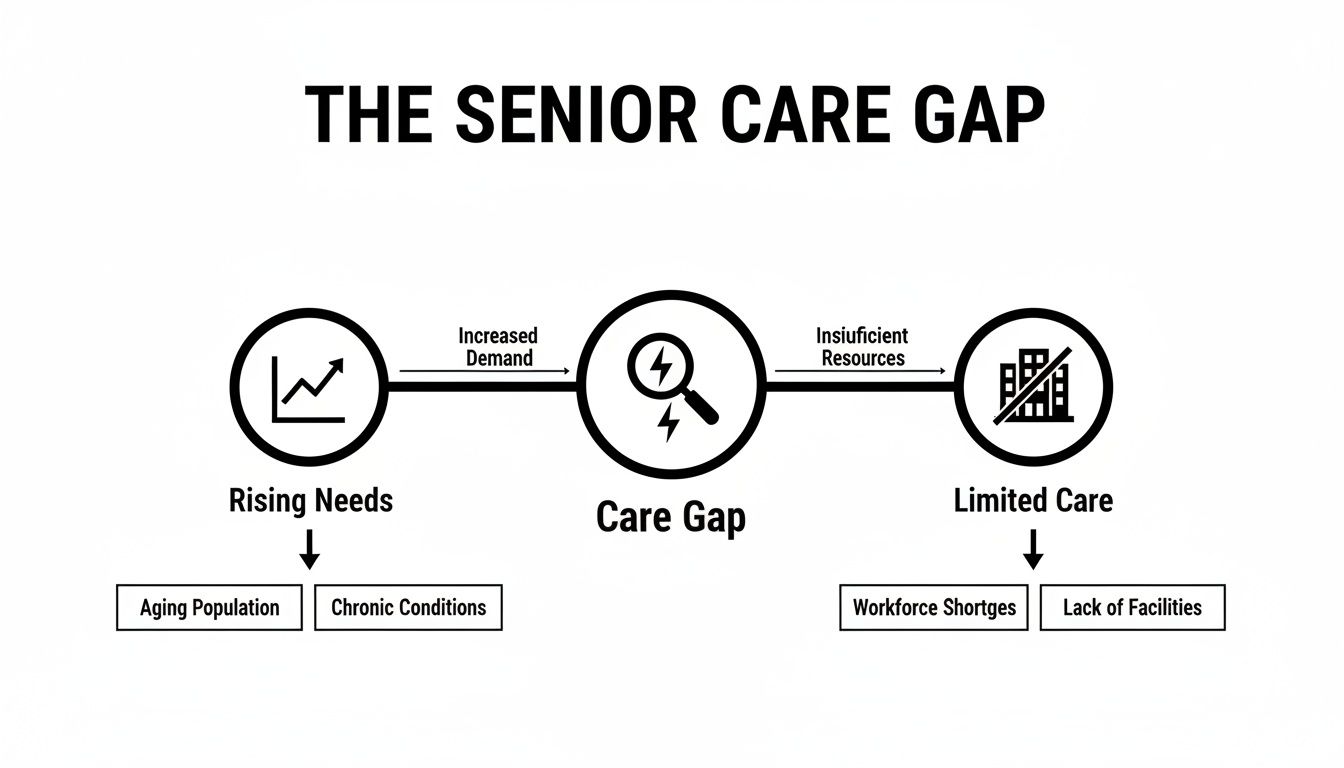
The visual above shows why a unified approach is essential. It ensures seniors get consistent, reliable support.
How a Single Provider Makes a Difference
When one organization provides the full spectrum of home-based care, the benefits are immediate. Central Coast VNA & Hospice has spent over 74 years perfecting this model. Our approach is built on core principles.
- Seamless Transitions: If a home health patient’s illness progresses, our team can introduce palliative care without disruption. The transition to hospice is handled with compassion by clinicians who already know them.
- Coordinated Communication: Our Registered Nurses, therapists, social workers, and Hospice Aides are all part of the same team. They communicate constantly so you never have to repeat your story.
- Clinically Superior Outcomes: This leads to better health outcomes. By managing symptoms proactively, we can reduce preventable hospitalizations and improve quality of life.
At its heart, the continuum of care is about providing the right care, at the right time, in the right place. It replaces confusion with clarity and stress with support.
For families in Monterey, Hollister, Santa Cruz, or South Santa Clara County, this means you have a dedicated partner. You can see this model in action by learning more about how our expert teams provide skilled nursing at home.
Why a Nonprofit Mission Matters
As the only local provider offering this full continuum of care, Central Coast VNA & Hospice operates as a nonprofit. This is a critical distinction. Our mission is driven by the needs of our community, not by shareholder profits.
This focus allows us to pour our energy into what truly matters. We deliver compassionate, high-quality care that honors each person's wish to remain at home.
What Integrated Home-Based Care Really Means for You

Choosing an integrated care model goes far beyond convenience. It delivers real benefits that improve a patient’s quality of life and give families peace of mind. This unified approach makes the wish to stay home a safe reality.
When a single, mission-driven team oversees a patient's entire journey, the care becomes smarter. It is more responsive and deeply personal. It is the difference between a stressful experience and a seamless one.
No More Broken Telephone
With separate agencies, families often find themselves playing messenger. An integrated model eliminates this risk.
At Central Coast VNA & Hospice, our Registered Nurses, therapists, and Hospice Aides are part of one connected team. Proactive communication helps us catch potential issues before they become serious problems.
Keeping You Safely Out of the Hospital
One of the biggest wins with coordinated home-based care is a drop in avoidable ER visits. Our clinical teams work in sync to manage symptoms and teach families how to handle challenges at home. This is more important than ever as the shift driving more seniors to stay at home in 2026 picks up speed.
Integrated services make this possible, keeping patients safely out of hospitals. This helps to reduce hospitalizations and support seniors to age safely in their own homes.
By offering a steady, watchful eye, integrated care teams can address health concerns before they escalate. This preserves a patient’s well-being and a family's emotional resources.
Care Plans That Evolve With You
A person's health needs are not static. The beauty of an integrated continuum is that the care plan adapts just as smoothly. This model ensures the right level of support is always there.
Here’s how a care journey can evolve under one roof:
- Home Health: Following a hospital stay, a patient gets skilled nursing and physical therapy to rebuild strength.
- Palliative Care: As a chronic illness progresses, the focus can shift to managing symptoms, often while other treatments continue. Our article on using telehealth in hospice and palliative care shows how technology helps us do this.
- Hospice Care: If the time comes, the transition to hospice is handled with compassion by a team that has earned the family’s trust.
Integrated care also provides practical solutions for daily living. Guides on finding the best lift chairs for seniors can make a huge difference in comfort and independence.
For over 74 years, Central Coast VNA & Hospice has delivered this connected care to families. We serve Monterey, San Benito, Santa Cruz, and South Santa Clara counties.
Getting Your Network Ready for the Future of Senior Care
For healthcare providers on the Central Coast, the message is clear. By 2026, a massive wave of seniors will be choosing to age at home. This shift puts pressure on our local health systems.
Discharge planners and physicians in Monterey, Hollister, Salinas, and Santa Cruz should evaluate their care networks now. If we wait, we risk serious service gaps. A fragmented approach no longer works for our community.
Central Coast VNA & Hospice is a local partner ready to help. As a nonprofit with over 74 years of local experience, we offer an integrated continuum of care under one trusted roof. Our coordinated model creates seamless transitions and personalized support.
We are ready to partner with providers to help meet the rising need for aging-in-place services. Let's work together to strengthen our community’s ability to support seniors.
To learn how you can partner with a trusted, mission-driven leader, visit us at ccvna.com or call 831-372-6668 to speak with our team.
Frequently Asked Questions About In-Home Senior Care
Figuring out the world of in-home care brings up many questions. As the shift driving more seniors to stay at home in 2026 becomes clearer, getting a handle on your options is the first step. Here are answers to common questions.
How do I know if my loved one is eligible for home health care?
Eligibility for home health care usually depends on a few key things set by Medicare. A patient needs to be under a doctor's care and require skilled services on an intermittent basis. This may include visits from a Registered Nurse or a physical therapist.
The patient must also be considered "homebound," meaning it is a major effort to leave the house. A physician must certify that the care is medically necessary. Our team can work with your loved one's doctor to determine eligibility.
What should I expect from a home-based care team?
A professional home-based care team brings expert medical support to your home. At Central Coast VNA & Hospice, our teams are led by experienced healthcare professionals. Their team-based approach ensures we care for the whole person.
Depending on a patient's needs, their team might include a Registered Nurse, a Physical Therapist, or a Medical Social Worker. This approach addresses physical, emotional, and social needs with skill and heart.
How does home health care coordinate with my primary doctor?
Great coordination with a primary doctor is the foundation of quality home health care. Our clinical team becomes the doctor's eyes and ears in the home. We provide regular, detailed updates on your loved one's progress.
This constant communication loop ensures the care plan is always in sync with the doctor's orders. This partnership helps catch issues early and manage symptoms better. It also reduces the chance of an unnecessary trip back to the hospital.
What is the difference between palliative and hospice care?
This is a very common and important question. Both palliative and hospice care are centered on comfort and quality of life. However, they are designed for different situations.
Palliative care can start at any stage of a serious illness and can be given alongside curative treatments. Hospice care is for individuals with a terminal illness who have decided to stop seeking curative treatments. Central Coast VNA & Hospice offers both, ensuring a smooth transition if needs change.
How do I start the conversation about in-home care with my parent?
Bringing up this topic requires sensitivity. Frame it as a way to support their independence and honor their wish to stay at home. You could say, “Let’s talk about getting a little extra help to make it easier and safer for you to stay here.”
Focus on the benefits, like having a skilled nurse visit or a therapist to build up strength. For more tips, you can read our article on how to get help caring for an aging parent at home. Approaching it as a partnership is key.
At Central Coast VNA & Hospice, we are your local, nonprofit partner. We are dedicated to providing compassionate, integrated care for families across Monterey, San Benito, Santa Cruz, and South Santa Clara counties. Contact us today to learn how our 74+ years of experience can support your loved one’s wish to age safely and with dignity at home. Learn more at https://ccvna.com.
A Guide to Choosing Hospice in Salinas: What Local Families Search for Most
When families begin choosing hospice in Salinas, what local families search for most often comes down to trust and local understanding. They want a provider with deep roots in the community. They also look for clear guidance on Medicare and compassionate support.
This search is about finding a partner who understands the unique needs of communities from Monterey to Santa Cruz. It's about feeling seen and supported every step of the way.
What Salinas Families Truly Prioritize in Hospice Care
Making the decision to start hospice care is incredibly personal. For families in Salinas, certain priorities consistently rise to the top. It is not just about finding a medical service.
It is about finding a genuine community partner during a profound time. This means you need an organization that truly understands the Salinas Valley. When local families search online, their queries tell a story.
Phrases like "Medicare hospice options" and searches for Spanish-language materials reveal practical, real-world concerns. These are not abstract questions. They reflect the immediate challenges families face.
The Importance of a Local, Nonprofit Mission
In a community like ours, a good reputation is earned over decades, not days. Families naturally trust providers with a long-term, unwavering commitment to the area. This is where a nonprofit, mission-driven provider like Central Coast VNA & Hospice stands apart.
With over 74 years of service, our focus has always been on patient care, not profit margins. Being a nonprofit means we reinvest resources back into our care programs and community support. This model, built on compassion, aligns with what local families tell us they need most.
Seamless Support Through a Continuum of Care
Another major priority we hear about is the desire for a smooth care journey. Families are already under enough stress. They should not have to worry about switching agencies as a loved one's health needs change.
That's why having a continuum of care is so important. Finding an organization that offers home health, palliative care, and hospice under one roof provides invaluable stability.
- Home Health: Provides skilled nursing and therapy at home, often after a hospital stay.
- Palliative Care: Focuses on aggressive symptom management and support during a serious illness.
- Hospice Care: Shifts the focus entirely to comfort and quality of life at the end of life.
This integrated approach means a single, trusted team can support a family through every stage. A Registered Nurse from a home health visit might later join the hospice team. This continuity builds a powerful foundation of trust when it's needed most.
The Monterey County 2022 Community Health Needs Assessment revealed that reliable access to healthcare is a top concern for residents, especially when it comes to managing the chronic conditions that affect over 20% of seniors. This reality is what drives the search for local, trusted providers like Central Coast VNA & Hospice, which has been delivering in-home care here since 1951.
To feel confident in your decision, it helps to have a clear picture of the journey. You can learn more by reading this guide on what to expect from hospice care.
Decoding Local Searches: What Families Truly Need
When families in our community search online for hospice, their keywords reveal their deepest needs. Understanding this can help you clarify your own priorities. Santa Cruz families often search for "in-home hospice near me," concerned with comfort and natural surroundings.
Meanwhile, Monterey users explore "quality ratings" and "continuum of care" benefits. Salinas families prioritize "Medicare hospice options" and often seek Spanish-language materials.
| Common Search Term | The Underlying Family Need | How Central Coast VNA & Hospice Responds |
|---|---|---|
| "Hospice care Salinas" | Finding a provider with a strong local presence and reputation. | We've served the Salinas community for over 74 years, building generations of trust. |
| "Medicare hospice coverage Monterey County" | Needing clear, straightforward answers about costs and insurance. | We are 100% Medicare-certified and guide families through every step of the process. |
| "Hospice care en español" | The critical need for culturally sensitive care and bilingual staff. | We offer bilingual team members and culturally inclusive hospice guidance for Latino families. |
| "In-home hospice near me" | The desire for a loved one to remain in the comfort and familiarity of their own home. | The vast majority of our hospice care is provided right where patients live, from Santa Cruz to Hollister. |
| "Hospice for veterans Salinas" | Seeking a provider who understands and honors a veteran's unique needs. | We are a proud partner in the We Honor Veterans program, offering specialized support. |
This table shows that behind every search is a family looking for reassurance and compassionate care. Central Coast VNA & Hospice is dedicated to meeting these specific, local needs.
Your Practical Guide to Evaluating Local Hospice Options
Taking the first step toward choosing hospice care can feel like a big task. Think of this as a clear, practical roadmap for families in Salinas and our neighboring communities. We will move beyond a simple checklist to give you real guidance.
First, let's talk about how hospice is paid for. For most families, the answer is the Medicare Hospice Benefit. This plan, also covered by Medi-Cal and private insurance, typically pays for 100% of the costs.
This means the hospice team's services, medical equipment, and medications are all covered. This lifts a major financial weight off your shoulders.
Gather Essential Medical Information
Before you start calling, pull together some key medical information. Having this ready will make your conversations more productive. It helps ensure you find a team that can meet your loved one’s specific needs.
Your goal is to paint a clear picture of their current health.
- Primary Diagnosis: What is the main illness leading to hospice consideration?
- Key Symptoms: What are the biggest challenges right now, such as pain or shortness of breath?
- Current Medications: Make a quick list of all prescriptions and supplements.
- Physician Information: Jot down the names of their primary doctor and any specialists.
With this information, a potential hospice provider can quickly confirm eligibility. They can also start thinking about a personalized care plan.
Understand the Nonprofit Difference
As you begin your search, you'll see for-profit and nonprofit hospice agencies. This is a critical distinction. As a nonprofit organization serving this community for over 74 years, Central Coast VNA & Hospice has a mission-first focus.
Our priority is always the patient and their family, not shareholders.
A nonprofit structure means all our resources go directly back into patient care, staff training, and community programs. This allows us to provide compassionate care to everyone who needs it in Salinas, Hollister, and across Monterey and San Benito Counties, regardless of their financial situation.
When you choose a mission-driven provider, you can be confident that every decision is guided by your loved one’s comfort.
This decision tree helps visualize the key priorities that Salinas families weigh when choosing a hospice provider.
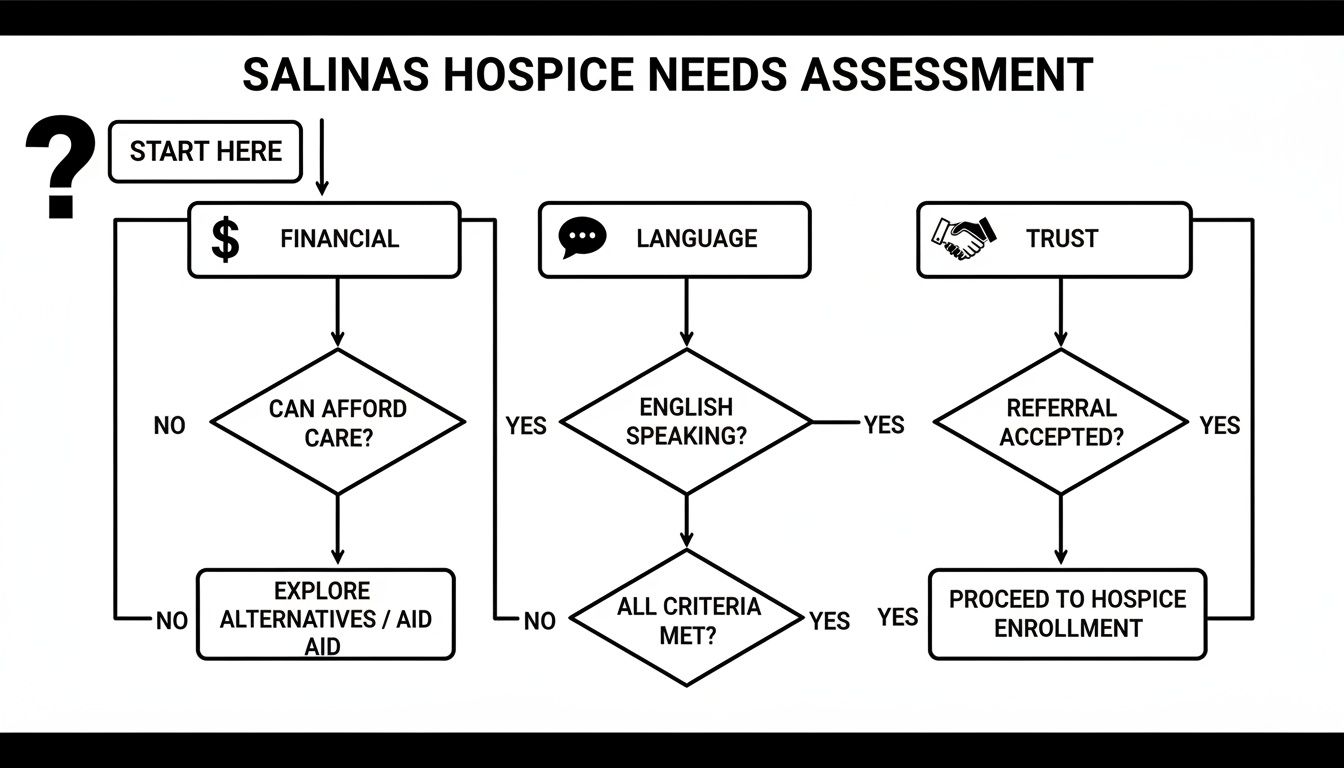
As you can see, these core concerns are all connected. Addressing them is fundamental to making a compassionate choice for your family.
Schedule Consultations and Prepare Questions
The final piece is to schedule informational meetings with providers. These consultations have no obligation. They are your chance to ask questions and get a feel for the organization.
Come ready with questions that go deeper than the basics. What matters most to your family? Is it 24/7 access to a nurse, spiritual support from a Chaplain, or a compassionate Hospice Aide?
Building confidence in your choice often comes down to transparency. You can read our guide on trust, transparency, and testimonials when choosing a hospice to learn more.
Getting to Know a Potential Hospice Provider
Talking with a potential hospice agency is your chance to see if they're the right fit. Once you've narrowed your list of providers in the Salinas area, a thoughtful conversation can tell you what you need to know. This is about more than a list of services.
It’s about finding a team you trust during a sensitive time. Think of this as building a foundation of confidence. Asking the right questions helps you understand the day-to-day reality of their care.
Who Is on the Care Team?
The heart of any hospice agency is its people. This team will become a regular presence in your life. It's essential to understand who they are and how they work together.
Their roles are different, but they should be coordinated to provide complete support.
- Registered Nurse (RN) Visits: How often will the RN visit? Can we ask for more visits if needed?
- Hospice Aide Support: What personal care tasks does the Hospice Aide help with?
- Team Communication: How does the entire team stay on the same page?
- Staff Consistency: Will my loved one see the same familiar faces?
Knowing who to expect can bring incredible comfort. To get a better feel for what a top-notch provider looks like, see our guide on the 7 signs you’ve found the right hospice for your parent.
What Happens After Hours and in an Emergency?
Pain and medical questions don't stick to a 9-to-5 schedule. It's critical to understand how a hospice in Salinas handles after-hours support. Knowing help is a phone call away, day or night, is crucial for peace of mind.
When a symptom flares up late, you need immediate access to expert guidance.
A hospice’s true value often shines in a crisis. Their 24/7 on-call system should be staffed by their own clinical team, not a third-party call center. This ensures the person on the other end of the line understands hospice care.
Ask directly about their emergency protocols. How quickly can a Registered Nurse respond to a late-night call or visit a home in Salinas? This responsiveness is a key marker of a high-quality agency like Central Coast VNA & Hospice.
Do They Have Specialized Experience?
Every patient's journey is unique. If your loved one is a veteran or has a complex condition, find a provider with relevant experience. Specialized training ensures the care team understands the unique challenges involved.
Ask if they have specific programs or staff with credentials in these areas. For example, Central Coast VNA & Hospice is a proud participant in the We Honor Veterans program. This means our team has special training to address the needs of those who have served.
Side-by-Side Hospice Provider Comparison
To make your decision easier, use this checklist. It helps you compare providers on what matters most to families in Salinas.
| Question or Feature | Provider A | Provider B | Central Coast VNA & Hospice |
|---|---|---|---|
| Is 24/7 support staffed by their own nurses? | ☐ Yes ☐ No | ☐ Yes ☐ No | ✅ Yes |
| Do they have a consistent care team? | ☐ Yes ☐ No | ☐ Yes ☐ No | ✅ Yes |
| Are they a We Honor Veterans Partner? | ☐ Yes ☐ No | ☐ Yes ☐ No | ✅ Yes |
| Do they have specialized dementia training? | ☐ Yes ☐ No | ☐ Yes ☐ No | ✅ Yes |
| Is the agency nonprofit? | ☐ Yes ☐ No | ☐ Yes ☐ No | ✅ Yes |
| How long have they served the community? | 74+ years | ||
| What is their nurse response time after hours? | |||
| What is their staff-to-patient ratio? |
Once you've filled this out, the right choice often becomes clearer. The goal is to find a partner who makes you feel heard, respected, and supported.
What Does In-Home Hospice in Monterey County Actually Look Like?
When families think about hospice, they hope their loved one can stay at home. Here in Salinas and across Monterey County, in-home hospice care makes that a reality. It's about transforming the home into a sanctuary of comfort.
It is natural to wonder what daily life will be like. In-home hospice isn't about constant medical intrusion. It is about creating a circle of support with scheduled visits designed to enhance quality of life.
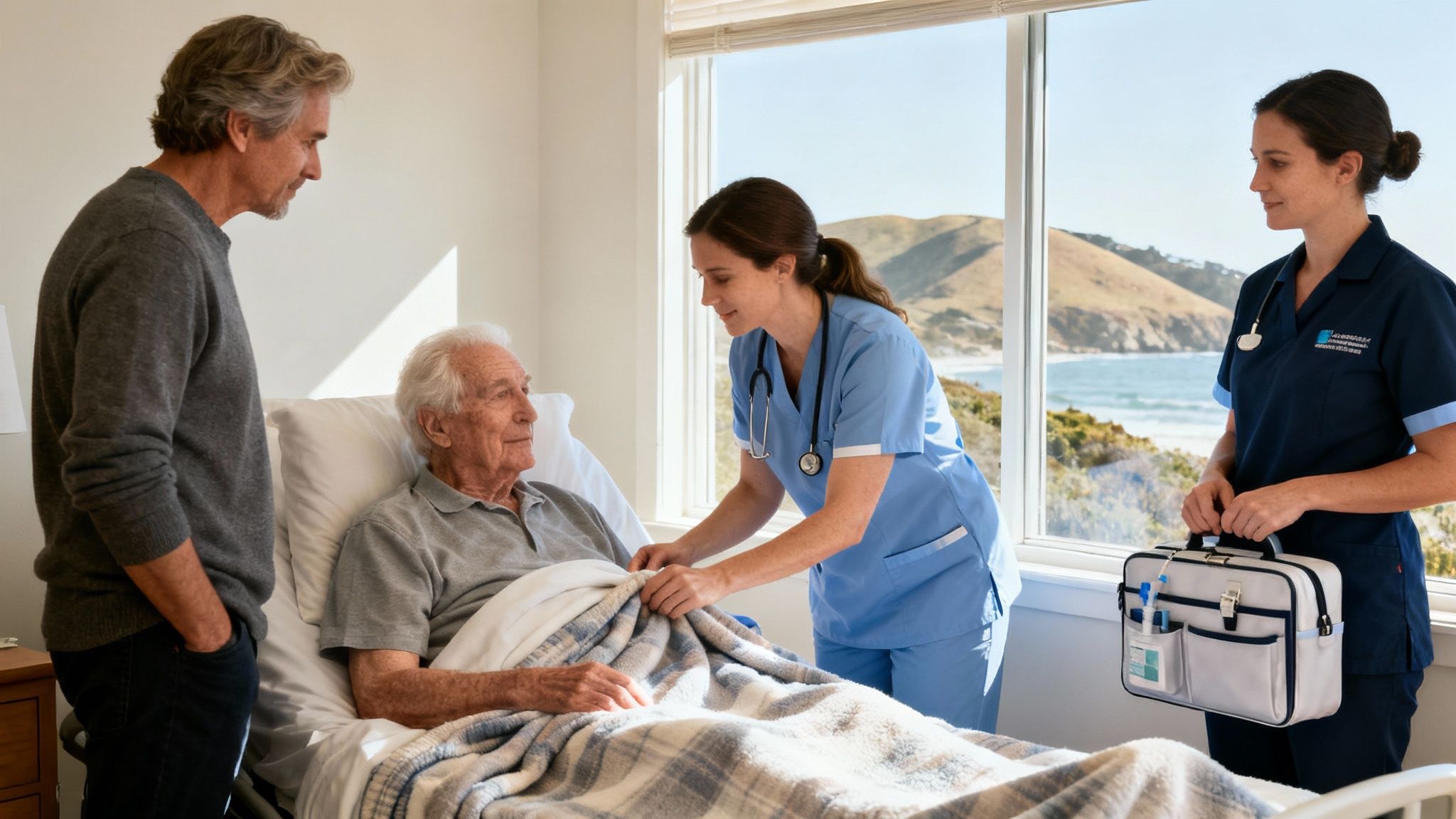
The Team That Comes to Your Door
The Central Coast VNA & Hospice team is a coordinated group of specialists. Each one brings a unique skill set to your home. We schedule visits based on your loved one's specific needs.
Here’s a look at the core team members:
- Registered Nurse (RN): The RN is the clinical leader, managing pain and other symptoms.
- Hospice Aide: Our aides provide essential personal care with dignity, such as bathing and dressing.
- Medical Social Worker: This person is a lifeline for the family, offering emotional support and resources.
- Chaplain: Our chaplains provide non-denominational spiritual support for people of all backgrounds.
If you want to dig deeper into this philosophy, exploring explanations of palliative care services at home can provide a broader perspective.
Answering the Questions That Keep You Up at Night
Bringing a care team into your home is a big step. It’s normal to have questions about managing medications or equipment. These are valid concerns, and a great hospice provider will have clear answers.
With Central Coast VNA & Hospice, you're never alone. Our team gives you training on how to safely manage medications and use equipment. We set everything up to be as simple as possible.
The biggest source of peace for families is knowing that expert help is just a phone call away. Central Coast VNA & Hospice provides 24/7 on-call nursing support. If a symptom worsens at 2 a.m., a Registered Nurse is there to give immediate guidance.
That round-the-clock availability is what quality in-home hospice is all about. This is the bedrock of our hospice at home program.
Understanding Hospice Costs and Coverage in Salinas
When your family is facing a serious illness, you should not have to worry about money. A common question from Salinas families is, "How are we going to pay for this?" The good news is that comprehensive hospice care is often available at no cost.
Let’s clear up the financial side so you can focus on what matters.
The Medicare Hospice Benefit
For most families in Monterey County, the Medicare Hospice Benefit is key. This federal benefit is thorough. It typically covers 100% of all costs related to the terminal illness.
That means no deductibles or copayments for core services. This benefit ensures everyone eligible can access dignified end-of-life care without financial strain.
What’s included?
- Visits from your entire care team—the Registered Nurse, Hospice Aide, Medical Social Worker, and Chaplain.
- All medications needed for pain relief and symptom management.
- Medical equipment like a hospital bed or oxygen, delivered to the home.
- 24/7 on-call access to clinical staff for any urgent needs.
Coverage Options Beyond Medicare
While Medicare is common, it's not the only path. In Salinas, many residents are covered by Medi-Cal or the Central California Alliance for Health. Both provide a hospice benefit that works like Medicare's.
Private insurance plans also almost always offer comprehensive hospice coverage. The team at Central Coast VNA & Hospice can verify your plan’s benefits and handle the paperwork for you.
According to the National Hospice and Palliative Care Organization (NHPCO), over 1.72 million Medicare beneficiaries received hospice services in 2020 (NHPCO, 2021). This highlights how vital this benefit is for families across the country, including right here on the Central Coast.
The Unmatched Value of a Nonprofit Provider
This is where choosing a nonprofit provider like Central Coast VNA & Hospice makes a difference. With over 74 years of history, our focus is on patient care, not profit.
Thanks to generous community donors, we can provide care to every eligible patient, regardless of their financial situation. This mission guarantees that no one in our service area, from Salinas to Santa Cruz County, is turned away because they can't pay.
For a deeper dive into payment options, you can learn more about how to pay for hospice in our detailed guide. We want to give you clear information to put financial worries to rest.
Your Trusted Community Partner in Salinas
When you’re looking for hospice care in Salinas, you are really searching for a partner you can trust. It’s a decision that goes beyond medical charts. It is about finding a team that understands our local community.
That's who we are at Central Coast VNA & Hospice. We have been part of the Monterey County community for over 74 years.
Our nonprofit mission is simple. Every decision we make is guided by your family’s comfort and dignity, not a corporate bottom line. We put resources back into patient care, ensuring anyone who needs support can get it.
A Legacy of Comprehensive Care
We offer a full spectrum of services—from home health and palliative care to hospice. This creates a seamless journey for our families. There’s peace of mind in knowing the same trusted organization can support you as needs change.
Our team of Registered Nurses, Hospice Aides, Chaplains, and Medical Social Workers cares for the whole person. We also have specialized programs, like our partnership with We Honor Veterans. We are dedicated to providing reliable, accessible, and compassionate care rooted right here at home.
Choosing a hospice provider is one of the most significant decisions a family can make. It’s about ensuring your loved one’s final chapter is filled with peace, respect, and the highest quality of life possible. Our long-standing legacy is a promise to deliver just that.
Let’s Start the Conversation
If you’re exploring hospice options, we invite you to have a warm, no-obligation conversation with us. We are here to answer your questions. We want to help you understand how our team can support your family.
If you’re a provider working with families in the Central Coast, partner with us to ensure your patients have access to local, compassionate care. Contact Central Coast VNA & Hospice today at 831-372-6668 or visit us at ccvna.com to learn more. We are here for you.
Frequently Asked Questions (FAQs)
What's the main difference between hospice and palliative care?
Palliative care focuses on relief from the symptoms of a serious illness and can begin at any time. Hospice is a specific type of palliative care for those with a life expectancy of six months or less who are no longer seeking curative treatment.
How do most families pay for hospice care?
The vast majority of hospice care is covered 100% by the Medicare Hospice Benefit. This coverage is also typically provided by Medi-Cal and most private insurance plans.
Can my loved one receive hospice care in a nursing home?
Yes, absolutely. Hospice is a philosophy of care that comes to you, wherever you call home. This includes private residences, assisted living facilities, and skilled nursing homes in Monterey County and surrounding areas.
What professionals are on the hospice team?
A hospice team is interdisciplinary. It includes a Registered Nurse, Hospice Aide, Medical Social Worker, Chaplain, and trained volunteers who all work together to support the patient and family.
How do we know when it is the right time for hospice?
This is a personal decision, often made with family and doctors. It may be time when treatments are no longer effective or their burden outweighs the benefits, and the focus shifts to comfort and quality of life.
Does Central Coast VNA & Hospice serve areas outside of Salinas?
Yes. As a long-standing community provider, we serve families across Monterey County, San Benito County, Santa Cruz County, and South Santa Clara County.
Do you offer support for family members?
Yes. Our support extends to the entire family. Our Medical Social Workers and Chaplains provide emotional and spiritual support, and we offer bereavement services for up to 13 months after a loved one's passing.

New Hospice Audits Are Here: What Families Should Know in 2026
If you've heard about new hospice audits coming in 2026, you might wonder what it means for your family. The simple answer is that Medicare is increasing its oversight. This ensures every family receives high-quality and compassionate care.
This change highlights the importance of choosing a trusted provider for your loved one. It’s more critical than ever to select an agency known for transparency and quality.
Understanding the New Wave of Hospice Audits

Starting in 2025, Medicare introduced the Hospice Special Focus Program. This triggered tougher audits and more oversight for providers across the country. Over half of U.S. hospices have already been audited.
Think of these audits like routine quality checks. They are similar to health inspections for restaurants. The goal is to ensure hospices meet high standards for patient safety and care.
This is happening to protect patients and their families. Inconsistent care from some providers raised concerns about patient well-being. These new rules hold every agency accountable for delivering on their promises.
Why This Matters for Your Family
The new audits are a response to growth in hospice services. With more people using hospice, the government is taking a closer look. This helps prevent improper billing and upholds care standards.
Medicare's changes mean more site visits and claim reviews are coming. This helps verify that providers are fully operational and following the rules. You can find more details in these insights on CMS program integrity efforts.
For families in Monterey County, San Benito County, Santa Cruz County, and South Santa Clara County, this is a call to look beyond glossy brochures. Many providers are being flagged for inconsistent care or staff shortages. Accountability and transparency matter more than ever when choosing a provider.
Choosing a hospice provider is one of the most important decisions a family can make. These new audits empower you to select an agency based on proven quality and a deep commitment to patient care.
The key is finding an organization that has always operated with high standards in mind.
A Quick Guide to the 2026 Hospice Audits
| What Is Changing | Why It's Happening | What It Means for Families |
|---|---|---|
| Increased Audits: Medicare is conducting more frequent and thorough reviews of hospice providers. | Protecting Patients: To address inconsistencies in care and ensure high standards are met across the board. | Greater Assurance: You can have more confidence that your chosen provider is held accountable for quality care. |
| Hospice Special Focus Program: This program targets providers with a history of quality issues for closer monitoring. | Financial Integrity: With rising hospice spending, the goal is to prevent fraud and improper billing. | Empowered Choices: This push for transparency helps you ask better questions and choose a provider with a proven track record. |
| More Site Visits: Expect more unannounced visits to verify providers are fully operational and compliant. | Accountability: The aim is to ensure all hospice agencies deliver the care they promise. | Focus on Quality: Reputable providers will be prepared, while others will be required to improve their services. |
These changes raise the bar for everyone, which benefits you.
As a nonprofit organization with over 74 years of service to the Central Coast community, Central Coast VNA & Hospice embraces this new era. Our mission has always been to provide compassionate, high-quality care. Our clinical oversight and documentation protocols already exceed these standards.
Understanding how hospices are funded is a key part of making an informed choice for your loved one.
Why Medicare Is Strengthening Hospice Oversight
As hospice becomes a more familiar option, Medicare is ensuring every patient receives ethical care. The increased oversight for 2026 is not meant to create hurdles. It is about building a stronger foundation of trust.
Think of it like hiring any professional for your family. You expect a certain standard of quality. Medicare is now making that expectation official for every hospice nationwide.
These new rules protect you and your loved ones. They give you peace of mind when it matters most.
The Difference Between For-Profit and Nonprofit Care
When choosing a hospice, it helps to understand the difference between for-profit and nonprofit providers. This difference often reveals an organization's priorities. This is even more critical with the new audit rules.
- For-Profit Hospices: These agencies are businesses owned by investors. Their main goal is to generate profit. This model can create pressure to cut costs, which might impact staffing or services.
- Nonprofit Hospices: Mission-driven organizations like Central Coast VNA & Hospice operate differently. We are accountable to our community, not shareholders. Any revenue is put back into improving patient care and training our staff.
As a nonprofit, our bottom line is patient well-being. With over 74 years of service, our legacy is built on compassionate care that puts people first.
This mission-first approach is why Central Coast VNA & Hospice is ready for this new era. Our practices have always been based on transparency and clinical excellence. We do it because it’s the right thing to do.
Navigating the Financial Realities of Hospice Care
The new audits are also tightening financial rules for hospice providers. As families look toward 2026, it is wise to be aware of these shifts. They can affect a provider's long-term stability.
For instance, the 2026 Hospice Final Rule includes a payment increase. However, Medicare margins for hospices have been shrinking. You can learn more in this breakdown of the 2026 Hospice Final Rule on alorahealth.com.
This financial pressure means choosing a stable, mission-driven provider is more important than ever. A hospice that is financially sound is better equipped to provide steady support. This commitment to integrity is why Central Coast VNA & Hospice is a reliable partner for families on the Central Coast.
For more information on what Medicare covers, check out our guide on Medicare home care eligibility.
How These Audits Directly Impact Your Family's Care
The new hospice audits for 2026 might sound like government paperwork. However, their impact is deeply personal for families like yours. This is not about bureaucracy—it's about accountability.
Increased oversight leads to a higher standard of care for your loved one. It is a shift from promises on paper to proven, consistent support.
Stricter documentation means every detail of your loved one’s care is tracked. This ensures the plan for managing pain and providing comfort is followed precisely. For families, this brings peace of mind.
From Inconsistent Care to Reliable Support
The real goal here is simple. It is to close the gap between the care a family expects and the care they receive.
Sadly, inconsistent practices and staff shortages from some providers prompted Medicare to act. These audits act as a quality benchmark. They help you identify the most dependable hospice organizations.
This chart shows how increased oversight is designed to create better outcomes for patients and families.
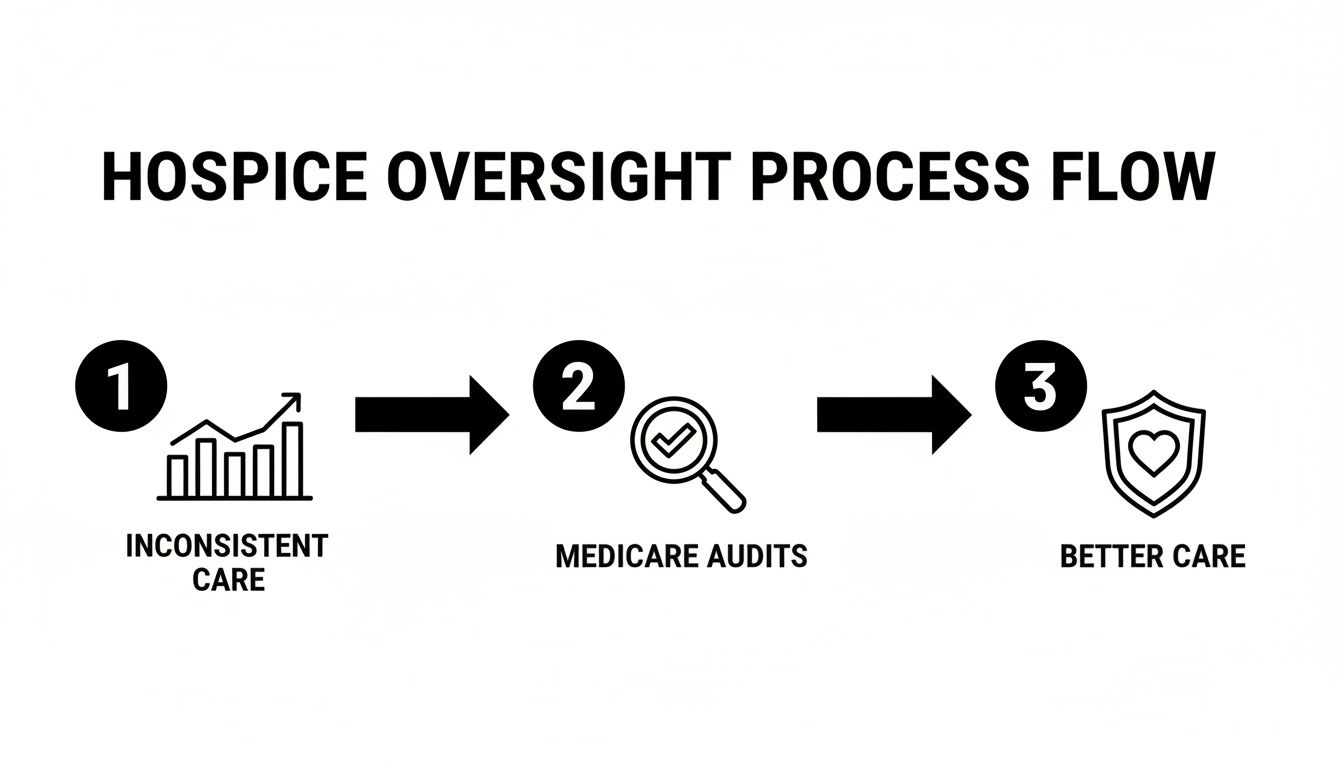
Ultimately, Medicare's audits are a response to quality issues. They are pushing the entire industry toward a more compassionate care environment.
Tangible Benefits of a Compliant Provider
When you partner with a hospice that is ready for these higher standards, you feel the difference. It is the difference between hoping for good care and knowing you will receive it.
Here’s what you can expect:
- Better Communication: Audit-ready agencies have strong communication systems. You’ll get regular updates from the Registered Nurse and other team members.
- More Reliable Symptom Management: With detailed documentation required, there’s less room for error in managing pain. Medication schedules and comfort measures are carefully recorded.
- A Deeper Commitment to Dignity: These audits reinforce what matters most: patient dignity. The focus remains on the patient's physical, emotional, and spiritual well-being.
Families who choose a provider aligned with Medicare’s new standards can trust they’ll receive consistent communication, proper symptom management, and a focus on dignity during one of life’s most sensitive transitions.
At Central Coast VNA & Hospice, our nonprofit, mission-driven approach has always put these values first. With over 74 years of serving our communities, our way of doing things is built on trust. A well-documented hospice care plan is the heart of delivering this reliable support.
Families also often face the task of figuring out how to settle an estate. Choosing a hospice that provides clear support can ease that burden. This allows you to focus on what matters most.
What to Look for in a Hospice Provider Now
With new hospice audits coming in 2026, how families choose a provider is changing. Vague promises are no longer enough. The focus must be on proof of quality, transparency, and compassionate care.
Many industry peers offer vague promises but avoid discussing quality metrics. That leaves families unsure how to judge which providers are truly reliable. Making an informed choice means looking for specific signs of a trustworthy agency.
For families in Monterey, San Benito, Santa Cruz, and South Santa Clara counties, this is your guide. It will help you find a provider you can truly trust.
A Legacy of Trust and Community Roots
In this new landscape, a provider’s history matters more than ever. An agency with deep community roots and decades of service has a proven track record. Central Coast VNA & Hospice's 74+ years of nonprofit care show a long-term commitment to our neighbors.
This history shows stability and a dedication to quality. It was in place long before any new regulations.
The Importance of a Complete Care Team
High-quality hospice care is never a one-person job. It takes the expertise of a full team working together. This team supports not just the patient, but their entire family.
When you evaluate a provider, make sure they offer a complete team, including:
- A Registered Nurse (RN) available 24/7 for urgent needs.
- A dedicated Hospice Aide to help with personal care.
- A Medical Social Worker to help navigate challenges.
- A Chaplain to provide spiritual support.
- Trained Volunteers who can offer companionship.
This complete approach ensures every aspect of your loved one’s well-being is addressed.
Verifiable Quality and Audit Readiness
A transparent provider will not shy away from talking about its quality metrics. Do not hesitate to ask about their patient satisfaction scores. This is critical as the Office of Inspector General (OIG) increases its scrutiny.
For example, recent OIG audits in Texas found significant non-compliance issues leading to overpayments. Similar reviews are planned nationwide. Knowing a provider is prepared for this level of review protects your family.
A provider’s readiness for an audit is a direct reflection of its day-to-day commitment to clinical excellence. A well-run agency operates with meticulous care every single day.
Central Coast VNA & Hospice delivers care with full clinical oversight. Our robust documentation protocols and 24/7 nurse availability ensure we meet these new standards. As a nonprofit home healthcare provider, we have built a 74+ year legacy of trusted and compassionate hospice care.
Your 2026 Hospice Provider Checklist
Use this comparison to evaluate hospice providers. Identify the signs of high-quality care that your family deserves.
| What to Look For | A Compliant Provider (Like CCVNA) | Potential Red Flags |
|---|---|---|
| Years of Service | Decades of community-based, nonprofit care. | Recently established for-profit agency with little local history. |
| Care Team | A full team (RN, Aide, Social Worker, Chaplain, Volunteers) is standard. | Vague descriptions of staff or reliance on only a few roles. |
| 24/7 Support | A Registered Nurse is available by phone and for visits 24/7. | Calls go to an answering service or a non-clinical person after hours. |
| Transparency | Openly shares quality scores and compliance processes. | Avoids answering direct questions about quality or audit readiness. |
| Documentation | Meticulous, patient-centered record-keeping is part of their daily routine. | Rushed intake process or minimal communication about the care plan. |
| Mission & Focus | Mission-driven, focused on patient comfort and family support. | High-pressure sales tactics or focus on enrollment numbers. |
Choosing a hospice is a personal decision. By focusing on these key areas, you can find a partner committed to dignity and peace of mind. For more guidance, read our article on choosing the right hospice for your loved one.
Critical Questions to Ask Any Hospice Agency
Choosing a hospice provider is one of the most important decisions your family will make. With new audits coming in 2026, it is crucial to ask direct questions. These questions should go beyond marketing brochures.
The right questions will reveal an agency's true commitment to quality care. You should feel empowered in these conversations. A trustworthy provider will welcome your questions with clear answers.
Questions About Audit Readiness and Compliance
First, you need to know how prepared an agency is for this new era. An agency's readiness for an audit reflects its everyday commitment to excellence. Vague answers are a big red flag.
Start with these questions:
- How is your agency preparing for the 2026 Medicare audits and the Hospice Special Focus Program? A prepared provider can describe their documentation protocols and staff training.
- Can you share your most recent patient satisfaction scores or quality metrics? Transparent agencies are proud of their work and should share this information.
- What is your staff-to-patient ratio? This number gives you a sense of how much personal attention your loved one will receive.
These questions get to the heart of an agency's operational strength.
Questions About Patient Care and Family Communication
Beyond compliance, you need to understand how the hospice will care for your loved one. Consistent communication and dependable support are the cornerstones of quality hospice care.
A provider’s ability to clearly explain their communication process is a strong indicator of the support your family will receive. Vague answers may suggest a lack of structured family support.
Consider asking these things:
- How do you guarantee a Registered Nurse is available 24/7 for urgent needs? Listen for details. Will you speak directly with a nurse after hours?
- Can you walk me through your process for communicating with families about the care plan? A great provider will have a system for regular updates.
- How does your team handle spiritual and emotional support for the patient and the family? This helps you see if they offer holistic care.
It is also important to ask how they handle documents like healthcare directives and living wills. These are vital in ensuring your loved one's wishes are respected.
At Central Coast VNA & Hospice, our answers are grounded in our 74-year legacy of nonprofit care. We have always operated with full clinical oversight and transparent communication. Our team welcomes these questions because they highlight our high standards.
How Central Coast VNA & Hospice Delivers Peace of Mind
As your local, nonprofit hospice provider for over 74 years, we hold ourselves to the highest standards. We see Medicare’s new audit program as a validation of our compassionate care. Our mission-driven approach means our focus is always on patient comfort and family support.
This is why families in Monterey, Salinas, Hollister, and Santa Cruz have trusted us for generations. We built our legacy on robust clinical oversight and meticulous documentation. This new era of accountability shines a light on the values we've upheld all along.
A Seamless Continuum of Care
Navigating healthcare can feel overwhelming, especially when needs change. That is why we offer a full continuum of care. Our services provide stability and support under one roof.
This integrated approach includes:
- Home Health: Skilled nursing and therapy to help patients recover at home.
- Palliative Care: Specialized support to manage symptoms and improve quality of life.
- Hospice Care: Compassionate end-of-life care focused on dignity and comfort.
This means your loved one can receive care from a team they already know and trust. It minimizes stress and ensures consistency. Our entire team works together to provide a safety net of support.
For families on the Central Coast, choosing a provider with a long history of compliance means choosing peace of mind. Our nonprofit status ensures every decision is guided by what is best for our patients.
Your Trusted Partner in Compassionate Care
The new hospice audits for 2026 are about ensuring every family receives quality care. Central Coast VNA & Hospice has always been ready for this accountability. We welcome any questions you have about our services or our quality metrics.
We invite you to explore why Central Coast VNA is the best choice for hospice care on the Central Coast.
If you’re seeking a hospice provider in Monterey, Santa Cruz, Hollister, or Salinas, ensure they’re prepared for these new regulations. Central Coast VNA & Hospice welcomes questions and offers transparent guidance. Contact us today at 831‑372‑6668 or visit us online at ccvna.com to learn more.
Frequently Asked Questions About Hospice Audits
1. Will these audits interrupt my loved one's care?
No, these audits should not interrupt care. A compliant provider like Central Coast VNA & Hospice handles audits behind the scenes. Our team’s focus remains on providing seamless support for your loved one.
2. What happens if a hospice provider fails an audit?
A provider that fails a Medicare audit can face serious consequences. These may include financial penalties or removal from the Medicare program. This is why choosing a provider with a proven history of compliance is so important.
3. Are all hospice agencies being audited?
Medicare is strengthening its oversight for all providers. However, it tends to focus on those with red flags like unusual billing or patient complaints. Reputable agencies welcome this accountability as it validates the high-quality care they already provide.
4. How can I check a hospice's quality record?
Medicare offers a free tool called Care Compare on its official website. It provides objective data on hospices in your area. You can find family satisfaction survey results and scores on patient care measures.
5. Why should I choose a nonprofit hospice?
As a nonprofit, Central Coast VNA & Hospice is driven by a mission, not profit. We reinvest resources back into patient care, community programs, and staff training. Our 74+ year legacy serving Monterey, San Benito, Santa Cruz, and South Santa Clara Counties shows our commitment to compassionate care.
Navigating hospice care can be overwhelming, but you are not alone. The team at Central Coast VNA & Hospice is here to provide clear answers and support your family. Contact us today to learn more about our services at https://ccvna.com.
How Can I Get Help Caring for My Elderly Parent at Home in Monterey?
Caring for an elderly parent in Monterey can feel overwhelming. Many adult children assume they have only two choices: do everything themselves or move their loved one into a facility.
But there is a better way. Professional, in-home clinical support from a nonprofit like Central Coast VNA & Hospice brings skilled nursing, therapy, and compassionate care right to your parent's home. This approach respects their wish to age in place while keeping them safe.
The Reality of Caring for an Aging Parent in Monterey
If you are juggling your career, family, and your parent’s growing needs, you are not alone. It is a common challenge for families in Monterey County.
Many families believe they must choose between handling it all themselves or placing a parent in a facility. This "either/or" thinking often leads to burnout. It overlooks a crucial third option: professional in-home clinical care.
Understanding the Local Need
Monterey County's population of adults aged 60 and older is growing. Projections show that the number of residents over 75 will continue to increase.
This trend means more of us will become family caregivers. The good news is that most seniors want to stay in their own homes. According to AARP, 75% of adults over 50 share this goal, and it is achievable with the right support.
The goal is not to replace family support. It is to supplement it with professional clinical expertise, which keeps your parent safe and improves their quality of life.
At Central Coast VNA & Hospice, we provide a full continuum of nonprofit in-home care. Our services range from home health to palliative and hospice care. Our interdisciplinary teams include Registered Nurses, therapists, and medical social workers who deliver expert care in the home.
If you live in Monterey County, Salinas, Hollister, or Santa Cruz, we can help. Central Coast VNA & Hospice has been a trusted local provider for over 74 years. We can guide you through your options with compassion.
Decoding the Types of In-Home Medical Support
Navigating healthcare terms can be confusing. Understanding your options is the first step to finding the right help for your parent at home in Monterey.
Let's break down the main types of in-home clinical care. This clarity helps you match your parent's needs with the right professional team.
Home Health Care for Recovery and Rehabilitation
Home Health Care is skilled medical support provided in your parent's home. It helps them recover from an illness, injury, or surgery. A doctor must prescribe this care, which is short-term and goal-oriented.
Think of it as bringing hospital rehabilitation services to your parent's living room. A Home Health team often includes:
- Registered Nurses who manage medications and teach you about the care plan.
- Physical Therapists who work on building strength and improving balance.
- Occupational Therapists who help your parent relearn daily tasks safely.
This service is ideal for a parent returning home after surgery or managing a new health condition.
Palliative Care for Comfort and Quality of Life
Palliative Care is specialized medical support for people with a serious illness. The goal is to provide relief from symptoms and stress. It improves the quality of life for your parent and your family.
A common myth is that palliative care is only for the end of life. This is not true. Your parent can receive it at any stage of an illness, often alongside curative treatments.
Hospice Care for Compassionate End-of-Life Support
Hospice Care is for someone in the final phase of a terminal illness. The focus shifts from curing the disease to providing comfort and dignity.
Hospice supports the whole person by addressing physical, emotional, and spiritual needs. This care is essential in Monterey County, where many seniors face complex health challenges. You can find more insights into our local senior population from the California Department ofAging.
Choosing the right care depends on the primary goal. Is it recovery (Home Health), symptom relief (Palliative), or comfort (Hospice)?
To help you see the differences, here is a simple breakdown.
In-Home Clinical Care Options in Monterey County
| Type of Care | Primary Goal | Who It's For (Example Scenario) | Covered by Medicare? |
|---|---|---|---|
| Home Health | Recovery & Rehabilitation. Help patients regain independence after an illness, surgery, or hospital stay. | An 80-year-old recovering at home after hip surgery who needs physical therapy and nursing to manage their recovery. | Yes |
| Palliative | Comfort & Symptom Management. Improve quality of life for those with a serious illness, at any stage. | A 75-year-old undergoing cancer treatment who needs help managing pain and nausea while still pursuing a cure. | Yes |
| Hospice | Dignity & Peace. Provide compassionate comfort care for individuals in the final months of a terminal illness. | A 92-year-old with end-stage heart failure who has chosen to focus on quality of life at home rather than further treatment. | Yes |
Central Coast VNA & Hospice is a nonprofit provider offering this full continuum of care. This means your parent can transition smoothly between services as their needs change.
How to Assess Your Parent’s Needs for Home Care
Before you can find the right help, you need a clear picture of what your parent needs. This process is about working together to ensure their safety and comfort.
Start by observing their daily routines. Also, have an open and compassionate conversation with them. This creates a partnership where you make decisions together.
Key Areas to Evaluate
To get a complete view, focus on a few critical areas. This helps you pinpoint specific challenges where professional care can help.
Consider these four categories:
- Medical Management: Are they taking medications correctly? Look for missed doses or confusion about their prescriptions.
- Personal Care: Do they need help with bathing, dressing, or grooming? Changes in personal hygiene can be a sign of struggle.
- Mobility and Safety: Have you noticed changes in their balance? Assess their home for safety risks like loose rugs.
- Emotional Well-being: Are they experiencing loneliness or social isolation? Changes in mood can indicate a need for more support.
For more guidance, you can review these 5 warning signs that elderly parents may need home health care. It is also wise to learn about essential tips for preventing elderly falls.
This decision tree shows how different needs point to specific types of in-home care.
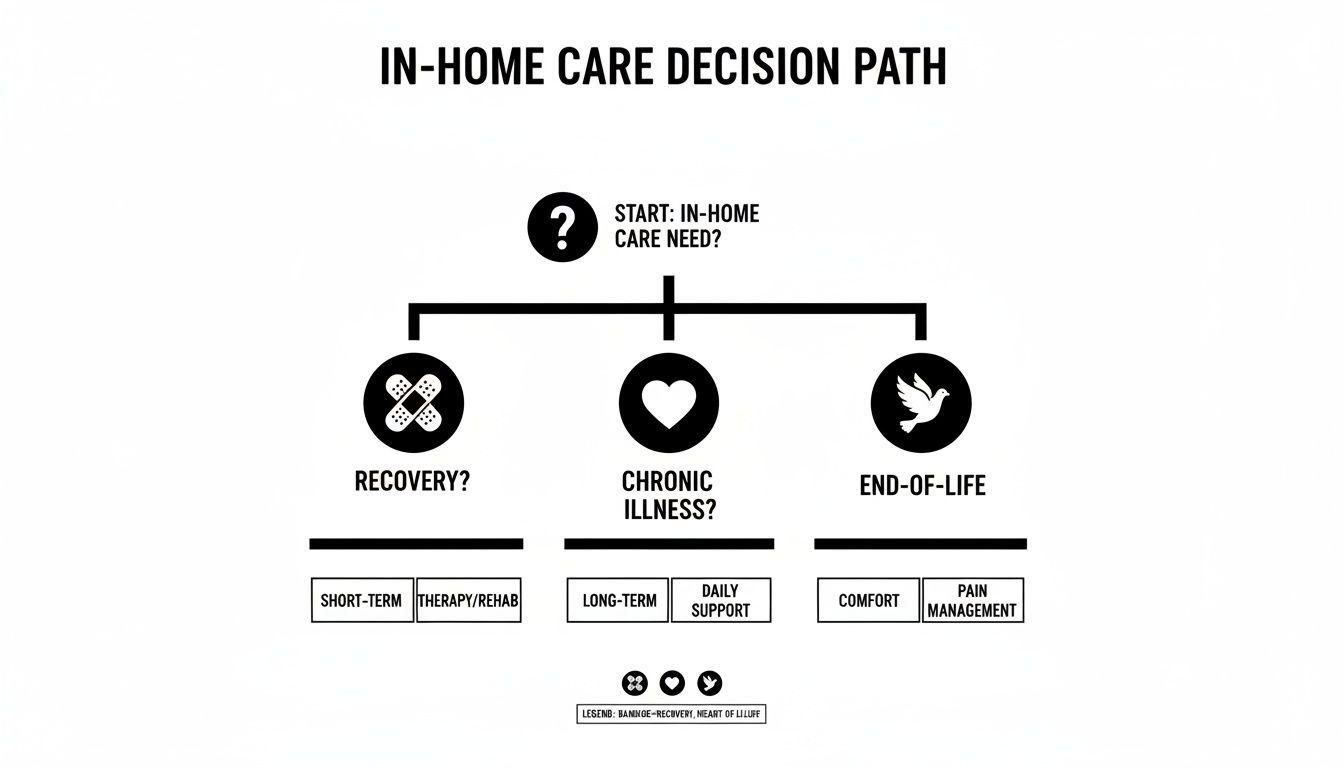
As you can see, there is a specialized care path for nearly every situation. This makes it easier to match your parent’s condition to the right clinical support.
Your observations are valuable. They provide the foundation for a personalized care plan that addresses your parent's unique needs.
Once you have a clearer picture, you can contact providers like Central Coast VNA & Hospice. This allows our clinical team to recommend the right level of care for your family.
Navigating Insurance Coverage for Home Services
Many families worry about how to pay for care. The good news is that skilled home health, palliative, and hospice care are often more affordable than you think.
Let's review how coverage typically works in Monterey County. Knowing your options can bring peace of mind.
Understanding Medicare's Role
For most people 65 and older, Medicare is the primary payer for these services. Medicare Part A and/or Part B will often cover 100% of the costs for home health care.
To qualify, a patient must be under a doctor's care and need skilled services. They also must be "homebound."
Being 'homebound' does not mean your parent must be bedridden. It means that leaving home requires a considerable and taxing effort.
Hospice care is another essential service fully covered under Medicare Part A. This benefit is comprehensive and relieves financial burdens during a difficult time.
Other Coverage Options on the Central Coast
Besides Medicare, other plans provide coverage for home-based clinical care. It is important to know all of your options.
Other common payers include:
- Medi-Cal: California's Medicaid program covers home health and hospice for low-income individuals.
- Central California Alliance for Health: This is the local Medi-Cal managed care plan for Monterey, Santa Cruz, and San Benito counties.
- Private Insurance: Many private insurance plans also offer benefits for home-based care.
As a nonprofit organization, Central Coast VNA & Hospice works with all these payers. Our team can help you verify benefits and understand what is covered.
Choosing the Right Home Care Provider in Monterey
You have figured out what kind of help your parent needs. Now, it is time to find the right partner to provide that care.
Asking the right questions will help you find a team you can trust. You are looking for an agency with expertise and local roots in Monterey County.

You need to understand their philosophy and the quality of their clinical team.
Questions About the Clinical Team and Services
The quality of care depends on the people providing it. Look for an agency with a well-rounded, interdisciplinary team.
Here are a few questions to ask:
- What are the qualifications of your clinical staff? Ensure the agency has Registered Nurses, licensed therapists, and other certified professionals.
- How do you create a personalized plan of care? The answer should describe a team effort that includes the patient and family.
- What does after-hours support look like? A quality provider will have a Registered Nurse on call 24/7.
- How does your team coordinate with my parent’s doctor? The agency should work as an extension of your parent’s medical team.
An interdisciplinary team shows a commitment to whole-person care. This approach ensures every aspect of your parent's well-being is addressed.
Questions About the Organization's History and Local Roots
Choosing a provider with deep community ties is a real advantage. An established local agency understands the needs of residents in Monterey County, Salinas, and Hollister.
Consider asking these questions:
- How long have you been serving the Central Coast? Central Coast VNA & Hospice has over 74 years of local service and a proven track record.
- Are you a nonprofit or a for-profit agency? A nonprofit, mission-driven provider reinvests its resources into patient care and community programs.
- What is your service area? Confirm they cover your parent’s town in Monterey, San Benito, Santa Cruz, or South Santa Clara County.
For more insights, check out our guide on finding the best home health agency for seniors.
Taking Your Next Step with Confidence
You do not have to figure out your parent's care alone. Professional support is available right here on the Central Coast.
This process begins with a simple conversation. It's also a good time to consider legal matters; understanding Power of Attorney is crucial for making decisions on their behalf.
If you are ready to explore your options, let’s talk. A consultation with Central Coast VNA & Hospice can provide the clarity your family needs.
Frequently Asked Questions About In-Home Care
Here are answers to some of the most common questions we hear from families.
1. What’s the difference between home care and home health care?
Home care is non-medical help with daily living, like meal prep or companionship. Home health care is skilled medical support prescribed by a doctor, provided by professionals like Registered Nurses and therapists. Central Coast VNA & Hospice provides home health care.
2. How do I know when it’s time for professional help?
If you are starting to worry, it is time to explore options. Signs include trouble with medications, increased falls, or difficulty managing a chronic illness. A professional assessment can provide a clear plan.
3. Can my parent receive palliative care and curative treatment at the same time?
Yes. Palliative care is designed to be an extra layer of support alongside other treatments. It focuses on managing symptoms and improving quality of life at any stage of a serious illness.
4. Does my parent have to be bedridden to qualify for home health?
No. To qualify for Medicare coverage, a patient must be "homebound." This means leaving home requires a significant effort, but they can still attend medical appointments or infrequent outings.
5. How quickly can we start services in Monterey County?
After a doctor's referral, services can start quickly. Central Coast VNA & Hospice can typically schedule an in-home assessment within 24 to 48 hours to create a care plan and begin services.
You are not alone in this journey. The team at Central Coast VNA & Hospice has provided compassionate, nonprofit home health, palliative, and hospice care in our community for over 74 years.
Contact us today to learn how we can support your family.