

Not the Same, Not Opposites: What Families Need to Know About Palliative and Hospice Care
When a loved one is living with a serious illness, it’s easy to get lost in a sea of medical terms. Families often find themselves trying to figure out the difference between palliative care and hospice care.
They aren't the same, but they aren’t opposites, either. Think of it this way: palliative care is all about providing comfort at any stage of a serious illness, while hospice care is for the final months of life.
Guiding Your Family Through Palliative and Hospice Care
Navigating a serious illness with someone you love is overwhelming. This is one of the most common—and confusing—questions families face when dealing with a serious illness.
Here on the Central Coast, one of the most common questions we hear is: what’s the real difference between palliative and hospice care? Getting this distinction right is the first step toward making confident, compassionate decisions for your family.
At Central Coast VNA & Hospice, we have been helping families walk through this for over 74 years. We know you need more than definitions. You need to understand how these services actually work to bring comfort and support into your home.
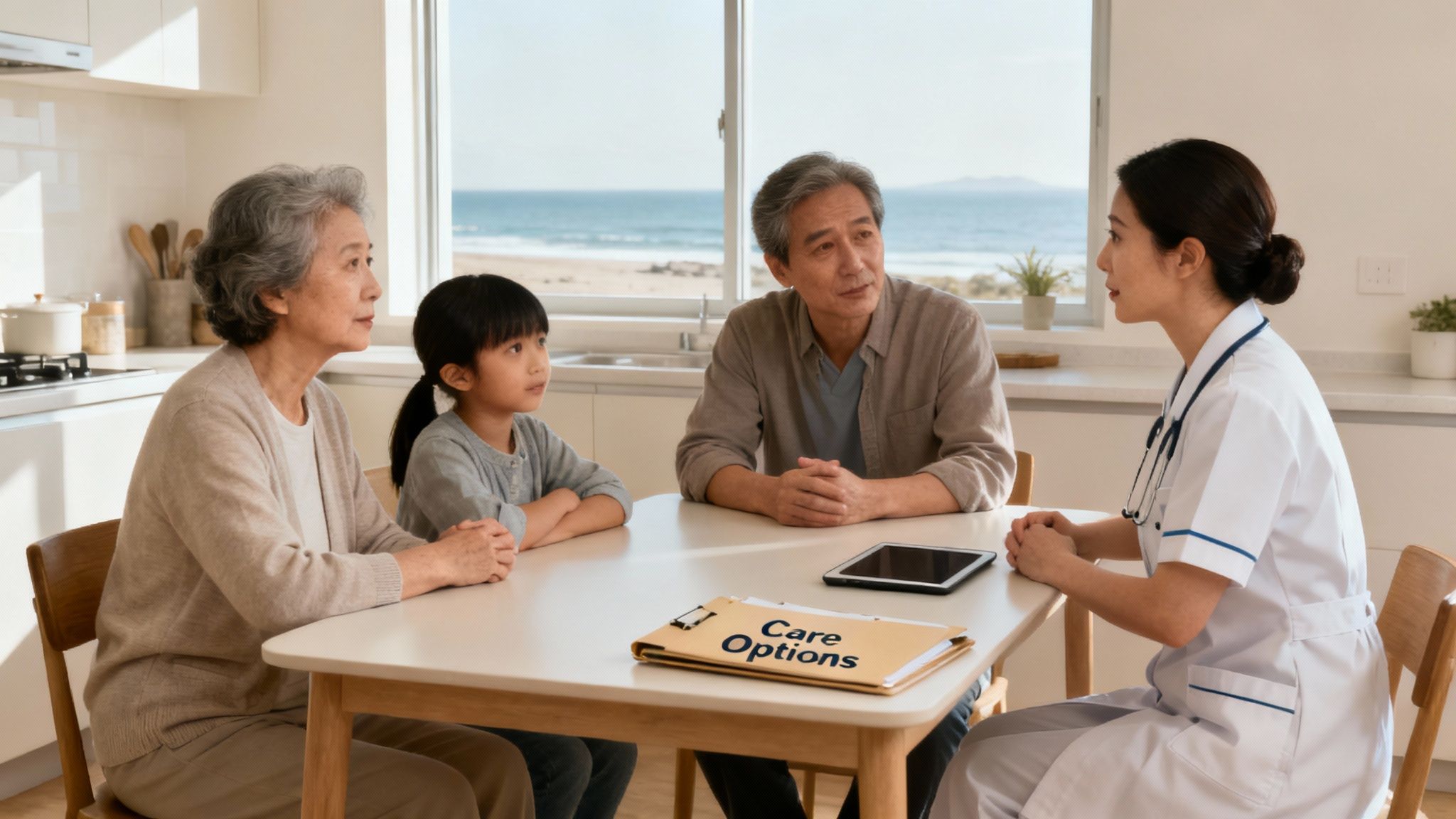
Palliative Care vs Hospice Care at a Glance
Let's start by breaking down the core differences. While both are centered on improving quality of life, their timing and goals are distinct. This simple table can help clear things up.
| Feature | Palliative Care | Hospice Care |
|---|---|---|
| When It Can Start | At any point from diagnosis onward, alongside all other medical care. | When a doctor certifies a life expectancy of six months or less if the illness runs its natural course. |
| Treatment Goals | Can be provided at the same time as curative treatments like chemotherapy or dialysis. | The focus shifts entirely from cure to comfort. Curative treatments are stopped to prioritize quality of life. |
| Primary Focus | Relieving the symptoms, pain, and stress of a serious illness to improve daily life. | Providing comfort, dignity, and peace in the final stages of life. |
| Provided By | A specialized team that works in partnership with your existing doctors and specialists. | A dedicated, interdisciplinary team that provides comprehensive medical, emotional, and spiritual support. |
This distinction is important because many people who could benefit from palliative support miss out. Globally, an estimated 56.8 million people need palliative care each year, yet the vast majority never receive it.
According to the World Health Organization, these services often don't reach people because of the misconception that they are only for the very end of life. To learn more, read about palliative care for seniors in our detailed guide.
What Palliative Care Really Means for Your Family
You often hear the term palliative care, but what does it actually involve? It’s specialized medical care that adds an extra layer of support. It focuses on relief from symptoms, pain, and stress of conditions like cancer, heart failure, or dementia.
Think of it as a team focused on the whole person, not just the disease. It works right alongside your loved one's regular treatments. The goal is to improve quality of life from the moment of diagnosis.
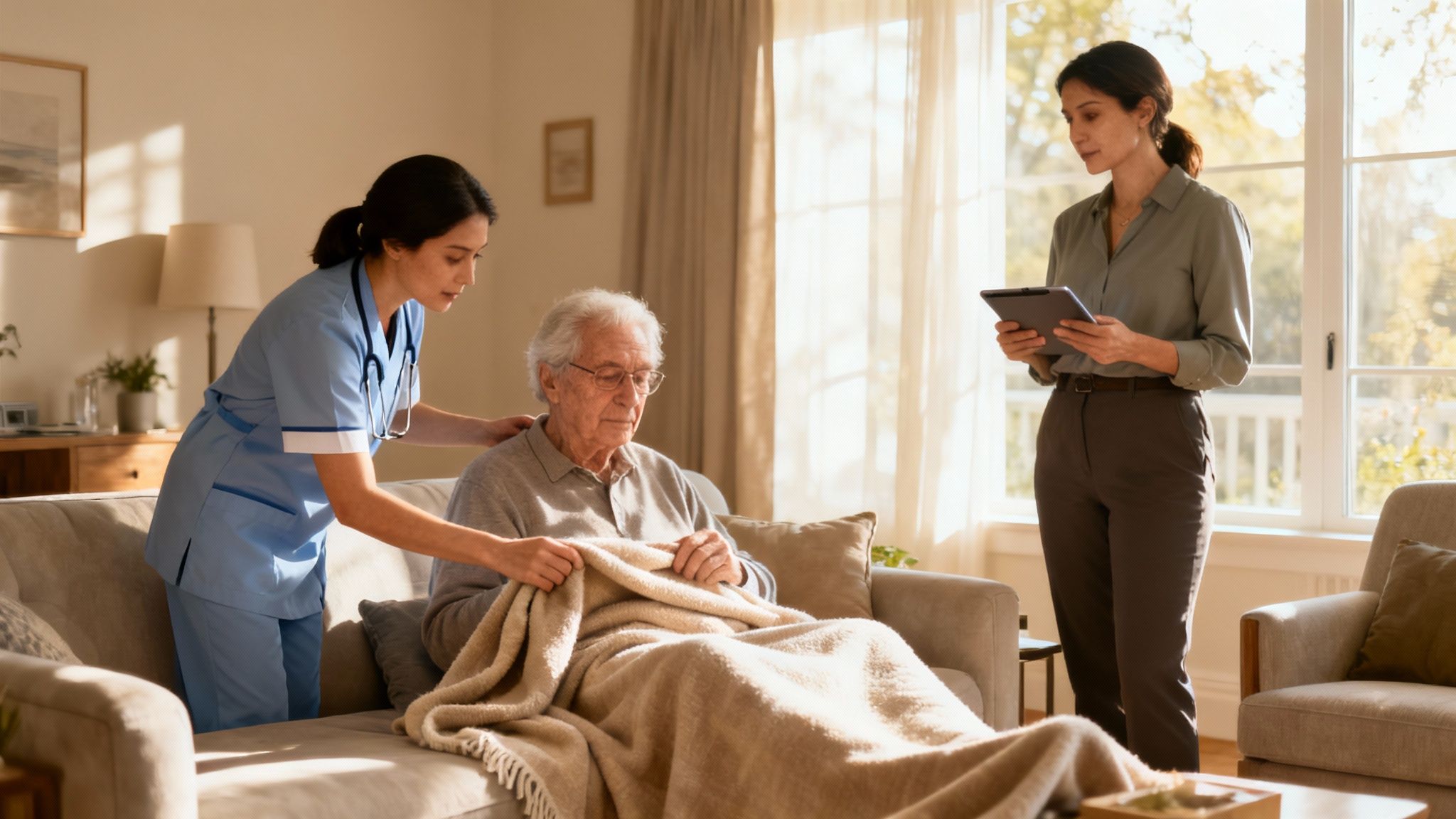
More Than Just Symptom Management
Managing physical symptoms is a huge part of palliative care. But the support goes deeper. It also addresses the emotional and spiritual challenges that come with a serious diagnosis.
At Central Coast VNA & Hospice, our palliative care team helps families navigate the healthcare system. Our skilled professionals, including Registered Nurses, act as your advocates. They ensure communication between doctors is clear and everyone is on the same page.
For families in Monterey County, Salinas, Hollister, and Santa Cruz, this means having a local expert to turn to. We help you understand complex medical information and make difficult decisions in your own home.
Key Benefits of Starting Palliative Care Early
Many families think palliative care is only for the end of life, but research shows the opposite is true. Introducing this support early often leads to better outcomes. You do not have to stop curative treatments to receive it.
Here are a few key benefits:
- Pain and Symptom Control: Expert management of discomfort to improve daily life.
- Emotional and Spiritual Support: Help for the patient and family to cope with the stress of illness.
- Improved Communication: A team that helps facilitate conversations about goals of care.
- Coordination of Care: We ensure all of your doctors and specialists are working together effectively.
Palliative care is not about giving up. It's about living as well as possible by adding an extra layer of comfort to your existing treatments.
This approach empowers your family to face challenges with more confidence and less anxiety. To dig deeper, find more insights in our article about what palliative care really means for families today.
How Hospice Care Provides Dignity and Comfort
When treatments no longer focus on a cure, the goal of care shifts to maximizing comfort. This is where hospice care offers a compassionate path forward.
Choosing hospice isn't about giving up. It's about redefining hope and focusing on living each day to the fullest, with dignity and support.
Hospice is for individuals with a life-limiting illness and a prognosis of six months or less. It provides a complete circle of support for physical, emotional, and spiritual needs.
At Central Coast VNA & Hospice, our team brings this care to wherever a patient calls home. We serve families across Monterey County, San Benito County, Santa Cruz County, and South Santa Clara County.
A Team Approach to Whole-Person Care
Hospice is delivered by an interdisciplinary team that works together. This ensures no aspect of a person's well-being is overlooked.
Our teams at Central Coast VNA & Hospice include:
- Registered Nurses who are experts in managing pain and other symptoms.
- Hospice Aides who assist with personal care like bathing and dressing to preserve dignity.
- Chaplains who offer spiritual support that honors all beliefs and philosophies.
- Medical Social Workers who provide emotional support and connect families with resources.
- Volunteers who bring companionship and give family members a much-needed break.
By managing symptoms, we allow families in communities like Salinas and Hollister to focus on their time together.
Redefining Hope and Quality of Life
The decision to begin hospice is a profound one. The focus moves away from aggressive treatments. It shifts toward ensuring the patient is comfortable and can enjoy meaningful moments.
Hospice is a philosophy of care that affirms life and regards dying as a normal process. The goal is to make the end of life as peaceful and meaningful as possible.
This patient-centered approach is gaining ground. According to the National Hospice and Palliative Care Organization (NHPCO), over 1.72 million Medicare beneficiaries received hospice services in 2020 (NHPCO, 2021). You can read more about hospice trends and insights in this detailed report.
Hospice care empowers patients to live out their final months on their own terms. For more information, you can learn about the real benefits of starting hospice early in our related article.
Deciding Between Palliative And Hospice Care
Making the right choice for a loved one isn’t about picking a “better” option. It’s about matching the care to their current goals and wishes.
It comes down to one question: Is the primary goal to cure the illness or to provide comfort? Understanding this difference brings clarity to families in Monterey County, Salinas, and Hollister.
When To Choose Palliative Care
Palliative care is the answer when your loved one is still pursuing treatment but is struggling with symptoms. Think of it as an extra layer of support that works alongside their existing care.
Here are a few real-world examples:
- A patient with lung cancer undergoing chemotherapy can use palliative care to manage nausea and pain.
- Someone with congestive heart failure might receive palliative care at home to help control shortness of breath.
- An individual with early-stage dementia can benefit from a team that helps manage behavioral changes.
In every case, the patient continues seeing their regular doctors. The palliative team, including a Registered Nurse, simply adds support to the care they're already receiving.
When To Consider Hospice Care
The conversation shifts toward hospice care when the focus moves from curing to quality of life. This usually happens when a doctor certifies a life expectancy of six months or less.
Choosing hospice isn't giving up. It's a compassionate decision to prioritize peace, dignity, and comfort.
Choosing hospice means redefining hope. The focus shifts from enduring aggressive treatments to embracing comfort and creating meaningful moments.
Hospice becomes the right path in situations like these:
- A patient with late-stage cancer decides to stop chemotherapy because the side effects outweigh the benefits.
- An individual with advanced Alzheimer's disease whose family’s priority is to ensure they are comfortable.
- Someone with end-stage kidney disease chooses to stop dialysis to spend their remaining time at home.
Knowing when to make this transition is a major step. For more guidance, our team created a resource on when to call hospice.
This infographic simplifies the core difference based on the primary treatment goal.
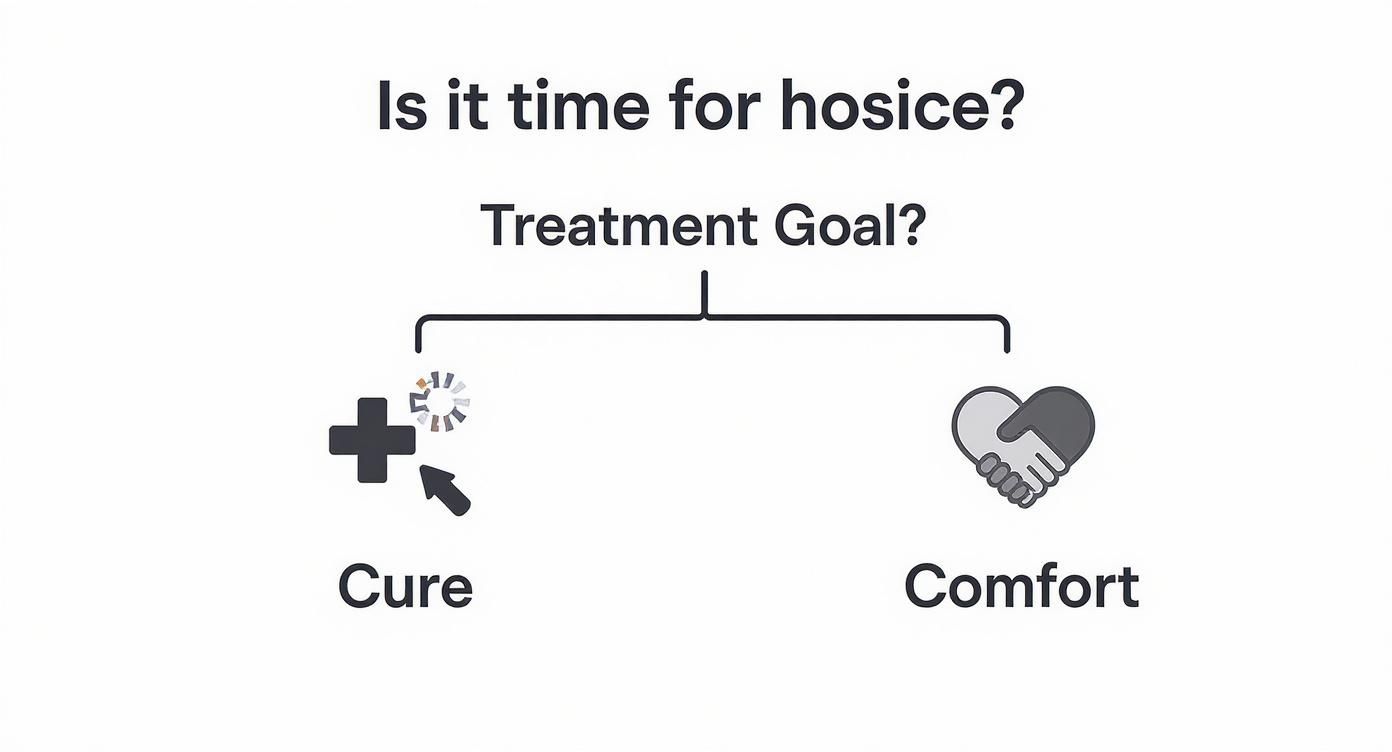
The choice hinges on whether the patient is pursuing curative treatments or has decided to shift their focus to comfort.
Detailed Comparison: Palliative Care vs Hospice Care
To help your family see the differences more clearly, let's compare the services side-by-side. The practical details of eligibility and payment are important factors in making an informed choice.
Here's a breakdown of the key distinctions.
| Aspect of Care | Palliative Care | Hospice Care |
|---|---|---|
| Timing | Can begin at any stage of a serious illness, often right from diagnosis. | Begins when curative treatments stop and a doctor certifies a prognosis of six months or less. |
| Treatment Goal | Provided alongside curative treatments like chemotherapy, surgery, or dialysis to manage symptoms. | Focuses entirely on comfort and quality of life; curative treatments are discontinued. |
| Location of Care | Often provided at home, but also available in hospitals and outpatient clinics. | Primarily provided wherever the patient calls home, including private residences and assisted living facilities. |
| Payment | Typically covered by Medicare Part B, Medi-Cal, and private insurance, similar to a specialist visit. | Covered fully by the Medicare Hospice Benefit, Medi-Cal, and most private insurance plans. |
At Central Coast VNA & Hospice, we are one of the few local providers offering both services. This means if a patient transitions from palliative to hospice care, they can often keep the same trusted team. For families, that continuity provides immense comfort.
The Benefit of a Seamless Continuum of Care
Choosing a provider for a serious illness is about finding a stable, reassuring partner for your journey. Many families must start over with a new healthcare organization when needs shift from palliative to hospice care.
At Central Coast VNA & Hospice, we provide a true continuum of care. Our services are designed to flow seamlessly from one stage to the next, from home health to palliative and hospice care. This integrated approach offers stability during a difficult time.

Why a Single Provider Matters
When needs evolve, the last thing your family should do is navigate a new healthcare system. With Central Coast VNA & Hospice, you don’t have to. The same clinicians who understand your family’s history can continue providing support.
This single-provider model offers several benefits:
- Familiarity and Trust: Your loved one builds a relationship with our Registered Nurses and Hospice Aides. Keeping that trusted team reduces stress.
- Consistent Communication: Because our teams work together under one roof, care coordination is smooth. There are no communication gaps.
- Simplified Transitions: Moving from palliative to hospice care becomes a gentle shift in focus. We guide your family through every step with compassion.
Having a single, trusted team means your family can focus on what matters most—each other. It provides peace of mind knowing that a familiar hand is there to guide you.
Rooted in Your Community
As a local nonprofit with over 74 years of service, our mission is connected to our communities. We are your neighbors in Monterey County, San Benito County, Santa Cruz County, and South Santa Clara County.
Our integrated model of home health, palliative, and hospice care is unique in the region. It ensures that no matter how your loved one’s needs change, they are supported by a team that knows them. Contact us to learn more about how our seamless care can support your family.
How to Make the Right Choice for Your Family
There’s no magic formula for deciding between palliative and hospice care. The best choice is always the one that fits your loved one’s unique needs and wishes.
At Central Coast VNA & Hospice, our approach starts with listening. We offer free, no-pressure consultations to help you understand your options.
Starting the Conversation
The first step is a simple, honest conversation. Our team can help you weigh the benefits of each path and figure out what makes sense for your family right now.
Having this talk is critical. Access to quality care isn't universal. This makes choosing a trusted local provider even more important for ensuring your family gets high-quality support.
The right choice is a personal one, based on your loved one's goals for their care. We are here to provide the information you need to make that choice with confidence.
As you make these decisions, it’s helpful to understand the legal tools available. Taking time for understanding Power of Attorney and advanced directives can empower you to honor their wishes.
You don’t have to navigate this journey alone. As a trusted nonprofit serving Monterey County, Salinas, Hollister, and Santa Cruz for over 74 years, we can help. Contact us today to learn more.
Frequently Asked Questions (FAQs)
1. Can my loved one get palliative care and curative treatment at the same time?
Yes, absolutely. This is the biggest difference between palliative care and hospice. Palliative care is designed to work alongside treatments like chemotherapy. Its purpose is to manage symptoms and stress, which often helps people tolerate their treatments better.
2. Does choosing hospice mean we're giving up hope?
No. Choosing hospice isn't about giving up; it’s about redefining hope. It becomes about hoping for comfort, dignity, and the best possible quality of life in the time that remains. Hope shifts from a cure to goals of a comfortable day and meaningful moments.
3. Who pays for palliative and hospice care?
The payment structures are different, but both are generally accessible. Palliative care is often covered by Medicare Part B, Medi-Cal, and private insurance. Hospice care is almost always 100% covered by the Medicare Hospice Benefit, Medi-Cal, and most private insurance with no out-of-pocket costs.
4. Can my loved one receive care at home?
Yes. Central Coast VNA & Hospice is built around bringing expert care to wherever you call home. That could be a private house, an assisted living community, or a nursing home. Our teams—including Registered Nurses and Hospice Aides—come to you.
5. What if my loved one gets better while on hospice?
It happens. With intensive comfort care, some people's conditions stabilize or improve. If they no longer meet the criteria, they can leave hospice care at any time and can always re-enroll later if their situation changes.
6. How do we know when it’s the right time to call?
It is never too soon to ask questions. If your loved one is dealing with a serious illness, we encourage you to call us for a free, no-obligation conversation. Our team at Central Coast VNA & Hospice can walk you through the support available.
You don't have to navigate these decisions alone. For over 74 years, Central Coast VNA & Hospice has provided a seamless continuum of care to families across Monterey County, Salinas, and Hollister. Contact us today to learn how our compassionate, local team can support your family. Learn more at https://ccvna.com.
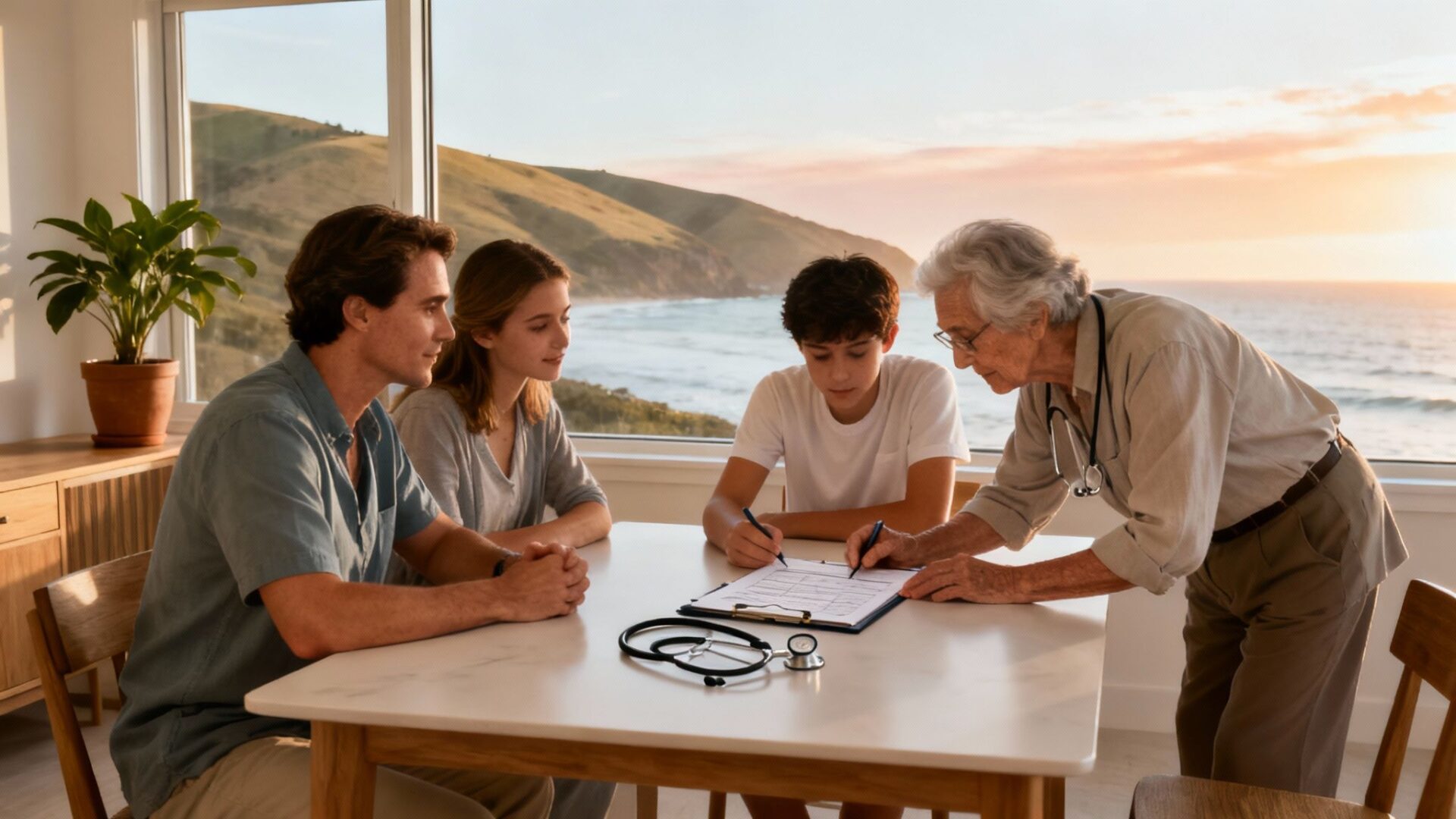
Before The Next Health Crisis: A Central Coast Family's Guide to Advance Care Planning at Home
For families on the Central Coast, talking about future health wishes can feel like a conversation for another day. But having a plan in place before a health crisis hits is one of the most loving things you can do for your family.
This guide is a local roadmap. It is designed for families in Monterey, Salinas, Santa Cruz, and Hollister to navigate advance care planning at home. Think of it as turning a difficult topic into an act of empowerment and care.
Why Planning Before a Crisis Brings Peace of Mind

The end of the year often makes us reflect on what's next. For many, that includes concerns about aging parents, a spouse managing a serious illness, or their own long-term health. These conversations are important but are often put off until it's too late.
Waiting for a 911 call to discuss care wishes is a stressful mistake. During a crisis, emotions are high, decisions are rushed, and options become limited. This is when families in Monterey and San Benito Counties must guess what their loved one would have wanted.
Proactive planning changes that scenario completely. This is not about expecting the worst. It’s about ensuring loved ones receive care that reflects their values and goals.
The Gift of Clarity and Control
Advance care planning is the process of thinking about, talking about, and writing down your preferences for future healthcare. It ensures your family and doctors know what matters most if you cannot speak for yourself. This is an incredible gift.
When your wishes are documented, your family is relieved of making difficult decisions in the dark. Instead of guessing, they can be your confident advocate, knowing they are honoring your choices. This simple act helps prevent painful conflicts and reduces emotional strain.
Just think about the benefits:
- Your Wishes Are Honored: Your personal values drive every decision.
- Family Stress is Reduced: Loved ones have a clear roadmap, easing their burden.
- Your Advocate is Empowered: Your chosen decision-maker can speak confidently for you.
- Quality of Life Improves: Planning can lead to services like palliative care earlier, improving comfort long before a crisis.
Your Local Partner in Planning
For over 74 years, Central Coast VNA & Hospice has been a trusted, nonprofit guide for local families. We live here too and understand the unique needs of our communities. We serve Monterey County, San Benito County, Santa Cruz County, and South Santa Clara County.
Our regional population is aging, with more than one in five residents over 65 in some areas. The need for clear, compassionate planning is more urgent than ever.
Our mission-driven team is here to help you understand all your options. We cover everything from home health nursing to palliative care and hospice. You can learn more about the 7 important benefits of advance care planning in California and see how these steps bring peace of mind.
Starting these talks now protects your family from the chaos of a future medical event. It is an act of love that provides comfort and clarity when it’s needed most.
How to Start the Conversation About Care Wishes
Starting the topic of future health wishes can be the hardest part. Many families across Monterey and Santa Cruz Counties worry about upsetting their loved one or saying the wrong thing.
The secret is to treat it as a series of small, heartfelt talks, not one big meeting. You are not trying to fill out legal forms on day one. You are trying to understand what makes life meaningful for the person you love.
Framing the Conversation with Care
Finding the right moment is key. A formal meeting can feel intimidating. A quiet afternoon, a peaceful drive, or a shared cup of coffee creates a more relaxed setting.
A natural way to begin is by connecting it to a recent event. This could be a friend's health scare or a story in the news. You could also start from a place of joy, asking, "I was thinking about our last family picnic. What does a truly good day look like for you?"
A great conversation about care wishes starts with listening, not talking. It’s about creating a safe space where your loved one feels heard and understood, ensuring their values lead every future decision.
Remember, this is a dialogue. Your main job is to ask open-ended questions and listen carefully to the answers.
Gentle Questions to Get Started
Instead of asking about specific medical treatments, try questions that explore values. This helps you understand the "why" behind their future choices.
Here are a few conversation starters:
- Focus on Joy: "When you think about the future, what are you most looking forward to?"
- Define a Good Day: "If your health changed, what would a 'good day' still look like for you?"
- Address Fears: "What are your biggest worries if you were to get seriously ill?"
- Explore Trade-Offs: "Are there times you would value comfort more than living as long as possible?"
These questions shift the focus from medical jargon to what truly matters. Research shows that people who have these conversations are more likely to get the care they want. One review found these talks led to care that matched patient goals and reduced unwanted hospitalizations. You can learn more about from these findings.
When You Need a Helping Hand
Sometimes, these conversations are too hard to have alone. That’s when bringing in a neutral third party can help.
At Central Coast VNA & Hospice, our team includes Medical Social Workers and Chaplains trained to facilitate these discussions. They help families across Monterey, San Benito, Santa Cruz, and South Santa Clara counties navigate these talks with empathy.
If you’re struggling, our guide on how to talk to your parents about hospice care offers more tips. The most important thing is to just start the conversation.
Getting Your Wishes Down on Paper
Once you've started talking, the next step is to make it official. Legal documents give your loved one’s voice real power. They turn personal wishes into clear instructions for healthcare teams during a crisis.
For families on the Central Coast, understanding these key forms is the first step. They might sound similar, but each one has a different job.
The Three Core Documents for Central Coast Families
In California, there are three main documents in advance care planning. Not everyone needs all three. Knowing what each one does helps you choose the right tools.
- Advance Healthcare Directive: This is the foundation for any adult. It lets you name a healthcare agent—the person you trust to make decisions for you—and outline your general wishes for care.
- Durable Power of Attorney for Health Care (DPOAHC): This is the part of your Advance Directive that legally appoints your healthcare agent. It answers the crucial "who" question.
- Physician Orders for Life-Sustaining Treatment (POLST): This is a medical order signed by a doctor. It is for people with a serious illness or advanced frailty and gives direct instructions to EMTs.
A key part of this process is the Durable Power of Attorney (POA). You can review a Durable Power of Attorney (POA) form template to see what’s involved. Our team at Central Coast VNA & Hospice can help you get the right California-specific forms.
Key Advance Care Planning Documents at a Glance
It is easy to mix up these documents. In short, an Advance Directive states general wishes for the future. A POLST gives specific medical orders for right now.
This table breaks down the key differences.
| Document Type | What It Does | Who It's For | When It's Used |
|---|---|---|---|
| Advance Healthcare Directive | Names a healthcare agent and outlines general wishes for future medical care. | Any adult 18 or older, regardless of health status. | When you are unable to communicate your own medical decisions. |
| Durable Power of Attorney for Health Care (DPOAHC) | Legally appoints the person who will make healthcare decisions on your behalf. | Any adult who wants to choose a specific person to be their advocate. | When you are unable to speak for yourself; it activates upon incapacity. |
| Physician Orders for Life-Sustaining Treatment (POLST) | Translates your wishes into direct medical orders (e.g., DNR, feeding tubes). | Individuals with a serious, life-limiting illness or advanced frailty. | Immediately, and it is followed by all healthcare providers, including EMS. |
Thinking through what truly matters is the first step. The choices you make should reflect what makes life meaningful.
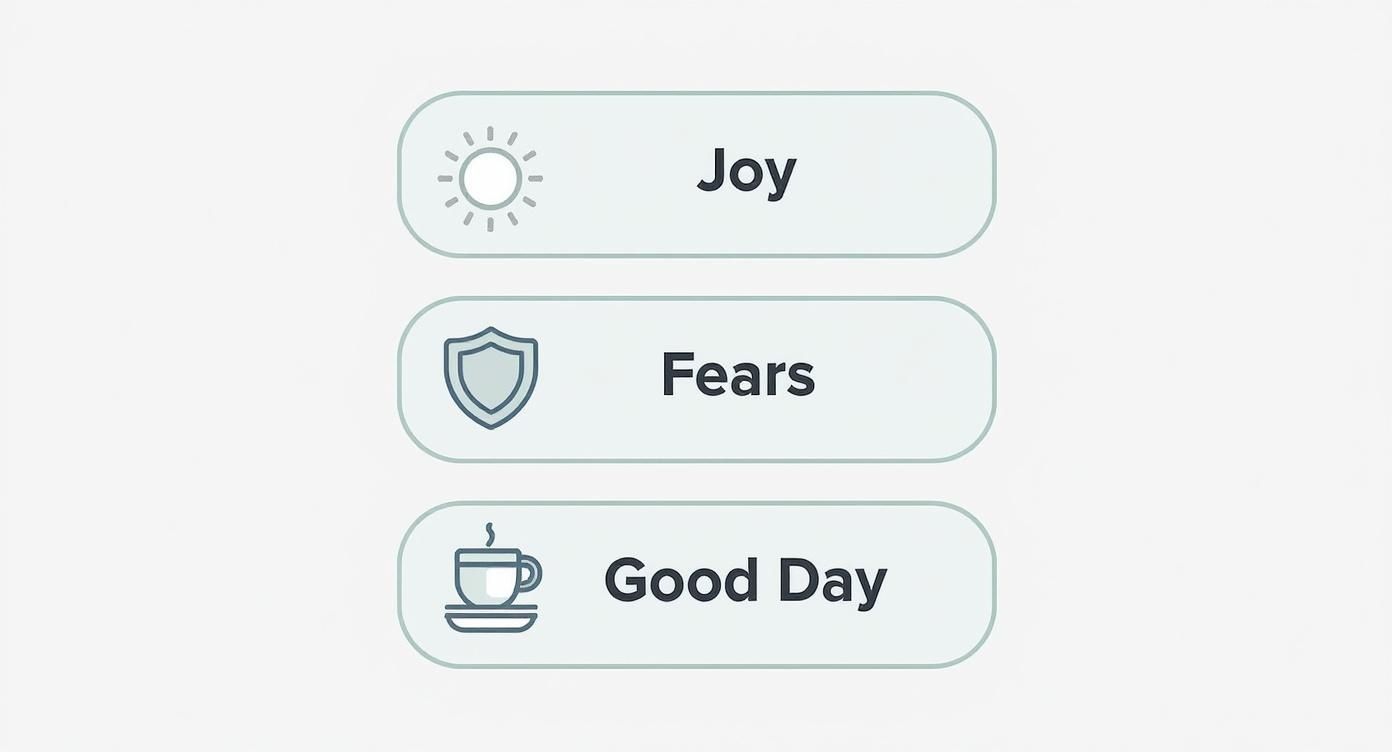
Understanding what brings joy, what causes fear, and what a "good day" looks like provides emotional clarity. For a closer look, see our helpful guide to three common advance directives for more detail.
Having these documents completed and shared is a profound act of love. It replaces uncertainty with clarity, ensuring that even in a crisis, the care provided aligns perfectly with your loved one's deeply held values and wishes.
Remember, these are not "set it and forget it" documents. They should be revisited every few years or after a major life change.
Assembling Your Home Health Emergency Kit

Advance care planning is not just about legal documents. It is also about being practically prepared. A well-organized “ready kit” at home makes a huge difference during a stressful moment.
Think of this kit as the single source of truth for your family. A visiting Registered Nurse from Central Coast VNA & Hospice or an emergency team can use it. It cuts through confusion and helps clinicians provide faster, better care.
Creating a One-Page Medical Summary
The heart of your kit is a simple, one-page medical summary. This is a snapshot of your loved one's health that anyone can understand quickly.
Keep it somewhere obvious, like on the refrigerator or in a marked folder by the front door.
Your one-page summary should include:
- Full Name and Date of Birth: Start with the basics.
- Key Medical Diagnoses: List significant conditions like heart failure or COPD.
- Known Allergies: Make this stand out in bold or red text.
- Primary Care Physician's Name and Number: Include office and after-hours contacts.
- Specialist Contact Information: List key specialists like a cardiologist.
- Emergency Contacts: Provide names and numbers for at least two family members.
This single sheet can save precious time.
Organizing Medications and Prescriptions
Medication management is a big challenge for families. Getting it organized prevents missed doses and dangerous interactions.
Your kit should have an up-to-date list of all medications. Include the name, dosage, frequency, and reason for taking it. A simple pill organizer can also help with daily routines.
Note the pharmacy's name and phone number to make refills easier. Knowing about options for home medical equipment rental can also be a crucial part of your plan.
Preparing Questions for Medical Professionals
During a health crisis, it’s normal to feel overwhelmed and forget what you wanted to ask. Preparing a list of questions in advance empowers you to be a better advocate.
In a crisis, your emergency kit is your family's anchor. It transforms chaos into clarity, ensuring that even under pressure, your loved one’s care is guided by accurate information and well-defined wishes.
This simple preparation ensures you get the information needed to make informed decisions. Keep a small notebook in your kit with questions like:
- What is the main problem we are treating?
- What are the next steps in the treatment plan?
- What side effects should we watch for?
- Who should we call if we have questions after we go home?
Assembling a hands-on kit is a powerful way to make your planning practical and effective.
How Home-Based Care Brings Your Plan to Life
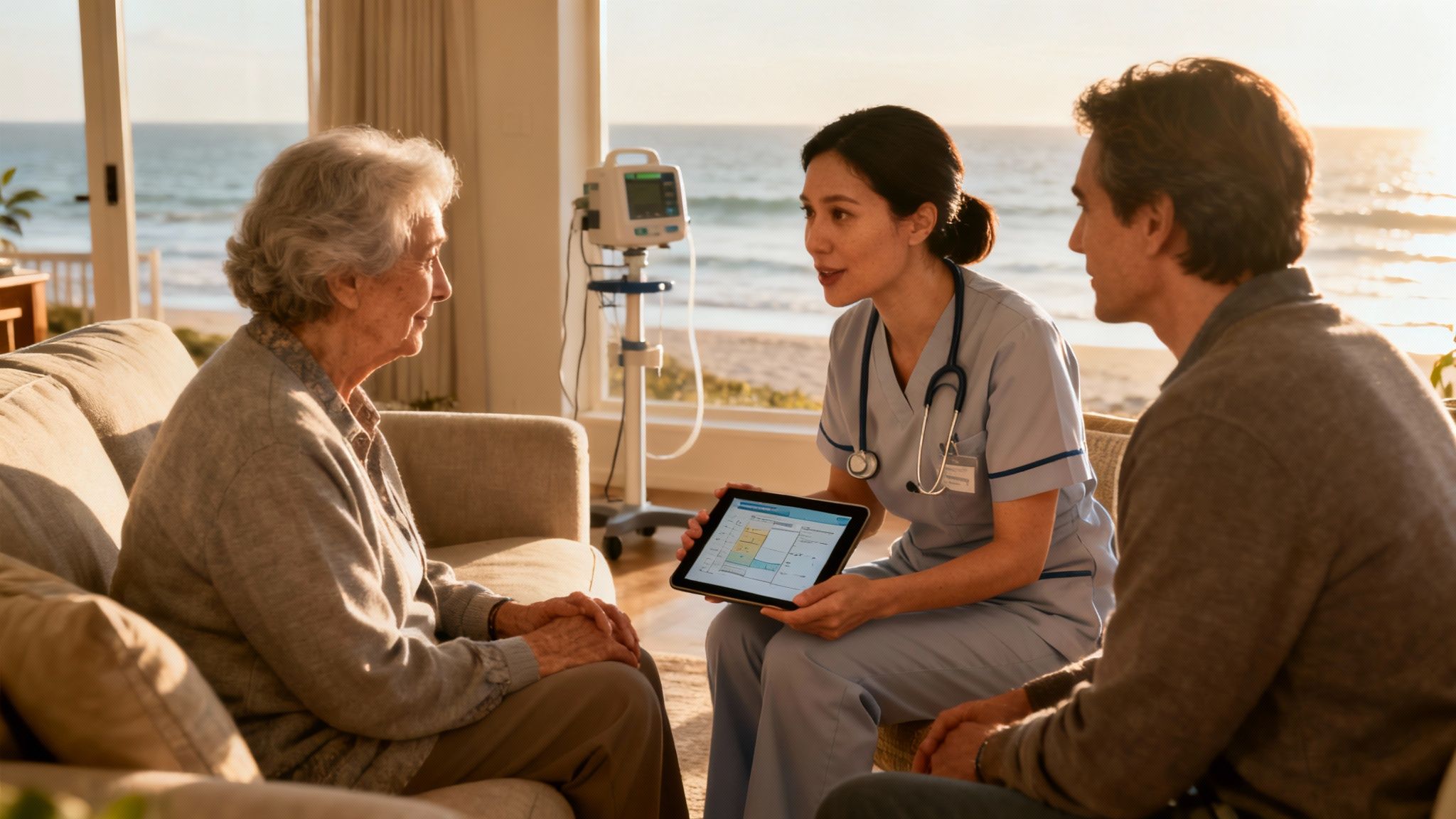
An advance care plan is more than just paperwork. It is a living roadmap that guides your family and healthcare team. But how do those wishes become reality?
Home-based care is the vehicle that brings your plan to life. It ensures your loved one’s values are honored in the comfort of their home.
For families across Monterey and San Benito Counties, this is what makes planning so powerful. It ensures care aligns with discussed goals, like prioritizing comfort or avoiding hospital stays. At Central Coast VNA & Hospice, our nonprofit mission is to make this happen every day.
Aligning Care with Your Family’s Values
The beauty of a good advance care plan is how it centers on what matters most. Home-based care is designed to support those personal goals. We bring a personalized, interdisciplinary team to the patient.
This team may include a Registered Nurse, Medical Social Worker, Hospice Aide, and Chaplain. They work together to follow the instructions in an Advance Directive or POLST.
Home-based care ensures that a person's documented wishes aren't just acknowledged—they become the foundation of the daily care plan. It's about honoring values, not just treating symptoms.
For example, if a plan emphasizes avoiding hospitalization, our home health and palliative care teams provide expert symptom management at home. This proactive approach helps prevent crises before they start.
The Power of Palliative Care at Home
Many families in Salinas and Santa Cruz believe this type of care is only for the end of life. That is a myth. Palliative care improves quality of life for anyone with a serious illness, at any stage.
When provided at home, palliative care can:
- Manage Complex Symptoms: Control pain, nausea, and shortness of breath.
- Provide Emotional and Spiritual Support: Help patients and families cope.
- Coordinate Care: Improve communication between all doctors.
Bringing palliative care into the home sooner gives families support to honor their loved one's wish for comfort.
A Seamless Continuum of Care
As a nonprofit with over 74 years of service on the Central Coast, CCVNA supports families as their needs change. We offer the full spectrum of home-based services, from home health to palliative care and hospice.
This continuum ensures a smooth transition if a condition progresses. The same trusted organization can provide all levels of care. You can learn more about how VNA helps seniors live safely at home in Monterey in our dedicated article.
According to the National Hospice and Palliative Care Organization (NHPCO), over 1.72 million Medicare beneficiaries received hospice services in 2020 (NHPCO, 2021). As you consider how to bring your plan to life, exploring resources on general healthcare services and technology that support in-home care might be beneficial. By planning ahead, you give your loved one the gift of expert, compassionate care that reflects their wishes.
FAQs: Your Questions About Advance Care Planning Answered
Navigating advance care planning can bring up many questions. As a nonprofit healthcare provider with over 74 years of experience on the Central Coast, we have helped thousands of local families find clarity. Here are answers to common questions we hear in Monterey, San Benito, Santa Cruz, and South Santa Clara counties.
1. When is the right time to start advance care planning?
The best time to start is now, while you are healthy. A sudden accident or health crisis can happen to anyone at any age. Starting the conversation early removes the pressure of making these decisions during an emergency.
2. Who should I choose as my healthcare agent?
Your healthcare agent is the person you appoint to make medical decisions for you if you cannot. Choose someone who understands your values, can stay calm under pressure, and will be a strong advocate for your wishes. Have a frank conversation with them to ensure they are comfortable with this role.
3. How often should I update my advance care planning documents?
Review your documents every few years or after a major life event. This includes a new diagnosis, a change in marital status, or the death of your chosen healthcare agent. Keeping them current ensures they always reflect what is most important to you.
4. Do I need a lawyer to complete these forms in California?
No, you do not need a lawyer to complete an Advance Healthcare Directive in California. The forms can be legally binding if signed by two witnesses or notarized. However, guidance from a healthcare professional, like our Medical Social Workers at CCVNA, can be very helpful.
5. What is the difference between palliative care and hospice care?
Palliative care can be provided at any stage of a serious illness to improve quality of life and can be given alongside curative treatments. Hospice care is for individuals with a life-limiting illness when the focus shifts to comfort and quality of life, typically when life expectancy is six months or less. Central Coast VNA & Hospice offers both services at home.
At Central Coast VNA & Hospice, we believe every family deserves the peace of mind that comes with a thoughtful advance care plan. If you're ready to start the conversation, our compassionate team is here to guide you every step of the way. Contact us today to learn how we support families throughout the Central Coast.
Learn more about our services at ccvna.com
Trust, Transparency, and Testimonials: Choosing the Right Hospice for Your Loved One
Choosing a hospice for someone you love is one of the most profound decisions a family can make. This decision often comes at a time when you're already feeling overwhelmed.
While your heart and gut instincts are important, grounding your choice in objective measures is key. Trust, transparency, and real patient stories will ensure your loved one receives high-quality care. This guide will walk you through how to use these three pillars to find the right care partner.
Making an Informed and Compassionate Hospice Choice
Finding the right hospice means looking past glossy brochures to find measurable proof of excellence. It’s about learning to evaluate a provider’s history in the community and understanding public data. Authentic testimonials reflect the true character of their team and empower you to be the best advocate for your loved one.
New regulations are raising the bar on care standards. Families are paying closer attention to things like satisfaction scores, CAHPS survey results, and provider ratings. With over 70% of people reading reviews before choosing a healthcare provider, testimonials and ratings have become essential trust signals.
The Three Pillars of a Good Decision
To make a confident choice, it helps to focus on three core factors. Think of these as the legs of a sturdy stool—each is essential for stable, reliable support. These pillars help you see the complete picture of a hospice agency.
- Trust: This is built on a provider's proven track record and deep local roots. A long history of service, like Central Coast VNA & Hospice’s 74+ years on the Central Coast, is a powerful indicator of reliability.
- Transparency: A transparent provider openly shares their quality scores and patient satisfaction results. They make it easy for families to find data from objective sources like the CAHPS Hospice Survey.
- Testimonials: These are the human stories behind the statistics. Authentic reviews give priceless insights into the compassion of the care team, from the Registered Nurse managing symptoms to the Hospice Aide providing comfort.
Choosing a hospice isn't just about finding medical support; it's about partnering with a team that honors your loved one's dignity and brings peace of mind to the entire family.
To help you organize your thoughts, here’s a quick look at how these three pillars work together.
Key Pillars for Choosing a Hospice
A quick look at the three core factors—Trust, Transparency, and Testimonials—and what they mean for your family's decision.
| Pillar | What to Look For | Why It Matters for Your Family |
|---|---|---|
| Trust | A long history in the community, non-profit status, and a clear, patient-focused mission. | A long-standing provider has proven its reliability and commitment, ensuring stable, dependable care when you need it most. |
| Transparency | Publicly available quality scores (like CAHPS ratings) and clear communication about services and staffing. | This shows the agency is confident in its quality of care and has nothing to hide, giving you confidence in your choice. |
| Testimonials | Specific, heartfelt stories from other local families that mention staff members and the quality of care provided. | Real stories go beyond data, revealing the true compassion, responsiveness, and humanity of the care team. |
By focusing on these three areas, you can cut through the noise and find a partner you can truly rely on.
Educating yourself on what quality hospice looks like helps you ask the right questions. Many don’t realize there are differences between providers. Taking the time to learn how to find the best hospice care near me can make an incredible difference.
Beyond immediate needs, families often face practical challenges. A compassionate guide for cleaning out a house after death can provide direction for managing difficult tasks.
Central Coast VNA & Hospice is available to explain what quality care looks like—at no cost or commitment. If your family is in Monterey County, San Benito County, Santa Cruz County, or South Santa Clara County, please contact our team.
Building a Foundation of Trust in Hospice Care
When it comes to end-of-life care, trust isn't just a feeling—it's everything. It’s built on a provider’s proven history of reliability and deep roots in the community. This foundation assures you that your family can count on a consistent, professional, and caring team.
A trustworthy reputation is earned over years, not overnight. For families here in Monterey County or San Benito County, that means looking for an organization with decades of local service. A long history signals stability and a real understanding of our community's needs.
Nonprofit Mission vs. For-Profit Models
A huge piece of the trust puzzle comes down to a hospice’s core mission. Nonprofit providers, like Central Coast VNA & Hospice, are mission-driven. Our primary focus is on patient care and community well-being, not generating profits.
Any excess revenue is put right back into enhancing patient services, community programs, and staff training. In contrast, for-profit agencies answer to their investors, which can sometimes influence care decisions. A nonprofit's sole commitment is to the patients and families it serves.
The Power of an Interdisciplinary Team
A truly trustworthy hospice provider doesn't just send one person to help. They bring a full, coordinated team of professionals who work together. This structure is a hallmark of high-quality, reliable care.
This interdisciplinary team creates a seamless support system. It ensures every physical, emotional, and spiritual need is met with expertise and heart.
At Central Coast VNA & Hospice, our team approach means you are never alone. A dedicated group of professionals collaborates to create a circle of support around your family, ensuring consistent and holistic care.
So, who is on this team? Here’s a look at the professionals who work together for your family:
- Registered Nurse: Manages pain and other symptoms and coordinates the overall medical care plan.
- Hospice Aide: Provides gentle, hands-on personal care, like assistance with bathing and dressing.
- Medical Social Worker: Offers emotional support and helps families connect to community resources.
- Chaplain: Provides spiritual support that respects your family’s unique beliefs and values.
This collaborative model ensures no detail is overlooked and that your family feels fully supported. Understanding the importance of online reputation management also reflects a provider's credibility.
With over 74+ years of service on the Central Coast, organizations with deep local roots have a proven legacy. You can see how Central Coast VNA & Hospice impacts lives by reading these stories of compassionate care.
Using Transparency to Measure Quality of Care
When you're choosing a hospice, how can you be sure you’re getting the best possible care? True quality comes down to transparency. A transparent provider is open and honest about their performance, sharing public data that works like a report card.
This data lets you look past the sales pitch and see objective proof of how an agency supports families. This openness is a cornerstone of trust between a healthcare provider and families in communities like Salinas and Santa Cruz.

Finding a Hospice Report Card
So, where do you find this "report card"? The most powerful tool you have is the CAHPS Hospice Survey. This is a national survey that gathers feedback directly from families who have received hospice care.
Since 2015, the Centers for Medicare & Medicaid Services (CMS) has required hospices to participate. The results are posted on Medicare.gov, allowing families to compare agencies. It’s a real snapshot of quality care that empowers you to make an informed choice.
These surveys aren't just about statistics; they capture the heart of the hospice experience. They reveal how well a team managed a patient’s symptoms and supported a family’s emotional needs.
By looking at this public data, you can see a provider’s track record for delivering compassionate, consistent care. It helps you move from hoping for good care to expecting it based on proven results.
What to Look For in the Data
When you review the survey results on Medicare’s Care Compare website, you’ll see how different providers score. This is your window into what day-to-day support will actually look and feel like.
To get a clear picture, focus on these key areas:
- Communication with Family: This score shows how well the team kept everyone informed about the patient’s condition.
- Getting Timely Help: This tells you how quickly the hospice responded when the family needed help.
- Treating Patient with Respect: This is a direct measure of the compassion and humanity of the care provided.
- Emotional and Spiritual Support: This reflects how well the hospice addressed the needs of both the patient and the family.
These scores give you a way to compare providers in Monterey County and neighboring areas side-by-side. Understanding how hospices are funded also adds important context, especially for nonprofit organizations like Central Coast VNA & Hospice.
By using these transparent, public tools, you become an empowered advocate for your family. You can make a decision based on what a provider’s past performance proves.
The Human Story Behind Testimonials and Reviews
Data and quality scores give you the black-and-white numbers. Testimonials and patient stories provide the heart of the hospice experience. These personal accounts reveal the compassion that statistics alone can never capture.
When you know how to read between the lines, these stories give you real, authentic insights.
These stories matter. With over 70% of people reading online reviews when choosing healthcare providers, genuine feedback is an essential trust signal. Hearing from others who have walked a similar path can be incredibly reassuring.
Looking for Consistent Themes in Feedback
One of the most powerful ways to use testimonials is to look for consistent themes. A single glowing review is nice, but a pattern of praise across multiple reviews tells a much bigger story. It signals that a positive experience is part of the provider's culture.
As you read, ask yourself if the same comments keep popping up. These patterns are clues to a provider’s true strengths.
- Compassionate Staff: Do different reviews mention a specific Hospice Aide who was exceptionally gentle? Consistent praise points to a strong, caring staff culture.
- Excellent Communication: Look for comments that highlight how well the team kept the family informed. Phrases like "they always answered our calls" are signs of a supportive provider.
- Effective Symptom Management: Do families mention how comfortable their loved one was? Comments about pain control are direct indicators of high-quality clinical care.
Finding these recurring themes helps build confidence in the team you’re choosing.
How to Spot an Authentic and Helpful Review
Not all reviews are created equal. To get the most value, you need to know how to spot genuine, detailed stories. Authentic testimonials are full of specific details that paint a clear picture.
A truly helpful review will often include:
- Specific Examples: Instead of saying "the care was good," a detailed review might share, "The Hospice Aide knew exactly how to reposition my father to make him comfortable."
- Names or Roles: When a family mentions a professional by their role (e.g., "our Medical Social Worker"), it suggests that person made a significant impact.
- The Full Journey: The most insightful stories touch on the entire experience, from the first call to bereavement support.
Testimonials and family satisfaction scores are more than just marketing tools; they are critical benchmarks for evaluating quality. Positive feedback often correlates with better patient outcomes and a more peaceful end-of-life experience for the entire family.
Research backs this up. According to one study, patients receiving hospice care report a 44.8% increase in satisfaction ratings and experience significantly fewer hospitalizations. You can explore research on hospice patient outcomes to learn more.
Reading about the experiences of other local families can be incredibly powerful. You can read our VNA & Hospice stories to see firsthand how our team has supported families across Monterey and Santa Cruz Counties.
Critical Questions to Ask Any Hospice Provider
When you're meeting with potential hospice providers, walking in prepared can make all the difference. Knowing what to ask helps you become the best advocate for your loved one. It allows you to clearly compare your options and find a team that fits your family’s values.
Think of it as an interview for one of life’s most significant journeys. Below is a checklist of practical questions to guide these crucial conversations. We'll also get into why each question is so important.
Care Team and Support
A hospice is only as good as its people. The quality of care your loved one receives comes down to the expertise and compassion of the team. These questions will help you understand how their team actually operates.
A great provider won't hesitate to give you specific, concrete answers.
- What is your staff-to-patient ratio? A lower ratio often translates to more direct, hands-on care from the Registered Nurse and Hospice Aide.
- How often will a Registered Nurse and Hospice Aide visit? You're looking for a provider who offers consistent, planned visits, not one that only shows up in a crisis.
- Is your entire team—including Chaplains and Medical Social Workers—employed directly by your agency? Direct employees usually mean better communication and more coordinated care.
- What does your after-hours support look like? A top-tier hospice will have a Registered Nurse available 24/7 to take your call and make an emergency visit if needed.
Getting a feel for these details is essential. You can explore our guide on the 7 signs you’ve found the right hospice for your parent.
Quality and Communication
Trust is built on transparency. These questions are designed to get to the heart of a provider's quality. They also reveal their commitment to keeping families informed.
A hospice that is proud of the care it delivers will be open and ready to talk about its quality scores and family satisfaction ratings. If you sense hesitation when you ask for this information, that’s a red flag.
The decision tree below can help you visualize how to sort through testimonials and reviews.
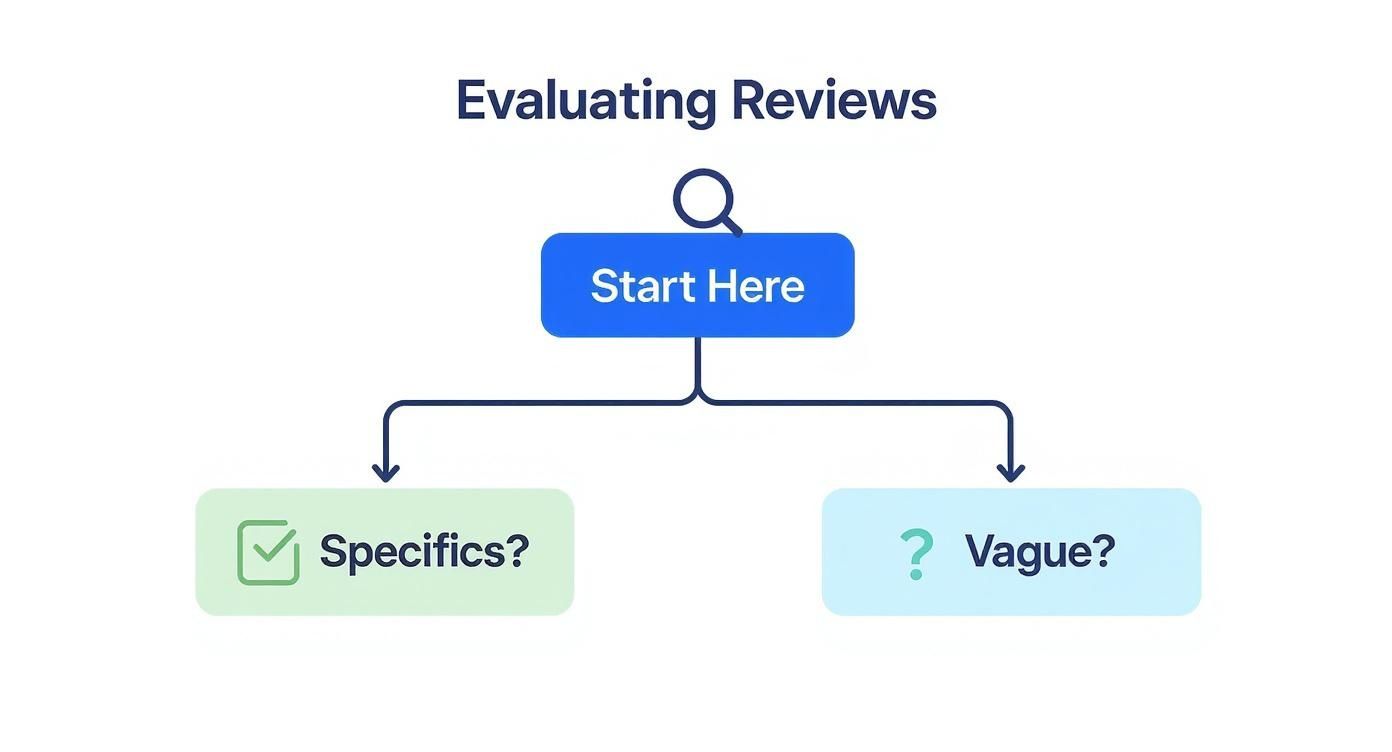
As you can see, specific stories from other families will give you a much clearer picture.
Here are a few more questions to get to the core of their quality:
- Can you share your most recent CAHPS Hospice Survey scores? A willingness to point you to this public data shows they are accountable.
- How do you create and update a patient's care plan? A strong answer will describe a collaborative process involving the patient, family, and the hospice team.
- What is your process for managing pain and other difficult symptoms? Listen for a proactive, comprehensive approach that includes regular assessments and timely adjustments.
- How does your team support the family? Ask specifically about bereavement programs, training, and emotional support offered by their Medical Social Workers and Chaplains.
We've compiled the key questions into a simple checklist you can use.
Essential Questions Checklist for Hospice Interviews
This simple checklist can guide your conversations with potential hospice providers, ensuring you cover every critical aspect of care.
| Category | Question to Ask | What a Good Answer Includes |
|---|---|---|
| Care Team | What is your staff-to-patient ratio? | A specific number and an explanation of how it allows for personalized care. |
| Care Team | How often will nurses and aides visit? | A clear, typical schedule for routine visits, not just crisis response. |
| Care Team | Is your interdisciplinary team employed by you? | Confirmation of direct employment, which promotes coordinated care. |
| Care Team | What is your after-hours support system? | 24/7 access to a Registered Nurse by phone and for visits, with a quick response time. |
| Quality | Can I see your CAHPS Hospice Survey scores? | An enthusiastic "yes," with directions to their scores on Medicare.gov. |
| Quality | How is the care plan developed and updated? | A description of a collaborative process involving the patient, family, and team. |
| Quality | How do you manage pain and symptoms? | Details on a proactive approach, including regular assessments and medication management. |
| Quality | How do you support the family? | Specific examples of bereavement support, respite care, and emotional counseling. |
Armed with these questions, you’re ready to have meaningful conversations with providers across the Central Coast.
A Legacy of Trusted Care on the Central Coast
Choosing a hospice is a journey of the heart. It’s a decision guided by a deep need for trust, honesty, and comfort. For families across the Central Coast, these are the bedrock of the care we've provided at Central Coast VNA & Hospice for over 74+ years.
As a local, nonprofit, mission-driven organization, our entire focus has always been on the people we serve. Our legacy is built on decades of showing up for our neighbors in Monterey County, San Benito County, Santa Cruz County, and South Santa Clara County. Our commitment is to our community’s well-being.

Our Commitment to Transparency
We believe families deserve to make decisions with total confidence. That’s why we are completely transparent about our quality of care. We invite you to review our patient satisfaction scores and quality metrics.
Our team—made up of dedicated Registered Nurses, Hospice Aides, Chaplains, and Medical Social Workers—is here to deliver consistent support. We are incredibly proud of the work they do and the peace of mind they bring to families.
At Central Coast VNA & Hospice, we see ourselves as more than a provider—we are a local community partner. We are here to help you navigate this journey with clarity, compassion, and peace of mind, every step of the way.
Support Along the Entire Continuum of Care
The need for support often begins long before hospice care is on the table. That’s why we offer a full Continuum of Care. Our services are designed to work together seamlessly as your loved one’s needs change.
This integrated approach includes:
- Home Health Care: We provide skilled nursing and therapy to help patients recover from surgery or manage chronic conditions at home.
- Palliative Care: Our teams offer specialized support to manage symptoms and improve quality of life for those with serious illnesses.
- Hospice Care: We deliver compassionate end-of-life care that honors your loved one’s dignity and supports the entire family.
By offering this complete spectrum, we can build a lasting, trusting relationship with your family. This ensures a smooth and gentle transition between levels of care.
Let's Talk About Your Needs
We understand how difficult and overwhelming this time can be, and we are here to help. We invite you to contact us for a no-cost, no-commitment conversation. Let us show you what our legacy of trusted, transparent, and compassionate care looks like.
You can learn more about our hospice care services or call our team today. We are here to listen and provide the guidance you need.
Frequently Asked Questions About Choosing Hospice
Exploring hospice care brings up many questions. The path ahead can feel uncertain, but clear answers help. Here are five of the most common questions we hear from families.
What’s the difference between nonprofit and for-profit hospice?
A nonprofit hospice, like Central Coast VNA & Hospice, is mission-driven. Our purpose is built around patient care and serving our community—not generating profits. Any revenue goes right back into our programs to enhance patient care and support families.
A for-profit agency has a responsibility to its investors, which can shape its approach. With a nonprofit, the commitment is always to the people we serve.
Where can I find honest quality ratings for local hospices?
The best place to start is Medicare's official "Care Compare" tool on Medicare.gov. You can look up hospice providers in Monterey County or Santa Cruz County. The tool shows family satisfaction scores from the national CAHPS Hospice Survey, giving you unbiased feedback.
How can I spot a genuine patient testimonial?
Look for specific details, not just vague praise. A trustworthy review will often mention how a specific Hospice Aide brought comfort or how a Registered Nurse managed a tough symptom. Look for patterns across multiple reviews that highlight the same strengths, like excellent communication or genuine compassion.
Can my loved one receive hospice care at home?
Yes, absolutely. A core goal of hospice is to bring comfort and care to wherever a person calls home. This could be their own house, an assisted living community, or a skilled nursing facility. The Central Coast VNA & Hospice team comes directly to the patient, allowing them to stay in a familiar environment.
When is the right time to start looking into hospice?
It’s never too early to start learning. Gathering information before you're in a crisis can lift a huge weight off your shoulders. It allows you to make calm, clear-headed decisions when the time comes. If your loved one is managing a serious illness, please call us for a no-cost consultation to learn about all the support available.
At Central Coast VNA & Hospice, our commitment is to guide you through this journey with trust, transparency, and genuine care. To learn more about our services or just to talk with someone from our team, please visit us at https://ccvna.com.
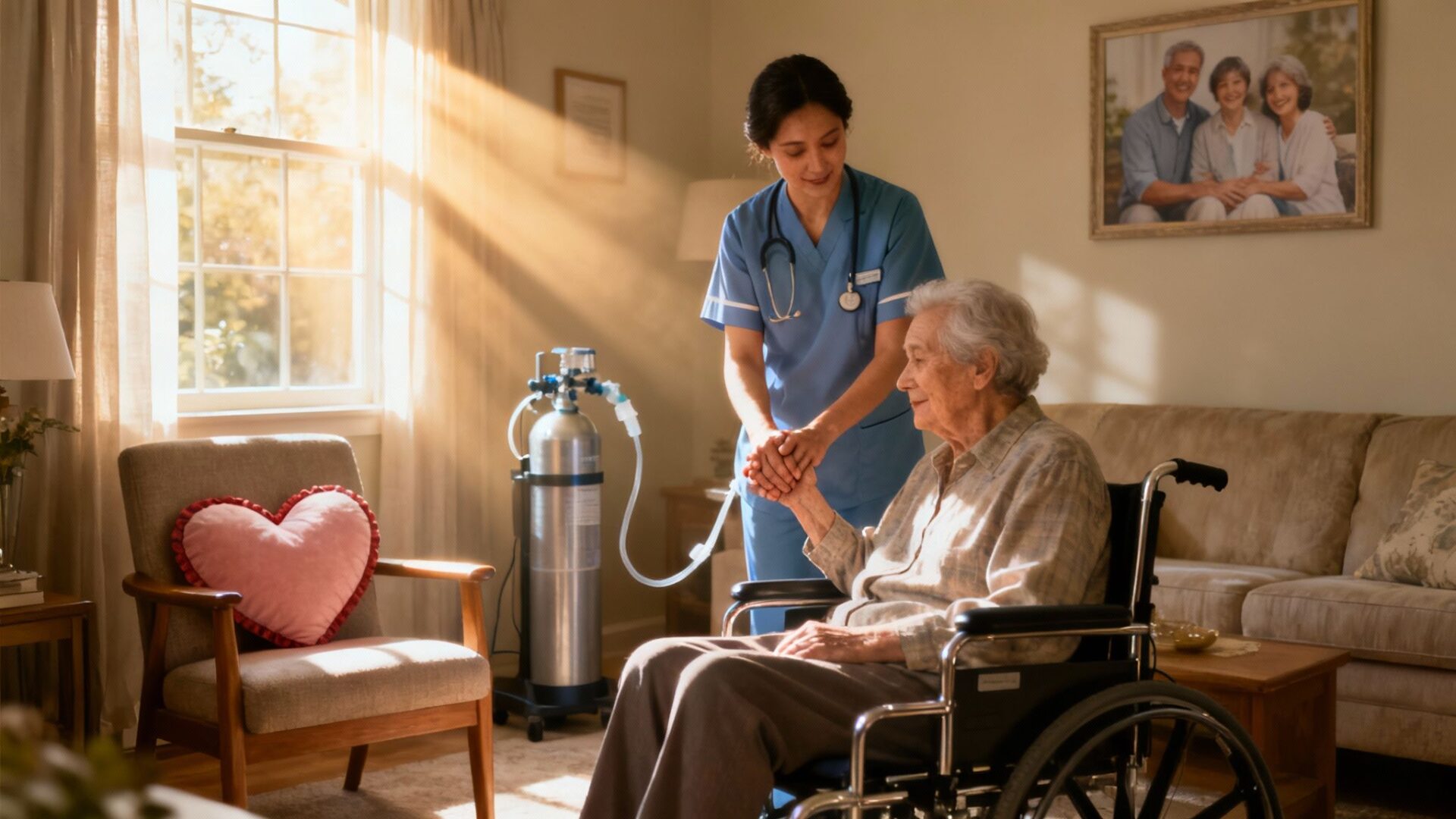
Is Hospice Only for Cancer Patients? Understanding Eligibility
No, hospice is not just for cancer patients. This is a common myth. Hospice care supports anyone with a life-limiting illness, no matter the diagnosis.
The focus is on providing comfort, dignity, and the best quality of life. This happens when curative treatments are no longer the main goal.
Challenging a Common Hospice Myth
When families in Monterey and Santa Cruz counties think of hospice, cancer often comes to mind. While we proudly support cancer patients, this myth can prevent people with other serious illnesses from getting the care they deserve.
The truth is, hospice serves a wide range of advanced conditions. For over 74 years, Central Coast VNA & Hospice has provided compassionate support to our community, regardless of the diagnosis. We see how this care helps people with heart failure, dementia, and other illnesses live their final months in peace.
Understanding this helps you make informed choices for your loved ones. We explore more myths in our article separating hospice fact from fiction.
Hospice Serves a Diverse Patient Community
While cancer is a common diagnosis, it is only one of many. Hospice care is for anyone facing the final chapter of a serious illness.
According to the National Hospice and Palliative Care Organization (NHPCO), over 1.72 million Medicare beneficiaries received hospice services in 2020 (NHPCO, 2021). Many of these patients had diagnoses other than cancer, such as heart disease, dementia, and lung disease.
Hospice is not defined by a single disease but by a philosophy of care. It embraces anyone facing the final stages of a serious illness, offering a supportive embrace that honors their life and wishes.
The goal is to provide comfort and manage symptoms. It also includes offering emotional and spiritual support to the patient and their family. This focus on the whole person makes hospice a vital resource for our neighbors in Monterey County, San Benito County, Santa Cruz County, and South Santa Clara County.
Hospice Eligibility at a Glance
This simple table gives a quick overview of common conditions that may qualify a patient for hospice. It shows that many illnesses beyond cancer are included.
| Condition Category | Examples of Diagnoses |
|---|---|
| Heart Disease | Congestive Heart Failure (CHF) |
| Lung Disease | Chronic Obstructive Pulmonary Disease (COPD) |
| Neurological Conditions | Parkinson's Disease, ALS |
| Kidney Disease | End-Stage Renal Disease |
| Liver Disease | End-Stage Liver Disease |
| Dementia | Advanced Alzheimer's Disease |
This is just a starting point. A physician must determine that a patient's life expectancy is six months or less if the disease runs its natural course. The key is focusing on the person, not just the diagnosis.
Understanding When Hospice Is an Option
Knowing when to consider hospice can feel overwhelming. The guidelines are designed to bring clarity and support during a difficult time.
The main requirement is that a doctor must certify the patient likely has six months or less to live if their illness follows its natural course. This is not a strict deadline. If a patient lives longer, hospice support can continue as long as they still meet the criteria.
Recognizing the Signs It Might Be Time
The conversation about hospice often begins when a family notices changes in a loved one's health. While every person's journey is unique, there are common signs that comfort-focused care could be beneficial.
Observing these changes helps your family start a conversation. Recognizing them early allows you to explore options with less pressure.
Key indicators that hospice may be an appropriate choice include:
- Frequent Hospitalizations: A pattern of recurring trips to the emergency room or multiple hospital stays in the last six months.
- Difficulty Managing Pain: When pain and other symptoms become persistent and are not well-controlled by current treatments.
- Noticeable Decline: You might see increasing weakness, constant fatigue, significant weight loss, or recurring infections.
- Reduced Daily Function: A clear decline in the ability to manage daily activities like bathing, dressing, eating, or moving around independently.
This simple decision tree shows that hospice eligibility is based on the seriousness of an illness, not a specific diagnosis.
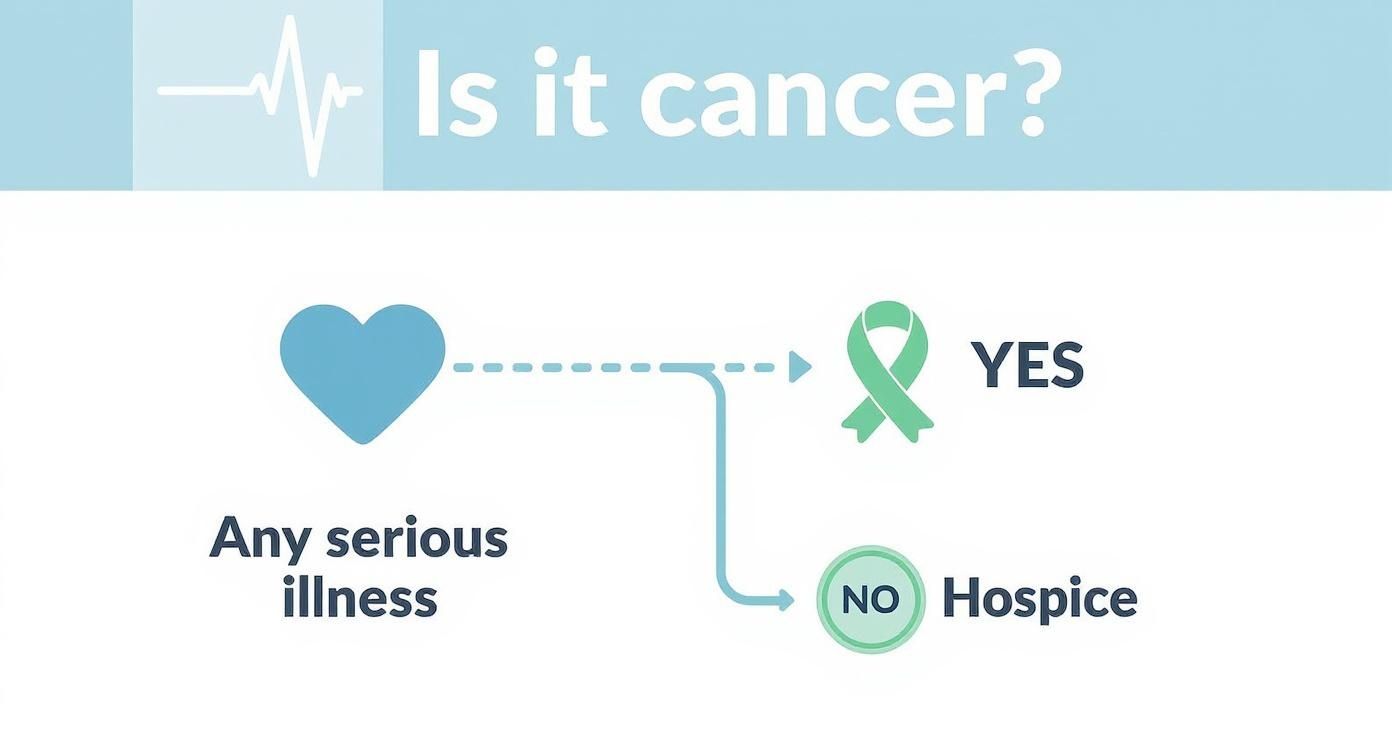
The path to hospice is determined by need, not the name of the disease. It’s all about focusing on quality of life when an illness has advanced.
Empowering Your Family with Information
Understanding these signs empowers you to advocate for your loved one. It opens the door to a different kind of care—one that prioritizes peace over aggressive treatments. This is often the most compassionate choice a family can make.
It ensures their loved one receives holistic support for their body, mind, and spirit. If you are noticing these signs and wondering about next steps, you can learn more about when to call hospice in our detailed guide.
Choosing hospice is not about giving up. It is an active decision to shift the focus from curative treatments to maximizing comfort, managing symptoms, and honoring a person's wishes for their final months.
By understanding the criteria and recognizing the signs, you can make informed decisions. Our team at Central Coast VNA & Hospice is ready to help families in Monterey County and San Benito County navigate this sensitive topic with compassion.
The Many Conditions Hospice Can Support
Most people think of cancer when they hear the word "hospice." But this care adapts to many other serious illnesses.
The teams at Central Coast VNA & Hospice support individuals with a wide range of advanced conditions. We tailor care to meet each person's unique needs right here in Monterey County and the surrounding areas.
Advanced Heart Disease
For someone with advanced heart disease, like Congestive Heart Failure (CHF), daily life can be exhausting. Simple activities might trigger fatigue, shortness of breath, or chest pain.
Our hospice Registered Nurses are experts at managing these symptoms at home. They work with the patient’s doctor to adjust medications and provide oxygen. The goal is to reduce hospital visits and improve comfort.
Chronic Lung Disease
Patients with Chronic Obstructive Pulmonary Disease (COPD) often feel anxious about their breathing. This feeling of breathlessness can be frightening and isolating.
Hospice care for COPD focuses on easing this symptom. We teach patients breathing techniques and relaxation methods. Our Hospice Aides can also help with personal care, saving the patient’s energy for time with loved ones.
Hospice care is about adding life to a patient’s days, not just days to their life. By focusing on symptom relief and emotional peace, we help individuals with any terminal illness live as fully as possible.
Dementia and Alzheimer's Disease
As dementia or Alzheimer's advances, communication becomes a challenge. The world can feel confusing.
Our teams are trained to create a peaceful and safe environment. We learn to read non-verbal cues to understand needs and manage agitation. This approach upholds the patient’s dignity and gives their family needed support.
Advanced Neurological Conditions
Conditions like Amyotrophic Lateral Sclerosis (ALS) or Parkinson’s Disease cause a progressive loss of function. This creates immense physical and emotional hurdles.
For these individuals, hospice care helps maintain comfort and preserve independence. A dedicated hospice team coordinates pain management, mobility assistance, and medical equipment. Our Social Workers and Chaplains also offer emotional and spiritual support.
What a Hospice Care Team Provides
Hospice is a dedicated team of professionals working together for you and your family. This team-based approach supports every aspect of a person's well-being.
At Central Coast VNA & Hospice, our care comes to you, wherever you call home. This could be a private residence in Monterey County or an assisted living facility in San Benito County. Our goal is to provide comfort in a familiar environment.
Your Interdisciplinary Care Team
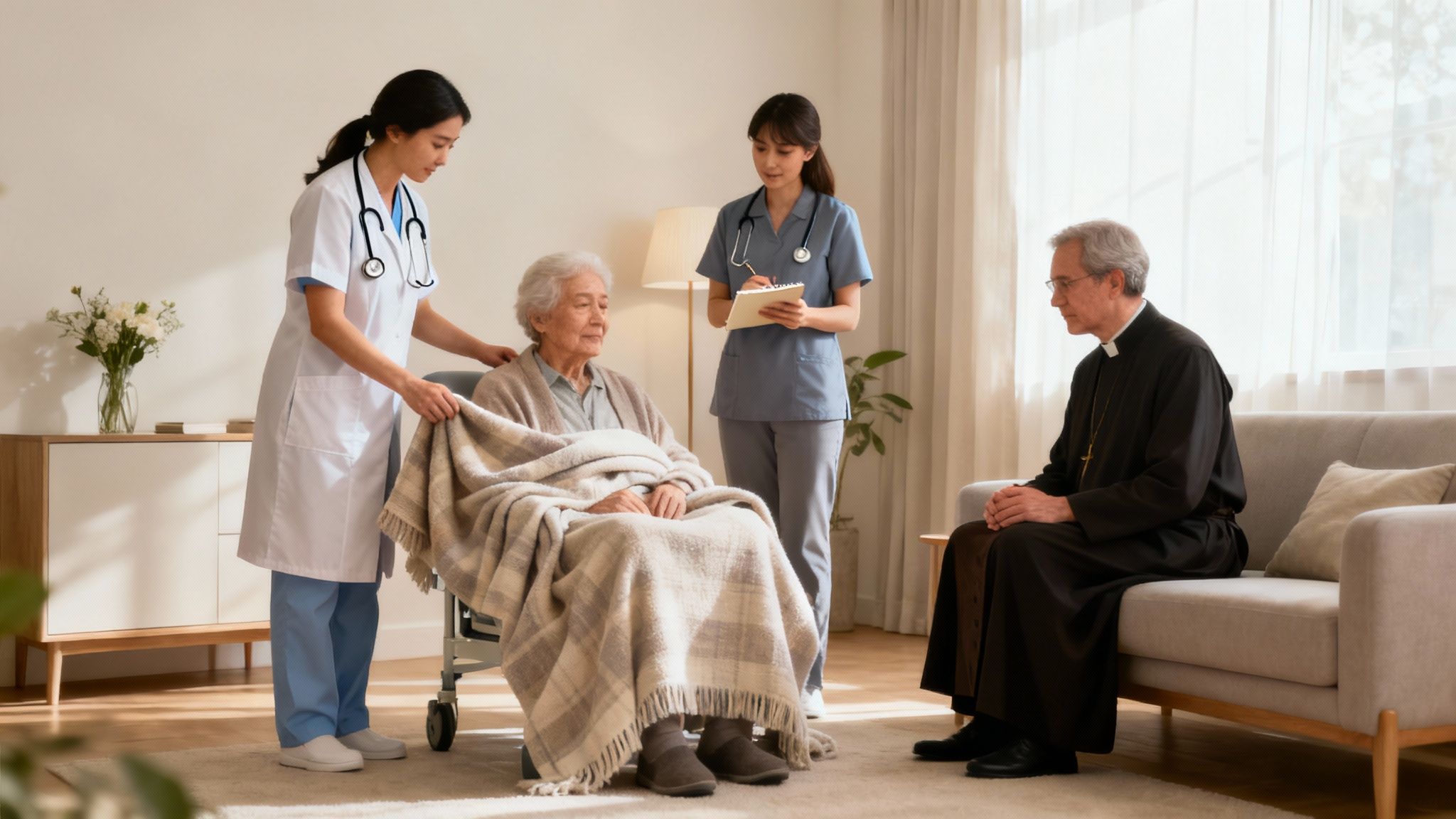
A patient’s hospice journey is guided by a core team of specialists. They work together to create a personalized care plan.
Your Central Coast VNA & Hospice team includes:
- Registered Nurse: Manages pain and other symptoms and coordinates with your physician.
- Hospice Aide: Assists with personal care tasks like bathing and dressing.
- Social Worker: Offers emotional support and helps with practical matters like advance care planning.
- Chaplain: Provides non-denominational spiritual guidance that respects your family’s beliefs.
This team approach ensures the complete needs of the patient and family are met. It addresses physical, emotional, and spiritual well-being.
Easing Financial and Practical Burdens
Worrying about the cost of care can be a major source of stress. Hospice is designed to relieve this burden. This lets you focus on spending quality time together.
Under the hospice benefit, most medical supplies, equipment, and medications related to the illness are covered. This can include a hospital bed, oxygen, and pain medications. Our team coordinates the delivery and setup of everything you need.
Hospice is a comprehensive support system that wraps around the entire family. It’s about ensuring comfort, preserving dignity, and providing a steady, guiding hand during a challenging time.
By handling these logistics, we help create a more peaceful home environment. This is central to our mission as a nonprofit serving the Central Coast for over 74 years. Learn more about what to expect from hospice care in our helpful guide.
The Relationship Between Palliative and Hospice Care
Many people think "palliative care" and "hospice care" are the same. They are related, but they serve different needs at different times.
Think of palliative care as a broad type of support that can begin at any point after a serious diagnosis. A person can receive palliative care while still getting curative treatments, like chemotherapy. The goal is to relieve symptoms and improve quality of life.
All Hospice Is Palliative, But Not All Palliative Care Is Hospice
Hospice care is a specific type of palliative care. It begins when the focus shifts from curing the illness to maximizing comfort. It is for individuals with a life expectancy of six months or less.
This is the main difference. Palliative care can be given alongside curative treatments, but hospice starts after the decision to stop them.
The simplest way to think about it is that all hospice care is palliative because it’s all about comfort and symptom management. However, not all palliative care is hospice, because it can be provided long before a person reaches the end-of-life stage.
For a deeper look, you can read our guide on the real difference between hospice and palliative care.
A Seamless Continuum of Care on the Central Coast
Central Coast VNA & Hospice provides a complete continuum of care. We are the only organization in Monterey County and the surrounding areas offering home health, palliative, and hospice services under one roof.
A patient might start with our home health nursing after a hospital stay. They can then transition to our palliative care program for extra support. When the time is right, they can move smoothly into hospice care, often with the same team they already trust.
This integrated approach prevents stressful gaps in care. Our team builds a lasting relationship with your family, providing consistent support.
How to Begin the Hospice Conversation
Talking about hospice can be tough, but it is a loving conversation. It’s not about giving up. It’s about ensuring your loved one’s final chapter is lived with comfort and dignity.
You can create a safe space by starting with open-ended questions. Try asking, "Have you thought about what kind of care you’d want if you became more ill?" The goal is to listen and understand their hopes and fears.
Taking the Next Step
Once the conversation is open, the next step is gathering information. It is a myth that you need a doctor’s referral to learn about hospice. Anyone—a patient, family member, or friend—can call to ask for information.
You don’t need a physician’s referral to explore your options. A simple, no-pressure phone call can bring so much clarity and answer your questions, empowering you to make the best decision for your family.
At Central Coast VNA & Hospice, our team is right here in Santa Cruz County, ready to help. We can walk you through the services and explain eligibility.
The process for starting hospice care is straightforward. Here’s how it works:
- Contact a Hospice Provider: Call us to request an informational visit. There is no commitment.
- Schedule a Consultation: One of our Registered Nurses will meet with you to discuss needs and eligibility.
- Obtain a Physician's Order: If hospice is the right choice, we will coordinate with your loved one’s doctor to get the necessary certification.
This process is meant to relieve stress. Contact us today for a compassionate, no-obligation conversation.
Frequently Asked Questions (FAQs)
Is hospice only for the last few days of life?
No, this is a common misconception. Hospice care is most beneficial when started earlier. Patients can receive care for six months or longer, as long as they meet the eligibility criteria, allowing more time for comfort and support.
Does choosing hospice mean we are giving up?
Not at all. Choosing hospice is an active decision to focus on quality of life. It’s about ensuring your loved one’s final months are lived with peace, dignity, and as much comfort as possible.
How is hospice care paid for?
Hospice is fully covered by Medicare, Medicaid, and most private insurance plans. As a nonprofit serving the Central Coast for over 74 years, Central Coast VNA & Hospice provides care to all eligible patients, regardless of their ability to pay.
Can a patient leave hospice if they get better?
Absolutely. If a patient's condition improves or they want to try a new curative treatment, they can leave hospice care at any time. They can re-enroll later if they meet the hospice eligibility requirements.
Where is hospice care provided?
Hospice care is provided wherever a patient calls home. This could be their own house, an assisted living community, or a nursing home in Monterey County, San Benito County, or our other service areas. The goal is to bring support to them in a familiar setting.
If you have more questions or want to understand how our continuum of care can support your family, contact Central Coast VNA & Hospice today. Learn more at https://ccvna.com.

thumbnail-5
Making decisions about a loved one's health is one of the most challenging responsibilities a family can face. When a serious illness progresses, conversations about end-of-life care are often filled with emotion and misinformation. For many, the word 'hospice' brings up feelings of fear, rooted in myths that could be keeping your family from the care you deserve.
These misconceptions are significant barriers. They prevent families from accessing compassionate care that can improve a loved one’s final months. Many people delay asking about hospice because they believe it means 'giving up' or that it is only for the last few days of life. This delay, born from myths, can lead to preventable suffering and missed opportunities for meaningful connection.
At Central Coast VNA & Hospice, we have spent over 74 years helping our community navigate these difficult conversations. We believe that debunking these myths is the first step toward empowering you to make informed, compassionate choices. This article will walk you through the five most common hospice myths, replacing fear with facts and showing how hospice is truly about living as fully and comfortably as possible.
1. Myth #1: Hospice Means Giving Up and Choosing to Die
Perhaps the most damaging misconception about hospice care is the belief that it signifies surrender. Many families view a hospice referral as a sign that they are “giving up” on their loved one. This common fear is one of the biggest barriers preventing patients from receiving compassionate care when they need it most.
What Hospice Really Is: A Shift in Focus
Hospice is not about giving up; it is about shifting the goals of care. It represents a move away from aggressive curative treatments that may no longer be effective. Instead, it moves toward a philosophy centered on comfort, dignity, and quality of life.
Hospice care does not hasten death. It supports the body’s natural process by managing symptoms and providing emotional, spiritual, and physical support. The primary goal is to ensure the patient is comfortable and free from pain, allowing them to spend meaningful time with their family.
Key Insight: Hospice is not about the end of life. It is about the quality of life. The focus shifts from adding more days to life to adding more life to each day.
Comfort Care vs. Curative Treatment: A Practical Example
Understanding the difference between curative and comfort-focused care helps clarify the role of hospice. Let’s consider a patient with advanced cancer who has endured multiple rounds of chemotherapy.
- Curative Approach: The patient might continue with aggressive chemotherapy. This often causes severe side effects with a diminishing chance of shrinking the tumor.
- Hospice Approach: The patient would stop curative chemotherapy but continue receiving medications to manage symptoms like pain or nausea. A hospice team focuses on treatments that improve comfort and quality of life.
In the hospice model, every treatment is evaluated based on a single question: “Will this improve the patient’s quality of life?” This philosophy allows patients to regain control over their daily lives.
The Surprising Truth: Hospice Can Mean More Time
Contrary to the myth that hospice shortens life, studies have shown the opposite can be true. When pain and symptoms are expertly managed, the body is under less physical stress.
According to a study in the New England Journal of Medicine, lung cancer patients who received early palliative care—a philosophy similar to hospice—lived nearly three months longer than those receiving standard aggressive treatment (Temel et al., 2010). By focusing on the whole person, hospice care can provide the comfort and stability needed to extend meaningful life. You can learn more about how hospice care redefines support for patients and families and what it truly means to choose comfort.
How to Reframe the Conversation
If your family is grappling with this myth, it’s important to change the conversation from one of defeat to one of empowerment.
- Talk about goals: Ask your loved one, "What is most important to you right now?" Their answer may be to be pain-free, to be at home, or to spend time with family.
- Use different language: Instead of saying “giving up,” try framing it as “choosing comfort” or “taking control of your quality of life.”
- Consult the experts: A conversation with a Central Coast VNA & Hospice professional can help. Our teams across Monterey County, San Benito County, Santa Cruz County, and South Santa Clara County are here to provide information so you can make the decision that is right for you.
2. Myth #2: Hospice is only for cancer patients in their final days
Another common barrier to timely care is the narrow perception of who hospice is for. Many people associate hospice exclusively with a cancer diagnosis and the very last days of life. This myth can prevent patients with other life-limiting illnesses from getting crucial support.

What Hospice Really Is: A Broader Spectrum of Care
Hospice care is designed for anyone with a terminal illness who has a prognosis of six months or less if the disease follows its natural course. While hospice was founded to provide better care for cancer patients, it now supports individuals with a wide range of conditions.
Today, hospice serves patients with many different diagnoses, including:
- Congestive Heart Failure (CHF)
- Chronic Obstructive Pulmonary Disease (COPD)
- Alzheimer's disease and other forms of dementia
- Kidney or liver failure
- ALS (Lou Gehrig’s Disease)
The key eligibility criterion is the prognosis, not the specific illness. This is one of the most critical facts to understand in the list of 5 hospice myths that could be keeping your family from the care you deserve.
Key Insight: Hospice eligibility is based on prognosis, not diagnosis. It supports anyone facing the final months of any terminal illness, not just cancer.
Beyond the Final Days: A Practical Example
The belief that hospice is only for the "last 48 hours" prevents families from experiencing the full benefits of care. Let’s look at a patient with late-stage dementia.
- Without Hospice: The family might struggle with challenging behaviors and frequent infections. This often leads to repeated, stressful hospitalizations.
- Hospice Approach: The patient can enroll in hospice months before their final days. A hospice team provides specialized care at home, focusing on comfort, safety, and dignity. The patient remains in a familiar, peaceful environment.
In this model, the patient receives consistent, compassionate care over a longer period. The family receives the education and support needed to navigate a difficult disease.
The Surprising Truth: The "Six-Month" Rule is Not an Expiration Date
The six-month prognosis is a clinical guideline, not a strict deadline. It is a physician's best estimate of life expectancy if the illness runs its typical course. Many patients live longer than six months and continue to receive hospice care.
As long as a physician continues to certify that the patient’s prognosis is six months or less, they remain eligible. The hospice team simply re-evaluates the patient’s condition at regular intervals. It is possible to explore the real benefits of starting hospice early and how it can improve quality of life for months.
How to Reframe the Conversation
If you believe your loved one might be eligible for hospice but they do not have cancer, it is important to advocate for their needs.
- Ask the doctor directly: Use specific language like, "Would you be surprised if my mother lived for more than another six months?" This can open the door to a conversation about hospice.
- Focus on symptoms: Discuss uncontrolled symptoms like shortness of breath, chronic pain, or frequent infections with the doctor.
- Request a consultation: Ask for an informational meeting with a provider like Central Coast VNA & Hospice. Our team can assess your loved one’s eligibility and explain the support we can offer.
3. Myth #3: Hospice Abandons Patients and Stops All Medical Care
A common fear is that choosing hospice means a patient will be left on their own. Families worry that their loved one will no longer receive medications or clinical support. This belief suggests an abandonment of care when, in fact, the opposite is true.
What Hospice Really Is: A Refocusing of Medical Care
Hospice does not stop medical care; it redefines its purpose. Hospice provides a highly attentive team of professionals dedicated to ensuring comfort and dignity. This team includes a hospice physician, Registered Nurses, Hospice Aides, a social worker, a Chaplain, and trained volunteers.
The hospice team carefully reviews every medication and intervention. The focus shifts from curing the disease to aggressively managing its symptoms. This is active, intensive medical care designed to enhance the patient's quality of life.
Key Insight: Hospice care is not the absence of medical care. It is a specialized type of medical care focused entirely on comfort, symptom management, and holistic well-being.
Intensive Comfort Care vs. Curative Treatment: A Practical Example
Understanding how care is redirected helps debunk this myth. Consider a patient with end-stage congestive heart failure (CHF).
- Curative Approach: The patient might experience frequent, stressful trips to the emergency room for fluid overload and other complications.
- Hospice Approach: The Registered Nurse actively manages the patient’s symptoms at home. They provide medications and oxygen to ease shortness of breath and adjust treatments to maintain comfort. They also teach the family how to recognize and respond to symptoms.
The hospice team continues to provide a wide range of medical services, all tailored to the patient's comfort. This can include:
- Pain and symptom management
- Wound care
- Catheter and ostomy care
- Providing medical equipment like a hospital bed or oxygen
The Surprising Truth: Hospice Can Mean More Attention
Many families are surprised to find that hospice provides more hands-on support and medical attention. Instead of waiting for an appointment or rushing to a hospital, they have a dedicated team on call 24/7. Regular visits from nurses and Hospice Aides ensure symptoms are managed proactively.
This constant, specialized attention is a cornerstone of the hospice philosophy. The goal is to create a stable, comfortable environment in the patient's own home. You can get a clearer picture of the support provided by exploring what to expect when beginning hospice care with a team like ours at Central Coast VNA & Hospice.
How to Reframe the Conversation
If your family is concerned about the level of medical care in hospice, shift the discussion from a fear of abandonment to specialized support.
- Ask about the team: Inquire about the roles of each team member. Who manages medications? Who is available after hours?
- Discuss specific treatments: Talk about which medications and treatments will continue.
- Focus on the location of care: Emphasize that hospice brings medical expertise directly to the patient.
- Involve the primary doctor: Remember that your loved one can often keep their primary care physician, who collaborates with the hospice team.
4. Myth #4: Entering hospice means you must leave your home
The idea of moving a seriously ill loved one out of their familiar surroundings can be a source of stress. Many people associate hospice with a specific place and fear uprooting their family member. This misconception often prevents patients from accessing care in the very place they feel most comfortable.

What Hospice Really Is: Bringing Care to You
Hospice care is not a place; it is a philosophy of care that can be delivered wherever a patient calls home. The vast majority of hospice services are provided in a patient's private residence. This allows individuals to remain in familiar, comforting environments.
The goal of hospice is to enhance comfort and dignity. Hospice care can also be provided in nursing homes and assisted living facilities, integrating with the care already being received.
Key Insight: Hospice is a service, not a location. The care team brings medical, emotional, and spiritual support directly to the patient, wherever they reside.
Care Settings vs. Philosophy: A Practical Example
Understanding how hospice adapts to different environments helps clarify this common myth. Let’s consider a patient with advanced heart failure.
- Misconception: The family believes they must transfer their loved one from their home in Monterey County to a dedicated hospice facility.
- Hospice Approach: The patient can enroll in hospice while remaining in their own home. A Central Coast VNA & Hospice team, including a Registered Nurse and Hospice Aide, will make regular visits. The team provides medical equipment, manages medications, and offers emotional support.
If symptoms become too difficult to manage at home, a patient can be moved to an inpatient facility for short-term symptom management. Once their symptoms are controlled, they can return home with continued hospice support.
The Surprising Truth: Familiarity Enhances Comfort
The primary goal of hospice is to maximize quality of life, and environment plays a huge role in that. Being at home allows patients to maintain their routines and have family and friends visit freely. This sense of normalcy and control is invaluable.
The hospice team coordinates with family members to create a safe and comfortable environment. They provide the training and support needed for families to confidently care for their loved ones at home. You can discover more about the comprehensive support available through hospice at home and how it empowers families.
How to Reframe the Conversation
If your family is concerned about leaving home, it’s important to focus the conversation on how hospice supports staying in place.
- Ask about services: Inquire about what medical equipment and supplies they provide for home-based care.
- Discuss family support: Ask about respite care options, which provide short-term relief for family members providing care.
- Use different language: Instead of "going to hospice," frame it as "bringing hospice support home."
- Clarify care settings: When speaking with Central Coast VNA & Hospice, ask which settings we serve across our service areas.
5. Myth #5: Hospice is expensive and not covered by insurance or Medicare
The thought of adding another healthcare expense during a stressful time is overwhelming. This leads to the myth that hospice is a costly service reserved for the wealthy. The fear of unaffordable bills often prevents families from exploring hospice care.
What Hospice Really Is: A Fully Funded Benefit
The reality is that hospice care is a fully funded benefit for most eligible patients. It is covered by Medicare, Medicaid, and most private insurance plans. Hospice is designed to relieve financial burdens by bundling all necessary services under one umbrella of coverage.
This comprehensive benefit includes nursing visits, physician services, medical equipment, and necessary medications. It also covers emotional and spiritual support for both the patient and their family. In fact, choosing hospice often reduces a family's overall healthcare spending.
Key Insight: Hospice is not an added expense; it is a comprehensive, covered benefit designed to reduce financial stress and provide all-inclusive care for patients and families.
Medicare and Insurance Coverage: A Practical Example
Understanding how coverage works can provide immense peace of mind. Let’s look at a patient with a Medicare plan who has end-stage heart failure.
- Without Hospice: The patient might face multiple hospital stays, each with its own deductible. They would also pay separately for prescriptions and medical equipment.
- With Hospice: Once the patient elects their Medicare Hospice Benefit, almost everything related to their heart condition is covered. This includes regular nurse visits, a hospital bed, oxygen, and all medications for pain and symptom relief. The family typically faces minimal to no out-of-pocket costs.
Understanding the distinctions between Medicare vs. private insurance is essential. Most private plans model their benefits after Medicare, offering similar coverage.
The Surprising Truth: Care is Provided Regardless of Ability to Pay
As a nonprofit organization, Central Coast VNA & Hospice is committed to serving everyone in our community, regardless of their financial situation. This is a core part of our 74-year mission in Monterey County, San Benito County, Santa Cruz County, and South Santa Clara County.
For patients who are uninsured or underinsured, our services are made possible through generous community donations. No one is ever turned away due to an inability to pay. This commitment ensures that financial worries do not stand in the way of receiving compassionate care. You can learn more about how to pay for hospice care and the financial resources available.
How to Reframe the Conversation
If your family is worried about costs, shift the focus from "Can we afford this?" to "Let's find out what's covered." Taking a proactive approach can quickly alleviate financial fears.
- Verify your benefits: Contact your insurance provider or ask the hospice admissions team to help you understand your coverage.
- Ask about financial assistance: Inquire with the hospice provider about programs for uninsured patients.
- Request a clear explanation: A reputable hospice will provide a transparent overview of what is covered. Our team at Central Coast VNA & Hospice is ready to walk you through the process.
Your Next Step: Finding Clarity and Compassionate Support on the Central Coast
Navigating a serious illness is one of life’s most profound challenges. Misconceptions should never stand in the way of receiving the best possible support. The truth about hospice care often stands in stark contrast to the persistent myths.
Debunking the 5 hospice myths that could be keeping your family from the care you deserve is about unlocking a pathway to comfort, dignity, and meaningful time together. Let’s briefly revisit the essential truths we’ve uncovered.
Key Takeaways: From Myth to Reality
- Hospice is about living fully, not giving up. It shifts the goal from aggressive treatments to comprehensive comfort care that addresses physical, emotional, and spiritual needs.
- Care is inclusive and available early. Hospice serves individuals with a wide range of life-limiting illnesses. The benefit is greatest when families engage with hospice support sooner rather than later.
- Medical support is enhanced, not abandoned. Hospice adds an entire team of experts to your care circle. Your primary physician remains involved while our team of Registered Nurses and Hospice Aides provides specialized pain and symptom management.
- Comfort is found in familiar surroundings. The vast majority of hospice care is provided right where a person lives—a private home, an assisted living facility, or a nursing home.
- Hospice is an affordable, covered benefit. For eligible individuals, Medicare covers hospice services, including medical equipment, supplies, and medications related to the terminal illness.
Your Actionable Next Steps
Making decisions during a stressful time can feel overwhelming. The key is to take small, manageable steps. Start by having an open conversation with your loved ones and your doctor.
- Start the Conversation: Talk with your family about your wishes and what quality of life means to you.
- Consult Your Doctor: Ask your physician if a hospice or palliative care consultation might be appropriate.
- Gather Information Without Pressure: Contact a local, nonprofit hospice provider like Central Coast VNA & Hospice. We can answer your specific questions and explain the services available in our service areas, all without any commitment.
By moving past the myths, you open the door to a philosophy of care centered on compassion and support. Families who embrace hospice earlier often discover it provides more peaceful days, shared memories, and the comfort of knowing you are not alone.
Frequently Asked Questions (FAQs)
1. What is the difference between palliative care and hospice care?
Palliative care can be provided at any stage of a serious illness and alongside curative treatments. Hospice care is a specific type of palliative care for individuals with a prognosis of six months or less who are no longer seeking curative treatment. Central Coast VNA & Hospice offers a continuum of care that can transition from home health to palliative and then to hospice care.
2. Can a patient keep their own doctor if they enroll in hospice?
Yes. Central Coast VNA & Hospice’s team collaborates closely with the patient's primary care physician. The patient's doctor remains a key part of the care team, working with our hospice experts to manage symptoms and ensure comfort.
3. What happens if a patient's health improves on hospice?
Patients can be discharged from hospice if their condition improves and their prognosis extends beyond six months. They can re-enroll later if their health declines. Hospice is not a one-way street; care is always adapted to the patient's needs.
4. Does hospice provide 24/7 in-home care?
Hospice provides intermittent visits from a team of professionals, including Registered Nurses and Hospice Aides, and is available 24/7 for support via phone or for urgent visits. It does not typically include continuous, round-the-clock staffing in the home. However, the hospice team provides training and support to empower families to provide care.
5. How do I know if it’s the right time to ask about hospice?
It’s time to ask about hospice when you or a loved one are experiencing frequent hospitalizations, uncontrolled symptoms like pain or shortness of breath, or a decline in the ability to perform daily activities. An informational consultation with Central Coast VNA & Hospice can help you understand your options without any pressure.
Ready to replace uncertainty with clarity and compassionate support? Learn how the dedicated team at Central Coast VNA & Hospice can help your family navigate this journey with dignity. Visit us at VNA and Hospice to explore our services or call for a no-obligation conversation today.

Flu Season on the Central Coast: Protecting Vulnerable Adults This Fall
Fall is here, and so is the familiar trio of respiratory illnesses: the flu, RSV, and COVID-19. This year on the Central Coast, these viruses are arriving earlier and with more intensity than in recent seasons.
For many, getting sick is a brief inconvenience. But for vulnerable adults—seniors and those with chronic health conditions—even a mild virus can become a serious threat. If you support a loved one in Monterey, San Benito, Santa Cruz, or South Santa Clara County, having clear information is key to keeping them safe at home.
Understanding This Year’s Respiratory Virus Season

This year’s flu season presents unique challenges. Local health officials note an aggressive and early return of seasonal viruses. While many people recover quickly, the outcome can be very different for older adults or those with underlying health issues.
This timing is causing real concern for families. Hospitals are preparing for a potential surge, but many of the most at-risk individuals are aging at home. This makes them more susceptible to complications that could lead to hospitalization.
Why Are Vulnerable Adults at Higher Risk?
As we age, our immune systems can weaken, making it harder to fight off infections. This is especially true for anyone managing a long-term health problem. A respiratory virus acts like a sudden stress test on the body, which can destabilize a previously managed condition.
Patients with heart disease, COPD, dementia, or cancer are especially vulnerable. Even a mild case can lead to serious complications. Many families are unsure what symptoms to watch for or when to call for help.
Key Risks for Vulnerable Adults This Flu Season
This table summarizes the primary health risks facing seniors and individuals with chronic illnesses during the fall respiratory virus season on the Central Coast.
| Vulnerable Group | Primary Flu-Related Risks | Why They Are at Higher Risk |
|---|---|---|
| Adults with Heart Disease | Increased inflammation leading to a higher risk of heart attack or stroke. | The body's inflammatory response to the flu puts extra strain on the cardiovascular system. |
| Adults with COPD or Asthma | Severe breathing difficulties, lung inflammation (pneumonia), and potential hospitalization. | Respiratory infections directly attack the lungs, worsening existing breathing problems. |
| Adults with Diabetes | Difficulty controlling blood sugar levels, which can lead to serious complications. | Illness-related stress hormones can cause blood sugar to spike, disrupting diabetes management. |
| Adults with Dementia or Alzheimer's | Increased confusion, delirium, or a sudden and sharp decline in cognitive function. | Sickness and fever can significantly impact brain function and accelerate cognitive decline. |
This heightened risk is why proactive prevention and early symptom detection are so critical. You can find more practical ways to prepare for a safe and healthy fall season in our guide.
The landscape of respiratory illnesses in California has shifted. For the first time since 2020, the flu is now associated with more deaths than COVID-19, a trend seen on the Central Coast where wastewater data shows rising flu activity.
This major shift underscores the importance of flu prevention. Health experts are clear: the annual flu shot remains the most effective tool for protecting vulnerable adults.
Your Local Partner in Home-Based Care
For over 74 years, Central Coast VNA & Hospice has been a steadfast, nonprofit partner for families across Monterey County, San Benito County, Santa Cruz County, and South Santa Clara County. We are part of this community and understand the unique health challenges our neighbors face.
Our mission is to provide expert, compassionate care that helps people stay safe and comfortable at home. During flu season, our clinicians work with families to prevent illness and manage symptoms before they become emergencies. This focus on prevention, safety, and community is what our nonprofit model is all about.
Creating a Circle of Protection at Home
When you support an older adult or someone with a chronic illness, flu season brings unique worries. One of the most powerful actions you can take is building a "circle of protection" right in their home. This involves simple, proactive habits that dramatically lower their risk of getting sick.
By focusing on a few key areas, you empower your family to keep germs out. This helps your loved one stay safe and comfortable where they belong.
The First Line of Defense: Vaccinations
A strong defense starts with timely vaccinations. The CDC recommends annual shots for the flu and COVID-19. For some older adults, the new RSV vaccine is also an important option. These vaccines teach the immune system to fight specific viruses, often making any resulting illness much milder.
It’s not just about the person you support. Everyone in the household should be vaccinated to create a strong shield of immunity. If you have questions about which shots are right for your family, Central Coast VNA & Hospice offers helpful information on flu shots available from VNA.
Vaccinations are particularly important for:
- Adults aged 65 and older, as their immune systems may be less responsive.
- Anyone with high-risk health conditions like asthma, diabetes, or heart disease.
- Every person living in the same household as someone at high risk to reduce transmission.
Practical Infection Control at Home
Beyond vaccines, simple daily habits make a world of difference. These are common-sense routines that stop germs from spreading.
A clean, safe home is a cornerstone of protecting vulnerable adults. By focusing on hand hygiene and surface cleaning, you can effectively break the chain of infection.
First, handwashing remains the single most effective way to prevent infections. Ensure everyone washes their hands with soap and water for at least 20 seconds. Do this after coming inside, before preparing food, and after coughing or sneezing.
Next, wipe down high-touch surfaces regularly. Viruses can linger on doorknobs, light switches, and remote controls. Using an EPA-approved disinfectant on these spots can stop germs in their tracks.
Improving Ventilation and Managing Visitors
Another effective strategy is improving airflow in your home. Opening windows for a few minutes each day helps disperse virus particles. When that isn’t practical, an air purifier with a HEPA filter can help clean indoor air.
Managing visitors is also key. Don't hesitate to politely ask friends and family to reschedule if they feel unwell. When you have guests, encourage them to wash their hands upon arrival. You can find more ideas in these nursing home infection control strategies, many of which can be adapted for home use.
How to Recognize Early Warning Signs
For vulnerable adults, the flu doesn't always present with classic symptoms like high fever and body aches. The first signs can be subtle. Learning to spot these atypical symptoms is one of the most critical things families on the Central Coast can do this fall.
When someone has a chronic illness, their body's response to infection can be muted. Instead of a high fever, the body might signal distress in quieter ways. Family members can become detectives, watching for small changes in behavior or health.
Beyond the Common Cold
It's vital to know the difference between a minor bug and something more serious. While a simple cold might cause a runny nose, flu symptoms in a vulnerable adult can look very different.
Keep an eye out for these subtle but crucial warning signs:
- Sudden Confusion or Delirium: A sharp, unexplained shift in mental state can be one of the first signs of infection in older adults.
- Worsening of a Chronic Condition: If a loved one’s breathing with COPD suddenly gets worse, the flu could be the trigger.
- Loss of Appetite or Dehydration: Refusing food or water is often an early red flag.
- Unusual Weakness or Dizziness: A sudden onset of severe fatigue or feeling faint needs immediate attention.
This infographic offers a quick guide for deciding when it's safe for visitors to come into the home.
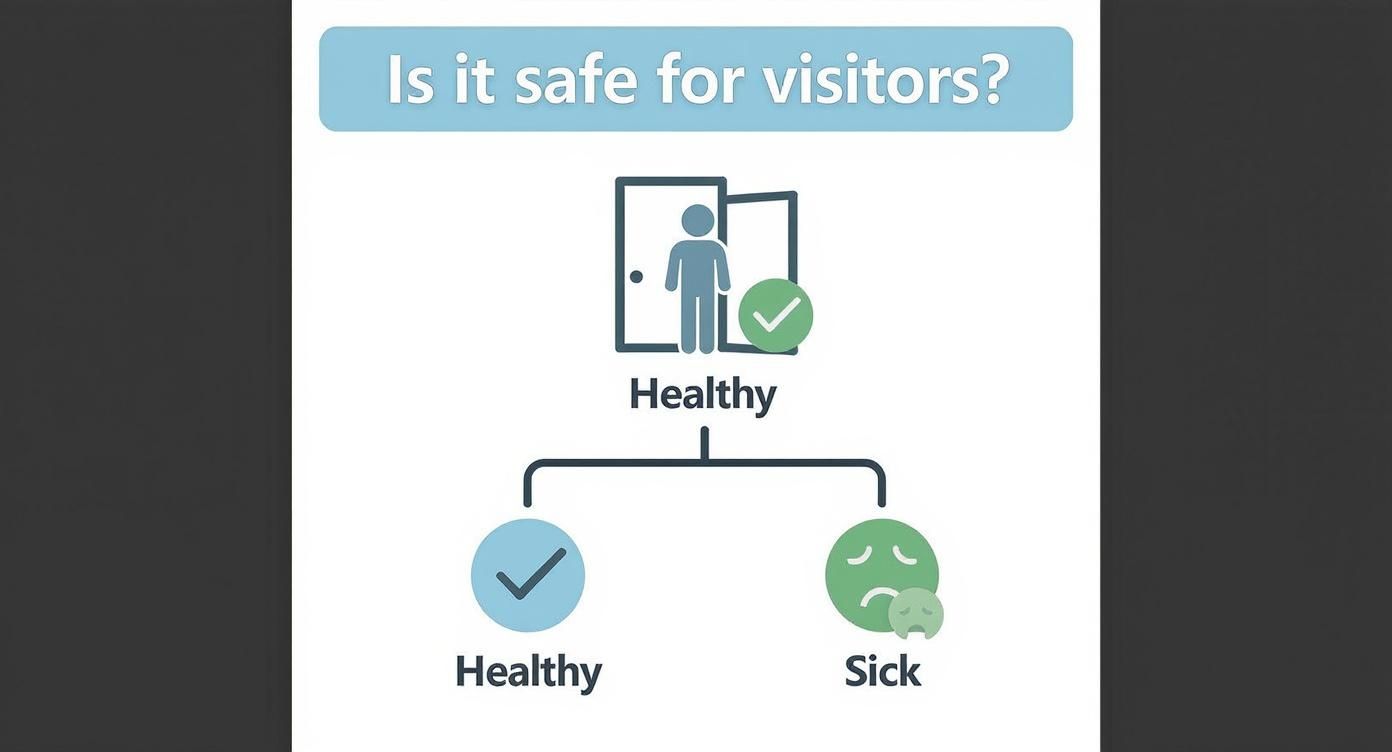
The main takeaway is simple: preventing germs from entering the house is the most effective way to protect a vulnerable loved one.
When to Seek Help
Knowing when to call for help can prevent a minor illness from becoming a major health crisis. These changes are often subtle, which is why understanding the 5 warning signs that elderly parents may need home health care can be helpful.
Here's a quick guide to help you decide on the next steps when you notice concerning symptoms.
Symptom Guide: When to Call for Help
| Symptom Category | Manage at Home (Contact Provider) | Seek Emergency Care Immediately |
|---|---|---|
| Breathing | Mild cough or congestion that isn't worsening rapidly. | Difficulty breathing, shortness of breath, chest pain or pressure. |
| Mental State | Slight lethargy but remains alert and oriented. | Sudden confusion, delirium, extreme drowsiness, or inability to wake up. |
| Fever | Low-grade fever that responds to fever-reducing medication. | High, persistent fever that doesn't improve with medication. |
| Hydration | Reduced appetite but still taking fluids. | Signs of severe dehydration (no urination, dizziness when standing). |
| Chronic Conditions | Minor, manageable flare-up of an existing condition. | Severe worsening of a chronic condition (e.g., uncontrolled blood sugar). |
Always trust your instincts. If something feels seriously wrong, it's better to be safe and seek help right away.
Acting quickly is essential. Early intervention with antiviral medications, prescribed by a doctor, can significantly reduce the severity of the flu and prevent complications like pneumonia, especially in high-risk individuals.
The flu's impact is staggering. According to the CDC, the 2022-2023 season led to an estimated 360,000 flu-related hospitalizations nationally, with adults 65 and older being one of the hardest-hit groups. These numbers underscore why spotting early symptoms is so crucial.
A general understanding of infection indicators can also be helpful. For instance, knowing what causes high white blood cells can offer insight into how the body is fighting an illness. If you notice worrying signs, contact your loved one’s primary care provider immediately.
The Role of Home Health Care During Flu Season

When flu season hits the Central Coast, local providers are often overwhelmed. This can make it tough for families to get the support they need. In these moments, professional home health care becomes an essential lifeline.
For families across Monterey, San Benito, Santa Cruz, and South Santa Clara counties, clinical support at home adds a critical layer of protection. This proactive care is key to managing health and preventing a crisis before it starts.
Proactive Monitoring and Early Intervention
One of the biggest challenges is spotting symptoms before they worsen. The trained eye of a skilled clinician makes all the difference. A Registered Nurse from Central Coast VNA & Hospice can bring that expert monitoring right to your home.
Our team is equipped to deliver safe, compassionate care where patients are most comfortable. VNA clinicians monitor high-risk patients closely, manage symptoms early, and coordinate with physicians to prevent unnecessary ER visits.
Our skilled clinicians can:
- Assess symptoms and immediately report changes to the patient’s physician.
- Administer treatments like IV fluids or prescribed medications at home.
- Educate families on what to look for and how to manage care.
This professional oversight provides priceless peace of mind. To see the full scope of this support, you can learn more about our home health care services.
A Nonprofit Partner Rooted in the Community
For over 74 years, Central Coast VNA & Hospice has been a nonprofit, community-first healthcare provider. Our deep local roots and mission-driven focus mean our priority is always the patient, not profit. That commitment is vital when the local healthcare system is stretched thin.
Our long-standing relationships in Monterey, San Benito, Santa Cruz, and South Santa Clara counties allow for faster response and continuity of services. Our team includes Registered Nurses and therapy services for recovering patients.
As a nonprofit, our goal is to provide high-quality, accessible care. We offer 24/7 on-call support, so families have a direct line to a clinician day or night if a concern arises.
This constant availability is a cornerstone of our care model. It gives families reassurance that they are never alone.
Navigating Respiratory Illness Risk at Home
The overlapping threats of the flu, COVID-19, and RSV create a complicated health puzzle. This risk makes early detection and treatment more crucial than ever. Home health professionals help families navigate these challenges safely.
Antiviral medications work best when started soon after symptoms appear. Our clinical team can help arrange for timely testing and ensure clear communication with doctors so that treatments can begin without delay. As our community faces these threats, the best defense is vaccination, early treatment, and staying informed.
Ultimately, having a dedicated clinical professional provides stability and expert guidance. This support not only leads to better patient outcomes but also empowers families with the confidence to care for their loved ones safely.
Navigating Palliative and Hospice Care Options
When someone is living with a serious illness, the flu can be a serious threat. A respiratory infection can worsen symptoms and lead to stressful hospital stays. For families on the Central Coast, knowing what support is available can make all the difference.
At Central Coast VNA & Hospice, we provide a full spectrum of care designed to offer comfort and dignity at home. Two services that are especially important during flu season are palliative care and hospice care. They each play a unique role in a person’s health journey.
Understanding Palliative Care
Palliative care is specialized medical support focused on providing relief from the symptoms and stress of a serious illness. Its goal is to improve quality of life for both the patient and their family. A common myth is that palliative care is only for the end of life, but this is untrue.
This care can start at any stage of an illness and works alongside curative treatments. For someone with a chronic condition, palliative care during flu season might mean getting help with breathing difficulties at home. It is an extra layer of support that partners with a person’s regular doctors.
The Central Coast VNA & Hospice palliative care team includes expert clinicians who help patients:
- Manage complex symptoms like shortness of breath, fatigue, pain, and anxiety.
- Improve communication between the patient, their family, and their healthcare providers.
- Align treatment choices with the patient’s personal goals.
By focusing on comfort, palliative care can help prevent exhausting trips to the emergency room. You can learn more about palliative care for seniors on the Central Coast and how it supports families.
Compassionate Hospice Care at Home
As an illness progresses, a person's goals might shift toward comfort and peace. This is where hospice care provides a special kind of support. Hospice is a philosophy of care that honors a person’s wish to live their final months with dignity, free from pain, and surrounded by loved ones.
Hospice care is not about giving up. It’s about shifting the focus to ensuring the best possible quality of life for the time that remains.
Central Coast VNA & Hospice provides this compassionate end-of-life care across Monterey, San Benito, Santa Cruz, and South Santa Clara counties. Our dedicated hospice team is made up of Registered Nurses, Hospice Aides, Chaplains, and Medical Social Workers. This team also provides invaluable emotional and practical support for the family.
During flu season, having this expert team on call 24/7 brings profound peace of mind. Families can call their hospice nurse for immediate guidance at home. This allows the focus to remain on comfort and honoring the patient’s wishes with grace.
Your Trusted Health Partner on the Central Coast
This flu season, being prepared is your family's best defense. For vulnerable loved ones at home, proactive planning and quick action are everything. As a nonprofit with over 74 years of service, Central Coast VNA & Hospice is rooted in the well-being of our community.
We help families across Monterey, San Benito, Santa Cruz, and South Santa Clara counties navigate the challenges of fall and winter. We are your partner in creating a continuum of care that ensures your loved one gets the right support at the right time.
Proactive Planning for Peace of Mind
Waiting for a crisis creates stress and rushed decisions. Planning ahead empowers your family to act swiftly if illness strikes.
A good plan includes:
- Knowing who to call for medical advice when symptoms appear.
- Understanding how in-home clinical support can prevent a hospital trip.
- Discussing care preferences with your loved one before an emergency.
Taking these steps creates a clear roadmap. It reduces uncertainty and ensures your loved one’s care aligns with their wishes.
Our mission is to help people stay safe and comfortable at home. We offer expert home health, palliative care, and hospice services to provide the peace of mind your family deserves.
If you have questions about protecting a vulnerable adult this flu season, please get in touch. Contact Central Coast VNA & Hospice today to learn how our expert teams can support your family.
Frequently Asked Questions About Flu Season
1. Who is most at risk for serious flu complications on the Central Coast?
Adults aged 65 and older and individuals with chronic health conditions like COPD, heart disease, or diabetes are at the highest risk. Their immune systems may have a harder time fighting off infections, leading to severe illness, hospitalization, or worse.
2. What are the key differences between palliative care and hospice care?
Palliative care can be provided at any stage of a serious illness and alongside curative treatments to manage symptoms and improve quality of life. Hospice care is for individuals in the final months of life when curative treatment is no longer the focus, emphasizing comfort and dignity at home.
3. What is the first thing I should do if my vulnerable parent shows flu symptoms?
Isolate them from others if possible, ensure they are getting plenty of fluids, and encourage rest. Most importantly, contact their primary care provider immediately, as antiviral medications are most effective when started within the first 48 hours.
4. How does Central Coast VNA & Hospice help prevent hospital visits during flu season?
Our clinical teams provide expert monitoring and symptom management at home. By identifying and addressing potential problems early, our Registered Nurses coordinate with the patient’s physician to adjust care plans, often preventing the need for an emergency room visit. Our 24/7 on-call support means help is always available.
5. What counties does Central Coast VNA & Hospice serve?
As a local, nonprofit organization with over 74 years of service, we are proud to provide compassionate home health, palliative, and hospice care to families throughout Monterey County, San Benito County, Santa Cruz County, and South Santa Clara County.
If your family needs guidance on how to manage chronic illness or protect a vulnerable loved one this season, VNA is here. Learn more about our home health and hospice services and find the peace of mind your family deserves.

Is Hospice Only for Terminal Patients? A Clear Guide
When people ask if hospice is only for the last few days of life, the answer is no. This is a common misunderstanding about this special type of care.
Hospice care is designed to improve the quality of life for someone with a life-limiting illness. This means a doctor believes they have six months or less to live if the illness follows its usual course.
Reframing the Purpose of Hospice Care

Many people think starting hospice means giving up. The truth is very different.
Choosing hospice is about shifting the goal from curing an illness to managing symptoms. It helps patients focus on comfort, dignity, and their final wishes. It is about making the most of the time that is left.
For over 74 years, Central Coast VNA & Hospice has provided this kind of care. We are a nonprofit serving families in Monterey County and nearby areas. We have learned that patients get more benefit from hospice when they start sooner.
The Goal of Hospice Is Quality of Life
Hospice care is not about dying. It is about living as well as possible for as long as possible. We offer a team of experts to help with more than just physical pain.
The main goals of hospice include:
- Managing Pain and Symptoms: Our team provides expert medical care. We help relieve pain, breathing problems, and other symptoms of a serious illness.
- Providing Emotional and Spiritual Support: We have chaplains and social workers on our team. They help patients and families work through difficult emotions and find peace.
- Supporting the Family: A serious illness affects everyone. Hospice gives education, resources, and breaks to loved ones who are providing care.
Hospice care changes what hope looks like. Instead of hoping for a cure, families can hope for peaceful days, meaningful talks, and comfort at home.
This approach makes sure a person’s final months are lived with dignity. It lets them make choices about their care and focus on what matters to them.
To learn more about this philosophy, you can find detailed information about what hospice care is and how we support patients and families on the Central Coast.
Understanding Hospice Eligibility and When to Consider It
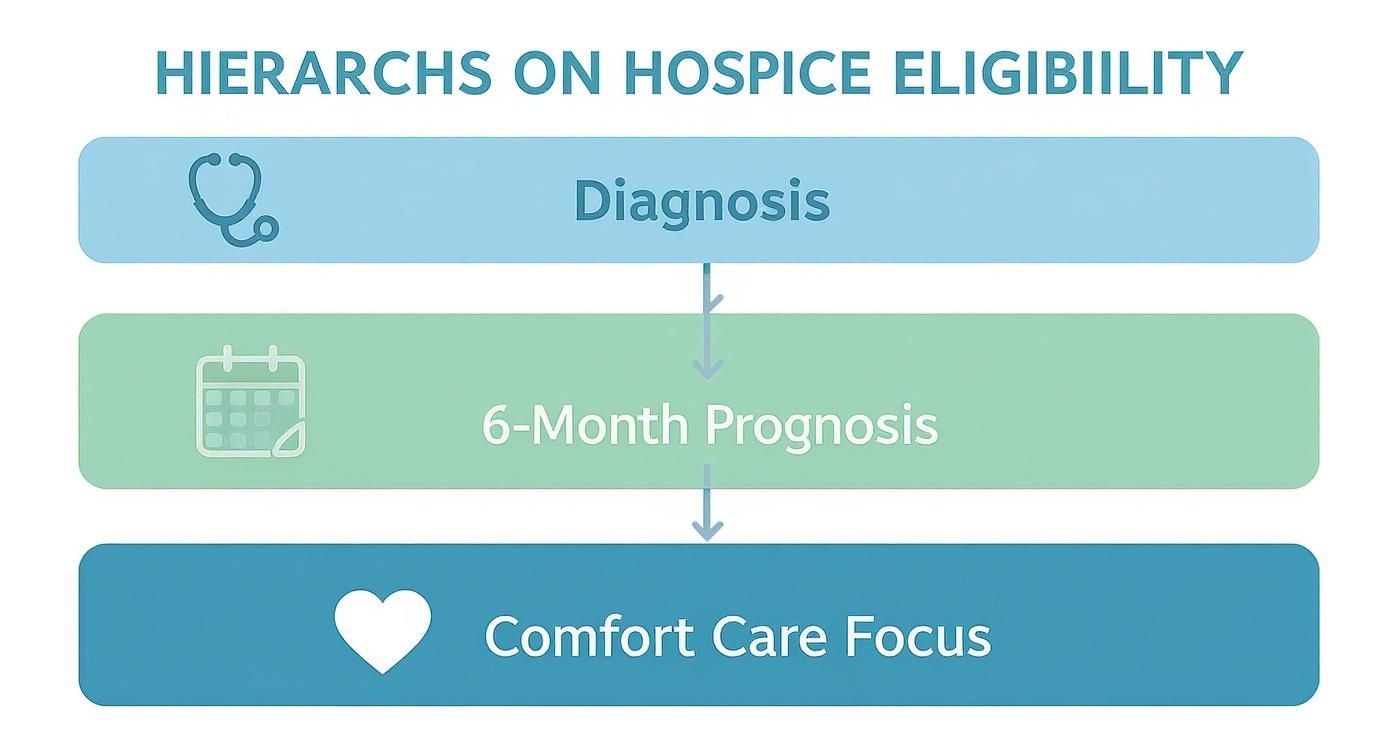
Knowing when to think about hospice can feel confusing. The main rule, especially for Medicare, is that a doctor expects the patient to live for six months or less. This is if the illness runs its natural course.
This six-month timeline is not a strict deadline. Many people receive hospice care for longer than six months. A doctor just needs to confirm they still meet the requirements. The focus moves from cure to comfort.
Gentle Signs It May Be Time to Talk
The choice to talk about hospice is very personal. It is often a series of small changes, not one big event.
If you are in Monterey County or nearby, it may be time for a gentle conversation if you see these signs:
- Frequent Hospital Stays: Are visits to the ER or hospital happening more often?
- Noticeable Decline: Is your loved one weaker, losing weight, or too tired for simple daily tasks?
- Worse Symptoms: Is pain or shortness of breath getting harder to manage?
- Trouble with Daily Activities: Do they need more help with bathing, dressing, or eating?
This is also a good time to review advance care plans. Resources like understanding Do Not Resuscitate (DNR) orders can help make sure everyone agrees on what to do.
Navigating the Six-Month Guideline
In the U.S., a doctor must certify that a patient is eligible for the Medicare Hospice Benefit. This can mean that patients with serious illnesses that are not yet terminal may not qualify. This is where palliative care can help.
Many hospice agencies, including Central Coast VNA & Hospice, offer palliative care. This service supports patients who need help with symptoms but do not meet the strict hospice rules yet.
Exploring hospice means choosing to put comfort and quality of life first. It ensures a loved one’s final months are lived with dignity and peace.
Starting these talks early, before a crisis, gives your family time to make careful choices. For a closer look at the rules, see our guide on hospice eligibility requirements. Our team is here to give you kind answers and support.
Hospice Care Versus Palliative Care

It is common to confuse hospice and palliative care. They are related, but they are not the same. Understanding the difference helps you choose the right support.
Simply put, all hospice care is palliative, but not all palliative care is hospice. Palliative care is a broad approach focused on relief from the symptoms and stress of a serious illness. It can start on the day of diagnosis and happen alongside treatments meant to cure.
Defining the Primary Focus of Care
The main difference is the goal of care. Palliative care aims to improve your quality of life while you are still getting treatment for an illness. It helps manage symptoms like pain and anxiety.
Hospice care begins when the focus moves from curing the illness to maximizing comfort. It is for someone with a life-limiting illness and a life expectancy of six months or less. The goal is to help them live their final months with dignity and peace. Knowing whether Medicare pays for palliative care can also help families decide.
Here is a simple chart to compare them:
Comparing Palliative Care and Hospice Care
| Feature | Palliative Care | Hospice Care |
|---|---|---|
| When It Starts | At any stage of a serious illness, often at diagnosis. | Typically when life expectancy is 6 months or less. |
| Treatment Goal | To relieve symptoms and stress while pursuing curative treatment. | To provide comfort and quality of life when curative treatment is stopped. |
| Location of Care | Can be provided in a hospital, outpatient clinic, or at home. | Primarily provided wherever the patient calls home. |
| Curative Treatments | Can be received at the same time as treatments like chemo or radiation. | Curative treatments are no longer the focus of the care plan. |
This table shows that palliative care can be given with cure-focused treatments. Hospice is for when comfort becomes the main goal.
The Continuum of Care on the Central Coast
Here at Central Coast VNA & Hospice, we offer a complete Continuum of Care in Monterey County. This means we guide patients from one level of support to the next. Families do not have the stress of changing agencies as needs change.
For example, a patient might start with our home health nursing after a hospital stay. If their illness gets worse, they could move to our palliative care program for more symptom management. When the time is right, they can transition to our hospice program, often with the same nurses they already know.
This connected approach ensures patients receive consistent, compassionate care. It is part of our nonprofit mission to support our community.
Understanding the benefits of each service is important. We explain more in our article about hospice vs. palliative care.
What Services Hospice Actually Provides
Many families wonder what hospice support looks like from day to day. It is much more than just a nurse visiting. It is a complete support system for both the patient and their loved ones.
This care happens wherever a person calls home. This could be a private house, an assisted living community, or a nursing facility.
At the center of this support is a dedicated team. These professionals work together to create a plan that honors the patient's wishes. This brings a sense of calm and control back to the family.
Your Dedicated Care Team
As a nonprofit serving the Central Coast for over 74 years, our focus is on patient care, not profits. Our team is built to provide layers of support.
The main members of every hospice team include:
- Registered Nurse (RN): The RN leads the medical care, focusing on pain and symptom control. They visit regularly, monitor the patient, and teach the family how to help.
- Hospice Aide: A Hospice Aide helps with personal care like bathing and dressing. This support can be a huge relief for family members.
- Medical Social Worker: This person offers emotional support and helps with practical challenges. They connect families to community resources and help with advance care planning.
- Chaplain: The Chaplain provides spiritual support that respects all beliefs. They listen, offer comfort, and help patients and families find peace.
This team approach ensures that all needs are met. It is a circle of support that provides comfort when it is needed most.
A Plan Centered on Comfort and Dignity
Together, this team does much more than medical check-ups. They manage symptoms like pain and shortness of breath to keep the patient comfortable.
The team also provides emotional and spiritual guidance. They offer respite for family members, giving them a needed break.
This complete system is the foundation of the hospice care options we offer. We serve families across Monterey, San Benito, Santa Cruz, and South Santa Clara counties.
Debunking Common Fears About Hospice

Fear and wrong information can keep families from exploring hospice. This is unfortunate because hospice can bring great comfort and support. Most of these fears are based on myths that are not true.
Let's clear up what hospice really is. This will help you make confident decisions for your family.
One of the biggest fears is that choosing hospice means "giving up hope." Hope does not go away—it just changes. Instead of hoping for a cure, families hope for comfort, peace, and meaningful time together.
This shift helps everyone focus on quality of life at home. For over 74 years, our team at Central Coast VNA & Hospice has seen this positive change in thousands of families. We serve communities across the Central Coast of California, including Monterey and San Benito Counties.
Hospice Is a Service, Not a Place
Another common myth is that hospice is a building you move into. This is not true.
Hospice is a service delivered by a team that comes to you. They provide care wherever you call home, whether it's a house, assisted living, or a nursing facility. The goal is to provide expert support in a familiar place.
Hospice is not just for the last few days of life. Many patients receive services for months. This gives them time to build trusting relationships with their care team.
Enrolling in hospice earlier gives patients more time to benefit from symptom management and emotional support. This leads to a higher quality of life.
The Benefit of Early Enrollment
Waiting until the last days of life to start hospice is a common regret we hear. When you wait, you miss out on the full benefits of this support.
According to the National Hospice and Palliative Care Organization (NHPCO), about 1.72 million Medicare beneficiaries received hospice care in 2020 (NHPCO, 2022). Many still enroll very late, missing months of comfort and guidance. You can discover more insights about these hospice trends to learn why early talks are so important.
When you face these fears with facts, hospice becomes a team of allies for the journey. To learn more, you can separate fact from fiction in our detailed guide. Our nonprofit mission is to provide this care to everyone in our community who needs it.
Taking the Next Step with Central Coast VNA & Hospice
Learning about your options is the first step toward peace of mind. Hospice is not about giving up. It is a choice to focus on comfort, dignity, and making the most of every day.
For families in Monterey County, San Benito County, Santa Cruz County, and South Santa Clara County, the next step is a simple talk. We encourage you to talk with your loved ones and your doctor about your wishes. When everyone is on the same page, the choices made will reflect what truly matters.
How to Get More Information
You do not have to figure this out alone. You can contact Central Coast VNA & Hospice for a no-obligation consultation. The best time to get information is before a crisis.
Our compassionate, local team has been part of this community for over 74 years. We are here to provide clear, honest answers for your journey.
Taking time to understand your options now helps you make thoughtful decisions. It honors your values and brings comfort to your family.
As a nonprofit, our mission is to ensure every family has the support they need. Contact us today to start the conversation. You deserve this support.
Frequently Asked Questions About Hospice
What if a patient on hospice gets better?
A person can leave hospice care at any time if their health improves or they want to try curative treatments again. If their health declines later, they can re-enroll in hospice. This flexibility ensures the care plan always meets the patient’s needs.
Do we have to give up our own doctor?
No. Your family doctor can remain an important part of the care team. The hospice team works closely with your physician to coordinate care, ensuring a smooth and collaborative process. Central Coast VNA & Hospice values the relationship you have with your trusted doctor.
Is hospice care expensive?
Hospice is covered by Medicare Part A, Medi-Cal, and most private insurance plans. This benefit typically covers the hospice team, medications related to the terminal illness, and medical equipment. As a nonprofit, CCVNA is committed to providing care to all eligible individuals, regardless of their ability to pay.
Where is hospice care provided?
Hospice care is provided wherever the patient calls home. This could be a private residence, an assisted living facility, or a nursing home. The goal is to bring comfort, support, and expert care directly to the patient in a familiar environment.
When is the right time to learn about hospice?
It is never too early to gather information. Many families say they wish they had called sooner. Learning about your options now, before a crisis, allows you to make calm, informed decisions that align with your family’s wishes.
At Central Coast VNA & Hospice, our mission is to provide comfort, dignity, and expert care. If you have more questions or just want to talk through your family's situation, please contact us today. We're here for a compassionate, no-obligation conversation whenever you're ready.

Not Just for End-of-Life: What Palliative Care Really Means for Families Today
Let's clear up the biggest myth right away: palliative care is not the same as end-of-life care. It's an extra layer of support that works with your family’s current medical treatments to improve quality of life. The main goal is to bring relief from the symptoms, pain, and stress of a serious illness for both the patient and the family.
Rethinking Palliative Care Beyond Misconceptions
When families in Monterey County or Santa Cruz County hear "palliative care," they often think it means giving up hope. This is a common misunderstanding that prevents many people from getting the support they need.
The truth is that palliative care is about adding more help, not taking anything away. It can begin on the very day a serious illness is diagnosed.
Imagine your loved one is getting treatment for a condition like heart failure, cancer, or COPD. Their doctors focus on treating the disease itself. But who is helping manage the exhausting side effects, the emotional toll, and the tough decisions along the way?
That’s where palliative care steps in to provide an extra layer of support.
A Partnership for Better Living
Think of palliative care as a specialized team that joins your existing medical team. It does not replace your primary doctor or specialists. Instead, our team of Nurse Practitioners and Medical Social Workers works alongside them to manage symptoms and improve daily life.
This added support can help with:
- Pain, nausea, or shortness of breath
- Anxiety, depression, and emotional strain
- Understanding complex treatment choices
- Planning for the future with confidence (Advance Care Planning)
This diagram shows how palliative care works hand-in-hand with curative treatment to support a better quality of life.
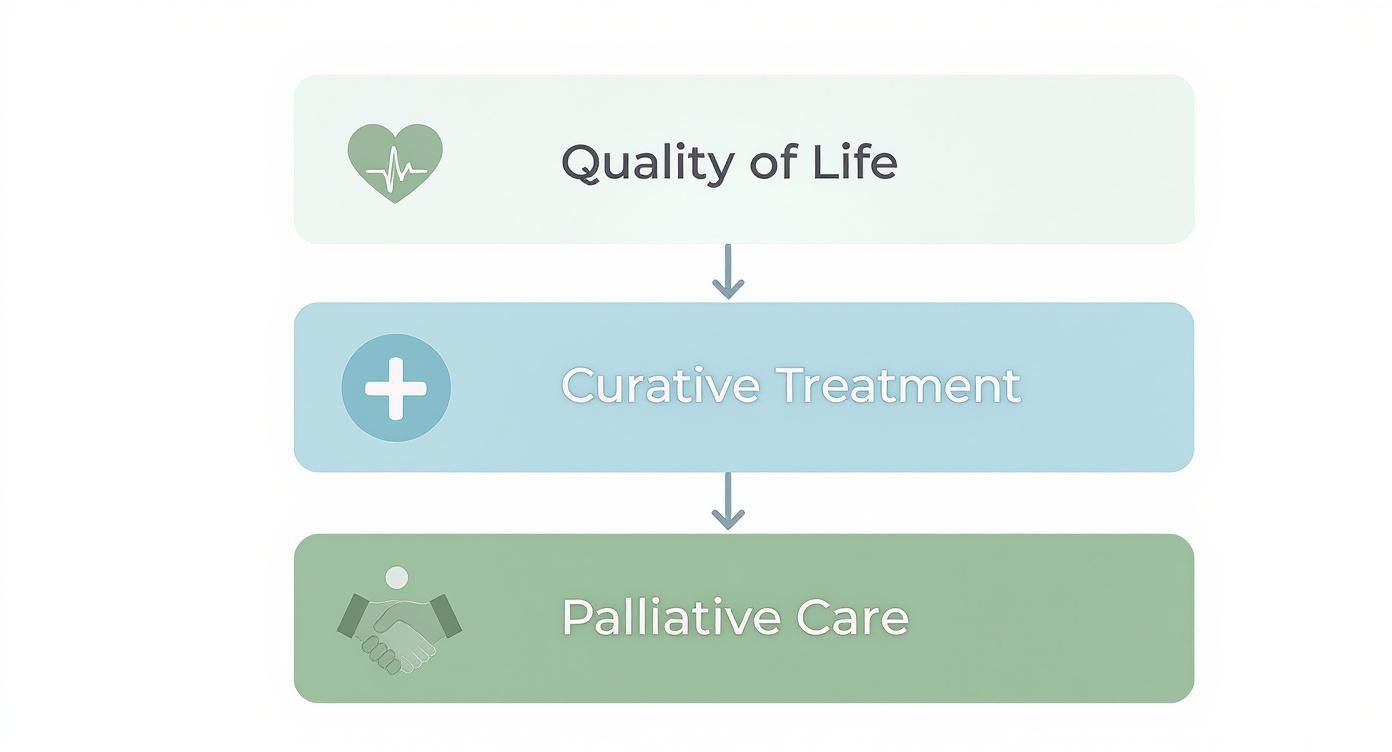
As you can see, palliative care enhances the ongoing medical plan instead of replacing it.
Palliative Care vs. Hospice Care at a Glance
It helps to see how palliative care and hospice care are different. While both focus on comfort, their timing and goals are not the same. This table breaks it down clearly.
| Feature | Palliative Care | Hospice Care |
|---|---|---|
| When It Begins | At any stage of a serious illness, often at diagnosis. | Typically when life expectancy is 6 months or less. |
| Treatment Goal | Can be received alongside curative treatments. | Focuses on comfort care when curative treatment ends. |
| Who It's For | Patients of any age with a serious illness. | Patients with a terminal diagnosis. |
| Duration | Can be provided for years, based on need. | Provided as long as the patient meets criteria. |
Understanding this difference helps families choose the care that best fits their loved one's needs and goals.
Support for the Whole Family
A serious illness affects everyone in the family. At Central Coast VNA & Hospice, we know that family members are the main support system, and they need help too. Our palliative teams, serving communities from San Benito County to South Santa Clara County, offer guidance for the entire family.
You can learn more by debunking the 9 biggest myths about palliative care in our detailed guide. Palliative care helps reduce stressful hospitalizations and ER visits by focusing on the whole person, not just the illness. For over 74 years, our nonprofit mission has been to provide this compassionate care right where it is needed most: at home.
Who Benefits From an Extra Layer of Support
How do you know if palliative care is the right choice for your family? This question comes up when a loved one is living with a serious, long-term illness. The answer often comes from looking at the daily challenges your family faces.
If your loved one is dealing with cancer, heart failure, COPD, or advanced kidney disease, their medical team is focused on treating the illness. But what about the symptoms and the emotional weight of it all? This is where palliative care at home offers crucial support.

This support is not a sign of giving up. It is a proactive step toward gaining comfort and control, and it works with your loved one’s ongoing medical treatments.
Recognizing the Need for More Help
Palliative care is most helpful when an illness creates ongoing challenges that affect quality of life. See if any of these situations sound familiar:
- Uncontrolled Symptoms: This could be persistent pain, shortness of breath, fatigue, or nausea that makes it hard to get through the day.
- Frequent Hospital Visits: Is your family stuck in a cycle of emergency room visits or hospital readmissions? That is a clear sign more support is needed at home.
- Emotional and Spiritual Distress: A serious illness often brings anxiety, depression, or uncertainty. A palliative team provides emotional and spiritual support for both the patient and the family.
If you agree with any of these points, your family is a great candidate for palliative care. Seeking this support means you are choosing to care for the whole person, not just their disease.
Bringing Expert Care to Your Home
For families across Monterey, San Benito, Santa Cruz, and South Santa Clara Counties, Central Coast VNA & Hospice brings this specialized care to your home. Our teams of Registered Nurses, Nurse Practitioners, and Medical Social Workers visit patients wherever they live. This could be a private residence or an assisted living facility.
Our in-home approach makes life easier for everyone. It reduces the strain of travel to appointments and provides expert clinical oversight in a familiar environment. To learn more, explore Central Coast VNA & Hospice's palliative care services and see how we tailor our support to each family's needs.
What Your In-Home Palliative Care Team Provides
When you choose in-home palliative care, you get a dedicated, compassionate team of experts. At Central Coast VNA & Hospice, this team is built to provide complete support for your entire family. We address physical symptoms as well as emotional and spiritual needs.
This is what modern palliative care really means: a team of professionals focused on improving quality of life, right where your loved one feels most comfortable.

This team acts as an extra layer of expert oversight. They work with your loved one’s primary doctor and other specialists to coordinate care and ensure everyone is working toward your family's goals.
Who Is on Your Team
Each member of your palliative care team brings a vital skill to create a support system for the whole person. While the team is shaped by your family's needs, it often includes professionals like these:
- Nurse Practitioners: These clinicians are experts in managing pain and other difficult symptoms. They assess your loved one’s condition, adjust medications with their doctor, and provide clear education to help your family feel more in control.
- Medical Social Workers: A serious illness affects more than just physical health. Our Medical Social Workers provide emotional support, connect you with community resources, and help you navigate the healthcare system.
- Chaplains: For families who desire it, our Chaplains offer non-denominational spiritual support. They provide a comforting presence and can help explore questions of meaning and hope.
How They Support Your Family
The support from your team makes a real difference every day. Beyond managing pain, they help with practical and emotional challenges.
To better understand a patient's abilities, a palliative care team may use various forms of physical performance testing. This helps create a smart plan to keep your loved one as active and independent as possible.
Your team also provides guidance with advance care planning. This is the process of clarifying your loved one's wishes for future medical care. Having these conversations with an expert guide ensures their values are respected and can relieve a significant emotional burden.
This complete approach is designed to reduce stress and prevent unnecessary hospital visits. To see how we support families across the Central Coast, explore our palliative home care services to learn more.
The Real-World Impact on Families
A serious illness sends ripples through the entire family. Managing symptoms, appointments, and an uncertain future is exhausting. Palliative care steps in to lift that burden, improving the quality of life for everyone involved.
There is a deep sense of relief when a loved one’s symptoms are finally under control. It means fewer trips to the emergency room and less anxiety. This is what palliative care really means for families today: it brings back a sense of calm and stability.

This support is not just about physical comfort. It’s about giving families the professional guidance they need to feel confident and in control again.
Reducing Stress and Preventing Crisis
One of the biggest benefits is having an expert clinical team just a phone call away. You are no longer navigating every challenge alone. This professional oversight is key to preventing small issues from becoming major crises.
Proactive symptom management helps families break free from the cycle of hospital readmissions. This reduces stress and allows your loved one to stay at home, surrounded by the people they love. It is all about creating more good days.
This team approach means that tough medical decisions are shared. Having an expert explain complex medical options provides immense emotional relief. For many families, this support is a true lifeline.
Empowering Families to Live More Fully
It’s no surprise that the global market for palliative care is growing. The benefits are clear and profound. You can learn more about the growth and impact of palliative care and its positive outcomes.
This is the heart of our nonprofit mission at Central Coast VNA & Hospice. For over 74 years, we have served families across Monterey, San Benito, Santa Cruz, and South Santa Clara Counties. We believe palliative care helps families live more fully, even when facing a serious illness.
The demands on family members can be intense, which is why understanding options like respite care for family caregivers is so important. By supporting the whole family, we help you focus on what truly matters: making the most of your time together.
How to Start the Conversation and Access Care
Taking the first step to get more support can feel difficult. But it doesn't have to be.
Talking about palliative care is not about giving up. It's about adding a layer of comfort and strength to your loved one's current medical plan. Frame it as a positive choice for a better quality of life.
When you talk with your loved one, focus on the benefits. Explain that it's a way to bring in experts who can help manage tough symptoms like pain or fatigue. This support can make it easier to continue with their treatments and live more fully.
Talking to the Doctor
Bringing up palliative care with a physician is the next key step. While doctors focus on treating the illness, they are also committed to their patient's well-being. A simple question is often all it takes to open the door.
Here are a few conversation starters you can use:
- "We’ve been struggling with [symptom, e.g., pain, nausea]. Could a palliative care team help us manage this better at home?"
- "I've read that palliative care can provide extra support. Could you give us a referral to explore this?"
- "We want to focus on improving quality of life right now. Is palliative care an option for us?"
These questions position palliative care as a collaborative tool.
How to Access Care with CCVNA
Getting started with Central Coast VNA & Hospice is simple. The process begins with a referral from your loved one's physician. From there, our team handles the rest, coordinating with their doctor to ensure a smooth transition.
Palliative care is a medical specialty covered by Medicare Part B, Medi-Cal, and most private insurance plans. It is billed like seeing any other specialist. Our team can help you navigate your specific coverage and answer financial questions.
This removes a huge barrier for many families and makes expert care more accessible. We are here to empower you to advocate for the comfort and support your loved one deserves.
If your loved one is living with a serious illness and you're not sure what support is available, call Central Coast VNA & Hospice at 831‑372‑6668. Our team can help you understand if palliative care is right for your situation.
Your Trusted Local Partner in Compassionate Care
For over 74 years, Central Coast VNA & Hospice has been a trusted nonprofit partner for families. Our mission has always been guided by a simple idea: palliative care is about adding support, not giving up hope.
We are proud to share this message with every family we serve across Monterey, San Benito, Santa Cruz, and South Santa Clara Counties. Our local roots and mission-driven approach are why we are the leading choice for palliative care on the Central Coast.
Getting the Support You Deserve
Globally, the need for this kind of care is huge. A 2024 report highlights a major gap in access, leaving millions without the help they need. These findings on palliative care needs worldwide show how big the global challenge is.
Additionally, some data suggests that 60% of eligible patients never access palliative or hospice care, often due to a lack of understanding.
Palliative care is not about giving up—it’s about getting more support, sooner. This blog helps families understand that serious illness doesn’t have to mean silent suffering or constant crisis.
If your loved one is living with a serious illness and you're not sure what support is available, call Central Coast VNA & Hospice at 831‑372‑6668. Our team can help you understand if palliative care is right for your situation.
Palliative Care: Your Questions Answered
Navigating a serious illness can be overwhelming. To help, we've answered the most common questions our families ask about palliative care. Our goal is to give you clear information so you can feel confident in your choices.
Can my loved one still see their regular doctors?
Yes, absolutely. Palliative care is designed to work with your loved one’s current medical team, not replace it. Our Central Coast VNA & Hospice team acts as an extra layer of support, collaborating with physicians and specialists to manage symptoms and improve comfort at home.
Does choosing palliative care mean we are giving up?
Not at all. This is one of the biggest myths. Palliative care can happen at the same time as curative treatments like chemotherapy or radiation. The goal is to help your loved one feel strong enough to continue with their treatments by managing difficult side effects.
Who pays for palliative care?
Palliative care is a medical specialty covered by Medicare Part B, Medi-Cal, and most private insurance plans. It is billed just like a visit to a specialist, such as a cardiologist. Our team at Central Coast VNA & Hospice can help you understand your specific coverage.
When is the right time to ask for palliative care?
The best time to start is as soon as a serious illness causes persistent symptoms, stress, or frequent hospital visits. You do not have to wait for a crisis to get help. In fact, getting support sooner can improve your family's quality of life and help prevent future emergencies.
How does palliative care reduce hospital visits?
Palliative care is especially beneficial for homebound patients with frequent ER visits or hospitalizations. Our in-home teams manage symptoms proactively, preventing them from becoming crises that require a hospital trip. This expert oversight at home provides stability and peace of mind.
Where does CCVNA provide palliative care?
Our teams bring palliative care to wherever a patient calls home on the Central Coast. This can be a private residence, a board and care home, or an assisted living facility. We proudly serve families throughout Monterey County, San Benito County, Santa Cruz County, and South Santa Clara County.
If your loved one is living with a serious illness and you're not sure what support is available, call Central Coast VNA & Hospice at 831‑372‑6668. Our team can help you understand if palliative care is right for your situation. You can also learn more at our website, https://ccvna.com.
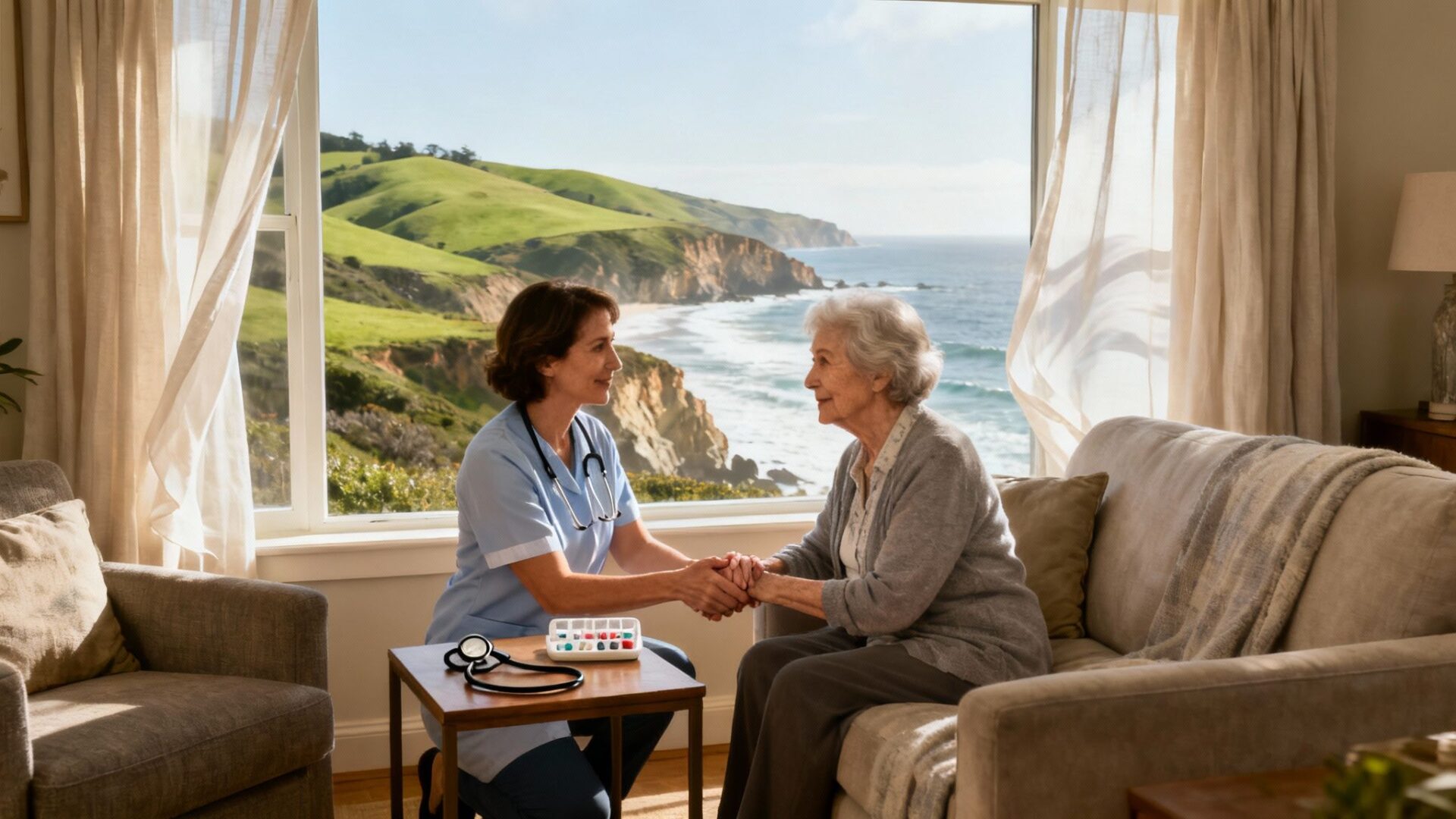
You’re Not Alone: How to Get Real Support as a Family Caregiver on the Central Coast
For family caregivers on the Central Coast, vague advice like "take breaks" can feel hollow. You need to know where to turn for help. Getting real, practical support means connecting with local services in Monterey, San Benito, Santa Cruz, and South Santa Clara counties.
This guide is your roadmap to finding that help. It moves beyond generic tips to offer real solutions for caregivers in our community.
The Unseen Challenges of Caregiving on the Central Coast
Stepping into a caregiving role is an act of love. But it often comes with an enormous physical, emotional, and financial weight. Most people are thrown into this role with no training, leading to stress that affects the entire family.
General advice from national websites often misses the mark. It doesn't understand the unique challenges of our local community. You need more than just encouragement; you need coordinated, compassionate support right here at home.
A trusted local partner can change everything. For over 74 years, Central Coast VNA & Hospice has served this community. We understand the specific challenges family caregivers face in our region.
The Growing Reality for Families
If you feel like the demands of caregiving are growing, you are not alone. It is a national trend that impacts families everywhere. According to AARP, the number of family caregivers providing complex or intense care grew from 2015 to 2020 (AARP, 2020).
This surge means more people like you are juggling difficult medical tasks. You are also managing finances and providing emotional support. This often comes at the expense of your own well-being.
It is important to recognise the signs of emotional burnout. Burnout is a serious and common consequence of this demanding role. Recognizing when you need help is the first step toward getting relief.
Taking care of yourself is not selfish. It is an essential part of providing sustainable, loving care for someone else.
Many caregivers in Salinas, Hollister, and across the Central Coast do not realize they qualify for help. They often think services like hospice are only for the patient. The truth is, these programs are designed to support the entire family by offering a lifeline when you feel most isolated.
For immediate ideas, our team has put together some practical tips for family caregivers that can help on this journey.
Signs You Need More Support
This table helps you identify signs of burnout. It connects them to specific, actionable solutions. Recognizing your needs is the first step.
| Common Feeling or Challenge | What It Could Mean | Where to Find Help |
|---|---|---|
| Constant exhaustion, poor sleep | Physical Burnout | Respite Care, Hospice Aides |
| Feeling isolated, irritable, or hopeless | Emotional Strain | Caregiver Support Groups, Social Workers |
| Overwhelmed by medical tasks | Lack of Training | Home Health Nursing, Palliative Care Team |
| Worried about finances or insurance | Financial Stress | Financial Assistance Programs, Social Workers |
| No time for yourself or other family | Need for a Break | Respite Care, Volunteer Visits |
If any of these challenges feel familiar, it is a clear signal to reach out. You do not have to carry this weight alone.
Pinpointing the Exact Support You Need
Saying "I need a break" is a huge first step. But to get help that truly helps, it is useful to get more specific. Taking a personal inventory of your caregiving role can clarify what is most draining.
You can break down your support needs into three main areas. These are physical, emotional, and logistical. Once you know which one causes the most strain, you can find solutions that lighten your load.
Understanding Your Unique Needs
Every caregiving situation is different. Are you physically tired from helping a loved one with daily tasks? Or is the emotional weight and constant worry the biggest challenge?
Perhaps the biggest stressor is logistical. This can include juggling prescriptions, appointments, and insurance paperwork. Answering these questions honestly helps you create a clear, actionable plan.
- Physical Support: This is the hands-on help. A professional can assist with medications, wound care, or personal hygiene.
- Emotional Support: This tends to the mental toll of caregiving. It might mean finding a local support group or talking with a social worker or chaplain.
- Logistical Support: This covers administrative tasks. It involves getting help with insurance, scheduling, or important legal documents.
This decision tree infographic can help you visualize that first step. It shows how to recognize when you are overwhelmed and need to reach out.
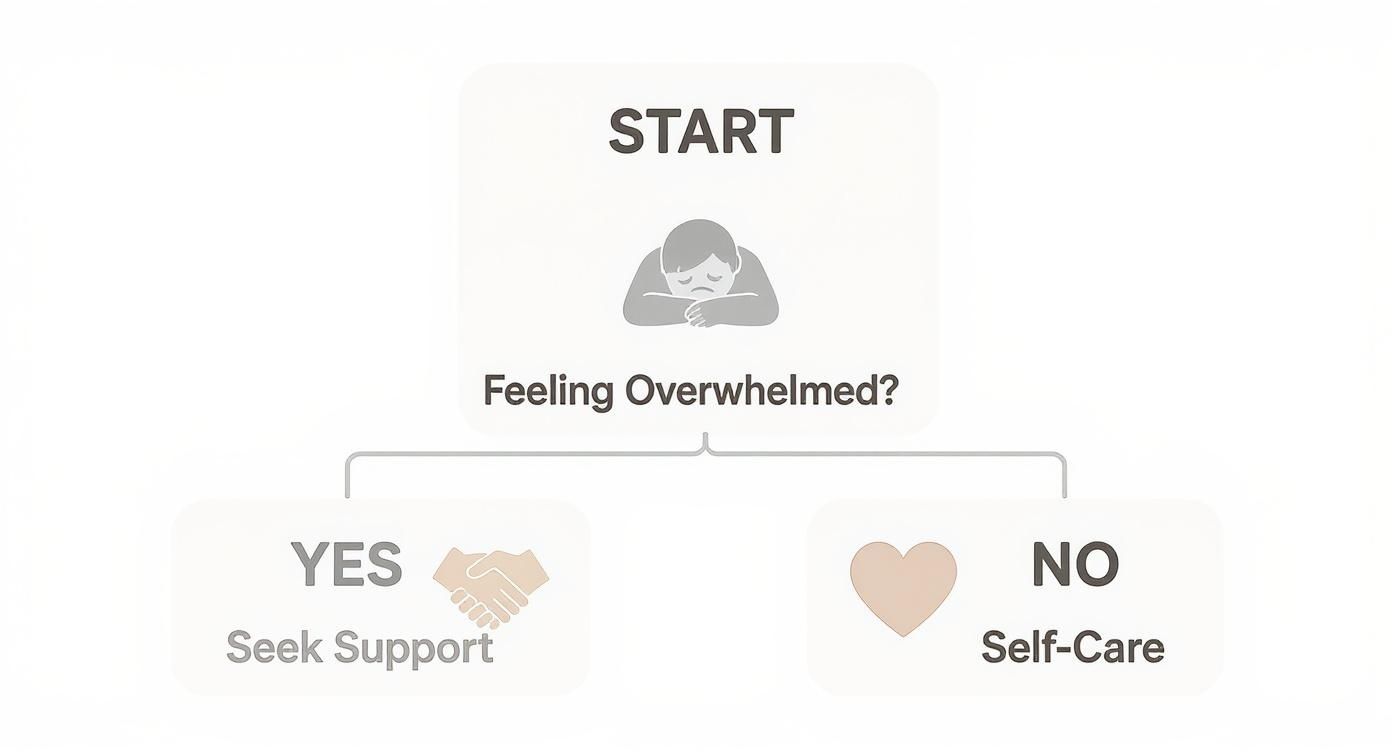
Acknowledging you are burning out is the critical trigger. It is the moment you decide to seek real, structured support.
From Identification to Action
Once you name your biggest challenges, you can connect them to specific services. If medical tasks cause anxiety, you may benefit from training from a Registered Nurse. This is available through our home health care services.
If you feel overwhelmed by paperwork, a Medical Social Worker can help. They are experts at connecting families with local resources.
Pinpointing your needs transforms a cry for help into a targeted request. It’s the difference between saying "I'm drowning" and "I need a life raft."
Caregivers often manage finances and legal matters. For instance, understanding the critical importance of Power of Attorney is essential for managing a loved one's affairs. Breaking down your challenges helps you find the right professionals for each one.
Finding Actionable Local Resources
Knowing you need help is one thing. Finding it is something else. For families on the Central Coast, national advice does not always apply. You need local solutions from a team that knows our community.
Central Coast VNA & Hospice builds caregiver support into everything we do. Our continuum of care—from home health to palliative and hospice—is designed with you in mind. We provide different layers of assistance to relieve your burden at the right time.

How Our Continuum of Care Supports You
Imagine having a team of experts in your corner. That is what our services feel like. Each one is tailored not just to help your loved one, but to make your life more manageable.
For example, after a hospital stay, you may face complex medical tasks. A Home Health Registered Nurse can provide hands-on training for medication management or wound care. This expert guidance turns overwhelming duties into manageable routines.
If a serious illness is the focus of every day, our Palliative Care team can help. Their expertise in symptom management directly eases your load. When your loved one is more comfortable, you can focus on being a family member again.
The goal is not to replace you, but to empower you. Our professionals work alongside you, providing specialized skills to ensure the best care while you get relief.
The Comprehensive Support of Hospice
When an illness is terminal, our hospice program provides complete support for the entire family. Many caregivers in Monterey, Salinas, Hollister, and Santa Cruz do not realize hospice is for them, too. It is not about giving up; it is about gaining a full support system.
Here is what that support looks like:
- 24/7 Access to Nurses: You can call a Registered Nurse anytime for guidance. This on-call support prevents late-night panic.
- Trained Volunteers: Our compassionate volunteers can visit, offering companionship. This gives you a chance to run errands or take a quiet break.
- Respite Care: This is a vital tool for preventing burnout. It provides a short-term break while your loved one receives professional care.
- Social Work and Spiritual Support: Our Medical Social Workers and Chaplains help your family navigate complex emotions and end-of-life planning.
Figuring all this out can feel overwhelming. We have a list of local health care resources for seriously ill family members on the Central Coast to help you start. Our team is always here to talk through your family’s situation.
How Palliative and Hospice Care Support You
Many families misunderstand palliative and hospice care. There's a common fear that choosing them means giving up. However, it is the opposite—it is about gaining an incredible support system for the entire family.
Palliative care can start at diagnosis of a serious illness. It works alongside curative treatments to improve quality of life. For a caregiver, this means a team helps manage symptoms, freeing you up to focus on quality time.
Hospice Support Is Family Support
It is important to reframe how we think about hospice. When an illness can no longer be cured, hospice provides comfort and dignity. It offers a dedicated team for both the patient and their family.
This support is becoming more critical every day. According to AARP, over 40% of caregivers handle complex medical tasks. However, only 22% report receiving any training for it (AARP, 2020). You can discover more insights about the state of caregiving from AARP.
Hospice services directly address these pressures. Here’s what that support looks like:
- Professional Respite Care: This gives you a planned break to prevent burnout. Your loved one receives expert care, so you can rest.
- 24/7 Nurse Access: Calling a Registered Nurse anytime reduces anxiety. It helps you manage unexpected symptoms at home.
- Grief and Bereavement Counseling: Support from Chaplains and counselors begins before a loss. It helps you navigate anticipatory grief.
- Guidance from Social Workers: Our Medical Social Workers help with family dynamics, planning, and connecting you to other local resources.
A Team That Wraps Around Your Entire Family
At Central Coast VNA & Hospice, we build this support into everything we do. We know a serious illness impacts the entire family. Our team of Registered Nurses, Hospice Aides, Medical Social Workers, and Chaplains works together to lift your burden.
You do not have to be a medical expert, a counselor, and a full-time aide. Our team is here to fill those roles, allowing you to be a family member again.
This approach recognizes that you are on this journey together. You can learn more about the specifics of palliative and hospice care to see how each service supports the whole family. We provide compassionate, expert care so no one feels alone.
Your First Steps to Getting Help
Taking the first step to ask for help can feel hard. We understand that. We have made connecting with Central Coast VNA & Hospice a simple, compassionate process.
It all begins with a phone call. You will talk to a real person who will listen and answer your questions. There is no pressure—just clear, helpful information for your family.
Making the First Call
If that conversation feels right, the next step is a no-cost assessment. A Registered Nurse will visit to understand your needs. This visit is about building a partnership and creating a plan for relief.
We know finances are a worry for families. Services from Central Coast VNA & Hospice are covered by Medicare, Medi-Cal, and most private insurance. As a nonprofit, our mission for over 74 years has been to provide exceptional care.
The economic weight on families is staggering. A recent report found that unpaid family caregivers in the U.S. provided an estimated $600 billion in economic value in 2021 (AARP, 2023). You can read the full report on the economic impact of caregiving. Our goal is to connect you with covered services to ease this burden.
How to Talk About Getting Help
Bringing up outside support with a loved one can be delicate. The best approach is with honesty, love, and a focus on teamwork.
Frame it as adding to the support system, not replacing you. Explain that professional help allows more quality time together.
Here are a few tips for that conversation:
- Use "I" Statements: Instead of, "You need help," try, "I’m feeling overwhelmed, and I want us to have the best support team."
- Focus on the Benefits: Talk about how a professional can help. For example, "A nurse could help manage these new medications."
- Start Small: Suggest trying it for a few hours a week to see how it feels.
Getting started is straightforward. Healthcare providers, patients, or family can submit referral information online or call us. Our team will guide you through every step.
Frequently Asked Questions (FAQs)
Making decisions about care can bring up many questions. Below are some common ones we hear from Central Coast caregivers. We aim to provide clear, compassionate answers.
1. Does insurance cover support services for me as a caregiver?
While your insurance may not cover "caregiver support" directly, your loved one's benefits often include it. For example, the Medicare Hospice Benefit includes respite care, counseling, and social work services for the family. Our team can help you understand all the benefits available.
2. I feel guilty asking for help. How do I move past that?
Feeling guilty is a common and tough emotion for caregivers. Asking for help is not a failure; it is a responsible choice to ensure the best care. Bringing in a professional from Central Coast VNA & Hospice helps you sustain your own health for the long haul.
3. What is respite care and how does it work?
Respite care is a dedicated, short-term break for you. If your loved one is in our hospice program, they can receive temporary care in a skilled facility for up to five days. This gives you a chance to rest, knowing your loved one is safe and receiving expert care.
4. My loved one is not ready for hospice. What other support is available?
This is a common situation, and we have other options. Palliative care is often a perfect fit for those still seeking treatment but needing help with symptoms and stress. We also offer home health services, which provide skilled nursing and therapy after a hospital stay.
5. How do I talk to my family about bringing in outside help?
This can be a tough conversation. Frame it around your feelings and needs, not their shortcomings. Present it as adding to their support team, not replacing you. Our Medical Social Workers are also experts at helping families navigate these important talks.
At Central Coast VNA & Hospice, we are committed to supporting family caregivers in our community. If you are feeling overwhelmed, you do not have to carry this weight alone. Contact us today to learn how our services can provide the relief you need to recharge and continue your vital role.
Aging At Home on the Central Coast: How Local Families Can Plan Now For What's Coming
Thinking about the future can feel overwhelming. This is true when helping a loved one stay in their own home as they get older. Here on the Central Coast, more and more families are choosing this path. It is a choice for independence, comfort, and familiarity.
But aging at home is often a choice made from necessity. The rising cost of living and few long-term care facilities in our area make it the main option for many. This reality makes having a solid plan more critical than ever.
Why Planning for In-Home Care Is More Urgent Than Ever
The simple truth is that our communities are changing. The Central Coast is experiencing a rapid shift as older adults make up a growing part of the population. This trend is clear across Monterey, Santa Cruz, and San Benito counties.
This demographic shift is putting new pressures on families and our local healthcare system. For families, now is the time to plan, not react. A proactive plan can ease future stress and ensure your loved one gets the best care.
A Changing Central Coast
This shift means more of us are stepping into caregiving roles. Adult children and spouses often find themselves juggling jobs, raising kids, and managing a parent's health. Many do this without a clear roadmap or support system.
This trend is increasing pressure on family caregivers. Many are unprepared, overextended, or unaware of available support. Burnout, emotional strain, and a lack of local resources are growing concerns across the region.
Waiting for a health crisis to make decisions leads to stress and limited options. A proactive approach, on the other hand, empowers you to navigate this journey with confidence.
The Power of a Proactive Plan
When you plan ahead, you turn uncertainty into empowerment.
You will be able to:
- Know Your Options: Learn about home health, palliative care, and hospice before you are in a crisis.
- Prevent Emergencies: Simple home modifications can reduce the risk of falls and hospital stays.
- Honor Their Wishes: Early conversations ensure your loved one’s care preferences are heard and respected.
- Reduce Family Stress: Knowing what resources are available provides peace of mind for everyone.
As a nonprofit organization with over 74 years of service to this community, Central Coast VNA & Hospice has seen how a good plan changes everything. Our deep local roots mean we provide more than medical care; we offer compassionate guidance.
To help you get started, we have broken down the key areas to focus on. This guide will give you a clear overview of what you need to consider.
Key Steps for Planning to Age at Home
| Planning Area | What to Consider | Why It's Important |
|---|---|---|
| Healthcare & Medical Needs | Types of care (home health, palliative, hospice), Medicare/insurance coverage, managing medications. | Ensures your loved one receives the right level of care at the right time, preventing crises. |
| Home Safety & Accessibility | Fall prevention, bathroom safety (grab bars), easy navigation, emergency alert systems. | Creates a safe environment that reduces the risk of accidents and hospitalizations. |
| Legal & Financial Planning | Advance directives (living will, power of attorney), long-term care insurance, budgeting for care. | Guarantees wishes are honored and avoids financial strain on the family. |
| Caregiver Support | Respite care options, support groups, understanding burnout, family communication. | Protects the well-being of the primary caregiver, allowing them to provide better care long-term. |
| Community Resources | Meals on Wheels, transportation services, local senior centers, social programs. | Connects your loved one with a broader support network to combat isolation and meet daily needs. |
Each of these areas is crucial for building a strong foundation. Our teams, including Registered Nurses and Medical Social Workers, provide expert in-home support to avoid nursing home placement.
Whether you are just starting to think about the future or are in the middle of a challenge, you do not have to do it alone.
Understanding Your In-Home Healthcare Options
Making sense of healthcare terms can feel like learning a new language. This is especially true during a stressful family situation. Getting a clear picture of in-home support is the first step.
At Central Coast VNA & Hospice, we provide a full spectrum of care. We make sure your family member gets the right support as their needs change. Our Continuum of Care model seamlessly connects home health, palliative care, and hospice services.
This chart breaks down the basic steps for planning care right here on the Central Coast.
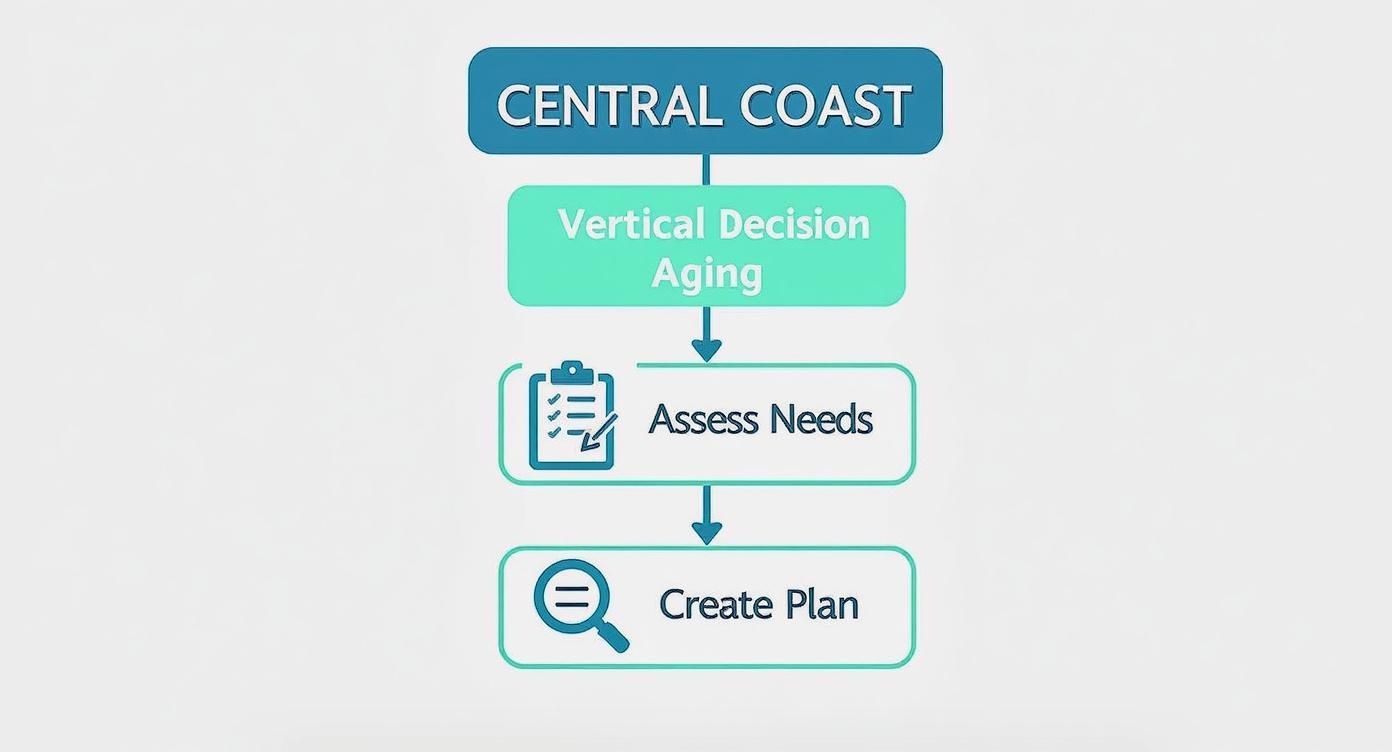
As you can see, a successful plan starts with understanding what is needed. That assessment guides you to the right options. Let's look at the three main types of in-home care.
Home Health Care: For Recovery and Independence
Imagine your father is heading home from the hospital in Salinas after a knee replacement. He needs help managing his medications, changing his surgical dressing, and doing his physical therapy.
This is a perfect time for home health care.
Home health is a short-term, skilled service prescribed by a doctor. It helps patients recover from an illness, injury, or surgery. The goal is to restore independence right at home.
Our teams of professionals work together to provide care:
- Registered Nurses for skilled medical care, medication management, and patient education.
- Physical and Occupational Therapists to help regain strength and mobility.
- Medical Social Workers to connect you with community resources and support.
This expert care helps lower the risk of a return trip to the hospital. You can learn more about our Central Coast VNA & Hospice home health care services.
Palliative Care: For Comfort and Quality of Life
Now, picture a different situation. Your mother in Santa Cruz County has a chronic lung condition. She wants to continue treatment, but her symptoms make life difficult.
This is where palliative care can make a world of difference.
Palliative care is specialized medical care for people with a serious illness. The focus is on relief from symptoms and stress. The goal is to improve quality of life for both the patient and the family.
A person can receive palliative care at any age and at any stage of a serious illness. It can be provided alongside curative treatments. Think of it as an extra layer of support.
Hospice Care: For Dignity and Peace
When treatments are no longer working and a doctor expects a person to live six months or less, the focus often shifts. This is when hospice care provides comfort, dignity, and peace.
For a family in Monterey or San Benito County, this means a dedicated team ensures a loved one’s final months are lived as fully as possible. Hospice is not about giving up; it is about shifting the focus to quality of life.
Our hospice teams include Registered Nurses, Hospice Aides, Chaplains, and volunteers. They provide support for the patient and the entire family. That support continues with bereavement counseling for 13 months.
CCVNA's In-Home Care Services Compared
It can be tough to keep these services straight. This table breaks down the key differences to help you.
| Service | Primary Goal | Who It's For | Covered By |
|---|---|---|---|
| Home Health | Help patients recover from an illness, injury, or surgery and regain independence. | Individuals needing short-term, skilled nursing or therapy after a hospital stay or new diagnosis. | Medicare, Medi-Cal, and most private insurance plans with a doctor's order. |
| Palliative Care | Relieve symptoms and stress of a serious illness to improve quality of life. | Patients of any age, at any stage of a serious illness, often alongside curative treatments. | Medicare Part B, Medi-Cal, and many private insurance plans. |
| Hospice | Provide comfort, dignity, and peace when a cure is no longer the goal. | Patients with a life-limiting illness and a prognosis of six months or less. | Medicare, Medi-Cal, and most private insurance plans. |
Each service plays a vital role. Understanding the differences is the first step toward getting the compassionate care your loved one deserves.
Preparing the Home for Safe and Comfortable Aging

Turning a house into a safe haven is a practical and loving act. For many on the Central Coast, their home holds decades of memories. The goal is to keep them there, comfortably and safely.
This is not about a massive renovation. It is about thoughtful changes that support independence and give everyone peace of mind. Small adjustments can have a huge impact.
High-Impact Changes for Key Areas of the Home
Start by focusing on the rooms where your loved one spends the most time. Simple fixes in the bathroom, bedroom, and living areas can make a world of difference.
Here are a few practical ideas:
- Brighten things up. Good lighting is very important. Add nightlights to hallways, bathrooms, and bedrooms.
- Clear the way. Walk through the main pathways and remove clutter, loose rugs, and extra furniture.
- Make the bathroom a priority. This room is a high-risk area for falls. Install grab bars, a non-slip mat in the tub, and a shower chair.
These changes help create a safer living space. They make daily life easier and reduce the risk of accidents.
Organizing Medications and Medical Equipment
A jumble of pill bottles can be dangerous. A disorganized system can lead to missed doses or errors. Creating a simple, consistent routine is key.
Start by dedicating one spot for all medical needs. A pill organizer, clearly labeled, is a must-have. It simplifies the daily routine.
Our Registered Nurses often help families create a safe medication plan. This hands-on support gets everyone on the same page. It helps prevent common mistakes that can lead to hospital visits.
Creating an Accessible Living Space
As mobility changes, stairs can become a major obstacle. Creating a main living area on a single floor is often a practical solution. This might mean converting a downstairs den into a bedroom.
The goal is to have everything for daily life on one level. This reduces the need to use stairs, a major source of falls. If you need ideas, you can look at house plans specifically designed for elderly people.
Making these changes can be emotional. It is helpful to see them as tools for empowerment. They help your loved one maintain independence in the home they love.
Navigating the Financial and Legal Realities of Care
Talking about money and legal documents can be hard. But these conversations are critical for a family to have. Tackling them now removes a massive amount of future stress.
This allows you to make thoughtful decisions, not panicked ones. It is an important part of planning for aging at home on the Central Coast.
How Is In-Home Care Paid For?
Figuring out how care will be covered is always the first question. For most families, Medicare is the primary source of funding. Its benefits for home health and hospice are quite strong.
When ordered by a doctor, Medicare generally covers skilled home health care. This includes visits from a Registered Nurse or a physical therapist. The focus is on helping your parent get better.
The Medicare hospice benefit is also very comprehensive. It covers nearly everything related to a terminal diagnosis. This includes nursing support, medical equipment, and comfort medications.
Our team at Central Coast VNA & Hospice guides families through Medicare benefits every day. We serve Monterey, San Benito, and Santa Cruz Counties. We are here to bring clarity to your situation.
Getting Their Wishes on Paper
Beyond finances, it is vital to have legal documents in place. This process is called Advance Care Planning. It ensures your loved one’s voice is heard, even if they cannot speak for themselves.
Having these documents is a great gift to your family. It replaces guesswork with guidance. It ensures care decisions align with your loved one’s values.
Two documents are the cornerstone of a solid plan:
- Durable Power of Attorney for Healthcare: This names a person (a "healthcare agent") to make medical decisions if your loved one cannot.
- Living Will (or Advance Directive): This document outlines preferences for end-of-life medical treatments, like life support.
These are not just legal forms; they are powerful tools for communication. As a trusted nonprofit, we encourage families to explore end-of-life care planning sooner rather than later. For more information, you can also research strategies to safeguard assets for long-term care.
Building a Support System for Family Caregivers
Caring for a loved one is a profound act of love. But it is also one of the most demanding jobs. Here on the Central Coast, thousands of family members are helping loved ones age at home.
The simple truth is, no one can do it alone. A solid plan for aging at home must include support for the caregiver. Your own well-being is the foundation for providing sustainable, loving care.
Acknowledging the Reality of Caregiver Burnout
Caregiver burnout is not a sign of weakness. It is a sign that you have been strong for too long. It can show up as exhaustion, feeling irritable, or being overwhelmed.
Juggling care duties with a job and family can feel impossible. This is a growing issue on the Central Coast. According to the Public Policy Institute of California, by 2030, more than 1 in 5 Californians will be 65 or older, increasing the need for family care (PPIC, 2022). As our communities age, the need for robust caregiver support is critical.
Finding Balance Through Respite and Support
One of the most effective tools for preventing burnout is respite care. It is a short-term break for caregivers. It gives you a chance to rest, recharge, and take care of your own needs.
Taking this time is not selfish; it is a necessary part of the journey. It allows you to return to your loved one with renewed energy.
Central Coast VNA & Hospice offers services to provide this vital break. A Hospice Aide can assist with personal care. A trained volunteer can provide companionship. For more details, see our guide on respite care for family caregivers.
More Than Just Medical Support
Caregiving is an emotional and spiritual journey. Families in Monterey, Hollister, and the surrounding areas often navigate complex feelings. You do not have to walk this path by yourself.
Our interdisciplinary teams include professionals dedicated to supporting the whole family:
- Medical Social Workers: These team members connect you with community resources and offer counseling.
- Chaplains: Our Chaplains offer non-denominational spiritual support for people of all faiths and beliefs.
As a nonprofit with over 74 years of local service, our mission extends to the entire family. We encourage you to reach out before you hit a breaking point. A simple conversation can provide clarity and reassurance.
FAQs: Your Questions About Aging at Home Answered
It is normal to have questions when planning for a loved one’s care. Making decisions for someone aging at home on the Central Coast can feel overwhelming. Our goal is to give clear, compassionate answers.
As a trusted community partner for over 74 years, Central Coast VNA & Hospice is here to be a resource for your family.
When is the right time to contact Central Coast VNA & Hospice?
The best time to reach out is often before a crisis hits. If you notice changes in a loved one’s health, a conversation with our team can bring clarity. Getting a plan in place early makes all the difference. We guide families in Monterey, San Benito, Santa Cruz, and South Santa Clara counties at any point in their journey.
How is palliative care different from hospice care?
This is an important question. Palliative care can be provided at any stage of a serious illness, even during curative treatment. Hospice care begins when curative treatments stop, and the focus shifts to comfort and quality of life for the final months. Central Coast VNA & Hospice provides both services, ensuring a smooth transition if needs change.
What if my parent is resistant to getting help at home?
This is a common challenge. Resistance often comes from a fear of losing independence. Approach the conversation with empathy. Frame in-home support as a tool to help them stay safely in their own home. Starting with small steps, like a weekly visit from a Registered Nurse, can help.
Does Medicare cover the services we need for aging at home?
Yes, Medicare provides excellent coverage for many in-home services. Medically necessary home health care is typically covered after a hospitalization. The Medicare hospice benefit is very comprehensive, covering nearly all aspects of care related to a terminal illness. Our team can help your family understand the specifics of your coverage.
How does Central Coast VNA & Hospice support the whole family?
We believe high-quality care must extend to the entire family. Our interdisciplinary teams include Medical Social Workers who connect you with resources and Chaplains who offer spiritual support. We also provide bereavement support for 13 months after a loved one passes, ensuring no one feels alone on this journey.
Planning for the future can feel daunting, but you have a local, nonprofit partner ready to help. At Central Coast VNA & Hospice, our teams are here to answer your questions, provide expert guidance, and deliver the compassionate care your family deserves. Contact us today to learn more about how we can support you.