
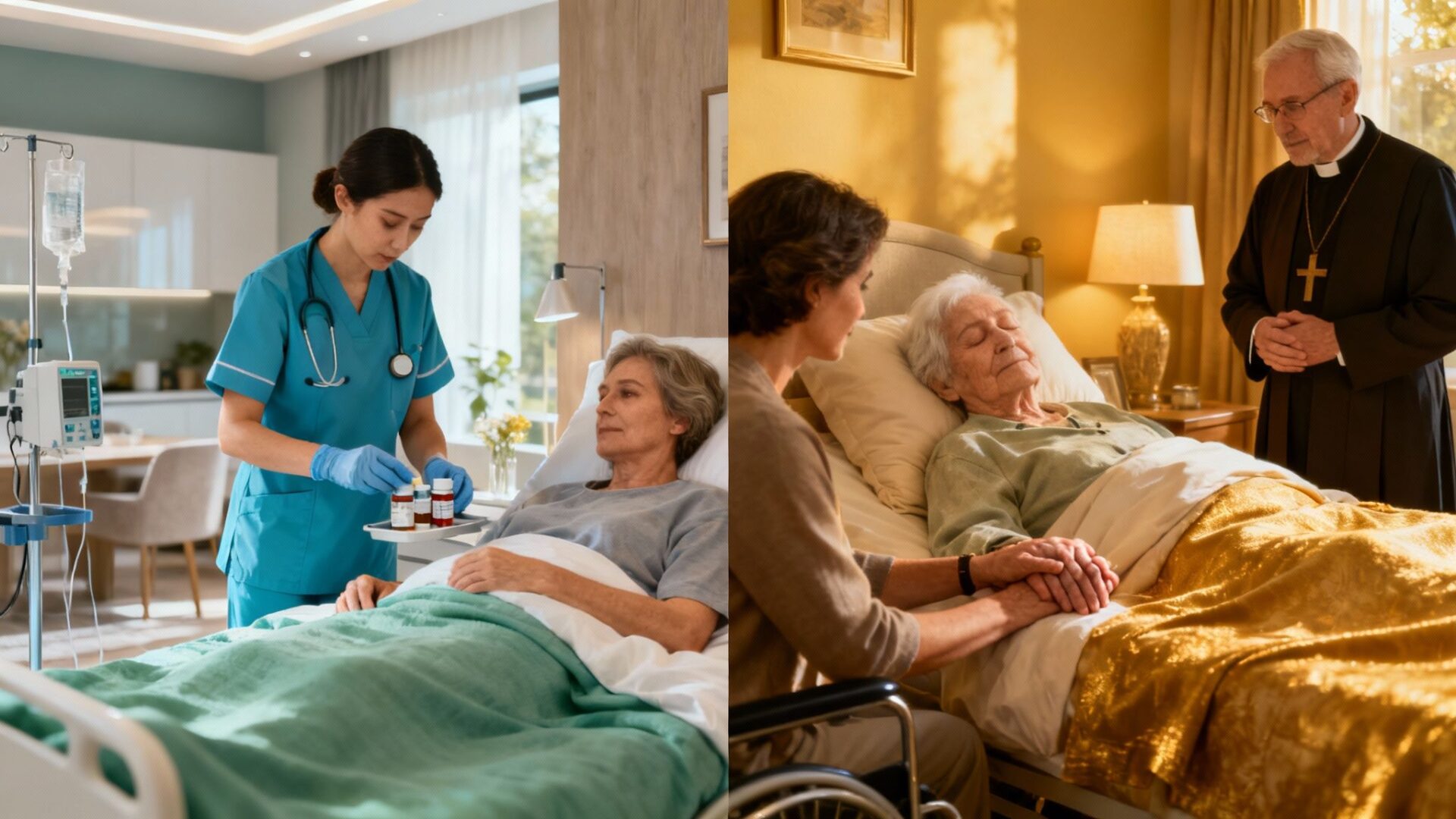
Hospice vs. Palliative Care: What’s the Real Difference?
The main difference between hospice and palliative care is about timing and goals. Both types of care provide comfort, but they are used at different stages of an illness.
Palliative care can start when someone is first diagnosed with a serious illness. Its goal is to relieve symptoms and stress while the person continues to get treatment to cure their illness.
Hospice care is for people with a life expectancy of six months or less. At this point, the goal is no longer a cure. The focus shifts completely to comfort and quality of life.
Clarifying Your Care Options
Understanding this difference is a key step in making informed healthcare decisions. Families in Monterey County and nearby communities often ask us which path is right for their loved one.
At Central Coast VNA & Hospice, our mission is to make this choice clear. We offer compassionate guidance to help you get the right support at the right time.
Both services add an extra layer of support. But they are for different stages of a health journey.
Palliative care works with your current doctors to help manage symptoms. Hospice care becomes the main source of support after curative treatments have stopped.
Palliative Care and Hospice at a Glance
This chart shows the basic differences in timing, focus, and treatment goals.
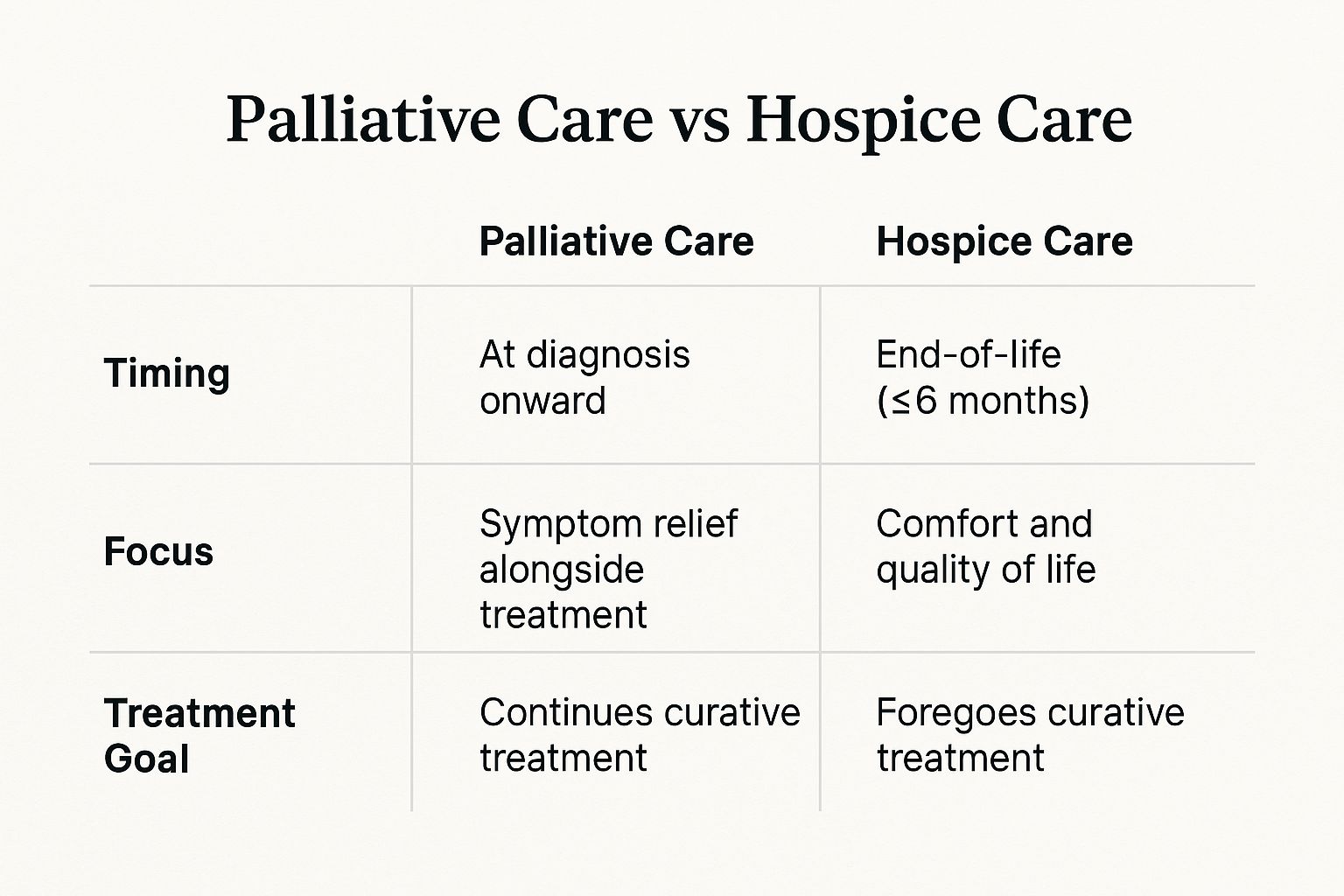
As the chart shows, palliative care is a broad support system you can use early on. Hospice is special care for the final phase of life.
The need for supportive care is very large. According to the World Health Organization, an estimated 56.8 million people need palliative care each year (WHO, 2020).
Many of these people are older adults. The key point is that palliative care can start at any time during a serious illness.
Hospice is for when a doctor believes a patient has six months or less to live. You can learn more about this in the Global Atlas of Palliative Care.
This simple table helps you see the differences side-by-side.
Hospice vs Palliative Care At a Glance
| Aspect | Palliative Care | Hospice Care |
|---|---|---|
| Timing | Can begin at diagnosis, at any stage of illness. | Begins when life expectancy is six months or less. |
| Treatment | Can be received alongside curative treatments. | Focuses on comfort care; curative treatments have stopped. |
| Goal | To relieve symptoms and improve quality of life. | To provide comfort and support for the end of life. |
| Payment | Covered by Medicare Part B, Medicaid, and private insurance. | Covered 100% by Medicare, Medicaid, and most private insurance. |
This table makes it easy to compare the two options. But every family's situation is unique.
At Central Coast VNA & Hospice, we view these services as a continuum of care. Our local clinicians in Monterey, Santa Cruz, and San Benito counties help families make informed decisions.
Many of our patients start with palliative care at home. Later, they may transition smoothly to our hospice program if their needs change. This seamless transition is a core part of our nonprofit mission.
Understanding the Role of Palliative Care
Palliative care is an extra layer of support that works with your primary treatments. It is specialized medical care for people living with serious illnesses.
This includes conditions like cancer, heart disease, or COPD. It can start at any age and at any stage of an illness, even on the day of diagnosis.
The main goal is to improve the quality of life for the patient and their family. We do this by providing relief from symptoms, pain, and stress.
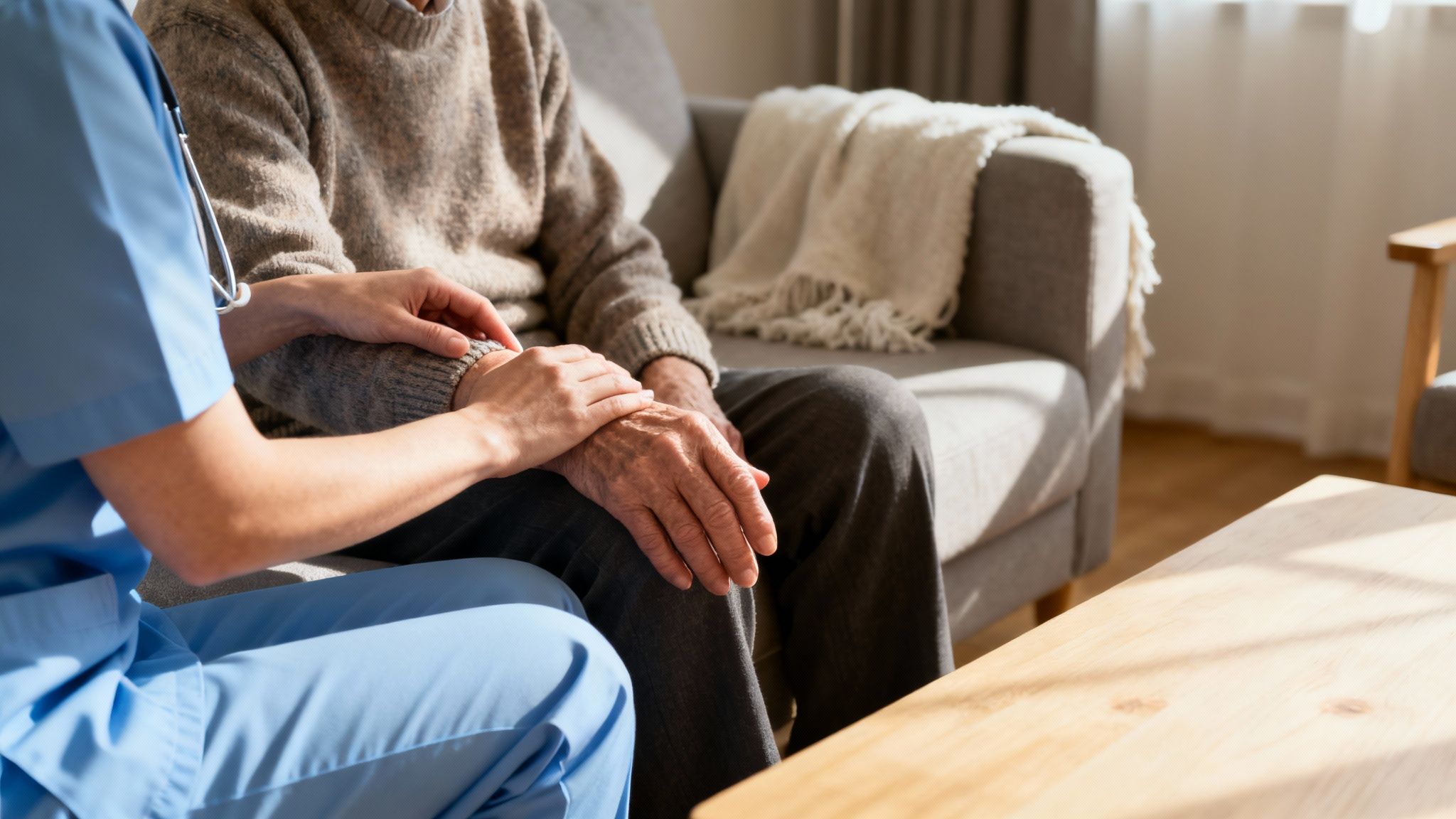
Who Can Benefit From Palliative Care
Anyone with a serious illness can benefit. This is especially true when symptoms affect daily life.
It is not based on a patient's prognosis. It is often provided alongside aggressive treatments like chemotherapy.
This is a key point in the hospice vs. palliative care discussion. Palliative care helps manage symptoms while you continue to fight the illness.
A common misconception is that palliative care means you’re giving up. Our board-certified palliative experts clarify that it actually provides the strength to carry on with daily life.
Our Central Coast VNA & Hospice team helps patients in Monterey County and the surrounding areas. You can learn more about what palliative care is and how it helps patients at home.
How Palliative Care Works
A dedicated team of specialists, including Registered Nurses, works with a patient’s primary doctor. This teamwork ensures that care is coordinated and focused on the patient's needs.
The palliative care team focuses on:
- Symptom Management: Treating pain, nausea, fatigue, and other physical discomforts.
- Emotional Support: Helping patients and families cope with the emotional stress of a serious diagnosis.
- Clear Communication: Guiding conversations about treatment goals and personal care preferences.
This support is often provided right in the home. This brings skilled medical care to patients throughout our service areas in Monterey, San Benito, Santa Cruz, and South Santa Clara counties.
For many, palliative care is the first step in our continuum of care. It provides vital support long before hospice is needed.
Exploring the Purpose of Hospice Care
Hospice is not a place. It is a philosophy of care that prioritizes comfort and dignity when a cure is no longer the main goal.
It honors a person’s final chapter by focusing on their quality of life. This ensures they can live as fully and comfortably as possible.
This compassionate approach is for people with a life-limiting illness and a prognosis of six months or less. Choosing hospice is a decision to shift the focus from cure to comfort.
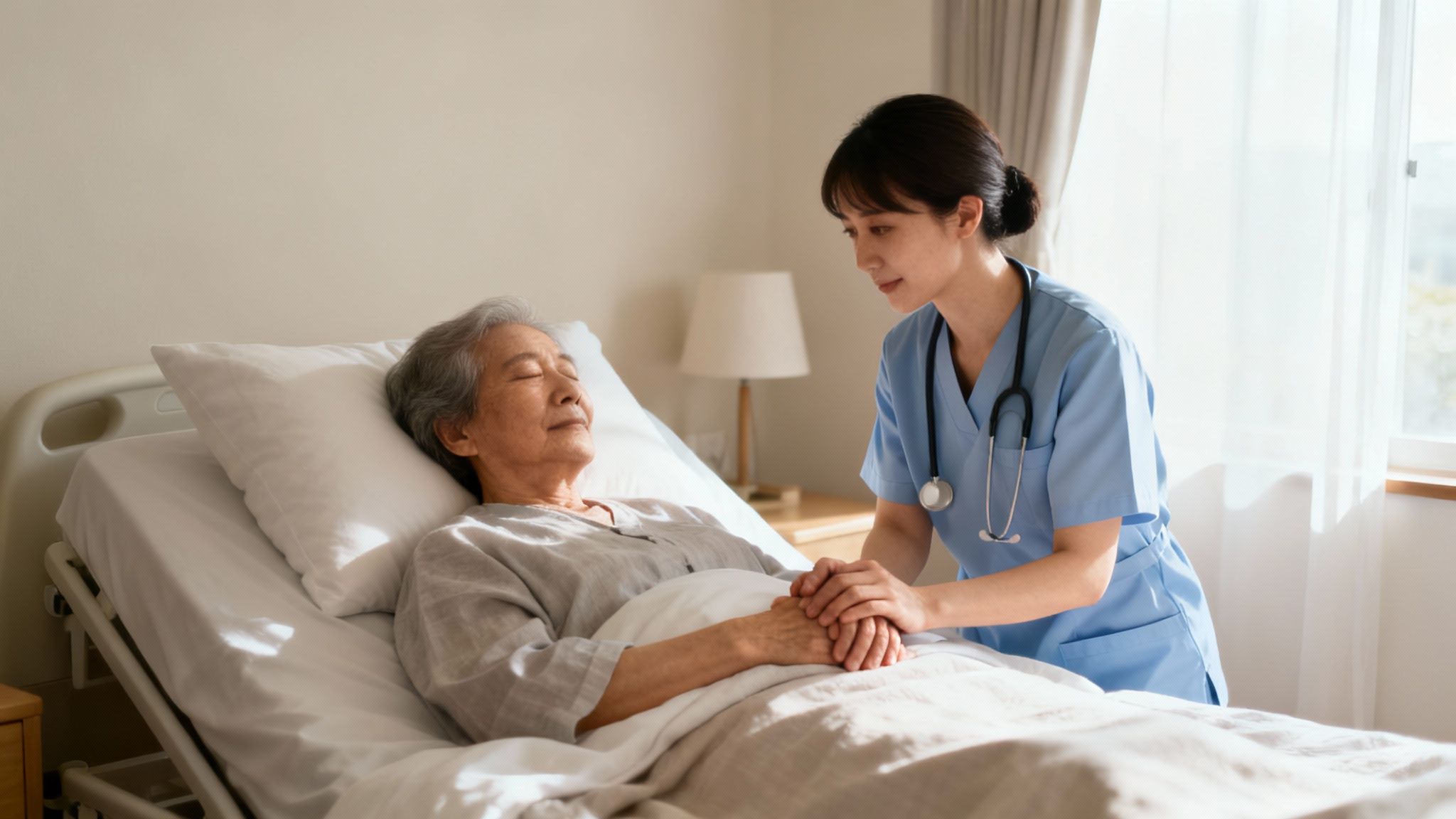
A Team-Based Approach to Comfort
At Central Coast VNA & Hospice, our care is built around the whole person. We address their physical, emotional, and spiritual needs.
Our teams create personalized care plans for patients across Monterey, San Benito, Santa Cruz, and South Santa Clara counties. For over 74 years, our local roots have allowed us to provide this mission-driven, compassionate care.
This interdisciplinary team is the heart of hospice care and includes:
- Registered Nurses who are experts in managing pain and other symptoms.
- Hospice Aides to help with personal care, such as bathing and dressing.
- Medical Social Workers to provide emotional support and connect families with community resources.
- Chaplains for spiritual guidance that respects all faiths and beliefs.
Hospice care is about adding life to a patient's days, not just days to their life. It means redefining hope—hope for comfort, peace, and meaningful moments with loved ones.
Making Informed and Proactive Decisions
Families often face complex medical and emotional challenges. It is also important to address legal matters to ensure a patient's wishes are honored.
Understanding how to manage end-of-life decisions is a crucial part of this journey.
The length of time a person receives hospice care can vary. According to the National Hospice and Palliative Care Organization (NHPCO), the median length of service was 17 days in 2020 (NHPCO, 2022).
Our goal is to help families feel prepared and supported. We provide clear guidance to help you understand what to expect from hospice care.
Choosing the Right Care with Real-World Scenarios
Reading definitions is helpful. But seeing how hospice and palliative care work for real families can make things clearer.
Let’s look at two scenarios based on our work on the Central Coast. These stories show how each service provides the right support at the right time.
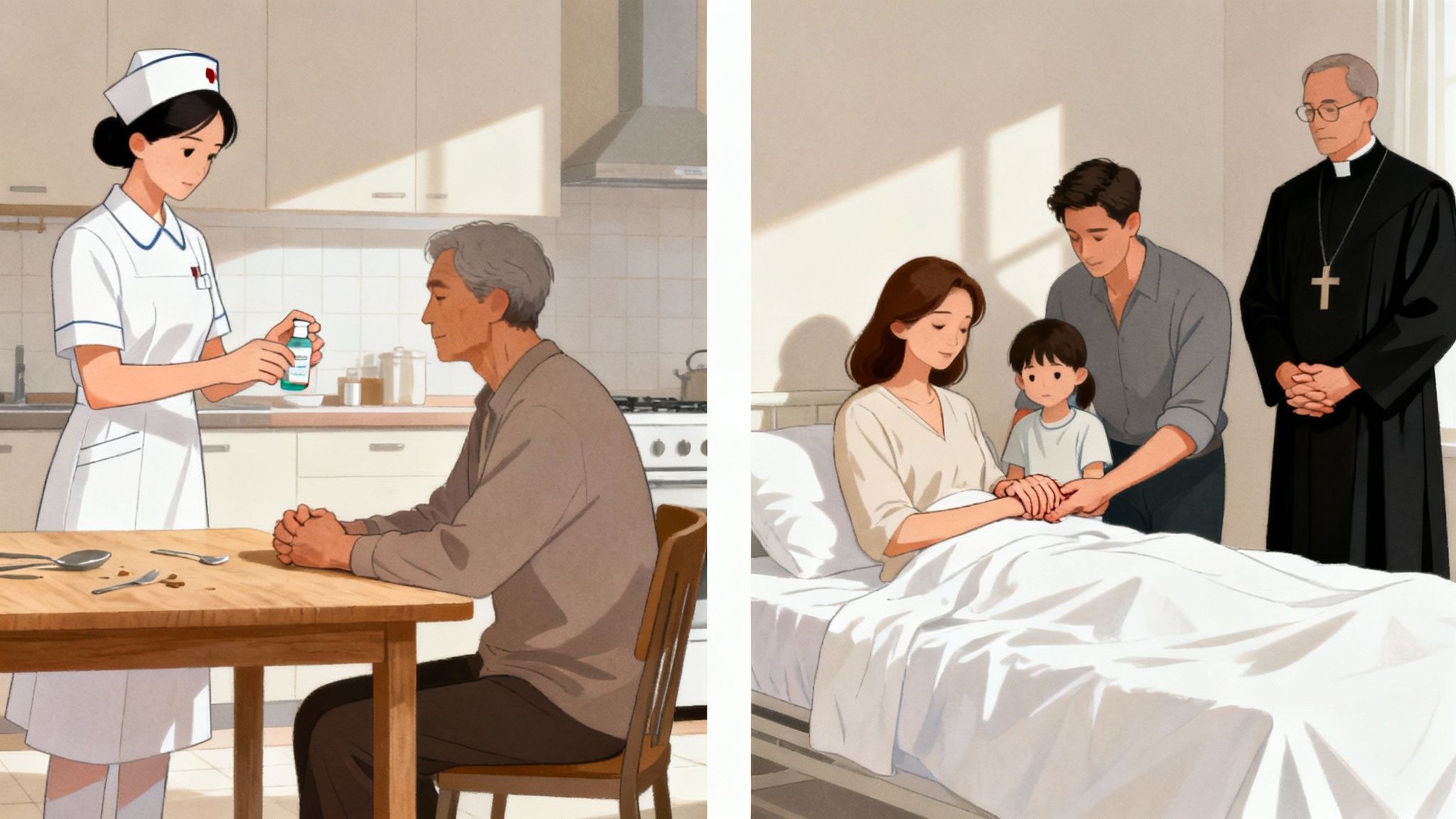
These examples help families understand how Central Coast VNA & Hospice supports loved ones at any stage of illness. This is part of our commitment as a nonprofit, mission-driven provider.
Scenario One: Palliative Care in Monterey County
Meet Maria, a 68-year-old from Monterey who has lung cancer. Her oncologist has a clear chemotherapy plan, but the side effects are severe.
Nausea and fatigue make it hard for her to continue treatment. Her doctor refers her to Central Coast VNA & Hospice for palliative care at home.
Our team’s goal is not to replace her cancer treatment. Our goal is to make it more tolerable.
Our palliative care team helps in a few key ways:
- Managing Nausea: A Registered Nurse works with Maria’s oncologist to adjust her medications, which helps her eat again.
- Reducing Fatigue: We teach her strategies to conserve energy and coordinate with her family for support.
- Emotional Support: Maria and her family have a safe space to talk about their fears and anxieties.
With this extra support, Maria’s quality of life improves. She can handle her treatments better and focus on recovery.
Scenario Two: Hospice Care in San Benito County
Now, consider David, an 82-year-old in San Benito County with advanced heart failure. After several hospitalizations, he decides to stop aggressive treatments.
His goal is to spend quality time with his family at home. His doctor certifies that his life expectancy is likely six months or less, making him eligible for hospice care.
His family calls Central Coast VNA & Hospice. Our team creates a care plan focused entirely on his comfort.
This is a key difference in the hospice vs. palliative care talk. David’s care has shifted from curative treatment to comfort-focused support.
Our hospice team provides:
- Expert Symptom Control: A Registered Nurse manages his shortness of breath so he can rest comfortably.
- Personal Care Assistance: A Hospice Aide helps with daily tasks like bathing, preserving his dignity.
- Spiritual and Emotional Support: Our Chaplain and Social Worker offer comfort to David and support his family.
By choosing hospice, David's family honors his wish for a peaceful end-of-life experience. He is surrounded by loved ones in his own home.
Correcting Common Misconceptions About Care
Misinformation often stops families from getting the right support. When learning about hospice and palliative care, you may hear myths that cause confusion.
Let's clear the air and talk about the facts. Our board-certified palliative experts want to clarify these common misconceptions.
One myth is that choosing palliative care means you are giving up. In reality, it is an extra layer of support to help you manage symptoms while you continue treatment.
Addressing Common Myths Head-On
Another common myth is that hospice is a place you move into. This is not true.
Over 90% of hospice care in the United States is provided wherever a patient calls home. This could be a private residence, an assisted living community, or a nursing home.
Here are a few other myths we often hear from families in Monterey and Santa Cruz counties:
- Myth: You have to give up your own doctor if you choose hospice.
- Fact: Your trusted personal physician can remain a central part of your care team and will work closely with our hospice team.
- Myth: Hospice care is only for the last few days of life.
- Fact: Patients can receive hospice care for six months or longer. Studies show that starting hospice earlier can improve quality of life.
By correcting these myths, we empower families to make decisions based on truth. Our goal as a nonprofit provider is to educate our community.
A Global Perspective on Care
Understanding these services is critical. Access to quality end-of-life care varies greatly worldwide.
The United States ranks 43rd out of 81 countries in end-of-life care quality. This shows a need for better education. You can discover more insights about these global disparities on NCBI.
As a nonprofit with over 74 years of service to the Central Coast, we are a reliable source of information. Continue debunking the 9 biggest myths about palliative care in our detailed guide.
How to Access Care on the Central Coast
Knowing how and when to ask for help is a critical step for families. The best place to start is with a conversation with a primary doctor or specialist.
This discussion helps get everyone on the same page about care goals. It also focuses on what is most important: quality of life.
Bringing up palliative or hospice care can feel difficult. It helps to have a few questions ready to guide the conversation.
Starting the Conversation With a Doctor
Here are a few questions you can ask to get the conversation started:
- Could palliative care help manage symptoms while we continue treatment?
- At what point should we consider hospice care, and what would that look like?
- What can we do to support our loved one’s comfort and quality of life right now?
The answers should provide a clearer path forward. If the doctor agrees that support is needed, the next step is to ask for a referral.
It is also helpful to understand your insurance options. This includes learning about coverage through Medicare Advantage plans.
At Central Coast VNA & Hospice, we work closely with physicians across our service areas. These include Monterey, San Benito, Santa Cruz, and South Santa Clara counties.
Our nonprofit, mission-driven approach means we are focused on your family’s needs. We ensure a smooth transition into our care.
Once we receive a referral, our team will schedule an informational visit. This meeting is a chance for you to ask questions and learn how our programs can help.
We also provide a number of local health care resources for seriously ill family members to guide you. Contact us today to learn more.
Frequently Asked Questions About Hospice and Palliative Care
It is easy to get confused by healthcare terms. Many families on the Central Coast ask us about the practical differences between hospice and palliative care.
Here are answers to some of the most common questions.
Can a patient receive both palliative care and curative treatment?
Yes, absolutely. This is one of the most important differences between the two types of care.
Palliative care is an extra layer of support that works alongside treatments like chemotherapy. Its goal is to manage symptoms and improve your quality of life while you continue to fight an illness.
Who pays for palliative and hospice care services?
Both services are covered by most insurance plans. This is a relief for many families.
- Palliative care is usually covered by Medicare Part B, Medi-Cal, and most private insurance.
- Hospice care is covered 100% by the Medicare Hospice Benefit, including medications and medical equipment. Most private insurance plans offer a similar benefit.
Does choosing hospice mean we are giving up hope?
No, not at all. Choosing hospice means redefining hope.
It is a shift in focus from finding a cure to hoping for comfort, peace, and meaningful time with loved ones. It is a proactive decision to make the most of the time that remains.
Where are hospice services provided?
The vast majority of hospice care happens wherever a patient calls home. This could be a private residence, an assisted living community, or a nursing home.
Central Coast VNA & Hospice brings expert care directly to patients in Monterey County, San Benito County, Santa Cruz County, and South Santa Clara County.
How does Central Coast VNA & Hospice support the family?
Our support extends to the entire family. Our team includes Social Workers and Chaplains who provide emotional support, education, and guidance.
We also offer bereavement services for up to 13 months after a loved one has passed. This ensures families are not left alone in their grief. You can learn more by exploring our other palliative care FAQs.
For over 74 years, the team at Central Coast VNA & Hospice has provided compassionate home health, palliative, and hospice care. If you have more questions or need guidance on what's right for your family, please contact us today at https://ccvna.com to learn how we can support you.
Personalized Home Health Aide Services in Monterey County: A Guide
Imagine having dedicated support for daily activities. This support helps you live with safety and independence in your own home. That is the goal of personalized home health aide services in monterey county.
These services help you or a loved one live with greater dignity.
Understanding Personalized Home Health Aide Services
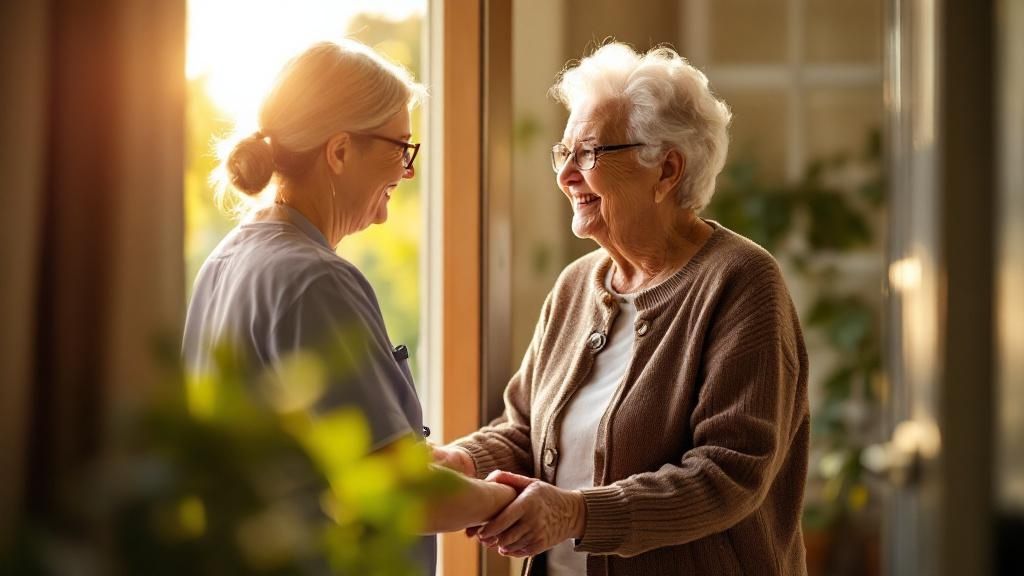
Personalized home health aide services provide professional help with daily tasks. These tasks can become hard to do on your own. This support is about more than just convenience. It is about creating a safe, nurturing environment that promotes well-being.
At Central Coast VNA & Hospice, our Home Health Aides are a key part of a coordinated care team. They do not work alone. This is different from informal help you might get from a friend. Our aides provide skilled help under the direct supervision of a licensed Registered Nurse.
This integrated approach makes sure all care is clinically sound. It aligns with a patient’s overall health goals. For families in Monterey County, this brings great peace of mind.
What Does a Home Health Aide Do?
A Home Health Aide helps with activities of daily living. These activities can be hard due to illness, injury, or aging. They deliver support with compassion and respect for a person's dignity.
Here are some of the tasks they help with:
- Personal Care: Assisting with bathing, dressing, grooming, and toileting.
- Mobility Support: Helping people move safely around their home. This can be transferring from a bed to a chair or taking a walk.
- Light Housekeeping: Taking care of tasks like changing bed linens to keep the living area clean and safe.
- Meal Preparation: Making sure nutritious meals are prepared based on any dietary needs.
This professional support is a core part of our home health care services. Our community has trusted us for over 74 years. It is also helpful for families to understand all care options, including different care models in senior communities.
The goal of personalized home health aide services is to empower people to remain safely in their homes. This approach improves quality of life and preserves independence.
By adding aides to a clinical team, we achieve a higher level of safety. An aide can see small changes in a patient's condition. They report these changes to the supervising nurse. This allows for quick changes to the care plan.
The CCVNA Difference in Integrated Home Care
Not all personalized home health aide services in Monterey County are the same. The real difference is teamwork and professional oversight. At Central Coast VNA & Hospice, our Home Health Aides are a vital part of a full clinical team. They work with Registered Nurses and other specialists.
This integrated approach creates a safety net that many non-medical providers cannot offer. A licensed professional guides the plan of care. They are ready to step in when needed. This ensures support is not just helpful but also medically sound.
Professional Oversight Provides Peace of Mind
Let's look at a real-world example. Imagine an aide helping a client in Salinas. The aide notices a small change in the client's breathing. This is a subtle change that could be easily missed.
Because they are part of our integrated team, they report it to the supervising Registered Nurse. The nurse can then assess the situation. They can talk to the patient's doctor and adjust the care plan right away. That single observation could prevent a serious problem.
At Central Coast VNA & Hospice, our integrated care model ensures that every Home Health Aide is supported by a full clinical team. This provides an essential layer of safety and expertise.
This professional oversight is the heart of the CCVNA difference. Our aides are more than helpers. They are trained professionals who are the eyes and ears of the clinical team. Their consistent presence and training help them build trusting relationships.
This structure gives families across the Central Coast peace of mind. You know your loved one is getting care that is both compassionate and clinically supervised. We are a trusted, nonprofit that has served our community for over 74 years. It's a key reason families discover why Central Coast VNA is the best choice for home health care.
The infographic below shows how our integrated approach improves client satisfaction.
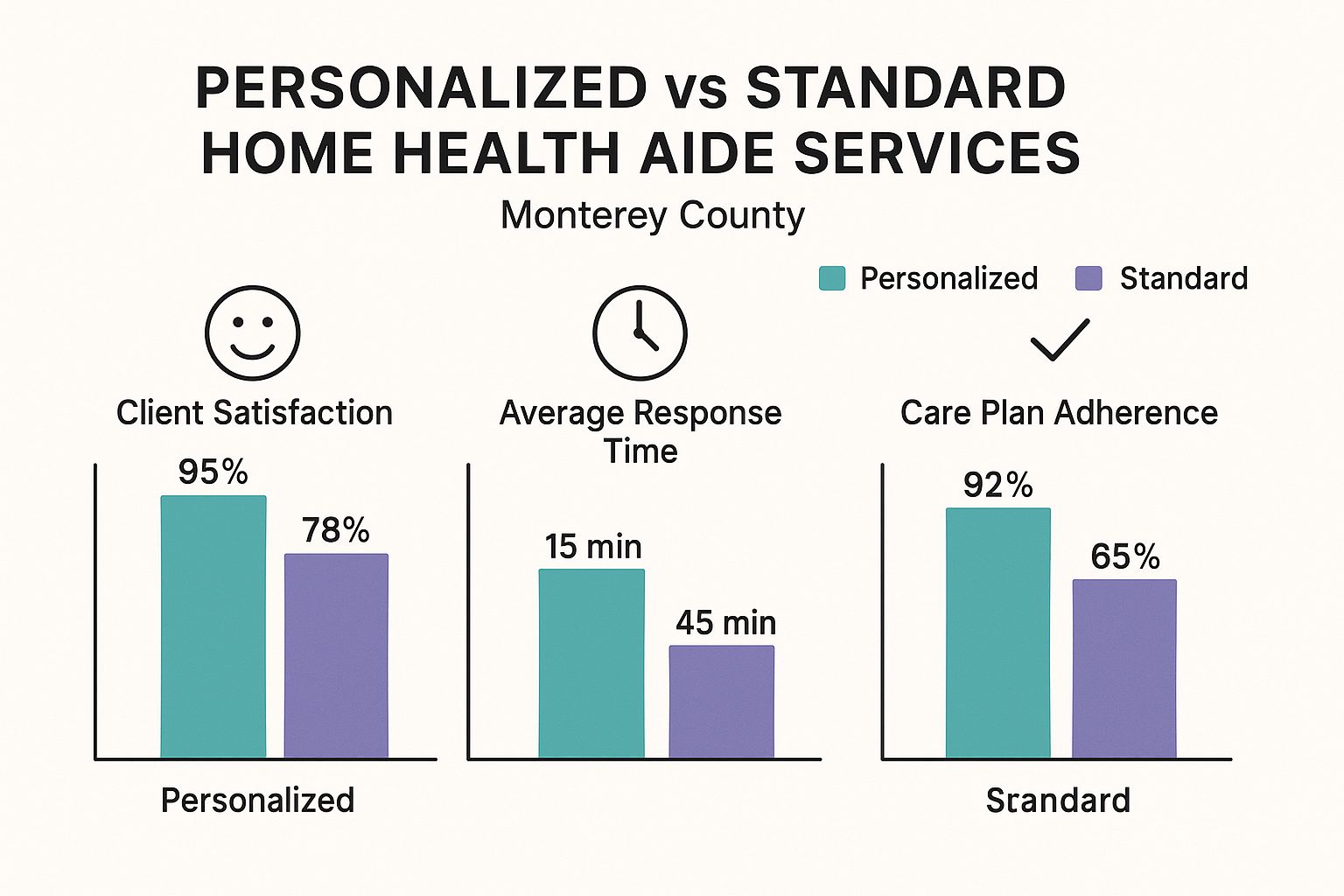
As you can see, a team-based approach leads to better results. When everyone works together, the patient's health is always the top priority.
CCVNA Integrated Care vs. Non-Medical Providers
Let's compare the differences between a CCVNA Home Health Aide and a standard non-medical provider.
| Feature | CCVNA Home Health Aide | Standard Non-Medical Provider |
|---|---|---|
| Supervision | Directly supervised by a Registered Nurse (RN) | Typically supervised by a non-clinical manager |
| Care Planning | Part of a clinical team contributing to a holistic plan | Follows a task list; not involved in clinical planning |
| Clinical Reporting | Trained to observe and report clinical changes to the RN | Not trained for clinical observation or reporting |
| Emergency Response | Immediate access to clinical team for guidance | Must call 911 or a family contact for medical issues |
| Training & Skills | State-certified (CHHA) with ongoing clinical training | Basic training, often focused on non-medical tasks |
| Medication Support | Can assist with medication reminders under RN guidance | Limited to basic reminders; cannot assess reactions |
| Service Scope | Provides both personal care and supports a medical plan | Focused on companionship and household tasks |
The table shows a key point. With CCVNA, your Home Health Aide is part of a professional medical team. This adds a layer of safety and expertise.
How a Home Health Aide Supports Your Family
Personalized home health aide services are about more than a list of duties. They are about restoring dignity and improving safety. They make it possible for people to stay in the homes they love.
This compassionate support makes a big difference for families in Monterey County.
For example, think about an older adult in Salinas home after surgery. A CCVNA Home Health Aide helps with safe bathing and dressing. This consistent support is key to preventing falls and helping them heal.
Enhancing Daily Life with Compassionate Support
Picture someone in Monterey living with a chronic illness. Their energy is low, and they have no appetite. Our Home Health Aide prepares nutritious meals that fit their diet. Good nutrition can boost energy and well-being.
Beyond physical tasks, our aides offer companionship. They provide a friendly face and a listening ear. This helps ease the loneliness that can come with illness. This mix of practical help and human connection defines quality in-home support.
The work of a Home Health Aide is about enabling independence. By managing daily tasks with skill, they help people maintain their routines and live with dignity.
Real-World Scenarios in Our Community
Our aides are trained to handle many situations with a focus on well-being. Here are a few examples of how they make a difference:
- Post-Surgery Recovery: An aide in Pacific Grove helps a client with physical therapy exercises. They offer encouragement and ensure movements are done safely.
- Chronic Condition Management: For a person with diabetes in King City, an aide prepares healthy meals. They also give gentle medication reminders, supporting the nurse's care plan.
- Family Caregiver Relief: By providing reliable support for a few hours, an aide gives family a needed break. This is the foundation of effective respite care for family caregivers.
In every case, the aide improves safety, nutrition, and emotional health. This is the positive impact of professional personalized home health aide services in Monterey County.
Navigating the Cost of Home Care in Monterey County

One of the first questions families ask is, "How much will this cost?" This is a valid concern. At Central Coast VNA & Hospice, we are transparent about the financial side of care. We want to give you the information you need to plan with confidence.
In Monterey County, the starting hourly rate for home care services is around $26.50. According to a 2021 Genworth survey, this is slightly higher than the state and national averages. This reflects our area's cost of living.
As a mission-driven nonprofit, we have always put people before profits. This allows us to focus on providing the highest quality care. It is a promise we have kept for over 74 years.
Understanding Your Payment Options
Figuring out how to pay for a home health aide can feel overwhelming. You are not alone. Several options are available to help manage the costs. Our team can walk you through your coverage to find the best path.
Many families find that their insurance covers a large part of the care. We work with many payers to ensure you get the support you deserve.
Common sources for coverage include:
- Medicare: When medically necessary, Medicare often covers home health aide services.
- Medi-Cal: Medi-Cal provides coverage for many people who need in-home support.
- Private Insurance: Many private health insurance plans include home health services.
- Veterans Benefits: We are proud to serve veterans and can help coordinate care through VA benefits.
At Central Coast VNA & Hospice, our focus is on your family’s well-being. We help you explore every option to ensure you receive the highest quality personalized home health aide services in Monterey County.
How We Can Help You
Our dedicated team will work with you and your insurance provider. We verify all benefits before care begins. We handle the paperwork so you can focus on your loved one’s health.
This process ensures there are no financial surprises. We provide a clear explanation of any out-of-pocket costs. This helps families across Monterey, San Benito, Santa Cruz, and South Santa Clara counties make good decisions.
You can learn more from our guide to Medicare home care eligibility. When you're ready, call us to discuss your specific needs.
Why a Supported Workforce Provides Better Care
Excellent care comes from compassionate and skilled professionals. For personalized home health aide services in Monterey County to be effective, the people delivering care must feel valued.
When Home Health Aides are supported, they can focus on their client's well-being. It is that simple.
Many in-home care professionals face economic pressure. As a nonprofit with deep roots in Monterey County, we believe caring for our staff is the first step in caring for your family.
Our Commitment to a Professional Team
Our nonprofit model allows us to reinvest in our people, not in profits. We are committed to providing fair pay, thorough training, and a supportive environment for our Home Health Aides. This helps us attract and keep the most dedicated professionals.
This investment in our team is the foundation of our care philosophy. We provide a complete new employee onboarding checklist to make sure our aides feel prepared from day one. Ongoing education builds confidence and competence.
We know this work is demanding. That’s why we offer resources like our employee wellness program. When our aides feel secure, they can build the trusting relationships that are so important for healing.
The Impact of Economic Stability on Care
The workforce providing personalized home health aide services in Monterey County often faces challenges. According to a 2018 report, many in-home workers struggle with low wages and food insecurity (UCLA Labor Center, 2018).
This makes it hard to focus on caring for others.
By prioritizing fair pay and a stable work environment, we reduce staff turnover. For your family, this means more consistent, reliable care from a Home Health Aide who knows your loved one’s unique needs.
Our commitment to our team is a commitment to you. When you choose Central Coast VNA & Hospice, you choose an organization that invests in its people. This ensures a higher standard of care for families across Monterey County.
How to Get Started with Home Health Aide Services
Taking the first step toward getting professional support is a big decision. We are here to make the process simple and clear. Our goal is to understand your family’s needs and create a plan that brings comfort.
Getting started with our personalized home health aide services in Monterey County begins with a phone call.
Your Path to Personalized Care
We follow a three-step process to cover every detail. We listen first to build a strong foundation of trust.
- Initial Consultation Call: Your journey starts with a conversation. You will speak with a team member who will listen to your concerns and answer your questions.
- In-Home Nursing Assessment: A Registered Nurse will visit your home to conduct a detailed assessment. The nurse will work to understand the medical needs and personal preferences of your loved one.
- Custom Care Plan Creation: Based on the assessment, the Registered Nurse creates a personalized care plan. This plan outlines the support the Home Health Aide will provide.
At Central Coast VNA & Hospice, every care journey begins with listening. We take the time to understand your family's needs so we can provide the most effective support.
If you are in Monterey, San Benito, Santa Cruz, or South Santa Clara County, we invite you to contact us today. Let’s have a no-obligation conversation about how our team can support your family.
Frequently Asked Questions (FAQs)
What is the difference between a Home Health Aide and a “caregiver”?
At CCVNA, we use the term Home Health Aide for our staff. They are certified professionals on a clinical team, supervised by a Registered Nurse. This is different from an informal or non-medical “caregiver” who may not have the same training or oversight.
How is a personalized care plan created?
A Registered Nurse visits your home to conduct a thorough assessment. Based on this visit and conversations with you, the nurse creates a custom plan. This plan guides the Home Health Aide's daily tasks.
Are your Home Health Aides trained and certified?
Yes, all of our Home Health Aides are state-certified. They also receive ongoing training. They work under the direct supervision of a licensed nurse.
Can we request a specific Home Health Aide for my family member?
We understand the importance of a trusting relationship. We always try to match patients with aides who are a good fit. While we cannot guarantee a specific person, we prioritize consistency to build strong rapport.
Do you serve areas outside of Monterey County?
Yes, we do. Central Coast VNA & Hospice has served the Central Coast for over 74 years. Our service area includes Monterey County, San Benito County, Santa Cruz County, and South Santa Clara County.
Ready to take the next step? Contact Central Coast VNA & Hospice today for a no-obligation consultation to discuss how our compassionate, professional team can support your family. Learn more at https://ccvna.com.
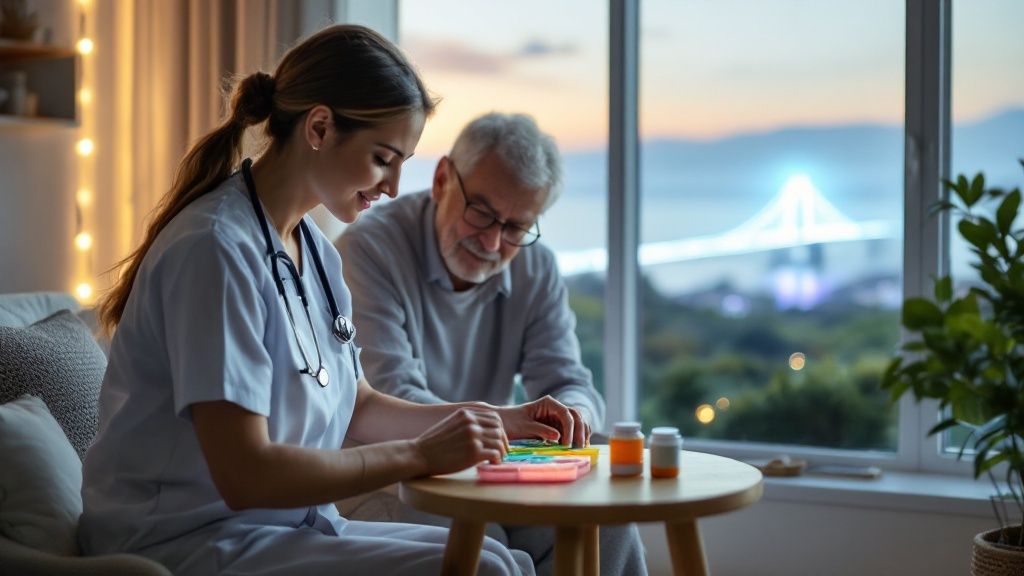
How VNA Is Reducing Hospital Readmissions on the Central Coast
The key to avoiding a return trip to the hospital is having a plan before you go home. At Central Coast VNA & Hospice, we have a system to make your transition from hospital to home as smooth as possible. This helps lower hospital readmissions on the Central Coast.
Our team looks for risks early, like confusion with medications or fall hazards. This lets us build a personalized care plan for a safer, more confident recovery.
Keeping You Safe at Home to Prevent Hospital Returns
A good recovery depends on a strong support system that starts right after discharge. For over 74 years, Central Coast VNA & Hospice has provided that support. We act as a bridge, making sure the great care you got in the hospital continues at home.
This proactive approach is how we are reducing hospital readmissions across the Central Coast. Our teams, including Registered Nurses and Physical Therapists, deliver expert support right after you leave the hospital. This is vital for patients with chronic conditions or those recovering from surgery.
Identifying Risks Before They Become Problems
One of our main strategies is to get ahead of problems before they get worse. For example, in Monterey County, our CCVNA nurses work with hospital discharge teams. They find common risks, like a fall hazard or medication mix-ups.
We create tailored care plans to lower these risks from day one. This might include help from a Physical Therapist or a simple medication chart.
This infographic shows how our care model creates a safety net for patients.
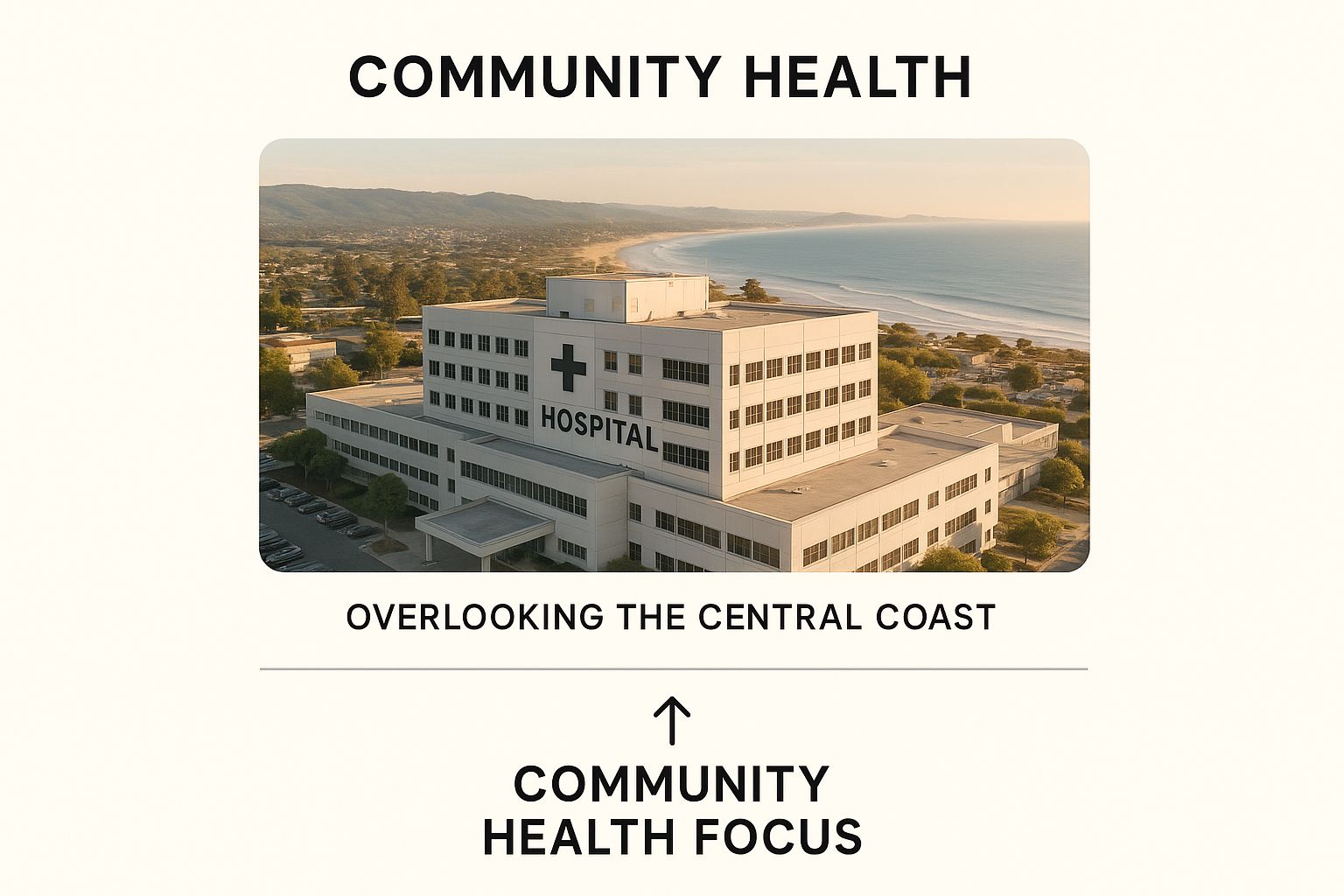
As you can see, a lasting recovery is built on good planning, in-home support, and education for patients and families.
Creating a Secure Home Environment
Our support is more than just medical treatment. It's about making your home a safe place to heal.
Here is a quick look at how our team helps keep patients safe at home and out of the hospital.
CCVNA's Core Strategies for Preventing Readmissions
| Strategy | How It Helps Patients | Team Member Involved |
|---|---|---|
| Fall Prevention Assessments | Our therapists check the home for hazards like loose rugs, poor lighting, or unsafe bathrooms. They help make the home safer. | Physical/Occupational Therapist |
| Empowering Education | We teach patients and families how to spot warning signs, manage symptoms, and know when to call for help. | Registered Nurse, Therapist |
| Coordinated Care | We keep in close contact with your doctor. This ensures your home care plan always matches your health needs. | Care Coordinator, Nurse |
These actions are just a few ways we provide support. We believe in giving you the safety measures and knowledge you need to feel secure.
Thinking about the future is also key to staying safe at home. For those looking to plan ahead, this comprehensive guide on long-term care planning offers valuable information.
Building the Bridge from Hospital to Home
A successful recovery starts long before you walk through your front door. At Central Coast VNA & Hospice, we know a difficult transition can lead to a return trip to the ER. That's why we focus on building a strong, smooth bridge from the hospital to your living room.
This is a true partnership. Our clinical team works with hospital staff across the Central Coast to make sure your care continues without any gaps. This teamwork is how we are reducing hospital readmissions and keeping our community safe at home.
Planning for Your Unique Needs
Before you are discharged, a Central Coast VNA & Hospice Registered Nurse meets with you. This meeting is more than just looking at your medical chart. It’s about getting to know you and the challenges you might face at home.
At CCVNA, we believe that a personalized care plan is the roadmap for a safe recovery. It turns a complex medical journey into clear, manageable steps, giving patients and families confidence and peace of mind.
Our nurses look at every detail to create this roadmap. This proactive approach lets us get ahead of problems before they become a crisis.
Turning Challenges into Solutions
We look at your complete life at home to solve problems ahead of time. It's about creating a practical care plan by looking at your home and your support system.
Some key areas we assess include:
- Your Home Environment: We ask important questions. Is your home two stories, making it hard to move around after surgery? Are there hidden fall risks, like loose rugs?
- Medication Management: We review your new prescriptions carefully. Is the schedule complex? Are there side effects you should know about?
- Your Support System: We connect with your family. We want to know how they can help and give them the tools they need to be confident partners in your recovery.
By spotting these things early, we can schedule a Physical Therapist to meet you on day one. We can also create a simple medication chart that’s easy to follow. This detailed planning helps create a safe recovery at home.
To learn more, explore our guide on how to make a smooth transition from hospital to home. This preparation means a dedicated support system is waiting for you when you get home.
Using Data to Manage Chronic Illness at Home
When you have a chronic condition like heart failure or COPD, you want to stay out of the hospital. These illnesses are major reasons for readmissions. At Central Coast VNA & Hospice, we use data-driven strategies to support you at home.
We don’t wait for problems to happen. Our clinical teams use real-time information to stay one step ahead. By watching key health signs, we can adjust your care plan based on what the data tells us. This helps us catch small issues before they become a crisis.
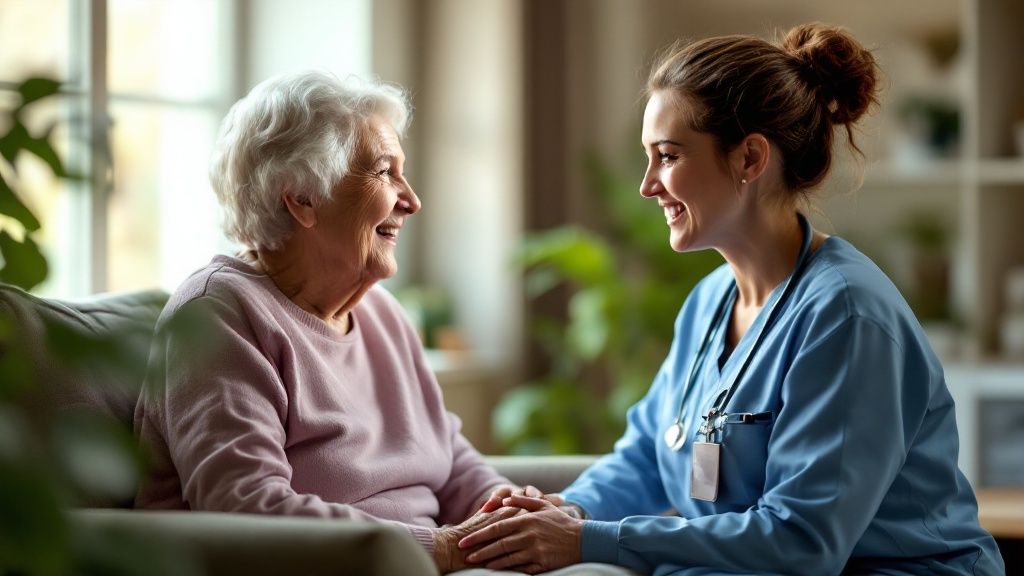
Early Intervention Through Proactive Monitoring
Think of our team as a neighborhood watch for your health. Our Registered Nurses are trained to see small changes that might signal a problem.
For example, a slight weight gain in a heart failure patient could mean fluid retention. This is a common reason for going back to the hospital. When our nurse sees this, they contact the patient’s doctor to discuss changing medications.
This focus on managing chronic illness leads to better health. It also helps lower healthcare costs for our community.
By turning daily health data into action, we help our clinical teams provide responsive care. This keeps patients safer and more comfortable in their own homes.
Supporting National Healthcare Goals
This data-first approach fits with national efforts to improve care after a hospital stay. The Hospital Readmissions Reduction Program (HRRP) from CMS gives hospitals and home health agencies reasons to work together.
The results are positive. For the 2025 fiscal year, only 7% of hospitals faced penalties over 1% for high readmissions. The program targets conditions like heart failure and pneumonia, which are common on the Central Coast. You can read more about these trends in readmission penalties.
This is where Central Coast VNA & Hospice makes a difference. Our targeted care helps local hospitals meet these national goals by addressing the causes of readmission at home. You can explore our effective patient engagement strategies to see how we partner with patients.
This commitment to data and early action fuels our 74-year mission. We work to keep our neighbors in Monterey, San Benito, Santa Cruz, and South Santa Clara counties healthy at home.
Empowering Families with In-Home Education
A confident patient and a prepared family are key to a successful recovery at home. At Central Coast VNA & Hospice, our teams know that preventing a return to the hospital is about more than medical treatments. It requires powerful, hands-on education.
Our Registered Nurses and therapists are also teachers. They are dedicated to empowering you and your loved ones. This turns the stress of recovery into clear, manageable steps for everyone. It's a vital part of how we are reducing hospital readmissions on the Central Coast.
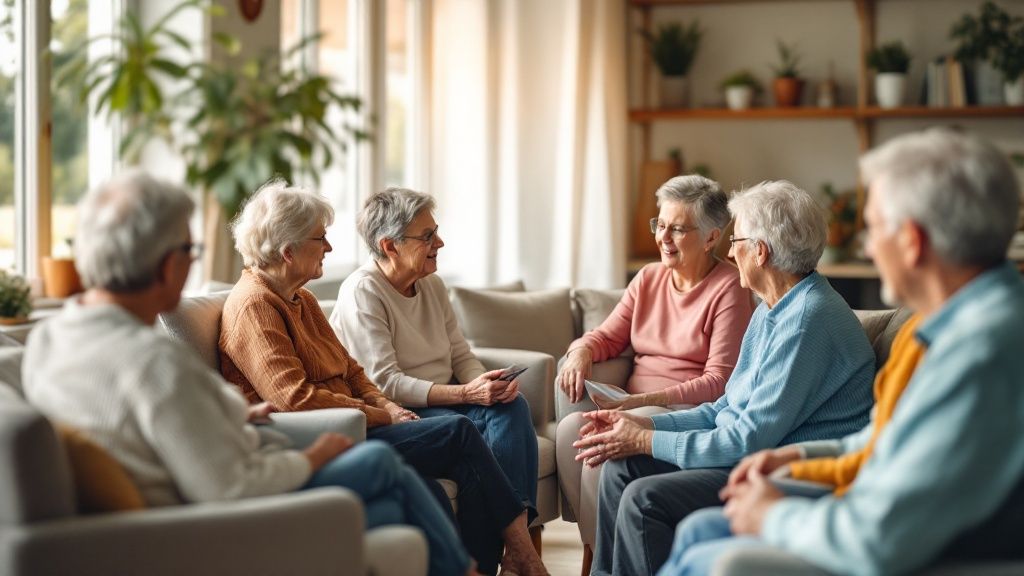
Turning Instructions into Practical Skills
Real education is more than just a pamphlet. It’s about showing people skills that make sense in their own home. Our clinicians take time to ensure families feel capable and ready.
This hands-on approach might look like:
- A Physical Therapist guiding a family member on the safest way to help a loved one with stairs.
- A Registered Nurse sitting down to create a simple, color-coded pill organizer to make a confusing medication schedule easy.
- An Occupational Therapist showing a patient how to use tools like a shower chair to stay independent and avoid falls.
These are real skills that build a strong foundation for a safe recovery. They reduce the risk of accidents that could lead to an emergency room visit.
Teaching Families to Be a Proactive First Alert System
One of the most important parts of our teaching is helping families spot early warning signs. A small issue can grow quickly. An informed family can catch it before it becomes a crisis.
We don't just give families a list of symptoms; we give them a clear plan of action. This replaces worry with calm, decisive steps, so they know exactly when to call us for support.
For example, our Registered Nurse might teach a family how to watch for red flags. This could be a sudden weight gain of more than three pounds in a day for a heart failure patient.
By giving clear guidelines, we turn the family into a first alert system. This focus on practical knowledge is key to our 74-year legacy of serving Monterey, San Benito, Santa Cruz, and South Santa Clara counties. You can find more helpful information in our guide to medication management for the elderly.
The Proven Impact of Coordinated Post-Acute Care
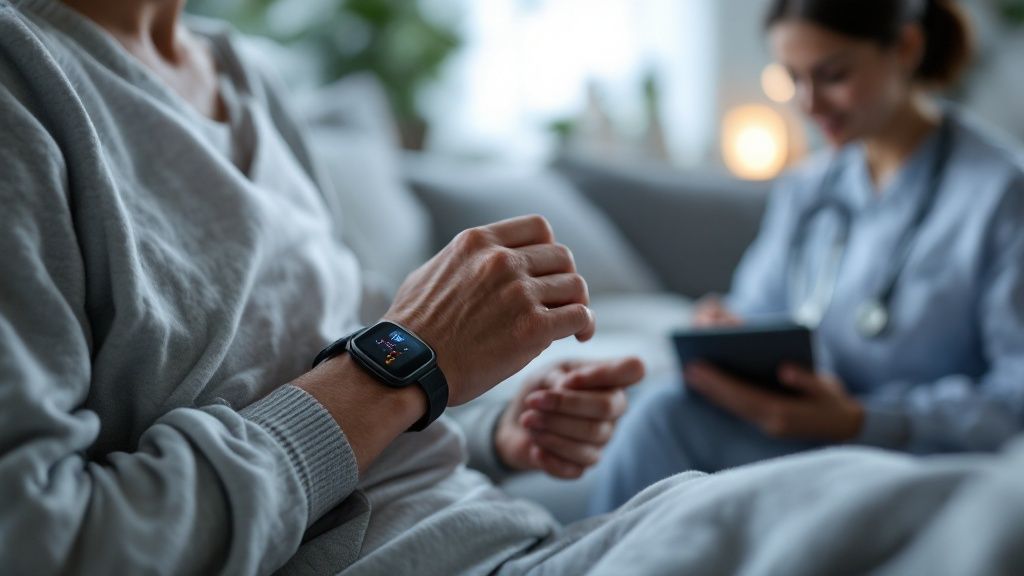
The work Central Coast VNA & Hospice does in Monterey County is part of a larger national effort. A big piece of this effort is called post-acute care.
This is the skilled support you get after you leave the hospital. It helps you continue your recovery at home.
When a team coordinates this care, patient outcomes improve. It’s like a safety net that catches small issues before they become big problems. This is critical for preventing return trips to the hospital on the Central Coast.
A Model That Works for Patients and the Healthcare System
Coordinated home health is a proven strategy with numbers to back it up. Studies show that when skilled home health agencies get involved, hospital readmission rates go down.
This team approach gives patients expert care. It also strengthens our local healthcare system by helping hospitals manage patient flow and reduce costs.
Think of coordinated care as a bridge from the hospital back to daily life. It ensures the momentum of recovery keeps going, preventing dangerous gaps in communication and support that often lead to a relapse.
This model is the heart of what we’ve done for over 74 years as a nonprofit. We bring this high standard of care to our neighbors in Monterey, San Benito, Santa Cruz, and South Santa Clara counties. They can heal safely where they feel most comfortable—at home.
National Data Confirms the Local Impact
The success we see at Central Coast VNA & Hospice is also seen in national data. Research shows a clear link between coordinated home health and fewer hospital readmissions.
For instance, one study found that from 2008 to 2014, readmissions for certain conditions dropped from 6.8% to 4.8%. These numbers show the powerful effect of a partnership between hospitals and home care experts like our teams. For more on these positive national trends, the data is compelling.
It all shows how valuable it is to have an expert team managing recovery after a hospital stay. You can learn more about how our home health care services make a difference right here on the Central Coast.
Your Partners in Health on the Central Coast
Preventing a return trip to the hospital is a team effort. Central Coast VNA & Hospice is proud to be your dedicated partner. For over 74 years, we’ve served our community with one goal: keeping you and your loved ones safe and comfortable at home.
Our approach is built on proactive planning, skilled in-home care, and patient education. It’s a coordinated system that creates a circle of support. This is how VNA is reducing hospital readmissions across Monterey, San Benito, Santa Cruz, and South Santa Clara counties.
As a nonprofit, our commitment is to community wellness. To keep our services running, VNA actively seeks and manages various healthcare grants that help sustain our mission.
From our home health services to palliative and hospice care, our full spectrum of care ensures you are never alone. We are more than a provider; we are your local partners in health.
Contact us today to learn how our compassionate teams can support your family.
Frequently Asked Questions
When a loved one is recovering from a hospital stay, families often have questions. Here are clear answers to common concerns. We want you to understand how home health care works and why it’s so effective.
How soon after hospital discharge does CCVNA care begin?
Our goal is a smooth transition from hospital to home. A Central Coast VNA & Hospice Registered Nurse will typically visit within 24 to 48 hours of your return. This quick start is critical for getting your recovery plan rolling right away.
Who qualifies for home health services to prevent readmission?
Home health is for patients discharged from the hospital who need skilled medical care to recover safely. This often includes nursing, physical therapy, or speech therapy at home. Your doctor will refer you if they believe our support can help you heal and stay out of the hospital.
What is the difference between home health care and other in-home help?
Home health care from Central Coast VNA & Hospice is skilled medical care ordered by a doctor. It is provided by licensed professionals like Registered Nurses and Physical Therapists. This is different from non-medical home care, which helps with daily tasks like cooking or light housekeeping.
Does my family get involved in the care plan?
Yes, absolutely. An informed and confident family is a powerful tool for preventing hospital readmissions. Our team works closely with you and your family members. We provide the education and training they need to feel comfortable helping with your care.
How does CCVNA coordinate with my doctor?
We are an extension of your doctor's office in your home. Our team communicates regularly with your primary physician and any specialists. We send progress updates and report any changes in your condition immediately to ensure your care is always aligned with your doctor's orders.
For over 74 years, Central Coast VNA & Hospice has been the Central Coast's trusted nonprofit partner in health. If you or a loved one needs support after a hospital stay, we are here for you.
Learn more about our full continuum of care and see how we can help.

Meaningful Care, Measurable Impact: How Central Coast VNA & Hospice Serves the Community
For over 74 years, Central Coast VNA & Hospice has been a trusted healthcare partner on the Central Coast. We bring expert, compassionate care into the homes of our neighbors. We serve communities across Monterey County, San Benito County, Santa Cruz County, and South Santa Clara County.
Our work is about people, not just numbers. Behind every statistic is a story of comfort and healing. This guide shows how our nonprofit mission makes a real difference every day.
A Legacy of Local, Mission-Driven Care
Our nonprofit mission is the driving force behind everything we do. For decades, this mission has delivered real results for local families. We provide a smooth continuum of care that adapts to a patient's changing needs.
This deep-rooted community connection is a vital part of our history. You can learn more about how VNA has provided health services for seven decades. This legacy continues today, driven by the goal of caring for our neighbors with honor.
Our Annual Impact by the Numbers
The numbers below show the measurable impact of our mission-driven services. Each statistic represents a person, family, and story we were honored to be a part of.
- 10,215 In-Home Visits: Our clinical teams brought personalized care and support directly into thousands of homes. This ensures patients receive consistent, high-quality attention where they are most comfortable.
- 720 New Hospice Admissions: Hundreds of families trusted us to provide compassionate end-of-life care. We helped them find peace and dignity during a profound life transition.
- 405 Patients Served Through Home Health: Individuals recovered safely at home with skilled nursing and rehabilitation therapies. This helped them avoid re-hospitalization and heal in a familiar setting.
- 285 Active Palliative Care Patients: Our palliative care team delivered symptom management and emotional support. We helped patients and families create care plans for living with serious illnesses.
- 3,530 Bereavement Services Provided: We supported families through loss with counseling and grief groups. Our personalized follow-up care helps them navigate the grieving process.
- 13,210 Volunteer Hours Donated: Community volunteers offered companionship, music therapy, and pet therapy. Their support demonstrates the incredible power of giving back to the community.
- 50 Veterans Honored: We are proud to honor those who served our country. We offer Veteran-centered care and personalized recognition ceremonies.
- 95% Patient Satisfaction Score: Families and patients consistently express high satisfaction. This confirms the exceptional quality and compassion of our care teams.
Our sustained impact is a testament to our ability in fostering a lasting culture of philanthropy within the Central Coast community, ensuring these essential resources are available for generations to come.
Ultimately, our work ensures no one has to navigate a health crisis alone. We are building a healthier, more compassionate community one home at a time.
Understanding Your Journey Through Our Continuum of Care
Facing a serious illness can feel overwhelming. At Central Coast VNA & Hospice, we provide a clear, supportive path forward. This is what we call our continuum of care.
Our services are designed to flow seamlessly from one to the next. A patient can move from home health to palliative care, and later to hospice. This all happens within the same trusted organization, with a familiar, compassionate team.
From Recovery to Comfort in Your Own Home
For many, the journey begins with home health care. This service helps people recover from surgery, injury, or a serious illness at home. Last year, our skilled nursing and therapies helped 405 patients regain their independence.
Our goal is to help you recover safely where you are most comfortable. This approach helps reduce the risk of returning to the hospital. You can learn more about what modern home health services can offer.
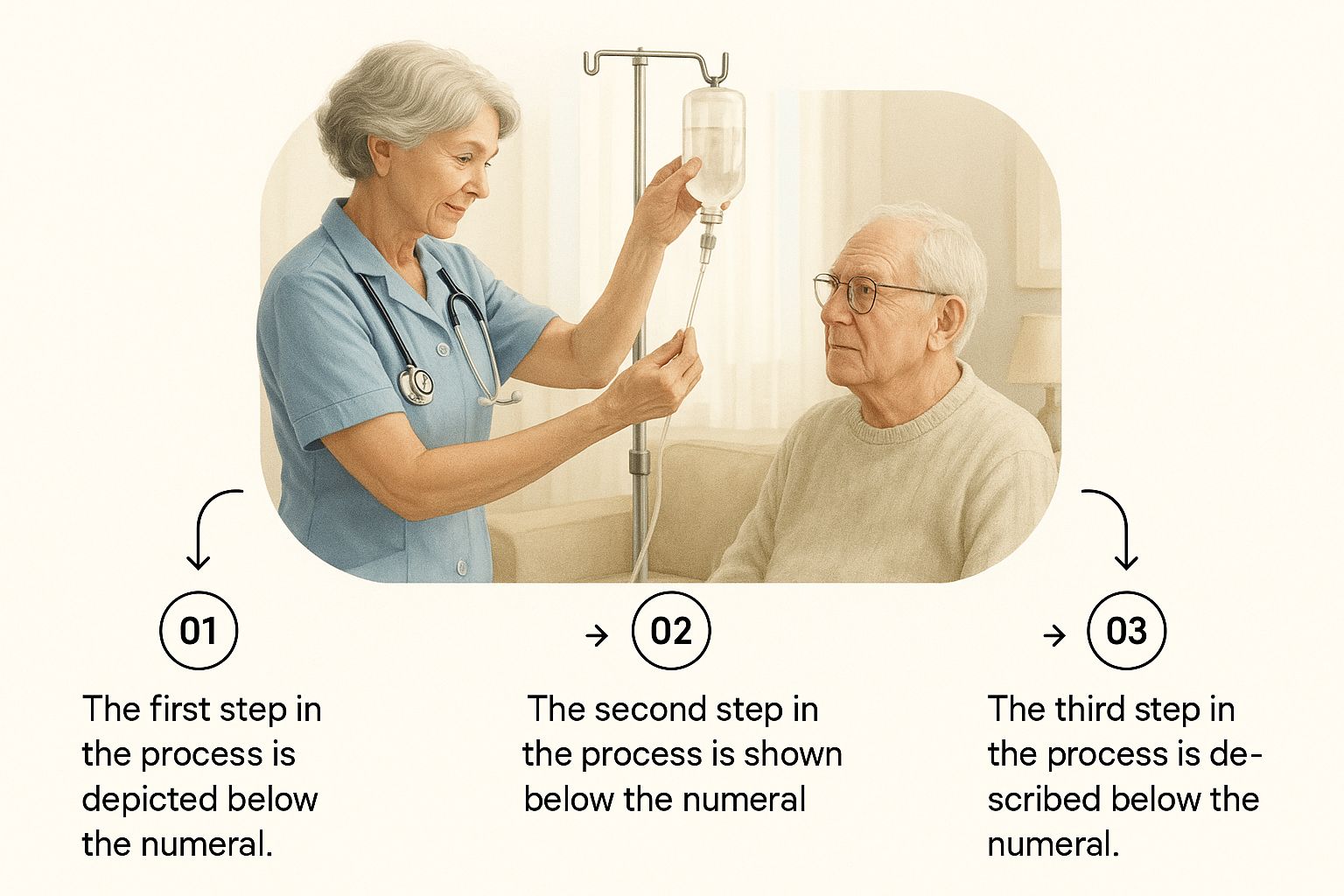
This image captures the gentle, one-on-one attention our clinical teams provide. It is the heart of what we do.
Adding an Extra Layer of Support with Palliative Care
For those with a long-term, serious illness, palliative care offers extra support. You can receive this care at the same time you are receiving curative treatments. Our team focuses on relieving symptoms, pain, and stress.
Palliative care is defined by need, not prognosis. It is a proactive choice to add comfort and support to your healthcare journey, empowering you to live more fully.
Right now, we are supporting 285 active palliative care patients and their families. Our team works with your doctors to align your care plan with your personal goals. This partnership is all about improving your quality of life.
Finding Dignity and Peace with Hospice Care
Sometimes, an illness no longer responds to curative treatments. The focus then shifts to comfort and quality of life. This is where hospice care provides compassionate support for patients and families.
Choosing hospice is not about giving up. It is about choosing to live your final months with dignity and peace. Last year, 720 new admissions to our hospice program showed how much families trust us. You can see how we support families through our integrated home health and hospice services.
The Human Touch Behind Our Medical Expertise
Great healthcare is about more than just medical treatments. It is about treating the whole person. How Central Coast VNA & Hospice impacts lives across the Central Coast is seen in our commitment to compassion and human connection.
Our nonprofit mission is to provide holistic support. We address physical symptoms as well as emotional and spiritual well-being. This human touch makes our care feel different.
The Power of Compassion in Action
Our volunteers are a powerful expression of our mission. Last year, they donated an incredible 13,210 hours of their time. These hours represent thousands of moments of genuine connection.
Volunteers bring unique gifts that brighten a patient's day. Their contributions include:
- Companionship: Simply sitting with a patient or sharing stories can ease feelings of isolation.
- Pet and Music Therapy: A therapy animal or soothing music can lower stress and lift spirits.
- Veteran-to-Veteran Support: This program connects veteran patients with fellow veterans who understand their experiences.
These acts of kindness show our impact is measured in quality of life. Every volunteer visit is a reminder that a whole community cares.
Supporting Families Through Grief and Loss
Our commitment to care extends to the entire family. We know that a serious illness affects everyone. Our support continues long after a loved one has passed.
Last year, we provided 3,530 bereavement services to help families navigate grief. We offer a safe space for healing and remembrance.
Our role is to walk alongside families, offering a steady hand and a listening ear during one of life's most challenging chapters. We provide counseling, grief support groups, and personalized follow-up care for up to 13 months.
This support for families is a cornerstone of our nonprofit mission. The dedication of our skilled teams, including the vital role of RNs in home care, ensures everyone feels cared for. This complete circle of care defines our impact on the Central Coast.
Honoring Service with Specialized Veteran Care
At Central Coast VNA & Hospice, we believe our nation's heroes deserve special care. Our programs for Veterans are designed to provide comfort, dignity, and recognition. This respect is a cornerstone of how we serve families across the Central Coast.

Our commitment goes beyond standard medical care. We recently honored 50 Veterans in recognition ceremonies. We presented them with certificates and thanks in front of their loved ones.
A Bond Forged Through Shared Experience
Our Veteran-to-Veteran volunteer program is a powerful way we support military families. This program pairs Veteran patients with volunteers who also served. This shared background creates an immediate bond and understanding.
For many Veterans, sharing stories with someone who walked a similar path is comforting. This connection helps combat isolation. It provides unique emotional support built on shared service and respect.
Dignified, Veteran-Centered Care
Our approach meets the specific needs of Veterans at the end of life. Our teams receive specialized training to understand military culture. This helps us provide sensitive and effective care.
We are committed to providing care that not only addresses medical needs but also honors a lifetime of service. Our programs aim to bring peace, dignity, and closure to Veterans and their families.
We help families navigate VA benefits and provide spiritual support. We are proud to serve those who served us in Monterey, San Benito, Santa Cruz, and South Santa Clara counties. Learn more about our specialized hospice care for Veterans on our website.
Sorting Fact from Fiction: Hospice and Palliative Care Myths
Misinformation about hospice and palliative care is common. These myths can stop families from getting the support they need. We want to clear the air so you can make informed decisions.
A big myth is that choosing hospice means "giving up." Hospice is not about surrendering. It is about choosing to live your remaining time with quality, comfort, and dignity.
Palliative Care Is Not Just for End of Life
People often confuse palliative care with hospice. Palliative care is an extra layer of support available from the moment of diagnosis. It works alongside curative treatments.
The whole point of palliative care is to ease the symptoms, pain, and stress that come with a serious illness. Our team collaborates with your primary doctors to make sure your comfort aligns with your personal goals.
You do not have to wait to start palliative care. It helps manage treatment side effects and offers emotional support. It is about living better with your illness.
Hospice is About Comfort, and It’s Accessible
Hospice care begins when an illness is no longer curable. A doctor certifies that life expectancy is likely six months or less. The focus shifts entirely to comfort and quality of life.
Another myth is the fear of cost. Hospice is widely accessible. It is typically covered by Medicare, Medicaid, and most veterans' benefits. You can learn more by reading about disproving common myths surrounding hospice care.
The Untapped Power of Community Volunteers
Volunteers are the heart and soul of our mission. Last year, they donated 13,210 volunteer hours. They brought companionship, music, and support into patients' homes.

This generosity enriches patients' lives and gives families a needed break. However, our volunteer services are an underused resource. There is an opportunity to provide even more comfort.
An Opportunity for Greater Community Involvement
Research shows that many patients do not use volunteer services. This is often because they have strong family support. But the same research notes that more volunteers could provide hands-on help. You can read more findings on volunteer utilization in hospice care.
This highlights a key opportunity for us. By growing our volunteer team, we can meet more diverse patient needs. We serve people across Monterey, San Benito, Santa Cruz, and South Santa Clara counties.
Volunteering is more than just giving time; it is about sharing a part of yourself to bring comfort and dignity to a neighbor. It’s a direct and meaningful way to strengthen the fabric of our community.
If this inspires you, you can learn how to volunteer for hospice and join our mission. Every hour helps us bring more comfort to local families.
Frequently Asked Questions (FAQs)
1. What is the difference between palliative care and hospice care?
Palliative care can start at any point during a serious illness, even during curative treatment, to manage symptoms. Hospice care begins when curative treatments stop, and the focus shifts to comfort and quality of life for the final months.
2. Which counties does Central Coast VNA & Hospice serve?
We are a local nonprofit serving communities throughout Monterey County, San Benito County, Santa Cruz County, and South Santa Clara County.
3. How do I start services with Central Coast VNA & Hospice?
Getting started is simple and usually requires a referral from your doctor. You, your family, or your physician can contact us directly, and our team will coordinate the rest.
4. What does being a nonprofit healthcare provider mean for patients?
As a nonprofit, our priority is our mission, not profits. All resources are reinvested into patient care, staff training, and community programs. Our decisions are driven by what is best for the patients and families we serve.
5. Who is part of the hospice care team?
A hospice care team is made up of multiple professionals working together. This includes a Registered Nurse, Hospice Aide, Medical Social Worker, and Chaplain to support your physical, emotional, and spiritual needs.
Navigating your healthcare journey is easier with a trusted partner. For over 74 years, Central Coast VNA & Hospice has provided expert, compassionate care on the Central Coast. To learn more about our services, please visit us at https://ccvna.com.

Dignity and Compassion: Hospice Care in Pebble Beach
When facing end-of-life decisions, the path forward can feel overwhelming. Hospice care is a choice that centers everything on comfort, dignity, and quality of life. For families in Pebble Beach, our team at Central Coast VNA & Hospice provides that compassionate support in the comfort of home. We want to ensure a loved one’s final chapter is lived with peace and respect, which is the heart of our nonprofit mission.
Embracing Dignity and Comfort in Pebble Beach
When a cure is no longer the main goal, the focus shifts to something just as vital. This new goal is living the remaining time with purpose and peace. This is the core of what hospice care is all about. It is not about giving up. It’s about choosing a path that puts the patient’s comfort first and honors their wishes.
For residents of Pebble Beach and across Monterey County, this kind of specialized support is available right at home. Central Coast VNA & Hospice brings a dedicated team of professionals to you. This allows your loved one to stay in a familiar, cherished environment. Surrounded by personal memories, patients often feel a greater sense of calm.
A Mission of Compassionate Care
As a nonprofit organization with deep roots in this community, our approach is guided by a mission of service. This mission spans more than 74 years. We believe that end-of-life care should be a personal and respectful experience. This philosophy shapes every part of our support system.
Our primary goals are simple but profound:
- Symptom Management: Expertly managing pain and other symptoms to ensure physical comfort.
- Emotional and Spiritual Support: Providing guidance and a compassionate presence for both patients and their families.
- Family Empowerment: Educating and supporting family members so they feel confident in their roles.
This entire approach is centered on what is known as comfort care. It’s a philosophy that places the patient’s well-being and personal wishes at the forefront of every decision. To get a better feel for what this means, you can explore our guide on what is comfort care.
At its core, hospice care is about adding life to a person’s days, not just days to their life. It’s a commitment to ensuring that every moment is lived with as much dignity and peace as possible.
Choosing hospice with Central Coast VNA & Hospice means choosing a partner dedicated to honoring your loved one’s journey. Our local teams are here to provide unwavering support. We help families navigate this time with grace and compassion.
What In-Home Hospice Care Really Means
When families in Pebble Beach hear the word "hospice," it is natural to wonder what it means for a loved one. It is helpful to think of it not as an endpoint, but as a shift in focus. Hospice is a compassionate choice to move away from treatments aimed at curing an illness. Instead, all efforts turn toward maximizing comfort and enriching the time that remains.
This approach is not about the final destination. It is about making the journey as peaceful and meaningful as it can be. It redefines hope, centering it on quality moments, shared memories, and personal dignity.
Bringing Comfort and Care to Your Doorstep
For those living in Pebble Beach, our team comes directly to you. We provide expert dignity and compassion: hospice care in Pebble Beach where your loved one feels most comfortable. This could be a private home, an assisted living community, or a nursing facility. This simple approach avoids stressful trips to a hospital and allows your loved one to stay in a familiar environment.
There is an immense sense of peace that comes from being surrounded by personal memories and family. This commitment to in-home support is the cornerstone of our philosophy. It’s about making sure medical care fits into the patient's life, not forcing their life to revolve around appointments. You can learn more about how our in-home hospice care services support families on the Central Coast.
A Team-Based Approach to Wholeness
Hospice care is not the work of just one person. It is delivered by a complete team of professionals who work together. They create a circle of support around the patient and their family. This structure ensures that no need—physical, emotional, or spiritual—goes unmet.
Our team typically includes:
- A Registered Nurse specializing in managing pain and other symptoms.
- A Hospice Aide to provide gentle, respectful assistance with personal care.
- A Medical Social Worker who offers emotional support and helps navigate planning.
- A Chaplain to provide spiritual guidance that honors individual beliefs.
This collaborative model guarantees that care is truly comprehensive. The physical symptoms, emotional needs, and spiritual well-being of the patient are all addressed with equal importance. It is a model built to support not just the individual, but the entire family.
Central Coast VNA & Hospice believes in treating the whole person, not just the illness. Our team-based model ensures that every patient in Pebble Beach receives wrap-around support that honors their complete humanity.
By bringing this specialized team into your home, we provide a reliable safety net of support. Help is always just a phone call away. Families can rest easier knowing that expert help and a compassionate presence are available 24/7.
Your Compassionate 24/7 Hospice Team
When navigating the complexities of end-of-life care, no family in Pebble Beach should feel they are alone. Central Coast VNA & Hospice provides a dedicated team of experts. This circle of support works together to ensure your loved one’s well-being is addressed with skill and compassion.
This approach is built on the core pillars of dignity and personalized comfort.
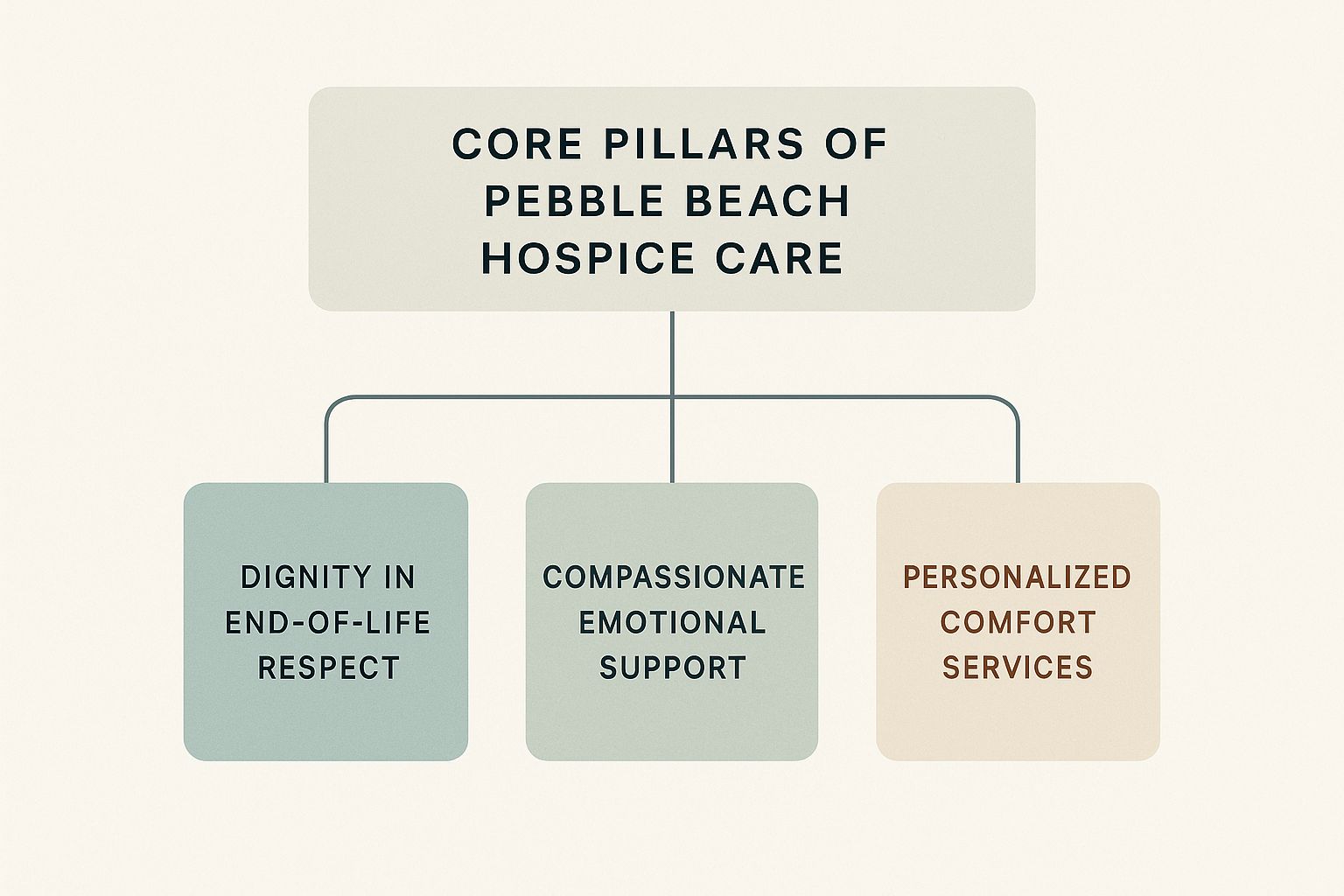
This structure is a philosophy woven into every interaction. It ranges from expert medical management to quiet moments of spiritual guidance.
Your Dedicated Circle of Support
Each person on the hospice team brings a specialized skill set. They create a holistic plan of care that honors the patient's wishes and supports the family. It’s a collaborative effort that makes sure no need gets overlooked. Think of it as a crucial safety net, giving you peace of mind around the clock.
Here is a closer look at the dedicated professionals who make up this compassionate team. They all work together to provide seamless care.
The CCVNA Hospice Care Team
An overview of the dedicated professionals providing compassionate care and their primary responsibilities for patients in Pebble Beach.
| Team Member | Primary Role and Responsibilities |
|---|---|
| Registered Nurse | A specialist in pain and symptom management, the RN ensures your loved one remains comfortable. They are experts at anticipating needs and adjusting care plans to maintain the highest quality of life. |
| Hospice Aide | Providing gentle and respectful assistance with daily personal care, the Hospice Aide helps preserve a person’s sense of dignity. You can learn more about the support provided by exploring these Hospice Aide responsibilities. |
| Medical Social Worker | This professional offers crucial emotional support, helping patients and families navigate complex conversations. They also connect families to valuable community resources. |
| Chaplain | Offering spiritual guidance tailored to your family’s unique beliefs, our Chaplains provide a comforting presence for people of all faiths or no faith at all. |
| Trained Volunteers | Our compassionate volunteers offer companionship for the patient and much-needed respite for family members, giving them a chance to rest and recharge. |
This entire group coordinates with your loved one’s own physician. This ensures that care is perfectly aligned with their personal medical history.
Always Available When You Need Us Most
One of the most reassuring parts of our hospice care program is its 24/7 availability. An illness does not follow a 9-to-5 schedule, and neither do we. Families in Pebble Beach can rest easy knowing that expert help is always just a phone call away, day or night.
This constant availability is more than a service; it's a promise. It’s the peace of mind that comes from knowing you are never alone on this journey, and that a compassionate expert is ready to provide guidance at any moment.
This round-the-clock clinical support is essential for managing unexpected symptoms. It allows families to keep their loved ones at home, avoiding stressful trips to the emergency room.
A Nonprofit Mission Focused on You
As a nonprofit organization with deep roots in Monterey County, our approach is driven by our mission, not by profit. For over 74 years, we have been committed to serving our community with integrity and heart.
This means every decision made by your hospice team comes down to one simple question: what is best for the patient and their family? Our nonprofit status allows us to focus completely on providing personalized comfort at the end of life.
Personalized Support for Body, Mind, and Spirit
Real comfort is about more than just managing physical pain. At Central Coast VNA & Hospice, our nonprofit mission is to care for the whole person—body, mind, and spirit. This promise of dignity and compassion: hospice care in Pebble Beach comes to life through specialized services. These services create moments of joy, connection, and peace.
We know that a person’s well-being is a mix of physical ease, emotional health, and spiritual comfort. That's why our care plans often include unique, non-medical support. These supports are meant to nurture the human spirit and honor the individual.

Nurturing Connection Through Specialized Therapies
Picture a quiet afternoon brightened by the gentle presence of a therapy dog. Its head resting softly on a patient's lap. The simple act of petting a friendly animal can cut through feelings of loneliness, offering unconditional comfort.
Music is another powerful way we reach beyond an illness. A familiar song played by our music therapist can unlock a treasured memory. This can spark a conversation and allow a family to connect in a meaningful way.
Our specialized programs are designed to meet the complete needs of our patients:
- Pet Therapy: Certified therapy animals and their handlers visit patients to provide calming companionship.
- Music Therapy: Our trained therapists use music to bring back positive memories and ease anxiety.
- Veteran-to-Veteran Program: This program pairs a trained volunteer who has a military background with a fellow service member, creating a bond of shared experience.
Hospice care is about honoring a life lived. These specialized services help us do that by celebrating the individual and nurturing the parts of them that an illness can never touch—their memories, their spirit, and their personal story.
To support this holistic approach, we also encourage exploring various therapeutic activities for mental health and well-being. These activities can give a real boost to patients and their families.
Honoring the Spiritual Journey
Spiritual well-being is a deeply personal and vital part of end-of-life care. It is about finding meaning and peace in one's own beliefs. Our Chaplains are here to support this journey with open hearts and without judgment.
They provide a compassionate presence for patients and families of all faiths, as well as those with no religious affiliation. Their role is to listen and help navigate complex emotions. This focus on individual belief systems is a cornerstone of dignified care. You can learn more about how we approach spiritual care in hospice.
As a nonprofit organization that has served Pebble Beach and Monterey County for over 74 years, our mission is focused on the patient. It's about making sure that every person’s final chapter is filled with comfort, dignity, and meaning.
Making Hospice Care Accessible and Affordable in Pebble Beach
When families in Pebble Beach look into hospice, two questions almost always come up. "Is my loved one eligible?" and "How much does it cost?"
Thinking about these details can feel overwhelming. The reality is much simpler than most people think. At Central Coast VNA & Hospice, our job is to bring clarity to these conversations.
It all starts with a discussion between a patient, their family, and their doctor. Choosing hospice is a decision to put comfort and quality of life first.
Understanding Hospice Eligibility
The first step is a medical one. A person is typically eligible for hospice if their doctor believes they have a life expectancy of six months or less. This assumes the illness runs its natural course. This isn't a hard deadline; it's a professional guideline that opens the door to a new kind of support.
Once a doctor confirms eligibility, the choice is personal. The patient and their family decide together to shift from curing the illness to managing symptoms. It's a powerful decision, and our dignity and compassion: hospice care in pebble beach is designed to support that choice.
Choosing hospice isn't about giving up. It's an active decision to redefine hope—to focus on living each day to the fullest, free from the strain of aggressive treatments.
How Hospice Care Is Covered
One of the biggest reliefs for families is learning how affordable this specialized care can be. As a nonprofit that has served the Central Coast for over 74 years, we are committed to lifting the financial burden from families.
Hospice provides a wide range of services designed for dignity and support. They are almost always fully covered. A common myth is that hospice is expensive. The truth is, Medicare pays 100% of the costs for eligible patients. This includes all care related to their diagnosis, plus medical equipment, at no extra charge. You can learn more by disproving common hospice myths on our blog.
Care is paid for through these primary sources:
- Medicare Part A: This is the most common coverage and typically pays for all hospice-related services.
- Medi-Cal: California's Medicaid program provides a comprehensive hospice benefit.
- Private Insurance: Most private and employer health plans offer a hospice benefit similar to Medicare’s.
Because of this broad coverage, nearly every family has zero out-of-pocket costs. This frees you to focus on what matters: spending precious time with your loved one.
Supporting Families Through Every Step
Hospice care is not just about the patient; it involves the entire family. We know that caring for a loved one at the end of life can feel overwhelming. That’s why our team at Central Coast VNA & Hospice empowers Pebble Beach families. We provide the education, training, and resources you need to provide care with confidence.

This holistic support is part of our promise to deliver dignity and compassion: hospice care in Pebble Beach. Our Medical Social Worker serves as a trusted guide. They help you navigate complex emotions and connect you with practical community resources.
A Commitment That Continues
Our nonprofit mission means our support doesn’t stop when your loved one passes away. We understand that grief is a unique path for every person. Hospice care extends its compassionate reach to support families long after. We offer guidance on how to deal with grief and find a way toward healing.
As part of our commitment to the communities we serve across Monterey County, we provide bereavement support for up to a year. This crucial service is offered at no cost to our families and includes:
- Individual Counseling: Private sessions with our experienced bereavement specialists.
- Support Groups: A safe space to connect with others who understand.
- Community Resources: Connections to other local support networks.
This ongoing care is a reflection of our community roots and our 74+ year legacy. Our team is here to help families heal.
At Central Coast VNA & Hospice, we believe in caring for families, not just patients. Our bereavement services are a core part of our nonprofit mission to provide comfort and support through every single step of the end-of-life journey.
Understanding the Community Impact
This model of care is vital for our community. According to the National Hospice and Palliative Care Organization (NHPCO), over 1.72 million Medicare beneficiaries received hospice services in 2020 (NHPCO, 2021). This data highlights the critical role of accessible, compassionate end-of-life care.
We offer comprehensive hospice bereavement services to ensure every family has the tools to navigate their loss. If you are in Pebble Beach and have questions about our family support programs, we invite you to start a conversation with our team today.
Frequently Asked Questions
Making decisions about end-of-life care brings up many questions. For families in Pebble Beach, getting clear answers is the first step toward feeling confident. At Central Coast VNA & Hospice, we believe knowledge is empowering. Here are some of the questions we hear most often.
1. When is the right time to think about hospice?
The best time to learn about hospice is long before you think you need it. The conversation becomes most relevant when curative treatments are no longer working as hoped. Patients and their families get the most out of our support when they enroll early. This gives our team time to provide comfort and manage symptoms.
2. Can my loved one keep seeing their doctor?
Absolutely. We view your loved one’s personal physician as a crucial partner in their care. Our hospice team works hand-in-hand with their doctor. Together, we make sure the plan of care is coordinated and aligned with your family’s wishes.
3. What happens if their condition improves?
Sometimes, a person’s condition can stabilize or even get better on hospice care. If that happens, or if they decide to pursue curative treatment again, they can be discharged from hospice at any time. The door is always open to re-enroll if their condition changes later.
4. How does CCVNA support our family's emotional needs?
Our care is designed for the entire family, not just the person who is ill. Our dedicated Medical Social Workers and Chaplains offer counseling, guidance, and a comforting presence. This support continues after your loved one passes away. We offer bereavement services for up to a year to help families navigate their grief.
5. Isn't hospice only for the last few days of life?
This is a common myth. While we provide intensive support during the final days, the true benefits of hospice shine when care begins much earlier. Starting hospice weeks or months in advance allows our team to manage symptoms before they become a crisis. It gives us time to build trusting relationships with the patient and family.
If you have more questions about how our services could support your family in Pebble Beach or anywhere in Monterey County, please reach out. The compassionate team at Central Coast VNA & Hospice is here to listen and provide the guidance you need.
Contact us today to learn more about our hospice care services.
Expert Aging in Place Services Near You in Monterey
What are "expert aging in place services"? In Monterey, it's about bringing skilled medical support right to your home. These are not companion services. They are led by licensed clinicians like Registered Nurses and therapists.
Our teams help older adults manage their health and stay independent. We help them live safely in the place they know and love. It’s professional healthcare, delivered to your doorstep.
Keeping Your Independence with In-Home Support

Staying in the home you love is a goal for many people in Monterey County. It’s a feeling shared across the nation. In fact, an overwhelming 94% of seniors would rather age in place than move to a facility.
This shows how important it is to make independent living safe and possible. With the right support system, you never have to face health challenges alone.
How Clinician-Led Services Help
Professional, clinician-led home healthcare provides skilled support that makes a real difference. This care is helpful for managing a chronic condition or recovering from an injury. It’s also for those dealing with new mobility limits.
This care model is built on medical expertise. A dedicated team from a local, nonprofit provider like Central Coast VNA & Hospice can deliver:
- Skilled Nursing: A Registered Nurse can manage complex medication schedules and check vital signs. They also dress wounds and work with your doctor to prevent hospital visits.
- Therapeutic Support: Physical and Occupational Therapists create custom exercise plans. These plans improve strength, restore balance, and make your home safer to move around in.
- Personalized Care Plans: Every plan is built around your specific needs and goals. This ensures your home stays a safe place for healing and independence.
The Core Components of Expert Aging in Place Services
To live well at home, your support needs to cover several key areas. It's a whole-person approach that addresses medical needs and the practical parts of daily life.
| Service Area | What It Involves | How It Supports Independence |
|---|---|---|
| Medical Management | Medication help, vital sign monitoring, wound care, and disease education by a Registered Nurse. | Prevents health crises, reduces hospital readmissions, and ensures chronic conditions are well-managed. |
| Rehabilitative Therapy | Physical, occupational, and speech therapy sessions at home to restore function, strength, and communication. | Improves mobility, helps with daily activities like dressing, and boosts confidence after an illness or injury. |
| Home Safety | Assessing the home for fall risks and suggesting changes like grab bars or better lighting. | Creates a safer living space, greatly reducing the risk of accidents that could lead to a hospital stay. |
Combining skilled care with smart home changes is key. Making small adjustments, like understanding ADA faucet requirements for easier use, can make a big difference. These changes help you stay in control of your daily routines.
Expert services empower you to live confidently on your own terms. Our team is here to show you how you can age in place with senior home care and live a full, independent life.
What Clinician-Led Home Health Care Really Looks Like
What happens when a Registered Nurse from Central Coast VNA & Hospice visits your home? It’s the start of a partnership. It is designed to fit your life and support your health goals where you feel most comfortable.
It all starts with listening. We need to understand your unique situation.
Imagine you are recovering from a fall or surgery. Traveling to a clinic can be tiring. Instead, our clinical team comes to you.
We work with your doctor to build a care plan that feels seamless. This helps you feel stronger, safer, and more in control every day.
Your Personalized Care Team in Action
When you choose expert aging in place services near you in Monterey, you get a whole team. This team is dedicated to your well-being. It’s not just about reacting to problems.
It’s about proactive support that helps prevent future health issues. The need for this type of in-home support is growing. The home care market is expanding, with seniors aged 65 and older making up 17.5% of the U.S. population in 2025.
Your in-home clinical team might include:
- A Registered Nurse who can manage medications, check vital signs, and educate you about your condition. This consistent oversight is key to preventing complications.
- A Physical Therapist to guide you through targeted exercises. The goal is to rebuild strength, improve balance, and boost your confidence in moving safely around your home.
- An Occupational Therapist who helps you master daily activities again. This could be anything from getting dressed to preparing meals by adapting your environment to your abilities.
Building a Plan That Works for You
Every visit focuses on one thing: making real progress toward your goals. We believe the best care happens when it's a partnership. This partnership is between you, your family, your doctor, and our clinical team.
Our approach is centered on a simple idea: provide the medical care and support you need to live as independently as possible. We empower you with the tools and knowledge to manage your health confidently at home.
This coordinated effort makes sure every piece of your health is addressed. By bringing skilled nursing at home, we help you avoid unnecessary trips to the hospital. As a nonprofit, our mission-driven commitment means we always focus on your health and independence.
Managing Chronic Conditions and Mobility at Home
Living at home with a chronic condition like diabetes or COPD requires special support. Navigating new mobility challenges also calls for help. This is where expert aging in place services near you in Monterey make a difference.
We provide targeted medical care that makes daily life safer and more manageable. Someone managing heart failure needs more than a pill reminder. They benefit from a Registered Nurse who monitors symptoms and oversees medications.
This proactive, in-home nursing helps prevent complications. It reduces the chance of a stressful trip to the emergency room. It’s clinician-led support, built around your specific health needs.
Tailored Support for Daily Living
Our approach is centered on real-world solutions. We don't just treat the condition. We help you adapt your home and routines to live better with it.
Our licensed therapists are key to this process. They work with you to create a safer, more accessible environment. Here’s how that might look:
- Occupational Therapy: An Occupational Therapist can assess your living spaces to find simple ways to make life easier. They might suggest rearranging items to be within easy reach or recommend adaptive tools. The goal is to preserve your energy and independence.
- Physical Therapy: After a hospital stay, a Physical Therapist creates a custom exercise plan to help you regain strength. Having these sessions at home helps build confidence and is a key part of preventing falls in the home.
Our clinical team focuses on practical, personalized support that helps you maintain control over your health and daily life. It's not just care—it’s a true partnership dedicated to your well-being.
As a local nonprofit serving Monterey County for over 74 years, Central Coast VNA & Hospice is deeply committed to providing these essential services. We're here to help you stay right where you want to be: at home.
Why a Local Nonprofit Partner Matters
When you look for expert aging in place services near you in Monterey, you'll find different kinds of organizations. Choosing a home health provider is about more than a list of services. It’s about trust.
Partnering with a local, nonprofit provider like Central Coast VNA & Hospice makes a real difference. Unlike large for-profit chains that answer to shareholders, our mission is built around our community. We don’t have shareholders; we have neighbors.
This means we reinvest every resource back into improving patient care and our local health programs. For over 74 years, our focus has been serving families here in Monterey County and across the Central Coast.
A Mission-Driven Approach to Care
This nonprofit commitment means your care is guided by your health needs, not a balance sheet. Our clinicians are often your neighbors. They are deeply invested in the health of the community we all share.
This local connection creates a more personal and compassionate care experience. Our team works with you to create truly personalized care plans. These plans are all designed to help you live safely and independently at home.
You can learn more about why Central Coast VNA & Hospice is the best choice for home health care and see our mission in action.
When you choose Central Coast VNA & Hospice, you're not just a patient. You're part of a community we've served for generations. Our priority is your health, comfort, and dignity.
Finding the Right Home Health Partner in Monterey
Deciding to bring professional support into your home is a big step. When you search for expert aging in place services near you in Monterey, it’s easy to feel overwhelmed. Knowing what to look for can give you confidence.
You are not just hiring an agency. You are finding a partner who understands your family’s needs. The demand for quality elder care is rising.
Globally, the market is expected to hit $1.1 trillion by 2028. You can read the full research about elder care services to understand these trends. More options mean you must be careful in choosing a provider with a proven track record.
Key Questions to Ask Any Agency
Before you agree to anything, have a real conversation with any potential provider. Treat it like an interview. Your goal is to make sure they are the best fit for your loved one.
A few direct questions can tell you a lot:
- Are you Medicare-certified? This is essential. It ensures the agency meets strict federal quality standards and that services can be covered.
- What are the credentials of your clinical staff? Care should be delivered by licensed professionals, like Registered Nurses and Physical Therapists.
- How do you create and update a care plan? The best answer involves a team approach with the patient, their family, and their doctor.
This chart breaks down the typical process, from the first assessment to ongoing support.
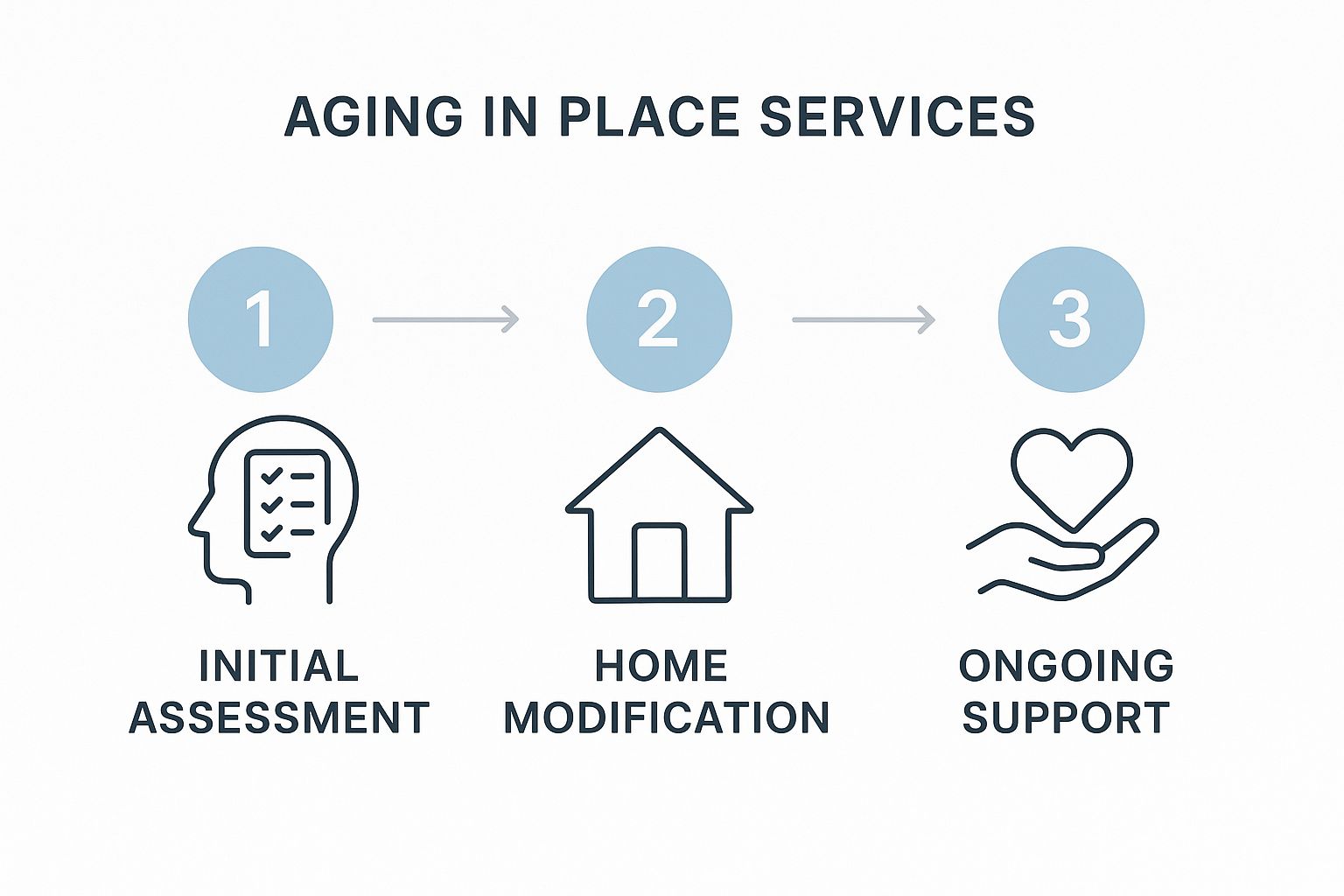
A clear process like this is a good sign that care will be personalized and effective.
The right partner won’t just answer your questions—they’ll make you feel heard, respected, and understood. An agency's deep roots in the local community often speak volumes about their commitment and reliability.
As a nonprofit that has served this community for over 74 years, Central Coast VNA & Hospice is built on trust and compassion. Our team is here to walk you through your options for home health care in Monterey. We provide the expert, clinician-led support your family deserves.
FAQs: Your Questions About Aging in Place Answered
Figuring out home health care can feel confusing. It's natural to have questions. Here are some simple answers to what we hear most often from families in Monterey.
How do I know if my loved one needs aging in place services?
You know your loved one best. Small changes often signal a need for more support. Have they had a recent fall, or is managing medication becoming a struggle?
If they have trouble with daily routines like bathing or preparing meals, it's a good time to talk to their doctor. A clinical assessment by a Registered Nurse can then identify the exact support needed to keep them safe at home.
Is skilled home health care covered by Medicare in Monterey?
Yes, for those who are eligible, Medicare Part A and/or Part B can cover home health services. The care must be ordered by a doctor and provided by a Medicare-certified agency, like Central Coast VNA & Hospice. This typically covers services like skilled nursing and physical or occupational therapy.
What is the difference between home health and in-home care?
This is an important distinction. Home health care provides skilled, clinical services ordered by a physician. This includes medical care from a Registered Nurse or rehabilitation from a licensed Therapist.
In-home care often refers to non-medical help with personal tasks. This can include making meals, light housekeeping, or providing companionship. At Central Coast VNA & Hospice, our teams are made up of licensed clinicians who focus on medical care.
How does Central Coast VNA & Hospice create a personalized care plan?
Our approach is built around the individual. It starts with an assessment by a Registered Nurse in the patient’s home. We talk with the patient, their family, and their doctor to understand their health goals.
Using that information, we create a custom plan of care. This plan is a clear roadmap that outlines the skilled services needed, visit frequency, and treatment goals.
What areas do you serve besides Monterey?
Central Coast VNA & Hospice proudly serves families across the Central Coast of California. Our local teams are dedicated to providing compassionate, clinician-led care. Our service areas include Monterey County, San Benito County, Santa Cruz County, and South Santa Clara County.
Ready to explore how professional home health care can support your family? The team at Central Coast VNA & Hospice has provided compassionate, mission-driven care for over 74 years. Contact us today to learn more about how we can help your loved one thrive at home.
VNA’s Comprehensive Skilled Care: Monterey’s Best Choice
Finding the right care after a hospital stay can feel overwhelming for families in Monterey County. Choosing VNA’s skilled care brings expert medical professionals to your door. This helps you have a safe and supported recovery at home.
This approach is not just easier for you. Healing in a familiar space often helps you recover faster and more effectively.
Your Trusted Path to Recovery at Home
Leaving the hospital is a big step, but the real work of recovery starts at home. Healing happens best in a peaceful space where you can rest and regain your strength. Central Coast VNA & Hospice brings a dedicated medical team right to you.
Think of us as your partner in health. For over 74 years, we have been a nonprofit, mission-driven organization. We serve our communities across Monterey County, San Benito County, Santa Cruz County, and South Santa Clara County.
The Benefit of Healing in a Familiar Place
There is a reason people say "there's no place like home," especially when you are recovering. Healing in your own space has powerful advantages.
- Improved Comfort and Rest: It is easier to heal in your own bed. Familiar surroundings reduce anxiety and help you get the deep sleep needed for recovery.
- Lower Risk of Infection: Your home is a controlled environment. This means a much lower risk of exposure to infections found in healthcare facilities.
- Greater Independence: Our team works with you to regain confidence. We help you adapt your home for safety and manage daily tasks on your own terms.
Our goal is to create a smooth transition from the hospital to your front door. We work with your doctor to create a personal care plan. You can learn more by recovering from surgery at home.
What Is Comprehensive Skilled Care?
"Comprehensive skilled care" means bringing specialized medical attention into your home. It’s like having a hospital team in your living room. Central Coast VNA & Hospice delivers this level of care.
Skilled care is medical care that must be handled by a licensed professional. This includes a Registered Nurse or a Physical Therapist. Their work is based on direct orders from your doctor.
This care is essential after a hospital stay for surgery, illness, or injury. It covers needs like wound care, managing medications, or physical therapy. Without it, recovery can be a longer and tougher road.
It’s More Than Just One Service
The "comprehensive" part is where the VNA approach truly shines. We bring together a multidisciplinary team to create a recovery plan just for you.
This team approach ensures every part of your health is considered. Your team could include:
- Registered Nurses (RNs) oversee your medical plan, give medications, and teach you and your family about your condition.
- Physical Therapists (PTs) help you rebuild strength, mobility, and balance to move safely around your home.
- Occupational Therapists (OTs) guide you in relearning daily tasks like dressing, bathing, and cooking.
- Medical Social Workers connect you with community resources and help with emotional support and long-term planning.
Our team handles all the communication and collaboration. This teamwork makes your recovery journey smoother and more effective. Learn more about our skilled nursing services at home.
Coordinated Care Leads to Better Results
This collaborative approach empowers you to take back control of your health. With a full team looking at the big picture, we can spot issues before they become serious. To understand how overall health is measured, you can read about comprehensive health panels.
A coordinated care plan is a living roadmap to recovery. It ensures every team member is aligned with your personal health goals, helping you achieve independence faster and more safely.
Choosing VNA means you are gaining a partner dedicated to your recovery. We focus on helping you heal right where you belong—at home.
The VNA Difference: 74 Years of Local Expertise
When a health crisis happens, families in Monterey County face many choices. Central Coast VNA & Hospice offers a clear, steady hand. Our 74-year legacy is built on a simple idea: healthcare should put people before profits.
As a nonprofit, our mission guides every decision. We reinvest our resources into improving patient care and staff training. This focus benefits everyone in Monterey, San Benito, Santa Cruz, and South Santa Clara counties.
A Legacy of Trust Built on Community Roots
For generations, Central Coast families have turned to us in their most vulnerable moments. That trust was earned over decades of providing compassionate and excellent care.
Our roots are deep in this community. We understand the local healthcare landscape and the needs of our neighbors. Our team members are your neighbors, committed to the health of the community we all call home. You can learn more about how VNA provides health services for seven decades.
The Gold Standard of Medicare Certification
Being Medicare-certified is our promise of quality, safety, and reliability. This certification holds us to the highest national standards for home healthcare. We undergo rigorous evaluations to maintain it.
This gives patients and families peace of mind. It is a guarantee that the care you receive meets strict, evidence-based clinical benchmarks.
Choosing a Medicare-certified agency like VNA guarantees that your care team follows proven best practices for patient safety, infection control, and positive health outcomes. It is the gold standard for in-home medical services.
This dedication to quality ensures our patients get the best support for their recovery. It helps them regain independence and stay safely at home.
The Nonprofit Mission: Patient-Centered Care
The difference between a nonprofit and a for-profit provider is huge. For-profit agencies must focus on their bottom line. At VNA, our mission allows us to focus only on what is best for you.
What does that look like?
- Decisions Based on Need: Your care plan is built around your medical needs and goals, not profit margins.
- Focus on the Whole Person: We take the time to understand you as a person, not just a patient.
- Commitment to Access: As a nonprofit, we are dedicated to making our services accessible to every eligible person in our community.
This patient-first philosophy is the foundation of our organization. It is our combination of local expertise and compassion that makes VNA the trusted choice for care at home in Monterey.
How Our Team Works Together for Your Recovery
Getting back on your feet after a hospital stay takes a solid plan and a great team. At Central Coast VNA & Hospice, we build that team around you. Our specialists work together to create a smooth and supportive healing experience.
Coming home after surgery can feel overwhelming, but you are not alone. Our team works like a pit crew, with each person playing a key role.
This chart shows our basic framework. We always start with your specific needs to create a personalized care plan.
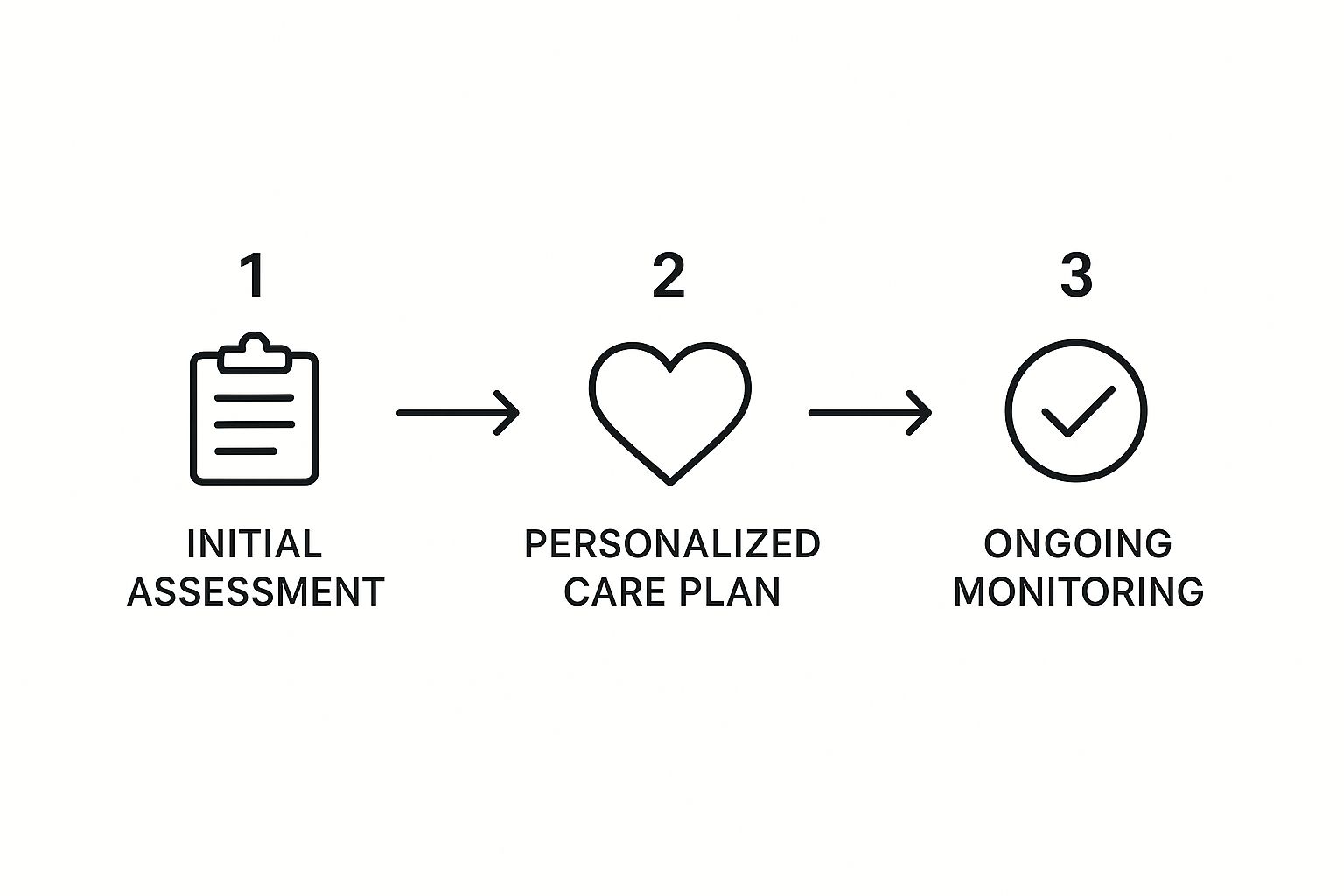
This straightforward approach is powerful because it allows us to adapt your care as you get stronger.
The Experts on Your Dedicated Care Team
So, how does this work in real life? The magic is not just in individual skills, but in how the team connects and collaborates for you.
Here’s a look at your team in action:
- A Registered Nurse (RN) is your main medical guide. They manage your care plan, medications, and wound care, and keep your doctor informed.
- A Physical Therapist (PT) is your movement specialist. They help you regain strength, balance, and flexibility so you can walk and climb stairs safely.
- An Occupational Therapist (OT) is your champion for daily living. They show you practical ways to do everyday tasks safely, like dressing or showering. You can learn about the benefits home health care patients receive from Occupational Therapists in our guide.
- A Medical Social Worker provides practical and emotional backup. They connect you with community resources and help manage the stress of recovery.
These professionals are always talking to each other. This seamless communication is what makes our care so effective.
With this integrated approach, your care is never siloed. You get one cohesive team focused on a single mission: getting you better, right at home.
Delivering this high-quality care takes a serious commitment to clinical excellence. According to the Centers for Medicare & Medicaid Services (CMS), skilled nursing facilities will see a 4.1% net increase in Medicare Part A payments in fiscal year 2025 (CMS, 2024). This support is crucial for a nonprofit like ours, as it allows us to invest in our team and provide the top-tier care our community deserves.
A Partner for Your Entire Health Journey
A person’s health needs can change over time. With Central Coast VNA & Hospice, you can set aside the worry of finding a new provider. A change in your needs simply means a smooth transition to a different level of support from the same trusted team.
This continuity of care is designed to provide deep peace of mind. Our model is built to adapt right alongside you.

From Home Health to Palliative and Hospice Care
Navigating different stages of health can be hard, but your care plan should not add to the stress. VNA is unique in Monterey County because we offer a full spectrum of in-home medical support. We call this our Continuum of Care.
You might start with our home health team after surgery. If your condition becomes more complex, we can bring in our palliative care specialists. Should your illness progress, our hospice team can provide comfort and dignity, all without you leaving the VNA family.
Staying with a single, trusted provider means you can skip the logistical nightmare of transferring records and building new relationships during a challenging time. It frees you to focus on your well-being.
This unified approach ensures nothing gets lost in translation. We explain more about how we make the transition from hospital to home a smooth one in our guide.
The Power of a Consistent, Familiar Team
There is a powerful sense of security that comes from knowing the faces walking through your door. As you move between VNA services, you will often keep many of the same team members. This familiarity is a huge source of comfort and reduces stress for patients and families.
Having a consistent team offers real benefits:
- Preserved Knowledge: Your team already understands your health history and what is important to you.
- Reduced Family Stress: Loved ones do not have the burden of coordinating with new agencies.
- Trust and Comfort: The bond you form with your clinicians creates a supportive environment built on respect.
Choosing VNA means choosing a partner for your entire health journey. Our comprehensive skilled care in Monterey ensures you will always be surrounded by a familiar, compassionate team.
Frequently Asked Questions (FAQs)
How is VNA's skilled care different from a private aide?
A private aide helps with daily living tasks like housekeeping or companionship. VNA’s skilled care is medical care delivered by licensed clinicians like Registered Nurses and Physical Therapists. Our team follows your doctor's orders to help you meet clinical goals and recover your independence.
Is skilled home health care covered by Medicare?
Yes, for most eligible patients, skilled home health is covered by Medicare. As a Medicare-certified agency, our services meet the high standards required for coverage. Our team works with Medicare, Medi-Cal, and most private insurance plans to verify your benefits for you.
How do I know if I qualify for skilled care?
You generally qualify if you are under a doctor's care, need intermittent skilled services from a licensed professional, and are considered "homebound." Being homebound means leaving home requires a major effort. Our team can help you and your doctor determine if you meet the criteria.
How long will my skilled care services last?
The length of care depends on your specific needs and recovery goals. Your personalized care plan will have clear milestones. As you get stronger, we will adjust our visits until you can safely manage on your own.
What happens if my health needs change?
This is a key benefit of choosing Central Coast VNA & Hospice. Our Continuum of Care allows us to adapt with you. If you need palliative or hospice care, we can make a seamless transition, allowing you to stay with the same trusted organization.
How do I start services with Central Coast VNA & Hospice?
Getting started is simple. A referral can come from your doctor, a hospital discharge planner, or you can contact us directly. Our intake team will guide you through the next steps and coordinate with your doctor's office to set up your first home visit.
Ready to see how Central Coast VNA & Hospice can help you or a loved one recover safely and comfortably at home? Let's talk. Contact us today to start the conversation. https://ccvna.com

5 Expert Tips to Prevent Medication Errors at Home
Managing many medications can feel like a big task. Mistakes can lead to serious health problems. For families in Monterey County and across the Central Coast, keeping a loved one safe is a top priority. This is especially true when they are receiving home health or palliative care.
Adverse drug events cause over 1 million emergency department visits each year. This is according to the Centers for Disease Control and Prevention (CDC, 2023). Many of these problems can be stopped with the right knowledge.
At Central Coast VNA & Hospice, our skilled clinicians have spent over 74 years helping patients. We are a nonprofit, mission-driven organization dedicated to our community. We have seen how simple strategies can make a big difference. This guide shares tools and insights from our clinical teams to help you manage prescriptions safely.
Here are 5 expert tips to prevent medication errors at home.
1. Keep an Accurate, Updated Medication List
The most powerful tool for medication safety is a complete, current list of every medication you take. This list helps you communicate clearly with all your healthcare providers. It is one of the simplest ways to prevent medication errors at home.
When our Registered Nurses visit a patient in San Benito County, this list is the first thing they check. A complete list includes more than just prescriptions. It must include everything, like over-the-counter pain relievers, vitamins, and herbal supplements. These items can cause dangerous interactions if your doctors don't know about them.
What to Include on Your List
Your medication list should be detailed and easy to update. For each medication, be sure to write down the following information:
- Name of the Medication: Include both the brand name and the generic name.
- Dosage: Write down how many milligrams are in each pill (e.g., 25 mg).
- Frequency and Timing: Note how often and what time you take it (e.g., "Twice daily at 8 a.m. and 8 p.m.").
- Prescribing Doctor: List the name of the provider who prescribed it.
- Reason for Taking: Explain the condition the medication treats (e.g., "For high blood pressure").
Actionable Tips for Success
Keeping your list current is very important. Update it right away any time a medication is started, stopped, or the dose changes. This is a key step, especially when you are managing care for an aging parent. For more help, discover strategies for caring for elderly parents at home.
Here are some ways to keep your list handy and correct:
- Use a Smartphone App: Apps can help you organize and share your list digitally.
- Carry a Wallet Card: A small card with your medication info can be a lifesaver in an emergency.
- Share with Family: Give a copy to a trusted family member who helps with medical appointments.
2. Use a Pill Organizer System
A messy pile of pill bottles can cause confusion and lead to medication mistakes. Using a system to organize medications is a key step to make sure doses are taken correctly and on time. This method removes the guesswork and gives a clear guide to your medication schedule.
Organizing your medications helps prevent taking a dose twice or missing one. A clear system is very important for people with many prescriptions. When our clinicians visit patients in Santa Cruz County, setting up a good organization method is a top priority for safety.
What a Good System Looks Like
A good medication system is simple and fits your needs. The goal is to make your daily routine as safe as possible.
- Pill Organizers: A seven-day pill organizer with sections for morning, noon, evening, and bedtime is a very effective tool.
- Designated Storage: Keep all medications in a cool, dry place away from children and pets.
Actionable Tips for Success
Being consistent is the key to making your system work. Set aside a time each week, like Sunday evening, to fill your pill organizer. Do this in a quiet, well-lit space so you can focus.
Here are some more tips to improve your system:
- Check Labels: When filling your organizer, double-check the label on each bottle to confirm the medication and dose.
- Keep Emergency Meds Separate: Store medications like nitroglycerin or rescue inhalers in a consistent, easy-to-reach place, away from your daily pills.
- Replace When Needed: Pill organizers can get old. Replace yours every year or if the labels fade.
For more details on creating a safe medication routine, read our guide on medication management for the elderly.
3. Use the 'Five Rights' Before Taking Medications
Healthcare professionals use a safety check called the "Five Rights" to prevent errors. This simple system can also be used at home. It creates a final check before you or a loved one takes any medication.
The 'Five Rights' is a way to pause and confirm you are making the right choice. Our skilled Registered Nurses at Central Coast VNA & Hospice teach this to patients and families. It helps them manage their care safely. This strategy is one our teams use to help reduce problems and improve patient outcomes.
What Are the Five Rights?
Before each dose, pause and check these five points. This simple check is one of the best expert tips to prevent medication errors at home.
- Right Patient: Is this medication for you (or the person you are helping)?
- Right Medication: Does the name on the bottle match what you are supposed to take?
- Right Dose: Are you taking the correct amount, such as one pill?
- Right Route: Is the medication taken by mouth, or another way?
- Right Time: Is it the correct time of day to take this medication?
Actionable Tips for Success
Making the 'Five Rights' part of your daily routine turns it into a safety habit. This process is very important for taking medications correctly. It is a key part of at-home care that helps in preventing hospital readmissions.
Try these tips to make the 'Five Rights' a natural part of your schedule:
- Say It Aloud: Speak each of the five rights as you check them.
- Use Good Lighting: Always check medications in a well-lit area to avoid mistakes.
- Trust Your Gut: If a pill looks different, do not take it. Call your pharmacist right away to check.
4. Talk Clearly with Your Healthcare Team
Your healthcare team is there to help you. They can give the safest care when they have all the information. Clear talks with your doctors, nurses, and pharmacists create a safety net that helps prevent medication errors at home.
Good communication goes both ways. You need to share information and ask questions until you understand your treatment plan. This makes you a partner in your own health. Being an active partner is a key part of getting good results. You can find more tips in these patient engagement strategies.
What to Talk About and When
Communication is not just for appointments. Be sure to contact your provider or pharmacist about:
- New or Worsening Side Effects: Report any unusual symptoms right away.
- Concerns About Cost: Your doctor may be able to prescribe a cheaper option.
- Confusion About Instructions: If you are confused, ask for an explanation.
- Use of Over-the-Counter Products: Always check with your pharmacist before starting new vitamins or supplements.
Actionable Tips for Success
Preparing for talks with your healthcare team can make them more helpful. Here are some ways to ensure clear communication:
- Prepare a Question List: Before each appointment, write down all your questions.
- Bring All Your Bottles: Take your medication bottles to appointments for a "brown bag review."
- Use One Pharmacy: Using one pharmacy helps your pharmacist spot potential problems.
- Ask for Simple Terms: If you do not understand, say, "Could you please explain that to me in a different way?"
5. Get Help from Home Health Professionals
Sometimes, managing medications at home becomes too difficult, especially after a hospital stay or with a new diagnosis. This is when professional support can make all the difference. Central Coast VNA & Hospice offers expert home health, palliative care, and hospice services across the Central Coast.
Our skilled clinicians, including Registered Nurses and therapists, come to your home. They provide personalized care that prevents medication errors before they happen. An in-home visit is a powerful tool to identify and solve risks.
How In-Home Visits Prevent Errors
Our team provides hands-on support right where it matters most—at home. We serve Monterey County, San Benito County, Santa Cruz County, and South Santa Clara County.
Here is how we help:
- Medication Reconciliation: Our clinicians review all your prescriptions, over-the-counter drugs, and supplements to create one accurate master list.
- Patient and Family Education: We teach you and your family about each medication, its purpose, side effects, and the importance of the schedule.
- Setting Up Systems: We help you create a simple, effective organization system, like a weekly pillbox, and make sure you know how to use it. This is a key part of our home health care services.
- Coordination with Doctors: We communicate directly with your doctors to clarify orders and report any issues, ensuring your entire care team is on the same page.
Actionable Tips for Success
The support of a professional can bring peace of mind and improve safety. Our goal is to empower you to manage health at home confidently.
- Ask for a Referral: Talk to your doctor about getting a referral for home health services if you feel overwhelmed.
- Be Prepared for the Visit: Have all your medication bottles and your list ready for the visiting clinician.
- Involve Your Family: Ask a family member to be present during the visit to learn alongside you. This teamwork is crucial for long-term success.
Your Partner in Safe Home Care
Taking control of your health at home starts with managing your medications safely. Preventing mistakes is about creating strong systems that protect you or your loved one. By using these 5 expert tips to prevent medication errors at home, you build a powerful safety net.
This guide gives you a clear path. You now have ways to keep an accurate medication list, use pill organizers, and apply the 'Five Rights' before every dose. Clear communication and professional support are the final layers of protection. Each tip works to reduce mistakes and help you feel confident in your care.
At Central Coast VNA & Hospice, our mission is to empower families with the knowledge they need. As a local nonprofit, we have been serving our communities for over 74 years. Our continuum of care, from home health to hospice, ensures you have a trusted partner. If you need support, our compassionate team is here to help, bringing expert care into your home.
Are you looking for professional support to help manage medications at home? The skilled clinicians at VNA and Hospice provide expert in-home assessments and create personalized care plans. Learn more about how our services can provide peace of mind for you and your family by visiting us at VNA and Hospice today.
Frequently Asked Questions (FAQs)
1. What is the most common cause of medication errors at home?
The most common causes are taking the wrong dose, taking a medication at the wrong time, or forgetting a dose completely. A disorganized system and poor communication with doctors contribute to these errors.
2. How can a pill organizer help prevent mistakes?
A pill organizer allows you to sort medications for the entire week. This provides a clear visual reminder of what to take and when, which helps prevent missed or double doses.
3. Why is it important to tell my doctor about vitamins and supplements?
Vitamins, herbs, and over-the-counter products can interact with prescription medications. These interactions can make your medicine less effective or cause harmful side effects.
4. What should I do if I think I made a medication error?
If you think you made an error, contact your doctor or pharmacist immediately for guidance. If you are experiencing severe symptoms like trouble breathing, call 911.
5. How can Central Coast VNA & Hospice help with medication management?
Our Registered Nurses provide in-home visits to review all your medications, educate you and your family on how to take them safely, set up organization systems, and coordinate with your doctors. This service is part of our comprehensive home health and palliative care programs in Monterey, San Benito, Santa Cruz, and South Santa Clara counties.
Palliative Care for Seniors: A Complete Guide
Palliative care is a special type of medical care. It provides relief from the symptoms and stress of a serious illness. Its main goal is to improve the quality of life for patients and their families. Think of it as an extra layer of support that works with your other treatments.
Understanding Palliative Care and Its Purpose
When a senior lives with a serious illness, daily life can be a challenge. Palliative care helps ease that burden. It is important to know that it is not the same as hospice. Palliative care can start at any stage of an illness, even right after diagnosis.
This care offers a dedicated support system. A special team works with your main doctor to manage symptoms like pain or nausea. They also help with the emotional and spiritual stress of a chronic condition. This approach makes sure your healthcare choices match your personal goals.
This visual shows the key parts of palliative care for seniors. It highlights how it manages pain, gives emotional support, and includes the family.
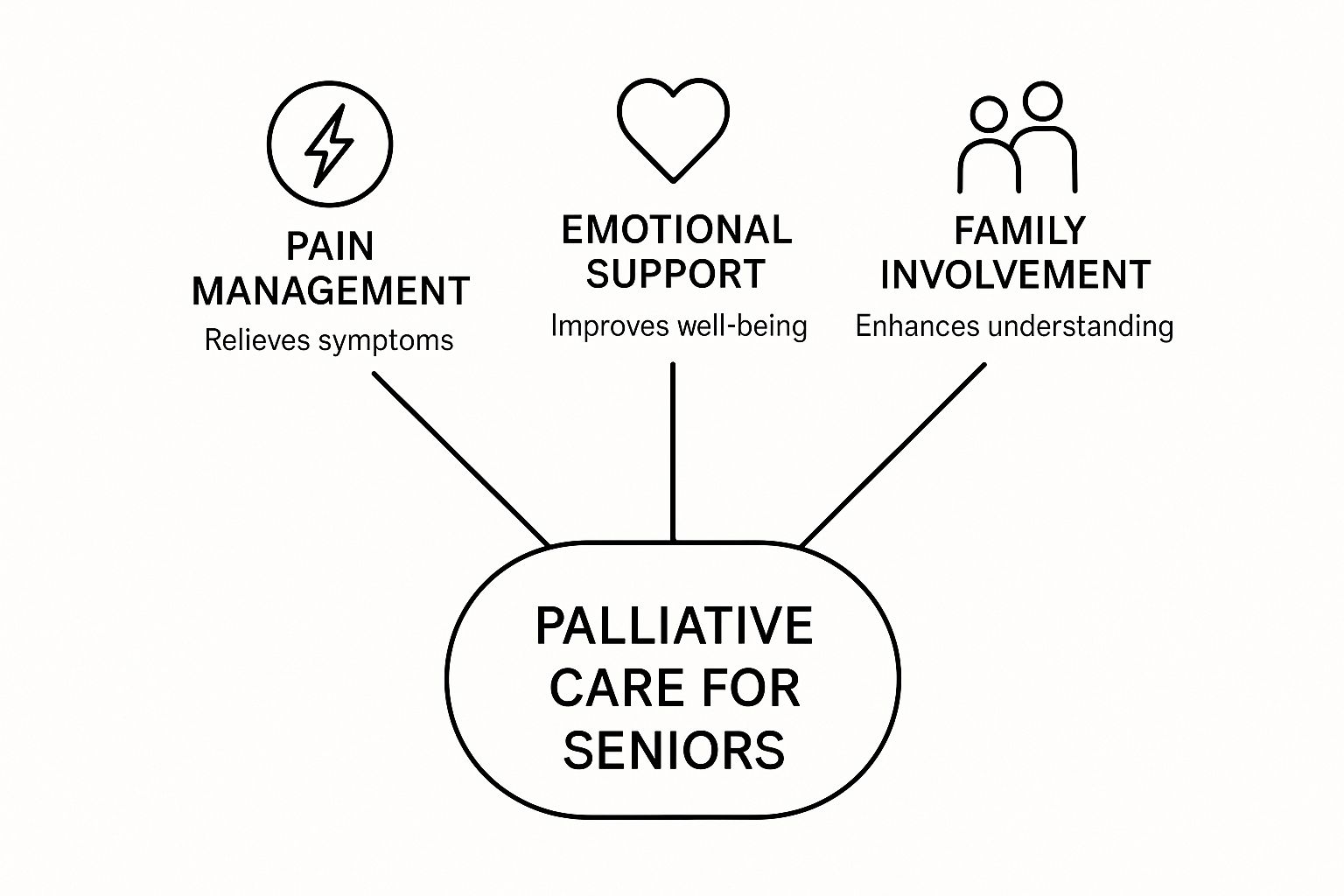
As you can see, this care model surrounds the patient and their loved ones. It creates a full circle of support.
An Extra Layer of Compassionate Support
The focus of palliative care is to improve overall well-being. It is meant to go along with the treatments you already receive, not replace them.
The need for this kind of support is growing. In fact, the global demand for palliative care grew significantly between 1990 and 2021. This is largely due to the rise of chronic illnesses in aging populations.
At Central Coast VNA & Hospice, our nonprofit team has provided this care for over 74 years. We proudly serve families in Monterey County, San Benito County, Santa Cruz County, and South Santa Clara County.
Palliative care is about living as well as possible, for as long as possible. It focuses on the whole person—not just the disease—by addressing physical, emotional, and spiritual needs to enhance comfort and dignity.
This focus on the whole person makes palliative care so helpful. It is about more than medicine. It provides comfort, clarity, and control. To learn more, you can read our guide on what comfort care means. This ensures every senior gets care that respects their wishes.
The Core Goals of Palliative Care
It is easy to think palliative care is just about treating an illness. But it is much more—it is about treating the whole person. The goal is to improve the quality of life for seniors with serious health issues. We want to make sure they feel comfortable, respected, and in control.
This approach helps with physical symptoms and the emotional toll of a long-term condition. Think of it as a partnership between the patient, their family, and a team of professionals. At Central Coast VNA & Hospice, we have delivered this compassionate care to families on the Central Coast for over 74 years.
Comprehensive Symptom Management
A key part of palliative care for seniors is managing difficult symptoms. A serious illness can bring tough physical issues that get in the way of daily life.
The care team works with your primary doctor to create a plan. It is designed to relieve symptoms before they get worse. This helps you keep your strength and independence.
This includes managing things like:
- Chronic Pain: Using proven methods to reduce pain and improve comfort.
- Shortness of Breath: Finding ways to ease breathing and calm anxiety.
- Fatigue and Weakness: Developing strategies to save energy for important things.
- Nausea or Loss of Appetite: Providing medical and nutritional support to help you feel stronger.
By managing these symptoms, palliative care helps seniors get back parts of their lives. It lets them enjoy activities and spend quality time with loved ones.
Emotional and Spiritual Support
A serious illness affects the body, mind, and spirit. It can bring anxiety, depression, and worry for the patient and their family. Palliative care provides vital emotional and spiritual support to address these challenges.
This part of care is just as important as managing physical pain. A Medical Social Worker can offer counseling and connect you with community resources. A Chaplain can provide spiritual comfort to people of all beliefs. This complete support helps families find peace during a difficult time.
Palliative care is designed to support the entire family, not just the patient. By addressing the emotional and spiritual needs of everyone involved, it helps reduce stress and improve coping skills for the whole family unit.
This support system means no one has to face these challenges alone. It offers a steady hand to guide you. You can learn more about the benefits of palliative care on our website.
Aligning Care with Your Wishes
A central goal of palliative care is making sure your medical treatment matches your personal values. It is all about clear, open communication between you, your family, and your healthcare providers. This keeps everyone on the same page.
Your palliative care team acts as your advocate. They help you understand your treatment options and share your goals. By guiding these talks, they ensure your voice is heard and your wishes are respected. This gives you more control over your health journey.
Who Can Benefit from Palliative Care Services?
Many people think palliative care is only for seniors with cancer. But this is a common misunderstanding. This special support is for anyone living with a serious or chronic illness. The key is the impact the illness has on a person’s life.
At its heart, palliative care for seniors is about managing symptoms and stress. At Central Coast VNA & Hospice, we provide this care in the comfort of home. We serve families across Monterey County, San Benito County, Santa Cruz County, and South Santa Clara County. Our focus is on improving quality of life at any stage of an illness.
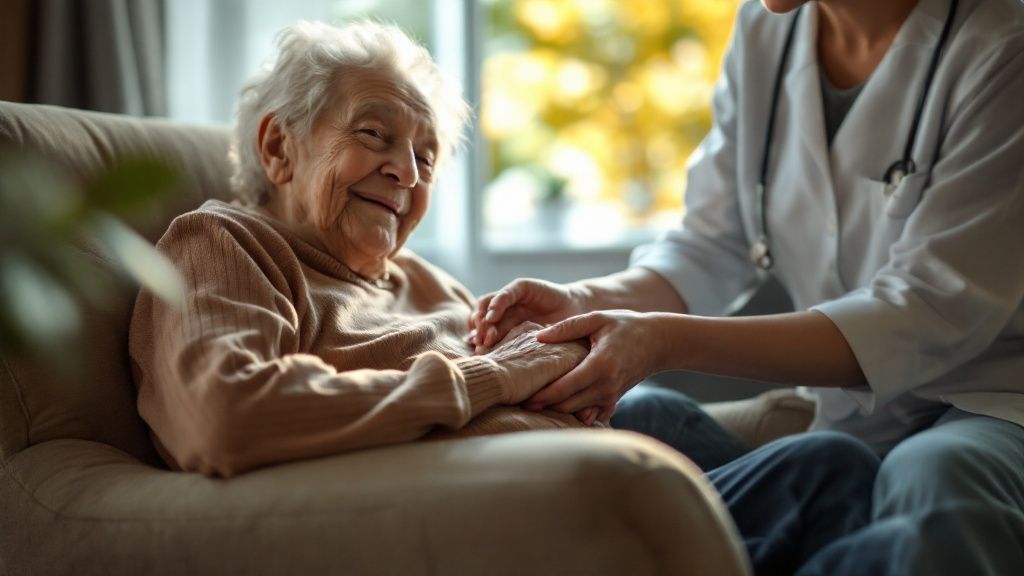
Common Conditions That Qualify for Palliative Care
Palliative care was once tied mainly to cancer. Today, it helps with a wide range of chronic illnesses common in older adults. According to the National Hospice and Palliative Care Organization (NHPCO), palliative care has expanded to serve patients with many different diagnoses (NHPCO, 2022). You can read more about this global shift in palliative care on Euronews.
This means a senior with one of many conditions can find relief. It is a valuable resource for anyone whose illness creates ongoing symptoms.
Some of the most common conditions include:
- Heart Disease: Such as congestive heart failure (CHF), which causes fatigue and shortness of breath.
- Lung Disease: Like Chronic Obstructive Pulmonary Disease (COPD) or pulmonary fibrosis.
- Kidney Disease: Helping manage chronic kidney failure and its symptoms.
- Neurological Conditions: Including Alzheimer’s disease, Parkinson’s disease, or ALS.
- Advanced Liver Disease: Assisting with symptoms like fluid buildup and discomfort.
This is not a complete list. The key is how the illness affects the person, not just the name of the disease.
Recognizing When It Is Time to Consider Palliative Care
How do you know when it is the right time to talk about palliative support? The decision is more about seeing signs that an illness is getting harder to manage. If a senior's quality of life is going down because of their symptoms, palliative care can help.
The right time for palliative care is as soon as a serious illness starts to impact daily life. It is not about waiting for a crisis; it is about proactively adding a layer of support to improve comfort and control.
Think about the daily struggles your loved one is facing. If you notice these signs, it may be time to talk to their doctor. A referral to a trusted, local nonprofit like Central Coast VNA & Hospice can make a difference.
Practical Signs to Look For
Here are clear signs that a senior could benefit from more support:
- Frequent Hospital or ER Visits: More than one hospital stay in a few months for the same problem.
- Unmanaged Pain or Other Symptoms: Ongoing pain, shortness of breath, nausea, or fatigue that disrupts daily life.
- Significant Weight Loss: Losing weight without trying can be a sign of stress from the illness.
- Decline in Daily Functioning: A noticeable drop in the ability to handle personal care, like bathing or dressing.
- Difficult Treatment Side Effects: When side effects from treatments like chemotherapy become too hard to handle.
Noticing these signs early allows you to bring in support sooner. This proactive step helps prevent future crises. It ensures your loved one gets the expert care they need to live more comfortably.
Meet Your Palliative Care Team
When you choose palliative care, you get a whole team of specialists. This is one of the best parts of palliative care for seniors. Instead of one doctor managing everything, a group of professionals works together. They provide complete, wrap-around support.
This team approach ensures every need is met, from physical comfort to emotional well-being. At Central Coast VNA & Hospice, our team is built on over 74 years of experience. We serve our neighbors in Monterey County, San Benito County, Santa Cruz County, and South Santa Clara County. Each person brings a unique skill to improve your quality of life.
The Professionals Who Support You
Think of your palliative care team as your personal support system. Each member has a role, but they all communicate to make your care smooth.
Your team will usually include a few key professionals. They work with your main doctor to add an extra layer of support.
Here’s a look at the core members and what they do:
- Registered Nurse (RN): Your RN is often your main care coordinator. They are experts at managing symptoms like pain and shortness of breath.
- Medical Social Worker: A serious illness affects more than the body. The Medical Social Worker gives emotional support to you and your family.
- Chaplain: Spiritual support is important for many people. Our Chaplains offer comfort and guidance to people of all faiths and backgrounds.
This team-based approach ensures nothing is missed. It addresses the whole person—body, mind, and spirit.
The table below shows how these professionals work together.
| Team Member Role | Primary Responsibilities |
|---|---|
| Registered Nurse (RN) | Manages physical symptoms like pain. Coordinates care with other doctors and adjusts medications. |
| Medical Social Worker | Provides emotional support and counseling. Helps with resources and long-term planning. |
| Chaplain | Offers spiritual comfort that respects all personal beliefs, faiths, and backgrounds. |
Each role is different, but they all work together. They create a strong, supportive network for you.
A Coordinated Approach to Your Well-Being
The team works together in a special way. They have regular meetings to discuss your progress and update your care plan. This communication means everyone is on the same page—you, your family, and your other doctors.
For example, an RN might notice that anxiety makes a patient's pain worse. They can bring in the Medical Social Worker to help. At the same time, the Chaplain might offer spiritual support to ease fears.
A team-based approach in palliative care provides a safety net of experts. It ensures that every aspect of a person's well-being is considered, leading to better symptom control, stronger emotional resilience, and a greater sense of peace for the entire family.
This integrated care is very effective. It lightens the load for families, so they don't have to manage everything alone. You can learn more about how our specialists work together in our palliative care program.
This partnership helps you feel more supported and in control. It's built on trust, expertise, and a commitment to your comfort and dignity.
Receiving Palliative Care in Your Home
When you're dealing with a serious illness, there is no place like home. Being in a familiar space can make a big difference. That's why palliative care for seniors is often brought right to you. It removes the stress of trips to a hospital or clinic.
At Central Coast VNA & Hospice, bringing care into homes has been our nonprofit mission for over 74 years. We are a trusted part of the community in Monterey County, San Benito County, Santa Cruz County, and South Santa Clara County. This means you can focus on your well-being in the comfort of your home.

What a Palliative Care Home Visit Looks Like
When one of our Registered Nurses visits, their goal is to provide support built around you. These visits are much more than a quick check-in. They are a key part of your care plan.
During a visit, our nurse will:
- Assess and Manage Symptoms: The nurse starts by listening. They will check your symptoms and understand how you are feeling.
- Coordinate with Your Doctor: The nurse communicates directly with your primary doctor. This teamwork allows for quick changes to your treatment plan.
- Provide Hands-On Education: A big part of our role is to empower your family. The nurse provides training to help your loved ones support you confidently.
This in-home model is convenient and effective. It helps us create a care plan that is more personal.
Planning for the Future with Confidence
Our palliative care team also helps with important talks about the future. Talking about long-term healthcare wishes can feel hard. But it is a key step to make sure your preferences are followed. This is called advance care planning.
Our team offers gentle guidance to help you document your wishes. They create a calm space for these conversations with your family. This planning brings peace of mind to you and your loved ones.
Advance care planning is a gift to your family. It clarifies your wishes, removes the burden of difficult decision-making from your loved ones, and ensures your voice remains at the center of your care, no matter what the future holds.
By putting your wishes in writing, you can be sure your values will guide your care. You can learn more about our palliative home care services. This dedicated support ensures you get compassionate care where you want to be.
How to Get Started with Palliative Care
Taking the first step toward getting more support can feel hard. The good news is that starting palliative care for seniors is simpler than you might think. It all begins with a conversation.
The journey starts with your primary doctor. They can give you a referral, which is the official request for palliative services. Here at Central Coast VNA & Hospice, our team works with local doctors to make this process smooth for families in Monterey, San Benito, Santa Cruz, and South Santa Clara counties.
Understanding the Referral Process
Once your doctor agrees that palliative care is a good fit, they will send us a referral. Our team will then call you to schedule a first meeting. This is our chance to listen to your needs and answer your questions.
The referral process has a few simple steps:
- Talk to Your Doctor: Be open about the symptoms and challenges you are facing.
- Get a Referral: Your doctor handles the paperwork and sends it to our team.
- Schedule a Consultation: We will contact you to set up a visit and create a care plan.
Healthcare providers can find referral information on our website.
How Palliative Care Is Paid For
A common worry for families is the cost of care. Palliative care is a medical specialty, like cardiology. Because of this, it is usually covered by Medicare Part B, Medicaid, and most private insurance plans.
According to the World Health Organization, millions of people who need palliative care do not receive it (WHO, 2020). Our nonprofit mission is to help every eligible family get this vital support.
Palliative care is not a luxury; it is a standard medical service designed to be accessible. Understanding your insurance coverage can provide peace of mind and open the door to much-needed comfort and support.
It is also wise to think about legal documents that honor your wishes. This includes understanding the critical importance of Power of Attorney. Taking these steps empowers you and your family. If you think your loved one could benefit from more support, contact their doctor today.
Frequently Asked Questions About Palliative Care for Seniors
Here are answers to some common questions we hear from families. Our goal is to give you clear information to help you make the best decisions.
Is palliative care the same as hospice?
No, they are different. Palliative care can be started at any time during a serious illness, even while you are getting treatment to cure it. Hospice care is for when curative treatment is no longer being sought, focusing entirely on comfort at the end of life. Central Coast VNA & Hospice offers both as part of our continuum of care.
Can I keep my own doctor?
Yes, absolutely. The palliative care team works with your primary doctor and any other specialists you see. They act as an extra layer of support and communicate regularly with your entire healthcare team to coordinate care.
How soon should we start palliative care?
It is best to start palliative care early, soon after a serious diagnosis. You do not need to wait for a crisis. Early support can improve comfort, reduce stress, and help prevent hospital visits.
Where is palliative care provided?
Palliative care can be provided wherever a senior calls home. This includes a private residence, an assisted living facility, or a nursing home. Our Central Coast VNA & Hospice team brings care directly to patients in Monterey County, San Benito County, Santa Cruz County, and South Santa Clara County.
Who is on the palliative care team?
A typical palliative care team includes a Registered Nurse, a Medical Social Worker, and a Chaplain. These professionals work together with your doctor to address your physical, emotional, and spiritual needs. This team approach provides complete support for both the patient and their family.
If you believe your loved one could benefit from an extra layer of compassionate support, talk to their doctor or contact us directly. Learn more about how the dedicated, nonprofit team at Central Coast VNA & Hospice can improve quality of life for your family by visiting us at https://ccvna.com.
Hospice at Home: A Compassionate Guide
Hospice at home is a special kind of care. It allows someone with a life-limiting illness to spend their final months where they feel most comfortable—their own home. It brings a team with medical, emotional, and spiritual support directly to the patient. The focus is on managing symptoms and making sure quality of life is the top priority.
This approach is about dignity and peace, not treatments that are no longer working.
Shifting the Focus to Comfort and Dignity
Many families in Monterey County worry that choosing hospice means giving up. The truth is the opposite.
Hospice at home is about redefining hope. It is a choice to shift focus from finding a cure to living each day to its fullest. This means being surrounded by familiar comforts and the people who matter most.
This decision empowers patients to stay in control of their journey. The goal is simple: to be as comfortable and pain-free as possible. This creates space for meaningful moments with loved ones.
A Mission of Compassionate Community Care
For over 74 years, Central Coast VNA & Hospice has been a trusted, nonprofit partner for families. Our mission is to provide expert, compassionate care that honors the wishes of every person we serve. We are a community-based organization, deeply rooted in Monterey County, San Benito County, Santa Cruz County, and South Santa Clara County.
We believe end-of-life care should be filled with comfort, respect, and peace. Our dedicated team works with the patient and the entire family. We provide a circle of support for physical, emotional, and spiritual needs.
More people want this kind of care. According to the National Hospice and Palliative Care Organization (NHPCO), over 1.72 million Medicare beneficiaries received hospice services in 2020 (NHPCO, 2021). This trend shows a powerful desire for patient-centered care at home.
Understanding the Hospice Journey
Making the decision to start hospice at home is a big one. It’s natural to have questions. Our professional team is here to walk you through the process with clear guidance. We handle the medical details so you can focus on what’s important: sharing love and creating memories.
To get a better sense of the overall journey, this general guide on what to expect from hospice care can be a helpful resource.
At Central Coast VNA & Hospice, we support every family with professionalism and warmth. We make sure your loved one’s final chapter is lived with dignity.
The Comforts and Benefits of In-Home Care

Most people want to spend their final chapter at home for a reason. Choosing hospice at home offers a level of comfort that a hospital cannot match. Being surrounded by photos, a favorite chair, or a familiar window makes a big difference.
This sense of normalcy helps preserve a person's independence and dignity. It allows life to continue with its familiar rhythms. That feeling of peace is the foundation of quality end-of-life care.
Keeping Families Together
One of the greatest gifts of in-home hospice is being together without the stress of hospital visits. Strict visiting hours and long commutes are a heavy burden. When care comes to you, families can share quiet, spontaneous moments that mean so much.
It creates space for sharing memories or just holding a hand. The experience becomes more personal and intimate. The focus shifts from hospital rules back to love and connection.
By bringing expert medical support into the home, Central Coast VNA & Hospice allows families to set aside the role of medical manager. They can return to being a spouse, a child, or a grandchild. We handle the details so you can focus on love.
This is a growing trend. Recent Medicare data shows Routine Home Care is the most common level of hospice service. The number of hospice days provided at home is rising each year.
Empowering Families with Expert Support
It’s normal to feel overwhelmed by a loved one’s medical needs. That’s why our team at Central Coast VNA & Hospice empowers families with education and support. Our Registered Nurses and Hospice Aides are always there to answer questions and provide clear guidance.
We teach family members how to help with daily tasks and what to watch for. This partnership reduces anxiety. It builds a circle of trust for both the patient and their loved ones.
The Practical Advantages of Home-Based Care
Beyond the emotional side, hospice at home has practical benefits. It is designed to reduce stressful trips to the emergency room or hospital.
Here are a few key advantages:
- Personalized Care Plans: Care is built around your loved one’s specific needs and wishes at home.
- Reduced Financial Strain: Hospice is a fully covered benefit under Medicare and most private insurance.
- Consistent Care Team: The same dedicated team provides care, building a trusting relationship with the patient and family.
We manage symptoms and provide 24/7 on-call support. This helps keep things stable and prevent crises. To learn more, check out our article on the benefits of home health care. This approach gives everyone much-needed peace of mind.
Meet Your Compassionate Hospice Care Team
When you choose hospice at home, you are not alone. A dedicated team from Central Coast VNA & Hospice provides a circle of support. We ensure every need—physical, emotional, and spiritual—is met with expertise and kindness.
Think of it as having a group of specialists focused on one goal. That goal is maximizing your loved one's comfort and honoring their wishes. This team-based approach allows families in our service area to feel completely supported.
Your Hospice at Home Care Team Roles
The strength of hospice at home comes from its team spirit. Our professionals work together to create a seamless care plan. This plan adapts as your family's needs change. This model relieves burdens on family and brings you peace of mind.
Here’s a look at the professionals on your core support system.
| Team Member | Primary Role and Responsibilities |
|---|---|
| Registered Nurse (RN) | The cornerstone of medical care. Manages pain and symptoms, makes regular home visits, coordinates with the physician, and educates the family on care techniques. |
| Hospice Aide | A certified professional providing essential, hands-on personal care. Assists with bathing, dressing, and grooming to help your loved one maintain comfort and dignity. |
| Medical Social Worker | Offers counseling for emotional and practical challenges. Helps with advance care planning and connects families to community resources. |
| Chaplain | Provides spiritual care to people of all faiths, beliefs, and those with no religious affiliation. Offers a comforting presence to help navigate spiritual questions and find peace. |
A hospice physician or your loved one's own doctor will oversee the medical plan. Trained volunteers also play a key part by offering companionship. This gives family members a much-needed break.
This infographic breaks down the primary areas of focus for the hospice at home team.
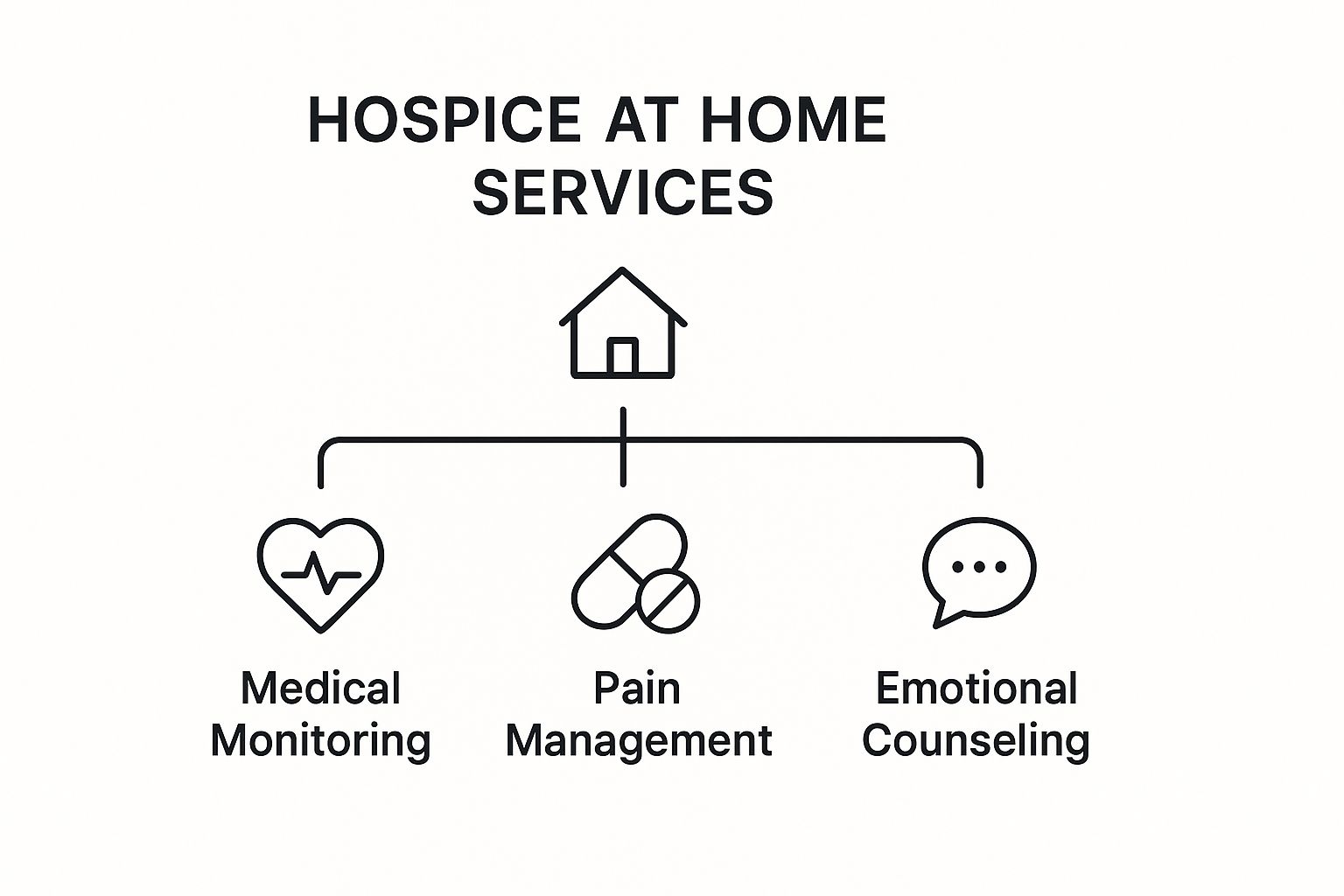
As you can see, medical monitoring, pain management, and emotional counseling are the three pillars of our hospice support.
The Vital Role of the Hospice Aide
While every team member is essential, the Hospice Aide often becomes a familiar and comforting face. They provide the gentle, hands-on care that makes a difference in a patient's daily comfort.
Their work is both practical and deeply personal. They might help with meals or simply be there to listen.
This support allows family members to shift their focus from physical tasks back to what matters most. To learn more, you can read about the responsibilities of a Hospice Aide on our website.
Comprehensive Services Included in Home Hospice
When families in Monterey County choose hospice at home, they get more than medical support. Central Coast VNA & Hospice delivers a complete circle of care. We bring comfort, dignity, and peace right into the home.
This coordinated approach makes sure the patient and their family have everything they need. By handling the practical details, we lift a heavy weight off your shoulders. This frees you to focus on being present for one another.
Expert Medical Care and Symptom Management
The main goal of home hospice is to keep your loved one comfortable and pain-free. Our Registered Nurses are experts in managing symptoms that come with a life-limiting illness. These include pain, shortness of breath, anxiety, and fatigue.
Regular nursing visits are the foundation of our care. Nurses check the patient's condition, give medications, and adjust the care plan as needed. They also provide key education to the family so you feel confident.
Hospice care is about actively managing symptoms. This gives your loved one the best possible quality of life for every single day they have. This proactive approach helps prevent crises and reduces trips to the hospital.
Personal Support and Daily Assistance
Maintaining personal dignity is critical. Our certified Hospice Aides provide gentle, hands-on help with daily activities.
This support includes help with:
- Bathing and grooming: Making sure your loved one feels clean and refreshed.
- Dressing: Providing a helping hand to make this daily routine easier.
- Light meal preparation: Helping with nutrition when appetite is low.
- Mobility: Assisting with moving safely around the home.
This one-on-one care not only supports the patient. It also gives family members a much-needed break.
Emotional and Spiritual Guidance for the Whole Family
A serious illness affects everyone. Our Medical Social Workers and Chaplains support the entire family. They help you navigate the emotional and spiritual challenges of this journey.
Our Medical Social Workers offer counseling and help with advance care planning. They create a safe space to talk through fears or concerns.
Our Chaplains provide non-denominational spiritual support that honors all beliefs. They are great listeners who bring a calming presence. They help patients and families find peace and meaning.
Medical Equipment and Supplies
Having the right equipment makes a home a safe place for care. As a patient of Central Coast VNA & Hospice, all needed medical equipment and supplies are delivered to your door.
This typically includes items like:
- A hospital bed to improve comfort.
- An oxygen concentrator for breathing support.
- A wheelchair or walker to help with mobility.
- Essential medical supplies like bandages and catheters.
We take care of all the logistics for equipment and supplies. This removes another layer of stress for families. You can explore our detailed breakdown of hospice care services. This all-inclusive support ensures you can focus on your loved one.
Understanding Hospice Eligibility and Costs
When families look into hospice at home, two questions often come up first. "Does my loved one qualify?" and "How will we pay for this?" These are normal concerns, and the answers are often reassuring.
Getting a clear picture of the requirements can lift a huge weight off your shoulders. Our goal is to give families in Monterey County and nearby areas the confidence to make informed decisions.
Who Is Eligible for Hospice Care
Hospice care is for someone with a life-limiting illness. The focus shifts from curing the disease to comfort and quality of life. The general guideline is a doctor's prognosis that the person has six months or less to live if the illness runs its natural course.
But it's not just about a date on a calendar. It’s about what a person needs and wants right now.
Common conditions for hospice eligibility include:
- Advanced-stage cancer
- End-stage heart, lung, or kidney disease
- Late-stage Alzheimer's disease or other dementias
- Conditions like ALS or Parkinson's disease
Criteria can vary by location. It can help to look into state-specific eligibility requirements. A simple conversation with us can clarify if hospice is the right path for your family.
How Hospice Care Is Paid For
This part brings most families a huge sense of relief. The cost of hospice care is rarely a financial burden. For most patients, hospice is a fully covered benefit.
Hospice is a benefit covered 100% by Medicare Part A. This includes all services, medications, supplies, and medical equipment related to the terminal illness. There are no deductibles or copayments for the patient.
This full coverage is there to remove financial stress. Beyond Medicare, hospice is also covered by:
- Medi-Cal (California's Medicaid program)
- The Department of Veterans Affairs (VA)
- Most private insurance plans
You can get more details in our guide on how to pay for hospice care. Our team is here to help you navigate your specific coverage.
Our Nonprofit Mission to Serve the Central Coast
As a nonprofit that’s been part of this community for over 74 years, Central Coast VNA & Hospice operates on a simple promise. We believe everyone deserves compassionate end-of-life care, no matter their financial situation. We are committed to providing hospice at home to every eligible person in our service area.
This commitment reflects a growing understanding of how vital this care is. More people recognize the value of comfort-focused care.
Because of our nonprofit status, a person's ability to pay will never get in the way of receiving dignified, expert care.
Starting the Conversation About Hospice Care
Bringing up hospice care can feel tough. But it’s not about giving up. It’s a discussion rooted in love and courage. It is a way to honor your loved one’s wishes and ensure their final chapter is lived with dignity and comfort.
A gentle way to begin is by focusing on their goals. Try asking questions like, "What is most important to you right now?" This simple shift puts them back in control. It centers the talk on their quality of life, not their illness.
Finding the Right Words and Time
Choose a quiet, calm moment when you won't be rushed. This is not a conversation to have with one eye on the clock. Your role is to listen more than you talk.
Involving their physician is another helpful step. A doctor can offer a clear medical perspective. This often helps the entire family get on the same page.
Approaching this conversation with empathy transforms it. It becomes a meaningful opportunity to connect and reaffirm your commitment to their well-being.
We Are Here to Help You Begin
You don’t have to have this conversation alone. Central Coast VNA & Hospice offers no-obligation consultations for families. We serve Monterey County, San Benito County, Santa Cruz County, and South Santa Clara County. Our compassionate team is here to answer your questions.
Taking this first step empowers your family with knowledge and support. Contact us today to learn how we can support your family and help you begin this journey with peace of mind.
Frequently Asked Questions About Hospice at Home
When a loved one faces a life-limiting illness, it’s normal to have questions. Getting clear answers is the first step toward feeling more in control. Below are answers to some of the most common questions we hear.
When is the right time to consider hospice care?
The best time to explore hospice is when care goals shift from curing an illness to maximizing comfort. This often begins when a doctor estimates a prognosis of six months or less. Starting hospice early provides months of meaningful support for the patient and family.
Can my loved one still see their own doctor?
Yes, absolutely. A patient's trusted physician is a vital part of their care. We encourage them to stay as involved as they’d like. Our team works hand-in-hand with your family’s doctor to ensure the care plan is seamless.
What happens if their condition improves?
It’s not uncommon for a person's health to stabilize with hospice care. If a patient's condition improves, they can be discharged from hospice at any time. They can resume curative treatments, and the door to hospice is always open if needed later.
Does choosing hospice mean giving up hope?
Not at all. Choosing hospice is about redefining hope. The focus shifts from hope for a cure to hope for comfort, dignity, and making the most of the time you have together. It’s hope for a gentle journey filled with meaningful moments.
What is the family's role in hospice at home?
The family is the heart of the hospice team. Our professional team handles medical tasks, but the family provides irreplaceable love and comfort. We support you with training and resources, so you can focus on simply being a spouse, child, or friend again.
At Central Coast VNA & Hospice, we are committed to guiding families in Monterey County, San Benito County, Santa Cruz County, and South Santa Clara County with compassion and expertise. If you have more questions or want to learn how our services can support your family, we are here to help.
Contact us today to learn more about our compassionate hospice care.