
Making care decisions for a loved one is tough, and the language of healthcare can be overwhelming. Let's clear up one of the most common points of confusion: home health care versus hospice care. The choice between them depends entirely on your loved one’s health goals.
The most straightforward way to think about it is this: home health care focuses on recovery and rehabilitation after an illness, injury, or surgery. The goal is to get better. Hospice care, on the other hand, provides comfort and quality of life when a cure is no longer the primary goal.
Understanding this core distinction is the first step toward choosing the right path for your family. This guide will help clarify the purpose, eligibility, and services of each, so you can make an informed decision with confidence.
Understanding Your Care Options
Navigating these choices can feel complex, but you don't have to do it alone. For over 74 years, Central Coast VNA & Hospice has been a trusted, nonprofit partner for families across Monterey County, San Benito County, Santa Cruz County, and South Santa Clara County. We specialize in providing a continuum of care, from home health to palliative care to hospice, ensuring seamless support as your loved one's needs evolve.
The infographic below highlights some of the key statistical differences between home health and hospice based on national data.
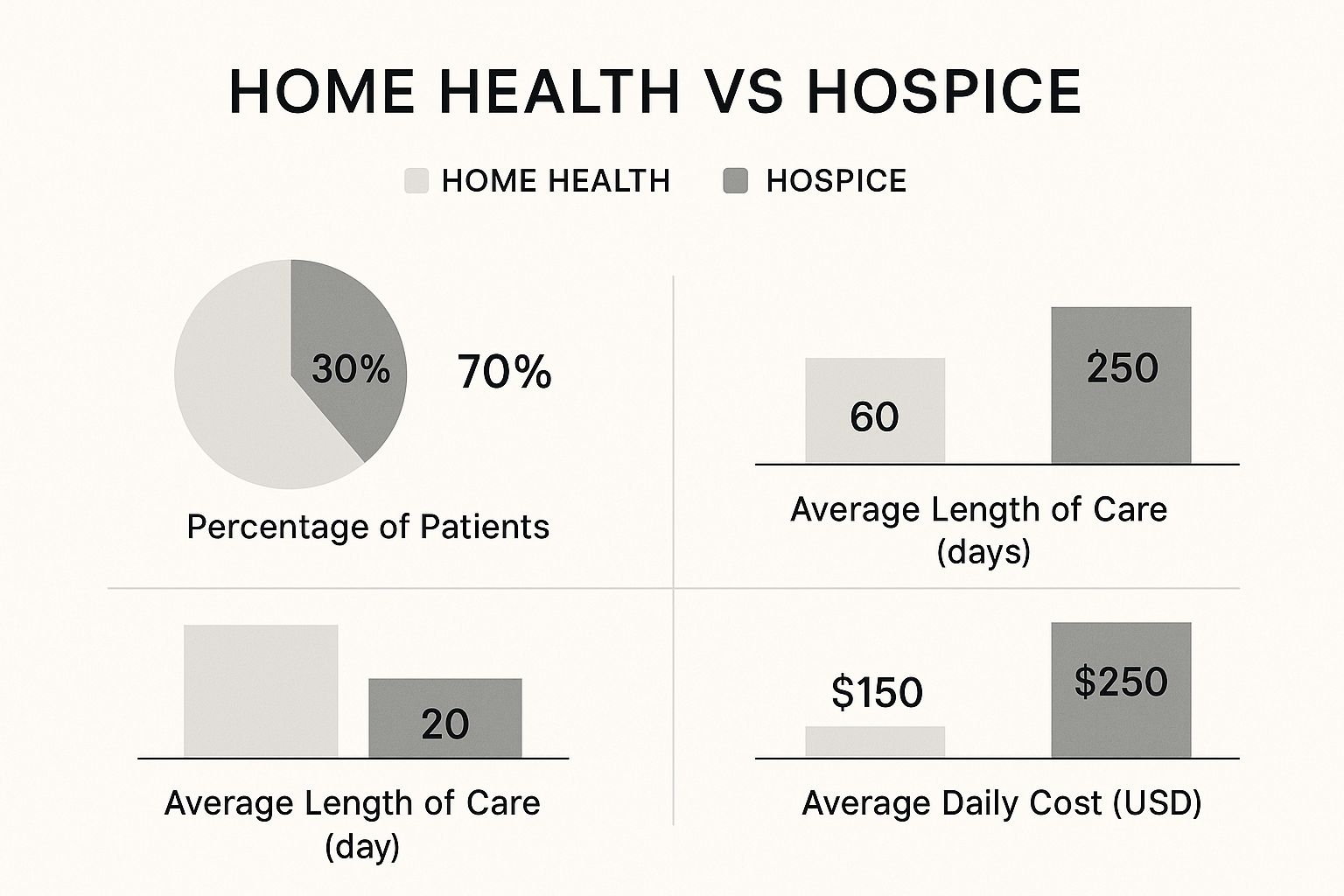
As you can see, home health care is typically a shorter-term service focused on helping someone recover. Hospice provides more intensive, comfort-oriented support for a longer period.
To make the differences even clearer, here’s a quick look at how the two services compare side-by-side.
Home Health vs Hospice At a Glance
| Feature | Home Health Care | Hospice Care |
|---|---|---|
| Primary Goal | To help patients recover from illness, injury, or surgery and regain independence. | To provide comfort, dignity, and quality of life for patients with a terminal illness. |
| Focus of Care | Curative and rehabilitative, using skilled therapies and nursing to improve health. | Palliative and supportive, focusing on pain and symptom management. |
| Eligibility | Requires a doctor's order and for the patient to be considered "homebound." | Requires two physicians to certify a life expectancy of six months or less. |
| Team Members | Registered Nurse, Physical Therapist, Occupational Therapist, Home Health Aide. | Medical Director, Registered Nurse, Social Worker, Chaplain, Hospice Aide, Volunteers. |
While the goals and teams are different, they share a common purpose.
The most important takeaway is that both home health and hospice are designed to provide expert, compassionate care in the comfort of home. The right choice simply depends on the patient's specific medical needs and personal care goals at that time.
The Guiding Philosophy Behind Each Care Path

While both home health and hospice care happen in the familiar comfort of a patient’s home, their core philosophies are worlds apart. Getting this distinction right is the first step in matching care to a person’s medical needs and, just as importantly, their personal goals.
The choice often boils down to a single, critical question: Is the goal to recover, or is the goal to find comfort?
An Active Approach to Recovery
Home health care is built entirely on a philosophy of rehabilitative and curative care. Its one and only purpose is to help people get back on their feet after an illness, injury, or surgery. It's all about empowering them to regain their independence.
This path is active and goal-oriented, with every service designed to actively improve a patient’s condition. It's a temporary support system that promotes healing through measurable progress toward specific health outcomes.
The services a Central Coast VNA & Hospice home health team provides make this focus clear:
- Skilled Nursing: Our Registered Nurses monitor vital signs, manage medications, and provide expert wound care, all aimed at preventing complications and supporting the body’s healing process.
- Physical Therapy: Our Physical Therapists work with patients to rebuild strength, improve mobility, and restore balance after a major health event or operation.
- Occupational Therapy: Our Occupational Therapists help people relearn the practical activities of daily life—like cooking a meal or getting dressed—so they can reclaim their independence at home.
Ultimately, this approach is for anyone who is expected to improve and can benefit from targeted medical support. The end goal is always to "graduate" from our services, leaving the patient with the tools they need for continued self-management.
A Gentle Shift to Comfort and Dignity
Hospice care, on the other hand, operates from a palliative philosophy. This means the focus shifts away from curing an illness and toward maximizing comfort and quality of life. Families choose this path when curative treatments are no longer working or wanted, and the priority becomes ensuring a peaceful and dignified journey.
Hospice care is not about ending life. It’s about changing the focus to living each day that remains as fully as possible, free from pain and distress.
At Central Coast VNA & Hospice, our mission-driven model guarantees this care is holistic. We don't just manage physical symptoms; we provide essential emotional and spiritual support to both the patient and their entire family. The value of this approach is clear, as Routine Home Care remains the most common level of hospice service. In fact, total hospice days have climbed from 125.8 million in 2020 to nearly 146 million in fiscal year 2024, showing just how vital this support has become (CMS, 2024). For a deeper look, you can read more on hospice trends from CMS.
While related, this philosophy is different from palliative care, which can be provided at any stage of a serious illness. To understand those nuances better, you can explore our guide to palliative care services.
Understanding Eligibility for Home Health and Hospice
It’s easy for families to get tangled up in the rules for home health and hospice care. The qualifications for each service are distinct, mainly because their goals are worlds apart. Getting a handle on these criteria is the first real step toward finding the right support for your loved one.
The best way to know for sure is to get a professional assessment from a mission-driven provider like Central Coast VNA & Hospice. Our team has been helping families across the Central Coast figure out their options for more than 74 years.
Who Qualifies for Home Health Care
Home health care is really built for patients who are recovering from an illness, injury, or surgery and are expected to improve. To be eligible, a patient has to meet a few specific requirements set by Medicare and most private insurance companies.
These requirements usually include:
- A Doctor's Order: A physician must certify that the patient needs medical care at home.
- Need for Skilled Care: The patient must require intermittent skilled services, like those from a Registered Nurse or a Physical, Occupational, or Speech Therapist.
- Being Homebound: A doctor must certify the patient as "homebound," which means it’s a considerable and taxing effort for them to leave their home.
This service is meant for those on a clear path to recovery, not as a long-term solution for custodial care.
The term "homebound" can be a little misleading. It doesn't mean a patient is literally confined to the house. They can still go to medical appointments or attend short, infrequent outings like religious services, but the key is that leaving home must be difficult.
Who Qualifies for Hospice Care
Hospice eligibility, on the other hand, is for individuals who are no longer seeking a cure for their illness. Instead, the focus shifts entirely to comfort and quality of life. The primary requirement here is a prognosis of six months or less if the disease is left to run its natural course.
This determination isn't made lightly. It has to be certified by two physicians—usually the patient’s primary doctor and the hospice medical director. This dual certification ensures the decision is backed by thorough clinical judgment. It’s important to remember that this path is chosen when the patient decides to stop curative treatments and prioritize comfort above all else.
For families wrestling with this incredibly tough decision, it helps to understand all the factors involved. You can find more clarity by reviewing detailed information on hospice care eligibility. Our nonprofit team is here to support patients in Monterey County, San Benito County, and our other service areas with compassionate, straightforward guidance.
Comparing the Interdisciplinary Care Teams
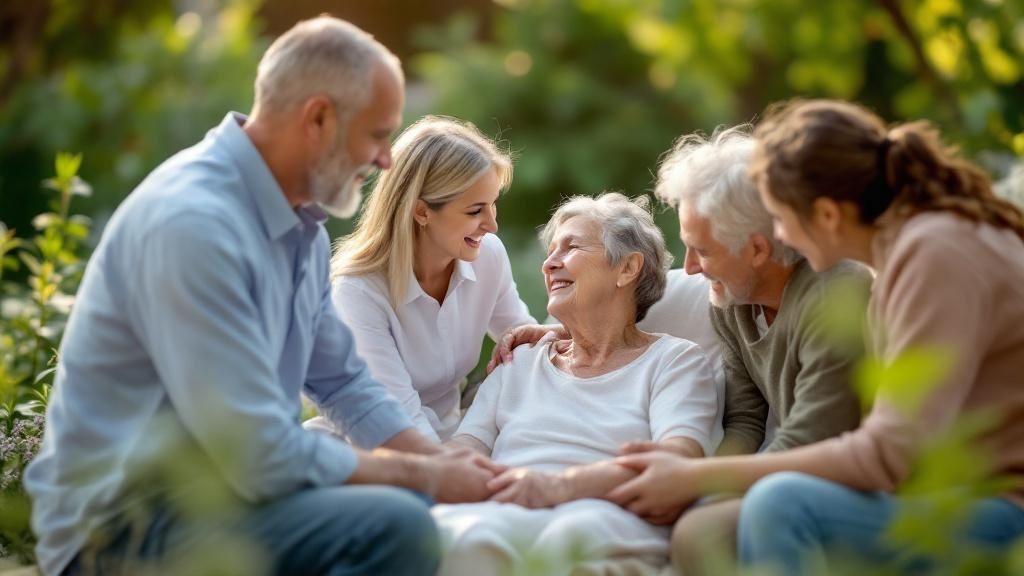
Behind every successful home health and hospice plan, you'll find a dedicated team of professionals. While both services bring expert support right into the home, the makeup of their care teams is quite different because their goals are fundamentally different. One team is built for clinical recovery, while the other provides holistic comfort.
Knowing who will be visiting your loved one is one of the best ways to understand the purpose of each service. At Central Coast VNA & Hospice, our teams across Monterey and San Benito Counties are staffed by experienced, licensed professionals who are deeply committed to our nonprofit mission. The need for this kind of care is growing fast—the global home healthcare market hit USD 416.4 billion in 2024 and continues to expand (Grand View Research, 2024). You can learn more about trends in home-based care.
The Home Health Team: A Focus on Rehabilitation
Think of the home health care team as a clinical group laser-focused on rehabilitation and medical recovery. Every member has a specific role aimed at helping a patient get back their strength and independence after an illness, injury, or hospital stay.
This team almost always includes:
- Registered Nurse (RN): The RN is the project manager, overseeing the care plan, giving medications, caring for wounds, and teaching the patient and family how to manage the condition.
- Physical Therapist (PT): This is the expert who works to restore mobility, strength, and balance through targeted exercises and therapies.
- Occupational Therapist (OT): The OT helps patients get back to safely doing daily activities we often take for granted, like bathing, dressing, and making meals.
- Speech-Language Pathologist (SLP): An SLP steps in to help with communication or swallowing issues that might pop up after a stroke or another health event.
- Home Health Aide: Under the watch of a nurse or therapist, an aide provides that crucial hands-on help with personal care.
Each one of these specialists works toward clear, measurable goals to help the patient "graduate" from our care. For a closer look at what they do, you can learn about our home health care services.
The Hospice Team: A Focus on Holistic Comfort
The hospice team, on the other hand, is built differently because its mission is to care for the whole person—body, mind, and spirit. This interdisciplinary group works together to manage symptoms, offer emotional and spiritual guidance, and support the entire family through a difficult time.
At Central Coast VNA & Hospice, our strength lies in our seamless continuum of care. A patient might start with our home health team, transition to palliative care for advanced symptom management, and then move to hospice care when their goals shift to comfort, all within the same trusted, mission-driven organization.
To meet these diverse needs, the hospice team is intentionally broader:
- Medical Director: This physician oversees the medical plan and works closely with the patient's own doctor.
- Registered Nurse (RN): The RN serves as the case manager, bringing expertise in managing pain and other symptoms effectively.
- Hospice Aide: An aide provides compassionate, hands-on help with personal tasks like bathing and grooming.
- Social Worker: A key resource for emotional support, the social worker also connects families with helpful community resources.
- Chaplain: The chaplain offers spiritual support that honors whatever beliefs and values the patient holds.
- Volunteers: These individuals provide companionship, give family members a much-needed break, and bring a comforting presence.
This team-based approach ensures that as a patient's journey unfolds in Santa Cruz County or South Santa Clara County, every single need is met with expertise and genuine compassion.
Navigating Payment and Insurance Coverage
Let's talk about one of the most practical—and often stressful—parts of this journey: the cost. Understanding how home health and hospice care are paid for is a huge piece of the puzzle for families. The payment structures for each service are quite different, mainly because their goals are different.
The good news is that both are often covered by major insurance, especially Medicare. As a nonprofit provider here on the Central Coast, our team at Central Coast VNA & Hospice is here to walk you through these financial questions. We want you to have total clarity so you can focus on what really matters—your loved one’s health and comfort.
How Home Health Care Is Funded
Think of home health care as a short-term medical service designed to help someone recover. Because the goal is rehabilitation from an illness or injury, insurance coverage is tied to clear clinical needs and measurable progress.
Typically, payment for home health services comes from one of these sources:
- Medicare Part A or Part B: For most people, Medicare is the primary payer. It covers things like intermittent skilled nursing, physical therapy, and other rehabilitative services, but only for patients who are certified as homebound.
- Private Insurance Plans: Commercial plans like Blue Shield almost always have benefits for home health care, though your specific copays and covered services might vary.
- Medi-Cal: California's Medicaid program is another common source of funding for qualified individuals needing home health services.
The key takeaway is that these services aren't just available on demand. They have to be ordered by a doctor who certifies that they are medically necessary for treating a specific condition.
Understanding the Medicare Hospice Benefit
Hospice care works differently. It’s funded through a more all-inclusive model designed to lift the financial weight off families during an incredibly tough time. The Medicare Hospice Benefit, which falls under Medicare Part A, is the perfect example of this.
This comprehensive benefit is one of the most compassionate parts of the Medicare program. It’s designed to cover nearly everything related to the terminal diagnosis, which means families often have little to no out-of-pocket costs.
This single benefit bundles together a wide range of support, including:
- All physician and nursing services
- Medical equipment, like a hospital bed, and necessary supplies
- Medications for pain relief and symptom control
- Hospice Aide and homemaker services
- Spiritual and social work counseling
- Bereavement support for the family after their loss
This structure is designed to let families concentrate on their time together, not on juggling medical bills. To get a better sense of the specifics, we put together a simple guide on how hospice care is funded. As a nonprofit that has served our community for over 74 years, our entire mission is to make sure this incredible support is available to everyone who needs it.
Making the Right Choice for Your Family's Needs

Choosing between home health and hospice is a deeply personal decision, but it doesn't have to be overwhelming. When you understand the unique purpose behind each type of care, the best path for your loved one often becomes much clearer. It all comes down to their specific needs and, most importantly, their goals.
Sometimes, seeing it in a real-world context makes all the difference. Imagine a patient in Monterey County recovering at home after joint replacement surgery. Their goal is to heal and get back on their feet. In this case, home health care is the perfect fit, providing home health nursing and therapies to help them regain strength and mobility.
Now, consider a patient in San Benito County with late-stage cancer who has decided to stop curative treatments. Their focus has shifted to living their remaining time with comfort and dignity. For them, hospice care in Monterey County is an incredible resource, offering expert symptom control and peace at home.
The demand for both of these in-home options is growing. In fact, the global market for home-based care is projected to hit USD 522.79 billion by 2032, largely thanks to new technologies that make managing care at home more effective than ever (Data Bridge Market Research, 2024). You can read the full research on the home care market.
This choice is never one you should make alone. The most confident decisions are made with guidance from physicians and a trusted local provider.
Ultimately, the right service is the one that aligns with the patient's medical reality and personal wishes. It's also important to remember that a patient's needs can change over time. For a deeper dive into another key service, check out our guide on palliative vs. hospice care.
As a nonprofit community partner with over 74 years of experience, Central Coast VNA & Hospice is here to help you navigate these decisions. Contact us for a no-obligation consultation, and we can explore the best support for your family's journey together.
Frequently Asked Questions About Home Health and Hospice
When families are trying to understand the differences between home health and hospice, it's natural to have a lot of questions. Getting clear, honest answers is the first step toward making confident decisions for a loved one. With over 74 years of nonprofit service, our team at Central Coast VNA & Hospice has helped thousands of families find that clarity.
Here are a few of the most common questions we hear from families in Monterey County, San Benito County, Santa Cruz County, and South Santa Clara County.
Can a patient receive both home health and hospice care at the same time?
No, under Medicare rules, a patient cannot receive home health and hospice benefits at the same time. This is because each service has a different primary goal. Home health focuses on recovery and rehabilitation, while hospice focuses on comfort and quality of life.
However, a patient can transition from one service to another. For example, a patient receiving home health care might move to hospice if their condition progresses and goals shift toward comfort, a process our team seamlessly manages.
Does choosing hospice mean we are giving up?
Absolutely not. Choosing hospice is not about giving up; it is a positive decision to shift the focus from cure to comfort. This allows a patient to live their remaining time with dignity, free from pain and distressing symptoms, surrounded by loved ones.
At Central Coast VNA & Hospice, our mission is to redefine hope as living each day to its fullest. Our compassionate team provides physical, emotional, and spiritual support to ensure every moment is meaningful.
How long do home health services last?
Home health care is provided for as long as a patient meets eligibility criteria, which are regularly reviewed by their physician. A doctor certifies the need for care in 60-day periods. As long as the patient remains homebound and requires skilled care from a Registered Nurse or therapist, services can be re-certified for another 60 days.
Where is hospice care provided?
Hospice care is provided wherever the patient calls home. For most people, this is their private residence. However, Central Coast VNA & Hospice also provides care in assisted living communities, residential care homes, and skilled nursing facilities throughout our service areas.
What is the difference between palliative care and hospice care?
Palliative care is a specialized approach to care that focuses on providing relief from the symptoms and stress of a serious illness. A key difference is that it can be provided at any age and at any stage of an illness, even alongside curative treatments.
Hospice care is a specific type of palliative care for individuals with a life-limiting illness and a prognosis of six months or less. Palliative care often acts as a bridge; a patient receiving home health nursing might also benefit from palliative care at home to manage complex symptoms.
Navigating these decisions is so much easier when you have a trusted partner to turn to. For more than seven decades, Central Coast VNA & Hospice has provided expert guidance and compassionate care to families across the Central Coast. If you have more questions or just need help making sense of your options, our team is here to support you.
Contact us today to learn more about our services and how we can help your family on this journey.