

75 Years of Home Care: What VNA's Numbers Actually Show
Annual reports are easy to skim. A number like 73,000 visits lands on the page and most people move on without thinking about what it actually means at the street level — who opened the door, what was wrong, what happened next.
But if you're a family in Salinas trying to bring someone home from the hospital, or a daughter in Pacific Grove trying to figure out whether her mother qualifies for skilled nursing at home, those numbers aren't institutional data. They're the shape of what help actually looked like for 3,800 patients across Monterey County last year.
This article walks through what the 2025 VNA annual report actually documents — not as a summary, but as a way to understand what home-based care looks like in practice on the Central Coast, and what makes one agency's numbers mean something real.
What 73,000 Visits Looks Like on a Friday Afternoon
A number like 73,000 only starts to make sense when you put a scene behind it. A Registered Nurse drives out to a home in King City on a Friday afternoon — a patient discharged from the hospital two days earlier, still not sure how to manage a new wound, family members trying to work out what happens next.
That visit is one of 73,000. And the ones that don't happen on weekdays are the ones that tend to matter most. Families described in call records for April 2026 included people navigating hospital discharges over weekends, uncertain whether they'd get a call back before Monday. For anyone who has been in that position, the gap between a number and a real outcome is exactly the size of one unanswered phone.
What the annual report documents in that 3,800-patient figure is a team that includes Registered Nurses, Licensed Vocational Nurses, Physical Therapists, Occupational Therapists, Speech Therapists, Medical Social Workers, Hospice Aides, Chaplains, Bereavement Specialists, and Volunteers — not just a nurse at the door, but a coordinated group of clinicians working together around a single patient's needs at home.
For families weighing what comes after a hospital stay, what actually happens during a skilled nursing home visit is often not what they expect — and understanding it matters before the discharge paperwork is signed.
Jack Murphy's Four Months at Home — and Why It Wasn't a Given
One of the more specific accounts in the 2025 annual report comes from Jack Murphy, Director of the Military and Veterans Affairs Office, who spent 24 days in UCSF's Cardiac Critical Care Unit before returning home to Monterey County to recover.
Four months of home-based recovery after a serious cardiac event isn't automatic. It requires nurses who understand what to watch for, Physical Therapists helping someone relearn how to move safely in their own space, and Medical Social Workers coordinating the pieces that make it logistically possible. Murphy's own words in the report: 'VNA was truly the only organization that could make that happen.'
His wife, who volunteers as a death doula, observed something she described as presence in the care team — a quality that doesn't show up in a rating score but that families recognize immediately when it's there and notice just as fast when it isn't.
For patients returning home after serious illness, what families often miss in hospital discharge planning is worth reading before the transition happens — not after.

What the CMS Rating and Patient Satisfaction Scores Actually Measure
VNA holds a 4-Star Home Health rating from the Centers for Medicare and Medicaid Services — and the 2025 annual report also documents a patient satisfaction score worth understanding.
The HHCAHPS overall recommendation rate for VNA sits at 85%, compared to a national average of 78%. Those aren't numbers VNA generated internally. HHCAHPS surveys are administered independently and submitted to CMS — patients answer questions about their care after the fact, without a VNA staff member present.
What those scores actually measure:
- Whether clinicians explained medications and care instructions clearly
- Whether patients felt treated with respect
- Whether the care team communicated well with the patient's doctors
- Whether patients would recommend the agency to someone they know
For a family comparing home health agencies on the Central Coast, those benchmarks reflect day-to-day care decisions made by individual clinicians across thousands of visits — not a single good outcome or a marketing claim. And a 7-point gap above the national average on the recommendation question is a meaningful signal, not a rounding difference.
2025 Annual Report: By the Numbers
The figures below come directly from VNA's 2025 annual report and reflect the scope of home-based care delivered across Monterey County and the surrounding region.
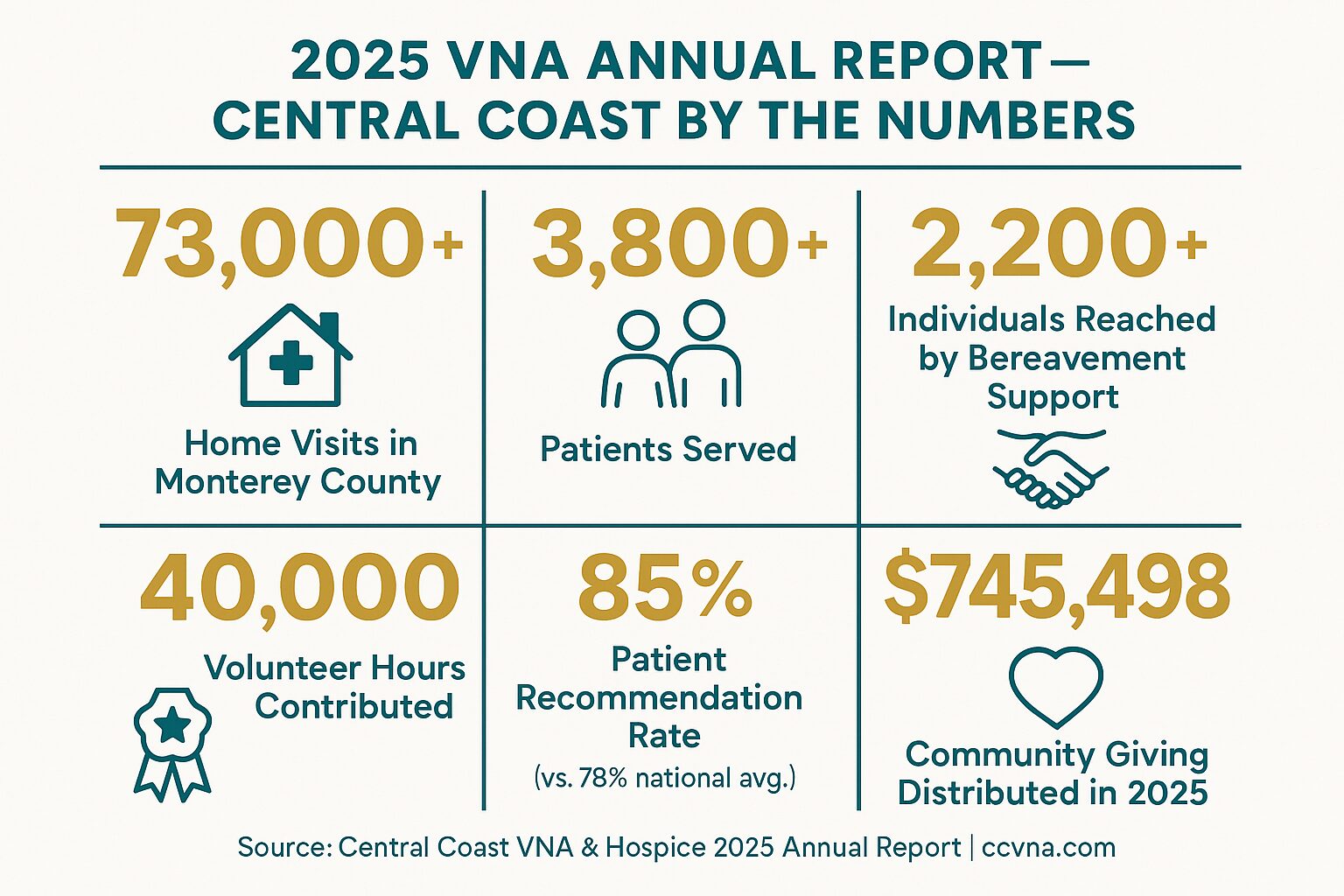
The 40,000 Volunteer Hours — and What They Actually Cover
The 2025 report notes that volunteers contributed nearly 40,000 hours — and that this represents more than 5% of all direct hospice care delivered. That's not a rounding detail. It's a structural part of how hospice at home actually functions.
Volunteers sit vigil through the night so a spouse can sleep. They provide companionship during the hours between clinical visits. They give family members a few hours away from the house — something paid clinical care simply isn't structured to provide.
What a hospice volunteer visit looks like in practice:
- Arriving at a home in Seaside or Monterey for a few hours in the afternoon
- Sitting with a patient who is awake but doesn't need clinical attention
- Giving the family member who has been there all week a chance to leave the house
- Returning for a vigil shift when a patient is in the final hours of life
This kind of presence is what one family described in a public review as genuinely caring — the kind that shows up not because a schedule requires it, but because the situation calls for it. For anyone thinking about volunteering, what hospice volunteer training involves is a useful starting point for understanding how the program works.
Bereavement Support After a Patient Passes — and How It's Funded
One of the less visible milestones in the 2025 report: bereavement support reached more than 2,200 individuals. Most families don't know this service exists at all, or that it continues well after a patient has passed.
Bereavement Specialists work with families for months after a loss — grief counseling, check-in calls, and support that doesn't have a reimbursement code attached to it. Medicare doesn't pay for ongoing bereavement support at that scale. This programming runs on donor contributions and grant funding — which is one concrete reason why community giving matters beyond the general sense of supporting a good cause.
The McGives 2025 campaign raised $95,812.73 for VNA — described in the report as the largest total ever. Those funds flow into the Quality of Life Fund, which covers non-reimbursable patient needs, expanded bereavement programming, and the ability to serve patients in Salinas, King City, Hollister, and across Monterey County who can't fully cover the cost of care on their own.
Families who have used bereavement services often describe grief as something that doesn't follow a predictable timeline — which is exactly why ongoing support matters. Understanding what happens when grief feels stuck can help families recognize when they need more than time.
2025 VNA Annual Report Highlights at a Glance
These figures come directly from the 2025 annual report and reflect care delivered across Monterey County and surrounding communities.
| Metric | 2025 Figure | What It Reflects |
|---|---|---|
| Home Visits — Monterey County | 73,000+ | Skilled nursing, therapy, and hospice visits at patients' homes |
| Patients Served | 3,800+ | Individuals receiving home health, palliative, or hospice care |
| Bereavement Individuals Reached | 2,200+ | Families supported after a patient's passing, often for months |
| Volunteer Hours | ~40,000 | More than 5% of all direct hospice care delivered |
| Patient Recommendation Rate | 85% (vs. 78% national avg.) | Independent HHCAHPS surveys submitted to CMS |
| CMS Star Rating | 4-Star Home Health | Federal quality rating based on clinical outcomes and patient surveys |
| Community Giving Distributed | $745,498 | Directed to general operations, home health, hospice, and community services |
| McGives 2025 Total | $95,812.73 | Largest McGives total in VNA's history |
Founded in 1951 With $1,500 — What That Origin Explains About Now
VNA was founded in 1951 with $1,500 in seed funding and one nurse making home visits across Monterey County. That origin story isn't just historical context — it explains something about how decisions get made today.
As a nonprofit, VNA's obligation runs to the community, not to shareholders. The $745,498 in community giving distributed in 2025 went to general operations, home health, hospice, and community services — including care for patients who can't fully pay. That's a real policy choice, and it shows up in how services are structured across communities like Salinas, King City, and Hollister.
As VNA marks its 75th anniversary in 2026, the question isn't what the numbers add up to. It's what they represent at the household level — a family in Pacific Grove figuring out how to bring a parent home after surgery, a spouse in Seaside trying to understand what comes next after a diagnosis, a daughter in Hollister who doesn't know yet that bereavement support will still be available six months after her father passes.
For families trying to understand whether home-based care is the right fit right now, the difference between needing help and needing a facility often comes down to clinical facts that are worth knowing before a decision has to be made.
Frequently Asked Questions About VNA's Annual Report and Services
Does Medicare or Medi-Cal cover VNA home health services?
Yes. VNA accepts Medicare, Medi-Cal, and Veterans benefits. Coverage eligibility depends on the specific services needed and a patient's diagnosis, so it's worth calling VNA directly to confirm what applies to a particular situation. Many families are surprised to find that skilled nursing visits and therapy services are covered under Medicare when ordered by a physician.
What does a VNA home health visit actually include?
It depends on what the patient needs. A visit might be a Registered Nurse checking wound healing and adjusting medications after a hospital discharge, or a Physical Therapist helping someone safely walk through their own home after a cardiac event, or a Medical Social Worker connecting a family in Salinas with community resources. The care team — which includes nurses, therapists, social workers, chaplains, and volunteers — is coordinated around a single plan of care.
How long does bereavement support last after a patient passes?
Bereavement support through VNA continues for months after a patient's passing — not just the days immediately following. Bereavement Specialists provide grief counseling and ongoing emotional care. This programming is funded in part through donor contributions and grants, not insurance reimbursements, which is one reason community giving has a direct impact on what families actually receive.
What does a hospice volunteer actually do?
Hospice volunteers provide companionship, sit vigil, and give family members time to step away from caregiving — tasks that paid clinical visits aren't designed to cover. In 2025, VNA volunteers contributed nearly 40,000 hours, which represented more than 5% of all direct hospice care delivered. That's a structural part of how home hospice functions, not a supplementary add-on.
What areas does VNA serve?
VNA's primary service area includes all of Monterey County — including the Monterey Peninsula, Salinas, King City, and surrounding communities — as well as San Benito County (including Hollister) and parts of South Santa Clara County. VNA also serves portions of Santa Cruz County. For questions about a specific location, calling VNA directly at 831-372-6668 is the fastest way to confirm coverage.
What does VNA's 4-Star CMS rating actually mean for my family?
The 4-Star Home Health rating from the Centers for Medicare and Medicaid Services is based on clinical outcomes and patient survey data — not self-reported information. It reflects how well clinicians communicate, how patients recover, and how likely patients are to recommend the agency. VNA's 85% recommendation rate on independent HHCAHPS surveys is 7 points above the national average of 78%, which reflects thousands of individual care decisions made in patients' homes.
Questions About Care in Monterey County?
Central Coast VNA & Hospice has been serving families across Monterey County, Salinas, King City, Hollister, and the surrounding region since 1951. If you have questions about home health, hospice, palliative care, or bereavement support, a care coordinator can help you understand what fits your situation — without pressure. Call 831-372-6668 or visit ccvna.com to learn more.
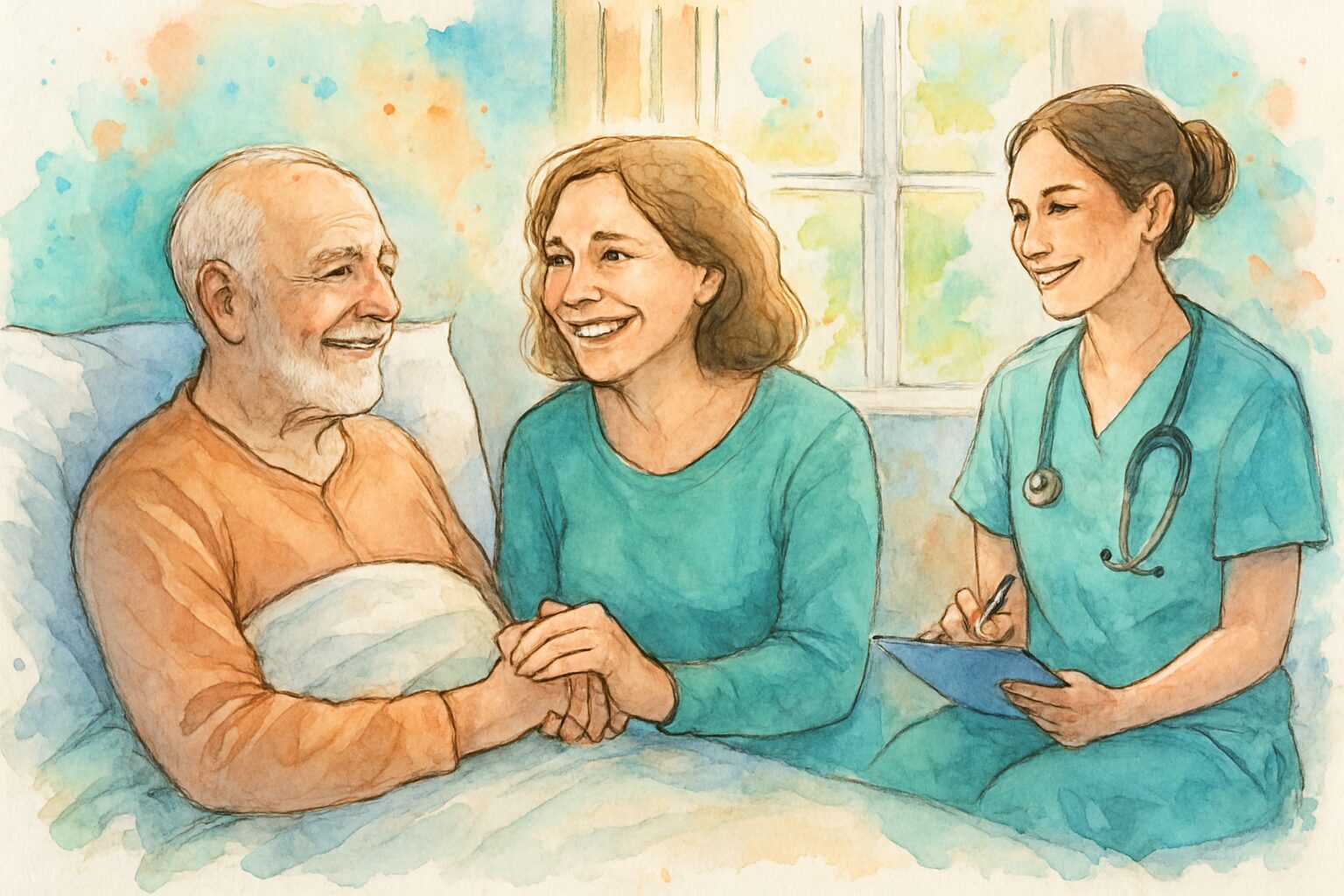
Hospice Care Is Not What Most Families Think It Is
The word "hospice" stops families cold. For most people, it sounds like a final door closing — a signal that medicine has nothing left to offer and the end is imminent. That fear keeps families waiting weeks or months longer than they need to, often until a crisis forces the decision.
But the families who have actually been through it — here in Monterey County and across the Central Coast — consistently say the same thing: they wished they had called sooner. Not because the outcome changed, but because the experience of those final weeks or months was completely different than they expected.
This article is for anyone who has heard the word hospice and felt their stomach drop. What hospice actually involves, what it covers, and what it does not take away from your loved one — these are things most families don't find out until they're already in the middle of it.
The Myth That Keeps Families Waiting Too Long
The single biggest barrier to hospice care isn't eligibility. It's the word itself.
Families delay because they believe that choosing hospice means "we've given up" — or worse, that it somehow speeds up the dying process. Neither is true. Research consistently shows that patients receiving hospice care report better quality of life than those who don't, and families overwhelmingly report feeling relieved rather than defeated once care begins.
One family's account captures it well. Their loved one — an Alzheimer's patient — had been making difficult trips to clinics that weren't improving her condition and were exhausting everyone involved. Once hospice began, she stayed home. She stayed comfortable. As the family put it: "The word hospice does not mean the patient is dying right away. It just means the patient will be comfortable."
That reframe matters. Because the decision to call isn't a surrender — it's a choice to stop spending whatever time remains in waiting rooms and start spending it at home.
For families who aren't sure whether hospice or another type of support is the right fit right now, understanding the difference between home health and hospice is a good place to start.
What Hospice Care Actually Looks Like in Your Home
Most families picture hospice as one nurse, a few visits a week, and not much else. The reality is a full interdisciplinary team that comes to wherever your loved one lives — a house in Pacific Grove, an apartment in Salinas, a family home in King City or Hollister.
The team typically includes:
- Registered Nurses who visit regularly to manage pain, monitor symptoms, and adjust medications
- Hospice Aides who help with bathing, personal care, and daily comfort
- Medical Social Workers who help the family navigate decisions, paperwork, and emotional stress
- Chaplains who provide spiritual care — for patients of any faith, or none
- Volunteers who offer companionship, respite time for family, and practical support
- Bereavement Specialists who continue supporting the family after the patient passes
The physician stays involved too. Hospice coordinates directly with your loved one's doctor — it doesn't replace that relationship.
What consistently moves families from hesitation to yes is simply hearing this list out loud. Many assume hospice means handing their loved one over to an institution. Instead, the institution comes to them — and the family remains at the center of everything.
For families carrying the weight of day-to-day support, recognizing when that load has become too much to carry alone is part of this same conversation.
What Hospice Covers That Most Families Don't Know About
One of the most common reasons families delay calling is cost. They assume hospice will add another financial burden on top of everything else.
For most families in Monterey County, Medicare covers hospice care in full when a physician certifies that the patient has a terminal illness with a prognosis of six months or less if the illness follows its expected course. Medi-Cal and Veterans benefits also cover hospice services — and for families navigating dual eligibility, a hospice intake coordinator can walk through exactly how coverage applies.
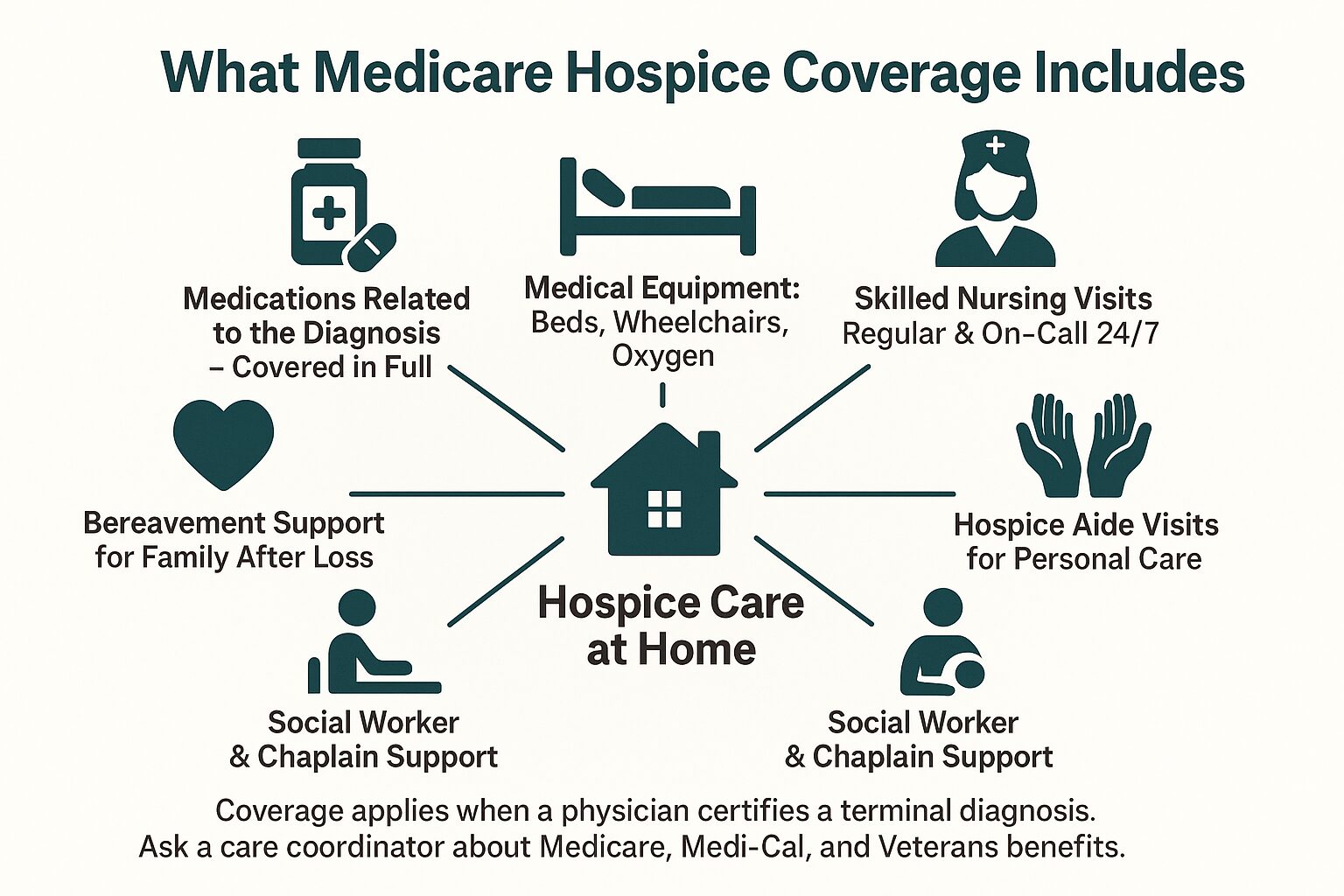
What Medicare hospice coverage includes:
- Medications related to the terminal diagnosis — filled and delivered, no co-pay
- Medical equipment — hospital beds, wheelchairs, oxygen, whatever is needed at home
- All team visits — nursing, aide, social work, chaplaincy, and volunteer services
- 24/7 on-call nursing access — a real nurse available by phone any hour, any day
- Bereavement services — grief support for family members that continues after the patient passes
The medication and equipment coverage surprises almost every family. That gap — not knowing that prescription costs and home equipment are included — is one of the most consistent things that keeps families from calling.
For families who want to understand what comfort-focused care actually means before they make any decisions, this explanation of comfort-focused care breaks it down without any clinical language.
What Hospice Care Actually Covers
Most families are surprised by how much is included. This breakdown shows what Medicare hospice coverage typically provides — at no additional cost to the family.
The 'Point of No Return' Myth — and Why It's Wrong
Many families hold back because they believe that choosing hospice is permanent. They worry that once they say yes, there's no going back — no more curative treatment, no more options.
This is one of the most underexplained things in all of end-of-life care, and it's worth being direct about it.
A patient can leave hospice at any time. The formal term is "revoking the hospice election," and it happens more often than most families realize. A patient who improves, or who decides they want to pursue treatment again, can return to curative care. They can re-elect hospice later if their condition changes again.
A few things that don't go away when someone is on hospice:
- Their relationship with their primary care physician
- Treatment for unrelated conditions — a hospice patient with diabetes still receives insulin
- The ability to go to the emergency room or seek a second opinion
This flexibility is what often frees families to say yes. They're not locking a door. They're opening one — to a team of nurses, aides, social workers, chaplains, and volunteers who will show up at the home and focus entirely on comfort, dignity, and the family's experience of this time.
Families who have been through this moment — the decision itself — describe it in ways that are worth reading before you're in the middle of it. How families describe the moment they chose hospice captures those experiences honestly.
Common Hospice Misconceptions vs. What's Actually True
These are the beliefs that show up most often when families first call — and what the reality actually looks like.
| What Families Often Believe | What's Actually True |
|---|---|
| Hospice means we've given up | It means shifting the focus to comfort — the patient and family remain in control |
| Hospice speeds up death | Studies consistently show hospice patients often live as long or longer, with better quality of life |
| Once we choose hospice, we can't go back | Patients can revoke hospice at any time and return to curative treatment |
| Hospice is just a nurse visiting a few times a week | It's a full team — nurses, aides, social workers, chaplains, volunteers, and bereavement support |
| Hospice costs a lot out of pocket | Medicare, Medi-Cal, and Veterans benefits cover hospice — including medications and equipment |
| The doctor steps back once hospice starts | The physician stays involved; hospice coordinates directly with the treating doctor |
When to Start the Conversation — and What Happens First
There's no perfect moment that announces itself. But there are signs that it's time to at least ask the question.
Families in Monterey County often reach out after a loved one has been in and out of the hospital for the same condition — when treatment isn't improving things anymore, only managing acute episodes. Others call after a diagnosis that carries a clear prognosis, like end-stage heart failure, advanced COPD, or late-stage cancer.
But many calls come from families who aren't sure yet. A daughter in Pacific Grove managing her father's medications. A family in Salinas whose mother keeps declining between hospital stays. A spouse who hasn't slept well in months. These families often aren't calling because hospice is definitely the answer — they're calling because they need someone to help them understand what the options actually are.
A physician referral is part of the process, but families can also call a hospice provider directly to ask questions before any decisions are made. An intake coordinator can explain what a physician certification involves, what the evaluation looks like, and whether the situation qualifies — without any pressure to commit.
For families weighing whether this is the right time, what families wish they'd known sooner about home care covers the hesitation that almost always comes before the call. And for anyone already thinking about the longer arc of planning, why starting end-of-life planning earlier changes everything is worth reading alongside this one.
Frequently Asked Questions About Hospice Care
Does a patient have to stop seeing their regular doctor to start hospice?
No. The primary care physician stays involved and hospice coordinates with them directly. The hospice team works alongside the treating doctor — not instead of them.
What if my loved one improves after starting hospice?
Improvement is always welcome, and it happens. If a patient's condition stabilizes or improves, they can be discharged from hospice. If they later meet the criteria again, they can re-elect hospice services. There is no penalty and no permanent commitment.
Does Medicare really cover all of it — medications, equipment, the whole team?
For most patients, yes. Medicare Part A covers hospice care in full when a physician certifies a terminal diagnosis with a prognosis of six months or less. That includes medications related to the diagnosis, medical equipment delivered to the home, all team visits, and 24/7 on-call nursing. Medi-Cal and Veterans benefits have comparable coverage. A care coordinator can walk through how coverage applies to a specific situation.
Can hospice care be provided in a nursing facility or assisted living community?
Yes. Hospice is defined by a philosophy of care, not a physical location. A hospice team can come to a skilled nursing facility, an assisted living community, or any place the patient calls home.
What happens to the family after the patient passes?
Hospice doesn't end when the patient dies. Bereavement services — including grief counseling and ongoing emotional support — continue for family members after the loss. For families navigating grief in the months that follow, understanding what grief support actually looks like can help set realistic expectations.
How do we know if it's too early to call?
It almost never is. Families who call early get information — not enrollment pressure. A conversation with an intake coordinator can clarify whether the situation qualifies, what the process looks like, and what questions to bring to the physician. Most families who waited wish they had called months sooner.
Questions About Hospice Care for a Loved One on the Central Coast?
Central Coast VNA & Hospice has been serving families across Monterey County — from the Peninsula to Salinas, King City, and the surrounding communities — since 1951. If you have questions about whether hospice care is the right fit, or just want to understand what the process looks like before making any decisions, a care coordinator is available to talk through it with you. Call 831-372-6668 or visit ccvna.com to reach someone who can help.
Home Health vs. Hospice: How Families Know Which One Fits Right Now
One of the most common calls families make to a home health agency goes something like this: a loved one is being discharged from Salinas Valley Health or Community Hospital of the Monterey Peninsula, and the family has 48 hours to figure out what happens next. They've heard the words home health, palliative care, and hospice — sometimes in the same conversation — and they're not sure which one applies or whether their loved one even qualifies.
That confusion is completely understandable. These three types of care are genuinely different — different goals, different eligibility rules, different teams involved — but from the outside, they can sound like variations of the same thing. And when a discharge planner is waiting on a decision, there's rarely time to sort it out quietly.
This article explains how these three options actually differ, who qualifies for each, and — critically — how a patient can move between them as their needs change. If you're making this decision for someone in Monterey County, Salinas, Pacific Grove, King City, or anywhere else on the Central Coast, this is meant to give you a clear picture before you talk to anyone.
What Home Health Actually Is — and Who It's For
Home health is medical care delivered in the home for patients who are still working toward a goal — recovering from surgery, managing a worsening chronic condition, or regaining function after a hospital stay. The word that matters here is goal. Home health is built around measurable progress.
To qualify under Medicare, a patient generally needs to meet two criteria:
- They must be homebound, meaning leaving home requires significant effort or assistance
- They must need skilled care — services that only a licensed clinician can provide, not just help with daily tasks
What that looks like in practice is a care team that might include a Registered Nurse managing medications and monitoring for complications, a Physical Therapist rebuilding strength and mobility after a hip replacement, an Occupational Therapist helping someone adapt their home routine, or a Speech Therapist addressing swallowing difficulties after a stroke. A Medical Social Worker may also be involved to connect the family with community resources and support.
One family from Pacific Grove described the moment their mother came home from rehab: a nurse arrived first to assess her needs, then a physical therapist came weekly to work through an individualized exercise plan, and a medical social worker helped them sort out her Medicaid paperwork from another state. That combination — not just nursing, but a full team with specific roles — is what home health actually looks like when it's working.
For more on what happens during those visits, What Does a Skilled Nurse Actually Do on a Home Visit? explains the details in plain terms. And if you're navigating a discharge right now, What Families Often Miss When Planning a Hospital Discharge to Home is worth reading before you finalize anything.
What Hospice Is — and What It Isn't
Hospice represents a different philosophy entirely. It's not a lower level of home health — it's a different choice about what care is for.
When a patient and their physician agree that curative or life-prolonging treatment is no longer the goal, and a physician certifies a prognosis of six months or less if the illness follows its expected course, hospice becomes available. At that point, Medicare's hospice benefit covers the full scope of comfort-focused care in the home.
What that team looks like:
- Hospice Registered Nurses managing pain and symptoms, available around the clock
- Hospice Aides assisting with personal care and daily comfort
- Medical Social Workers supporting the patient and family with practical and emotional needs
- Chaplains providing spiritual care — regardless of religious background
- Bereavement Specialists who stay connected with families after the patient's passing
- Volunteers who provide companionship and respite
One reviewer described receiving care for a parent in a terminal situation: "They don't just show up to work everyday for us in need — they care for our loved ones that are in need of support through the very hard times life brings."
A few things families often get wrong about hospice: it doesn't mean giving up hope, it doesn't mean the patient dies sooner, and — importantly — it's a choice the patient can reverse. If someone on hospice decides they want to pursue treatment again, they can leave hospice and return to curative care. That flexibility rarely gets communicated clearly, and it changes how many families approach the conversation.
For a deeper look at what this decision actually feels like, How Families Describe the Moment They Chose Hospice reflects honest accounts from people who've been there.
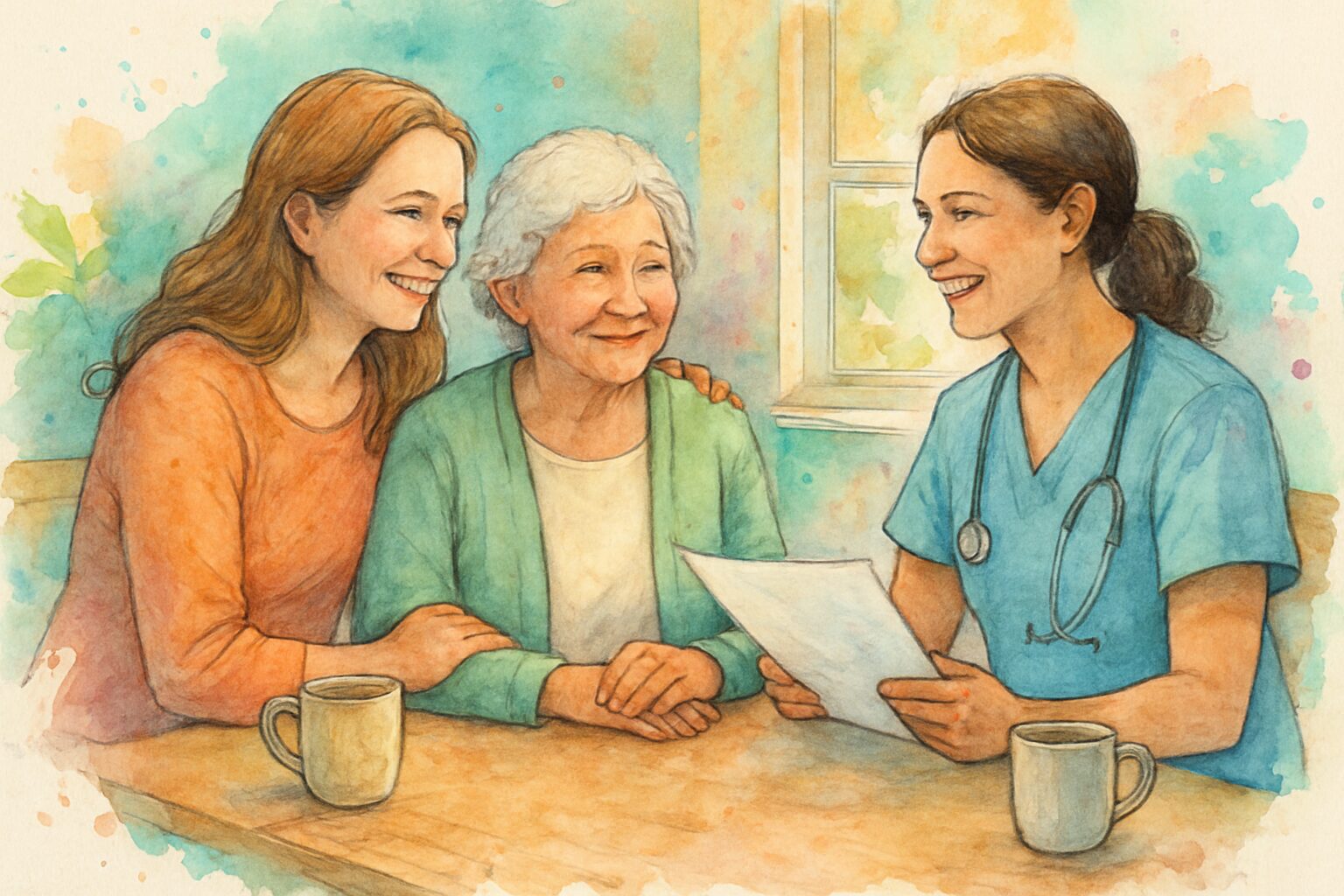
The Three Paths: Home Health, Palliative Care, and Hospice
This comparison shows how home health, palliative care, and hospice differ across the dimensions families ask about most.
Palliative Care: The Option Most Families Have Never Heard Of
If home health is about recovery and hospice is about comfort at end of life, palliative care sits in a space most families don't realize exists.
Palliative care is available at any stage of a serious illness — even alongside active treatment. It does not require a terminal diagnosis. A person receiving chemotherapy, managing a progressive neurological condition like Parkinson's, or living with advanced heart failure can all qualify. The focus is on managing symptoms, improving quality of life, supporting the family, and helping everyone involved make informed decisions about what comes next.
In real terms, palliative care might look like:
- A nurse practitioner or physician working alongside the treating doctor to control pain and fatigue
- A medical social worker helping the family understand their options and anticipate what's ahead
- Emotional and psychosocial support for the patient and for family members carrying the weight of caregiving
- Care planning conversations that happen before a crisis forces a rushed decision
One caller navigating a Parkinson's diagnosis for her husband didn't know whether he would qualify for any services at all. Palliative care was the answer — not home health, not hospice — and it's the category most likely to be missing from the conversation families are having right now.
For a full explanation of what palliative care actually involves, Palliative Care Meaning: A 2026 Guide to Family Support is a good place to start. And What "Comfort-Focused Care" Really Means — and When to Ask About It addresses the language families often encounter without a clear explanation.
Can a Patient Move Between These Categories?
This is one of the most important questions families ask — and the answer is almost always yes. Here's how those transitions typically work.
| Starting Point | Transition | What Makes It Possible |
|---|---|---|
| Home Health | → Palliative Care | Illness progresses; curative treatment continues but symptom burden increases |
| Home Health | → Hospice | Patient and physician agree comfort is now the goal; prognosis of 6 months or less |
| Palliative Care | → Hospice | Patient elects to stop curative treatment; palliative team often helps facilitate |
| Hospice | → Home Health or Curative Treatment | Patient decides to resume treatment; hospice is revoked; Medicare covers new plan |
| Hospice | Continued beyond 6 months | Patient outlives initial prognosis; hospice continues with physician recertification |
How Families in Monterey County Are Actually Making This Decision
In practice, the families calling with these questions are rarely sitting calmly with time to research. More often, someone is being discharged from a hospital in Marina or Carmel, a specialist has said something that changed everything, or a parent who was managing fine last month is no longer managing at all.
Several patterns come up repeatedly among families navigating this on the Central Coast:
- Families with a loved one in a skilled nursing facility — places like Canterbury Woods in Pacific Grove — trying to understand what home health looks like once their parent returns home
- Adult children managing a parent's medications who realize the complexity has exceeded what they can safely handle alone
- Spouses of patients with dementia, Parkinson's, or cancer who have been carrying everything themselves and aren't sure where to draw the line
What changes the conversation for many of these families is learning that the care team is larger than they assumed. Many callers are surprised to find out that physical therapists, occupational therapists, medical social workers, and chaplains are part of the picture — not just nurses. When a discharge planner or agency representative describes that full team clearly and early, it often resolves the hesitation.
If you're in that position right now — caring for an aging parent and trying to figure out when you've reached the edge of what you can do alone — When Caring for an Aging Parent Becomes More Than You Can Do Alone addresses that experience directly.
Frequently Asked Questions About Home Health vs. Hospice
My mother's doctor mentioned home health after her surgery. Does she automatically qualify?
Not automatically — but most post-surgical patients do qualify if they meet two conditions: they're homebound (meaning leaving home takes considerable effort), and they need skilled care like nursing, physical therapy, or wound care. A physician order is required, and an agency will do an initial evaluation to confirm eligibility before services begin.
Does choosing hospice mean we're giving up?
No. Hospice is a choice about what kind of care fits best at a particular moment — not a surrender. Many families describe it as the first time their loved one felt genuinely comfortable. And it's worth knowing that hospice is revocable: if a patient wants to return to curative treatment, they can. The decision isn't permanent.
Can someone be on hospice and still live at home?
Yes — that's actually the most common arrangement. Hospice care is designed to be delivered in the home, and the team — nurses, aides, chaplains, social workers, and volunteers — comes to the patient. A patient doesn't need to move to a facility to receive hospice.
We're not sure if we're at the hospice stage yet. What's in between?
Palliative care is the answer most families don't know to ask about. It's available at any stage of serious illness, alongside whatever treatment is already happening. It doesn't require a terminal prognosis. If your loved one is dealing with significant symptoms, medication complexity, or emotional strain — and they're still pursuing treatment — palliative care may fit right now.
Does Medicare cover all of this?
Medicare covers home health when the patient is homebound and needs skilled care, ordered by a physician. It covers hospice fully under the Medicare Hospice Benefit when a physician certifies a prognosis of six months or less and the patient elects comfort-focused care. Palliative care coverage varies — it depends on the patient's diagnosis, their Medicare plan, and how services are structured. VNA accepts Medicare, Medi-Cal, and Veterans benefits; a care coordinator can walk through what applies to your loved one's specific situation.
Can a patient receive home health in Salinas or King City, not just on the Monterey Peninsula?
Yes. Central Coast VNA & Hospice serves all of Monterey County — including Salinas, King City, the Monterey Peninsula, and surrounding communities — as well as San Benito County, South Santa Clara County, and parts of the region beyond. Geographic coverage is worth confirming when you call, especially for more rural areas.
Still Not Sure Which One Fits?
That's exactly the kind of question a care coordinator at Central Coast VNA & Hospice can help sort out — without pressure, and without requiring you to have it figured out first. VNA has been serving families across Monterey County, Salinas, the Monterey Peninsula, and the broader Central Coast since 1951, and this conversation is one they have every day. You can reach them at 831-372-6668 or visit ccvna.com to learn more about the options available to your family right now.
How Long Can You Actually Age in Place — and What Makes It Work?
Most families in Monterey County have the same conversation eventually — usually after a fall, a confusing hospital discharge, or a medication mix-up that nearly turned serious. Someone says, "We need to figure out what to do about Mom." And the options that come to mind are usually two: stay home or move to a facility.
But that's a false choice, and it's one that leads a lot of families to make decisions under pressure that they didn't have to make at all. The question isn't whether your loved one can age in place. The question is what support makes it sustainable — and how long you can keep it working before the gaps catch up.
Across Monterey and Santa Cruz counties, where more than 15% of the population is over 65 and healthcare infrastructure is thinner than in larger urban centers, those gaps show up faster than families expect. This article is about what actually closes them.
Why Aging in Place Falls Apart — and It's Usually Not the Illness
About 93% of adults 55 and older say they want to remain in their own homes as they age. Almost none of them have a plan for how to make that happen.
What's striking is that when aging in place finally breaks down, it's rarely the underlying diagnosis that forces a move. It's the logistics around it. The four patterns that appear most often are:
- Medication errors — An 83-year-old managing five or more prescriptions alone, or with a spouse who is also aging, will almost inevitably make mistakes. Dosing errors, missed medications, and dangerous interactions are common and largely preventable with skilled oversight.
- Unmanaged wound care — A surgical site, a diabetic ulcer, or a pressure wound that isn't being properly assessed and dressed will deteriorate. What starts as a manageable wound becomes a hospitalization.
- Unaddressed fall risk — Falls are the leading cause of injury-related death among older adults, and many of the risk factors — throw rugs, bathroom layout, weakened gait — are sitting in plain sight in the home.
- Family exhaustion — Adult children carrying the weight of coordinating care, monitoring medications, attending appointments, and managing their own lives eventually hit a wall. When they do, the system collapses.
Each of these is addressable through skilled home health services before it becomes the crisis that ends aging in place. But most families don't reach out until the crisis is already underway. One family in Pacific Grove recently submitted an inquiry specifically because managing a parent's five medications had become "too confusing" — a solvable problem that had been quietly building for months.
For more on recognizing when that threshold has been crossed, When Is It Time to Think About Getting Help at Home? walks through the specific signals families miss.
The Care Team Most Families Don't Know They Can Have
When families call to ask about home health, they almost always describe what they're looking for the same way: "We just need a nurse to check in on her."
That's a natural starting point — but it significantly undersells what skilled home health actually involves. The team that can support aging in place at home includes:
- Registered Nurses (RNs) and Licensed Vocational Nurses (LVNs) who assess health status, manage medications, oversee wound care, and coordinate with the treating physician
- Physical Therapists who evaluate how a patient moves through their own home, identify fall risks, and design a plan to improve strength and balance in that specific space
- Occupational Therapists who assess the home itself for hazards — grab bars, lighting, furniture placement — and recommend adaptive equipment that makes daily tasks manageable
- Medical Social Workers who connect families to community resources, help navigate insurance questions, and provide support when the logistics feel overwhelming
- Speech Therapists when swallowing, communication, or cognitive function is part of the picture
One reviewer described what it felt like to have this full team arrive for her elderly mother: "I was blown away by the personalized care that she received. A team made of nurses, physical therapists and Medical social worker came to help us." That response — surprise at the scope — is more common than VNA staff would probably like.
This is also where California's IHSS program (In-Home Supportive Services) becomes relevant. For qualifying families, IHSS can supplement skilled home health with non-medical support — bathing assistance, meal preparation, transportation — at little or no out-of-pocket cost. It doesn't replace skilled clinical care, but it fills gaps that skilled care doesn't cover. Families in Salinas, King City, and Hollister especially benefit from knowing both programs exist and can work alongside each other.
For a closer look at what actually happens during a skilled nursing visit, What Does a Skilled Nurse Actually Do on a Home Visit? explains the specifics.
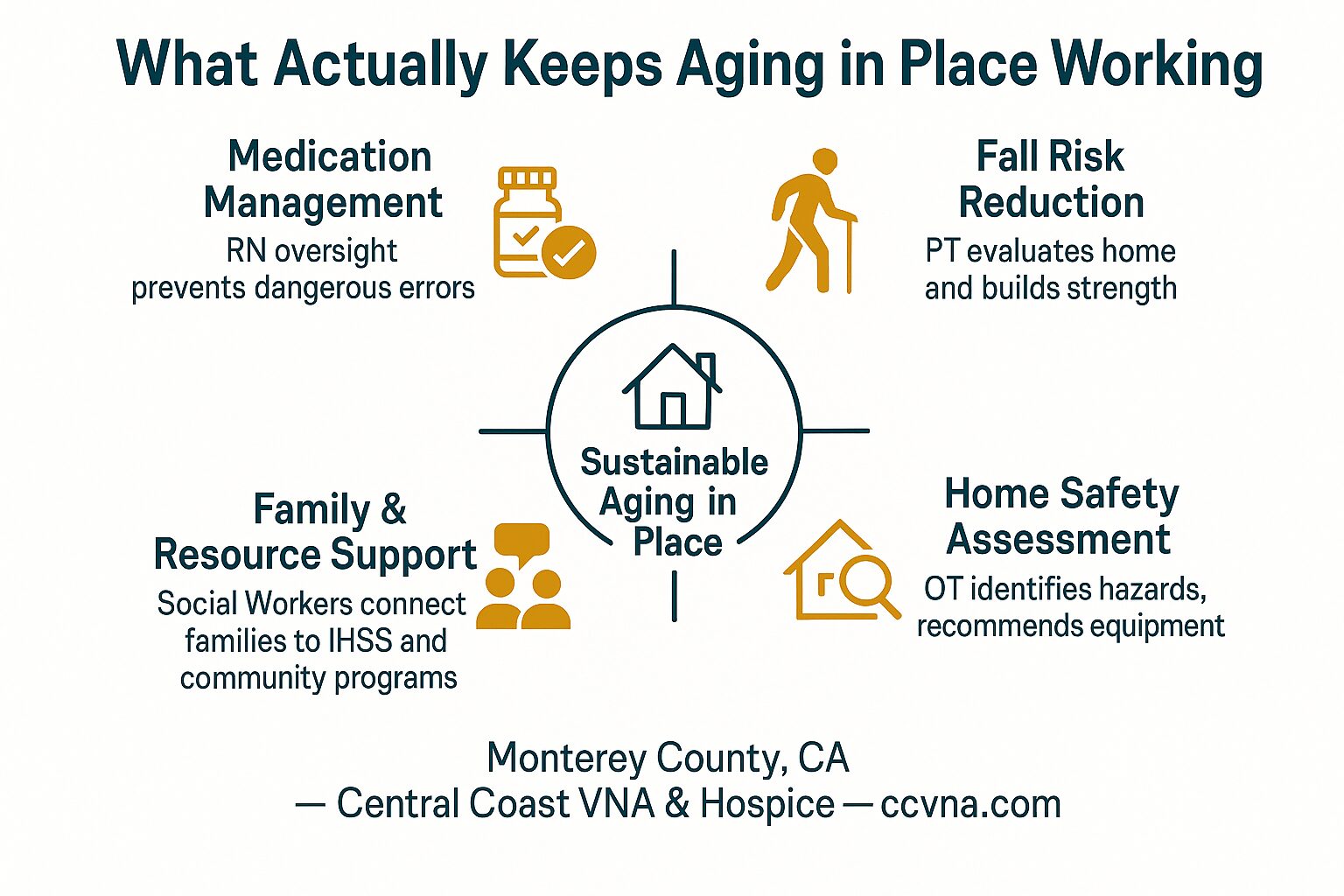
What Actually Keeps Aging in Place Working
The four support structures that determine whether aging in place remains sustainable — and what breaks down without each one.
When the Seasons Work Against You — Central Coast Timing Matters
Monterey County has a mild climate, which can make it easy to overlook seasonal health risks for older adults. But two windows of the year consistently push aging-in-place situations to the breaking point.
Summer brings dehydration risk that families underestimate. Elderly patients with chronic conditions — heart disease, diabetes, kidney disease — can reach a medical crisis faster than their families realize, especially when heat arrives suddenly. The coast fogs over by afternoon, but inland Salinas and King City heat up significantly, and seniors living alone often don't register how dehydrated they've become.
Fall compounds the risk in a different direction. Flu season increases hospitalization rates among older adults. Hospital discharges accelerate, and families who've been deferring care decisions suddenly have to make them in 24 hours. And every year from October 15 through December 7, Medicare Open Enrollment creates a narrow window to review and adjust coverage — a window most families miss because no one told them it was coming.
These aren't reasons to panic. But they are reasons to get the right support structures in place before August, not after a September emergency room visit. What Families Often Miss When Planning a Hospital Discharge to Home covers what that moment actually requires.
Aging in Place: What Skilled Home Health Covers vs. What It Doesn't
Families often confuse skilled home health with live-in caregiving or residential placement. These are different services with different purposes — and understanding the distinction helps families build the right combination of support.
| Support Need | Skilled Home Health Covers This | Requires Other Programs (e.g., IHSS, Private Aide) |
|---|---|---|
| Medication management and oversight | Yes — RN or LVN | No |
| Wound assessment and dressing changes | Yes — RN or LVN | No |
| Fall risk evaluation and home safety | Yes — Physical Therapist, Occupational Therapist | No |
| Bathing, dressing, personal hygiene | Limited (Hospice Aides in some programs) | Yes — IHSS or private aide |
| Meal preparation and housekeeping | No | Yes — IHSS or community programs |
| Transportation to appointments | No | Yes — IHSS or community programs like Community Bridges |
| Emotional support and resource coordination | Yes — Medical Social Worker | No |
| 24/7 supervision or companionship | No | Yes — family, private aide, or facility |
What Medicare Actually Pays For — and What Families Assume It Won't
Coverage is one of the most common reasons families wait too long to call. The fear is that skilled home health isn't covered, or that the process to qualify is more complicated than it's worth.
The basics are worth knowing. Medicare covers skilled home health services — including nursing visits, physical therapy, occupational therapy, speech therapy, and medical social services — when a patient is considered homebound and has a physician's order. There is no daily copay for home health under Medicare.
Medi-Cal covers home health for qualifying patients, and many Central Coast families who have both Medicare and Medi-Cal (called dual eligibility) have more coverage than they realize. Veterans benefits also cover home health for eligible patients.
What Medicare does not cover is non-medical home care — bathing assistance, housekeeping, companionship. That gap is real, and it's where IHSS or private arrangements come in. But the clinical piece — the nursing, the therapy, the social work — is often fully covered for patients who qualify, and most families are surprised to learn that.
For a deeper look at how Medicare handles home-based physical therapy specifically, Does Medicare Cover Physical Therapy At Home? addresses the exact question families ask.
Frequently Asked Questions About Aging in Place on the Central Coast
How do we actually get started with home health services?
You need a physician's order — a recommendation from your loved one's doctor that home health is appropriate. From there, you call to initiate the intake process, and a clinician typically comes out to do an evaluation within a few days. The intake team can help you understand what the physician needs to provide and what to expect after that first call.
My parent lives in Salinas / King City / Hollister — does home health actually reach there?
Yes. Central Coast VNA & Hospice serves all of Monterey County, including Salinas, King City, and surrounding communities, as well as San Benito County including Hollister. Geographic coverage is not typically a barrier for families in those areas.
What's the difference between palliative care and hospice — and can someone get either while still living at home?
Both can be delivered at home, and that's how most patients receive them on the Central Coast. Palliative care is for anyone with a serious illness — it focuses on symptom management, care planning, and emotional support without requiring a patient to stop pursuing curative treatment. Hospice care is for patients who are no longer pursuing curative treatment and want comfort-focused care instead. The two are often confused, but they serve different moments in a patient's journey. What 'Comfort-Focused Care' Really Means — and When to Ask About It explains the distinction in plain terms.
My parent keeps refusing help. How do other families handle that?
This is one of the most common situations families describe. A parent who values independence often hears "home health" as a threat to that independence — when the actual goal is the opposite. Some families find it helps to frame the initial visit as an evaluation rather than ongoing care, and to let the clinician build rapport directly with the patient. A Medical Social Worker can also help families navigate these conversations. There's no script that works every time, but the resistance usually softens when the patient sees the care team is there to help them stay home — not to take anything away.
Can we get help with grief support if our loved one has already passed?
Yes. Bereavement support is available for families after a patient's death, and it doesn't require that the patient was previously in hospice. If someone in Monterey County or the surrounding area is navigating loss and needs a grief support group or counseling, that support exists. Grief Doesn't Follow a Schedule — What Support Actually Helps is a good starting point for families trying to understand their options.
Questions About What's Possible for Your Family?
Central Coast VNA & Hospice has been supporting families across Monterey County, Salinas, King City, San Benito County, and the surrounding Central Coast since 1951. If you're trying to figure out what's realistic for your loved one — what support they qualify for, what Medicare or Medi-Cal covers, or just where to start — a care coordinator can talk through your situation without pressure. Call 831-372-6668 or visit ccvna.com to learn more.
Most Families Start End-of-Life Planning Too Late. Here's What Changes When You Don't.
Most families on the Central Coast don't avoid end-of-life planning because they don't care. They avoid it because starting feels like admitting something is already over.
But that belief — that planning means giving up — is exactly what leads to the hardest moments: a family disagreeing in a hospital hallway at midnight, a loved one unable to speak for themselves, a physician asking questions no one prepared to answer. Across Monterey County, these situations play out regularly, and almost all of them were preventable.
This article covers what end-of-life planning actually includes, why earlier is genuinely better, and what California's legal documents mean for your family — explained in plain terms, without pressure.
What End-of-Life Planning Actually Covers (It's More Than a Document)
When most people hear "end-of-life planning," they picture a single piece of paperwork. The reality is more like a set of conversations — some legal, some deeply personal — that together give your family a map when things get hard.
A complete plan typically addresses:
- Who makes decisions if you can't speak for yourself
- What treatments you want — and which ones you don't
- Where you want to be — home, a facility, or somewhere specific in your community
- Pain and symptom preferences — how aggressively you want discomfort managed
- Spiritual and cultural wishes — what matters at the end in terms of faith, ritual, and presence
- What your family needs to know about finances, accounts, and practical logistics
Most families get to one or two of these. The rest become crises — not because anyone failed, but because no one knew the conversation needed to happen.
For families in Salinas, Pacific Grove, King City, or anywhere across Monterey County, what families in Monterey wish they'd known sooner about home care reflects a recurring theme: the questions people wish they'd asked earlier.
California's Three Advance Directive Documents — and What Each One Does
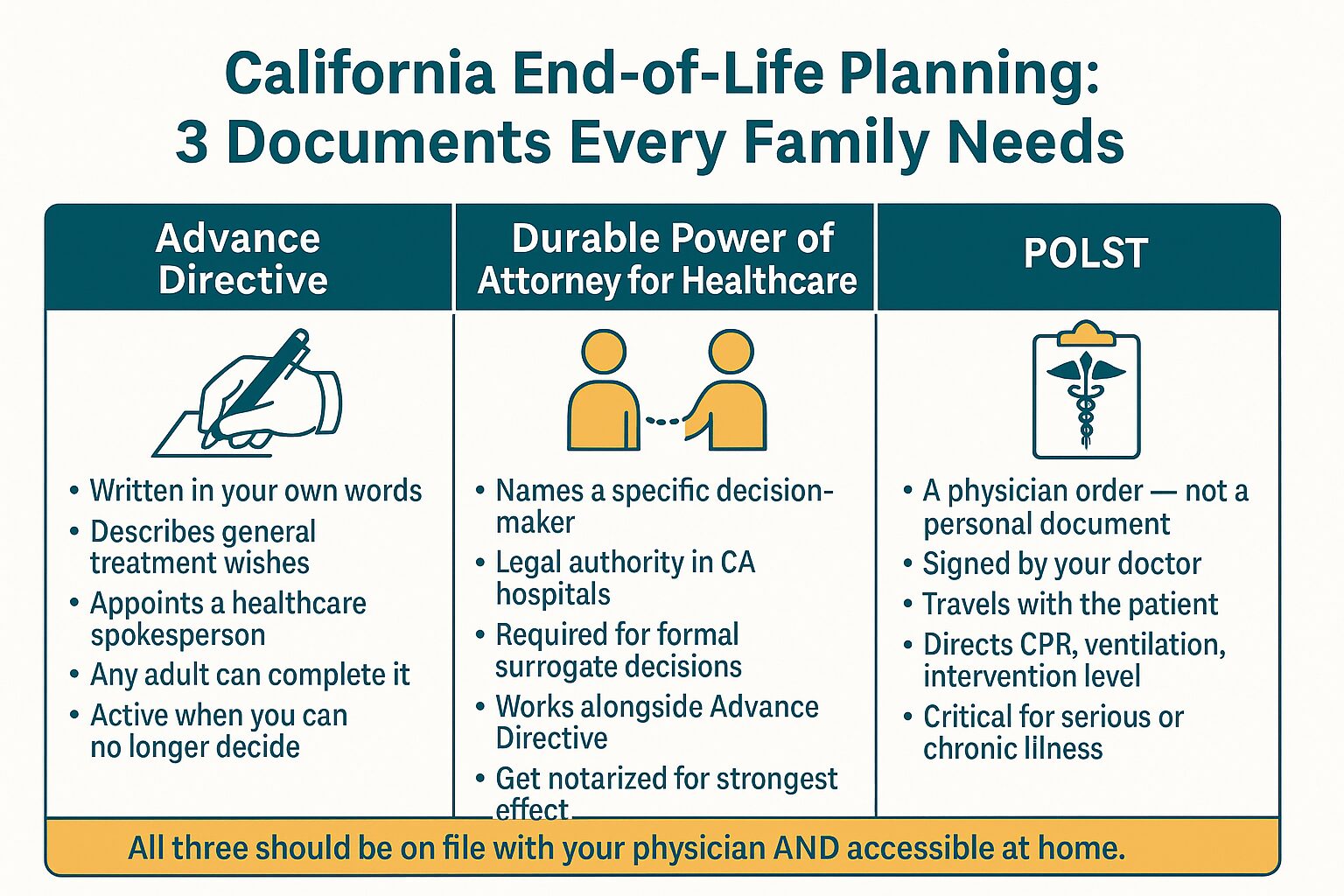
California recognizes three distinct legal documents for end-of-life planning. They're not interchangeable, and each one serves a different function. Understanding which is which — and who needs to have a copy — is one of the most practical things a family can do.
1. Advance Directive (also called a Healthcare Directive)
This is the broadest document. It lets you describe your general wishes for medical treatment and designate someone to speak for you. It's written in your own words and becomes active when a physician determines you can no longer make decisions yourself. Any adult in California can complete one without an attorney.
2. Durable Power of Attorney for Healthcare (DPAHC)
This document formally appoints a specific person — your healthcare agent — to make medical decisions on your behalf. It has legal weight in California hospitals and medical settings. Without it, a hospital may default to its own protocol for surrogate decision-making, which may not reflect what you'd want.
3. POLST (Physician Orders for Life-Sustaining Treatment)
This is not an advance directive — it's a medical order, signed by a physician. It travels with a patient and gives emergency responders and medical staff specific, actionable instructions: whether to attempt CPR, whether to use mechanical ventilation, what level of intervention you want. A POLST is especially important for people with serious or chronic illness who may need emergency care at home.
All three documents should be:
- On file with your primary physician
- Accessible to your designated decision-maker
- Kept somewhere findable at home — not locked in a safe deposit box
If you're caring for an aging parent in Hollister, Seaside, or anywhere across Monterey County, having all three in order — and copies distributed — means a physician, nurse, or paramedic will know exactly what your family wants.
California's Three Advance Directive Documents at a Glance
This infographic breaks down the three documents California families need, what each one covers, and who should have a copy.
Why Families Wait — and What Research and Experience Actually Show
The most common reason families delay isn't avoidance. It's a specific belief: that starting the conversation means accepting that death is close.
But families who plan early consistently report the opposite experience. Less conflict. Fewer emergency decisions. More time spent actually present with their loved one instead of managing a crisis.
One reason early planning changes the experience is that it removes a particular kind of stress — the stress of not knowing what the person would want. When a Registered Nurse or Medical Social Worker visits a patient at home and the family has already had these conversations, the clinical team can focus on care instead of spending precious time reconstructing preferences from scratch.
For families weighing whether a loved one still needs curative treatment or might benefit from a different kind of support, what comfort-focused care really means — and when to ask about it is worth reading before those conversations happen in a hospital setting.
Palliative Care Isn't an End — It's a Different Kind of Beginning
One of the most persistent misunderstandings in end-of-life planning is the belief that seeking additional support means stopping treatment. It doesn't.
Palliative care is specifically designed to run alongside curative treatment. A patient in Monterey County who is still pursuing chemotherapy, cardiac intervention, or aggressive management of a chronic condition can also have a palliative care team providing:
- Symptom management — pain, fatigue, nausea, breathlessness
- Emotional and psychosocial support for both patient and family
- Care coordination with treating physicians
- Honest, unhurried conversations about what the patient actually wants
This is not an all-or-nothing choice. The framing that palliative care means "giving up" keeps many families from seeking earlier support — and that delay often means more suffering, not less.
In April 2024, California passed AB 1005, which now requires hospitals and Medi-Cal managed care plans to inform terminally ill patients about in-home supportive services and palliative options. Patients with serious illness have more locally available options than they're typically told about during a hospital stay — and knowing to ask is half the work.
For a deeper look at what this kind of care involves, the advanced guide to palliative care in Monterey at home explains the practical side in plain terms.
What Hospice Actually Includes — and When to Have the Conversation
Hospice care is one of the most misunderstood options in end-of-life planning — and one of the most underused, often because families wait until the very last weeks to ask about it.
Hospice is appropriate when a patient's illness is no longer responding to curative treatment and the focus shifts to comfort and quality of life. In California, a patient generally qualifies for the Medicare Hospice Benefit when two physicians certify a prognosis of six months or less if the illness runs its natural course.
But hospice isn't just pain management. A full interdisciplinary team typically includes:
- Registered Nurses and Licensed Vocational Nurses for symptom management and clinical monitoring
- Medical Social Workers for care planning and family support
- Hospice Aides for personal care
- Chaplains for spiritual care, regardless of faith background
- Bereavement Specialists who continue supporting the family after the patient passes
- Volunteers who provide companionship and respite
Medicare and Medi-Cal both cover hospice services when eligibility criteria are met. Veterans benefits also apply for qualifying patients.
Many families describe the decision to ask about hospice as the moment things finally felt less chaotic — not more. How families describe the moment they chose hospice captures that experience directly, in their own words.
Palliative Care vs. Hospice Care: Key Differences
Families often confuse these two types of care. This table breaks down the main distinctions so you know what you're asking about — and when each applies.
| Palliative Care | Hospice Care | |
|---|---|---|
| Curative treatment continues? | Yes — runs alongside treatment | No — focus shifts to comfort only |
| Eligibility | Any serious illness, any stage | Prognosis of 6 months or less (if illness runs its course) |
| Care team | Nurses, therapists, social workers, chaplains | Nurses, aides, social workers, chaplains, bereavement specialists, volunteers |
| Medicare/Medi-Cal coverage | Covered under certain plans; varies | Fully covered under Medicare Hospice Benefit and Medi-Cal when eligible |
| Where care happens | Home, clinic, or hospital | Primarily at home or in a home-like setting |
| Goal | Symptom relief, care coordination, quality of life | Comfort, dignity, and family support through end of life |
What Grief Looks Like Before and After — and Why Bereavement Support Belongs in the Plan
End-of-life planning doesn't end when a patient passes. Families who've been through a serious illness often carry grief that started long before the death — grief for the person they're watching change, for the life that got interrupted, for the decisions they're still carrying.
Anticipatory grief is real and common, especially for adult children who've become primary decision-makers for an aging parent. Having a Medical Social Worker or Bereavement Specialist as part of the care team — not just after the death, but during the illness — gives families a real outlet.
Bereavement support that begins before a loss tends to make the months afterward less isolating. For families in the Seaside, Hollister, or Salinas areas who find themselves without a nearby support group, grief doesn't follow a schedule — what support actually helps is a practical starting point.
Frequently Asked Questions About End-of-Life Planning
Does starting end-of-life planning mean we're giving up?
No — and this is the most important thing to understand. Planning early doesn't signal that death is close. It means that if something happens suddenly, your family doesn't have to make irreversible decisions under pressure. Families who plan earliest consistently report more meaningful time with their loved one, not less.
What's the difference between an Advance Directive and a POLST?
An Advance Directive is a personal document that describes your general wishes and names someone to speak for you. A POLST is a physician-signed medical order that travels with you and gives emergency responders specific instructions — CPR, ventilation, level of intervention. Both are important, and they serve different situations. If your loved one has a serious or chronic illness, they likely need both.
Can someone still receive palliative care if they're pursuing curative treatment?
Yes. Palliative care runs alongside treatment — it doesn't replace it. A patient who is still actively treating cancer, heart disease, or another serious condition can simultaneously receive symptom management, emotional support, and care coordination from a palliative care team. California's AB 1005 (2024) now requires hospitals and Medi-Cal plans to tell seriously ill patients about these options.
Does Medicare cover hospice care at home?
Medicare fully covers the hospice benefit when two physicians certify that a patient's prognosis is six months or less if the illness runs its natural course, and when the patient elects to focus on comfort rather than curative treatment. Medi-Cal and Veterans benefits also cover hospice under qualifying circumstances. Coverage typically includes nursing visits, medications related to the terminal diagnosis, aide services, chaplain visits, and bereavement support for the family.
Who should have copies of our end-of-life planning documents?
At minimum: your primary physician, your designated healthcare agent (the person named in your Durable Power of Attorney for Healthcare), and a family member who knows where to find the originals quickly. Your POLST should be posted somewhere visible at home — on the refrigerator is the standard recommendation — so that emergency responders can find it fast. Locked away in a safe deposit box is the one place it will not be useful when it's needed most.
How do we start this conversation with a parent who doesn't want to talk about it?
Start smaller than you think you need to. Instead of 'let's talk about what happens when you die,' try 'I want to make sure I know what's important to you if something ever happened.' Most people have strong feelings about where they want to be cared for and what they don't want done to them medically — they just haven't been asked. A Medical Social Worker can also help facilitate these conversations, particularly when family dynamics make them feel loaded.
Questions About Where to Start?
Central Coast VNA & Hospice has been supporting families across Monterey County, Salinas, King City, Hollister, and the surrounding Central Coast since 1951 — including families navigating these exact conversations for the first time. If you're not sure what documents your family needs, whether a loved one might qualify for palliative or hospice care, or just want to talk through the options, a care coordinator can help you find your footing. Call 831-372-6668 or visit ccvna.com to learn more.
What Families Often Miss When Planning a Hospital Discharge to Home
A family reached out to us recently — the day after their mother came home from Salinas Valley Health. Her physician had already recommended home health services. But no one had made a call before discharge, and now she was home without any care lined up.
This happens more than most families expect. The hospital stay feels like the hard part, and the discharge feels like relief. But the 48 hours after leaving the hospital are when things can quietly go wrong — a wound that needs changing, medications that need managing, a fall that triggers a second admission.
This article is about what to do before that discharge happens — not after. If your family is navigating this right now in Monterey County, Salinas, King City, or anywhere on the Central Coast, here's what actually matters.
The Discharge Day Problem Nobody Warns You About
Hospitals often discharge patients on Fridays. It's not a coincidence — weekend staffing is lighter, beds turn over, and the administrative machinery that keeps patients in the building slows down heading into the weekend.
The problem is that home health agencies work on the same calendar. If a physician order for home health goes out Friday afternoon, a first home visit typically follows within 24 to 48 hours of the order being received. That means your loved one could be home for a full weekend before a Registered Nurse ever walks through the door.
That gap is exactly when readmissions happen — a missed medication dose, an unmanaged wound, a patient who isn't moving the way they should after surgery. For families in communities like Hollister or King City, where the nearest hospital is already a drive away, a weekend readmission is its own ordeal.
The fix isn't complicated, but it has to happen before discharge day, not after. If a physician has already recommended home health during the hospital stay, the conversation with the discharge planner should start that same day — not on the morning your loved one is getting dressed to leave.
How the Medicare Home Health Order Actually Works
About 43% of admissions-related calls to home health agencies are some version of "how do I get started?" Most families don't know what's actually required — and the hospital doesn't always explain it clearly.
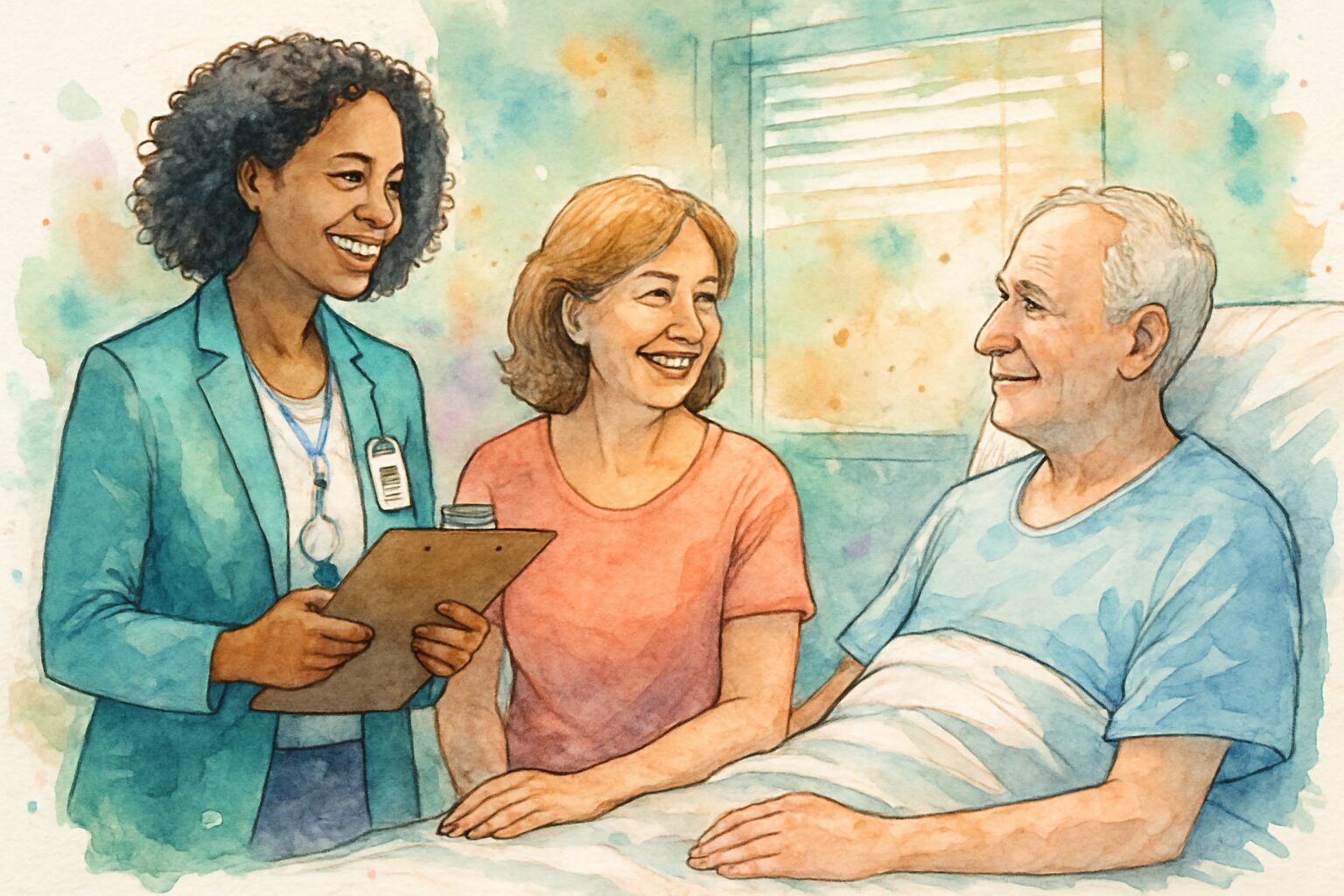
Medicare covers home health services when three conditions are met:
- A physician order — not a prescription, but a signed order from the treating physician (or nurse practitioner) authorizing home health
- Homebound status — your loved one has difficulty leaving home due to illness, injury, or recovery; this doesn't mean they can never leave, but leaving requires significant effort
- A skilled care need — there must be a clinical reason for the visit, such as wound care, medication management, post-surgical monitoring, or physical therapy
Once those three boxes are checked, the physician's office (or the hospital discharge team) can fax the order directly to a home health agency. That fax starts the clock. A first home visit typically follows within 24 to 48 hours of the order being received.
If your loved one is recovering from a procedure and a physician has mentioned home health, ask the hospital team directly: has the order been placed, and has it been sent? Does Medicare cover physical therapy at home? — that's a question worth reading up on before the discharge conversation happens.
The Three Things Medicare Requires for Home Health Coverage
Before a home health agency can schedule a first visit, three conditions must be confirmed. Here's how they fit together.
Your Right to Choose — What the Discharge Planner Isn't Always Telling You
Every hospital has a discharge planner or Medical Social Worker whose job is to coordinate what happens after you leave. They're often the ones who will name a specific home health agency — sometimes the one the hospital has a referral relationship with.
What many families don't realize: you have the right to choose your home health provider. The hospital can offer a recommendation, and that recommendation might be perfectly good. But you are not required to accept it, and the decision belongs to your family.
If your family has a prior relationship with a home health agency, or if you've done your own research and prefer a nonprofit provider with deep local roots, you can request that specific agency. You can also ask the discharge planner to contact them directly.
For families in Monterey County, that conversation is worth having. A local agency that has been operating in this region for decades — with staff who know the roads from Salinas to Carmel Valley — brings a different kind of familiarity than a large national network whose nearest office might be a county away. What families in Monterey wish they'd known sooner about home care is a useful read before that conversation.
What Home Health Can Do — and What It Can't
One of the most common mismatches at discharge is a family expecting round-the-clock support at home. Home health services aren't residential care, and the sooner families understand that distinction, the better prepared they'll be.
Home health — covered by Medicare and Medi-Cal — includes:
- Skilled nursing visits by Registered Nurses and Licensed Vocational Nurses for wound care, medication management, post-surgical monitoring, and chronic disease management
- Physical Therapy to rebuild strength and improve mobility after surgery or illness
- Occupational Therapy to help patients manage daily tasks safely at home
- Speech Therapy for swallowing difficulties or cognitive changes
- Medical Social Workers for care coordination, emotional support, and connecting families to community resources
What it doesn't include: 24-hour staffing, live-in care, or ongoing personal care assistance like bathing, dressing, or meal preparation on a daily basis. Those services fall under a different category of support — often called personal care or custodial care — which Medicare does not typically cover.
If your family is realizing that your loved one needs more support than a skilled nursing visit can provide, when caring for an aging parent becomes more than you can do alone walks through what that transition looks like. And the difference between needing help and needing a facility is worth reading if a higher level of care is on the table.
Home Health vs. What Medicare Doesn't Cover
Families frequently arrive at discharge expecting services that fall outside Medicare's home health benefit. Here's a side-by-side look at what is and isn't included.
| Service | Covered by Medicare Home Health? | Notes |
|---|---|---|
| Skilled nursing visits (wound care, medications) | Yes | Requires physician order and homebound status |
| Physical, Occupational, or Speech Therapy | Yes | Must have a skilled care need tied to current diagnosis |
| Medical Social Worker visits | Yes | Included as part of home health benefit |
| 24-hour live-in nursing | No | Falls outside Medicare home health benefit |
| Daily personal care (bathing, dressing) | No | Considered custodial care; not covered by Medicare |
| Meal preparation or housekeeping | No | May be available through county programs separately |
A Pre-Discharge Checklist for Families
If your loved one is currently in a hospital anywhere in Monterey County — Salinas, the Monterey Peninsula, or across the Central Coast — here's what to address before the discharge day arrives.
- Ask the attending physician whether home health services have been ordered and whether the order has been sent
- Identify the hospital's discharge planner or Medical Social Worker and schedule time to talk about the plan — not just the paperwork
- Confirm homebound status applies to your loved one, and ask the team to document it clearly
- Decide which agency you want and give the discharge planner that name early — don't wait until the morning of discharge
- Ask about discharge timing — if it looks like a Friday, ask whether the agency can receive the order Thursday to close the weekend gap
- Prepare the home before your loved one arrives: clear pathways, check medications, remove trip hazards
The families who avoid the readmission spiral are almost always the ones who started this list two or three days early. After the hospital discharge, what comes next? goes into more detail on the days immediately following a return home.
Frequently Asked Questions About Hospital Discharge to Home
How quickly can a home health agency start after my loved one is discharged?
Once a home health agency receives a signed physician order, a first home visit typically follows within 24 to 48 hours. The key is making sure the order is sent before discharge — not after. If the order goes out on a Friday afternoon, the first visit may not happen until Monday. Getting the order placed earlier in the week closes that gap.
Can we choose our own home health provider, or do we have to use the hospital's recommendation?
You can choose your own. The hospital's discharge planner may recommend an agency, but that recommendation isn't binding. If you have a preference — including a local nonprofit with a long history in Monterey County — tell the discharge planner and ask them to send the order there directly.
What does 'homebound status' actually mean? My father goes to the occasional doctor's appointment.
Homebound doesn't mean someone can never leave the house. It means that leaving home requires considerable effort due to illness, injury, or recovery — and that absences are infrequent or brief. Going to a doctor's appointment does not disqualify someone from homebound status. Most patients recovering from surgery or managing serious illness qualify without issue.
My mother needs help bathing and getting dressed every day. Does home health cover that?
Not on a daily basis through Medicare. Home health covers skilled care — nursing, therapy, and social work — but not ongoing personal care like bathing, dressing, or meal prep. If your mother needs that kind of daily support, a Medical Social Worker can help identify what's available in Monterey County, including community programs and private options.
What if the physician already mentioned palliative care or hospice — does that change the discharge process?
It can. Palliative care can be provided alongside home health services and doesn't require giving up other treatment. Hospice is a separate benefit with its own enrollment process and eligibility criteria. If either has come up during the hospital stay, that's worth a direct conversation with the discharge team before your loved one leaves. What comfort-focused care really means is a good place to start if you're trying to understand the difference.
Have Questions Before Discharge Day?
Central Coast VNA & Hospice has been supporting families in Monterey County, Salinas, the Monterey Peninsula, and across the Central Coast since 1951. If a hospital stay is wrapping up and you're not sure what comes next, a care coordinator can walk you through the process — no pressure, just clear answers. Call 831-372-6668 or visit ccvna.com to learn more.
When Caring for an Aging Parent Becomes More Than You Can Do Alone
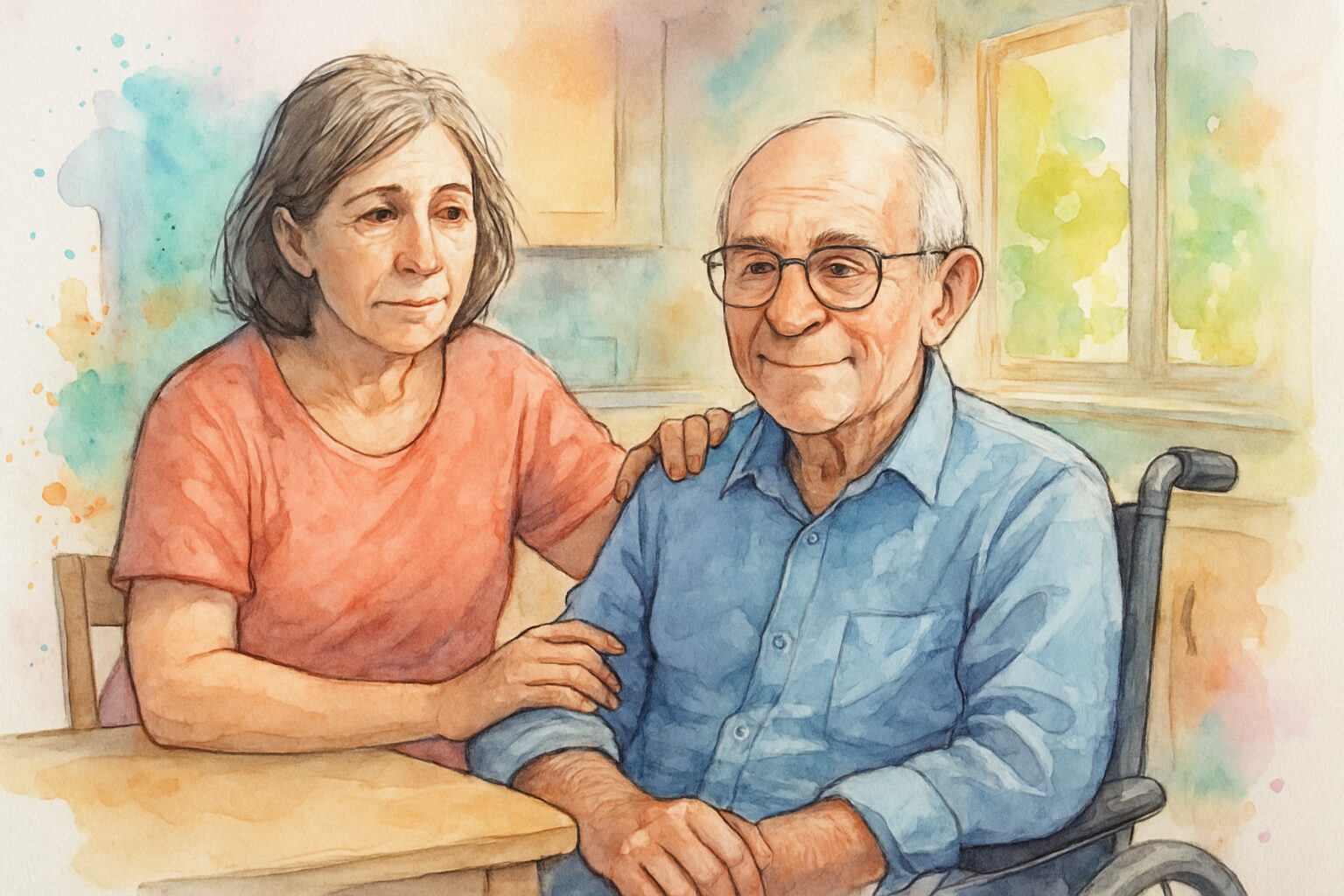
A woman called recently to ask about help for her husband, who has Parkinson's disease. She wasn't calling on behalf of a grown child or a sibling. She was calling for herself. "I'm elderly myself," she said, "and I'm caring for him alone. I don't know where to turn."
This situation is more common on the Monterey Peninsula and throughout Monterey County than most people realize. One aging adult supporting another — managing medications, preventing falls, handling wound care after a hospital discharge — while quietly running out of physical and emotional capacity. And often, carrying the fear that asking for help means something is ending.
This article is written for people in that exact position. What skilled home health actually looks like. What it costs — or more accurately, what it doesn't cost if Medicare or Medi-Cal covers it. And why a single assessment visit from a Registered Nurse changes the picture for most families who have been guessing.
The Line Between Managing and Not Managing
There's no single moment when caring for an aging parent — or a spouse, or any loved one — becomes too much. It builds. A medication that needs to be managed more carefully. A fall that didn't cause injury but easily could have. Sleep that keeps getting shorter because you're listening for sounds in the next room.
Many families in Salinas, Pacific Grove, King City, and Hollister reach this point without realizing they've passed it. They keep adjusting, keep absorbing. They tell themselves things are manageable. And sometimes they are — for a while.
But a few signs tend to show up before the situation becomes a crisis:
- You're making medical decisions without knowing if they're right
- Wound care, injections, or medication dosing has become part of your daily routine
- Your loved one has been discharged from a hospital and the follow-up care feels unclear — what comes next after a hospital discharge is one of the most common questions families ask
- Your own health — sleep, appointments, mental health — is being neglected
- You feel like you can't leave the house for more than an hour
None of these are signs of failure. They're signs that the situation has grown beyond what one person was ever meant to handle alone.
What Skilled Home Health Actually Is — and What It Isn't
A lot of families picture home health as a full-time aide moving into the house, or as something that signals a loss of independence. Neither is accurate.
Skilled home health is structured, scheduled visits from a coordinated clinical team. A Registered Nurse might come three times a week to manage a wound or oversee medications. A Physical Therapist works on fall prevention and strength. An Occupational Therapist helps a patient move safely through their own home. A Medical Social Worker handles care coordination and connects families to local resources in Monterey County. A Chaplain or Bereavement Specialist can support the emotional side of a serious illness — for the patient and for the person caring for them.
Nobody moves in. You don't give up control. You get a team of clinicians who take on the clinical tasks that were never yours to carry in the first place.
To understand the full scope of what a Registered Nurse does during a home visit — what they're actually assessing, tracking, and managing — this breakdown of a skilled nurse's home visit is worth reading before you make any decisions.
For many families, the real question isn't whether help is needed — it's whether home is still the right setting. Skilled home health is specifically designed for patients who can and want to stay home, and who need clinical support to do it safely.
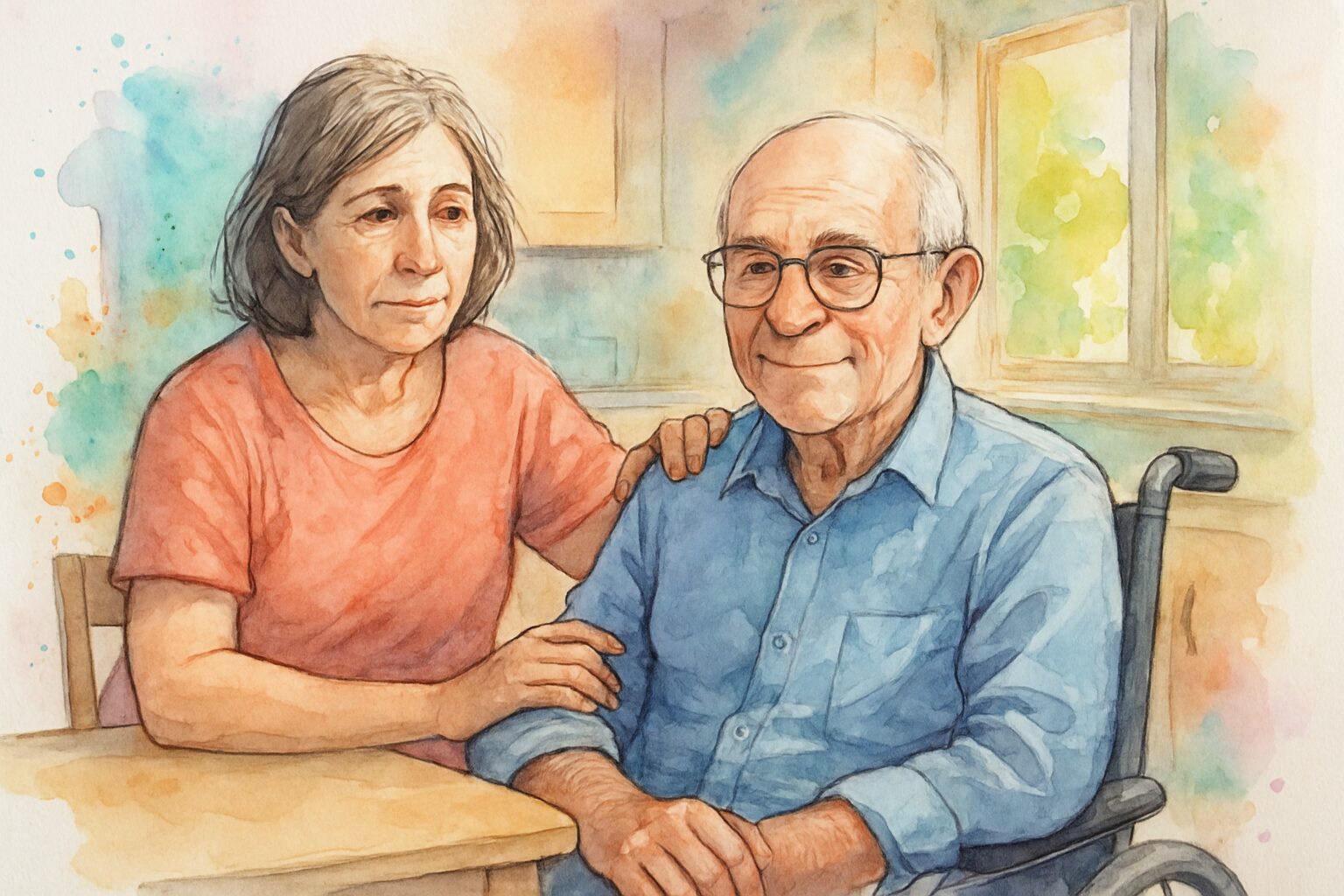
The Assessment Visit: Why One Conversation Changes Everything
Most families who have been managing on their own are guessing. Not because they aren't smart or devoted — but because they were never trained as clinicians. They're doing their best with incomplete information.
A Registered Nurse assessment visit changes that picture within a single appointment. The nurse reviews the patient's full medical history, current medications, mobility, wound status, cognitive function, and living environment. They identify what's working, what's risky, and what actually needs clinical attention.
For the person doing the caregiving, this visit is often the first time someone has said: here is what is actually happening, and here is what needs to happen next. That clarity alone — knowing you're not missing something critical — is something families across Monterey County describe as a turning point.
The assessment also determines what services Medicare or Medi-Cal will cover, so you're not going into that conversation blind. What families in Monterey wish they'd known sooner often comes down to this: they waited longer than they needed to because they assumed the process would be complicated or the cost would be out of reach.
Who's on the Home Health Team — and What Each Person Does
Skilled home health isn't one person. It's a coordinated team of clinicians, each handling a specific part of the patient's care.
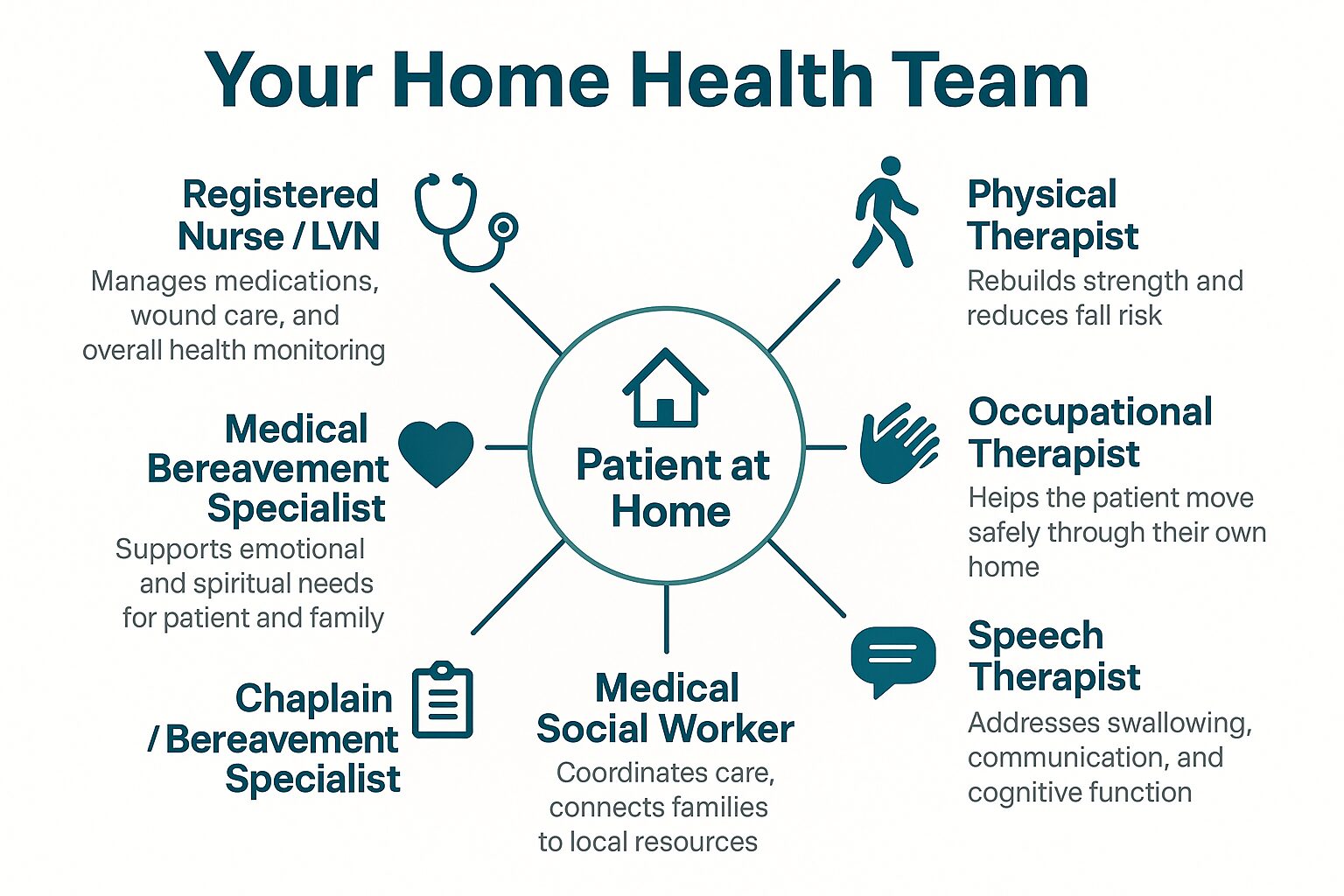
Does Insurance Cover This? A Plain-Language Breakdown
Insurance uncertainty stops more families from calling than almost anything else. Here's what Medicare, Medi-Cal, and Veterans benefits actually cover for skilled home health.
| Coverage Type | What It Covers | Key Requirement |
|---|---|---|
| Medicare Part A/B | Skilled nursing, PT, OT, Speech Therapy, Medical Social Work — when ordered by a physician | Patient must be homebound and have a physician's order for skilled care |
| Medi-Cal | Similar skilled home health services for eligible patients; covers many who don't qualify for Medicare | Eligibility based on income and medical need; prior authorization may apply |
| Veterans Benefits (VA) | Home health services for qualifying veterans through VA-authorized providers | Must be enrolled in VA healthcare; physician referral required |
| Private Insurance / HMO | Coverage varies widely by plan — always verify benefits before assuming | Check your specific plan; some require pre-authorization |
| Out-of-Pocket / Private Pay | Available when insurance doesn't cover — see what options exist when Medicare doesn't cover everything | No insurance requirement; costs vary by service and frequency |
When the Illness Is Serious: Palliative Care and Hospice as Part of the Picture
For families caring for someone with a serious or progressive illness — Parkinson's, advanced heart failure, cancer, late-stage COPD — the clinical needs often go beyond what standard home health covers.
Palliative care is specialized support for managing symptoms, reducing pain, and helping families understand what's ahead — without requiring the patient to stop pursuing treatment. It's not the same as hospice. A patient can receive palliative care while still seeing their oncologist or neurologist. It's about improving quality of life alongside whatever else is happening medically. What comfort-focused care really means — and when to ask about it is a good starting point if you're not sure whether palliative care applies to your situation.
Hospice is for patients whose illness has advanced to a point where curative treatment is no longer the focus. It brings a full team — nurses, hospice aides, chaplains, social workers, and volunteers — into the home to manage pain, provide emotional and spiritual support, and guide the family through one of the hardest experiences of their lives. How families describe the moment they chose hospice is one of the most honest accounts of what that decision actually feels like.
Both programs are covered under Medicare for qualifying patients. And both are available throughout Monterey County, San Benito County, and the surrounding Central Coast communities where VNA has been serving families since 1951.
Frequently Asked Questions About Getting Help at Home
My spouse has Parkinson's and I'm elderly myself. Am I the kind of person who can actually get help?
Yes — and you're exactly who these services are designed for. When one aging adult is caring for another, the risk of injury, burnout, and medical error increases significantly. A Registered Nurse can assess your spouse's current needs and determine what Medicare or Medi-Cal will cover. You don't have to keep guessing, and you don't have to keep doing this alone.
Will Medicare really pay for a nurse to come to the house?
Medicare covers skilled home health — including nursing, physical therapy, occupational therapy, and medical social work — when a physician orders it and the patient meets the homebound criteria. Most patients with a serious chronic illness or recent hospitalization qualify. The assessment visit will confirm coverage before any services begin.
Does asking for home health mean my parent is going to a facility next?
No. Skilled home health is specifically designed to keep people at home safely. Getting clinical support doesn't put someone on a path to a facility — in many cases, it's what prevents that outcome. What actually makes staying home possible as you age breaks this down in more detail.
How often does someone actually come to the house?
It depends on what the physician orders and what the assessment finds. A typical skilled nursing visit might happen two to four times per week for wound care or medication management. Physical therapy visits are often scheduled three times per week for a set number of weeks. This is structured, scheduled care — not someone living in your home.
What if my parent doesn't want help? They're very independent.
This is one of the most common concerns families in Monterey County bring up. A first visit from a nurse is often just that — a visit. Many patients who were resistant become comfortable once they understand that the goal is to help them stay home and stay independent, not to take over. A Medical Social Worker can also help navigate these conversations with the family.
What happens after a loved one passes — is there any support for our family?
VNA provides bereavement support after a patient passes, including grief counseling and ongoing care for family members navigating loss. That support doesn't end at the time of death. If you're already in a difficult place emotionally, grief support resources for families are available and don't require a prior relationship with VNA's clinical team.
Ready to Talk to Someone Who Can Help You Sort This Out?
Central Coast VNA & Hospice has been serving families across Monterey County, San Benito County, and the surrounding Central Coast since 1951 — including families in Salinas, King City, Pacific Grove, and Hollister who are navigating exactly what you're facing right now. If you're not sure whether your situation qualifies, or you just want to understand your options before making any decisions, a care coordinator can walk you through it without pressure. Call 831-372-6668 or visit ccvna.com to start the conversation.
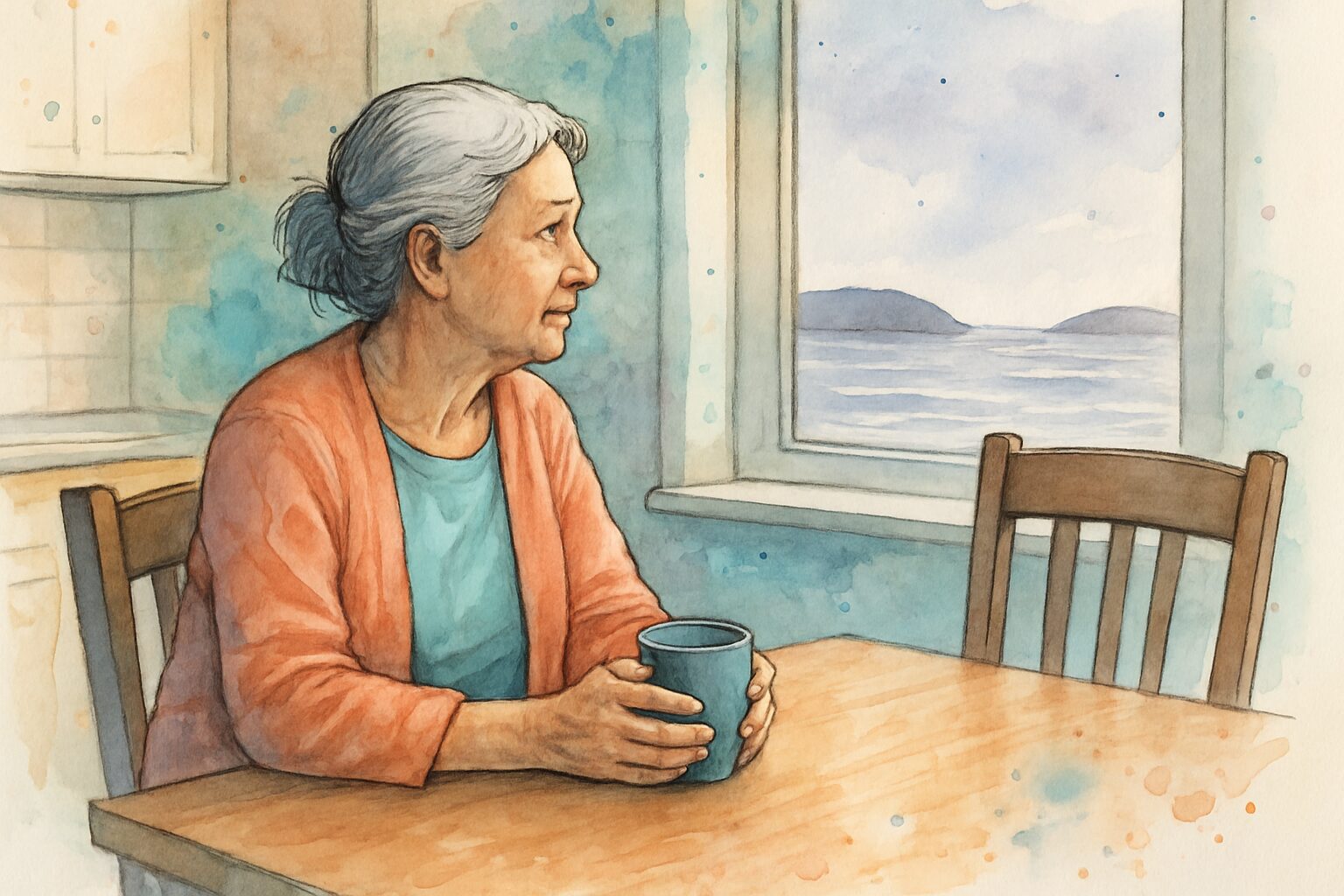
When Mourning Feels Stuck: Understanding Complicated Grief
Most people expect grief to follow some kind of arc — hard at first, then slowly lighter. But for many families in Monterey County, that arc never comes. Instead, the loss stays as raw at six months as it did the first week. Or it goes quiet for a while, then returns with a force that feels impossible to explain.
This is complicated grief — sometimes called prolonged grief disorder — and it affects roughly 10 to 15 percent of people who experience a significant loss. It's not a sign that someone loved too much or is too fragile to cope. It's a recognized condition, and it looks different from ordinary mourning in ways that matter.
If you're caring for an aging parent on the Monterey Peninsula, managing your own health while grieving, or supporting a family member who hasn't seemed like themselves in over a year — this article is for you. Understanding what complicated grief actually is, and what separates it from the normal pain of loss, is the first step toward finding real support.
What Makes Grief "Complicated"
Grief is painful for everyone. But typical grief, even when it's intense, tends to shift over time. There are good days mixed with hard ones. The person can still function — work, connect with others, find moments of meaning.
Complicated grief doesn't shift. It stays concentrated. The pain doesn't soften — it either holds at the same level or gets worse. Daily life becomes difficult to manage, sometimes for a year or longer.
Clinicians look for a specific cluster of experiences to distinguish complicated grief from normal mourning:
- Intense longing for the person that doesn't ease over time
- Difficulty accepting the reality of the loss, even months later
- Bitterness or anger about the death that feels unresolvable
- Feeling like part of yourself died along with the person
- Pulling away from other relationships and activities you used to care about
- A sense that life has no meaning or purpose without that person
- Difficulty imagining a future
Not everyone experiences all of these. But when several of them persist past the six-month mark and are interfering with daily life, that's when the term complicated grief becomes clinically meaningful — and when professional support is worth seeking.
As grief support specialists note, grief that intensifies rather than softens over time often signals that someone needs more than time alone to heal.
Why Some Grief Gets Stuck — and Who's Most at Risk
There's no single reason complicated grief develops. But research points to a few factors that make it more likely.
The nature of the loss matters a great deal. Sudden deaths — accidents, unexpected cardiac events, a quick decline from a diagnosis that wasn't caught early — leave survivors without any time to prepare. There's no goodbye, no chance to say what needed to be said. Families who cared for a loved one through a long illness sometimes face the opposite problem: they've been grieving in pieces for years, and when the death finally comes, the loss feels complicated by exhaustion, guilt, and relief all at once.
Losing a spouse or a child carries a particular weight. So does losing someone with whom you had a complex relationship — one marked by unresolved conflict, estrangement, or dependency. These losses leave things unfinished in a way that ordinary grief doesn't.
Certain personal factors also increase risk:
- A personal or family history of depression or anxiety
- Previous significant losses, especially in childhood
- Limited social support — living alone, having few close relationships
- Being the primary family decision-maker during a loved one's illness and death
- Financial stress tied directly to the loss
For families in Monterey County — where many older adults live alone in Salinas, King City, or the more rural parts of the county — social isolation is a real issue. The distance from support systems can make grief harder to move through, especially in communities where there's still stigma around asking for help with mental or emotional health.
Normal Grief vs. Complicated Grief: Key Differences
This side-by-side comparison shows how typical mourning and complicated grief differ across the most important markers families and clinicians watch for.
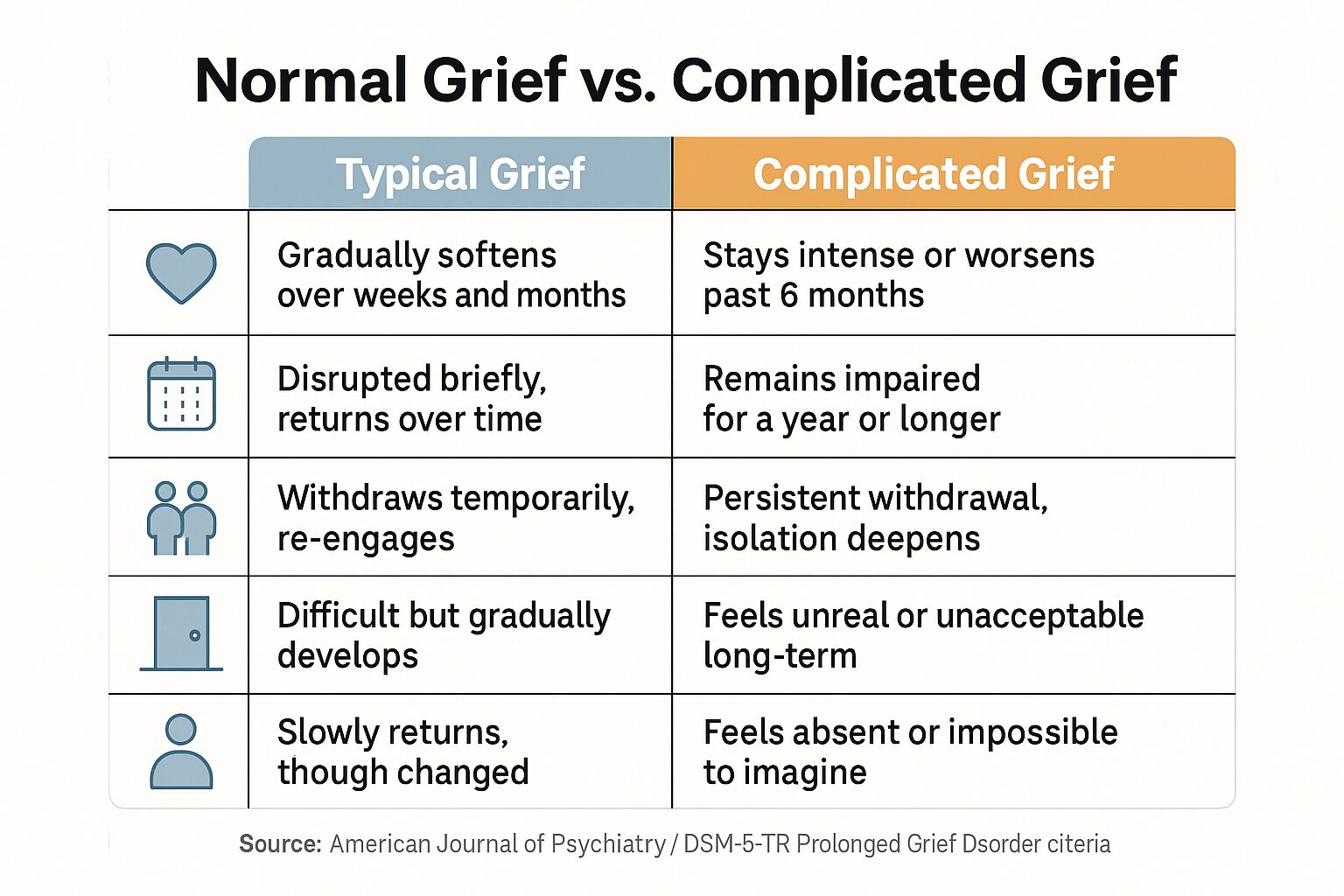
What Complicated Grief Actually Feels Like From the Inside
People in complicated grief often don't describe their experience as "grief." They describe feeling broken, or like they're living in a fog. Some say they can go through the motions of daily life but feel completely detached from it — like they're watching themselves from a distance.
Others describe an inability to stop replaying the death itself. The final days in the hospital. The last conversation. What they did or didn't say. This kind of rumination isn't the same as remembering and honoring someone — it's more like being trapped in a loop that won't release.
A few things families should watch for in a loved one:
- Refusing to change anything in the deceased person's room or belongings more than a year after the death
- Avoiding all reminders of the person, to the point that it limits their life
- Talking about death or not wanting to be alive — this requires immediate attention
- Significant weight loss, poor sleep, or physical health decline with no medical explanation
- Expressing that grief feels like a form of loyalty — that getting better would mean forgetting
That last one is worth sitting with. Many people in Monterey County and surrounding communities — families with deep cultural roots in Salinas or Hollister, older widows and widowers living alone on the Peninsula — carry a belief that staying in grief is how they stay connected. Understanding that healing doesn't mean forgetting is often one of the most important shifts that bereavement support can offer.
For families trying to understand what support can look like in practice, this guide on what grief support actually helps explains it plainly.
Types of Support for Complicated Grief — What to Expect
Different approaches to grief support work differently depending on the person and the situation. Here's a general overview of the main options families explore.
| Type of Support | What It Involves | Best Suited For |
|---|---|---|
| Individual grief therapy | One-on-one sessions with a therapist trained in loss and bereavement | People with significant daily impairment, trauma around the death |
| Complicated Grief Treatment (CGT) | A structured 16-session therapy developed specifically for prolonged grief disorder | People who haven't responded to standard counseling |
| Bereavement counseling | Emotional support and guidance from a bereavement specialist, often less clinical | People who need a consistent, compassionate presence and someone to talk to |
| Support groups | Facilitated group setting with others who've experienced similar losses | People who feel isolated and benefit from shared experience |
| Medical evaluation | Assessment by a physician or Nurse Practitioner for depression, anxiety, or sleep issues | When physical symptoms (weight loss, insomnia) are prominent |
| Spiritual care | Conversations with a chaplain or spiritual advisor about meaning, loss, and faith | People for whom spiritual meaning is central to processing loss |
When Complicated Grief Follows a Hospice Loss
Families who've been through hospice sometimes assume that because the death was expected — because there was time to prepare — grief should be more manageable. But that's not how it works.
Caring for someone through the end of their life is physically and emotionally exhausting. By the time the death comes, many family members are already depleted. The grief arrives on top of that exhaustion, and there's no runway left. Some people don't feel the full weight of the loss until months later, once the practical demands of settling an estate, notifying everyone, and handling logistics have finally quieted.
Others carry guilt — about decisions made during the illness, about moments of impatience or frustration during caregiving, about choosing hospice in the first place. Families who've wondered whether they made the right call can find some grounding in reading how other families describe the moment they chose hospice — the doubt is more common than most people realize.
This is exactly why bereavement support doesn't end with the death. A good hospice program continues to support surviving family members — through bereavement specialists, check-in calls, and access to counseling — for at least 13 months after a loved one passes. That's not an arbitrary timeframe. It's designed to cover all the "firsts": the first holidays, the first birthday, the first anniversary of the death.
If you're a year or more out from a hospice loss and still struggling significantly, that's not a sign you're grieving wrong. It may be a sign that complicated grief developed, and that more focused support could help.
Frequently Asked Questions About Complicated Grief
How do I know if what I'm feeling is complicated grief or just normal sadness?
The clearest marker is time and function. Normal grief is painful, but it tends to allow you to live your life even while hurting. If you're more than six months out from the loss and still finding it hard to work, connect with people, or imagine the future — and if the pain hasn't softened at all — that's worth taking seriously. A conversation with a bereavement specialist or your doctor is a good first step.
Is complicated grief the same as depression?
They overlap but aren't the same thing. Depression is a broader condition affecting mood, energy, and function in many areas of life. Complicated grief is specifically anchored to the loss — the yearning, the inability to accept, the sense that life can't go on without that person. Someone can have both at the same time, which is why a medical evaluation alongside grief support is often recommended.
My father lost my mother two years ago and still won't leave the house or talk about the future. What should we do?
What you're describing — withdrawal, isolation, and difficulty imagining a future after two years — is a pattern that warrants a gentle but direct conversation, and possibly a referral to professional support. Try not to frame it as "you need help" and instead approach it as "I want to make sure you're not carrying this alone." A Medical Social Worker or bereavement specialist can often help families navigate this kind of conversation.
Does Medicare cover grief counseling or bereavement support?
Medicare covers bereavement services as part of the hospice benefit — meaning families of a hospice patient are entitled to bereavement support for up to 13 months after the death. Outside of a hospice context, standard Medicare does not typically cover stand-alone grief counseling, though Medicare Advantage plans vary. Medi-Cal may cover mental health services including therapy for grief-related conditions — it's worth checking with your county's behavioral health department.
Can children develop complicated grief too?
Yes. Children process loss differently than adults, and complicated grief in kids can look like behavioral changes, school problems, physical complaints, or regressive behavior — not just sadness. If a child in your family lost a parent or grandparent and hasn't seemed like themselves for many months, a referral to a child therapist experienced in grief is worth pursuing.
Is there a specific treatment that works for complicated grief?
Yes — Complicated Grief Treatment (CGT) is a structured, evidence-based therapy developed specifically for prolonged grief disorder. It typically runs about 16 sessions and has strong research support. It's different from standard grief counseling in that it uses specific techniques to help people process the loss and re-engage with life. Not every therapist is trained in CGT, so it's worth asking specifically about it when seeking a referral.
You Don't Have to Figure This Out Alone
Central Coast VNA & Hospice has been supporting families across Monterey County — from the Peninsula to Salinas to King City — through some of the hardest moments of their lives since 1951. If you or someone you love seems stuck in grief long after a loss, speaking with a bereavement specialist can help clarify what's happening and what kind of support might actually make a difference. You're welcome to call 831-372-6668 or visit ccvna.com to learn more about bereavement support services available to families in our region.
Grief Doesn't Follow a Schedule — What Support Actually Helps
Most families in Monterey County expect the hardest part to be the weeks surrounding a loved one's death. What they don't expect is how heavy month four or month nine can feel — when the casseroles have stopped coming, the phone calls have thinned out, and the world around them has returned to normal while they're still carrying something enormous.
Grief doesn't follow a schedule. It doesn't peak at the funeral and fade evenly from there. It comes in waves — triggered by a song, a smell, a Tuesday afternoon that used to belong to someone else. And the support available to most people doesn't account for that.
This article looks at what actually helps during bereavement — not the platitudes, but the practical and emotional supports that make a real difference — and what families on the Central Coast can realistically access.
Why Grief Feels Worse When Everyone Thinks You Should Be Better
There's a social expiration date on grief that most people feel but nobody says out loud. Around the six-week mark, many family members start hearing things like "you're so strong" or "at least they're not suffering anymore" — signals from well-meaning people that it's time to move forward.
But brain science and clinical experience tell a different story. The acute, disorienting pain of early grief often gives way to a subtler, more persistent grief that can settle in for months or years. Anniversaries, holidays, medical appointments that used to involve your parent — these are landmines that people don't anticipate.
For families in Salinas, Seaside, or King City who may not have close family nearby, the isolation that compounds grief can be significant. The Central Coast has a strong sense of community, but grief is still something most people face quietly and alone. That's exactly where structured bereavement support fills a gap that friendship alone can't.
Understanding what comfort-focused care really means can also help families reframe the period leading up to a death — which shapes how grief is carried afterward.
What Bereavement Support Actually Looks Like
"Bereavement support" can sound clinical, but what it actually involves is fairly straightforward: someone trained to sit with grief — not fix it, not rush it — and help people process what they're carrying.
Depending on what a family needs, support can take several forms:
- One-on-one grief counseling with a Bereavement Specialist, usually by phone or in person, focused on whatever the person is experiencing right now
- Support groups where people who've lost someone can talk with others who understand — without explanation, without having to manage anyone else's discomfort
- Check-in calls at regular intervals, especially around anniversaries and the first year of "firsts" (first holiday, first birthday, first spring without them)
- Resources and education about what grief actually does to the body and mind — because many people worry something is wrong with them when grief is affecting their sleep, concentration, or appetite
For families who went through hospice, bereavement services are often a natural continuation of the care relationship — offered by the same organization that supported their loved one at the end of life. The guide to grief support and bereavement counseling goes deeper into what that process typically involves.
What most families report is that just knowing support is available — that they can call someone who won't get uncomfortable — makes a measurable difference in how alone grief feels.
The First Year of Grief: When Support Matters Most
Grief doesn't distribute evenly across the calendar. This shows when families most often need support — and what kind.
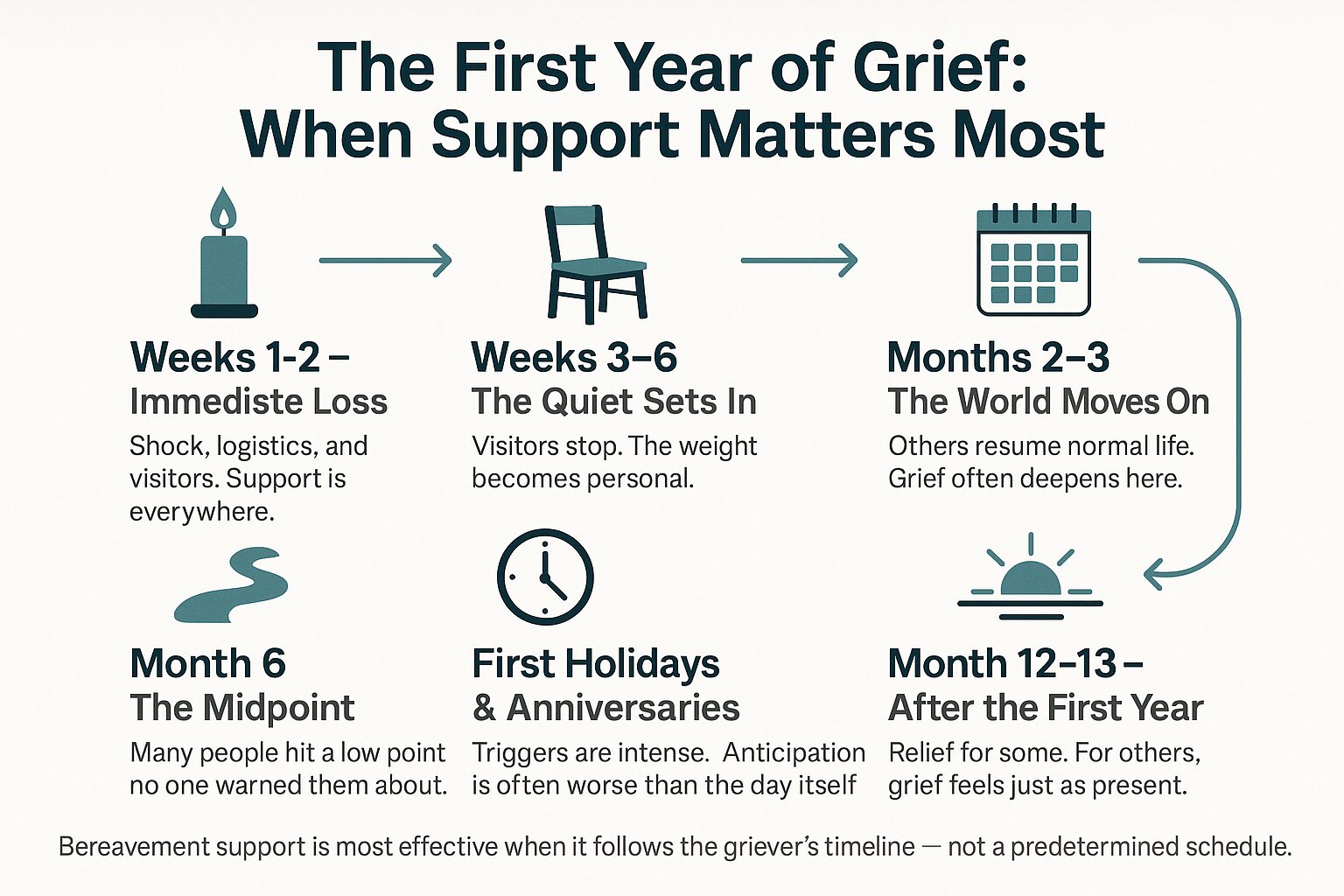
The Difference Between Normal Grief and Something That Needs More Help
Most grief — even grief that feels unbearable — is a normal human response to losing someone. It doesn't require a diagnosis or medication. What it requires is time, acknowledgment, and connection.
But sometimes grief becomes something heavier: prolonged grief disorder, sometimes called complicated grief, where the intensity doesn't ease over time and starts to seriously interfere with daily life. Signs that grief may have crossed into something that warrants clinical attention include:
- Inability to function at work or in relationships after six or more months
- Persistent thoughts of wanting to join the deceased
- Complete social withdrawal that isn't improving
- Physical symptoms like dramatic weight loss or inability to sleep for extended periods
- Intense guilt that feels fixed and unshakeable
This isn't about pathologizing grief or putting it on a clock. Most people move through grief without ever reaching this point. But for those who do, having a Bereavement Specialist or Medical Social Worker in their corner means the difference between suffering alone and getting actual help.
For families who first encountered a Medical Social Worker during a hospice admission, that relationship is often where these concerns get surfaced first. How families describe the moment they chose hospice often reflects just how much weight the whole family was already carrying before a death occurred.
Grief Support Options: What Each One Offers
Not every type of support fits every person. This gives a plain-language look at what the main options actually provide.
| Type of Support | What It Involves | Best For |
|---|---|---|
| Individual Bereavement Counseling | One-on-one sessions with a Bereavement Specialist, by phone or in person | People who want private space to process at their own pace |
| Grief Support Groups | Facilitated group conversations with others who've experienced loss | People who feel isolated and want to be understood without explaining |
| Scheduled Check-In Calls | Regular outreach at key intervals — 1 month, 3 months, 6 months, 1 year | People who won't ask for help but benefit from someone reaching out |
| Medical Social Worker Referral | Connection to mental health resources, community services, or clinical care | When grief has crossed into depression, anxiety, or prolonged impairment |
| Chaplain or Spiritual Care | Non-denominational emotional and spiritual support | People processing meaning, faith questions, or spiritual dimensions of loss |
Who Bereavement Support Is For — Including People Who Don't Think They Need It
There's a common assumption that bereavement support is for people who are visibly falling apart. But many of the people who benefit most are the ones who held everything together during the illness and death — and who haven't stopped long enough to feel what they're carrying.
In Monterey County, that often looks like an adult daughter who coordinated her father's care for two years, managed his hospice enrollment, arranged the memorial, and handled the estate — and who finally hits a wall six months later with no idea why she can't sleep.
Bereavement support is also for:
- Adult children processing the death of a parent, even when the death was expected
- Spouses and partners navigating life reconfiguration after decades together
- Siblings who grieve differently from each other and feel misunderstood within their own family
- Grandchildren and younger family members who sometimes get overlooked in family grief
Nobody has to be in crisis to deserve support. And nobody should have to wait until they are.
For families still in the middle of a serious illness — not yet at the point of loss — palliative care support for families addresses the emotional weight that builds well before a death occurs.
Frequently Asked Questions About Grief Support
How long does bereavement support last?
There's no fixed end date. For families who received hospice care, bereavement services are typically available for at least 13 months after a loved one's death — which covers the full first year of grief plus the anniversary. Some people use support for a few months. Others check in periodically for longer. The pace follows the person, not a program calendar.
Does insurance cover grief counseling?
For families who received Medicare-covered hospice, bereavement services for the family are included as part of the hospice benefit — at no additional cost. Outside of hospice, coverage depends on individual plans. A Medical Social Worker can help sort out what's covered and what other community options exist.
What if I'm not sure I need help — I'm functioning okay?
Functioning and grieving aren't opposites. Many people who would genuinely benefit from bereavement support are going to work, managing their households, and appearing fine on the outside. If a loss is sitting heavy — even quietly — reaching out to a Bereavement Specialist isn't a sign of crisis. It's just honest.
My family member died at home under hospice care. Are we automatically connected to bereavement services?
Yes, typically. When someone passes under hospice care, the family is contacted by the hospice's bereavement team as a standard part of the care. You don't have to ask — a Bereavement Specialist or Medical Social Worker will reach out. But if you haven't heard from anyone and want support, you can always call the hospice directly.
Is grief support available if our loved one didn't receive hospice care?
Yes. Bereavement support isn't limited to hospice families. Community-based grief counseling and support groups are available to anyone navigating loss — regardless of how or where a loved one died.
What's the difference between a Bereavement Specialist and a grief therapist?
A Bereavement Specialist is typically focused on supportive care — listening, normalizing grief, tracking how someone is doing over time, and connecting them to additional help if needed. A grief therapist or licensed clinical social worker goes deeper into mental health treatment and is more appropriate when grief has become clinically significant. Many people start with bereavement support and are referred to a therapist if the situation calls for it.
When You're Ready to Talk to Someone
If you're a family in Monterey County, Salinas, Hollister, or anywhere on the Central Coast who is carrying grief — recently or from longer ago than you'd like to admit — Central Coast VNA & Hospice has Bereavement Specialists available to talk. You can reach their care team at 831-372-6668 or visit ccvna.com to learn more about what bereavement support looks like and whether it might help.
What "Comfort-Focused Care" Really Means — and When to Ask About It
Families across Monterey County hear the phrase "comfort-focused care" at some point during a serious illness — often from a doctor, a discharge planner at Community Hospital of the Monterey Peninsula, or a nurse after a difficult diagnosis. And most of the time, they nod along without being entirely sure what it means.
That's not their fault. The phrase gets used loosely, and it carries emotional weight that makes people hesitant to ask follow-up questions. Does it mean treatment is stopping? Does it mean the end is near? Does choosing comfort mean giving up?
The honest answers are no, not necessarily, and never. What comfort-focused care actually describes is a shift in what the care team is working toward — and understanding that shift is one of the most useful things a family can know when they're navigating serious illness.
The Difference Between Curing and Caring
Most of the medical system is built around fixing things — treating infections, removing tumors, repairing damage. That approach works well when the problem is solvable. But for many people living with a serious or advanced illness, cure isn't always on the table. And that's when the goals of care need to shift.
Comfort-focused care means the primary goal becomes quality of life — not length of life, not test results, not disease management for its own sake. It asks: what does this person need to feel as well as possible, right now, in the life they're actually living?
For a 78-year-old in Salinas managing congestive heart failure, that might mean adjusting medications to reduce breathlessness rather than pursuing another hospitalization. For someone in Pacific Grove with advanced cancer, it might mean focusing on pain control, sleep, and being present with family rather than continuing chemotherapy with significant side effects.
This isn't a lesser form of care. In many cases it requires more clinical attention, not less — because managing complex symptoms at home takes real skill. What does a skilled nurse actually do on a home visit? is a question worth asking, because the answer might surprise families who assume comfort care is just "keeping someone comfortable" in a passive sense.
Palliative Care vs. Hospice — Where Comfort Care Lives
Two programs put comfort-focused care into practice: palliative care and hospice. They're related, but they're not the same thing, and the difference matters a lot to families trying to make decisions.
Palliative care can start at any point after a serious diagnosis — even while a person is still pursuing curative treatment. It layers on top of whatever else is happening medically. A person can be receiving chemotherapy and palliative care at the same time. The palliative care team focuses on symptoms, emotional support, care planning, and helping the family understand what's ahead.
Hospice care is specifically for people who have decided — usually alongside their physician — to stop pursuing curative treatment and focus entirely on comfort. Medicare's hospice benefit requires a physician to certify that the patient's life expectancy is six months or less if the illness follows its expected course. But it's important to know: people can live on hospice longer than six months, and they can also choose to leave hospice if their condition stabilizes.
Here's how families often describe the distinction:
- Palliative care: still fighting the illness, but with a team helping manage the burden of it
- Hospice care: no longer trying to cure the illness, with a team focused entirely on comfort and quality of life
Both involve nurses, therapists, social workers, chaplains, and volunteers working together. Neither one is about doing less. For a deeper look at what palliative care actually means for families, it's worth reading through the specifics before making any decisions.
Palliative Care vs. Hospice: A Side-by-Side Look
This comparison helps families quickly see how the two programs differ in terms of goals, timing, and what Medicare covers.
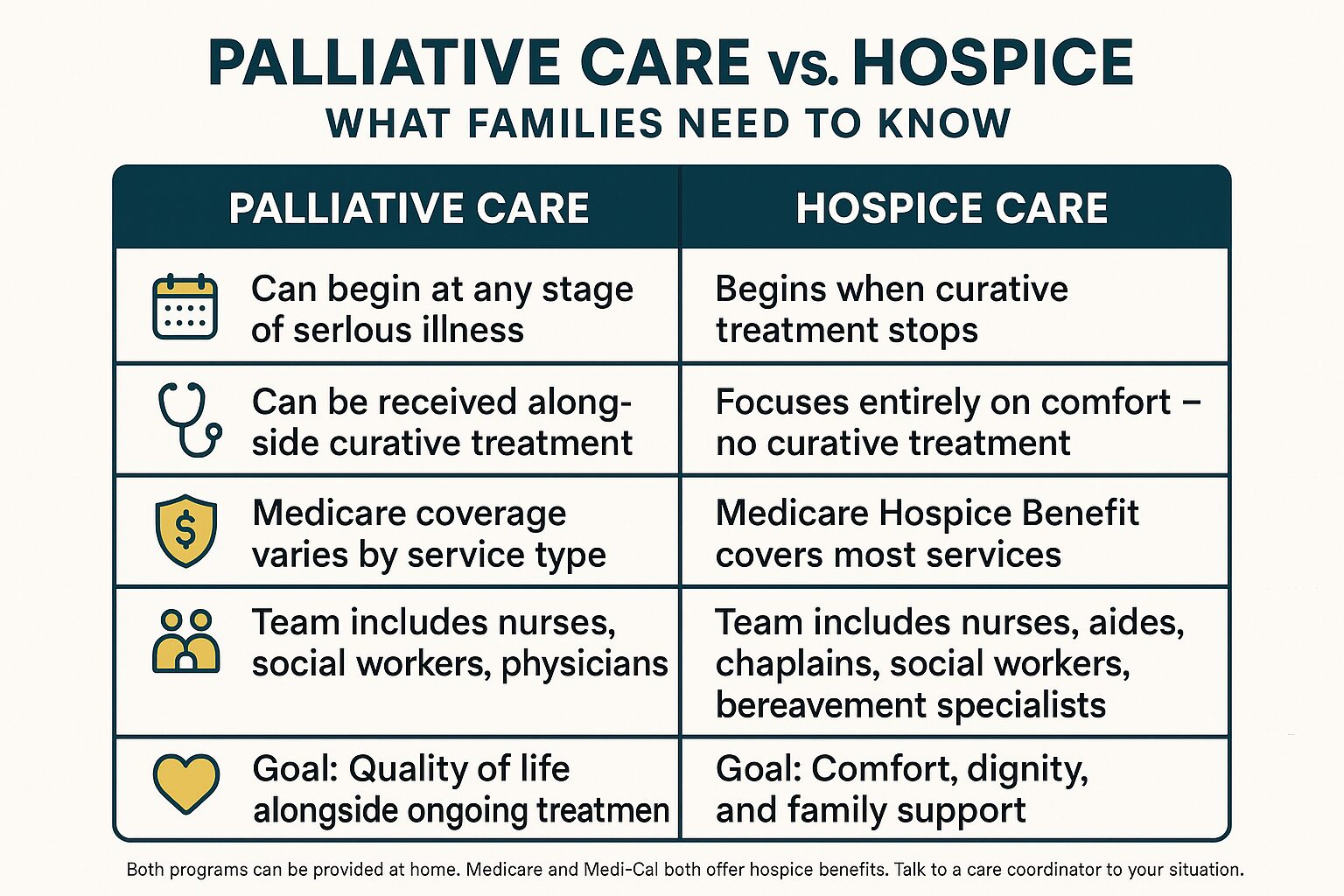
When Families Actually Ask About It — and Why They Wait
In Monterey County, families often ask about comfort-focused care later than they wish they had. This comes up again and again — not because families don't care, but because the system doesn't always make it easy to know when to bring it up.
There's no single right moment. But there are signals worth paying attention to:
- A loved one has been hospitalized two or more times in the past six months for the same condition
- Treatments are causing significant side effects without clear benefit
- A physician has mentioned that the illness is "not responding" or is "progressing"
- The person with the illness has expressed that they feel tired of treatment
- A family member has had to step back from work or their own life to manage care
- Discharge planners at the hospital have raised the question of home-based support
None of these signals means hospice is the immediate answer. But they do mean the conversation is worth having. What families in Monterey wish they'd known sooner about home care often includes wishing they had asked about comfort-focused options earlier — not because it would have changed the outcome, but because it would have reduced suffering in the meantime.
And asking doesn't commit anyone to anything. It's a conversation, not a contract.
What Comfort-Focused Care Can Look Like at Home
Comfort-focused care is practical, not abstract. Here's a plain-language look at what different team members actually do in the home.
| Team Member | What They Focus On | How Often They Visit |
|---|---|---|
| Registered Nurse (RN) | Pain assessment, medication management, wound care, symptom monitoring | Several times per week, or as needed |
| Licensed Vocational Nurse (LVN) | Medication review, vital signs, day-to-day symptom support | Coordinated with RN schedule |
| Medical Social Worker | Emotional support, care planning, connecting families to local resources | Weekly or as needed |
| Chaplain | Spiritual care and emotional presence for patient and family | As requested or scheduled |
| Hospice Aide | Personal care, bathing, comfort routines | Daily or several times per week |
| Bereavement Specialist | Grief support for family members — before and after the patient's passing | Ongoing, continues after death |
| Volunteers | Companionship, respite for family, errands, reading aloud | Flexible, scheduled with the family |
How Medicare and Medi-Cal Actually Cover This
One of the biggest reasons families hesitate to ask about comfort-focused care is cost. The assumption is that it's expensive, or that insurance won't cover it. In most cases, that assumption is wrong.
Medicare's Hospice Benefit covers virtually all hospice-related services for eligible patients — nursing visits, medications related to the terminal diagnosis, medical equipment like hospital beds and wheelchairs, and support from the full care team including chaplains and bereavement specialists. The patient typically pays nothing out of pocket for these services.
Medi-Cal also provides a hospice benefit with similar coverage. And for veterans living in Salinas, King City, Hollister, or elsewhere in the region, VA benefits may cover home-based comfort care as well.
Palliative care coverage is more variable. It depends on the specific services and how they're billed. But many palliative care visits — particularly those involving Registered Nurses or social workers — are covered under standard Medicare home health benefits when a physician orders them.
If you're uncertain what would be covered in a specific situation, a care coordinator can walk through the details before any commitment is made. What families need to know about Medicare coverage for home care covers many of the common questions families ask.
Frequently Asked Questions About Comfort-Focused Care
Does choosing comfort-focused care mean we're giving up?
No. Choosing comfort-focused care means changing the goal — from trying to cure an illness to making sure the person with that illness feels as well as possible. Many families who've made that shift say it was the most loving decision they ever made, not a defeat. How families describe the moment they chose hospice is worth reading if you're wrestling with this question.
Can someone receive palliative care while still getting chemotherapy or other treatment?
Yes. Palliative care does not require stopping treatment. It works alongside whatever treatment a person is receiving. The palliative care team focuses on managing symptoms — nausea, pain, fatigue, anxiety — that treatment often causes, as well as supporting the family through a difficult time.
What happens if someone on hospice starts to get better?
They can leave hospice. There's no penalty and no paperwork punishment for choosing to resume curative treatment if a person's condition improves. Some people stabilize, leave hospice, and re-enroll later. The hospice benefit under Medicare can be used more than once.
How do we know if our family member qualifies for hospice?
Qualification requires a physician to certify that the patient's life expectancy is six months or less if the illness follows its expected path. The patient (or their representative) also needs to agree to focus on comfort rather than cure. A care coordinator or the patient's physician can help determine eligibility — it's a conversation, not a complicated application process.
Can comfort-focused care happen at home, or does it require a facility?
Most comfort-focused care — including both palliative care and hospice — is delivered at home. For families in Monterey County, that means a patient can stay in their own house, with their own routines and the people they love around them, while still receiving skilled clinical support. Facility-based hospice exists but is typically reserved for symptom crises that can't be managed at home.
What support does the family get — not just the patient?
Quite a bit. Hospice care includes medical social workers for emotional and practical support, chaplains for spiritual care, and bereavement specialists who work with the family both before and after a patient's passing. Bereavement support continues for at least 13 months after the death of a loved one under the Medicare Hospice Benefit. That's not a minor detail — grief doesn't follow a schedule, and having a bereavement specialist available during that time makes a real difference.
Still Have Questions About What This Could Look Like for Your Family?
Central Coast VNA & Hospice has been supporting families across Monterey County — from the Peninsula to Salinas to King City — since 1951. If you're trying to understand whether comfort-focused care makes sense for your situation, a care coordinator can talk through the specifics without pressure or obligation. Call 831-372-6668 or visit ccvna.com to start the conversation.