

The First Holiday Season After a Loss: What Grief Can Look Like
The weeks right after someone dies are often filled with motion. There are arrangements to make, people to call, paperwork to complete. Families move through that period with a kind of purposeful momentum that can feel, from the outside, like coping.
Then the holidays arrive. And the absence, which may have felt manageable in the busyness of early grief, suddenly fills the entire room.
For families across Monterey County, from the Peninsula to Salinas to Hollister, this pattern shows up every year without fail. It is not a sign that something has gone wrong in the grieving process. It is one of the most common and well-documented features of grief, and understanding it before the season hits can make a real difference in how families find their footing.
Why the First Holiday Hits Harder Than Families Expect
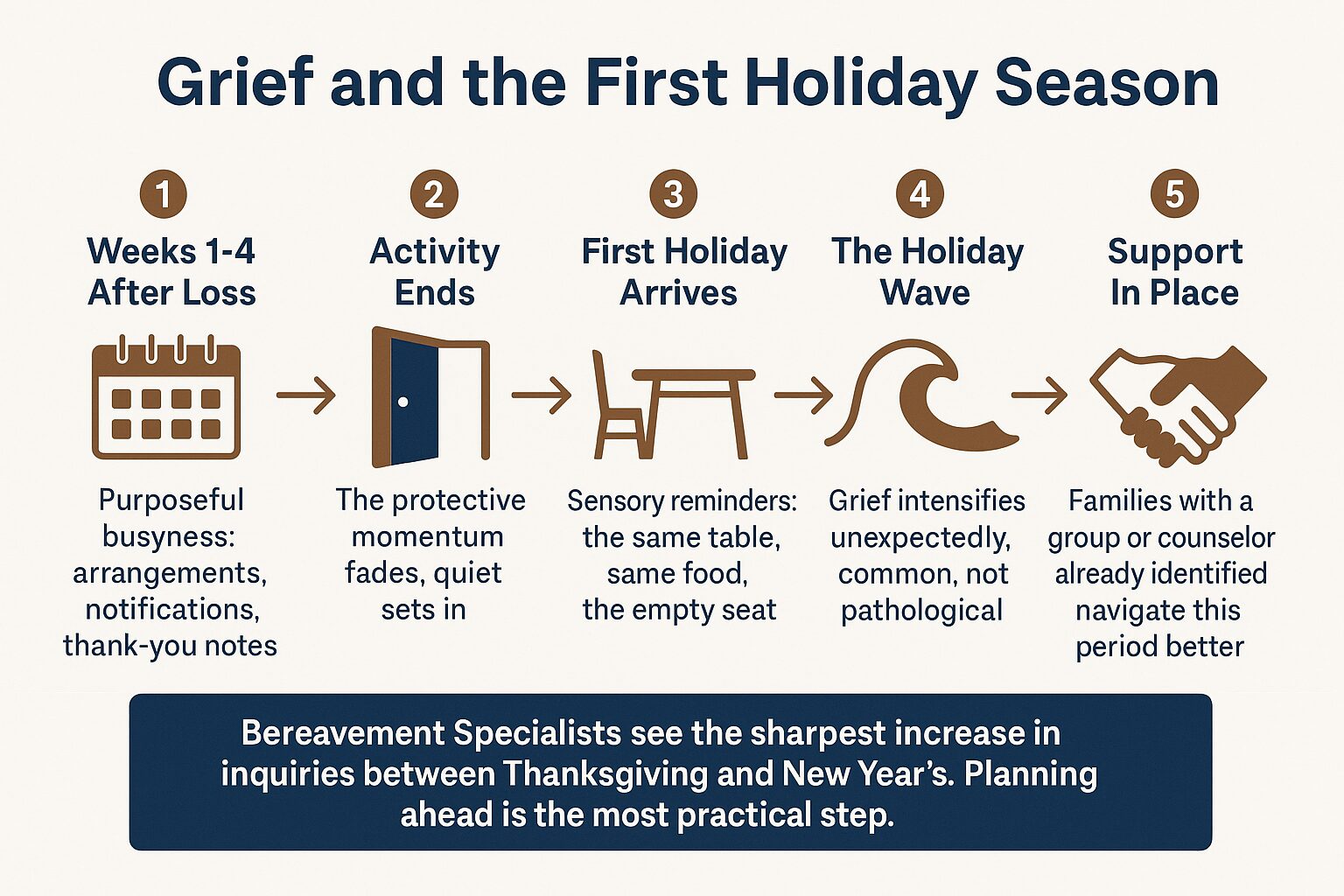
Grief researchers have long noted that the initial weeks after a death carry a kind of protective busyness. The practical demands of loss, the calls, the services, the thank-you notes, give the grieving person something to do with the enormity of what has happened.
When that activity ends and the first Thanksgiving, Christmas, or even a birthday rolls around, the absence can feel sudden and total. The holiday table, the family rituals, the food that was always made the same way, all of it becomes a sensory reminder of who is no longer there.
This is not pathological grief. It is a normal part of the grief timeline, and it is worth knowing it is coming before it arrives. According to research from the American Psychological Association, anticipating difficult grief moments and having support in place ahead of time is one of the most practical steps a grieving person can take.
For families who lost someone in the spring or summer, the holiday season may arrive when they feel they should be "past the hardest part." That expectation can make the holiday wave feel even more disorienting when it comes.

Spousal Loss and the Holiday Table
Not all grief moves the same way, and the holiday grief that surviving spouses experience often has a specific quality that is different from what adult children feel when mourning a parent.
Decades of shared ritual create a kind of sensory map. The same table. The same seat. The food that one person always made and the other always praised. When those rituals arrive without the person who made them meaningful, the loss can feel both immediate and total in a way that is hard to describe to someone who hasn't lived it.
One Monterey woman submitted a message to a local bereavement program the day after her husband of 56 years died. Her message was direct and raw: she needed a local grief group, immediately. That kind of reaching out, in the earliest hours of loss, reflects something grief support professionals see often. The need for connection is immediate, even when the emotional capacity to reach out is barely there.
For surviving spouses specifically, grief support programs that address spousal loss tend to be more useful than general bereavement groups. The shared experience in the room matters. When the people around you have also lost a partner of many years, the conversations start at a different depth.
If you are an adult child helping a surviving parent plan for the holiday season, understanding what grief support after hospice actually looks like can help you find the right kind of help, not just the closest available option.
The Grief Timeline Around the Holidays
This overview shows how grief tends to shift in the weeks surrounding the first holiday season, and when families most often reach out for support.
Finding Support Before the Season Arrives, Not After
Grief counselors and Bereavement Specialists consistently note the same pattern: the sharpest increase in inquiries from grieving families arrives in the weeks between Thanksgiving and New Year's. Many of those callers say the same thing, they thought they were managing fine.
The problem is that finding a local grief group or counselor in the middle of an acute grief moment is much harder than finding one in a calmer week. The emotional bandwidth required to research options, make calls, and get enrolled in a program is exactly what grief depletes.
For families in the Monterey Peninsula, Salinas, and Hollister areas, the practical advice is straightforward: identify your support resource before the holiday season, not during it. Get on the list. Attend once. Know where to go.
Bereavement support in Monterey County is not limited to families who used hospice services. Anyone who has experienced a significant loss, whether a loved one died at home, in a hospital, or in a care facility, can access grief counseling and group support. That access point is not always obvious to families who navigated a hospital death rather than a hospice program, and it is worth knowing the door is open.
You can read more about what is specifically available locally in this guide to finding grief support in Monterey County after a loss.
For families who are also managing a loved one's ongoing health needs while grieving, the weight can compound quickly. Knowing when caring for an aging parent becomes more than you can do alone is a useful starting point if that is part of your situation.
Types of Grief Support and Who They Tend to Help
Different kinds of support serve different needs. This is a general overview, the right fit depends on the individual and what feels most useful.
| Type of Support | What It Involves | Best Fit For |
|---|---|---|
| Individual grief counseling | One-on-one sessions with a Bereavement Specialist or licensed counselor | People who prefer privacy or have complex grief histories |
| General bereavement group | Group sessions open to anyone who has experienced a loss | People who find connection with others helpful and have flexible schedules |
| Spousal loss group | Group sessions specifically for people who have lost a spouse or partner | Surviving spouses navigating the specific pattern of partner grief |
| Community bereavement programs | Support offered through local nonprofits, open to the broader community regardless of how care was received | Anyone who lost a loved one in a hospital, at home, or in a care facility |
What Grief Can Actually Look Like in the Weeks Around the Holidays
Grief does not always look the way people expect. Some of what families experience around the first holiday season can feel confusing, because it may not match what they think grief is supposed to be.
Common patterns include:
- Feeling fine for days, then being hit hard by a specific song, smell, or meal
- Dreading the holiday weeks in advance, then finding them more manageable than expected, followed by a harder week afterward
- Feeling guilty for laughing or enjoying any part of the holiday
- Anger or irritability that doesn't seem tied to anything specific
- Physical symptoms, fatigue, poor sleep, changes in appetite, that arrive or worsen around the holiday period
- Difficulty being around the same family gathering without the person who is gone
None of these responses are wrong. And none of them mean that grief is "not progressing." Grief doesn't follow a schedule, and the holiday season has a way of making that very clear.
If grief starts to feel stuck, not just painful, but genuinely immovable over many months, that is worth a conversation with a counselor. There is a difference between grief that is hard and grief that has become complicated in ways that benefit from professional support. Understanding complicated grief can help families recognize when that line has been crossed.
Frequently Asked Questions About Grief Support During the Holidays
Do I have to have used hospice services to access bereavement support in Monterey County?
No. Bereavement support through community-based programs is open to anyone who has experienced a significant loss, regardless of how care was provided. If your loved one died in a hospital or care facility rather than through a hospice program, you can still reach out for grief counseling or group support.
When should I look for a grief support group, before or after the holidays?
Before, if at all possible. The weeks between Thanksgiving and New Year's are when Bereavement Specialists see the sharpest increase in people reaching out. Having a resource already identified, even just knowing where to call, means it is there when you need it most, rather than having to search in the middle of a difficult moment.
Is it normal to feel like the holidays are harder than the days right after the death?
Yes, and it is more common than most families realize. The initial weeks after a loss often carry a protective momentum, things to do, people to contact. When that activity winds down and a holiday arrives, the absence becomes much more visible. This is a well-documented feature of grief, not a sign that something has gone wrong.
My surviving parent lost their spouse of many decades. Are there specific groups for that kind of loss?
Yes. Spousal loss groups focus specifically on the grief of losing a long-term partner, which has a different quality than grieving a parent or sibling. The shared experience in the room matters, conversations can start at a level of specificity that a general group may not reach. Ask when you call about bereavement resources whether a spousal loss group is available in your area.
What if I'm not sure whether what I'm feeling is grief or something that needs clinical attention?
A conversation with a Bereavement Specialist is a good first step. They can help you understand whether what you are experiencing is part of a normal grief process or whether it might benefit from a more structured clinical response. You do not need to have a diagnosis or a crisis to make that call, it is what the support is there for.
Finding Support in Monterey County Before the Season Hits
Central Coast VNA & Hospice has been supporting grieving families across Monterey County, Salinas, Hollister, and surrounding communities since 1951. In 2025 alone, the bereavement program extended support to more than 2,200 individuals, many of them people who had not used hospice services but needed a place to turn. If you or someone you love is approaching the first holiday season after a loss, a Bereavement Specialist can help you understand what is available and whether a group or individual counseling might be the right fit. You can reach the care team at 831-372-6668 or visit ccvna.com to learn more.

What Grief Support After Hospice Actually Looks Like
Most families assume that when a loved one dies under hospice care, their relationship with the care team ends that same day. A phone call, maybe a card in the mail, and then silence. That assumption is understandable, but it's also wrong, and for families across Monterey County, the difference matters.
Grief doesn't follow a tidy timeline. The weeks after a death can feel surreal, then exhausting, then suddenly empty in ways nobody warned you about. Knowing what bereavement support after hospice loss actually looks like, what happens, when it happens, and what you can ask for, gives families a clearer picture of what's available before they need it most.
This article focuses specifically on the transition from hospice to bereavement: the first days, the first months, and what structured grief support looks like in practice.
The First Outreach Isn't a One-Time Check-In
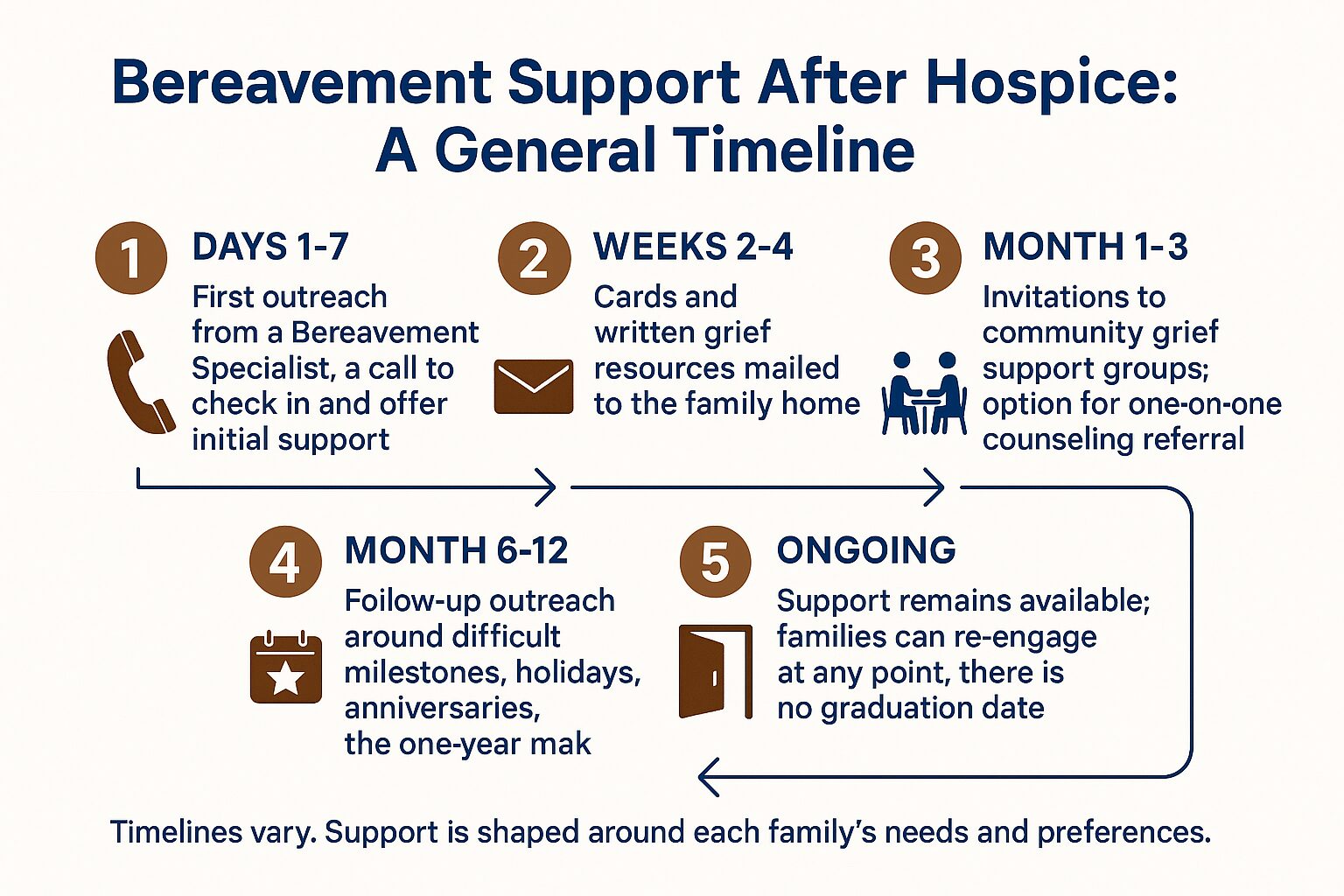
After a patient passes, a Bereavement Specialist reaches out to the family. That first contact is not a formality and not a single call. It's the beginning of a structured support program that unfolds over months.
Depending on what the family needs, that support can include:
- Phone calls at key intervals in the weeks following the death
- Cards and written grief resources mailed to the home
- Invitations to join a grief support group in the community
- Referrals for one-on-one counseling when a family member needs more than a group setting can offer
Some families engage actively with every touchpoint. Others prefer a lighter presence, just knowing support exists if they reach for it. Both approaches are respected. There's no pressure to participate in any particular way, and no single path that families are expected to follow.
In 2025, more than 2,200 individuals received bereavement support through this kind of program across Monterey County and surrounding communities. That number reflects real depth, not a small afterthought program, but one built for the full range of how people grieve.
For families wondering whether grief counseling and group support are available to them specifically, the Finding Grief Support in Monterey County After a Loss resource offers more detail on local options.

The Loss Nobody Warns You About: When the Role Disappears
There's a specific grief experience that often catches people off guard, and it belongs to the person who was the primary day-to-day presence during a loved one's illness.
For months or years, that person, often an adult child or a spouse, organized their life around someone else's needs. Medication schedules. Appointments. Calls to the care team. The constant, focused attention that serious illness demands. Then, almost overnight, all of it stops.
What's left isn't just grief for the person who died. It's also the loss of purpose and structure. The quiet that was supposed to feel like relief instead feels disorienting. And many people are not prepared for it.
This is a well-documented pattern. Research from the National Institute on Aging confirms that grief takes many forms, and that those who served as primary supporters during illness often face a layered loss that goes beyond the loss of the relationship itself.
A Bereavement Specialist or grief group facilitator who understands this particular experience brings something different from general mental health support. They've sat with families at this exact point of transition many times before. That familiarity shapes how they listen and what they suggest.
If you were the person doing the daily work of caring for someone, it's worth naming that experience when you reach out for support, because it's a real and distinct part of what you're carrying.
What Bereavement Support Looks Like Over Time
Grief support after hospice loss doesn't arrive all at once. This timeline shows what families can typically expect in the weeks and months that follow.
Grief Peaks at Unexpected Moments, and Support Should Too
One of the most honest things that can be said about grief is that it does not resolve on a fixed schedule. The people around a grieving person often move on within weeks. But grief frequently intensifies around specific moments: the first holidays, a birthday, the one-year anniversary of a death, a random Tuesday when a song plays on the radio.
This is exactly why bereavement support programs are designed to follow up at intervals, not just in the immediate aftermath of a death. A check-in at six months or twelve months isn't a formality, it's timed to a period when many people feel most alone in their grief.
One person who volunteered as a hospice vigiling volunteer, sitting bedside to provide comfort during a patient's final hours, wrote publicly about being consistently impressed by the quality of the clinical staff and the genuine care they showed families across difficult moments. That kind of team culture doesn't end at the patient's death. It extends into how Bereavement Specialists, grief group facilitators, and Volunteers continue to show up for families afterward.
If you're wondering whether complicated grief, the kind that feels stuck rather than slowly moving, is something you're experiencing, the article When Mourning Feels Stuck: Understanding Complicated Grief addresses that specific experience in more depth. And if grief simply doesn't seem to be following any predictable pattern at all, Grief Doesn't Follow a Schedule, What Support Actually Helps is worth reading.
Two Paths Through Bereavement Support
Families engage with grief support in very different ways. Neither path is wrong, the right level of involvement is whatever actually helps.
| If You Want Active Support | If You Prefer a Lighter Presence |
|---|---|
| Regular calls from a Bereavement Specialist | Knowing contact information is available when needed |
| Grief support group attendance in the community | Receiving mailed resources without committing to calls |
| Referral to one-on-one grief counseling | Reconnecting with the program at a later milestone |
| Follow-up outreach at key anniversaries | Opting back in if grief intensifies unexpectedly |
| Ongoing coordination with the broader care team | A single point of contact who can respond if you reach out |
Who Can Access Bereavement Support
One question families sometimes ask is whether bereavement support is only available to people whose loved one was actively enrolled in hospice. The answer is broader than most people expect.
Grief counseling and bereavement services are available to anyone navigating the loss of a loved one, not only families who went through a formal hospice program. If someone in Salinas, King City, Hollister, or anywhere else in Monterey County is carrying grief and doesn't know where to turn, that support is not locked behind prior enrollment.
Bereavement is also not the same conversation as hospice eligibility or home health. If you're still in an earlier stage, trying to understand whether hospice is even the right direction, the article How Do You Know When It's Time to Consider Hospice Care? is a better place to start. And if a loved one is still living but facing serious illness, What Palliative Care Actually Means, and When It Can Start explains how earlier support works alongside treatment.
Frequently Asked Questions About Bereavement Support After Hospice
Does bereavement support really continue after my loved one dies, or is it just a one-time call?
It continues. A structured bereavement program typically includes multiple points of outreach over months, not a single call. This can include phone check-ins, mailed resources, grief group invitations, and referrals for individual counseling depending on what a family needs.
What if I wasn't the primary person in the house, but I'm still grieving? Can I access support too?
Yes. Grief doesn't only belong to the person who was most physically present. A sibling who lived across the country, a close friend, an adult child who visited on weekends, all of these people can experience significant loss. Bereavement support is not limited to a single designated family member.
I feel fine right now, but I've heard grief sometimes hits hard later. What if I need support months from now?
That's a very common pattern. Many people find that grief intensifies at the six-month or one-year mark, or around the first holiday season after a death, often because the people around them have moved on and the loss feels more isolating. A good bereavement program anticipates this and reaches out at those intervals. And if support isn't already in place, reaching out later is always an option.
I was the one managing all the care for months. Now I feel lost without that structure. Is that normal?
It's extremely common and worth naming directly. When someone's daily life is organized around another person's medical needs, appointments, medications, calls to nurses and therapists, the loss of that structure after a death is a real secondary grief. It's not weakness or confusion; it's a recognized part of the grief experience for primary family supporters. Mentioning this specifically when you reach out for support will help a Bereavement Specialist understand what you're going through.
Do I need to have used hospice to access grief support?
No. Bereavement and grief counseling are available to anyone experiencing loss, not only families who went through a formal hospice program.
What if I live in Salinas or King City, not right on the Monterey Peninsula? Is support available there too?
Yes. Monterey County as a whole is part of the service area, which includes the Peninsula, Salinas, King City, and surrounding communities. Geography should not be a barrier to reaching out.
Ready to Learn What Support Is Available to Your Family?
Central Coast VNA & Hospice has been walking alongside families in Monterey County through some of the hardest moments of their lives since 1951. If you or someone you love is in the months following a loss and wondering what support looks like, a conversation with a care coordinator is a good first step, no commitment required, no pressure. You can reach the team at 831-372-6668 or visit ccvna.com to learn more.
When a Parent's Medications Become Too Much to Track Alone
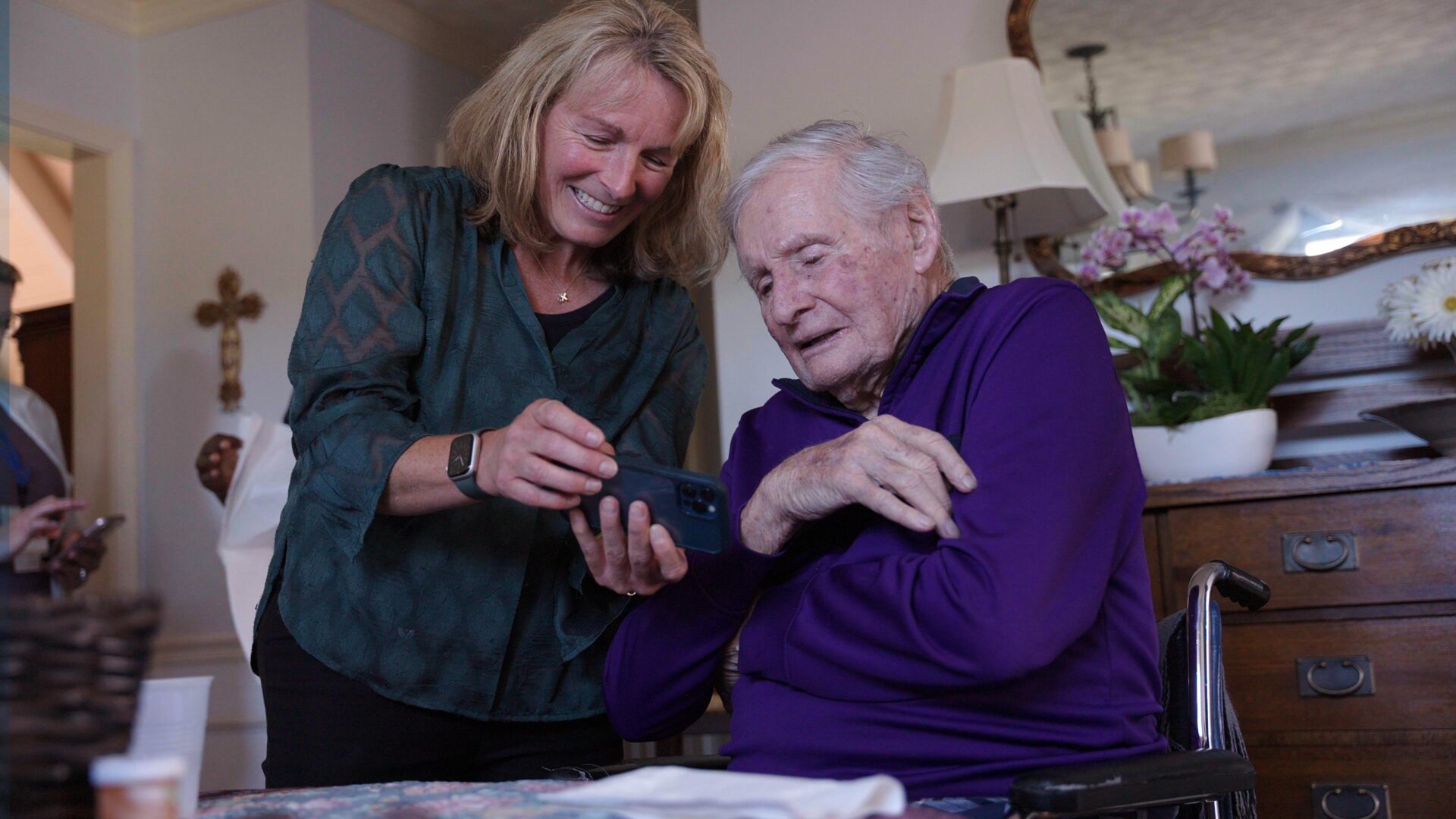
A Monterey County family reached out in early 2026 with a situation that many families here are quietly living through. Their 83-year-old mother, a cancer survivor, and their 86-year-old father, recently diagnosed with dementia, were living independently, but managing more than five medications between them had become more than Mom could handle alone. The question they asked was simple: can a Registered Nurse come to the house and help sort this out?
The answer is yes. But most families don't know that until they're already in crisis.
This article explains what medication management at home actually looks like, why it matters more when dementia is part of the picture, and how skilled nursing visits work, including what Medicare covers and how to get one started in Monterey County.
What Polypharmacy Means and Why It Raises the Stakes
Polypharmacy is the term clinicians use when a patient takes five or more medications regularly at the same time. It's common in older adults managing multiple chronic conditions, heart disease, diabetes, cancer recovery, and now, increasingly, dementia, and the risks grow with every added prescription.
The National Institute on Aging notes that drug interactions and dosing errors are among the most preventable causes of hospitalization in older adults. When you add dementia to the picture, those risks compound.
A parent with dementia may:
- Take a dose twice because they don't remember the first one
- Skip doses entirely without realizing it
- Be unable to describe side effects they're experiencing
- Struggle to manage a pill organizer independently, even a simple one
For an adult child managing this from across the Monterey Peninsula, or from Salinas, or King City, the coordination challenge is real. You can't be there for every dose. And the stakes of a mistake are high.
What a Skilled Nursing Medication Visit at Home Actually Looks Like
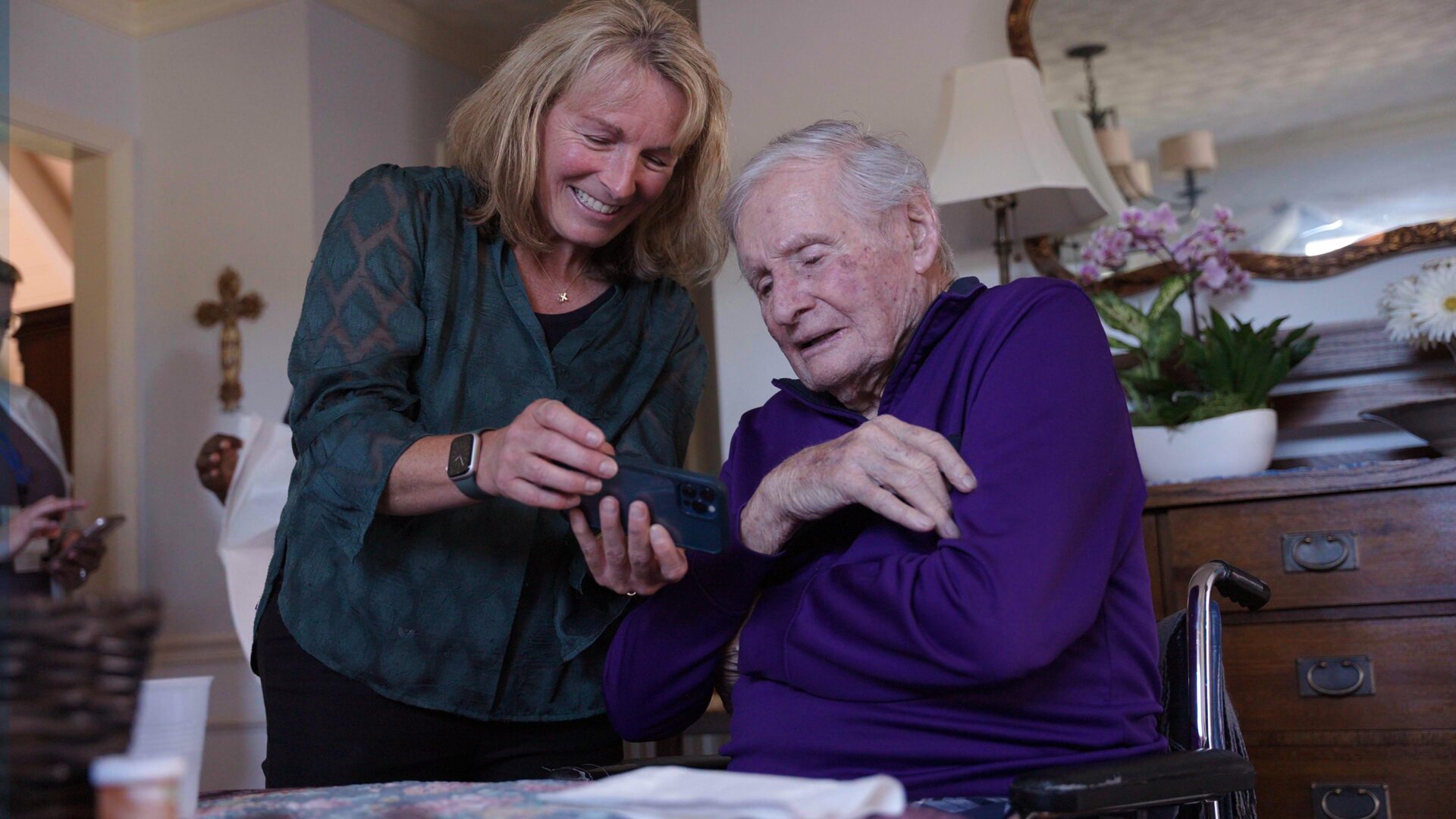
This is not a wellness check or a friendly drop-in. A skilled nursing medication management visit is licensed clinical work, performed by a Registered Nurse in the patient's home.
Here's what happens during that visit:
- The RN collects and reviews every medication the patient is taking, prescriptions, over-the-counter drugs, and supplements
- Each drug is checked for correct dose and timing against the physician's orders
- The nurse screens for drug interactions that may not have been flagged when prescriptions came from different specialists
- If adjustments are needed, the RN coordinates directly with the prescribing physician
- The patient and family receive clear education on what each medication does and what warning signs to watch for
- A daily schedule is established that works for the household, not just for a chart
For a family where one parent has dementia and the other is managing recovery from cancer treatment, this kind of structured visit changes the daily reality. It moves the household from guesswork to a clear, clinically reviewed plan.
You can read more about what a nurse actually does on one of these visits in this overview of what a skilled nurse actually does on a home visit.
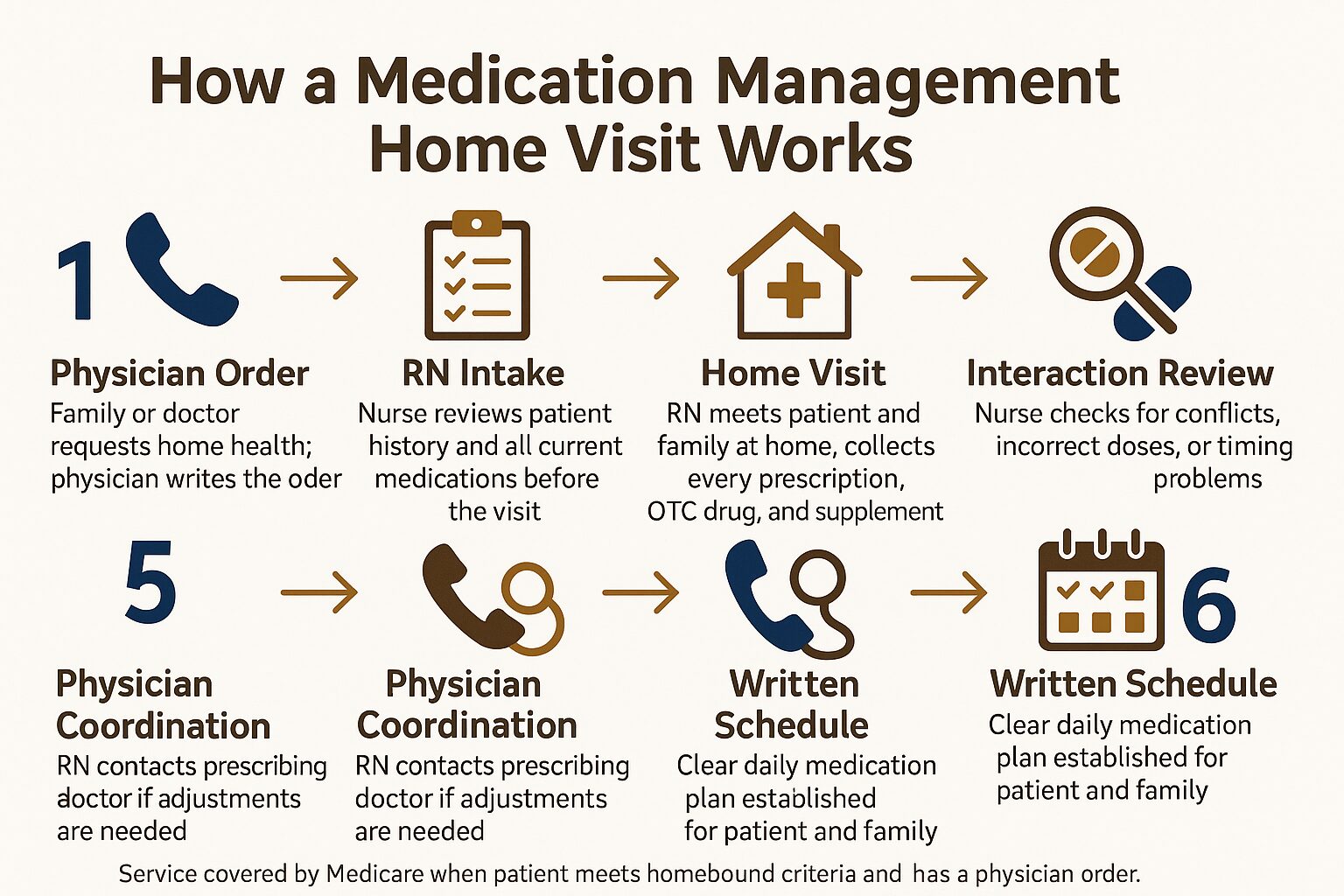
How a Medication Management Home Visit Works
This step-by-step breakdown shows what happens from the first phone call to an established medication plan in the home.
Does Medicare Cover This, and How Do You Get It Started?
Medicare Part A and Part B both cover skilled nursing home visits when the patient meets homebound criteria and has a physician order for the service. Homebound does not mean bedridden, it means that leaving home requires a considerable effort due to illness, injury, or cognitive decline.
For a parent with dementia and multiple complex medications, that threshold is often met. The conversation starts with the patient's physician.
Many families are surprised to learn that a physician referral is required before a skilled nurse can come to the house. It's not a barrier, it's how the clinical and insurance systems connect. If you're not sure how that process works, this explanation of why a physician referral is required for home health walks through it clearly.
VNA accepts Medicare, Medi-Cal, and Veterans benefits for qualifying home health services. For families navigating both parents' needs simultaneously, knowing that coverage exists for this kind of skilled visit is often the piece of information that changes everything.
Skilled Nursing at Home vs. Managing Medications Without Help
This comparison shows what changes when a Registered Nurse steps in to manage a complex medication situation at home.
| Area of Risk | Without Skilled Nursing Support | With RN Medication Management |
|---|---|---|
| Drug interactions | Unknown unless a pharmacist flags it at pickup | Clinically screened during the visit; physician contacted if needed |
| Missed or doubled doses | Common, especially with dementia; often undetected | Daily schedule established and reviewed; family educated on monitoring |
| Side effect recognition | Patient may not self-report; family may not know warning signs | RN educates family on what to watch for and when to call the doctor |
| Coordination between specialists | Falls to the family to relay information between offices | RN communicates directly with prescribing physicians on the patient's behalf |
| Medicare coverage | Not applicable | Covered when patient meets homebound criteria and has a physician order |
The Emotional Weight Nobody Talks About
Managing two aging parents with serious health histories, one with dementia, one recovering from cancer, is not a logistical problem. It's an emotional one that happens to have logistical symptoms.
Families in this situation often describe the same feelings: they're afraid of making a mistake, they don't know where to start, and they feel like they're doing it alone. Those feelings are completely understandable. The medication situation is genuinely complex. It's not something a pill organizer and a spreadsheet can solve when cognitive decline is in the picture.
Calling a nurse to the home is not an admission of failure. It's the right tool for a genuinely difficult clinical situation. The skilled nursing care at home article addresses a lot of the assumptions families carry into this, including the worry that asking for help means giving something up.
For families managing a parent with dementia specifically, it can also help to understand the full picture of what support looks like as the disease progresses. The article on hospice criteria for dementia addresses questions families often don't feel ready to ask out loud, but frequently need answered.
Why Local, Nonprofit Care Makes a Difference Here
In 2025, VNA's nurses and clinicians made more than 73,000 home visits across Monterey County, serving over 3,800 patients across the full spectrum of care. Medication management is one of the core services that Registered Nurses and Licensed Vocational Nurses deliver on those visits every week, in Salinas, in Pacific Grove, in King City, and throughout the Salinas Valley.
For a family trying to coordinate care for two aging parents from across town, that local presence matters. A nonprofit with 75 years of community history in Monterey County knows the area's physicians, the local hospital discharge teams, and the real geography of getting to a patient's home.
That's a meaningfully different experience from navigating a large regional agency that doesn't know the Central Coast. And for families wondering how to keep a parent at home safely as their needs grow, understanding how long aging in place can realistically work is a worthwhile starting point.
Frequently Asked Questions About Medication Management at Home
Can a nurse really come to my parent's house just to review medications?
Yes. A Registered Nurse can come to the home specifically to review all medications, check for interactions, confirm correct dosing, and set up a daily schedule. This is a skilled nursing service covered by Medicare when the patient meets homebound criteria and has a physician order. It is not a general wellness visit, it is clinical work.
My father has dementia. Does that change what kind of help is available?
It changes how care is delivered, not whether it's available. For a patient with dementia, the RN will work closely with family members to establish a system that accounts for the patient's cognitive limitations. The nurse also educates the family on warning signs, because the patient may not reliably report how they're feeling. The physician is kept in the loop throughout.
We have two parents with different health histories. Can a nurse help with both?
Home health services are ordered per patient, so each parent would have their own plan and physician order. But a skilled nursing team can coordinate visits and care planning for both. That's a conversation worth having with a care coordinator when you first reach out.
Does Medicare cover medication management visits at home?
Medicare Part A and Part B both cover skilled nursing home visits when the patient is homebound and has a physician order. Homebound doesn't mean bedridden, it means leaving home takes considerable effort. Many patients with dementia or serious chronic illness qualify. Medi-Cal and Veterans benefits may also apply depending on the patient's coverage.
How do I get this started for my parent in Monterey County?
The first step is a physician order. Talk to your parent's primary care physician and ask for a home health referral specifically for skilled nursing and medication management. If you're not sure how to have that conversation, a VNA care coordinator can walk you through the process. You can reach the care team at 831-372-6668 or visit ccvna.com.
Ready to Get a Clearer Picture of Your Parent's Medication Situation?
If you're managing a parent's medications in Monterey County and things have gotten too complex to handle alone, Central Coast VNA & Hospice has care coordinators who can help you figure out the right next step. You can reach the team at 831-372-6668 or visit ccvna.com to learn more about home health services and what Medicare covers.
Why a Physician Referral Is Required for Home Health, and How It Works
One of the most common things families say when they first call about home health is some version of: "I didn't know I needed a referral to get started." It comes up again and again, and usually the family is already frustrated, because no one at the hospital or the doctor's office explained this step to them.
In Monterey County, many families are navigating a loved one's discharge from Community Hospital of the Monterey Peninsula or Salinas Valley Health for the first time. The process moves quickly, and the referral requirement can feel like a surprise obstacle when it should be a routine part of the discharge plan.
This article explains what a physician referral for home health actually is, how it gets started, and what your family's role looks like through the process, so you are not caught off guard when the moment comes.
What a Physician Referral for Home Health Actually Means
A physician referral is a written order from a licensed physician that does two things at once. It certifies that the patient has a medical need for skilled care at home, and it confirms that the patient meets the homebound standard Medicare requires.
Without this order, a home health agency cannot legally admit a patient for skilled services. That includes skilled nursing, physical therapy, occupational therapy, speech therapy, and wound care. It is not a paperwork formality, it is the clinical and legal authorization that makes Medicare coverage possible in the first place.
The referring physician also takes on an ongoing role. Medicare requires that a physician review and sign the patient's plan of care within a specific window after services begin, and that the plan be recertified if care continues beyond the initial period. So the referral is not a one-time event. It is the beginning of a documented, physician-supervised relationship between the patient and the home health team.
For a closer look at what happens once a skilled nurse actually arrives at the home, What Does a Skilled Nurse Actually Do on a Home Visit? walks through that process in plain terms.
What 'Homebound' Means, and Why It Trips People Up
The word "homebound" sounds more restrictive than it actually is. Many families assume it means their loved one cannot leave the house under any circumstances. That is not the standard.
Medicare considers a patient homebound when leaving the home requires considerable effort, meaning the patient uses a wheelchair, walker, or crutches, or has a condition that makes leaving medically inadvisable. The patient can still go to a medical appointment, attend a religious service, or step outside occasionally. What matters is that leaving is the exception, not the routine.
Families do not have to make this determination on their own. A Registered Nurse from the home health team will assess homebound status during the first visit. That assessment becomes part of the clinical record that supports Medicare billing.
Here are common situations that typically qualify:
- Recent surgery with limited mobility
- Recovering from a fall or fracture
- Significant weakness from a cardiac event or stroke
- A condition where leaving the home poses a genuine medical risk
- Dependence on a walker, wheelchair, or assistive device to leave safely
If you are unsure whether your family member qualifies, that question is worth asking a care coordinator directly rather than guessing.
How the Referral Process Actually Starts
Most families have no idea who initiates the referral, which is exactly where the confusion starts. The answer depends on where the patient is at the time.
If the patient is being discharged from a hospital: A hospital discharge planner or medical social worker typically handles the referral. At Community Hospital of the Monterey Peninsula or Salinas Valley Health, this is a standard part of the discharge planning process. The family does not have to track down a physician or submit paperwork on their own, the hospital team is supposed to coordinate this.
If the patient is already at home and the situation has changed, a new diagnosis, a fall, a medication issue, increasing difficulty managing daily tasks, the referral comes from the primary care physician. In this case, it often starts with a phone call to the doctor's office describing what has changed.
In both situations, the family does not have to manage this alone. A home health agency can also help facilitate the referral by sending the necessary paperwork directly to the physician's office. That removes most of the burden from the family.
For a broader look at what happens in the days right after a hospital stay, After the Hospital Discharge, What Comes Next? is worth reading before a discharge date arrives.
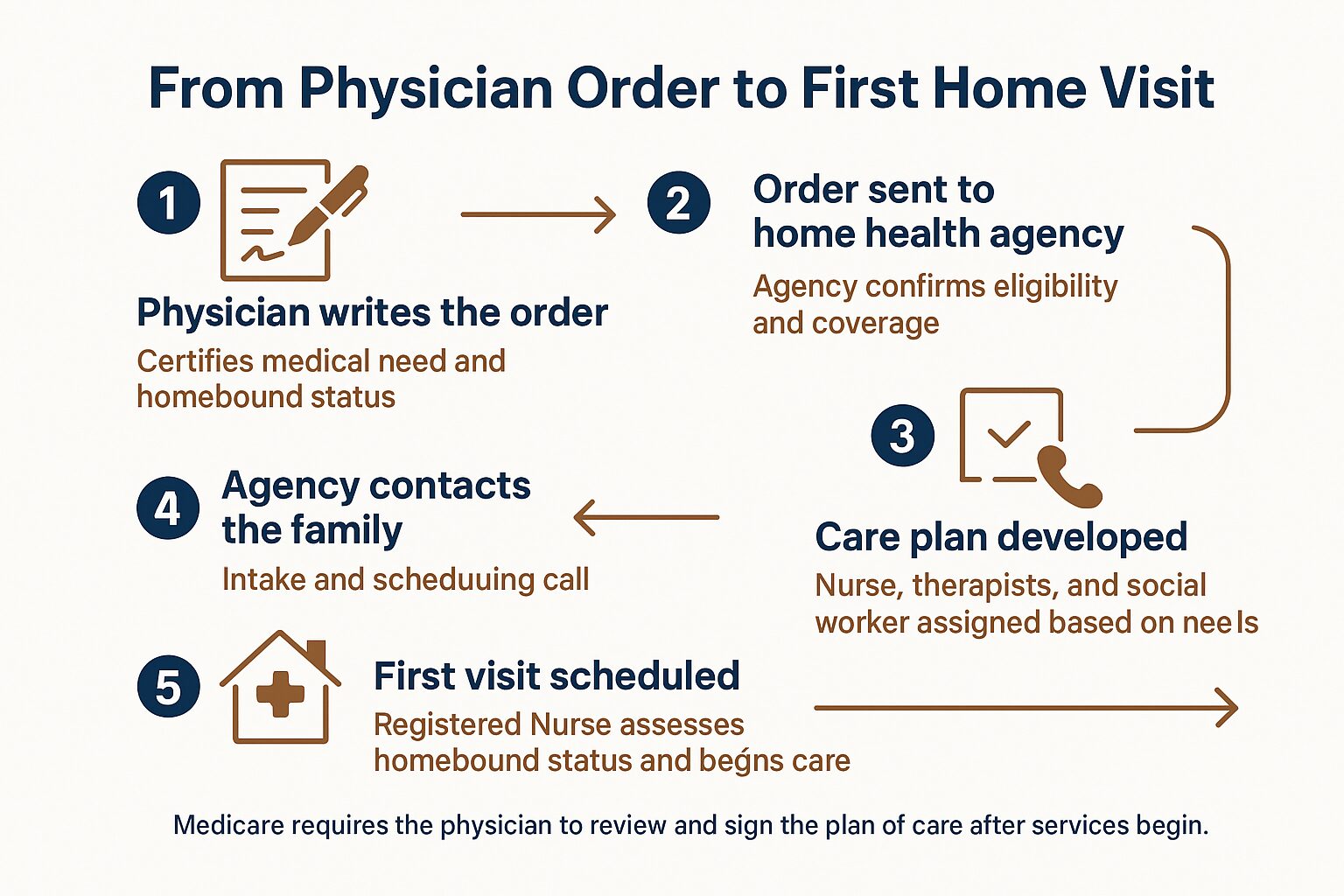
How a Home Health Referral Moves from Order to First Visit
This step-by-step flow shows what happens between a physician writing an order and a nurse arriving at the patient's home.
Hospital Discharge vs. Home-Based Referral: What's Different
The referral process looks slightly different depending on where the patient is when care is first needed. This table shows the key differences at a glance.
| Situation | Who Initiates the Referral | What the Family Typically Does |
|---|---|---|
| Patient being discharged from a hospital | Hospital discharge planner or medical social worker | Confirm the referral is in progress and state your agency preference |
| Patient already at home with a changing condition | Primary care physician (after a call or visit) | Contact the doctor's office and describe what has changed |
| Patient with a specialist managing a chronic condition | Specialist or primary care physician, coordinated together | Ask the specialist whether a home health referral is appropriate |
You Can Choose Your Own Home Health Agency
This is one of the most important things families do not know: Medicare gives patients the right to choose their own home health provider. A referring physician or discharge planner cannot require you to use a specific agency.
If a hospital social worker suggests a particular provider and you would prefer a local nonprofit organization, one that has served someone you know, or that has been part of the Monterey Peninsula community for decades, that choice is yours to make. You can say so directly, and the referral will be directed to the agency you select.
This matters because not all home health agencies are the same. Nonprofit agencies, for example, are structured differently from for-profit companies. The mission and the margins work differently. Families who do not know they have a choice sometimes end up with whichever agency is suggested first, rather than the one that actually fits their situation.
If you are trying to think through whether home health is even the right type of care for your loved one right now, Home Health vs. Hospice: How Families Know Which One Fits Right Now lays out the distinction clearly. And if a physician has raised the possibility of palliative care alongside treatment, What Palliative Care Actually Means, and When It Can Start is a useful read.
Frequently Asked Questions About the Home Health Referral Process
Can I request a home health referral myself, or does it have to come from the doctor?
The order itself has to come from a licensed physician, that is a Medicare requirement. But you can absolutely prompt the conversation. Call the doctor's office, describe what has changed with your loved one, and ask whether a home health referral is appropriate. Most physician offices are familiar with the process and can move quickly once the request is made.
What if the discharge planner at the hospital doesn't mention a referral?
Ask directly. Before a loved one leaves Community Hospital of the Monterey Peninsula or any other hospital, it is reasonable to ask the discharge team: "Is a home health referral being placed, and who is it going to?" You can also state your agency preference at that point. Discharge planners handle many cases at once, and a direct question ensures nothing is overlooked.
Does Medicare cover home health if I have a referral?
Medicare covers 100% of approved home health services when the patient meets eligibility criteria, including the homebound standard and a documented need for skilled care. There is no copay for home health under Medicare Part A or Part B when those criteria are met. The Medicare.gov home health coverage page has the full eligibility details straight from the source.
My mother's condition has been stable for months. Can she still qualify?
Stability alone does not disqualify a patient. Medicare allows home health services for patients managing chronic conditions, such as heart disease, COPD, or diabetes, when skilled care is needed to maintain that stability or prevent a decline. The key is that a Registered Nurse or therapist needs to be doing something that requires clinical training, not just general assistance.
How long does it take to get services started after a referral is sent?
Once a referral is received, many home health agencies aim to initiate contact with the family quickly, often within 24 to 48 hours for standard cases. For patients being discharged from the hospital, the goal is typically to have care in place before or immediately after the patient arrives home. If urgency is a factor, say so when you call.
What if my family member is not technically homebound but still needs skilled nursing at home?
If a patient does not meet the homebound standard, Medicare home health benefits would not apply. However, there may be other coverage options depending on the patient's insurance situation, and some services can be arranged privately. A care coordinator can help clarify what options exist based on the specific situation.
Questions About Getting Started With Home Health in Monterey County?
Central Coast VNA & Hospice has been supporting families across Monterey County, Santa Cruz County, San Benito County, and South Santa Clara County since 1951. If you are trying to figure out whether a referral is already in motion, which agency to request, or whether your family member qualifies for skilled care at home, a care coordinator can talk through the specifics with you. Call 831-372-6668 or visit ccvna.com to reach someone who knows this process and can help you take the right next step.

Finding Grief Support in Monterey County After a Loss
Losing someone you love is one of the hardest things a person goes through. And in the hours and days right after, one of the most common things people reach for is connection, someone who understands what this actually feels like.
For families in Monterey County, that search is real and immediate. A woman in Monterey recently submitted a message that said simply: she had lost her husband of 56 years the day before, he had been in hospice at Community Hospital of Monterey Peninsula, and she needed a local grief support group. That single message captures what many people in this situation feel, a need for something concrete, nearby, and soon.
This article explains what grief support actually looks like in practice, who it is for, and how people in communities like Monterey, Pacific Grove, Seaside, and Salinas can find their way to it.
What Grief Support Actually Looks Like
Many people have never used bereavement support before and aren't sure what to expect. There are two main forms, and they serve different needs.
One-on-one grief counseling involves meeting privately with a Bereavement Specialist, a trained professional who helps you process the emotional weight of loss over a series of conversations. This is a form of psychotherapy, though it doesn't feel clinical. It's a place to say what you can't easily say to the people around you.
Group support brings together people who have experienced similar losses, usually with a trained facilitator guiding the conversation. Groups are especially valuable for people whose grief feels invisible to those around them. Friends and family mean well, but they move on. A group stays with you.
Neither form requires you to have used a specific hospice or healthcare provider. Grief doesn't follow a schedule, and the support available to you doesn't either, both options are open to anyone in the community who has lost someone.
The two forms also aren't mutually exclusive. Some people start with a group and later move to individual counseling. Others do both at the same time. What matters is finding something that fits where you are.

Spousal Grief Is Different, and Often the Most Isolated
There is a reason the loss of a long-term spouse hits the way it does. When someone loses a partner of 50 or 60 years, they lose far more than one person. They lose a daily routine, a financial partner, a social anchor, and often their closest confidant.
Research from the National Institute on Aging shows that spousal bereavement carries real physical and mental health risks, particularly in the first year after a loss. Sleep changes, appetite loss, and depression are common, and often go unaddressed because the grieving person is focused on practical logistics rather than their own wellbeing.
In Monterey County, where a large portion of the population is older and long-term couples are common in communities like Carmel, Pacific Grove, and Pebble Beach, this situation is far from rare. But it is also easy to fall through the cracks, especially when friends and family assume that after a few months, things should be settling down.
They often don't. And that's something grief support groups understand in a way that general social networks usually don't. When mourning feels stuck, the problem isn't the person, it's that grief was never meant to be carried alone.
When People Search for Grief Support, and Why It's Never Too Late
Grief doesn't arrive on a schedule, and neither does the need for help. This shows when people most often reach out, and why any of these moments is the right time.
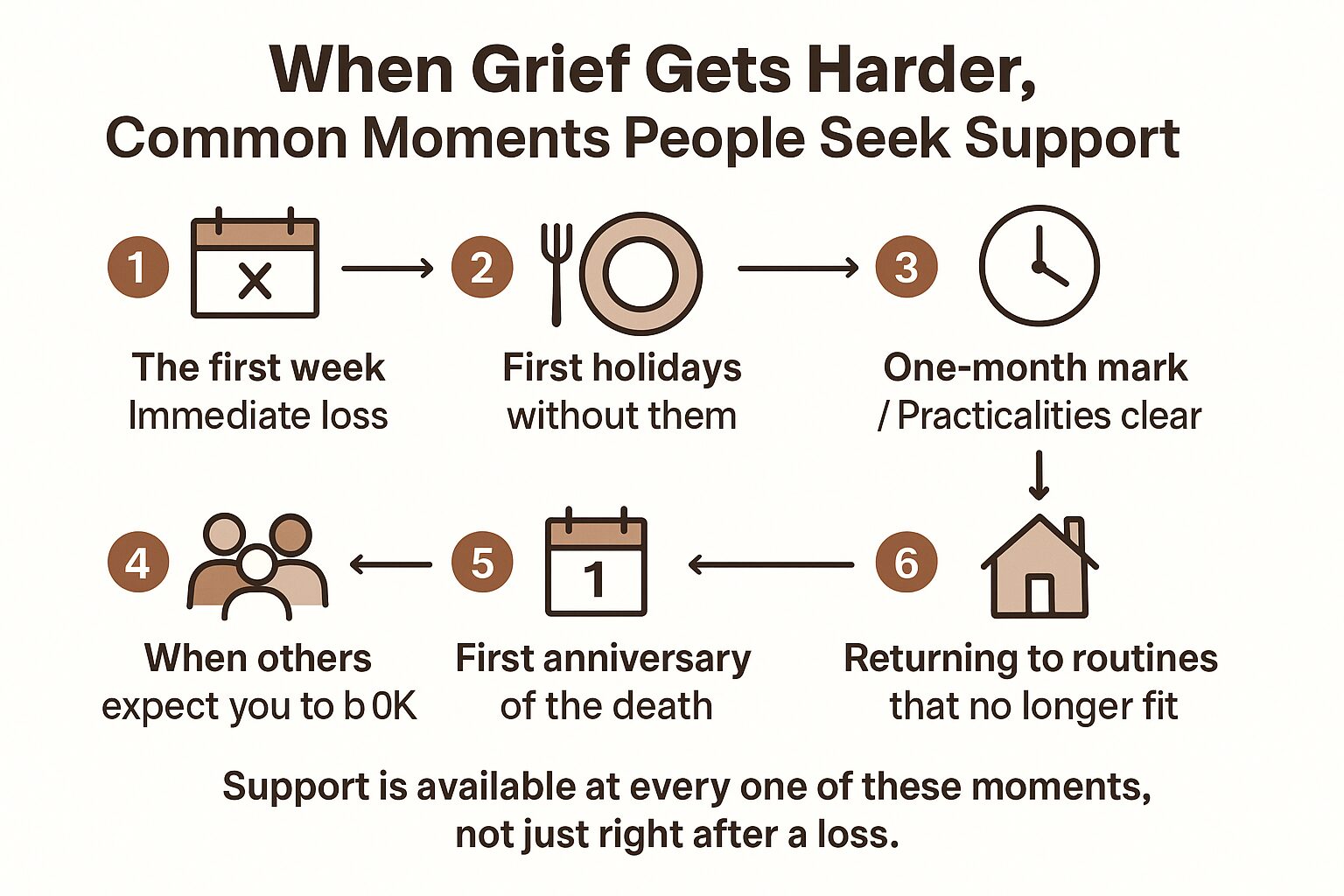
Grief Support Is Not Just for the Immediate Aftermath
People often search for grief support groups weeks or even months after a loss, not in the first few days. That's worth saying plainly, because many people assume they missed a window.
There is no window. Grief doesn't run on a linear track, and the need for support often intensifies at specific moments that come later:
- The first major holidays without the person who is gone
- The first anniversary of their death
- The point when other people seem to expect things to be back to normal
- Returning to routines, a morning coffee, a Sunday walk, that used to involve the person you lost
Someone who lost a spouse eight months ago and finds that it's getting harder rather than easier isn't doing anything wrong. That experience is documented and common. And it's exactly the kind of moment when a group of people who understand can make a real difference.
For adult children grieving a parent, which is also extremely common in Monterey County, the same applies. The loss of a parent reshapes a person's sense of place in the world, sometimes in ways that take months to fully register.
One-on-One Counseling vs. Group Support: A Quick Comparison
Both forms of bereavement support serve real needs, but they work differently. Here is how they compare across the factors most people ask about.
| Factor | One-on-One Counseling | Group Support |
|---|---|---|
| Setting | Private, with a Bereavement Specialist | Small group with a trained facilitator |
| Best for | Personal, specific grief work | Connection with others in similar situations |
| Requires prior relationship with hospice? | No | No |
| Cost | Varies; often covered by Medicare or insurance | Often low-cost or free through community programs |
| Availability in Monterey County | Yes, through community programs | Yes, through community and nonprofit programs |
| Timeline | Ongoing, at your pace | Scheduled sessions, often weekly or biweekly |
What's Available Locally, and Who Can Access It
In 2025, Central Coast VNA & Hospice expanded bereavement support to more than 2,200 individuals across its service area, according to the organization's annual report. That figure reflects a program operating at meaningful scale, with trained Bereavement Specialists and facilitated groups available to families across Monterey County.
Importantly, VNA's bereavement support is not limited to families who used VNA's hospice services. It is available to the broader community. Families in Salinas, Seaside, Pacific Grove, and King City can access the same support as anyone in Monterey proper, without needing a prior connection to the organization.
For people navigating the financial side of grief support, it's worth knowing that Medicare covers certain mental health and counseling services, and community-based grief programs through nonprofits are often low-cost or free. Costs vary depending on the type of support and how it's structured, so contacting a local program directly is the most reliable way to understand what applies to your situation.
If you are also trying to understand what the end-of-life care journey looked like for your loved one, or making sense of the decisions that were made, articles like what families often miss when planning a hospital discharge to home and how families describe the moment they chose hospice may offer some grounding as you process things.
Frequently Asked Questions About Grief Support in Monterey County
Do I have to have used VNA's hospice services to access their bereavement support?
No. Bereavement support through Central Coast VNA & Hospice is available to anyone in the community who has experienced a loss, not only families who were enrolled in their hospice program.
What if I'm not ready for a group? Can I start with individual counseling?
Absolutely. One-on-one sessions with a Bereavement Specialist are available and don't require you to participate in a group setting. Many people start there and later decide whether a group feels right for them.
Is there a cost for grief support groups?
It depends on the program. Community-based grief groups through nonprofits are often low-cost or free. Individual grief counseling may be covered in part by Medicare or private insurance, but costs vary. Contacting the program directly is the fastest way to find out what applies to your situation.
I lost my spouse eight months ago and I feel like it's getting harder, not easier. Is that normal?
Yes, and you are not alone in that experience. Grief often intensifies at specific points, the first holidays, the first anniversary, the moment when everyday life no longer fits the way it used to. Reaching out for support now, months after a loss, is exactly as valid as reaching out in the first week.
How do I find out when grief support groups meet in Monterey County?
The most direct step is to call or visit ccvna.com to ask about current group schedules and availability. Group meeting times and formats change, so checking directly gives you the most accurate information.
Ready to Find Local Grief Support?
If you are in Monterey County and looking for a grief support group or one-on-one bereavement counseling, Central Coast VNA & Hospice can help you understand what is available and when. You can reach their care team at 831-372-6668 or visit ccvna.com to learn more, no prior connection to their services is required to ask.
Hospice Criteria for Dementia: What Families Are Really Asking
Dementia is one of the hardest conditions for families to navigate when thinking about hospice. Unlike cancer or heart failure, it doesn't follow a predictable curve. It moves slowly, plateaus, then shifts again, and families often find themselves watching a parent decline for years without ever feeling certain that the moment has arrived.
Families across Monterey County ask versions of this question regularly. A daughter calling after a sleepless night. A son managing his father's medications alongside a cancer survivor mother. The situation is different each time, but the core question is always the same: how do we know when it's time?
This article won't give you a script or a shortcut. But it will walk through what the clinical markers actually look like in everyday life, what Medicare requires before hospice can begin, and how to start a conversation with a physician that most families wait too long to have.
What Does Medicare Actually Require for Hospice with Dementia?
Medicare's hospice benefit requires a physician to certify that the patient's life expectancy is six months or less if the disease runs its natural course. That standard applies to all diagnoses, but dementia makes it particularly hard to apply because the disease can stretch across a decade or more.
For dementia specifically, physicians look at a cluster of functional and medical changes that, taken together, indicate the illness has progressed to its final stage. There is no single test that triggers eligibility. It is a clinical picture built from several markers, assessed together.
The changes physicians and hospice nurses typically look for include:
- Significant weight loss, often 10% or more of body weight in six months, even when nutrition support is offered
- Recurrent infections, especially pneumonia or urinary tract infections that keep returning
- Severe loss of functional ability, the person can no longer walk without full physical support from another person
- Loss of meaningful verbal communication, speaking fewer than six intelligible words per day is one recognized threshold
- Inability to swallow safely, leading to choking, aspiration risk, or refusal to eat
These changes don't announce themselves on a single day. Families usually recognize them in hindsight, looking back at the last few months and realizing how much shifted. That's actually one of the most important things to understand: you don't have to wait for a crisis to ask whether hospice criteria have been met. A conversation with the physician can happen at any point. The hospice eligibility question most families are afraid to ask is often one of the most relieving ones to finally ask out loud.
When a Parent Has Dementia and Something Else Too
One situation that comes up regularly in conversations with Monterey County families involves a parent who has dementia alongside one or more other serious diagnoses. Heart failure and dementia. A cancer history and dementia. Diabetes and dementia. This is not unusual, it is actually the common picture for people in their 80s.
A family recently described their situation this way: an 83-year-old mother who is a cancer survivor, and an 86-year-old father who was recently diagnosed with dementia and takes more than five medications. Coordinating that care had become overwhelming.
When multiple serious conditions overlap, the path to hospice eligibility can shorten faster than families expect. A physician evaluating whether hospice criteria are met looks at the whole patient, not each diagnosis in isolation. Heart failure that is worsening alongside advanced dementia may meet eligibility thresholds much sooner than dementia alone would.
The harder truth is that many families don't bring this up with the physician because they aren't sure it's appropriate to ask. It is. Any family member can request that a physician assess whether their loved one may now qualify for hospice. The physician makes the determination, your job is to start the conversation.
If you are not yet at the hospice threshold but your loved one needs more support than they are getting, there is another option worth understanding before you get there.
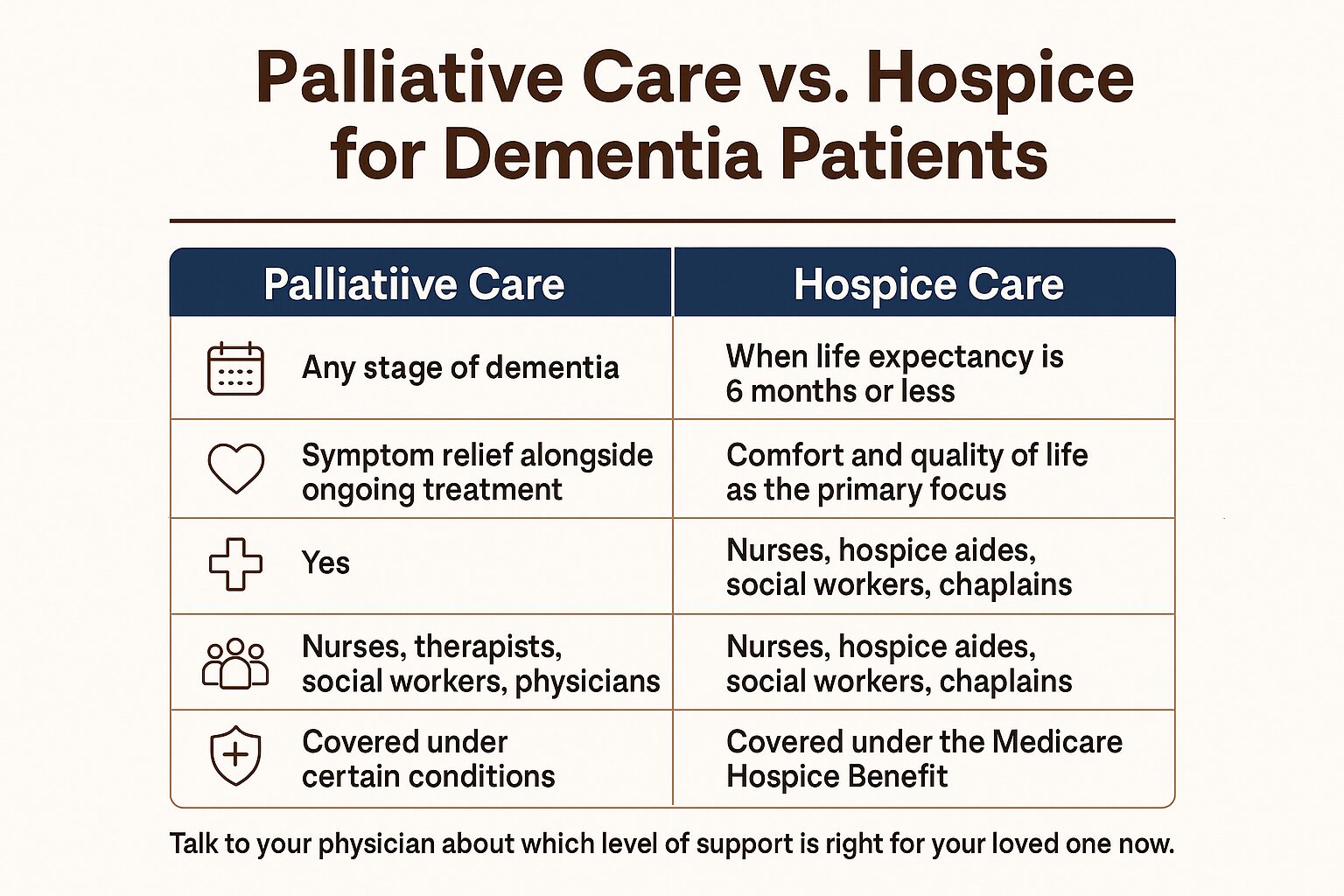
What Is the Difference Between Palliative Care and Hospice for Someone with Dementia?
This distinction matters enormously, and many families searching for hospice information don't yet realize that palliative care exists as a separate, earlier option.
Palliative care can begin at any stage of dementia. It focuses on managing symptoms, reducing discomfort, supporting the family, and coordinating care, all while the patient continues whatever medical treatment the physician recommends. Choosing palliative care does not mean stopping treatment. It does not require a six-month prognosis.
Hospice begins when curative or life-prolonging treatment is no longer the goal, typically when a physician and family agree that comfort and quality of life matter more than further medical intervention.
For a family with a parent in early or middle-stage dementia who is struggling with symptoms, recurrent hospitalizations, or caregiver exhaustion, palliative care is often the right fit right now. Central Coast VNA & Hospice has offered a home-based palliative care program since 2015, and it remains available to patients across Monterey County, including Salinas, Hollister, and King City.
You can read more about what this program actually involves in what palliative care actually means, and when it can start. Understanding comfort care vs. hospice can also help clarify which path fits your family's situation right now.
Palliative Care vs. Hospice: A Side-by-Side Look for Dementia Families
This comparison shows the key differences between palliative care and hospice for patients with dementia, so families can identify which level of support fits their current situation.
Dementia Hospice Eligibility: What Physicians Are Looking For
These are the clinical markers physicians commonly use when assessing whether a dementia patient may meet hospice eligibility. No single marker determines eligibility on its own, the physician looks at the full picture.
| Clinical Marker | What It Looks Like in Daily Life | Why It Matters |
|---|---|---|
| Significant weight loss | Losing noticeable weight over several months despite eating attempts | Signals the body is no longer able to maintain itself |
| Recurrent infections | Repeated bouts of pneumonia or urinary tract infections | Indicates the immune system is significantly weakened |
| Loss of mobility | Cannot stand or walk without full physical support from another person | Reflects late-stage neurological decline |
| Loss of verbal communication | Fewer than six intelligible words spoken per day | One recognized clinical threshold for late-stage dementia |
| Unsafe swallowing | Choking, gagging, or refusing food and liquids | Raises aspiration risk and signals end-stage progression |
Does Choosing Hospice Mean Giving Up on My Parent?
This fear is real, and it comes up constantly, in phone calls, in form submissions, in the hesitation families carry into every conversation about this topic. The word "hospice" can feel like a door closing.
But the clinical evidence points in a different direction. Many patients with dementia who transition to hospice stabilize in the early weeks of enrollment. With consistent pain and symptom management, fewer disruptive hospitalizations, and a team visiting regularly at home, some patients become more comfortable and more settled than they had been in months.
Hospice does not accelerate death. What it does is shift the focus from fighting a disease to caring for a whole person. According to research published by the National Hospice and Palliative Care Organization, hospice patients often report better symptom control and family members report less distress than those who do not enroll.
The interdisciplinary team on a hospice program includes nurses, Hospice Aides, a Medical Social Worker, a Chaplain, and Volunteers. That team addresses not just the physical symptoms your parent is experiencing, but the emotional and spiritual weight your entire family is carrying. For families in Monterey County who have been shouldering this alone, that kind of support often arrives as a genuine relief.
If you are still sorting through what to expect, how families describe the moment they chose hospice offers a grounded look at what that decision actually felt like for real families.
Frequently Asked Questions About Hospice and Dementia
Can someone with dementia qualify for hospice if they don't have another terminal diagnosis?
Yes. Dementia alone can meet hospice eligibility criteria when it has progressed to a late stage. Medicare does not require a secondary diagnosis. The physician must certify that the patient's life expectancy is six months or less based on the current trajectory of the disease, and late-stage dementia with the markers described above can meet that standard on its own.
What if my parent seems stable, can they still be evaluated for hospice?
Stability in dementia can be misleading. A person may appear calm or comfortable at home while still meeting hospice eligibility criteria based on weight, swallowing, mobility, or communication. "Stable" does not mean improving. A physician evaluation looks at the full clinical picture, not just how a patient seems on a given day. It is always appropriate to ask for that assessment.
Does Medicare cover hospice for dementia?
Yes. The Medicare Hospice Benefit covers hospice services when a physician certifies a terminal prognosis of six months or less. This includes nursing visits, Hospice Aide services, medication for comfort, medical equipment, and support for the family. Central Coast VNA & Hospice accepts Medicare, Medi-Cal, and Veterans benefits. For a full picture of what is covered and how to access it, a care coordinator can walk you through the specifics for your family's situation.
My parent has dementia and heart failure. Could they qualify sooner than I expect?
Quite possibly. When dementia overlaps with another serious condition, the combined effect on a patient's health often brings eligibility timelines forward. A physician evaluating hospice criteria looks at the whole patient, and two serious illnesses progressing together can meet the eligibility standard more quickly than either would alone. The important step is asking the physician to evaluate where things actually stand right now rather than waiting for an obvious crisis.
What if my parent isn't ready for hospice, is there anything in between?
Palliative care is exactly that. It can begin at any stage of dementia, continues alongside treatment, and focuses on symptom management, care planning, and family support. Central Coast VNA & Hospice has offered a home-based palliative care program in Monterey County since 2015, including Salinas, Hollister, and King City. If you are not sure whether your family is at the hospice threshold but know that more support is needed, what palliative care actually means, and when it can start is a good place to begin.
How do I start the conversation with my parent's doctor about hospice?
You can simply ask: "Has my parent reached the point where a hospice evaluation would make sense?" That is enough. Physicians are accustomed to this question, and a good physician will welcome it rather than dismiss it. If you are not sure how to frame the conversation or what to bring to the appointment, the article on advance care planning offers practical guidance for preparing for exactly this kind of discussion.
Not Sure Where Your Family Stands Right Now?
Families in Monterey County, Salinas, Hollister, King City, and the surrounding communities are welcome to call Central Coast VNA & Hospice at 831-372-6668 to speak with a care coordinator, no referral needed to start that conversation. If you would rather reach out online first, visit ccvna.com to learn more about the hospice and palliative care programs available in your area.

How to Tell If a Hospice Provider Is Actually Trustworthy
When a loved one's health is declining, most families in Monterey County focus on finding someone who can help quickly. What they rarely think to ask is whether the hospice they are considering is legally operating at all.
That is not an abstract concern in California right now. The California Department of Public Health has revoked the licenses of more than 280 hospice providers in the past two years, with roughly 300 more currently under evaluation. Many of those cases involved billing fraud, failure to deliver required services, or inadequate staffing. Families who enrolled without checking their provider's credentials had no idea anything was wrong until care fell apart.
This article focuses on three things that actually matter when evaluating a hospice: how to verify that a provider is licensed and compliant under California's new 2026 regulations, what questions to ask about geographic coverage so you are not left without care at the worst moment, and what real families consistently describe as the signs of a trustworthy team.
California's Hospice Licensing Landscape Changed in June 2026
For decades, hospice oversight in California was thin. The California Hospice Licensure Act of 1990 set a framework, but enforcement was inconsistent and the regulatory gap allowed poorly run agencies to operate with little accountability.
That changed on June 22, 2026, when California enacted its first updated, comprehensive hospice licensing framework through emergency CDPH regulations. The new rules introduced specific requirements that families can now ask about directly:
- Nurse-to-patient ratios, providers must meet defined staffing levels, not just claim adequate coverage
- Management qualifications, agency leadership must meet documented experience requirements
- Unannounced inspections, CDPH can now conduct surprise reviews, not just scheduled ones
- Individualized care planning, each patient must have a documented, specific care plan, not a generic template
The practical meaning for families is that the bar for what a licensed, compliant hospice must provide is now higher and more specific than it has ever been. You can and should ask any prospective provider directly: Are you currently licensed by CDPH, and are you in full compliance with the June 2026 emergency regulations?
A trustworthy provider will answer that question directly. One that hedges or changes the subject is worth a second look.
For broader context on how CMS oversees hospice quality and what transparency tools are being developed, the CMS Hospice Center is worth bookmarking. CMS is actively developing a public scoring tool to flag providers with concerning utilization patterns, and new telehealth restrictions now apply to any hospice operating under enhanced oversight.

The Geographic Question Families Forget to Ask
Monterey County is large. Salinas, King City, Hollister, and Pacific Grove are all in the service area of some providers but not others. And there is a real source of confusion specific to this region: Central Coast VNA & Hospice, based in Monterey, is sometimes mistaken for other organizations with similar names serving areas like Santa Cruz.
Callers to VNA's intake line regularly ask whether the organization serves their specific neighborhood. Some have already started the enrollment conversation before discovering the provider they called does not actually cover their address. That kind of mix-up, when it happens during a health crisis, can leave a family without care at exactly the wrong moment.
Before a loved one is admitted to any hospice program, ask these questions and get specific answers:
- Does this agency serve [your exact city or zip code]? Not the county in general, your neighborhood.
- Do you have nurses and other clinicians already working in this area, or would my loved one require a long travel window for every visit?
- If I am in Hollister or King City, does your coverage there match what you offer in Monterey?
- Are you the same organization as [any similar-sounding agency], or are you independent?
If a provider cannot answer those questions cleanly and specifically, that is information worth having before you sign anything.
If you are unsure whether hospice is even the right fit right now, this overview of how families describe the moment they chose hospice may help you think through where your family actually stands.
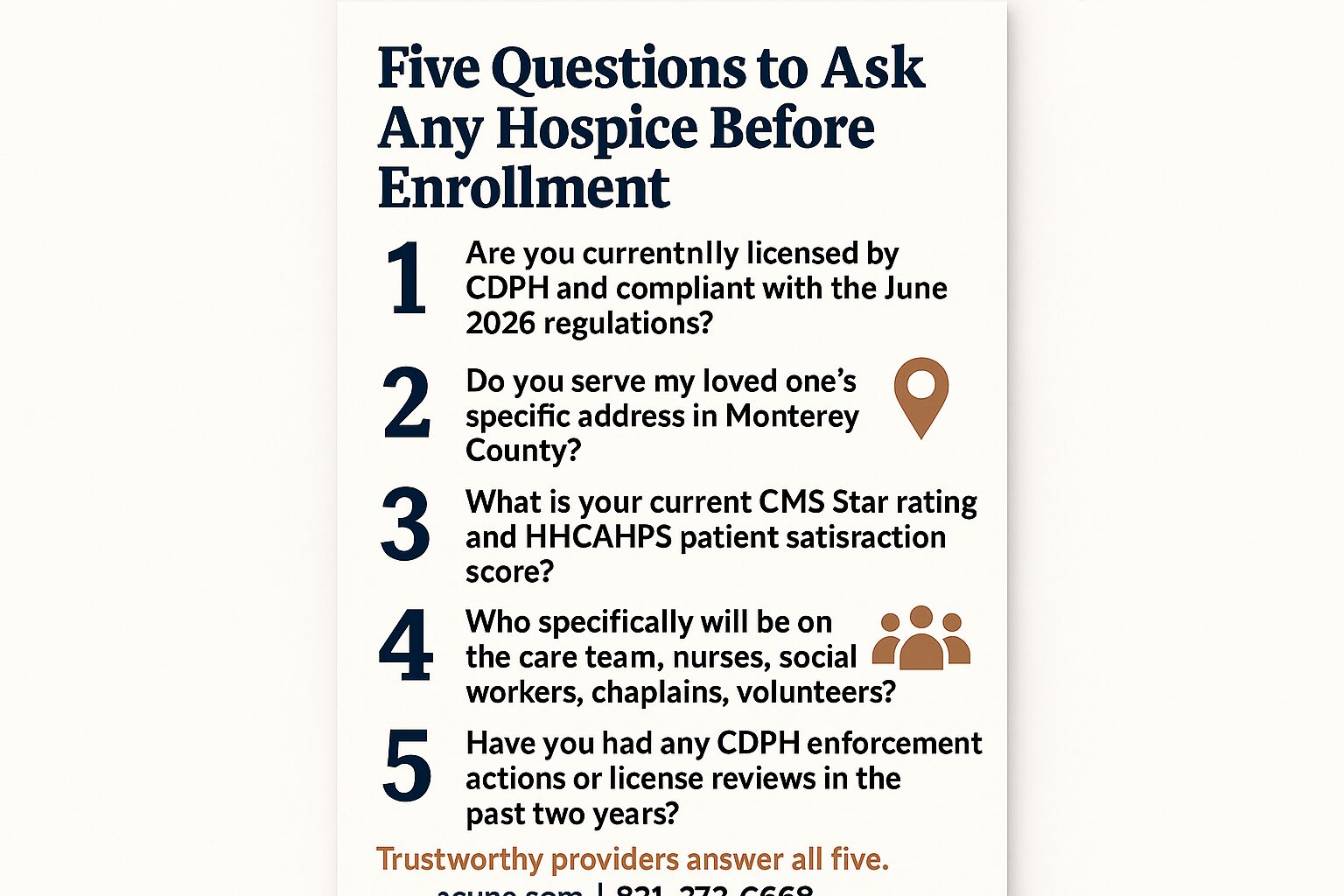
Five Questions to Ask Any Hospice Provider Before Enrollment
These five questions give families a practical checklist for evaluating a hospice before agreeing to any admission.
How to Read the Public Record on Any Hospice
Most families do not realize there is a public paper trail on every Medicare-certified hospice in the country. You do not have to take a provider's word for how well they operate.
Here is what you can ask about or look up directly:
- CMS Star ratings, the Centers for Medicare and Medicaid Services publishes ratings on Medicare.gov for hospice providers. Ask any provider you are considering for their current Star rating.
- HHCAHPS patient satisfaction scores, these are standardized surveys completed by families after a hospice stay. A provider's score reflects how real patients and families rated their communication, responsiveness, and emotional support.
- CDPH survey history, you can ask a hospice directly whether they have had any unannounced inspections, deficiency citations, or enforcement actions in the past two years. Under the new June 2026 regulations, that history is more relevant than ever.
- License verification, CDPH maintains a database of licensed hospice agencies. A quick check can confirm whether the agency you are speaking with is currently in good standing.
CMS is also developing a public icon system for its Medicare.gov comparison tool that will flag hospices that have not submitted required quality data. Until that feature is live, ask providers directly for their submission history.
A nonprofit organization with 75 years of continuous service in a community, a public track record, and a verified license is a materially different thing from a recently licensed agency with no local history and no public data trail. That difference is worth understanding before you commit to a provider.
For more background on what the hospice benefit actually covers and when it applies, this explanation of hospice eligibility questions families are afraid to ask is a useful starting point.
What Trustworthy Hospice Providers Can Show You
A compliant, accountable hospice should be able to answer or provide documentation for each of the items below. This is not an exhaustive legal checklist, but a practical starting point for families evaluating a provider.
| What to Ask For | What It Tells You | Red Flag If... |
|---|---|---|
| Current CDPH license number | The agency is legally authorized to operate in California | They cannot provide a number or deflect the question |
| CMS Star rating on Medicare.gov | How their quality compares to other hospices nationally | They have no published rating or refuse to share it |
| HHCAHPS patient satisfaction score | How families rate their communication and responsiveness | Scores are unavailable or the provider is unaware of the metric |
| Recent CDPH survey/inspection history | Whether they have had deficiencies or enforcement actions | They have had actions in the past 24 months they cannot explain |
| Specific coverage confirmation for your address | That they actually serve your loved one's neighborhood | They confirm 'Monterey County' without specifying your area |
| Named care team roles | That a full team, including chaplains and social workers, is in place | They describe a team vaguely or cannot name specific roles |
What Real Families Say Makes a Hospice Team Worth Trusting
Marketing materials from hospice agencies tend to emphasize the same things: experience, compassion, and 24/7 availability. Those claims are worth little without a way to evaluate them.
What real families consistently describe as meaningful is different from what brochures emphasize. One reviewer described a team that explained what was happening and why, translated the parts that did not make sense, and made the path forward feel possible. Another noted staff who seem to truly care about helping others, not just showing up to complete tasks.
The pattern across real feedback is consistent. Families remember:
- Whether nurses showed up consistently and communicated proactively, not just when called
- Whether the Medical Social Worker actually helped navigate decisions rather than just handing over a pamphlet
- Whether Chaplains and Volunteers were present and genuine, not perfunctory
- Whether the team spoke clearly about what was happening medically, without hiding behind clinical language
Scheduling inconsistency is also a real concern families raise. When visits happen at unpredictable times, or when patients do not know who is coming or when, the anxiety that creates is significant. A reliable hospice team should be able to tell you, before enrollment, how visit windows are communicated and what happens when a scheduled clinician cannot make a visit.
If you are still working through whether your loved one's situation calls for hospice or something earlier, this piece on comfort-focused care and when to ask about it may help clarify the options. And for families earlier in the process, understanding what palliative care actually means is often the right first conversation to have.
Frequently Asked Questions About Choosing a Hospice Provider in California
How do I verify that a hospice is currently licensed in California?
You can ask the provider directly for their CDPH license number and then verify it through the California Department of Public Health's licensing database. Under the new June 2026 regulations, licensed hospices must meet specific staffing, planning, and inspection requirements. If a provider cannot give you a license number or hesitates to confirm their compliance status, that is worth taking seriously.
What is a CMS Star rating and where do I find it?
The Centers for Medicare and Medicaid Services assigns Star ratings to hospice providers based on quality measures and patient satisfaction surveys. You can look up ratings at Medicare.gov. You can also ask any provider you are considering to tell you their current rating directly. A provider that does not know their rating or cannot share their HHCAHPS patient satisfaction scores is missing a basic level of transparency.
Does Medicare cover hospice at home?
Yes. Medicare Part A covers hospice services for patients who meet eligibility requirements, which generally means a physician has certified a prognosis of six months or less if the illness follows its expected course. Medi-Cal and Veterans benefits also cover hospice in most cases. There is typically no out-of-pocket cost for covered hospice services under Medicare. For more detail on what the eligibility question actually involves, this article on hospice eligibility walks through it plainly.
What should I do if I'm not sure whether a hospice covers my area in Monterey County?
Ask directly and ask specifically. Give the provider your city, zip code, or neighborhood and ask whether they have clinicians currently serving that area. There is real confusion in this region between organizations with similar names, and assuming coverage by county rather than confirming by location has left some families without care. If you are in Salinas, Hollister, King City, or a smaller community in the area, get a specific yes before moving forward.
Is a nonprofit hospice meaningfully different from a for-profit one?
The organizational structure does matter in practice. A nonprofit hospice reinvests any surplus back into services and community programs rather than returning it to shareholders. That does not automatically make every nonprofit better than every for-profit, but it does mean the incentive structure is different. When combined with a long track record, public accountability, and a verifiable history in the community, nonprofit status is one reasonable factor to weigh.
Can I switch hospice providers if I am unhappy with the care being given?
Yes. Under Medicare, patients have the right to change hospice providers. You can discharge from one hospice and re-enroll with another. The process involves paperwork and a transition period, so it is not seamless, but it is possible. If care is falling short of what was promised or what the new CDPH regulations require, you do not have to stay. Document your concerns and speak with a Medical Social Worker or patient advocate if you need help navigating the transition.
Questions About Hospice Care in Monterey County?
Central Coast VNA & Hospice has been serving families across Monterey County, San Benito County, and surrounding communities since 1951. If you want to talk through what questions to ask, confirm whether your loved one's address falls within the service area, or simply understand what the process looks like, a care coordinator is available to help without pressure. You can reach the team at 831-372-6668 or visit ccvna.com to learn more.

Advance Care Planning Is Not Just Paperwork. Here Is What It Actually Does.
Most families in Monterey County think they have handled advance care planning the moment someone signs an advance directive. The form gets filed away, and the subject gets dropped. Then a health crisis arrives, and no one in the room, including the person holding the form, actually knows what the patient would want.
The document was never the hard part. The conversation was.
Advance care planning as a real process means something much deeper than filling out paperwork. It means that a patient and the people they trust have actually talked through what kind of life is worth sustaining, what they fear most about serious illness, and who they want making decisions if they cannot speak for themselves. This article is about that process, and about who can help families get through it before a crisis makes it impossible.
The Difference Between a Signed Form and a Real Plan
An advance directive tells medical staff what interventions a patient does or does not want in a medical emergency. That matters. But a form that no one has talked through is a document no one fully understands.
Consider what happens in practice. A patient arrives at Community Hospital of the Monterey Peninsula after a stroke. The family is asked whether their loved one would want aggressive intervention. There is a signed advance directive somewhere, but the adult children remember the conversation differently, or there was no real conversation at all. The form says something, but no one can explain the reasoning behind it.
Advance care planning as a process changes that. It means the patient has answered harder questions with the people who will carry those answers:
- What does a good day look like to me, and would I still value life if that changed significantly?
- Who do I trust to make decisions when I cannot?
- What do I fear most, pain, loss of independence, being a burden, something else?
- Are there conditions under which I would want care to focus on comfort rather than treatment?
When those conversations have happened, the signed form becomes a reflection of real choices. Without them, it is just a document. As one reviewer of an existing article on this topic put it, the guidance was clear but they wished someone had explained what to do with the form after signing it. That gap, between documentation and understanding, is what advance care planning is designed to close.
For families navigating serious illness, what palliative care actually means and when it can start is worth reading alongside this, because palliative care teams are often the first to open these conversations with patients at home.

Who Should Be Part of the Conversation, and When
The research on this is consistent: most families start end-of-life planning too late, often not until a crisis has already forced the decision. The ideal time for advance care planning is when no immediate decision is required, which means now, for most families reading this.
But the "who" matters just as much as the "when."
The obvious participants are the patient and the people they designate as decision-makers. But one role that often gets overlooked is the Medical Social Worker on a home health or palliative care team. Medical Social Workers are trained specifically to help patients and families do three things that are genuinely difficult:
- Articulate what matters most in plain language, even when the feelings are complicated
- Work through disagreements between family members who see things differently
- Translate those conversations into documentation that travels with the patient through every care setting
For patients already receiving home health care in Salinas, King City, Pacific Grove, or Hollister, this kind of conversation does not require a separate appointment or a formal meeting. A Medical Social Worker visiting a patient at home can open and guide these discussions in a living room, with the people who know the patient's history. That context changes the conversation considerably compared to a clipboard in a doctor's office.
The care team involved in these conversations typically includes Registered Nurses, Nurse Practitioners, Medical Social Workers, and depending on the patient's situation, Chaplains and other clinicians who know the patient's full picture. Advance care planning is not a one-time event. It is a conversation that may happen more than once as a person's health changes, and having a consistent care team at home means someone is always there to revisit it.
Advance Care Planning: The Process at a Glance
This overview shows the difference between signing a directive and completing the full planning process, including who is involved and what each step produces.
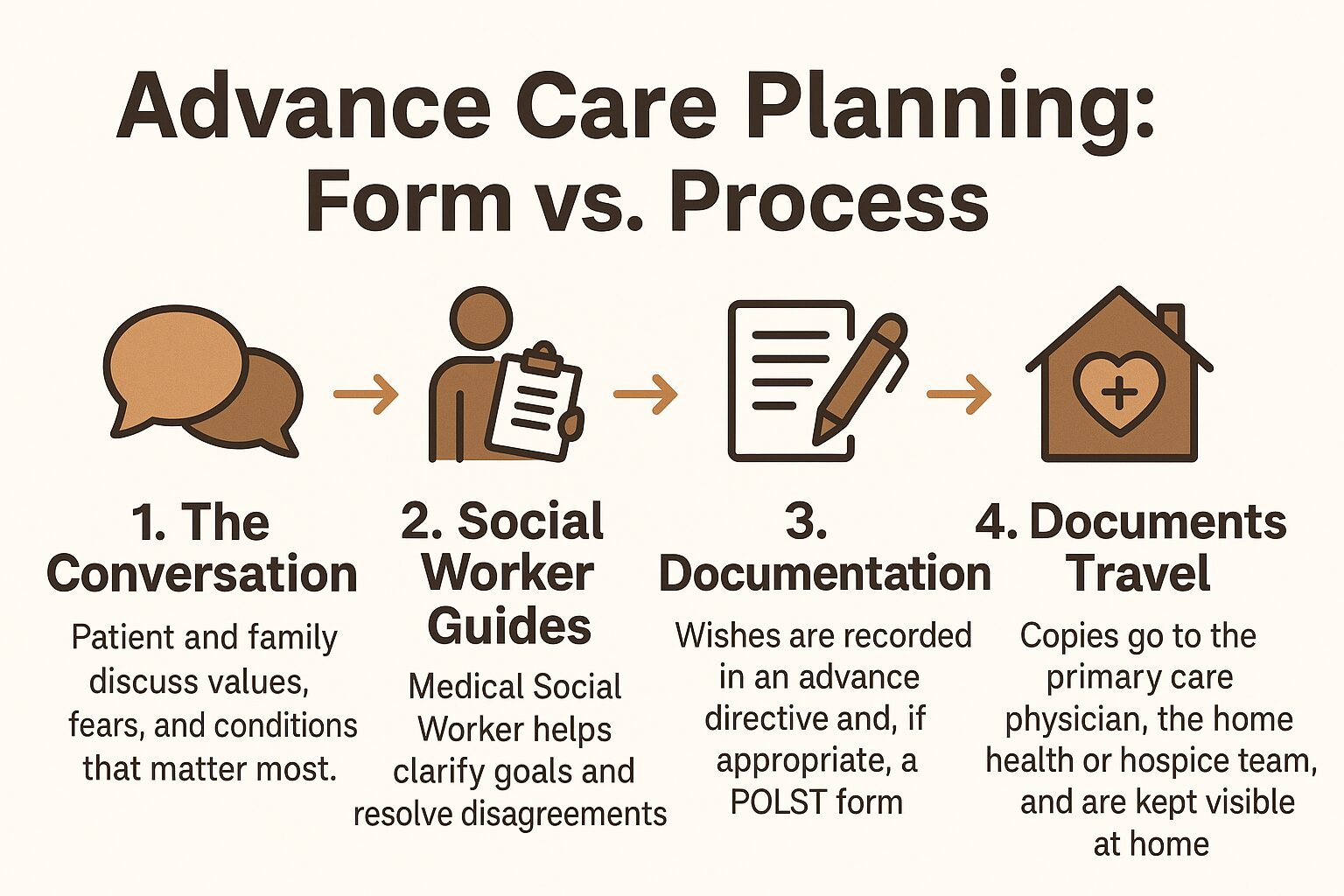
Where the Documents Need to Go After You Sign Them
This is the practical piece that a reader of VNA's earlier advance directives article specifically raised, and it deserves a direct answer.
An advance directive or POLST form (Physician Orders for Life-Sustaining Treatment) is only useful if the right people can find the most current version at the right moment. In Monterey County, POLST forms carry specific medical orders and are designed to travel with a patient between care settings, including Salinas Valley Health, Community Hospital of the Monterey Peninsula, and home. But that only works if the form exists, is current, and is accessible.
Here is where copies should go:
- Primary care physician, the form should be in the patient's medical record
- Specialists, if the patient sees any regularly
- Home health or hospice team, clinicians visiting at home need to know what the patient's documented wishes are
- A visible location at home, the refrigerator door is standard guidance for a reason: first responders in Monterey County are trained to look there
One detail families often miss: if an advance directive is updated, the old version should be destroyed or clearly marked as superseded. A care team acting on an outdated document is not acting on the patient's actual wishes.
The California Attorney General's office provides standardized advance directive forms that meet state legal requirements, which is a useful starting point for families who want to make sure the paperwork is valid before the conversations begin.
For families sorting out what all of this means alongside a home health transition, what families often miss when planning a hospital discharge to home covers related ground that is worth reading together with this.
Advance Directive vs. POLST: What Each One Does
These two documents serve different purposes and are not interchangeable. Understanding which one applies in a given situation helps families make sure the right document is in the right hands.
| Document | What It Does | Who Acts on It |
|---|---|---|
| Advance Directive | Records a patient's general values and wishes about future medical care, including who makes decisions | Physicians, hospitals, and care facilities when the patient cannot speak for themselves |
| POLST Form | Carries specific, immediately actionable medical orders (e.g., DNR, hospitalization preferences) | First responders, emergency staff, home health and hospice clinicians in any care setting |
| Healthcare Power of Attorney | Legally designates a specific person to make medical decisions on the patient's behalf | Any medical provider when the patient lacks decision-making capacity |
When Palliative Care and Home Health Teams Are Already Involved
Families sometimes assume advance care planning requires scheduling a special meeting or hiring an attorney. For patients already receiving home-based care, that assumption is worth setting aside.
Registered Nurses, Nurse Practitioners, and Medical Social Workers who visit patients at home in Monterey County, Salinas, King City, and Hollister regularly engage in these conversations as part of ongoing care. A nurse assessing a patient's pain management may naturally open the question of what the patient's goals for treatment are. A Medical Social Worker helping a family coordinate care may be the first person to ask who the patient wants making decisions if they cannot.
These are not bureaucratic checkboxes. They are conversations that happen because the care team has built enough of a relationship with the patient to have them. That relationship is part of what makes home-based care different from a clinic visit. For families thinking about what that kind of support looks like in practice, what a skilled nurse actually does on a home visit gives a realistic picture.
If a family member is dealing with a serious or progressive illness and has not yet had any of these conversations, how do you know when it is time to consider hospice care is another place to start, particularly if the question of comfort-focused care is beginning to feel more pressing.
Frequently Asked Questions About Advance Care Planning
Does my loved one need an attorney to complete an advance directive in California?
No. California law allows advance directives to be signed without an attorney as long as the document is witnessed by two people who are not the patient's healthcare providers or heirs. Some families do choose to have a document notarized for extra certainty, but it is not required. The California Attorney General's office provides a free standardized form.
What if family members disagree about what the patient would want?
This is one of the most common and most painful situations families face. A Medical Social Worker on a home health or palliative care team is specifically trained to help families work through these disagreements, not by deciding for them, but by helping everyone articulate what they understand and what they fear. Getting those conversations on the table before a crisis is far less painful than having them in a hospital hallway.
How is a POLST different from a Do Not Resuscitate (DNR) order?
A DNR is one specific order within a POLST, which covers a broader set of decisions including hospitalization preferences, artificial nutrition, and other interventions. A POLST form is a physician-signed medical order that travels with the patient and can be acted on immediately by first responders. A DNR alone may not address what happens in other situations where intervention is possible but not desired.
Can an advance directive be changed after it is signed?
Yes, and it should be updated whenever a patient's health situation, values, or wishes change significantly. The most important step after updating is making sure old versions are replaced in every location where the document was previously distributed, including the patient's physician, any specialist offices, and the home health or hospice team.
At what age or health stage should someone start advance care planning?
There is no minimum age or health condition that makes it appropriate. Most planning guides recommend starting these conversations well before any diagnosis, while the person has full capacity to articulate what matters to them. For people already managing a serious or chronic illness, the conversation becomes more urgent, but it is rarely too late to have it meaningfully.
Ready to Start This Conversation With Someone Who Knows Your Family's Situation?
For patients already receiving home health or palliative care in Monterey County, these conversations do not have to happen in a waiting room or a formal meeting. Central Coast VNA & Hospice has been supporting families across the Central Coast since 1951, and the nurses, Medical Social Workers, and other clinicians on its home-based teams are available to help patients and families think through what advance care planning actually looks like for their situation. You can reach VNA at 831-372-6668 or visit ccvna.com to connect with a care coordinator.

What Palliative Care Actually Means, and When It Can Start
On a Tuesday afternoon, palliative care might look like a Registered Nurse reviewing a pain management plan at a kitchen table in Salinas. It might look like a Medical Social Worker helping a family figure out why their father keeps ending up in the emergency room. It might look like a simple phone call that finally gives a spouse the words she needs to describe what her husband is going through to his oncologist. That is the palliative care meaning that matters, not the policy definition, but what it actually does for a person on an ordinary day.
Most families on the Central Coast first hear the phrase during a hospital stay or a difficult appointment. And most of them assume it means something is ending. It usually doesn't. Palliative care can begin the day a serious illness is diagnosed, whether that's Parkinson's disease, heart failure, COPD, or cancer, and it can continue for months or years while a patient is still pursuing treatment.
This article explains what palliative care actually is, who it's for, what the team looks like in a home-based setting, and how families in Monterey County can ask for it without waiting until things get worse.
What Palliative Care Means, in Plain Language
Palliative care is specialized medical support focused on relieving the symptoms and stress caused by serious illness. The goal is not to treat the underlying disease, that's the job of the patient's primary physicians, but to make the experience of living with that disease more manageable.
Symptoms that palliative care commonly addresses include:
- Pain that isn't well controlled by a primary care plan
- Shortness of breath, especially common in heart failure and COPD
- Fatigue and sleep disruption that leave patients exhausted and families worn down
- Anxiety and depression that develop alongside serious illness
- Nausea, appetite loss, and medication side effects
- Confusion about care options and what decisions need to be made
That last one matters more than people expect. A significant part of palliative care is helping patients and families understand what is happening, what choices exist, and how to communicate those choices to the broader care team. One family described calling their loved one's physician's office and not knowing which questions to even ask, a palliative care team addresses exactly that gap.
For families wondering about coverage, what Medicare covering palliative care could mean for your family is worth reading before you assume cost is a barrier.

Is Palliative Care the Same as Hospice?
This question comes up in nearly every family conversation about serious illness, and the confusion is completely understandable.
Palliative care is the broader category. Hospice is one specific type of palliative care. Here is the clearest way to think about it:
- Palliative care can begin at any stage of illness, runs alongside curative treatment, and has no required prognosis. A patient can receive palliative care for two years while actively treating cancer.
- Hospice care is for patients who have decided to stop pursuing curative treatment and whose physician estimates a prognosis of six months or less if the illness runs its natural course.
Someone on palliative care is not giving up. They are getting help managing symptoms so they can tolerate treatment, stay out of the emergency room, and keep living at home. That distinction changes everything about how families receive the idea.
If you are already weighing where hospice fits into the picture, how do you know when it's time to consider hospice care covers that question with the same directness.
The National Institute on Aging also describes the distinction clearly and is worth bookmarking for family conversations.
Palliative Care vs. Hospice: Side by Side
This table shows the practical differences between palliative care and hospice, two terms that are often used interchangeably but mean very different things.
| Palliative Care | Hospice Care | |
|---|---|---|
| When it starts | At diagnosis, any stage of illness | When curative treatment has stopped |
| Prognosis required? | No | Yes, 6 months or less |
| Can patient still pursue treatment? | Yes | No, hospice is comfort-focused only |
| Focus | Symptom relief and care planning alongside treatment | Comfort, dignity, and quality of life at end of life |
| How long it lasts | Months to years | Up to 6 months (renewable if eligible) |
| Medicare coverage | Varies by plan and setting | Covered under Medicare Hospice Benefit |
Why Starting Earlier Almost Always Helps
Most families wait too long. The pattern is familiar to anyone who has worked with seriously ill patients on the Central Coast, a spouse managing a husband's Parkinson's progression alone, an adult child flying in from out of state to handle a parent's heart failure crisis, a family member in Pacific Grove who didn't know palliative care was even an option until the third ER visit in two months.
Earlier palliative care involvement is tied to fewer ER visits, better sleep, reduced anxiety, and longer time at home. Those outcomes are not accidental. When a palliative team is involved early, medication plans are adjusted before symptoms spiral. Emotional support is in place before families hit a wall. Care decisions get made with time to think, not in a hospital hallway at midnight.
For families managing chronic, progressive illnesses like COPD, advanced heart failure, or neurodegenerative conditions, the question is rarely "is it time for palliative care?", it's "why haven't we started yet?"
If you're navigating whether your situation calls for this kind of support, when caring for an aging parent becomes more than you can do alone describes the signs families often recognize too late.
What the Palliative Care Team Actually Looks Like
Home-based palliative care involves more than one nurse checking in. This shows who is on the team and what each person does.
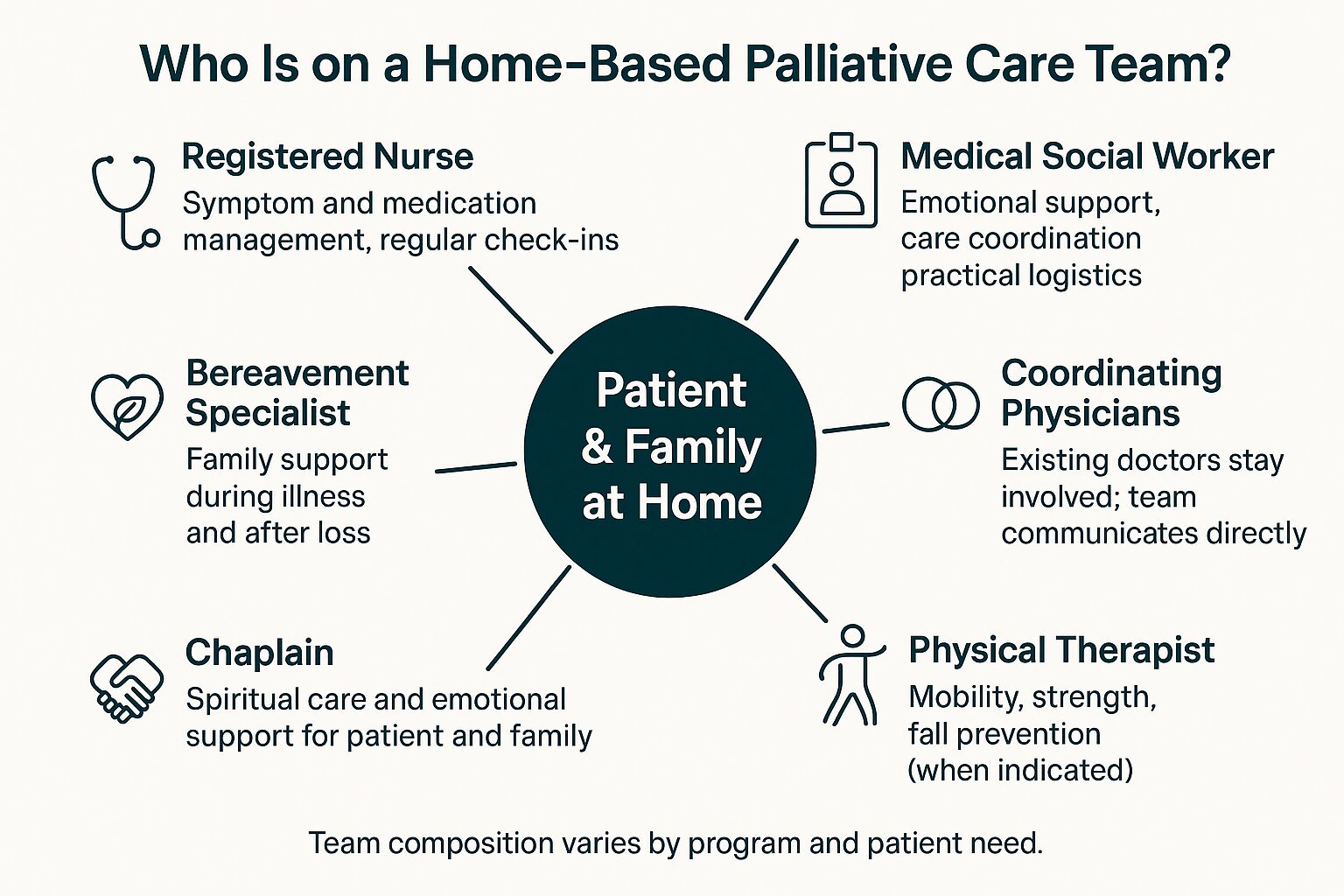
How to Ask Your Doctor for a Palliative Care Referral
One of the most common things families say after getting connected to palliative care is that they didn't know they could ask for it. Many assume a specialist has to bring it up first.
Any patient with a serious illness can ask their primary care physician or specialist for a palliative care referral. You don't need to be near the end of life. You don't need to have stopped treatment. You just need to be dealing with a serious illness that is affecting quality of life.
A straightforward way to start the conversation with a physician:
- "My [husband/mother/father] is having a hard time managing [pain/fatigue/shortness of breath] alongside treatment. Is a palliative care referral something we should consider?"
- "We're feeling overwhelmed trying to coordinate all of this at home. Is there a palliative care team that could help us with care planning?"
- "I've heard palliative care can help people stay out of the ER. Would that be appropriate given where we are?"
After a referral is placed, the process typically involves an initial home visit to assess the patient's symptoms, medications, and overall situation. From there, the team develops a plan and begins coordinating with existing physicians. In a home-based program, the team comes to the patient, whether that's a home in King City, an apartment in Salinas, or a residence in Pacific Grove. That matters a great deal for older adults who find clinic visits exhausting or physically difficult.
For those who aren't sure whether their situation calls for palliative care or something closer to home health, skilled nursing care at home is different from what most people picture explains that distinction clearly.
Frequently Asked Questions About Palliative Care
Does palliative care mean my loved one is dying?
No. Palliative care can start at any stage of a serious illness, including shortly after diagnosis, and it runs alongside curative treatment. Many patients receive palliative care for a year or more while still actively treating their illness. It is focused on quality of life, managing symptoms, reducing stress, and supporting the whole family, not on end-of-life preparation.
Who pays for palliative care at home?
Coverage depends on the setting and your specific plan. Medicare, Medi-Cal, and Veterans benefits may cover various components of home-based palliative care, though the rules differ from hospice coverage. A care coordinator can walk through what applies to your situation before any services begin. Central Coast VNA & Hospice accepts Medicare, Medi-Cal, and Veterans benefits.
Can my loved one receive palliative care and still see their regular doctors?
Yes, and that's actually the point. Palliative care is designed to coordinate with, not replace, the patient's existing care team. Registered Nurses and Medical Social Workers communicate directly with the treating physicians so the whole picture stays connected.
How do I know if palliative care is the right fit right now versus hospice?
If your loved one is still pursuing curative or disease-managing treatment, palliative care is almost certainly the right conversation to start. Hospice applies when curative treatment has stopped and a physician estimates six months or less. The table above in this article breaks down the practical differences, and comfort care vs. hospice: why the difference matters goes deeper on where the lines are.
What if I'm not sure my loved one qualifies or where to start?
That uncertainty is exactly where a care coordinator can help. Many families call not knowing whether they qualify, what a physician referral requires, or whether their area is covered. A single phone call can answer those questions without any commitment. Central Coast VNA & Hospice serves all of Monterey County, including Salinas, King City, the Monterey Peninsula, and surrounding communities, as well as parts of San Benito and South Santa Clara counties.
Ready to Talk Through Whether Palliative Care Fits Your Situation?
If you are managing a serious illness, yours or a loved one's, and you're not sure whether palliative care is an option yet, a conversation with a care coordinator is the simplest first step. Central Coast VNA & Hospice has served families across Monterey County, Salinas, King City, the Monterey Peninsula, and surrounding communities since 1951, and that kind of local experience makes a real difference when you're trying to understand what is available and where to start. You can reach their team at 831-372-6668 or learn more at ccvna.com.

Comfort Care vs. Hospice: Why the Difference Matters
If you've heard a doctor use the phrase comfort care and walked away unsure what it actually meant, you're not alone. Families across Monterey County hear this term during hospitalizations, in physician offices, and from discharge planners, and almost no one uses it the same way. Some clinicians mean palliative support alongside active treatment. Others use it to signal a shift toward end-of-life focus. A few use it interchangeably with hospice. The term itself is genuinely inconsistent across hospitals, insurers, and physicians, and the confusion that follows is completely understandable.
What matters is that the phrase almost always carries more weight than people realize in the moment. When a doctor brings up comfort care, it usually means something specific is being proposed, and the family deserves to know exactly what that is. This article breaks down what comfort care actually means in a clinical context, how it differs from hospice, and what questions will help any family in Monterey, Salinas, or the surrounding Central Coast communities understand what's being offered before they agree to anything.
What 'Comfort Care' Actually Means When a Doctor Says It
In most clinical settings, when a physician or hospital team uses the phrase comfort care, they are signaling a shift in treatment goals, from curing or controlling a disease to managing how a patient feels day to day. That means focusing on pain, breathlessness, anxiety, nausea, and other symptoms that reduce quality of life.
But here is what many families miss: that shift in goals does not automatically mean treatment is ending. Comfort-focused care can run alongside active medical treatment. A patient receiving chemotherapy, for example, can also receive symptom management support for the side effects of that treatment. These are not mutually exclusive approaches.
When you hear a physician propose comfort care, the most important thing you can do is ask a few direct questions:
- Is this being offered alongside my loved one's current treatment, or instead of it?
- What specific symptoms are you hoping to address?
- Does this change any of the medications or therapies already in place?
- Are you recommending a referral to a palliative care team or to hospice?
Those four questions will tell you almost everything you need to know about what is actually being proposed. Families who understand this early tend to accept appropriate support sooner, and that timing genuinely affects how much relief their loved one receives.
For a broader look at what comfort-focused care looks like in practice, What "Comfort-Focused Care" Really Means, and When to Ask About It is worth reading before or after any conversation with a physician.

Hospice Is a Specific Program, Not Just a Philosophy
Hospice is not a vague idea or a general approach to care. It is a structured, medically defined program with specific eligibility requirements, a dedicated team, and its own coverage under Medicare and Medi-Cal.
To qualify for hospice, a physician must certify that a patient's life-limiting illness may result in death within six months if the illness follows its expected course. That is the threshold. It does not mean a patient will die in six months, some patients on hospice live longer and are discharged. But that medical determination is required before the program can begin.
Once enrolled, hospice brings an interdisciplinary team into the home that most families did not know existed. That team typically includes:
- Registered Nurses who assess symptoms, manage medications, and are available around the clock
- Hospice Aides who help with personal care and daily routines
- Medical Social Workers who address practical needs, family stress, and care coordination
- Chaplains who offer spiritual support to patients and families of any faith background or none
- Bereavement Specialists who continue supporting the family after the patient passes
- Volunteers who provide companionship and give family members a break
Medicare covers hospice as a distinct benefit, including medications related to the terminal diagnosis, equipment like a hospital bed or wheelchair, and all of the team visits described above. Medi-Cal and Veterans benefits also cover hospice, though the specifics vary. If you want to understand how that eligibility question actually works in practice, The Hospice Eligibility Question Most Families Are Afraid to Ask addresses it directly.
Comfort care, by contrast, has no formal eligibility threshold. A patient at any stage of illness can receive comfort-focused symptom support. That is one of the most important distinctions families need to hear: you do not have to qualify for hospice to get meaningful relief.
Comfort Care vs. Hospice: A Side-by-Side Look
These are the practical differences families most often need to understand when weighing their options.
| Feature | Comfort Care (General) | Hospice Program |
|---|---|---|
| Eligibility requirement | None, available at any illness stage | Physician certifies 6-month prognosis |
| Can continue curative treatment? | Yes | Generally no, goals shift to comfort only |
| Medicare/Medi-Cal benefit | Covered based on diagnosis and how services are ordered | Distinct Medicare Hospice Benefit with defined coverage |
| Team involved | Varies, may include nurses, therapists, social workers | Full interdisciplinary team: nurses, aides, social workers, chaplains, volunteers, bereavement specialists |
| Where care is provided | Home, clinic, or hospital setting | Primarily in the home or a homelike setting |
| Duration | As long as clinically appropriate | Recertified in 90-day periods; no set end date |
The Team Behind Comfort-Focused Care
Most families are surprised by how many clinicians can be involved before a hospice decision is ever made. This shows who is typically part of a comfort-focused care team.
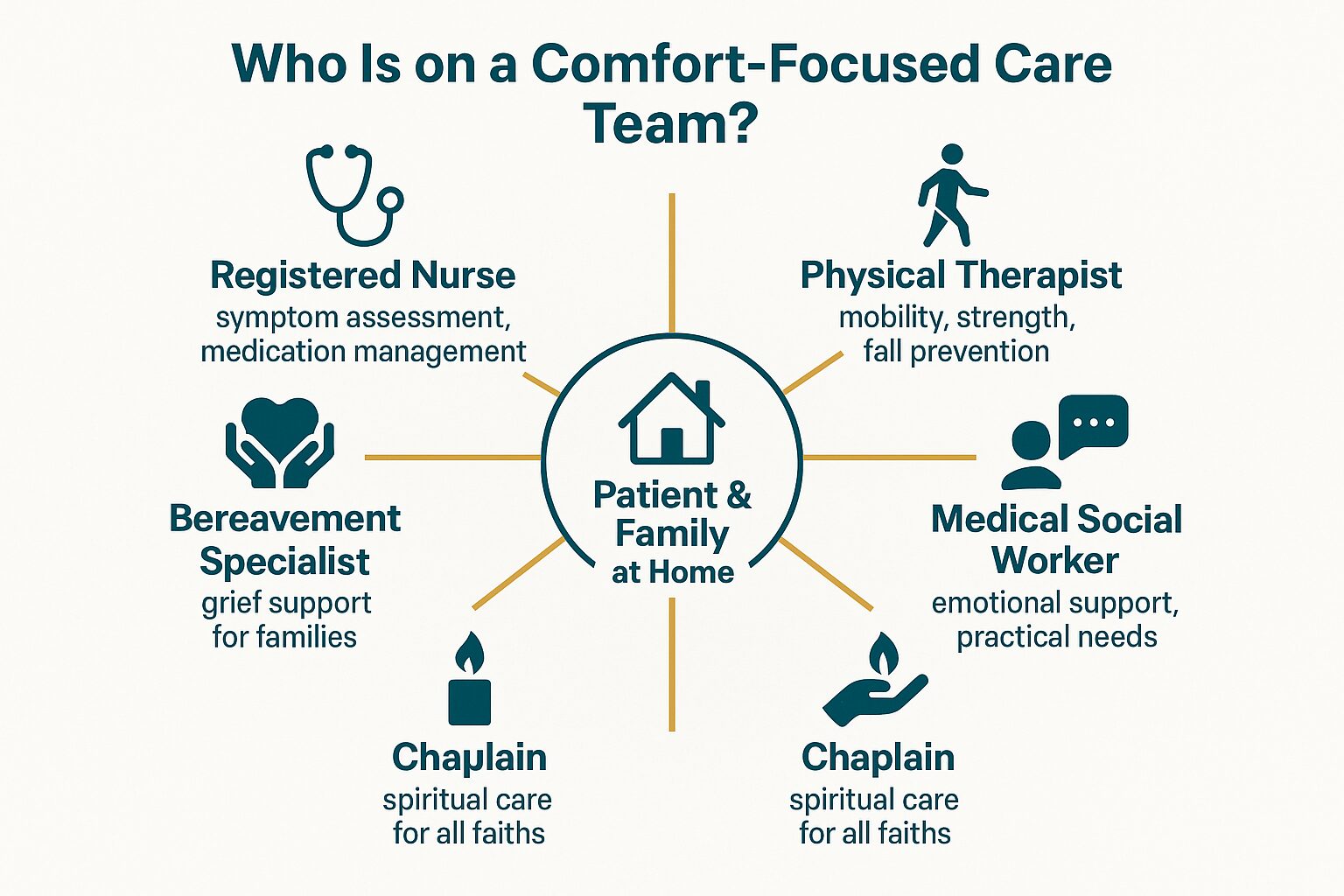
Why Families Hear 'Comfort Care' and Think It Means Giving Up
This is one of the most consistent patterns in conversations with families navigating a serious illness. Someone hears a physician recommend comfort care during a hospitalization and interprets it as the medical team stepping back, as giving up on their loved one.
That interpretation is understandable. And it is also often wrong.
Focusing on comfort does not require stopping other care. In many cases, physicians recommend a palliative layer of support specifically because a patient is in active treatment and the treatment itself is causing significant suffering. Adding symptom management in that context is not a retreat. It is an expansion of care.
The phrase that tends to create the most confusion is when comfort care is offered as a goal-of-care conversation, a discussion about what matters most to the patient as a person, not just as a medical case. Those conversations can feel heavy, and physicians do not always frame them in a way that feels reassuring. But families who engage with those conversations openly tend to find that their loved one's wishes become clearer, and that the care that follows is more aligned with those wishes.
If your family is in the middle of that conversation right now, How Families Describe the Moment They Chose Hospice offers real perspective from people who have been through it, and may help the decision feel less isolating.
For families in Salinas, King City, Hollister, or the Monterey Peninsula who are trying to figure out what comes next after a hospitalization, What Families Often Miss When Planning a Hospital Discharge to Home is also worth a read before discharge day arrives.
How Coverage Works, and Why It Should Not Stop You from Asking
One question that comes up constantly, from families in Pacific Grove to patients in King City, is whether Medicare or Medi-Cal will pay for comfort-focused care. The short answer is: it depends on how the services are ordered and what the underlying diagnosis is.
Medicare's Hospice Benefit is one of the most clearly defined coverages in all of Medicare. Once a patient is enrolled in a certified hospice program, Medicare covers the team visits, medications related to the terminal diagnosis, and equipment delivered to the home, with little to no cost to the patient.
Palliative and comfort-focused care outside of hospice is covered differently. Skilled nursing visits, physical therapy, and other home health services are generally covered under Medicare Part A or Part B when a physician orders them and the patient meets homebound criteria. The Medicare website has a useful breakdown of what home health services Medicare covers and the conditions that apply.
The most practical step any family can take is to ask two questions of their physician and their care team:
- How will these services be billed, and under what part of my coverage?
- Is there anything I need to do to make sure the referral is in place before care begins?
Coverage should never be the reason a family waits to ask for help. If there is uncertainty, a care coordinator can help clarify what applies to a specific situation before anything is scheduled. For more on how Medicare coverage intersects with palliative care specifically, What Medicare Covering Palliative Care Could Mean for Your Family explains the landscape in plain language.
Frequently Asked Questions About Comfort Care and Hospice
Can my loved one receive comfort care and still try to get better?
Yes. Comfort care and curative treatment can run at the same time. Focusing on symptoms like pain or breathlessness does not require stopping chemotherapy, dialysis, or other active treatment. The two goals can coexist, and in many cases, managing symptoms actually helps a patient tolerate treatment better.
How is hospice different from just having a nurse come to the house?
Home nursing visits and hospice are very different programs. A skilled nursing visit through home health focuses on a specific clinical task, wound care, medication management, post-surgical recovery. Hospice brings a full team into the home on an ongoing basis: Registered Nurses, Hospice Aides, Medical Social Workers, Chaplains, and Volunteers, all coordinated around one goal, which is quality of life for the patient and support for the family. It is a much broader program than a single nursing visit.
Does choosing hospice mean we're giving up?
Most families who have been through it say the opposite. Hospice shifts the focus from fighting the illness to focusing on the person, their comfort, their dignity, and their wishes. Families often describe feeling that hospice gave their loved one more presence, more peace, and more control over their final months than continued aggressive treatment would have. That is not giving up. It is a different kind of commitment.
What if my parent isn't ready for hospice but is still struggling with symptoms?
This is exactly the situation where palliative and comfort-focused care is most valuable. There is no eligibility threshold for comfort-focused symptom support. A patient does not have to be near the end of life to benefit from a Medical Social Worker helping with stress, or a Registered Nurse managing pain more effectively. If your loved one is suffering and you are not sure whether hospice is the right step, asking about palliative care first is a completely reasonable path.
Does a physician referral have to come first?
For most home health and hospice services, yes, a physician order is required to get started. Many families don't realize this until they call, which can create frustrating delays. If you know care is coming, the fastest thing you can do is contact the physician's office and ask them to send a referral directly to the home health or hospice agency. A care coordinator can walk you through that process and often help facilitate the paperwork.
What happens to the family after a hospice patient passes away?
Hospice care does not end at the moment of death. Bereavement support, including grief counseling and ongoing check-ins from Bereavement Specialists, continues for the family after their loved one passes. This is a covered part of the Medicare Hospice Benefit and can make a meaningful difference for spouses, adult children, and others navigating loss.
Still Trying to Sort Out What Your Family Actually Needs?
Families across Monterey County, from Pacific Grove to Salinas to Hollister, are often working through these questions in real time, after a hospitalization, during a health decline, or in the middle of a conversation with a physician that left more questions than answers. Central Coast VNA & Hospice has been helping families in this region find clarity since 1951, and a care coordinator is available to talk through what options may apply to your specific situation. You can reach the team at 831-372-6668 or visit ccvna.com to learn more.