
Direct Answer: Most families wait too long to ask about home care — and later wish they’d known Medicare often covers skilled nursing, therapy, and more, delivered right at home.
Most families in Monterey County don’t think about home care until a parent falls, a hospital stay ends abruptly, or a diagnosis lands that nobody was ready for. Then the questions come fast — and the answers feel impossibly hard to find.
What actually surprises people, once they’re on the other side of that moment, is how much was available to them all along. Skilled nursing at home. Physical therapy in the living room. Help managing a chronic illness without driving to Salinas or Pacific Grove three times a week.
This article is built around the things families consistently say they wish they’d understood earlier — not about any one service, but about how home-based care actually works, what it costs, and when to start the conversation.
The Part About Medicare Nobody Explains Clearly
When a parent comes home from Community Hospital of the Monterey Peninsula after a surgery or a health event, the discharge process moves fast. A nurse hands over paperwork, someone mentions “home health,” and families nod along — often without fully understanding what they just agreed to or what they’re entitled to.
Medicare covers more than most families realize. If your parent is homebound and a physician certifies that skilled care is needed, Medicare Part A will pay for:
- Skilled nursing visits from a Registered Nurse or Licensed Vocational Nurse
- Physical therapy, occupational therapy, and speech therapy at home
- Medical social worker visits
- Some medical equipment and supplies
There is no copay for Medicare-covered home health services, and there’s no requirement that your parent have a prior hospital stay to qualify. That surprises almost everyone.
What Medicare doesn’t cover is around-the-clock supervision or personal care that isn’t tied to a medical need. Understanding that line — between skilled care and custodial care — saves families from a lot of confusion later. For a deeper look at what happens when coverage has gaps, Can I Still Get Home Care If Medicare Doesn’t Cover Everything? is worth reading before you need it.
Medi-Cal and Veterans benefits also cover home health services for qualifying patients, and those programs serve a significant portion of families across Monterey County, Salinas, and Hollister.

When to Ask for Help — and Why Families Usually Ask Too Late
There’s a pattern that plays out in families across Monterey County, from Carmel Valley to King City. A parent starts declining slowly — missing medications, losing weight, struggling with balance — and family members rationalize each change as a one-off. By the time someone calls for help, the situation is harder to manage than it needed to be.
The signs that warrant a conversation with a physician or a home health organization aren’t dramatic. They’re quiet.
- Repeated falls or near-falls in the past 90 days
- A new diagnosis that requires ongoing monitoring (heart failure, COPD, diabetes)
- A surgery recovery happening at home without clinical follow-up
- Wounds that aren’t healing or are getting worse
- Medications that are confusing or being taken inconsistently
- Noticeable changes in strength, balance, or the ability to speak clearly
Any one of those is a legitimate reason to ask a physician whether home health services are appropriate. The bar isn’t “my parent can’t function at all.” The bar is: is there a clinical need that could be safely addressed at home?
For families trying to figure out where that line actually falls, When Is It Time to Think About Getting Help at Home? gives a more detailed breakdown of the signals worth taking seriously.
Home Health vs. Palliative Care vs. Hospice — What’s the Difference?
Families often use these terms interchangeably, but they describe three different things. Here’s a plain-language comparison of what each one involves.
| Type of Care | Who It’s For | Key Services | Medicare Coverage |
|---|---|---|---|
| Home Health | Patients recovering from illness, surgery, or managing a chronic condition | Skilled nursing, physical/occupational/speech therapy, wound care, medication management | Yes — if homebound and physician-ordered |
| Palliative Care | Patients with serious illness at any stage, including those still receiving treatment | Symptom management, care planning, emotional support, coordination with treating physicians | Partially — varies by service and payer |
| Hospice | Patients with a terminal diagnosis and a life expectancy of 6 months or less | Pain management, interdisciplinary team support, spiritual care, family guidance, bereavement | Yes — Medicare Hospice Benefit covers nearly all costs |
The 5 Things Monterey Families Wish They’d Known Sooner
These are the five points that come up most consistently when families reflect on what they would have done differently.
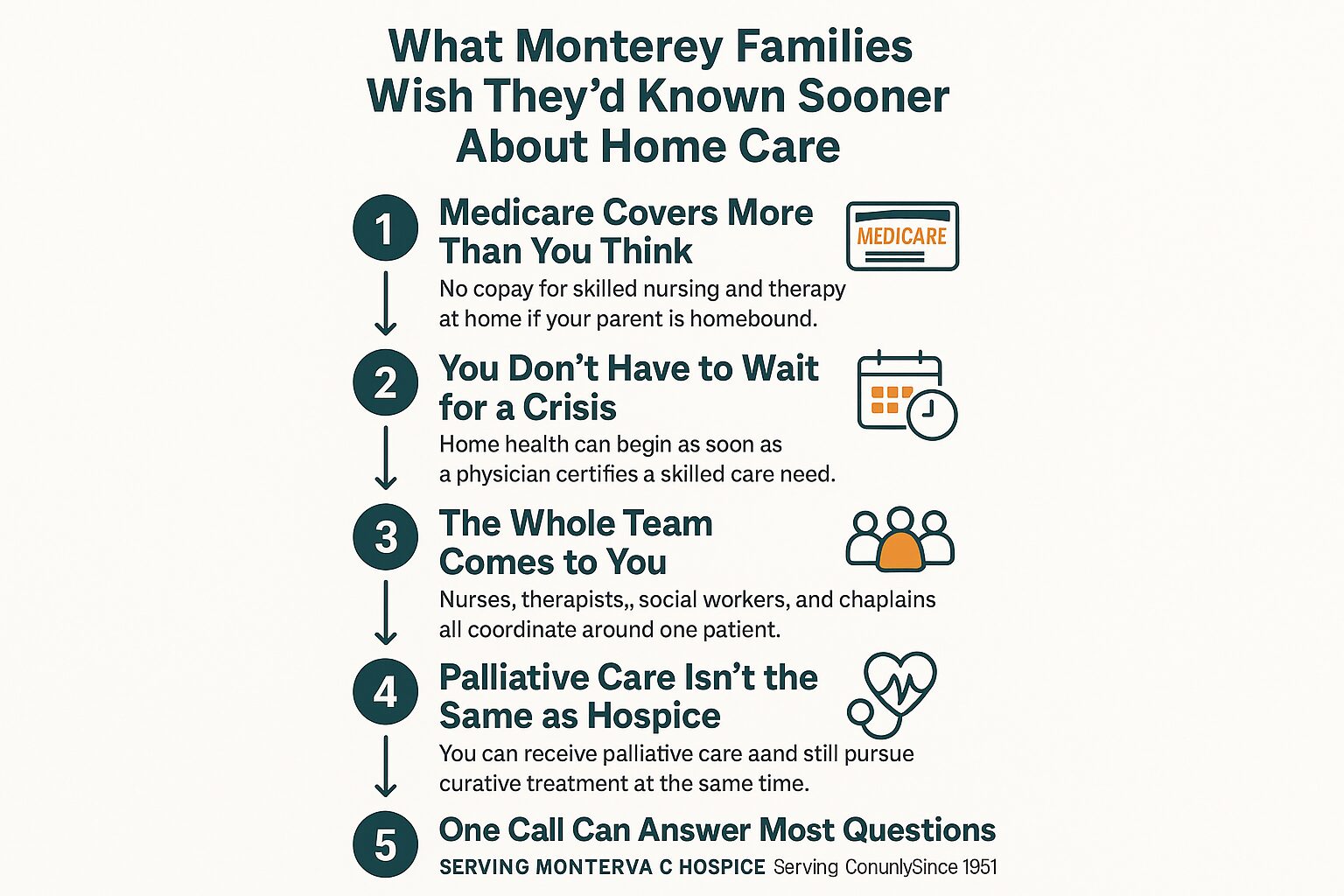
What Palliative Care Actually Means for a Family in the Middle of It
“Palliative” is one of those words that stops people cold. Families often assume it means their loved one is being given up on — that it’s a step toward hospice, not away from suffering.
That’s not what it is.
Palliative care is symptom management and support for people living with serious illness, and it can happen alongside any other treatment a physician is providing. Someone in Salinas going through chemotherapy can receive palliative care at the same time. Someone in Pacific Grove managing advanced heart disease can have a palliative care team helping with pain, breathlessness, and care planning — while still seeing their cardiologist.
The team that delivers palliative care typically includes nurses, Medical Social Workers, and sometimes Chaplains or other clinicians depending on what the patient needs. Visits happen at home. The focus is on quality of life and making sure the patient — and the family — understands what’s happening and what choices are available.
For a much more detailed explanation of what this looks like in practice on the Central Coast, Palliative Care Meaning: A 2026 Guide to Family Support is a good place to start.
One thing families consistently say: they wish they’d asked about palliative care months earlier. It doesn’t foreclose any options. It adds support.
Hospice at Home — What It Looks Like in Real Life
People picture hospice as a facility — a quiet building somewhere outside of town. In Monterey County, most hospice care happens at home. The patient stays in their own bedroom, in a house they know, surrounded by people who matter to them.
The hospice team visits regularly. That team isn’t just a nurse. It includes:
- Registered Nurses managing pain and symptoms
- Hospice Aides helping with personal care and comfort
- Medical Social Workers supporting the patient and family emotionally and practically
- Chaplains available for spiritual support — regardless of religious background
- Volunteers who provide companionship and relief for family members
- Bereavement Specialists who continue working with the family after the patient passes
The Medicare Hospice Benefit covers nearly everything — medications related to the terminal diagnosis, equipment like hospital beds or wheelchairs, and all team visits. For families who have spent months managing costly care, that often comes as a genuine relief.
And the conversation about hospice doesn’t have to be a final door closing. For many families across the Central Coast, it’s the moment things get quieter — and more manageable. The Heart of Hospice: A Guide for Families goes into much more depth on what that transition actually looks like day to day.
If your family is earlier in that conversation and still weighing options, What Is Aging in Place? A Guide for Central Coast Families addresses how home-based care at every stage fits into the broader goal of staying home.
Frequently Asked Questions About Home Care in Monterey County
Does my parent have to be completely homebound to qualify for Medicare home health?
Not completely housebound — but leaving home has to require considerable effort. Someone who can only go out for medical appointments, or who needs a wheelchair or significant assistance to leave, generally qualifies. A physician makes that determination based on your parent’s specific situation.
What’s the difference between home health and having a home health aide come in?
Home health under Medicare refers to skilled clinical services — nursing, therapy, wound care — provided by licensed clinicians. A home health aide visit can be part of a Medicare-covered home health plan, but only if it’s paired with a skilled care need. Personal care alone — help with bathing, dressing, cooking — is generally not covered by Medicare.
Can someone receive palliative care and still get curative treatment at the same time?
Yes. That’s one of the most important things to understand about palliative care. It’s not a replacement for treatment — it runs alongside it. A patient can continue working with their oncologist or cardiologist while a palliative care team manages symptoms and supports the whole family.
How does grief support work after a loved one passes?
Bereavement support through a hospice organization typically continues for at least 13 months after a patient’s death. That includes check-in calls, counseling resources, and support groups depending on what the family needs. This support is part of the hospice benefit and available to family members — not just the patient. Bereavement Counseling: A Guide to Grief Support covers what to expect during that period.
We live in Hollister — does home care reach us?
Yes. Home-based services in San Benito County, including Hollister, are covered. Monterey County is the largest service area, but families in Hollister and surrounding communities in San Benito County have access to the same skilled nursing, therapy, and hospice services.
How do I even start this conversation with my parent?
That’s usually the hardest part. Most families find it easier to frame it around a specific event — a recent fall, a new diagnosis, a medication that’s gotten complicated — rather than a general conversation about aging. Focusing on what’s already happening, rather than what might happen, tends to feel less threatening to the parent. A Medical Social Worker can also help families navigate that conversation directly.
Ready to Get Some Clarity?
If anything in this article raised a question you haven’t been able to answer, a care coordinator at Central Coast VNA & Hospice can talk through your family’s specific situation — no commitment required, just information. VNA has been serving families across Monterey County, Salinas, Hollister, and the surrounding Central Coast since 1951, and that experience shows up in every conversation. Call 831-372-6668 or visit ccvna.com to learn more.