
Direct Answer: It’s time to think about home health help when daily tasks become unsafe, health conditions are hard to manage alone, or recovery from illness or surgery is happening without professional support.
Most families don’t plan for this moment. One day, a parent is managing fine. The next, you’re noticing the dishes piling up, a fall that ‘wasn’t a big deal,’ or a medication schedule that’s gotten confusing. If you’re a family member in Monterey County asking yourself whether it’s time to get some help — you’re already asking the right question.
The challenge is that there’s no single clear line. Home health isn’t just for people at the very end of life. It’s also for someone recovering from a hip replacement at Community Hospital of the Monterey Peninsula, managing heart failure in Salinas, or dealing with a wound that isn’t healing the way it should.
This guide walks through the real signs that home health support might be needed, what kinds of help are available, and how families across Monterey County — from Pacific Grove to King City — have found their way through this decision.
The Signs Families Usually Spot First
Most families don’t recognize the need for home health all at once. It shows up in small things that start adding up.
Some of the clearest early signs include:
- A recent fall, even if it seemed minor at the time
- Medications being skipped, doubled, or taken at the wrong time
- A chronic condition like diabetes or COPD that’s gotten harder to manage
- Weight loss that no one can explain
- Wounds, surgical incisions, or skin breakdown that aren’t healing
- Confusion or memory changes that are new or getting worse
- Difficulty walking, bathing, or getting in and out of bed safely
- Missed doctor’s appointments due to transportation or fatigue
Any one of these can be a signal. More than two or three together usually means it’s time to have a real conversation.
For families in Monterey County, geography adds another layer. If your parent lives in Carmel Valley or out near Greenfield, getting to appointments is genuinely hard. Home-based care removes that barrier entirely — a clinician comes to them.
What Home Health Actually Covers
A lot of people picture home health as someone stopping by to help with chores. That’s not what skilled home health is. It’s clinical care — delivered at home by licensed professionals.
Depending on what a patient needs, a home health team can include:
- Registered Nurses (RNs) and Licensed Vocational Nurses (LVNs) who manage wound care, IV medications, post-surgical recovery, and chronic disease monitoring
- Physical Therapists who work on strength, balance, and mobility — especially after a fall or surgery
- Occupational Therapists who help patients safely manage daily tasks like bathing, dressing, and getting around the home
- Speech Therapists who address swallowing problems, communication issues, and cognitive function
- Medical Social Workers who connect families with community resources, support systems, and care planning
For patients with a serious illness who aren’t ready for hospice, palliative care is another option worth understanding. It focuses on symptom relief and quality of life — and patients don’t have to give up other treatments to receive it. The palliative care meaning guide explains this in plain terms.
All of these services can happen at home. In Monterey County, that means a clinician coming to your family’s actual house — whether that’s a condo in Marina or a farmworker family’s home in Soledad.
When a Loved One Is Facing Serious Illness
There’s a harder version of this question that some families are sitting with: What do you do when a loved one has been told their illness isn’t going to get better?
This is where hospice care becomes relevant — and where many families wish they’d asked questions sooner. Hospice isn’t about giving up. It’s about choosing comfort and dignity over treatments that may no longer help.
A hospice team typically includes nurses, therapists, social workers, chaplains, volunteers, and other clinicians who work together around the patient and the family. Pain is managed. Emotional and spiritual needs are addressed. And family members get support too — before and after their loved one passes.
If you’re trying to understand what this care actually looks like in practice, The Heart of Hospice: A Guide for Families is a good place to start.
One of the most common things families say after choosing hospice earlier is that they wish they hadn’t waited. Most patients who receive hospice care in Monterey County are eligible for it weeks or months before families ask.
A Simple Way to Think About the Decision
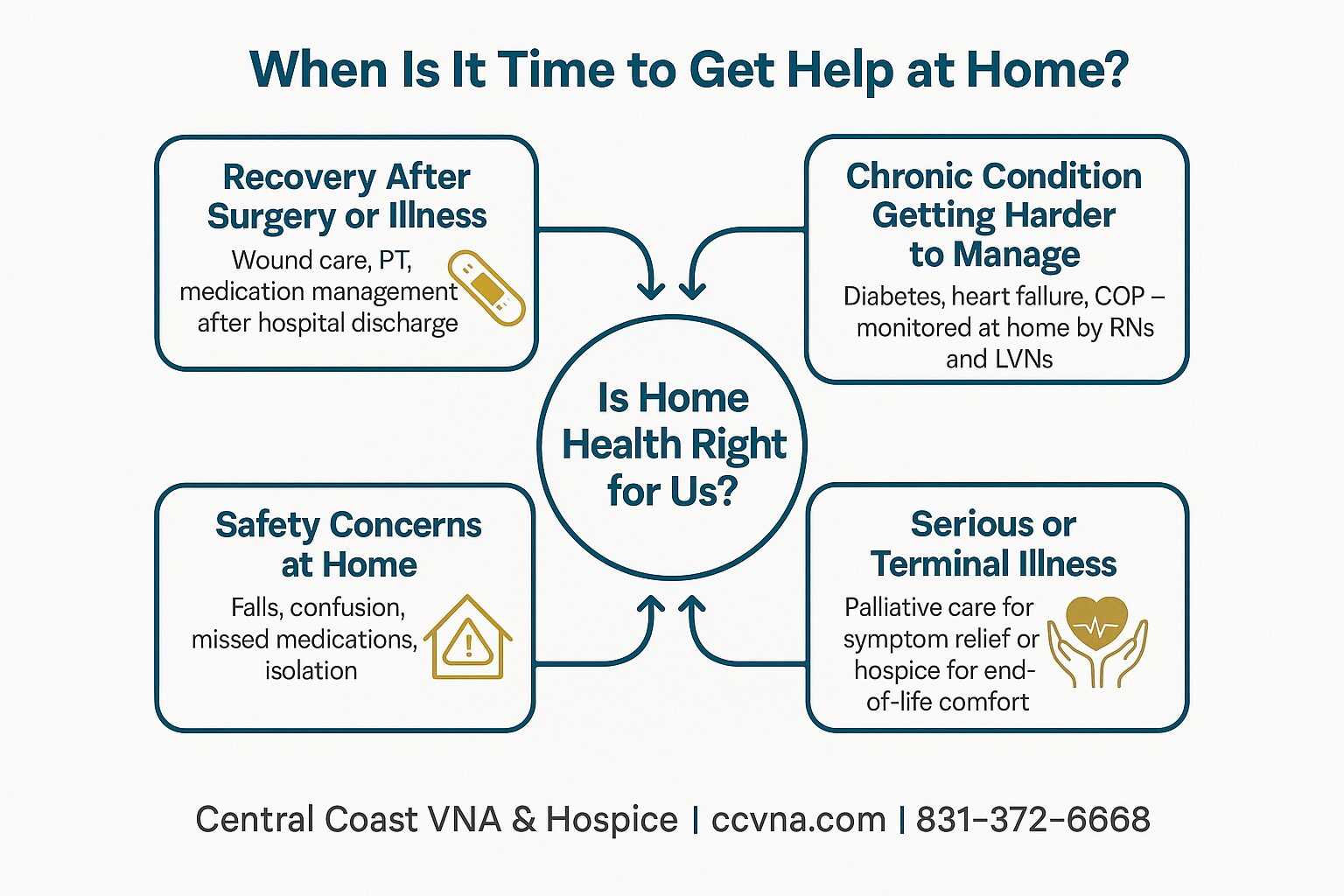
This visual breaks down the four main situations that typically lead families to explore home health — and what kind of support fits each one.
What Medicare and Medi-Cal Actually Pay For
Cost is usually the first question — and the good news is that home health is often more covered than families expect.
Medicare covers skilled home health services when a patient is homebound and a doctor certifies the need. That includes nursing visits, physical therapy, occupational therapy, speech therapy, and medical social work. There’s no copay for Medicare-certified home health services when conditions are met.
Medi-Cal covers home health for eligible patients as well. In Monterey County, a significant portion of the population — particularly in Salinas, Greenfield, and King City — qualifies for Medi-Cal, and this is an important coverage option that families sometimes overlook.
Veterans benefits can also cover home health for qualifying veterans. If your family member served, it’s worth asking specifically about this.
For a more detailed breakdown of what Medicare covers and what it doesn’t, this guide on Medicare and physical therapy at home is useful. And if you’re worried about gaps in coverage, this article on what happens when Medicare doesn’t cover everything addresses that directly.
The main point: don’t assume cost is a barrier before you ask. The answer is often more reassuring than families expect.
Home Health vs. Palliative Care vs. Hospice: What’s the Difference?
Families often confuse these three types of care. Here’s a straightforward comparison to help clarify when each one applies.
| Type of Care | Who It’s For | Does It Require Giving Up Other Treatment? |
|---|---|---|
| Home Health | Anyone recovering from illness/surgery or managing a chronic condition at home | No — this is medical care alongside other treatment |
| Palliative Care | Patients with serious illness who want symptom relief and support | No — patients can continue curative treatment |
| Hospice Care | Patients with a terminal diagnosis choosing comfort over curative treatment | Yes — focus shifts entirely to comfort and quality of life |
The Conversation No One Wants to Have — But Usually Needs To
Bringing up home health with a parent or spouse is hard. Most people resist it at first. It can feel like an admission that something has changed — and no one wants to admit that.
A few things that tend to make the conversation easier:
- Start with a specific concern, not a general one. ‘I noticed you were unsteady on the stairs last week’ lands better than ‘I’m worried about you.’
- Frame it as temporary if it is. Many people need home health for a short stretch after surgery — not forever.
- Ask the doctor to bring it up. Physicians carry authority that family members don’t. A recommendation from a doctor at Natividad Medical Center or Salinas Valley Memorial Hospital often lands differently.
- Give the person some control. Letting them be part of the decision — which days, which services — makes acceptance more likely.
If the conversation is about hospice specifically, this guide on aging in place for Central Coast families may help frame the broader picture of care at home in a way that opens the door.
And if grief is already part of the picture — if a family is anticipating a loss or has recently experienced one — bereavement support is available and doesn’t require waiting until after a death. Grief support services can start when a family needs them.
How to Know If Home Health Is the Right Fit Right Now
Not every situation requires a full skilled home health team. But there are some clear indicators that it’s the right time to make a call and ask.
Home health is likely a good fit if:
- A loved one was just discharged from a hospital or rehab facility and needs follow-up care
- A doctor has recommended home health but the family hasn’t acted on it yet
- A chronic condition has caused a recent emergency room visit or hospitalization
- The family lives far from the patient and can’t provide daily oversight
- The patient refuses to leave home for appointments — but clearly needs ongoing clinical monitoring
Home health may not be the right fit if someone mainly needs companionship or help with housekeeping. Those are important needs, but they fall under a different category of services.
For families trying to sort through senior home care options in Monterey and surrounding areas, understanding the difference between skilled care and custodial care is an important first step. Skilled care is what Medicare covers. Custodial care — help with bathing, meals, laundry — is a separate conversation.
If you’re not sure which one your family needs, a care coordinator can usually help you figure that out in a single phone call.
Frequently Asked Questions About Getting Help at Home
Does my loved one have to be bedridden to qualify for home health?
No. The Medicare definition of ‘homebound’ doesn’t mean completely unable to leave home. It means leaving requires considerable effort — due to illness, injury, or a medical condition. Many people who qualify for home health do leave the house occasionally.
Can my parent stay on home health for as long as they need it?
Home health is typically prescribed in 60-day certification periods, and a doctor must re-certify the need at each renewal. As long as a patient continues to meet the criteria — homebound status and a skilled care need — coverage can continue.
What’s the difference between home health and a home health aide?
Skilled home health involves licensed clinicians — RNs, LVNs, physical therapists, and others — providing medical care. A home health aide assists with personal care like bathing and dressing. Medicare covers skilled care; aide services are covered only as part of a broader skilled care plan.
Who decides when it’s time for hospice — the family or the doctor?
It’s a shared decision. A physician must certify that a patient has a terminal prognosis of six months or less if the illness follows its expected course. But families and patients have a say in when to make that transition — and many wish they’d had the conversation sooner.
What happens to bereavement support after a hospice patient passes away?
Bereavement support doesn’t end at the time of death. Hospice programs are required to offer at least 13 months of bereavement follow-up after a patient passes. That can include grief counseling, check-in calls, and emotional support for the whole family.
Ready to Talk Through Your Options?
If you’re a family in Monterey County — or in Santa Cruz, San Benito, or South Santa Clara County — and you’re trying to figure out whether home health, palliative care, or hospice is the right next step, Central Coast VNA & Hospice has been helping families work through exactly this question since 1951. You can reach a care coordinator at 831-372-6668 or visit ccvna.com to learn more about what’s available and whether your loved one may qualify.