
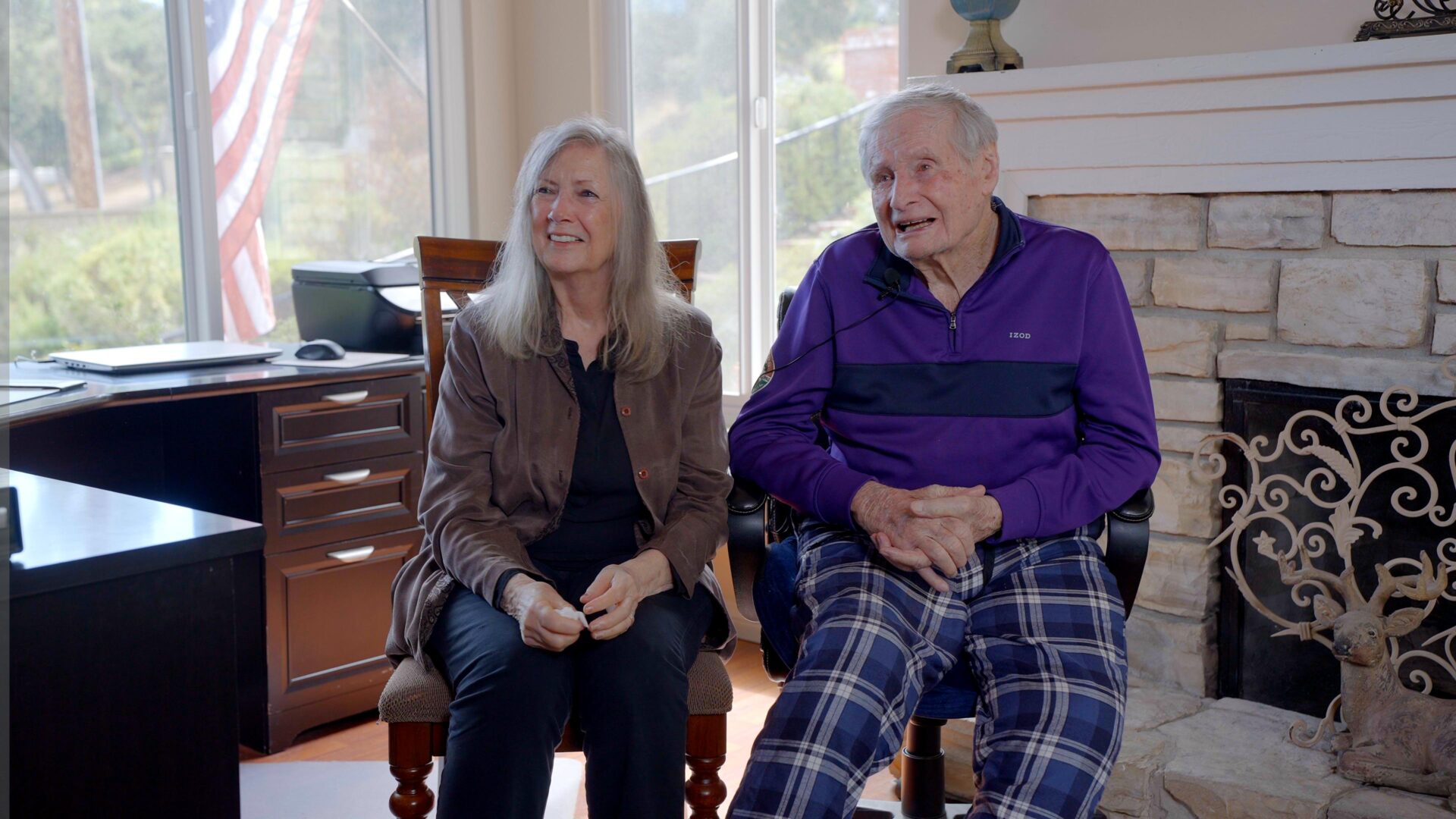
How Families in Monterey County Can Vet a Hospice Provider
The moment usually arrives on a hard day. A physician sits down with your family and explains that treatment is no longer working, and someone hands you a name and a phone number for hospice.
Most families accept that first name. It feels like the only option, and nobody has the energy to shop around. But a referral from a discharge planner or a physician is a starting point, not a vetted recommendation.
This guide walks through the questions families in Monterey County can ask in a single phone call. Six steps, each with a concrete answer you can actually judge.
Step 1: Treat the referral as one option, not the decision
Hospital discharge planners at hospitals across the Monterey Peninsula and Salinas Valley are doing their job, and they are usually doing it fast. They pass along providers who are in-network and accepting patients.
That list is not a quality ranking. You are allowed to ask for more than one name, and you are allowed to call a provider your family found on its own.
Here is what to do before you say yes to anyone:
- Ask the discharge planner for two or three hospice names, not one
- Ask whether the hospital has any financial relationship with the provider
- Write down the questions in this guide and ask each provider the same ones
- Give yourself 24 to 48 hours if the clinical situation allows it
One more practical note for families in King City, Greenfield, or out toward Big Sur: ask directly whether the provider actually staffs your area. Several callers each month learn mid-conversation that a provider's map stops well short of their driveway. Coverage on paper and a nurse who can reach you in 40 minutes are two different things.
Step 2: Ask if they are Medicare-certified, and whether they are nonprofit
Start with Medicare certification. Every legitimate hospice serving Monterey County is certified, so this is a floor requirement rather than something that sets a provider apart. If a provider hesitates on this question, end the call.
You can verify certification and see patient survey results yourself through Medicare's Care Compare tool, which lists hospices by ZIP code.
The more revealing question is the funding model. Nonprofit hospice organizations return their resources to patients and the community. For-profit hospices answer to investors.
That difference shows up in ordinary ways: staffing ratios, how long a nurse stays in the room, whether a Chaplain drives to Carmel Valley at 10 p.m. because it is the right thing to do.
California has also seen a real problem with fraudulent hospice operations, mostly concentrated in Southern California but worth understanding anyway. If you want the background, read about California's hospice fraud crisis.
A quick safety note families here have raised: a legitimate provider will never ask for personal or financial details before an in-person assessment is scheduled. If someone shows up unannounced claiming to represent a hospice, call the agency's main number and confirm.
Step 3: Make them name every person on the team
Hospice is not one nurse who visits twice a week. A credible program should be able to name each member of the interdisciplinary team without pausing to think about it.
Ask who will actually come to the house. The full team should include:
- Registered Nurses for pain and symptom management
- Hospice Aides for bathing, grooming, and personal comfort
- Medical Social Workers for paperwork, benefits, and family conflict
- Chaplains for spiritual support, regardless of faith or lack of one
- Bereavement Specialists for the months after a death
- Volunteers who sit with patients so family members can sleep or run errands
If a provider is vague about Chaplain availability, or does not bring up bereavement follow-up on their own, treat that as a real gap. Families across Monterey County have been caught off guard by programs that sent a nurse but had no one else behind her.
Ask how often each person visits, and ask whether visit schedules are set in advance. Inconsistent, unannounced arrivals are one of the most common complaints families raise about hospice care anywhere, and a provider who cannot describe a schedule probably does not keep one.
Step 4: Ask what happens at 2 a.m.
This is the single most useful question on the list, because the answer is concrete and easy to judge.
Ask it plainly: if my mother has a pain crisis at two in the morning, what happens?
A solid answer sounds like this. You call one number, a clinician answers, and that person can either talk you through a medication adjustment or send a Registered Nurse to the house that night.
A weak answer sounds like this. An answering service takes a message, and someone calls back during business hours.
Follow up with:
- Is the after-hours line staffed by a nurse or by a message service?
- How long does a night visit typically take to arrive in my area?
- Who covers weekends and holidays?
- What medications will already be in the house for a crisis?
Nights are when families feel most alone. A provider that has thought this through will answer in fifteen seconds without checking with a supervisor.
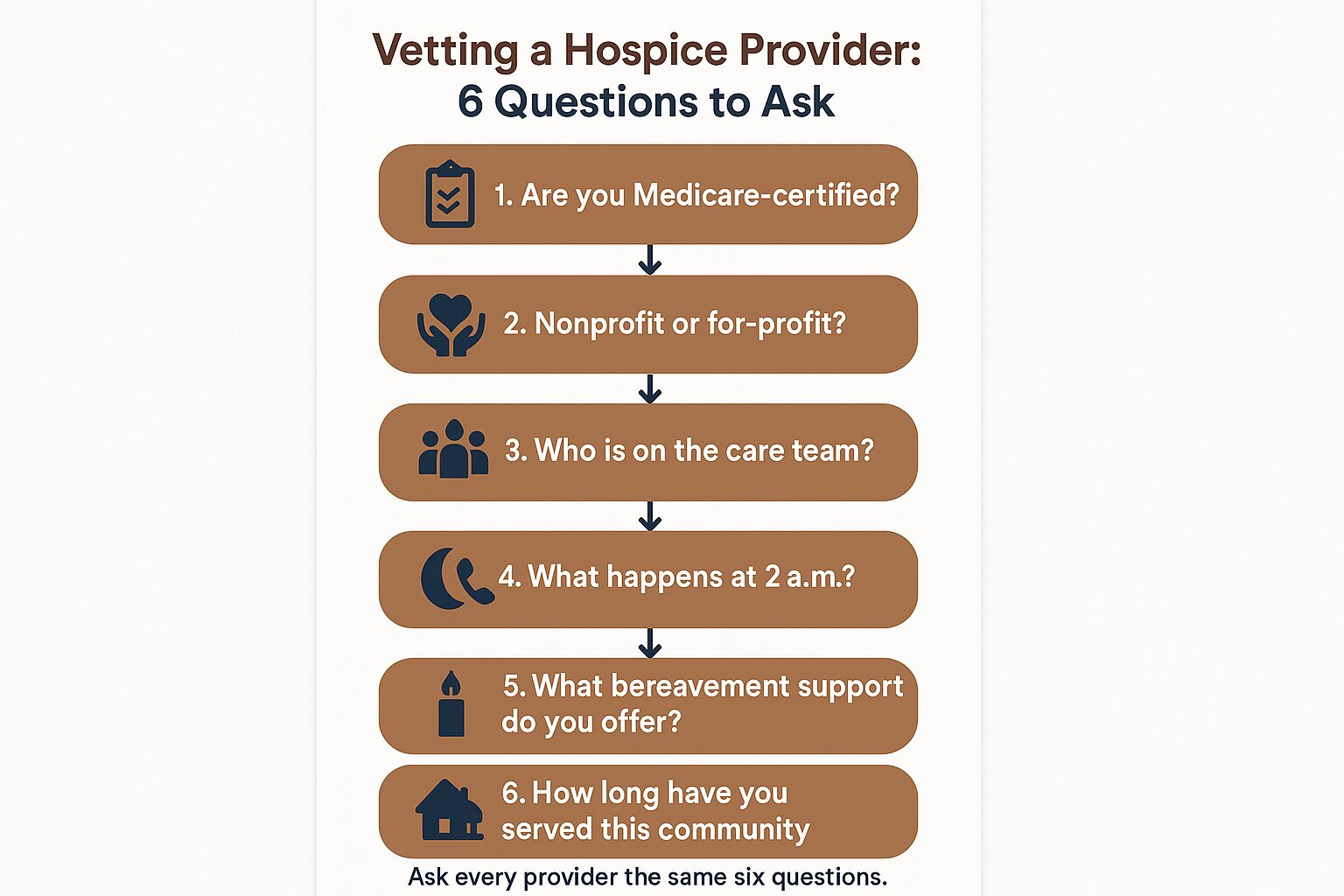
Six Questions and What the Answers Should Sound Like
Use this as a phone script. Ask every provider the same questions and compare the answers side by side.
| Question to ask | A solid answer | A warning sign |
|---|---|---|
| Are you Medicare-certified? | Yes, with a certification number they will share | Hesitation or a vague yes |
| Nonprofit or for-profit? | A direct answer either way, with an explanation | Deflection or confusion |
| Who is on the care team? | Names every role, including Chaplain and Volunteers | Only nurses are mentioned |
| What happens at 2 a.m.? | A 24/7 clinical line that can dispatch a nurse | An answering service takes a message |
| What does bereavement look like? | Months of support, groups and one-on-one counseling | A single follow-up phone call |
| How long in this community? | A specific number of years and local references | Recently opened, no local history |
The Six-Question Vetting Call at a Glance
Print this or keep it on your phone. The whole conversation takes about fifteen minutes per provider.
Step 5: Ask about grief support before you think you need it
Bereavement is the part families skip during the vetting call and regret skipping six months later.
Ask what happens after your loved one dies. Real grief support means ongoing counseling and support groups over a period of months, not one sympathy call and a mailed pamphlet.
A second question worth asking: does the provider offer grief support to people in the community who were never hospice patients? A steady stream of calls comes in from Monterey and Pacific Grove residents who lost a spouse through a different provider and have nowhere to turn afterward. One recent message came from a woman whose husband of more than fifty years had died the day before, asking simply for a group she could attend nearby.
Providers who keep the door open to the wider community tend to be more invested in the whole family experience. If you want a sense of what this looks like in practice, here is what grief support after hospice actually involves.
Step 6: Check local history, because reputation here is evidence
The Monterey Peninsula is small. A provider's actual record travels through churches, senior communities, and physician offices faster than any marketing campaign.
A hospice that has operated continuously in Monterey County, San Benito County, and the surrounding communities for decades leaves a trail you can follow:
- Ask your loved one's primary physician which programs they trust
- Ask neighbors and friends who have been through it recently
- Check licensing and complaint history through the California Department of Public Health
- Read reviews, including the critical ones, and see whether the provider responds
Read negative reviews carefully rather than dismissing them. A pattern of complaints about scheduling or communication tells you something. A single hard review with a thoughtful reply tells you something different.
Also be clear on what you are actually choosing. Many families call about hospice when what they need right now is home health or palliative care. If that line is still blurry, this comparison of home health and hospice sorts it out, and the eligibility question most families are afraid to ask covers timing.
Frequently Asked Questions About Choosing a Hospice Provider
Do we need a doctor's order before hospice can start?
Yes. Hospice requires a physician certification that the illness is expected to run its course within about six months if it follows its usual path. This is the step that surprises families most often and the one that delays admission. You can call a provider first and start the conversation while the order is being arranged.
Does Medicare cover hospice, and what does it actually pay for?
The Medicare hospice benefit generally covers the care team's visits, medications related to the terminal illness, medical equipment such as a hospital bed, and supplies. Small copayments can apply to some outpatient prescriptions and inpatient respite stays, and coverage details vary by situation. Medi-Cal and Veterans benefits also cover hospice. Ask any provider you call to walk you through the specifics for your loved one.
Can we switch hospice providers if it is not working?
Yes. Medicare allows you to change hospice providers once during each benefit period, and doing so does not end the benefit. If visits are inconsistent, calls go unanswered, or the team is not a fit, you are not stuck.
How quickly can hospice start after a hospital discharge?
Often within a day or two once the physician order is in place, and sometimes the same day for urgent situations. When you call, say plainly that the patient is being discharged and needs someone at the house. That changes how the intake conversation is handled.
Does hospice mean we are giving up on treatment?
No. Hospice shifts the goal from curing the disease to caring for the whole person, including pain relief, emotional support, and spiritual care. Families often describe it as the point where their loved one finally got comfortable. If curative treatment is still on the table, palliative care may be the better fit right now.
Questions About Hospice Care on the Central Coast?
If you are working through these questions for a parent or spouse in Monterey County, San Benito County, or South Santa Clara County, you are welcome to ask them of us the same way you would ask any other provider. Central Coast VNA & Hospice has served families here since 1951, and a care coordinator can talk through options, eligibility, and Medicare or Medi-Cal coverage without any pressure to decide. The number is 831-372-6668.

California's Hospice Fraud Crisis: What Families Need to Know
In April 2026, federal agents suspended 447 hospices and 23 home health agencies in the greater Los Angeles area, alleging roughly $600 million in Medicare fraud. That number is not a typo. California's hospice fraud problem has grown into one of the largest healthcare crime waves in the country.
The fraud is not limited to Southern California, and it is not abstract. The California Hospice and Palliative Care Association has documented cases where scammers "deceptively and illegally enroll seniors in hospice and skilled home health programs they never consented to." Families across the state, including those in Monterey County, need to understand what is happening before they accept a referral or sign any paperwork.
This article focuses on two things: what the fraud actually looks like in practice, and how families can tell the difference between a trustworthy provider and one they should walk away from.
What California's Hospice Fraud Actually Looks Like
Hospice fraud does not always look like obvious crime. It often looks like a helpful person showing up at the right moment, offering relief to a family that is already exhausted and overwhelmed.
The scheme tends to follow a pattern. A recruiter, sometimes posing as a hospital worker or social services coordinator, approaches a senior or their family and steers them toward a specific hospice agency. The family signs documents they may not fully understand. The agency then bills Medicare for services it either never delivers or delivers poorly, while the patient loses access to treatments they could still benefit from.
The California Governor's office confirmed expanded DHCS oversight of hospice services taking effect in July 2026, and emergency hospice regulations took effect on June 22, 2026, giving the California Department of Public Health broader authority to deny licensure, investigate complaints, and revoke licenses from illegitimate operators. This is a meaningful shift. But regulations alone do not replace a family's own judgment.
The warning signs families should watch for include:
- Pressure to enroll before a physician has recommended it, a legitimate hospice never pushes enrollment
- Recruiters approaching you in non-medical settings, like at a senior center, a pharmacy, or through an unsolicited call
- An agency that cannot clearly explain what the Medicare hospice benefit covers or what your loved one would be giving up
- Discouraging you from asking questions or comparing providers
- No verifiable history in your community, no local address, no staff you can speak with directly, no track record you can confirm
If any of these apply to a provider you are considering, stop and ask more questions before moving forward.

Why Referrals Alone Are Not Enough
Many families assume that if a hospital or physician refers them to a hospice provider, that provider must be reputable. This is understandable, but it is not always true.
Hospital discharge planners work under real time pressure. They may default to whichever agency responds fastest or is most familiar to their team, not necessarily the one with the strongest record of care. A referral is a starting point, not a guarantee.
Families have every right to ask:
- "Who else could we consider for hospice care in this area?"
- "How long has this agency operated in Monterey County or the surrounding region?"
- "Is this provider accredited and in good standing with the California Department of Public Health?"
- "Is this a nonprofit or a for-profit agency?"
Asking those questions is not rude. It is exactly what a thoughtful family should do. A trustworthy provider will welcome them. One with something to hide will not.
For families navigating this for the first time, it also helps to understand what hospice actually involves before any agency visit or paperwork conversation. Articles like how to know when it may be time to consider hospice care and what families often miss when planning a hospital discharge to home can help you go into those conversations with the right questions already in mind.
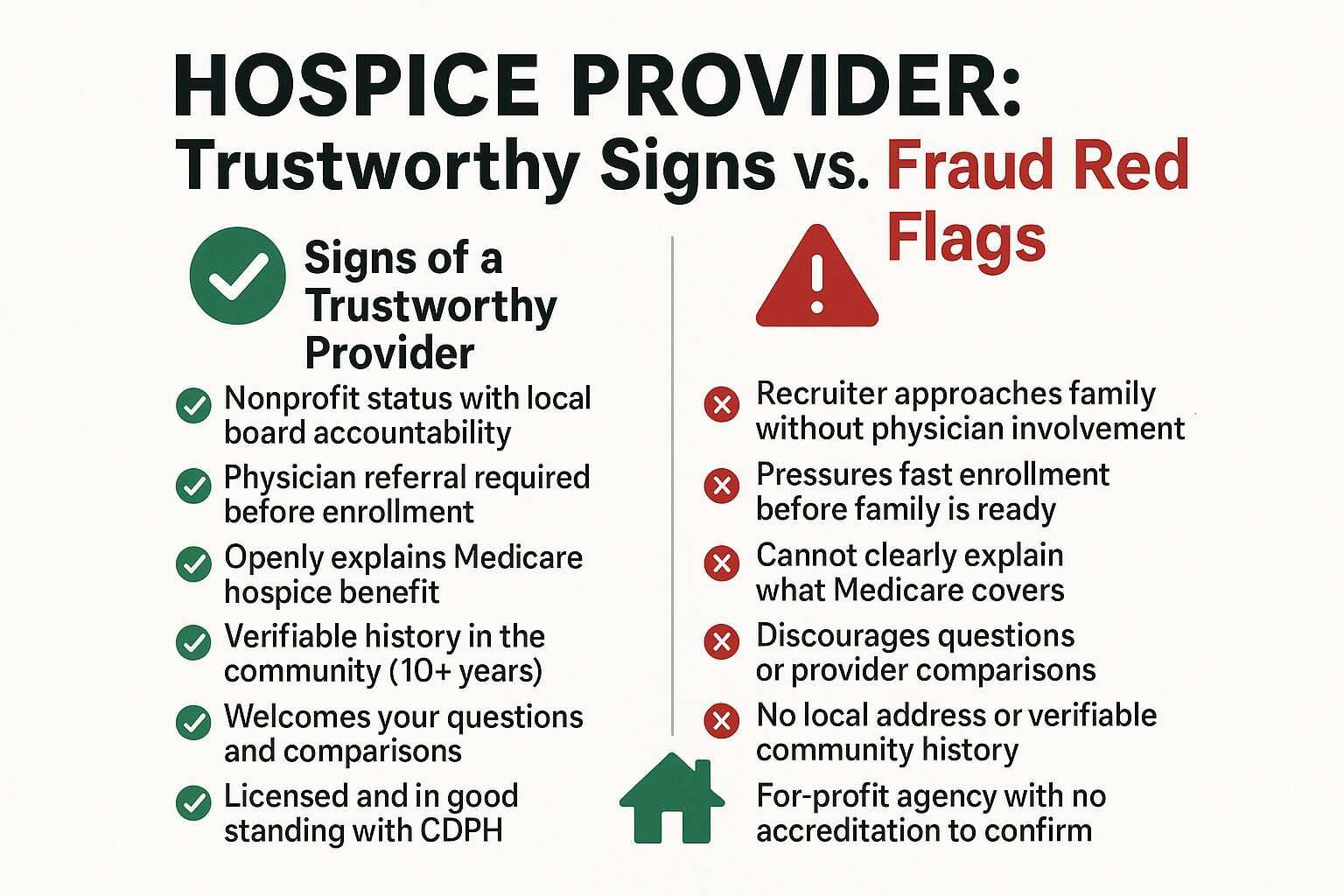
Trustworthy Hospice Provider vs. Fraud Red Flags
Use this side-by-side comparison to quickly evaluate any hospice provider you are considering.
What Longevity and Nonprofit Status Actually Signal
One of the most reliable ways to evaluate a hospice provider is to ask how long they have been operating in your specific community, and whether they are a nonprofit.
Fraud operations are built to bill Medicare quickly and then disappear or rebrand before regulators catch up. They cannot fabricate decades of community presence. A nonprofit organization accountable to a local board of directors has a fundamentally different structure than a billing operation set up to exploit the Medicare hospice benefit.
This is not to say that all for-profit hospice agencies are fraudulent, or that all nonprofits are above criticism. But when a provider has been delivering care in the same communities since before most of today's families were born, that history is verifiable. Patients and families from Salinas, Pacific Grove, King City, and Hollister can speak to the care they received. Neighbors can vouch or not vouch. That kind of local accountability does not exist when a provider showed up recently with no track record you can trace.
Families evaluating their options should also consider whether a provider accepts Medicare and Medi-Cal on a transparent basis. Legitimate providers are straightforward about coverage. If an agency is vague about billing or steers you away from using Medicare, that is a reason to pause.
For a broader look at how to evaluate a provider's credibility, how to tell if a hospice provider is actually trustworthy covers the specific questions worth asking before you commit.
Questions to Ask Any Hospice Provider Before Enrolling
Before agreeing to hospice services for a loved one, work through this checklist with any provider you are considering.
| Question to Ask | What a Good Answer Looks Like | Why It Matters |
|---|---|---|
| How long has your agency operated in this county? | Specific founding year, verifiable local history | Fraud operations cannot fake a long local track record |
| Is this agency nonprofit or for-profit? | Clear, direct answer with no deflection | Nonprofit status signals community accountability over profit motive |
| Did my physician recommend hospice and refer us to you specifically? | Enrollment should follow a physician recommendation | Unsolicited recruitment is a primary fraud tactic |
| What exactly does the Medicare hospice benefit cover? | Plain explanation of covered services and what changes at enrollment | Legitimate providers explain this clearly without hesitation |
| Are you licensed and in good standing with the California Department of Public Health? | Confirmed licensure, ability to provide accreditation details | New regulations give CDPH authority to revoke fraudulent operators |
| Can I speak with a care coordinator before we decide anything? | Yes, with no pressure to sign first | Trustworthy agencies welcome questions before commitment |
What the New California Regulations Mean for Families
The emergency hospice regulations that took effect June 22, 2026 represent a real shift in how California oversees hospice licensure. The California Department of Public Health now has broader authority to deny new licenses, investigate complaints more aggressively, and revoke the licenses of providers found to be operating fraudulently.
This matters for families because it means the accountability gap that allowed hundreds of fraudulent agencies to operate in California is beginning to close. The expanded DHCS oversight taking effect July 2026 adds another layer of scrutiny at the state level.
But regulatory change moves slowly compared to how quickly a family in crisis needs to make a decision. If your parent is being discharged from Natividad Medical Center or Community Hospital of the Monterey Peninsula and a hospice referral is on the table, you may have hours, not weeks, to evaluate your options. Knowing the warning signs in advance is the practical advantage that regulations alone cannot give you.
Families who want to understand more about what hospice actually involves, separate from the fraud question, will find it useful to read hospice care is not what most families think it is before they are in a time-pressured situation.
Frequently Asked Questions About Hospice Fraud in California
Can I switch hospice providers if I realize I enrolled with the wrong one?
Yes. Under the Medicare hospice benefit, a patient has the right to change hospice providers. You can request a transfer to a different agency without losing your hospice eligibility. If you believe you were enrolled without proper consent or under false pretenses, you can also report the provider to the California Department of Public Health and to Medicare directly.
Does the hospice fraud crisis affect providers in Monterey County, or just Southern California?
The large-scale suspensions in April 2026 centered on the Los Angeles area, but the patterns that enable fraud, including loose oversight and aggressive recruiting, are not geographically limited. Families throughout California, including the Central Coast, should apply the same due diligence regardless of location.
What does a patient give up when they enroll in hospice?
Under the Medicare hospice benefit, a patient agrees to shift focus from curative treatment to comfort-focused care. This means Medicare generally stops covering treatments aimed at curing the underlying illness. This is a significant decision that should happen only when a physician has determined that curative treatment is no longer the goal, and only after a full conversation with the patient and family. Any provider that enrolls a patient without that conversation is not operating ethically. For more on this, comfort care vs. hospice: why the difference matters explains the distinction clearly.
How do I verify a hospice provider's license in California?
The California Department of Public Health maintains a public database of licensed healthcare providers. You can search by provider name or license number to confirm current status. If a provider cannot give you a license number or discourages you from checking, that is a significant warning sign.
Is a physician referral required to start hospice?
Yes. Legitimate hospice enrollment requires a physician to certify that the patient has a terminal diagnosis with a life expectancy of six months or less if the illness follows its expected course. No reputable hospice agency will enroll a patient without that physician certification in place. If someone is pushing enrollment before that step has happened, stop and ask why.
Want to Ask Questions Without Any Pressure?
Central Coast VNA & Hospice has been serving families in Monterey County, San Benito County, and surrounding Central Coast communities since 1951, and a care coordinator is available to answer your questions at whatever pace you need. You can call the team at 831-372-6668 or visit ccvna.com to learn more about hospice and palliative care services, how the enrollment process actually works, and what families in this region typically want to know before they decide.
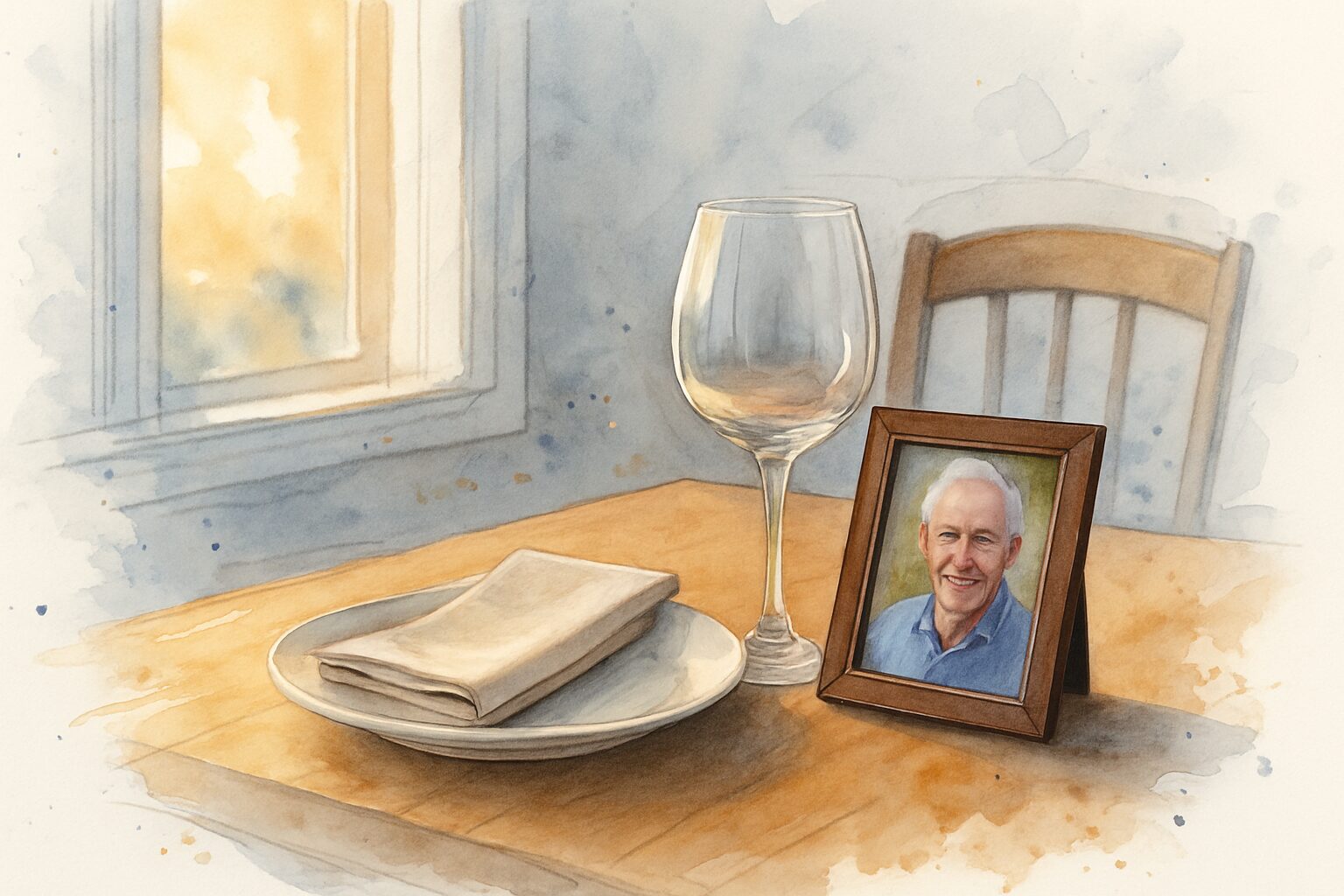
The First Holiday Season After a Loss: What Grief Can Look Like
The weeks right after someone dies are often filled with motion. There are arrangements to make, people to call, paperwork to complete. Families move through that period with a kind of purposeful momentum that can feel, from the outside, like coping.
Then the holidays arrive. And the absence, which may have felt manageable in the busyness of early grief, suddenly fills the entire room.
For families across Monterey County, from the Peninsula to Salinas to Hollister, this pattern shows up every year without fail. It is not a sign that something has gone wrong in the grieving process. It is one of the most common and well-documented features of grief, and understanding it before the season hits can make a real difference in how families find their footing.
Why the First Holiday Hits Harder Than Families Expect
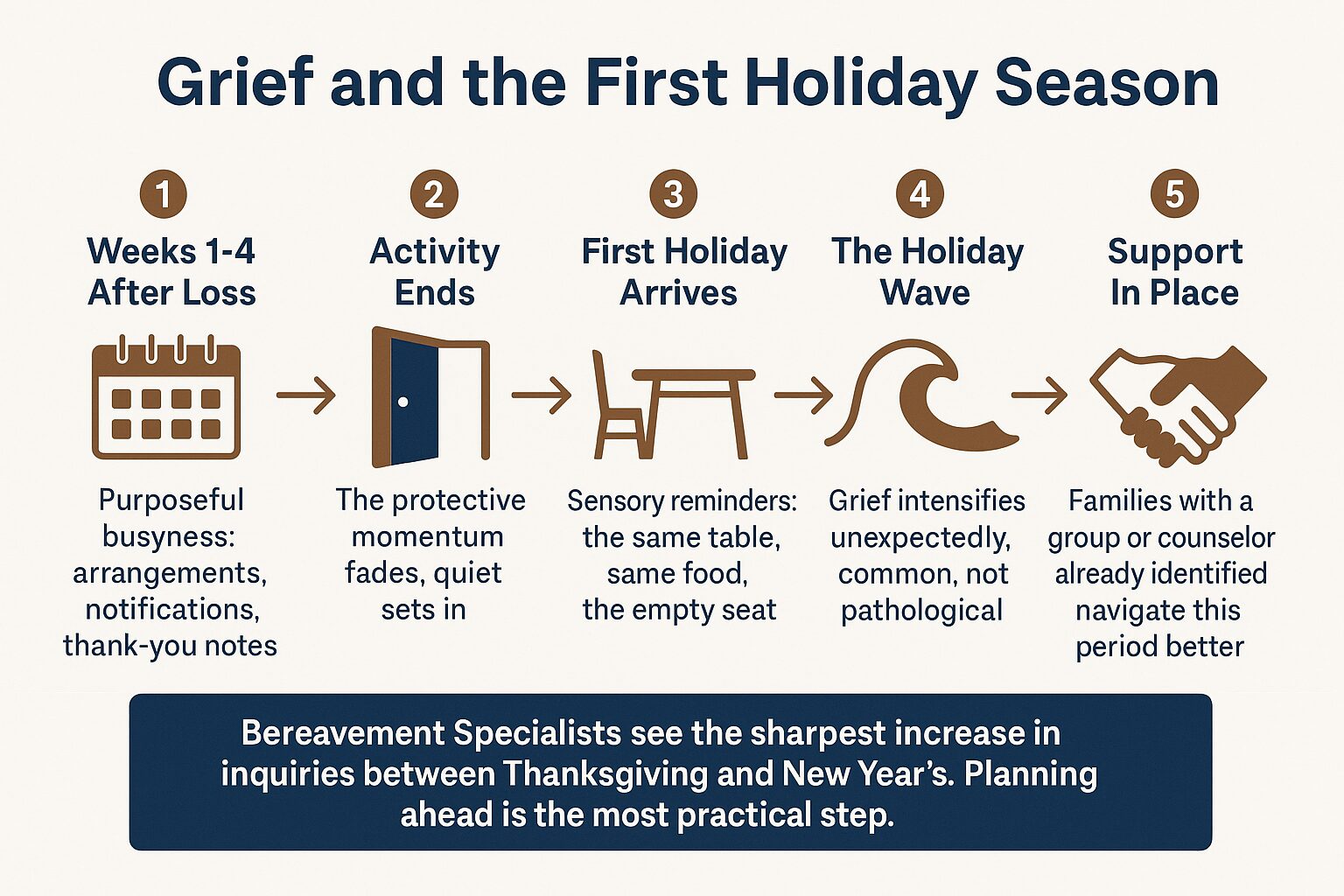
Grief researchers have long noted that the initial weeks after a death carry a kind of protective busyness. The practical demands of loss, the calls, the services, the thank-you notes, give the grieving person something to do with the enormity of what has happened.
When that activity ends and the first Thanksgiving, Christmas, or even a birthday rolls around, the absence can feel sudden and total. The holiday table, the family rituals, the food that was always made the same way, all of it becomes a sensory reminder of who is no longer there.
This is not pathological grief. It is a normal part of the grief timeline, and it is worth knowing it is coming before it arrives. According to research from the American Psychological Association, anticipating difficult grief moments and having support in place ahead of time is one of the most practical steps a grieving person can take.
For families who lost someone in the spring or summer, the holiday season may arrive when they feel they should be "past the hardest part." That expectation can make the holiday wave feel even more disorienting when it comes.
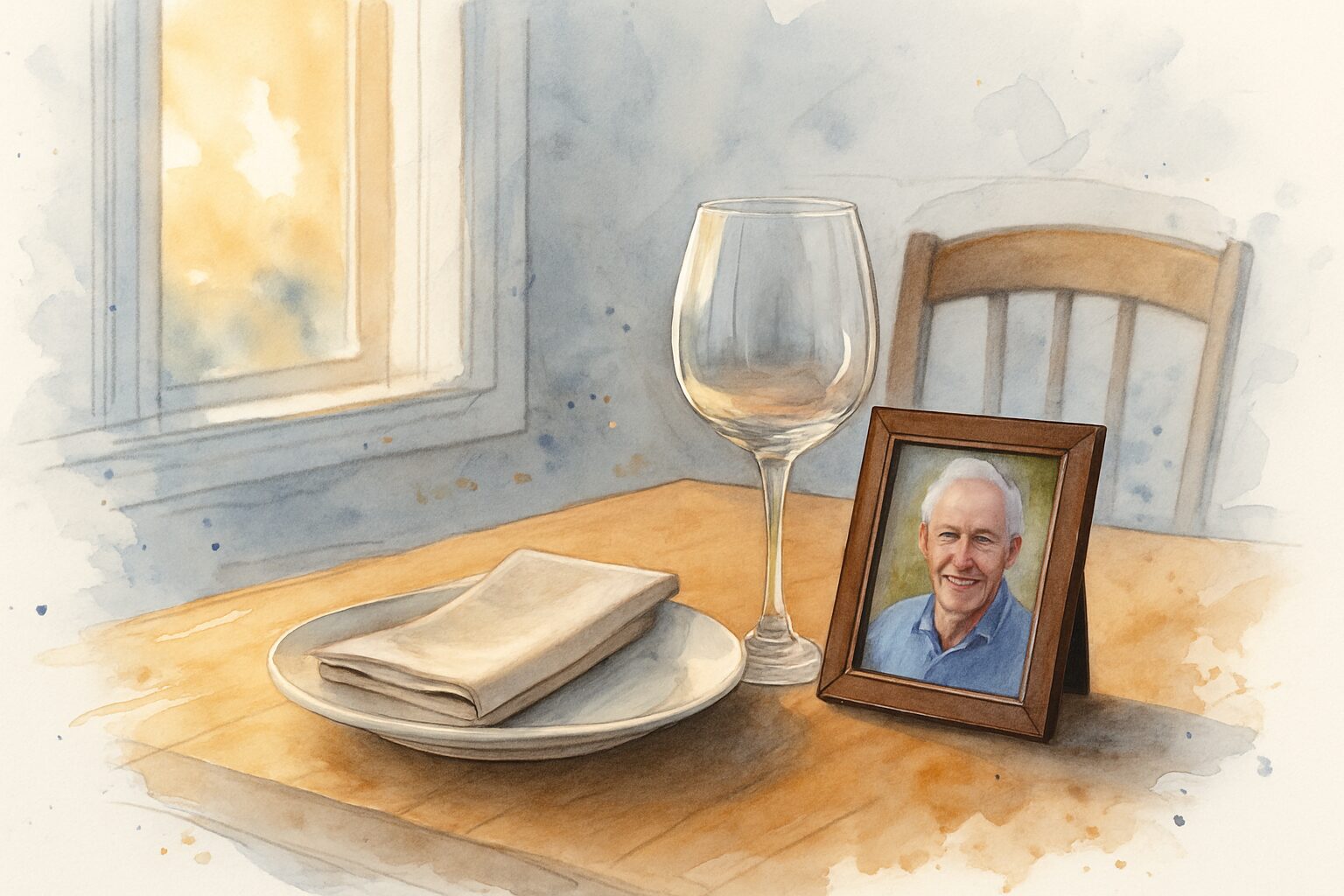
Spousal Loss and the Holiday Table
Not all grief moves the same way, and the holiday grief that surviving spouses experience often has a specific quality that is different from what adult children feel when mourning a parent.
Decades of shared ritual create a kind of sensory map. The same table. The same seat. The food that one person always made and the other always praised. When those rituals arrive without the person who made them meaningful, the loss can feel both immediate and total in a way that is hard to describe to someone who hasn't lived it.
One Monterey woman submitted a message to a local bereavement program the day after her husband of 56 years died. Her message was direct and raw: she needed a local grief group, immediately. That kind of reaching out, in the earliest hours of loss, reflects something grief support professionals see often. The need for connection is immediate, even when the emotional capacity to reach out is barely there.
For surviving spouses specifically, grief support programs that address spousal loss tend to be more useful than general bereavement groups. The shared experience in the room matters. When the people around you have also lost a partner of many years, the conversations start at a different depth.
If you are an adult child helping a surviving parent plan for the holiday season, understanding what grief support after hospice actually looks like can help you find the right kind of help, not just the closest available option.
The Grief Timeline Around the Holidays
This overview shows how grief tends to shift in the weeks surrounding the first holiday season, and when families most often reach out for support.
Finding Support Before the Season Arrives, Not After
Grief counselors and Bereavement Specialists consistently note the same pattern: the sharpest increase in inquiries from grieving families arrives in the weeks between Thanksgiving and New Year's. Many of those callers say the same thing, they thought they were managing fine.
The problem is that finding a local grief group or counselor in the middle of an acute grief moment is much harder than finding one in a calmer week. The emotional bandwidth required to research options, make calls, and get enrolled in a program is exactly what grief depletes.
For families in the Monterey Peninsula, Salinas, and Hollister areas, the practical advice is straightforward: identify your support resource before the holiday season, not during it. Get on the list. Attend once. Know where to go.
Bereavement support in Monterey County is not limited to families who used hospice services. Anyone who has experienced a significant loss, whether a loved one died at home, in a hospital, or in a care facility, can access grief counseling and group support. That access point is not always obvious to families who navigated a hospital death rather than a hospice program, and it is worth knowing the door is open.
You can read more about what is specifically available locally in this guide to finding grief support in Monterey County after a loss.
For families who are also managing a loved one's ongoing health needs while grieving, the weight can compound quickly. Knowing when caring for an aging parent becomes more than you can do alone is a useful starting point if that is part of your situation.
Types of Grief Support and Who They Tend to Help
Different kinds of support serve different needs. This is a general overview, the right fit depends on the individual and what feels most useful.
| Type of Support | What It Involves | Best Fit For |
|---|---|---|
| Individual grief counseling | One-on-one sessions with a Bereavement Specialist or licensed counselor | People who prefer privacy or have complex grief histories |
| General bereavement group | Group sessions open to anyone who has experienced a loss | People who find connection with others helpful and have flexible schedules |
| Spousal loss group | Group sessions specifically for people who have lost a spouse or partner | Surviving spouses navigating the specific pattern of partner grief |
| Community bereavement programs | Support offered through local nonprofits, open to the broader community regardless of how care was received | Anyone who lost a loved one in a hospital, at home, or in a care facility |
What Grief Can Actually Look Like in the Weeks Around the Holidays
Grief does not always look the way people expect. Some of what families experience around the first holiday season can feel confusing, because it may not match what they think grief is supposed to be.
Common patterns include:
- Feeling fine for days, then being hit hard by a specific song, smell, or meal
- Dreading the holiday weeks in advance, then finding them more manageable than expected, followed by a harder week afterward
- Feeling guilty for laughing or enjoying any part of the holiday
- Anger or irritability that doesn't seem tied to anything specific
- Physical symptoms, fatigue, poor sleep, changes in appetite, that arrive or worsen around the holiday period
- Difficulty being around the same family gathering without the person who is gone
None of these responses are wrong. And none of them mean that grief is "not progressing." Grief doesn't follow a schedule, and the holiday season has a way of making that very clear.
If grief starts to feel stuck, not just painful, but genuinely immovable over many months, that is worth a conversation with a counselor. There is a difference between grief that is hard and grief that has become complicated in ways that benefit from professional support. Understanding complicated grief can help families recognize when that line has been crossed.
Frequently Asked Questions About Grief Support During the Holidays
Do I have to have used hospice services to access bereavement support in Monterey County?
No. Bereavement support through community-based programs is open to anyone who has experienced a significant loss, regardless of how care was provided. If your loved one died in a hospital or care facility rather than through a hospice program, you can still reach out for grief counseling or group support.
When should I look for a grief support group, before or after the holidays?
Before, if at all possible. The weeks between Thanksgiving and New Year's are when Bereavement Specialists see the sharpest increase in people reaching out. Having a resource already identified, even just knowing where to call, means it is there when you need it most, rather than having to search in the middle of a difficult moment.
Is it normal to feel like the holidays are harder than the days right after the death?
Yes, and it is more common than most families realize. The initial weeks after a loss often carry a protective momentum, things to do, people to contact. When that activity winds down and a holiday arrives, the absence becomes much more visible. This is a well-documented feature of grief, not a sign that something has gone wrong.
My surviving parent lost their spouse of many decades. Are there specific groups for that kind of loss?
Yes. Spousal loss groups focus specifically on the grief of losing a long-term partner, which has a different quality than grieving a parent or sibling. The shared experience in the room matters, conversations can start at a level of specificity that a general group may not reach. Ask when you call about bereavement resources whether a spousal loss group is available in your area.
What if I'm not sure whether what I'm feeling is grief or something that needs clinical attention?
A conversation with a Bereavement Specialist is a good first step. They can help you understand whether what you are experiencing is part of a normal grief process or whether it might benefit from a more structured clinical response. You do not need to have a diagnosis or a crisis to make that call, it is what the support is there for.
Finding Support in Monterey County Before the Season Hits
Central Coast VNA & Hospice has been supporting grieving families across Monterey County, Salinas, Hollister, and surrounding communities since 1951. In 2025 alone, the bereavement program extended support to more than 2,200 individuals, many of them people who had not used hospice services but needed a place to turn. If you or someone you love is approaching the first holiday season after a loss, a Bereavement Specialist can help you understand what is available and whether a group or individual counseling might be the right fit. You can reach the care team at 831-372-6668 or visit ccvna.com to learn more.

What Grief Support After Hospice Actually Looks Like
Most families assume that when a loved one dies under hospice care, their relationship with the care team ends that same day. A phone call, maybe a card in the mail, and then silence. That assumption is understandable, but it's also wrong, and for families across Monterey County, the difference matters.
Grief doesn't follow a tidy timeline. The weeks after a death can feel surreal, then exhausting, then suddenly empty in ways nobody warned you about. Knowing what bereavement support after hospice loss actually looks like, what happens, when it happens, and what you can ask for, gives families a clearer picture of what's available before they need it most.
This article focuses specifically on the transition from hospice to bereavement: the first days, the first months, and what structured grief support looks like in practice.
The First Outreach Isn't a One-Time Check-In
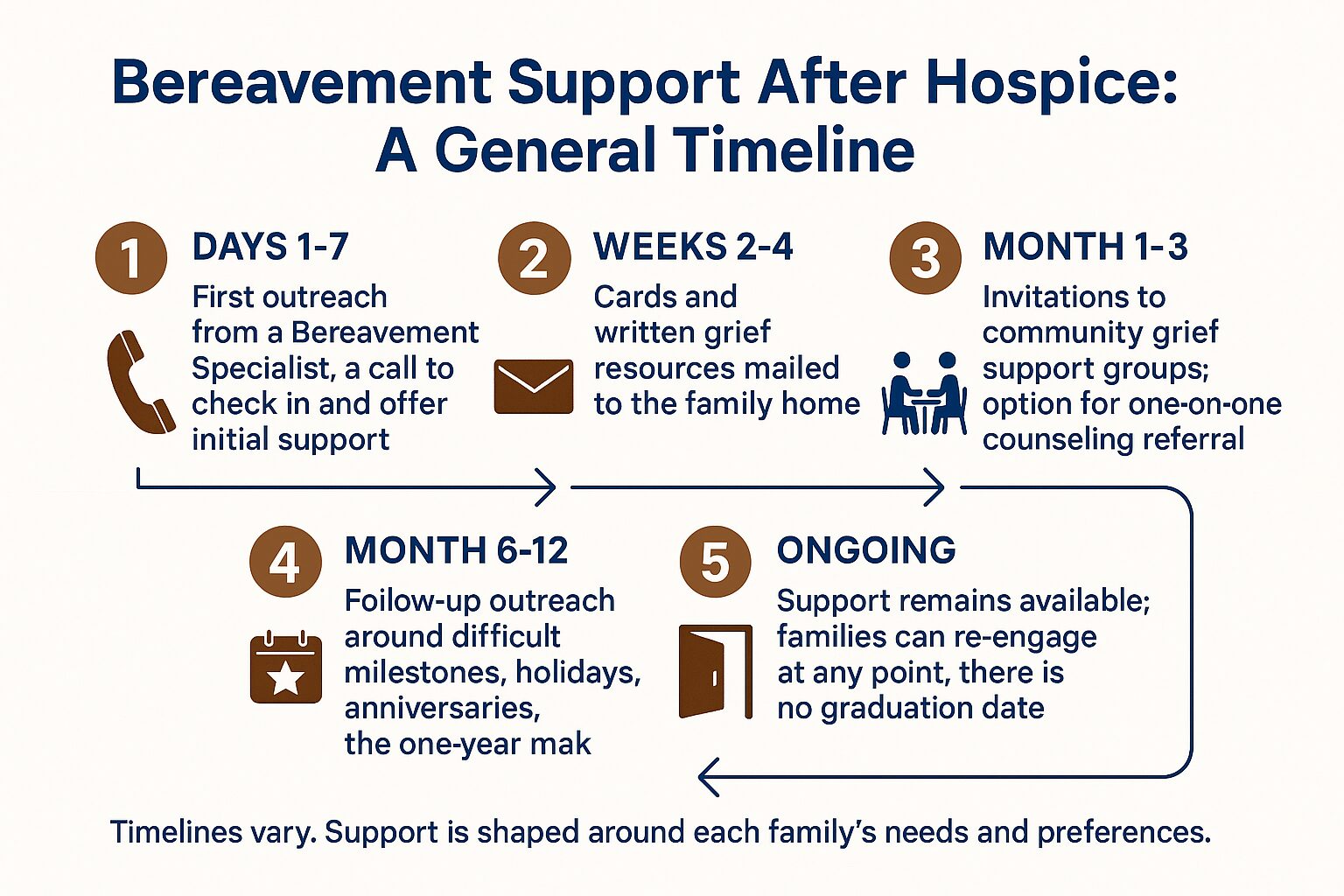
After a patient passes, a Bereavement Specialist reaches out to the family. That first contact is not a formality and not a single call. It's the beginning of a structured support program that unfolds over months.
Depending on what the family needs, that support can include:
- Phone calls at key intervals in the weeks following the death
- Cards and written grief resources mailed to the home
- Invitations to join a grief support group in the community
- Referrals for one-on-one counseling when a family member needs more than a group setting can offer
Some families engage actively with every touchpoint. Others prefer a lighter presence, just knowing support exists if they reach for it. Both approaches are respected. There's no pressure to participate in any particular way, and no single path that families are expected to follow.
In 2025, more than 2,200 individuals received bereavement support through this kind of program across Monterey County and surrounding communities. That number reflects real depth, not a small afterthought program, but one built for the full range of how people grieve.
For families wondering whether grief counseling and group support are available to them specifically, the Finding Grief Support in Monterey County After a Loss resource offers more detail on local options.

The Loss Nobody Warns You About: When the Role Disappears
There's a specific grief experience that often catches people off guard, and it belongs to the person who was the primary day-to-day presence during a loved one's illness.
For months or years, that person, often an adult child or a spouse, organized their life around someone else's needs. Medication schedules. Appointments. Calls to the care team. The constant, focused attention that serious illness demands. Then, almost overnight, all of it stops.
What's left isn't just grief for the person who died. It's also the loss of purpose and structure. The quiet that was supposed to feel like relief instead feels disorienting. And many people are not prepared for it.
This is a well-documented pattern. Research from the National Institute on Aging confirms that grief takes many forms, and that those who served as primary supporters during illness often face a layered loss that goes beyond the loss of the relationship itself.
A Bereavement Specialist or grief group facilitator who understands this particular experience brings something different from general mental health support. They've sat with families at this exact point of transition many times before. That familiarity shapes how they listen and what they suggest.
If you were the person doing the daily work of caring for someone, it's worth naming that experience when you reach out for support, because it's a real and distinct part of what you're carrying.
What Bereavement Support Looks Like Over Time
Grief support after hospice loss doesn't arrive all at once. This timeline shows what families can typically expect in the weeks and months that follow.
Grief Peaks at Unexpected Moments, and Support Should Too
One of the most honest things that can be said about grief is that it does not resolve on a fixed schedule. The people around a grieving person often move on within weeks. But grief frequently intensifies around specific moments: the first holidays, a birthday, the one-year anniversary of a death, a random Tuesday when a song plays on the radio.
This is exactly why bereavement support programs are designed to follow up at intervals, not just in the immediate aftermath of a death. A check-in at six months or twelve months isn't a formality, it's timed to a period when many people feel most alone in their grief.
One person who volunteered as a hospice vigiling volunteer, sitting bedside to provide comfort during a patient's final hours, wrote publicly about being consistently impressed by the quality of the clinical staff and the genuine care they showed families across difficult moments. That kind of team culture doesn't end at the patient's death. It extends into how Bereavement Specialists, grief group facilitators, and Volunteers continue to show up for families afterward.
If you're wondering whether complicated grief, the kind that feels stuck rather than slowly moving, is something you're experiencing, the article When Mourning Feels Stuck: Understanding Complicated Grief addresses that specific experience in more depth. And if grief simply doesn't seem to be following any predictable pattern at all, Grief Doesn't Follow a Schedule, What Support Actually Helps is worth reading.
Two Paths Through Bereavement Support
Families engage with grief support in very different ways. Neither path is wrong, the right level of involvement is whatever actually helps.
| If You Want Active Support | If You Prefer a Lighter Presence |
|---|---|
| Regular calls from a Bereavement Specialist | Knowing contact information is available when needed |
| Grief support group attendance in the community | Receiving mailed resources without committing to calls |
| Referral to one-on-one grief counseling | Reconnecting with the program at a later milestone |
| Follow-up outreach at key anniversaries | Opting back in if grief intensifies unexpectedly |
| Ongoing coordination with the broader care team | A single point of contact who can respond if you reach out |
Who Can Access Bereavement Support
One question families sometimes ask is whether bereavement support is only available to people whose loved one was actively enrolled in hospice. The answer is broader than most people expect.
Grief counseling and bereavement services are available to anyone navigating the loss of a loved one, not only families who went through a formal hospice program. If someone in Salinas, King City, Hollister, or anywhere else in Monterey County is carrying grief and doesn't know where to turn, that support is not locked behind prior enrollment.
Bereavement is also not the same conversation as hospice eligibility or home health. If you're still in an earlier stage, trying to understand whether hospice is even the right direction, the article How Do You Know When It's Time to Consider Hospice Care? is a better place to start. And if a loved one is still living but facing serious illness, What Palliative Care Actually Means, and When It Can Start explains how earlier support works alongside treatment.
Frequently Asked Questions About Bereavement Support After Hospice
Does bereavement support really continue after my loved one dies, or is it just a one-time call?
It continues. A structured bereavement program typically includes multiple points of outreach over months, not a single call. This can include phone check-ins, mailed resources, grief group invitations, and referrals for individual counseling depending on what a family needs.
What if I wasn't the primary person in the house, but I'm still grieving? Can I access support too?
Yes. Grief doesn't only belong to the person who was most physically present. A sibling who lived across the country, a close friend, an adult child who visited on weekends, all of these people can experience significant loss. Bereavement support is not limited to a single designated family member.
I feel fine right now, but I've heard grief sometimes hits hard later. What if I need support months from now?
That's a very common pattern. Many people find that grief intensifies at the six-month or one-year mark, or around the first holiday season after a death, often because the people around them have moved on and the loss feels more isolating. A good bereavement program anticipates this and reaches out at those intervals. And if support isn't already in place, reaching out later is always an option.
I was the one managing all the care for months. Now I feel lost without that structure. Is that normal?
It's extremely common and worth naming directly. When someone's daily life is organized around another person's medical needs, appointments, medications, calls to nurses and therapists, the loss of that structure after a death is a real secondary grief. It's not weakness or confusion; it's a recognized part of the grief experience for primary family supporters. Mentioning this specifically when you reach out for support will help a Bereavement Specialist understand what you're going through.
Do I need to have used hospice to access grief support?
No. Bereavement and grief counseling are available to anyone experiencing loss, not only families who went through a formal hospice program.
What if I live in Salinas or King City, not right on the Monterey Peninsula? Is support available there too?
Yes. Monterey County as a whole is part of the service area, which includes the Peninsula, Salinas, King City, and surrounding communities. Geography should not be a barrier to reaching out.
Ready to Learn What Support Is Available to Your Family?
Central Coast VNA & Hospice has been walking alongside families in Monterey County through some of the hardest moments of their lives since 1951. If you or someone you love is in the months following a loss and wondering what support looks like, a conversation with a care coordinator is a good first step, no commitment required, no pressure. You can reach the team at 831-372-6668 or visit ccvna.com to learn more.

Finding Grief Support in Monterey County After a Loss
Losing someone you love is one of the hardest things a person goes through. And in the hours and days right after, one of the most common things people reach for is connection, someone who understands what this actually feels like.
For families in Monterey County, that search is real and immediate. A woman in Monterey recently submitted a message that said simply: she had lost her husband of 56 years the day before, he had been in hospice at Community Hospital of Monterey Peninsula, and she needed a local grief support group. That single message captures what many people in this situation feel, a need for something concrete, nearby, and soon.
This article explains what grief support actually looks like in practice, who it is for, and how people in communities like Monterey, Pacific Grove, Seaside, and Salinas can find their way to it.
What Grief Support Actually Looks Like
Many people have never used bereavement support before and aren't sure what to expect. There are two main forms, and they serve different needs.
One-on-one grief counseling involves meeting privately with a Bereavement Specialist, a trained professional who helps you process the emotional weight of loss over a series of conversations. This is a form of psychotherapy, though it doesn't feel clinical. It's a place to say what you can't easily say to the people around you.
Group support brings together people who have experienced similar losses, usually with a trained facilitator guiding the conversation. Groups are especially valuable for people whose grief feels invisible to those around them. Friends and family mean well, but they move on. A group stays with you.
Neither form requires you to have used a specific hospice or healthcare provider. Grief doesn't follow a schedule, and the support available to you doesn't either, both options are open to anyone in the community who has lost someone.
The two forms also aren't mutually exclusive. Some people start with a group and later move to individual counseling. Others do both at the same time. What matters is finding something that fits where you are.

Spousal Grief Is Different, and Often the Most Isolated
There is a reason the loss of a long-term spouse hits the way it does. When someone loses a partner of 50 or 60 years, they lose far more than one person. They lose a daily routine, a financial partner, a social anchor, and often their closest confidant.
Research from the National Institute on Aging shows that spousal bereavement carries real physical and mental health risks, particularly in the first year after a loss. Sleep changes, appetite loss, and depression are common, and often go unaddressed because the grieving person is focused on practical logistics rather than their own wellbeing.
In Monterey County, where a large portion of the population is older and long-term couples are common in communities like Carmel, Pacific Grove, and Pebble Beach, this situation is far from rare. But it is also easy to fall through the cracks, especially when friends and family assume that after a few months, things should be settling down.
They often don't. And that's something grief support groups understand in a way that general social networks usually don't. When mourning feels stuck, the problem isn't the person, it's that grief was never meant to be carried alone.
When People Search for Grief Support, and Why It's Never Too Late
Grief doesn't arrive on a schedule, and neither does the need for help. This shows when people most often reach out, and why any of these moments is the right time.
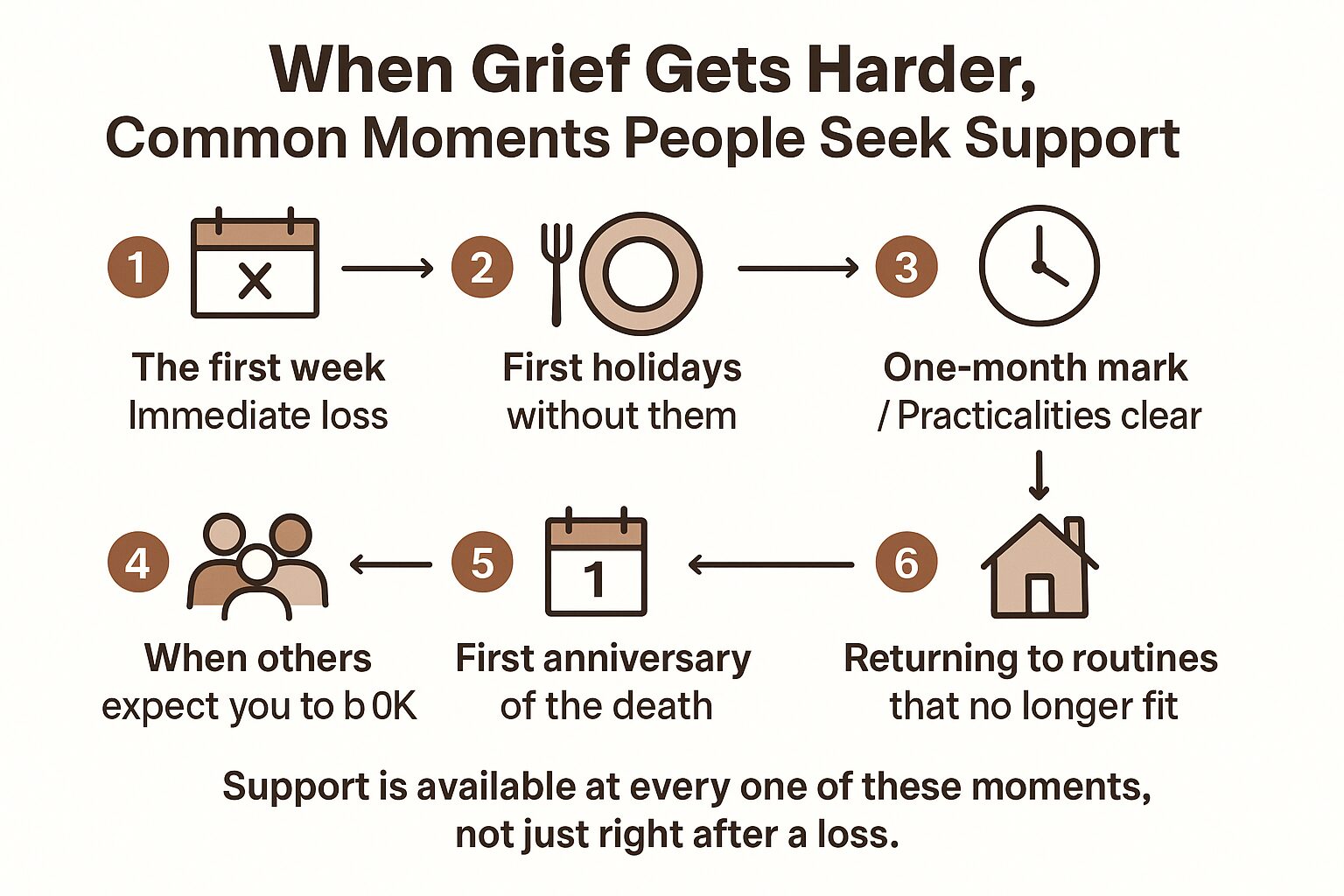
Grief Support Is Not Just for the Immediate Aftermath
People often search for grief support groups weeks or even months after a loss, not in the first few days. That's worth saying plainly, because many people assume they missed a window.
There is no window. Grief doesn't run on a linear track, and the need for support often intensifies at specific moments that come later:
- The first major holidays without the person who is gone
- The first anniversary of their death
- The point when other people seem to expect things to be back to normal
- Returning to routines, a morning coffee, a Sunday walk, that used to involve the person you lost
Someone who lost a spouse eight months ago and finds that it's getting harder rather than easier isn't doing anything wrong. That experience is documented and common. And it's exactly the kind of moment when a group of people who understand can make a real difference.
For adult children grieving a parent, which is also extremely common in Monterey County, the same applies. The loss of a parent reshapes a person's sense of place in the world, sometimes in ways that take months to fully register.
One-on-One Counseling vs. Group Support: A Quick Comparison
Both forms of bereavement support serve real needs, but they work differently. Here is how they compare across the factors most people ask about.
| Factor | One-on-One Counseling | Group Support |
|---|---|---|
| Setting | Private, with a Bereavement Specialist | Small group with a trained facilitator |
| Best for | Personal, specific grief work | Connection with others in similar situations |
| Requires prior relationship with hospice? | No | No |
| Cost | Varies; often covered by Medicare or insurance | Often low-cost or free through community programs |
| Availability in Monterey County | Yes, through community programs | Yes, through community and nonprofit programs |
| Timeline | Ongoing, at your pace | Scheduled sessions, often weekly or biweekly |
What's Available Locally, and Who Can Access It
In 2025, Central Coast VNA & Hospice expanded bereavement support to more than 2,200 individuals across its service area, according to the organization's annual report. That figure reflects a program operating at meaningful scale, with trained Bereavement Specialists and facilitated groups available to families across Monterey County.
Importantly, VNA's bereavement support is not limited to families who used VNA's hospice services. It is available to the broader community. Families in Salinas, Seaside, Pacific Grove, and King City can access the same support as anyone in Monterey proper, without needing a prior connection to the organization.
For people navigating the financial side of grief support, it's worth knowing that Medicare covers certain mental health and counseling services, and community-based grief programs through nonprofits are often low-cost or free. Costs vary depending on the type of support and how it's structured, so contacting a local program directly is the most reliable way to understand what applies to your situation.
If you are also trying to understand what the end-of-life care journey looked like for your loved one, or making sense of the decisions that were made, articles like what families often miss when planning a hospital discharge to home and how families describe the moment they chose hospice may offer some grounding as you process things.
Frequently Asked Questions About Grief Support in Monterey County
Do I have to have used VNA's hospice services to access their bereavement support?
No. Bereavement support through Central Coast VNA & Hospice is available to anyone in the community who has experienced a loss, not only families who were enrolled in their hospice program.
What if I'm not ready for a group? Can I start with individual counseling?
Absolutely. One-on-one sessions with a Bereavement Specialist are available and don't require you to participate in a group setting. Many people start there and later decide whether a group feels right for them.
Is there a cost for grief support groups?
It depends on the program. Community-based grief groups through nonprofits are often low-cost or free. Individual grief counseling may be covered in part by Medicare or private insurance, but costs vary. Contacting the program directly is the fastest way to find out what applies to your situation.
I lost my spouse eight months ago and I feel like it's getting harder, not easier. Is that normal?
Yes, and you are not alone in that experience. Grief often intensifies at specific points, the first holidays, the first anniversary, the moment when everyday life no longer fits the way it used to. Reaching out for support now, months after a loss, is exactly as valid as reaching out in the first week.
How do I find out when grief support groups meet in Monterey County?
The most direct step is to call or visit ccvna.com to ask about current group schedules and availability. Group meeting times and formats change, so checking directly gives you the most accurate information.
Ready to Find Local Grief Support?
If you are in Monterey County and looking for a grief support group or one-on-one bereavement counseling, Central Coast VNA & Hospice can help you understand what is available and when. You can reach their care team at 831-372-6668 or visit ccvna.com to learn more, no prior connection to their services is required to ask.
How to Launch a Meaningful Healthcare Career Right Here in Monterey
When people think about a healthcare career, they often picture big-city hospitals or fast-paced emergency rooms. But here on California’s Central Coast, healthcare looks—and feels—a little different. It’s more personal, more connected, and deeply rooted in community. If you’re considering a career in this vital and growing field, you might be wondering, “How do I get started?” or “What kinds of healthcare roles are in demand in Monterey?”
The good news? You don’t need to move to San Francisco or Los Angeles to make a meaningful impact in someone’s life. Whether you're just beginning your professional journey or looking to make a change, there are many pathways to launch a rewarding healthcare career right here in Monterey, CA.
Why Choose a Healthcare Career in Monterey?
Monterey County is home to a diverse and aging population, a growing need for chronic illness management, and a deeply rooted culture of community care. These local dynamics have created a strong demand for compassionate professionals in roles that range from in-home caregivers to specialized hospice nurses.
The healthcare landscape in this region is also shaped by unique geographic and cultural features:
-
A high concentration of retirees, especially in areas like Carmel, Pacific Grove, and Pebble Beach
-
A bilingual and bicultural community, with increasing need for culturally competent care
-
Access to beautiful outdoor settings that promote healing and work-life balance
-
A tight-knit healthcare network where professionals know and support one another
For many, the combination of clinical purpose and personal connection makes healthcare careers in Monterey, CA especially meaningful.
What Are the Most In-Demand Healthcare Roles in Monterey?
Healthcare is a wide field, and not all careers require years of schooling or clinical degrees. Here are a few roles in particular demand in the Monterey area:
1. Certified Home Health Aides (HHAs)
As more patients choose to receive care in their homes, HHAs are essential for helping with daily tasks and providing companionship. Training programs are accessible and can often be completed in just a few months.
2. Registered Nurses (RNs) and Licensed Vocational Nurses (LVNs)
From hospitals to hospice agencies, RNs and LVNs are the backbone of local healthcare. Those with experience or interest in end-of-life care may find especially meaningful work in hospice nurse careers in Monterey.
3. Hospice and Palliative Care Providers
Providing comfort and dignity at the end of life is one of the most compassionate roles in healthcare. These roles are ideal for individuals who value connection, listening, and holistic care.
4. Medical Assistants and Administrative Professionals
Behind every patient visit is a team handling appointments, records, billing, and communications. These roles are ideal entry points for those interested in a stable, service-oriented career.
5. Social Workers and Care Coordinators
Helping patients navigate complex healthcare systems requires empathy and resourcefulness. These professionals often serve as bridges between medical teams and families.
How to Get Started: Education and Certification Options
If you're asking, "How do I start a healthcare career in Monterey?" the first step is understanding your options. The region offers several local resources and programs to help you begin or advance your path.
🏫 Community Colleges and Training Programs
-
Monterey Peninsula College (MPC) offers nursing programs, CNA/HHA certification, and allied health training.
-
Hartnell College in Salinas also provides healthcare career programs, especially for bilingual students.
🏥 Local Employers Offering On-the-Job Training
-
Some healthcare providers, including home health and hospice agencies, offer paid training or tuition reimbursement for committed candidates.
-
Central Coast VNA & Hospice supports continuing education and mentoring opportunities for team members.
💻 Online and Hybrid Certification
-
For those balancing work or family, many programs now offer flexible online courses to gain credentials in medical billing, patient care, or administration.
What Makes a Healthcare Career “Meaningful”?
You may be wondering, “Is healthcare really right for me?” or “Will I find purpose in this kind of work?” These are important questions, especially if you're making a career switch or returning to the workforce.
Healthcare is one of the few fields where your day-to-day actions have a direct impact on someone’s well-being. Whether you're helping an elderly patient safely navigate their home, comforting a family in hospice care, or ensuring a client gets the right appointment—your work matters.
Here’s what many of our own team members at Central Coast VNA & Hospice say they love most about their jobs:
-
Building long-term relationships with patients and families
-
Being part of a supportive, mission-driven team
-
Knowing their efforts improve someone’s quality of life, even in difficult moments
-
Working in a field that continues to grow and evolve
If those things resonate with you, there’s a good chance you’ll find meaning here, too.
Real Life, Real Impact: A Local Story
Elizabeth Yanez, LVN and Business Development Manager at Central Coast VNA & Hospice, shares a perspective that reflects why so many professionals are choosing healthcare careers in Monterey:
“I am proud to work for a home health, palliative and hospice organization that is truly invested in serving our communities. I find that VNA’s commitment to our patients is not only evident in the leadership team, but also all of the people around me. I find it easy to ask for help and collaborate with our clinical staff on a daily basis. I trust the team I work with to find solutions and better outcomes for our patients.”
Her words echo what makes healthcare in Monterey so distinct—a strong sense of teamwork, community trust, and a shared mission of compassion. At VNA, careers are more than clinical roles—they are partnerships in care and community.
How to Apply for Healthcare Jobs in Monterey
Once you’ve chosen a path or earned the necessary credentials, here’s how to start your job search:
✅ Check Local Healthcare Employers' Websites
-
Organizations like Central Coast VNA & Hospice regularly post job openings for hospice nurses, caregivers, and administrative roles.
-
Larger health systems in the area, including CHOMP and Salinas Valley Health, also offer robust career pages.
✅ Use Regional Job Boards
-
Websites like MontereyHelpWanted.com or Indeed allow you to filter by location and field.
-
Set up job alerts to stay notified of new postings.
✅ Connect with a Mentor or Career Counselor
-
Monterey Peninsula College and local workforce development agencies offer career counseling and job placement support.
-
If you’re new to healthcare, these professionals can help clarify your direction and next steps.
Final Thoughts: There’s Purpose Waiting Here
Starting a healthcare career may feel like a big leap—but if you’re looking for work that aligns with your values, supports your community, and grows with you, Monterey is a wonderful place to take that leap.
Whether you’re exploring hospice nurse careers in Monterey or looking into a new administrative role in the healthcare field, the opportunities here are both meaningful and attainable.
At Central Coast VNA & Hospice, we’ve seen how one person’s care can make a lifelong difference for a patient or family. And that difference can start with you.
To learn more about healthcare opportunities with our team, visit ccvna.com/careers.
Understanding the Compassionate Care of Hospice Services on the Central Coast

When someone we love is facing the final chapter of life, the journey can feel overwhelming, uncertain, and emotionally complex. Families are often filled with questions: What does hospice really mean? How can I make sure my loved one is comfortable? Where can I turn for guidance and support that understands what we’re going through?
Here on California’s Central Coast, many families are finding those answers—and a deep sense of peace—through the compassionate, thoughtful care provided by hospice services. This blog aims to help you better understand what hospice care involves, how it supports families, and why this kind of care can be one of the most meaningful decisions you’ll make.
Understanding Hospice Services on the Central Coast
What Is Hospice Care?
Hospice care is a specialized form of medical and emotional support provided to individuals with life-limiting illnesses. Unlike treatments aimed at curing disease, hospice focuses on comfort, dignity, and quality of life in the time that remains.
Hospice care includes:
-
Pain and symptom management
-
Emotional and spiritual support
-
Help with daily tasks and caregiving
-
Counseling for both the patient and their family
-
Bereavement services after a loved one has passed
One of the most common questions people ask is, "Does hospice mean giving up?" The answer is no. Hospice is not about giving up; it’s about shifting focus—from cure to comfort, from treatment to time together.
Who Is Hospice Care For?
Hospice care is for individuals who have been diagnosed with a life-limiting illness and are no longer pursuing curative treatment. This includes people with conditions such as:
-
Advanced cancer
-
Late-stage Alzheimer’s or dementia
-
End-stage liver or kidney disease
Hospice services are available to anyone with a prognosis of six months or less if the illness follows its natural course, as determined by a physician.
Why Families Choose Hospice on the Central Coast
The Central Coast of California, known for its temperate climate, scenic coastline, and close-knit communities, offers more than just beauty—it offers a sense of peace and groundedness that many families seek during emotionally difficult times.
At Central Coast VNA & Hospice, we’ve seen firsthand how meaningful it is when individuals can spend their final days surrounded by familiar views, caring hands, and the comforts of home. Whether it's a quiet home in Pacific Grove or a hillside residence in Salinas, the setting itself becomes part of the care.
Families often tell us that what they remember most isn't the illness—it’s the moments: the ocean breeze coming through the window, a family member’s laughter in the next room, or the steady support of a hospice nurse during a hard day.
For those wondering where to find compassionate hospice of the Central Coast, trusted care is closer than you might think.
What Services Does Hospice Provide?
Hospice services are designed to support the whole person—not just their illness, but their emotional, spiritual, and relational needs. Here’s a breakdown of the key services provided:
1. Medical Care and Pain Management
Trained hospice nurses and physicians work together to manage pain and symptoms so that the individual can experience as much comfort as possible. This may include medications, equipment, and support for mobility or breathing.
2. Caregiver Support
Family caregivers are often under tremendous stress. Hospice services provide education, respite care, and in-home visits to support family members as they provide day-to-day care.
3. Emotional and Spiritual Support
Social workers and chaplains are available to help with everything from grief and anxiety to spiritual questions and life reflection. These specialized hospice services are offered with sensitivity to each person’s background and beliefs.
4. Bereavement Counseling
Support doesn't end when a loved one passes. Hospice programs offer grief counseling, support groups, and resources to help families heal in the months that follow.
5. Personal Care Services
Hospice aides help with daily living activities such as bathing, dressing, and grooming—helping patients maintain dignity and comfort.
How to Know When It's Time for Hospice
One of the most difficult decisions families face is knowing when to begin hospice care. People often wait too long, thinking they must wait until the very end. But in truth, starting hospice earlier allows more time to manage symptoms, build relationships with the care team, and experience meaningful moments with loved ones.
Signs it may be time to consider hospice:
-
Frequent hospital visits or ER trips
-
Difficulty managing pain or symptoms at home
-
Significant weight loss or weakness
-
Increased emotional distress or confusion
-
Caregiver exhaustion or burnout
If you're unsure, you can always ask your loved one’s doctor or reach out to Central Coast VNA & Hospice directly for guidance and an evaluation.
What Makes Hospice on the Central Coast Unique?
Every hospice organization shares a commitment to comfort and dignity—but care on the Central Coast comes with a distinct sense of place and purpose.
🌿 Community Roots
Central Coast VNA & Hospice has been a trusted part of the community for generations. Many of our staff live in the same neighborhoods as the families we serve. That local connection brings warmth, familiarity, and a true sense of community care.
🌊 A Calming Environment
The region’s natural beauty plays an unexpected role in care. From coastal sunsets in Monterey to the golden hills of Carmel Valley, many patients find comfort in being able to look outside and feel connected to the place they call home.
👪 Diverse Family Needs
Monterey County is home to a wide mix of families—multigenerational households, caregivers balancing work and family, and people who’ve retired here for peace and beauty. Our care teams understand the unique challenges and cultural values that shape each family’s experience.
Common Questions About Hospice Care
Is hospice only for people with cancer?
No. While hospice services originally served many cancer patients, today it supports individuals with a wide range of conditions including heart, lung, liver, and neurological illnesses.
Can hospice services happen at home?
Yes. In fact, most people receive hospice services in the comfort of their own home. Care teams come to you—bringing medical, emotional, and practical support right where you live.
How are hospice services paid for?
Hospice care is covered by Medicare, Medi-Cal, and most private insurance plans. There are no out-of-pocket costs for services covered under the hospice benefit.
Can I still see my regular doctor?
Yes. Hospice teams coordinate with your loved one’s existing physicians to ensure care is consistent and personalized.
Final Thoughts: A Compassionate Choice
Facing the end of life is never easy—but choosing hospice services can bring peace, comfort, and a renewed focus on what matters most. It’s about making the most of each day, honoring the wishes of your loved one, and being supported by people who truly care.
If you’ve been wondering whether it’s time—or even just what to expect—we hope this helped bring clarity and comfort. Hospice isn’t just about the end of life. It’s about living that life with grace, dignity, and love.
To learn more about hospice services offered by Central Coast VNA & Hospice, including trusted hospice of the Central Coast care, visit www.ccvna.com.
Giving Back to VNA - Real Stories of Help and Hope
Have you ever wondered how a simple act of kindness could ripple across an entire community? Giving back to VNA—whether through time, donations, or advocacy—does just that. At Central Coast VNA & Hospice, these gestures translate into real stories of help, hope, and healing for patients and families in Monterey and beyond.
Many supporters ask, “Can you donate to VNA?” The answer is yes—and those donations do more than you might imagine. From comforting a hospice patient through pet therapy, to funding flu shot clinics for those who’ve missed the flu shot, every contribution fuels vital, compassionate care.
In this blog, you’ll learn:
- Why giving back is so impactful
- The types of support that make a difference
- Personal stories from Monterey families and volunteers
- How you can get involved through VNA’s donation and volunteer programs
Let’s explore how you can be part of this mission.
The Challenge: Meeting Community Health Needs
Healthcare is deeply personal—but accessing quality care isn’t always easy, especially for underserved or homebound individuals in Monterey County. VNA fills that gap with hospice, home health, flu prevention, and specialty programs.
Common Barriers VNA Helps Overcome:
- Lack of transportation for flu shots and home care
- Isolation and emotional distress in patients
- Limited resources for end-of-life support
- Emotional strain on family caregivers
Still, many people don’t realize that VNA is a nonprofit—and relies on donations, volunteers, and community partnerships to bridge these gaps.
Misconceptions we often hear:
- “Hospice is fully funded by insurance.”
- “My small donation won’t make a difference.”
- “Only medical professionals can volunteer.”
These myths prevent community members from seeing the vital role they can play in helping others. But through giving back to VNA, ordinary people do extraordinary things every day.
The Solution: Giving Back to VNA—Made Easy
You don’t have to be a healthcare expert to support the work we do. There are many simple ways to give back to VNA—each one creating a meaningful difference.
Donation Opportunities:
- One-time or monthly gifts to support hospice and home health
- Tribute donations to honor loved ones
- In-kind donations like comfort care items or technology
- Planned giving options such as bequests or charitable trusts
Volunteer Roles:
- VNA Ambassador: Spread awareness through community outreach
- VNA Pet Therapy volunteers: Bring joy and comfort through trained therapy animals
- Office or event volunteers: Help behind the scenes
- Bereavement and family support roles
What These Gifts Support:
- Flu clinics for those who’ve missed the flu shot
- Grief counseling and family support programs
- Specialty care programs for Alzheimer’s, Parkinson’s, and veterans
- Compassionate end-of-life care in patients’ homes
To learn more about volunteer and giving opportunities, visit https://ccvna.com.
Benefits: The Ripple Effect of Giving
Whether you give time, resources, or a monetary donation, giving back to VNA brings measurable—and deeply personal—benefits to everyone involved.
For the Community:
- Expanded access to care for low-income and rural families
- Increased vaccination rates (especially important for those who’ve missed the flu shot)
- Enhanced quality of life for patients facing illness
For Donors:
- Sense of purpose and fulfillment
- Public acknowledgment (if desired) for generous contributions
- The ability to honor a loved one’s legacy in a meaningful way
For Volunteers:
- Develop new skills or apply existing talents
- Build relationships with patients, families, and fellow volunteers
- Know that you’re making a real difference, right here in Monterey
Testimonial from a VNA Volunteer:
“I started volunteering after my father passed in VNA’s care. Giving back helped me heal, and now I get to help others in their time of need.”
Local Focus: What Makes Giving Back in Monterey Unique
The beauty of giving back to VNA is that your contribution stays local—helping families right here in Monterey County.
Why Local Support Matters:
- Monterey’s senior population is growing, and many live alone
- Rural and coastal areas often lack easy access to in-person care
- Language and cultural barriers can affect the quality of service
VNA addresses these gaps by:
- Offering bilingual support services
- Deploying home health nurses across the region
- Hosting community flu shot clinics, ideal for anyone who’s missed the flu shot
- Running volunteer-led programs that reflect the diversity of our community
Your donation or time stays local and is used responsibly—backed by over 70 years of trusted nonprofit care.
FAQs About Giving Back to VNA
1. Can I donate in honor of someone?
Yes! Tribute gifts are a powerful way to celebrate a life or thank a caregiver. They can be made online or by mail.
2. Is my donation tax-deductible?
Yes. Central Coast VNA & Hospice is a 501(c)(3) nonprofit. All eligible gifts are tax-deductible.
3. What if I only have a few hours a month to volunteer?
That’s perfect. We have flexible volunteer roles to fit all schedules and lifestyles.
4. Can I support VNA if I’m not a healthcare professional?
Absolutely. Most volunteers aren’t medical professionals. Everyone can bring kindness, time, or energy.
5. Where can I learn more about VNA’s services before donating?
Explore all our services—from hospice and home health to grief counseling and specialty programs.
Ready to Make a Difference? Start Giving Back to VNA Today
Your support—big or small—can brighten someone’s final days, ease a caregiver’s burden, or provide a child with grief counseling. Giving back to VNA connects you to something bigger: the power of community compassion.
And if you’ve missed the flu shot, donating or volunteering with VNA is the perfect reminder to stay proactive about your health, too.
📞 Call us at (831) 372-6668
📩 Donate online or fill out a volunteer interest form today
Together, we bring hope home.
Central Coast VNA & Hospice – Supporting lives, families, and futures across Monterey County since 1951.
What’s the Difference Between Palliative Care and Hospice? A Comprehensive Breakdown
Understanding Palliative Care and Hospice
When facing a serious illness, understanding the options available for supportive care is essential. Palliative care and hospice are two vital services designed to improve quality of life, yet they serve different purposes. Many families in Monterey struggle to determine which is best suited for their loved ones.
In this guide, we’ll break down the key differences between palliative care and hospice, dispel common misconceptions, and help you decide which care option aligns with your needs.
Common Problems and Challenges
Many people assume that palliative care and hospice are interchangeable. However, these services differ in eligibility, goals, and timing.
Common Misconceptions:
- Myth: Palliative care is only for end-of-life care.
- Reality: It can be provided at any stage of a serious illness.
- Myth: Hospice is just a place.
- Reality: It’s a type of care that can be given at home, in a hospital, or in a facility.
- Myth: You must stop treatment to receive palliative care.
- Reality: Palliative care works alongside curative treatments.
Understanding these differences can prevent unnecessary stress and ensure that patients receive appropriate care.
Palliative Care vs. Hospice: How They Work
What Is Palliative Care?
Palliative care focuses on improving the quality of life for individuals with serious illnesses such as cancer, heart disease, or dementia. It aims to relieve symptoms like pain, fatigue, and nausea while the patient continues medical treatments.
Key Features of Palliative Care:
- Available at any stage of illness, not just end-of-life.
- Can be provided alongside curative treatments.
- Focuses on pain management, emotional support, and symptom relief.
- Available in hospitals, outpatient clinics, and sometimes at home.
What Is Hospice Care?
Hospice care is specifically designed for individuals in the final months of life, typically when curative treatments are no longer effective. The goal is to provide comfort, dignity, and support for both patients and their families.
Key Features of Hospice Care:
- For patients with a life expectancy of six months or less.
- Focuses on comfort rather than cure.
- Provides emotional and spiritual support for patients and families.
- Available in homes, hospice centers, nursing homes, and hospitals.
Benefits of Choosing the Right Care
Selecting the appropriate care service ensures that patients receive the right support at the right time.
Benefits of Palliative Care:
- Improves quality of life while managing symptoms.
- Reduces hospital visits and medical complications.
- Helps patients and families navigate complex medical decisions.
Benefits of Hospice Care:
- Provides compassionate, end-of-life care.
- Reduces unnecessary medical interventions.
- Offers grief support for families after a loved one passes.
Choosing the Right Provider in Monterey
When selecting a provider, consider factors such as experience, range of services, and patient testimonials. At Central Coast VNA & Hospice, we offer both palliative care and hospice services tailored to the needs of Monterey residents.
Why Choose Central Coast VNA & Hospice?
- Expert Team: Our professionals include doctors, nurses, and social workers.
- Comprehensive Support: We provide medical, emotional, and spiritual care.
- Flexible Care Options: Services are available in homes, hospitals, and nursing facilities.
- Local Commitment: Proudly serving Monterey, Salinas, Hollister, and Santa Cruz.
Frequently Asked Questions (FAQs)
1. Is palliative care covered by insurance?
Yes, most insurance plans, including Medicare and Medicaid, cover palliative care. Always check with your provider for details.
2. When should someone consider hospice care?
Hospice care is recommended when a physician determines that a patient has six months or less to live and treatment is no longer effective.
3. Can I receive palliative care at home?
Yes, palliative care can often be provided at home, depending on the patient’s needs and the provider’s services.
4. How do I know which service is right for my loved one?
Consulting with a healthcare provider or Central Coast VNA & Hospice can help determine the best care option based on medical needs and goals.
Take the Next Step
If you or a loved one need palliative care or hospice in Monterey, Central Coast VNA & Hospice is here to help. Our compassionate team provides personalized support tailored to your needs.
📞 Call us today at 831-372-6668 or visit our website to learn more.
By understanding the differences between palliative care and hospice, you can make informed choices that prioritize comfort, dignity, and quality of life.
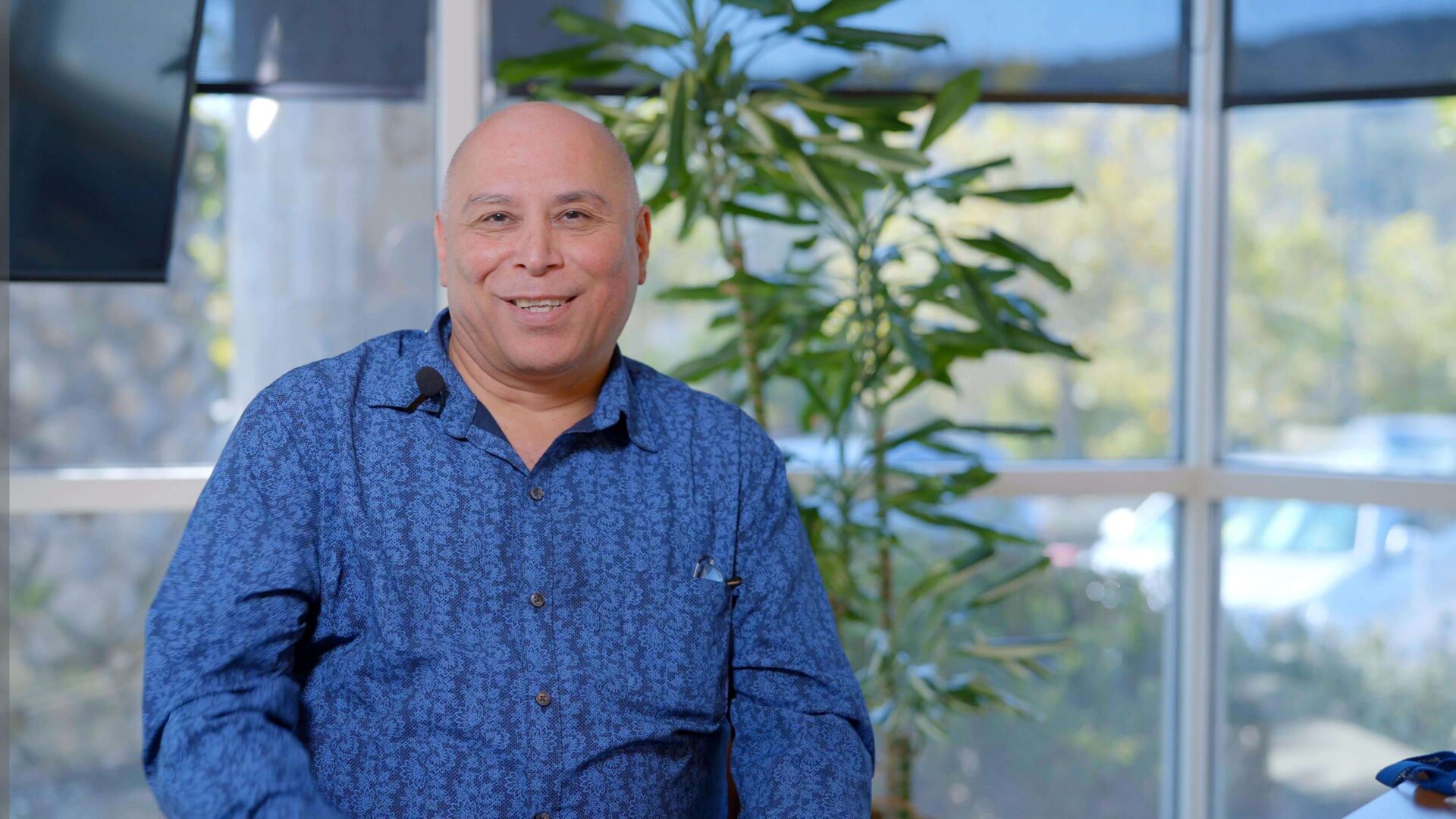
Understanding Long-Term Hospice - Can It Last for Years?
Hospice care is often associated with the final weeks or months of life, but can someone be on hospice for years? The answer may surprise you. Long-term hospice care is a reality for many patients who meet the criteria but experience a slower decline in health. This raises questions about eligibility, benefits, and the impact on patients and families.
In this blog, we’ll explore:
- What long-term hospice means and how it works
- Common challenges and misconceptions
- Benefits and outcomes of extended hospice care
- Key considerations when choosing a hospice provider
For those in Monterey County seeking compassionate, expert care, Central Coast VNA & Hospice offers specialized hospice services tailored to each patient's needs.
What Is Long-Term Hospice Care?
Hospice care is designed for individuals with a terminal illness who have a prognosis of six months or less. However, some patients remain in hospice care for years due to the unpredictable nature of certain diseases, such as:
- Alzheimer’s and other dementias – Progressive but slow decline.
- Chronic obstructive pulmonary disease (COPD) – Frequent exacerbations but periods of stability.
- Heart failure – Episodes of decline followed by recovery.
- Neurological conditions (e.g., Parkinson’s, ALS) – Gradual decline over time.
Patients who stabilize or experience slow decline may continue to qualify for hospice care as long as their condition meets eligibility criteria.
Challenges and Misconceptions About Long-Term Hospice
Common Misunderstandings
Many people assume that hospice care is only for the final days of life, leading to misconceptions such as:
- “Hospice means giving up hope.” In reality, hospice focuses on quality of life, not death.
- “Patients must leave hospice if they live longer than six months.” Patients are re-evaluated periodically, and those who continue to meet criteria can remain on hospice.
- “Only cancer patients qualify for hospice.” Hospice serves individuals with a variety of illnesses, including heart disease, lung disease, and neurological conditions.
Challenges for Families
Caring for a loved one in long-term hospice<span style="font-weight: 400;"> presents unique challenges, such as:
- Emotional toll – Prolonged caregiving can lead to burnout.
- Insurance concerns – Coverage policies vary and may need clarification.
- Navigating transitions – If a patient improves significantly, they may need to transition out of hospice care.
How Long-Term Hospice Works
Long-term hospice care follows a structured process to ensure patients receive consistent, compassionate care:
- Initial Assessment – A hospice team evaluates the patient’s condition to determine eligibility.
- Personalized Care Plan – Services are tailored to the patient’s needs, including:
- Pain and symptom management
- Emotional and spiritual support
- Family education and counseling
- Regular Evaluations – Every 60 to 90 days, hospice teams reassess the patient’s status to determine continued eligibility.
- Transitioning Out of Hospice – If a patient stabilizes or improves, they may be discharged with options for palliative care or home health services.
Benefits of Long-Term Hospice Care
Choosing long-term hospice care provides numerous benefits:
For Patients:
- Enhanced Comfort: Pain and symptoms are managed effectively.
- Dignity and Autonomy: Patients receive care in their preferred setting (often at home).
- Holistic Support: Emotional, spiritual, and medical needs are addressed.
For Families:
- Respite Care: Temporary relief for caregivers.
- 24/7 Support: Access to hospice professionals at any time.
- Guidance and Counseling: Emotional and grief support for loved ones.
Choosing the Right Long-Term Hospice Provider
When selecting a hospice provider in Monterey, consider:
Key Factors:
- Accreditation and Reputation – Look for a provider with a strong history of compassionate care, like Central Coast VNA & Hospice.
- Range of Services – Ensure they offer medical, emotional, and spiritual support.
- Coverage and Costs – Confirm what’s covered under Medicare, Medicaid, or private insurance.
Why Choose Central Coast VNA & Hospice?
- 40+ years of expertise in hospice and home health care.
- Comprehensive care teams, including nurses, social workers, and chaplains.
- Serving Monterey County and surrounding areas with personalized, high-quality care.
FAQs About Long-Term Hospice Care
1. Can someone be on hospice for years?
Yes. If a patient continues to meet eligibility criteria, they can remain on hospice indefinitely.
2. Does long-term hospice affect Medicare coverage?
Medicare covers hospice as long as the patient qualifies. Patients are re-evaluated periodically to ensure eligibility.
3. What happens if a patient improves while on hospice?
If a patient no longer meets hospice criteria, they may transition to palliative care or home health services.
4. Can hospice patients still receive treatments?
Hospice focuses on comfort care, so curative treatments are typically not provided. However, treatments for symptom management (e.g., pain relief, oxygen therapy) are included.
5. How do I know if my loved one qualifies for hospice?
A physician or hospice team can assess eligibility based on the patient’s illness and symptoms.
Take the Next Step: Contact Central Coast VNA & Hospice
If you or a loved one may benefit from long-term hospice care, don’t wait to seek support. Central Coast VNA & Hospice provides expert, compassionate care tailored to your needs.
📞 Call us at 831-372-6668 for a consultation.
Let us help you navigate this journey with care, comfort, and dignity.