
Direct Answer: Grief support groups and one-on-one bereavement counseling are available in Monterey County to anyone who has lost a loved one, no prior connection to a hospice or healthcare provider required.
Losing someone you love is one of the hardest things a person goes through. And in the hours and days right after, one of the most common things people reach for is connection, someone who understands what this actually feels like.
For families in Monterey County, that search is real and immediate. A woman in Monterey recently submitted a message that said simply: she had lost her husband of 56 years the day before, he had been in hospice at Community Hospital of Monterey Peninsula, and she needed a local grief support group. That single message captures what many people in this situation feel, a need for something concrete, nearby, and soon.
This article explains what grief support actually looks like in practice, who it is for, and how people in communities like Monterey, Pacific Grove, Seaside, and Salinas can find their way to it.
What Grief Support Actually Looks Like
Many people have never used bereavement support before and aren’t sure what to expect. There are two main forms, and they serve different needs.
One-on-one grief counseling involves meeting privately with a Bereavement Specialist, a trained professional who helps you process the emotional weight of loss over a series of conversations. This is a form of psychotherapy, though it doesn’t feel clinical. It’s a place to say what you can’t easily say to the people around you.
Group support brings together people who have experienced similar losses, usually with a trained facilitator guiding the conversation. Groups are especially valuable for people whose grief feels invisible to those around them. Friends and family mean well, but they move on. A group stays with you.
Neither form requires you to have used a specific hospice or healthcare provider. Grief doesn’t follow a schedule, and the support available to you doesn’t either, both options are open to anyone in the community who has lost someone.
The two forms also aren’t mutually exclusive. Some people start with a group and later move to individual counseling. Others do both at the same time. What matters is finding something that fits where you are.

Spousal Grief Is Different, and Often the Most Isolated
There is a reason the loss of a long-term spouse hits the way it does. When someone loses a partner of 50 or 60 years, they lose far more than one person. They lose a daily routine, a financial partner, a social anchor, and often their closest confidant.
Research from the National Institute on Aging shows that spousal bereavement carries real physical and mental health risks, particularly in the first year after a loss. Sleep changes, appetite loss, and depression are common, and often go unaddressed because the grieving person is focused on practical logistics rather than their own wellbeing.
In Monterey County, where a large portion of the population is older and long-term couples are common in communities like Carmel, Pacific Grove, and Pebble Beach, this situation is far from rare. But it is also easy to fall through the cracks, especially when friends and family assume that after a few months, things should be settling down.
They often don’t. And that’s something grief support groups understand in a way that general social networks usually don’t. When mourning feels stuck, the problem isn’t the person, it’s that grief was never meant to be carried alone.
When People Search for Grief Support, and Why It’s Never Too Late
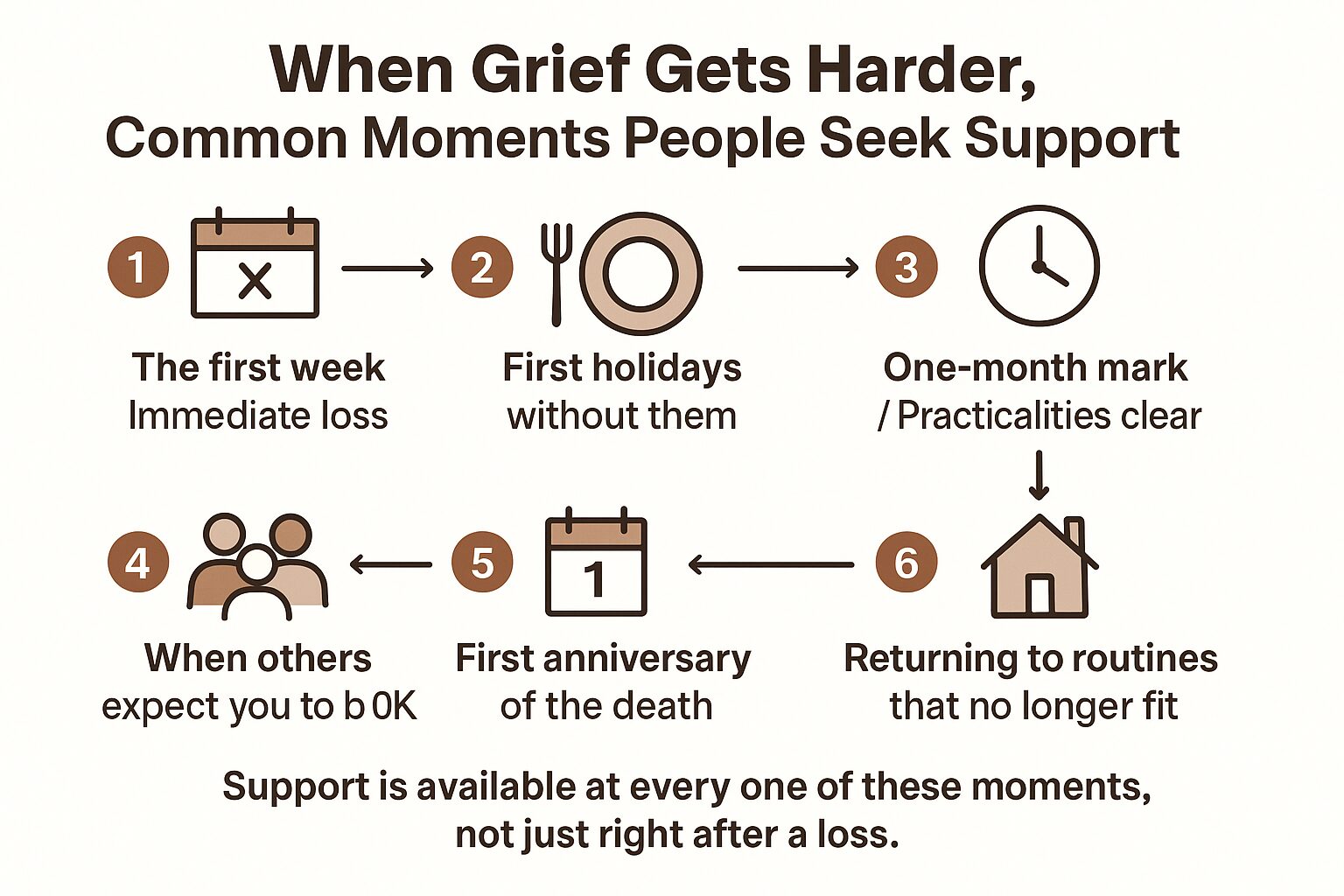
Grief doesn’t arrive on a schedule, and neither does the need for help. This shows when people most often reach out, and why any of these moments is the right time.
Grief Support Is Not Just for the Immediate Aftermath
People often search for grief support groups weeks or even months after a loss, not in the first few days. That’s worth saying plainly, because many people assume they missed a window.
There is no window. Grief doesn’t run on a linear track, and the need for support often intensifies at specific moments that come later:
- The first major holidays without the person who is gone
- The first anniversary of their death
- The point when other people seem to expect things to be back to normal
- Returning to routines, a morning coffee, a Sunday walk, that used to involve the person you lost
Someone who lost a spouse eight months ago and finds that it’s getting harder rather than easier isn’t doing anything wrong. That experience is documented and common. And it’s exactly the kind of moment when a group of people who understand can make a real difference.
For adult children grieving a parent, which is also extremely common in Monterey County, the same applies. The loss of a parent reshapes a person’s sense of place in the world, sometimes in ways that take months to fully register.
One-on-One Counseling vs. Group Support: A Quick Comparison
Both forms of bereavement support serve real needs, but they work differently. Here is how they compare across the factors most people ask about.
| Factor | One-on-One Counseling | Group Support |
|---|---|---|
| Setting | Private, with a Bereavement Specialist | Small group with a trained facilitator |
| Best for | Personal, specific grief work | Connection with others in similar situations |
| Requires prior relationship with hospice? | No | No |
| Cost | Varies; often covered by Medicare or insurance | Often low-cost or free through community programs |
| Availability in Monterey County | Yes, through community programs | Yes, through community and nonprofit programs |
| Timeline | Ongoing, at your pace | Scheduled sessions, often weekly or biweekly |
What’s Available Locally, and Who Can Access It
In 2025, Central Coast VNA & Hospice expanded bereavement support to more than 2,200 individuals across its service area, according to the organization’s annual report. That figure reflects a program operating at meaningful scale, with trained Bereavement Specialists and facilitated groups available to families across Monterey County.
Importantly, VNA’s bereavement support is not limited to families who used VNA’s hospice services. It is available to the broader community. Families in Salinas, Seaside, Pacific Grove, and King City can access the same support as anyone in Monterey proper, without needing a prior connection to the organization.
For people navigating the financial side of grief support, it’s worth knowing that Medicare covers certain mental health and counseling services, and community-based grief programs through nonprofits are often low-cost or free. Costs vary depending on the type of support and how it’s structured, so contacting a local program directly is the most reliable way to understand what applies to your situation.
If you are also trying to understand what the end-of-life care journey looked like for your loved one, or making sense of the decisions that were made, articles like what families often miss when planning a hospital discharge to home and how families describe the moment they chose hospice may offer some grounding as you process things.
Frequently Asked Questions About Grief Support in Monterey County
Do I have to have used VNA’s hospice services to access their bereavement support?
No. Bereavement support through Central Coast VNA & Hospice is available to anyone in the community who has experienced a loss, not only families who were enrolled in their hospice program.
What if I’m not ready for a group? Can I start with individual counseling?
Absolutely. One-on-one sessions with a Bereavement Specialist are available and don’t require you to participate in a group setting. Many people start there and later decide whether a group feels right for them.
Is there a cost for grief support groups?
It depends on the program. Community-based grief groups through nonprofits are often low-cost or free. Individual grief counseling may be covered in part by Medicare or private insurance, but costs vary. Contacting the program directly is the fastest way to find out what applies to your situation.
I lost my spouse eight months ago and I feel like it’s getting harder, not easier. Is that normal?
Yes, and you are not alone in that experience. Grief often intensifies at specific points, the first holidays, the first anniversary, the moment when everyday life no longer fits the way it used to. Reaching out for support now, months after a loss, is exactly as valid as reaching out in the first week.
How do I find out when grief support groups meet in Monterey County?
The most direct step is to call or visit ccvna.com to ask about current group schedules and availability. Group meeting times and formats change, so checking directly gives you the most accurate information.
Ready to Find Local Grief Support?
If you are in Monterey County and looking for a grief support group or one-on-one bereavement counseling, Central Coast VNA & Hospice can help you understand what is available and when. You can reach their care team at 831-372-6668 or visit ccvna.com to learn more, no prior connection to their services is required to ask.