
Direct Answer: Bereavement support after hospice doesn’t end when a loved one dies. A structured program of outreach, grief resources, and counseling continues for months, and is open to families across Monterey County.
Most families assume that when a loved one dies under hospice care, their relationship with the care team ends that same day. A phone call, maybe a card in the mail, and then silence. That assumption is understandable, but it’s also wrong, and for families across Monterey County, the difference matters.
Grief doesn’t follow a tidy timeline. The weeks after a death can feel surreal, then exhausting, then suddenly empty in ways nobody warned you about. Knowing what bereavement support after hospice loss actually looks like, what happens, when it happens, and what you can ask for, gives families a clearer picture of what’s available before they need it most.
This article focuses specifically on the transition from hospice to bereavement: the first days, the first months, and what structured grief support looks like in practice.
The First Outreach Isn’t a One-Time Check-In
After a patient passes, a Bereavement Specialist reaches out to the family. That first contact is not a formality and not a single call. It’s the beginning of a structured support program that unfolds over months.
Depending on what the family needs, that support can include:
- Phone calls at key intervals in the weeks following the death
- Cards and written grief resources mailed to the home
- Invitations to join a grief support group in the community
- Referrals for one-on-one counseling when a family member needs more than a group setting can offer
Some families engage actively with every touchpoint. Others prefer a lighter presence, just knowing support exists if they reach for it. Both approaches are respected. There’s no pressure to participate in any particular way, and no single path that families are expected to follow.
In 2025, more than 2,200 individuals received bereavement support through this kind of program across Monterey County and surrounding communities. That number reflects real depth, not a small afterthought program, but one built for the full range of how people grieve.
For families wondering whether grief counseling and group support are available to them specifically, the Finding Grief Support in Monterey County After a Loss resource offers more detail on local options.

The Loss Nobody Warns You About: When the Role Disappears
There’s a specific grief experience that often catches people off guard, and it belongs to the person who was the primary day-to-day presence during a loved one’s illness.
For months or years, that person, often an adult child or a spouse, organized their life around someone else’s needs. Medication schedules. Appointments. Calls to the care team. The constant, focused attention that serious illness demands. Then, almost overnight, all of it stops.
What’s left isn’t just grief for the person who died. It’s also the loss of purpose and structure. The quiet that was supposed to feel like relief instead feels disorienting. And many people are not prepared for it.
This is a well-documented pattern. Research from the National Institute on Aging confirms that grief takes many forms, and that those who served as primary supporters during illness often face a layered loss that goes beyond the loss of the relationship itself.
A Bereavement Specialist or grief group facilitator who understands this particular experience brings something different from general mental health support. They’ve sat with families at this exact point of transition many times before. That familiarity shapes how they listen and what they suggest.
If you were the person doing the daily work of caring for someone, it’s worth naming that experience when you reach out for support, because it’s a real and distinct part of what you’re carrying.
What Bereavement Support Looks Like Over Time
Grief support after hospice loss doesn’t arrive all at once. This timeline shows what families can typically expect in the weeks and months that follow.
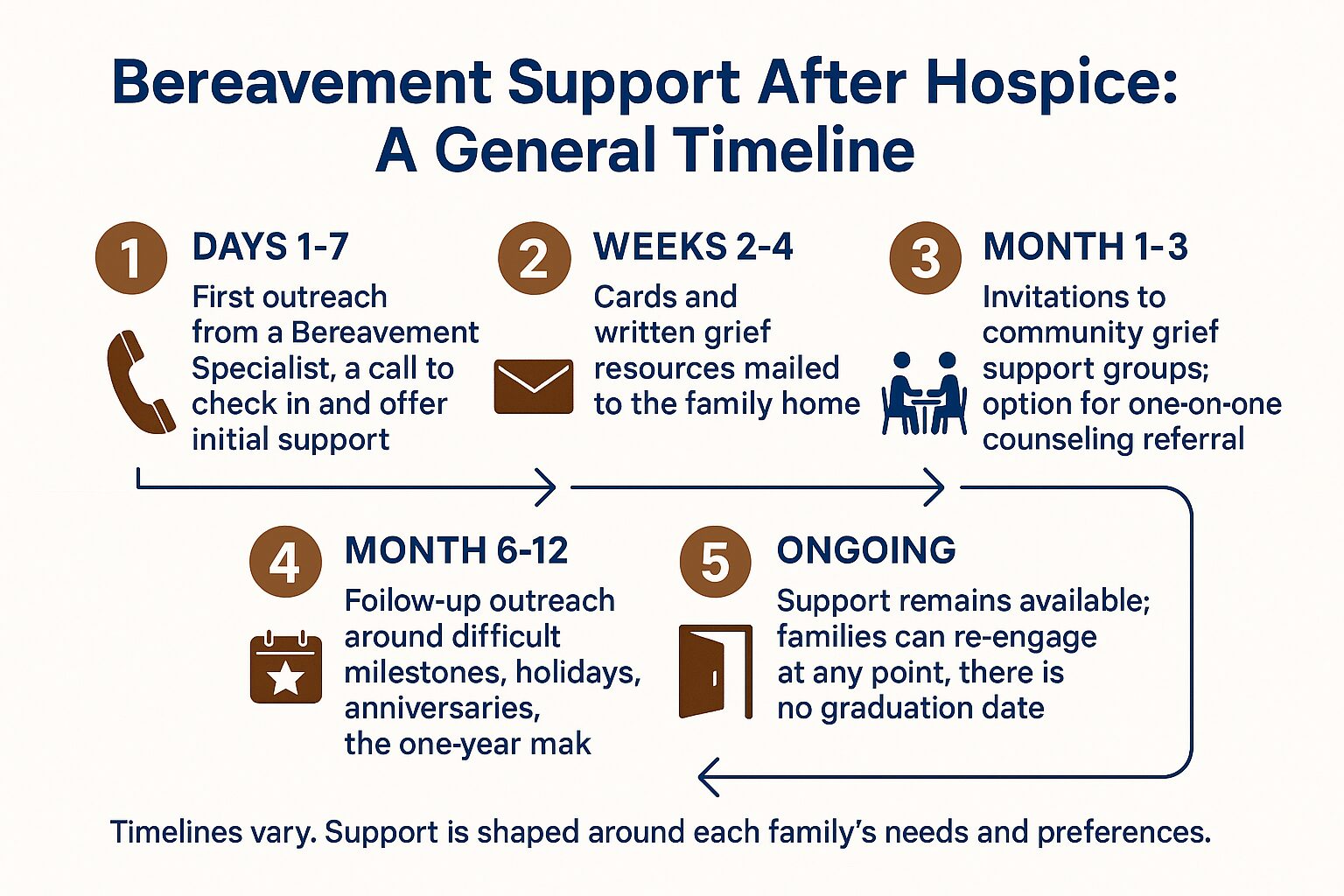
Grief Peaks at Unexpected Moments, and Support Should Too
One of the most honest things that can be said about grief is that it does not resolve on a fixed schedule. The people around a grieving person often move on within weeks. But grief frequently intensifies around specific moments: the first holidays, a birthday, the one-year anniversary of a death, a random Tuesday when a song plays on the radio.
This is exactly why bereavement support programs are designed to follow up at intervals, not just in the immediate aftermath of a death. A check-in at six months or twelve months isn’t a formality, it’s timed to a period when many people feel most alone in their grief.
One person who volunteered as a hospice vigiling volunteer, sitting bedside to provide comfort during a patient’s final hours, wrote publicly about being consistently impressed by the quality of the clinical staff and the genuine care they showed families across difficult moments. That kind of team culture doesn’t end at the patient’s death. It extends into how Bereavement Specialists, grief group facilitators, and Volunteers continue to show up for families afterward.
If you’re wondering whether complicated grief, the kind that feels stuck rather than slowly moving, is something you’re experiencing, the article When Mourning Feels Stuck: Understanding Complicated Grief addresses that specific experience in more depth. And if grief simply doesn’t seem to be following any predictable pattern at all, Grief Doesn’t Follow a Schedule, What Support Actually Helps is worth reading.
Two Paths Through Bereavement Support
Families engage with grief support in very different ways. Neither path is wrong, the right level of involvement is whatever actually helps.
| If You Want Active Support | If You Prefer a Lighter Presence |
|---|---|
| Regular calls from a Bereavement Specialist | Knowing contact information is available when needed |
| Grief support group attendance in the community | Receiving mailed resources without committing to calls |
| Referral to one-on-one grief counseling | Reconnecting with the program at a later milestone |
| Follow-up outreach at key anniversaries | Opting back in if grief intensifies unexpectedly |
| Ongoing coordination with the broader care team | A single point of contact who can respond if you reach out |
Who Can Access Bereavement Support
One question families sometimes ask is whether bereavement support is only available to people whose loved one was actively enrolled in hospice. The answer is broader than most people expect.
Grief counseling and bereavement services are available to anyone navigating the loss of a loved one, not only families who went through a formal hospice program. If someone in Salinas, King City, Hollister, or anywhere else in Monterey County is carrying grief and doesn’t know where to turn, that support is not locked behind prior enrollment.
Bereavement is also not the same conversation as hospice eligibility or home health. If you’re still in an earlier stage, trying to understand whether hospice is even the right direction, the article How Do You Know When It’s Time to Consider Hospice Care? is a better place to start. And if a loved one is still living but facing serious illness, What Palliative Care Actually Means, and When It Can Start explains how earlier support works alongside treatment.
Frequently Asked Questions About Bereavement Support After Hospice
Does bereavement support really continue after my loved one dies, or is it just a one-time call?
It continues. A structured bereavement program typically includes multiple points of outreach over months, not a single call. This can include phone check-ins, mailed resources, grief group invitations, and referrals for individual counseling depending on what a family needs.
What if I wasn’t the primary person in the house, but I’m still grieving? Can I access support too?
Yes. Grief doesn’t only belong to the person who was most physically present. A sibling who lived across the country, a close friend, an adult child who visited on weekends, all of these people can experience significant loss. Bereavement support is not limited to a single designated family member.
I feel fine right now, but I’ve heard grief sometimes hits hard later. What if I need support months from now?
That’s a very common pattern. Many people find that grief intensifies at the six-month or one-year mark, or around the first holiday season after a death, often because the people around them have moved on and the loss feels more isolating. A good bereavement program anticipates this and reaches out at those intervals. And if support isn’t already in place, reaching out later is always an option.
I was the one managing all the care for months. Now I feel lost without that structure. Is that normal?
It’s extremely common and worth naming directly. When someone’s daily life is organized around another person’s medical needs, appointments, medications, calls to nurses and therapists, the loss of that structure after a death is a real secondary grief. It’s not weakness or confusion; it’s a recognized part of the grief experience for primary family supporters. Mentioning this specifically when you reach out for support will help a Bereavement Specialist understand what you’re going through.
Do I need to have used hospice to access grief support?
No. Bereavement and grief counseling are available to anyone experiencing loss, not only families who went through a formal hospice program.
What if I live in Salinas or King City, not right on the Monterey Peninsula? Is support available there too?
Yes. Monterey County as a whole is part of the service area, which includes the Peninsula, Salinas, King City, and surrounding communities. Geography should not be a barrier to reaching out.
Ready to Learn What Support Is Available to Your Family?
Central Coast VNA & Hospice has been walking alongside families in Monterey County through some of the hardest moments of their lives since 1951. If you or someone you love is in the months following a loss and wondering what support looks like, a conversation with a care coordinator is a good first step, no commitment required, no pressure. You can reach the team at 831-372-6668 or visit ccvna.com to learn more.