
Direct Answer: SB 1088 takes effect January 1, 2027. Most existing California POLST and DNR forms stay valid and do not need re-signing. Out-of-state forms must now be honored here.
Somewhere in a lot of Monterey County homes there is a bright pink piece of paper on the refrigerator. Mom signed it two years ago with her doctor, and nobody has looked at it since.
Then a new law shows up in the news and the worry starts. Does that form still work? Does she have to sign a new one?
Here is the short version. Governor Newsom signed SB 1088 on September 30, 2026, and the changes take effect January 1, 2027. Most families will not need to re-sign anything, but a few will, and this article walks through which group you are in.
What SB 1088 actually changes about California POLST and DNR forms
SB 1088, introduced by Sen. Catherine Blakespear, amends California’s prehospital DNR and POLST statutes. The Senate announcement of the bill lays out the reasoning, and the Coalition for Compassionate Care of California summarized the final version when it was signed.
Four changes matter to families:
- The POLST gets a new name. It goes from Physician Orders for Life Sustaining Treatment to POLST (Portable Orders Listing Scope of Treatment). Same form, same purpose, broader name.
- Nurse practitioners and physician assistants/associates can sign the prehospital DNR. Before, that signature line was for physicians. NPs and PAs could already sign POLST in California.
- Electronic signatures are authorized on POLST. No more hunting down a wet-ink signature by fax or in person.
- California providers must honor POLST and DNR forms executed in other states.
That last one is a real shift. If a parent moved to Pacific Grove from Arizona with paperwork already in hand, that paperwork is supposed to be followed here.
The name change is not cosmetic either. It reflects what the form has always done, which is spell out the full scope of treatment a person wants, not just whether to use life support.

Do you need to re-sign your POLST or DNR? For most people, no
A valid California POLST signed in 2024 does not stop working on January 1. The law does not void existing forms, and nothing in it sets an expiration date on what you already have.
So if your father’s form is complete, signed by both him (or his decision maker) and his provider, and it still matches what he wants, leave it alone.
Redo the form if any of these are true:
- His health has changed since he signed it, such as a hospital stay, a new diagnosis, or a clear decline
- His wishes have changed
- A signature line is blank, or sections were left unfilled
- Nobody can find the original and there is no copy in his chart
- He signed it in another state and wants a California version for clarity
A good rhythm is to review the form once a year, and again any time there is a hospitalization or a change of condition. Families who do that are rarely the ones scrambling at 2 a.m.
On cost: California does not charge a filing fee for a POLST, and the blank form is free to obtain. The visit where you complete it with a physician, nurse practitioner, or physician assistant is usually billed like any other office or home visit, and Medicare, Medi-Cal, and VA coverage apply the way they normally would. Ask the office directly so there are no surprises.
Advance directive, DNR, and POLST: three different forms
Callers mix these up constantly, and that confusion is exactly what SB 1088 was written to reduce. Here is how the three documents differ.
| Form | What it does | Who signs it |
|---|---|---|
| Advance health care directive | Names who speaks for you and describes your general wishes. Takes effect if you cannot speak for yourself. | You, plus witnesses or a notary. No provider signature. |
| Prehospital DNR | Tells paramedics not to attempt CPR if the heart or breathing stops. CPR only, nothing else. | You or your decision maker, plus a physician. Starting January 1, 2027, also a nurse practitioner or physician assistant/associate. |
| POLST (Portable Orders Listing Scope of Treatment) | Medical orders covering CPR, level of medical intervention, and artificial nutrition. For people who are seriously ill or frail. | You or your decision maker, plus a physician, nurse practitioner, or physician assistant/associate. Electronic signatures allowed starting January 1, 2027. |
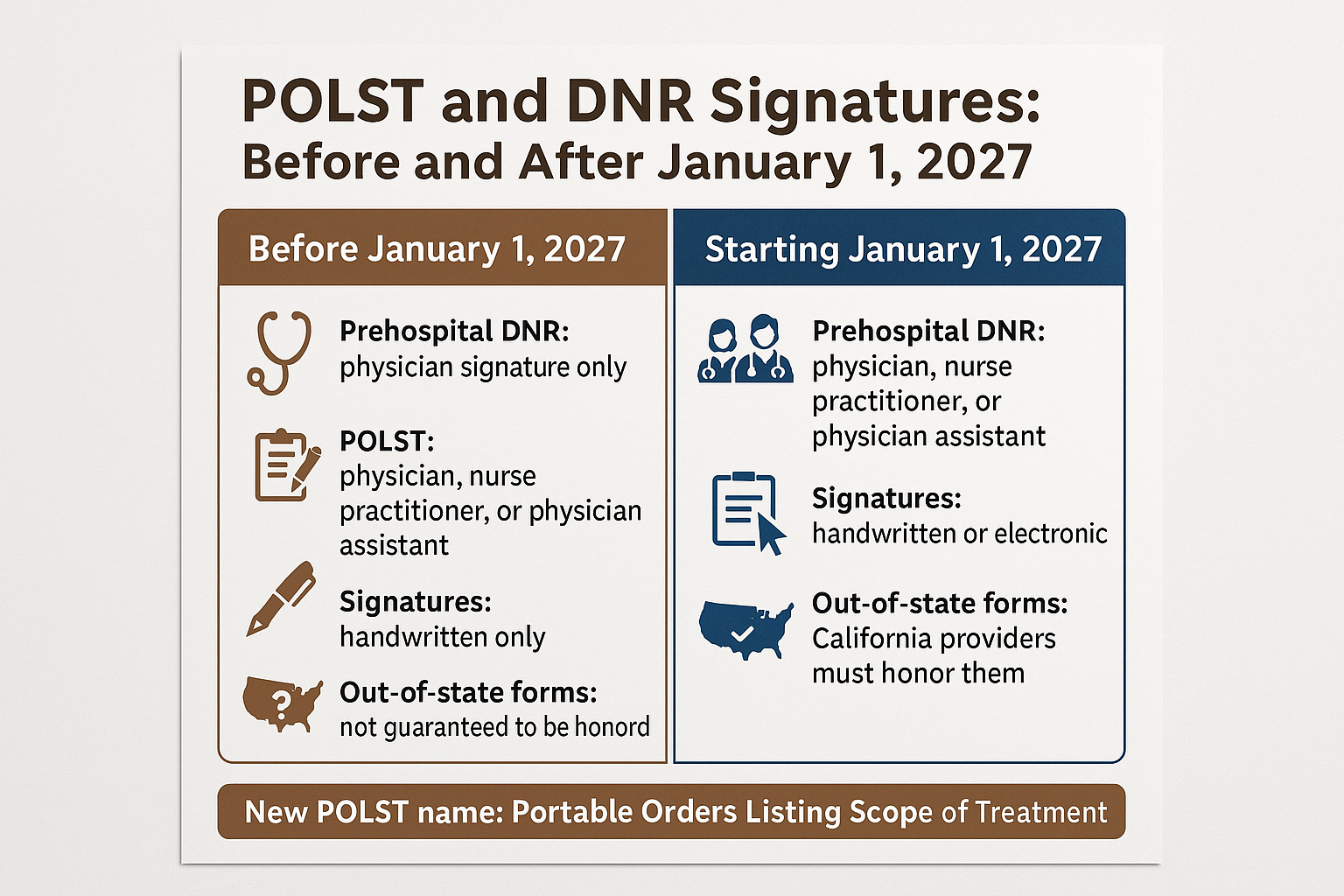
Who can sign what, before and after January 1
The signature rules are the piece most families get stuck on. This comparison shows what changes.
If your parent moved here from another state
This part of SB 1088 lands hard on the Monterey Peninsula. A good share of the people who retire to Carmel, Pacific Grove, and Monterey spent their working lives somewhere else, and adult children often move a parent out here from Ohio, Texas, or Florida after a health scare.
Until now, an out-of-state DNR or POLST sat in a gray zone. A family would arrive with a green Oregon form or a yellow New York form, and nobody could promise how it would be treated by responders or an emergency department here.
As of January 1, 2027, California providers are required to honor POLST and DNR forms executed in other states. Hospice News reported on the bill as it moved through the Legislature, and this continuity piece was the headline change.
Two practical notes anyway:
- Keep the original out-of-state form. Do not throw it away just because you got a California one.
- Still consider completing a California POLST at the next appointment. A form in the familiar format gets recognized faster at Community Hospital of the Monterey Peninsula, Salinas Valley Health, or Natividad, and in the back of an ambulance on Highway 68.
The new rule protects you. A California form just removes a half-step of hesitation.
What happens at the door when paramedics arrive
One visitor to our site asked about “the colored paper form paramedics ask about if it isn’t a DNR.” That is the POLST, and in California it is usually printed on bright pink paper so it is easy to spot in a hurry.
Paramedics are not going to open a filing cabinet. They look where forms usually live, which is why the fridge door, the bedroom wall near the bed, or a folder by the front door are the right places for it.
A few things that make the form work when it counts:
- Keep the original or a clear copy visible, not in a safe deposit box in Salinas
- Give a copy to the primary physician so it lives in the chart
- Put a copy in the bag that travels with your parent to appointments
- Make sure whoever stays overnight knows where it is and what it says
That last point gets skipped. If a family member is sitting with your mom at 3 a.m. and cannot find the form or does not know the wishes, the default is full resuscitation.
And a form is not a plan for everything. When something shifts at home overnight, you still need to know who to call after hours before anyone dials 911 by reflex.
Where this fits with hospice and palliative care paperwork
Families enrolling in hospice or palliative care already get handed a stack of documents, and a POLST conversation often happens in the same week. They are not the same thing.
Hospice enrollment paperwork covers what the hospice benefit pays for and how the care team works. The POLST covers what medical treatment a person wants if their heart stops or they stop breathing, no matter who is providing care.
If you want a sense of how dense that admission packet gets, the Medicare addendum explaining what hospice does not cover is a good example of a document that deserves a slow read instead of a quick signature.
A care team of nurses, therapists, social workers, chaplains, volunteers, and other clinicians can walk through a POLST with you, but the signature has to come from a physician, nurse practitioner, or physician assistant who knows the patient. Starting January 1, that list is wider for the prehospital DNR too, which should cut down the wait when a physician is hard to reach.
Frequently Asked Questions About SB 1088 and California POLST Changes
Does my mom’s existing POLST expire on January 1, 2027?
No. SB 1088 does not void existing forms. A complete, signed POLST stays valid. Review it yearly and after any hospitalization or change in her condition, which is good practice regardless of the new law.
Can a nurse practitioner sign the DNR now instead of a doctor?
Starting January 1, 2027, yes. SB 1088 authorizes nurse practitioners and physician assistants/associates to sign the prehospital DNR, not just physicians. For POLST, NPs and PAs could already sign in California, which is part of why the form’s name changed.
What is the new POLST name and do I need a new form because of it?
POLST now stands for Portable Orders Listing Scope of Treatment instead of Physician Orders for Life Sustaining Treatment. It is a name change, not a new document, and it is not a reason by itself to re-sign.
We moved here from out of state. Will Monterey County paramedics follow our old form?
As of January 1, 2027, California providers are required to honor POLST and DNR forms executed in other states. Keep the original. Completing a California version at the next appointment is still worth doing, since the familiar pink form gets recognized faster in an emergency.
What does a POLST cost?
The blank form is free and California does not charge a filing fee. The appointment where you complete it with a provider is typically billed like any other visit, and Medicare, Medi-Cal, and VA coverage apply as usual. Ask the office what to expect before the visit.
Is a POLST the same as an advance health care directive?
No. An advance directive names who speaks for you and describes your general wishes. A POLST is a set of actual medical orders that paramedics and hospital staff follow immediately. Many people benefit from having both.
Sorting out the paperwork for a parent on the Central Coast
Advance care planning forms are easier to handle before a crisis than during one, and most families in Monterey County only need one clear conversation to feel settled about them. Central Coast VNA & Hospice has been supporting families here since 1951, and a care coordinator can talk through how a POLST fits with home health, palliative, or hospice care at 831-372-6668. No pressure, just a straight answer to whatever you are stuck on.