
Direct Answer: Complicated grief is when mourning doesn’t ease over time — it intensifies or stays frozen. It’s not weakness. It’s a real condition that responds to the right kind of support.
Most people expect grief to follow some kind of arc — hard at first, then slowly lighter. But for many families in Monterey County, that arc never comes. Instead, the loss stays as raw at six months as it did the first week. Or it goes quiet for a while, then returns with a force that feels impossible to explain.
This is complicated grief — sometimes called prolonged grief disorder — and it affects roughly 10 to 15 percent of people who experience a significant loss. It’s not a sign that someone loved too much or is too fragile to cope. It’s a recognized condition, and it looks different from ordinary mourning in ways that matter.
If you’re caring for an aging parent on the Monterey Peninsula, managing your own health while grieving, or supporting a family member who hasn’t seemed like themselves in over a year — this article is for you. Understanding what complicated grief actually is, and what separates it from the normal pain of loss, is the first step toward finding real support.
What Makes Grief “Complicated”
Grief is painful for everyone. But typical grief, even when it’s intense, tends to shift over time. There are good days mixed with hard ones. The person can still function — work, connect with others, find moments of meaning.
Complicated grief doesn’t shift. It stays concentrated. The pain doesn’t soften — it either holds at the same level or gets worse. Daily life becomes difficult to manage, sometimes for a year or longer.
Clinicians look for a specific cluster of experiences to distinguish complicated grief from normal mourning:
- Intense longing for the person that doesn’t ease over time
- Difficulty accepting the reality of the loss, even months later
- Bitterness or anger about the death that feels unresolvable
- Feeling like part of yourself died along with the person
- Pulling away from other relationships and activities you used to care about
- A sense that life has no meaning or purpose without that person
- Difficulty imagining a future
Not everyone experiences all of these. But when several of them persist past the six-month mark and are interfering with daily life, that’s when the term complicated grief becomes clinically meaningful — and when professional support is worth seeking.
As grief support specialists note, grief that intensifies rather than softens over time often signals that someone needs more than time alone to heal.
Why Some Grief Gets Stuck — and Who’s Most at Risk
There’s no single reason complicated grief develops. But research points to a few factors that make it more likely.
The nature of the loss matters a great deal. Sudden deaths — accidents, unexpected cardiac events, a quick decline from a diagnosis that wasn’t caught early — leave survivors without any time to prepare. There’s no goodbye, no chance to say what needed to be said. Families who cared for a loved one through a long illness sometimes face the opposite problem: they’ve been grieving in pieces for years, and when the death finally comes, the loss feels complicated by exhaustion, guilt, and relief all at once.
Losing a spouse or a child carries a particular weight. So does losing someone with whom you had a complex relationship — one marked by unresolved conflict, estrangement, or dependency. These losses leave things unfinished in a way that ordinary grief doesn’t.
Certain personal factors also increase risk:
- A personal or family history of depression or anxiety
- Previous significant losses, especially in childhood
- Limited social support — living alone, having few close relationships
- Being the primary family decision-maker during a loved one’s illness and death
- Financial stress tied directly to the loss
For families in Monterey County — where many older adults live alone in Salinas, King City, or the more rural parts of the county — social isolation is a real issue. The distance from support systems can make grief harder to move through, especially in communities where there’s still stigma around asking for help with mental or emotional health.
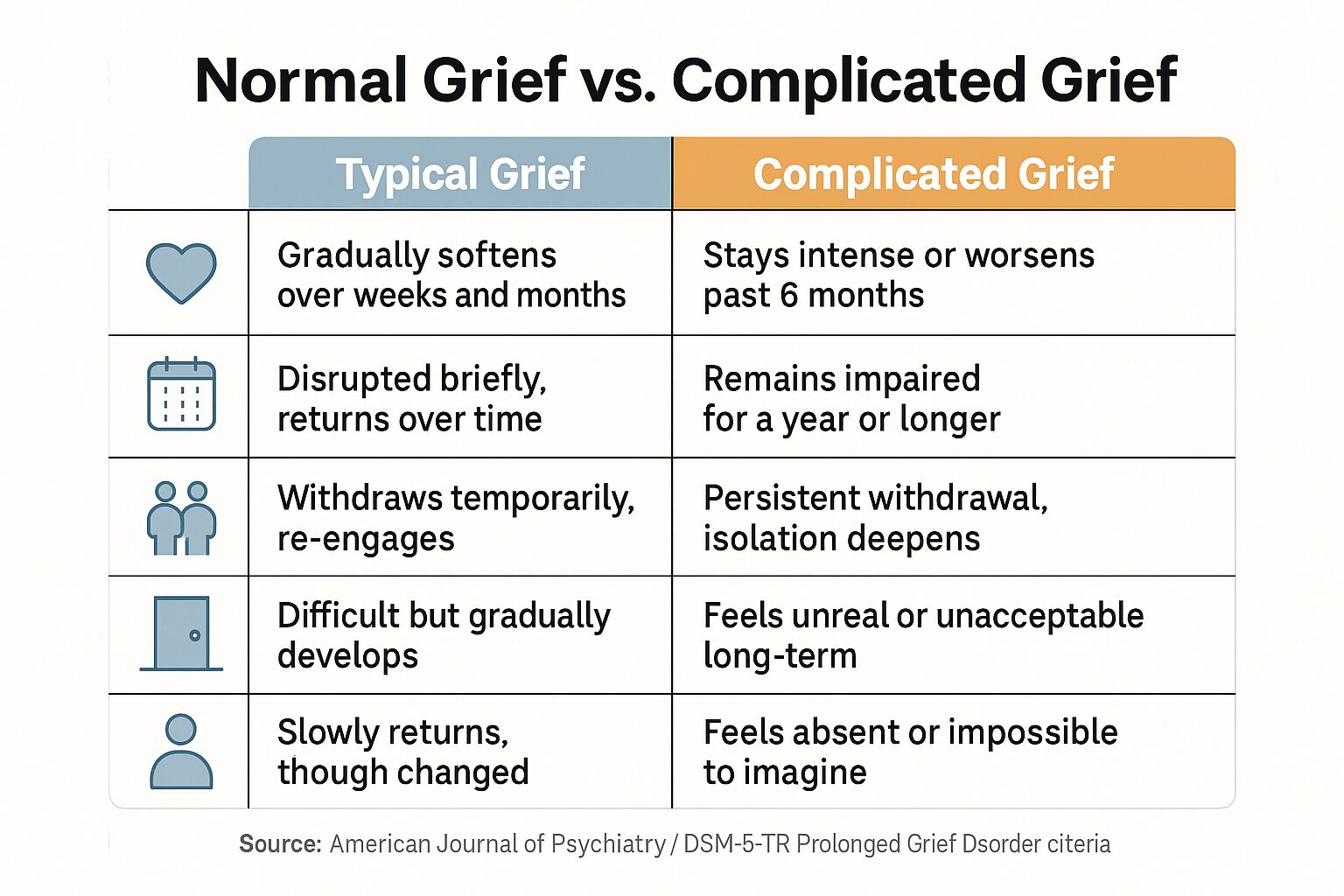
Normal Grief vs. Complicated Grief: Key Differences
This side-by-side comparison shows how typical mourning and complicated grief differ across the most important markers families and clinicians watch for.
What Complicated Grief Actually Feels Like From the Inside
People in complicated grief often don’t describe their experience as “grief.” They describe feeling broken, or like they’re living in a fog. Some say they can go through the motions of daily life but feel completely detached from it — like they’re watching themselves from a distance.
Others describe an inability to stop replaying the death itself. The final days in the hospital. The last conversation. What they did or didn’t say. This kind of rumination isn’t the same as remembering and honoring someone — it’s more like being trapped in a loop that won’t release.
A few things families should watch for in a loved one:
- Refusing to change anything in the deceased person’s room or belongings more than a year after the death
- Avoiding all reminders of the person, to the point that it limits their life
- Talking about death or not wanting to be alive — this requires immediate attention
- Significant weight loss, poor sleep, or physical health decline with no medical explanation
- Expressing that grief feels like a form of loyalty — that getting better would mean forgetting
That last one is worth sitting with. Many people in Monterey County and surrounding communities — families with deep cultural roots in Salinas or Hollister, older widows and widowers living alone on the Peninsula — carry a belief that staying in grief is how they stay connected. Understanding that healing doesn’t mean forgetting is often one of the most important shifts that bereavement support can offer.
For families trying to understand what support can look like in practice, this guide on what grief support actually helps explains it plainly.
Types of Support for Complicated Grief — What to Expect
Different approaches to grief support work differently depending on the person and the situation. Here’s a general overview of the main options families explore.
| Type of Support | What It Involves | Best Suited For |
|---|---|---|
| Individual grief therapy | One-on-one sessions with a therapist trained in loss and bereavement | People with significant daily impairment, trauma around the death |
| Complicated Grief Treatment (CGT) | A structured 16-session therapy developed specifically for prolonged grief disorder | People who haven’t responded to standard counseling |
| Bereavement counseling | Emotional support and guidance from a bereavement specialist, often less clinical | People who need a consistent, compassionate presence and someone to talk to |
| Support groups | Facilitated group setting with others who’ve experienced similar losses | People who feel isolated and benefit from shared experience |
| Medical evaluation | Assessment by a physician or Nurse Practitioner for depression, anxiety, or sleep issues | When physical symptoms (weight loss, insomnia) are prominent |
| Spiritual care | Conversations with a chaplain or spiritual advisor about meaning, loss, and faith | People for whom spiritual meaning is central to processing loss |
When Complicated Grief Follows a Hospice Loss
Families who’ve been through hospice sometimes assume that because the death was expected — because there was time to prepare — grief should be more manageable. But that’s not how it works.
Caring for someone through the end of their life is physically and emotionally exhausting. By the time the death comes, many family members are already depleted. The grief arrives on top of that exhaustion, and there’s no runway left. Some people don’t feel the full weight of the loss until months later, once the practical demands of settling an estate, notifying everyone, and handling logistics have finally quieted.
Others carry guilt — about decisions made during the illness, about moments of impatience or frustration during caregiving, about choosing hospice in the first place. Families who’ve wondered whether they made the right call can find some grounding in reading how other families describe the moment they chose hospice — the doubt is more common than most people realize.
This is exactly why bereavement support doesn’t end with the death. A good hospice program continues to support surviving family members — through bereavement specialists, check-in calls, and access to counseling — for at least 13 months after a loved one passes. That’s not an arbitrary timeframe. It’s designed to cover all the “firsts”: the first holidays, the first birthday, the first anniversary of the death.
If you’re a year or more out from a hospice loss and still struggling significantly, that’s not a sign you’re grieving wrong. It may be a sign that complicated grief developed, and that more focused support could help.
Frequently Asked Questions About Complicated Grief
How do I know if what I’m feeling is complicated grief or just normal sadness?
The clearest marker is time and function. Normal grief is painful, but it tends to allow you to live your life even while hurting. If you’re more than six months out from the loss and still finding it hard to work, connect with people, or imagine the future — and if the pain hasn’t softened at all — that’s worth taking seriously. A conversation with a bereavement specialist or your doctor is a good first step.
Is complicated grief the same as depression?
They overlap but aren’t the same thing. Depression is a broader condition affecting mood, energy, and function in many areas of life. Complicated grief is specifically anchored to the loss — the yearning, the inability to accept, the sense that life can’t go on without that person. Someone can have both at the same time, which is why a medical evaluation alongside grief support is often recommended.
My father lost my mother two years ago and still won’t leave the house or talk about the future. What should we do?
What you’re describing — withdrawal, isolation, and difficulty imagining a future after two years — is a pattern that warrants a gentle but direct conversation, and possibly a referral to professional support. Try not to frame it as “you need help” and instead approach it as “I want to make sure you’re not carrying this alone.” A Medical Social Worker or bereavement specialist can often help families navigate this kind of conversation.
Does Medicare cover grief counseling or bereavement support?
Medicare covers bereavement services as part of the hospice benefit — meaning families of a hospice patient are entitled to bereavement support for up to 13 months after the death. Outside of a hospice context, standard Medicare does not typically cover stand-alone grief counseling, though Medicare Advantage plans vary. Medi-Cal may cover mental health services including therapy for grief-related conditions — it’s worth checking with your county’s behavioral health department.
Can children develop complicated grief too?
Yes. Children process loss differently than adults, and complicated grief in kids can look like behavioral changes, school problems, physical complaints, or regressive behavior — not just sadness. If a child in your family lost a parent or grandparent and hasn’t seemed like themselves for many months, a referral to a child therapist experienced in grief is worth pursuing.
Is there a specific treatment that works for complicated grief?
Yes — Complicated Grief Treatment (CGT) is a structured, evidence-based therapy developed specifically for prolonged grief disorder. It typically runs about 16 sessions and has strong research support. It’s different from standard grief counseling in that it uses specific techniques to help people process the loss and re-engage with life. Not every therapist is trained in CGT, so it’s worth asking specifically about it when seeking a referral.
You Don’t Have to Figure This Out Alone
Central Coast VNA & Hospice has been supporting families across Monterey County — from the Peninsula to Salinas to King City — through some of the hardest moments of their lives since 1951. If you or someone you love seems stuck in grief long after a loss, speaking with a bereavement specialist can help clarify what’s happening and what kind of support might actually make a difference. You’re welcome to call 831-372-6668 or visit ccvna.com to learn more about bereavement support services available to families in our region.