
Direct Answer: The first holiday season after a loss is often harder than the weeks right after a death. The absence becomes sharply visible, and knowing that in advance can help families find support before the hardest moments arrive.
The weeks right after someone dies are often filled with motion. There are arrangements to make, people to call, paperwork to complete. Families move through that period with a kind of purposeful momentum that can feel, from the outside, like coping.
Then the holidays arrive. And the absence, which may have felt manageable in the busyness of early grief, suddenly fills the entire room.
For families across Monterey County, from the Peninsula to Salinas to Hollister, this pattern shows up every year without fail. It is not a sign that something has gone wrong in the grieving process. It is one of the most common and well-documented features of grief, and understanding it before the season hits can make a real difference in how families find their footing.
Why the First Holiday Hits Harder Than Families Expect
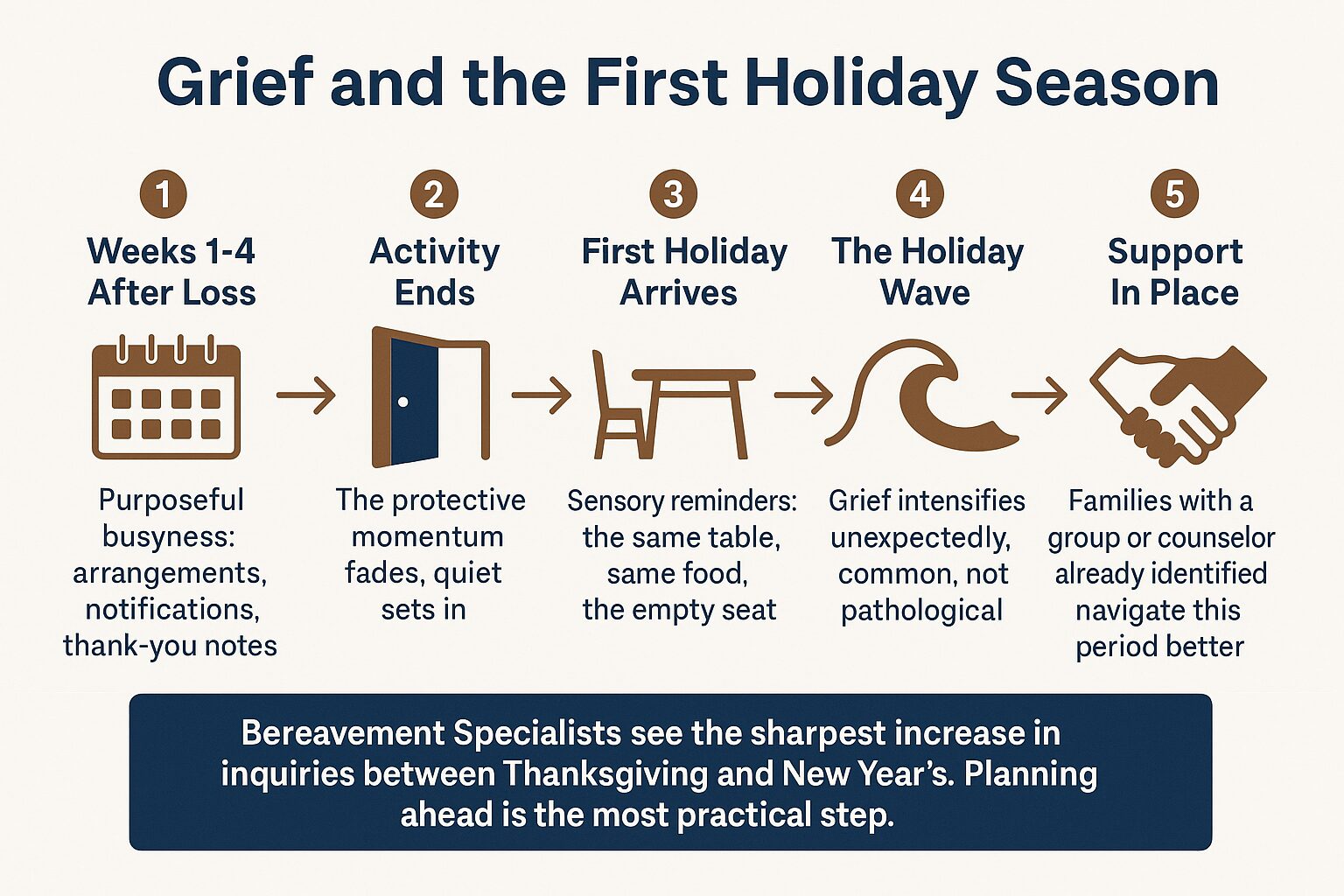
Grief researchers have long noted that the initial weeks after a death carry a kind of protective busyness. The practical demands of loss, the calls, the services, the thank-you notes, give the grieving person something to do with the enormity of what has happened.
When that activity ends and the first Thanksgiving, Christmas, or even a birthday rolls around, the absence can feel sudden and total. The holiday table, the family rituals, the food that was always made the same way, all of it becomes a sensory reminder of who is no longer there.
This is not pathological grief. It is a normal part of the grief timeline, and it is worth knowing it is coming before it arrives. According to research from the American Psychological Association, anticipating difficult grief moments and having support in place ahead of time is one of the most practical steps a grieving person can take.
For families who lost someone in the spring or summer, the holiday season may arrive when they feel they should be “past the hardest part.” That expectation can make the holiday wave feel even more disorienting when it comes.
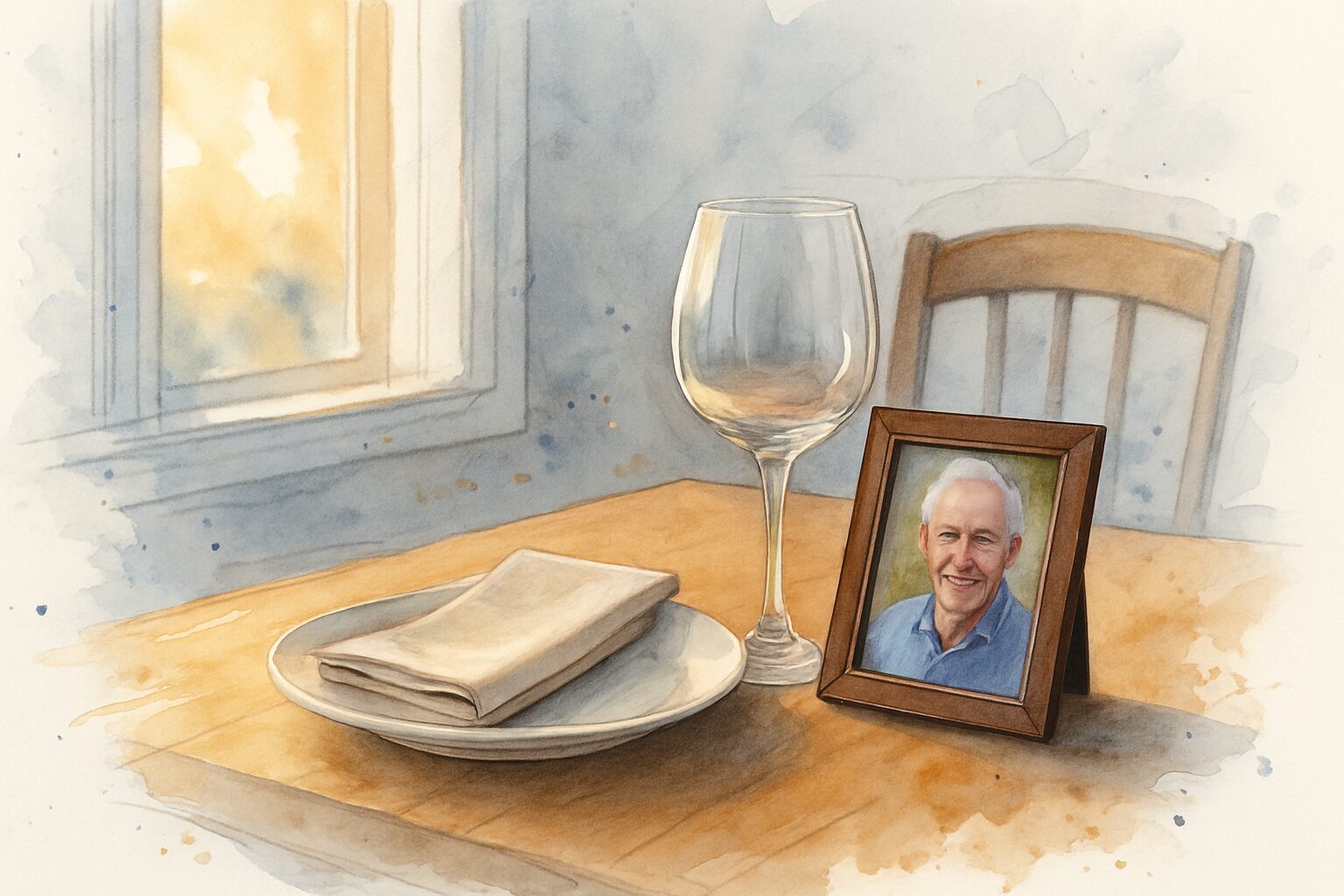
Spousal Loss and the Holiday Table
Not all grief moves the same way, and the holiday grief that surviving spouses experience often has a specific quality that is different from what adult children feel when mourning a parent.
Decades of shared ritual create a kind of sensory map. The same table. The same seat. The food that one person always made and the other always praised. When those rituals arrive without the person who made them meaningful, the loss can feel both immediate and total in a way that is hard to describe to someone who hasn’t lived it.
One Monterey woman submitted a message to a local bereavement program the day after her husband of 56 years died. Her message was direct and raw: she needed a local grief group, immediately. That kind of reaching out, in the earliest hours of loss, reflects something grief support professionals see often. The need for connection is immediate, even when the emotional capacity to reach out is barely there.
For surviving spouses specifically, grief support programs that address spousal loss tend to be more useful than general bereavement groups. The shared experience in the room matters. When the people around you have also lost a partner of many years, the conversations start at a different depth.
If you are an adult child helping a surviving parent plan for the holiday season, understanding what grief support after hospice actually looks like can help you find the right kind of help, not just the closest available option.
The Grief Timeline Around the Holidays
This overview shows how grief tends to shift in the weeks surrounding the first holiday season, and when families most often reach out for support.
Finding Support Before the Season Arrives, Not After
Grief counselors and Bereavement Specialists consistently note the same pattern: the sharpest increase in inquiries from grieving families arrives in the weeks between Thanksgiving and New Year’s. Many of those callers say the same thing, they thought they were managing fine.
The problem is that finding a local grief group or counselor in the middle of an acute grief moment is much harder than finding one in a calmer week. The emotional bandwidth required to research options, make calls, and get enrolled in a program is exactly what grief depletes.
For families in the Monterey Peninsula, Salinas, and Hollister areas, the practical advice is straightforward: identify your support resource before the holiday season, not during it. Get on the list. Attend once. Know where to go.
Bereavement support in Monterey County is not limited to families who used hospice services. Anyone who has experienced a significant loss, whether a loved one died at home, in a hospital, or in a care facility, can access grief counseling and group support. That access point is not always obvious to families who navigated a hospital death rather than a hospice program, and it is worth knowing the door is open.
You can read more about what is specifically available locally in this guide to finding grief support in Monterey County after a loss.
For families who are also managing a loved one’s ongoing health needs while grieving, the weight can compound quickly. Knowing when caring for an aging parent becomes more than you can do alone is a useful starting point if that is part of your situation.
Types of Grief Support and Who They Tend to Help
Different kinds of support serve different needs. This is a general overview, the right fit depends on the individual and what feels most useful.
| Type of Support | What It Involves | Best Fit For |
|---|---|---|
| Individual grief counseling | One-on-one sessions with a Bereavement Specialist or licensed counselor | People who prefer privacy or have complex grief histories |
| General bereavement group | Group sessions open to anyone who has experienced a loss | People who find connection with others helpful and have flexible schedules |
| Spousal loss group | Group sessions specifically for people who have lost a spouse or partner | Surviving spouses navigating the specific pattern of partner grief |
| Community bereavement programs | Support offered through local nonprofits, open to the broader community regardless of how care was received | Anyone who lost a loved one in a hospital, at home, or in a care facility |
What Grief Can Actually Look Like in the Weeks Around the Holidays
Grief does not always look the way people expect. Some of what families experience around the first holiday season can feel confusing, because it may not match what they think grief is supposed to be.
Common patterns include:
- Feeling fine for days, then being hit hard by a specific song, smell, or meal
- Dreading the holiday weeks in advance, then finding them more manageable than expected, followed by a harder week afterward
- Feeling guilty for laughing or enjoying any part of the holiday
- Anger or irritability that doesn’t seem tied to anything specific
- Physical symptoms, fatigue, poor sleep, changes in appetite, that arrive or worsen around the holiday period
- Difficulty being around the same family gathering without the person who is gone
None of these responses are wrong. And none of them mean that grief is “not progressing.” Grief doesn’t follow a schedule, and the holiday season has a way of making that very clear.
If grief starts to feel stuck, not just painful, but genuinely immovable over many months, that is worth a conversation with a counselor. There is a difference between grief that is hard and grief that has become complicated in ways that benefit from professional support. Understanding complicated grief can help families recognize when that line has been crossed.
Frequently Asked Questions About Grief Support During the Holidays
Do I have to have used hospice services to access bereavement support in Monterey County?
No. Bereavement support through community-based programs is open to anyone who has experienced a significant loss, regardless of how care was provided. If your loved one died in a hospital or care facility rather than through a hospice program, you can still reach out for grief counseling or group support.
When should I look for a grief support group, before or after the holidays?
Before, if at all possible. The weeks between Thanksgiving and New Year’s are when Bereavement Specialists see the sharpest increase in people reaching out. Having a resource already identified, even just knowing where to call, means it is there when you need it most, rather than having to search in the middle of a difficult moment.
Is it normal to feel like the holidays are harder than the days right after the death?
Yes, and it is more common than most families realize. The initial weeks after a loss often carry a protective momentum, things to do, people to contact. When that activity winds down and a holiday arrives, the absence becomes much more visible. This is a well-documented feature of grief, not a sign that something has gone wrong.
My surviving parent lost their spouse of many decades. Are there specific groups for that kind of loss?
Yes. Spousal loss groups focus specifically on the grief of losing a long-term partner, which has a different quality than grieving a parent or sibling. The shared experience in the room matters, conversations can start at a level of specificity that a general group may not reach. Ask when you call about bereavement resources whether a spousal loss group is available in your area.
What if I’m not sure whether what I’m feeling is grief or something that needs clinical attention?
A conversation with a Bereavement Specialist is a good first step. They can help you understand whether what you are experiencing is part of a normal grief process or whether it might benefit from a more structured clinical response. You do not need to have a diagnosis or a crisis to make that call, it is what the support is there for.
Finding Support in Monterey County Before the Season Hits
Central Coast VNA & Hospice has been supporting grieving families across Monterey County, Salinas, Hollister, and surrounding communities since 1951. In 2025 alone, the bereavement program extended support to more than 2,200 individuals, many of them people who had not used hospice services but needed a place to turn. If you or someone you love is approaching the first holiday season after a loss, a Bereavement Specialist can help you understand what is available and whether a group or individual counseling might be the right fit. You can reach the care team at 831-372-6668 or visit ccvna.com to learn more.