
Direct Answer: Ask whether the provider is Medicare-certified, nonprofit or for-profit, who staffs the 24/7 line, which team members will visit, and how long they have served Monterey County.
The moment usually arrives on a hard day. A physician sits down with your family and explains that treatment is no longer working, and someone hands you a name and a phone number for hospice.
Most families accept that first name. It feels like the only option, and nobody has the energy to shop around. But a referral from a discharge planner or a physician is a starting point, not a vetted recommendation.
This guide walks through the questions families in Monterey County can ask in a single phone call. Six steps, each with a concrete answer you can actually judge.
Step 1: Treat the referral as one option, not the decision
Hospital discharge planners at hospitals across the Monterey Peninsula and Salinas Valley are doing their job, and they are usually doing it fast. They pass along providers who are in-network and accepting patients.
That list is not a quality ranking. You are allowed to ask for more than one name, and you are allowed to call a provider your family found on its own.
Here is what to do before you say yes to anyone:
- Ask the discharge planner for two or three hospice names, not one
- Ask whether the hospital has any financial relationship with the provider
- Write down the questions in this guide and ask each provider the same ones
- Give yourself 24 to 48 hours if the clinical situation allows it
One more practical note for families in King City, Greenfield, or out toward Big Sur: ask directly whether the provider actually staffs your area. Several callers each month learn mid-conversation that a provider’s map stops well short of their driveway. Coverage on paper and a nurse who can reach you in 40 minutes are two different things.
Step 2: Ask if they are Medicare-certified, and whether they are nonprofit
Start with Medicare certification. Every legitimate hospice serving Monterey County is certified, so this is a floor requirement rather than something that sets a provider apart. If a provider hesitates on this question, end the call.
You can verify certification and see patient survey results yourself through Medicare’s Care Compare tool, which lists hospices by ZIP code.
The more revealing question is the funding model. Nonprofit hospice organizations return their resources to patients and the community. For-profit hospices answer to investors.
That difference shows up in ordinary ways: staffing ratios, how long a nurse stays in the room, whether a Chaplain drives to Carmel Valley at 10 p.m. because it is the right thing to do.
California has also seen a real problem with fraudulent hospice operations, mostly concentrated in Southern California but worth understanding anyway. If you want the background, read about California’s hospice fraud crisis.
A quick safety note families here have raised: a legitimate provider will never ask for personal or financial details before an in-person assessment is scheduled. If someone shows up unannounced claiming to represent a hospice, call the agency’s main number and confirm.

Step 3: Make them name every person on the team
Hospice is not one nurse who visits twice a week. A credible program should be able to name each member of the interdisciplinary team without pausing to think about it.
Ask who will actually come to the house. The full team should include:
- Registered Nurses for pain and symptom management
- Hospice Aides for bathing, grooming, and personal comfort
- Medical Social Workers for paperwork, benefits, and family conflict
- Chaplains for spiritual support, regardless of faith or lack of one
- Bereavement Specialists for the months after a death
- Volunteers who sit with patients so family members can sleep or run errands
If a provider is vague about Chaplain availability, or does not bring up bereavement follow-up on their own, treat that as a real gap. Families across Monterey County have been caught off guard by programs that sent a nurse but had no one else behind her.
Ask how often each person visits, and ask whether visit schedules are set in advance. Inconsistent, unannounced arrivals are one of the most common complaints families raise about hospice care anywhere, and a provider who cannot describe a schedule probably does not keep one.
Step 4: Ask what happens at 2 a.m.
This is the single most useful question on the list, because the answer is concrete and easy to judge.
Ask it plainly: if my mother has a pain crisis at two in the morning, what happens?
A solid answer sounds like this. You call one number, a clinician answers, and that person can either talk you through a medication adjustment or send a Registered Nurse to the house that night.
A weak answer sounds like this. An answering service takes a message, and someone calls back during business hours.
Follow up with:
- Is the after-hours line staffed by a nurse or by a message service?
- How long does a night visit typically take to arrive in my area?
- Who covers weekends and holidays?
- What medications will already be in the house for a crisis?
Nights are when families feel most alone. A provider that has thought this through will answer in fifteen seconds without checking with a supervisor.
Six Questions and What the Answers Should Sound Like
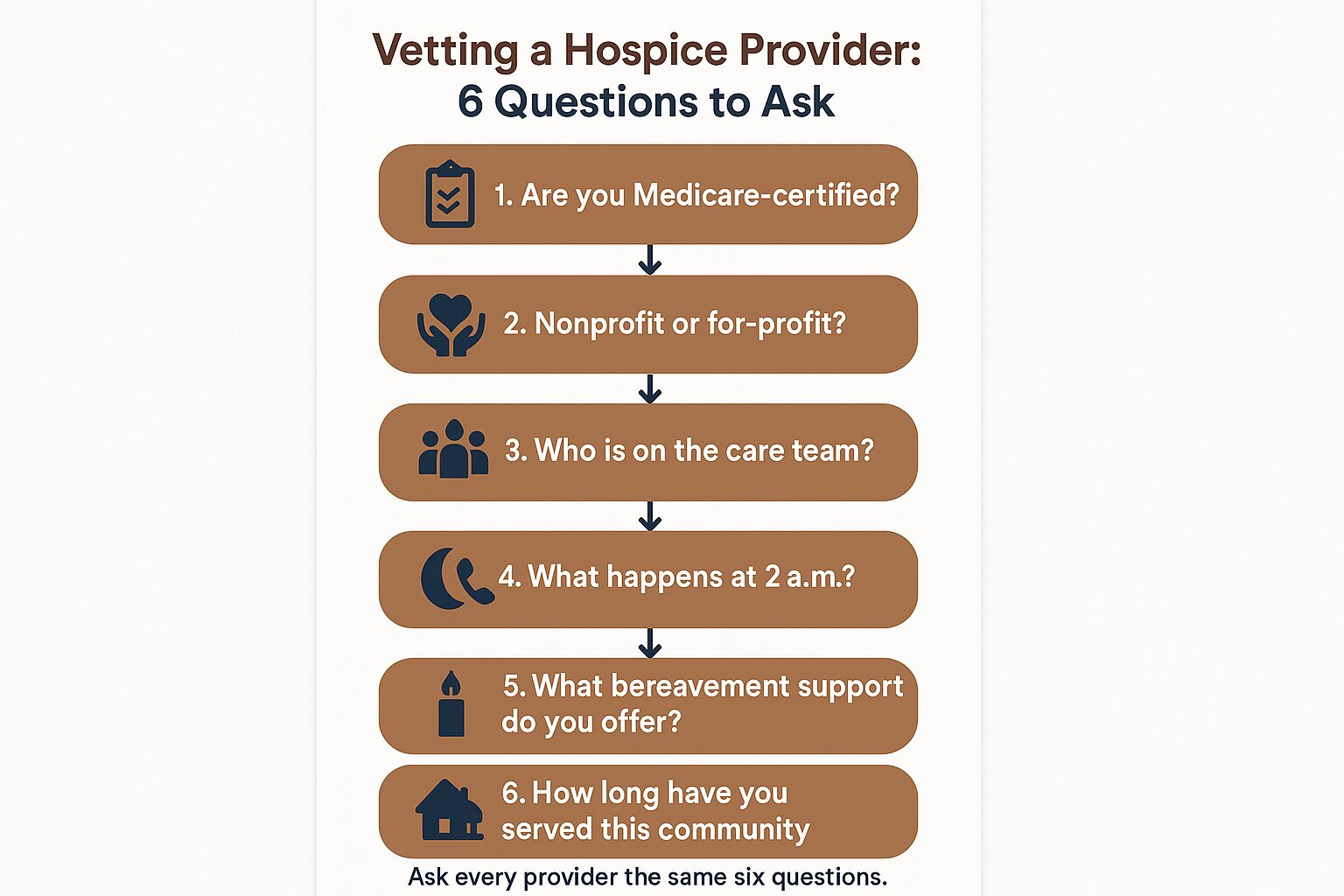
Use this as a phone script. Ask every provider the same questions and compare the answers side by side.
| Question to ask | A solid answer | A warning sign |
|---|---|---|
| Are you Medicare-certified? | Yes, with a certification number they will share | Hesitation or a vague yes |
| Nonprofit or for-profit? | A direct answer either way, with an explanation | Deflection or confusion |
| Who is on the care team? | Names every role, including Chaplain and Volunteers | Only nurses are mentioned |
| What happens at 2 a.m.? | A 24/7 clinical line that can dispatch a nurse | An answering service takes a message |
| What does bereavement look like? | Months of support, groups and one-on-one counseling | A single follow-up phone call |
| How long in this community? | A specific number of years and local references | Recently opened, no local history |
The Six-Question Vetting Call at a Glance
Print this or keep it on your phone. The whole conversation takes about fifteen minutes per provider.
Step 5: Ask about grief support before you think you need it
Bereavement is the part families skip during the vetting call and regret skipping six months later.
Ask what happens after your loved one dies. Real grief support means ongoing counseling and support groups over a period of months, not one sympathy call and a mailed pamphlet.
A second question worth asking: does the provider offer grief support to people in the community who were never hospice patients? A steady stream of calls comes in from Monterey and Pacific Grove residents who lost a spouse through a different provider and have nowhere to turn afterward. One recent message came from a woman whose husband of more than fifty years had died the day before, asking simply for a group she could attend nearby.
Providers who keep the door open to the wider community tend to be more invested in the whole family experience. If you want a sense of what this looks like in practice, here is what grief support after hospice actually involves.
Step 6: Check local history, because reputation here is evidence
The Monterey Peninsula is small. A provider’s actual record travels through churches, senior communities, and physician offices faster than any marketing campaign.
A hospice that has operated continuously in Monterey County, San Benito County, and the surrounding communities for decades leaves a trail you can follow:
- Ask your loved one’s primary physician which programs they trust
- Ask neighbors and friends who have been through it recently
- Check licensing and complaint history through the California Department of Public Health
- Read reviews, including the critical ones, and see whether the provider responds
Read negative reviews carefully rather than dismissing them. A pattern of complaints about scheduling or communication tells you something. A single hard review with a thoughtful reply tells you something different.
Also be clear on what you are actually choosing. Many families call about hospice when what they need right now is home health or palliative care. If that line is still blurry, this comparison of home health and hospice sorts it out, and the eligibility question most families are afraid to ask covers timing.
Frequently Asked Questions About Choosing a Hospice Provider
Do we need a doctor’s order before hospice can start?
Yes. Hospice requires a physician certification that the illness is expected to run its course within about six months if it follows its usual path. This is the step that surprises families most often and the one that delays admission. You can call a provider first and start the conversation while the order is being arranged.
Does Medicare cover hospice, and what does it actually pay for?
The Medicare hospice benefit generally covers the care team’s visits, medications related to the terminal illness, medical equipment such as a hospital bed, and supplies. Small copayments can apply to some outpatient prescriptions and inpatient respite stays, and coverage details vary by situation. Medi-Cal and Veterans benefits also cover hospice. Ask any provider you call to walk you through the specifics for your loved one.
Can we switch hospice providers if it is not working?
Yes. Medicare allows you to change hospice providers once during each benefit period, and doing so does not end the benefit. If visits are inconsistent, calls go unanswered, or the team is not a fit, you are not stuck.
How quickly can hospice start after a hospital discharge?
Often within a day or two once the physician order is in place, and sometimes the same day for urgent situations. When you call, say plainly that the patient is being discharged and needs someone at the house. That changes how the intake conversation is handled.
Does hospice mean we are giving up on treatment?
No. Hospice shifts the goal from curing the disease to caring for the whole person, including pain relief, emotional support, and spiritual care. Families often describe it as the point where their loved one finally got comfortable. If curative treatment is still on the table, palliative care may be the better fit right now.
Questions About Hospice Care on the Central Coast?
If you are working through these questions for a parent or spouse in Monterey County, San Benito County, or South Santa Clara County, you are welcome to ask them of us the same way you would ask any other provider. Central Coast VNA & Hospice has served families here since 1951, and a care coordinator can talk through options, eligibility, and Medicare or Medi-Cal coverage without any pressure to decide. The number is 831-372-6668.