
Direct Answer: Children grieve in short bursts, moving in and out of sadness rather than mourning steadily. Grief often resurfaces weeks or months later as stomachaches, sleep trouble, clinginess, or anger at school.
A grandparent dies at home on a Tuesday. By Saturday the adults are still working through paperwork and casseroles, and the eight year old is on the couch playing a video game and laughing out loud.
Parents across Monterey County describe some version of that afternoon and quietly wonder what it means. It looks like the child is fine, or like the child never cared at all.
Neither is true. Children grieve in short bursts, and this piece covers what that looks like by age, which words actually help, and where grief support for children is available locally, even for families who never used hospice.
Why children drop in and out of grief
Grief specialists sometimes describe it as puddle jumping. A child steps into sadness, feels it hard for ten minutes, then climbs back out and goes looking for a snack.
That pattern is normal developmental behavior, not avoidance. Young minds cannot hold a feeling that large for long stretches, so they take it in doses and come back to it later.
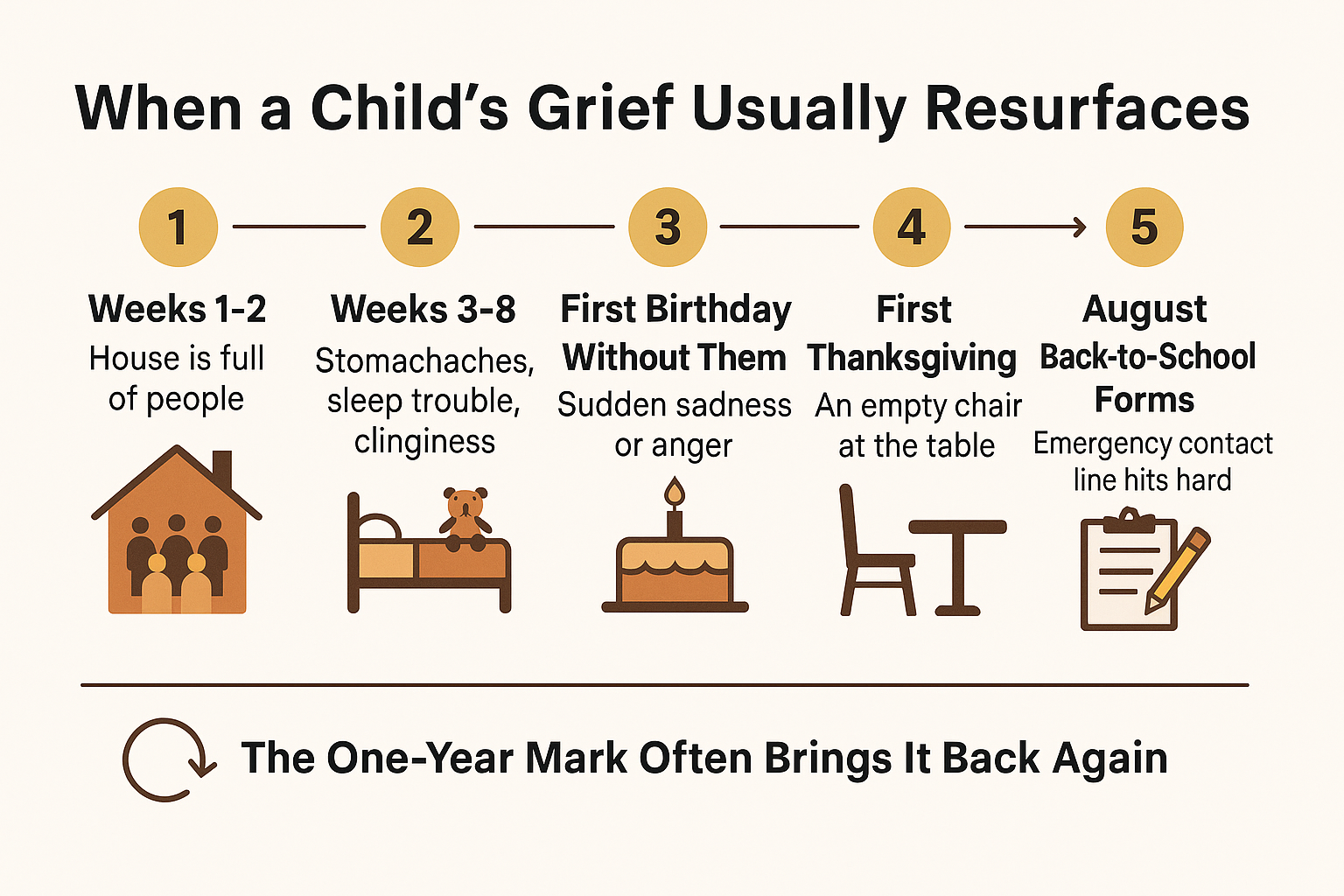
The delay is what catches families off guard. Sadness that never showed up in week one often arrives in week six, and it rarely arrives as tears. What parents on the Peninsula and in Salinas tend to notice instead:
- Stomachaches and headaches with no clear medical cause
- Sleep trouble, including refusing to sleep alone after months of sleeping fine
- Clinginess at school drop-off from a kid who was independent before
- Sudden anger at school, on the field, or over something small at home
- Going completely quiet about the grandparent, then asking one blunt question at bedtime
Federal health guidance on grief and bereavement makes the same point. A child’s response tracks with their age and with what they understand about death, not with how much they loved the person who died.
What grief looks like at each age
This is the single most useful thing a parent can read, because a five year old and a fifteen year old are having two completely different experiences in the same house.
Children under about six usually think death is reversible. They will ask when Grandma is coming back, and they will ask again next week, and that repetition is how they process it rather than a sign you explained it badly.
Elementary-age children get literal and worried. They ask mechanical questions about the body, about what happens at the cemetery, and often about who else in the house might die next.
Teenagers grieve sideways. They pull toward friends and away from the family, and many of them hide how deep it goes on purpose, because they can see a parent who is already struggling and do not want to add to it.
A quick reference by age band
Use this as a starting point, not a rulebook. Kids move between bands depending on how close they were and how much of the illness they saw.
| Age | What families often see | What tends to help |
|---|---|---|
| Under 6 | Repeated questions about when the grandparent is returning; regression in sleep or toileting; play that acts out the death | Direct, plain words repeated calmly as often as asked; steady routines; permission to play |
| 6 to 12 | Literal questions about the body; worry about who dies next; stomachaches; trouble concentrating at school | Honest, simple facts; reassurance about who will care for them; a teacher who knows what happened |
| 13 to 18 | Pulling toward friends, irritability, hidden sadness, protecting the parent by acting fine | Low-pressure presence, rides and food instead of talks, an adult outside the family they can open up to |
The words that confuse kids most
Most of the damage here comes from kind, well-meaning phrases. Young children take language at face value.
“We lost him” can leave a six year old genuinely worried about getting lost. “She went to sleep” can turn bedtime into a fight for months. “He passed on” raises the obvious question of passed on to where, and when he comes back.
What works better is plainer and more repetitive than adults expect:
- Use the real words: died, death, body stopped working
- Name the cause simply, at the child’s level, so they do not invent a scarier one
- Say clearly that nothing the child did or said caused it
- Answer the same question the tenth time as patiently as the first
- Let them see you sad, then show them you are still functioning
One calm sentence repeated over six weeks does far more good than one perfect conversation.
Whether to bring a child to the bedside or the service
Families agonize over this one, and there is no answer that fits every child. But there is a reliable process.
Describe what will happen in concrete detail first. Who will be in the room, what the hospital bed looks like, whether the grandparent will be awake, that there may be crying, how long it will last, and that they can leave any time they want.
Then offer the choice and accept the answer. A child who is told the truth and given a real option usually chooses well, and a child who is pushed into a room they were not ready for remembers being pushed.
If they say no to the bedside or the funeral, give them another way in. Drawing a picture to be placed in the casket, choosing a photo for the table, or lighting a candle at home all count.
When the hard stretch usually lands
The first two weeks are rarely the hardest part for a child. Here is the timeline families tell us surprised them.
On the Central Coast, many kids live where the care happened
Multigenerational households are common across Salinas, Greenfield, King City, and Hollister, and Monterey County is roughly 62 percent Hispanic. For a lot of children here, the grandparent was not in a facility an hour away. The grandparent was down the hall.
That means these kids watched the hospital bed come through the front door. They saw nurses and therapists arrive on a schedule, heard the adults talking in the kitchen, and absorbed far more of the illness than anyone realized.
That closeness can be a real gift when a child is given a small, honest job. Carrying a blanket in, filling a water cup, sitting nearby with a book, or picking the music that plays in the room.
It becomes destabilizing when nobody explains what is happening in words the child can hold. If your household runs in two languages, the same rule applies in both, and the questions Spanish-speaking households ask first often include exactly this one.
Tell the school, even if your child seems steady
Behavior changes at school are usually the earliest signal, and they show up as discipline problems before they show up as sadness.
A short email to the teacher and the school counselor is enough. Worth including:
- Who died, when, and what words your family is using at home
- Whether the child was present during the illness or at the death
- Specific dates likely to be hard, like a birthday or the anniversary
- What you would like the school to do if the child gets upset in class
- Your preference on whether classmates are told
Ask the counselor to loop back to you if anything shifts, even something small like skipped lunches or a sudden drop in homework. Teachers in Monterey County districts see this more often than parents assume, and they generally respond well to being told early.
Grief support for children is not just for hospice families
Several families in Monterey County reached out this year asking specifically about grief help for a child, and many were surprised that bereavement support exists outside of end-of-life care at all.
One person who had recently moved to the Carmel area wrote in with nothing more than a question about whether there was a grief group nearby. Another Monterey resident wrote in simply to suggest that more local groups be offered, not for themselves, but because they had seen the need in the community.
Here is the plain answer. Grief counseling in this region is not reserved for families who used hospice, and a parent can ask about support for a child with no prior connection to any care team.
What that support usually looks like locally:
- A conversation with a Bereavement Specialist about what is normal for your child’s age
- Medical Social Workers who can point you toward child and teen resources
- Chaplains for families who want spiritual support included
- Trained Volunteers who support families alongside the nurses, therapists, and other clinicians who deliver care at home
- Group options in the region, which vary in schedule and location
Community grief programs in this area are frequently offered at no charge or on a donation basis through nonprofit providers, but that varies by program, so it is worth asking directly what applies to yours. If you are also carrying your own grief, that is a separate subject covered in when mourning feels stuck and in the first holiday season after a loss.
Frequently Asked Questions About Grief Support for Children
My child laughed an hour after the funeral. Should I be worried?
No. That is the burst pattern doing exactly what it does. Children step out of grief to recover, then step back in later. Watch the next two months for sleep changes, stomachaches, or anger, which is where the grief usually reappears.
Do we have to have used hospice to get grief support for a child?
No. Bereavement support in this region is open to anyone in the community who is grieving, including families who never received home health or hospice care. You can call and ask questions without any prior connection.
My teenager will not talk about it at all. What do I do?
Stop aiming for a conversation and aim for proximity. Drive them places, feed them, sit in the same room. Many teens also open up faster to an adult outside the family, so offering a counselor or group can work better than another talk with you. Get help sooner if you see withdrawal from friends, grades falling off, or any talk of self-harm.
It has been a year. Is it too late to ask for help?
Not at all. The one-year mark is one of the most common times grief resurfaces in children, and plenty of families reach out well after the death. Late is a normal time to ask.
Should I let my child see the grandparent’s body?
Describe what they will see in real detail, offer the choice, and accept the answer. Children who are told the truth and given a genuine option usually handle it fine. Children who are surprised or pressured tend to remember that part more than anything else.
Questions about grief support for a child in your family
Central Coast VNA & Hospice provides bereavement support to anyone in the community who is grieving, including families who never received care from the organization, and in 2025 that support reached more than 2,200 individuals across the Central Coast. Families in Monterey County with questions about grief support for a child are welcome to call 831-372-6668 or visit ccvna.com to ask what is available. There is no rush and no obligation in asking.