
Direct Answer: Staff take basic details, confirm your address and benefits, then schedule an evaluation visit. With a physician order in place, a nurse can often reach the house within 24 to 48 hours.
A doctor said the word hospice for the first time, or your mother is being discharged tomorrow and someone handed you a phone number. You are not comparing agencies or reading about care philosophies. You want to know one thing: when does a nurse actually come to the house?
That question has a real answer, and it is usually measured in hours or a day or two, not weeks. But the timeline depends on a few steps most families have never heard of until the moment they need them.
This walks through the sequence as it actually unfolds on the Central Coast, from that first phone call to what physically changes in the house by day two.
What Happens When You Call Hospice on Day One
The first call is short. Most last only a few minutes, and the person on the other end is gathering enough information to figure out whether services can start and how fast.
Expect to be asked:
- The city or address where the patient is living, since coverage areas have real boundaries
- The main diagnosis and the name of the doctor following it
- Whether the patient is at home, in the hospital, or in a rehab facility right now
- What insurance the patient carries, usually Medicare, Medi-Cal, a private plan, or Veterans benefits
- Who is at the house day to day, and who has authority to make decisions
That address question matters more than families expect. Roughly one in twenty calls to local agencies ends right there because the patient lives outside the service area, so it is worth naming the city first thing. Households in Greenfield, King City, Hollister, and Marina all sit at very different distances from Monterey.
And you do not need a referral in hand to call and ask questions. Many families lose two or three days waiting for paperwork they were allowed to ask about by phone the whole time.
The Physician Order: The Step That Stalls Families the Longest
About one in ten callers asks how the referral works, and many are surprised by the answer. A hospice agency cannot simply start care because a family requests it.
The sequence usually runs like this:
- A physician certifies that the prognosis meets hospice criteria, generally a life expectancy of six months or less if the illness follows its expected course
- The referral reaches the agency, often by fax or secure message
- Intake verifies the benefit, Medicare, Medi-Cal, private insurance, or VA coverage
- An evaluation visit gets scheduled, commonly within 24 to 48 hours once the order is in hand
On the Central Coast, most referrals do not come from the family at all. They come from a hospital discharge planner at a Monterey Peninsula or Salinas hospital, a dialysis center, a medical group, or a skilled nursing facility.
That is helpful, but it also means families sometimes call to ask whether their doctor’s referral has arrived yet. It is a fair question to ask directly, and worth asking twice if nobody has called you back.
If you are still sorting out whether hospice or home health fits the situation, After the Hospital Discharge, What Comes Next? and Home Health vs. Hospice: How Families Know Which One Fits Right Now lay out the difference in plain terms.

A Realistic First 48 Hours
Timing shifts with distance, the time of day the referral arrives, and how quickly the physician order clears. This is a common shape, not a promise.
| Timeframe | What usually happens | What the family can do |
|---|---|---|
| First call, 5 to 15 minutes | Intake gathers address, diagnosis, doctor, insurance, and decision maker | Ask what number reaches a nurse overnight and on weekends |
| Same day | Referral and physician order confirmed, benefit verified | Ask whether the doctor’s referral has actually arrived |
| Within 24 to 48 hours | Registered Nurse comes to the house for the evaluation visit | Have the medication bottles and insurance cards in one place |
| End of the evaluation visit | Election signed, written Medicare addendum reviewed, visit schedule set | Ask what is covered and what is not before signing |
| Day two | Comfort medications and equipment can arrive, team introductions begin | Write down which team member handles which question |
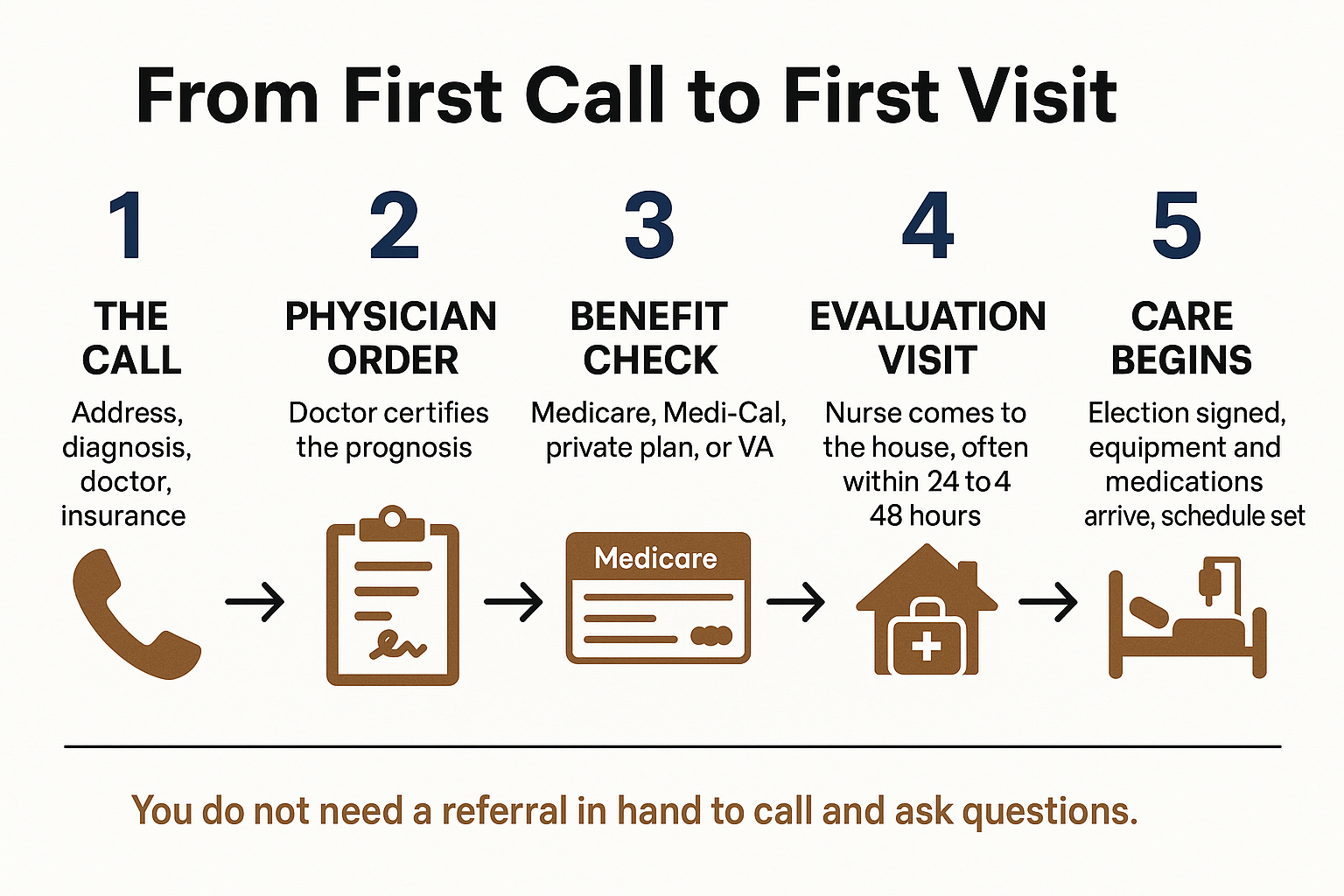
The Intake Sequence at a Glance
Five steps stand between a first phone call and a nurse at the kitchen table.
Inside the Evaluation Visit
This is the part families quietly dread, and almost nobody describes it ahead of time. A Registered Nurse comes to the house and sits down, usually for an hour or more.
The visit covers:
- The diagnosis and recent history, including the last hospital stay
- Every current medication, which is why it helps to gather the actual bottles beforehand
- What the patient wants the next few weeks to look like, in their own words
- What the hospice benefit pays for and what it does not
- Who else will be coming to the house, and how often
Under Medicare, hospice care related to the terminal illness is generally covered with little or no out-of-pocket cost, though plans and situations vary and the agency should verify your specific coverage.
You will also receive a written election statement addendum listing items and services the hospice will not cover. CMS finalized the FY 2027 hospice rule on July 30, 2026, making that document mandatory at every election. Read it at the table, not later. The new Medicare form families get explains what usually shows up on it.
One thing worth saying plainly: electing hospice is signed by the patient or their representative. A doctor can certify eligibility, but no one imposes this on your family.
Over the following days you will meet the rest of the team: nurses, therapists, social workers, chaplains, volunteers, and other clinicians. Ask for names and roles and write them down.
What Physically Changes in the House by Day Two
For most families, the open-ended waiting is the worst part. That is what ends first.
Within a day or so of the election, several concrete things can show up:
- A comfort medication supply kept at the house for pain, breathing, nausea, and agitation
- A hospital bed, often set up in a living room rather than a bedroom
- An oxygen concentrator, bedside commode, wheelchair, or walker
- A written visit schedule replacing the guesswork
About seven percent of calls to local agencies are families asking when the nurse will arrive and whether they can get an exact time. The honest answer is that agencies give arrival windows instead of appointments, because a clinician who finds a patient in crisis at the previous stop does not leave on schedule. Someday that will be your house, and you will want them to stay.
Distance shapes the window too. A household in Pacific Grove or Salinas and a household in King City or Hollister may see different first visit times purely because of drive distance across Monterey County. Ask about that on the first call.
Ask one more thing on that call: what number reaches a nurse at 2 a.m. and on Sunday. Knowing who to call after hours is the single piece of information families say they wish they had written on the refrigerator sooner.
One limit worth understanding now: hospice does not provide round-the-clock personal attendant care in the home. Families who hire private personal care help on the Central Coast often report costs running into the thousands of dollars per month, and a Medical Social Worker can point you toward IHSS and local options.
Calling to Ask Questions Is Not the Same as Choosing Hospice
Plenty of families hesitate on that first call because it feels like a decision they are not ready to make. It is not one.
For the first time, a majority of Medicare decedents, 53.1 percent in 2024, were enrolled in hospice at the time of death, the third year in a row that figure rose, according to the National Alliance for Care at Home. Hospice has become the ordinary choice, not the unusual one.
Asking what the benefit covers, whether a parent would qualify, or how long the drive is from Monterey to your mother’s house in Gonzales commits you to nothing. If eligibility is the part you are unsure about, the hospice eligibility question most families are afraid to ask covers it without the clinical language.
Why a Long-Established Local Agency Answers That Call Differently
There is a practical difference between an agency that has driven Highway 101 to King City for decades and one that has not. It shows up in how fast someone can tell you whether they cover your street and how honestly they describe the first visit window.
Central Coast VNA & Hospice has been answering these calls in Monterey County since 1951 and marks 75 years in 2026. Volunteers alone contributed nearly 40,000 hours in 2025, more than five percent of all direct hospice care.
One family put the value of steady contact simply in a public review: “I appreciate everything that was provided to us from information on how to cope with a deteriorating health situation to who to contact 24/7 if more assistance was needed.” That is usually what families remember, not the paperwork.
Frequently Asked Questions About Calling Hospice
Can I call before my doctor has written a referral?
Yes. You can call and ask questions with no referral and no commitment. Staff can explain eligibility, coverage, and service area, and can often coordinate directly with the physician’s office to get the order moving.
How fast can a nurse actually come to the house?
Once a physician order is in place and the benefit is verified, the evaluation visit is commonly scheduled within 24 to 48 hours. Afternoon referrals and longer drives to places like Hollister or King City can push that later, so ask for a realistic window on the call.
Does Medicare cover this, and what about Medi-Cal or Veterans benefits?
The Medicare hospice benefit generally covers care related to the terminal illness with little or no out-of-pocket cost. Medi-Cal and Veterans benefits also cover hospice for eligible patients. Coverage details vary by plan and situation, so have intake verify yours specifically before the first visit.
My mother was just discharged and we need help now. Is that too soon to call?
No. A hospital or rehab discharge is the most common reason families call, and it is the right moment to ask questions rather than wait until something goes wrong at home over a weekend.
Can services start before someone is at the end of life?
Yes, and many families do not realize it. Palliative care supports patients with serious illness while they continue treatment, and grief counseling is available to anyone in the community, not only families who used hospice.
Who signs the paperwork if my father cannot?
The patient signs the election, or their legal representative does if the patient is unable. Bring any power of attorney or advance directive documents to the evaluation visit so there is no delay.
Still Have Questions About the First Call?
If you are somewhere in the middle of this right now, with a discharge date coming and no clear next step, a care coordinator can walk you through the sequence for your own situation, including whether your address in Monterey County falls inside the service area. Central Coast VNA & Hospice can be reached at 831-372-6668, and asking questions carries no commitment of any kind.