
Direct Answer: A facilitator opens the meeting, sets a few ground rules, and people share at their own pace. You can give your first name and then listen. Nobody is required to speak.
The hardest part of a grief support group is not the hour inside the room. It is the parking lot, sitting in your car, wondering if you will be asked to say out loud what happened.
That fear keeps a lot of people on the Central Coast from ever walking in. They picture a circle of strangers turning toward them, waiting for them to narrate the worst week of their life.
So this article does one thing. It walks through what actually happens in the first hour, who these groups are open to, and the practical choices you get to make before you ever show up.
What Happens at a Grief Support Group, Minute by Minute
Most groups meet in a plain room. A church hall in Seaside, a meeting room at a community center in Salinas, a conference room off a hallway. Chairs in a circle or around a table, a box of tissues somewhere, often coffee.
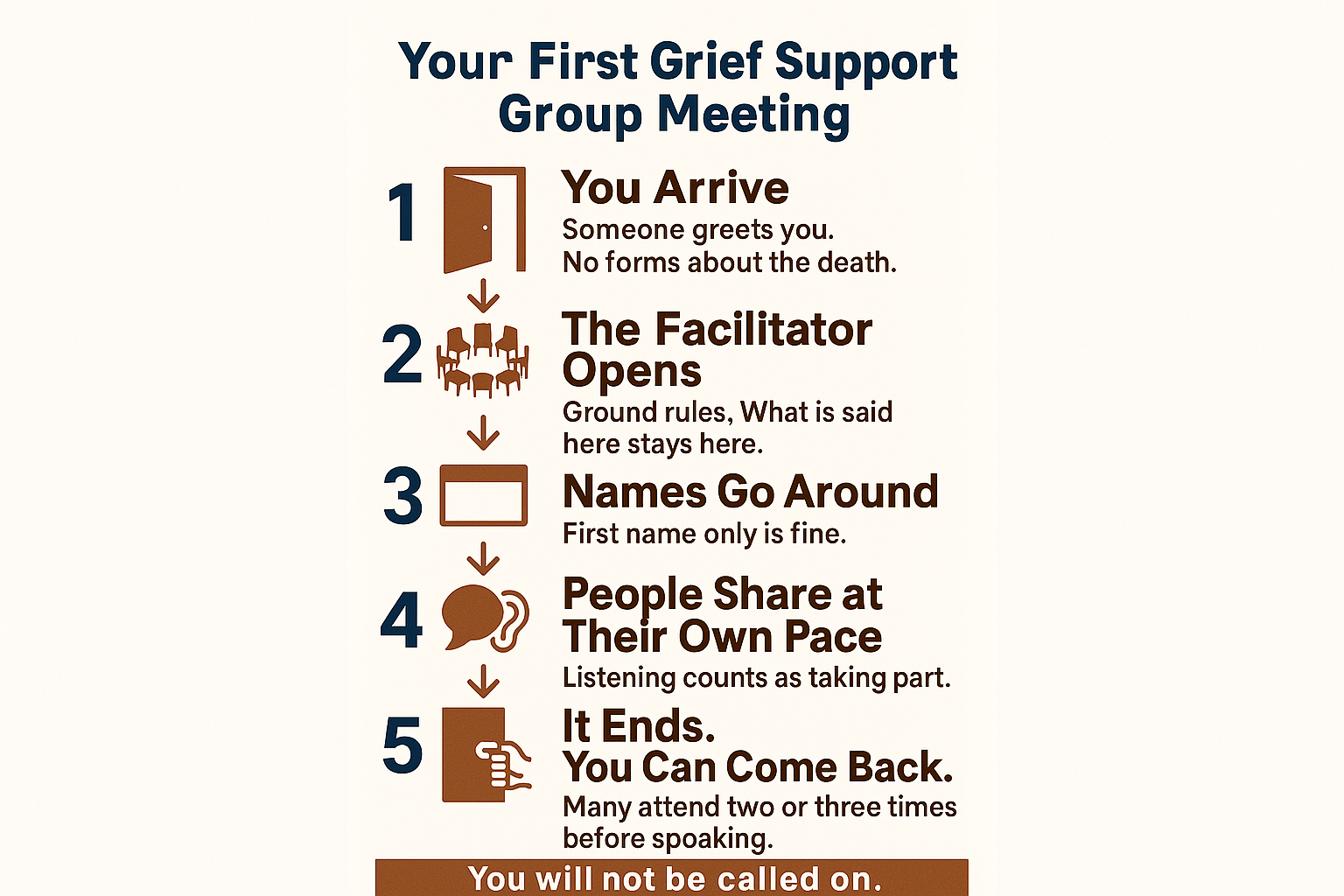
You arrive a few minutes early. Someone greets you, maybe asks your first name, and points you to a seat. There is no intake interview at the door and no form asking you to describe the death.
The facilitator opens the session. In a group run by a Bereavement Specialist, that usually means a short welcome, a reminder that what is said in the room stays in the room, and a note that nobody has to speak.
Then the group goes around. Here is what that part usually looks like:
- People give a first name, and often say who they lost and when
- Some talk for several minutes, some for fifteen seconds
- Some say “I am just here to listen today” and the facilitator moves on
- The facilitator steps in if one person takes over or if the room gets unsafe
- Toward the end, there is often a closing question or a quiet moment
Then it ends. People stand up, some linger in the hallway, and you drive home. That is the whole shape of it.
Listening Counts as Participating
This is the part worth saying plainly. You will not be called on. You will not be asked to explain the circumstances of the death. You will not be pressed if you shake your head.
It is common for someone to attend two or three meetings before saying anything beyond their first name. Facilitators expect that. Sitting in the room and hearing other people describe the same strange, sideways feelings you have had is itself the work.
Some people cry the whole first hour and say nothing. Some people laugh, which surprises them. Both are normal in that room.
If you want one small thing to hold onto before you go: you are allowed to leave early. Nobody will chase you down the hallway. Walking out at the forty minute mark and coming back the following week is a perfectly ordinary thing to do.

These Groups Are Not Only for Hospice Families
A lot of people assume grief support through a hospice organization is reserved for families whose loved one was a hospice patient. That single misunderstanding keeps people out of the room, so here it is without hedging: community grief support is open to anyone grieving the loss of a loved one.
If your mother died in a hospital bed in Salinas, if your husband died suddenly at home in Seaside, if your brother died four years ago in another state and you have never talked about it with anyone, you can sit in the room.
Calls come in regularly from people who are surprised this kind of support exists outside of end-of-life care. Parents ask about grief support for children. Adults who lost someone decades ago ask whether they have waited too long.
The County of Monterey also keeps a public grief and loss resource page through Behavioral Health, which is worth a look if you want to see the range of county-level and community options side by side. If you want a broader local list, there is more in our piece on finding grief support in Monterey County.
Three Doors Into the Same Building
People often mix up three different things when they start looking. They are not ranked. Many people use more than one over time.
| What it is | Who leads it | What it feels like |
|---|---|---|
| Peer grief support group | A Bereavement Specialist facilitates; the rest of the room is people who have also lost someone | Unhurried, shared, you set your own pace. Listening is enough. |
| Individual grief counseling | A Bereavement Specialist, one on one and private | Private and clinical. The hour is entirely about your loss. |
| Grief exercises on your own | You, sometimes with a prompt from a facilitator | Solitary. Writing an unsent letter, a journal page, something to do at 2am when sleep will not come. |
The First Hour, Step by Step
If it helps to see the shape of a first meeting before you go, this is the usual order of events.
In Person or Virtual, Weekday or Evening: The Central Coast Reality
Geography is a real barrier here, not a small one. A forty minute drive is a normal Tuesday on this coast, and the group that meets at 1pm in Salinas is useless to someone working in Monterey until six.
One person wrote in last summer and said it about as plainly as it can be said: “I’ve been in the look out for a grief group. I recently moved to the Carmel area.” Another suggested adding a general grief or widows group in Monterey itself, in addition to other locations.
So before you commit, sort out four practical variables:
- In person or virtual. A virtual group is not a lesser option. For someone in Hollister or King City, it may be the difference between going and not going.
- Weekday or evening. Evening availability decides whether a working adult can attend at all.
- Drop-in or a set series. Drop-in groups let you come when you can. A multi week series asks for a commitment and builds more familiarity.
- Who the group is for. Some are general. Some are for spouses, for adult children, or for people grieving a particular kind of loss.
Meeting times and locations shift. Call and confirm the current schedule rather than relying on an old flyer or a directory listing. The quiet fear behind most of this is turning up somewhere that does not fit and never trying again.
Is It Too Soon?
People ask this constantly, and the honest answer has two halves.
Structured multi week groups often suggest letting some weeks pass after a death before joining. That is not a rule about readiness. It is because hearing a dozen other losses in the rawest early days can land hard, and the series format works better once the first fog lifts.
One on one grief counseling is generally available much earlier, including in the first weeks. So the useful move is not to guess, but to ask.
When you call, say this: “Do you recommend waiting a certain number of weeks before joining the group series, and are individual sessions available in the meantime?” That one sentence gets you a straight answer and saves you from showing up in the wrong format at the wrong moment.
If grief started before the death, which happens often with long illness, that has its own shape. Our piece on anticipatory grief covers that ground.
Frequently Asked Questions About Grief Support Groups
Will I have to tell the group how my person died?
No. Most people share their first name and who they lost, and even that is optional. You will not be asked to describe the circumstances of the death, and a good facilitator will not let anyone else push you to.
What does a grief support group cost?
Costs vary by provider and format. Many community grief groups on the Central Coast are offered at little or no charge as a community service, while individual counseling is often billed differently or covered in part by insurance. Ask directly when you call so there are no surprises.
My loved one died years ago. Is it too late to join?
No. People come in at six weeks and at six years. Grief does not have an expiration date, and anniversaries, moves, and holidays often reopen something that felt settled. The first holiday season after a loss brings a lot of people through the door for the first time.
Is there grief support for children?
Children grieve differently than adults, usually in short bursts rather than long stretches, and support for them is structured differently too. Families on the Peninsula and in Salinas ask about this regularly. Start with a phone call to describe the child’s age and what they are showing you at home.
What if I go once and it is not right for me?
Then you try a different one, or a different format. A group that meets in person on a weekday afternoon in Salinas and a virtual evening group are genuinely different experiences. One group not fitting is not evidence that groups do not work for you.
Asking About a Group Near You
Bereavement support here runs as a nonprofit community service across Monterey County and the surrounding Central Coast, not as a hospice add-on. In 2025 that support reached more than 2,200 people, with groups facilitated by Bereavement Specialists who work alongside the wider care team of nurses, therapists, social workers, chaplains, volunteers, and other clinicians. If you want to know what is currently meeting, where, and whether a group or an individual session fits where you are right now, Central Coast VNA & Hospice can be reached at 831-372-6668 for a conversation about the current schedule.