
Direct Answer: Ask any hospice provider which visiting clinicians speak Spanish, how interpretation works at 2 a.m., and whether consent and medication instructions already exist in Spanish before you sign anything.
You are the one who takes the call from the doctor. You are the one who turns it into words your mother or father can hear. And you are also the son or daughter, sitting in the same room, trying not to cry while you do it.
In Monterey County, that scene is common. Roughly 62 percent of residents are Hispanic, and about 65,000 people here are 65 or older, so a huge share of local end-of-life conversations happen through a family member who is interpreting, scheduling, and grieving all at once.
This article answers the questions families ask first when hospice comes up in a Spanish-speaking household. Language, who decides, money, faith, and why so many people find out about all of this far too late.
Will someone who speaks Spanish actually come into the house?
This is the first question, and it deserves a straight answer instead of a brochure line about “language services available.”
Ask any agency in Salinas, King City, Hollister, or on the Peninsula these questions before you commit:
- Which visiting clinicians on your team speak Spanish? Not the office. The Registered Nurse, the Hospice Aide, the Medical Social Worker who will actually walk through the door.
- Will a bilingual clinician be assigned to this case, or is it whoever is on the schedule that day?
- How does interpretation work during a scheduled visit? In person, by phone line, by video?
- How does it work at 2 a.m.? The on-call nurse is the one you reach when breathing changes or pain spikes. If that line has no Spanish option, you will be interpreting at the worst hour of your life.
- Do the consent forms, the plan of care, and the medication instructions already exist in Spanish? Translated on the spot is not the same thing as printed and left on the counter.
There is one conversation where this matters most. Research on hospice enrollment has found that interpretation quality breaks down around prognosis, the exact moment when precision is everything.
So ask directly who will interpret when the doctor explains how much time is likely left. It should not be you.
What to ask, and what a real answer sounds like
Bring this list to the first phone call. You are allowed to ask all of it before anyone comes to the house.
| Ask this | Why it matters | A solid answer sounds like |
|---|---|---|
| Who on the visiting team speaks Spanish? | Office staff and field clinicians are not the same people | Named roles, not a general yes |
| How is the after-hours line handled in Spanish? | Nights and weekends are when families panic | A specific process, available 24/7 |
| Are forms and medication instructions printed in Spanish? | Written instructions get reread at 3 a.m. | Yes, and they show you a sample |
| Who interprets prognosis conversations? | This is where meaning gets lost most often | A trained interpreter or bilingual clinician, not a relative |
| Can my parent choose who receives clinical updates? | Many patients want certain details handled carefully | The patient directs this, in writing |
Does hospice mean sending my parent somewhere?
For a lot of families, the word lands like a building. A place you send someone. A decision to stop caring.
In this region, hospice is almost always care delivered in the patient’s own bedroom. The family stays in charge of the home, and the team comes to them.
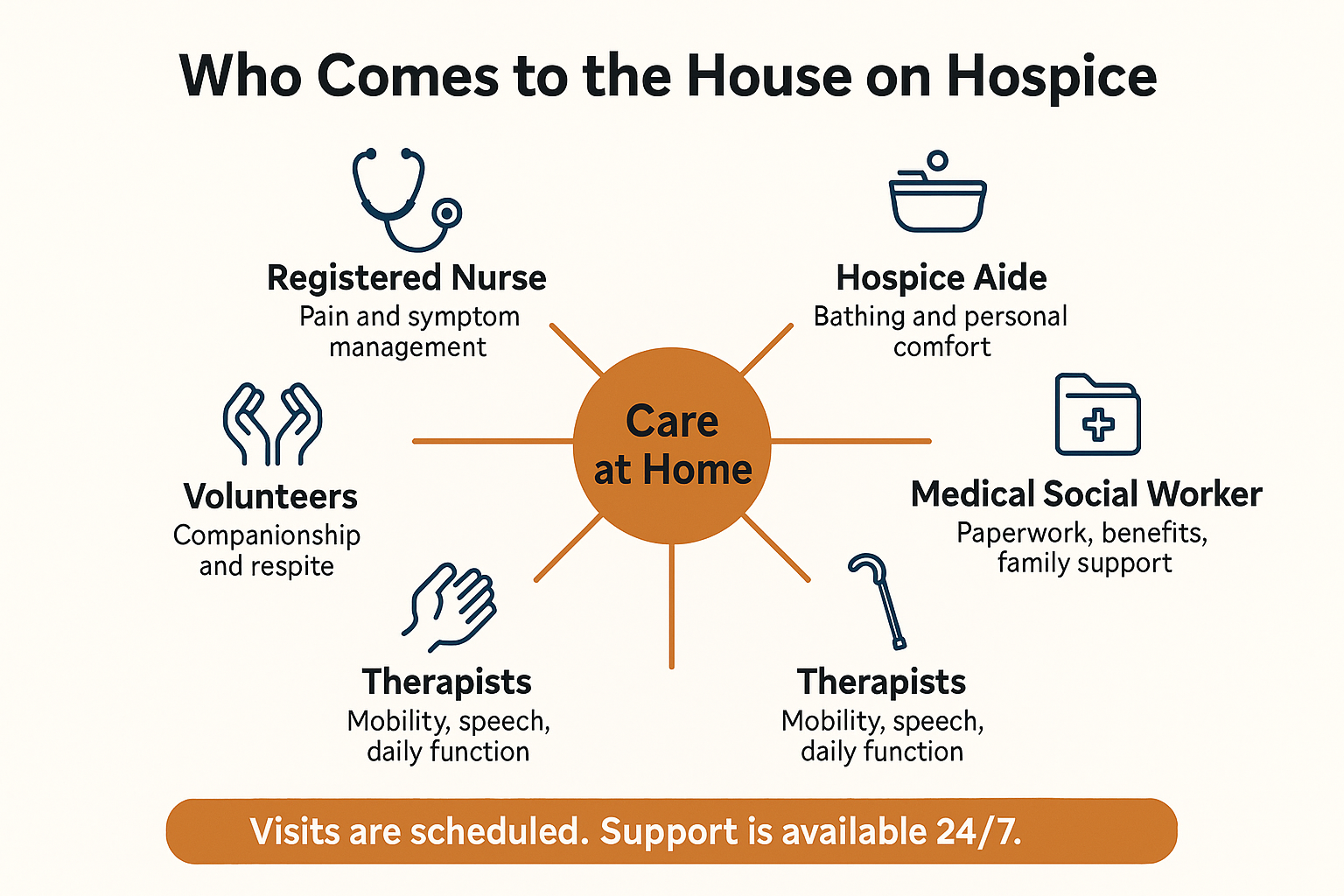
That team includes Registered Nurses, Hospice Aides, Medical Social Workers, Chaplains, Physical and Occupational Therapists, Volunteers, and other clinicians. They visit on a schedule, and someone is reachable around the clock.
Families also mix up hospice, home health, and palliative care in a single sentence, which is completely understandable. Home health is recovery focused. Palliative care runs alongside treatment. Hospice begins when the goal shifts from curing to comfort.
One caller described the turn this way: “He wants to stop dialysis and focus on comfort at home.” That sentence is how real families say it, and it is a clear, dignified choice, not a surrender. If that is where your family is, what happens after stopping dialysis is worth reading before the next appointment.
It also helps to know that hospice is not what most families picture.
Who actually comes to the house
Hospice at home is a team, not one nurse. Here is who shows up and what each person handles.
Who decides, when the whole family is involved?
In many multigenerational households, the answer is not one person. It is a mother, four siblings, a spouse, and an opinion from the aunt in Greenfield.
Here is how care teams usually handle that:
- The family names a spokesperson who receives updates and coordinates visits, which cuts down on five people getting five versions of the same news.
- The patient directs who receives clinical information. If your father wants certain details handled a specific way, or wants them shared with one child first, he can say so and the team follows it.
- Disagreement in the first week is normal. Social workers sit with families through exactly this.
Some adult children feel that agreeing to hospice means giving up on a mother or father. That feeling is real and it deserves space, not a lecture.
There is no single correct way for a family to organize itself. If your siblings are still arguing, the conversation about knowing when it is time is often easier to have than the decision itself.
Who pays for this, and how do I know the caller is legitimate?
Families raise these two together, so let’s answer them together.
Hospice is covered under Medicare, Medi-Cal, and Veterans benefits. That matters in a county where households headed by someone over 65 report lower median income than the county overall, and roughly 9.5 percent of families live below the poverty line.
In general, the hospice benefit covers visits from the team, medications tied to the terminal illness, medical equipment like a hospital bed, and supplies. What typically falls outside it includes room and board in a facility, treatment unrelated to the terminal diagnosis, and around-the-clock help in the home.
Costs and coverage details vary by plan and situation, so ask any provider to put the specifics in writing before you sign. Room and board questions trip up families most often.
On legitimacy, families are right to be careful. A reputable provider will:
- Confirm the identity of any staff member who contacts you
- Give you a callback number you can verify
- Never ask for personal or financial information before an in-person assessment is confirmed
If a call feels like a sales pitch, it probably is one. Vetting a hospice provider is a reasonable thing to do, not an insult to anyone.
Can a priest come? What about prayers and family at the bedside?
Yes, and yes. A home is still your home when hospice is involved.
Chaplains work with your family’s own parish or pastor rather than replacing them. If your mother has attended the same church in Salinas for forty years, the team helps coordinate with that priest, not around him.
Relatives at the bedside, prayers, candles, an altar in the corner of the room, none of that is a problem. Clinicians will ask about safety with open flames near oxygen, and that is the only real limit.
The team will also walk you through what happens in the hours right after a death at home, including who to call and what does not need to be rushed. Families are often surprised by how much time they are allowed to simply sit.
Support does not end there. Bereavement services continue for the family afterward, and grief support is open to people who were never hospice families at all. Spanish-language grief support meets in this region, so ask what is available near you instead of assuming nothing is. Here is what grief support actually looks like.
Why do families find out about all of this so late?
One caller said it plainly: “I did not know you offered that here.”
That comes up constantly. People in Monterey County often learn at a crisis point, usually a hospital discharge, that home-based palliative care, wound care, and hospice exist in their own community.
Timing matters more than most families realize. National research on 2018 Medicare decedents found hospice use at 55.8 percent for non-Hispanic white beneficiaries compared with 46.2 percent for Hispanic beneficiaries, and that starting hospice before the last day of life was strongly tied to dying at home across every group. You can read the full study from the National Institutes of Health.
The research points at information and language access far more than at family preference. Families want this care. They often just do not know it is available in Spanish, at home, down the road.
You do not need a hospital transfer to start. A phone call and a conversation with the treating physician is enough to begin asking questions.
Frequently Asked Questions About Hospice Care for Spanish-Speaking Families
Can I ask for a bilingual nurse specifically, or is that rude?
It is not rude at all. Ask for it directly, and ask whether it applies to every visit or only some. A provider that handles this well will tell you exactly which roles on the team speak Spanish.
My mother does not want to know her prognosis. Do you have to tell her?
The patient directs who receives clinical information and how it is shared. Many families in this region ask that certain details go to a designated family member first. Tell the care team early so the plan is documented rather than improvised in the living room.
Is hospice free with Medi-Cal?
Hospice is covered under Medicare, Medi-Cal, and Veterans benefits, but what is covered depends on the plan and the situation. Ask for the coverage details in writing before services begin, including anything that falls outside the benefit.
Can we still call 911 if something happens?
You can always call 911. But once hospice is in place, the on-call line is usually the faster path to comfort, because the nurse knows the patient, the medications, and the plan. Ask how that line works in Spanish before you need it.
What if my family cannot agree on hospice?
That is normal in the first week, not a sign your family is failing. Medical Social Workers sit with families through disagreement regularly, and no one is asked to sign anything in a single conversation.
Does grief counseling cost anything if my father was never a patient?
Grief support is offered to people in the community who are grieving a loss, not only to families who used hospice. Ask what groups meet near you and whether any of them run in Spanish.
If you are the one doing the translating
Central Coast VNA & Hospice is a nonprofit that has served this region since 1951, reached into the Salinas Valley in 1969, and opened a Hollister office for San Benito County in 1974, with Latino community outreach through the Taylor Farms Family Health and Wellness Center. That history is why families here sometimes recognize the name from a neighbor rather than an ad. A care coordinator can answer questions about home health, palliative care, hospice, or grief support at 831-372-6668 or ccvna.com.