

Can Pain That Cannot Be Brought Under Control Make Someone Hospice Eligible?
The medication works for a few hours, then it stops working. By late evening your mother is crying, you are standing in the kitchen with the car keys in your hand, and you are wondering whether another trip to the emergency room is really the answer. Somewhere in that night, you type the question into your phone.
Families across Monterey County ask us a version of this all the time, usually in those exact words: can pain that cannot be brought under control make someone eligible for hospice? The honest answer is that pain level by itself is not the test. Hospice eligibility rests on a physician certifying that an illness, if it runs its normal course, is expected to end life within about six months.
But here is the part that matters more. Pain is a good reason to make the call even when it is not, on its own, a reason to qualify. Nobody gets turned away for asking at the wrong moment, and the conversation usually opens doors a family did not know were there.
Does Uncontrolled Pain Qualify for Hospice on Its Own?
No. Under Medicare, hospice coverage begins when a physician certifies a prognosis of roughly six months or less if the illness follows its expected path. That is the gate. Symptom severity is part of the clinical picture, but it is not the measure.
So why does the question come up so often? Because uncontrolled pain is usually the first thing a family actually notices. The decline that does make someone eligible is quieter and slower, and it often shows up alongside the pain rather than instead of it.
Medicare's own guidance is more flexible than most families expect. The local coverage determination for hospice eligibility notes that a patient who does not neatly fit a published disease-specific guideline can still be covered when the clinical documentation supports the prognosis. In plain terms, there is room for judgment.
A few things that commonly sit alongside severe pain and do point toward eligibility:
- Repeat hospital stays or emergency visits over a short stretch of months
- Steady weight loss, or eating and drinking far less than before
- Less time out of bed, more time sleeping, less interest in things that used to matter
- A treating physician who has started using words like "we are running out of options"
If you are asking about a parent with memory loss, hospice criteria for dementia works a little differently and is worth reading on its own.

Two Questions Families Blur Together
Picture this at a kitchen table. There are really two separate questions sitting in front of you, and they get tangled together because both of them hurt.
The first question is how bad the symptoms are right now. The second is what the underlying illness is expected to do over the next several months. They are not the same, and one does not predict the other.
A person can live in severe pain for years with a condition that is not going to end their life. Spinal problems, neuropathy, advanced arthritis, old injuries. The suffering is real and it deserves attention, but the illness is not on a six-month path.
And the reverse happens just as often. Someone can be close to the end of life with very little pain at all, slipping away quietly while the family keeps waiting for a dramatic sign that never arrives.
When you call anybody about care, it helps to say both parts out loud: what today looks like, and what the doctor has said about where this is heading. Those two sentences will get you a far more useful answer than either one alone.
What the Situation at Home Actually Tells You
Here is how four common scenarios usually sort out. None of this replaces a physician's judgment, but it helps you aim the conversation.
| What you are seeing at home | Does it answer the hospice question? | Usual next step |
|---|---|---|
| Severe pain from a long-term condition, otherwise stable | No. Pain is real but the prognosis is not the issue | Ask the treating physician about a revised pain plan or in-home symptom support |
| Severe pain plus weight loss and repeat hospital visits | Possibly. These often travel together | Ask the physician directly whether a hospice evaluation makes sense |
| Little pain, but steep decline in strength, eating, and alertness | Possibly, even without pain | Same conversation. Decline matters more than discomfort |
| Pain that spikes at night and forces ER trips | Not on its own, but it is a flag worth raising | Bring a written record to the next appointment |
What to Write Down Before You Call the Doctor
Underneath the eligibility question is a simpler worry: nobody is fixing the pain. That part you can start working on tonight, with a pen and a sheet of paper on the counter.
A physician cannot change a pain plan on the phrase "he is in a lot of pain." What moves an appointment is a specific record. Write down, for three or four days:
- When the pain spikes, with the actual time of day or night
- Which medication, at which dose, and when it was given
- How long relief lasted before the pain came back
- What made it worse: moving, eating, bathing, being transferred to a chair
- A number from 1 to 10, in your loved one's own words if they can give it
- Anything new: nausea, confusion, shortness of breath, not sleeping
Four days of handwriting will tell a doctor more than an hour of conversation. It shows patterns, and patterns are what prompt a change in dose, timing, or medication.
One family member who went through home health with her 91 year old mother in Monterey described a nurse who came weekly, checked vital signs, and "made suggestions that helped alleviate any discomfort that Mom had." That kind of adjustment usually starts with somebody writing things down.
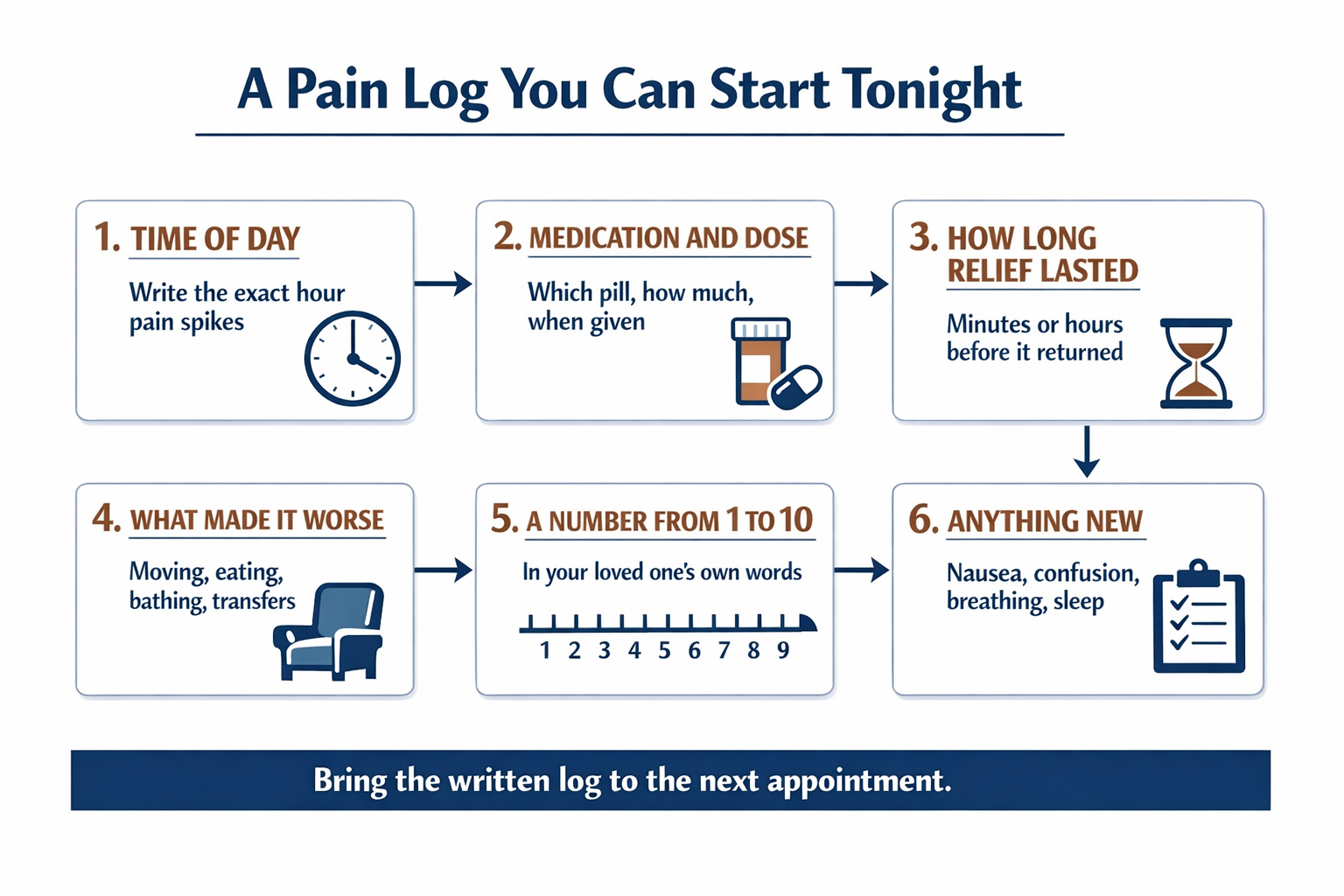
A Pain Log You Can Start Tonight
Six things to track in the days before the appointment. A short written record changes a doctor's visit more than a description ever does.
When the Answer Is "Not Yet"
Hearing "not yet" from a hospice conversation does not mean hearing "nothing." This is the part most families have no idea exists, and it is the reason the call is worth making even when you suspect it is early.
If the pain is severe but the illness is not at that stage, there are still home-based options:
- Skilled nursing visits for medication management, with a Registered Nurse or Licensed Vocational Nurse watching how a pain plan is actually working day to day
- Physician-directed symptom support at home, which focuses on quality of life while treatment continues
- Coordination back to the treating doctor, so changes get reported instead of waiting for the next appointment
- Physical and occupational therapy when pain is tied to movement, transfers, or weakness
All of that is delivered where the patient already is, which matters more than it sounds. Hospital-affiliated programs in this area often run symptom support through a clinic visit, or require that you already be their patient.
One thing worth knowing: skilled home health requires a physician referral, and it is intermittent clinical care, usually a visit of an hour or less once or twice a week. It is not someone staying in the house all day. Families looking for cooking, bathing, and companion help are looking at private non-medical home care, which is generally paid out of pocket and can run into the thousands per month depending on hours. Ask any agency for their current rates directly.
More families start support earlier than they expect. Our piece on when hospice starts earlier than most families expect covers that pattern in detail.
Why Distance Changes This Question in South County
A pain crisis at 11 p.m. in King City or Greenfield is not the same problem it is in Pacific Grove. It is a long drive up the valley to a hospital, and an emergency room visit that solves the night but not the week.
Families out toward Soledad, Gonzales, and Hollister feel that more sharply than families on the Peninsula. Managing pain at home is partly a clinical question and partly a distance question.
We hear from callers in outlying communities who hesitate before picking up the phone because they assume home-based care does not reach their address. It does. Home health, palliative support, and hospice all extend across Monterey County, including South County, as well as San Benito County and South Santa Clara County.
If the real fear is what happens at 2 a.m. when nobody is nearby, that is worth planning for ahead of time. Here is who to call after hours when something changes at home.
Frequently Asked Questions About Hospice Eligibility and Pain
Can severe pain alone make someone hospice eligible?
No. The test is a physician's certification of a six-month prognosis if the illness runs its normal course. Severe pain often appears alongside that decline, which is why the two get confused, but pain by itself is not the qualifier.
Am I calling too early if I'm not sure my parent qualifies?
There is no wrong time to ask the question. A care coordinator can talk through what is happening at home and explain which kind of support fits, including options that are not hospice. Many families find out they qualified for something months before they called.
What does a doctor need from me before changing a pain plan?
Specifics. When the pain spikes, which medication at which dose, how long relief lasted, and what makes it worse. A few days of written notes gives a physician something to act on.
Does Medicare pay for hospice at home?
Yes, the Medicare hospice benefit covers hospice care for eligible patients, and Medi-Cal and Veterans benefits are also accepted by many providers here. Coverage questions are best confirmed during intake with your specific plan in hand.
What if we start hospice and the pain gets better?
Patients can leave hospice. If someone stabilizes or improves, or decides to return to curative treatment, they can be discharged and re-enroll later if things change. Choosing hospice is not a one-way door.
Not Sure Which Kind of Support Fits Yet?
Central Coast VNA & Hospice is a nonprofit founded in Monterey in 1951 and marking 75 years in 2026, with pain managed by a team rather than one visiting clinician: Registered Nurses, Licensed Vocational Nurses, therapists, Medical Social Workers, Chaplains, Volunteers, and other clinicians. Medicare, Medi-Cal, and Veterans benefits are accepted across Monterey County, San Benito County, and South Santa Clara County. If you are somewhere between "this is hard" and "I don't know what to ask for," a care coordinator can talk it through with you at 831-372-6668 or at ccvna.com.

When Hospice Starts Earlier Than Most Families Expect
Most families on the Monterey Peninsula hear the word hospice for the first time in a hospital hallway. A doctor or discharge planner says it, the room gets quiet, and a decision has to be made in the next day or two.
So, is hospice only for end of life? Not in the way most people picture it. Under Medicare, hospice can begin when a physician certifies that a patient's illness, if it follows its expected course, may result in death within six months. That is a window measured in months, not hours.
The gap between what families assume and what the rule actually says is the single most common reason people later say they wished they had called sooner. This article covers what that six-month window means in practice, and what earlier hospice at home actually looks like in a house in Pacific Grove, Salinas, or Hollister.
Is Hospice Only for End of Life? The Six-Month Rule Most Families Never Hear
Thousands of people type that exact question into a search bar every month. The plain answer is no, hospice is not reserved for the final days.
Eligibility rests on a physician's clinical judgment about the expected course of an illness, not on a patient being bedbound or unresponsive. According to the Medicare hospice benefit guidelines, coverage begins with certification of a life expectancy of six months or less if the illness runs its usual course, and it can be renewed if the patient lives longer than expected.
A few things that surprise families in Monterey County:
- Patients can live longer than six months and stay on hospice, as long as a physician recertifies eligibility
- Patients can leave hospice and return to curative treatment if their condition changes or they change their mind
- A doctor's order is required to start, which is a step many callers do not know about until they ask
- Hospice care happens at home in most cases, not in a facility
One pattern shows up again and again on first-time calls: surprise that hospice was even an option. Families assumed there was nothing left to consider until things got much worse. For a closer look at who qualifies, the hospice eligibility question most families are afraid to ask walks through it in detail.

Stopping Curative Treatment Is Not the Same as Giving Up
This is where the emotional barrier is usually higher than the logistical one. Families hear "stop curative treatment" and translate it into "stop fighting for my mother."
What actually changes is the target. Instead of aiming treatment at the disease, the team aims it at comfort, function, and the quality of the days a person has left.
At home, that shift looks concrete:
- Regular scheduled visits from Registered Nurses and Licensed Vocational Nurses who track symptoms and adjust the plan
- Pain and symptom management that is reviewed continuously, not only during a crisis
- Hospice Aides helping with bathing, grooming, and daily comfort
- Medical Social Workers sorting out benefits, family conflict, and practical logistics
- Chaplains for spiritual support, on the patient's own terms and beliefs
- Volunteers who sit with a patient so a family member can sleep, shop, or step outside
- Bereavement Specialists who stay involved with the family after a death
One family member on the Peninsula described a home health team of nurses, Physical Therapists, and a Medical Social Worker arriving one after another, each one adding something the family could not have arranged alone. Hospice works the same way, with the whole team assigned at once.
If the line between programs still feels blurry, home health vs. hospice lays out how families tell which one fits the moment they are in.
What Changes When Hospice Starts Weeks Earlier Instead of Days
The services are the same. The difference is how much time the family and the team have to use them.
| What families face | Hospice starting in the last few days | Hospice starting weeks or months earlier |
|---|---|---|
| Pain and symptom control | Team is playing catch-up on symptoms already out of control | Symptoms tracked and adjusted over time before crisis hits |
| Home setup | Hospital bed, wheelchair, or oxygen arrives during an emergency | Equipment in place and the home arranged in advance |
| Family training | Instructions given once, under stress | Repeated coaching on medications, positioning, and what to watch for |
| Emotional and spiritual support | Little time for Chaplain or Volunteer involvement | Relationships built with the patient and family over weeks |
| Decision-making | Irreversible choices made in a hospital hallway | Choices made at the kitchen table, with questions answered |
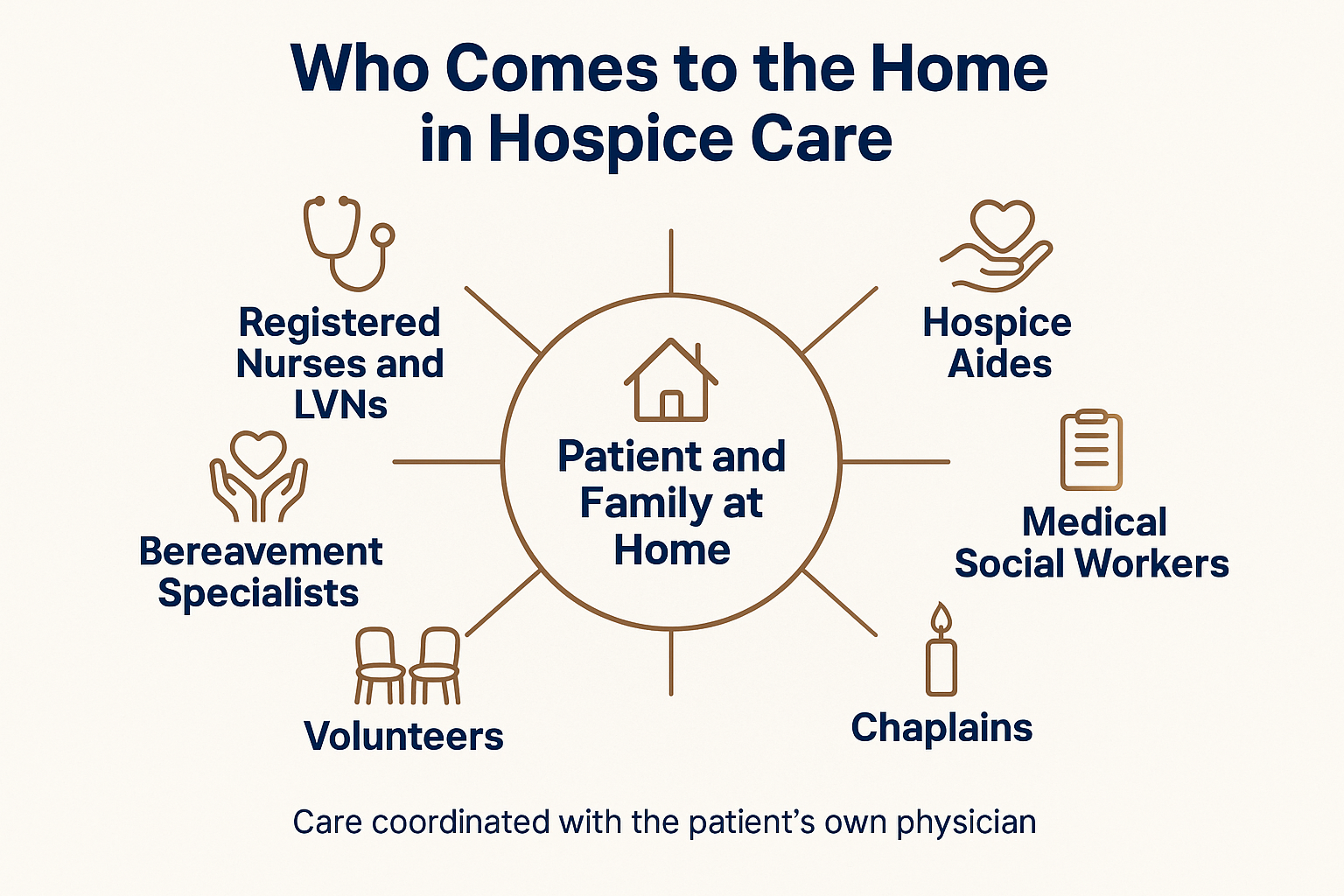
Who Actually Comes to the Home
Hospice is not one nurse making occasional visits. It is a team assigned to the patient and the family at the same time.
Why the Word Usually Comes Up at CHOMP or Salinas Valley Health
Community Hospital of the Monterey Peninsula and Salinas Valley Health are two of the most common places where local families first hear hospice mentioned. It comes from a discharge planner, often on short notice, sometimes on a Friday afternoon.
Call records tell the same story from the other side. Roughly a third of first-time callers are an adult child or spouse phoning within hours or days of a discharge, wanting to know if someone can come to the house today or tomorrow.
Those calls are not comparison shopping. They are people trying to keep a parent from going back to the hospital for a third time in two months.
When a family already understands what hospice at home provides, that hallway conversation is far less frightening. They can ask real questions instead of guessing. What families often miss when planning a hospital discharge to home covers the practical side of that handoff.
Geography matters here too. Home-based hospice across Monterey County covers a wide spread, from the Peninsula down through Salinas and King City, plus San Benito County including Hollister and parts of Santa Cruz and South Santa Clara counties. Worth confirming coverage for the patient's actual address early, since that question comes up on about one in twelve calls.
What Families Should Expect on Cost
Cost is the second question almost every family asks, usually right after eligibility. The general picture is that the Medicare hospice benefit covers services, visits, medications, and equipment related to the terminal illness, and most families see little to no out-of-pocket expense for those items.
Medi-Cal and Veterans benefits also cover hospice for eligible patients. Exact coverage depends on the plan, the diagnosis, and what else the patient needs, so the honest answer is to confirm specifics with the provider and the plan directly.
One thing that catches families off guard: hospice visits are intermittent, not around-the-clock. Households that need someone present all day often hire private-duty help separately, and market rates for that kind of daily coverage in Monterey County can run into the thousands of dollars per month, depending on hours and level of need.
Starting hospice earlier does not lower that hourly rate. But it does give families time to plan for it instead of scrambling.
Frequently Asked Questions About Hospice Timing
Is hospice only for end of life, or can it start months ahead?
It can start months ahead. The standard is a physician's certification that the illness, if it runs its expected course, may result in death within six months. Many patients are eligible well before a family thinks to ask.
What happens if my parent lives longer than six months?
Care continues. A physician recertifies eligibility at set intervals, and patients who live longer than expected stay on hospice as long as they still meet the criteria. Living longer than predicted is common, not a problem.
Do we need a doctor's order to start?
Yes. A physician's order is required before a hospice team can schedule an assessment. This trips up a lot of families who call ready to start and do not realize a doctor's signature comes first, so it is worth asking the treating physician early.
Can someone come off hospice if their condition improves?
Yes. A patient can revoke hospice at any time and return to curative treatment, and can re-enroll later if things change. Choosing hospice is not a one-way door.
Does support really continue after a death?
It does. Bereavement Specialists offer grief counseling and support groups to families after a patient's passing, and locally that support is open to anyone grieving a loss, not only families who used hospice services.
Ready to understand your options before you have to decide?
Learning what hospice at home involves before a discharge conversation gives a family room to think instead of react. Central Coast VNA & Hospice has supported families across Monterey County, San Benito County, and the surrounding Central Coast since 1951, and a care coordinator can walk through eligibility, coverage, and what visits actually look like without any commitment. Questions are welcome at 831-372-6668 or at ccvna.com.
Understanding the Compassionate Care of Hospice Services on the Central Coast

When someone we love is facing the final chapter of life, the journey can feel overwhelming, uncertain, and emotionally complex. Families are often filled with questions: What does hospice really mean? How can I make sure my loved one is comfortable? Where can I turn for guidance and support that understands what we’re going through?
Here on California’s Central Coast, many families are finding those answers—and a deep sense of peace—through the compassionate, thoughtful care provided by hospice services. This blog aims to help you better understand what hospice care involves, how it supports families, and why this kind of care can be one of the most meaningful decisions you’ll make.
Understanding Hospice Services on the Central Coast
What Is Hospice Care?
Hospice care is a specialized form of medical and emotional support provided to individuals with life-limiting illnesses. Unlike treatments aimed at curing disease, hospice focuses on comfort, dignity, and quality of life in the time that remains.
Hospice care includes:
-
Pain and symptom management
-
Emotional and spiritual support
-
Help with daily tasks and caregiving
-
Counseling for both the patient and their family
-
Bereavement services after a loved one has passed
One of the most common questions people ask is, "Does hospice mean giving up?" The answer is no. Hospice is not about giving up; it’s about shifting focus—from cure to comfort, from treatment to time together.
Who Is Hospice Care For?
Hospice care is for individuals who have been diagnosed with a life-limiting illness and are no longer pursuing curative treatment. This includes people with conditions such as:
-
Advanced cancer
-
Late-stage Alzheimer’s or dementia
-
End-stage liver or kidney disease
Hospice services are available to anyone with a prognosis of six months or less if the illness follows its natural course, as determined by a physician.
Why Families Choose Hospice on the Central Coast
The Central Coast of California, known for its temperate climate, scenic coastline, and close-knit communities, offers more than just beauty—it offers a sense of peace and groundedness that many families seek during emotionally difficult times.
At Central Coast VNA & Hospice, we’ve seen firsthand how meaningful it is when individuals can spend their final days surrounded by familiar views, caring hands, and the comforts of home. Whether it's a quiet home in Pacific Grove or a hillside residence in Salinas, the setting itself becomes part of the care.
Families often tell us that what they remember most isn't the illness—it’s the moments: the ocean breeze coming through the window, a family member’s laughter in the next room, or the steady support of a hospice nurse during a hard day.
For those wondering where to find compassionate hospice of the Central Coast, trusted care is closer than you might think.
What Services Does Hospice Provide?
Hospice services are designed to support the whole person—not just their illness, but their emotional, spiritual, and relational needs. Here’s a breakdown of the key services provided:
1. Medical Care and Pain Management
Trained hospice nurses and physicians work together to manage pain and symptoms so that the individual can experience as much comfort as possible. This may include medications, equipment, and support for mobility or breathing.
2. Caregiver Support
Family caregivers are often under tremendous stress. Hospice services provide education, respite care, and in-home visits to support family members as they provide day-to-day care.
3. Emotional and Spiritual Support
Social workers and chaplains are available to help with everything from grief and anxiety to spiritual questions and life reflection. These specialized hospice services are offered with sensitivity to each person’s background and beliefs.
4. Bereavement Counseling
Support doesn't end when a loved one passes. Hospice programs offer grief counseling, support groups, and resources to help families heal in the months that follow.
5. Personal Care Services
Hospice aides help with daily living activities such as bathing, dressing, and grooming—helping patients maintain dignity and comfort.
How to Know When It's Time for Hospice
One of the most difficult decisions families face is knowing when to begin hospice care. People often wait too long, thinking they must wait until the very end. But in truth, starting hospice earlier allows more time to manage symptoms, build relationships with the care team, and experience meaningful moments with loved ones.
Signs it may be time to consider hospice:
-
Frequent hospital visits or ER trips
-
Difficulty managing pain or symptoms at home
-
Significant weight loss or weakness
-
Increased emotional distress or confusion
-
Caregiver exhaustion or burnout
If you're unsure, you can always ask your loved one’s doctor or reach out to Central Coast VNA & Hospice directly for guidance and an evaluation.
What Makes Hospice on the Central Coast Unique?
Every hospice organization shares a commitment to comfort and dignity—but care on the Central Coast comes with a distinct sense of place and purpose.
🌿 Community Roots
Central Coast VNA & Hospice has been a trusted part of the community for generations. Many of our staff live in the same neighborhoods as the families we serve. That local connection brings warmth, familiarity, and a true sense of community care.
🌊 A Calming Environment
The region’s natural beauty plays an unexpected role in care. From coastal sunsets in Monterey to the golden hills of Carmel Valley, many patients find comfort in being able to look outside and feel connected to the place they call home.
👪 Diverse Family Needs
Monterey County is home to a wide mix of families—multigenerational households, caregivers balancing work and family, and people who’ve retired here for peace and beauty. Our care teams understand the unique challenges and cultural values that shape each family’s experience.
Common Questions About Hospice Care
Is hospice only for people with cancer?
No. While hospice services originally served many cancer patients, today it supports individuals with a wide range of conditions including heart, lung, liver, and neurological illnesses.
Can hospice services happen at home?
Yes. In fact, most people receive hospice services in the comfort of their own home. Care teams come to you—bringing medical, emotional, and practical support right where you live.
How are hospice services paid for?
Hospice care is covered by Medicare, Medi-Cal, and most private insurance plans. There are no out-of-pocket costs for services covered under the hospice benefit.
Can I still see my regular doctor?
Yes. Hospice teams coordinate with your loved one’s existing physicians to ensure care is consistent and personalized.
Final Thoughts: A Compassionate Choice
Facing the end of life is never easy—but choosing hospice services can bring peace, comfort, and a renewed focus on what matters most. It’s about making the most of each day, honoring the wishes of your loved one, and being supported by people who truly care.
If you’ve been wondering whether it’s time—or even just what to expect—we hope this helped bring clarity and comfort. Hospice isn’t just about the end of life. It’s about living that life with grace, dignity, and love.
To learn more about hospice services offered by Central Coast VNA & Hospice, including trusted hospice of the Central Coast care, visit www.ccvna.com.
Giving Back to VNA - Real Stories of Help and Hope
Have you ever wondered how a simple act of kindness could ripple across an entire community? Giving back to VNA—whether through time, donations, or advocacy—does just that. At Central Coast VNA & Hospice, these gestures translate into real stories of help, hope, and healing for patients and families in Monterey and beyond.
Many supporters ask, “Can you donate to VNA?” The answer is yes—and those donations do more than you might imagine. From comforting a hospice patient through pet therapy, to funding flu shot clinics for those who’ve missed the flu shot, every contribution fuels vital, compassionate care.
In this blog, you’ll learn:
- Why giving back is so impactful
- The types of support that make a difference
- Personal stories from Monterey families and volunteers
- How you can get involved through VNA’s donation and volunteer programs
Let’s explore how you can be part of this mission.
The Challenge: Meeting Community Health Needs
Healthcare is deeply personal—but accessing quality care isn’t always easy, especially for underserved or homebound individuals in Monterey County. VNA fills that gap with hospice, home health, flu prevention, and specialty programs.
Common Barriers VNA Helps Overcome:
- Lack of transportation for flu shots and home care
- Isolation and emotional distress in patients
- Limited resources for end-of-life support
- Emotional strain on family caregivers
Still, many people don’t realize that VNA is a nonprofit—and relies on donations, volunteers, and community partnerships to bridge these gaps.
Misconceptions we often hear:
- “Hospice is fully funded by insurance.”
- “My small donation won’t make a difference.”
- “Only medical professionals can volunteer.”
These myths prevent community members from seeing the vital role they can play in helping others. But through giving back to VNA, ordinary people do extraordinary things every day.
The Solution: Giving Back to VNA—Made Easy
You don’t have to be a healthcare expert to support the work we do. There are many simple ways to give back to VNA—each one creating a meaningful difference.
Donation Opportunities:
- One-time or monthly gifts to support hospice and home health
- Tribute donations to honor loved ones
- In-kind donations like comfort care items or technology
- Planned giving options such as bequests or charitable trusts
Volunteer Roles:
- VNA Ambassador: Spread awareness through community outreach
- VNA Pet Therapy volunteers: Bring joy and comfort through trained therapy animals
- Office or event volunteers: Help behind the scenes
- Bereavement and family support roles
What These Gifts Support:
- Flu clinics for those who’ve missed the flu shot
- Grief counseling and family support programs
- Specialty care programs for Alzheimer’s, Parkinson’s, and veterans
- Compassionate end-of-life care in patients’ homes
To learn more about volunteer and giving opportunities, visit https://ccvna.com.
Benefits: The Ripple Effect of Giving
Whether you give time, resources, or a monetary donation, giving back to VNA brings measurable—and deeply personal—benefits to everyone involved.
For the Community:
- Expanded access to care for low-income and rural families
- Increased vaccination rates (especially important for those who’ve missed the flu shot)
- Enhanced quality of life for patients facing illness
For Donors:
- Sense of purpose and fulfillment
- Public acknowledgment (if desired) for generous contributions
- The ability to honor a loved one’s legacy in a meaningful way
For Volunteers:
- Develop new skills or apply existing talents
- Build relationships with patients, families, and fellow volunteers
- Know that you’re making a real difference, right here in Monterey
Testimonial from a VNA Volunteer:
“I started volunteering after my father passed in VNA’s care. Giving back helped me heal, and now I get to help others in their time of need.”
Local Focus: What Makes Giving Back in Monterey Unique
The beauty of giving back to VNA is that your contribution stays local—helping families right here in Monterey County.
Why Local Support Matters:
- Monterey’s senior population is growing, and many live alone
- Rural and coastal areas often lack easy access to in-person care
- Language and cultural barriers can affect the quality of service
VNA addresses these gaps by:
- Offering bilingual support services
- Deploying home health nurses across the region
- Hosting community flu shot clinics, ideal for anyone who’s missed the flu shot
- Running volunteer-led programs that reflect the diversity of our community
Your donation or time stays local and is used responsibly—backed by over 70 years of trusted nonprofit care.
FAQs About Giving Back to VNA
1. Can I donate in honor of someone?
Yes! Tribute gifts are a powerful way to celebrate a life or thank a caregiver. They can be made online or by mail.
2. Is my donation tax-deductible?
Yes. Central Coast VNA & Hospice is a 501(c)(3) nonprofit. All eligible gifts are tax-deductible.
3. What if I only have a few hours a month to volunteer?
That’s perfect. We have flexible volunteer roles to fit all schedules and lifestyles.
4. Can I support VNA if I’m not a healthcare professional?
Absolutely. Most volunteers aren’t medical professionals. Everyone can bring kindness, time, or energy.
5. Where can I learn more about VNA’s services before donating?
Explore all our services—from hospice and home health to grief counseling and specialty programs.
Ready to Make a Difference? Start Giving Back to VNA Today
Your support—big or small—can brighten someone’s final days, ease a caregiver’s burden, or provide a child with grief counseling. Giving back to VNA connects you to something bigger: the power of community compassion.
And if you’ve missed the flu shot, donating or volunteering with VNA is the perfect reminder to stay proactive about your health, too.
📞 Call us at (831) 372-6668
📩 Donate online or fill out a volunteer interest form today
Together, we bring hope home.
Central Coast VNA & Hospice – Supporting lives, families, and futures across Monterey County since 1951.

How Doctors Determine Hospice Eligibility - A Complete Guide
Understanding Hospice Eligibility
Making the decision to transition to hospice care can be overwhelming for families. How do doctors determine hospice eligibility? What factors influence their decision? Understanding these criteria can help patients and their loved ones navigate this emotional process with clarity.
At Central Coast VNA & Hospice, we provide compassionate hospice care for patients in Monterey County, Salinas, Hollister, and Santa Cruz. Our team works closely with families to ensure a smooth transition into hospice when the time is right. In this guide, we’ll explore how doctors assess hospice eligibility, common challenges, and what families should consider when seeking hospice care.
Common Challenges in Determining Hospice Eligibility
Deciding whether a patient qualifies for hospice care can be complex. Here are some common challenges families and doctors face:
- Uncertainty About Timing – Many families wait too long before considering hospice, unsure if their loved one qualifies.
- Misconceptions About Hospice – Some believe hospice is only for the final days of life, but it can provide comfort for months.
- Varying Medical Conditions – Eligibility is based on different criteria depending on the illness. Cancer patients may have different benchmarks than those with heart disease or dementia.
- Emotional Barriers – Families may struggle to accept the transition to hospice, fearing it means “giving up.”
- Lack of Knowledge About Hospice Services – Many are unaware that hospice offers pain management, emotional support, and spiritual care.
How Doctors Determine Hospice Eligibility
Doctors follow specific medical guidelines to determine hospice eligibility, focusing on these key factors:
1. Terminal Illness Diagnosis
- Patients must have a life expectancy of six months or less if the disease follows its normal course.
- This prognosis is certified by a physician and regularly reassessed.
2. Declining Functional Status
- Patients who require more assistance with daily activities, such as:
- Dressing and bathing
- Walking and eating
- Increased hospitalizations or emergency visits.
3. Disease-Specific Guidelines
Each condition has unique hospice criteria. For example:
- Cancer: Metastatic disease or declining despite treatment.
- Heart Disease: Symptoms of heart failure despite optimal therapy.
- Dementia: Severe cognitive decline, limited speech, and inability to walk.
- Lung Disease: Severe shortness of breath, oxygen dependence.
4. Weight Loss and Nutritional Decline
- Unintentional weight loss of more than 10% in six months.
- Difficulty swallowing or loss of appetite.
5. Increased Pain and Symptom Burden
- Chronic pain, fatigue, shortness of breath, and frequent infections indicate worsening health.
Benefits of Hospice Care with Central Coast VNA & Hospice
Once a patient meets hospice eligibility, they can experience the many benefits hospice care provides:
- Pain and Symptom Management – Our team ensures comfort through tailored care plans.
- Emotional and Spiritual Support – Social workers and chaplains provide guidance.
- In-Home Care – Patients receive care in their preferred setting, whether at home or in a facility.
- 24/7 On-Call Support – Families have access to nurses and caregivers around the clock.
- Reduced Hospital Visits – Hospice care helps prevent unnecessary ER trips.
Industry-Specific Considerations for Hospice Eligibility in Monterey
Choosing the right hospice provider is crucial. Here’s what families in Monterey County should consider:
- Local Experience – CCVNA has served Monterey communities for decades.
- Insurance and Coverage – Hospice is often covered by Medicare, Medicaid, and private insurance.
- Bilingual Support – Language barriers should never be an obstacle to care.
- Comprehensive Services – Our team provides skilled nursing, therapy, and grief counseling.
FAQs: Common Questions About Hospice Eligibility
1. Can hospice care be extended beyond six months?
Yes. If a patient outlives the initial prognosis but still meets eligibility criteria, hospice care continues.
2. Is hospice only for cancer patients?
No. Hospice supports patients with heart disease, lung disease, dementia, and other terminal illnesses.
3. How do I know when it’s time for hospice?
If your loved one is experiencing significant decline, frequent hospitalizations, or unmanaged pain, hospice may be appropriate.
4. Does hospice mean stopping all treatments?
Hospice focuses on comfort care, but patients continue receiving medications and treatments for symptom relief.
5. How can I start the hospice process in Monterey?
Contact Central Coast VNA & Hospice for a consultation. Our team will guide you through eligibility and enrollment.
Get Expert Hospice Care with CCVNA
If you’re considering hospice care in Monterey County, Central Coast VNA & Hospice is here to help. Our compassionate team provides expert end-of-life care, ensuring dignity and comfort for patients and families. Contact us today at (831) 372-6668 to discuss hospice eligibility and learn how we can support your loved one’s journey.

How Hospice Care Offers Remarkable Comfort and Dignity for Families
Hospice care is more than just medical support; it is a compassionate approach to helping patients and families navigate one of life’s most challenging journeys. For families in Salinas, CA, choosing hospice care means providing their loved ones with a dignified, comfortable, and peaceful experience during the final stages of life. At Central Coast VNA & Hospice, we are committed to offering specialized care that meets the physical, emotional, and spiritual needs of both patients and their families. This holistic care approach helps ensure that every family member feels supported during a profoundly emotional time.
In this blog post, we’ll explore the remarkable ways hospice care offers comfort and dignity for families in Salinas, CA, and why it’s an essential service for those facing life-limiting illnesses.
What Is Hospice Care?
Hospice care is designed to improve the quality of life for individuals with terminal illnesses who are no longer seeking curative treatments. Instead of focusing on curing the illness, hospice care prioritizes comfort, pain relief, and emotional support. This specialized care is provided by a multidisciplinary team that includes doctors, nurses, social workers, chaplains, counselors, and volunteers who work together to address the unique needs of each patient and their family.
Hospice care can be provided in various settings, including at home, in nursing facilities, or hospice centers. The goal is to ensure that patients spend their remaining days in a peaceful and familiar environment, surrounded by loved ones and receiving the care they need to feel comfortable and dignified.
Remarkable Comfort: Physical and Emotional Support
Pain and Symptom Management
One of the primary goals of hospice care is to manage the patient’s pain and other distressing symptoms. Patients with life-limiting illnesses often experience physical discomfort due to their condition or treatments. Hospice teams specialize in providing relief through medications, therapies, and techniques that help patients remain as pain-free and comfortable as possible.
In Salinas, CA, where the local climate is mild and pleasant, hospice patients can enjoy the comfort of their homes or other familiar environments. The ability to stay in a peaceful setting, whether in a patient’s residence or surrounded by the natural beauty of the Central Coast, enhances the comfort of hospice care.
Emotional and Spiritual Support
Beyond physical care, hospice also emphasizes emotional and spiritual support for patients and their families. Facing a terminal diagnosis is emotionally challenging for everyone involved, and hospice care teams are trained to offer counseling and emotional support. Whether it’s helping the patient cope with their emotions or guiding family members through difficult conversations, hospice care helps provide peace of mind.
For the community in Salinas, which is known for its strong family values and close-knit relationships, hospice care serves as a vital source of comfort. Hospice chaplains offer spiritual care that aligns with the patient’s personal beliefs, while social workers provide counseling and help with the emotional complexities of end-of-life planning.
Remarkable Dignity: Preserving Identity and Autonomy
Personalized Care Plans
Hospice care is about more than just physical relief—it’s about respecting a person’s dignity during their final days. One of the remarkable aspects of hospice care is the creation of personalized care plans that are tailored to the patient’s unique needs, preferences, and values. This ensures that the care they receive aligns with their desires, allowing them to maintain control over their treatment and end-of-life decisions.
For patients in Salinas, CA, this means that hospice care honors their personal wishes, whether that includes spending time outdoors in the region’s beautiful parks or staying at home surrounded by family. Personalization allows for a meaningful and dignified experience that recognizes the individual’s identity and preferences.
Support for Families and Caregivers
The journey through a terminal illness doesn’t only affect the patient; it deeply impacts the entire family. Hospice care also prioritizes the needs of family members and caregivers, helping them navigate their emotional, psychological, and practical challenges. Hospice teams provide education and guidance on how to care for their loved ones, as well as respite care to give family caregivers a much-needed break.
In Salinas, where many families share multigenerational homes and caregiving responsibilities, hospice care offers critical relief and support. By taking some of the caregiving duties off the shoulders of family members, hospice allows them to focus on spending quality time with their loved one and sharing meaningful moments together.
The Central Coast Connection: Hospice Care in Salinas, CA
Salinas, CA, nestled in the heart of the Central Coast, is known for its rich agricultural history and vibrant community. With its beautiful weather and strong cultural ties, Salinas provides an ideal environment for hospice care. The peacefulness of the area, along with its proximity to natural beauty such as the nearby Monterey Peninsula, offers a tranquil setting for patients receiving hospice care.
In addition, Salinas boasts a diverse and caring community. Many local organizations, churches, and community groups collaborate with Central Coast VNA & Hospice to provide additional support and resources to families in need. This sense of community is especially important during times of grief and transition, when a strong support system can make all the difference.
How Hospice Care Improves Quality of Life
Focusing on What Matters Most
Hospice care allows patients to focus on what truly matters to them in their final days—whether that’s reconnecting with loved ones, reflecting on their life, or simply enjoying small moments of peace. By alleviating pain and providing emotional support, hospice care gives patients the opportunity to make the most of their remaining time, free from the burden of excessive medical interventions.
In Salinas, the mild climate and serene environment allow patients to take advantage of their surroundings. Whether they wish to spend time in their garden, sit by the window and enjoy the gentle breezes, or take part in family gatherings, hospice care makes it possible for them to live fully and meaningfully.
Preserving Dignity in All Aspects
One of the most important aspects of hospice care is ensuring that patients maintain their dignity, even as they face the end of life. This is achieved by respecting their autonomy, providing compassionate care, and treating them with the utmost respect. Hospice caregivers are trained to handle even the most sensitive situations with grace and professionalism, ensuring that patients feel valued and respected at all times.
For families in Salinas, hospice care ensures that their loved ones receive the compassionate and respectful care they deserve. Central Coast VNA & Hospice prides itself on upholding these values, making sure every patient feels honored and cared for in a way that reflects their wishes and personality.
How to Get Started with Hospice Care in Salinas, CA
If you’re considering hospice care for a loved one, it’s important to start by having open and honest conversations about their preferences and needs. Once you’ve made the decision to pursue hospice care, reaching out to Central Coast VNA & Hospice can help you navigate the process. Our team is available to answer your questions, guide you through the logistics, and provide the support you and your family need during this time.
Conclusion
Hospice care offers remarkable comfort and dignity for patients and families facing the challenges of a life-limiting illness. Through personalized care, emotional and spiritual support, and a compassionate approach, hospice helps patients live their final days in peace and comfort. In Salinas, CA, Central Coast VNA & Hospice provides this vital service to the community, ensuring that families can focus on what matters most—spending meaningful time together and preserving their loved one’s dignity.
If you or a loved one would benefit from hospice care, don’t hesitate to reach out to Central Coast VNA & Hospice. Our team is here to provide the care, support, and guidance you need during this important time.

A Beginner's Guide to Understanding Hospice Care Eligibility

A Beginner's Guide to Understanding Hospice Care Eligibility
Hospice care is an invaluable resource for individuals and families facing the advanced stages of a serious illness. It focuses on providing comfort, dignity, and quality of life rather than curative treatments. However, determining eligibility for hospice care can be confusing for many. This guide aims to clarify the criteria and processes involved in qualifying for hospice care, particularly for residents of Monterey, CA, and the surrounding areas.
What is Hospice Care?
Hospice care is a type of care designed to provide comprehensive support to patients who are nearing the end of life. This care includes managing symptoms, providing emotional and spiritual support, and offering assistance to families. Hospice care can be provided in various settings, including the patient’s home, a hospice center, or a hospital.
Understanding Hospice Care Eligibility
Medical Eligibility Criteria
- Terminal Illness Diagnosis: The primary criterion for hospice care eligibility is a diagnosis of a terminal illness with a prognosis of six months or less if the disease follows its natural course. This prognosis must be certified by a physician.
- Focus on Comfort Care: The patient and their family must choose comfort care over curative treatments. Hospice care emphasizes palliative treatment aimed at managing symptoms rather than attempting to cure the illness.
- Declining Health: Eligibility often requires evidence of declining health despite medical treatment. This can include frequent hospitalizations, significant weight loss, increased pain, and other signs that the illness is progressing.
Common Conditions for Hospice Eligibility
Several conditions commonly qualify for hospice care, including but not limited to:
- Cancer: Patients with advanced stages of cancer who have decided to stop curative treatments.
- Heart Disease: Individuals with severe heart failure or other advanced cardiac conditions.
- Lung Disease: Patients with advanced chronic obstructive pulmonary disease (COPD) or other severe respiratory conditions.
- Neurological Diseases: Conditions such as advanced Alzheimer’s, Parkinson’s, or Amyotrophic Lateral Sclerosis (ALS).
- Liver Disease: Patients with end-stage liver disease.
The Process of Determining Eligibility
Initial Assessment
The first step in determining hospice care eligibility involves an initial assessment by healthcare professionals. In Monterey, CA, and the surrounding areas, this often involves a visit from a hospice nurse or physician who evaluates the patient’s condition and reviews their medical history.
Certification by Physicians
Two physicians typically need to certify that the patient’s life expectancy is six months or less. This includes the patient’s primary care physician and a hospice medical director. This dual certification ensures that the patient’s condition meets the hospice care criteria.
Development of a Care Plan
Once eligibility is established, a personalized care plan is developed. This plan addresses the patient’s specific needs and preferences, focusing on pain management, symptom control, and emotional and spiritual support. The care plan is regularly reviewed and adjusted as needed to ensure it continues to meet the patient’s needs.
The Role of the Local Community
Monterey’s close-knit community and abundant resources play a vital role in supporting those in hospice care. Various local organizations and community groups offer additional support services, such as meal delivery, transportation, and companionship, enhancing the overall quality of hospice care.
Community Events and Support Groups
Monterey is home to numerous community events and support groups that can be beneficial for hospice patients and their families. For example, local senior centers and churches often host support groups for caregivers and families, providing a space to share experiences and find emotional support.
Cultural and Recreational Activities
The region’s cultural and recreational activities also contribute to the well-being of hospice patients. Visits to the peaceful beaches, scenic drives along the Pacific Coast Highway, or simple strolls in local parks can offer moments of joy and relaxation for both patients and their families. Monterey, known for its stunning coastal views and moderate Mediterranean climate, provides a serene environment ideal for those receiving hospice care.
Financial Considerations and Insurance
Medicare and Medicaid
Hospice care is covered by Medicare under the Medicare Hospice Benefit, which includes services such as nursing care, pain management, medical equipment, and support services. Medicaid also covers hospice care for eligible individuals.
Private Insurance
Most private insurance plans provide coverage for hospice care. It’s important to review the specific benefits and coverage details with your insurance provider to understand what services are included.
Financial Assistance Programs
For those without insurance or with limited financial resources, many hospice organizations offer financial assistance programs. These programs are designed to ensure that everyone who needs hospice care can access it, regardless of their financial situation.
The Importance of Early Planning
Early planning for hospice care can significantly improve the quality of life for patients and ease the emotional burden on families. Discussing hospice care options with your healthcare provider before a crisis occurs allows for a smoother transition when the time comes.
Advance Directives
Creating advance directives, such as a living will and a durable power of attorney for healthcare, ensures that your wishes regarding end-of-life care are respected. These legal documents guide healthcare providers and family members in making decisions that align with your preferences.
Family Discussions
Having open and honest discussions with family members about your wishes for end-of-life care can prevent misunderstandings and conflicts. It’s important to communicate your values, goals, and preferences clearly to your loved ones.
Conclusion
Understanding hospice care eligibility is crucial for ensuring that patients receive the compassionate and comprehensive care they need during the final stages of life. In Monterey, CA, and the surrounding areas, hospice care is supported by a dedicated medical community and a wealth of local resources that enhance the quality of life for patients and their families.
By recognizing the medical criteria, engaging with local support systems, and planning early, you can navigate the complexities of hospice care eligibility with confidence. Remember, hospice care is not just about end-of-life; it’s about enriching the final chapter of life with comfort, dignity, and peace.
For more information on hospice care eligibility and services in Monterey, CA, contact VNA & Hospice. Our team is here to support you every step of the way.