
Direct Answer: No. Hospice can begin when a physician certifies that an illness, if it follows its expected course, may lead to death within six months. Many families qualify long before they realize it.
Most families on the Monterey Peninsula hear the word hospice for the first time in a hospital hallway. A doctor or discharge planner says it, the room gets quiet, and a decision has to be made in the next day or two.
So, is hospice only for end of life? Not in the way most people picture it. Under Medicare, hospice can begin when a physician certifies that a patient’s illness, if it follows its expected course, may result in death within six months. That is a window measured in months, not hours.
The gap between what families assume and what the rule actually says is the single most common reason people later say they wished they had called sooner. This article covers what that six-month window means in practice, and what earlier hospice at home actually looks like in a house in Pacific Grove, Salinas, or Hollister.
Is Hospice Only for End of Life? The Six-Month Rule Most Families Never Hear
Thousands of people type that exact question into a search bar every month. The plain answer is no, hospice is not reserved for the final days.
Eligibility rests on a physician’s clinical judgment about the expected course of an illness, not on a patient being bedbound or unresponsive. According to the Medicare hospice benefit guidelines, coverage begins with certification of a life expectancy of six months or less if the illness runs its usual course, and it can be renewed if the patient lives longer than expected.
A few things that surprise families in Monterey County:
- Patients can live longer than six months and stay on hospice, as long as a physician recertifies eligibility
- Patients can leave hospice and return to curative treatment if their condition changes or they change their mind
- A doctor’s order is required to start, which is a step many callers do not know about until they ask
- Hospice care happens at home in most cases, not in a facility
One pattern shows up again and again on first-time calls: surprise that hospice was even an option. Families assumed there was nothing left to consider until things got much worse. For a closer look at who qualifies, the hospice eligibility question most families are afraid to ask walks through it in detail.

Stopping Curative Treatment Is Not the Same as Giving Up
This is where the emotional barrier is usually higher than the logistical one. Families hear “stop curative treatment” and translate it into “stop fighting for my mother.”
What actually changes is the target. Instead of aiming treatment at the disease, the team aims it at comfort, function, and the quality of the days a person has left.
At home, that shift looks concrete:
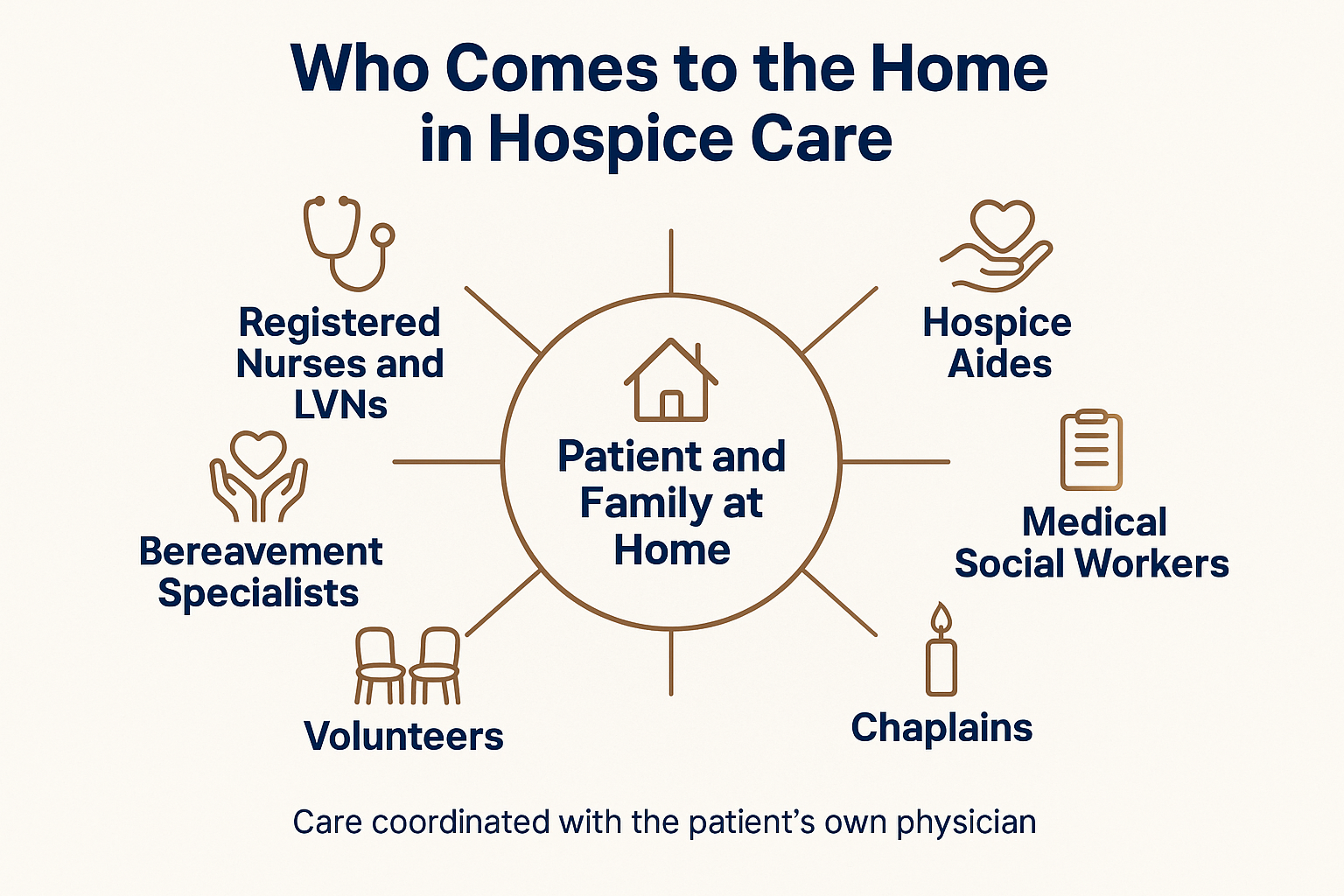
- Regular scheduled visits from Registered Nurses and Licensed Vocational Nurses who track symptoms and adjust the plan
- Pain and symptom management that is reviewed continuously, not only during a crisis
- Hospice Aides helping with bathing, grooming, and daily comfort
- Medical Social Workers sorting out benefits, family conflict, and practical logistics
- Chaplains for spiritual support, on the patient’s own terms and beliefs
- Volunteers who sit with a patient so a family member can sleep, shop, or step outside
- Bereavement Specialists who stay involved with the family after a death
One family member on the Peninsula described a home health team of nurses, Physical Therapists, and a Medical Social Worker arriving one after another, each one adding something the family could not have arranged alone. Hospice works the same way, with the whole team assigned at once.
If the line between programs still feels blurry, home health vs. hospice lays out how families tell which one fits the moment they are in.
What Changes When Hospice Starts Weeks Earlier Instead of Days
The services are the same. The difference is how much time the family and the team have to use them.
| What families face | Hospice starting in the last few days | Hospice starting weeks or months earlier |
|---|---|---|
| Pain and symptom control | Team is playing catch-up on symptoms already out of control | Symptoms tracked and adjusted over time before crisis hits |
| Home setup | Hospital bed, wheelchair, or oxygen arrives during an emergency | Equipment in place and the home arranged in advance |
| Family training | Instructions given once, under stress | Repeated coaching on medications, positioning, and what to watch for |
| Emotional and spiritual support | Little time for Chaplain or Volunteer involvement | Relationships built with the patient and family over weeks |
| Decision-making | Irreversible choices made in a hospital hallway | Choices made at the kitchen table, with questions answered |
Who Actually Comes to the Home
Hospice is not one nurse making occasional visits. It is a team assigned to the patient and the family at the same time.
Why the Word Usually Comes Up at CHOMP or Salinas Valley Health
Community Hospital of the Monterey Peninsula and Salinas Valley Health are two of the most common places where local families first hear hospice mentioned. It comes from a discharge planner, often on short notice, sometimes on a Friday afternoon.
Call records tell the same story from the other side. Roughly a third of first-time callers are an adult child or spouse phoning within hours or days of a discharge, wanting to know if someone can come to the house today or tomorrow.
Those calls are not comparison shopping. They are people trying to keep a parent from going back to the hospital for a third time in two months.
When a family already understands what hospice at home provides, that hallway conversation is far less frightening. They can ask real questions instead of guessing. What families often miss when planning a hospital discharge to home covers the practical side of that handoff.
Geography matters here too. Home-based hospice across Monterey County covers a wide spread, from the Peninsula down through Salinas and King City, plus San Benito County including Hollister and parts of Santa Cruz and South Santa Clara counties. Worth confirming coverage for the patient’s actual address early, since that question comes up on about one in twelve calls.
What Families Should Expect on Cost
Cost is the second question almost every family asks, usually right after eligibility. The general picture is that the Medicare hospice benefit covers services, visits, medications, and equipment related to the terminal illness, and most families see little to no out-of-pocket expense for those items.
Medi-Cal and Veterans benefits also cover hospice for eligible patients. Exact coverage depends on the plan, the diagnosis, and what else the patient needs, so the honest answer is to confirm specifics with the provider and the plan directly.
One thing that catches families off guard: hospice visits are intermittent, not around-the-clock. Households that need someone present all day often hire private-duty help separately, and market rates for that kind of daily coverage in Monterey County can run into the thousands of dollars per month, depending on hours and level of need.
Starting hospice earlier does not lower that hourly rate. But it does give families time to plan for it instead of scrambling.
Frequently Asked Questions About Hospice Timing
Is hospice only for end of life, or can it start months ahead?
It can start months ahead. The standard is a physician’s certification that the illness, if it runs its expected course, may result in death within six months. Many patients are eligible well before a family thinks to ask.
What happens if my parent lives longer than six months?
Care continues. A physician recertifies eligibility at set intervals, and patients who live longer than expected stay on hospice as long as they still meet the criteria. Living longer than predicted is common, not a problem.
Do we need a doctor’s order to start?
Yes. A physician’s order is required before a hospice team can schedule an assessment. This trips up a lot of families who call ready to start and do not realize a doctor’s signature comes first, so it is worth asking the treating physician early.
Can someone come off hospice if their condition improves?
Yes. A patient can revoke hospice at any time and return to curative treatment, and can re-enroll later if things change. Choosing hospice is not a one-way door.
Does support really continue after a death?
It does. Bereavement Specialists offer grief counseling and support groups to families after a patient’s passing, and locally that support is open to anyone grieving a loss, not only families who used hospice services.
Ready to understand your options before you have to decide?
Learning what hospice at home involves before a discharge conversation gives a family room to think instead of react. Central Coast VNA & Hospice has supported families across Monterey County, San Benito County, and the surrounding Central Coast since 1951, and a care coordinator can walk through eligibility, coverage, and what visits actually look like without any commitment. Questions are welcome at 831-372-6668 or at ccvna.com.