
Direct Answer: Hospice for dementia is appropriate when a physician determines that life expectancy is six months or less if the disease follows its natural course. Key signs include significant weight loss, recurrent infections, inability to walk without full assistance, and loss of safe swallowing.
Dementia is one of the hardest conditions for families to navigate when thinking about hospice. Unlike cancer or heart failure, it doesn’t follow a predictable curve. It moves slowly, plateaus, then shifts again, and families often find themselves watching a parent decline for years without ever feeling certain that the moment has arrived.
Families across Monterey County ask versions of this question regularly. A daughter calling after a sleepless night. A son managing his father’s medications alongside a cancer survivor mother. The situation is different each time, but the core question is always the same: how do we know when it’s time?
This article won’t give you a script or a shortcut. But it will walk through what the clinical markers actually look like in everyday life, what Medicare requires before hospice can begin, and how to start a conversation with a physician that most families wait too long to have.
What Does Medicare Actually Require for Hospice with Dementia?
Medicare’s hospice benefit requires a physician to certify that the patient’s life expectancy is six months or less if the disease runs its natural course. That standard applies to all diagnoses, but dementia makes it particularly hard to apply because the disease can stretch across a decade or more.
For dementia specifically, physicians look at a cluster of functional and medical changes that, taken together, indicate the illness has progressed to its final stage. There is no single test that triggers eligibility. It is a clinical picture built from several markers, assessed together.
The changes physicians and hospice nurses typically look for include:
- Significant weight loss, often 10% or more of body weight in six months, even when nutrition support is offered
- Recurrent infections, especially pneumonia or urinary tract infections that keep returning
- Severe loss of functional ability, the person can no longer walk without full physical support from another person
- Loss of meaningful verbal communication, speaking fewer than six intelligible words per day is one recognized threshold
- Inability to swallow safely, leading to choking, aspiration risk, or refusal to eat
These changes don’t announce themselves on a single day. Families usually recognize them in hindsight, looking back at the last few months and realizing how much shifted. That’s actually one of the most important things to understand: you don’t have to wait for a crisis to ask whether hospice criteria have been met. A conversation with the physician can happen at any point. The hospice eligibility question most families are afraid to ask is often one of the most relieving ones to finally ask out loud.
When a Parent Has Dementia and Something Else Too
One situation that comes up regularly in conversations with Monterey County families involves a parent who has dementia alongside one or more other serious diagnoses. Heart failure and dementia. A cancer history and dementia. Diabetes and dementia. This is not unusual, it is actually the common picture for people in their 80s.
A family recently described their situation this way: an 83-year-old mother who is a cancer survivor, and an 86-year-old father who was recently diagnosed with dementia and takes more than five medications. Coordinating that care had become overwhelming.
When multiple serious conditions overlap, the path to hospice eligibility can shorten faster than families expect. A physician evaluating whether hospice criteria are met looks at the whole patient, not each diagnosis in isolation. Heart failure that is worsening alongside advanced dementia may meet eligibility thresholds much sooner than dementia alone would.
The harder truth is that many families don’t bring this up with the physician because they aren’t sure it’s appropriate to ask. It is. Any family member can request that a physician assess whether their loved one may now qualify for hospice. The physician makes the determination, your job is to start the conversation.
If you are not yet at the hospice threshold but your loved one needs more support than they are getting, there is another option worth understanding before you get there.
What Is the Difference Between Palliative Care and Hospice for Someone with Dementia?
This distinction matters enormously, and many families searching for hospice information don’t yet realize that palliative care exists as a separate, earlier option.
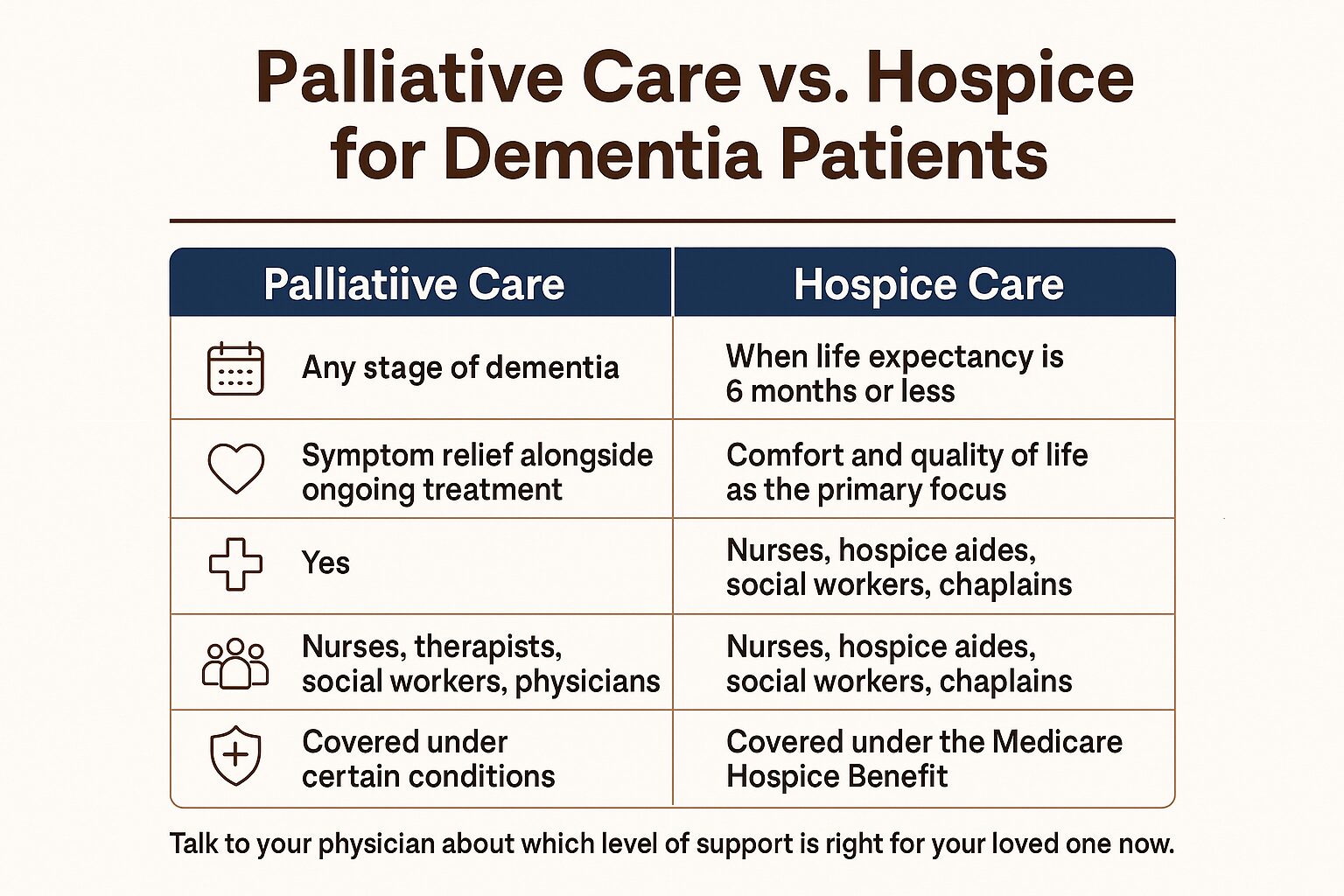
Palliative care can begin at any stage of dementia. It focuses on managing symptoms, reducing discomfort, supporting the family, and coordinating care, all while the patient continues whatever medical treatment the physician recommends. Choosing palliative care does not mean stopping treatment. It does not require a six-month prognosis.
Hospice begins when curative or life-prolonging treatment is no longer the goal, typically when a physician and family agree that comfort and quality of life matter more than further medical intervention.
For a family with a parent in early or middle-stage dementia who is struggling with symptoms, recurrent hospitalizations, or caregiver exhaustion, palliative care is often the right fit right now. Central Coast VNA & Hospice has offered a home-based palliative care program since 2015, and it remains available to patients across Monterey County, including Salinas, Hollister, and King City.
You can read more about what this program actually involves in what palliative care actually means, and when it can start. Understanding comfort care vs. hospice can also help clarify which path fits your family’s situation right now.
Palliative Care vs. Hospice: A Side-by-Side Look for Dementia Families
This comparison shows the key differences between palliative care and hospice for patients with dementia, so families can identify which level of support fits their current situation.
Dementia Hospice Eligibility: What Physicians Are Looking For
These are the clinical markers physicians commonly use when assessing whether a dementia patient may meet hospice eligibility. No single marker determines eligibility on its own, the physician looks at the full picture.
| Clinical Marker | What It Looks Like in Daily Life | Why It Matters |
|---|---|---|
| Significant weight loss | Losing noticeable weight over several months despite eating attempts | Signals the body is no longer able to maintain itself |
| Recurrent infections | Repeated bouts of pneumonia or urinary tract infections | Indicates the immune system is significantly weakened |
| Loss of mobility | Cannot stand or walk without full physical support from another person | Reflects late-stage neurological decline |
| Loss of verbal communication | Fewer than six intelligible words spoken per day | One recognized clinical threshold for late-stage dementia |
| Unsafe swallowing | Choking, gagging, or refusing food and liquids | Raises aspiration risk and signals end-stage progression |
Does Choosing Hospice Mean Giving Up on My Parent?
This fear is real, and it comes up constantly, in phone calls, in form submissions, in the hesitation families carry into every conversation about this topic. The word “hospice” can feel like a door closing.
But the clinical evidence points in a different direction. Many patients with dementia who transition to hospice stabilize in the early weeks of enrollment. With consistent pain and symptom management, fewer disruptive hospitalizations, and a team visiting regularly at home, some patients become more comfortable and more settled than they had been in months.
Hospice does not accelerate death. What it does is shift the focus from fighting a disease to caring for a whole person. According to research published by the National Hospice and Palliative Care Organization, hospice patients often report better symptom control and family members report less distress than those who do not enroll.
The interdisciplinary team on a hospice program includes nurses, Hospice Aides, a Medical Social Worker, a Chaplain, and Volunteers. That team addresses not just the physical symptoms your parent is experiencing, but the emotional and spiritual weight your entire family is carrying. For families in Monterey County who have been shouldering this alone, that kind of support often arrives as a genuine relief.
If you are still sorting through what to expect, how families describe the moment they chose hospice offers a grounded look at what that decision actually felt like for real families.
Frequently Asked Questions About Hospice and Dementia
Can someone with dementia qualify for hospice if they don’t have another terminal diagnosis?
Yes. Dementia alone can meet hospice eligibility criteria when it has progressed to a late stage. Medicare does not require a secondary diagnosis. The physician must certify that the patient’s life expectancy is six months or less based on the current trajectory of the disease, and late-stage dementia with the markers described above can meet that standard on its own.
What if my parent seems stable, can they still be evaluated for hospice?
Stability in dementia can be misleading. A person may appear calm or comfortable at home while still meeting hospice eligibility criteria based on weight, swallowing, mobility, or communication. “Stable” does not mean improving. A physician evaluation looks at the full clinical picture, not just how a patient seems on a given day. It is always appropriate to ask for that assessment.
Does Medicare cover hospice for dementia?
Yes. The Medicare Hospice Benefit covers hospice services when a physician certifies a terminal prognosis of six months or less. This includes nursing visits, Hospice Aide services, medication for comfort, medical equipment, and support for the family. Central Coast VNA & Hospice accepts Medicare, Medi-Cal, and Veterans benefits. For a full picture of what is covered and how to access it, a care coordinator can walk you through the specifics for your family’s situation.
My parent has dementia and heart failure. Could they qualify sooner than I expect?
Quite possibly. When dementia overlaps with another serious condition, the combined effect on a patient’s health often brings eligibility timelines forward. A physician evaluating hospice criteria looks at the whole patient, and two serious illnesses progressing together can meet the eligibility standard more quickly than either would alone. The important step is asking the physician to evaluate where things actually stand right now rather than waiting for an obvious crisis.
What if my parent isn’t ready for hospice, is there anything in between?
Palliative care is exactly that. It can begin at any stage of dementia, continues alongside treatment, and focuses on symptom management, care planning, and family support. Central Coast VNA & Hospice has offered a home-based palliative care program in Monterey County since 2015, including Salinas, Hollister, and King City. If you are not sure whether your family is at the hospice threshold but know that more support is needed, what palliative care actually means, and when it can start is a good place to begin.
How do I start the conversation with my parent’s doctor about hospice?
You can simply ask: “Has my parent reached the point where a hospice evaluation would make sense?” That is enough. Physicians are accustomed to this question, and a good physician will welcome it rather than dismiss it. If you are not sure how to frame the conversation or what to bring to the appointment, the article on advance care planning offers practical guidance for preparing for exactly this kind of discussion.
Not Sure Where Your Family Stands Right Now?
Families in Monterey County, Salinas, Hollister, King City, and the surrounding communities are welcome to call Central Coast VNA & Hospice at 831-372-6668 to speak with a care coordinator, no referral needed to start that conversation. If you would rather reach out online first, visit ccvna.com to learn more about the hospice and palliative care programs available in your area.