
Direct Answer: Most families arrange home health after discharge, but the process needs to start before your loved one leaves the hospital — ideally 24 to 48 hours earlier.
A family reached out to us recently — the day after their mother came home from Salinas Valley Health. Her physician had already recommended home health services. But no one had made a call before discharge, and now she was home without any care lined up.
This happens more than most families expect. The hospital stay feels like the hard part, and the discharge feels like relief. But the 48 hours after leaving the hospital are when things can quietly go wrong — a wound that needs changing, medications that need managing, a fall that triggers a second admission.
This article is about what to do before that discharge happens — not after. If your family is navigating this right now in Monterey County, Salinas, King City, or anywhere on the Central Coast, here’s what actually matters.
The Discharge Day Problem Nobody Warns You About
Hospitals often discharge patients on Fridays. It’s not a coincidence — weekend staffing is lighter, beds turn over, and the administrative machinery that keeps patients in the building slows down heading into the weekend.
The problem is that home health agencies work on the same calendar. If a physician order for home health goes out Friday afternoon, a first home visit typically follows within 24 to 48 hours of the order being received. That means your loved one could be home for a full weekend before a Registered Nurse ever walks through the door.
That gap is exactly when readmissions happen — a missed medication dose, an unmanaged wound, a patient who isn’t moving the way they should after surgery. For families in communities like Hollister or King City, where the nearest hospital is already a drive away, a weekend readmission is its own ordeal.
The fix isn’t complicated, but it has to happen before discharge day, not after. If a physician has already recommended home health during the hospital stay, the conversation with the discharge planner should start that same day — not on the morning your loved one is getting dressed to leave.
How the Medicare Home Health Order Actually Works
About 43% of admissions-related calls to home health agencies are some version of “how do I get started?” Most families don’t know what’s actually required — and the hospital doesn’t always explain it clearly.
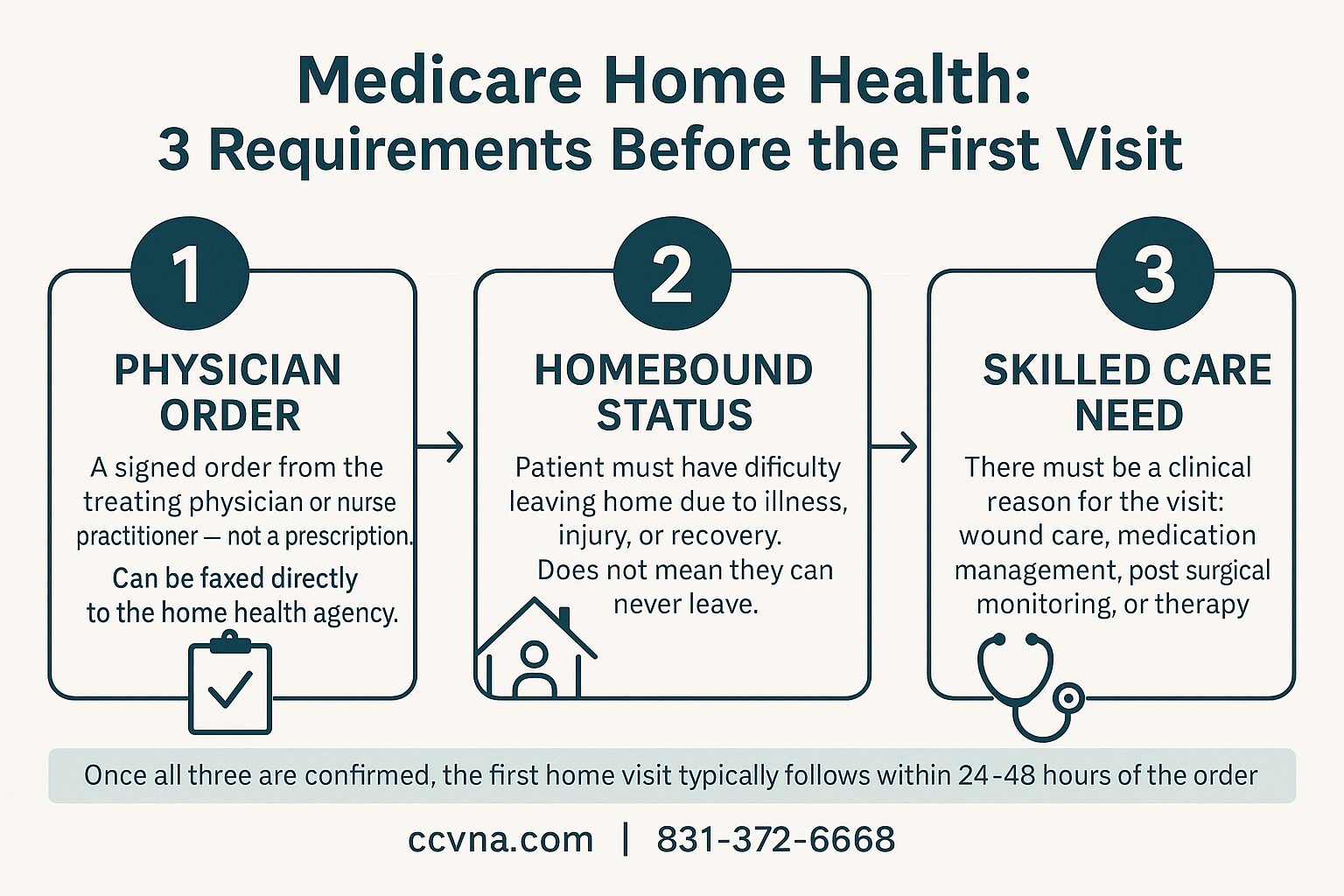
Medicare covers home health services when three conditions are met:
- A physician order — not a prescription, but a signed order from the treating physician (or nurse practitioner) authorizing home health
- Homebound status — your loved one has difficulty leaving home due to illness, injury, or recovery; this doesn’t mean they can never leave, but leaving requires significant effort
- A skilled care need — there must be a clinical reason for the visit, such as wound care, medication management, post-surgical monitoring, or physical therapy
Once those three boxes are checked, the physician’s office (or the hospital discharge team) can fax the order directly to a home health agency. That fax starts the clock. A first home visit typically follows within 24 to 48 hours of the order being received.
If your loved one is recovering from a procedure and a physician has mentioned home health, ask the hospital team directly: has the order been placed, and has it been sent? Does Medicare cover physical therapy at home? — that’s a question worth reading up on before the discharge conversation happens.
The Three Things Medicare Requires for Home Health Coverage
Before a home health agency can schedule a first visit, three conditions must be confirmed. Here’s how they fit together.

Your Right to Choose — What the Discharge Planner Isn’t Always Telling You
Every hospital has a discharge planner or Medical Social Worker whose job is to coordinate what happens after you leave. They’re often the ones who will name a specific home health agency — sometimes the one the hospital has a referral relationship with.
What many families don’t realize: you have the right to choose your home health provider. The hospital can offer a recommendation, and that recommendation might be perfectly good. But you are not required to accept it, and the decision belongs to your family.
If your family has a prior relationship with a home health agency, or if you’ve done your own research and prefer a nonprofit provider with deep local roots, you can request that specific agency. You can also ask the discharge planner to contact them directly.
For families in Monterey County, that conversation is worth having. A local agency that has been operating in this region for decades — with staff who know the roads from Salinas to Carmel Valley — brings a different kind of familiarity than a large national network whose nearest office might be a county away. What families in Monterey wish they’d known sooner about home care is a useful read before that conversation.
What Home Health Can Do — and What It Can’t
One of the most common mismatches at discharge is a family expecting round-the-clock support at home. Home health services aren’t residential care, and the sooner families understand that distinction, the better prepared they’ll be.
Home health — covered by Medicare and Medi-Cal — includes:
- Skilled nursing visits by Registered Nurses and Licensed Vocational Nurses for wound care, medication management, post-surgical monitoring, and chronic disease management
- Physical Therapy to rebuild strength and improve mobility after surgery or illness
- Occupational Therapy to help patients manage daily tasks safely at home
- Speech Therapy for swallowing difficulties or cognitive changes
- Medical Social Workers for care coordination, emotional support, and connecting families to community resources
What it doesn’t include: 24-hour staffing, live-in care, or ongoing personal care assistance like bathing, dressing, or meal preparation on a daily basis. Those services fall under a different category of support — often called personal care or custodial care — which Medicare does not typically cover.
If your family is realizing that your loved one needs more support than a skilled nursing visit can provide, when caring for an aging parent becomes more than you can do alone walks through what that transition looks like. And the difference between needing help and needing a facility is worth reading if a higher level of care is on the table.
Home Health vs. What Medicare Doesn’t Cover
Families frequently arrive at discharge expecting services that fall outside Medicare’s home health benefit. Here’s a side-by-side look at what is and isn’t included.
| Service | Covered by Medicare Home Health? | Notes |
|---|---|---|
| Skilled nursing visits (wound care, medications) | Yes | Requires physician order and homebound status |
| Physical, Occupational, or Speech Therapy | Yes | Must have a skilled care need tied to current diagnosis |
| Medical Social Worker visits | Yes | Included as part of home health benefit |
| 24-hour live-in nursing | No | Falls outside Medicare home health benefit |
| Daily personal care (bathing, dressing) | No | Considered custodial care; not covered by Medicare |
| Meal preparation or housekeeping | No | May be available through county programs separately |
A Pre-Discharge Checklist for Families
If your loved one is currently in a hospital anywhere in Monterey County — Salinas, the Monterey Peninsula, or across the Central Coast — here’s what to address before the discharge day arrives.
- Ask the attending physician whether home health services have been ordered and whether the order has been sent
- Identify the hospital’s discharge planner or Medical Social Worker and schedule time to talk about the plan — not just the paperwork
- Confirm homebound status applies to your loved one, and ask the team to document it clearly
- Decide which agency you want and give the discharge planner that name early — don’t wait until the morning of discharge
- Ask about discharge timing — if it looks like a Friday, ask whether the agency can receive the order Thursday to close the weekend gap
- Prepare the home before your loved one arrives: clear pathways, check medications, remove trip hazards
The families who avoid the readmission spiral are almost always the ones who started this list two or three days early. After the hospital discharge, what comes next? goes into more detail on the days immediately following a return home.
Frequently Asked Questions About Hospital Discharge to Home
How quickly can a home health agency start after my loved one is discharged?
Once a home health agency receives a signed physician order, a first home visit typically follows within 24 to 48 hours. The key is making sure the order is sent before discharge — not after. If the order goes out on a Friday afternoon, the first visit may not happen until Monday. Getting the order placed earlier in the week closes that gap.
Can we choose our own home health provider, or do we have to use the hospital’s recommendation?
You can choose your own. The hospital’s discharge planner may recommend an agency, but that recommendation isn’t binding. If you have a preference — including a local nonprofit with a long history in Monterey County — tell the discharge planner and ask them to send the order there directly.
What does ‘homebound status’ actually mean? My father goes to the occasional doctor’s appointment.
Homebound doesn’t mean someone can never leave the house. It means that leaving home requires considerable effort due to illness, injury, or recovery — and that absences are infrequent or brief. Going to a doctor’s appointment does not disqualify someone from homebound status. Most patients recovering from surgery or managing serious illness qualify without issue.
My mother needs help bathing and getting dressed every day. Does home health cover that?
Not on a daily basis through Medicare. Home health covers skilled care — nursing, therapy, and social work — but not ongoing personal care like bathing, dressing, or meal prep. If your mother needs that kind of daily support, a Medical Social Worker can help identify what’s available in Monterey County, including community programs and private options.
What if the physician already mentioned palliative care or hospice — does that change the discharge process?
It can. Palliative care can be provided alongside home health services and doesn’t require giving up other treatment. Hospice is a separate benefit with its own enrollment process and eligibility criteria. If either has come up during the hospital stay, that’s worth a direct conversation with the discharge team before your loved one leaves. What comfort-focused care really means is a good place to start if you’re trying to understand the difference.
Have Questions Before Discharge Day?
Central Coast VNA & Hospice has been supporting families in Monterey County, Salinas, the Monterey Peninsula, and across the Central Coast since 1951. If a hospital stay is wrapping up and you’re not sure what comes next, a care coordinator can walk you through the process — no pressure, just clear answers. Call 831-372-6668 or visit ccvna.com to learn more.