
That nagging feeling, "is it too late for help?" can be an incredibly heavy weight to carry. The simple truth is, support is almost always available. The real question isn't if you can get help, but how to make the most of the precious time that's left.
This guide is here to walk you through exactly that.
When Is the Right Time for Hospice Care?

Many families believe hospice is only for the last few days of life. This is one of the biggest and most heartbreaking misunderstandings we see. It often leads to missed opportunities for meaningful support.
Hospice isn't about giving up or waiting for the end. It's a philosophy of care that shifts the focus from adding more days to life, to adding more life to the days we have left.
For over 74 years, Central Coast VNA & Hospice has served as a local, nonprofit guide for families just like yours. We're proud to serve our neighbors across Monterey County, San Benito County, Santa Cruz County, and South Santa Clara County. Our goal has always been to replace fear with facts.
The Problem of Waiting Too Long
When families put off the conversation about hospice, they often miss out on months of valuable support. The benefits aren't just for the person who is ill; they extend to the entire family. A dedicated team—including a Registered Nurse, Hospice Aide, and Chaplain—can manage symptoms, reduce stressful hospital visits, and provide crucial emotional support.
Unfortunately, many people only find this care at the last minute. In fact, many patients enter hospice with fewer than 17 days to live, even though they could have received care for months. This delay means families miss the full benefit of comfort care and symptom relief.
Waiting for a crisis forces families to make overwhelming decisions under stress. An early, gentle conversation can completely change the end-of-life experience, bringing peace instead of panic.
To see how timing impacts care, it helps to compare the two scenarios side-by-side.
Early vs. Late Hospice Support: A Quick Comparison
| Care Aspect | Benefits of an Early Conversation | Challenges of a Late Referral |
|---|---|---|
| Symptom Management | The care team has time to stabilize pain and manage complex symptoms effectively. | Symptoms may be out of control, leading to a crisis situation and emergency room visits. |
| Patient Involvement | Your loved one can actively participate in their care decisions and share their wishes. | The patient may be too ill to communicate, leaving the family to guess at what they wanted. |
| Emotional Support | Families have time to process emotions and find closure with professional guidance. | The family is often in crisis mode, with little time to prepare emotionally for the loss. |
| Family Well-being | Family members receive training, respite, and emotional support, preventing burnout. | Family members are often exhausted, having managed the illness alone for too long. |
As you can see, the difference is night and day. An early conversation opens the door to a more peaceful, dignified journey.
Benefits of an Early Conversation
Starting the discussion sooner gives everyone room to breathe. It allows your loved one to be an active participant in their own care decisions. It also gives the entire family time to prepare, both emotionally and practically.
An early start offers:
- Better Symptom Control: Our clinical teams can manage pain and other symptoms much more effectively over weeks or months.
- Emotional and Spiritual Support: Chaplains and Social Workers help patients and families navigate complex feelings.
- Reduced Family Stress: Knowing your loved one is comfortable and safe provides an incredible sense of peace of mind.
Understanding that hospice is about living fully is the first step toward finding peace. Our guide to understanding your hospice care options can provide even more clarity.
Palliative Care vs. Hospice: What Is the Difference?
To figure out if it’s ever “too late for help,” we first need to clear up some confusion. Many families use the terms palliative care and hospice to mean the same thing. But they are two distinct types of support.
Think of palliative care as an extra layer of support. It can begin the moment someone is diagnosed with a serious illness. Its main job is to improve quality of life by managing symptoms like pain or anxiety.
Palliative Care: A Focus on Comfort at Any Stage
Palliative care is not tied to a person's prognosis. It's for anyone with a serious condition, offering relief and strength. A person can receive palliative care while still getting treatments meant to cure their illness.
The key takeaway is that palliative care works alongside other medical treatments. It adds comfort without asking a patient to give up on a cure.
Hospice Care: A Shift in Goals
Hospice care is a special kind of palliative care. It begins when the focus of treatment shifts. Instead of trying to cure an illness, the goal becomes providing comfort and peace.
For a person to be eligible for hospice, a doctor usually certifies that they have a life expectancy of six months or less. This is if the illness runs its natural course.
This is the most important distinction:
- Palliative Care: Can be provided with curative treatment.
- Hospice Care: Is for patients who are no longer seeking curative treatment.
Choosing hospice isn't about giving up. It’s about prioritizing quality of life over quantity.
The Central Coast VNA & Hospice Continuum of Care
At Central Coast VNA & Hospice, we see these as a seamless continuum of care. For over 74 years, our nonprofit has guided families on the Central Coast through their healthcare journey. This approach provides stability when families need it most.
Many of our patients in Monterey County and surrounding areas start with our home health or palliative care services. Then, as their needs change, they can transition smoothly to hospice.
This transition is often handled by the same trusted clinicians. The same Registered Nurse or Hospice Aide already knows the patient’s story and preferences. This eliminates the stress of starting over with a new team.
Our integrated model ensures that care is always consistent and compassionate. It allows us to build deep, trusting relationships. To learn more, explore our guide on the differences between hospice and palliative care.
Key Signs It Might Be Time to Consider Hospice
Knowing when it's the right moment to talk about hospice can feel difficult. But several clear signs can help guide your family. These signs are about the real-world challenges that come with a serious illness.
Thinking about hospice isn't about giving up. It’s about shifting the focus to making every day the best it can be. For families across the Central Coast, a simple conversation with Central Coast VNA & Hospice can provide clarity.
This flowchart helps visualize the choice families face.
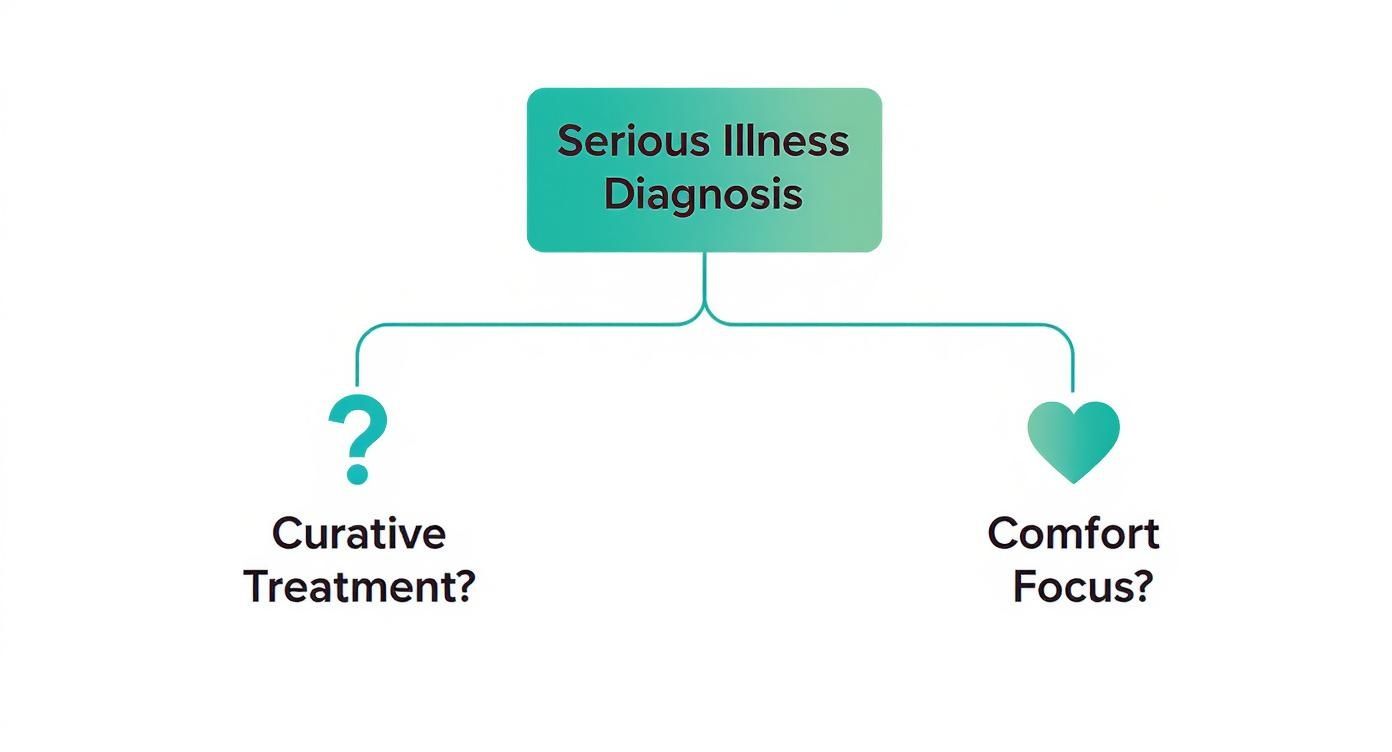
As you can see, both paths are valid options. The right choice depends entirely on a person's goals.
Physical and Clinical Indicators
Certain physical changes often signal that the body could benefit from hospice support. We’re not talking about a single bad day. We mean a pattern over time that shows an illness is progressing.
Some common clinical signs include:
- Frequent Hospital Visits: Multiple trips to the ER or hospital stays within the last six months for the same symptoms.
- Uncontrolled Symptoms: Persistent pain, shortness of breath, or nausea that has become difficult to manage.
- Significant Weight Loss: Noticeable, unintentional weight loss, often with a loss of appetite.
- Declining Function: A clear drop in the ability to handle daily activities like bathing or dressing.
These physical markers are important clues. But how a person is feeling is just as crucial.
Practical and Emotional Signs
Sometimes, the clearest signs aren't on a medical chart. You can see them in the exhaustion of a family member. You can hear them when your loved one says they’re "tired of fighting."
When someone says they no longer want to go back to the hospital, it’s a pivotal moment. Their priorities are shifting toward comfort. Listening to that is an act of love and respect.
When family members feel overwhelmed or exhausted, it's a sign that professional support is needed. Hospice isn't just for the patient; it provides essential guidance and respite for the entire family.
Other practical signs can include:
- Spending most of the day in a bed or a chair.
- Needing more and more help with basic daily tasks.
- Withdrawing from conversations or favorite social activities.
Recognizing these signs allows you to be proactive instead of reactive. For a deeper dive, you can learn more about how you know when hospice is needed in our detailed guide.
The Role of a Professional Assessment
While these signs are helpful, you don’t have to figure this out alone. The best way to get clear answers is with a hospice eligibility assessment. This is provided at no cost by a Registered Nurse from Central Coast VNA & Hospice.
This assessment can happen wherever your loved one calls home. The nurse will review your loved one’s condition and listen to your family's goals. This is a conversation designed to empower you with information.
How to Start the Hospice Conversation

Talking about hospice is one of the toughest conversations any family will have. The words themselves feel heavy. But approaching this topic with honesty and compassion is an act of love.
The goal isn't to force a decision. It's about opening a door to understand what your loved one truly wants for their quality of life. An early conversation allows for calm discussion instead of rushed choices during a crisis.
Finding the Right Time and Place
Choosing the right moment is half the battle. Look for a time when you won’t be rushed. A quiet afternoon at home often works better than a busy family gathering.
The key is to make sure everyone feels as comfortable as possible. This conversation takes emotional energy, so starting from a place of calm helps.
Framing hospice as a choice for empowerment can change the tone. It’s not about giving up; it’s about taking control of how one lives, ensuring their final chapter is filled with dignity and peace.
Starting with gentle, open-ended questions can ease into the topic. Try asking questions that focus on their feelings:
- “What’s been the most difficult part of your days lately?”
- “When you think about the coming months, what are you hoping for?”
- “What matters most to you right now?”
These questions show you’re there to listen, not to push an agenda. Their answers will give you a natural path to discussing helpful support.
Talking with the Medical Team
Your loved one’s doctor is a crucial partner in this conversation. When you meet with their physician, being prepared helps you get clear answers.
Bring a list of questions so you don’t forget anything. You might consider asking:
- What can we realistically expect as the illness progresses?
- What are the benefits of continuing with the current treatments?
- At what point would you recommend we consider comfort-focused care?
Bringing another family member to the appointment can be a huge help. One person can take notes while the other focuses on the conversation.
How Central Coast VNA & Hospice Can Help
You don’t have to navigate these difficult conversations alone. For families across the Central Coast, from Monterey to Santa Cruz, our team is here to offer guidance.
Our experienced Social Workers and Chaplains are experts at facilitating family meetings. They can help explain care options and ensure the final decision reflects your loved one's wishes. For more detailed advice, check out our guide on how to talk to your parents about hospice care.
Navigating Hospice Enrollment and What Insurance Covers
When you're facing a serious illness, the last thing you want to worry about is complicated paperwork. The good news is, the enrollment process is designed to be straightforward and supportive.
It all begins with a simple conversation. While a referral often comes from a physician, you can call Central Coast VNA & Hospice directly to ask questions. A Registered Nurse will meet with your family for an assessment, listen to your concerns, and confirm eligibility.
How Hospice Care Is Paid For
One of the biggest sources of comfort for families is learning how hospice is paid for. For most people on the Central Coast, hospice is a fully covered benefit under Medicare Part A. It’s also covered by Medi-Cal and most private insurance plans.
This benefit is designed to lift the financial burden off families. It allows you to focus on spending quality time together. As a local nonprofit, our mission is to make sure everyone in our community gets the compassionate care they deserve.
Despite a recent rise in hospice use, access remains limited. In 2022, 49.1% of Medicare beneficiaries who died received hospice care (NHPCO, 2023). This means many families are still missing out on this vital support.
What the Hospice Benefit Typically Includes
The Medicare hospice benefit covers everything related to the terminal illness. This all-inclusive approach means families aren't surprised by hidden costs.
Here’s a look at the services usually covered:
- Nursing Visits: Regular check-ins from a Registered Nurse to manage symptoms at home.
- Hospice Aide Support: Compassionate help from a Hospice Aide with personal care like bathing and dressing.
- Medical Equipment: A hospital bed, oxygen, or wheelchair delivered directly to the home.
- Medications: All medications for managing pain and other symptoms related to the terminal illness.
- Emotional and Spiritual Support: Visits from Social Workers and Chaplains for the patient and family.
- Bereavement Support: Grief counseling and support groups for the family for up to 13 months.
This complete circle of support allows families to stop worrying about medical bills. It’s designed to address physical, emotional, and spiritual needs all at once.
Understanding your options is the first step toward peace of mind. For a more detailed breakdown, learn more about how to pay for hospice care on our website. Families may also find it helpful to research resources for accessing free grant money for bills and personal use.
Why Earlier Support on the Central Coast Matters
When families ask, "Is it too late for help?", it usually means they’re in a crisis. The key to avoiding that stressful moment is understanding that timing is everything. Starting the conversation about comfort early can completely change a family’s end-of-life experience.
At Central Coast VNA & Hospice, our 74 years of serving this community have shown us one thing clearly: earlier support makes a profound difference. When families reach out before things get overwhelming, our teams have time to get to know a patient and build a trusting relationship. This helps prevent emergency room visits and gives families space to make meaningful memories.
The CCVNA Continuum of Care
As a local nonprofit serving Monterey, San Benito, Santa Cruz, and South Santa Clara counties, we offer a seamless continuum of care. Our services range from home health and palliative care to hospice. As a patient's needs change, their care team can often remain the same, providing a stable presence.
There’s incredible comfort in that consistency. Imagine your loved one receiving care from a Registered Nurse or Hospice Aide who already knows their story. This lifts a huge weight off of everyone involved.
The greatest gift of an early conversation is control. It empowers your loved one to be an active participant in their care, ensuring their final chapter is lived with dignity, comfort, and peace—on their own terms.
Take the First Step Today
Many families begin their research online. In fact, 65% of healthcare decision-makers start with Google. Educational content can bridge the knowledge gap, and Central Coast VNA & Hospice can be that trusted local source.
Don't wait until you're at a breaking point. An informational call doesn't commit you to anything, but it can provide immense relief.
Our compassionate experts are here to help you:
- Understand the real differences between palliative care and hospice.
- Recognize the signs that your loved one might need more support.
- Navigate the often-confusing world of insurance and enrollment.
If you live on the Central Coast, we encourage you to contact Central Coast VNA & Hospice for a no-obligation conversation. Learning about your options is a powerful first step toward getting the support your family deserves.
Frequently Asked Questions About Hospice Timing
1. Does choosing hospice mean we are giving up hope?
No. Choosing hospice isn’t about giving up. It’s about shifting what you hope for, from a cure to comfort, peace, and meaningful moments. It's about adding life to days, not just days to life.
2. Can a patient leave hospice care?
Absolutely. A patient can leave hospice care at any time and for any reason. If their condition improves or they decide to try a new treatment, they can stop services and re-enroll later if needed.
3. How long can someone receive hospice care?
A doctor must certify a life expectancy of six months or less. However, care is not limited to six months. A person can receive hospice support as long as they meet the medical criteria, with regular recertifications from their doctor.
4. Where is hospice care provided?
Most hospice care happens wherever a person calls home. This could be a private residence, an assisted living community, or a nursing home. Central Coast VNA & Hospice brings this support directly to you, helping avoid stressful hospital trips.
5. Do we need a doctor's referral to ask about hospice?
No. Anyone can call us directly to ask questions or get information. If you decide hospice is the right path, our team at Central Coast VNA & Hospice will coordinate with your loved one’s doctor to get the necessary referral.
It's never too late to ask for help or just get information. Early conversations bring peace of mind and a sense of control. If you're caring for a loved one on the Central Coast, please reach out to Central Coast VNA & Hospice. Learn more by visiting https://ccvna.com or calling us for a no-obligation conversation today.