
When a loved one is living with a serious illness, it’s easy to get lost in a sea of medical terms. Families often find themselves trying to figure out the difference between palliative care and hospice care.
They aren't the same, but they aren’t opposites, either. Think of it this way: palliative care is all about providing comfort at any stage of a serious illness, while hospice care is for the final months of life.
Guiding Your Family Through Palliative and Hospice Care
Navigating a serious illness with someone you love is overwhelming. This is one of the most common—and confusing—questions families face when dealing with a serious illness.
Here on the Central Coast, one of the most common questions we hear is: what’s the real difference between palliative and hospice care? Getting this distinction right is the first step toward making confident, compassionate decisions for your family.
At Central Coast VNA & Hospice, we have been helping families walk through this for over 74 years. We know you need more than definitions. You need to understand how these services actually work to bring comfort and support into your home.

Palliative Care vs Hospice Care at a Glance
Let's start by breaking down the core differences. While both are centered on improving quality of life, their timing and goals are distinct. This simple table can help clear things up.
| Feature | Palliative Care | Hospice Care |
|---|---|---|
| When It Can Start | At any point from diagnosis onward, alongside all other medical care. | When a doctor certifies a life expectancy of six months or less if the illness runs its natural course. |
| Treatment Goals | Can be provided at the same time as curative treatments like chemotherapy or dialysis. | The focus shifts entirely from cure to comfort. Curative treatments are stopped to prioritize quality of life. |
| Primary Focus | Relieving the symptoms, pain, and stress of a serious illness to improve daily life. | Providing comfort, dignity, and peace in the final stages of life. |
| Provided By | A specialized team that works in partnership with your existing doctors and specialists. | A dedicated, interdisciplinary team that provides comprehensive medical, emotional, and spiritual support. |
This distinction is important because many people who could benefit from palliative support miss out. Globally, an estimated 56.8 million people need palliative care each year, yet the vast majority never receive it.
According to the World Health Organization, these services often don't reach people because of the misconception that they are only for the very end of life. To learn more, read about palliative care for seniors in our detailed guide.
What Palliative Care Really Means for Your Family
You often hear the term palliative care, but what does it actually involve? It’s specialized medical care that adds an extra layer of support. It focuses on relief from symptoms, pain, and stress of conditions like cancer, heart failure, or dementia.
Think of it as a team focused on the whole person, not just the disease. It works right alongside your loved one's regular treatments. The goal is to improve quality of life from the moment of diagnosis.

More Than Just Symptom Management
Managing physical symptoms is a huge part of palliative care. But the support goes deeper. It also addresses the emotional and spiritual challenges that come with a serious diagnosis.
At Central Coast VNA & Hospice, our palliative care team helps families navigate the healthcare system. Our skilled professionals, including Registered Nurses, act as your advocates. They ensure communication between doctors is clear and everyone is on the same page.
For families in Monterey County, Salinas, Hollister, and Santa Cruz, this means having a local expert to turn to. We help you understand complex medical information and make difficult decisions in your own home.
Key Benefits of Starting Palliative Care Early
Many families think palliative care is only for the end of life, but research shows the opposite is true. Introducing this support early often leads to better outcomes. You do not have to stop curative treatments to receive it.
Here are a few key benefits:
- Pain and Symptom Control: Expert management of discomfort to improve daily life.
- Emotional and Spiritual Support: Help for the patient and family to cope with the stress of illness.
- Improved Communication: A team that helps facilitate conversations about goals of care.
- Coordination of Care: We ensure all of your doctors and specialists are working together effectively.
Palliative care is not about giving up. It's about living as well as possible by adding an extra layer of comfort to your existing treatments.
This approach empowers your family to face challenges with more confidence and less anxiety. To dig deeper, find more insights in our article about what palliative care really means for families today.
How Hospice Care Provides Dignity and Comfort
When treatments no longer focus on a cure, the goal of care shifts to maximizing comfort. This is where hospice care offers a compassionate path forward.
Choosing hospice isn't about giving up. It's about redefining hope and focusing on living each day to the fullest, with dignity and support.
Hospice is for individuals with a life-limiting illness and a prognosis of six months or less. It provides a complete circle of support for physical, emotional, and spiritual needs.
At Central Coast VNA & Hospice, our team brings this care to wherever a patient calls home. We serve families across Monterey County, San Benito County, Santa Cruz County, and South Santa Clara County.
A Team Approach to Whole-Person Care
Hospice is delivered by an interdisciplinary team that works together. This ensures no aspect of a person's well-being is overlooked.
Our teams at Central Coast VNA & Hospice include:
- Registered Nurses who are experts in managing pain and other symptoms.
- Hospice Aides who assist with personal care like bathing and dressing to preserve dignity.
- Chaplains who offer spiritual support that honors all beliefs and philosophies.
- Medical Social Workers who provide emotional support and connect families with resources.
- Volunteers who bring companionship and give family members a much-needed break.
By managing symptoms, we allow families in communities like Salinas and Hollister to focus on their time together.
Redefining Hope and Quality of Life
The decision to begin hospice is a profound one. The focus moves away from aggressive treatments. It shifts toward ensuring the patient is comfortable and can enjoy meaningful moments.
Hospice is a philosophy of care that affirms life and regards dying as a normal process. The goal is to make the end of life as peaceful and meaningful as possible.
This patient-centered approach is gaining ground. According to the National Hospice and Palliative Care Organization (NHPCO), over 1.72 million Medicare beneficiaries received hospice services in 2020 (NHPCO, 2021). You can read more about hospice trends and insights in this detailed report.
Hospice care empowers patients to live out their final months on their own terms. For more information, you can learn about the real benefits of starting hospice early in our related article.
Deciding Between Palliative And Hospice Care
Making the right choice for a loved one isn’t about picking a “better” option. It’s about matching the care to their current goals and wishes.
It comes down to one question: Is the primary goal to cure the illness or to provide comfort? Understanding this difference brings clarity to families in Monterey County, Salinas, and Hollister.
When To Choose Palliative Care
Palliative care is the answer when your loved one is still pursuing treatment but is struggling with symptoms. Think of it as an extra layer of support that works alongside their existing care.
Here are a few real-world examples:
- A patient with lung cancer undergoing chemotherapy can use palliative care to manage nausea and pain.
- Someone with congestive heart failure might receive palliative care at home to help control shortness of breath.
- An individual with early-stage dementia can benefit from a team that helps manage behavioral changes.
In every case, the patient continues seeing their regular doctors. The palliative team, including a Registered Nurse, simply adds support to the care they're already receiving.
When To Consider Hospice Care
The conversation shifts toward hospice care when the focus moves from curing to quality of life. This usually happens when a doctor certifies a life expectancy of six months or less.
Choosing hospice isn't giving up. It's a compassionate decision to prioritize peace, dignity, and comfort.
Choosing hospice means redefining hope. The focus shifts from enduring aggressive treatments to embracing comfort and creating meaningful moments.
Hospice becomes the right path in situations like these:
- A patient with late-stage cancer decides to stop chemotherapy because the side effects outweigh the benefits.
- An individual with advanced Alzheimer's disease whose family’s priority is to ensure they are comfortable.
- Someone with end-stage kidney disease chooses to stop dialysis to spend their remaining time at home.
Knowing when to make this transition is a major step. For more guidance, our team created a resource on when to call hospice.
This infographic simplifies the core difference based on the primary treatment goal.
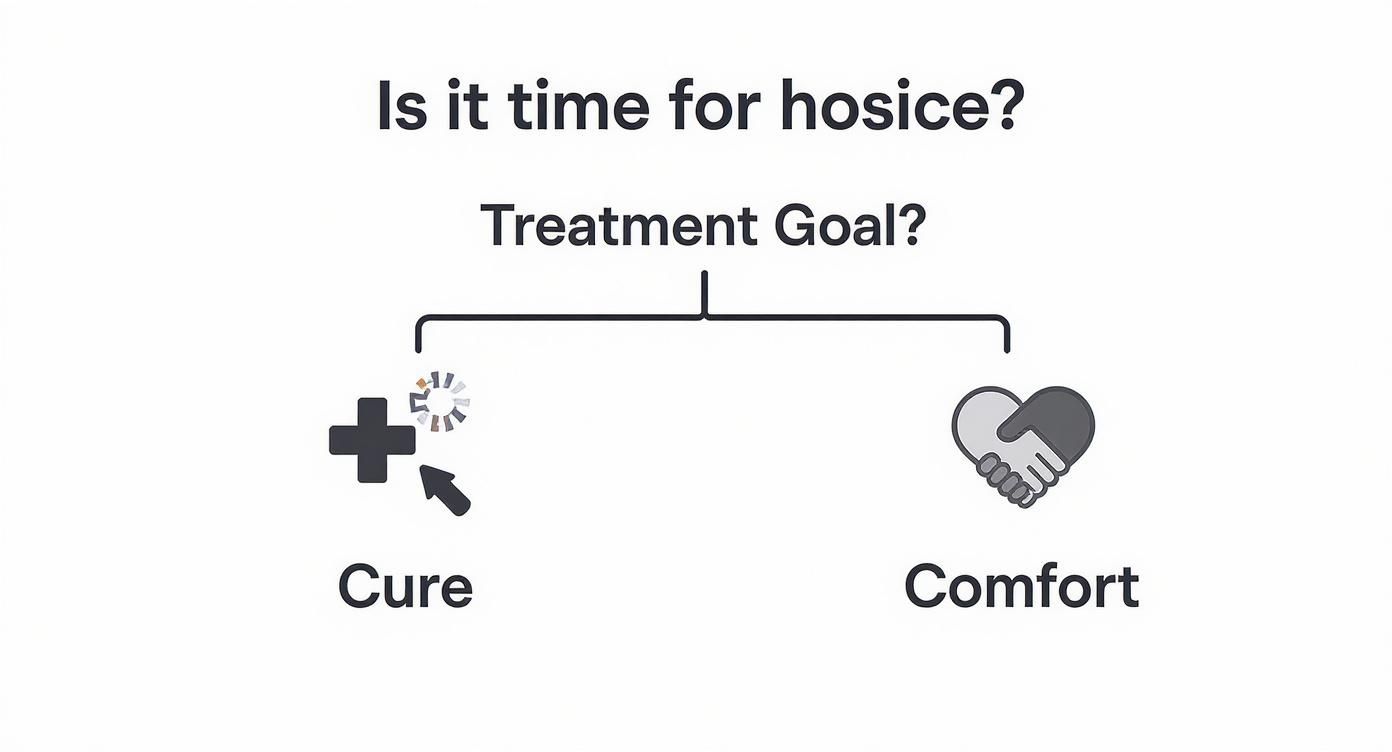
The choice hinges on whether the patient is pursuing curative treatments or has decided to shift their focus to comfort.
Detailed Comparison: Palliative Care vs Hospice Care
To help your family see the differences more clearly, let's compare the services side-by-side. The practical details of eligibility and payment are important factors in making an informed choice.
Here's a breakdown of the key distinctions.
| Aspect of Care | Palliative Care | Hospice Care |
|---|---|---|
| Timing | Can begin at any stage of a serious illness, often right from diagnosis. | Begins when curative treatments stop and a doctor certifies a prognosis of six months or less. |
| Treatment Goal | Provided alongside curative treatments like chemotherapy, surgery, or dialysis to manage symptoms. | Focuses entirely on comfort and quality of life; curative treatments are discontinued. |
| Location of Care | Often provided at home, but also available in hospitals and outpatient clinics. | Primarily provided wherever the patient calls home, including private residences and assisted living facilities. |
| Payment | Typically covered by Medicare Part B, Medi-Cal, and private insurance, similar to a specialist visit. | Covered fully by the Medicare Hospice Benefit, Medi-Cal, and most private insurance plans. |
At Central Coast VNA & Hospice, we are one of the few local providers offering both services. This means if a patient transitions from palliative to hospice care, they can often keep the same trusted team. For families, that continuity provides immense comfort.
The Benefit of a Seamless Continuum of Care
Choosing a provider for a serious illness is about finding a stable, reassuring partner for your journey. Many families must start over with a new healthcare organization when needs shift from palliative to hospice care.
At Central Coast VNA & Hospice, we provide a true continuum of care. Our services are designed to flow seamlessly from one stage to the next, from home health to palliative and hospice care. This integrated approach offers stability during a difficult time.

Why a Single Provider Matters
When needs evolve, the last thing your family should do is navigate a new healthcare system. With Central Coast VNA & Hospice, you don’t have to. The same clinicians who understand your family’s history can continue providing support.
This single-provider model offers several benefits:
- Familiarity and Trust: Your loved one builds a relationship with our Registered Nurses and Hospice Aides. Keeping that trusted team reduces stress.
- Consistent Communication: Because our teams work together under one roof, care coordination is smooth. There are no communication gaps.
- Simplified Transitions: Moving from palliative to hospice care becomes a gentle shift in focus. We guide your family through every step with compassion.
Having a single, trusted team means your family can focus on what matters most—each other. It provides peace of mind knowing that a familiar hand is there to guide you.
Rooted in Your Community
As a local nonprofit with over 74 years of service, our mission is connected to our communities. We are your neighbors in Monterey County, San Benito County, Santa Cruz County, and South Santa Clara County.
Our integrated model of home health, palliative, and hospice care is unique in the region. It ensures that no matter how your loved one’s needs change, they are supported by a team that knows them. Contact us to learn more about how our seamless care can support your family.
How to Make the Right Choice for Your Family
There’s no magic formula for deciding between palliative and hospice care. The best choice is always the one that fits your loved one’s unique needs and wishes.
At Central Coast VNA & Hospice, our approach starts with listening. We offer free, no-pressure consultations to help you understand your options.
Starting the Conversation
The first step is a simple, honest conversation. Our team can help you weigh the benefits of each path and figure out what makes sense for your family right now.
Having this talk is critical. Access to quality care isn't universal. This makes choosing a trusted local provider even more important for ensuring your family gets high-quality support.
The right choice is a personal one, based on your loved one's goals for their care. We are here to provide the information you need to make that choice with confidence.
As you make these decisions, it’s helpful to understand the legal tools available. Taking time for understanding Power of Attorney and advanced directives can empower you to honor their wishes.
You don’t have to navigate this journey alone. As a trusted nonprofit serving Monterey County, Salinas, Hollister, and Santa Cruz for over 74 years, we can help. Contact us today to learn more.
Frequently Asked Questions (FAQs)
1. Can my loved one get palliative care and curative treatment at the same time?
Yes, absolutely. This is the biggest difference between palliative care and hospice. Palliative care is designed to work alongside treatments like chemotherapy. Its purpose is to manage symptoms and stress, which often helps people tolerate their treatments better.
2. Does choosing hospice mean we're giving up hope?
No. Choosing hospice isn't about giving up; it’s about redefining hope. It becomes about hoping for comfort, dignity, and the best possible quality of life in the time that remains. Hope shifts from a cure to goals of a comfortable day and meaningful moments.
3. Who pays for palliative and hospice care?
The payment structures are different, but both are generally accessible. Palliative care is often covered by Medicare Part B, Medi-Cal, and private insurance. Hospice care is almost always 100% covered by the Medicare Hospice Benefit, Medi-Cal, and most private insurance with no out-of-pocket costs.
4. Can my loved one receive care at home?
Yes. Central Coast VNA & Hospice is built around bringing expert care to wherever you call home. That could be a private house, an assisted living community, or a nursing home. Our teams—including Registered Nurses and Hospice Aides—come to you.
5. What if my loved one gets better while on hospice?
It happens. With intensive comfort care, some people's conditions stabilize or improve. If they no longer meet the criteria, they can leave hospice care at any time and can always re-enroll later if their situation changes.
6. How do we know when it’s the right time to call?
It is never too soon to ask questions. If your loved one is dealing with a serious illness, we encourage you to call us for a free, no-obligation conversation. Our team at Central Coast VNA & Hospice can walk you through the support available.
You don't have to navigate these decisions alone. For over 74 years, Central Coast VNA & Hospice has provided a seamless continuum of care to families across Monterey County, Salinas, and Hollister. Contact us today to learn how our compassionate, local team can support your family. Learn more at https://ccvna.com.