
Direct Answer: Grief has no set timeline. Real support means having someone available when hard moments hit — not just in the first week, but months later when the world has moved on and you haven’t.
Most families in Monterey County expect the hardest part to be the weeks surrounding a loved one’s death. What they don’t expect is how heavy month four or month nine can feel — when the casseroles have stopped coming, the phone calls have thinned out, and the world around them has returned to normal while they’re still carrying something enormous.
Grief doesn’t follow a schedule. It doesn’t peak at the funeral and fade evenly from there. It comes in waves — triggered by a song, a smell, a Tuesday afternoon that used to belong to someone else. And the support available to most people doesn’t account for that.
This article looks at what actually helps during bereavement — not the platitudes, but the practical and emotional supports that make a real difference — and what families on the Central Coast can realistically access.
Why Grief Feels Worse When Everyone Thinks You Should Be Better
There’s a social expiration date on grief that most people feel but nobody says out loud. Around the six-week mark, many family members start hearing things like “you’re so strong” or “at least they’re not suffering anymore” — signals from well-meaning people that it’s time to move forward.
But brain science and clinical experience tell a different story. The acute, disorienting pain of early grief often gives way to a subtler, more persistent grief that can settle in for months or years. Anniversaries, holidays, medical appointments that used to involve your parent — these are landmines that people don’t anticipate.
For families in Salinas, Seaside, or King City who may not have close family nearby, the isolation that compounds grief can be significant. The Central Coast has a strong sense of community, but grief is still something most people face quietly and alone. That’s exactly where structured bereavement support fills a gap that friendship alone can’t.
Understanding what comfort-focused care really means can also help families reframe the period leading up to a death — which shapes how grief is carried afterward.
What Bereavement Support Actually Looks Like
“Bereavement support” can sound clinical, but what it actually involves is fairly straightforward: someone trained to sit with grief — not fix it, not rush it — and help people process what they’re carrying.
Depending on what a family needs, support can take several forms:
- One-on-one grief counseling with a Bereavement Specialist, usually by phone or in person, focused on whatever the person is experiencing right now
- Support groups where people who’ve lost someone can talk with others who understand — without explanation, without having to manage anyone else’s discomfort
- Check-in calls at regular intervals, especially around anniversaries and the first year of “firsts” (first holiday, first birthday, first spring without them)
- Resources and education about what grief actually does to the body and mind — because many people worry something is wrong with them when grief is affecting their sleep, concentration, or appetite
For families who went through hospice, bereavement services are often a natural continuation of the care relationship — offered by the same organization that supported their loved one at the end of life. The guide to grief support and bereavement counseling goes deeper into what that process typically involves.
What most families report is that just knowing support is available — that they can call someone who won’t get uncomfortable — makes a measurable difference in how alone grief feels.
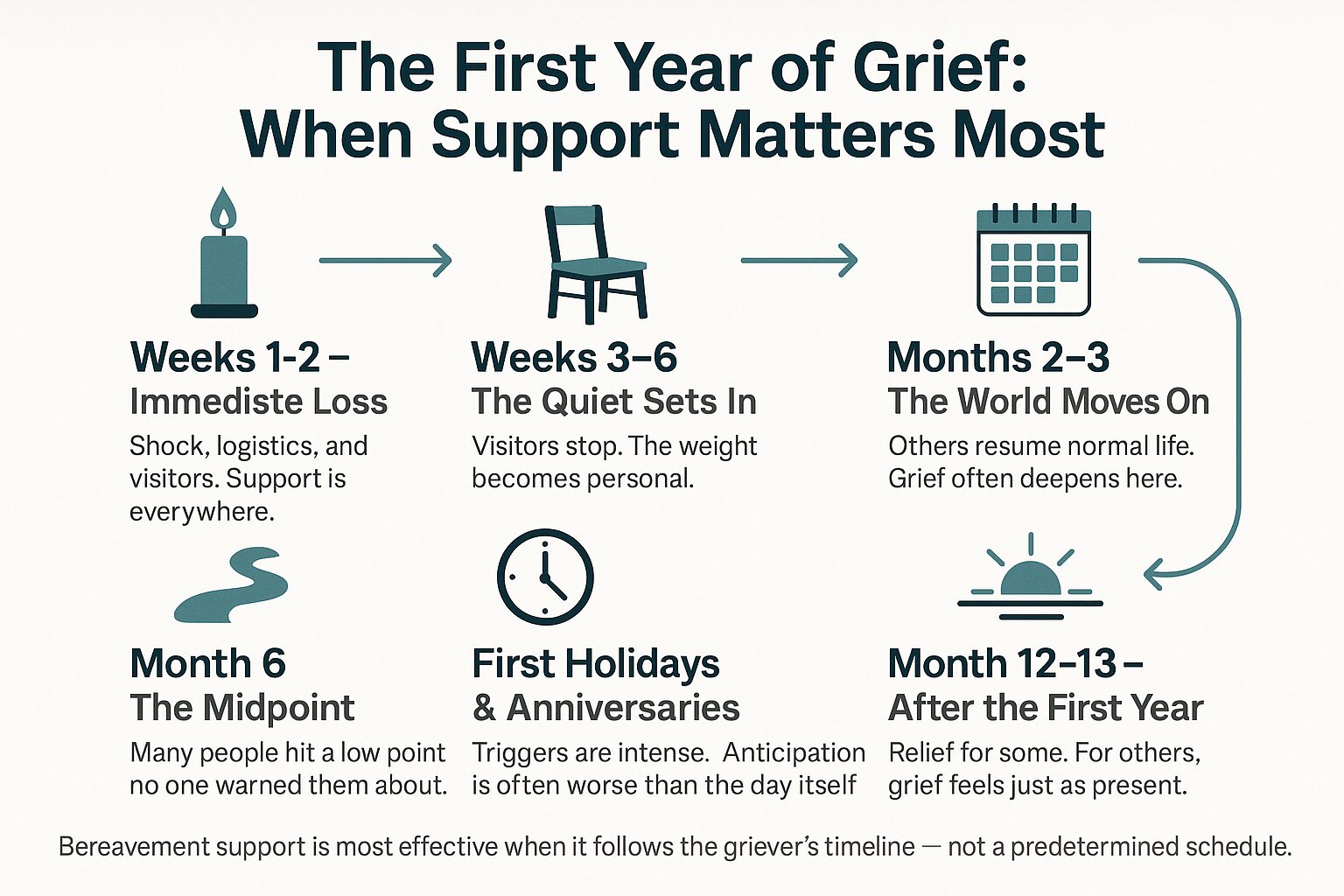
The First Year of Grief: When Support Matters Most
Grief doesn’t distribute evenly across the calendar. This shows when families most often need support — and what kind.
The Difference Between Normal Grief and Something That Needs More Help
Most grief — even grief that feels unbearable — is a normal human response to losing someone. It doesn’t require a diagnosis or medication. What it requires is time, acknowledgment, and connection.
But sometimes grief becomes something heavier: prolonged grief disorder, sometimes called complicated grief, where the intensity doesn’t ease over time and starts to seriously interfere with daily life. Signs that grief may have crossed into something that warrants clinical attention include:
- Inability to function at work or in relationships after six or more months
- Persistent thoughts of wanting to join the deceased
- Complete social withdrawal that isn’t improving
- Physical symptoms like dramatic weight loss or inability to sleep for extended periods
- Intense guilt that feels fixed and unshakeable
This isn’t about pathologizing grief or putting it on a clock. Most people move through grief without ever reaching this point. But for those who do, having a Bereavement Specialist or Medical Social Worker in their corner means the difference between suffering alone and getting actual help.
For families who first encountered a Medical Social Worker during a hospice admission, that relationship is often where these concerns get surfaced first. How families describe the moment they chose hospice often reflects just how much weight the whole family was already carrying before a death occurred.
Grief Support Options: What Each One Offers
Not every type of support fits every person. This gives a plain-language look at what the main options actually provide.
| Type of Support | What It Involves | Best For |
|---|---|---|
| Individual Bereavement Counseling | One-on-one sessions with a Bereavement Specialist, by phone or in person | People who want private space to process at their own pace |
| Grief Support Groups | Facilitated group conversations with others who’ve experienced loss | People who feel isolated and want to be understood without explaining |
| Scheduled Check-In Calls | Regular outreach at key intervals — 1 month, 3 months, 6 months, 1 year | People who won’t ask for help but benefit from someone reaching out |
| Medical Social Worker Referral | Connection to mental health resources, community services, or clinical care | When grief has crossed into depression, anxiety, or prolonged impairment |
| Chaplain or Spiritual Care | Non-denominational emotional and spiritual support | People processing meaning, faith questions, or spiritual dimensions of loss |
Who Bereavement Support Is For — Including People Who Don’t Think They Need It
There’s a common assumption that bereavement support is for people who are visibly falling apart. But many of the people who benefit most are the ones who held everything together during the illness and death — and who haven’t stopped long enough to feel what they’re carrying.
In Monterey County, that often looks like an adult daughter who coordinated her father’s care for two years, managed his hospice enrollment, arranged the memorial, and handled the estate — and who finally hits a wall six months later with no idea why she can’t sleep.
Bereavement support is also for:
- Adult children processing the death of a parent, even when the death was expected
- Spouses and partners navigating life reconfiguration after decades together
- Siblings who grieve differently from each other and feel misunderstood within their own family
- Grandchildren and younger family members who sometimes get overlooked in family grief
Nobody has to be in crisis to deserve support. And nobody should have to wait until they are.
For families still in the middle of a serious illness — not yet at the point of loss — palliative care support for families addresses the emotional weight that builds well before a death occurs.
Frequently Asked Questions About Grief Support
How long does bereavement support last?
There’s no fixed end date. For families who received hospice care, bereavement services are typically available for at least 13 months after a loved one’s death — which covers the full first year of grief plus the anniversary. Some people use support for a few months. Others check in periodically for longer. The pace follows the person, not a program calendar.
Does insurance cover grief counseling?
For families who received Medicare-covered hospice, bereavement services for the family are included as part of the hospice benefit — at no additional cost. Outside of hospice, coverage depends on individual plans. A Medical Social Worker can help sort out what’s covered and what other community options exist.
What if I’m not sure I need help — I’m functioning okay?
Functioning and grieving aren’t opposites. Many people who would genuinely benefit from bereavement support are going to work, managing their households, and appearing fine on the outside. If a loss is sitting heavy — even quietly — reaching out to a Bereavement Specialist isn’t a sign of crisis. It’s just honest.
My family member died at home under hospice care. Are we automatically connected to bereavement services?
Yes, typically. When someone passes under hospice care, the family is contacted by the hospice’s bereavement team as a standard part of the care. You don’t have to ask — a Bereavement Specialist or Medical Social Worker will reach out. But if you haven’t heard from anyone and want support, you can always call the hospice directly.
Is grief support available if our loved one didn’t receive hospice care?
Yes. Bereavement support isn’t limited to hospice families. Community-based grief counseling and support groups are available to anyone navigating loss — regardless of how or where a loved one died.
What’s the difference between a Bereavement Specialist and a grief therapist?
A Bereavement Specialist is typically focused on supportive care — listening, normalizing grief, tracking how someone is doing over time, and connecting them to additional help if needed. A grief therapist or licensed clinical social worker goes deeper into mental health treatment and is more appropriate when grief has become clinically significant. Many people start with bereavement support and are referred to a therapist if the situation calls for it.
When You’re Ready to Talk to Someone
If you’re a family in Monterey County, Salinas, Hollister, or anywhere on the Central Coast who is carrying grief — recently or from longer ago than you’d like to admit — Central Coast VNA & Hospice has Bereavement Specialists available to talk. You can reach their care team at 831-372-6668 or visit ccvna.com to learn more about what bereavement support looks like and whether it might help.