
Direct Answer: Skilled nursing care at home is a physician-ordered, Medicare-covered service that includes a full team — nurses, therapists, and social workers — delivering clinical care in your loved one’s home.
When families in Monterey County first call about skilled nursing care at home, most of them picture the same thing: one nurse, one short visit, maybe a blood pressure check. That mental image is understandable — but it’s not what skilled home health nursing actually is, and the gap between that assumption and reality matters a lot when you’re trying to figure out what your mother or father actually needs.
The misunderstanding also stops families from calling in the first place. If you think it’s just a nurse who pops in once a week, it might not sound worth the trouble. But if you knew that Medicare may cover a coordinated team of clinicians coming directly to your loved one’s home — and that this team can manage wound care, help someone walk safely again after surgery, and untangle a complicated medication list — the picture changes entirely.
This article explains what skilled nursing care at home actually includes, who qualifies, and what the first few weeks look like in practice. If your loved one was recently discharged from Salinas Valley Health, Community Hospital of the Monterey Peninsula, or another facility, or if a chronic condition has made leaving the house genuinely difficult, this is worth reading before you decide anything.
What Skilled Home Nursing Actually Includes
The word “skilled” in this context is a legal and clinical term, not a marketing word. Skilled nursing care at home requires a physician’s order, follows a written care plan supervised by a Registered Nurse in coordination with the patient’s doctor, and is distinct in every meaningful way from private duty care or live-in help.
What surprises most families is that skilled home health is rarely just nursing. The care team that comes to the home can include:
- Registered Nurses (RNs) — assessment, medication management, wound care, IV therapy, chronic disease monitoring
- Licensed Vocational Nurses (LVNs) — ongoing skilled nursing support under RN supervision
- Physical Therapists — rebuilding strength, mobility, and balance after illness or surgery
- Occupational Therapists — helping patients relearn daily tasks safely, from bathing to cooking
- Speech Therapists — addressing swallowing difficulties, communication, or cognitive changes
- Medical Social Workers — connecting families to community resources, navigating insurance, and addressing the emotional weight of a health crisis
- Chaplains — spiritual support for patients and family members when it’s wanted
In one April call reviewed by our team, a family was surprised to learn that physical therapists and social workers were part of the same program as the nursing visits. That surprise is common — and it’s why what a skilled nurse actually does on a home visit often reads as new information even to families already in the system.
The care plan is written around one patient’s specific situation — not a template, but a clinical response to what that person actually needs right now.

The Medicare Eligibility Question Families Get Wrong
The most common reason families don’t pursue skilled home health is a wrong assumption about eligibility. Many people believe their loved one doesn’t qualify because they can still get around the house, or because they’re managing — not great, but managing.
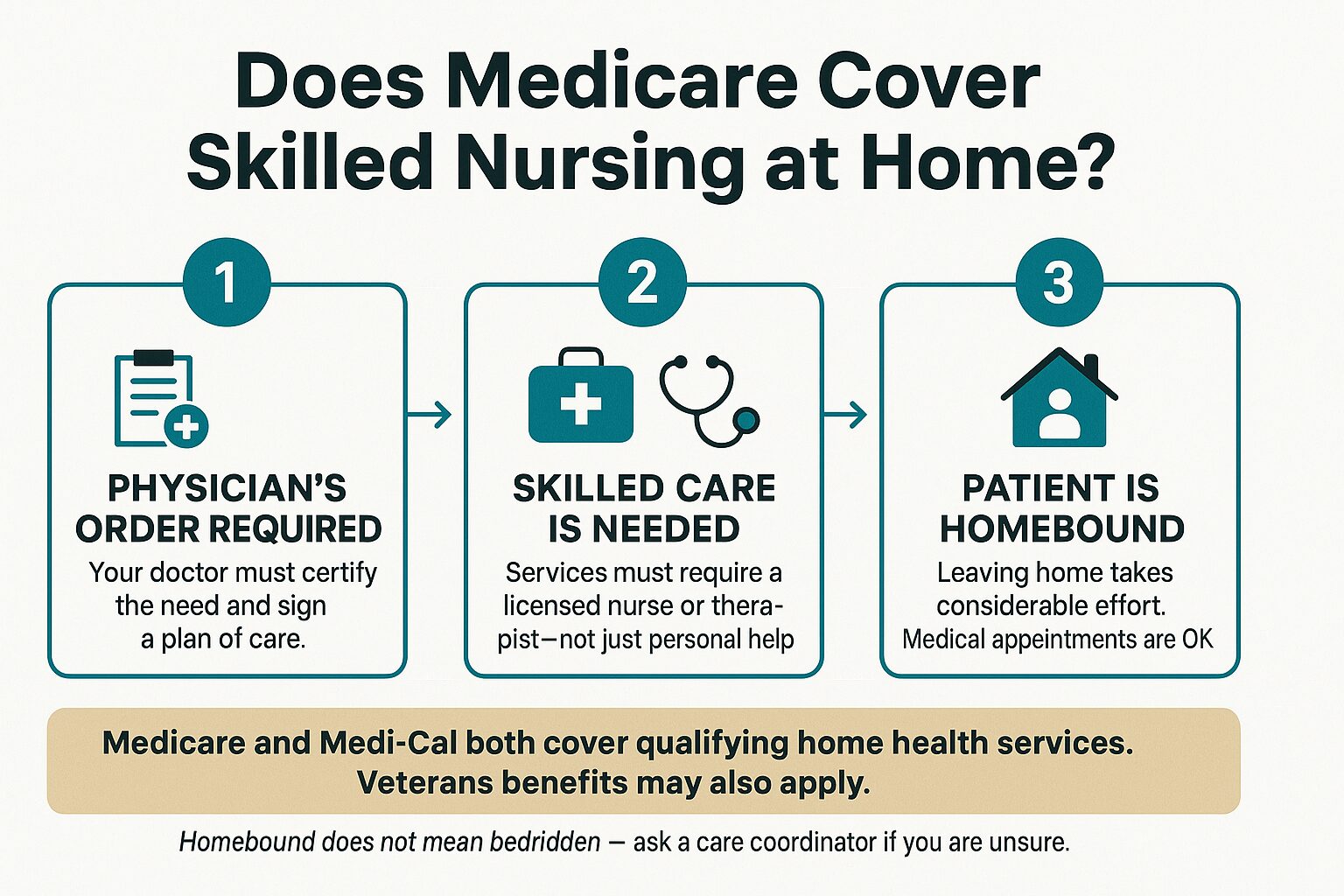
Medicare covers skilled nursing at home when three criteria are met:
- The patient is under a physician’s plan of care
- The patient needs skilled care — clinical services that can’t be safely performed by an untrained person
- The patient is considered homebound
That last criterion is where the confusion lives. Homebound does not mean bedridden. According to Medicare’s official guidelines, a patient is considered homebound when leaving home requires considerable and taxing effort — and when absences from home are infrequent or primarily for medical appointments.
A woman in Pacific Grove who drives herself to the pharmacy once a week might still qualify. A man in Salinas managing Parkinson’s who tires quickly and rarely leaves the house almost certainly does. The homebound determination is made by the patient’s physician and the admitting nurse — not by a family member’s guess.
Medi-Cal also covers skilled home health for qualifying patients, and Veterans benefits may apply as well. If you’re unsure whether your loved one’s coverage applies, the most direct path is a conversation with a care coordinator — not more research.
How Medicare Covers Skilled Nursing Care at Home
This infographic shows the three eligibility criteria Medicare uses and how each one applies in practice — including what “homebound” actually means.
What to Expect in the First Two Weeks
Knowing you might qualify is one thing. Knowing what actually happens next is what helps families take the step.
Here’s how the process typically unfolds once a referral is in place:
Week 1 — Evaluation and Care Plan
A Registered Nurse comes to the home for an initial visit. This is a full clinical assessment — not a brief introduction. The nurse reviews medications, checks vital signs, assesses mobility and fall risk, and identifies what services the patient needs. The care plan is written based on what is found in that visit, in coordination with the patient’s physician.
Days 3–7 — Additional Team Members Begin
Depending on what the evaluation found, other clinicians may begin visits within the first week. A Physical Therapist may come to assess strength and gait. An Occupational Therapist may evaluate the home layout for fall hazards or help the patient relearn bathing safely. A Medical Social Worker may meet with the family to identify community resources or help with insurance questions.
Week 2 — Active Treatment and Adjustment
Visit frequency varies by patient. Some receive nursing visits several times a week; others once. The schedule is driven by clinical need, not a fixed template. Families should expect the care plan to be adjusted as the patient’s condition changes.
For families navigating a hospital discharge — which is one of the most common reasons for a call in Monterey County — what comes next after discharge is worth reviewing alongside this article. The transition from hospital to home is where gaps in care tend to appear, and where a coordinated home health team can prevent a readmission.
Why Summer Is a High-Demand Season in Monterey County
If you’re reading this in the summer months, you’re not alone in the timing. Skilled nursing referrals in Monterey County tend to spike between June and September for a few converging reasons.
Post-surgical recoveries often cluster in late spring and early summer, when patients who scheduled elective procedures during the school year are discharged and need follow-up care at home. Chronic conditions — particularly heart failure, COPD, and diabetes — can destabilize in summer heat, especially for older adults living inland in communities like Salinas or King City, where temperatures run significantly warmer than the coast.
And seasonal accidents — falls, outdoor injuries, heat-related illness — mean more hospital discharges from July through August than at almost any other time of year.
If a family member was recently discharged or is managing a condition that has worsened over the summer, the window between discharge and a potential readmission is short. What families often miss when planning a hospital discharge to home covers the specific gaps that lead to preventable returns to the ER.
Skilled Home Nursing vs. Private Duty / Live-In Care — Key Differences
Families often call about one service when what they actually need is the other. This comparison covers the distinctions that matter most when making that decision.
| Factor | Skilled Home Nursing | Private Duty / Live-In Care |
|---|---|---|
| Requires physician’s order? | Yes — required by law | No |
| Covered by Medicare or Medi-Cal? | Yes, when criteria are met | Generally not covered |
| Who delivers care? | RNs, LVNs, PTs, OTs, Speech Therapists, Social Workers, Chaplains | Aides, companions — not licensed clinicians |
| Type of care provided? | Clinical: wound care, medication management, therapy, disease monitoring | Personal: bathing, dressing, meal prep, companionship |
| Visit frequency? | Driven by clinical care plan — often several times per week | Can be daily or live-in, based on purchase of hours |
| Duration of services? | Time-limited — tied to recovery or clinical need | Ongoing as long as family continues to pay |
| Who coordinates the plan? | Registered Nurse and treating physician | Family or placement agency |
Frequently Asked Questions About Skilled Nursing Care at Home
My mother can walk to her mailbox. Does that mean she’s not homebound and doesn’t qualify?
Not necessarily. Homebound doesn’t mean she can’t leave — it means leaving requires considerable effort and happens rarely. If your mother tires quickly, needs help getting ready to go out, or only leaves for medical appointments, she may still meet the homebound definition. The determination is made by her physician and the admitting nurse, not by a family member’s observation. The only way to know for sure is to start the eligibility conversation.
How do we get a referral started?
The process begins with a physician’s order. If your loved one was recently discharged from a hospital, the discharge planner may initiate this directly. If you’re starting from home, ask the primary care physician to write an order for a home health evaluation. Once the order is in place, a care coordinator schedules the initial nursing visit — usually within a few days.
Is skilled home nursing the same as having a home health aide come in?
No — these are different services. A home health aide helps with personal care like bathing and dressing. A skilled nurse manages clinical needs: wound care, medication monitoring, IV therapy, and disease management. Medicare covers the skilled nursing component; it does not generally cover aide-only or companion-only care.
What if my father needs both nursing care and help with daily tasks?
That’s a very common situation, and the two types of care can run alongside each other. Skilled nursing through Medicare handles the clinical side. Personal care or aide services — which are typically paid privately or through certain Medi-Cal programs — address daily living support. A Medical Social Worker on the skilled home health team can help identify what options exist for filling both needs.
Can someone with dementia or Alzheimer’s receive skilled home nursing?
Yes. A diagnosis of dementia doesn’t disqualify someone from skilled home health services. In fact, medication management and safety assessments are especially important for patients with cognitive changes. Multiple families in Monterey County have contacted us specifically because a parent’s dementia made managing five or more medications too complicated to handle at home alone — and that is exactly the kind of clinical situation skilled nursing is designed to address. The difference between needing help and needing a facility is a question worth reading about if you’re at that crossroads.
What if we’re not sure whether our family member needs home health or something more serious, like palliative care?
This is one of the most common questions families sit with, often for longer than they should. Home health and palliative care serve different purposes, and they can sometimes run at the same time. Home health versus hospice — how families know which one fits right now walks through that distinction in plain terms.
Questions About Whether Your Family Member Qualifies?
Central Coast VNA & Hospice has been serving families across Monterey County — from the Peninsula to Salinas, King City, and communities in between — since 1951. If you’re trying to figure out whether your loved one qualifies for skilled home nursing, or what the first steps look like, a care coordinator can walk you through it without pressure. Call 831-372-6668 or visit ccvna.com to learn more.