
Direct Answer: Aging in place can work indefinitely for many people — but only when the right support structures are in place before a crisis forces a different decision.
Most families in Monterey County have the same conversation eventually — usually after a fall, a confusing hospital discharge, or a medication mix-up that nearly turned serious. Someone says, “We need to figure out what to do about Mom.” And the options that come to mind are usually two: stay home or move to a facility.
But that’s a false choice, and it’s one that leads a lot of families to make decisions under pressure that they didn’t have to make at all. The question isn’t whether your loved one can age in place. The question is what support makes it sustainable — and how long you can keep it working before the gaps catch up.
Across Monterey and Santa Cruz counties, where more than 15% of the population is over 65 and healthcare infrastructure is thinner than in larger urban centers, those gaps show up faster than families expect. This article is about what actually closes them.
Why Aging in Place Falls Apart — and It’s Usually Not the Illness
About 93% of adults 55 and older say they want to remain in their own homes as they age. Almost none of them have a plan for how to make that happen.
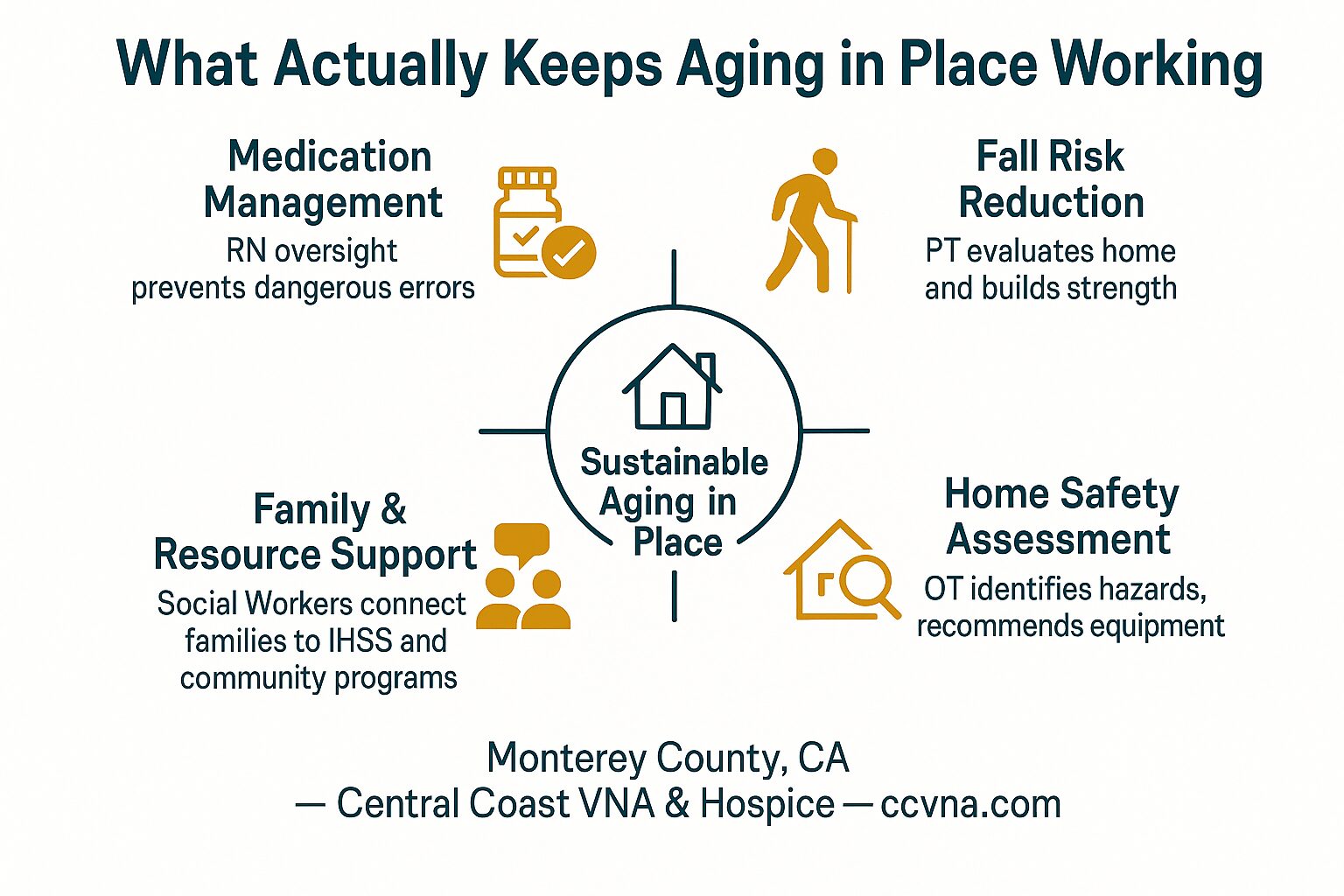
What’s striking is that when aging in place finally breaks down, it’s rarely the underlying diagnosis that forces a move. It’s the logistics around it. The four patterns that appear most often are:
- Medication errors — An 83-year-old managing five or more prescriptions alone, or with a spouse who is also aging, will almost inevitably make mistakes. Dosing errors, missed medications, and dangerous interactions are common and largely preventable with skilled oversight.
- Unmanaged wound care — A surgical site, a diabetic ulcer, or a pressure wound that isn’t being properly assessed and dressed will deteriorate. What starts as a manageable wound becomes a hospitalization.
- Unaddressed fall risk — Falls are the leading cause of injury-related death among older adults, and many of the risk factors — throw rugs, bathroom layout, weakened gait — are sitting in plain sight in the home.
- Family exhaustion — Adult children carrying the weight of coordinating care, monitoring medications, attending appointments, and managing their own lives eventually hit a wall. When they do, the system collapses.
Each of these is addressable through skilled home health services before it becomes the crisis that ends aging in place. But most families don’t reach out until the crisis is already underway. One family in Pacific Grove recently submitted an inquiry specifically because managing a parent’s five medications had become “too confusing” — a solvable problem that had been quietly building for months.
For more on recognizing when that threshold has been crossed, When Is It Time to Think About Getting Help at Home? walks through the specific signals families miss.
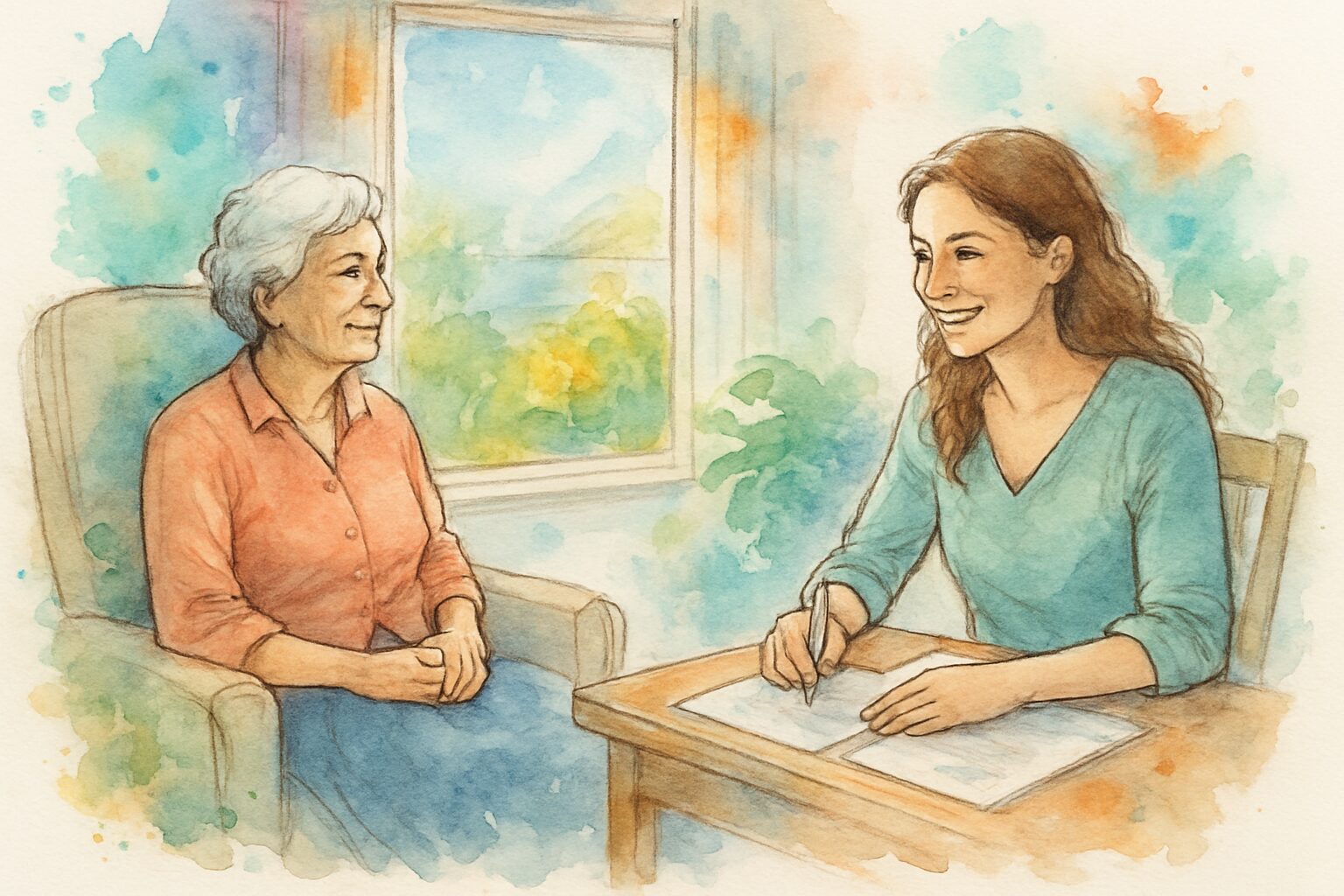
The Care Team Most Families Don’t Know They Can Have
When families call to ask about home health, they almost always describe what they’re looking for the same way: “We just need a nurse to check in on her.”
That’s a natural starting point — but it significantly undersells what skilled home health actually involves. The team that can support aging in place at home includes:
- Registered Nurses (RNs) and Licensed Vocational Nurses (LVNs) who assess health status, manage medications, oversee wound care, and coordinate with the treating physician
- Physical Therapists who evaluate how a patient moves through their own home, identify fall risks, and design a plan to improve strength and balance in that specific space
- Occupational Therapists who assess the home itself for hazards — grab bars, lighting, furniture placement — and recommend adaptive equipment that makes daily tasks manageable
- Medical Social Workers who connect families to community resources, help navigate insurance questions, and provide support when the logistics feel overwhelming
- Speech Therapists when swallowing, communication, or cognitive function is part of the picture
One reviewer described what it felt like to have this full team arrive for her elderly mother: “I was blown away by the personalized care that she received. A team made of nurses, physical therapists and Medical social worker came to help us.” That response — surprise at the scope — is more common than VNA staff would probably like.
This is also where California’s IHSS program (In-Home Supportive Services) becomes relevant. For qualifying families, IHSS can supplement skilled home health with non-medical support — bathing assistance, meal preparation, transportation — at little or no out-of-pocket cost. It doesn’t replace skilled clinical care, but it fills gaps that skilled care doesn’t cover. Families in Salinas, King City, and Hollister especially benefit from knowing both programs exist and can work alongside each other.
For a closer look at what actually happens during a skilled nursing visit, What Does a Skilled Nurse Actually Do on a Home Visit? explains the specifics.
What Actually Keeps Aging in Place Working
The four support structures that determine whether aging in place remains sustainable — and what breaks down without each one.
When the Seasons Work Against You — Central Coast Timing Matters
Monterey County has a mild climate, which can make it easy to overlook seasonal health risks for older adults. But two windows of the year consistently push aging-in-place situations to the breaking point.
Summer brings dehydration risk that families underestimate. Elderly patients with chronic conditions — heart disease, diabetes, kidney disease — can reach a medical crisis faster than their families realize, especially when heat arrives suddenly. The coast fogs over by afternoon, but inland Salinas and King City heat up significantly, and seniors living alone often don’t register how dehydrated they’ve become.
Fall compounds the risk in a different direction. Flu season increases hospitalization rates among older adults. Hospital discharges accelerate, and families who’ve been deferring care decisions suddenly have to make them in 24 hours. And every year from October 15 through December 7, Medicare Open Enrollment creates a narrow window to review and adjust coverage — a window most families miss because no one told them it was coming.
These aren’t reasons to panic. But they are reasons to get the right support structures in place before August, not after a September emergency room visit. What Families Often Miss When Planning a Hospital Discharge to Home covers what that moment actually requires.
Aging in Place: What Skilled Home Health Covers vs. What It Doesn’t
Families often confuse skilled home health with live-in caregiving or residential placement. These are different services with different purposes — and understanding the distinction helps families build the right combination of support.
| Support Need | Skilled Home Health Covers This | Requires Other Programs (e.g., IHSS, Private Aide) |
|---|---|---|
| Medication management and oversight | Yes — RN or LVN | No |
| Wound assessment and dressing changes | Yes — RN or LVN | No |
| Fall risk evaluation and home safety | Yes — Physical Therapist, Occupational Therapist | No |
| Bathing, dressing, personal hygiene | Limited (Hospice Aides in some programs) | Yes — IHSS or private aide |
| Meal preparation and housekeeping | No | Yes — IHSS or community programs |
| Transportation to appointments | No | Yes — IHSS or community programs like Community Bridges |
| Emotional support and resource coordination | Yes — Medical Social Worker | No |
| 24/7 supervision or companionship | No | Yes — family, private aide, or facility |
What Medicare Actually Pays For — and What Families Assume It Won’t
Coverage is one of the most common reasons families wait too long to call. The fear is that skilled home health isn’t covered, or that the process to qualify is more complicated than it’s worth.
The basics are worth knowing. Medicare covers skilled home health services — including nursing visits, physical therapy, occupational therapy, speech therapy, and medical social services — when a patient is considered homebound and has a physician’s order. There is no daily copay for home health under Medicare.
Medi-Cal covers home health for qualifying patients, and many Central Coast families who have both Medicare and Medi-Cal (called dual eligibility) have more coverage than they realize. Veterans benefits also cover home health for eligible patients.
What Medicare does not cover is non-medical home care — bathing assistance, housekeeping, companionship. That gap is real, and it’s where IHSS or private arrangements come in. But the clinical piece — the nursing, the therapy, the social work — is often fully covered for patients who qualify, and most families are surprised to learn that.
For a deeper look at how Medicare handles home-based physical therapy specifically, Does Medicare Cover Physical Therapy At Home? addresses the exact question families ask.
Frequently Asked Questions About Aging in Place on the Central Coast
How do we actually get started with home health services?
You need a physician’s order — a recommendation from your loved one’s doctor that home health is appropriate. From there, you call to initiate the intake process, and a clinician typically comes out to do an evaluation within a few days. The intake team can help you understand what the physician needs to provide and what to expect after that first call.
My parent lives in Salinas / King City / Hollister — does home health actually reach there?
Yes. Central Coast VNA & Hospice serves all of Monterey County, including Salinas, King City, and surrounding communities, as well as San Benito County including Hollister. Geographic coverage is not typically a barrier for families in those areas.
What’s the difference between palliative care and hospice — and can someone get either while still living at home?
Both can be delivered at home, and that’s how most patients receive them on the Central Coast. Palliative care is for anyone with a serious illness — it focuses on symptom management, care planning, and emotional support without requiring a patient to stop pursuing curative treatment. Hospice care is for patients who are no longer pursuing curative treatment and want comfort-focused care instead. The two are often confused, but they serve different moments in a patient’s journey. What ‘Comfort-Focused Care’ Really Means — and When to Ask About It explains the distinction in plain terms.
My parent keeps refusing help. How do other families handle that?
This is one of the most common situations families describe. A parent who values independence often hears “home health” as a threat to that independence — when the actual goal is the opposite. Some families find it helps to frame the initial visit as an evaluation rather than ongoing care, and to let the clinician build rapport directly with the patient. A Medical Social Worker can also help families navigate these conversations. There’s no script that works every time, but the resistance usually softens when the patient sees the care team is there to help them stay home — not to take anything away.
Can we get help with grief support if our loved one has already passed?
Yes. Bereavement support is available for families after a patient’s death, and it doesn’t require that the patient was previously in hospice. If someone in Monterey County or the surrounding area is navigating loss and needs a grief support group or counseling, that support exists. Grief Doesn’t Follow a Schedule — What Support Actually Helps is a good starting point for families trying to understand their options.
Questions About What’s Possible for Your Family?
Central Coast VNA & Hospice has been supporting families across Monterey County, Salinas, King City, San Benito County, and the surrounding Central Coast since 1951. If you’re trying to figure out what’s realistic for your loved one — what support they qualify for, what Medicare or Medi-Cal covers, or just where to start — a care coordinator can talk through your situation without pressure. Call 831-372-6668 or visit ccvna.com to learn more.