
Direct Answer: Heat and wildfire smoke strain the heart and lungs. For patients with cardiac disease, COPD, or serious illness at home, the two together sharply raise the risk of a medical emergency.
It usually starts with a phone call. A daughter in Pacific Grove, wearing a sweatshirt in 62-degree fog, calls her father in Salinas and finds out his house has been sitting at 94 degrees since noon.
That gap between the coast and the valley is one of the most misunderstood health risks in Monterey County. And when wildfire smoke drifts in on top of the heat, a patient managing serious illness at home is dealing with a medical situation, not a weather annoyance.
This guide covers what heat and smoke actually do to a seriously ill person at home, which medications make it worse, and the handful of questions families should answer before the next advisory shows up on their phone.
Why heat hits inland patients harder than coastal ones
Monterey County is really two climates. Coastal Monterey, Pacific Grove, and Carmel often stay in the 60s through summer, while Salinas, Gonzales, Soledad, and King City can push into the 90s and past 100.
A lot of seriously ill patients live in those hotter inland communities. Their adult children often live on the Peninsula, where the fog makes the risk feel abstract.
Heat is harder on some bodies than others. Risk climbs for:
- Adults over 65, who sweat less and feel thirst less reliably
- People with heart disease or a history of heart failure
- People with COPD or other chronic lung conditions
- People with diabetes, which can affect circulation and sweating
- Anyone with limited mobility who cannot move to a cooler room on their own
- Anyone taking medications that interfere with temperature regulation
One more factor matters here: many older inland homes have no central air conditioning. A home built to shed valley heat overnight does not do much during a five-day stretch of triple digits. If your parent is already having trouble managing the house on a hot day, that is often the same moment families start asking whether it’s time to get some help at home.
Heat plus wildfire smoke is a different kind of risk
Smoke season on the Central Coast rarely stays put. Fires burning in Big Sur, Los Padres National Forest, or well outside the county can push haze into the Salinas Valley and across the Peninsula for days.
In July 2026, the American Heart Association published findings that the combination of extreme heat and wildfire smoke can nearly double the risk of a fatal heart attack, with older adults facing even greater risk. You can read the American Heart Association’s warning on heat and wildfire smoke directly.
The reason is fairly simple. Heat already makes the heart work harder to cool the body. Fine smoke particles inflame the airways and lower the oxygen the blood is carrying. Stack those two demands on a heart or set of lungs that is already compromised, and the margin gets thin fast.
For a patient with a cardiac diagnosis, COPD, or an advanced illness, that means a smoke event needs to be managed clinically, not just waited out. Symptoms families should watch closely during a smoke day include new or worsening shortness of breath, chest pressure, a cough that will not settle, confusion, and swelling in the legs or feet.
The medication piece most families never hear about
This is the part that surprises people. Some of the most common medications for seriously ill patients make it harder for the body to handle heat.
Monterey County’s own emergency heat guidance flags people taking certain medications as higher-risk during heat events. Broad categories that can affect temperature regulation, fluid balance, or sweating include:
- Diuretics, often called water pills
- Beta blockers and some other blood pressure medications
- Certain antidepressants and antipsychotics
- Anticholinergic medications, including some bladder and allergy drugs
- Medications that cause drowsiness or reduce awareness of thirst
Nobody should stop or change a dose on their own. But a Registered Nurse visiting the home can look at the full medication list, flag the combinations that raise heat risk, and bring concerns back to the treating physician.
That kind of review is routine work on a home visit. If you have never seen one, this walkthrough of what a skilled nurse actually does during a home visit covers the ground. Medication management is also part of why a single visit often catches problems a family has been living with for months.
Warning signs during a heat or smoke event and what they usually mean
Use this as a general reference, not a diagnosis. Any patient with a serious illness should have symptom instructions from their own physician or care team.
| What you notice | What it may point to | Typical next step |
|---|---|---|
| Hot, dry skin with no sweating, plus confusion | Possible heat stroke | Call 911 right away |
| Chest pressure, pain, or a racing heartbeat | Cardiac event | Call 911 right away |
| Sudden severe shortness of breath or bluish lips | Respiratory distress | Call 911 right away |
| Dizziness, weakness, cramping, heavy sweating | Early heat exhaustion | Move to a cooler room, give fluids, call the care team |
| Worsening cough or wheeze during a smoke day | Airway irritation | Call the care team or physician the same day |
| Not urinating much, very dark urine | Dehydration | Call the care team or physician the same day |
| More confused or sleepy than usual | Heat effect or medication effect | Call the care team the same day |
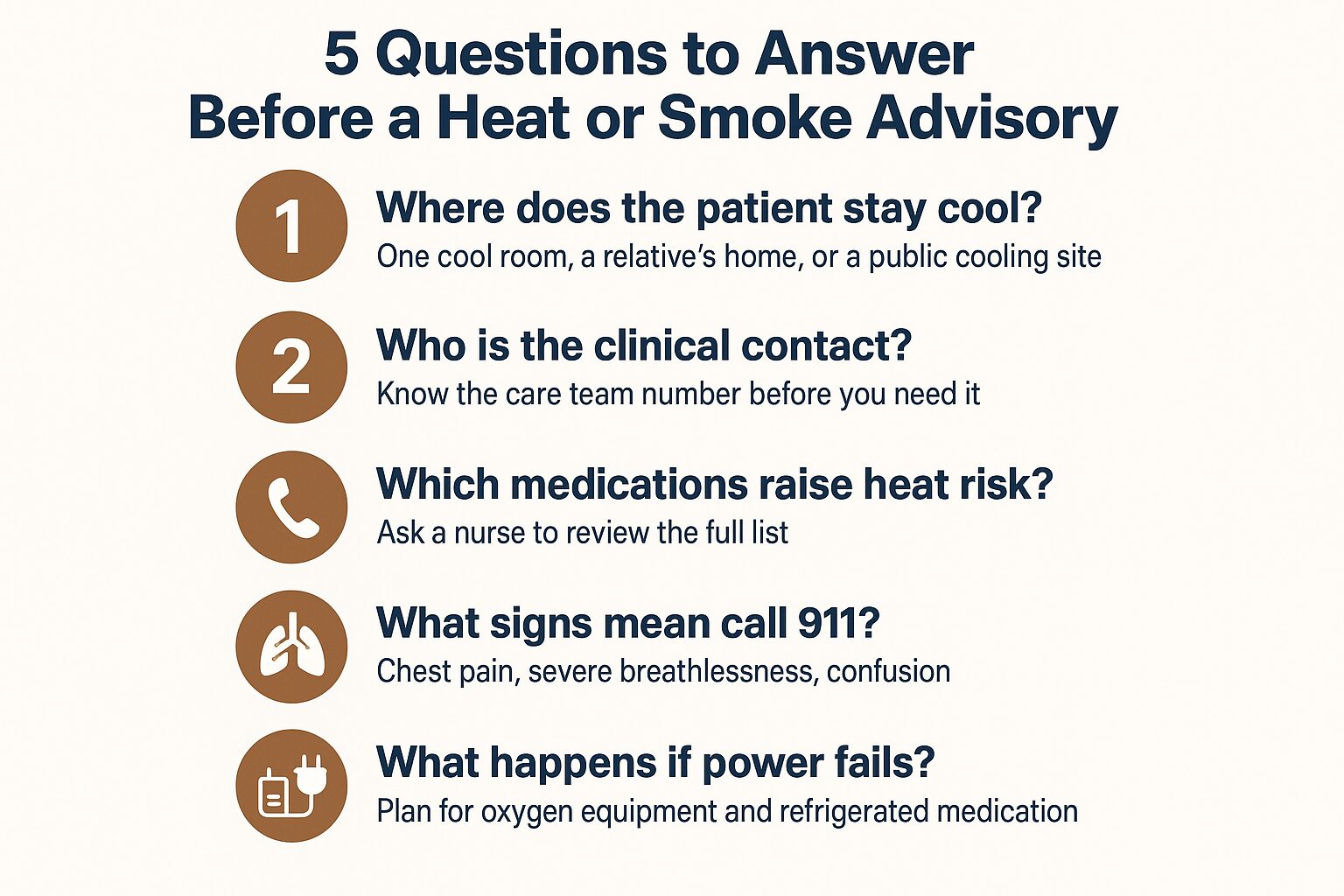
Five questions to answer before the next heat advisory
Families who work through these five questions ahead of time spend far less energy scrambling once an advisory hits.
Building a plan that fits your parent’s actual house
The plan does not need to be elaborate. It needs to be specific to the home and the person in it.
Start with cooling. If there is no air conditioning, pick one room to cool rather than the whole house. Costs vary, but many households in Monterey County find portable or window units land somewhere in the range of a couple hundred dollars, and a good box fan with drawn shades makes a real difference in a valley home overnight.
Then work through the practical gaps:
- A backup plan for power, especially if the patient uses an oxygen concentrator or refrigerated medication
- Someone who can physically get the patient to the cooler room, since a hallway is a long trip for a patient with limited mobility
- Windows and doors closed during smoke, with recirculating air and a clean filter if the home has a system
- A written symptom list on the refrigerator so any family member or visitor knows what to act on
- Fluid guidance from the physician, because some heart and kidney patients have fluid limits that override general advice to drink more
One caller described the feeling plainly: they just needed someone to come out and help, because they did not know where to start. That is a normal place to be. Families managing a hospital discharge in August have plenty on their plate already, and the pieces families tend to miss during a discharge home often include seasonal safety.
The team already in the home is part of the answer
Here is what families often overlook. If a patient is receiving home health, palliative care, or hospice care at home, clinicians are already walking through that house on a regular schedule.
A Physical Therapist who visits weekly already knows whether the patient can safely get down the hall to a cooler room. A nurse already has the medication list. A Medical Social Worker already knows what community resources exist in Salinas or Hollister or King City.
Across a home care team, that means nurses, therapists, social workers, chaplains, volunteers, and other clinicians all see pieces of the picture. Seasonal safety planning is a reasonable thing to raise at the next visit instead of researching alone at 11 p.m.
One family in Monterey County described a team of nurses, physical therapists, and a Medical Social Worker coming into the home and said they were “blown away by the personalized care.” That kind of coordination is exactly what makes a heat plan realistic rather than theoretical. It is also part of what makes staying home as you age workable through a hard summer.
Frequently Asked Questions About Heat, Smoke, and Home Patients
Does Medicare cover home health visits during a heat wave?
Heat by itself is not a qualifying reason for home health. But Medicare covers physician-ordered home health when a patient meets the clinical criteria, and a real change in condition during a heat or smoke event is worth reporting to the physician. Home health always starts with a physician referral, which is a step many families do not realize is required.
Should we cancel a scheduled home visit when the air quality is bad?
Talk to the care team rather than deciding on your own. Clinicians work through smoke days regularly, and a visit during a bad air stretch is often more useful than a normal one because someone is laying eyes on the patient.
My mother is on hospice at home. Does smoke really matter at that point?
Yes. Hospice care is focused on comfort, and smoke can cause coughing, breathlessness, and agitation that make a patient genuinely uncomfortable. Pain and symptom management includes respiratory symptoms, so report changes just as you would report new pain.
What about air purifiers? Are they worth it?
A unit with a HEPA filter sized for one room can meaningfully cut indoor fine particles during a smoke event. Prices vary widely by room size and brand, so check what the room actually needs. Running it in the bedroom where the patient sleeps usually gives the most benefit per dollar.
Who do I call if I am not sure whether something is an emergency?
Keep the care team’s clinical line where you can see it, and use 911 without hesitation for chest pain, severe shortness of breath, or new confusion. Guessing wrong toward caution is the right error to make.
Want help thinking through a heat and smoke plan?
Summers in Monterey County are not getting gentler, and families in Salinas, King City, and Hollister feel that before anyone on the coast does. If you have questions about care at home during a heat or smoke event, a care coordinator at Central Coast VNA & Hospice can talk through what applies to your loved one’s situation. Call 831-372-6668 or visit ccvna.com when the timing is right for you.