
Direct Answer: Palliative care is specialized support for people living with serious illness, managing symptoms, coordinating care, and supporting families, and it can begin while a patient is still receiving treatment.
Most families who call asking about palliative care say the same thing: they assumed it was another word for hospice. That misunderstanding has real costs. Families in Salinas, Pacific Grove, and King City who waited until hospice was the only conversation left often lost months of symptom management and care planning support they were already entitled to.
On July 1, 2026, the Centers for Medicare and Medicaid Services proposed that community-based palliative care be covered through the existing Medicare home health benefit, separate from hospice, and available earlier in a serious illness. CMS stated that ‘skilled palliative care services can be furnished and billed under existing Medicare home health benefits for eligible patients with serious illnesses.’ That is a meaningful shift in federal policy, even before it becomes final.
This article explains what palliative care meaning actually is in plain terms, what Medicare covers today and what the proposed change could add, and what the referral process looks like for families in Monterey County who want to ask about it now.
Palliative Care Meaning: What It Actually Is and What It Isn’t
Palliative care is specialized medical support focused on managing the symptoms, pain, and stress of a serious illness. It is not the same as hospice. The single most important thing to understand is that palliative care can begin at any stage of illness, even while a patient is still receiving treatment meant to cure or slow the disease.
A patient in Monterey County with advanced heart failure, COPD, advanced cancer, or dementia can receive palliative care at home while still seeing their cardiologist, oncologist, or primary care physician. The palliative team does not replace those specialists. It adds a layer of support those physicians rarely have the bandwidth to provide on their own, structured symptom management, help understanding options, and emotional and spiritual support for the whole family.
Hospice, by contrast, is end-of-life care that generally requires a patient to stop pursuing curative treatment. The two are related in philosophy but very different in timing and purpose. Families who understand this distinction early are the ones who tend to use palliative care when it can do the most good.
Conditions that commonly qualify for home-based palliative care support include:
- Advanced cancer at any stage of treatment
- Congestive heart failure with recurring hospitalizations
- COPD with significant functional decline
- Dementia with complex care management needs
- End-stage renal or liver disease
- Neurological conditions such as ALS or Parkinson’s disease

What Medicare Covers Now and What the Proposed Rule Would Change
Right now, Medicare does not have a standalone palliative care benefit. Coverage depends on whether the services involve skilled nursing or therapy that meets the existing home health eligibility criteria. That means many patients with serious illness already qualify for home health services today that can include palliative-focused symptom management, they just don’t always know it.
The July 2026 CMS proposed rule would clarify and expand this significantly. It would allow community-based palliative care to be billed explicitly under the Medicare home health benefit for eligible patients with serious illnesses, separate from hospice. If finalized, this could open access to structured palliative support for many Central Coast families who currently fall through the gap between standard home health and hospice.
Families should not wait for a final rule to ask about their options. The proposed change signals the direction Medicare is heading, but the care itself, skilled nursing visits, symptom management, social work support, coordination with treating physicians, is available today for patients who meet existing home health eligibility criteria. The Medicare.gov overview of home health services provides a baseline explanation of what Medicare home health currently covers and who qualifies.
For families in Monterey County navigating a loved one’s serious diagnosis right now, the practical question is whether their family member already qualifies under current rules, not whether to wait for the proposed rule to finalize.
Palliative Care vs. Hospice: Key Differences at a Glance
Families often come in thinking these two terms mean the same thing. This table shows the clearest points of difference.
| Factor | Palliative Care | Hospice Care |
|---|---|---|
| When it begins | Any stage of serious illness | When curative treatment ends and life expectancy is estimated at 6 months or less |
| Curative treatment | Patient continues treatment | Patient typically stops curative treatment |
| Goal | Symptom management + quality of life alongside treatment | Comfort and quality of life at end of life |
| Medicare coverage (current) | Through home health eligibility criteria, not a standalone benefit yet | Medicare Hospice Benefit, covered separately |
| Who is on the team | RN or Nurse Practitioner, Medical Social Worker, Chaplain, coordinating with existing physicians | Nurses, Hospice Aides, Medical Social Workers, Chaplains, Volunteers, Bereavement Specialists |
| Family support | Care planning, emotional support, system navigation | Emotional, spiritual, and bereavement support through and after loss |
How Palliative Care at Home Actually Works: The Path from Referral to First Visit
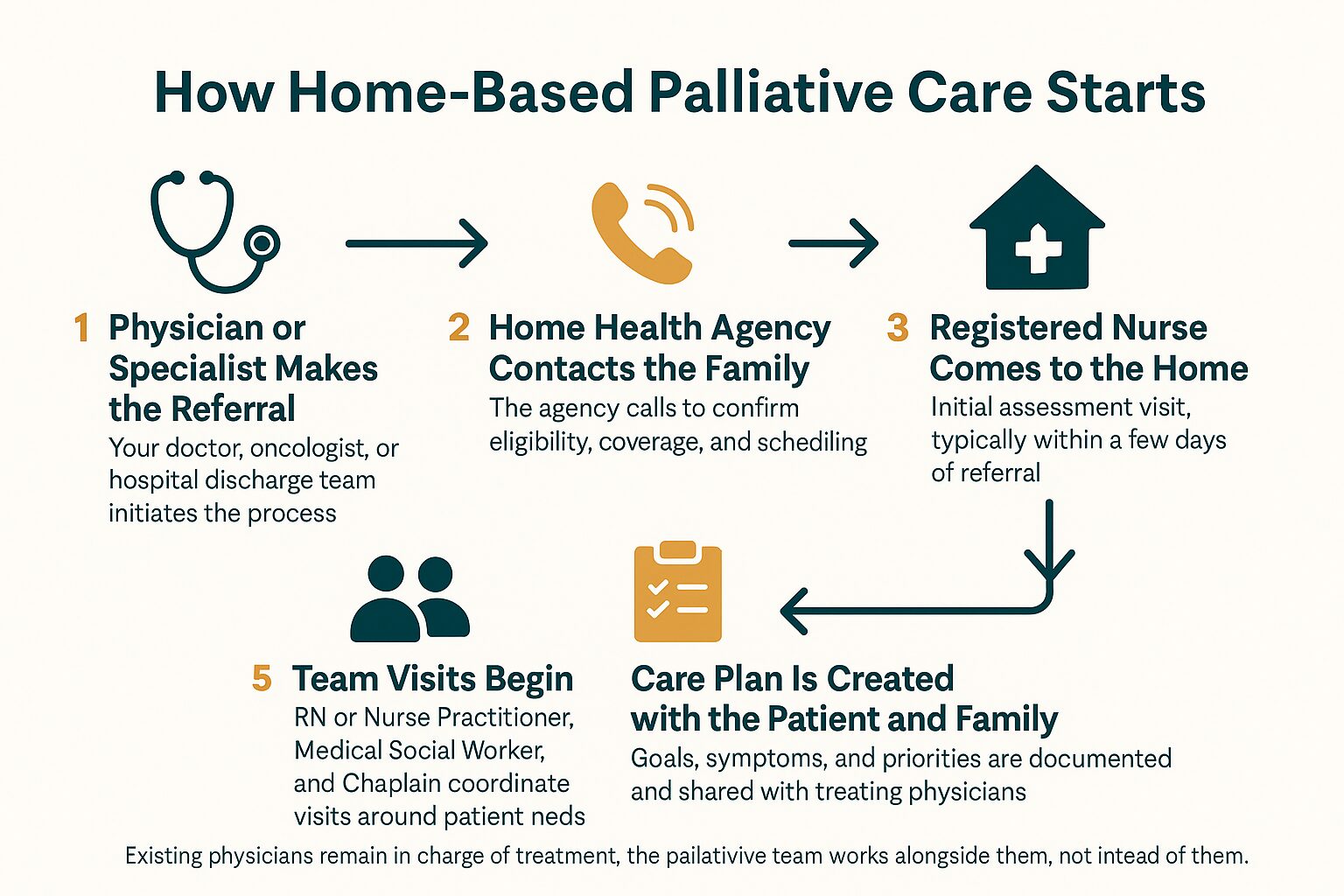
Many families in Monterey County don’t realize a physician referral is required to start home-based palliative care. This shows what the process typically looks like once a referral is made.
What the Referral Process Actually Looks Like, and Why It Surprises Families
One of the most consistent patterns in calls from Monterey County families is that they don’t know a physician referral is required to begin any home health or palliative care service. They often assume they can simply call an agency and get started. When they learn there is a referral step, the process feels more complicated than it actually is.
In practice, it works like this: the patient’s physician, oncologist, or specialist makes the referral. The home health agency then contacts the family directly to confirm eligibility, insurance coverage, and scheduling. A Registered Nurse comes to the home for an initial assessment, typically within a few days of the referral being received. From there, the full team begins coordinating visits.
Patients keep their existing physicians throughout. A palliative care team visiting a home in Pacific Grove or Salinas typically includes:
- A Registered Nurse or Nurse Practitioner managing pain and symptoms
- A Medical Social Worker helping the patient and family understand options and navigate the system
- A Chaplain providing emotional and spiritual support
All three coordinate with the patient’s treating physicians rather than replacing them. For families who feel overwhelmed and don’t know where to start, that first call to ask about a referral is usually the simplest step. You can also read more about what a skilled nurse actually does on a home visit to understand what that first assessment typically covers.
Why Starting Earlier Matters More Than Most Families Realize
Families who access palliative care early in a serious illness consistently describe a different experience than those who come to it late. Symptoms are better controlled. The patient has more say in their own care. The family has time to understand what lies ahead rather than making decisions in crisis mode.
The families who wait, often because they don’t know palliative care exists as a separate option from hospice, sometimes describe the opposite: a scramble near the end when options narrow quickly. The article Most Families Start End-of-Life Planning Too Late goes deeper on that pattern and what changes when families ask the question earlier.
For a parent with advancing dementia in Salinas or a spouse managing heart failure on the Monterey Peninsula, the window for palliative support is often longer than families assume. The question worth asking, ideally at the next physician appointment, is not whether it’s time for hospice. It is whether the current symptom load and care complexity would benefit from a dedicated palliative support team. Those are different questions, and the answer to the second one may be yes months or years before the first one becomes relevant.
If you are still weighing whether it’s time to consider hospice care, understanding palliative care as a distinct earlier option often reframes that question entirely.
Frequently Asked Questions About Palliative Care and Medicare Coverage
Does Medicare pay for palliative care at home right now?
The honest answer is: it depends on how the care is structured. Medicare does not currently have a standalone palliative care benefit. But many patients with serious conditions like heart failure, COPD, advanced cancer, or dementia already qualify for home health services under existing Medicare criteria, and those services can include palliative-focused symptom management. The July 2026 proposed CMS rule would clarify and expand this, but families should not wait for it to finalize before asking about their options.
Is palliative care the same as hospice?
No. Palliative care can begin at any stage of serious illness, even while a patient is still pursuing treatment. Hospice is end-of-life care that generally involves stopping curative treatment. They share some of the same philosophy around comfort and quality of life, but they are different services with different eligibility requirements and timing.
Can my family member keep their regular doctors if they start palliative care?
Yes. The palliative care team, nurses, a Medical Social Worker, a Chaplain, works alongside the patient’s existing physicians. The oncologist, cardiologist, or primary care doctor stays in charge of treatment. Palliative care adds support those specialists often don’t have the bandwidth to provide, without replacing anyone.
How do we get started? Do we just call an agency?
A physician referral is required to begin home-based palliative care. The patient’s doctor or specialist initiates the referral, the home health agency contacts the family, and a Registered Nurse typically comes to the home within a few days of that referral being received. Many families don’t know this step is required, asking the treating physician at the next appointment is usually the fastest way to get the process moving.
What does a palliative care team actually do when they visit someone at home?
A typical home visit involves a Registered Nurse or Nurse Practitioner managing pain and symptoms, a Medical Social Worker helping the patient and family understand their options and navigate the system, and a Chaplain providing emotional and spiritual support. The team communicates regularly with the patient’s treating physicians and adjusts the care plan as the patient’s needs change.
What if we’re not sure whether our family member needs palliative care or hospice?
That uncertainty is very common. A good starting point is reading what comfort-focused care really means and the difference between home health and hospice. A care coordinator can also walk through the specific situation and help a family understand which type of support fits where their loved one is right now.
This Care Has Been Available on the Central Coast for Over a Decade
The proposed Medicare change is new. The care itself, for families in Monterey County who know to ask for it, is not.
Central Coast VNA and Hospice has operated the only home-based palliative care program in its service area since 2015, well before palliative care at home became a national conversation. That team includes Registered Nurses, Nurse Practitioners, Physical Therapists, Occupational Therapists, Medical Social Workers, and Chaplains who have been coordinating with Monterey Peninsula physicians, Salinas Valley Health, and Community Hospital of the Monterey Peninsula for over a decade.
For a family in King City, Hollister, or on the Monterey Peninsula, the path to palliative support doesn’t start with waiting to see how federal policy evolves. It starts with a conversation with the treating physician about whether a referral makes sense now. And for families who are also thinking ahead about what happens if the illness progresses, having that conversation early is consistently what families say, afterward, they wish they had done sooner.
Want to Know If Your Family Member Qualifies Right Now?
Central Coast VNA and Hospice has been serving families across Monterey County, Santa Cruz County, San Benito County, and South Santa Clara County since 1951. If your family is navigating a serious diagnosis and you want to understand whether palliative care at home is an option today, a care coordinator can walk through the specifics with you. Call 831-372-6668 or visit ccvna.com to learn more.