
Direct Answer: A patient qualifies for hospice when a physician certifies a life expectancy of six months or less if the illness follows its expected course, and the patient chooses comfort-focused care over curative treatment.
Most families on the Central Coast who are facing a serious illness with a loved one eventually arrive at the same question. But they don’t always ask it out loud. The fear isn’t just about not qualifying — it’s the equally unsettling possibility that they will qualify, and what that means.
That double-sided fear is completely normal. And it’s exactly why the eligibility question deserves a plain, direct answer rather than clinical language or a pamphlet full of fine print.
This article covers the two conditions that define hospice eligibility, what Medicare and Medi-Cal actually pay for once those conditions are met, a California law from 2023 that most families haven’t heard of, and what happens if a patient’s condition improves. These are the things families in Monterey County most often want to know — and most often don’t think to ask.
The Two Conditions That Actually Determine Hospice Eligibility
Hospice eligibility comes down to two things working together. A physician must certify that, if the illness follows its expected course, the patient’s life expectancy is six months or less. And the patient — or the family decision-maker acting on their behalf — must choose to prioritize comfort rather than curative treatment.
Both conditions have to be present. The six-month prognosis alone doesn’t trigger hospice. The patient or family also has to make an affirmative choice to focus on quality of life over treatment aimed at curing the illness.
In practice, that second condition is often the harder one to work through emotionally. Choosing comfort-focused care doesn’t mean giving up on the person. It means redirecting the care team’s full attention toward managing pain, maintaining dignity, and supporting the family — rather than continuing treatments that may no longer be helping. What “comfort-focused care” really means is worth understanding before a family reaches a decision point, because the choice looks very different once families know what it actually involves.
Common diagnoses that lead families in Monterey County to this conversation include:
- Advanced cancer
- End-stage heart or lung disease
- Late-stage Parkinson’s disease
- Advanced dementia
- End-stage kidney or liver failure
- ALS and other progressive neurological conditions
The diagnosis itself doesn’t determine eligibility — the physician’s assessment of the prognosis does.

What Medicare and Medi-Cal Actually Cover — Once Eligibility Is Confirmed
Families often ask about eligibility and insurance in the same breath, because they’re really asking the same question: can we actually do this without it becoming a financial crisis?
When a patient enrolls in the Medicare Hospice Benefit, Medicare covers the full scope of hospice services. There are no co-pays for covered hospice care and no deductibles for most patients. What Medicare pays for includes:
- Skilled nursing visits from Registered Nurses and Licensed Vocational Nurses
- Hospice Aide visits for personal care
- Medications related to the terminal diagnosis
- Medical equipment like hospital beds, wheelchairs, and oxygen
- Medical Social Worker support
- Chaplain and spiritual care
- Volunteer services
- Bereavement support for the family after the patient’s passing
For patients who qualify for both Medicare and Medi-Cal — known as dual eligibility — Medi-Cal generally covers costs that Medicare doesn’t, which can mean little to no out-of-pocket expense. Families navigating that situation should ask the hospice team directly about how their specific coverage applies, because the interaction between the two programs isn’t always straightforward.
One family member who called about a Parkinson’s diagnosis wasn’t sure whether her husband qualified for palliative services or hospice — and she wasn’t sure what the difference was in terms of what Medicare would pay. Those two questions almost always arrive together, and a care coordinator can walk through both in a single conversation. Understanding the difference between palliative and hospice care is a good place to start.
The Medicare hospice benefit is administered federally, so the covered services are consistent regardless of which provider a family uses in Monterey County, Salinas, or King City.
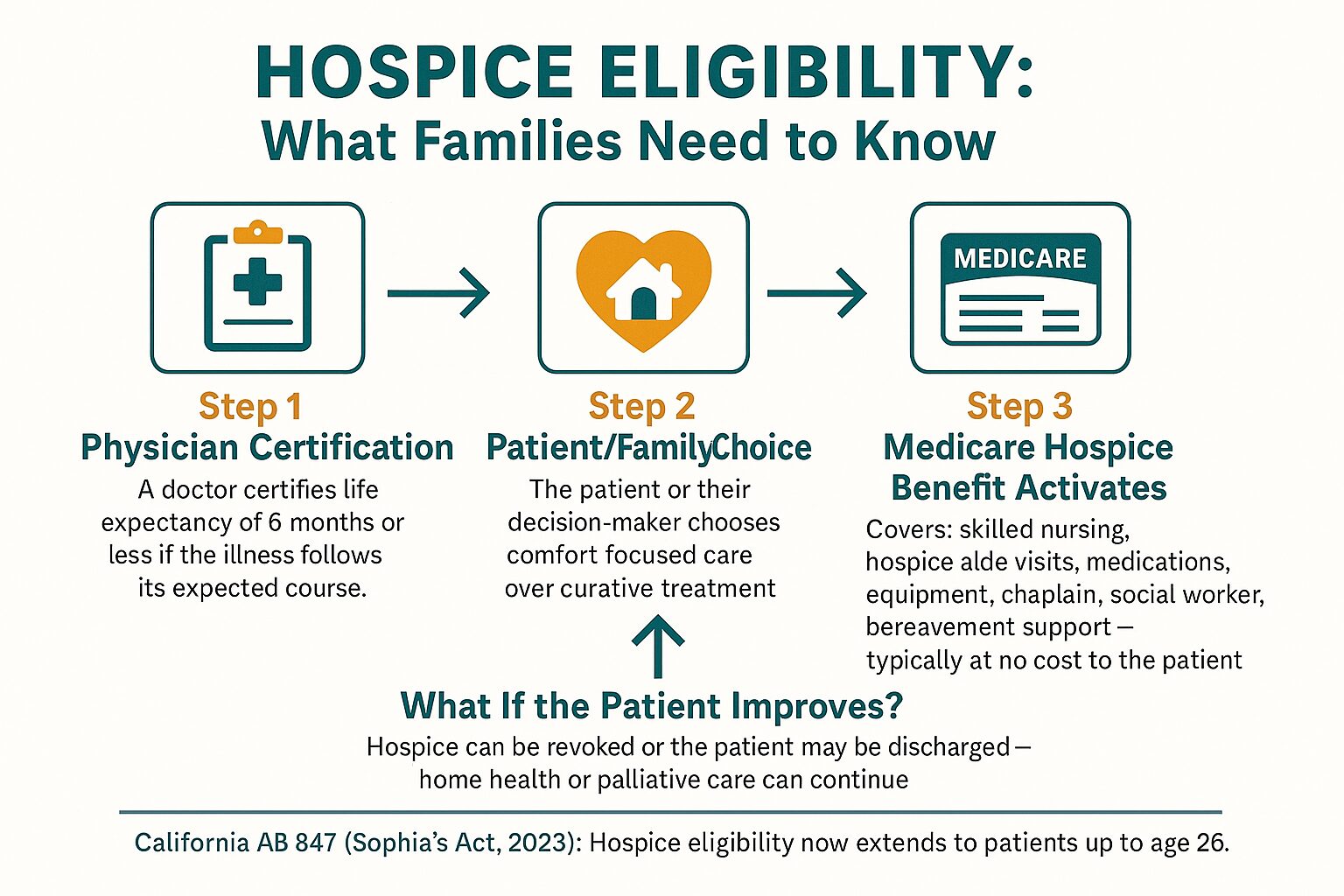
Hospice Eligibility at a Glance
This visual summarizes the two eligibility conditions, what Medicare covers, and what happens if a patient’s condition changes.
A California Law Most Families Haven’t Heard Of
In 2023, California passed AB 847, also known as Sophia’s Act. Before this law, hospice eligibility in California was limited to adults 21 and older under Medi-Cal. Sophia’s Act extended that eligibility to patients up to age 26.
This matters for families caring for young adults with terminal illness — a situation that is less common but no less real. If a family in Hollister, Salinas, or anywhere in Monterey County is caring for a young adult with a serious progressive illness and isn’t sure whether hospice applies, the answer under California law may now be yes.
This provision doesn’t get much attention in national hospice content. But for the families it affects, it can be the difference between receiving full hospice support and navigating a serious illness without it.
Hospice vs. Palliative Care: Key Differences for Families
Families often confuse these two types of care. This table shows how they differ on the points that matter most when making a decision.
| Factor | Palliative Care | Hospice Care |
|---|---|---|
| Eligibility requirement | Serious illness at any stage | Physician-certified prognosis of 6 months or less |
| Curative treatment | Can continue alongside palliative care | Patient elects to focus on comfort, not cure |
| Medicare coverage | Varies by specific services | Full Medicare Hospice Benefit applies |
| Care team | Nurses, therapists, social workers, physicians | Nurses, aides, social workers, chaplains, volunteers, bereavement specialists |
| Duration | No time limit | Recertified every 60–90 days as long as criteria are met |
| Goal | Symptom management and quality of life | Comfort, dignity, and family support through end of life |
Hospice Is Not a One-Way Door
This is the piece of information that reduces more hesitation than almost anything else — and it’s one of the least explained parts of how hospice actually works.
If a patient enrolls in hospice and then stabilizes or improves beyond the six-month prognosis, they can be discharged from hospice. Care doesn’t end — it transitions. A patient who has improved can return to home health services, continue with palliative care, or simply be monitored by their primary physician. The hospice chapter closes, and another one opens.
And if a patient or family decides they want to pursue curative treatment after all, they can revoke the hospice election at any time. There’s no penalty and no waiting period. The Medicare Hospice Benefit ends, and standard Medicare coverage resumes immediately.
This reversibility matters because families sometimes hold back from asking about hospice out of fear that asking the question commits them to something permanent. It doesn’t. Asking what your loved one qualifies for is just information — and having that information early gives families more time to make a considered decision rather than a rushed one. How families describe the moment they chose hospice reflects how much that timing matters.
For families earlier in this process who aren’t sure whether their loved one’s condition has reached the hospice threshold, understanding what palliative care actually offers is often the right starting point. Palliative care doesn’t require a terminal prognosis — it’s available at any stage of serious illness, and it can continue right alongside curative treatment.
Frequently Asked Questions About Hospice Eligibility
What if my loved one’s doctor hasn’t brought up hospice — can we ask about it ourselves?
Yes, and families do this regularly. You don’t have to wait for a physician to raise the subject. If you’re wondering whether your loved one might qualify, you can contact a hospice provider directly to ask questions — no referral is required to have an initial conversation. A hospice team will coordinate with the treating physician if eligibility is confirmed and the family decides to move forward.
Does choosing hospice mean we’ve given up hope?
Not in any clinical or practical sense. Hospice redirects the focus from treating the illness to treating the person — managing pain, preserving comfort, and supporting the whole family. Many families describe the decision as one of the most loving choices they made. The care team — nurses, hospice aides, chaplains, Medical Social Workers, and volunteers — is fully present and actively engaged throughout.
What if my loved one is on Medi-Cal, not Medicare?
Medi-Cal also covers hospice services for eligible patients. For patients who qualify for both Medicare and Medi-Cal — dual eligibility — the combination typically covers the full scope of hospice care with little to no out-of-pocket cost. Because the details depend on individual coverage, speaking directly with a care coordinator is the most reliable way to understand what applies to your situation.
Can a patient go back to regular home health after hospice if they get better?
Yes. If a patient stabilizes or improves enough that the six-month prognosis no longer applies, they can be discharged from hospice. Home health services — including skilled nursing visits and physical, occupational, or speech therapy — can resume. Understanding what home health includes helps families know what that transition would look like.
My family member is in their early 20s with a terminal diagnosis. Do they qualify for hospice in California?
Under California AB 847 (Sophia’s Act, 2023), Medi-Cal hospice eligibility now extends to patients up to age 26. If your family member meets the physician certification criteria and chooses comfort-focused care, age is no longer a barrier under state law. A care coordinator can help confirm how this applies to your specific situation.
Does the patient have to go to a facility to receive hospice care?
No. Hospice care is delivered in the home — wherever the patient lives. That includes private residences throughout Monterey County, as well as assisted living communities and other residential settings. The care team comes to the patient.
Ready to Get a Straight Answer to the Eligibility Question?
If you’ve been sitting with this question for a family member in Monterey County, Salinas, King City, or the surrounding Central Coast communities, Central Coast VNA & Hospice has been answering it for families like yours since 1951. A care coordinator can walk through the eligibility criteria, explain what Medicare or Medi-Cal covers in your specific situation, and help you understand what the next step actually looks like — without any pressure. Call 831-372-6668 or visit ccvna.com to start that conversation.