
Direct Answer: Central Coast VNA & Hospice’s 2025 annual report shows 73,000+ home visits, 3,800 patients served, and nearly 40,000 volunteer hours — each number representing a family navigating a difficult moment in Monterey County.
Annual reports are easy to skim. A number like 73,000 visits lands on the page and most people move on without thinking about what it actually means at the street level — who opened the door, what was wrong, what happened next.
But if you’re a family in Salinas trying to bring someone home from the hospital, or a daughter in Pacific Grove trying to figure out whether her mother qualifies for skilled nursing at home, those numbers aren’t institutional data. They’re the shape of what help actually looked like for 3,800 patients across Monterey County last year.
This article walks through what the 2025 VNA annual report actually documents — not as a summary, but as a way to understand what home-based care looks like in practice on the Central Coast, and what makes one agency’s numbers mean something real.
What 73,000 Visits Looks Like on a Friday Afternoon
A number like 73,000 only starts to make sense when you put a scene behind it. A Registered Nurse drives out to a home in King City on a Friday afternoon — a patient discharged from the hospital two days earlier, still not sure how to manage a new wound, family members trying to work out what happens next.
That visit is one of 73,000. And the ones that don’t happen on weekdays are the ones that tend to matter most. Families described in call records for April 2026 included people navigating hospital discharges over weekends, uncertain whether they’d get a call back before Monday. For anyone who has been in that position, the gap between a number and a real outcome is exactly the size of one unanswered phone.
What the annual report documents in that 3,800-patient figure is a team that includes Registered Nurses, Licensed Vocational Nurses, Physical Therapists, Occupational Therapists, Speech Therapists, Medical Social Workers, Hospice Aides, Chaplains, Bereavement Specialists, and Volunteers — not just a nurse at the door, but a coordinated group of clinicians working together around a single patient’s needs at home.
For families weighing what comes after a hospital stay, what actually happens during a skilled nursing home visit is often not what they expect — and understanding it matters before the discharge paperwork is signed.
Jack Murphy’s Four Months at Home — and Why It Wasn’t a Given
One of the more specific accounts in the 2025 annual report comes from Jack Murphy, Director of the Military and Veterans Affairs Office, who spent 24 days in UCSF’s Cardiac Critical Care Unit before returning home to Monterey County to recover.
Four months of home-based recovery after a serious cardiac event isn’t automatic. It requires nurses who understand what to watch for, Physical Therapists helping someone relearn how to move safely in their own space, and Medical Social Workers coordinating the pieces that make it logistically possible. Murphy’s own words in the report: ‘VNA was truly the only organization that could make that happen.’
His wife, who volunteers as a death doula, observed something she described as presence in the care team — a quality that doesn’t show up in a rating score but that families recognize immediately when it’s there and notice just as fast when it isn’t.
For patients returning home after serious illness, what families often miss in hospital discharge planning is worth reading before the transition happens — not after.

What the CMS Rating and Patient Satisfaction Scores Actually Measure
VNA holds a 4-Star Home Health rating from the Centers for Medicare and Medicaid Services — and the 2025 annual report also documents a patient satisfaction score worth understanding.
The HHCAHPS overall recommendation rate for VNA sits at 85%, compared to a national average of 78%. Those aren’t numbers VNA generated internally. HHCAHPS surveys are administered independently and submitted to CMS — patients answer questions about their care after the fact, without a VNA staff member present.
What those scores actually measure:
- Whether clinicians explained medications and care instructions clearly
- Whether patients felt treated with respect
- Whether the care team communicated well with the patient’s doctors
- Whether patients would recommend the agency to someone they know
For a family comparing home health agencies on the Central Coast, those benchmarks reflect day-to-day care decisions made by individual clinicians across thousands of visits — not a single good outcome or a marketing claim. And a 7-point gap above the national average on the recommendation question is a meaningful signal, not a rounding difference.
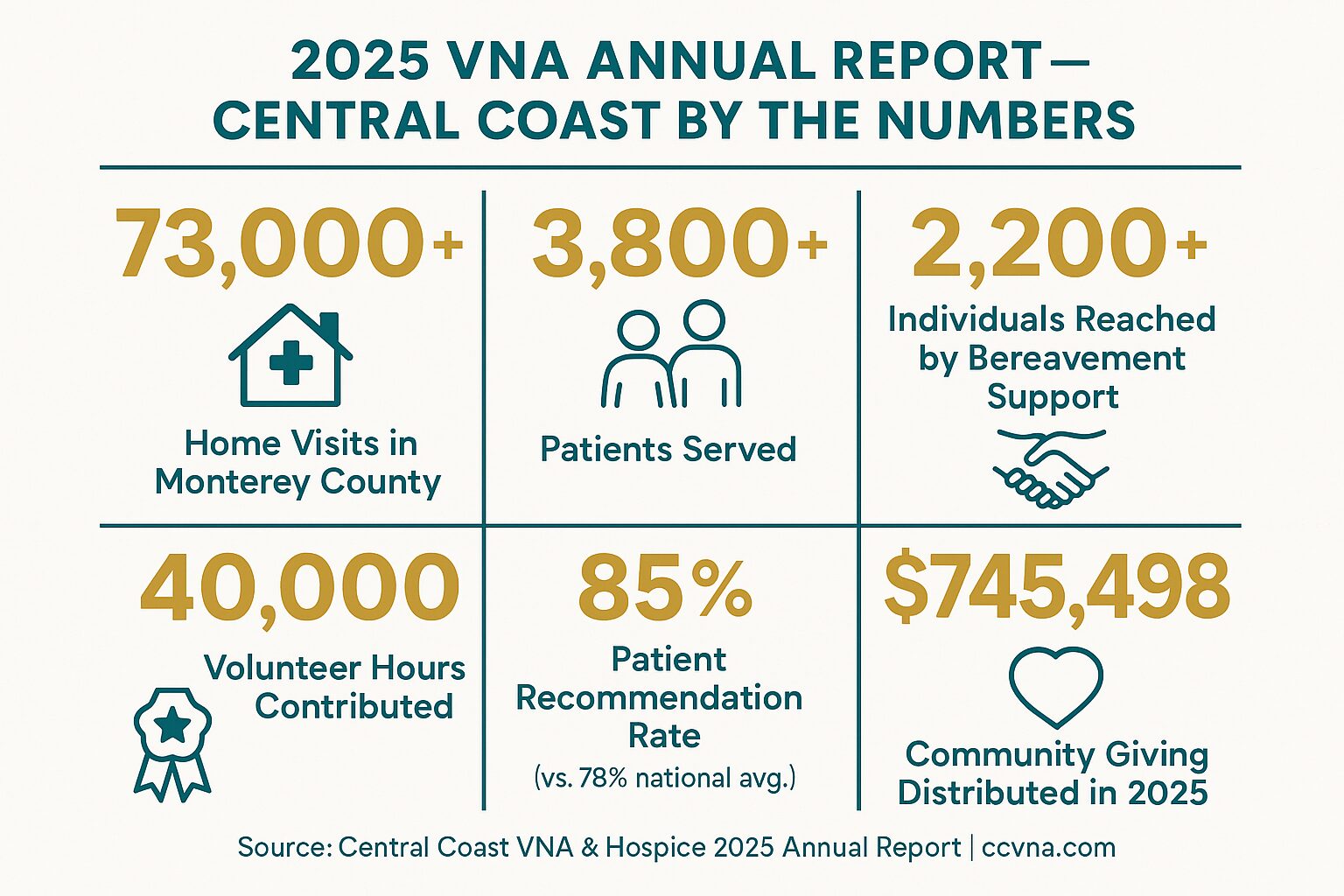
2025 Annual Report: By the Numbers
The figures below come directly from VNA’s 2025 annual report and reflect the scope of home-based care delivered across Monterey County and the surrounding region.
The 40,000 Volunteer Hours — and What They Actually Cover
The 2025 report notes that volunteers contributed nearly 40,000 hours — and that this represents more than 5% of all direct hospice care delivered. That’s not a rounding detail. It’s a structural part of how hospice at home actually functions.
Volunteers sit vigil through the night so a spouse can sleep. They provide companionship during the hours between clinical visits. They give family members a few hours away from the house — something paid clinical care simply isn’t structured to provide.
What a hospice volunteer visit looks like in practice:
- Arriving at a home in Seaside or Monterey for a few hours in the afternoon
- Sitting with a patient who is awake but doesn’t need clinical attention
- Giving the family member who has been there all week a chance to leave the house
- Returning for a vigil shift when a patient is in the final hours of life
This kind of presence is what one family described in a public review as genuinely caring — the kind that shows up not because a schedule requires it, but because the situation calls for it. For anyone thinking about volunteering, what hospice volunteer training involves is a useful starting point for understanding how the program works.
Bereavement Support After a Patient Passes — and How It’s Funded
One of the less visible milestones in the 2025 report: bereavement support reached more than 2,200 individuals. Most families don’t know this service exists at all, or that it continues well after a patient has passed.
Bereavement Specialists work with families for months after a loss — grief counseling, check-in calls, and support that doesn’t have a reimbursement code attached to it. Medicare doesn’t pay for ongoing bereavement support at that scale. This programming runs on donor contributions and grant funding — which is one concrete reason why community giving matters beyond the general sense of supporting a good cause.
The McGives 2025 campaign raised $95,812.73 for VNA — described in the report as the largest total ever. Those funds flow into the Quality of Life Fund, which covers non-reimbursable patient needs, expanded bereavement programming, and the ability to serve patients in Salinas, King City, Hollister, and across Monterey County who can’t fully cover the cost of care on their own.
Families who have used bereavement services often describe grief as something that doesn’t follow a predictable timeline — which is exactly why ongoing support matters. Understanding what happens when grief feels stuck can help families recognize when they need more than time.
2025 VNA Annual Report Highlights at a Glance
These figures come directly from the 2025 annual report and reflect care delivered across Monterey County and surrounding communities.
| Metric | 2025 Figure | What It Reflects |
|---|---|---|
| Home Visits — Monterey County | 73,000+ | Skilled nursing, therapy, and hospice visits at patients’ homes |
| Patients Served | 3,800+ | Individuals receiving home health, palliative, or hospice care |
| Bereavement Individuals Reached | 2,200+ | Families supported after a patient’s passing, often for months |
| Volunteer Hours | ~40,000 | More than 5% of all direct hospice care delivered |
| Patient Recommendation Rate | 85% (vs. 78% national avg.) | Independent HHCAHPS surveys submitted to CMS |
| CMS Star Rating | 4-Star Home Health | Federal quality rating based on clinical outcomes and patient surveys |
| Community Giving Distributed | $745,498 | Directed to general operations, home health, hospice, and community services |
| McGives 2025 Total | $95,812.73 | Largest McGives total in VNA’s history |
Founded in 1951 With $1,500 — What That Origin Explains About Now
VNA was founded in 1951 with $1,500 in seed funding and one nurse making home visits across Monterey County. That origin story isn’t just historical context — it explains something about how decisions get made today.
As a nonprofit, VNA’s obligation runs to the community, not to shareholders. The $745,498 in community giving distributed in 2025 went to general operations, home health, hospice, and community services — including care for patients who can’t fully pay. That’s a real policy choice, and it shows up in how services are structured across communities like Salinas, King City, and Hollister.
As VNA marks its 75th anniversary in 2026, the question isn’t what the numbers add up to. It’s what they represent at the household level — a family in Pacific Grove figuring out how to bring a parent home after surgery, a spouse in Seaside trying to understand what comes next after a diagnosis, a daughter in Hollister who doesn’t know yet that bereavement support will still be available six months after her father passes.
For families trying to understand whether home-based care is the right fit right now, the difference between needing help and needing a facility often comes down to clinical facts that are worth knowing before a decision has to be made.
Frequently Asked Questions About VNA’s Annual Report and Services
Does Medicare or Medi-Cal cover VNA home health services?
Yes. VNA accepts Medicare, Medi-Cal, and Veterans benefits. Coverage eligibility depends on the specific services needed and a patient’s diagnosis, so it’s worth calling VNA directly to confirm what applies to a particular situation. Many families are surprised to find that skilled nursing visits and therapy services are covered under Medicare when ordered by a physician.
What does a VNA home health visit actually include?
It depends on what the patient needs. A visit might be a Registered Nurse checking wound healing and adjusting medications after a hospital discharge, or a Physical Therapist helping someone safely walk through their own home after a cardiac event, or a Medical Social Worker connecting a family in Salinas with community resources. The care team — which includes nurses, therapists, social workers, chaplains, and volunteers — is coordinated around a single plan of care.
How long does bereavement support last after a patient passes?
Bereavement support through VNA continues for months after a patient’s passing — not just the days immediately following. Bereavement Specialists provide grief counseling and ongoing emotional care. This programming is funded in part through donor contributions and grants, not insurance reimbursements, which is one reason community giving has a direct impact on what families actually receive.
What does a hospice volunteer actually do?
Hospice volunteers provide companionship, sit vigil, and give family members time to step away from caregiving — tasks that paid clinical visits aren’t designed to cover. In 2025, VNA volunteers contributed nearly 40,000 hours, which represented more than 5% of all direct hospice care delivered. That’s a structural part of how home hospice functions, not a supplementary add-on.
What areas does VNA serve?
VNA’s primary service area includes all of Monterey County — including the Monterey Peninsula, Salinas, King City, and surrounding communities — as well as San Benito County (including Hollister) and parts of South Santa Clara County. VNA also serves portions of Santa Cruz County. For questions about a specific location, calling VNA directly at 831-372-6668 is the fastest way to confirm coverage.
What does VNA’s 4-Star CMS rating actually mean for my family?
The 4-Star Home Health rating from the Centers for Medicare and Medicaid Services is based on clinical outcomes and patient survey data — not self-reported information. It reflects how well clinicians communicate, how patients recover, and how likely patients are to recommend the agency. VNA’s 85% recommendation rate on independent HHCAHPS surveys is 7 points above the national average of 78%, which reflects thousands of individual care decisions made in patients’ homes.
Questions About Care in Monterey County?
Central Coast VNA & Hospice has been serving families across Monterey County, Salinas, King City, Hollister, and the surrounding region since 1951. If you have questions about home health, hospice, palliative care, or bereavement support, a care coordinator can help you understand what fits your situation — without pressure. Call 831-372-6668 or visit ccvna.com to learn more.