
Families caring for a loved one with dementia often face a difficult question: when should we ask about hospice? Unlike illnesses with a clearer timeline, dementia’s decline is gradual. This can leave families wondering, “Are we there yet?”
Recognizing certain changes can help. If your loved one is speaking very little, needs help with all daily tasks, has lost significant weight, or sleeps most of the day, it may be time to talk about hospice.
Choosing hospice isn't about giving up. It is about adding a layer of comfort-focused care to provide the best quality of life possible.
Navigating the Gentle Path to Hospice for Dementia
Unlike cancer or heart disease, dementia progresses slowly and unpredictably. This gradual decline can leave families feeling uncertain about when to seek additional support.
Too often, families wait for a crisis to explore hospice. A fall, a serious infection, or a hospitalization can force a quick decision.
Waiting for an emergency means missing out on weeks or even months of valuable support. Hospice care is not just for the final few days of life; it can provide comfort for much longer. According to the National Hospice and Palliative Care Organization, over 51.7% of Medicare beneficiaries who died received hospice, but many enrolled too late to get the full benefit (NHPCO, 2021).
Reframing the Hospice Decision
Thinking about hospice brings up strong emotions. For many, it involves the profound challenge of letting go. It is helpful to reframe this choice as a transition to a different kind of care focused on dignity and peace.
Choosing hospice is an active decision to give your loved one comfort and expert symptom management. It supports the entire family during a difficult time.
This guide will explain the signs that it may be time for hospice and how eligibility works. At Central Coast VNA & Hospice, we have supported families in Monterey County, San Benito County, and Santa Cruz County for over 74 years.
Our local, nonprofit teams are here to guide you with compassion. Knowing when is the right time for hospice is the first step.
Recognizing the Key Signs for Hospice Consideration
Deciding when someone with dementia needs hospice can be confusing. The decline is often a series of small changes, not one single event. Knowing the specific signs of advanced dementia can help you feel more prepared.
It is rarely one single symptom. Instead, it is a collection of changes that show the body is slowing down. Recognizing these shifts can help you start a conversation about comfort-focused care.
Changes in Communication and Awareness
A significant decline in verbal communication is a key sign of advanced dementia. Your loved one may go from telling stories to struggling for words, or speaking very little at all.
This reflects deep changes happening in the brain. You might notice that they:
- Speak six or fewer intelligible words in a typical day.
- Rely on repetitive phrases or sounds instead of clear sentences.
- No longer recognize close family members or confuse them with others.
- Seem more withdrawn and less responsive to their surroundings.
This communication barrier shows the disease is affecting core brain functions. Comfort and non-verbal connection become more important than ever. Learn more in our guide on how to know when hospice is needed.
Increasing Physical Dependence
As dementia progresses, the ability to manage simple, everyday activities fades. This growing need for help is a key sign that your loved one may be ready for hospice support.
They may need total help with all activities of daily living (ADLs). This means they depend on others for basic self-care, including:
- Bathing and grooming
- Dressing and undressing
- Getting in and out of a bed or chair
- Using the toilet
When someone requires this level of hands-on care, it often signals the final stages of the disease. A skilled team, including Hospice Aides, can provide immense relief for both your loved one and the family.
Decline in Physical Health
You will likely see other significant physical changes. These signs point to a systemic decline and are crucial in determining hospice eligibility.
The checklist below can help you track these changes. Seeing several of these signs may mean it is time to speak with a doctor about a hospice consultation.
Observable Signs Your Loved One May Be Ready for Hospice
| Symptom Category | What to Look For |
|---|---|
| Weight Loss | Unintentional loss of 10% or more body weight in the last six months. |
| Swallowing Issues | Frequent coughing, choking, or holding food in the mouth while eating. |
| Increased Sleep | Spending most of the day asleep or in bed; showing little interest in activities. |
| Recurrent Infections | Repeated urinary tract infections, pneumonia, sepsis, or other infections. |
| Mobility Decline | Inability to walk without assistance; eventually confined to a bed or chair. |
| Skin Issues | Developing pressure ulcers (bedsores) despite good care. |
Seeing just one of these signs might not be a trigger. When you notice a pattern of several occurring together, it paints a clearer picture.
These physical markers show that the body is struggling to maintain its basic functions. Shifting the goals of care toward symptom management and comfort becomes the most loving path forward.
If you are seeing these signs, it may be the right time to explore what hospice can offer. The team at Central Coast VNA & Hospice can provide an expert assessment to guide your family.
Understanding How Hospice Eligibility for Dementia Works
The official requirements for hospice care can seem complex, but they are often straightforward. Doctors and hospice teams use specific tools to determine when a person with dementia is medically ready for this care.
A key benchmark for Medicare is the Functional Assessment Staging Tool (FAST). This scale measures how dementia has progressed by looking at a person’s ability to handle daily activities. Stage 7 is the most advanced phase of the disease.
What Does Stage 7 on the FAST Scale Look Like?
When someone reaches Stage 7, they need a tremendous amount of help with daily life. This goes far beyond memory loss. It is a sign that dementia has deeply affected the brain's ability to control the body.
A person in this stage will typically show a combination of these signs:
- Very Limited Speech: They might speak fewer than six words on an average day.
- Loss of Mobility: They can no longer walk without assistance.
- Need for Total Assistance: They are completely dependent on others for personal care like bathing and dressing.
This level of dependence is a strong signal that the illness has reached its final phase. The focus of care naturally shifts toward ensuring comfort. For more details, see our guide on hospice eligibility requirements.
More Than Just a Number
A FAST score is just one piece of the puzzle. Medicare also looks for other serious health issues that confirm the disease is advancing. These other conditions show how much dementia is impacting their overall health.
This visual decision tree shows how factors like communication, physical abilities, and eating all signal when hospice may be appropriate.
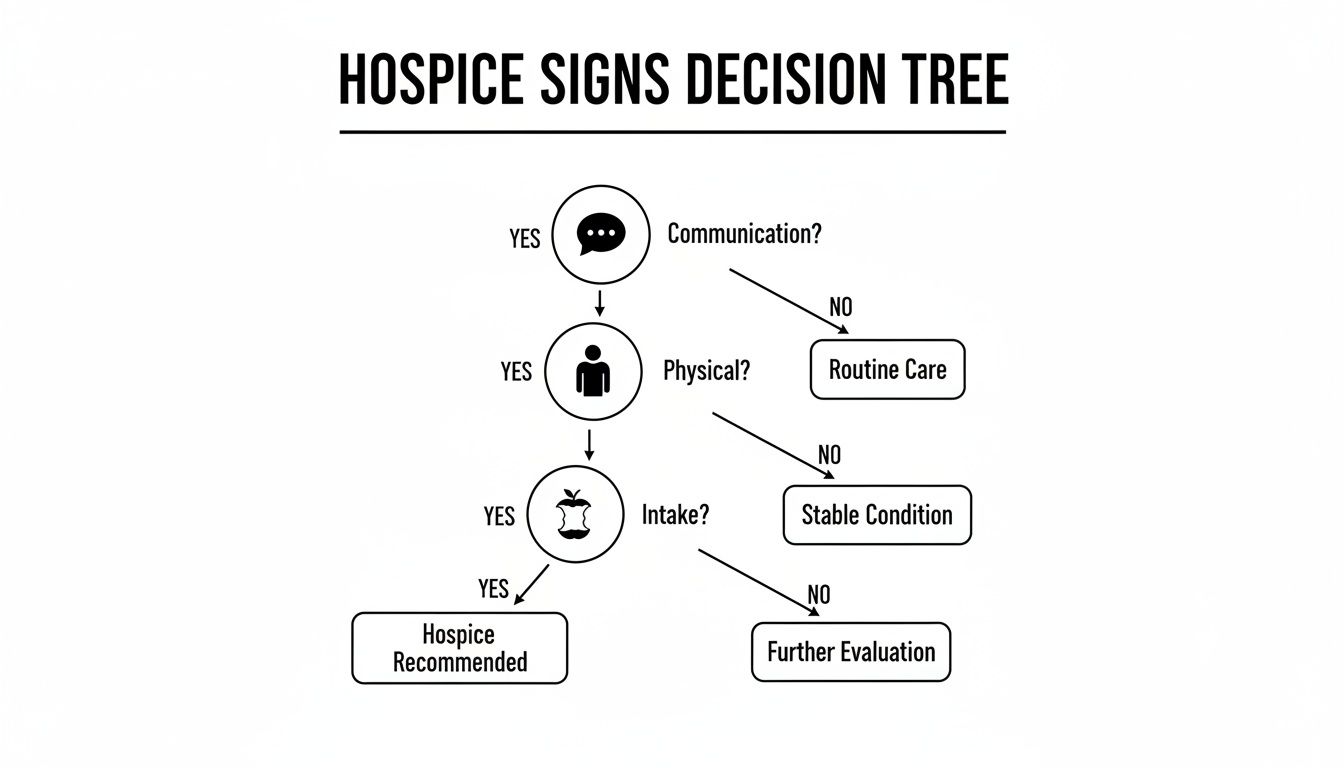
As the graphic shows, a decline across multiple areas usually opens the door to a hospice conversation.
Common Co-Occurring Conditions
A physician will look for at least one of the following health problems from the past year to complete the eligibility picture:
- Recurrent Infections: This could be pneumonia, urinary tract infections (UTIs), or sepsis.
- Significant Weight Loss: An unintentional loss of 10% or more of their body weight in the last six months.
- Difficulty Swallowing (Dysphagia): This can lead to choking and poor nutrition.
- Pressure Ulcers: The development of advanced bedsores (Stage 3-4) even with good daily care.
When one or more of these conditions appear with a FAST score of 7, it creates a clear medical basis for a hospice referral. This framework ensures your loved one gets the right care at the right time.
The Comfort and Support of Choosing Hospice Sooner

A common myth about hospice is that it is only for the last few days of life. This misunderstanding causes families to wait until a crisis, missing out on months of meaningful support.
Choosing hospice sooner is not giving up. It is a loving act that shifts the focus from cure to comfort, ensuring your loved one’s final chapter is lived with dignity.
Enhancing Comfort for Your Loved One
For a person with advanced dementia, symptoms like pain, agitation, and anxiety can be difficult to manage. An early hospice referral provides access to a team of experts trained in dementia care.
Our Registered Nurses work with your loved one’s doctor to manage symptoms, helping them stay calm and comfortable. This specialized attention can dramatically improve their daily experience.
Research shows that hospice care improves quality of life for dementia patients. A 2022 study found that 59% of dementia patients in hospice received 'excellent' care ratings from families, compared to just 28% for those not in hospice. Learn more about the benefits of hospice in dementia care from UCSF research.
A Circle of Care for the Whole Family
Hospice is a vital support system for the entire family. Caring for someone with advanced dementia is emotionally and physically exhausting. Our team at Central Coast VNA & Hospice steps in to share that load.
You gain a dedicated team offering essential support:
- Medical Social Workers provide emotional counseling and help you navigate difficult decisions.
- Chaplains offer spiritual guidance that respects your family’s beliefs.
- Hospice Aides can assist with personal care, like bathing and dressing, giving you a break.
- Specially trained volunteers offer companionship for your loved one, which gives you time to rest.
This network helps reduce stress, allowing you to focus on spending quality time together. You can explore more about the real benefits of starting hospice early in our related article.
How We Support Families on the Central Coast

Choosing a hospice provider is a decision built on trust. At Central Coast VNA & Hospice, our mission is to deliver expert, compassionate care to our neighbors.
We are a local, nonprofit organization with roots in this community going back more than 74 years. Our focus is your family’s comfort and well-being.
We understand the unique challenges of dementia care. From Salinas to Monterey and Hollister to Santa Cruz, we’re here to support you.
Your Dedicated Dementia Care Team
When you choose us, you get an entire team trained in dementia care. They work together to create a personalized plan that honors your loved one and supports your family.
Our team includes:
- Registered Nurses who are experts at managing symptoms like pain or agitation.
- Hospice Aides who provide gentle, hands-on help with personal care.
- Medical Social Workers who offer emotional support and practical guidance.
- Chaplains who provide spiritual care tailored to your family’s beliefs.
- Trained Volunteers who offer companionship for your loved one and respite for you.
This team approach ensures that every aspect of care—physical, emotional, and spiritual—is thoughtfully addressed.
A Seamless Continuum of Care
As the only organization on the Central Coast offering a full spectrum of home-based services, from home health to palliative care to hospice, we make the journey smooth. Many families already know us through our other programs.
When needs change, transitioning to hospice is a natural next step within a system they already trust. This continuum of care means your loved one can stay with a familiar, trusted team.
If you live in Monterey County, San Benito County, Santa Cruz County, or South Santa Clara County, our local team is ready to help. We can meet with you at home or in your loved one’s care facility to talk about your needs. There is never any pressure—just guidance from a team that has served this community for decades.
Learn more about how Central Coast VNA & Hospice supports lives across the Central Coast.
Taking the Next Step with Confidence
If you feel your loved one might be ready for hospice, the best next step is to talk with their doctor. This conversation can lead to a formal evaluation and bring peace of mind.
Remember, anyone—a patient, family member, or friend—can ask about hospice care. Our team at Central Coast VNA & Hospice is here to provide information and support whenever you need it.
How to Talk to the Doctor
When you speak with the physician, be specific. Share the changes you’ve noticed in their communication, physical strength, or overall health.
Asking direct questions can help start the conversation:
- "Based on the changes we’re seeing, do you think a hospice evaluation would be appropriate?"
- "Would you be surprised if their condition worsened in the next six months?"
- "What medical signs do you look for when deciding if hospice is the right choice?"
Requesting a Hospice Evaluation
A hospice evaluation is a no-obligation consultation to gather information. The doctor can make a referral, or you can call Central Coast VNA & Hospice directly to set one up.
One of our Registered Nurses will meet with you to assess your loved one's needs and see if they meet eligibility criteria. To qualify under Medicare, a person with advanced dementia typically needs to be at FAST Stage 7 and have secondary conditions like recurring infections. You can see the specifics in the official Medicare coverage determination guidelines.
We are proud to serve communities across the Central Coast, including Salinas, Monterey, Hollister, and Santa Cruz. To schedule a consultation, call us at (831) 375-9882 or visit our hospice care page.
Frequently Asked Questions About Hospice for Dementia
Making the decision to start hospice comes with many questions. Here are answers to some common concerns we hear from families.
1. Does choosing hospice mean we are giving up?
Not at all. Choosing hospice is not about giving up. It is about shifting the focus from cure to maximizing your loved one's quality of life. It’s an active choice to prioritize comfort, dignity, and peace.
2. Can my loved one still see their regular doctor?
Yes, absolutely. Our Central Coast VNA & Hospice team works alongside your loved one’s trusted physician. Their primary doctor remains a vital part of the care team, and we keep them informed every step of the way.
3. Does my loved one have to move to a facility?
No. The goal of hospice is to bring care to wherever your loved one calls home. For most families we serve in Salinas, Santa Cruz, and surrounding areas, this means their own private residence. We also provide care in assisted living communities and skilled nursing facilities.
4. How is hospice paid for?
Hospice is a fully covered benefit under Medicare Part A, Medi-Cal, and most private insurance plans. This coverage includes our care team's visits, medical equipment, supplies, and medications related to the dementia diagnosis. Our staff will explain your specific coverage so there are no surprises.
5. What happens if their condition improves?
Sometimes a person’s condition can stabilize or improve on hospice. If that happens, they can be discharged from hospice care. The door is always open to return to hospice later if their health declines again.
If you live in Salinas, Monterey, Hollister, or Santa Cruz, our hospice team can meet with you. Call (831) 375-9882 for guidance. Contact us today to learn more about our hospice care services.