
Direct Answer: Veterans can access home health and hospice through VA benefits, Medicare Part A, or Medi-Cal, and sometimes more than one. A Medical Social Worker can map which pathways apply to your veteran.
Your father spent decades in uniform. He knows how to fill out a form, how to sit on hold, how to work a system that does not want to be worked. And yet when the hospital says he needs care at home, nobody in the family knows which benefit actually pays for it.
That gap shows up constantly on the Central Coast. Families in Monterey, Salinas, Seaside, and Hollister take whatever plan the discharge planner hands them, never asking whether their veteran had a second or third benefit pathway available the whole time.
This article walks through the pathways veterans and their families most often miss, how VA and Medicare hospice benefits can interact, and why living an hour from a VA facility does not cut you off from care at home.
Why Veteran Benefits and Home Care Feel Like Two Separate Mazes
Veterans are usually the ones helping other people figure out paperwork. That is what makes this so disorienting when it happens to them.
Central Coast VNA & Hospice’s 2025 annual report includes a firsthand account from a local veterans affairs director who spent 24 days in UCSF’s Cardiac Critical Care Unit and then had to find home care to be discharged to. His description of that stretch is the clearest version of this problem anyone has written down: “Healthcare is its own complicated country, and we were trying to move through it while simultaneously hurting, healing, and feeling quite lost.”
He had spent a career helping veterans find the right door. He still could not find his own.
His family is not unusual. The people staffing a hospital discharge desk know Medicare home health cold. They do not always know how a veteran’s VA enrollment, service-connected disability rating, or priority group changes what is available.
So the family gets one option, takes it, and never learns there were others. That is not anyone acting in bad faith. It is just two systems that were built separately and never sat down together.
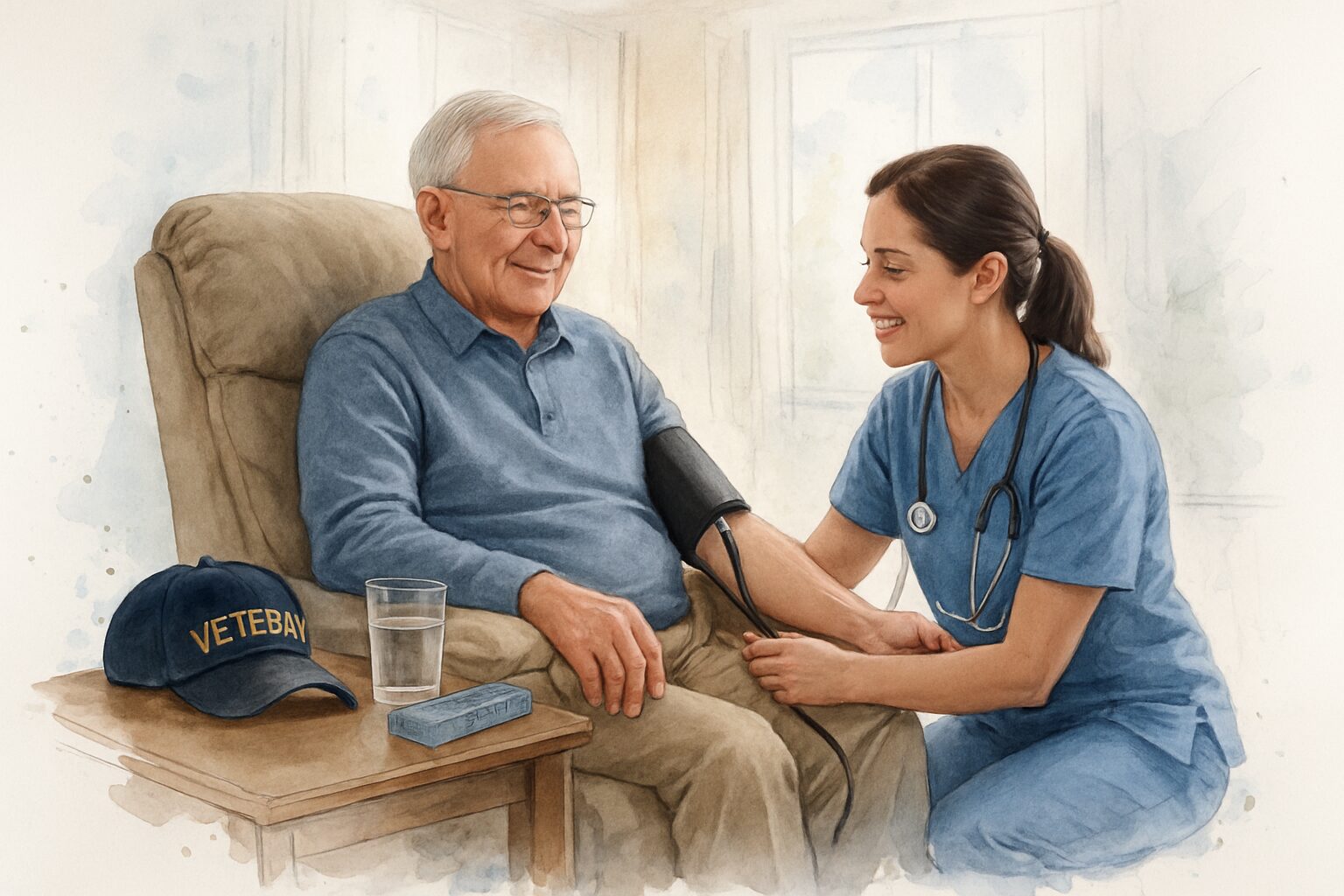
How Veterans Can Access Home Health and Hospice Benefits: Three Doors, Not One
Most families assume there is one payer and one plan. In practice a veteran may have coverage through more than one channel, and the rules about how they coordinate are complicated enough that it is worth asking directly.
The pathways worth asking about:
- VA healthcare benefits. Depending on enrollment status, priority group, and service connection, the VA may arrange or pay for home-based skilled care and hospice services through community providers.
- Medicare Part A. This is the standard route for home health and the Medicare hospice benefit. Most veterans over 65 have it alongside their VA coverage.
- Medi-Cal. For veterans who meet income and asset requirements, Medi-Cal can cover services or fill gaps the other two do not.
These are not always mutually exclusive. But the coordination rules are dense, and no family should be expected to sort them out from a hospital hallway.
One more thing that trips families up regardless of which door they use: a physician’s order is required before home health can be scheduled. Roughly one in ten calls to local home health agencies involves a family surprised by that step, which is why understanding why a physician referral is required for home health ahead of time saves days.
A Medical Social Worker is the person who maps all of this. Ask for one by name during the referral conversation, not after.
Three Benefit Pathways at a Glance
Coverage details depend on the individual veteran’s enrollment, service connection, and income. This table is general orientation, not a determination of what any one person qualifies for.
| Pathway | Generally Used For | Who Can Help You Confirm It |
|---|---|---|
| VA healthcare benefits | Home-based skilled care and hospice arranged through community providers; may cover items other benefits do not | VA social worker, county Veterans Service Office, or a Medical Social Worker at the home health agency |
| Medicare Part A | Intermittent skilled nursing, physical, occupational and speech therapy, and the hospice benefit | Discharge planner, physician’s office, or the home health agency’s intake team |
| Medi-Cal | Coverage for veterans meeting income and asset limits; can fill gaps left by other coverage | County social services, a Medical Social Worker, or the agency handling the referral |
VA Hospice and Medicare Hospice Are Not Always an Either/Or
This is the single most common thing families do not know to ask about.
When a veteran is nearing the end of life, families often assume they must pick one benefit. The VA offers hospice benefits that in some circumstances can work alongside the standard Medicare hospice benefit rather than instead of it.
In certain cases the VA benefit covers things the Medicare hospice benefit does not, including some medications and some care settings. Nobody volunteers this information. You have to ask about VA hospice coordination specifically when care is being set up.
The VA’s geriatrics and extended care program is the starting point for understanding what a veteran’s enrollment makes available. A county Veterans Service Office can help sort out the rest.
Worth saying plainly: asking about hospice benefits is not the same as choosing hospice. Plenty of families ask early, learn what exists, and use none of it for another year. If eligibility is the part that worries you, the hospice eligibility question most families are afraid to ask covers it directly.
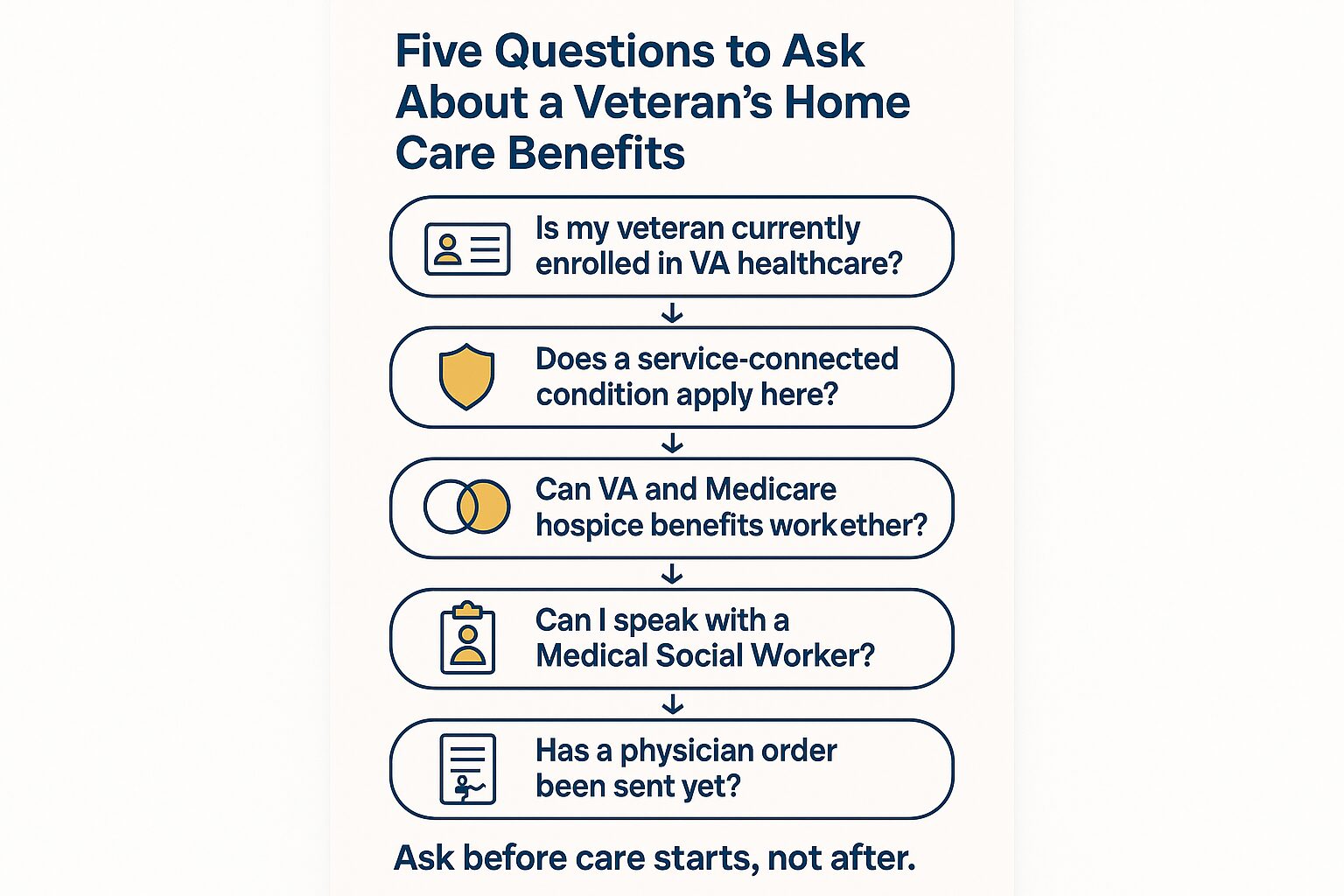
Five Questions to Ask Before Care Starts
These are the questions that open doors families did not know were there. Ask them during the referral conversation, not after care has already begun.
Hollister, King City, and the Salinas Valley: Distance From a VA Facility Is Not the Whole Story
Geography does real damage to veteran benefit access on the Central Coast, but not always in the way families assume.
A veteran in King City or out past Greenfield may be a long drive from any VA facility. Families in San Benito County sometimes decide that puts them outside the range of meaningful veteran support entirely, and they stop asking.
That conclusion is usually wrong. VA-coordinated home health and hospice services can be delivered by community providers with agreements in place, which means the care comes to the house in Hollister rather than the veteran driving to the care.
Home-based nonprofits have covered this ground for a long time. An office opened in Hollister back in 1974 to bring skilled nursing and therapy to San Benito County, and the four-county service footprint across Monterey, San Benito, Santa Cruz and South Santa Clara counties has held since.
What this means practically: the question is not “how far are we from the VA?” It is “which providers in our area coordinate with the VA?” Those are very different questions with very different answers.
Agent Orange, Burn Pits, and the Conversation Veterans Tend to Avoid
Veterans who served in eras with known toxic exposure, including Agent Orange in Vietnam and burn pits in Iraq and Afghanistan, may have chronic conditions that qualify them for specific VA healthcare programs.
As those conditions progress, home health or palliative care can become medically necessary. The clinical need is real. The paperwork usually is not the problem.
The problem is that many veterans will not describe their health in the terms that trigger eligibility. Saying “I am short of breath most days and I stopped walking to the mailbox” feels like complaining. So they say “I’m fine” instead, and the benefit conversation never starts.
A Medical Social Worker who has worked with veteran benefits knows how to translate that. So does an adult child who understands that describing symptoms accurately is not the same as asking for a handout.
One related note on cost, since families always ask. Home health and hospice benefits cover intermittent skilled visits, not round-the-clock help in the house. Families in Monterey County who need daily hands-on assistance often end up paying privately for that piece, and those costs can run well into the thousands per month depending on hours. It is worth asking early which portion a benefit covers and which portion it does not, which is a big part of what families miss when planning a hospital discharge to home.
Frequently Asked Questions About Veteran Home Health and Hospice Benefits
Does my veteran have to give up VA care to use Medicare home health?
Not necessarily. Many veterans carry both VA benefits and Medicare Part A, and the two can often be coordinated rather than traded. The rules depend on enrollment, service connection, and the specific service, so ask a Medical Social Worker or your county Veterans Service Office to confirm your veteran’s situation before you assume you have to pick.
We live in Hollister. Are we too far out for VA-coordinated home care?
Usually not. VA-coordinated home health and hospice can be delivered by community providers in San Benito County, so the visits happen at the house rather than requiring a drive to a VA facility. Distance from a VA campus and access to VA-coordinated care are two different things.
How fast can care start after a hospital discharge?
Once a physician’s order is in hand, home health agencies on the Central Coast typically move quickly, sometimes within a day or two of the veteran getting home. The delay is almost never the agency. It is the order. If a discharge is coming up, ask the hospital to send that order before the patient leaves the building.
What is the difference between home health and hospice for a veteran?
Home health is skilled care aimed at recovery and stability, like wound care, therapy after surgery, or managing heart disease and COPD at home. Hospice begins when the goal shifts from curing to comfort. Many veterans use home health for years before hospice ever comes up. The piece on home health vs. hospice breaks down how families tell which one fits.
Who actually shows up at the house?
Depending on the plan of care, that can include Registered Nurses, Licensed Vocational Nurses, Physical Therapists, Occupational Therapists, Speech Therapists, Medical Social Workers, Hospice Aides, Chaplains, and trained Volunteers. Ask during intake which team members are part of the plan so nobody is surprised by a knock at the door.
Questions About a Veteran’s Options for Care at Home?
If you are sorting through benefits for a veteran in Monterey County, Salinas, Hollister, or anywhere along the Central Coast, a conversation with a care coordinator can help you understand what pathways exist before any decisions get made. Central Coast VNA & Hospice accepts Medicare, Medi-Cal, and Veterans benefits, and has been caring for families in this region since 1951. You can reach a care coordinator at 831-372-6668 or find more information at ccvna.com.