
Direct Answer: A physician referral for home health is a written order from a licensed doctor certifying that a patient needs skilled care at home and qualifies as homebound. Medicare requires this order before any home health services can begin.
One of the most common things families say when they first call about home health is some version of: “I didn’t know I needed a referral to get started.” It comes up again and again, and usually the family is already frustrated, because no one at the hospital or the doctor’s office explained this step to them.
In Monterey County, many families are navigating a loved one’s discharge from Community Hospital of the Monterey Peninsula or Salinas Valley Health for the first time. The process moves quickly, and the referral requirement can feel like a surprise obstacle when it should be a routine part of the discharge plan.
This article explains what a physician referral for home health actually is, how it gets started, and what your family’s role looks like through the process, so you are not caught off guard when the moment comes.
What a Physician Referral for Home Health Actually Means
A physician referral is a written order from a licensed physician that does two things at once. It certifies that the patient has a medical need for skilled care at home, and it confirms that the patient meets the homebound standard Medicare requires.
Without this order, a home health agency cannot legally admit a patient for skilled services. That includes skilled nursing, physical therapy, occupational therapy, speech therapy, and wound care. It is not a paperwork formality, it is the clinical and legal authorization that makes Medicare coverage possible in the first place.
The referring physician also takes on an ongoing role. Medicare requires that a physician review and sign the patient’s plan of care within a specific window after services begin, and that the plan be recertified if care continues beyond the initial period. So the referral is not a one-time event. It is the beginning of a documented, physician-supervised relationship between the patient and the home health team.
For a closer look at what happens once a skilled nurse actually arrives at the home, What Does a Skilled Nurse Actually Do on a Home Visit? walks through that process in plain terms.
What ‘Homebound’ Means, and Why It Trips People Up
The word “homebound” sounds more restrictive than it actually is. Many families assume it means their loved one cannot leave the house under any circumstances. That is not the standard.
Medicare considers a patient homebound when leaving the home requires considerable effort, meaning the patient uses a wheelchair, walker, or crutches, or has a condition that makes leaving medically inadvisable. The patient can still go to a medical appointment, attend a religious service, or step outside occasionally. What matters is that leaving is the exception, not the routine.
Families do not have to make this determination on their own. A Registered Nurse from the home health team will assess homebound status during the first visit. That assessment becomes part of the clinical record that supports Medicare billing.
Here are common situations that typically qualify:
- Recent surgery with limited mobility
- Recovering from a fall or fracture
- Significant weakness from a cardiac event or stroke
- A condition where leaving the home poses a genuine medical risk
- Dependence on a walker, wheelchair, or assistive device to leave safely
If you are unsure whether your family member qualifies, that question is worth asking a care coordinator directly rather than guessing.
How the Referral Process Actually Starts
Most families have no idea who initiates the referral, which is exactly where the confusion starts. The answer depends on where the patient is at the time.
If the patient is being discharged from a hospital: A hospital discharge planner or medical social worker typically handles the referral. At Community Hospital of the Monterey Peninsula or Salinas Valley Health, this is a standard part of the discharge planning process. The family does not have to track down a physician or submit paperwork on their own, the hospital team is supposed to coordinate this.
If the patient is already at home and the situation has changed, a new diagnosis, a fall, a medication issue, increasing difficulty managing daily tasks, the referral comes from the primary care physician. In this case, it often starts with a phone call to the doctor’s office describing what has changed.
In both situations, the family does not have to manage this alone. A home health agency can also help facilitate the referral by sending the necessary paperwork directly to the physician’s office. That removes most of the burden from the family.
For a broader look at what happens in the days right after a hospital stay, After the Hospital Discharge, What Comes Next? is worth reading before a discharge date arrives.
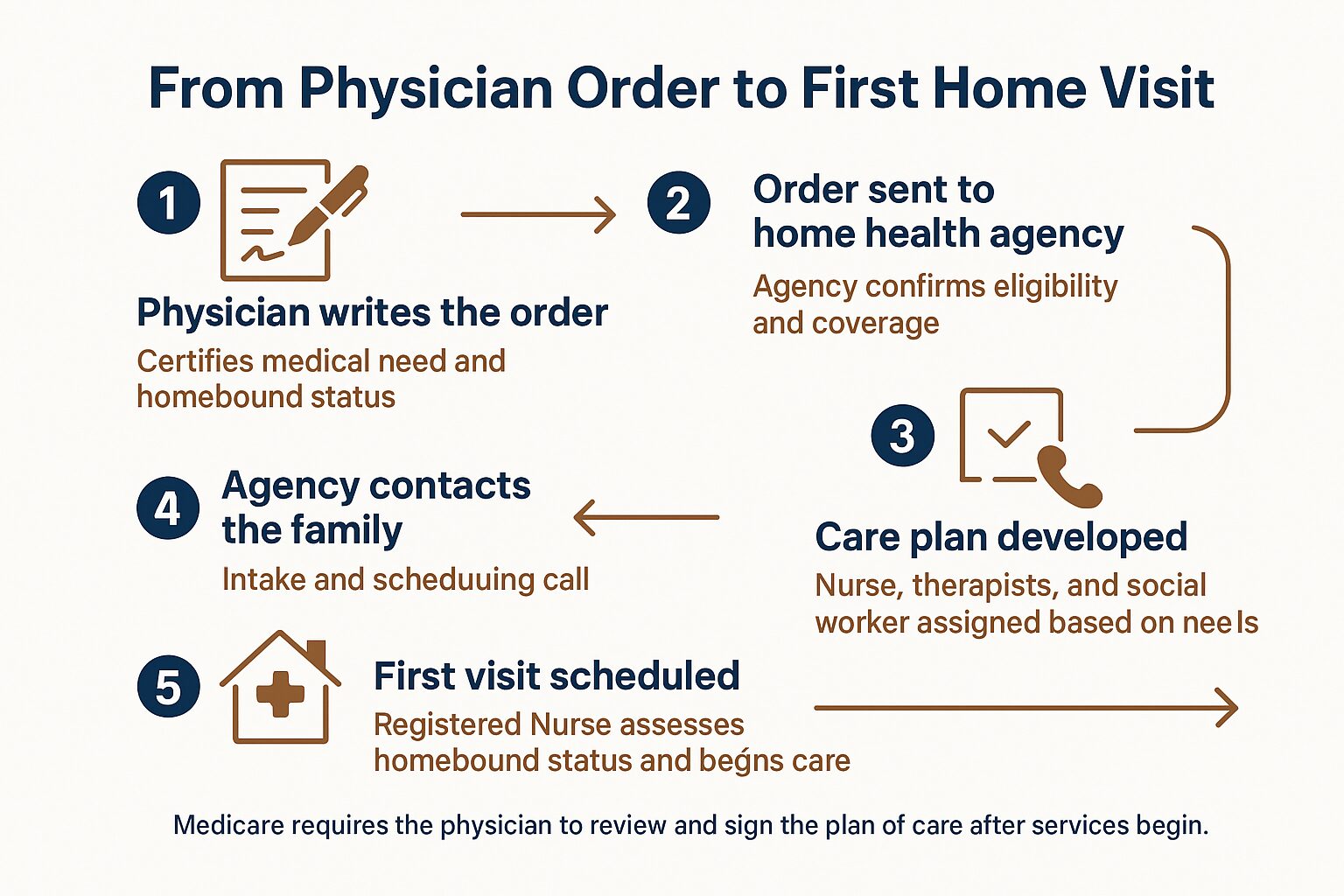
How a Home Health Referral Moves from Order to First Visit
This step-by-step flow shows what happens between a physician writing an order and a nurse arriving at the patient’s home.
Hospital Discharge vs. Home-Based Referral: What’s Different
The referral process looks slightly different depending on where the patient is when care is first needed. This table shows the key differences at a glance.
| Situation | Who Initiates the Referral | What the Family Typically Does |
|---|---|---|
| Patient being discharged from a hospital | Hospital discharge planner or medical social worker | Confirm the referral is in progress and state your agency preference |
| Patient already at home with a changing condition | Primary care physician (after a call or visit) | Contact the doctor’s office and describe what has changed |
| Patient with a specialist managing a chronic condition | Specialist or primary care physician, coordinated together | Ask the specialist whether a home health referral is appropriate |
You Can Choose Your Own Home Health Agency
This is one of the most important things families do not know: Medicare gives patients the right to choose their own home health provider. A referring physician or discharge planner cannot require you to use a specific agency.
If a hospital social worker suggests a particular provider and you would prefer a local nonprofit organization, one that has served someone you know, or that has been part of the Monterey Peninsula community for decades, that choice is yours to make. You can say so directly, and the referral will be directed to the agency you select.
This matters because not all home health agencies are the same. Nonprofit agencies, for example, are structured differently from for-profit companies. The mission and the margins work differently. Families who do not know they have a choice sometimes end up with whichever agency is suggested first, rather than the one that actually fits their situation.
If you are trying to think through whether home health is even the right type of care for your loved one right now, Home Health vs. Hospice: How Families Know Which One Fits Right Now lays out the distinction clearly. And if a physician has raised the possibility of palliative care alongside treatment, What Palliative Care Actually Means, and When It Can Start is a useful read.
Frequently Asked Questions About the Home Health Referral Process
Can I request a home health referral myself, or does it have to come from the doctor?
The order itself has to come from a licensed physician, that is a Medicare requirement. But you can absolutely prompt the conversation. Call the doctor’s office, describe what has changed with your loved one, and ask whether a home health referral is appropriate. Most physician offices are familiar with the process and can move quickly once the request is made.
What if the discharge planner at the hospital doesn’t mention a referral?
Ask directly. Before a loved one leaves Community Hospital of the Monterey Peninsula or any other hospital, it is reasonable to ask the discharge team: “Is a home health referral being placed, and who is it going to?” You can also state your agency preference at that point. Discharge planners handle many cases at once, and a direct question ensures nothing is overlooked.
Does Medicare cover home health if I have a referral?
Medicare covers 100% of approved home health services when the patient meets eligibility criteria, including the homebound standard and a documented need for skilled care. There is no copay for home health under Medicare Part A or Part B when those criteria are met. The Medicare.gov home health coverage page has the full eligibility details straight from the source.
My mother’s condition has been stable for months. Can she still qualify?
Stability alone does not disqualify a patient. Medicare allows home health services for patients managing chronic conditions, such as heart disease, COPD, or diabetes, when skilled care is needed to maintain that stability or prevent a decline. The key is that a Registered Nurse or therapist needs to be doing something that requires clinical training, not just general assistance.
How long does it take to get services started after a referral is sent?
Once a referral is received, many home health agencies aim to initiate contact with the family quickly, often within 24 to 48 hours for standard cases. For patients being discharged from the hospital, the goal is typically to have care in place before or immediately after the patient arrives home. If urgency is a factor, say so when you call.
What if my family member is not technically homebound but still needs skilled nursing at home?
If a patient does not meet the homebound standard, Medicare home health benefits would not apply. However, there may be other coverage options depending on the patient’s insurance situation, and some services can be arranged privately. A care coordinator can help clarify what options exist based on the specific situation.
Questions About Getting Started With Home Health in Monterey County?
Central Coast VNA & Hospice has been supporting families across Monterey County, Santa Cruz County, San Benito County, and South Santa Clara County since 1951. If you are trying to figure out whether a referral is already in motion, which agency to request, or whether your family member qualifies for skilled care at home, a care coordinator can talk through the specifics with you. Call 831-372-6668 or visit ccvna.com to reach someone who knows this process and can help you take the right next step.